Molecular UV-Vis
Spectroscopy
Prof. C. K. Mondal
Department of Chemistry
Jadavpur University
WHAT IS SPECTROSCOPY?
• Atoms and molecules interact with electromagnetic
radiation (EMR) in a wide variety of ways.
• Atoms and molecules may absorb and/or emit EMR.
• Absorption of EMR stimulates different types of
motion in atoms and/or molecules.
• The patterns of absorption (wavelengths absorbed
and to what extent) and/or emission (wavelengths
emitted and their respective intensities) are called
‘spectra’.
• The field of spectroscopy is concerned with the
interpretation of spectra in terms of atomic and
molecular structure (and environment).
Electromagnetic spectrum
Physical
stimulus
Molecule response Detecting
instrument
Visual (most common)
representation, or
Spectrum
SPECTROSCOPY ‐ Study of spectral information
Upon irradiation with infrared light, certain bonds respond by
vibrating faster. This response can be detected and translated
into a visual representation called a spectrum.
Spectroscopy
• The analysis of the EM radiations emitted, absorbed or
scattered by atoms, molecules or matter
• Photons of the radiation bring information to us about the atom,
molecule or matter.
• The difference between molecular and atomic spectroscopy: a
molecule can make a transition between its electronic,
rotational and vibrational states.
• The rotational and vibrational spectroscopy of a molecule can
provide information about the bond lengths, bond angles and
bond strength in the molecule.
General features of spectroscopy
Emission spectrum: A molecule returns to a state of lower energy
E1 from an excited state of energy E2 by emitting a photon.
Absorption spectrum: A molecule is excited from a lower energy
state to a higher energy state by absorbing a photon as the
frequency of the incident radiation is swept over a range
c
E
E
h
ν
=
λ
=
ν
−
=
ν
1
~
|
| 2
1
is called the wavenumber of the
photon and gives the number of
complete wavelengths per centimeter. It
is in the unit of cm‐1.
ν
~
Stimulated and Spontaneous emissions
Spontaneous emission:
A molecule in an excited state will decay to a lower
energy state without any stimulus from the outside.
Stimulated emission:
As an EM radiation incident upon a molecule in an
excited state can cause the molecule to decay to a lower
energy state. If the incoming photon has the same
frequency as the emitted photon, the incident and
emitted photons have the same wavelength and phase
and travel in the same direction. The incoming photon is
not absorbed by the molecule but triggers emission of a
second photon. The two photons are said to be coherent.
The stimulated emission is the fundamental physical
process of the operation of the laser.
Raman spectrum
A monochromatic radiation is incident and scattered by the molecule. The
frequency of a scattered radiation is different from the frequency of the
incident radiation. The spectrum of the scattered radiation is called the
Raman spectrum.
Stokes Raman spectrum: The frequency of the scattered radiation is
lower than the frequency of the incident radiation.
Anti-Stokes Raman spectrum: The frequency of the scattered radiation is
higher than the frequency of the incident radiation.
Transition dipole moment and selection rules
• Transition dipole moment integral
The strength with which individual molecules are able to interact with the EM
radiation and generate or absorb photons. The transition dipole moment
depends on the initial and the final states of the molecules
dτ
ψ
μ
ψ
μ i
*
f
fi ˆ
∫
= : Electric dipole moment operator
μ̂
The Beer-Lambert law for absorption
L
A
c
I
I
L
c
I
I
A
I
I
T
L
c
⋅
=
=
=
≡
=
−
ε
ε
ε
]
[
10
]
[
log
]
[
0
0
0
I0 and I : Intensities of the incident and transmitted radiations
A : Absorbance of the sample, T: Transmittance
L : Length of the sample
[c] : Concentration of the absorbing species in the sample
ε : Molar absorption coefficient or the extinction coefficient
The intensity of radiation transmitted by an absorbing sample decreases
exponentially with the path length through the sample.
ε depends on
wavelength of the
incident radiation.
UV‐Visible Spectroscopy
• THE BEER‐LAMBERT
LAW
• For a light absorbing
medium, the light
intensity falls
exponentially with
sample depth.
• For a light absorbing
medium, the light
intensity falls
exponentially with
increasing sample
concentration.
100
x
I
I
T
%
I
I
T
o
t
o
t
⎟
⎟
⎠
⎞
⎜
⎜
⎝
⎛
=
=
Io It
l
cuvette
light
intensity
(I)
Sample depth
Io
It
l
UV‐Visible Spectroscopy
Absorbance
Concentration
T
A
cl
A 10
log
−
=
= λ
ε
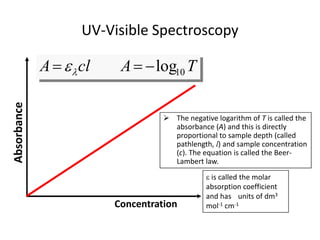
¾ The negative logarithm of T is called the
absorbance (A) and this is directly
proportional to sample depth (called
pathlength, l) and sample concentration
(c). The equation is called the Beer‐
Lambert law.
ε is called the molar
absorption coefficient
and has units of dm3
mol‐1 cm‐1
UV‐Visible Spectroscopy
• Beer‐Lambert Law
limitations
– Polychromatic Light
– Equilibrium shift
– Solvent
– pH
Rotational energy levels of a rigid rotor
πcI
B
J
J
J
B
hc
EJ
4
~
....
3,
2,
1,
0,
),
1
(
~
h
=
=
+
=
For a linear or spherical rigid rotor with a
moment of inertia I
z
z
y
y
x
x
I
J
I
J
I
J
E
2
2
2
2
2
2
+
+
=
The kinetic energy of a rigid rotor with
angular momentum Jx, Jy and Jz. with respect
to the three principal axes of the rotor.
2
2
2
2
2
,
2
z
y
x J
J
J
J
I
J
E +
+
=
=
Classical
description
Quantum
description
)
1
(
~
2
1
+
=
−
=
Δ +
J
B
hc
E
E
E J
J
J
Rotational spectroscopy
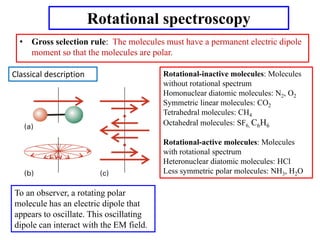
• Gross selection rule: The molecules must have a permanent electric dipole
moment so that the molecules are polar.
To an observer, a rotating polar
molecule has an electric dipole that
appears to oscillate. This oscillating
dipole can interact with the EM field.
Rotational-inactive molecules: Molecules
without rotational spectrum
Homonuclear diatomic molecules: N2, O2
Symmetric linear molecules: CO2
Tetrahedral molecules: CH4
Octahedral molecules: SF6, C6H6
Rotational-active molecules: Molecules
with rotational spectrum
Heteronuclear diatomic molecules: HCl
Less symmetric polar molecules: NH3, H2O
Classical description
Specific selection rules for rotational transition
• Conservation of angular momentum for ΔJ = ±1
A photon is a spin-1 particle. When the molecule
absorbs one photon, the angular momentum of the
molecule must increase to conserve the total angular
momentum, so J increases by one. When the
molecule emits a photon, the angular momentum of
the molecule must decreases, so J decreases by one.
• For symmetric rotors, ΔK = 0
The dipole moment of a polar molecule does not
move when a molecule rotates around its symmetric
axis and, therefore, there is no absorption or
emission of the EM radiation by the rotation of the
molecule about the axis.
ΔJ = ±1 and ΔK = 0
Quantum description
Absorption of allowed rotational transitions
)
1
(
~
2
1 +
=
−
=
Δ + J
B
hc
E
E
E J
J
)
1
(
~
2
~ +
=
ν J
B
A rigid molecule with K=0 makes a
transition from J to J+1
• The rotational spectrum consists of a series of lines at frequencies
separated by 2 .
• The rotational spectra of gas‐phase samples are microwave spectroscopy.
• We can use the value of obtained from the rotational spectrum to
estimate the bond length of a heteronuclear diatomic molecule.
B
~
B
~
Rigid‐rotor model
B
~
INFRARED SPECTROSCOPY
• Only vibrations that cause a change in ‘polarity’ give rise to
bands in IR spectra – which of the vibrations for CO2 are
infrared active?
O C O
O C O
O C O O C O
Symmetric stretch
Asymmetric stretch
Bending (doubly
degenerate)
INFRARED SPECTROSCOPY
What is a vibration in a molecule?
• Any change in shape of the molecule‐ stretching of bonds,
bending of bonds, or internal rotation around single bonds
What vibrations change the dipole moment of a
molecule?
• Asymmetrical stretching/bending and internal rotation change
the dipole moment of a molecule. Asymmetrical
stretching/bending are IR active.
• Symmetrical stretching/bending does not. Not IR active
Vibrations of diatomic molecules
B
A
B
A
eff
eff
f
n
e
f
har
m
m
m
m
m
m
k
n
E
R
R
k
R
V
+
=
⎟
⎟
⎠
⎞
⎜
⎜
⎝
⎛
=
ω
=
ω
+
=
−
=
,
..
0,1,2,3,..
n
,
)
2
1
(
)
(
2
1
)
(
2
/
1
2
h
Harmonic approximation around the equilibrium
A diatomic molecule has three
translational modes, two rotational
modes and one vibrational mode.
kf : force constant of the bond,
the curvature of the potential at Re
⋅
⋅
⋅
+
−
⎟
⎟
⎠
⎞
⎜
⎜
⎝
⎛
= 2
0
2
2
)
(
2
1
)
( e
R
R
dR
V
d
R
V
0
2
2
⎟
⎟
⎠
⎞
⎜
⎜
⎝
⎛
=
dR
V
d
k f
Infrared spectroscopy: Vibrational transitions
• Gross selection rule
The molecule need not to have a permanent dipole moment but
the electric dipole moment of the molecule must change during
the vibration. The rule only requires a change in electric dipole
moment, possibly from zero.
The typical vibrational frequency of a molecule
is about 1013~1014 Hz. The vibrational
spectroscopy of molecules is in the infrared
region, which normally lies in 300 ~ 3000 cm-1.
Homonuclear diatomic molecules are infrared
inactive, because their dipole moments remain
zero as they vibrate.
Heteronuclear diatomic molecules are infrared
active, because their dipole moments change as
they vibrate.
Bending motion of CO2
Specific selection rules for infrared spectroscopy
• Molecules with stiff bonds joining atoms
with low masses have high vibrational
wavenumbers.
• The bending modes of a linear molecule
are usually less stiff than stretching modes.
So, the bending modes usually occur at
lower wavenumbers than the stretching
modes in a spectrum.
• At room temperatures, almost all molecules
are in their vibrational ground states (n = 0).
So, the most probable transition is from n =
0 to n = 1.
• For Δn = 1, the molecule absorbs one
photon and, for Δn = -1, the molecule emits
one photon.
⋅
⋅
⋅
+
⎟
⎠
⎞
⎜
⎝
⎛ μ
+
μ
=
μ x
dx
d
x
0
0
ˆ
ˆ
)
(
ˆ
⋅
⋅
⋅
+
⎟
⎠
⎞
⎜
⎝
⎛ μ
+
=
=
∫
∫
dτ
ψ
x
ψ
dx
d
μ
dτ
ψ
μ
ψ
μ
i
*
f
i
*
f
fi
ˆ
ˆ
ˆ
0
0
Electric dipole moment
Transition dipole element
2
1
~
,
~
,
1
2
/
1
⎟
⎟
⎠
⎞
⎜
⎜
⎝
⎛
π
=
=
Δ
±
=
Δ
eff
f
m
k
c
ν
v
hc
E
n
Vibration-rotation absorption spectrum
P branch: ΔJ = -1
Q branch: ΔJ = 0
R branch: ΔJ = +1
J
B
J
P
~
2
~
)
(
~ −
ν
=
ν
ν
=
ν ~
)
(
~ J
Q
)
1
(
~
2
~
)
(
~ +
+
ν
=
ν J
B
J
R
Vibration‐rotation spectrum of HCl
Each line of the high-resolution
vibrational spectrum of a gas-
phase heteronuclear diatomic
molecule is found to consist of a
large number of closely spaced
components in the order of 10
cm-1, which suggests that the
structure is due to the rotational
transitions accompanying the
vibrational transitions.
•There is no Q branch.
•The lines appear in pair,
because both H35Cl and
H37Cl contribute in their
abundance ratio 3:1.
Vibration-rotation Raman spectrum of CO
ΔJ=+2
ΔJ=‐2 ΔJ=0
Molecular spectroscopy-final engineering.pdf

Molecular spectroscopy-final engineering.pdf

  • 1.
    Molecular UV-Vis Spectroscopy Prof. C.K. Mondal Department of Chemistry Jadavpur University
  • 6.
    WHAT IS SPECTROSCOPY? •Atoms and molecules interact with electromagnetic radiation (EMR) in a wide variety of ways. • Atoms and molecules may absorb and/or emit EMR. • Absorption of EMR stimulates different types of motion in atoms and/or molecules. • The patterns of absorption (wavelengths absorbed and to what extent) and/or emission (wavelengths emitted and their respective intensities) are called ‘spectra’. • The field of spectroscopy is concerned with the interpretation of spectra in terms of atomic and molecular structure (and environment).
  • 7.
  • 8.
    Physical stimulus Molecule response Detecting instrument Visual(most common) representation, or Spectrum SPECTROSCOPY ‐ Study of spectral information Upon irradiation with infrared light, certain bonds respond by vibrating faster. This response can be detected and translated into a visual representation called a spectrum.
  • 12.
    Spectroscopy • The analysisof the EM radiations emitted, absorbed or scattered by atoms, molecules or matter • Photons of the radiation bring information to us about the atom, molecule or matter. • The difference between molecular and atomic spectroscopy: a molecule can make a transition between its electronic, rotational and vibrational states. • The rotational and vibrational spectroscopy of a molecule can provide information about the bond lengths, bond angles and bond strength in the molecule.
  • 13.
    General features ofspectroscopy Emission spectrum: A molecule returns to a state of lower energy E1 from an excited state of energy E2 by emitting a photon. Absorption spectrum: A molecule is excited from a lower energy state to a higher energy state by absorbing a photon as the frequency of the incident radiation is swept over a range c E E h ν = λ = ν − = ν 1 ~ | | 2 1 is called the wavenumber of the photon and gives the number of complete wavelengths per centimeter. It is in the unit of cm‐1. ν ~
  • 14.
    Stimulated and Spontaneousemissions Spontaneous emission: A molecule in an excited state will decay to a lower energy state without any stimulus from the outside. Stimulated emission: As an EM radiation incident upon a molecule in an excited state can cause the molecule to decay to a lower energy state. If the incoming photon has the same frequency as the emitted photon, the incident and emitted photons have the same wavelength and phase and travel in the same direction. The incoming photon is not absorbed by the molecule but triggers emission of a second photon. The two photons are said to be coherent. The stimulated emission is the fundamental physical process of the operation of the laser.
  • 15.
    Raman spectrum A monochromaticradiation is incident and scattered by the molecule. The frequency of a scattered radiation is different from the frequency of the incident radiation. The spectrum of the scattered radiation is called the Raman spectrum. Stokes Raman spectrum: The frequency of the scattered radiation is lower than the frequency of the incident radiation. Anti-Stokes Raman spectrum: The frequency of the scattered radiation is higher than the frequency of the incident radiation.
  • 16.
    Transition dipole momentand selection rules • Transition dipole moment integral The strength with which individual molecules are able to interact with the EM radiation and generate or absorb photons. The transition dipole moment depends on the initial and the final states of the molecules dτ ψ μ ψ μ i * f fi ˆ ∫ = : Electric dipole moment operator μ̂
  • 18.
    The Beer-Lambert lawfor absorption L A c I I L c I I A I I T L c ⋅ = = = ≡ = − ε ε ε ] [ 10 ] [ log ] [ 0 0 0 I0 and I : Intensities of the incident and transmitted radiations A : Absorbance of the sample, T: Transmittance L : Length of the sample [c] : Concentration of the absorbing species in the sample ε : Molar absorption coefficient or the extinction coefficient The intensity of radiation transmitted by an absorbing sample decreases exponentially with the path length through the sample. ε depends on wavelength of the incident radiation.
  • 19.
    UV‐Visible Spectroscopy • THEBEER‐LAMBERT LAW • For a light absorbing medium, the light intensity falls exponentially with sample depth. • For a light absorbing medium, the light intensity falls exponentially with increasing sample concentration. 100 x I I T % I I T o t o t ⎟ ⎟ ⎠ ⎞ ⎜ ⎜ ⎝ ⎛ = = Io It l cuvette light intensity (I) Sample depth Io It l
  • 27.
    UV‐Visible Spectroscopy Absorbance Concentration T A cl A 10 log − = =λ ε ¾ The negative logarithm of T is called the absorbance (A) and this is directly proportional to sample depth (called pathlength, l) and sample concentration (c). The equation is called the Beer‐ Lambert law. ε is called the molar absorption coefficient and has units of dm3 mol‐1 cm‐1
  • 28.
    UV‐Visible Spectroscopy • Beer‐LambertLaw limitations – Polychromatic Light – Equilibrium shift – Solvent – pH
  • 30.
    Rotational energy levelsof a rigid rotor πcI B J J J B hc EJ 4 ~ .... 3, 2, 1, 0, ), 1 ( ~ h = = + = For a linear or spherical rigid rotor with a moment of inertia I z z y y x x I J I J I J E 2 2 2 2 2 2 + + = The kinetic energy of a rigid rotor with angular momentum Jx, Jy and Jz. with respect to the three principal axes of the rotor. 2 2 2 2 2 , 2 z y x J J J J I J E + + = = Classical description Quantum description ) 1 ( ~ 2 1 + = − = Δ + J B hc E E E J J J
  • 31.
    Rotational spectroscopy • Grossselection rule: The molecules must have a permanent electric dipole moment so that the molecules are polar. To an observer, a rotating polar molecule has an electric dipole that appears to oscillate. This oscillating dipole can interact with the EM field. Rotational-inactive molecules: Molecules without rotational spectrum Homonuclear diatomic molecules: N2, O2 Symmetric linear molecules: CO2 Tetrahedral molecules: CH4 Octahedral molecules: SF6, C6H6 Rotational-active molecules: Molecules with rotational spectrum Heteronuclear diatomic molecules: HCl Less symmetric polar molecules: NH3, H2O Classical description
  • 32.
    Specific selection rulesfor rotational transition • Conservation of angular momentum for ΔJ = ±1 A photon is a spin-1 particle. When the molecule absorbs one photon, the angular momentum of the molecule must increase to conserve the total angular momentum, so J increases by one. When the molecule emits a photon, the angular momentum of the molecule must decreases, so J decreases by one. • For symmetric rotors, ΔK = 0 The dipole moment of a polar molecule does not move when a molecule rotates around its symmetric axis and, therefore, there is no absorption or emission of the EM radiation by the rotation of the molecule about the axis. ΔJ = ±1 and ΔK = 0 Quantum description
  • 33.
    Absorption of allowedrotational transitions ) 1 ( ~ 2 1 + = − = Δ + J B hc E E E J J ) 1 ( ~ 2 ~ + = ν J B A rigid molecule with K=0 makes a transition from J to J+1 • The rotational spectrum consists of a series of lines at frequencies separated by 2 . • The rotational spectra of gas‐phase samples are microwave spectroscopy. • We can use the value of obtained from the rotational spectrum to estimate the bond length of a heteronuclear diatomic molecule. B ~ B ~ Rigid‐rotor model B ~
  • 34.
    INFRARED SPECTROSCOPY • Onlyvibrations that cause a change in ‘polarity’ give rise to bands in IR spectra – which of the vibrations for CO2 are infrared active? O C O O C O O C O O C O Symmetric stretch Asymmetric stretch Bending (doubly degenerate)
  • 35.
    INFRARED SPECTROSCOPY What isa vibration in a molecule? • Any change in shape of the molecule‐ stretching of bonds, bending of bonds, or internal rotation around single bonds What vibrations change the dipole moment of a molecule? • Asymmetrical stretching/bending and internal rotation change the dipole moment of a molecule. Asymmetrical stretching/bending are IR active. • Symmetrical stretching/bending does not. Not IR active
  • 36.
    Vibrations of diatomicmolecules B A B A eff eff f n e f har m m m m m m k n E R R k R V + = ⎟ ⎟ ⎠ ⎞ ⎜ ⎜ ⎝ ⎛ = ω = ω + = − = , .. 0,1,2,3,.. n , ) 2 1 ( ) ( 2 1 ) ( 2 / 1 2 h Harmonic approximation around the equilibrium A diatomic molecule has three translational modes, two rotational modes and one vibrational mode. kf : force constant of the bond, the curvature of the potential at Re ⋅ ⋅ ⋅ + − ⎟ ⎟ ⎠ ⎞ ⎜ ⎜ ⎝ ⎛ = 2 0 2 2 ) ( 2 1 ) ( e R R dR V d R V 0 2 2 ⎟ ⎟ ⎠ ⎞ ⎜ ⎜ ⎝ ⎛ = dR V d k f
  • 37.
    Infrared spectroscopy: Vibrationaltransitions • Gross selection rule The molecule need not to have a permanent dipole moment but the electric dipole moment of the molecule must change during the vibration. The rule only requires a change in electric dipole moment, possibly from zero. The typical vibrational frequency of a molecule is about 1013~1014 Hz. The vibrational spectroscopy of molecules is in the infrared region, which normally lies in 300 ~ 3000 cm-1. Homonuclear diatomic molecules are infrared inactive, because their dipole moments remain zero as they vibrate. Heteronuclear diatomic molecules are infrared active, because their dipole moments change as they vibrate. Bending motion of CO2
  • 38.
    Specific selection rulesfor infrared spectroscopy • Molecules with stiff bonds joining atoms with low masses have high vibrational wavenumbers. • The bending modes of a linear molecule are usually less stiff than stretching modes. So, the bending modes usually occur at lower wavenumbers than the stretching modes in a spectrum. • At room temperatures, almost all molecules are in their vibrational ground states (n = 0). So, the most probable transition is from n = 0 to n = 1. • For Δn = 1, the molecule absorbs one photon and, for Δn = -1, the molecule emits one photon. ⋅ ⋅ ⋅ + ⎟ ⎠ ⎞ ⎜ ⎝ ⎛ μ + μ = μ x dx d x 0 0 ˆ ˆ ) ( ˆ ⋅ ⋅ ⋅ + ⎟ ⎠ ⎞ ⎜ ⎝ ⎛ μ + = = ∫ ∫ dτ ψ x ψ dx d μ dτ ψ μ ψ μ i * f i * f fi ˆ ˆ ˆ 0 0 Electric dipole moment Transition dipole element 2 1 ~ , ~ , 1 2 / 1 ⎟ ⎟ ⎠ ⎞ ⎜ ⎜ ⎝ ⎛ π = = Δ ± = Δ eff f m k c ν v hc E n
  • 39.
    Vibration-rotation absorption spectrum Pbranch: ΔJ = -1 Q branch: ΔJ = 0 R branch: ΔJ = +1 J B J P ~ 2 ~ ) ( ~ − ν = ν ν = ν ~ ) ( ~ J Q ) 1 ( ~ 2 ~ ) ( ~ + + ν = ν J B J R
  • 40.
    Vibration‐rotation spectrum ofHCl Each line of the high-resolution vibrational spectrum of a gas- phase heteronuclear diatomic molecule is found to consist of a large number of closely spaced components in the order of 10 cm-1, which suggests that the structure is due to the rotational transitions accompanying the vibrational transitions. •There is no Q branch. •The lines appear in pair, because both H35Cl and H37Cl contribute in their abundance ratio 3:1.
  • 41.
    Vibration-rotation Raman spectrumof CO ΔJ=+2 ΔJ=‐2 ΔJ=0