Poultry Production Management Module Final
Bachelor of Technology Livelihood Education (Isabela State University)
Scan to open on Studocu
Studocu is not sponsored or endorsed by any college or university
Poultry Production Management Module Final
Bachelor of Technology Livelihood Education (Isabela State University)
Scan to open on Studocu
Studocu is not sponsored or endorsed by any college or university
Downloaded by Fredzkie Vargas Channel (vargasfred86@gmail.com)
lOMoARcPSD|16678982
Republic of the Philippines
ISABELA STATE UNIVERSITY
San Mariano Campus
BACHELOR OF AGRICULTURAL TECHNOLOGY PROGRAM
AGRITECH 114
POULTRY PRODUCTION AND MANAGEMENT
1
Downloaded by Fredzkie Vargas Channel (vargasfred86@gmail.com)
lOMoARcPSD|16678982
Chapter 1
Overview of the Poultry Production
Introduction:
The Poultry Industry in the Philippines
The significant development in the poultry industry over the past several decades can be attributed to
the application of modern technologies on breeding, reproduction, nutrition, animal health, production and
processing. The broiler chicken inventory grew by 6.2 present, from 64.94 million birds in 2018 to 68.97
million birds in 2019. Native/improved chicken inventory at 84.49 million birds declined by 1.5 percent
from its previous year’s level of 83.71 million birds.
Learning Outcomes:
At the end of this chapter the students must be able to:
1. Define Poultry
2. Identify the different terminologies in poultry production
3. Differentiate poultry orders
4. Enumerate the different poultry species
Learning Content
POULTRY: What does it mean?
POULTRY
 It can be defined as those species of birds that render economic service to man and reproduce freely
under his care.
 Popular because they are fast multipliers
 Quick growers, more efficient feed converters
 Chicken: most popular poultry species
 Duck: 2nd
most popular (for balut, salted and century eggs)
 Quail: 3rd
most popular (for its eggs)
a. ORDERS:
 Galliformes – don’t have true phallus (copulatory organ), v-shaped breast
 Anseriformes – have a true pphallus, v-shaped breast
 Struthioformes – have flat breast
 Columbiformes – secrete “milk”
b. POULTRY SPECIES:
Common Name Scientific Name
Egg Weight
(g)
Incubation
Period (days)
Chicken Gallus gallus 58 21
Ducks
Mallard pekin
(meat)
Mallard (egg)
Muscovy (meat)
Anas plathyrhynchos
Anas plathyrhynchos
Cairina moschata
80-83
60
70
28
28
35-37
Turkey Meleagris gallopavo 85 28
2
Downloaded by Fredzkie Vargas Channel (vargasfred86@gmail.com)
lOMoARcPSD|16678982
Quail Coturnix coturnix 12 16-18
Pigeon Columbia livia 17 18
Geese Cygnopsis cynoides 200 30-31
Swan Olor columbianus 285 35
Ostrich Struthio australis 1400 42
Peafowl Pavo cristatus 95 28
Pheasant Phasianus colchicus 32 23-24
Guinea fowl Numida meleagris 40 28
c. Terminologies in Poultry Production
DEFINITION OF TERMS
FOWL- term applied to all poultry species specifically, applied to designated mature domestic cocks and
hens. Poultry can refer also to the dressed carcass of fowls.
BEAK- the projecting mouthparts of the chickens and turkey, consisting of upper and lower mandible ;
organs of prehension
BILL- the projecting mouthparts of waterfowl, consisting of upper and lower mandibles
BREED- a race of domestic fowls which maintains distinctive characteristics shape, growth, temperament,
and shell color of egg produced.
BROILER- meat type chicken commonly grown up to 35-42 days and weighting 1.5-2.0 kgs liveweight.
BROODER- a place where young chicks / ducklings are cared for after hatching until they have grown to a
point where they no longer need additional heat.
CAPON- caponized cockerels; usually grown up to 4 months and weights up to 3 kgs with more improved
quality of meat.
CHICK- young domestic chicken while at the downy stage
CLUTCHES- groups of eggs layed for successive days
COCK/ ROOSTER- a male fowl one year old or over
COCKEREL- a male fowl less than one year old
COMB- made of vascularized tissue growing on tops of fowls head. This serves as an ornamental function
signs of status and conditions of the male and for heat dissipation. The standard varieties are single, rose,
pea, V-shaped, strawberry, cushion and the buttercup.
CROP- the receptacle in which s fowls food is accumulated before it passes to the gizzard.
CULLS- old hens that had passed their usefulness for commercial egg production
DOWN- the first covering of a chick whose major function is for insulation
DRAKE- the male of the duck family
DUBBING- cutting of the comb, wattles, or earlobes, so as to leave the head smooth
DUCKLING- the young of the duck family in the downy stage of plumage
FEED CONVERSION RATIO-volume of feed necessary to produce a kilogram gain in weight
HARVEST RECOVERY- the number or volume of chicken sold marketed based on the number of days
old chick raised
INCUBATION- period (in days) where embryonic development takes place outside the body of the hen.
LAYER- egg type or dual type 6 months old female that lay eggs.
OVIPOSITION- act of laying eggs
PLUMAGE- the feather of the fowl
POULT-the young of a domestic turkey; the term is properly applied until sex can be distinguished, when
they are called cockerels and pullets.
PULLET- female fowl 5-6 months of age intended for egg production
3
Downloaded by Fredzkie Vargas Channel (vargasfred86@gmail.com)
lOMoARcPSD|16678982
PRIMARIES- the longest feathers of wing, growing between the pinions and secondaries, hidden when
wings is folded, otherwise known as flight feathers
QUILL-the hollow horny , basal part of the stem of a feather
SECONDARIES- long, large quill feathers that grow between the first and second joints of the wing,
nearest to the body, that are visible when the wing is folded.
SHANK- the portion of the fowls legs below the hock, exclusive of the foot and toes
STRAIN- family of any variety of poultry that possesses and reproduces with mark regularity, common
individual characters which distinguish it from other families of the same variety
VARIETY- a subdivision of a breed, term to use to distinguish fowls having the standard shape and other
characteristics of the breed to which they belong, but differing in colors of plumage, shape of combs, etc.
from the other groups of the same breed.
A. History, Development and Growth of the Chicken Industry
The Red Jungle Fowl
The Red Junglefowl, Gallus gallus, is found as a wild bird throughout the Philippine archipelago in
suitably forested areas. All members of the Gallus genus are known as jungle fowl. This genus belongs to
the family Phasianidae. Other commonly known members of the Phasianidae include the peacock, pheasant,
grouse, partridge and quail. The domestic chicken (Gallus gallus domesticus) is descended from the red
junglefowl. Having been domesticated for over 4,000 years, there are now 200 breeds of domestic chickens
on record. Mass production of chicken eggs and meat began in the 1800s.
Characteristics of Red Jungle Fowl
The adult red junglefowl is between 43 and 76 cm long. The head of the cock has ear-wattles and a
red comb. The neck is yellow, with a brightly reddish back. The under parts are dark with grey feet, while the
arched tail and wing feathers are a glossy green. One of the distinguishing features of a red junglefowl is the
white patch at its rump. In Singapore and Malaysia, another distinguishing feature is the white ear-wattles.
Hens are dull brown with streaked pale yellow necks and light brown vents. Hen tails are erect and fan-
shaped. Unlike its domestic counterpart, the red junglefowl is a wary creature. The cock’s call is similar to
the domestic chicken, though with the last note missing: a “ka ka deedl”. The hen’s cackle is higher in
pitch than the domesticated variety.
The Native Chicken
The Philippine native chicken bearing the scientific name Gallus gallus domesticus is popularly
raised by Filipinos in their backyards. Having a population of about 22.6 million and mostly free ranged, this
chicken is hardy and well-adapted in the harsh temperature of the tropics and hardy against common illness
of chickens. This breed is a product of breeding different strains and one of them is the Red Jungle Fowl.
During the early times, the earlier breed which was brought by foreigners and traded with natives was raised
in the backyard is just allowed to roam freely and sometimes wander in the woods. There, they have mingled
with the Red Jungle Fowl and thus started the evolution of the Philippine Native Chicken breed. This is also
found to be the reason why they are so hardy and flighty.
Development of Poultry Industry
1800s – early-1900s
4
Downloaded by Fredzkie Vargas Channel (vargasfred86@gmail.com)
lOMoARcPSD|16678982
Early poultry production consisted of many households having backyard flocks of dual-purpose
chickens. These chickens supplied eggs and an occasional chicken for Sunday or holiday dinner. By the turn
of the century, a few entrepreneurs began selling young chickens during the summer for meat as a sideline
activity on their family farms. Year-round production was limited because vitamin D had not yet been
discovered and the importance of the photoperiod (cycle of sunlight and darkness) and its impact on
production was not understood.
1920s-1930s
Chicken meat production, previously a subsidiary of the egg industry, began with the development of
the broiler – a chicken raised specifically for its meat. Broiler production was initiated in locations such as
the Delmarva Peninsula, Georgia, Arkansas, and New England.
1940s – 1960s
Feed mills, hatcheries, farms, and processors were all separate entities in the early industry. The
hatcheries were called upon by their customers to become more involved in coordinating the production,
processing, and marketing of broilers with their own operations.
B. Overview of Poultry Industry
The Philippines has a massive poultry industry that is dominated by broilers and the native
Philippine chickens. Layer chicken farming is the third most popular poultry farming industry in the
Philippines. Some of the biggest factors favoring the Filipino poultry industry are its massive population,
fast rising incomes and a love for chicken.
By July 1, 2017, the chicken population in the Philippines stood at 181.05 million birds. In spite of
the numerous challenges faced during the year such as the avian flu, the chicken population in the
Philippines grew 3.73% compared to the previous year.
The fastest growth in chicken population was witnessed in the layer and the native chicken
populations that grew by 9.8% and 5.35% respectively. The broiler chicken population dropped 1.24% in
spite of being a very capital intensive industry.
Production
The chicken production volume was 861,870 metric tons between January and June 2017. During the
first half of 2017, the chicken egg production also grew by 242,988 metric tons, a growth of 4.49% over the
same period in the previous year.
Chicken Prices in the Philippines as off 2017
Between January and June 2017, the farm-gate prices declined by 1.99%. Part of the hit was due to
the avian flu outbreak which decimated market prices for the chickens. However, the prices have been
recovering in the recent months.
Population of Chickens as of July 1, 2017
Broiler population: 64.03 million birds
Layer Population: 35.66 million birds
Native/Improved Population: 81.36 million birds
5
Downloaded by Fredzkie Vargas Channel (vargasfred86@gmail.com)
lOMoARcPSD|16678982
Native and improved native varieties accounted for 45% of the chicken population in the Philippines.
Broilers accounted for 35% of the chicken population while the layer chickens accounted for 20% of the
chicken population.
BROILER FARMING IN THE PHILIPPINES
The largest broiler population in the Philippines has been recorded in Central Luzon. It accounted
for 26.53% of Philippine broiler population. This was followed by CALABARZON that accounted for
17.53% and Northern Mindanao that accounted for 13.47%. Together, these three regions accounted for
57.53% of the Philippine broiler production.
LAYER FARMING IN THE PHILIPPINES
When it comes to layer farming in the Philippines, CALABARZON accounts for the largest
population of layer chickens in the country at 35.18% of the layer population. This is followed by Central
Luzon at 23.63% and Northern Mindanao at 9.82%. Together, these three regions now account for 68.63%
of the total layer chicken population in the Philippines.
NATIVE CHICKEN FARMING IN THE PHILIPPINES
Native chicken farming is more widely spread in the country. The largest proportion of native
chicken population in the Philippines is in Northern Mindanao with 10.95% of the native chicken population
in the Philippines. It is followed by Western Visayas at 9.22, the Davao Region at 9.14%, Negros Island
Region at 8.68%, Central Visayas at 7.40%, Central Luzon at 7.20%, SOCCSKSARGEN at 6.36% and
Bicol Region at 6.24% among many others.
B. Different Poultry Enterprise
Poultry enterprises range from small farm flocks to large commercial operations. Approximately
45% of poultry raised in the Philippines is native chickens. There are several type enterprises but the most
common are egg production and broiler or meat production. The size of the poultry enterprises ranges from
small/backyard to commercial operation.
In egg production operations, laying hens are kept to produce table eggs (infertile eggs). Laying hens
are kept in cages. Cleaning, grading and packaging of eggs are usually done in the farm. When the
production is completed, layers are sold as culled hens and priced less than half the price of the broiler. In
broiler production operations, most of the chickens are produced by contract growing for meat purposes.
Among the poultry enterprise are as follows:
a. Egg production
b. Broiler production
c. Pullet production
d. Hatching egg production
e. Combination of breeding layers and hatchery
f. Combination of hatchery and broiler production
g. Dressed chicken marketing
6
Downloaded by Fredzkie Vargas Channel (vargasfred86@gmail.com)
lOMoARcPSD|16678982
h. Native chicken enterprise /organic chicken enterprise
i. Capon production
C. Benefits and problems of the Poultry Industry
Benefits/Advantages
a) It is a profitable business
b) Quick return on investment and income is spread throughout the year,
c) High feed efficiency and high return compared to feed cost
d) It is a source of income and provides cheap and nutritious meat
e) As source of livelihood for jobless people
f) Chicken dung makes good fertilizer
g) Used in fishponds to enhance the growth of planktons. This in turn serves as food for fish
h) Dried fermented manure as be recycled as feed for swine cattle an even broilers
i) Chicken feathers is an excellent materials
j) Low land requirements (intensive system)
k) Adapted to both small and large commercial enterprise
l) Serve as recreation identified poultry enterprise
Problems/Disadvantages
a) Serious problem on poultry is diseases and parasites
b) High cost of poultry supplies, feeds, medicines, vaccines and supplements
c) Require a high level of management ability especially for large commercial flocks
d) Need a large amount of capital for commercial operations
e) Lack of credit facilities
f) Continuous supply of feeds/feed ingredients and mixed feeds (commercial rations)
g) Availability of locally developed breeds and strains of chicken
h) Waste disposal and foul odor is a big problem
D. Factors to Consider in Starting Poultry Project
1. Interest – if an individual has an interest in the poultry project. They could easily attain their goal.
7
Downloaded by Fredzkie Vargas Channel (vargasfred86@gmail.com)
lOMoARcPSD|16678982
2. Personal qualification and farming – a farmer should have the necessary technical knowledge of the
poultry farming. If he does not have it, he/she has to undergo training so that he/she could
systematically manage his farm.
3. Personal Resources – a farmer should have sufficient land preferably located near the road so that the
cost marketing poultry products could be reduced. Also, he must have adequate financial resources to
ensure the smooth operation in the farm.
4. Supply and demand of Poultry Products
5. Assured supply and other inputs – quality stocks, feeds, feed ingredients, vaccines and other farm
inputs.
6. Abundance of water supply – birds requires clean, fresh drinking water in cleaning housing and
equipment as well as facilities.
Teaching and Learning Activities
The lecturer will use slides and powerpoint presentation showing the Ovierview of Poultry in the
Philippines.
The students will also encourage to participate and share their ideas regarding to the topics
discussion.
Recommended learning materials and resources for supplementary reading.
Worktext, Books, and PDF, text booklets.
Flexible Teaching Learning Modality (FTLM) adopted
Online teaching using google meet and zoom meeting
Assessment Task
1. Lecture Discussion and class participation will be strictly observed during online discussion
2. Quizzes will be given at the end of the module.
3. Learning exercises and assignments.
References
1. Gapuz, R. B. 2010. Poultry Management in the Philippines. Second Edition. Mc Cullough Printing
Company, Manila, Philippines.
2. Keeping Poultry, 2008. Intensive Animal Industries, Department of Agriculture, Tasmania.
3. Gillespie, J.R. 2013. Modern Livestock and Poultry Production. Delmar Publishers, 3 Columbia
Circle , Albany, New York.
8
Downloaded by Fredzkie Vargas Channel (vargasfred86@gmail.com)
lOMoARcPSD|16678982
Chapter 2
THE CHICKEN: CLASSES, BREEDS AND VARIETIES
Introduction:
Learning Outcomes:
At the end of this chapter the students must be able to:
1. Identify the different breeds of Chicken based on utility
2. Enumerate the categories of poultry production
3. Enumerate some Native breeds in the Philippines
Learning Content:
The Origin of Chicken
*The exact ancestry of the present day chicken is not known.
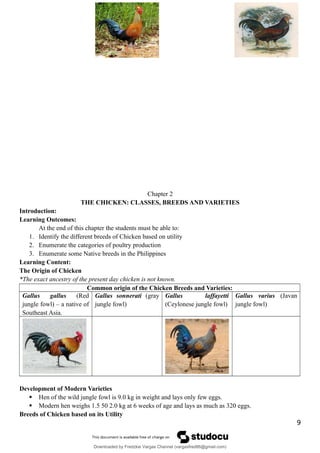
Common origin of the Chicken Breeds and Varieties:
Gallus gallus (Red
jungle fowl) – a native of
Southeast Asia.
Gallus sonnerati (gray
jungle fowl)
Gallus laffayetti
(Ceylonese jungle fowl)
Gallus varius (Javan
jungle fowl)
Development of Modern Varieties
 Hen of the wild jungle fowl is 9.0 kg in weight and lays only few eggs.
 Modern hen weighs 1.5 50 2.0 kg at 6 weeks of age and lays as much as 320 eggs.
Breeds of Chicken based on its Utility
9
Downloaded by Fredzkie Vargas Channel (vargasfred86@gmail.com)
lOMoARcPSD|16678982
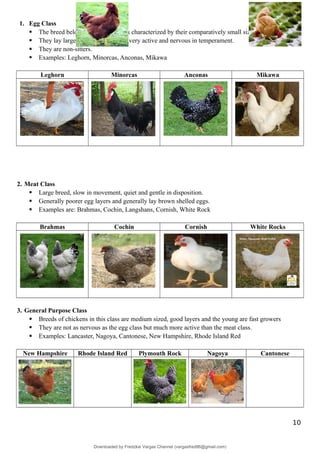
1. Egg Class
 The breed belonging to this class is characterized by their comparatively small size.
 They lay large white-shelled eggs, very active and nervous in temperament.
 They are non-sitters.
 Examples: Leghorn, Minorcas, Anconas, Mikawa
Leghorn Minorcas Anconas Mikawa
2. Meat Class
 Large breed, slow in movement, quiet and gentle in disposition.
 Generally poorer egg layers and generally lay brown shelled eggs.
 Examples are: Brahmas, Cochin, Langshans, Cornish, White Rock
Brahmas Cochin Cornish White Rocks
3. General Purpose Class
 Breeds of chickens in this class are medium sized, good layers and the young are fast growers
 They are not as nervous as the egg class but much more active than the meat class.
 Examples: Lancaster, Nagoya, Cantonese, New Hampshire, Rhode Island Red
New Hampshire Rhode Island Red Plymouth Rock Nagoya Cantonese
10
Downloaded by Fredzkie Vargas Channel (vargasfred86@gmail.com)
lOMoARcPSD|16678982
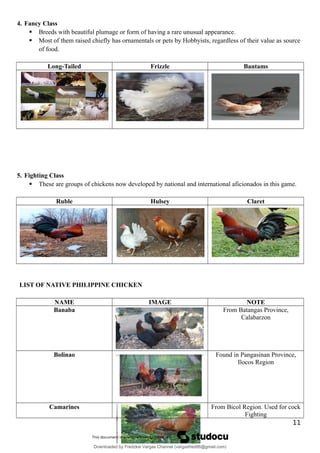
4. Fancy Class
 Breeds with beautiful plumage or form of having a rare unusual appearance.
 Most of them raised chiefly has ornamentals or pets by Hobbyists, regardless of their value as source
of food.
Long-Tailed Frizzle Bantams
5. Fighting Class
 These are groups of chickens now developed by national and international aficionados in this game.
Ruble Hulsey Claret
LIST OF NATIVE PHILIPPINE CHICKEN
NAME IMAGE NOTE
Banaba

From Batangas Province,
Calabarzon
Bolinao Found in Pangasinan Province,
Ilocos Region
Camarines From Bicol Region. Used for cock
Fighting
11
Downloaded by Fredzkie Vargas Channel (vargasfred86@gmail.com)
lOMoARcPSD|16678982
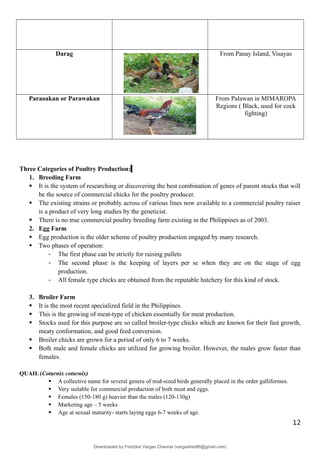
Darag From Panay Island, Visayas
Paraoakan or Parawakan From Palawan in MIMAROPA
Regions ( Black, used for cock
fighting)
Three Categories of Poultry Production:
1. Breeding Farm
 It is the system of researching or discovering the best combination of genes of parent stocks that will
be the source of commercial chicks for the poultry producer.
 The existing strains or probably across of various lines now available to a commercial poultry raiser
is a product of very long studies by the geneticist.
 There is no true commercial poultry breeding farm existing in the Philippines as of 2003.
2. Egg Farm
 Egg production is the older scheme of poultry production engaged by many research.
 Two phases of operation:
- The first phase can be strictly for raising pullets
- The second phase is the keeping of layers per se when they are on the stage of egg
production.
- All female type chicks are obtained from the reputable hatchery for this kind of stock.
3. Broiler Farm
 It is the most recent specialized field in the Philippines.
 This is the growing of meat-type of chicken essentially for meat production.
 Stocks used for this purpose are so called broiler-type chicks which are known for their fast growth,
meaty conformation, and good feed conversion.
 Broiler chicks are grown for a period of only 6 to 7 weeks.
 Both male and female chicks are utilized for growing broiler. However, the males grow faster than
females.
QUAIL (Coturnix coturnix)
 A collective name for several genera of mid-sized birds generally placed in the order galliformes.
 Very suitable for commercial production of both meat and eggs.
 Females (150-180 g) heavier than the males (120-130g)
 Marketing age – 5 weeks
 Age at sexual maturity- starts laying eggs 6-7 weeks of age.
12
Downloaded by Fredzkie Vargas Channel (vargasfred86@gmail.com)
lOMoARcPSD|16678982
 Produces 280 eggs per year
 Egg weight 9-10g
 Male quail – the breast is usually narrow and covered with equally distributed brown and white
feathers.
 Female quail- has a broad breast covered with brown feathers with black dots.
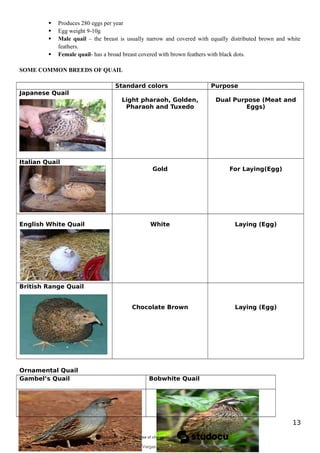
SOME COMMON BREEDS OF QUAIL
Standard colors Purpose
Japanese Quail
Light pharaoh, Golden,
Pharaoh and Tuxedo
Dual Purpose (Meat and
Eggs)
Italian Quail
Gold For Laying(Egg)
English White Quail White Laying (Egg)
British Range Quail
Chocolate Brown Laying (Egg)
Ornamental Quail
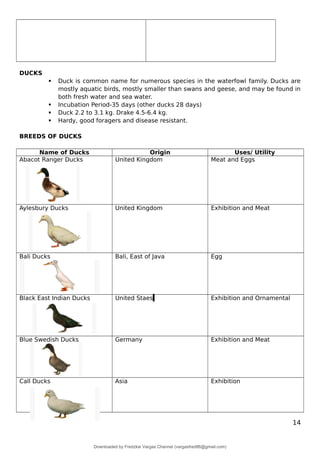
Gambel’s Quail Bobwhite Quail
13
Downloaded by Fredzkie Vargas Channel (vargasfred86@gmail.com)
lOMoARcPSD|16678982
DUCKS
 Duck is common name for numerous species in the waterfowl family. Ducks are
mostly aquatic birds, mostly smaller than swans and geese, and may be found in
both fresh water and sea water.
 Incubation Period-35 days (other ducks 28 days)
 Duck 2.2 to 3.1 kg. Drake 4.5-6.4 kg.
 Hardy, good foragers and disease resistant.
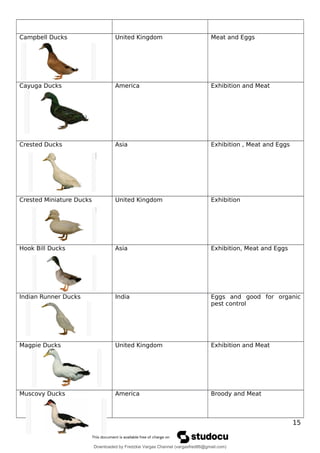
BREEDS OF DUCKS
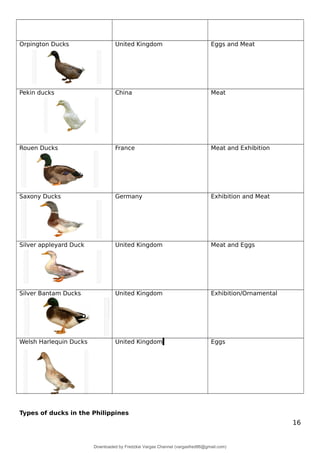
Name of Ducks Origin Uses/ Utility
Abacot Ranger Ducks United Kingdom Meat and Eggs
Aylesbury Ducks United Kingdom Exhibition and Meat
Bali Ducks Bali, East of Java Egg
Black East Indian Ducks United Staes Exhibition and Ornamental
Blue Swedish Ducks Germany Exhibition and Meat
Call Ducks Asia Exhibition
14
Downloaded by Fredzkie Vargas Channel (vargasfred86@gmail.com)
lOMoARcPSD|16678982
Campbell Ducks United Kingdom Meat and Eggs
Cayuga Ducks America Exhibition and Meat
Crested Ducks Asia Exhibition , Meat and Eggs
Crested Miniature Ducks United Kingdom Exhibition
Hook Bill Ducks Asia Exhibition, Meat and Eggs
Indian Runner Ducks India Eggs and good for organic
pest control
Magpie Ducks United Kingdom Exhibition and Meat
Muscovy Ducks America Broody and Meat
15
Downloaded by Fredzkie Vargas Channel (vargasfred86@gmail.com)
lOMoARcPSD|16678982
Orpington Ducks United Kingdom Eggs and Meat
Pekin ducks China Meat
Rouen Ducks France Meat and Exhibition
Saxony Ducks Germany Exhibition and Meat
Silver appleyard Duck United Kingdom Meat and Eggs
Silver Bantam Ducks United Kingdom Exhibition/Ornamental
Welsh Harlequin Ducks United Kingdom Eggs
Types of ducks in the Philippines
16
Downloaded by Fredzkie Vargas Channel (vargasfred86@gmail.com)
lOMoARcPSD|16678982
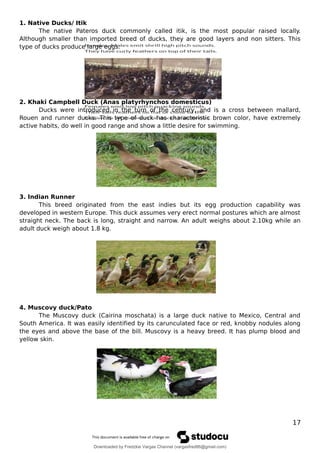
1. Native Ducks/ Itik
The native Pateros duck commonly called itik, is the most popular raised locally.
Although smaller than imported breed of ducks, they are good layers and non sitters. This
type of ducks produce large eggs.
2. Khaki Campbell Duck (Anas platyrhynchos domesticus)
Ducks were introduced in the turn of the century, and is a cross between mallard,
Rouen and runner ducks. This type of duck has characteristic brown color, have extremely
active habits, do well in good range and show a little desire for swimming.
3. Indian Runner
This breed originated from the east indies but its egg production capability was
developed in western Europe. This duck assumes very erect normal postures which are almost
straight neck. The back is long, straight and narrow. An adult weighs about 2.10kg while an
adult duck weigh about 1.8 kg.
4. Muscovy duck/Pato
The Muscovy duck (Cairina moschata) is a large duck native to Mexico, Central and
South America. It was easily identified by its carunculated face or red, knobby nodules along
the eyes and above the base of the bill. Muscovy is a heavy breed. It has plump blood and
yellow skin.
17
Downloaded by Fredzkie Vargas Channel (vargasfred86@gmail.com)
lOMoARcPSD|16678982
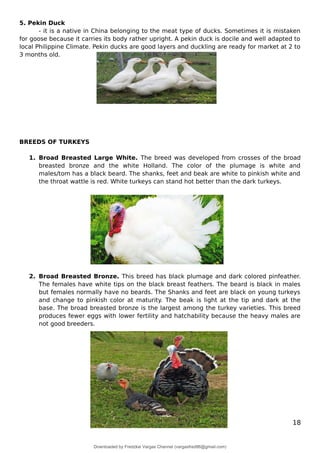
5. Pekin Duck
- it is a native in China belonging to the meat type of ducks. Sometimes it is mistaken
for goose because it carries its body rather upright. A pekin duck is docile and well adapted to
local Philippine Climate. Pekin ducks are good layers and duckling are ready for market at 2 to
3 months old.
BREEDS OF TURKEYS
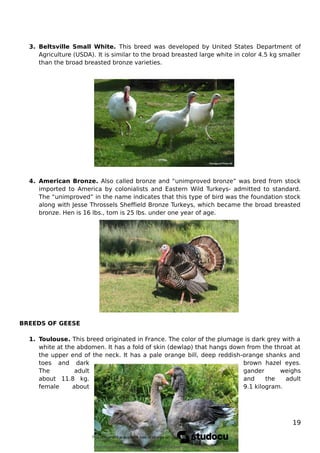
1. Broad Breasted Large White. The breed was developed from crosses of the broad
breasted bronze and the white Holland. The color of the plumage is white and
males/tom has a black beard. The shanks, feet and beak are white to pinkish white and
the throat wattle is red. White turkeys can stand hot better than the dark turkeys.
2. Broad Breasted Bronze. This breed has black plumage and dark colored pinfeather.
The females have white tips on the black breast feathers. The beard is black in males
but females normally have no beards. The Shanks and feet are black on young turkeys
and change to pinkish color at maturity. The beak is light at the tip and dark at the
base. The broad breasted bronze is the largest among the turkey varieties. This breed
produces fewer eggs with lower fertility and hatchability because the heavy males are
not good breeders.
18
Downloaded by Fredzkie Vargas Channel (vargasfred86@gmail.com)
lOMoARcPSD|16678982
3. Beltsville Small White. This breed was developed by United States Department of
Agriculture (USDA). It is similar to the broad breasted large white in color 4.5 kg smaller
than the broad breasted bronze varieties.
4. American Bronze. Also called bronze and “unimproved bronze” was bred from stock
imported to America by colonialists and Eastern Wild Turkeys- admitted to standard.
The “unimproved” in the name indicates that this type of bird was the foundation stock
along with Jesse Throssels Sheffield Bronze Turkeys, which became the broad breasted
bronze. Hen is 16 lbs., tom is 25 lbs. under one year of age.
BREEDS OF GEESE
1. Toulouse. This breed originated in France. The color of the plumage is dark grey with a
white at the abdomen. It has a fold of skin (dewlap) that hangs down from the throat at
the upper end of the neck. It has a pale orange bill, deep reddish-orange shanks and
toes and dark brown hazel eyes.
The adult gander weighs
about 11.8 kg. and the adult
female about 9.1 kilogram.
19
Downloaded by Fredzkie Vargas Channel (vargasfred86@gmail.com)
lOMoARcPSD|16678982
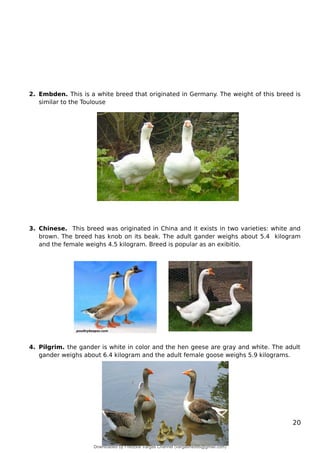
2. Embden. This is a white breed that originated in Germany. The weight of this breed is
similar to the Toulouse
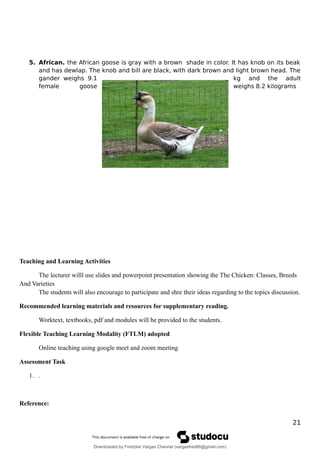
3. Chinese. This breed was originated in China and it exists in two varieties: white and
brown. The breed has knob on its beak. The adult gander weighs about 5.4 kilogram
and the female weighs 4.5 kilogram. Breed is popular as an exibitio.
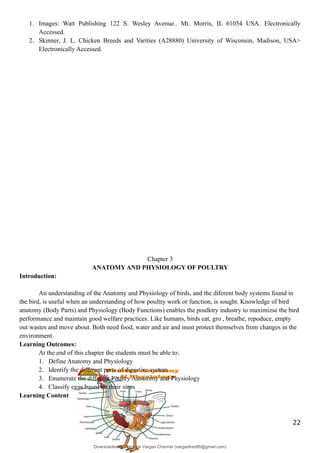
4. Pilgrim. the gander is white in color and the hen geese are gray and white. The adult
gander weighs about 6.4 kilogram and the adult female goose weighs 5.9 kilograms.
20
Downloaded by Fredzkie Vargas Channel (vargasfred86@gmail.com)
lOMoARcPSD|16678982
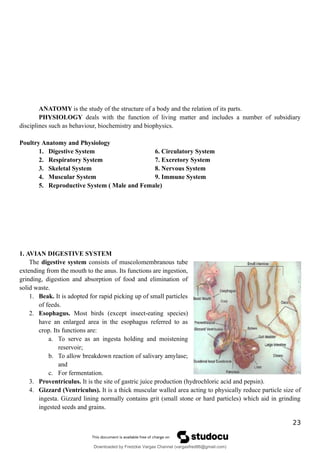
5. African. the African goose is gray with a brown shade in color. It has knob on its beak
and has dewlap. The knob and bill are black, with dark brown and light brown head. The
gander weighs 9.1 kg and the adult
female goose weighs 8.2 kilograms
Teaching and Learning Activities
The lecturer willl use slides and powerpoint presentation showing the The Chicken: Classes, Breeds
And Varieties
The students will also encourage to participate and shre their ideas regarding to the topics discussion.
Recommended learning materials and resources for supplementary reading.
Worktext, textbooks, pdf and modules will be provided to the students.
Flexible Teaching Learning Modality (FTLM) adopted
Online teaching using google meet and zoom meeting
Assessment Task
1. .
Reference:
21
Downloaded by Fredzkie Vargas Channel (vargasfred86@gmail.com)
lOMoARcPSD|16678982
1. Images: Watt Publishing 122 S. Wesley Avenue.. Mt. Morris, IL 61054 USA. Electronically
Accessed.
2. Skinner, J. L. Chicken Breeds and Varities (A28880) University of Wisconsin, Madison, USA>
Electronically Accessed.
Chapter 3
ANATOMY AND PHYSIOLOGY OF POULTRY
Introduction:
An understanding of the Anatomy and Physiology of birds, and the diferent body systems found in
the bird, is useful when an understanding of how poultry work or function, is sought. Knowledge of bird
anatomy (Body Parts) and Physiology (Body Functions) enables the poulktry industry to maximizse the bird
performance and maintain good welfare practices. Like humans, birds eat, gro , breathe, repoduce, empty
out wastes and move about. Both need food, water and air and must protect themselves from changes in the
environment.
Learning Outcomes:
At the end of this chapter the students must be able to:
1. Define Anatomy and Physiology
2. Identify the different parts of digestive system
3. Enumerate the different Poultry Aanatomy and Physiology
4. Classify eggs based on their sizes
Learning Content
22
Downloaded by Fredzkie Vargas Channel (vargasfred86@gmail.com)
lOMoARcPSD|16678982
ANATOMY is the study of the structure of a body and the relation of its parts.
PHYSIOLOGY deals with the function of living matter and includes a number of subsidiary
disciplines such as behaviour, biochemistry and biophysics.
Poultry Anatomy and Physiology
1. Digestive System 6. Circulatory System
2. Respiratory System 7. Excretory System
3. Skeletal System 8. Nervous System
4. Muscular System 9. Immune System
5. Reproductive System ( Male and Female)
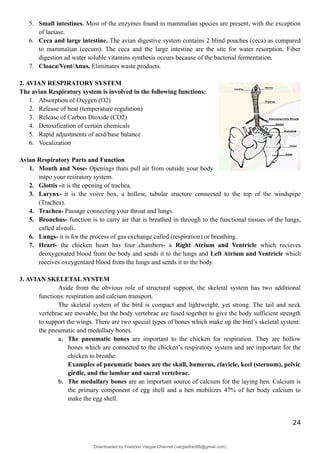
1. AVIAN DIGESTIVE SYSTEM
The digestive system consists of muscolomembranous tube
extending from the mouth to the anus. Its functions are ingestion,
grinding, digestion and absorption of food and elimination of
solid waste.
1. Beak. It is adopted for rapid picking up of small particles
of feeds.
2. Esophagus. Most birds (except insect-eating species)
have an enlarged area in the esophagus referred to as
crop. Its functions are:
a. To serve as an ingesta holding and moistening
reservoir;
b. To allow breakdown reaction of salivary amylase;
and
c. For fermentation.
3. Proventriculus. It is the site of gastric juice production (hydrochloric acid and pepsin).
4. Gizzard (Ventriculus). It is a thick muscular walled area acting to physically reduce particle size of
ingesta. Gizzard lining normally contains grit (small stone or hard particles) which aid in grinding
ingested seeds and grains.
23
Downloaded by Fredzkie Vargas Channel (vargasfred86@gmail.com)
lOMoARcPSD|16678982
5. Small intestines. Most of the enzymes found in mammalian species are present, with the exception
of lactase.
6. Ceca and large intestine. The avian digestive system contains 2 blind pouches (ceca) as compared
to mammalian (cecum). The ceca and the large intestine are the site for water resorption. Fiber
digestion ad water soluble vitamins synthesis occurs because of the bacterial fermentation.
7. Cloaca/Vent/Anus. Eliminates waste products.
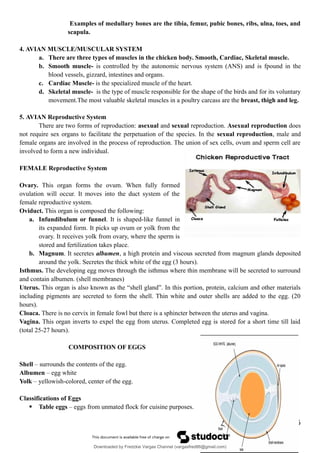
2. AVIAN RESPIRATORY SYSTEM
The avian Respiratory system is involved in the following functions:
1. Absorption of Oxygen (O2)
2. Release of heat (temperature regulation)
3. Release of Carbon Dioxide (CO2)
4. Detoxification of certain chemicals
5. Rapid adjustments of acid/base balance
6. Vocalization
Avian Respiratory Parts and Function
1. Mouth and Nose- Openings thats pull air from outside your body
intpo your resiratory system.
2. Glottis -it is the opening of trachea.
3. Larynx- it is the voive box, a hollow, tubular sructure connected to the top of the windspipe
(Trachea).
4. Trachea- Passage connecting your throat and lungs.
5. Bronchus- function is to carry air that is breathed in through to the functional tissues of the lungs,
called alveoli..
6. Lungs- it is for the process of gas exchange called (respiration) or breathing.
7. Heart- the chicken heart has four chambers- a Right Atrium and Ventricle which recieves
deoxygenated blood from the body and sends it to the lungs and Left Atrium and Ventricle which
receives oxeygentaed blood from the lungs and sends it to the body.
3. AVIAN SKELETAL SYSTEM
Aside from the obvious role of structural support, the skeletal system has two additional
functions: respiration and calcium transport.
The skeletal system of the bird is compact and lightweight, yet strong. The tail and neck
vertebrae are movable, but the body vertebrae are fused together to give the body sufficient strength
to support the wings. There are two special types of bones which make up the bird’s skeletal system:
the pneumatic and medullary bones.
a. The pneumatic bones are important to the chicken for respiration. They are hollow
bones which are connected to the chicken’s respiratory system and are important for the
chicken to breathe.
Examples of pneumatic bones are the skull, humerus, clavicle, keel (sternum), pelvic
girdle, and the lumbar and sacral vertebrae.
b. The medullary bones are an important source of calcium for the laying hen. Calcium is
the primary component of egg shell and a hen mobilizes 47% of her body calcium to
make the egg shell.
24
Downloaded by Fredzkie Vargas Channel (vargasfred86@gmail.com)
lOMoARcPSD|16678982
Examples of medullary bones are the tibia, femur, pubic bones, ribs, ulna, toes, and
scapula.
4. AVIAN MUSCLE/MUSCULAR SYSTEM
a. There are three types of muscles in the chicken body. Smooth, Cardiac, Skeletal muscle.
b. Smooth muscle- is controlled by the autonomic nervous system (ANS) and is fpound in the
blood vessels, gizzard, intestines and organs.
c. Cardiac Muscle- is the specialized muscle of the heart.
d. Skeletal muscle- is the type of muscle responsible for the shape of the birds and for its voluntary
movement.The most valuable skeletal muscles in a poultry carcass are the breast, thigh and leg.
5. AVIAN Reproductive System
There are two forms of reproduction: asexual and sexual reproduction. Asexual reproduction does
not require sex organs to facilitate the perpetuation of the species. In the sexual reproduction, male and
female organs are involved in the process of reproduction. The union of sex cells, ovum and sperm cell are
involved to form a new individual.
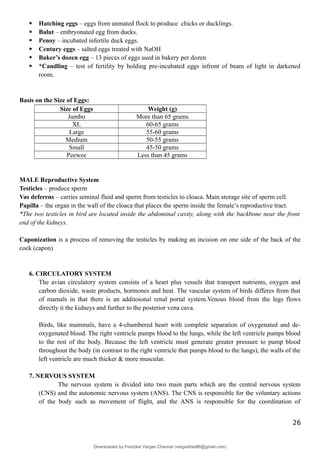
FEMALE Reproductive System
Ovary. This organ forms the ovum. When fully formed
ovulation will occur. It moves into the duct system of the
female reproductive system.
Oviduct. This organ is composed the following:
a. Infundibulum or funnel. It is shaped-like funnel in
its expanded form. It picks up ovum or yolk from the
ovary. It receives yolk from ovary, where the sperm is
stored and fertilization takes place.
b. Magnum. It secretes albumen, a high protein and viscous secreted from magnum glands deposited
around the yolk. Secretes the thick white of the egg (3 hours).
Isthmus. The developing egg moves through the isthmus where thin membrane will be secreted to surround
and contain albumen. (shell membranes)
Uterus. This organ is also known as the “shell gland”. In this portion, protein, calcium and other materials
including pigments are secreted to form the shell. Thin white and outer shells are added to the egg. (20
hours).
Cloaca. There is no cervix in female fowl but there is a sphincter between the uterus and vagina.
Vagina. This organ inverts to expel the egg from uterus. Completed egg is stored for a short time till laid
(total 25-27 hours).
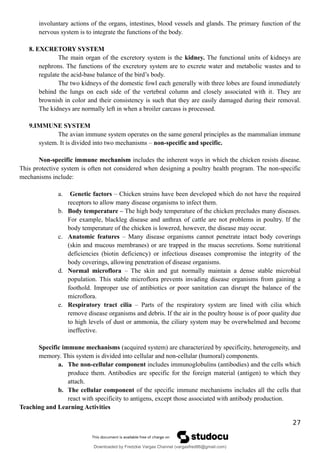
COMPOSITION OF EGGS
Shell – surrounds the contents of the egg.
Albumen – egg white
Yolk – yellowish-colored, center of the egg.
Classifications of Eggs
 Table eggs – eggs from unmated flock for cuisine purposes.
25
Downloaded by Fredzkie Vargas Channel (vargasfred86@gmail.com)
lOMoARcPSD|16678982
 Hatching eggs – eggs from unmated flock to produce chicks or ducklings.
 Balut – embryonated egg from ducks.
 Penoy – incubated infertile duck eggs.
 Century eggs – salted eggs treated with NaOH
 Baker’s dozen egg – 13 pieces of eggs used in bakery per dozen
 *Candling – test of fertility by holding pre-incubated eggs infront of beam of light in darkened
room.
Basis on the Size of Eggs:
Size of Eggs Weight (g)
Jumbo More than 65 grams
XL 60-65 grams
Large 55-60 grams
Medium 50-55 grams
Small 45-50 grams
Peewee Less than 45 grams
MALE Reproductive System
Testicles – produce sperm
Vas deferens – carries seminal fluid and sperm from testicles to cloaca. Main storage site of sperm cell.
Papilla – the organ in the wall of the cloaca that places the sperm inside the female’s reproductive tract.
*The two testicles in bird are located inside the abdominal cavity, along with the backbone near the front
end of the kidneys.
Caponization is a process of removing the testicles by making an incision on one side of the back of the
cock (capon)
6. CIRCULATORY SYSTEM
The avian circulatory system consists of a heart plus vessels that transport nutrients, oxygen and
carbon dioxide, waste products, hormones and heat. The vascular system of birds differes from that
of mamals in that there is an additoional renal portal system.Venous blood from the legs flows
directly ti the kidneys and further to the posterior vena cava.
Birds, like mammals, have a 4-chambered heart with complete separation of oxygenated and de-
oxygenated blood. The right ventricle pumps blood to the lungs, while the left ventricle pumps blood
to the rest of the body. Because the left ventricle must generate greater pressure to pump blood
throughout the body (in contrast to the right ventricle that pumps blood to the lungs), the walls of the
left ventricle are much thicker & more muscular.
7. NERVOUS SYSTEM
The nervous system is divided into two main parts which are the central nervous system
(CNS) and the autonomic nervous system (ANS). The CNS is responsible for the voluntary actions
of the body such as movement of flight, and the ANS is responsible for the coordination of
26
Downloaded by Fredzkie Vargas Channel (vargasfred86@gmail.com)
lOMoARcPSD|16678982
involuntary actions of the organs, intestines, blood vessels and glands. The primary function of the
nervous system is to integrate the functions of the body.
8. EXCRETORY SYSTEM
The main organ of the excretory system is the kidney. The functional units of kidneys are
nephrons. The functions of the excretory system are to excrete water and metabolic wastes and to
regulate the acid-base balance of the bird’s body.
The two kidneys of the domestic fowl each generally with three lobes are found immediately
behind the lungs on each side of the vertebral column and closely associated with it. They are
brownish in color and their consistency is such that they are easily damaged during their removal.
The kidneys are normally left in when a broiler carcass is processed.
9.IMMUNE SYSTEM
The avian immune system operates on the same general principles as the mammalian immune
system. It is divided into two mechanisms – non-specific and specific.
Non-specific immune mechanism includes the inherent ways in which the chicken resists disease.
This protective system is often not considered when designing a poultry health program. The non-specific
mechanisms include:
a. Genetic factors – Chicken strains have been developed which do not have the required
receptors to allow many disease organisms to infect them.
b. Body temperature – The high body temperature of the chicken precludes many diseases.
For example, blackleg disease and anthrax of cattle are not problems in poultry. If the
body temperature of the chicken is lowered, however, the disease may occur.
c. Anatomic features – Many disease organisms cannot penetrate intact body coverings
(skin and mucous membranes) or are trapped in the mucus secretions. Some nutritional
deficiencies (biotin deficiency) or infectious diseases compromise the integrity of the
body coverings, allowing penetration of disease organisms.
d. Normal microflora – The skin and gut normally maintain a dense stable microbial
population. This stable microflora prevents invading disease organisms from gaining a
foothold. Improper use of antibiotics or poor sanitation can disrupt the balance of the
microflora.
e. Respiratory tract cilia – Parts of the respiratory system are lined with cilia which
remove disease organisms and debris. If the air in the poultry house is of poor quality due
to high levels of dust or ammonia, the ciliary system may be overwhelmed and become
ineffective.
Specific immune mechanisms (acquired system) are characterized by specificity, heterogeneity, and
memory. This system is divided into cellular and non-cellular (humoral) components.
a. The non-cellular component includes immunoglobulins (antibodies) and the cells which
produce them. Antibodies are specific for the foreign material (antigen) to which they
attach.
b. The cellular component of the specific immune mechanisms includes all the cells that
react with specificity to antigens, except those associated with antibody production.
Teaching and Learning Activities
27
Downloaded by Fredzkie Vargas Channel (vargasfred86@gmail.com)
lOMoARcPSD|16678982
The lecturer willl use slides and powerpoint presentation showing the Anatomu and Physiology of
Poultry.
The students will also encourage to participate and shre their ideas regarding to the topics discussion.
Recommended learning materials and resources for supplementary reading.
Flexible Teaching Learning Modality (FTLM) adopted
Bleanded learning (Online and Modular)
Assessment Task
1. Quizzes and class participation.
2. Laboratory worksheets on anatomy and physiology of Chicken
Reference:
www.growelagrovet.com
Unit 4
Poultry Housing and Equipment
Introduction:
Importance of Poultry House
Provision of proper housing for the poultry - either layers or broilers, is the very first step necessary
towards achieving proper management and hence performance of your flock. The type of housing will
determine how you protect the birds from unfavourable weather and environmental conditions that normally
elicit diseases and dis-comfort in your flock.
Learning Outcomes:
At the end of this chapter, the students must be able to:
1. Enumerate the poultry housing specifications
2. Identify the housing equipment’s and its functions.
Learning Content
Planning Housing Construction
The very first task to address housing is to select a proper ground site for the chicken house. In
selecting the site for the chicken house, one should be guided by the following factors:
1. The site should preferably be on a level ground.
2. The soil must be well-drained so that during rain there is no water clogging.
3. The area must have plenty of natural air movement in order to aid ventilation.
28
Downloaded by Fredzkie Vargas Channel (vargasfred86@gmail.com)
lOMoARcPSD|16678982
4. The house should be oriented on an east-west axis to reduce the e ect of direct sunlight on the
ff
sidewalls during the hottest part of the day. The objective here is to reduce the temperature
fluctuation during any 24-hour period. Good temperature control always enhances feed
conversion and growth rate.
5. The ground must be big enough to accommodate the number of birds one wants to keep. This is
guided by the stocking density of adult birds which should be 10 -12 birds per square meter.
However, for layers another consideration is if the birds will be housed in cages, in which case
the floor space could be smaller.
6. The broiler house should be at least 1.5 km away from other types of poultry production.
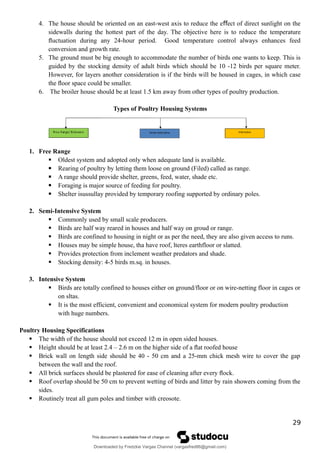
Types of Poultry Housing Systems
1. Free Range
 Oldest system and adopted only when adequate land is available.
 Rearing of poultry by letting them loose on ground (Filed) called as range.
 A range should provide shelter, greens, feed, water, shade etc.
 Foraging is major source of feeding for poultry.
 Shelter isussullay provided by temporary roofing supported by ordinary poles.
2. Semi-Intensive System
 Commonly used by small scale producers.
 Birds are half way reared in houses and half way on groud or range.
 Birds are confined to housing in night or as per the need, they are also given access to runs.
 Houses may be simple house, tha have roof, lteres earthfloor or slatted.
 Provides protection from inclement weather predators and shade.
 Stocking density: 4-5 birds m.sq. in houses.
3. Intensive System
 Birds are totally confined to houses either on ground/floor or on wire-netting floor in cages or
on sltas.
 It is the most efficient, convenient and economical system for modern poultry production
with huge numbers.
Poultry Housing Specifications
 The width of the house should not exceed 12 m in open sided houses.
 Height should be at least 2.4 – 2.6 m on the higher side of a flat roofed house
 Brick wall on length side should be 40 - 50 cm and a 25-mm chick mesh wire to cover the gap
between the wall and the roof.
 All brick surfaces should be plastered for ease of cleaning after every flock.
 Roof overlap should be 50 cm to prevent wetting of birds and litter by rain showers coming from the
sides.
 Routinely treat all gum poles and timber with creosote.
29
Downloaded by Fredzkie Vargas Channel (vargasfred86@gmail.com)
lOMoARcPSD|16678982
 Roofing material should have a reflective surface on the outside to help reduce the conduction of
solar heat and should be well insulated.
 Heating systems should have ample heating capacity in accordance with the climate.
 Ventilation systems should be designed to provide ample oxygen and to maintain optimum
temperature and relative humidity conditions for the birds.
 Lighting should be oriented to provide an even distribution of light at the floor level.
 It is important provide winches in order to facilitate the curtain management.
 The material of outside curtain can be sacs, but must be well sealed.
 All holes and tears in sidewall and/or inlet curtains must be repaired. • Curtains need to be sealed
at the base to prevent air leaks at floor level.
 It must be noted that there are many construction companies that now specialize in constructing
poultry houses. As long as they understand the above specifications, and provided one can a ord
ff
them, it is acceptable to get them to construct chicken houses for you. These sketches illustrate these
main housing basics.
Furnishing/Kitting the House
When the poultry house has been properly constructed, the next thing is to properly kit or furnish it
out. This stage involves installing the equipment and facilities that will complement the structure in creating
comfort for the birds. The first stage in furnishing the house is to install the correct, comfortable litter, or
bedding.
Litter/ Bedding
Litter or bedding refers to the material that is laid out on the ground to insulate the birds from the
floor conditions. Important to consider here is the type and amount /depth of litter used because this a ects
ff
the microenvironment created for the chickens in the house. Correct litter management is fundamental to
bird health, performance and final carcass quality which subsequently impacts the profit.
Functions of Litter
Litter plays a very important role in poultry houses. Its functions are:
 To absorb moisture.
 To dilute excreta, thus minimizing bird to manure contact.
 To provide an insulation from cold floor temperatures.
Litter Types
 Wood Shavings – the best, with excellent absorptive qualities.
 Rice husk – medium absorptive qualities.
 Sawdust - often high in moisture, prone to mold growth and chicks may consume it, which may
cause aspergillosis.
 Chopped straw - wheat straw is preferred to barley straw for absorptive qualities. Coarse chopped
straw has a tendency to cake in the first few weeks.
 Grass – often high in moisture and the absorptive qualities are not very good.
 Cotton Husks – low absorptive qualities.
Drinker / Water System
The drinker system is the equipment that is installed to hold and supply water for the birds. Providing
clean, cool water with adequate flow rate is fundamental to good poultry production. Without adequate water
30
Downloaded by Fredzkie Vargas Channel (vargasfred86@gmail.com)
lOMoARcPSD|16678982
intake, feed consumption will decline and bird performance will be compromised. Drinker systems are either
of open or closed type.
Feeding Systems
Feeding systems refers to equipment units that are installed to present feed to the birds. Regardless
of which type of feeding system is used, feeding space is absolutely critical. If feeder space is insu cient,
ffi
growth rates will be reduced and uniformity severely compromised. Feed distribution and the proximity of
the feeder to the birds are key to achieving target feed consumption rates. Again, feed equipment cans either
b manual or automatic.
Manual Feeders:
 Chick Trays: Round or Square Trays are necessary from placement from day 1 to Day 7; the quantity
must be 3 trays / 100 chicks.
 Tube feeders: From Day 7 to the end of the cycle, start using tube feeders.
*The recommended rate is 50 birds per Feeder.
Automatic Feeders
Fifty (50) birds per Feeder is the recommended rate. The quantity of feed inside the plate must be:
full at first 2 weeks, 50% of the plate between 2nd and 3rd weeks and 1/3 of the plate after 3rd week.
Feeders are generally recommended as they allow for unrestricted bird movement throughout the house, and
have a lower incidence of feed spillage and improved feed conversion. If birds are “tipping” the pans to
reach the feed, then the pans are set too high. The guideline is to set these such that the nipples are at the
same level as the bird’s main back line.
Heating Systems
It is an absolute requirement that birds be provided with an appropriate temperature range in the
poultry house. Any major deviations from the ideal range will result in many production problems. Too high
temperatures will bring dis-comfort to the birds and they will stop feeding, start drinking too much water
and if this continues, they start getting dehydrated, eventually dying. Too low temperatures will result in the
birds slowing down their metabolism and this starts many production problems as well. The appropriate
temperatures for the birds vary with age, the younger the birds, the more the warmth required. Therefore, if
the birds are still young, the farmer will be obliged to supply extra heat over and above that provided by the
warmth of the house. This is done during brooding. The supply of this heat / warmth is through several
mechanisms and equipment.
Heat Supply Equipment
Heat supply equipment is very varied, from the smallest and simplest, to the largest, and most
complicated. These are as follows: Infra-red Lamp This is an electric lamp that emits infra-red light hence
supplying warmth to the birds. One such lamp will warm 100 birds on average. The advantage is that this is
quite simple to install – it just needs a connection to an electricty source. The disadvantage is that it needs a
reliable source of electricity to ensure the birds are warmed consistently.
Electric Heaters
The normal electric heater can also be used to warm birds during brooding. One such heater can
warm 100 birds. This carries the same advantages and disadvantages as the infra-red lamp.
31
Downloaded by Fredzkie Vargas Channel (vargasfred86@gmail.com)
lOMoARcPSD|16678982
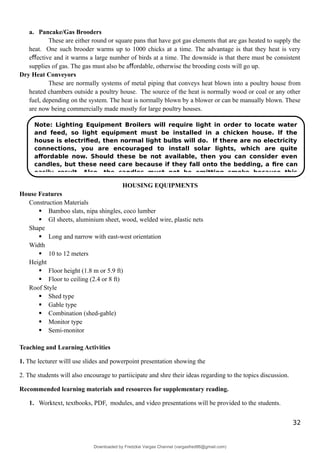
a. Pancake/Gas Brooders
These are either round or square pans that have got gas elements that are gas heated to supply the
heat. One such brooder warms up to 1000 chicks at a time. The advantage is that they heat is very
e ective and it warms a large number of birds at a time. The downside is that there must be consistent
ff
supplies of gas. The gas must also be a ordable, otherwise the brooding costs will go up.
ff
Dry Heat Conveyors
These are normally systems of metal piping that conveys heat blown into a poultry house from
heated chambers outside a poultry house. The source of the heat is normally wood or coal or any other
fuel, depending on the system. The heat is normally blown by a blower or can be manually blown. These
are now being commercially made mostly for large poultry houses.
HOUSING EQUIPMENTS
House Features
Construction Materials
 Bamboo slats, nipa shingles, coco lumber
 GI sheets, aluminium sheet, wood, welded wire, plastic nets
Shape
 Long and narrow with east-west orientation
Width
 10 to 12 meters
Height
 Floor height (1.8 m or 5.9 ft)
 Floor to ceiling (2.4 or 8 ft)
Roof Style
 Shed type
 Gable type
 Combination (shed-gable)
 Monitor type
 Semi-monitor
Teaching and Learning Activities
1. The lecturer willl use slides and powerpoint presentation showing the
2. The students will also encourage to partiicipate and shre their ideas regarding to the topics discussion.
Recommended learning materials and resources for supplementary reading.
1. Worktext, textbooks, PDF, modules, and video presentations will be provided to the students.
32
Note: Lighting Equipment Broilers will require light in order to locate water
and feed, so light equipment must be installed in a chicken house. If the
house is electrified, then normal light bulbs will do. If there are no electricity
connections, you are encouraged to install solar lights, which are quite
affordable now. Should these be not available, then you can consider even
candles, but these need care because if they fall onto the bedding, a fire can
easily result. Also, the candles must not be emitting smoke because this
Downloaded by Fredzkie Vargas Channel (vargasfred86@gmail.com)
lOMoARcPSD|16678982
Flexible Teaching Learning Modality (FTLM) adopted
Online teaching using google meet and zoom meeting
Assessment Task
1. Quiz will be done at the end of the chapter.
2. Laboratory worksheets will be done.
a. Housing equipment
b. Floor space requirements of the animals
Reference:
1. Keeping Poultry, 2010. Intensive Animal Industries, Department of Agriculture Tasmania.
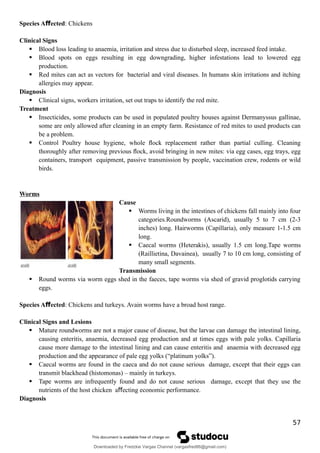
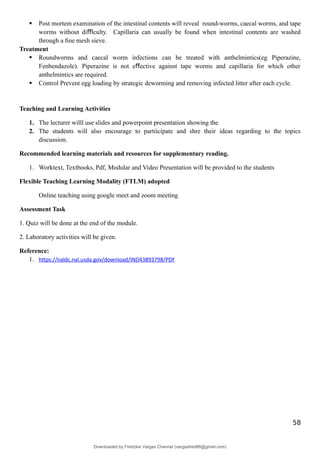
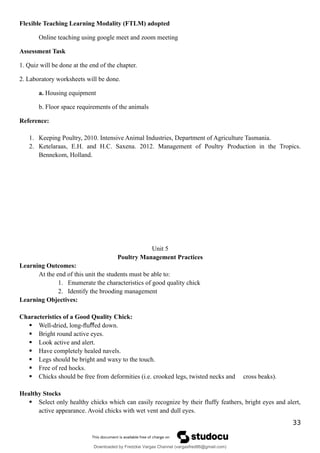
2. Ketelaraas, E.H. and H.C. Saxena. 2012. Management of Poultry Production in the Tropics.
Bennekom, Holland.
Unit 5
Poultry Management Practices
Learning Outcomes:
At the end of this unit the students must be able to:
1. Enumerate the characteristics of good quality chick
2. Identify the brooding management
Learning Objectives:
Characteristics of a Good Quality Chick:
 Well-dried, long-flu ed down.
ff
 Bright round active eyes.
 Look active and alert.
 Have completely healed navels.
 Legs should be bright and waxy to the touch.
 Free of red hocks.
 Chicks should be free from deformities (i.e. crooked legs, twisted necks and cross beaks).
Healthy Stocks
 Select only healthy chicks which can easily recognize by their fluffy feathers, bright eyes and alert,
active appearance. Avoid chicks with wet vent and dull eyes.
33
Downloaded by Fredzkie Vargas Channel (vargasfred86@gmail.com)
lOMoARcPSD|16678982
Chick Placement
 As soon as you arrive at the farm, open the boxes gently and allow the chicks to carefully move out
and into the prepared, pre-heated brooding area.
 During these first few days, constantly watch the young chicks as they go about their lives. Adjust
brooding temperature according to relative humidity at 33-36 degrees Celsius.
 After the first week, reduce the temperature weekly by 2-3 Degrees Celsius.
BROODING MANAGEMENT
Brooding
 Brooding is essential for the chicks.
 Brooding is the process of supplying artificial heat to the chicks from the time they are taken out
from the incubators up to the time their bodies can control their heat requirements and they are
covered with feathers.
 As soon as the chicks are placed in the brooder area where heat is supplied until the chicks have
grown to the point when they no longer need additional heat to keep them comfortable.
 This period lasts for approximately 4 weeks.
TYPE OF BROODER
1. Battery-type brooder – composed of compartment called tiers constructed on top of another, each
compartment equipped with separate heater and provisions for feeding and drinking.
2. Cage brooder – can be elevated slatted floor or litter floor type with capacity varying from few to
several hundreds.
Temperature Activity Check
 Every time you enter a poultry house you should always
observe the following activities:
o Birds eating
o Birds resting
o Birds “talking”
o Birds drinking
o Birds playing
o Birds should never be huddling
 Birds should be eating/drinking most of the time.
If there is feed in the troughs and water in the
drinkers but the birds are not consuming, check
the conditions in the house.
 The following set of temperature have been found
to be ideal for brooding under Philippine
conditions
Temperature Guidelines
 The behavior of the day-old chicks in the brooder
can be used as guidelines for the correct brooding
temperature.
34
Downloaded by Fredzkie Vargas Channel (vargasfred86@gmail.com)
lOMoARcPSD|16678982
 When the temperature is hot, the chicks will pant, spread out their wings, eat less and remain
inactive, move away from the source of heat and stay close to the edges of tile brooder.
 When the temperature is low, the chicks will crowd under the heater, pile up and make known their
comfort loud chirping.
Lighting Equipment
 Broilers will require light in order to locate water and feed, so light equipment must be installed in a
chicken house. If the house is electrified, then normal light bulbs will do.
 If there are no electricity connections, you are encouraged to install solar lights, which are quite
a ordable now.
ff
 Should these be not available, then you can consider even candles, but these need care because if
they fall onto the bedding, a fire can easily result.
 One cardinal rule to follow in the light management of poultry intended for egg production is
NEVER INCREASE LIGHT DURING GROWING PERIOD and NEVER DECREASE LIGHT
DURING THE LAYING PERIOD.
 Increase day length (light) during the growing period of birds will hasten their sexual maturity, which
will result to production of more pullet eggs (small eggs), layers are prone to prolapsed and shorter
egg production cycle.
 LIGHT REQUIREMENT - Light requirement is very important in the development of new layers.
The correct light to dark ratio in the rearing house will influence the production of larger eggs.
 During the first few days of brooding, lighting the chicks throughout the night (24 hours) is favorable
to growth because there is more eating time if feed is available.
 The light in the brooder will encourage the birds to keep close to the source of heat, feed and water.
 ADEQUATE LIGHT AND VENTILATION - a well lighted brooder attracts and encourage the
chicks to start feeding.
Sources of Heat Brooders
 Electricity
 LPG (Liquefied petroleum Gas)
 Infra-Red Lamp
 Lamp Charcoal
 Kerosene lamp
 Provide sufficient ventilation to supply plenty of oxygen and facilitate the removal of carbon dioxide
and excess ventilation, the chicks will not only be weak and in poor conditions but will also be more
predisposed to respiratory diseases.
Ample Space to Avoid Overcrowding
 It provides brooder with enough space to avoid overcrowding which leads to poorly developed
chicks, high mortality as well as harmful vices like toe picking, feather picking or cannibalism.
 At the beginning of the brooding period, the chicks need very little space but as the chicks grow
older they must be provided much wider area.
Space Requirements
Egg Type Chicken
1 day to 3 weeks 0.3 sq. ft/ bird
3 to 8 weeks 0.5 sq. ft/ bird
8-12 weeks 1.0 sq. ft/ bird
35
Downloaded by Fredzkie Vargas Channel (vargasfred86@gmail.com)
lOMoARcPSD|16678982
Meat Type / Broiler
1 day to 2 weeks 0.3 sq.ft/ bird
2 weeks to marketing stage 1.0 sq.ft/ bird
*After 12 weeks, the floor space requirement of growing pullets varies according to the system housing used.
Litter floor 2.0-2.5 sq. ft/ bird
Slat floor 1.5-2.0 sq. ft/ bird
Cages 0.75-1.0 sq.ft/ bird
Meat Type / Broiler
1 day to 2 weeks 0.3 sq. ft/ bird
2 weeks to marketing age 1.0 sq. ft/ bird
Teaching and Learning Activities
1. The lecturer willl use slides and powerpoint presentation showing the
2. The students will also encourage to partiicipate and share their ideas regarding to the topics
discussion.
Recommended learning materials and resources for supplementary reading.
1. Worktext, textbooks, PDF, modules and video presentations will be provided to the students.
Flexible Teaching Learning Modality (FTLM) adopted
Online teaching using google meet and zoom meeting
Assessment Task
1. Quiz will be done at the end of the chapter.
2. Laboratory worksheet on floor space requirement of poultry
Reference:
1. Keeping Poultry, 2010. Intensive Animal Industries, Department of Agriculture Tasmania.
2. Ketelaraas, E.H. and H.C. Saxena. 2012. Management of Poultry Production in the Tropics.
Bennekom, Holland.
36
Downloaded by Fredzkie Vargas Channel (vargasfred86@gmail.com)
lOMoARcPSD|16678982
Module 6
Poultry Nutrition and Feeds and Feeding
Introduction
Worldwide, production of poultry meat and eggs has increased consistently over the years, and this
trend is expected to continue. It is predicted that most increases in poultry production during the next two
decades will occur in developing countries, where rapid economic growth, urbanization and higher
household incomes will increase the demand for animal proteins. Several factors have contributed to the
consistent growth in world poultry production, including: i) genetic progress in poultry strains for meat and
egg production; ii) better understanding of the fundamentals of nutrition; and iii) disease control. For
example, the age for a meat chicken to reach the market weight of 2 kg has steadily decreased from 63 days
in 1976 to 35 days in 2009, and the efficiency of converting feed into poultry products also continues to
improve. This growth in poultry production is having a profound effect on the demand for feed and raw
materials. Feed is the most important input for poultry production in terms of cost, and the availability of
low-priced, high-quality feeds is critical if poultry production is to remain competitive and continue to grow
to meet the demand for animal protein.
Learning Outcome
At the end of this module, the students must be able to:
1. Discuss the nutrition in needed in poultry.
2. Identify the nutrient requirement in poultry nutrition
3. Practice and define the different methods in feed formulation.
Learning Content
37
Downloaded by Fredzkie Vargas Channel (vargasfred86@gmail.com)
lOMoARcPSD|16678982
. A. Nutrient Requirement
For maximum growth and good health, intensively reared poultry need a balanced array of nutrients
in their diet. The nutrients required by birds vary according to species, age and the purpose of production –
whether the birds are kept for meat or egg production. To meet these specific needs, different classes of poultry
have to be fed different types of diets. These recommendations should only be considered as guidelines and
used as the basis for setting dietary nutrient concentrations in practical diets. Historically, recommendations
on nutrient requirements have been based on available literature and data from expert groups. Currently,
however, because each specific genotype has its own requirements, most commercial feed formulations use
minimum requirements recommended by the breeding companies that supply the chicks.
1. Energy
Poultry can derive energy from simple carbohydrates, fat and protein. They cannot digest and utilize
some complex carbohydrates, such as fibre, so feed formulation should use a system based on available
energy. Metabolizable energy (ME) is the conventional measure of the available energy content of feed
ingredients and the requirements of poultry. This takes account of energy losses in the faeces and urine.
Birds eat primarily to satisfy their energy needs, provided that the diet is adequate in all other essential
nutrients. The energy level in the diet is therefore a major determinant of poultry’s feed intake. When the
dietary energy level changes, the feed intake will change, and the specifications for other nutrients must be
modified to maintain the required intake. For this reason, the dietary energy level is often used as the starting
point in the formulation of practical diets for poultry. Different classes of poultry need different amounts of
energy for metabolic purposes, and a deficiency will affect productive performance. To sustain high
productivity, modern poultry strains are typically fed relatively high-energy diets. The dietary energy levels
used in a given situation are largely dictated by the availability and cost of energy-rich feedstuffs. Because
of the high cost of cereals, particularly maize, the use of low-energy diets for poultry feeding is not
uncommon in many developing countrie
2. Protein and amino acids
The function of dietary protein is to supply amino acids for maintenance, muscle growth and
synthesis of egg protein. The synthesis of muscle and egg proteins requires a supply of 20 amino acids, all of
which are physiological requirements. Ten of these are either not synthesized at all or are synthesized too
slowly to meet the metabolic requirements, and are designated as essential elements of the diet. These need
to be supplied in the diet. The balance can be synthesised from other amino acids; these are referred to as
dietary non-essential elements and need not be considered in feed formulations. From a physiological point
of view, however, all 20 amino acids are essential for the synthesis of various proteins in the body. The
essential amino acids for poultry are lysine, methionine, threonine, tryptophan, isoleucine, leucine, histidine,
valine, phenylalanine and arginine. In addition, some consider glycine to be essential for young birds.
Cysteine and tyrosine are considered semi-essential amino acids, because they can be synthesized from
methionine and phenylalanine, respectively.
Of the ten essential amino acids, lysine, methionine and threonine are the most limiting in most
practical poultry diets. Poultry do not have a requirement for protein per se. However, an adequate dietary
supply of nitrogen from protein is essential to synthesize non-essential amino acids. This ensures that the
essential amino acids are not used to supply the nitrogen for the synthesis of non-essential amino acids.
Satisfying the recommended requirements for both protein and essential amino acids therefore ensures the
provision of all amino acids to meet the birds’ physiological needs. The amino acid requirements of poultry
are influenced by several factors, including production level, genotype, sex, physiological status,
38
Downloaded by Fredzkie Vargas Channel (vargasfred86@gmail.com)
lOMoARcPSD|16678982
environment and health status. For example, high levels of lean meat deposition require relatively high
levels of lysine. High levels of egg output or feather growth require relatively high levels of methionine.
However, most changes in amino acid requirements do not lead to changes in the relative proportions of the
different amino acids. There is therefore an ideal balance of dietary amino acids for poultry, and changes in
amino acid requirements are normally expressed in relation to a balanced protein or ideal protein.
3.Fats and fatty acids
Because of the greater energy density of fat compared with carbohydrates and protein, poultry diets
usually include fats to achieve the needed dietary energy concentration. Fat accounts for about 3 to no more
than 5 percent of most practical diets. Other benefits of using fats include better dust control in feed mills
and poultry houses, and improved palatability of diets. Poultry do not have a specific requirement for fats as
a source of energy, but a requirement for linoleic acid has been demonstrated. Linoleic acid is the only
essential fatty acid needed by poultry, and its deficiency has rarely been observed in birds fed practical diets.
Linoleic acid’s main effect in laying birds is on egg size.
4. Minerals
Minerals are needed for formation of the skeletal system, for general health, as components of
general metabolic activity, and for maintenance of the body’s acid-base balance. Calcium and phosphorus
are the most abundant mineral elements in the body, and are classified as macro-minerals, along with
sodium, potassium, chloride, sulphur and magnesium. Macro-minerals are elements required in the diet at
concentrations of more than 100 mg/kg. Calcium and phosphorus are necessary for the formation and
maintenance of the skeletal structure and for good egg-shell quality. In general, 60 to 80 percent of total
phosphorus present in plant-derived ingredients is in the form of phytate-phosphorus. Under normal dietary
conditions, phytate phosphorus is poorly utilized by poultry owing to the lack of endogenous phytase in their
digestive enzymes. It is generally assumed that about onethird of the phosphorus in plant feedstuffs is non-
phytate and is biologically available to poultry, so the phosphorus requirement for poultry is expressed as
non-phytate phosphorus, rather than total phosphorus.
A ratio of 2:1 must be maintained between calcium and non-phytate phosphorus in growing birds’
diets, to optimize the absorption of these two minerals. The ratio in laying birds’ diets is 13:1, because of the
very high requirement for calcium for good shell quality. Dietary proportions of sodium (Na), potassium (K)
and chloride (Cl) largely determine the acid-base balance in the body for maintaining the physiological pH.
If a shift occurs towards acid or base conditions, the metabolic processes are altered to maintain the pH, with
the likely result of depressed performance. The dietary electrolyte balance is described by the simple
formula (Na+ + K+ - Cl - ) and expressed as mEq/kg diet. Prevention of electrolyte imbalance needs careful
consideration, especially in hot climates. Under most conditions, a balance of about 250 mEq/ kg of diet
appears satisfactory for optimum growth.
The overall balance among these three minerals, and their individual concentrations are important.
To be effective, their dietary levels must each be within acceptable ranges, not deficient and not excessive.
Birds exposed to heat stress consume more water, and are better able to withstand heat when the water
contains electrolytes. The replacement of part of the supplemental dietary sodium chloride with sodium
bicarbonate has proved useful under these conditions. Trace elements, including copper, iodine, iron,
manganese, selenium, zinc and cobalt, function as components of larger molecules and as co-factors of
enzymes in various metabolic reactions. These are required in the diet in only very small amounts. Practical
39
Downloaded by Fredzkie Vargas Channel (vargasfred86@gmail.com)
lOMoARcPSD|16678982
poultry diets should be supplemented with these major and trace minerals, because typical cereal-based diets
are def cient in them. Organic forms of some trace minerals are currently available, and are generally
considered to have higher biological availability than inorganic forms.
5. Vitamins
Vitamins are classified as fat-soluble (vitamins A, D, E and K) and water-soluble (vitamin B complex
and vitamin C). All vitamins, except for vitamin C, must be provided in the diet. Vitamin C is not generally
classified as a dietary essential as it can be synthesized by the bird. However, under adverse circumstances
such as heat stress, dietary supplementation of vitamin C may be beneficial. The metabolic roles of the
vitamins are more complex than those of other nutrients. Vitamins are not simple body building units or
energy sources, but are mediators of or participants in all biochemical pathways in the body. Water Water is
the most important, but most neglected nutrient in poultry nutrition. Water has an impact on virtually every
physiological function of the bird. A constant supply of water is important to: i) the digestion of feed; ii) the
absorption of nutrients; iii) the excretion of waste products; and iv) the regulation of body temperature.
Water constitutes about 80 percent of the body. Unlike other animals, poultry eat and drink all the time. If
they are deprived of water for even a short time, production and growth are irreversibly affected. Water must
therefore be made available at all times. Both feed intake and growth rate are highly correlated with water
intake. Precise requirements for water are difficult to state, and are influenced by several factors, including
ambient conditions, and the age and physiological status of the birds. Under most conditions, water intake is
assumed to be twice the amount of feed intake. Drinking-water temperatures should be between 10 and 25
°C. Temperatures over 30 °C will reduce consumption. The quality of water is equally important. Quality is
often taken for granted, but poor water quality can lead to poor productivity and extensive economic losses.
Water is an ideal medium for the distribution of contaminants, such as chemicals and minerals, and the
proliferation of harmful microorganisms. Water quality for poultry can be a major issue in arid and semi-arid
regions where water is scarce. In particular, underground water in these areas can have high levels of salt.
Saline drinking-water containing less than 0.25 percent salt is tolerated by birds, but can cause sodium
toxicity if water intake is restricted.
B. Define Nutrition
Nutrition can be defined as the process of taking in and assimilating food. It can also defined as the
transformation of food elements to body elements through chemical and physiological processes with the
influence of body additives. Nourish means to feed or sustain animal with substances necessary for life and
growth. Thus a nutrient may be defined as something that nourishes an animal or more specifically, an
element that is required in the diet of a given animal permit normal functioning of the life processes.
C. Feed Additives
Agricultural producers must be efficient and produce a marketable product while maintaining costs.
One method agricultural producers use to help them achieve these goals is the use of feed additives. Feed
additives are added to an animal’s feed for growth acceleration, increased feed efficiency, increased
production of animal products, or health maintenance improvement. Feed additives are not usually
considered a nutrient source.
Two major categories of feed additives are growth regulators and antibiotics. Growth regulators are
hormones that increase growth rates and feed efficiency. Antibiotics are used as a feed additive for the
40
Downloaded by Fredzkie Vargas Channel (vargasfred86@gmail.com)
lOMoARcPSD|16678982
prevention and treatment of diseases and infections such as scours, coccidiosis, and foot rot. Antibiotics may
be used at low levels to improve efficiency and growth.
Feed additives are also used for other purposes. Anthelmintics, also known as dewormers, are used to
control various types of worms. Other uses of feed additives include bloat control in ruminant animals, stress
reduction by adding tranquilizers, pH level regulation, and fly control
E. Classification of feedstuff
1. Roughages
Feed consisting of bulky and course plants or plant parts, containing a high fiber content and low
total digestible nutrients, arbitrarily defined as feed with over 18% C.F. and 60% TDN
2. Concentrates
3. Grasses
F. Feed Formulation
Feed formulation is the process of quantifying the amounts of feed ingredients that need to be
combined to form a single uniform mixture (diet) for poultry that supplies all of their nutrient
requirements. Since feed accounts for 65-75% of total live production costs for most types of poultry
throughout the world, a simple mistake in diet formulation can be extremely expensive for a poultry
producer.
Feed formulation requires thorough understanding of the:
(a) nutrient requirements of the class of poultry (e.g., egg layers, meat chickens or breeders);
(b) feed ingredients in terms of nutrient composition and constraints in terms of nutrition and processing,
and
(c) cost and availability of the ingredients.
1. Types of Feed Formulation
a. Person Square method - The Pearson square or box method of balancing rations is a simple
procedure that has been used for many years. It is of greatest value when only two ingredients
are to be mixed. In taking a close look at the square, several numbers are in and around the
square. Probably one of the more important numbers is the number that appears in the middle
of the square. This number represents the nutritional requirement of an animal for a specific
nutrient. It may be crude protein or TDN, amino acids, minerals or vitamins
In order to make the square work consistently, there are three very important
considerations:
1. The value in the middle of the square must be intermediate between the two values that are
used on the left side of the square. For example, the 14 percent crude protein requirement has
to be intermediate between the soybean meal that has 45 percent crude protein or the corn
that has 10 percent crude protein. If barley is used that has 12 percent crude protein and corn
41
Downloaded by Fredzkie Vargas Channel (vargasfred86@gmail.com)
lOMoARcPSD|16678982
that has 10 percent crude protein, the square calculation method will not work because the 14
percent is outside the range of the values on the left side of the square.
2. Disregard any negative numbers that are generated on the right side of the square. Be
concerned only with the numerical differences between the nutrient requirement and the
ingredient nutrient values.
3. Subtract the nutrient value from the nutritional requirement on the diagonal and arrive at a
numerical value entitled parts. By summing those parts and dividing by the total, you can
determine the percent of the ration that each ingredient should represent in order to provide a
specific nutrient level. Always subtract on the diagonal within the square in order to
determine parts. Always double check calculations to make sure that you did not have a
mathematical error. It also is very important to work on a uniform basis. Use a 100-percent
dry-matter basis for nutrient composition of ingredients and requirements and then convert to
an as-fed basis after the formulation is calculated.
b. Trial and Error Method.
This is the most popular method of formulating ration for the swine and poultry. It is a type of
feed formulation in many developing nations of the world (Adejoro 2004), Nigeria inclusive.
As the name implies, the formulation is manipulated until the nutrient requirements of the
animal are met. This method makes possible the formulation of a ration that meets all the
nutrient requirements of the animal. In poultry feed formation, various cases of mineral
deficiency such as osteomalacia, rickets and shellessness or soft shell formation may not be
properly addressed if care is not taken to comprehensively analyze question.
Teaching and Learning Activities
1. The lecturer willl use slides and powerpoint presentation showing the
2. The students will also encourage to partiicipate and share their ideas regarding to the topics
discussion.
Recommended learning materials and resources for supplementary reading.
1. Worktext, textbooks, PDF, modules and video presentations will be provided to the students.
Flexible Teaching Learning Modality (FTLM) adopted
1. Online teaching using google meet and zoom meeting
Assessment Task
1. Quiz will be done at the end of the chapter.
2. Laboratory worksheet on floor space requirement of poultry
References:
1. Esminger, M.E., J.E. Oldfield and W.W. Heinemann.2008.Feeds and Nutrition Digest. The Esminger
Publishing Company,648 west Sierra Avenue Clovis, California, U.S.A
2. https://www.iiste.org/Journals/index.php/JBAH/article/viewFile/5358/5337
42
Downloaded by Fredzkie Vargas Channel (vargasfred86@gmail.com)
lOMoARcPSD|16678982
Module7
Common Diseases and Parasites of Poultry
Introduction:
Learning Outcomes:
Learning Objectives:
Common disease and Parasites in poultry
Aspergillosis (Fungal Pneumonia)
Cause
 The principal fungus causing Aspergillosis in poultry is Aspergillus
fumigatus.
Transmission
 Transmission is by inhalation of fungus spores from contaminated
litter (e.g. wood shavings, straw) or contaminated feed. Hatcheries
may also contribute to infection of chicks.
Species A ected
ff
 Young chickens are very susceptible. Older chickens are more resistant to infection. Turkey poults,
pheasants, quails, ducklings, and goslings may also become infected.
Clinical Signs
43
Downloaded by Fredzkie Vargas Channel (vargasfred86@gmail.com)
lOMoARcPSD|16678982
 Infected chickens are depressed and thirsty. Gasping and rapid breathing can be observed. Mortality
is variable, from 5 to 50 %. Gross lesions involve the lungs and airsacs primarily.
 Yellow-white pin head sized lesions can be found. Sometimes all body cavities are filled with small
yellow-green granular fungus growth.
Diagnosis
 The presence of Aspergillus fumigatus can be identified microscopically or sometimes even with the
naked eye in the air passages of the lungs, in the airsacs or in lesions of the abdominal cavity.
Aspergillosis can be confirmed by isolation and identification of the fungus from lesions.
Treatment and Control
 There no specific treatment for infected birds. The best is to remove and destroy a ected birds. Strict
ff
hygiene in breeder (hatching eggs) and hatchery management is necessary.
Avian Influenza (AI)
Cause
 Avian Influenza is caused by an Orthomyxovirus; there are
several serotypes.

Transmission
 AI virus is excreted from nares, mouth, conjunctiva and cloaca.
Airborne virus particles from the respiratory tract, droppings, and
people carrying virus on their clothing and equipment are the main
routes of transmission.
Diagnosis
 Clinical signs are indicative for AI; final confirmation by laboratory testing:
 Virus isolation from infected organs, tracheal or cloacal swabs.
 Serology from blood samples after infection and for routine monitoring showing specific AI
antibodies.
Treatment
 There is no treatment for Avian Influenza. Antibiotics will help to control secondary bacterial
infections.
Prevention and Control
 In many countries AI is a notifiable disease with specific local regulations on its control. In AI free
areas the disease is controlled by monitoring and stamping out.
 Vaccination is generally done with inactivated AI vaccines based on the strain H-type causing the
outbreaks.
Avian Metapneumovirus “Swollen Head Syndrome (SHS)”
Cause
 Avian Metapneumovirus, belongs to the subfamily Pneumovirus from
the family Paramyxoviridae.
44
Downloaded by Fredzkie Vargas Channel (vargasfred86@gmail.com)
lOMoARcPSD|16678982
Transmission
 The virus spreads horizontally via direct contact from bird to bird and via contaminated personnel,
water and equipment.
 Species a ected Turkeys and chickens.
ff
Clinical Signs and Lesions
 In both turkeys and chickens. In young birds the respiratory clinical signs; snicking, rales, sneezing,
nasal discharge , foamy conjunctivitis, swollen infraorbital and periorbital sinus “swollen head” are
most prominent; when birds become older head shaking and coughing can be added. In adult laying
hens there may a drop in egg production up to 70% with an increased incidence of poor shell quality.
Treatment
 There is no treatment for aMPV infections. Treatment with antibiotics can be given to control
secondary bacterial infections.
Prevention
 Vaccination is the most e ective prevention method. Over the years live and inactivated vaccines
ff
have been developed and are very e cacious in controlling infections. Short living birds will only
ffi
be vaccinated with a live vaccine(s). Long living birds are advised to be primed with live- and
boosted with inactivated vaccines. In this way the birds will have good long lasting local and
systemic protection.
Infectious Bronchitis (IB)
Cause
 Infectious Bronchitis (IB) is present worldwide, it is a highly
contagious, acute, and economically important disease. IB is
caused by an Avian Coronavirus.
Transmission
 The virus is transmitted rapidly from bird to bird through the
airborne route. The virus can also be transmitted via the air
between chicken houses and even from farm to farm. The
incubation period is only 1-3 days.
 Species a ected Chickens are the primary poultry species that is susceptible to IB-virus, but quail
ff
and pheasants can be a ected. Recent discovery of IB virus in other species without clinical signs
ff
indicates that other species may act as vectors.
Clinical Signs
 In young chickens the respiratory form appears with gasping, sneezing, tracheal rales and nasal
discharge. Generally chicks are depressed and show reduced feed consumption. Mortality in general
is low unless infection gets complicated with secondary bacterial infections (like E.coli).
 In adult “laying” birds (layers and breeders) after initial respiratory signs the a ected flocks show a
ff
drop in egg production and a loss of egg quality (shell deformation and internal egg changes)
resulting in more second class eggs, a ecting the hatchability rate of fertile eggs and day-old chick
ff
quality.
Post mortem lesions
 In young chicks a yellow cheesy plug at the tracheal bifurcation is indicative of IB infection. In case
of nephropathogenic infections pale and swollen kidneys and distended ureters with urates are found.
Diagnosis
45
Downloaded by Fredzkie Vargas Channel (vargasfred86@gmail.com)
lOMoARcPSD|16678982
 Clinical signs and post mortem lesions in a flock followed by laboratory confirmation based on virus
isolation and identification with PCR. Serology based on paired blood samples using HI, Elisa or VN
tests.
Treatment
 There is no treatment for IB. Antibiotics are used to control secondary bacterial infections.
Prevention
 Vaccination with strain specific or cross protective live vaccines, and for layers and breeders the
addition of inactivated vaccines at point of lay to induce long lasting systemic immunity.
Infectious Coryza
Cause
 This is a bacterial disease caused by Avibacterium paragallinarum, (in
the past known as Haemophilus paragallinarum).
 There are 3 common serotypes, representing di erent immunotypes:
ff
A, B, C.
Transmission
 The disease spreads from bird to bird and flock to flock by contact and
airborne infected dust particles and via the drinking water. Spread by equipment and personnel have
also been reported. The incubation period varies from 1 to 3 days.
Species A ected
ff
 The chicken is the natural host for Avibacterium paragallinarum. All ages are susceptible, but the
disease is usually less severe in juvenile birds.
Clinical Signs
 The main clinical signs are due to an acute inflammation around the eyes and upper respiratory tract.
Signs include a serous to mucoid discharge in the nasal passage and sinuses, facial edema and
conjunctivitis.
 Feed and water consumption will be decreased resulting in loss of weight gain and loss of egg
production (10-40%) in laying birds.
Diagnosis
 A field infection produces similar symptoms to chronic respiratory disease, therefore a diagnosis
based only on clinical signs is di cult to establish.
ffi
 The most certain diagnosis may be obtained by the isolation of the organism from the sinus or airsac
exudate from a ected birds. This procedure must be carried out in the laboratory. There is no
ff
practical serological test.
Control: Eradication is not economically feasible.
Treatment
 Treatment with various antibiotics (erythromycin and tetracycline are commonly used) will alleviate
the severity and course of the disease.
 Relapse often occurs after treatment is discontinued and recovered birds will remain carriers.
 Because of noted drug resistance of Avibacterium paragallinarum, an antimicrobial sensitivity test is
recommended.
Prevention
 Vaccination is the preferred control method and is standard in most endemic Coryza areas. There is
no cross protection between the serotypes A, B, C.
46
Downloaded by Fredzkie Vargas Channel (vargasfred86@gmail.com)
lOMoARcPSD|16678982
Infectious Laryngotracheitis (ILT)
Cause
 ILT is caused by a Herpesvirus, only one serotype is known.
Transmission
 The natural entry of ILT is via the upper respiratory tract and ocular
route. Field spread occurs via direct contact from bird to bird and/or
transmission by contaminated people or equipment (visitors, shoes,
clothing, egg boxes, transport crates). Incubation period varies from 4
-12 days.
Species A ected
ff : Chickens are the primary natural host but other species (pheasants) can also be a ected.
ff
Clinical Signs
 An acute respiratory disease with nasal discharge and moist rales followed by gasping, marked
respiratory distress and expectoration of blood-stained mucus in laying birds.
Post Mortem Lesions
 Lesion are found throughout the respiratory tract but most pronounced in the larynx and trachea.
 Depending on the severity of the infection you can find tracheitis with haemorrhagic and/or diphteric
changes.
Diagnosis Clinical
 Laboratory confirmation with: histopathology showing intranuclear inclusion bodies in tracheal
epithelial cells, virus isolation from tracheal swabs on embryonated chicken eggs, virus detection
with IFT on tracheal samples. Detecting antibodies from blood samples after infection.
Treatment
 There is no treatment for ILT; emergency vaccination in the early stage of an infected flock may
reduce the spread and limit the outbreak.
Prevention and Control
 In many countries vaccination is the preferred control method. Though in some countries it is not
allowed to vaccinate or only under restriction.
Mycoplasma gallicepticum (CRD)
Cause
 The underlying cause of CRD is Mycoplasma gallisepticum
(MG).
 The condition is frequently triggered by respiratory viruses
such as ND and IB and subsequently complicated by
bacterial invasion.
 The main agents involved in the infection are Mycoplasma
gallisepticum and E. coli. Stress caused by moving the birds,
by debeaking, other operations/ handlings or other unfavorable conditions e.g. cold or bad
ventilation, make the birds more susceptible.
Transmission
47
Downloaded by Fredzkie Vargas Channel (vargasfred86@gmail.com)
lOMoARcPSD|16678982
 The main problem is that parent birds infected with Mycoplasma gallisepticum can transmit the
organism through the egg to their o spring (vertical transmission).
ff
 In addition, infection can occur by contact or by airborne dust or droplets (horizontal transmission).
 The incubation period varies from 4 days to 3 weeks.
Species A ected
ff : Chickens and Turkeys.
Clinical Signs
 Young chickens (broilers or layer pullets) will show respiratory distress.
 The birds frequently show lack of appetite, decreased weight gain and increased feed conversion
ratios.
 In adult birds the most common signs are sneezing and general respiratory distress. In laying birds a
drop in egg production between 20-30 % can occur.
 In breeders hatchability can be a ected and day-old chick quality produced from hatching eggs
ff
coming from infected flocks will be reduced.
 CRD does not normally cause an alarming number of deaths.
 The e ect is more of a chronic nature causing reduced weight gain and higher feed conversion ratios
ff
in broilers and lower egg production in breeders and layers.
 In this way the overall economic losses can be very high.
Internal Lesions
 A reddish inflamed trachea and/or frothy, cheesy exudate in the airsacs, especially in complicated
cases (e.g. with secondary E. coli infections) are observed.
 In mild MG infections the only lesion might be slight mucus in the trachea and a cloudy or light froth
in the airsacs.
Diagnosis
 Diagnosis of MG infection can be made based on clinical signs and post mortem lesions followed by
confirmation in the laboratory using blood (serum) samples for serology or organs swabs for
identification by PCR or mycoplasma isolation.
Treatment
 Treatment of MG-infected chickens or turkeys with suitable antibiotics or chemotherapeutics has
been found to be of economic value, but will not eliminate MG from the flock.
Prevention
 Prevention by monitoring and vaccination has become a more e ective method of combating the
ff
disease especially in layers.
 Economic losses in commercial layers can be reduced by proper use of MG vaccines.
Newcastle Disease (NCD)
Cause
 Newcastle disease is caused by a Paramyxovirus (APMV-
1).
Transmission
 Newcastle disease virus is highly contagious through
infected and respiratory discharge between birds.
48
Downloaded by Fredzkie Vargas Channel (vargasfred86@gmail.com)
lOMoARcPSD|16678982
 Spread between farms is by infected equipment, trucks, personnel, wild birds or air. The incubation
period is variable but usually about 3 to 6 days.
Species A ected
ff : Chickens and turkeys.
Clinical Signs
 Highly pathogenic strains (velogenic) of ND cause high mortality with depression and death within 3
to 5 days. A ected chickens do not always exhibit respiratory or nervous signs.
ff
 Labored breathing with wheezing and gurgling, accompanied by nervous signs, such as paralysis or
twisted necks (torticollis) are the main signs.
 Drop in egg production 30 to 50 % or more, returning to normal levels in about 2-3 weeks is
observed. Besides also egg shell quality will be a ected (thin, loose color).
ff
 In well-vaccinated chicken flocks clinical signs may be di cult to find.
ffi
 Intestinal lesions Inflamed tracheas, pneumonia, and/or froth in the airsacs are the main lesions.
Treatment
 There is no specific treatment for ND; antibiotic treatment of secondary bacterial infections will
reduce the losses.
Prevention and Control
 Vaccination has proven to be a reliable control method.
 But ND is a notifiable disease, and in many countries the control is based on a combination of
obliged vaccination and stamping out in case of outbreaks.
 A wide range of live and inactivated vaccines are used in vaccination programs to prevent ND.
Marek’s Disease (MD)
Cause
 Marek’s disease is caused by a alphaherpesvirus.
Transmission
 The disease is highly contagious. Main transmission is by
infected premises, where day-old chicks will become
infected by the oral and respiratory routes. Dander from
feather follicles of MD-infected chickens can remain
infectious for more than a year.
 Young chicks are particularly susceptible to horizontal transmission. Susceptibility decreases rapidly
after the first few days of age. Species a ected.
ff
 Especially chickens, also quail, turkeys and pheasants are susceptible. Clinical signs Infected birds
show weight loss, or may exhibit some form of paralysis.
 When the gizzard nerve is involved, the birds will have a very small gizzard and intestines and will
waste away.
 Acute Marek’s disease is an epidemic in susceptible or unvaccinated flocks causing depression
paralysis, mortality and lymphomatous infiltrations/tumours in multiple organs.
Diagnosis
 The presence of tumours in liver, spleen, kidneys, lungs, ovary, muscles, or other tissues is indicative
of MD, but they can also be indicative of lymphoid leucosis.
49
Downloaded by Fredzkie Vargas Channel (vargasfred86@gmail.com)
lOMoARcPSD|16678982
 Eye involvement can be visible as an irregular constriction of the iris.
 Skin involvement often consists of tumours of feather follicles or in between follicles it is a reason
for broiler condemnation in certain parts of the world.
 A proper diagnosis to di erentiate MD from LL requires histological examination. The paralysis is
ff
caused by lesions and enlargements of the a ected nerves.
ff
Treatment
 There is no e ective treatment for a ected flocks.
ff ff
 Control Vaccination is an e ective means of control. It has been demonstrated that MD vaccine only
ff
prevents the appearance of Marek’s disease tumours and paralysis.
 It does not prevent the birds from becoming infected with MD-virus. It is therefore of major
importance to maintain high hygienic and sanitary measures by good management to avoid early
exposure of young chickens.
 Multiple age farms are big risk to Marek’s disease.
Inclusion Body Hepatitis Hydropericardium-Hepatitis Syndrome (HHS)
Cause
 The disease is caused by a virus belonging to the group 1 of
Avian Adenovirus and is usually simultaneously accompanied
by other immunosuppressive diseases such as infectious
bursal disease or infectious anaemia.
 There are12 known serotypes of Avian Adenoviruses that may
be involved in the development of this disease.
Transmission
 Egg transmission is an important factor but also horizontal transmission from bird to bird by contact
with droppings can occur.
 Once the bird becomes immune, the virus can no longer be isolated from the droppings. Progeny of
a shedding breeder flock can infect naive progeny of other breeder sources placed in the same house.
Species A ected:
ff Chickens, turkeys and pheasants and possibly other birds can be a ected by Avian
ff
Adenoviruses.
Clinical Signs
 Chickens with inclusion body hepatitis are a ected at usually 5 to 7 weeks of age. The birds are
ff
listless, with ru ed feathers.
ffl
 Mortality is usually quite severe, up to 25% in the first 10 days of the disease.
 Internal lesions; a ected chickens have enlarged and mottled livers, many with pinpoint necrotic and
ff
haemorrhagic spots.
 Pale bone marrow and, in some cases in presence of infectious anemia, gangrenous dermatitis can be
seen. Kidneys are pale.
Diagnosis
50
Downloaded by Fredzkie Vargas Channel (vargasfred86@gmail.com)
lOMoARcPSD|16678982
 Typical mottled livers with pinpoint lesions, pale bone marrow and kidneys, small spleen and bursa
are good indications of the disease. In the case of HHS the typical lesion is also found.
 The best method of control is to ensure adequate immunity against other immune suppressive
diseases.
Control
 The preferred way of control, in endemic areas, is to give the breeders a controlled exposed before
the onset of lay by using inactivated vaccines related to the appropriate serotype of Adenovirus to
match the challenge.
Chicken Anaemia Virus (CAV, Blue wing disease)
Cause
 Chicken Infectious anaemia is caused by a very resistant
small virus known as CAV (Chicken Anaemia Virus).
Transmission
 The major mode of transmission of infectious anemia is
vertical transmission from infected breeder hens. Horizontal
transmission from bird to bird or by infected equipment,
clothing, etc. is also possible.
Clinical Signs and Lesions
 CAV causes a syndrome in young chicks up to approximately 3 weeks of age. Adult birds may get
infected but will not develop clinical signs.
 The disease is characterized by depressed birds, increased mortality and anaemia (pale birds, low
hematocrit) and retarded growth.
 Lesions; thymus atrophy, bone marrow atrophy, subcutaneous and intramuscular hemorrhages can
be found accompanied with atrophy of the lymphoid system.
 A ected birds may show focal skin lesions often complicated by bacterial infection.
ff
 Mortality rates vary but generally do not exceed 30%.
Diagnosis
 The diagnosis can be based on the clinical signs and pathological findings in a ected birds.
ff
 Virus isolation is also possible but it is time-consuming and expensive.
Treatment
 No treatment is available for chicken infectious anaemia.
 Control Vaccination of breeders with live attenuated CAV vaccine will induce high and uniform
Maternal Derived Antibodies (MDA’s) levels and prevent vertical transmission. MDA’s will protect
the progeny during the susceptible period of life.
Fowl Pox (Avian Pox, Avian Diphtheria)
Cause
Fowl pox is caused by a Poxvirus.
51
Downloaded by Fredzkie Vargas Channel (vargasfred86@gmail.com)
lOMoARcPSD|16678982
Transmission
 Introduction of infected or “carrier” birds in a susceptible flock will cause an outbreak by direct
contact and water or feed transmission.
 Mosquitoes and other flying insects can also transmit the virus from bird to bird and also transmit the
disease to near-by flocks.
 The incubation period varies from 4 to 20 days.
Species A ected
ff : Chickens, turkeys, pheasants and pigeons can be a ected by di erent Fowl Poxvirus
ff ff
strains.
Clinical Signs
 The lesions of fowl pox can be external (mainly on the head) or internal (“wet pox”) in the oral
cavity, oesophagus and/or trachea.
 They can also be found on other parts of the body (skin of legs, cloaca etc.).
 The lesions on the head, combs, and wattles are usually wart-like in appearance, yellow to dark
brown in color.
 The internal lesions (diptherie) in the mouth, oesophagus and/or trachea are yellow-white and cheesy
in appearance.
 A ected birds will be depressed, lack appetite and when “wet pox” is present they breathe
ff
laboriously.
Treatment
 There is no e ective treatment.
ff
Control
 Vaccination using a live vaccine is by far the most successful control method. Even when an
outbreak of Fowl Pox has been diagnosed, it is advisable to vaccinate the flock immediately
(emergency vaccination) to stop further spreading of the infection.
Infectious Bursal Disease (Gumboro disease, IBD)
Cause
 The disease is caused by a Birnavirus of serotype 1.
 Virus strains can be divided in classical and variant strains. The
virus is very stable and is di cult to eradicate from an infected
ffi
farm.
Transmission
 IBD virus is very infectious and spreads easily from bird to bird
by way of droppings. Infected clothing and equipment are means of transmission between farms.
Species A ected
ff : Chickens and turkeys appear to be natural hosts.
Clinical Signs
 Clinical IBD occurs usually between 3 and 8 weeks of age depending on maternal antibody levels.
 A ected birds are listless and depressed, pale, huddling producing watery white diarrhea.
ff
 Mortality varies.
Diagnosis
 Typical clinical signs and post mortem lesions are found after IBD infection.
 Post mortem lesions; in acute cases the bursa of Fabricius is enlarged and gelatinous, sometimes
even bloody.
52
Downloaded by Fredzkie Vargas Channel (vargasfred86@gmail.com)
lOMoARcPSD|16678982
 Muscle haemorrhages and pale kidneys can be seen. Infection by variant strains is usually
accompanied by a fast bursal atrophy (in 24 - 48 hours) without the typical signs of Gumboro
disease.
 Also in chronic cases the bursa is smaller than normal (atrophy).
Treatment
 No treatment is available for IBD.
 Control Vaccination of breeders and young chicks is the best means of control. The induction of a
high maternal immunity in the progeny of vaccinated breeders, together with the vaccination of the
o spring is the most e ective approach to successful IBD control.
ff ff
Fowl Cholera (Avian Cholera, Pasteurellosis, Avain hemorrhagic septicaemia)
Cause
Fowl cholera is caused by a bacterium: Pasteurella multocida (several
serotypes).
Transmission
Transmission of fowl cholera is mainly from bird to bird by water or
feed contamination.
There is no evidence for egg transmission.
Vectors like flies and red mite can be carriers and can add to the
spread. Rodents (rats and mice) also appear to play a role in contamination of water and feed.
Species A ected
ff : Turkeys, chickens, ducks and geese, game birds and other bird species are susceptible.
Clinical Signs and Lesions
 A ected birds are depressed and have decreased appetite.
ff
 Egg production will drop 5-15 % and mortality will be high in acute fowl cholera.
 Birds that die from acute fowl cholera frequently have bluish combs and wattles.
 Chronic fowl cholera will not cause high mortality, although there will be an increase in deaths.
Swollen wattles is a feature of chronic fowl cholera.
 Lesions; acute phase septicaemia, vascular changes in abdominal viscera, hemorrhages, liver
swelling with focal necrosis, ovaries appear flaccid and hemorrhagic and show ruptured yolks,
Chronic phase; localized infections in conjunctiva, fecial edema, middle ear infection resulting in
torticollis, meningeal infection.
Diagnosis
 Clinical signs in combination with isolation and identification from samples from birds that died of
acute Fowl cholera. (Fresh death birds)
Treatment
 Antibiotics based on antibiotic sensitivity test, the earlier the diagnosis the better change of a positive
e ect of an antibiotic treatment.
ff
 Control Hygiene management and rodent control to
eliminate possible sources of Pasteurella multocida.
Vaccination can be considered in areas .
Infectious Synovitis
Cause
53
Downloaded by Fredzkie Vargas Channel (vargasfred86@gmail.com)
lOMoARcPSD|16678982
 Is a clinical condition caused by di erent possible agents: Mycoplasma synoviae, Staphylococcus
ff
aureus, E.coli and certain reoviruses. (MS, Reo virus and E.coli information can be found in other
chapters of this booklet).
 Staphylococcus aureus Staphylococcus infections are common in poultry and mainly caused by
Staphylococcus aureus.
Transmission
Infections generally occur after the breakdown of natural defense mechanisms, due to mechanical damage
(eg wounds) or infectious breakdown of the immune system.
Species A ected:
ff Chickens and turkeys.
Clinical Signs and Lesions
 Staphylococcus aureus is ubiquitous and infections can become manifest after breakdown of the
natural defense mechanisms such as wounds, inflammation, hematogenous dissemination.
 Signs vary with the site of entry, most frequent a ected tissues; bone, tendon sheaths and joints.
ff
 Clinical picture includes lameness in one or both legs, ru ed feathers, swollen joints, fever and
ffl
increased mortality.
 Lesions; swollen joints, arthritis, peri-arthritis and synovitis, osteomyelitis, septicaemia-swollen
liver-spleen.
Diagnosis
 Clinical signs and gross lesions in combination with isolation from a ected tissues will confirm
ff
Staphylococcus infection.
Treatment
 Antibiotic treatment based on sensitivity test. Success is not guaranteed.
 Control Prevent damage to natural host defense mechanisms. Good litter quality, prevent wounds,
hatchery management and sanitation. So far vaccination has not been successful.
Pullorum Disease and Fowl Typhoid
Cause
Pullorum disease is caused by a bacterium, Salmonella pullorum.
Fowl typhoid is caused by Salmonella gallinarum, which is related
to, but not identical to S. pullorum.
Transmission
Pullorum and typhoid can be transmitted horizontally and vertically
by infected (carrier) breeder hens through their eggs.
Chickens that hatch from such infected eggs will have typical
pullorum disease (white diarrhoea) and high mortality. Infected
chickens can also infect other chicks via droppings.
Fowl typhoid is more a disease of adult chickens, with high
mortality and morbidity. Horizontal transmission is important with
fowl typhoid through infected droppings, dead bird carcasses, and
infected clothing, shoes, utensils and other fomites.
Species A ected
ff Chickens and turkeys.
 Other birds such as quails, pheasants, ducks, peacocks and guinea fowl are susceptible.
54
Downloaded by Fredzkie Vargas Channel (vargasfred86@gmail.com)
lOMoARcPSD|16678982
Clinical Signs and Lesions
 Birds hatched from S.pullorum or S. gallinarum infected eggs appear moribund or dead in the
hatching trays and the young birds will show weakness, depressed appetite, poor growth and
increased mortality.
 In older birds depression. diarrhea, ru ed feathers, pale shrunken combs and drop in egg production
ffl
and increased mortality will be observed.
 Morbidity and mortality can be highly variable (mortality can reach 25-60%) Lesions; acute phase
septicaemia-enlarged and congested liver, spleen and kidneys, pericarditis. Hemorrhages. Livers may
show white foci. In adult birds atrophic ovarian follicles may be found.
Treatment
 Treatment with antibiotics of pullorum/fowl typhoid disease will not cure but reduce clinical signs
and is undesirable from a standpoint of eradication.
 It is far more practical to control the disease by elimination of infected carrier breeder hens.
 Blood testing (monitoring) of breeder chickens by the serum plate or tube agglutination test with
suitable .
 Control Monitoring and eradication in breeders is the preferred control method. For layers
vaccination against fowl typhoid with a special S. gallinarum (9R strain) has been practiced in
several countries.
PARASITIC DISEASES
Black head (Histomonosis, Enterohepatitis)
Cause
 A protozoan parasite, Histomonas meleagridis.
Transmission
 Direct transmission by infected water, feed, or droppings
has been proved. Indirect transmission by infected eggs of
the caecal worm. Heterakis gallinarum, is also a major
factor.
 Raising turkeys and chickens on wire and indoors decreases
the incidence of blackhead.
Species A ected
ff : Chickens and turkeys and peafowl are natural hosts to blackhead infections.
Clinical Signs and Lesions
 A ected birds are depressed, stand or sit with ru ed feathers, and have yellowish diarrhea.
ff ffl
 Darkening of head parts, especially in turkeys, gave the name to the disease (black head).
 Gross lesions include circular necrotic areas in livers with a crater-like center and cheesy cores in the
caeca.
 Blackhead can cause high mortality, particularly in young turkey poults, but the disease can also
a ect older birds. In chickens the mortality from blackhead infection is usually lower, young
ff
chickens being the most susceptible.
Diagnosis
 Clinical signs together with post mortem.
Treatment
 Treatment with protozoan chemotherapeutics is usually e ective. Such drugs can also be given at
ff
preventive levels in turkeys starter and grower feed.
55
Downloaded by Fredzkie Vargas Channel (vargasfred86@gmail.com)
lOMoARcPSD|16678982
 Growing turkeys on wire and indoors can reduce the incidence of blackhead to a large extent, but
even so, strict hygiene and elimination of caecal worms are important control measures.
Coccidiosis
Cause
 Coccidiosis is caused by single-celled parasites of the genus
Eimeria. In chickens, there are 9 species.
 The five most economically important species are: E. acervulina, E.
maxima, E. tenella, E. necatrix and E. brunetti. Other species can
be highly pathogenic (E. mivati) but are less ubiquitous.
Transmission
 Feces containing sporulated Eimeria oocysts are the main means of transmission between birds.
 The incubation period from ingestion to shedding of new oocysts is 4 to 7 days.
Clinical Signs
 Clinical signs, such as weight loss, may appear as early as 4-days post-ingestion of infectious
oocysts, but bloody droppings from E. tenella infection usually occur at 6 to 7 days post infection.
 Mortality in field cases of these species is rare, unless complicated by secondary infection with
Clostridium perfringens (necrotic enteritis).
Diagnosis
 Diagnosis is based on clinical signs and post-mortem examination, including mucosal scrapings
of a ected birds.
ff
 E. acervulina is characterized by white spots on the mucosal surface of the duodenum and upper
middle intestine.
Treatment and Prevention
 Anticoccidial chemicals e ectively suppress sensitive Eimeria spp. populations, but complete
ff
resistance to these drugs develops very quickly sometimes during a single broiler flock cycle.
 Most e ective coccidiosis prevention and control programs depend upon flock immunity.
ff
 One method to develop controlled immunity is via feed medication with ionophore antibiotics. The
ionophores reduce coccidiosis multiplication, allowing natural immunity to develop while
preventing clinical outbreaks.
Red Mite
Cause
 Blood sucking mite “Dermanyssus gallinae” that parasitize
birds.
 Red mites are obligatory but temporary nocturnal blood
feeders, they visit their hosts at night and after engorging
blood for 30 to 60 minutes return to their hiding places.
Cosmopolitan in distribution.
Transmission
 Chicken mites live in large colonies or clusters (sometimes multi-layered) near the roosting or resting
places of chicken and survive for more than 9 months.
56
Downloaded by Fredzkie Vargas Channel (vargasfred86@gmail.com)
lOMoARcPSD|16678982
Species A ected
ff : Chickens
Clinical Signs
 Blood loss leading to anaemia, irritation and stress due to disturbed sleep, increased feed intake.
 Blood spots on eggs resulting in egg downgrading, higher infestations lead to lowered egg
production.
 Red mites can act as vectors for bacterial and viral diseases. In humans skin irritations and itching
allergies may appear.
Diagnosis
 Clinical signs, workers irritation, set out traps to identify the red mite.
Treatment
 Insecticides, some products can be used in populated poultry houses against Dermanyssus gallinae,
some are only allowed after cleaning in an empty farm. Resistance of red mites to used products can
be a problem.
 Control Poultry house hygiene, whole flock replacement rather than partial culling. Cleaning
thoroughly after removing previous flock, avoid bringing in new mites: via egg cases, egg trays, egg
containers, transport equipment, passive transmission by people, vaccination crew, rodents or wild
birds.
Worms
Cause
 Worms living in the intestines of chickens fall mainly into four
categories.Roundworms (Ascarid), usually 5 to 7 cm (2-3
inches) long. Hairworms (Capillaria), only measure 1-1.5 cm
long.
 Caecal worms (Heterakis), usually 1.5 cm long.Tape worms
(Raillietina, Davainea), usually 7 to 10 cm long, consisting of
many small segments.
Transmission
 Round worms via worm eggs shed in the faeces, tape worms via shed of gravid proglotids carrying
eggs.
Species A ected
ff : Chickens and turkeys. Avain worms have a broad host range.
Clinical Signs and Lesions
 Mature roundworms are not a major cause of disease, but the larvae can damage the intestinal lining,
causing enteritis, anaemia, decreased egg production and at times eggs with pale yolks. Capillaria
cause more damage to the intestinal lining and can cause enteritis and anaemia with decreased egg
production and the appearance of pale egg yolks (“platinum yolks”).
 Caecal worms are found in the caeca and do not cause serious damage, except that their eggs can
transmit blackhead (histomonas) – mainly in turkeys.
 Tape worms are infrequently found and do not cause serious damage, except that they use the
nutrients of the host chicken a ecting economic performance.
ff
Diagnosis
57
Downloaded by Fredzkie Vargas Channel (vargasfred86@gmail.com)
lOMoARcPSD|16678982
 Post mortem examination of the intestinal contents will reveal round-worms, caecal worms, and tape
worms without di culty. Capillaria can usually be found when intestinal contents are washed
ffi
through a fine mesh sieve.
Treatment
 Roundworms and caecal worm infections can be treated with anthelmintics(eg Piperazine,
Fenbendazole). Piperazine is not e ective against tape worms and capillaria for which other
ff
anthelmintics are required.
 Control Prevent egg loading by strategic deworming and removing infected litter after each cycle.
Teaching and Learning Activities
1. The lecturer willl use slides and powerpoint presentation showing the
2. The students will also encourage to partiicipate and shre their ideas regarding to the topics
discussion.
Recommended learning materials and resources for supplementary reading.
1. Worktext, Textbooks, Pdf, Modular and Video Presentation will be provided to the students
Flexible Teaching Learning Modality (FTLM) adopted
Online teaching using google meet and zoom meeting
Assessment Task
1. Quiz will be done at the end of the module.
2. Laboratory activities will be given.
Reference:
1. https://naldc.nal.usda.gov/download/IND43893798/PDF
58
Downloaded by Fredzkie Vargas Channel (vargasfred86@gmail.com)
lOMoARcPSD|16678982

poultry-production-management-module-final (1).pdf

  • 1.
    Poultry Production ManagementModule Final Bachelor of Technology Livelihood Education (Isabela State University) Scan to open on Studocu Studocu is not sponsored or endorsed by any college or university Poultry Production Management Module Final Bachelor of Technology Livelihood Education (Isabela State University) Scan to open on Studocu Studocu is not sponsored or endorsed by any college or university Downloaded by Fredzkie Vargas Channel (vargasfred86@gmail.com) lOMoARcPSD|16678982
  • 2.
    Republic of thePhilippines ISABELA STATE UNIVERSITY San Mariano Campus BACHELOR OF AGRICULTURAL TECHNOLOGY PROGRAM AGRITECH 114 POULTRY PRODUCTION AND MANAGEMENT 1 Downloaded by Fredzkie Vargas Channel (vargasfred86@gmail.com) lOMoARcPSD|16678982
  • 3.
    Chapter 1 Overview ofthe Poultry Production Introduction: The Poultry Industry in the Philippines The significant development in the poultry industry over the past several decades can be attributed to the application of modern technologies on breeding, reproduction, nutrition, animal health, production and processing. The broiler chicken inventory grew by 6.2 present, from 64.94 million birds in 2018 to 68.97 million birds in 2019. Native/improved chicken inventory at 84.49 million birds declined by 1.5 percent from its previous year’s level of 83.71 million birds. Learning Outcomes: At the end of this chapter the students must be able to: 1. Define Poultry 2. Identify the different terminologies in poultry production 3. Differentiate poultry orders 4. Enumerate the different poultry species Learning Content POULTRY: What does it mean? POULTRY  It can be defined as those species of birds that render economic service to man and reproduce freely under his care.  Popular because they are fast multipliers  Quick growers, more efficient feed converters  Chicken: most popular poultry species  Duck: 2nd most popular (for balut, salted and century eggs)  Quail: 3rd most popular (for its eggs) a. ORDERS:  Galliformes – don’t have true phallus (copulatory organ), v-shaped breast  Anseriformes – have a true pphallus, v-shaped breast  Struthioformes – have flat breast  Columbiformes – secrete “milk” b. POULTRY SPECIES: Common Name Scientific Name Egg Weight (g) Incubation Period (days) Chicken Gallus gallus 58 21 Ducks Mallard pekin (meat) Mallard (egg) Muscovy (meat) Anas plathyrhynchos Anas plathyrhynchos Cairina moschata 80-83 60 70 28 28 35-37 Turkey Meleagris gallopavo 85 28 2 Downloaded by Fredzkie Vargas Channel (vargasfred86@gmail.com) lOMoARcPSD|16678982
  • 4.
    Quail Coturnix coturnix12 16-18 Pigeon Columbia livia 17 18 Geese Cygnopsis cynoides 200 30-31 Swan Olor columbianus 285 35 Ostrich Struthio australis 1400 42 Peafowl Pavo cristatus 95 28 Pheasant Phasianus colchicus 32 23-24 Guinea fowl Numida meleagris 40 28 c. Terminologies in Poultry Production DEFINITION OF TERMS FOWL- term applied to all poultry species specifically, applied to designated mature domestic cocks and hens. Poultry can refer also to the dressed carcass of fowls. BEAK- the projecting mouthparts of the chickens and turkey, consisting of upper and lower mandible ; organs of prehension BILL- the projecting mouthparts of waterfowl, consisting of upper and lower mandibles BREED- a race of domestic fowls which maintains distinctive characteristics shape, growth, temperament, and shell color of egg produced. BROILER- meat type chicken commonly grown up to 35-42 days and weighting 1.5-2.0 kgs liveweight. BROODER- a place where young chicks / ducklings are cared for after hatching until they have grown to a point where they no longer need additional heat. CAPON- caponized cockerels; usually grown up to 4 months and weights up to 3 kgs with more improved quality of meat. CHICK- young domestic chicken while at the downy stage CLUTCHES- groups of eggs layed for successive days COCK/ ROOSTER- a male fowl one year old or over COCKEREL- a male fowl less than one year old COMB- made of vascularized tissue growing on tops of fowls head. This serves as an ornamental function signs of status and conditions of the male and for heat dissipation. The standard varieties are single, rose, pea, V-shaped, strawberry, cushion and the buttercup. CROP- the receptacle in which s fowls food is accumulated before it passes to the gizzard. CULLS- old hens that had passed their usefulness for commercial egg production DOWN- the first covering of a chick whose major function is for insulation DRAKE- the male of the duck family DUBBING- cutting of the comb, wattles, or earlobes, so as to leave the head smooth DUCKLING- the young of the duck family in the downy stage of plumage FEED CONVERSION RATIO-volume of feed necessary to produce a kilogram gain in weight HARVEST RECOVERY- the number or volume of chicken sold marketed based on the number of days old chick raised INCUBATION- period (in days) where embryonic development takes place outside the body of the hen. LAYER- egg type or dual type 6 months old female that lay eggs. OVIPOSITION- act of laying eggs PLUMAGE- the feather of the fowl POULT-the young of a domestic turkey; the term is properly applied until sex can be distinguished, when they are called cockerels and pullets. PULLET- female fowl 5-6 months of age intended for egg production 3 Downloaded by Fredzkie Vargas Channel (vargasfred86@gmail.com) lOMoARcPSD|16678982
  • 5.
    PRIMARIES- the longestfeathers of wing, growing between the pinions and secondaries, hidden when wings is folded, otherwise known as flight feathers QUILL-the hollow horny , basal part of the stem of a feather SECONDARIES- long, large quill feathers that grow between the first and second joints of the wing, nearest to the body, that are visible when the wing is folded. SHANK- the portion of the fowls legs below the hock, exclusive of the foot and toes STRAIN- family of any variety of poultry that possesses and reproduces with mark regularity, common individual characters which distinguish it from other families of the same variety VARIETY- a subdivision of a breed, term to use to distinguish fowls having the standard shape and other characteristics of the breed to which they belong, but differing in colors of plumage, shape of combs, etc. from the other groups of the same breed. A. History, Development and Growth of the Chicken Industry The Red Jungle Fowl The Red Junglefowl, Gallus gallus, is found as a wild bird throughout the Philippine archipelago in suitably forested areas. All members of the Gallus genus are known as jungle fowl. This genus belongs to the family Phasianidae. Other commonly known members of the Phasianidae include the peacock, pheasant, grouse, partridge and quail. The domestic chicken (Gallus gallus domesticus) is descended from the red junglefowl. Having been domesticated for over 4,000 years, there are now 200 breeds of domestic chickens on record. Mass production of chicken eggs and meat began in the 1800s. Characteristics of Red Jungle Fowl The adult red junglefowl is between 43 and 76 cm long. The head of the cock has ear-wattles and a red comb. The neck is yellow, with a brightly reddish back. The under parts are dark with grey feet, while the arched tail and wing feathers are a glossy green. One of the distinguishing features of a red junglefowl is the white patch at its rump. In Singapore and Malaysia, another distinguishing feature is the white ear-wattles. Hens are dull brown with streaked pale yellow necks and light brown vents. Hen tails are erect and fan- shaped. Unlike its domestic counterpart, the red junglefowl is a wary creature. The cock’s call is similar to the domestic chicken, though with the last note missing: a “ka ka deedl”. The hen’s cackle is higher in pitch than the domesticated variety. The Native Chicken The Philippine native chicken bearing the scientific name Gallus gallus domesticus is popularly raised by Filipinos in their backyards. Having a population of about 22.6 million and mostly free ranged, this chicken is hardy and well-adapted in the harsh temperature of the tropics and hardy against common illness of chickens. This breed is a product of breeding different strains and one of them is the Red Jungle Fowl. During the early times, the earlier breed which was brought by foreigners and traded with natives was raised in the backyard is just allowed to roam freely and sometimes wander in the woods. There, they have mingled with the Red Jungle Fowl and thus started the evolution of the Philippine Native Chicken breed. This is also found to be the reason why they are so hardy and flighty. Development of Poultry Industry 1800s – early-1900s 4 Downloaded by Fredzkie Vargas Channel (vargasfred86@gmail.com) lOMoARcPSD|16678982
  • 6.
    Early poultry productionconsisted of many households having backyard flocks of dual-purpose chickens. These chickens supplied eggs and an occasional chicken for Sunday or holiday dinner. By the turn of the century, a few entrepreneurs began selling young chickens during the summer for meat as a sideline activity on their family farms. Year-round production was limited because vitamin D had not yet been discovered and the importance of the photoperiod (cycle of sunlight and darkness) and its impact on production was not understood. 1920s-1930s Chicken meat production, previously a subsidiary of the egg industry, began with the development of the broiler – a chicken raised specifically for its meat. Broiler production was initiated in locations such as the Delmarva Peninsula, Georgia, Arkansas, and New England. 1940s – 1960s Feed mills, hatcheries, farms, and processors were all separate entities in the early industry. The hatcheries were called upon by their customers to become more involved in coordinating the production, processing, and marketing of broilers with their own operations. B. Overview of Poultry Industry The Philippines has a massive poultry industry that is dominated by broilers and the native Philippine chickens. Layer chicken farming is the third most popular poultry farming industry in the Philippines. Some of the biggest factors favoring the Filipino poultry industry are its massive population, fast rising incomes and a love for chicken. By July 1, 2017, the chicken population in the Philippines stood at 181.05 million birds. In spite of the numerous challenges faced during the year such as the avian flu, the chicken population in the Philippines grew 3.73% compared to the previous year. The fastest growth in chicken population was witnessed in the layer and the native chicken populations that grew by 9.8% and 5.35% respectively. The broiler chicken population dropped 1.24% in spite of being a very capital intensive industry. Production The chicken production volume was 861,870 metric tons between January and June 2017. During the first half of 2017, the chicken egg production also grew by 242,988 metric tons, a growth of 4.49% over the same period in the previous year. Chicken Prices in the Philippines as off 2017 Between January and June 2017, the farm-gate prices declined by 1.99%. Part of the hit was due to the avian flu outbreak which decimated market prices for the chickens. However, the prices have been recovering in the recent months. Population of Chickens as of July 1, 2017 Broiler population: 64.03 million birds Layer Population: 35.66 million birds Native/Improved Population: 81.36 million birds 5 Downloaded by Fredzkie Vargas Channel (vargasfred86@gmail.com) lOMoARcPSD|16678982
  • 7.
    Native and improvednative varieties accounted for 45% of the chicken population in the Philippines. Broilers accounted for 35% of the chicken population while the layer chickens accounted for 20% of the chicken population. BROILER FARMING IN THE PHILIPPINES The largest broiler population in the Philippines has been recorded in Central Luzon. It accounted for 26.53% of Philippine broiler population. This was followed by CALABARZON that accounted for 17.53% and Northern Mindanao that accounted for 13.47%. Together, these three regions accounted for 57.53% of the Philippine broiler production. LAYER FARMING IN THE PHILIPPINES When it comes to layer farming in the Philippines, CALABARZON accounts for the largest population of layer chickens in the country at 35.18% of the layer population. This is followed by Central Luzon at 23.63% and Northern Mindanao at 9.82%. Together, these three regions now account for 68.63% of the total layer chicken population in the Philippines. NATIVE CHICKEN FARMING IN THE PHILIPPINES Native chicken farming is more widely spread in the country. The largest proportion of native chicken population in the Philippines is in Northern Mindanao with 10.95% of the native chicken population in the Philippines. It is followed by Western Visayas at 9.22, the Davao Region at 9.14%, Negros Island Region at 8.68%, Central Visayas at 7.40%, Central Luzon at 7.20%, SOCCSKSARGEN at 6.36% and Bicol Region at 6.24% among many others. B. Different Poultry Enterprise Poultry enterprises range from small farm flocks to large commercial operations. Approximately 45% of poultry raised in the Philippines is native chickens. There are several type enterprises but the most common are egg production and broiler or meat production. The size of the poultry enterprises ranges from small/backyard to commercial operation. In egg production operations, laying hens are kept to produce table eggs (infertile eggs). Laying hens are kept in cages. Cleaning, grading and packaging of eggs are usually done in the farm. When the production is completed, layers are sold as culled hens and priced less than half the price of the broiler. In broiler production operations, most of the chickens are produced by contract growing for meat purposes. Among the poultry enterprise are as follows: a. Egg production b. Broiler production c. Pullet production d. Hatching egg production e. Combination of breeding layers and hatchery f. Combination of hatchery and broiler production g. Dressed chicken marketing 6 Downloaded by Fredzkie Vargas Channel (vargasfred86@gmail.com) lOMoARcPSD|16678982
  • 8.
    h. Native chickenenterprise /organic chicken enterprise i. Capon production C. Benefits and problems of the Poultry Industry Benefits/Advantages a) It is a profitable business b) Quick return on investment and income is spread throughout the year, c) High feed efficiency and high return compared to feed cost d) It is a source of income and provides cheap and nutritious meat e) As source of livelihood for jobless people f) Chicken dung makes good fertilizer g) Used in fishponds to enhance the growth of planktons. This in turn serves as food for fish h) Dried fermented manure as be recycled as feed for swine cattle an even broilers i) Chicken feathers is an excellent materials j) Low land requirements (intensive system) k) Adapted to both small and large commercial enterprise l) Serve as recreation identified poultry enterprise Problems/Disadvantages a) Serious problem on poultry is diseases and parasites b) High cost of poultry supplies, feeds, medicines, vaccines and supplements c) Require a high level of management ability especially for large commercial flocks d) Need a large amount of capital for commercial operations e) Lack of credit facilities f) Continuous supply of feeds/feed ingredients and mixed feeds (commercial rations) g) Availability of locally developed breeds and strains of chicken h) Waste disposal and foul odor is a big problem D. Factors to Consider in Starting Poultry Project 1. Interest – if an individual has an interest in the poultry project. They could easily attain their goal. 7 Downloaded by Fredzkie Vargas Channel (vargasfred86@gmail.com) lOMoARcPSD|16678982
  • 9.
    2. Personal qualificationand farming – a farmer should have the necessary technical knowledge of the poultry farming. If he does not have it, he/she has to undergo training so that he/she could systematically manage his farm. 3. Personal Resources – a farmer should have sufficient land preferably located near the road so that the cost marketing poultry products could be reduced. Also, he must have adequate financial resources to ensure the smooth operation in the farm. 4. Supply and demand of Poultry Products 5. Assured supply and other inputs – quality stocks, feeds, feed ingredients, vaccines and other farm inputs. 6. Abundance of water supply – birds requires clean, fresh drinking water in cleaning housing and equipment as well as facilities. Teaching and Learning Activities The lecturer will use slides and powerpoint presentation showing the Ovierview of Poultry in the Philippines. The students will also encourage to participate and share their ideas regarding to the topics discussion. Recommended learning materials and resources for supplementary reading. Worktext, Books, and PDF, text booklets. Flexible Teaching Learning Modality (FTLM) adopted Online teaching using google meet and zoom meeting Assessment Task 1. Lecture Discussion and class participation will be strictly observed during online discussion 2. Quizzes will be given at the end of the module. 3. Learning exercises and assignments. References 1. Gapuz, R. B. 2010. Poultry Management in the Philippines. Second Edition. Mc Cullough Printing Company, Manila, Philippines. 2. Keeping Poultry, 2008. Intensive Animal Industries, Department of Agriculture, Tasmania. 3. Gillespie, J.R. 2013. Modern Livestock and Poultry Production. Delmar Publishers, 3 Columbia Circle , Albany, New York. 8 Downloaded by Fredzkie Vargas Channel (vargasfred86@gmail.com) lOMoARcPSD|16678982
  • 10.
    Chapter 2 THE CHICKEN:CLASSES, BREEDS AND VARIETIES Introduction: Learning Outcomes: At the end of this chapter the students must be able to: 1. Identify the different breeds of Chicken based on utility 2. Enumerate the categories of poultry production 3. Enumerate some Native breeds in the Philippines Learning Content: The Origin of Chicken *The exact ancestry of the present day chicken is not known. Common origin of the Chicken Breeds and Varieties: Gallus gallus (Red jungle fowl) – a native of Southeast Asia. Gallus sonnerati (gray jungle fowl) Gallus laffayetti (Ceylonese jungle fowl) Gallus varius (Javan jungle fowl) Development of Modern Varieties  Hen of the wild jungle fowl is 9.0 kg in weight and lays only few eggs.  Modern hen weighs 1.5 50 2.0 kg at 6 weeks of age and lays as much as 320 eggs. Breeds of Chicken based on its Utility 9 Downloaded by Fredzkie Vargas Channel (vargasfred86@gmail.com) lOMoARcPSD|16678982
  • 11.
    1. Egg Class The breed belonging to this class is characterized by their comparatively small size.  They lay large white-shelled eggs, very active and nervous in temperament.  They are non-sitters.  Examples: Leghorn, Minorcas, Anconas, Mikawa Leghorn Minorcas Anconas Mikawa 2. Meat Class  Large breed, slow in movement, quiet and gentle in disposition.  Generally poorer egg layers and generally lay brown shelled eggs.  Examples are: Brahmas, Cochin, Langshans, Cornish, White Rock Brahmas Cochin Cornish White Rocks 3. General Purpose Class  Breeds of chickens in this class are medium sized, good layers and the young are fast growers  They are not as nervous as the egg class but much more active than the meat class.  Examples: Lancaster, Nagoya, Cantonese, New Hampshire, Rhode Island Red New Hampshire Rhode Island Red Plymouth Rock Nagoya Cantonese 10 Downloaded by Fredzkie Vargas Channel (vargasfred86@gmail.com) lOMoARcPSD|16678982
  • 12.
    4. Fancy Class Breeds with beautiful plumage or form of having a rare unusual appearance.  Most of them raised chiefly has ornamentals or pets by Hobbyists, regardless of their value as source of food. Long-Tailed Frizzle Bantams 5. Fighting Class  These are groups of chickens now developed by national and international aficionados in this game. Ruble Hulsey Claret LIST OF NATIVE PHILIPPINE CHICKEN NAME IMAGE NOTE Banaba From Batangas Province, Calabarzon Bolinao Found in Pangasinan Province, Ilocos Region Camarines From Bicol Region. Used for cock Fighting 11 Downloaded by Fredzkie Vargas Channel (vargasfred86@gmail.com) lOMoARcPSD|16678982
  • 13.
    Darag From PanayIsland, Visayas Paraoakan or Parawakan From Palawan in MIMAROPA Regions ( Black, used for cock fighting) Three Categories of Poultry Production: 1. Breeding Farm  It is the system of researching or discovering the best combination of genes of parent stocks that will be the source of commercial chicks for the poultry producer.  The existing strains or probably across of various lines now available to a commercial poultry raiser is a product of very long studies by the geneticist.  There is no true commercial poultry breeding farm existing in the Philippines as of 2003. 2. Egg Farm  Egg production is the older scheme of poultry production engaged by many research.  Two phases of operation: - The first phase can be strictly for raising pullets - The second phase is the keeping of layers per se when they are on the stage of egg production. - All female type chicks are obtained from the reputable hatchery for this kind of stock. 3. Broiler Farm  It is the most recent specialized field in the Philippines.  This is the growing of meat-type of chicken essentially for meat production.  Stocks used for this purpose are so called broiler-type chicks which are known for their fast growth, meaty conformation, and good feed conversion.  Broiler chicks are grown for a period of only 6 to 7 weeks.  Both male and female chicks are utilized for growing broiler. However, the males grow faster than females. QUAIL (Coturnix coturnix)  A collective name for several genera of mid-sized birds generally placed in the order galliformes.  Very suitable for commercial production of both meat and eggs.  Females (150-180 g) heavier than the males (120-130g)  Marketing age – 5 weeks  Age at sexual maturity- starts laying eggs 6-7 weeks of age. 12 Downloaded by Fredzkie Vargas Channel (vargasfred86@gmail.com) lOMoARcPSD|16678982
  • 14.
     Produces 280eggs per year  Egg weight 9-10g  Male quail – the breast is usually narrow and covered with equally distributed brown and white feathers.  Female quail- has a broad breast covered with brown feathers with black dots. SOME COMMON BREEDS OF QUAIL Standard colors Purpose Japanese Quail Light pharaoh, Golden, Pharaoh and Tuxedo Dual Purpose (Meat and Eggs) Italian Quail Gold For Laying(Egg) English White Quail White Laying (Egg) British Range Quail Chocolate Brown Laying (Egg) Ornamental Quail Gambel’s Quail Bobwhite Quail 13 Downloaded by Fredzkie Vargas Channel (vargasfred86@gmail.com) lOMoARcPSD|16678982
  • 15.
    DUCKS  Duck iscommon name for numerous species in the waterfowl family. Ducks are mostly aquatic birds, mostly smaller than swans and geese, and may be found in both fresh water and sea water.  Incubation Period-35 days (other ducks 28 days)  Duck 2.2 to 3.1 kg. Drake 4.5-6.4 kg.  Hardy, good foragers and disease resistant. BREEDS OF DUCKS Name of Ducks Origin Uses/ Utility Abacot Ranger Ducks United Kingdom Meat and Eggs Aylesbury Ducks United Kingdom Exhibition and Meat Bali Ducks Bali, East of Java Egg Black East Indian Ducks United Staes Exhibition and Ornamental Blue Swedish Ducks Germany Exhibition and Meat Call Ducks Asia Exhibition 14 Downloaded by Fredzkie Vargas Channel (vargasfred86@gmail.com) lOMoARcPSD|16678982
  • 16.
    Campbell Ducks UnitedKingdom Meat and Eggs Cayuga Ducks America Exhibition and Meat Crested Ducks Asia Exhibition , Meat and Eggs Crested Miniature Ducks United Kingdom Exhibition Hook Bill Ducks Asia Exhibition, Meat and Eggs Indian Runner Ducks India Eggs and good for organic pest control Magpie Ducks United Kingdom Exhibition and Meat Muscovy Ducks America Broody and Meat 15 Downloaded by Fredzkie Vargas Channel (vargasfred86@gmail.com) lOMoARcPSD|16678982
  • 17.
    Orpington Ducks UnitedKingdom Eggs and Meat Pekin ducks China Meat Rouen Ducks France Meat and Exhibition Saxony Ducks Germany Exhibition and Meat Silver appleyard Duck United Kingdom Meat and Eggs Silver Bantam Ducks United Kingdom Exhibition/Ornamental Welsh Harlequin Ducks United Kingdom Eggs Types of ducks in the Philippines 16 Downloaded by Fredzkie Vargas Channel (vargasfred86@gmail.com) lOMoARcPSD|16678982
  • 18.
    1. Native Ducks/Itik The native Pateros duck commonly called itik, is the most popular raised locally. Although smaller than imported breed of ducks, they are good layers and non sitters. This type of ducks produce large eggs. 2. Khaki Campbell Duck (Anas platyrhynchos domesticus) Ducks were introduced in the turn of the century, and is a cross between mallard, Rouen and runner ducks. This type of duck has characteristic brown color, have extremely active habits, do well in good range and show a little desire for swimming. 3. Indian Runner This breed originated from the east indies but its egg production capability was developed in western Europe. This duck assumes very erect normal postures which are almost straight neck. The back is long, straight and narrow. An adult weighs about 2.10kg while an adult duck weigh about 1.8 kg. 4. Muscovy duck/Pato The Muscovy duck (Cairina moschata) is a large duck native to Mexico, Central and South America. It was easily identified by its carunculated face or red, knobby nodules along the eyes and above the base of the bill. Muscovy is a heavy breed. It has plump blood and yellow skin. 17 Downloaded by Fredzkie Vargas Channel (vargasfred86@gmail.com) lOMoARcPSD|16678982
  • 19.
    5. Pekin Duck -it is a native in China belonging to the meat type of ducks. Sometimes it is mistaken for goose because it carries its body rather upright. A pekin duck is docile and well adapted to local Philippine Climate. Pekin ducks are good layers and duckling are ready for market at 2 to 3 months old. BREEDS OF TURKEYS 1. Broad Breasted Large White. The breed was developed from crosses of the broad breasted bronze and the white Holland. The color of the plumage is white and males/tom has a black beard. The shanks, feet and beak are white to pinkish white and the throat wattle is red. White turkeys can stand hot better than the dark turkeys. 2. Broad Breasted Bronze. This breed has black plumage and dark colored pinfeather. The females have white tips on the black breast feathers. The beard is black in males but females normally have no beards. The Shanks and feet are black on young turkeys and change to pinkish color at maturity. The beak is light at the tip and dark at the base. The broad breasted bronze is the largest among the turkey varieties. This breed produces fewer eggs with lower fertility and hatchability because the heavy males are not good breeders. 18 Downloaded by Fredzkie Vargas Channel (vargasfred86@gmail.com) lOMoARcPSD|16678982
  • 20.
    3. Beltsville SmallWhite. This breed was developed by United States Department of Agriculture (USDA). It is similar to the broad breasted large white in color 4.5 kg smaller than the broad breasted bronze varieties. 4. American Bronze. Also called bronze and “unimproved bronze” was bred from stock imported to America by colonialists and Eastern Wild Turkeys- admitted to standard. The “unimproved” in the name indicates that this type of bird was the foundation stock along with Jesse Throssels Sheffield Bronze Turkeys, which became the broad breasted bronze. Hen is 16 lbs., tom is 25 lbs. under one year of age. BREEDS OF GEESE 1. Toulouse. This breed originated in France. The color of the plumage is dark grey with a white at the abdomen. It has a fold of skin (dewlap) that hangs down from the throat at the upper end of the neck. It has a pale orange bill, deep reddish-orange shanks and toes and dark brown hazel eyes. The adult gander weighs about 11.8 kg. and the adult female about 9.1 kilogram. 19 Downloaded by Fredzkie Vargas Channel (vargasfred86@gmail.com) lOMoARcPSD|16678982
  • 21.
    2. Embden. Thisis a white breed that originated in Germany. The weight of this breed is similar to the Toulouse 3. Chinese. This breed was originated in China and it exists in two varieties: white and brown. The breed has knob on its beak. The adult gander weighs about 5.4 kilogram and the female weighs 4.5 kilogram. Breed is popular as an exibitio. 4. Pilgrim. the gander is white in color and the hen geese are gray and white. The adult gander weighs about 6.4 kilogram and the adult female goose weighs 5.9 kilograms. 20 Downloaded by Fredzkie Vargas Channel (vargasfred86@gmail.com) lOMoARcPSD|16678982
  • 22.
    5. African. theAfrican goose is gray with a brown shade in color. It has knob on its beak and has dewlap. The knob and bill are black, with dark brown and light brown head. The gander weighs 9.1 kg and the adult female goose weighs 8.2 kilograms Teaching and Learning Activities The lecturer willl use slides and powerpoint presentation showing the The Chicken: Classes, Breeds And Varieties The students will also encourage to participate and shre their ideas regarding to the topics discussion. Recommended learning materials and resources for supplementary reading. Worktext, textbooks, pdf and modules will be provided to the students. Flexible Teaching Learning Modality (FTLM) adopted Online teaching using google meet and zoom meeting Assessment Task 1. . Reference: 21 Downloaded by Fredzkie Vargas Channel (vargasfred86@gmail.com) lOMoARcPSD|16678982
  • 23.
    1. Images: WattPublishing 122 S. Wesley Avenue.. Mt. Morris, IL 61054 USA. Electronically Accessed. 2. Skinner, J. L. Chicken Breeds and Varities (A28880) University of Wisconsin, Madison, USA> Electronically Accessed. Chapter 3 ANATOMY AND PHYSIOLOGY OF POULTRY Introduction: An understanding of the Anatomy and Physiology of birds, and the diferent body systems found in the bird, is useful when an understanding of how poultry work or function, is sought. Knowledge of bird anatomy (Body Parts) and Physiology (Body Functions) enables the poulktry industry to maximizse the bird performance and maintain good welfare practices. Like humans, birds eat, gro , breathe, repoduce, empty out wastes and move about. Both need food, water and air and must protect themselves from changes in the environment. Learning Outcomes: At the end of this chapter the students must be able to: 1. Define Anatomy and Physiology 2. Identify the different parts of digestive system 3. Enumerate the different Poultry Aanatomy and Physiology 4. Classify eggs based on their sizes Learning Content 22 Downloaded by Fredzkie Vargas Channel (vargasfred86@gmail.com) lOMoARcPSD|16678982
  • 24.
    ANATOMY is thestudy of the structure of a body and the relation of its parts. PHYSIOLOGY deals with the function of living matter and includes a number of subsidiary disciplines such as behaviour, biochemistry and biophysics. Poultry Anatomy and Physiology 1. Digestive System 6. Circulatory System 2. Respiratory System 7. Excretory System 3. Skeletal System 8. Nervous System 4. Muscular System 9. Immune System 5. Reproductive System ( Male and Female) 1. AVIAN DIGESTIVE SYSTEM The digestive system consists of muscolomembranous tube extending from the mouth to the anus. Its functions are ingestion, grinding, digestion and absorption of food and elimination of solid waste. 1. Beak. It is adopted for rapid picking up of small particles of feeds. 2. Esophagus. Most birds (except insect-eating species) have an enlarged area in the esophagus referred to as crop. Its functions are: a. To serve as an ingesta holding and moistening reservoir; b. To allow breakdown reaction of salivary amylase; and c. For fermentation. 3. Proventriculus. It is the site of gastric juice production (hydrochloric acid and pepsin). 4. Gizzard (Ventriculus). It is a thick muscular walled area acting to physically reduce particle size of ingesta. Gizzard lining normally contains grit (small stone or hard particles) which aid in grinding ingested seeds and grains. 23 Downloaded by Fredzkie Vargas Channel (vargasfred86@gmail.com) lOMoARcPSD|16678982
  • 25.
    5. Small intestines.Most of the enzymes found in mammalian species are present, with the exception of lactase. 6. Ceca and large intestine. The avian digestive system contains 2 blind pouches (ceca) as compared to mammalian (cecum). The ceca and the large intestine are the site for water resorption. Fiber digestion ad water soluble vitamins synthesis occurs because of the bacterial fermentation. 7. Cloaca/Vent/Anus. Eliminates waste products. 2. AVIAN RESPIRATORY SYSTEM The avian Respiratory system is involved in the following functions: 1. Absorption of Oxygen (O2) 2. Release of heat (temperature regulation) 3. Release of Carbon Dioxide (CO2) 4. Detoxification of certain chemicals 5. Rapid adjustments of acid/base balance 6. Vocalization Avian Respiratory Parts and Function 1. Mouth and Nose- Openings thats pull air from outside your body intpo your resiratory system. 2. Glottis -it is the opening of trachea. 3. Larynx- it is the voive box, a hollow, tubular sructure connected to the top of the windspipe (Trachea). 4. Trachea- Passage connecting your throat and lungs. 5. Bronchus- function is to carry air that is breathed in through to the functional tissues of the lungs, called alveoli.. 6. Lungs- it is for the process of gas exchange called (respiration) or breathing. 7. Heart- the chicken heart has four chambers- a Right Atrium and Ventricle which recieves deoxygenated blood from the body and sends it to the lungs and Left Atrium and Ventricle which receives oxeygentaed blood from the lungs and sends it to the body. 3. AVIAN SKELETAL SYSTEM Aside from the obvious role of structural support, the skeletal system has two additional functions: respiration and calcium transport. The skeletal system of the bird is compact and lightweight, yet strong. The tail and neck vertebrae are movable, but the body vertebrae are fused together to give the body sufficient strength to support the wings. There are two special types of bones which make up the bird’s skeletal system: the pneumatic and medullary bones. a. The pneumatic bones are important to the chicken for respiration. They are hollow bones which are connected to the chicken’s respiratory system and are important for the chicken to breathe. Examples of pneumatic bones are the skull, humerus, clavicle, keel (sternum), pelvic girdle, and the lumbar and sacral vertebrae. b. The medullary bones are an important source of calcium for the laying hen. Calcium is the primary component of egg shell and a hen mobilizes 47% of her body calcium to make the egg shell. 24 Downloaded by Fredzkie Vargas Channel (vargasfred86@gmail.com) lOMoARcPSD|16678982
  • 26.
    Examples of medullarybones are the tibia, femur, pubic bones, ribs, ulna, toes, and scapula. 4. AVIAN MUSCLE/MUSCULAR SYSTEM a. There are three types of muscles in the chicken body. Smooth, Cardiac, Skeletal muscle. b. Smooth muscle- is controlled by the autonomic nervous system (ANS) and is fpound in the blood vessels, gizzard, intestines and organs. c. Cardiac Muscle- is the specialized muscle of the heart. d. Skeletal muscle- is the type of muscle responsible for the shape of the birds and for its voluntary movement.The most valuable skeletal muscles in a poultry carcass are the breast, thigh and leg. 5. AVIAN Reproductive System There are two forms of reproduction: asexual and sexual reproduction. Asexual reproduction does not require sex organs to facilitate the perpetuation of the species. In the sexual reproduction, male and female organs are involved in the process of reproduction. The union of sex cells, ovum and sperm cell are involved to form a new individual. FEMALE Reproductive System Ovary. This organ forms the ovum. When fully formed ovulation will occur. It moves into the duct system of the female reproductive system. Oviduct. This organ is composed the following: a. Infundibulum or funnel. It is shaped-like funnel in its expanded form. It picks up ovum or yolk from the ovary. It receives yolk from ovary, where the sperm is stored and fertilization takes place. b. Magnum. It secretes albumen, a high protein and viscous secreted from magnum glands deposited around the yolk. Secretes the thick white of the egg (3 hours). Isthmus. The developing egg moves through the isthmus where thin membrane will be secreted to surround and contain albumen. (shell membranes) Uterus. This organ is also known as the “shell gland”. In this portion, protein, calcium and other materials including pigments are secreted to form the shell. Thin white and outer shells are added to the egg. (20 hours). Cloaca. There is no cervix in female fowl but there is a sphincter between the uterus and vagina. Vagina. This organ inverts to expel the egg from uterus. Completed egg is stored for a short time till laid (total 25-27 hours). COMPOSITION OF EGGS Shell – surrounds the contents of the egg. Albumen – egg white Yolk – yellowish-colored, center of the egg. Classifications of Eggs  Table eggs – eggs from unmated flock for cuisine purposes. 25 Downloaded by Fredzkie Vargas Channel (vargasfred86@gmail.com) lOMoARcPSD|16678982
  • 27.
     Hatching eggs– eggs from unmated flock to produce chicks or ducklings.  Balut – embryonated egg from ducks.  Penoy – incubated infertile duck eggs.  Century eggs – salted eggs treated with NaOH  Baker’s dozen egg – 13 pieces of eggs used in bakery per dozen  *Candling – test of fertility by holding pre-incubated eggs infront of beam of light in darkened room. Basis on the Size of Eggs: Size of Eggs Weight (g) Jumbo More than 65 grams XL 60-65 grams Large 55-60 grams Medium 50-55 grams Small 45-50 grams Peewee Less than 45 grams MALE Reproductive System Testicles – produce sperm Vas deferens – carries seminal fluid and sperm from testicles to cloaca. Main storage site of sperm cell. Papilla – the organ in the wall of the cloaca that places the sperm inside the female’s reproductive tract. *The two testicles in bird are located inside the abdominal cavity, along with the backbone near the front end of the kidneys. Caponization is a process of removing the testicles by making an incision on one side of the back of the cock (capon) 6. CIRCULATORY SYSTEM The avian circulatory system consists of a heart plus vessels that transport nutrients, oxygen and carbon dioxide, waste products, hormones and heat. The vascular system of birds differes from that of mamals in that there is an additoional renal portal system.Venous blood from the legs flows directly ti the kidneys and further to the posterior vena cava. Birds, like mammals, have a 4-chambered heart with complete separation of oxygenated and de- oxygenated blood. The right ventricle pumps blood to the lungs, while the left ventricle pumps blood to the rest of the body. Because the left ventricle must generate greater pressure to pump blood throughout the body (in contrast to the right ventricle that pumps blood to the lungs), the walls of the left ventricle are much thicker & more muscular. 7. NERVOUS SYSTEM The nervous system is divided into two main parts which are the central nervous system (CNS) and the autonomic nervous system (ANS). The CNS is responsible for the voluntary actions of the body such as movement of flight, and the ANS is responsible for the coordination of 26 Downloaded by Fredzkie Vargas Channel (vargasfred86@gmail.com) lOMoARcPSD|16678982
  • 28.
    involuntary actions ofthe organs, intestines, blood vessels and glands. The primary function of the nervous system is to integrate the functions of the body. 8. EXCRETORY SYSTEM The main organ of the excretory system is the kidney. The functional units of kidneys are nephrons. The functions of the excretory system are to excrete water and metabolic wastes and to regulate the acid-base balance of the bird’s body. The two kidneys of the domestic fowl each generally with three lobes are found immediately behind the lungs on each side of the vertebral column and closely associated with it. They are brownish in color and their consistency is such that they are easily damaged during their removal. The kidneys are normally left in when a broiler carcass is processed. 9.IMMUNE SYSTEM The avian immune system operates on the same general principles as the mammalian immune system. It is divided into two mechanisms – non-specific and specific. Non-specific immune mechanism includes the inherent ways in which the chicken resists disease. This protective system is often not considered when designing a poultry health program. The non-specific mechanisms include: a. Genetic factors – Chicken strains have been developed which do not have the required receptors to allow many disease organisms to infect them. b. Body temperature – The high body temperature of the chicken precludes many diseases. For example, blackleg disease and anthrax of cattle are not problems in poultry. If the body temperature of the chicken is lowered, however, the disease may occur. c. Anatomic features – Many disease organisms cannot penetrate intact body coverings (skin and mucous membranes) or are trapped in the mucus secretions. Some nutritional deficiencies (biotin deficiency) or infectious diseases compromise the integrity of the body coverings, allowing penetration of disease organisms. d. Normal microflora – The skin and gut normally maintain a dense stable microbial population. This stable microflora prevents invading disease organisms from gaining a foothold. Improper use of antibiotics or poor sanitation can disrupt the balance of the microflora. e. Respiratory tract cilia – Parts of the respiratory system are lined with cilia which remove disease organisms and debris. If the air in the poultry house is of poor quality due to high levels of dust or ammonia, the ciliary system may be overwhelmed and become ineffective. Specific immune mechanisms (acquired system) are characterized by specificity, heterogeneity, and memory. This system is divided into cellular and non-cellular (humoral) components. a. The non-cellular component includes immunoglobulins (antibodies) and the cells which produce them. Antibodies are specific for the foreign material (antigen) to which they attach. b. The cellular component of the specific immune mechanisms includes all the cells that react with specificity to antigens, except those associated with antibody production. Teaching and Learning Activities 27 Downloaded by Fredzkie Vargas Channel (vargasfred86@gmail.com) lOMoARcPSD|16678982
  • 29.
    The lecturer willluse slides and powerpoint presentation showing the Anatomu and Physiology of Poultry. The students will also encourage to participate and shre their ideas regarding to the topics discussion. Recommended learning materials and resources for supplementary reading. Flexible Teaching Learning Modality (FTLM) adopted Bleanded learning (Online and Modular) Assessment Task 1. Quizzes and class participation. 2. Laboratory worksheets on anatomy and physiology of Chicken Reference: www.growelagrovet.com Unit 4 Poultry Housing and Equipment Introduction: Importance of Poultry House Provision of proper housing for the poultry - either layers or broilers, is the very first step necessary towards achieving proper management and hence performance of your flock. The type of housing will determine how you protect the birds from unfavourable weather and environmental conditions that normally elicit diseases and dis-comfort in your flock. Learning Outcomes: At the end of this chapter, the students must be able to: 1. Enumerate the poultry housing specifications 2. Identify the housing equipment’s and its functions. Learning Content Planning Housing Construction The very first task to address housing is to select a proper ground site for the chicken house. In selecting the site for the chicken house, one should be guided by the following factors: 1. The site should preferably be on a level ground. 2. The soil must be well-drained so that during rain there is no water clogging. 3. The area must have plenty of natural air movement in order to aid ventilation. 28 Downloaded by Fredzkie Vargas Channel (vargasfred86@gmail.com) lOMoARcPSD|16678982
  • 30.
    4. The houseshould be oriented on an east-west axis to reduce the e ect of direct sunlight on the ff sidewalls during the hottest part of the day. The objective here is to reduce the temperature fluctuation during any 24-hour period. Good temperature control always enhances feed conversion and growth rate. 5. The ground must be big enough to accommodate the number of birds one wants to keep. This is guided by the stocking density of adult birds which should be 10 -12 birds per square meter. However, for layers another consideration is if the birds will be housed in cages, in which case the floor space could be smaller. 6. The broiler house should be at least 1.5 km away from other types of poultry production. Types of Poultry Housing Systems 1. Free Range  Oldest system and adopted only when adequate land is available.  Rearing of poultry by letting them loose on ground (Filed) called as range.  A range should provide shelter, greens, feed, water, shade etc.  Foraging is major source of feeding for poultry.  Shelter isussullay provided by temporary roofing supported by ordinary poles. 2. Semi-Intensive System  Commonly used by small scale producers.  Birds are half way reared in houses and half way on groud or range.  Birds are confined to housing in night or as per the need, they are also given access to runs.  Houses may be simple house, tha have roof, lteres earthfloor or slatted.  Provides protection from inclement weather predators and shade.  Stocking density: 4-5 birds m.sq. in houses. 3. Intensive System  Birds are totally confined to houses either on ground/floor or on wire-netting floor in cages or on sltas.  It is the most efficient, convenient and economical system for modern poultry production with huge numbers. Poultry Housing Specifications  The width of the house should not exceed 12 m in open sided houses.  Height should be at least 2.4 – 2.6 m on the higher side of a flat roofed house  Brick wall on length side should be 40 - 50 cm and a 25-mm chick mesh wire to cover the gap between the wall and the roof.  All brick surfaces should be plastered for ease of cleaning after every flock.  Roof overlap should be 50 cm to prevent wetting of birds and litter by rain showers coming from the sides.  Routinely treat all gum poles and timber with creosote. 29 Downloaded by Fredzkie Vargas Channel (vargasfred86@gmail.com) lOMoARcPSD|16678982
  • 31.
     Roofing materialshould have a reflective surface on the outside to help reduce the conduction of solar heat and should be well insulated.  Heating systems should have ample heating capacity in accordance with the climate.  Ventilation systems should be designed to provide ample oxygen and to maintain optimum temperature and relative humidity conditions for the birds.  Lighting should be oriented to provide an even distribution of light at the floor level.  It is important provide winches in order to facilitate the curtain management.  The material of outside curtain can be sacs, but must be well sealed.  All holes and tears in sidewall and/or inlet curtains must be repaired. • Curtains need to be sealed at the base to prevent air leaks at floor level.  It must be noted that there are many construction companies that now specialize in constructing poultry houses. As long as they understand the above specifications, and provided one can a ord ff them, it is acceptable to get them to construct chicken houses for you. These sketches illustrate these main housing basics. Furnishing/Kitting the House When the poultry house has been properly constructed, the next thing is to properly kit or furnish it out. This stage involves installing the equipment and facilities that will complement the structure in creating comfort for the birds. The first stage in furnishing the house is to install the correct, comfortable litter, or bedding. Litter/ Bedding Litter or bedding refers to the material that is laid out on the ground to insulate the birds from the floor conditions. Important to consider here is the type and amount /depth of litter used because this a ects ff the microenvironment created for the chickens in the house. Correct litter management is fundamental to bird health, performance and final carcass quality which subsequently impacts the profit. Functions of Litter Litter plays a very important role in poultry houses. Its functions are:  To absorb moisture.  To dilute excreta, thus minimizing bird to manure contact.  To provide an insulation from cold floor temperatures. Litter Types  Wood Shavings – the best, with excellent absorptive qualities.  Rice husk – medium absorptive qualities.  Sawdust - often high in moisture, prone to mold growth and chicks may consume it, which may cause aspergillosis.  Chopped straw - wheat straw is preferred to barley straw for absorptive qualities. Coarse chopped straw has a tendency to cake in the first few weeks.  Grass – often high in moisture and the absorptive qualities are not very good.  Cotton Husks – low absorptive qualities. Drinker / Water System The drinker system is the equipment that is installed to hold and supply water for the birds. Providing clean, cool water with adequate flow rate is fundamental to good poultry production. Without adequate water 30 Downloaded by Fredzkie Vargas Channel (vargasfred86@gmail.com) lOMoARcPSD|16678982
  • 32.
    intake, feed consumptionwill decline and bird performance will be compromised. Drinker systems are either of open or closed type. Feeding Systems Feeding systems refers to equipment units that are installed to present feed to the birds. Regardless of which type of feeding system is used, feeding space is absolutely critical. If feeder space is insu cient, ffi growth rates will be reduced and uniformity severely compromised. Feed distribution and the proximity of the feeder to the birds are key to achieving target feed consumption rates. Again, feed equipment cans either b manual or automatic. Manual Feeders:  Chick Trays: Round or Square Trays are necessary from placement from day 1 to Day 7; the quantity must be 3 trays / 100 chicks.  Tube feeders: From Day 7 to the end of the cycle, start using tube feeders. *The recommended rate is 50 birds per Feeder. Automatic Feeders Fifty (50) birds per Feeder is the recommended rate. The quantity of feed inside the plate must be: full at first 2 weeks, 50% of the plate between 2nd and 3rd weeks and 1/3 of the plate after 3rd week. Feeders are generally recommended as they allow for unrestricted bird movement throughout the house, and have a lower incidence of feed spillage and improved feed conversion. If birds are “tipping” the pans to reach the feed, then the pans are set too high. The guideline is to set these such that the nipples are at the same level as the bird’s main back line. Heating Systems It is an absolute requirement that birds be provided with an appropriate temperature range in the poultry house. Any major deviations from the ideal range will result in many production problems. Too high temperatures will bring dis-comfort to the birds and they will stop feeding, start drinking too much water and if this continues, they start getting dehydrated, eventually dying. Too low temperatures will result in the birds slowing down their metabolism and this starts many production problems as well. The appropriate temperatures for the birds vary with age, the younger the birds, the more the warmth required. Therefore, if the birds are still young, the farmer will be obliged to supply extra heat over and above that provided by the warmth of the house. This is done during brooding. The supply of this heat / warmth is through several mechanisms and equipment. Heat Supply Equipment Heat supply equipment is very varied, from the smallest and simplest, to the largest, and most complicated. These are as follows: Infra-red Lamp This is an electric lamp that emits infra-red light hence supplying warmth to the birds. One such lamp will warm 100 birds on average. The advantage is that this is quite simple to install – it just needs a connection to an electricty source. The disadvantage is that it needs a reliable source of electricity to ensure the birds are warmed consistently. Electric Heaters The normal electric heater can also be used to warm birds during brooding. One such heater can warm 100 birds. This carries the same advantages and disadvantages as the infra-red lamp. 31 Downloaded by Fredzkie Vargas Channel (vargasfred86@gmail.com) lOMoARcPSD|16678982
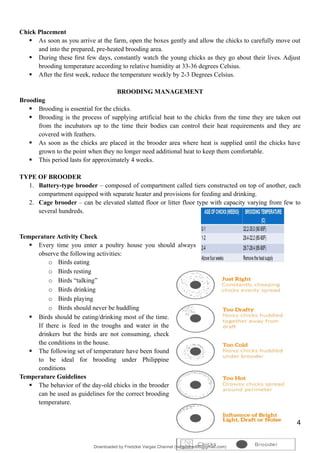
  • 33.
    a. Pancake/Gas Brooders Theseare either round or square pans that have got gas elements that are gas heated to supply the heat. One such brooder warms up to 1000 chicks at a time. The advantage is that they heat is very e ective and it warms a large number of birds at a time. The downside is that there must be consistent ff supplies of gas. The gas must also be a ordable, otherwise the brooding costs will go up. ff Dry Heat Conveyors These are normally systems of metal piping that conveys heat blown into a poultry house from heated chambers outside a poultry house. The source of the heat is normally wood or coal or any other fuel, depending on the system. The heat is normally blown by a blower or can be manually blown. These are now being commercially made mostly for large poultry houses. HOUSING EQUIPMENTS House Features Construction Materials  Bamboo slats, nipa shingles, coco lumber  GI sheets, aluminium sheet, wood, welded wire, plastic nets Shape  Long and narrow with east-west orientation Width  10 to 12 meters Height  Floor height (1.8 m or 5.9 ft)  Floor to ceiling (2.4 or 8 ft) Roof Style  Shed type  Gable type  Combination (shed-gable)  Monitor type  Semi-monitor Teaching and Learning Activities 1. The lecturer willl use slides and powerpoint presentation showing the 2. The students will also encourage to partiicipate and shre their ideas regarding to the topics discussion. Recommended learning materials and resources for supplementary reading. 1. Worktext, textbooks, PDF, modules, and video presentations will be provided to the students. 32 Note: Lighting Equipment Broilers will require light in order to locate water and feed, so light equipment must be installed in a chicken house. If the house is electrified, then normal light bulbs will do. If there are no electricity connections, you are encouraged to install solar lights, which are quite affordable now. Should these be not available, then you can consider even candles, but these need care because if they fall onto the bedding, a fire can easily result. Also, the candles must not be emitting smoke because this Downloaded by Fredzkie Vargas Channel (vargasfred86@gmail.com) lOMoARcPSD|16678982
  • 34.
    Flexible Teaching LearningModality (FTLM) adopted Online teaching using google meet and zoom meeting Assessment Task 1. Quiz will be done at the end of the chapter. 2. Laboratory worksheets will be done. a. Housing equipment b. Floor space requirements of the animals Reference: 1. Keeping Poultry, 2010. Intensive Animal Industries, Department of Agriculture Tasmania. 2. Ketelaraas, E.H. and H.C. Saxena. 2012. Management of Poultry Production in the Tropics. Bennekom, Holland. Unit 5 Poultry Management Practices Learning Outcomes: At the end of this unit the students must be able to: 1. Enumerate the characteristics of good quality chick 2. Identify the brooding management Learning Objectives: Characteristics of a Good Quality Chick:  Well-dried, long-flu ed down. ff  Bright round active eyes.  Look active and alert.  Have completely healed navels.  Legs should be bright and waxy to the touch.  Free of red hocks.  Chicks should be free from deformities (i.e. crooked legs, twisted necks and cross beaks). Healthy Stocks  Select only healthy chicks which can easily recognize by their fluffy feathers, bright eyes and alert, active appearance. Avoid chicks with wet vent and dull eyes. 33 Downloaded by Fredzkie Vargas Channel (vargasfred86@gmail.com) lOMoARcPSD|16678982
  • 35.
    Chick Placement  Assoon as you arrive at the farm, open the boxes gently and allow the chicks to carefully move out and into the prepared, pre-heated brooding area.  During these first few days, constantly watch the young chicks as they go about their lives. Adjust brooding temperature according to relative humidity at 33-36 degrees Celsius.  After the first week, reduce the temperature weekly by 2-3 Degrees Celsius. BROODING MANAGEMENT Brooding  Brooding is essential for the chicks.  Brooding is the process of supplying artificial heat to the chicks from the time they are taken out from the incubators up to the time their bodies can control their heat requirements and they are covered with feathers.  As soon as the chicks are placed in the brooder area where heat is supplied until the chicks have grown to the point when they no longer need additional heat to keep them comfortable.  This period lasts for approximately 4 weeks. TYPE OF BROODER 1. Battery-type brooder – composed of compartment called tiers constructed on top of another, each compartment equipped with separate heater and provisions for feeding and drinking. 2. Cage brooder – can be elevated slatted floor or litter floor type with capacity varying from few to several hundreds. Temperature Activity Check  Every time you enter a poultry house you should always observe the following activities: o Birds eating o Birds resting o Birds “talking” o Birds drinking o Birds playing o Birds should never be huddling  Birds should be eating/drinking most of the time. If there is feed in the troughs and water in the drinkers but the birds are not consuming, check the conditions in the house.  The following set of temperature have been found to be ideal for brooding under Philippine conditions Temperature Guidelines  The behavior of the day-old chicks in the brooder can be used as guidelines for the correct brooding temperature. 34 Downloaded by Fredzkie Vargas Channel (vargasfred86@gmail.com) lOMoARcPSD|16678982
  • 36.
     When thetemperature is hot, the chicks will pant, spread out their wings, eat less and remain inactive, move away from the source of heat and stay close to the edges of tile brooder.  When the temperature is low, the chicks will crowd under the heater, pile up and make known their comfort loud chirping. Lighting Equipment  Broilers will require light in order to locate water and feed, so light equipment must be installed in a chicken house. If the house is electrified, then normal light bulbs will do.  If there are no electricity connections, you are encouraged to install solar lights, which are quite a ordable now. ff  Should these be not available, then you can consider even candles, but these need care because if they fall onto the bedding, a fire can easily result.  One cardinal rule to follow in the light management of poultry intended for egg production is NEVER INCREASE LIGHT DURING GROWING PERIOD and NEVER DECREASE LIGHT DURING THE LAYING PERIOD.  Increase day length (light) during the growing period of birds will hasten their sexual maturity, which will result to production of more pullet eggs (small eggs), layers are prone to prolapsed and shorter egg production cycle.  LIGHT REQUIREMENT - Light requirement is very important in the development of new layers. The correct light to dark ratio in the rearing house will influence the production of larger eggs.  During the first few days of brooding, lighting the chicks throughout the night (24 hours) is favorable to growth because there is more eating time if feed is available.  The light in the brooder will encourage the birds to keep close to the source of heat, feed and water.  ADEQUATE LIGHT AND VENTILATION - a well lighted brooder attracts and encourage the chicks to start feeding. Sources of Heat Brooders  Electricity  LPG (Liquefied petroleum Gas)  Infra-Red Lamp  Lamp Charcoal  Kerosene lamp  Provide sufficient ventilation to supply plenty of oxygen and facilitate the removal of carbon dioxide and excess ventilation, the chicks will not only be weak and in poor conditions but will also be more predisposed to respiratory diseases. Ample Space to Avoid Overcrowding  It provides brooder with enough space to avoid overcrowding which leads to poorly developed chicks, high mortality as well as harmful vices like toe picking, feather picking or cannibalism.  At the beginning of the brooding period, the chicks need very little space but as the chicks grow older they must be provided much wider area. Space Requirements Egg Type Chicken 1 day to 3 weeks 0.3 sq. ft/ bird 3 to 8 weeks 0.5 sq. ft/ bird 8-12 weeks 1.0 sq. ft/ bird 35 Downloaded by Fredzkie Vargas Channel (vargasfred86@gmail.com) lOMoARcPSD|16678982
  • 37.
    Meat Type /Broiler 1 day to 2 weeks 0.3 sq.ft/ bird 2 weeks to marketing stage 1.0 sq.ft/ bird *After 12 weeks, the floor space requirement of growing pullets varies according to the system housing used. Litter floor 2.0-2.5 sq. ft/ bird Slat floor 1.5-2.0 sq. ft/ bird Cages 0.75-1.0 sq.ft/ bird Meat Type / Broiler 1 day to 2 weeks 0.3 sq. ft/ bird 2 weeks to marketing age 1.0 sq. ft/ bird Teaching and Learning Activities 1. The lecturer willl use slides and powerpoint presentation showing the 2. The students will also encourage to partiicipate and share their ideas regarding to the topics discussion. Recommended learning materials and resources for supplementary reading. 1. Worktext, textbooks, PDF, modules and video presentations will be provided to the students. Flexible Teaching Learning Modality (FTLM) adopted Online teaching using google meet and zoom meeting Assessment Task 1. Quiz will be done at the end of the chapter. 2. Laboratory worksheet on floor space requirement of poultry Reference: 1. Keeping Poultry, 2010. Intensive Animal Industries, Department of Agriculture Tasmania. 2. Ketelaraas, E.H. and H.C. Saxena. 2012. Management of Poultry Production in the Tropics. Bennekom, Holland. 36 Downloaded by Fredzkie Vargas Channel (vargasfred86@gmail.com) lOMoARcPSD|16678982
  • 38.
    Module 6 Poultry Nutritionand Feeds and Feeding Introduction Worldwide, production of poultry meat and eggs has increased consistently over the years, and this trend is expected to continue. It is predicted that most increases in poultry production during the next two decades will occur in developing countries, where rapid economic growth, urbanization and higher household incomes will increase the demand for animal proteins. Several factors have contributed to the consistent growth in world poultry production, including: i) genetic progress in poultry strains for meat and egg production; ii) better understanding of the fundamentals of nutrition; and iii) disease control. For example, the age for a meat chicken to reach the market weight of 2 kg has steadily decreased from 63 days in 1976 to 35 days in 2009, and the efficiency of converting feed into poultry products also continues to improve. This growth in poultry production is having a profound effect on the demand for feed and raw materials. Feed is the most important input for poultry production in terms of cost, and the availability of low-priced, high-quality feeds is critical if poultry production is to remain competitive and continue to grow to meet the demand for animal protein. Learning Outcome At the end of this module, the students must be able to: 1. Discuss the nutrition in needed in poultry. 2. Identify the nutrient requirement in poultry nutrition 3. Practice and define the different methods in feed formulation. Learning Content 37 Downloaded by Fredzkie Vargas Channel (vargasfred86@gmail.com) lOMoARcPSD|16678982
  • 39.
    . A. NutrientRequirement For maximum growth and good health, intensively reared poultry need a balanced array of nutrients in their diet. The nutrients required by birds vary according to species, age and the purpose of production – whether the birds are kept for meat or egg production. To meet these specific needs, different classes of poultry have to be fed different types of diets. These recommendations should only be considered as guidelines and used as the basis for setting dietary nutrient concentrations in practical diets. Historically, recommendations on nutrient requirements have been based on available literature and data from expert groups. Currently, however, because each specific genotype has its own requirements, most commercial feed formulations use minimum requirements recommended by the breeding companies that supply the chicks. 1. Energy Poultry can derive energy from simple carbohydrates, fat and protein. They cannot digest and utilize some complex carbohydrates, such as fibre, so feed formulation should use a system based on available energy. Metabolizable energy (ME) is the conventional measure of the available energy content of feed ingredients and the requirements of poultry. This takes account of energy losses in the faeces and urine. Birds eat primarily to satisfy their energy needs, provided that the diet is adequate in all other essential nutrients. The energy level in the diet is therefore a major determinant of poultry’s feed intake. When the dietary energy level changes, the feed intake will change, and the specifications for other nutrients must be modified to maintain the required intake. For this reason, the dietary energy level is often used as the starting point in the formulation of practical diets for poultry. Different classes of poultry need different amounts of energy for metabolic purposes, and a deficiency will affect productive performance. To sustain high productivity, modern poultry strains are typically fed relatively high-energy diets. The dietary energy levels used in a given situation are largely dictated by the availability and cost of energy-rich feedstuffs. Because of the high cost of cereals, particularly maize, the use of low-energy diets for poultry feeding is not uncommon in many developing countrie 2. Protein and amino acids The function of dietary protein is to supply amino acids for maintenance, muscle growth and synthesis of egg protein. The synthesis of muscle and egg proteins requires a supply of 20 amino acids, all of which are physiological requirements. Ten of these are either not synthesized at all or are synthesized too slowly to meet the metabolic requirements, and are designated as essential elements of the diet. These need to be supplied in the diet. The balance can be synthesised from other amino acids; these are referred to as dietary non-essential elements and need not be considered in feed formulations. From a physiological point of view, however, all 20 amino acids are essential for the synthesis of various proteins in the body. The essential amino acids for poultry are lysine, methionine, threonine, tryptophan, isoleucine, leucine, histidine, valine, phenylalanine and arginine. In addition, some consider glycine to be essential for young birds. Cysteine and tyrosine are considered semi-essential amino acids, because they can be synthesized from methionine and phenylalanine, respectively. Of the ten essential amino acids, lysine, methionine and threonine are the most limiting in most practical poultry diets. Poultry do not have a requirement for protein per se. However, an adequate dietary supply of nitrogen from protein is essential to synthesize non-essential amino acids. This ensures that the essential amino acids are not used to supply the nitrogen for the synthesis of non-essential amino acids. Satisfying the recommended requirements for both protein and essential amino acids therefore ensures the provision of all amino acids to meet the birds’ physiological needs. The amino acid requirements of poultry are influenced by several factors, including production level, genotype, sex, physiological status, 38 Downloaded by Fredzkie Vargas Channel (vargasfred86@gmail.com) lOMoARcPSD|16678982
  • 40.
    environment and healthstatus. For example, high levels of lean meat deposition require relatively high levels of lysine. High levels of egg output or feather growth require relatively high levels of methionine. However, most changes in amino acid requirements do not lead to changes in the relative proportions of the different amino acids. There is therefore an ideal balance of dietary amino acids for poultry, and changes in amino acid requirements are normally expressed in relation to a balanced protein or ideal protein. 3.Fats and fatty acids Because of the greater energy density of fat compared with carbohydrates and protein, poultry diets usually include fats to achieve the needed dietary energy concentration. Fat accounts for about 3 to no more than 5 percent of most practical diets. Other benefits of using fats include better dust control in feed mills and poultry houses, and improved palatability of diets. Poultry do not have a specific requirement for fats as a source of energy, but a requirement for linoleic acid has been demonstrated. Linoleic acid is the only essential fatty acid needed by poultry, and its deficiency has rarely been observed in birds fed practical diets. Linoleic acid’s main effect in laying birds is on egg size. 4. Minerals Minerals are needed for formation of the skeletal system, for general health, as components of general metabolic activity, and for maintenance of the body’s acid-base balance. Calcium and phosphorus are the most abundant mineral elements in the body, and are classified as macro-minerals, along with sodium, potassium, chloride, sulphur and magnesium. Macro-minerals are elements required in the diet at concentrations of more than 100 mg/kg. Calcium and phosphorus are necessary for the formation and maintenance of the skeletal structure and for good egg-shell quality. In general, 60 to 80 percent of total phosphorus present in plant-derived ingredients is in the form of phytate-phosphorus. Under normal dietary conditions, phytate phosphorus is poorly utilized by poultry owing to the lack of endogenous phytase in their digestive enzymes. It is generally assumed that about onethird of the phosphorus in plant feedstuffs is non- phytate and is biologically available to poultry, so the phosphorus requirement for poultry is expressed as non-phytate phosphorus, rather than total phosphorus. A ratio of 2:1 must be maintained between calcium and non-phytate phosphorus in growing birds’ diets, to optimize the absorption of these two minerals. The ratio in laying birds’ diets is 13:1, because of the very high requirement for calcium for good shell quality. Dietary proportions of sodium (Na), potassium (K) and chloride (Cl) largely determine the acid-base balance in the body for maintaining the physiological pH. If a shift occurs towards acid or base conditions, the metabolic processes are altered to maintain the pH, with the likely result of depressed performance. The dietary electrolyte balance is described by the simple formula (Na+ + K+ - Cl - ) and expressed as mEq/kg diet. Prevention of electrolyte imbalance needs careful consideration, especially in hot climates. Under most conditions, a balance of about 250 mEq/ kg of diet appears satisfactory for optimum growth. The overall balance among these three minerals, and their individual concentrations are important. To be effective, their dietary levels must each be within acceptable ranges, not deficient and not excessive. Birds exposed to heat stress consume more water, and are better able to withstand heat when the water contains electrolytes. The replacement of part of the supplemental dietary sodium chloride with sodium bicarbonate has proved useful under these conditions. Trace elements, including copper, iodine, iron, manganese, selenium, zinc and cobalt, function as components of larger molecules and as co-factors of enzymes in various metabolic reactions. These are required in the diet in only very small amounts. Practical 39 Downloaded by Fredzkie Vargas Channel (vargasfred86@gmail.com) lOMoARcPSD|16678982
  • 41.
    poultry diets shouldbe supplemented with these major and trace minerals, because typical cereal-based diets are def cient in them. Organic forms of some trace minerals are currently available, and are generally considered to have higher biological availability than inorganic forms. 5. Vitamins Vitamins are classified as fat-soluble (vitamins A, D, E and K) and water-soluble (vitamin B complex and vitamin C). All vitamins, except for vitamin C, must be provided in the diet. Vitamin C is not generally classified as a dietary essential as it can be synthesized by the bird. However, under adverse circumstances such as heat stress, dietary supplementation of vitamin C may be beneficial. The metabolic roles of the vitamins are more complex than those of other nutrients. Vitamins are not simple body building units or energy sources, but are mediators of or participants in all biochemical pathways in the body. Water Water is the most important, but most neglected nutrient in poultry nutrition. Water has an impact on virtually every physiological function of the bird. A constant supply of water is important to: i) the digestion of feed; ii) the absorption of nutrients; iii) the excretion of waste products; and iv) the regulation of body temperature. Water constitutes about 80 percent of the body. Unlike other animals, poultry eat and drink all the time. If they are deprived of water for even a short time, production and growth are irreversibly affected. Water must therefore be made available at all times. Both feed intake and growth rate are highly correlated with water intake. Precise requirements for water are difficult to state, and are influenced by several factors, including ambient conditions, and the age and physiological status of the birds. Under most conditions, water intake is assumed to be twice the amount of feed intake. Drinking-water temperatures should be between 10 and 25 °C. Temperatures over 30 °C will reduce consumption. The quality of water is equally important. Quality is often taken for granted, but poor water quality can lead to poor productivity and extensive economic losses. Water is an ideal medium for the distribution of contaminants, such as chemicals and minerals, and the proliferation of harmful microorganisms. Water quality for poultry can be a major issue in arid and semi-arid regions where water is scarce. In particular, underground water in these areas can have high levels of salt. Saline drinking-water containing less than 0.25 percent salt is tolerated by birds, but can cause sodium toxicity if water intake is restricted. B. Define Nutrition Nutrition can be defined as the process of taking in and assimilating food. It can also defined as the transformation of food elements to body elements through chemical and physiological processes with the influence of body additives. Nourish means to feed or sustain animal with substances necessary for life and growth. Thus a nutrient may be defined as something that nourishes an animal or more specifically, an element that is required in the diet of a given animal permit normal functioning of the life processes. C. Feed Additives Agricultural producers must be efficient and produce a marketable product while maintaining costs. One method agricultural producers use to help them achieve these goals is the use of feed additives. Feed additives are added to an animal’s feed for growth acceleration, increased feed efficiency, increased production of animal products, or health maintenance improvement. Feed additives are not usually considered a nutrient source. Two major categories of feed additives are growth regulators and antibiotics. Growth regulators are hormones that increase growth rates and feed efficiency. Antibiotics are used as a feed additive for the 40 Downloaded by Fredzkie Vargas Channel (vargasfred86@gmail.com) lOMoARcPSD|16678982
  • 42.
    prevention and treatmentof diseases and infections such as scours, coccidiosis, and foot rot. Antibiotics may be used at low levels to improve efficiency and growth. Feed additives are also used for other purposes. Anthelmintics, also known as dewormers, are used to control various types of worms. Other uses of feed additives include bloat control in ruminant animals, stress reduction by adding tranquilizers, pH level regulation, and fly control E. Classification of feedstuff 1. Roughages Feed consisting of bulky and course plants or plant parts, containing a high fiber content and low total digestible nutrients, arbitrarily defined as feed with over 18% C.F. and 60% TDN 2. Concentrates 3. Grasses F. Feed Formulation Feed formulation is the process of quantifying the amounts of feed ingredients that need to be combined to form a single uniform mixture (diet) for poultry that supplies all of their nutrient requirements. Since feed accounts for 65-75% of total live production costs for most types of poultry throughout the world, a simple mistake in diet formulation can be extremely expensive for a poultry producer. Feed formulation requires thorough understanding of the: (a) nutrient requirements of the class of poultry (e.g., egg layers, meat chickens or breeders); (b) feed ingredients in terms of nutrient composition and constraints in terms of nutrition and processing, and (c) cost and availability of the ingredients. 1. Types of Feed Formulation a. Person Square method - The Pearson square or box method of balancing rations is a simple procedure that has been used for many years. It is of greatest value when only two ingredients are to be mixed. In taking a close look at the square, several numbers are in and around the square. Probably one of the more important numbers is the number that appears in the middle of the square. This number represents the nutritional requirement of an animal for a specific nutrient. It may be crude protein or TDN, amino acids, minerals or vitamins In order to make the square work consistently, there are three very important considerations: 1. The value in the middle of the square must be intermediate between the two values that are used on the left side of the square. For example, the 14 percent crude protein requirement has to be intermediate between the soybean meal that has 45 percent crude protein or the corn that has 10 percent crude protein. If barley is used that has 12 percent crude protein and corn 41 Downloaded by Fredzkie Vargas Channel (vargasfred86@gmail.com) lOMoARcPSD|16678982
  • 43.
    that has 10percent crude protein, the square calculation method will not work because the 14 percent is outside the range of the values on the left side of the square. 2. Disregard any negative numbers that are generated on the right side of the square. Be concerned only with the numerical differences between the nutrient requirement and the ingredient nutrient values. 3. Subtract the nutrient value from the nutritional requirement on the diagonal and arrive at a numerical value entitled parts. By summing those parts and dividing by the total, you can determine the percent of the ration that each ingredient should represent in order to provide a specific nutrient level. Always subtract on the diagonal within the square in order to determine parts. Always double check calculations to make sure that you did not have a mathematical error. It also is very important to work on a uniform basis. Use a 100-percent dry-matter basis for nutrient composition of ingredients and requirements and then convert to an as-fed basis after the formulation is calculated. b. Trial and Error Method. This is the most popular method of formulating ration for the swine and poultry. It is a type of feed formulation in many developing nations of the world (Adejoro 2004), Nigeria inclusive. As the name implies, the formulation is manipulated until the nutrient requirements of the animal are met. This method makes possible the formulation of a ration that meets all the nutrient requirements of the animal. In poultry feed formation, various cases of mineral deficiency such as osteomalacia, rickets and shellessness or soft shell formation may not be properly addressed if care is not taken to comprehensively analyze question. Teaching and Learning Activities 1. The lecturer willl use slides and powerpoint presentation showing the 2. The students will also encourage to partiicipate and share their ideas regarding to the topics discussion. Recommended learning materials and resources for supplementary reading. 1. Worktext, textbooks, PDF, modules and video presentations will be provided to the students. Flexible Teaching Learning Modality (FTLM) adopted 1. Online teaching using google meet and zoom meeting Assessment Task 1. Quiz will be done at the end of the chapter. 2. Laboratory worksheet on floor space requirement of poultry References: 1. Esminger, M.E., J.E. Oldfield and W.W. Heinemann.2008.Feeds and Nutrition Digest. The Esminger Publishing Company,648 west Sierra Avenue Clovis, California, U.S.A 2. https://www.iiste.org/Journals/index.php/JBAH/article/viewFile/5358/5337 42 Downloaded by Fredzkie Vargas Channel (vargasfred86@gmail.com) lOMoARcPSD|16678982
  • 44.
    Module7 Common Diseases andParasites of Poultry Introduction: Learning Outcomes: Learning Objectives: Common disease and Parasites in poultry Aspergillosis (Fungal Pneumonia) Cause  The principal fungus causing Aspergillosis in poultry is Aspergillus fumigatus. Transmission  Transmission is by inhalation of fungus spores from contaminated litter (e.g. wood shavings, straw) or contaminated feed. Hatcheries may also contribute to infection of chicks. Species A ected ff  Young chickens are very susceptible. Older chickens are more resistant to infection. Turkey poults, pheasants, quails, ducklings, and goslings may also become infected. Clinical Signs 43 Downloaded by Fredzkie Vargas Channel (vargasfred86@gmail.com) lOMoARcPSD|16678982
  • 45.
     Infected chickensare depressed and thirsty. Gasping and rapid breathing can be observed. Mortality is variable, from 5 to 50 %. Gross lesions involve the lungs and airsacs primarily.  Yellow-white pin head sized lesions can be found. Sometimes all body cavities are filled with small yellow-green granular fungus growth. Diagnosis  The presence of Aspergillus fumigatus can be identified microscopically or sometimes even with the naked eye in the air passages of the lungs, in the airsacs or in lesions of the abdominal cavity. Aspergillosis can be confirmed by isolation and identification of the fungus from lesions. Treatment and Control  There no specific treatment for infected birds. The best is to remove and destroy a ected birds. Strict ff hygiene in breeder (hatching eggs) and hatchery management is necessary. Avian Influenza (AI) Cause  Avian Influenza is caused by an Orthomyxovirus; there are several serotypes.  Transmission  AI virus is excreted from nares, mouth, conjunctiva and cloaca. Airborne virus particles from the respiratory tract, droppings, and people carrying virus on their clothing and equipment are the main routes of transmission. Diagnosis  Clinical signs are indicative for AI; final confirmation by laboratory testing:  Virus isolation from infected organs, tracheal or cloacal swabs.  Serology from blood samples after infection and for routine monitoring showing specific AI antibodies. Treatment  There is no treatment for Avian Influenza. Antibiotics will help to control secondary bacterial infections. Prevention and Control  In many countries AI is a notifiable disease with specific local regulations on its control. In AI free areas the disease is controlled by monitoring and stamping out.  Vaccination is generally done with inactivated AI vaccines based on the strain H-type causing the outbreaks. Avian Metapneumovirus “Swollen Head Syndrome (SHS)” Cause  Avian Metapneumovirus, belongs to the subfamily Pneumovirus from the family Paramyxoviridae. 44 Downloaded by Fredzkie Vargas Channel (vargasfred86@gmail.com) lOMoARcPSD|16678982
  • 46.
    Transmission  The virusspreads horizontally via direct contact from bird to bird and via contaminated personnel, water and equipment.  Species a ected Turkeys and chickens. ff Clinical Signs and Lesions  In both turkeys and chickens. In young birds the respiratory clinical signs; snicking, rales, sneezing, nasal discharge , foamy conjunctivitis, swollen infraorbital and periorbital sinus “swollen head” are most prominent; when birds become older head shaking and coughing can be added. In adult laying hens there may a drop in egg production up to 70% with an increased incidence of poor shell quality. Treatment  There is no treatment for aMPV infections. Treatment with antibiotics can be given to control secondary bacterial infections. Prevention  Vaccination is the most e ective prevention method. Over the years live and inactivated vaccines ff have been developed and are very e cacious in controlling infections. Short living birds will only ffi be vaccinated with a live vaccine(s). Long living birds are advised to be primed with live- and boosted with inactivated vaccines. In this way the birds will have good long lasting local and systemic protection. Infectious Bronchitis (IB) Cause  Infectious Bronchitis (IB) is present worldwide, it is a highly contagious, acute, and economically important disease. IB is caused by an Avian Coronavirus. Transmission  The virus is transmitted rapidly from bird to bird through the airborne route. The virus can also be transmitted via the air between chicken houses and even from farm to farm. The incubation period is only 1-3 days.  Species a ected Chickens are the primary poultry species that is susceptible to IB-virus, but quail ff and pheasants can be a ected. Recent discovery of IB virus in other species without clinical signs ff indicates that other species may act as vectors. Clinical Signs  In young chickens the respiratory form appears with gasping, sneezing, tracheal rales and nasal discharge. Generally chicks are depressed and show reduced feed consumption. Mortality in general is low unless infection gets complicated with secondary bacterial infections (like E.coli).  In adult “laying” birds (layers and breeders) after initial respiratory signs the a ected flocks show a ff drop in egg production and a loss of egg quality (shell deformation and internal egg changes) resulting in more second class eggs, a ecting the hatchability rate of fertile eggs and day-old chick ff quality. Post mortem lesions  In young chicks a yellow cheesy plug at the tracheal bifurcation is indicative of IB infection. In case of nephropathogenic infections pale and swollen kidneys and distended ureters with urates are found. Diagnosis 45 Downloaded by Fredzkie Vargas Channel (vargasfred86@gmail.com) lOMoARcPSD|16678982
  • 47.
     Clinical signsand post mortem lesions in a flock followed by laboratory confirmation based on virus isolation and identification with PCR. Serology based on paired blood samples using HI, Elisa or VN tests. Treatment  There is no treatment for IB. Antibiotics are used to control secondary bacterial infections. Prevention  Vaccination with strain specific or cross protective live vaccines, and for layers and breeders the addition of inactivated vaccines at point of lay to induce long lasting systemic immunity. Infectious Coryza Cause  This is a bacterial disease caused by Avibacterium paragallinarum, (in the past known as Haemophilus paragallinarum).  There are 3 common serotypes, representing di erent immunotypes: ff A, B, C. Transmission  The disease spreads from bird to bird and flock to flock by contact and airborne infected dust particles and via the drinking water. Spread by equipment and personnel have also been reported. The incubation period varies from 1 to 3 days. Species A ected ff  The chicken is the natural host for Avibacterium paragallinarum. All ages are susceptible, but the disease is usually less severe in juvenile birds. Clinical Signs  The main clinical signs are due to an acute inflammation around the eyes and upper respiratory tract. Signs include a serous to mucoid discharge in the nasal passage and sinuses, facial edema and conjunctivitis.  Feed and water consumption will be decreased resulting in loss of weight gain and loss of egg production (10-40%) in laying birds. Diagnosis  A field infection produces similar symptoms to chronic respiratory disease, therefore a diagnosis based only on clinical signs is di cult to establish. ffi  The most certain diagnosis may be obtained by the isolation of the organism from the sinus or airsac exudate from a ected birds. This procedure must be carried out in the laboratory. There is no ff practical serological test. Control: Eradication is not economically feasible. Treatment  Treatment with various antibiotics (erythromycin and tetracycline are commonly used) will alleviate the severity and course of the disease.  Relapse often occurs after treatment is discontinued and recovered birds will remain carriers.  Because of noted drug resistance of Avibacterium paragallinarum, an antimicrobial sensitivity test is recommended. Prevention  Vaccination is the preferred control method and is standard in most endemic Coryza areas. There is no cross protection between the serotypes A, B, C. 46 Downloaded by Fredzkie Vargas Channel (vargasfred86@gmail.com) lOMoARcPSD|16678982
  • 48.
    Infectious Laryngotracheitis (ILT) Cause ILT is caused by a Herpesvirus, only one serotype is known. Transmission  The natural entry of ILT is via the upper respiratory tract and ocular route. Field spread occurs via direct contact from bird to bird and/or transmission by contaminated people or equipment (visitors, shoes, clothing, egg boxes, transport crates). Incubation period varies from 4 -12 days. Species A ected ff : Chickens are the primary natural host but other species (pheasants) can also be a ected. ff Clinical Signs  An acute respiratory disease with nasal discharge and moist rales followed by gasping, marked respiratory distress and expectoration of blood-stained mucus in laying birds. Post Mortem Lesions  Lesion are found throughout the respiratory tract but most pronounced in the larynx and trachea.  Depending on the severity of the infection you can find tracheitis with haemorrhagic and/or diphteric changes. Diagnosis Clinical  Laboratory confirmation with: histopathology showing intranuclear inclusion bodies in tracheal epithelial cells, virus isolation from tracheal swabs on embryonated chicken eggs, virus detection with IFT on tracheal samples. Detecting antibodies from blood samples after infection. Treatment  There is no treatment for ILT; emergency vaccination in the early stage of an infected flock may reduce the spread and limit the outbreak. Prevention and Control  In many countries vaccination is the preferred control method. Though in some countries it is not allowed to vaccinate or only under restriction. Mycoplasma gallicepticum (CRD) Cause  The underlying cause of CRD is Mycoplasma gallisepticum (MG).  The condition is frequently triggered by respiratory viruses such as ND and IB and subsequently complicated by bacterial invasion.  The main agents involved in the infection are Mycoplasma gallisepticum and E. coli. Stress caused by moving the birds, by debeaking, other operations/ handlings or other unfavorable conditions e.g. cold or bad ventilation, make the birds more susceptible. Transmission 47 Downloaded by Fredzkie Vargas Channel (vargasfred86@gmail.com) lOMoARcPSD|16678982
  • 49.
     The mainproblem is that parent birds infected with Mycoplasma gallisepticum can transmit the organism through the egg to their o spring (vertical transmission). ff  In addition, infection can occur by contact or by airborne dust or droplets (horizontal transmission).  The incubation period varies from 4 days to 3 weeks. Species A ected ff : Chickens and Turkeys. Clinical Signs  Young chickens (broilers or layer pullets) will show respiratory distress.  The birds frequently show lack of appetite, decreased weight gain and increased feed conversion ratios.  In adult birds the most common signs are sneezing and general respiratory distress. In laying birds a drop in egg production between 20-30 % can occur.  In breeders hatchability can be a ected and day-old chick quality produced from hatching eggs ff coming from infected flocks will be reduced.  CRD does not normally cause an alarming number of deaths.  The e ect is more of a chronic nature causing reduced weight gain and higher feed conversion ratios ff in broilers and lower egg production in breeders and layers.  In this way the overall economic losses can be very high. Internal Lesions  A reddish inflamed trachea and/or frothy, cheesy exudate in the airsacs, especially in complicated cases (e.g. with secondary E. coli infections) are observed.  In mild MG infections the only lesion might be slight mucus in the trachea and a cloudy or light froth in the airsacs. Diagnosis  Diagnosis of MG infection can be made based on clinical signs and post mortem lesions followed by confirmation in the laboratory using blood (serum) samples for serology or organs swabs for identification by PCR or mycoplasma isolation. Treatment  Treatment of MG-infected chickens or turkeys with suitable antibiotics or chemotherapeutics has been found to be of economic value, but will not eliminate MG from the flock. Prevention  Prevention by monitoring and vaccination has become a more e ective method of combating the ff disease especially in layers.  Economic losses in commercial layers can be reduced by proper use of MG vaccines. Newcastle Disease (NCD) Cause  Newcastle disease is caused by a Paramyxovirus (APMV- 1). Transmission  Newcastle disease virus is highly contagious through infected and respiratory discharge between birds. 48 Downloaded by Fredzkie Vargas Channel (vargasfred86@gmail.com) lOMoARcPSD|16678982
  • 50.
     Spread betweenfarms is by infected equipment, trucks, personnel, wild birds or air. The incubation period is variable but usually about 3 to 6 days. Species A ected ff : Chickens and turkeys. Clinical Signs  Highly pathogenic strains (velogenic) of ND cause high mortality with depression and death within 3 to 5 days. A ected chickens do not always exhibit respiratory or nervous signs. ff  Labored breathing with wheezing and gurgling, accompanied by nervous signs, such as paralysis or twisted necks (torticollis) are the main signs.  Drop in egg production 30 to 50 % or more, returning to normal levels in about 2-3 weeks is observed. Besides also egg shell quality will be a ected (thin, loose color). ff  In well-vaccinated chicken flocks clinical signs may be di cult to find. ffi  Intestinal lesions Inflamed tracheas, pneumonia, and/or froth in the airsacs are the main lesions. Treatment  There is no specific treatment for ND; antibiotic treatment of secondary bacterial infections will reduce the losses. Prevention and Control  Vaccination has proven to be a reliable control method.  But ND is a notifiable disease, and in many countries the control is based on a combination of obliged vaccination and stamping out in case of outbreaks.  A wide range of live and inactivated vaccines are used in vaccination programs to prevent ND. Marek’s Disease (MD) Cause  Marek’s disease is caused by a alphaherpesvirus. Transmission  The disease is highly contagious. Main transmission is by infected premises, where day-old chicks will become infected by the oral and respiratory routes. Dander from feather follicles of MD-infected chickens can remain infectious for more than a year.  Young chicks are particularly susceptible to horizontal transmission. Susceptibility decreases rapidly after the first few days of age. Species a ected. ff  Especially chickens, also quail, turkeys and pheasants are susceptible. Clinical signs Infected birds show weight loss, or may exhibit some form of paralysis.  When the gizzard nerve is involved, the birds will have a very small gizzard and intestines and will waste away.  Acute Marek’s disease is an epidemic in susceptible or unvaccinated flocks causing depression paralysis, mortality and lymphomatous infiltrations/tumours in multiple organs. Diagnosis  The presence of tumours in liver, spleen, kidneys, lungs, ovary, muscles, or other tissues is indicative of MD, but they can also be indicative of lymphoid leucosis. 49 Downloaded by Fredzkie Vargas Channel (vargasfred86@gmail.com) lOMoARcPSD|16678982
  • 51.
     Eye involvementcan be visible as an irregular constriction of the iris.  Skin involvement often consists of tumours of feather follicles or in between follicles it is a reason for broiler condemnation in certain parts of the world.  A proper diagnosis to di erentiate MD from LL requires histological examination. The paralysis is ff caused by lesions and enlargements of the a ected nerves. ff Treatment  There is no e ective treatment for a ected flocks. ff ff  Control Vaccination is an e ective means of control. It has been demonstrated that MD vaccine only ff prevents the appearance of Marek’s disease tumours and paralysis.  It does not prevent the birds from becoming infected with MD-virus. It is therefore of major importance to maintain high hygienic and sanitary measures by good management to avoid early exposure of young chickens.  Multiple age farms are big risk to Marek’s disease. Inclusion Body Hepatitis Hydropericardium-Hepatitis Syndrome (HHS) Cause  The disease is caused by a virus belonging to the group 1 of Avian Adenovirus and is usually simultaneously accompanied by other immunosuppressive diseases such as infectious bursal disease or infectious anaemia.  There are12 known serotypes of Avian Adenoviruses that may be involved in the development of this disease. Transmission  Egg transmission is an important factor but also horizontal transmission from bird to bird by contact with droppings can occur.  Once the bird becomes immune, the virus can no longer be isolated from the droppings. Progeny of a shedding breeder flock can infect naive progeny of other breeder sources placed in the same house. Species A ected: ff Chickens, turkeys and pheasants and possibly other birds can be a ected by Avian ff Adenoviruses. Clinical Signs  Chickens with inclusion body hepatitis are a ected at usually 5 to 7 weeks of age. The birds are ff listless, with ru ed feathers. ffl  Mortality is usually quite severe, up to 25% in the first 10 days of the disease.  Internal lesions; a ected chickens have enlarged and mottled livers, many with pinpoint necrotic and ff haemorrhagic spots.  Pale bone marrow and, in some cases in presence of infectious anemia, gangrenous dermatitis can be seen. Kidneys are pale. Diagnosis 50 Downloaded by Fredzkie Vargas Channel (vargasfred86@gmail.com) lOMoARcPSD|16678982
  • 52.
     Typical mottledlivers with pinpoint lesions, pale bone marrow and kidneys, small spleen and bursa are good indications of the disease. In the case of HHS the typical lesion is also found.  The best method of control is to ensure adequate immunity against other immune suppressive diseases. Control  The preferred way of control, in endemic areas, is to give the breeders a controlled exposed before the onset of lay by using inactivated vaccines related to the appropriate serotype of Adenovirus to match the challenge. Chicken Anaemia Virus (CAV, Blue wing disease) Cause  Chicken Infectious anaemia is caused by a very resistant small virus known as CAV (Chicken Anaemia Virus). Transmission  The major mode of transmission of infectious anemia is vertical transmission from infected breeder hens. Horizontal transmission from bird to bird or by infected equipment, clothing, etc. is also possible. Clinical Signs and Lesions  CAV causes a syndrome in young chicks up to approximately 3 weeks of age. Adult birds may get infected but will not develop clinical signs.  The disease is characterized by depressed birds, increased mortality and anaemia (pale birds, low hematocrit) and retarded growth.  Lesions; thymus atrophy, bone marrow atrophy, subcutaneous and intramuscular hemorrhages can be found accompanied with atrophy of the lymphoid system.  A ected birds may show focal skin lesions often complicated by bacterial infection. ff  Mortality rates vary but generally do not exceed 30%. Diagnosis  The diagnosis can be based on the clinical signs and pathological findings in a ected birds. ff  Virus isolation is also possible but it is time-consuming and expensive. Treatment  No treatment is available for chicken infectious anaemia.  Control Vaccination of breeders with live attenuated CAV vaccine will induce high and uniform Maternal Derived Antibodies (MDA’s) levels and prevent vertical transmission. MDA’s will protect the progeny during the susceptible period of life. Fowl Pox (Avian Pox, Avian Diphtheria) Cause Fowl pox is caused by a Poxvirus. 51 Downloaded by Fredzkie Vargas Channel (vargasfred86@gmail.com) lOMoARcPSD|16678982
  • 53.
    Transmission  Introduction ofinfected or “carrier” birds in a susceptible flock will cause an outbreak by direct contact and water or feed transmission.  Mosquitoes and other flying insects can also transmit the virus from bird to bird and also transmit the disease to near-by flocks.  The incubation period varies from 4 to 20 days. Species A ected ff : Chickens, turkeys, pheasants and pigeons can be a ected by di erent Fowl Poxvirus ff ff strains. Clinical Signs  The lesions of fowl pox can be external (mainly on the head) or internal (“wet pox”) in the oral cavity, oesophagus and/or trachea.  They can also be found on other parts of the body (skin of legs, cloaca etc.).  The lesions on the head, combs, and wattles are usually wart-like in appearance, yellow to dark brown in color.  The internal lesions (diptherie) in the mouth, oesophagus and/or trachea are yellow-white and cheesy in appearance.  A ected birds will be depressed, lack appetite and when “wet pox” is present they breathe ff laboriously. Treatment  There is no e ective treatment. ff Control  Vaccination using a live vaccine is by far the most successful control method. Even when an outbreak of Fowl Pox has been diagnosed, it is advisable to vaccinate the flock immediately (emergency vaccination) to stop further spreading of the infection. Infectious Bursal Disease (Gumboro disease, IBD) Cause  The disease is caused by a Birnavirus of serotype 1.  Virus strains can be divided in classical and variant strains. The virus is very stable and is di cult to eradicate from an infected ffi farm. Transmission  IBD virus is very infectious and spreads easily from bird to bird by way of droppings. Infected clothing and equipment are means of transmission between farms. Species A ected ff : Chickens and turkeys appear to be natural hosts. Clinical Signs  Clinical IBD occurs usually between 3 and 8 weeks of age depending on maternal antibody levels.  A ected birds are listless and depressed, pale, huddling producing watery white diarrhea. ff  Mortality varies. Diagnosis  Typical clinical signs and post mortem lesions are found after IBD infection.  Post mortem lesions; in acute cases the bursa of Fabricius is enlarged and gelatinous, sometimes even bloody. 52 Downloaded by Fredzkie Vargas Channel (vargasfred86@gmail.com) lOMoARcPSD|16678982
  • 54.
     Muscle haemorrhagesand pale kidneys can be seen. Infection by variant strains is usually accompanied by a fast bursal atrophy (in 24 - 48 hours) without the typical signs of Gumboro disease.  Also in chronic cases the bursa is smaller than normal (atrophy). Treatment  No treatment is available for IBD.  Control Vaccination of breeders and young chicks is the best means of control. The induction of a high maternal immunity in the progeny of vaccinated breeders, together with the vaccination of the o spring is the most e ective approach to successful IBD control. ff ff Fowl Cholera (Avian Cholera, Pasteurellosis, Avain hemorrhagic septicaemia) Cause Fowl cholera is caused by a bacterium: Pasteurella multocida (several serotypes). Transmission Transmission of fowl cholera is mainly from bird to bird by water or feed contamination. There is no evidence for egg transmission. Vectors like flies and red mite can be carriers and can add to the spread. Rodents (rats and mice) also appear to play a role in contamination of water and feed. Species A ected ff : Turkeys, chickens, ducks and geese, game birds and other bird species are susceptible. Clinical Signs and Lesions  A ected birds are depressed and have decreased appetite. ff  Egg production will drop 5-15 % and mortality will be high in acute fowl cholera.  Birds that die from acute fowl cholera frequently have bluish combs and wattles.  Chronic fowl cholera will not cause high mortality, although there will be an increase in deaths. Swollen wattles is a feature of chronic fowl cholera.  Lesions; acute phase septicaemia, vascular changes in abdominal viscera, hemorrhages, liver swelling with focal necrosis, ovaries appear flaccid and hemorrhagic and show ruptured yolks, Chronic phase; localized infections in conjunctiva, fecial edema, middle ear infection resulting in torticollis, meningeal infection. Diagnosis  Clinical signs in combination with isolation and identification from samples from birds that died of acute Fowl cholera. (Fresh death birds) Treatment  Antibiotics based on antibiotic sensitivity test, the earlier the diagnosis the better change of a positive e ect of an antibiotic treatment. ff  Control Hygiene management and rodent control to eliminate possible sources of Pasteurella multocida. Vaccination can be considered in areas . Infectious Synovitis Cause 53 Downloaded by Fredzkie Vargas Channel (vargasfred86@gmail.com) lOMoARcPSD|16678982
  • 55.
     Is aclinical condition caused by di erent possible agents: Mycoplasma synoviae, Staphylococcus ff aureus, E.coli and certain reoviruses. (MS, Reo virus and E.coli information can be found in other chapters of this booklet).  Staphylococcus aureus Staphylococcus infections are common in poultry and mainly caused by Staphylococcus aureus. Transmission Infections generally occur after the breakdown of natural defense mechanisms, due to mechanical damage (eg wounds) or infectious breakdown of the immune system. Species A ected: ff Chickens and turkeys. Clinical Signs and Lesions  Staphylococcus aureus is ubiquitous and infections can become manifest after breakdown of the natural defense mechanisms such as wounds, inflammation, hematogenous dissemination.  Signs vary with the site of entry, most frequent a ected tissues; bone, tendon sheaths and joints. ff  Clinical picture includes lameness in one or both legs, ru ed feathers, swollen joints, fever and ffl increased mortality.  Lesions; swollen joints, arthritis, peri-arthritis and synovitis, osteomyelitis, septicaemia-swollen liver-spleen. Diagnosis  Clinical signs and gross lesions in combination with isolation from a ected tissues will confirm ff Staphylococcus infection. Treatment  Antibiotic treatment based on sensitivity test. Success is not guaranteed.  Control Prevent damage to natural host defense mechanisms. Good litter quality, prevent wounds, hatchery management and sanitation. So far vaccination has not been successful. Pullorum Disease and Fowl Typhoid Cause Pullorum disease is caused by a bacterium, Salmonella pullorum. Fowl typhoid is caused by Salmonella gallinarum, which is related to, but not identical to S. pullorum. Transmission Pullorum and typhoid can be transmitted horizontally and vertically by infected (carrier) breeder hens through their eggs. Chickens that hatch from such infected eggs will have typical pullorum disease (white diarrhoea) and high mortality. Infected chickens can also infect other chicks via droppings. Fowl typhoid is more a disease of adult chickens, with high mortality and morbidity. Horizontal transmission is important with fowl typhoid through infected droppings, dead bird carcasses, and infected clothing, shoes, utensils and other fomites. Species A ected ff Chickens and turkeys.  Other birds such as quails, pheasants, ducks, peacocks and guinea fowl are susceptible. 54 Downloaded by Fredzkie Vargas Channel (vargasfred86@gmail.com) lOMoARcPSD|16678982
  • 56.
    Clinical Signs andLesions  Birds hatched from S.pullorum or S. gallinarum infected eggs appear moribund or dead in the hatching trays and the young birds will show weakness, depressed appetite, poor growth and increased mortality.  In older birds depression. diarrhea, ru ed feathers, pale shrunken combs and drop in egg production ffl and increased mortality will be observed.  Morbidity and mortality can be highly variable (mortality can reach 25-60%) Lesions; acute phase septicaemia-enlarged and congested liver, spleen and kidneys, pericarditis. Hemorrhages. Livers may show white foci. In adult birds atrophic ovarian follicles may be found. Treatment  Treatment with antibiotics of pullorum/fowl typhoid disease will not cure but reduce clinical signs and is undesirable from a standpoint of eradication.  It is far more practical to control the disease by elimination of infected carrier breeder hens.  Blood testing (monitoring) of breeder chickens by the serum plate or tube agglutination test with suitable .  Control Monitoring and eradication in breeders is the preferred control method. For layers vaccination against fowl typhoid with a special S. gallinarum (9R strain) has been practiced in several countries. PARASITIC DISEASES Black head (Histomonosis, Enterohepatitis) Cause  A protozoan parasite, Histomonas meleagridis. Transmission  Direct transmission by infected water, feed, or droppings has been proved. Indirect transmission by infected eggs of the caecal worm. Heterakis gallinarum, is also a major factor.  Raising turkeys and chickens on wire and indoors decreases the incidence of blackhead. Species A ected ff : Chickens and turkeys and peafowl are natural hosts to blackhead infections. Clinical Signs and Lesions  A ected birds are depressed, stand or sit with ru ed feathers, and have yellowish diarrhea. ff ffl  Darkening of head parts, especially in turkeys, gave the name to the disease (black head).  Gross lesions include circular necrotic areas in livers with a crater-like center and cheesy cores in the caeca.  Blackhead can cause high mortality, particularly in young turkey poults, but the disease can also a ect older birds. In chickens the mortality from blackhead infection is usually lower, young ff chickens being the most susceptible. Diagnosis  Clinical signs together with post mortem. Treatment  Treatment with protozoan chemotherapeutics is usually e ective. Such drugs can also be given at ff preventive levels in turkeys starter and grower feed. 55 Downloaded by Fredzkie Vargas Channel (vargasfred86@gmail.com) lOMoARcPSD|16678982
  • 57.
     Growing turkeyson wire and indoors can reduce the incidence of blackhead to a large extent, but even so, strict hygiene and elimination of caecal worms are important control measures. Coccidiosis Cause  Coccidiosis is caused by single-celled parasites of the genus Eimeria. In chickens, there are 9 species.  The five most economically important species are: E. acervulina, E. maxima, E. tenella, E. necatrix and E. brunetti. Other species can be highly pathogenic (E. mivati) but are less ubiquitous. Transmission  Feces containing sporulated Eimeria oocysts are the main means of transmission between birds.  The incubation period from ingestion to shedding of new oocysts is 4 to 7 days. Clinical Signs  Clinical signs, such as weight loss, may appear as early as 4-days post-ingestion of infectious oocysts, but bloody droppings from E. tenella infection usually occur at 6 to 7 days post infection.  Mortality in field cases of these species is rare, unless complicated by secondary infection with Clostridium perfringens (necrotic enteritis). Diagnosis  Diagnosis is based on clinical signs and post-mortem examination, including mucosal scrapings of a ected birds. ff  E. acervulina is characterized by white spots on the mucosal surface of the duodenum and upper middle intestine. Treatment and Prevention  Anticoccidial chemicals e ectively suppress sensitive Eimeria spp. populations, but complete ff resistance to these drugs develops very quickly sometimes during a single broiler flock cycle.  Most e ective coccidiosis prevention and control programs depend upon flock immunity. ff  One method to develop controlled immunity is via feed medication with ionophore antibiotics. The ionophores reduce coccidiosis multiplication, allowing natural immunity to develop while preventing clinical outbreaks. Red Mite Cause  Blood sucking mite “Dermanyssus gallinae” that parasitize birds.  Red mites are obligatory but temporary nocturnal blood feeders, they visit their hosts at night and after engorging blood for 30 to 60 minutes return to their hiding places. Cosmopolitan in distribution. Transmission  Chicken mites live in large colonies or clusters (sometimes multi-layered) near the roosting or resting places of chicken and survive for more than 9 months. 56 Downloaded by Fredzkie Vargas Channel (vargasfred86@gmail.com) lOMoARcPSD|16678982
  • 58.
    Species A ected ff: Chickens Clinical Signs  Blood loss leading to anaemia, irritation and stress due to disturbed sleep, increased feed intake.  Blood spots on eggs resulting in egg downgrading, higher infestations lead to lowered egg production.  Red mites can act as vectors for bacterial and viral diseases. In humans skin irritations and itching allergies may appear. Diagnosis  Clinical signs, workers irritation, set out traps to identify the red mite. Treatment  Insecticides, some products can be used in populated poultry houses against Dermanyssus gallinae, some are only allowed after cleaning in an empty farm. Resistance of red mites to used products can be a problem.  Control Poultry house hygiene, whole flock replacement rather than partial culling. Cleaning thoroughly after removing previous flock, avoid bringing in new mites: via egg cases, egg trays, egg containers, transport equipment, passive transmission by people, vaccination crew, rodents or wild birds. Worms Cause  Worms living in the intestines of chickens fall mainly into four categories.Roundworms (Ascarid), usually 5 to 7 cm (2-3 inches) long. Hairworms (Capillaria), only measure 1-1.5 cm long.  Caecal worms (Heterakis), usually 1.5 cm long.Tape worms (Raillietina, Davainea), usually 7 to 10 cm long, consisting of many small segments. Transmission  Round worms via worm eggs shed in the faeces, tape worms via shed of gravid proglotids carrying eggs. Species A ected ff : Chickens and turkeys. Avain worms have a broad host range. Clinical Signs and Lesions  Mature roundworms are not a major cause of disease, but the larvae can damage the intestinal lining, causing enteritis, anaemia, decreased egg production and at times eggs with pale yolks. Capillaria cause more damage to the intestinal lining and can cause enteritis and anaemia with decreased egg production and the appearance of pale egg yolks (“platinum yolks”).  Caecal worms are found in the caeca and do not cause serious damage, except that their eggs can transmit blackhead (histomonas) – mainly in turkeys.  Tape worms are infrequently found and do not cause serious damage, except that they use the nutrients of the host chicken a ecting economic performance. ff Diagnosis 57 Downloaded by Fredzkie Vargas Channel (vargasfred86@gmail.com) lOMoARcPSD|16678982
  • 59.
     Post mortemexamination of the intestinal contents will reveal round-worms, caecal worms, and tape worms without di culty. Capillaria can usually be found when intestinal contents are washed ffi through a fine mesh sieve. Treatment  Roundworms and caecal worm infections can be treated with anthelmintics(eg Piperazine, Fenbendazole). Piperazine is not e ective against tape worms and capillaria for which other ff anthelmintics are required.  Control Prevent egg loading by strategic deworming and removing infected litter after each cycle. Teaching and Learning Activities 1. The lecturer willl use slides and powerpoint presentation showing the 2. The students will also encourage to partiicipate and shre their ideas regarding to the topics discussion. Recommended learning materials and resources for supplementary reading. 1. Worktext, Textbooks, Pdf, Modular and Video Presentation will be provided to the students Flexible Teaching Learning Modality (FTLM) adopted Online teaching using google meet and zoom meeting Assessment Task 1. Quiz will be done at the end of the module. 2. Laboratory activities will be given. Reference: 1. https://naldc.nal.usda.gov/download/IND43893798/PDF 58 Downloaded by Fredzkie Vargas Channel (vargasfred86@gmail.com) lOMoARcPSD|16678982