Introduction
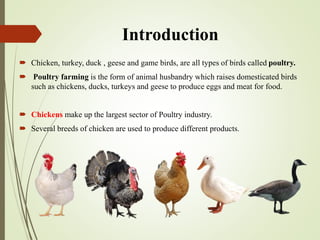
 Chicken, turkey, duck , geese and game birds, are all types of birds called poultry.
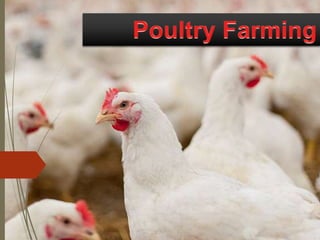
 Poultry farming is the form of animal husbandry which raises domesticated birds
such as chickens, ducks, turkeys and geese to produce eggs and meat for food.
 Chickens make up the largest sector of Poultry industry.
 Several breeds of chicken are used to produce different products.
Poultry Science
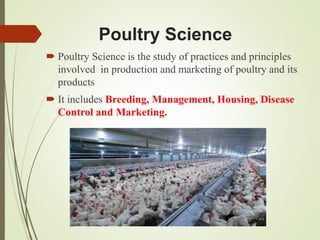
 Poultry Science is the study of practices and principles
involved in production and marketing of poultry and its
products
 It includes Breeding, Management, Housing, Disease
Control and Marketing.
COMMON TERMS TO
KNOW
 Boiler –– A chicken 6 to 9 months old.
 Broiler –– A cockerel of 2 or 3 pounds, at 8 to 12 weeks old.
 Pullet––a young female chicken soon to be at point of lay, near 5
months old
 Hen––a fully mature egg laying female chicken
 Cockerel––A young rooster, under 1 year old.
 Cock/Rooster––A fully mature male chicken
 Sexed chicken––A batch of chicks that are a specific sex (all females or
all males)
 Straight Run––A batch of chicks that are not sexed (meaning you could
have males or females in the batch)
Classification of Poultry
 Classification of poultry on the basis of age
 The age influences the tenderness of fat and fat
content which determines the cooking method.
 Broilers or Fryers: Chickens 6 to 8 weeks old and
weighing 2 1/2 to 3 1/2 pounds
 Roasters: Chickens less than 8 months old and
weighing 3 1/2 to 5 pounds
 Stewing Chickens: Chickens (usually hens) over 10
months old and weighing 5 to 7 pounds
 Capons: Castrated males that weigh 6 to 8 pounds
 Cock/Rooster: Male chickens over 10 months old
weighing 6 to 8 pounds
Classification of chicken
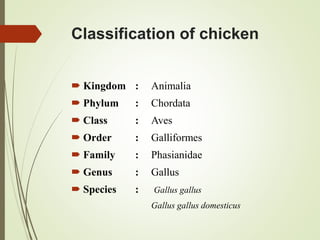
 Kingdom : Animalia
 Phylum : Chordata
 Class : Aves
 Order : Galliformes
 Family : Phasianidae
 Genus : Gallus
 Species : Gallus gallus
Gallus gallus domesticus
Common Breeds
 Layer type breeds
 Broiler type
 Game type
 Ornamental type
 Dual purpose breeds
Layer type
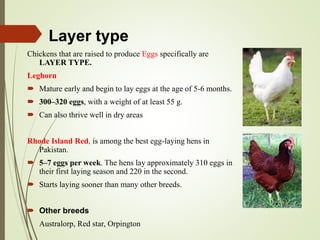
Chickens that are raised to produce Eggs specifically are
LAYER TYPE.
Leghorn
 Mature early and begin to lay eggs at the age of 5-6 months.
 300–320 eggs, with a weight of at least 55 g.
 Can also thrive well in dry areas
Rhode Island Red, is among the best egg-laying hens in
Pakistan.
 5–7 eggs per week. The hens lay approximately 310 eggs in
their first laying season and 220 in the second.
 Starts laying sooner than many other breeds.
 Other breeds
Australorp, Red star, Orpington
Broiler type
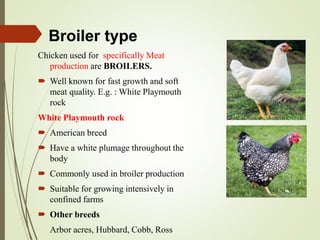
Chicken used for specifically Meat
production are BROILERS.
 Well known for fast growth and soft
meat quality. E.g. : White Playmouth
rock
White Playmouth rock
 American breed
 Have a white plumage throughout the
body
 Commonly used in broiler production
 Suitable for growing intensively in
confined farms
 Other breeds
Arbor acres, Hubbard, Cobb, Ross
Game type
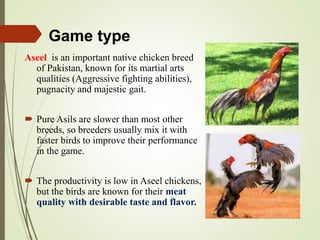
Aseel is an important native chicken breed
of Pakistan, known for its martial arts
qualities (Aggressive fighting abilities),
pugnacity and majestic gait.
 Pure Asils are slower than most other
breeds, so breeders usually mix it with
faster birds to improve their performance
in the game.
 The productivity is low in Aseel chickens,
but the birds are known for their meat
quality with desirable taste and flavor.
Ornamental type
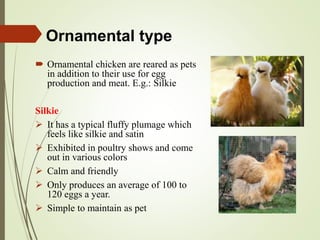
 Ornamental chicken are reared as pets
in addition to their use for egg
production and meat. E.g.: Silkie
Silkie
 It has a typical fluffy plumage which
feels like silkie and satin
 Exhibited in poultry shows and come
out in various colors
 Calm and friendly
 Only produces an average of 100 to
120 eggs a year.
 Simple to maintain as pet
Dual purpose breeds
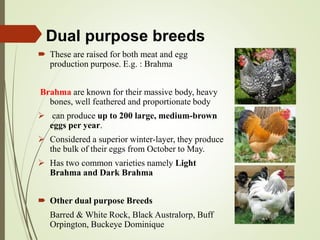
 These are raised for both meat and egg
production purpose. E.g. : Brahma
Brahma are known for their massive body, heavy
bones, well feathered and proportionate body
 can produce up to 200 large, medium-brown
eggs per year.
 Considered a superior winter-layer, they produce
the bulk of their eggs from October to May.
 Has two common varieties namely Light
Brahma and Dark Brahma
 Other dual purpose Breeds
Barred & White Rock, Black Australorp, Buff
Orpington, Buckeye Dominique
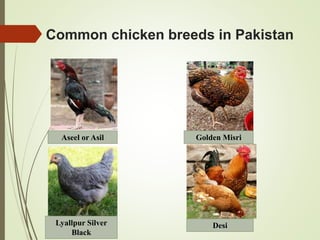
Common chicken breeds in Pakistan
Aseel or Asil
Desi
Lyallpur Silver
Black
Golden Misri
Steps in chicken rearing
1) Selection of Breeds
2) Selection of eggs for hatching
3) Incubation and hatching
4) Brooding
5) Housing of the poultry
6) Watering and Feeding
1) Selection of Breeds: Breeders today select for (or at least monitor):
 The age at sexual maturity
 Body weight- feed conversion
 The rate of lay, livability, egg weight, shell color, shell strength, albumen height,
egg inclusions (blood and meat spots)
 Temperament
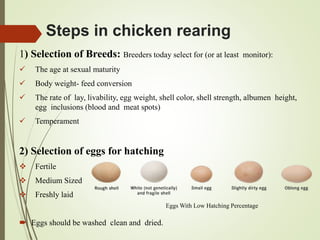
2) Selection of eggs for hatching
 Fertile
 Medium Sized
 Freshly laid
 Eggs should be washed clean and dried.
Eggs With Low Hatching Percentage
Steps in chicken rearing
3) Incubation and hatching
 The maintenance of newly laid eggs in
optimum condition till hatching is called incubation.
 The fully developed chick emerges out of egg after an incubation period of
21-22 days.
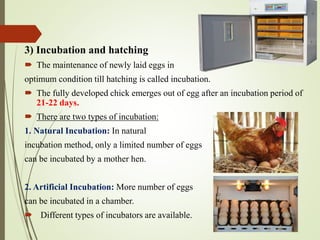
 There are two types of incubation:
1. Natural Incubation: In natural
incubation method, only a limited number of eggs
can be incubated by a mother hen.
2. Artificial Incubation: More number of eggs
can be incubated in a chamber.
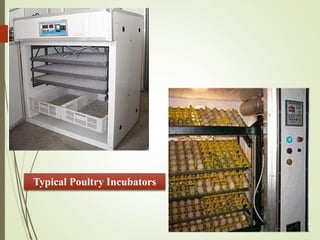
 Different types of incubators are available.
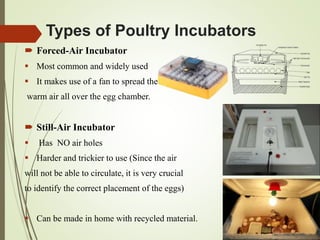
Types of Poultry Incubators
 Forced-Air Incubator
 Most common and widely used
 It makes use of a fan to spread the
warm air all over the egg chamber.
 Still-Air Incubator
 Has NO air holes
 Harder and trickier to use (Since the air
will not be able to circulate, it is very crucial
to identify the correct placement of the eggs)
 Can be made in home with recycled material.
Typical Poultry Incubators
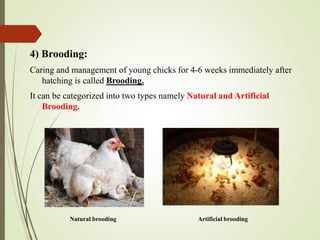
4) Brooding:
Caring and management of young chicks for 4-6 weeks immediately after
hatching is called Brooding.
It can be categorized into two types namely Natural and Artificial
Brooding.
Natural brooding Artificial brooding
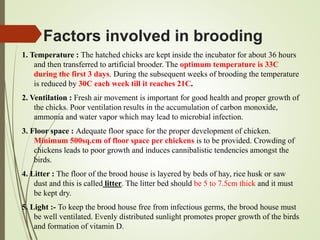
Factors involved in brooding
1. Temperature : The hatched chicks are kept inside the incubator for about 36 hours
and then transferred to artificial brooder. The optimum temperature is 33C
during the first 3 days. During the subsequent weeks of brooding the temperature
is reduced by 30C each week till it reaches 21C.
2. Ventilation : Fresh air movement is important for good health and proper growth of
the chicks. Poor ventilation results in the accumulation of carbon monoxide,
ammonia and water vapor which may lead to microbial infection.
3. Floor space : Adequate floor space for the proper development of chicken.
Minimum 500sq.cm of floor space per chickens is to be provided. Crowding of
chickens leads to poor growth and induces cannibalistic tendencies amongst the
birds.
4. Litter : The floor of the brood house is layered by beds of hay, rice husk or saw
dust and this is called litter. The litter bed should be 5 to 7.5cm thick and it must
be kept dry.
5. Light :- To keep the brood house free from infectious germs, the brood house must
be well ventilated. Evenly distributed sunlight promotes proper growth of the birds
and formation of vitamin D.
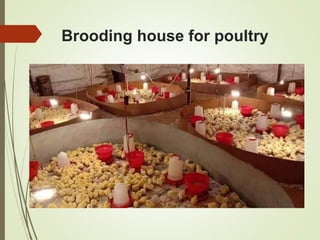
Brooding house for poultry
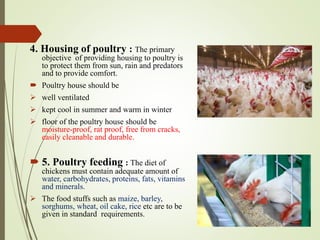
4. Housing of poultry : The primary
objective of providing housing to poultry is
to protect them from sun, rain and predators
and to provide comfort.
 Poultry house should be
 well ventilated
 kept cool in summer and warm in winter
 floor of the poultry house should be
moisture-proof, rat proof, free from cracks,
easily cleanable and durable.
 5. Poultry feeding : The diet of
chickens must contain adequate amount of
water, carbohydrates, proteins, fats, vitamins
and minerals.
 The food stuffs such as maize, barley,
sorghums, wheat, oil cake, rice etc are to be
given in standard requirements.
Typical Layer Farm Sequence
 This procedure starts when female chicks are raised into pullets for
commercial egg production. This stage is called ‘rearing’, and
there are several common rearing systems. Some farms raise layer
chicks on a litter floor in a shed. Other pullets are either finished off
or reared entirely in wire-floored cages.
 Brooding (Day-Old To 6 Weeks)
 Growing (6 To 20 Weeks)
 Moving
 Adult Layer (20 To/Up To 78 Weeks)
 Egg Collecting And Grading
 Marketing
Typical Broiler Farm Sequence
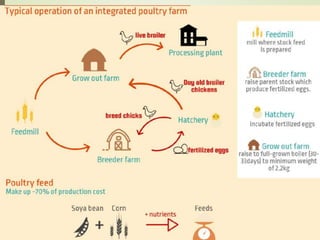
 There are Seven Stages involved in getting Chicken to a Consumer:
1. Hatchery
2. Broiler Farm
3. Grow-out
4. Harvesting/ Processing/further processing
5. Marketing/Distribution
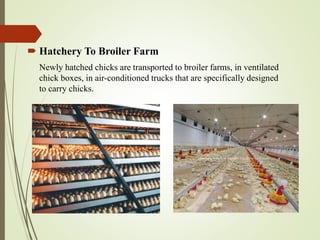
 Hatchery To Broiler Farm
Newly hatched chicks are transported to broiler farms, in ventilated
chick boxes, in air-conditioned trucks that are specifically designed
to carry chicks.
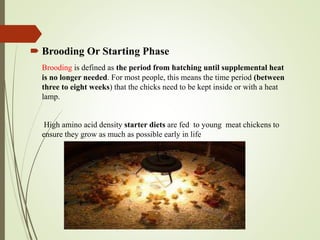
 Brooding Or Starting Phase
Brooding is defined as the period from hatching until supplemental heat
is no longer needed. For most people, this means the time period (between
three to eight weeks) that the chicks need to be kept inside or with a heat
lamp.
High amino acid density starter diets are fed to young meat chickens to
ensure they grow as much as possible early in life
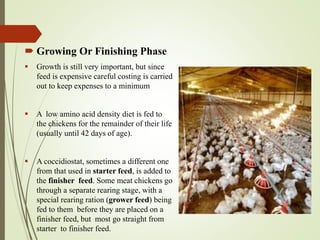
 Growing Or Finishing Phase
 Growth is still very important, but since
feed is expensive careful costing is carried
out to keep expenses to a minimum
 A low amino acid density diet is fed to
the chickens for the remainder of their life
(usually until 42 days of age).
 A coccidiostat, sometimes a different one
from that used in starter feed, is added to
the finisher feed. Some meat chickens go
through a separate rearing stage, with a
special rearing ration (grower feed) being
fed to them before they are placed on a
finisher feed, but most go straight from
starter to finisher feed.
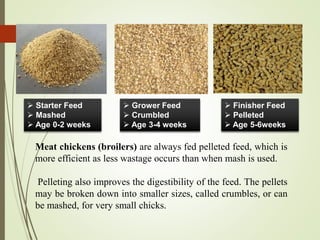
 Grower Feed
 Crumbled
 Age 3-4 weeks
 Finisher Feed
 Pelleted
 Age 5-6weeks
 Starter Feed
 Mashed
 Age 0-2 weeks
Meat chickens (broilers) are always fed pelleted feed, which is
more efficient as less wastage occurs than when mash is used.
Pelleting also improves the digestibility of the feed. The pellets
may be broken down into smaller sizes, called crumbles, or can
be mashed, for very small chicks.
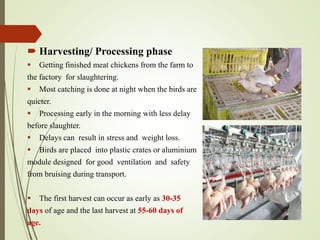
 Harvesting/ Processing phase
 Getting finished meat chickens from the farm to
the factory for slaughtering.
 Most catching is done at night when the birds are
quieter.
 Processing early in the morning with less delay
before slaughter.
 Delays can result in stress and weight loss.
 Birds are placed into plastic crates or aluminium
module designed for good ventilation and safety
from bruising during transport.
 The first harvest can occur as early as 30-35
days of age and the last harvest at 55-60 days of
age.
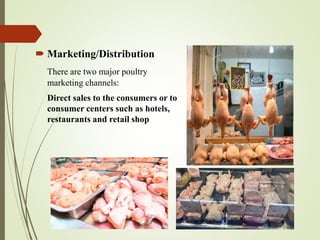
 Marketing/Distribution
There are two major poultry
marketing channels:
Direct sales to the consumers or to
consumer centers such as hotels,
restaurants and retail shop
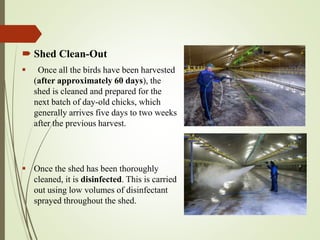
 Shed Clean-Out
 Once all the birds have been harvested
(after approximately 60 days), the
shed is cleaned and prepared for the
next batch of day-old chicks, which
generally arrives five days to two weeks
after the previous harvest.
 Once the shed has been thoroughly
cleaned, it is disinfected. This is carried
out using low volumes of disinfectant
sprayed throughout the shed.
By-products of Poultry
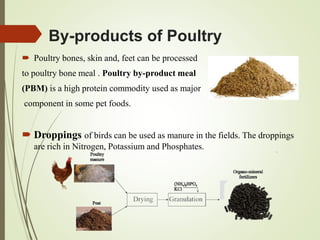
 Poultry bones, skin and, feet can be processed
to poultry bone meal . Poultry by-product meal
(PBM) is a high protein commodity used as major
component in some pet foods.
 Droppings of birds can be used as manure in the fields. The droppings
are rich in Nitrogen, Potassium and Phosphates.
By-products of Poultry
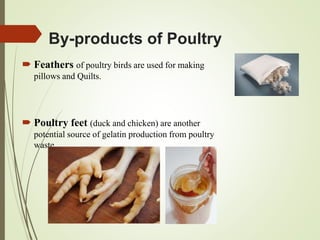
 Feathers of poultry birds are used for making
pillows and Quilts.
 Poultry feet (duck and chicken) are another
potential source of gelatin production from poultry
waste.
Diseases of the Poultry
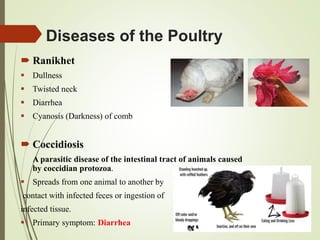
 Ranikhet
 Dullness
 Twisted neck
 Diarrhea
 Cyanosis (Darkness) of comb
 Coccidiosis
A parasitic disease of the intestinal tract of animals caused
by coccidian protozoa.
 Spreads from one animal to another by
contact with infected feces or ingestion of
infected tissue.
 Primary symptom: Diarrhea
Diseases of the Poultry
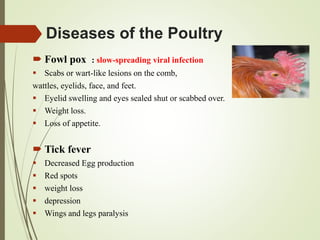
 Fowl pox : slow-spreading viral infection
 Scabs or wart-like lesions on the comb,
wattles, eyelids, face, and feet.
 Eyelid swelling and eyes sealed shut or scabbed over.
 Weight loss.
 Loss of appetite.
 Tick fever
 Decreased Egg production
 Red spots
 weight loss
 depression
 Wings and legs paralysis
Poultry Farming in Pakistan
 One of the most dynamic and well organized sectors
contributing 26.8%, 5.76% and 1.26% respectively to total meat
production, agricultural sector and overall GDP.
 This sector currently provides work for more than 1.5 million
people in Pakistan.
 Commercial poultry production began in Pakistan in 1962, and 1.94
million tons of chicken are currently produced, in the more than
15,000 farms established throughout the country.

Poultry Farming Lecture .pptx

  • 2.
    Introduction  Chicken, turkey,duck , geese and game birds, are all types of birds called poultry.  Poultry farming is the form of animal husbandry which raises domesticated birds such as chickens, ducks, turkeys and geese to produce eggs and meat for food.  Chickens make up the largest sector of Poultry industry.  Several breeds of chicken are used to produce different products.
  • 3.
    Poultry Science  PoultryScience is the study of practices and principles involved in production and marketing of poultry and its products  It includes Breeding, Management, Housing, Disease Control and Marketing.
  • 4.
    COMMON TERMS TO KNOW Boiler –– A chicken 6 to 9 months old.  Broiler –– A cockerel of 2 or 3 pounds, at 8 to 12 weeks old.  Pullet––a young female chicken soon to be at point of lay, near 5 months old  Hen––a fully mature egg laying female chicken  Cockerel––A young rooster, under 1 year old.  Cock/Rooster––A fully mature male chicken  Sexed chicken––A batch of chicks that are a specific sex (all females or all males)  Straight Run––A batch of chicks that are not sexed (meaning you could have males or females in the batch)
  • 5.
    Classification of Poultry Classification of poultry on the basis of age  The age influences the tenderness of fat and fat content which determines the cooking method.  Broilers or Fryers: Chickens 6 to 8 weeks old and weighing 2 1/2 to 3 1/2 pounds  Roasters: Chickens less than 8 months old and weighing 3 1/2 to 5 pounds  Stewing Chickens: Chickens (usually hens) over 10 months old and weighing 5 to 7 pounds  Capons: Castrated males that weigh 6 to 8 pounds  Cock/Rooster: Male chickens over 10 months old weighing 6 to 8 pounds
  • 6.
    Classification of chicken Kingdom : Animalia  Phylum : Chordata  Class : Aves  Order : Galliformes  Family : Phasianidae  Genus : Gallus  Species : Gallus gallus Gallus gallus domesticus
  • 7.
    Common Breeds  Layertype breeds  Broiler type  Game type  Ornamental type  Dual purpose breeds
  • 8.
    Layer type Chickens thatare raised to produce Eggs specifically are LAYER TYPE. Leghorn  Mature early and begin to lay eggs at the age of 5-6 months.  300–320 eggs, with a weight of at least 55 g.  Can also thrive well in dry areas Rhode Island Red, is among the best egg-laying hens in Pakistan.  5–7 eggs per week. The hens lay approximately 310 eggs in their first laying season and 220 in the second.  Starts laying sooner than many other breeds.  Other breeds Australorp, Red star, Orpington
  • 9.
    Broiler type Chicken usedfor specifically Meat production are BROILERS.  Well known for fast growth and soft meat quality. E.g. : White Playmouth rock White Playmouth rock  American breed  Have a white plumage throughout the body  Commonly used in broiler production  Suitable for growing intensively in confined farms  Other breeds Arbor acres, Hubbard, Cobb, Ross
  • 10.
    Game type Aseel isan important native chicken breed of Pakistan, known for its martial arts qualities (Aggressive fighting abilities), pugnacity and majestic gait.  Pure Asils are slower than most other breeds, so breeders usually mix it with faster birds to improve their performance in the game.  The productivity is low in Aseel chickens, but the birds are known for their meat quality with desirable taste and flavor.
  • 11.
    Ornamental type  Ornamentalchicken are reared as pets in addition to their use for egg production and meat. E.g.: Silkie Silkie  It has a typical fluffy plumage which feels like silkie and satin  Exhibited in poultry shows and come out in various colors  Calm and friendly  Only produces an average of 100 to 120 eggs a year.  Simple to maintain as pet
  • 12.
    Dual purpose breeds These are raised for both meat and egg production purpose. E.g. : Brahma Brahma are known for their massive body, heavy bones, well feathered and proportionate body  can produce up to 200 large, medium-brown eggs per year.  Considered a superior winter-layer, they produce the bulk of their eggs from October to May.  Has two common varieties namely Light Brahma and Dark Brahma  Other dual purpose Breeds Barred & White Rock, Black Australorp, Buff Orpington, Buckeye Dominique
  • 13.
    Common chicken breedsin Pakistan Aseel or Asil Desi Lyallpur Silver Black Golden Misri
  • 14.
    Steps in chickenrearing 1) Selection of Breeds 2) Selection of eggs for hatching 3) Incubation and hatching 4) Brooding 5) Housing of the poultry 6) Watering and Feeding
  • 15.
    1) Selection ofBreeds: Breeders today select for (or at least monitor):  The age at sexual maturity  Body weight- feed conversion  The rate of lay, livability, egg weight, shell color, shell strength, albumen height, egg inclusions (blood and meat spots)  Temperament 2) Selection of eggs for hatching  Fertile  Medium Sized  Freshly laid  Eggs should be washed clean and dried. Eggs With Low Hatching Percentage Steps in chicken rearing
  • 16.
    3) Incubation andhatching  The maintenance of newly laid eggs in optimum condition till hatching is called incubation.  The fully developed chick emerges out of egg after an incubation period of 21-22 days.  There are two types of incubation: 1. Natural Incubation: In natural incubation method, only a limited number of eggs can be incubated by a mother hen. 2. Artificial Incubation: More number of eggs can be incubated in a chamber.  Different types of incubators are available.
  • 17.
    Types of PoultryIncubators  Forced-Air Incubator  Most common and widely used  It makes use of a fan to spread the warm air all over the egg chamber.  Still-Air Incubator  Has NO air holes  Harder and trickier to use (Since the air will not be able to circulate, it is very crucial to identify the correct placement of the eggs)  Can be made in home with recycled material.
  • 18.
  • 19.
    4) Brooding: Caring andmanagement of young chicks for 4-6 weeks immediately after hatching is called Brooding. It can be categorized into two types namely Natural and Artificial Brooding. Natural brooding Artificial brooding
  • 20.
    Factors involved inbrooding 1. Temperature : The hatched chicks are kept inside the incubator for about 36 hours and then transferred to artificial brooder. The optimum temperature is 33C during the first 3 days. During the subsequent weeks of brooding the temperature is reduced by 30C each week till it reaches 21C. 2. Ventilation : Fresh air movement is important for good health and proper growth of the chicks. Poor ventilation results in the accumulation of carbon monoxide, ammonia and water vapor which may lead to microbial infection. 3. Floor space : Adequate floor space for the proper development of chicken. Minimum 500sq.cm of floor space per chickens is to be provided. Crowding of chickens leads to poor growth and induces cannibalistic tendencies amongst the birds. 4. Litter : The floor of the brood house is layered by beds of hay, rice husk or saw dust and this is called litter. The litter bed should be 5 to 7.5cm thick and it must be kept dry. 5. Light :- To keep the brood house free from infectious germs, the brood house must be well ventilated. Evenly distributed sunlight promotes proper growth of the birds and formation of vitamin D.
  • 21.
  • 22.
    4. Housing ofpoultry : The primary objective of providing housing to poultry is to protect them from sun, rain and predators and to provide comfort.  Poultry house should be  well ventilated  kept cool in summer and warm in winter  floor of the poultry house should be moisture-proof, rat proof, free from cracks, easily cleanable and durable.  5. Poultry feeding : The diet of chickens must contain adequate amount of water, carbohydrates, proteins, fats, vitamins and minerals.  The food stuffs such as maize, barley, sorghums, wheat, oil cake, rice etc are to be given in standard requirements.
  • 23.
    Typical Layer FarmSequence  This procedure starts when female chicks are raised into pullets for commercial egg production. This stage is called ‘rearing’, and there are several common rearing systems. Some farms raise layer chicks on a litter floor in a shed. Other pullets are either finished off or reared entirely in wire-floored cages.  Brooding (Day-Old To 6 Weeks)  Growing (6 To 20 Weeks)  Moving  Adult Layer (20 To/Up To 78 Weeks)  Egg Collecting And Grading  Marketing
  • 24.
    Typical Broiler FarmSequence  There are Seven Stages involved in getting Chicken to a Consumer: 1. Hatchery 2. Broiler Farm 3. Grow-out 4. Harvesting/ Processing/further processing 5. Marketing/Distribution
  • 25.
     Hatchery ToBroiler Farm Newly hatched chicks are transported to broiler farms, in ventilated chick boxes, in air-conditioned trucks that are specifically designed to carry chicks.
  • 26.
     Brooding OrStarting Phase Brooding is defined as the period from hatching until supplemental heat is no longer needed. For most people, this means the time period (between three to eight weeks) that the chicks need to be kept inside or with a heat lamp. High amino acid density starter diets are fed to young meat chickens to ensure they grow as much as possible early in life
  • 27.
     Growing OrFinishing Phase  Growth is still very important, but since feed is expensive careful costing is carried out to keep expenses to a minimum  A low amino acid density diet is fed to the chickens for the remainder of their life (usually until 42 days of age).  A coccidiostat, sometimes a different one from that used in starter feed, is added to the finisher feed. Some meat chickens go through a separate rearing stage, with a special rearing ration (grower feed) being fed to them before they are placed on a finisher feed, but most go straight from starter to finisher feed.
  • 28.
     Grower Feed Crumbled  Age 3-4 weeks  Finisher Feed  Pelleted  Age 5-6weeks  Starter Feed  Mashed  Age 0-2 weeks Meat chickens (broilers) are always fed pelleted feed, which is more efficient as less wastage occurs than when mash is used. Pelleting also improves the digestibility of the feed. The pellets may be broken down into smaller sizes, called crumbles, or can be mashed, for very small chicks.
  • 29.
     Harvesting/ Processingphase  Getting finished meat chickens from the farm to the factory for slaughtering.  Most catching is done at night when the birds are quieter.  Processing early in the morning with less delay before slaughter.  Delays can result in stress and weight loss.  Birds are placed into plastic crates or aluminium module designed for good ventilation and safety from bruising during transport.  The first harvest can occur as early as 30-35 days of age and the last harvest at 55-60 days of age.
  • 30.
     Marketing/Distribution There aretwo major poultry marketing channels: Direct sales to the consumers or to consumer centers such as hotels, restaurants and retail shop
  • 31.
     Shed Clean-Out Once all the birds have been harvested (after approximately 60 days), the shed is cleaned and prepared for the next batch of day-old chicks, which generally arrives five days to two weeks after the previous harvest.  Once the shed has been thoroughly cleaned, it is disinfected. This is carried out using low volumes of disinfectant sprayed throughout the shed.
  • 33.
    By-products of Poultry Poultry bones, skin and, feet can be processed to poultry bone meal . Poultry by-product meal (PBM) is a high protein commodity used as major component in some pet foods.  Droppings of birds can be used as manure in the fields. The droppings are rich in Nitrogen, Potassium and Phosphates.
  • 34.
    By-products of Poultry Feathers of poultry birds are used for making pillows and Quilts.  Poultry feet (duck and chicken) are another potential source of gelatin production from poultry waste.
  • 35.
    Diseases of thePoultry  Ranikhet  Dullness  Twisted neck  Diarrhea  Cyanosis (Darkness) of comb  Coccidiosis A parasitic disease of the intestinal tract of animals caused by coccidian protozoa.  Spreads from one animal to another by contact with infected feces or ingestion of infected tissue.  Primary symptom: Diarrhea
  • 36.
    Diseases of thePoultry  Fowl pox : slow-spreading viral infection  Scabs or wart-like lesions on the comb, wattles, eyelids, face, and feet.  Eyelid swelling and eyes sealed shut or scabbed over.  Weight loss.  Loss of appetite.  Tick fever  Decreased Egg production  Red spots  weight loss  depression  Wings and legs paralysis
  • 37.
    Poultry Farming inPakistan  One of the most dynamic and well organized sectors contributing 26.8%, 5.76% and 1.26% respectively to total meat production, agricultural sector and overall GDP.  This sector currently provides work for more than 1.5 million people in Pakistan.  Commercial poultry production began in Pakistan in 1962, and 1.94 million tons of chicken are currently produced, in the more than 15,000 farms established throughout the country.