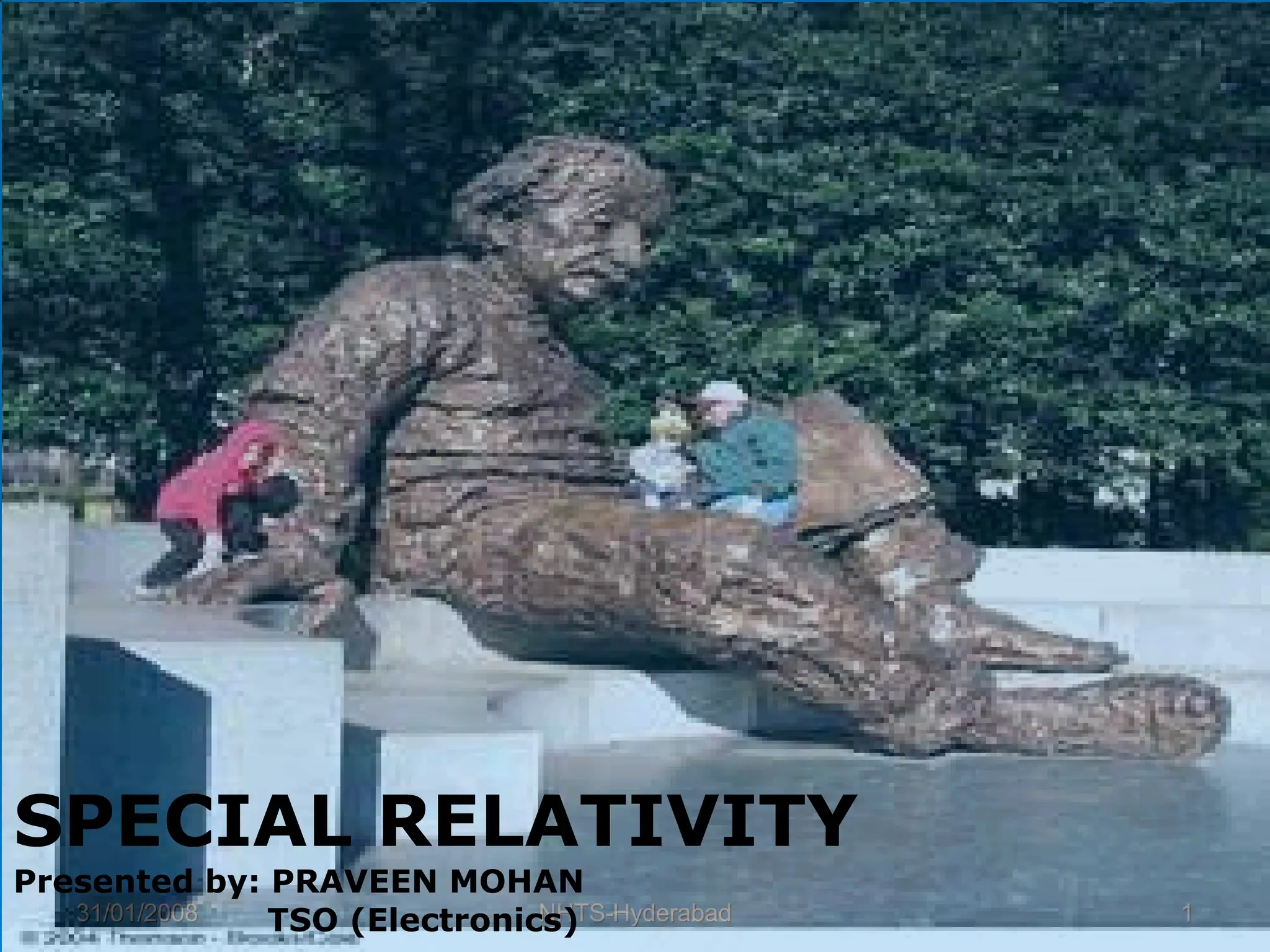
SPECIAL RELATIVITY Presented by: PRAVEEN MOHAN TSO (Electronics)
Relative Motion   Always specify the point from which motion is being observed and measured.   To measure the speed of an object: Choose a frame of reference Frame of reference standing still.  Frames of Reference Physical surroundings from which you observe and measure the world around you. Two Frame of Reference Inertial Non Inertial
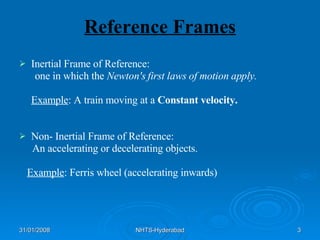
Reference Frames Inertial Frame of Reference: one in which the  Newton's first laws of motion apply.  Example : A train moving at a  Constant velocity.   Non- Inertial Frame of Reference: An accelerating or decelerating objects.  Example : Ferris wheel (accelerating inwards)
Theories before Einstein   Prior to Einstein two great theories of physics Newtonian Mechanics and Gravity. Maxwell’s unified theory of electricity and magnetism. These two theories imply different views of time.
Theory before  Einstein…… Newton Theory: Time is an absolute, universal measure, same for all observers, no matter whether they are at rest or travelling at high speed. Maxwell’s Theory: people and objects cannot travel at speeds greater than the speed of light. Einstein   explored the consequences of Maxwell’s theory.
Words of Einstein (Thoughts…) Can you catch up with light? What would happen if I rode a light beam? If you were travelling at the speed of light and looked in a mirror - would you see your reflection? “ Questions keep me awake at night. If you were in your vehicle travelling at the speed of light and you turn your headlights on, what would they do?”
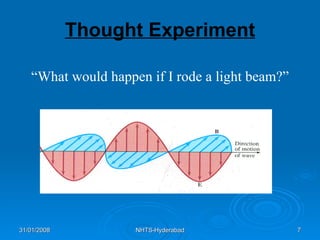
Thought Experiment “ What would happen if I rode a light beam?”
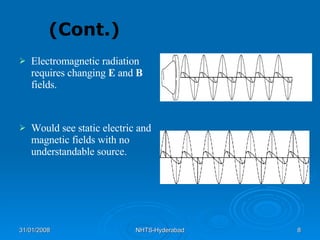
Electromagnetic radiation requires changing  E  and  B  fields. Would see static electric and magnetic fields with no understandable source.  (Cont.)
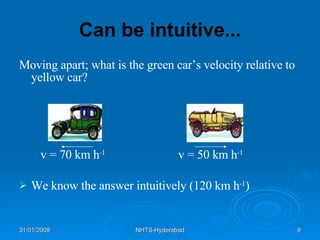
Can be intuitive... Moving apart; what is the green car’s velocity relative to yellow car? v = 70 km h -1   v = 50 km h -1 We know the answer intuitively (120 km h -1 )
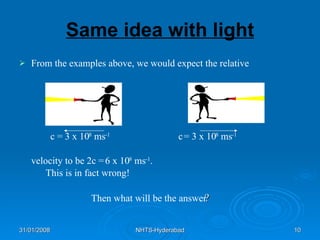
Same idea with light From the examples above, we would expect the relative c = 3 x 10 8  ms -1   c = 3 x 10 8  ms -1 velocity to be 2c = 6 x 10 8  ms -1 . This is in fact wrong! Then what will be the answer ?
Theory of Relativity Theory provide relation between: 1.  Space-Time (4 coordinates-3 spatial coordinates(x,y,z),4 th  is time.)   2.  Matter-Energy 3.  Electricity-Magnetism
Theory of Relativity Special relativity(1905) Deals with consequences of  LACK OF UNIVERSAL  inertial reference frame. General relativity(1915) Describe the relationship between  GRAVITY  and geometrical structure of  SPACE  and  TIME .
Postulates of Special Relativity Two postulates: The Relativity Principle : The laws of motion are the same in every inertial frame of reference. Constancy of the Speed of Light :  The speed of light  in a  vacuum  is the same independent of the speed of the source or the observer.
Consequences of the Special  Theory Of Relativity
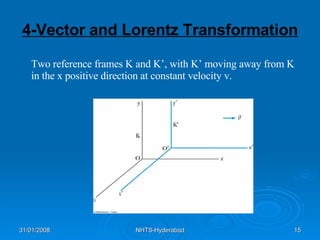
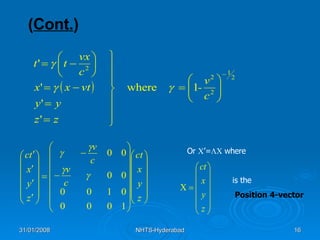
4-Vector and Lorentz Transformation Two reference frames K and K’, with K’ moving away from K in the x positive direction at constant velocity v.
( Cont. ) is the Position 4-vector Or   ’=   where
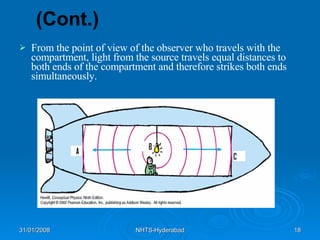
Simultaneity An interesting consequence of Einstein's second postulate occurs with the concept of  simultaneity.   Two events are simultaneous if they occur at the same time.  Consider, for example, a light source in the exact center of the compartment of a rocket ship.
From the point of view of the observer who travels with the compartment, light from the source travels equal distances to both ends of the compartment and therefore strikes both ends simultaneously.  (Cont.)
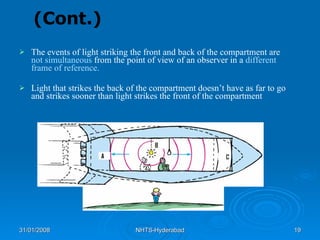
The events of light striking the front and back of the compartment are  not simultaneous  from the point of view of an observer in a  different frame of reference. Light that strikes the back of the compartment doesn’t have as far to go and strikes sooner than light strikes the front of the compartment  (Cont.)
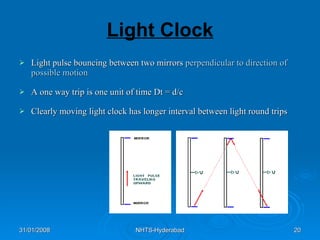
Light Clock Light pulse bouncing between two mirrors  perpendicular to direction of possible motion A one way trip is one unit of time Dt = d/c Clearly moving light clock has longer interval between light round trips
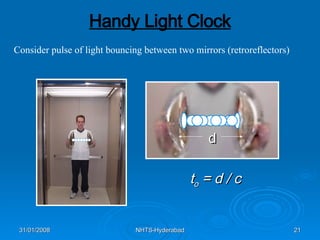
Handy Light Clock Consider pulse of light bouncing between two mirrors (retroreflectors) d t o  = d / c
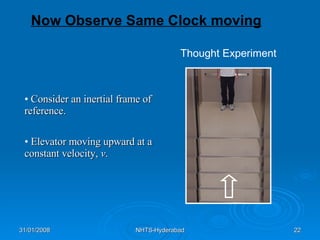
  Thought Experiment   Consider an inertial frame of reference. Elevator moving upward at a constant velocity,  v . Now Observe Same Clock moving
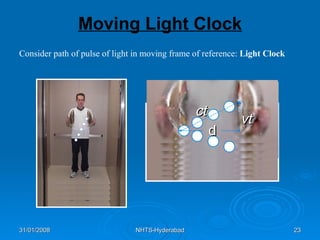
Moving Light Clock Consider path of pulse of light in moving frame of reference:   Light Clock d ct vt
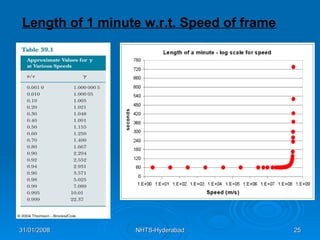
Time Dilation calculated Use Pythagorean Theorem: (ct)  2  = d  2   + (vt)  2 d  2   = (ct)  2  - (vt)  2 d  2 / c  2  = t  2  - (v  2 / c  2 )t  2 d / c  = t [1 - (v  2 / c  2 )] 1/2 But d = ct o  ,  So d ct d ct t o  = t  [1 - (v  2 / c  2 )]  1/2 The clock in the moving frame runs slower.
Length of 1 minute w.r.t. Speed of frame
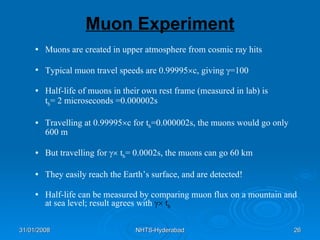
Muon Experiment Muons are created in upper atmosphere from cosmic ray hits Typical muon travel speeds are 0.99995  c, giving   =100 Half-life of muons in their own rest frame (measured in lab) is  t h = 2 microseconds =0.000002s Travelling at 0.99995  c for t h =0.000002s, the muons would go only 600 m But travelling for    t h = 0.0002s, the muons can go 60 km They easily reach the Earth’s surface, and are detected! Half-life can be measured by comparing muon flux on a mountain and at sea level; result agrees with    t h
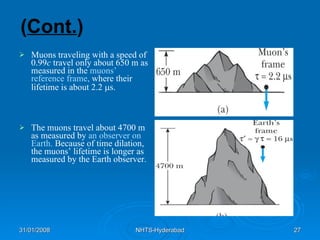
( Cont. ) Muons traveling with a speed of 0.99 c  travel only about 650 m as measured in the  muons’ reference frame,  where their lifetime is about 2.2   s. The muons travel about 4700 m as measured by  an observer on Earth.  Because of time dilation, the muons’ lifetime is longer as measured by the Earth observer.
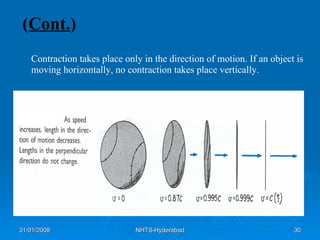
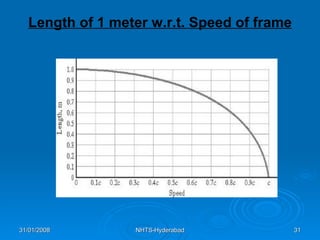
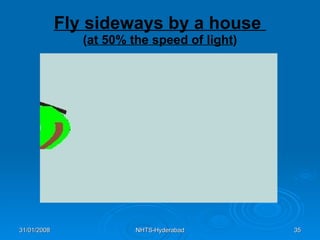
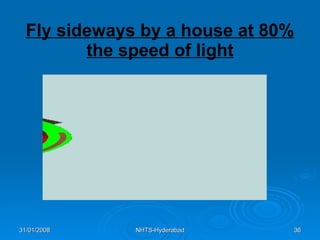
Length Contraction As objects move through space-time, space as well as time changes (as velocity of light is constant in vacuum)  Space is contracted Objects look shorter when they move at relativistic speeds.
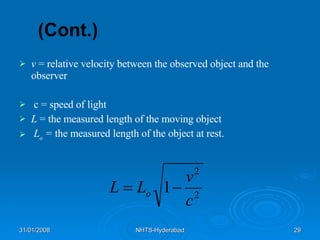
(Cont.) v  = relative velocity between the observed object and the observer c = speed of light L  = the measured length of the moving object L o  =  the measured length of the object at rest.
( Cont. ) Contraction takes place only in the direction of motion. If an object is moving horizontally, no contraction takes place vertically.
Length of 1 meter w.r.t. Speed of frame
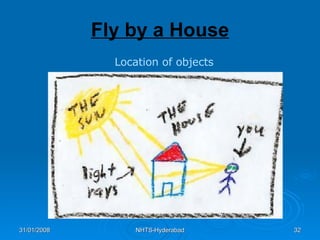
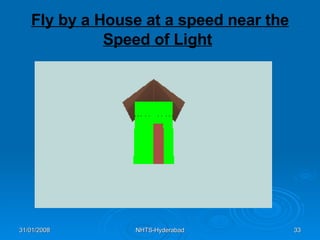
Fly by a House Location of objects
Fly by a House at a speed near the Speed of Light
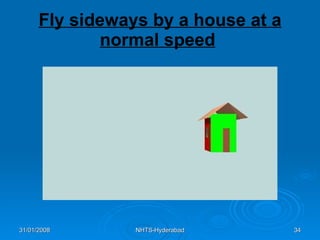
Fly sideways by a house at a normal speed
Fly sideways by a house  ( at 50% the speed of light )
Fly sideways by a house at 80% the speed of light
Fly sideways by a house at 90% the speed of light
Fly sideways by a house at 99.9% the speed of light
Length contraction should be of considerable interest to space voyagers. The center of our Milky Way galaxy is 25,000 light-years away.  Does this mean that if we traveled in that direction at the speed of light it would take 25,000 years to get there?  From an Earth frame of reference, yes, but to the space voyagers, decidedly not!  At the speed of light, the 25,000-light-year distance would be contracted to no distance at all.  Space voyagers would arrive there instantly!
Twin Paradox
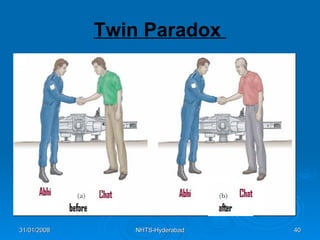
Twin Paradox I Suppose two twins, Chat & Abhi, are born on Earth. Suppose Abhi goes into a spaceship and travels at 0.99 c  to the nearest star,  Alpha Centauri, which is 4.3  light years away. Abhi stays at Alpha Centauri for 5 years, and then returns home at 0.99c . Chat stays home. (1 light year (ly ) is the distance light travels in 1 year.) Short hand: 1 ly = 1 [ c *yr] How many years have passed for Chat and Abhi ?
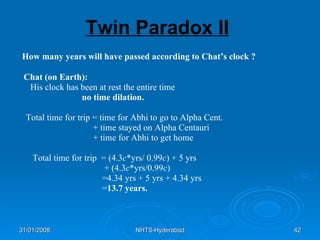
Twin Paradox II How many years will have passed according to Chat’s clock ? Chat (on Earth): His clock has been at rest the entire time no time dilation. Total time for trip = time for Abhi to go to Alpha Cent. + time stayed on Alpha Centauri + time for Abhi to get home Total time for trip  = (4.3 c *yrs/ 0.99 c ) + 5 yrs  + (4.3 c *yrs/0.99 c ) =4.34 yrs + 5 yrs + 4.34 yrs = 13.7 years.
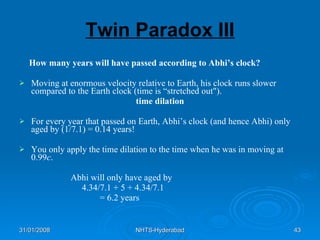
Twin Paradox III How many years will have passed according to Abhi’s clock? Moving at enormous velocity relative to Earth, his clock runs slower compared to the Earth clock (time is “stretched out"). time dilation For every year that passed on Earth, Abhi’s clock (and hence Abhi) only aged by (1/7.1) = 0.14 years!  You only apply the time dilation to the time when he was in moving at 0.99 c .  Abhi will only have aged by 4.34/7.1 + 5 + 4.34/7.1 = 6.2 years
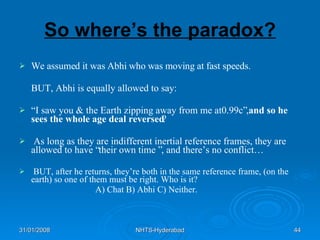
So where’s the paradox? We assumed it was Abhi who was moving at fast speeds. BUT, Abhi is equally allowed to say: “ I saw you & the Earth zipping away from me at0.99c” , and so he sees the whole age deal reversed ? As long as they are indifferent inertial reference frames, they are allowed to have “their own time ”, and there’s no conflict… BUT, after he returns, they’re both in the same reference frame, (on the earth) so one of them must be right. Who is it? A) Chat B) Abhi C) Neither.
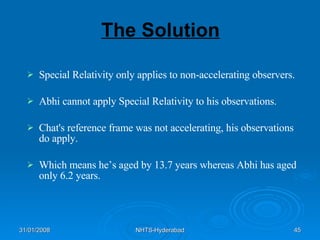
The Solution Special Relativity only applies to non-accelerating observers. Abhi cannot apply Special Relativity to his observations. Chat's reference frame was not accelerating, his observations do apply. Which means he’s aged by 13.7 years whereas Abhi has aged only 6.2 years.
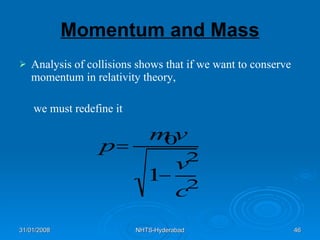
Momentum and Mass Analysis of collisions shows that if we want to conserve momentum in relativity theory, we must redefine it
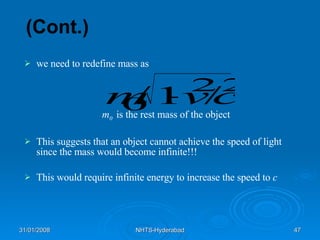
(Cont.) we need to redefine mass as m 0   is the rest mass of the object This suggests that an object cannot achieve the speed of light since the mass would become infinite!!! This would require infinite energy to increase the speed to  c
Mass and Energy Consider applying a force to an object As the object has work done on it (force x distance) it increases its kinetic energy But, its mass also increases. Not all the work done on the object increases velocity since there is a limit on velocity. Some of the work is increasing mass
(Cont.) Einstein showed that the correct expression is that  KE = mc 2  - m 0 c 2 Einstein called the  m 0 c 2  term the rest energy of the object This means that  mc 2   is the total energy of the object This is the origin of the famous E = mc 2
Mass and Energy (evidence) An elementary particle called a pion (composed of a quark/anti-quark pair) is observed to decay into EM waves whose energy is exactly  m pion c 2 Nuclear energy. (mass defect) Mass loss in 1kg of dynamite is the order of 10 -6 .
Correspondence Principle Einstein’s Special Relativity reduces to our old Newtonian mechanics for v << c Theories overlap and Special Theory is the more general case (closer to reality) and that Newtonian Mechanics is a special case for low speeds The two theories  correspond
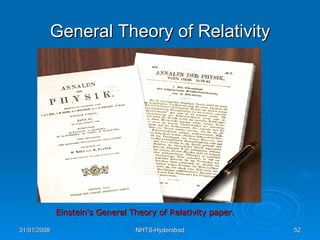
General Theory of Relativity Einstein's General Theory of Relativity paper.  
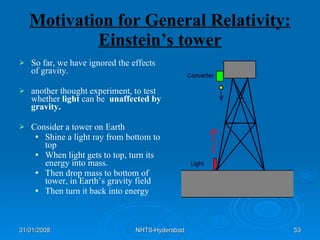
Motivation for General Relativity: Einstein’s tower So far, we have ignored the effects of gravity.  another thought experiment, to test whether  light  can be  unaffected by gravity. Consider a tower on Earth Shine a light ray from bottom to top When light gets to top, turn its energy into mass. Then drop mass to bottom of tower, in Earth’s gravity field Then turn it back into energy
( Cont. ) If we could do this, then we could get energy from nothing! Original energy in light beam = E start mass created at top is m=E/c 2 Then drop mass… at bottom of tower it has picked up speed (and energy) due to the effects of gravitational field. When we turn it back into energy, we have E end =E start +E grav But, we started off with only  E start  – we have made energy!  We’re rich!
( Cont. ) Clearly, our assumption must be wrong…  light  must  be affected by gravity. But gravity does not appear in Maxwell’s equations, which govern light Thus, Maxwell’s equations are not exactly valid in the reference frame of Earth’s surface, where there is gravity. The Earth’s surface must not be an inertial frame of reference!
Consequences of  General Theory of Relativity
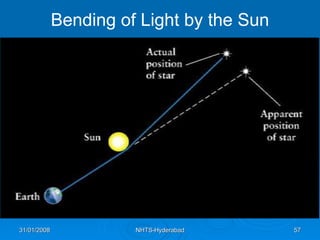
Bending of Light by the Sun
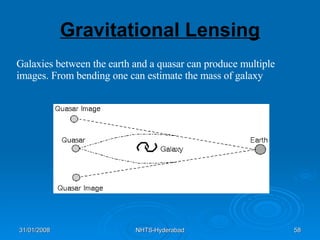
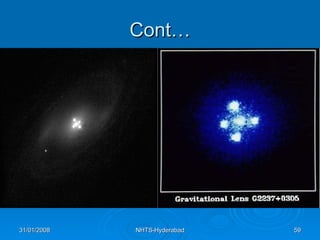
Gravitational Lensing Galaxies between the earth and a quasar can produce multiple images. From bending one can estimate the mass of galaxy
Cont…
Thank You Presented By: PRAVEEN MOHAN Trainee Scientific Officer (Electronics)

special relativity

  • 1.
    SPECIAL RELATIVITY Presentedby: PRAVEEN MOHAN TSO (Electronics)
  • 2.
    Relative Motion Always specify the point from which motion is being observed and measured. To measure the speed of an object: Choose a frame of reference Frame of reference standing still. Frames of Reference Physical surroundings from which you observe and measure the world around you. Two Frame of Reference Inertial Non Inertial
  • 3.
    Reference Frames InertialFrame of Reference: one in which the Newton's first laws of motion apply. Example : A train moving at a Constant velocity. Non- Inertial Frame of Reference: An accelerating or decelerating objects. Example : Ferris wheel (accelerating inwards)
  • 4.
    Theories before Einstein Prior to Einstein two great theories of physics Newtonian Mechanics and Gravity. Maxwell’s unified theory of electricity and magnetism. These two theories imply different views of time.
  • 5.
    Theory before Einstein…… Newton Theory: Time is an absolute, universal measure, same for all observers, no matter whether they are at rest or travelling at high speed. Maxwell’s Theory: people and objects cannot travel at speeds greater than the speed of light. Einstein explored the consequences of Maxwell’s theory.
  • 6.
    Words of Einstein(Thoughts…) Can you catch up with light? What would happen if I rode a light beam? If you were travelling at the speed of light and looked in a mirror - would you see your reflection? “ Questions keep me awake at night. If you were in your vehicle travelling at the speed of light and you turn your headlights on, what would they do?”
  • 7.
    Thought Experiment “What would happen if I rode a light beam?”
  • 8.
    Electromagnetic radiation requireschanging E and B fields. Would see static electric and magnetic fields with no understandable source. (Cont.)
  • 9.
    Can be intuitive...Moving apart; what is the green car’s velocity relative to yellow car? v = 70 km h -1 v = 50 km h -1 We know the answer intuitively (120 km h -1 )
  • 10.
    Same idea withlight From the examples above, we would expect the relative c = 3 x 10 8 ms -1 c = 3 x 10 8 ms -1 velocity to be 2c = 6 x 10 8 ms -1 . This is in fact wrong! Then what will be the answer ?
  • 11.
    Theory of RelativityTheory provide relation between: 1. Space-Time (4 coordinates-3 spatial coordinates(x,y,z),4 th is time.) 2. Matter-Energy 3. Electricity-Magnetism
  • 12.
    Theory of RelativitySpecial relativity(1905) Deals with consequences of LACK OF UNIVERSAL inertial reference frame. General relativity(1915) Describe the relationship between GRAVITY and geometrical structure of SPACE and TIME .
  • 13.
    Postulates of SpecialRelativity Two postulates: The Relativity Principle : The laws of motion are the same in every inertial frame of reference. Constancy of the Speed of Light : The speed of light in a vacuum is the same independent of the speed of the source or the observer.
  • 14.
    Consequences of theSpecial Theory Of Relativity
  • 15.
    4-Vector and LorentzTransformation Two reference frames K and K’, with K’ moving away from K in the x positive direction at constant velocity v.
  • 16.
    ( Cont. )is the Position 4-vector Or  ’=  where
  • 17.
    Simultaneity An interestingconsequence of Einstein's second postulate occurs with the concept of simultaneity. Two events are simultaneous if they occur at the same time. Consider, for example, a light source in the exact center of the compartment of a rocket ship.
  • 18.
    From the pointof view of the observer who travels with the compartment, light from the source travels equal distances to both ends of the compartment and therefore strikes both ends simultaneously. (Cont.)
  • 19.
    The events oflight striking the front and back of the compartment are not simultaneous from the point of view of an observer in a different frame of reference. Light that strikes the back of the compartment doesn’t have as far to go and strikes sooner than light strikes the front of the compartment (Cont.)
  • 20.
    Light Clock Lightpulse bouncing between two mirrors perpendicular to direction of possible motion A one way trip is one unit of time Dt = d/c Clearly moving light clock has longer interval between light round trips
  • 21.
    Handy Light ClockConsider pulse of light bouncing between two mirrors (retroreflectors) d t o = d / c
  • 22.
    ThoughtExperiment Consider an inertial frame of reference. Elevator moving upward at a constant velocity, v . Now Observe Same Clock moving
  • 23.
    Moving Light ClockConsider path of pulse of light in moving frame of reference: Light Clock d ct vt
  • 24.
    Time Dilation calculatedUse Pythagorean Theorem: (ct) 2 = d 2 + (vt) 2 d 2 = (ct) 2 - (vt) 2 d 2 / c 2 = t 2 - (v 2 / c 2 )t 2 d / c = t [1 - (v 2 / c 2 )] 1/2 But d = ct o , So d ct d ct t o = t [1 - (v 2 / c 2 )] 1/2 The clock in the moving frame runs slower.
  • 25.
    Length of 1minute w.r.t. Speed of frame
  • 26.
    Muon Experiment Muonsare created in upper atmosphere from cosmic ray hits Typical muon travel speeds are 0.99995  c, giving  =100 Half-life of muons in their own rest frame (measured in lab) is t h = 2 microseconds =0.000002s Travelling at 0.99995  c for t h =0.000002s, the muons would go only 600 m But travelling for  t h = 0.0002s, the muons can go 60 km They easily reach the Earth’s surface, and are detected! Half-life can be measured by comparing muon flux on a mountain and at sea level; result agrees with  t h
  • 27.
    ( Cont. )Muons traveling with a speed of 0.99 c travel only about 650 m as measured in the muons’ reference frame, where their lifetime is about 2.2  s. The muons travel about 4700 m as measured by an observer on Earth. Because of time dilation, the muons’ lifetime is longer as measured by the Earth observer.
  • 28.
    Length Contraction Asobjects move through space-time, space as well as time changes (as velocity of light is constant in vacuum) Space is contracted Objects look shorter when they move at relativistic speeds.
  • 29.
    (Cont.) v = relative velocity between the observed object and the observer c = speed of light L = the measured length of the moving object L o = the measured length of the object at rest.
  • 30.
    ( Cont. )Contraction takes place only in the direction of motion. If an object is moving horizontally, no contraction takes place vertically.
  • 31.
    Length of 1meter w.r.t. Speed of frame
  • 32.
    Fly by aHouse Location of objects
  • 33.
    Fly by aHouse at a speed near the Speed of Light
  • 34.
    Fly sideways bya house at a normal speed
  • 35.
    Fly sideways bya house ( at 50% the speed of light )
  • 36.
    Fly sideways bya house at 80% the speed of light
  • 37.
    Fly sideways bya house at 90% the speed of light
  • 38.
    Fly sideways bya house at 99.9% the speed of light
  • 39.
    Length contraction shouldbe of considerable interest to space voyagers. The center of our Milky Way galaxy is 25,000 light-years away. Does this mean that if we traveled in that direction at the speed of light it would take 25,000 years to get there? From an Earth frame of reference, yes, but to the space voyagers, decidedly not! At the speed of light, the 25,000-light-year distance would be contracted to no distance at all. Space voyagers would arrive there instantly!
  • 40.
  • 41.
    Twin Paradox ISuppose two twins, Chat & Abhi, are born on Earth. Suppose Abhi goes into a spaceship and travels at 0.99 c to the nearest star, Alpha Centauri, which is 4.3 light years away. Abhi stays at Alpha Centauri for 5 years, and then returns home at 0.99c . Chat stays home. (1 light year (ly ) is the distance light travels in 1 year.) Short hand: 1 ly = 1 [ c *yr] How many years have passed for Chat and Abhi ?
  • 42.
    Twin Paradox IIHow many years will have passed according to Chat’s clock ? Chat (on Earth): His clock has been at rest the entire time no time dilation. Total time for trip = time for Abhi to go to Alpha Cent. + time stayed on Alpha Centauri + time for Abhi to get home Total time for trip = (4.3 c *yrs/ 0.99 c ) + 5 yrs + (4.3 c *yrs/0.99 c ) =4.34 yrs + 5 yrs + 4.34 yrs = 13.7 years.
  • 43.
    Twin Paradox IIIHow many years will have passed according to Abhi’s clock? Moving at enormous velocity relative to Earth, his clock runs slower compared to the Earth clock (time is “stretched out&quot;). time dilation For every year that passed on Earth, Abhi’s clock (and hence Abhi) only aged by (1/7.1) = 0.14 years! You only apply the time dilation to the time when he was in moving at 0.99 c . Abhi will only have aged by 4.34/7.1 + 5 + 4.34/7.1 = 6.2 years
  • 44.
    So where’s theparadox? We assumed it was Abhi who was moving at fast speeds. BUT, Abhi is equally allowed to say: “ I saw you & the Earth zipping away from me at0.99c” , and so he sees the whole age deal reversed ? As long as they are indifferent inertial reference frames, they are allowed to have “their own time ”, and there’s no conflict… BUT, after he returns, they’re both in the same reference frame, (on the earth) so one of them must be right. Who is it? A) Chat B) Abhi C) Neither.
  • 45.
    The Solution SpecialRelativity only applies to non-accelerating observers. Abhi cannot apply Special Relativity to his observations. Chat's reference frame was not accelerating, his observations do apply. Which means he’s aged by 13.7 years whereas Abhi has aged only 6.2 years.
  • 46.
    Momentum and MassAnalysis of collisions shows that if we want to conserve momentum in relativity theory, we must redefine it
  • 47.
    (Cont.) we needto redefine mass as m 0 is the rest mass of the object This suggests that an object cannot achieve the speed of light since the mass would become infinite!!! This would require infinite energy to increase the speed to c
  • 48.
    Mass and EnergyConsider applying a force to an object As the object has work done on it (force x distance) it increases its kinetic energy But, its mass also increases. Not all the work done on the object increases velocity since there is a limit on velocity. Some of the work is increasing mass
  • 49.
    (Cont.) Einstein showedthat the correct expression is that KE = mc 2 - m 0 c 2 Einstein called the m 0 c 2 term the rest energy of the object This means that mc 2 is the total energy of the object This is the origin of the famous E = mc 2
  • 50.
    Mass and Energy(evidence) An elementary particle called a pion (composed of a quark/anti-quark pair) is observed to decay into EM waves whose energy is exactly m pion c 2 Nuclear energy. (mass defect) Mass loss in 1kg of dynamite is the order of 10 -6 .
  • 51.
    Correspondence Principle Einstein’sSpecial Relativity reduces to our old Newtonian mechanics for v << c Theories overlap and Special Theory is the more general case (closer to reality) and that Newtonian Mechanics is a special case for low speeds The two theories correspond
  • 52.
    General Theory ofRelativity Einstein's General Theory of Relativity paper.  
  • 53.
    Motivation for GeneralRelativity: Einstein’s tower So far, we have ignored the effects of gravity. another thought experiment, to test whether light can be unaffected by gravity. Consider a tower on Earth Shine a light ray from bottom to top When light gets to top, turn its energy into mass. Then drop mass to bottom of tower, in Earth’s gravity field Then turn it back into energy
  • 54.
    ( Cont. )If we could do this, then we could get energy from nothing! Original energy in light beam = E start mass created at top is m=E/c 2 Then drop mass… at bottom of tower it has picked up speed (and energy) due to the effects of gravitational field. When we turn it back into energy, we have E end =E start +E grav But, we started off with only E start – we have made energy! We’re rich!
  • 55.
    ( Cont. )Clearly, our assumption must be wrong… light must be affected by gravity. But gravity does not appear in Maxwell’s equations, which govern light Thus, Maxwell’s equations are not exactly valid in the reference frame of Earth’s surface, where there is gravity. The Earth’s surface must not be an inertial frame of reference!
  • 56.
    Consequences of General Theory of Relativity
  • 57.
    Bending of Lightby the Sun
  • 58.
    Gravitational Lensing Galaxiesbetween the earth and a quasar can produce multiple images. From bending one can estimate the mass of galaxy
  • 59.
  • 60.
    Thank You PresentedBy: PRAVEEN MOHAN Trainee Scientific Officer (Electronics)