Chapter S2 Lecture
© 2014 Pearson Education, Inc.
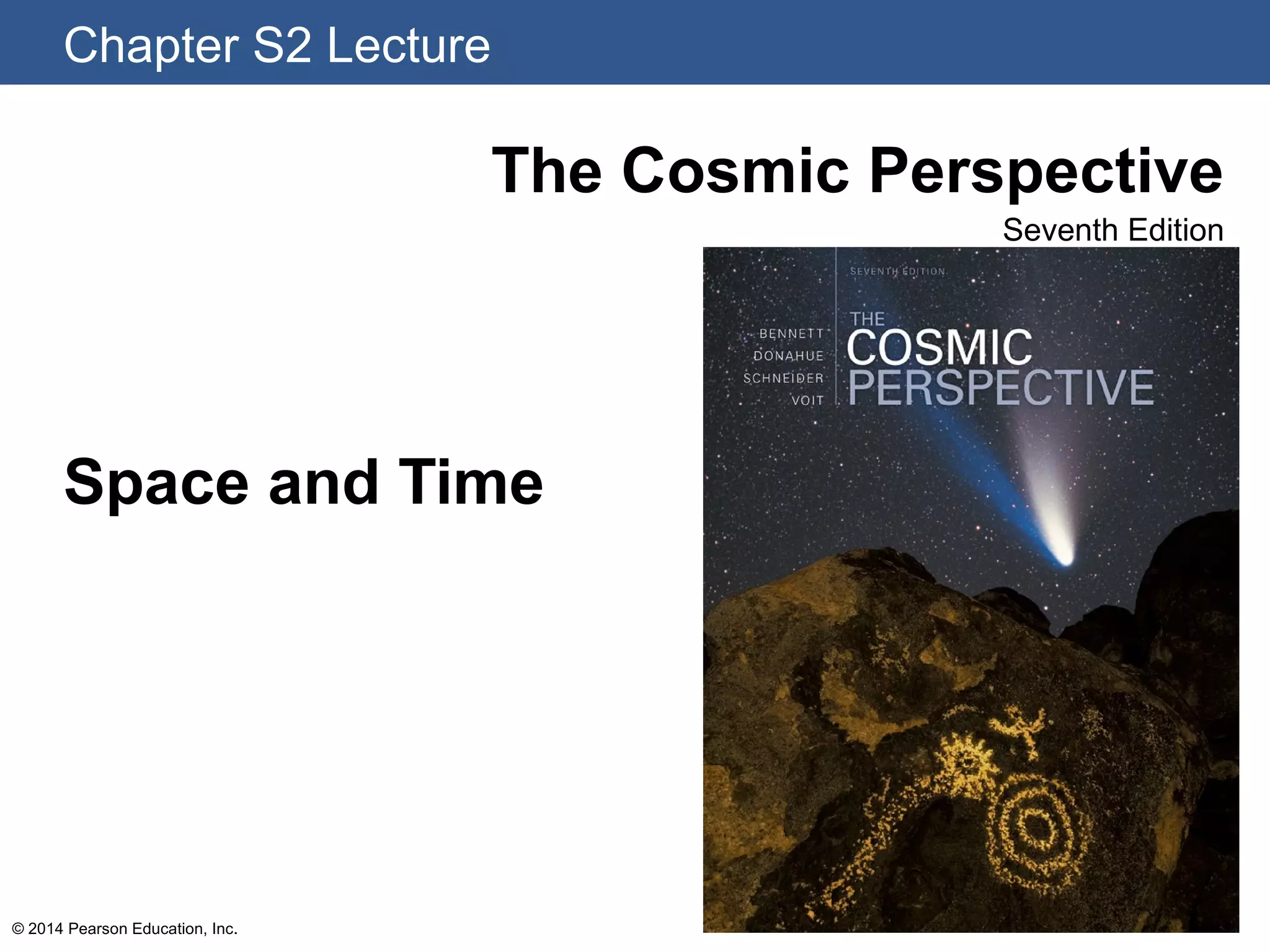
The Cosmic Perspective
Seventh Edition
Space and Time
Space and Time
S2.1 Einstein's Revolution
• Our goals for learning:
– What are the major ideas of special
relativity?
– What is relative about relativity?
– What is absolute about relativity?
What are the major ideas of special
relativity?
Einstein's Theories of Relativity
• Special Theory of Relativity (1905)
– Usual notions of space and time must be
revised for speeds approaching light speed (c).
– E = mc2
• General Theory of Relativity (1915)
– Expands the ideas of special theory to include a
surprising new view of gravity
Key Ideas of Special Relativity
• No material object can travel faster than light.
• If you observe something moving near light
speed:
– Its time slows down.
– Its length contracts in direction of motion.
– Its mass increases.
• Whether or not two events are simultaneous
depends on your frame of reference.
What is relative about relativity?
Relativity of Motion
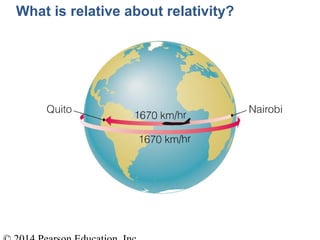
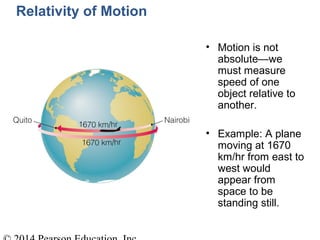
• Motion is not
absolute—we
must measure
speed of one
object relative to
another.
• Example: A plane
moving at 1670
km/hr from east to
west would
appear from
space to be
standing still.
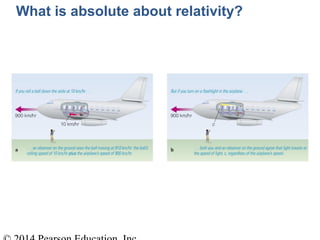
What is absolute about relativity?
Postulates of special relativity
1. The laws of nature are the same for everyone.
2. The speed of light is the same for everyone.
• All of relativity follows from these two ideas!
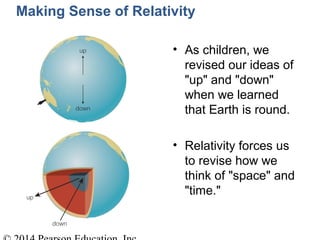
Making Sense of Relativity
• As children, we
revised our ideas of
"up" and "down"
when we learned
that Earth is round.
• Relativity forces us
to revise how we
think of "space" and
"time."
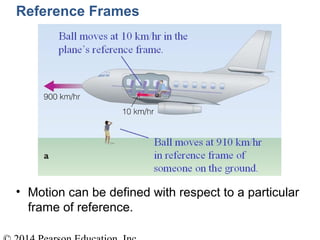
Reference Frames
• Motion can be defined with respect to a particular
frame of reference.
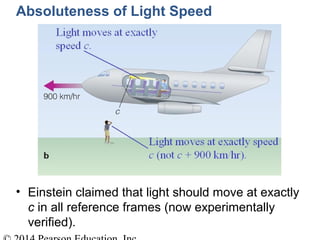
Absoluteness of Light Speed
• Einstein claimed that light should move at exactly
c in all reference frames (now experimentally
verified).
What have we learned?
• What are the major ideas of special
relativity?
– No material object can exceed the speed of
light.
– We must revise our notions of space and time
when dealing with objects near light speed.
• What is relative about relativity?
– All motion is relative, but laws of nature,
including the speed of light, are the same for
everybody.
What have we learned?
• What is absolute about relativity?
– The laws of physics, including the speed of
light, are the same for everyone.
S2.2 Relative Motion
• Our goals for learning:
– What's surprising about the absoluteness
of the speed of light?
– Why can't we reach the speed of light?
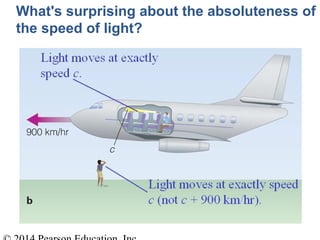
What's surprising about the absoluteness of
the speed of light?
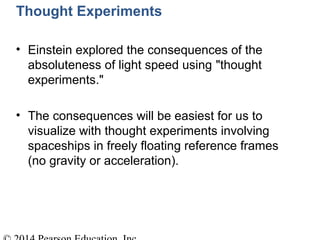
Thought Experiments
• Einstein explored the consequences of the
absoluteness of light speed using "thought
experiments."
• The consequences will be easiest for us to
visualize with thought experiments involving
spaceships in freely floating reference frames
(no gravity or acceleration).
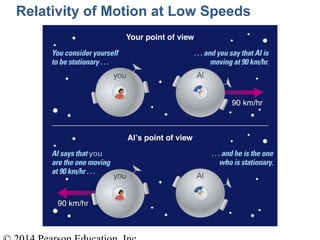
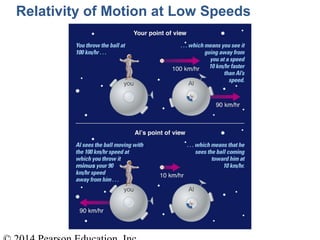
Relativity of Motion at Low Speeds
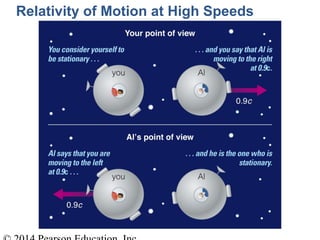
Relativity of Motion at High Speeds
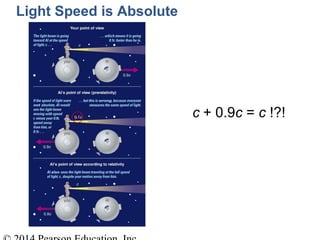
c + 0.9c = c !?!
Light Speed is Absolute
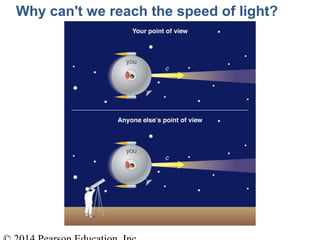
Why can't we reach the speed of light?
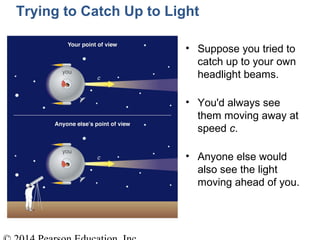
Trying to Catch Up to Light
• Suppose you tried to
catch up to your own
headlight beams.
• You'd always see
them moving away at
speed c.
• Anyone else would
also see the light
moving ahead of you.
Special Topic: What if Light Can't Catch
You?
• Is there a loophole?
• What if you're somehow moving away from a
distant planet faster than the speed of light?
• In that case, you have no way of detecting that
the planet is there.
• Although there are some phenomena that move
faster than light, no information can be
communicated faster than the speed of light.
What have we learned?
• What's surprising about the absoluteness of
the speed of light?
– Velocities in different reference frames do not
add up like we expect them to because the
speed of light must be the same for everyone.
• Why can't we reach the speed of light?
– No matter how fast we go, light will always
appear to move away from us at speed c.
S2.3 The Reality of Space and Time
• Our goals for learning:
– How does relativity affect our view of time
and space?
– Do the effects predicted by relativity really
occur?
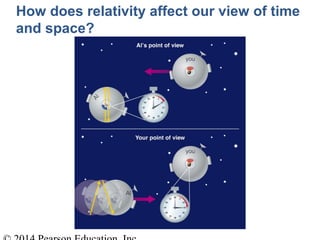
How does relativity affect our view of time
and space?
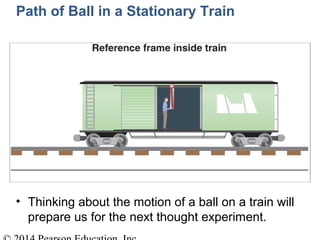
Path of Ball in a Stationary Train
• Thinking about the motion of a ball on a train will
prepare us for the next thought experiment.
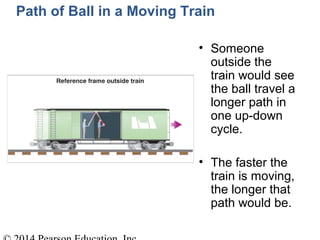
Path of Ball in a Moving Train
• Someone
outside the
train would see
the ball travel a
longer path in
one up-down
cycle.
• The faster the
train is moving,
the longer that
path would be.
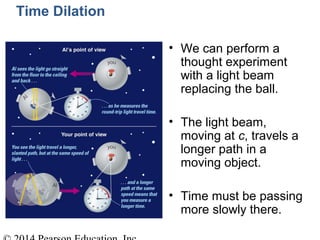
Time Dilation
• We can perform a
thought experiment
with a light beam
replacing the ball.
• The light beam,
moving at c, travels a
longer path in a
moving object.
• Time must be passing
more slowly there.
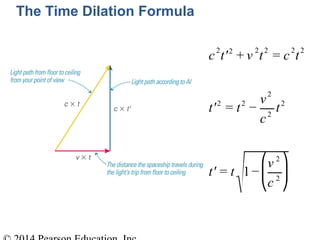
The Time Dilation Formula
c2
′t 2
+ v 2
t2
= c2
t2
′t 2
= t2
−
v
2
c2
t2
′t = t 1−
v 2
c 2
⎛
⎝
⎜
⎞
⎠
⎟
The Time Dilation Formula
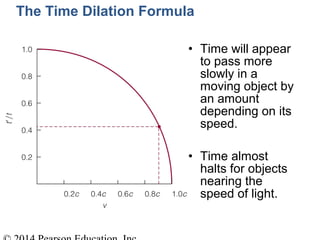
• Time will appear
to pass more
slowly in a
moving object by
an amount
depending on its
speed.
• Time almost
halts for objects
nearing the
speed of light.
Simultaneous Events?
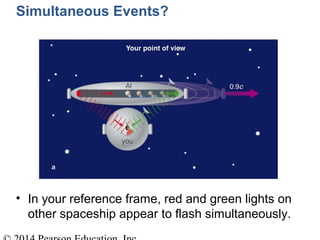
• In your reference frame, red and green lights on
other spaceship appear to flash simultaneously.
Simultaneous Events?
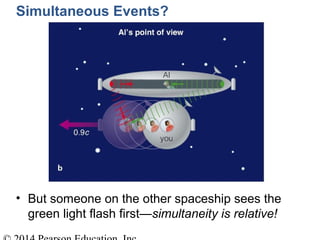
• But someone on the other spaceship sees the
green light flash first—simultaneity is relative!
Length Contraction
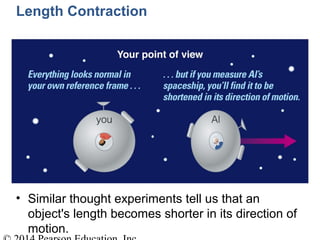
• Similar thought experiments tell us that an
object's length becomes shorter in its direction of
motion.
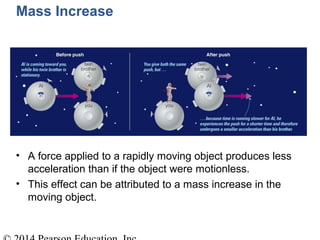
Mass Increase
• A force applied to a rapidly moving object produces less
acceleration than if the object were motionless.
• This effect can be attributed to a mass increase in the
moving object.
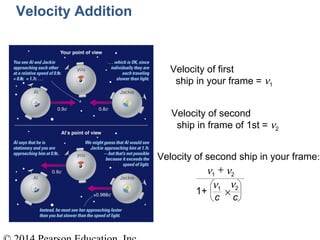
Velocity of first
ship in your frame = ν1
Velocity of second
ship in frame of 1st = ν2
Velocity of second ship in your frame:
ν1
+ ν2
1+
ν1
c
×
ν2
c
Velocity Addition
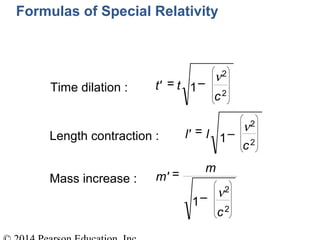
t' = t 1–
ν2
c2
Length contraction : l' = l
Mass increase : m' =
m
1–
Formulas of Special Relativity
Time dilation :
1–
ν2
c2
ν2
c2
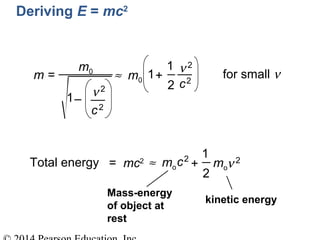
Deriving E = mc2
kinetic energy
Mass-energy
of object at
rest
m =
m0
+
1
2
for small ν
Total energy
m0
1
1
2
–1
≈
≈= mc2 mo + mo
ν 2
c2
ν 2
c2
ν 2c2
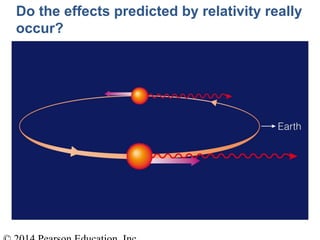
Do the effects predicted by relativity really
occur?
Tests of Relativity
• First evidence for absoluteness of speed of light
came from the Michelson-Morley experiment
performed in 1887.
• Time dilation happens routinely to subatomic
particles that approach the speed of light in
accelerators.
• Time dilation has also been verified through
precision measurements in airplanes moving at
much slower speeds.
Tests of Relativity
• Prediction that E = mc2
is verified daily in nuclear
reactors and in the core of the Sun.
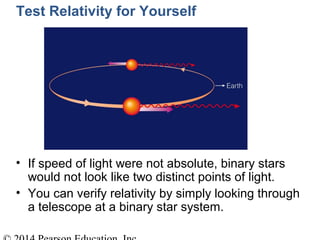
Test Relativity for Yourself
• If speed of light were not absolute, binary stars
would not look like two distinct points of light.
• You can verify relativity by simply looking through
a telescope at a binary star system.
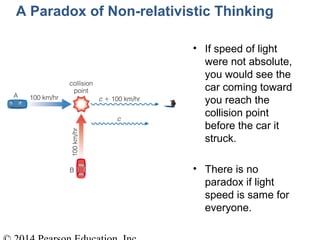
A Paradox of Non-relativistic Thinking
• If speed of light
were not absolute,
you would see the
car coming toward
you reach the
collision point
before the car it
struck.
• There is no
paradox if light
speed is same for
everyone.
What have we learned?
• How does relativity affect our view of time
and space?
– Time slows down for moving objects.
– Lengths shorten for moving objects.
– Mass of a moving object increases.
– Simultaneity of events depends on your
perspective.
• Do the effects predicted by relativity really
occur?
– Relativity has been confirmed by many
different experiments.
S2.4 Toward a New Common Sense
• Our goals for learning:
– How can we make sense of relativity?
– How does special relativity offer us a ticket
to the stars?
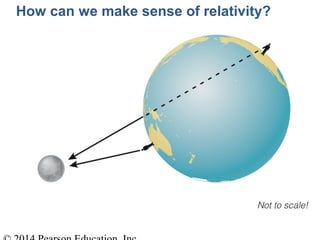
How can we make sense of relativity?
Making Sense of Relativity
• According to you, time slows down in a moving
spaceship.
• According to someone on that spaceship, your
time slows down.
• Who is right?
• You both are, because time is not absolute but
depends on your perspective.
Toward a New Common Sense
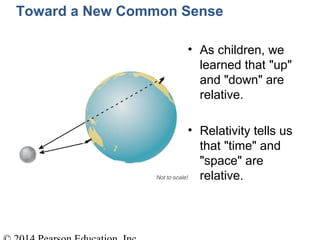
• As children, we
learned that "up"
and "down" are
relative.
• Relativity tells us
that "time" and
"space" are
relative.
How does relativity offer us a ticket to the
stars?
A Journey to Vega
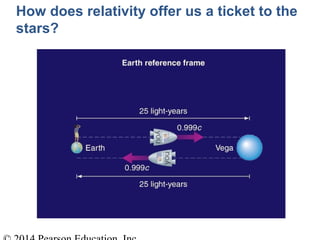
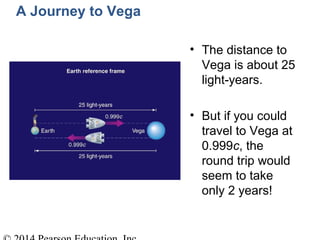
• The distance to
Vega is about 25
light-years.
• But if you could
travel to Vega at
0.999c, the
round trip would
seem to take
only 2 years!
A Journey to Vega
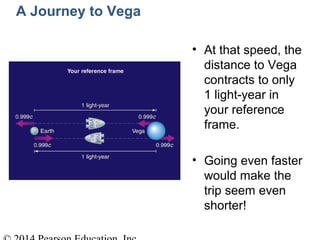
• At that speed, the
distance to Vega
contracts to only
1 light-year in
your reference
frame.
• Going even faster
would make the
trip seem even
shorter!
A Journey to Vega
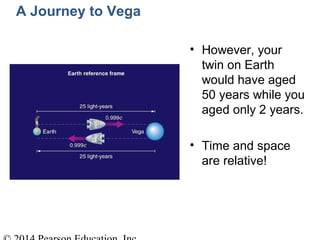
• However, your
twin on Earth
would have aged
50 years while you
aged only 2 years.
• Time and space
are relative!
What have we learned?
• How can we make sense of relativity?
– We need abandon our old notions of space
and time as absolute and adopt new a new
common sense in which time and space
depend on your perspective.
• How does special relativity offer us a ticket
to the stars?
– For someone moving near light speed,
distances appear to become shorter because
of length contraction.

S2 lecture outline

  • 1.
    Chapter S2 Lecture ©2014 Pearson Education, Inc. The Cosmic Perspective Seventh Edition Space and Time
  • 2.
  • 3.
    S2.1 Einstein's Revolution •Our goals for learning: – What are the major ideas of special relativity? – What is relative about relativity? – What is absolute about relativity?
  • 4.
    What are themajor ideas of special relativity?
  • 5.
    Einstein's Theories ofRelativity • Special Theory of Relativity (1905) – Usual notions of space and time must be revised for speeds approaching light speed (c). – E = mc2 • General Theory of Relativity (1915) – Expands the ideas of special theory to include a surprising new view of gravity
  • 6.
    Key Ideas ofSpecial Relativity • No material object can travel faster than light. • If you observe something moving near light speed: – Its time slows down. – Its length contracts in direction of motion. – Its mass increases. • Whether or not two events are simultaneous depends on your frame of reference.
  • 7.
    What is relativeabout relativity?
  • 8.
    Relativity of Motion •Motion is not absolute—we must measure speed of one object relative to another. • Example: A plane moving at 1670 km/hr from east to west would appear from space to be standing still.
  • 9.
    What is absoluteabout relativity?
  • 10.
    Postulates of specialrelativity 1. The laws of nature are the same for everyone. 2. The speed of light is the same for everyone. • All of relativity follows from these two ideas!
  • 11.
    Making Sense ofRelativity • As children, we revised our ideas of "up" and "down" when we learned that Earth is round. • Relativity forces us to revise how we think of "space" and "time."
  • 12.
    Reference Frames • Motioncan be defined with respect to a particular frame of reference.
  • 13.
    Absoluteness of LightSpeed • Einstein claimed that light should move at exactly c in all reference frames (now experimentally verified).
  • 14.
    What have welearned? • What are the major ideas of special relativity? – No material object can exceed the speed of light. – We must revise our notions of space and time when dealing with objects near light speed. • What is relative about relativity? – All motion is relative, but laws of nature, including the speed of light, are the same for everybody.
  • 15.
    What have welearned? • What is absolute about relativity? – The laws of physics, including the speed of light, are the same for everyone.
  • 16.
    S2.2 Relative Motion •Our goals for learning: – What's surprising about the absoluteness of the speed of light? – Why can't we reach the speed of light?
  • 17.
    What's surprising aboutthe absoluteness of the speed of light?
  • 18.
    Thought Experiments • Einsteinexplored the consequences of the absoluteness of light speed using "thought experiments." • The consequences will be easiest for us to visualize with thought experiments involving spaceships in freely floating reference frames (no gravity or acceleration).
  • 19.
    Relativity of Motionat Low Speeds
  • 20.
    Relativity of Motionat Low Speeds
  • 21.
    Relativity of Motionat High Speeds
  • 22.
    c + 0.9c= c !?! Light Speed is Absolute
  • 23.
    Why can't wereach the speed of light?
  • 24.
    Trying to CatchUp to Light • Suppose you tried to catch up to your own headlight beams. • You'd always see them moving away at speed c. • Anyone else would also see the light moving ahead of you.
  • 25.
    Special Topic: Whatif Light Can't Catch You? • Is there a loophole? • What if you're somehow moving away from a distant planet faster than the speed of light? • In that case, you have no way of detecting that the planet is there. • Although there are some phenomena that move faster than light, no information can be communicated faster than the speed of light.
  • 26.
    What have welearned? • What's surprising about the absoluteness of the speed of light? – Velocities in different reference frames do not add up like we expect them to because the speed of light must be the same for everyone. • Why can't we reach the speed of light? – No matter how fast we go, light will always appear to move away from us at speed c.
  • 27.
    S2.3 The Realityof Space and Time • Our goals for learning: – How does relativity affect our view of time and space? – Do the effects predicted by relativity really occur?
  • 28.
    How does relativityaffect our view of time and space?
  • 29.
    Path of Ballin a Stationary Train • Thinking about the motion of a ball on a train will prepare us for the next thought experiment.
  • 30.
    Path of Ballin a Moving Train • Someone outside the train would see the ball travel a longer path in one up-down cycle. • The faster the train is moving, the longer that path would be.
  • 31.
    Time Dilation • Wecan perform a thought experiment with a light beam replacing the ball. • The light beam, moving at c, travels a longer path in a moving object. • Time must be passing more slowly there.
  • 32.
    The Time DilationFormula c2 ′t 2 + v 2 t2 = c2 t2 ′t 2 = t2 − v 2 c2 t2 ′t = t 1− v 2 c 2 ⎛ ⎝ ⎜ ⎞ ⎠ ⎟
  • 33.
    The Time DilationFormula • Time will appear to pass more slowly in a moving object by an amount depending on its speed. • Time almost halts for objects nearing the speed of light.
  • 34.
    Simultaneous Events? • Inyour reference frame, red and green lights on other spaceship appear to flash simultaneously.
  • 35.
    Simultaneous Events? • Butsomeone on the other spaceship sees the green light flash first—simultaneity is relative!
  • 36.
    Length Contraction • Similarthought experiments tell us that an object's length becomes shorter in its direction of motion.
  • 37.
    Mass Increase • Aforce applied to a rapidly moving object produces less acceleration than if the object were motionless. • This effect can be attributed to a mass increase in the moving object.
  • 38.
    Velocity of first shipin your frame = ν1 Velocity of second ship in frame of 1st = ν2 Velocity of second ship in your frame: ν1 + ν2 1+ ν1 c × ν2 c Velocity Addition
  • 39.
    t' = t1– ν2 c2 Length contraction : l' = l Mass increase : m' = m 1– Formulas of Special Relativity Time dilation : 1– ν2 c2 ν2 c2
  • 40.
    Deriving E =mc2 kinetic energy Mass-energy of object at rest m = m0 + 1 2 for small ν Total energy m0 1 1 2 –1 ≈ ≈= mc2 mo + mo ν 2 c2 ν 2 c2 ν 2c2
  • 41.
    Do the effectspredicted by relativity really occur?
  • 42.
    Tests of Relativity •First evidence for absoluteness of speed of light came from the Michelson-Morley experiment performed in 1887. • Time dilation happens routinely to subatomic particles that approach the speed of light in accelerators. • Time dilation has also been verified through precision measurements in airplanes moving at much slower speeds.
  • 43.
    Tests of Relativity •Prediction that E = mc2 is verified daily in nuclear reactors and in the core of the Sun.
  • 44.
    Test Relativity forYourself • If speed of light were not absolute, binary stars would not look like two distinct points of light. • You can verify relativity by simply looking through a telescope at a binary star system.
  • 45.
    A Paradox ofNon-relativistic Thinking • If speed of light were not absolute, you would see the car coming toward you reach the collision point before the car it struck. • There is no paradox if light speed is same for everyone.
  • 46.
    What have welearned? • How does relativity affect our view of time and space? – Time slows down for moving objects. – Lengths shorten for moving objects. – Mass of a moving object increases. – Simultaneity of events depends on your perspective. • Do the effects predicted by relativity really occur? – Relativity has been confirmed by many different experiments.
  • 47.
    S2.4 Toward aNew Common Sense • Our goals for learning: – How can we make sense of relativity? – How does special relativity offer us a ticket to the stars?
  • 48.
    How can wemake sense of relativity?
  • 49.
    Making Sense ofRelativity • According to you, time slows down in a moving spaceship. • According to someone on that spaceship, your time slows down. • Who is right? • You both are, because time is not absolute but depends on your perspective.
  • 50.
    Toward a NewCommon Sense • As children, we learned that "up" and "down" are relative. • Relativity tells us that "time" and "space" are relative.
  • 51.
    How does relativityoffer us a ticket to the stars?
  • 52.
    A Journey toVega • The distance to Vega is about 25 light-years. • But if you could travel to Vega at 0.999c, the round trip would seem to take only 2 years!
  • 53.
    A Journey toVega • At that speed, the distance to Vega contracts to only 1 light-year in your reference frame. • Going even faster would make the trip seem even shorter!
  • 54.
    A Journey toVega • However, your twin on Earth would have aged 50 years while you aged only 2 years. • Time and space are relative!
  • 55.
    What have welearned? • How can we make sense of relativity? – We need abandon our old notions of space and time as absolute and adopt new a new common sense in which time and space depend on your perspective. • How does special relativity offer us a ticket to the stars? – For someone moving near light speed, distances appear to become shorter because of length contraction.