
Relativity
by
Albert Einstein
Prepared by:
Sir Antonio Salvador Jr.
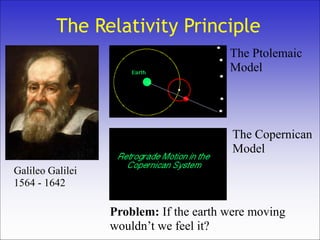
The Relativity Principle
Galileo Galilei
1564 - 1642
The Ptolemaic
Model
The Copernican
Model
Problem: If the earth were moving
wouldn’t we feel it?
A coordinate system moving at a
constant velocity is called an inertial
reference frame.
The Galilean Relativity Principle:
All physical laws are the same in all inertial reference
frames.
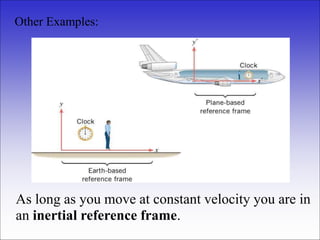
Other Examples:
As long as you move at constant velocity you are in
an inertial reference frame.
Galilean Relativity
– “Relativity” refers in general to the way
physical measurements made in a given
inertial frame are related to
measurements in another frame.
– An inertial observer is one whose rest
frame is inertial.
– A quantity is invariant if all inertial
observers obtain the same value.
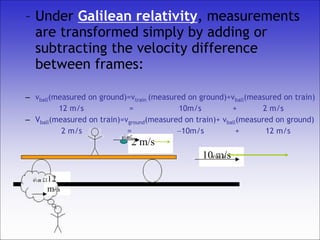
– Under Galilean relativity, measurements
are transformed simply by adding or
subtracting the velocity difference
between frames:
– vball(measured on ground)=vtrain (measured on ground)+vball(measured on train)
12 m/s = 10m/s + 2 m/s
– Vball(measured on train)=vground(measured on train)+ vball(measured on ground)
2 m/s = 10m/s + 12 m/s
10 m/s
2 m/s
12
m/s
Electromagnetism
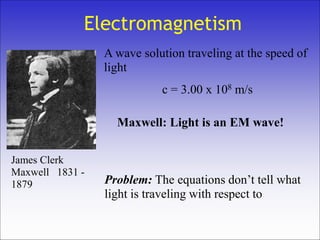
A wave solution traveling at the speed of
light
c = 3.00 x 10⁸ m/s
Maxwell: Light is an EM wave!
Problem: The equations don’t tell what
light is traveling with respect to
James Clerk
Maxwell 1831 -
1879
Einstein’s Approach to Physics
Albert Einstein
1879 - 1955
1. (Thought) Experiments
E.g., if we could travel next to a light
wave, what would we see?
2. “The Einstein Principle”:
If two phenomena are indistinguishable
by experiments then they are the same
thing.
Einstein’s Approach to Physics
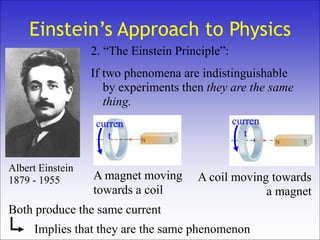
2. “The Einstein Principle”:
If two phenomena are indistinguishable
by experiments then they are the same
thing.
A magnet moving A coil moving towards
a magnet
Both produce the same current
Implies that they are the same phenomenon
towards a coil
Albert Einstein
1879 - 1955
curren
t
curren
t
Einstein’s Approach to Physics
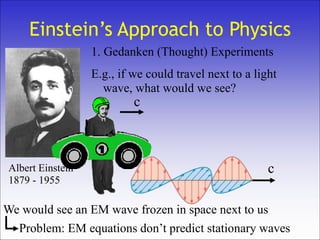
1. Gedanken (Thought) Experiments
E.g., if we could travel next to a light
wave, what would we see?
c
c
We would see an EM wave frozen in space next to us
Problem: EM equations don’t predict stationary waves
Albert Einstein
1879 - 1955
Electromagnetism
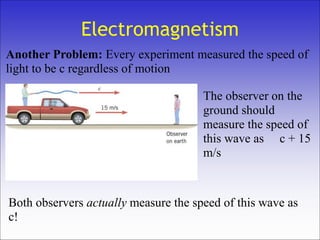
Another Problem: Every experiment measured the speed of
light to be c regardless of motion
The observer on the
ground should
measure the speed of
this wave as c + 15
m/s
Both observers actually measure the speed of this wave as
c!
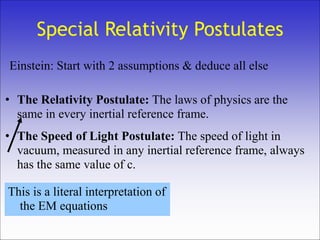
Special Relativity Postulates
• The Relativity Postulate: The laws of physics are the
same in every inertial reference frame.
• The Speed of Light Postulate: The speed of light in
vacuum, measured in any inertial reference frame, always
has the same value of c.
Einstein: Start with 2 assumptions & deduce all else
This is a literal interpretation of
the EM equations
Special Relativity Postulates
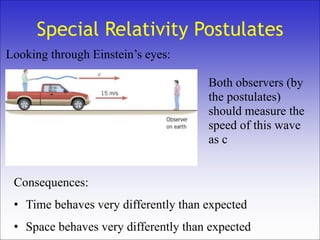
Looking through Einstein’s eyes:
Both observers (by
the postulates)
should measure the
speed of this wave
as c
Consequences:
• Time behaves very differently than expected
• Space behaves very differently than expected
Einstein’s Special Relativity
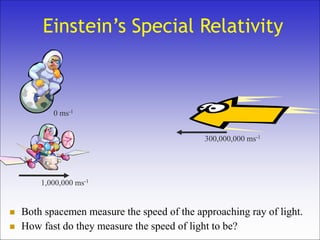
1,000,000 ms-1
0 ms-1
300,000,000 ms-1
 Both spacemen measure the speed of the approaching ray of light.
 How fast do they measure the speed of light to be?
Einstein’s Special Relativity
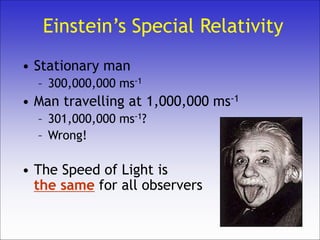
• Stationary man
– 300,000,000 ms-1
• Man travelling at 1,000,000 ms-1
– 301,000,000 ms-1?
– Wrong!
• The Speed of Light is
the same for all observers
Three effects
• 3 strange effects of special relativity
– Lorentz Transformations
– Relativistic Doppler Effect
– Headlight Effect
Lorentz Transformations
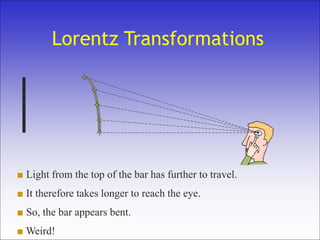
■ Light from the top of the bar has further to travel.
■ It therefore takes longer to reach the eye.
■ So, the bar appears bent.
■ Weird!
Doppler Effect
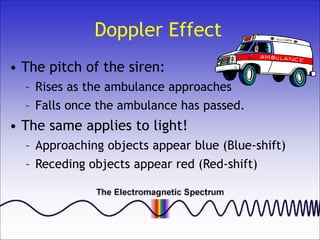
• The pitch of the siren:
– Rises as the ambulance approaches
– Falls once the ambulance has passed.
• The same applies to light!
– Approaching objects appear blue (Blue-shift)
– Receding objects appear red (Red-shift)
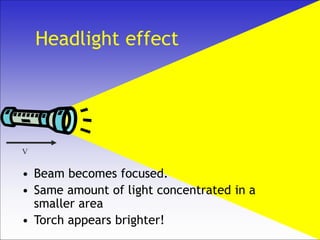
Headlight effect
• Beam becomes focused.
• Same amount of light concentrated in a
smaller area
• Torch appears brighter!
V
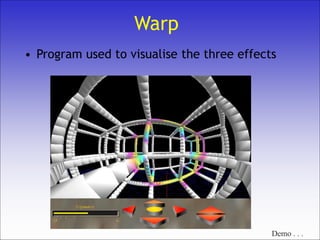
Warp
• Program used to visualise the three effects
Demo . . .
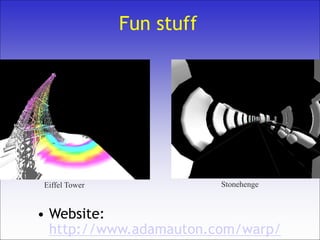
Fun stuff
• Website:
http://www.adamauton.com/warp/
Eiffel Tower Stonehenge
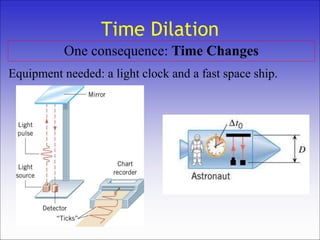
Time Dilation
One consequence: Time Changes
Equipment needed: a light clock and a fast space ship.
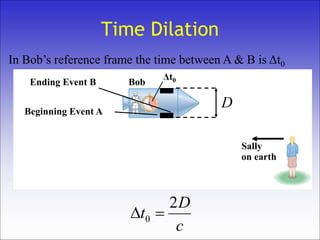
Time Dilation
In Bob’s reference frame the time between A & B is Δt0
Sally
on earth
Bob
Beginning Event A
Ending Event B
c
D
t
2
0 
D
Δt0
Bob
Time Dilation
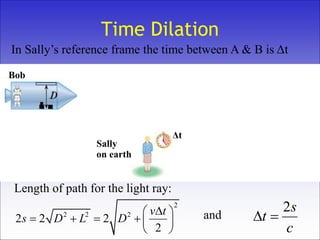
In Sally’s reference frame the time between A & B is Δt
Bob
A BSally
on earth
2
2 2 2
2 2 2
2
v t
s D L D
 
     
 
Length of path for the light ray:
c
s
t
2
and
Δt
Time Dilation
2
2 2 2
2 2 2
2
v t
s D L D
 
     
 
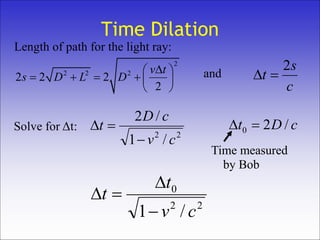
Length of path for the light ray:
c
s
t
2
and
Solve for Δt:
22
/1
/2
cv
cD
t

 cDt /20 
Time measured
by Bob
22
0
/1 cv
t
t



Time Dilation
22
0
/1 cv
t
t



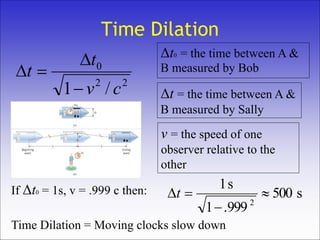
Δt0 = the time between A &
B measured by Bob
Δt = the time between A &
B measured by Sally
v = the speed of one
observer relative to the
other
Time Dilation = Moving clocks slow down
If Δt0 = 1s, v = .999 c then: s500
999.1
s1
2


t
Time Dilation
• Bob’s watch always displays his proper time
• Sally’s watch always displays her proper time
How do we define time?
The flow of time each observer experiences is measured by
their watch – we call this the proper time
• If they are moving relative to each other they will not
agree
Time Dilation
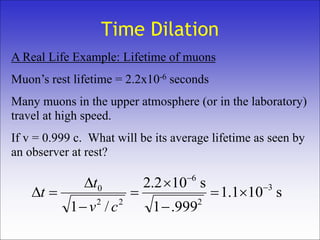
A Real Life Example: Lifetime of muons
Muon’s rest lifetime = 2.2x10⁻⁶ seconds
Many muons in the upper atmosphere (or in the laboratory)
travel at high speed.
If v = 0.999 c. What will be its average lifetime as seen by
an observer at rest?
s101.1
999.1
s102.2
/1
3
2
6
22
0 








cv
t
t
Length Contraction
Bob’s reference frame:
The distance measured by the spacecraft is shorter
Sally’s reference frame:
Sally
Bob
0
0
LL
v
t t
 
 
The relative speed v is the
same for both observers:
22
0
/1 cv
t
t



22
0 /1 cvLL 
-END-

Relativity by Albert einstein

  • 1.
  • 2.
    The Relativity Principle GalileoGalilei 1564 - 1642 The Ptolemaic Model The Copernican Model Problem: If the earth were moving wouldn’t we feel it?
  • 3.
    A coordinate systemmoving at a constant velocity is called an inertial reference frame. The Galilean Relativity Principle: All physical laws are the same in all inertial reference frames.
  • 4.
    Other Examples: As longas you move at constant velocity you are in an inertial reference frame.
  • 5.
    Galilean Relativity – “Relativity”refers in general to the way physical measurements made in a given inertial frame are related to measurements in another frame. – An inertial observer is one whose rest frame is inertial. – A quantity is invariant if all inertial observers obtain the same value.
  • 6.
    – Under Galileanrelativity, measurements are transformed simply by adding or subtracting the velocity difference between frames: – vball(measured on ground)=vtrain (measured on ground)+vball(measured on train) 12 m/s = 10m/s + 2 m/s – Vball(measured on train)=vground(measured on train)+ vball(measured on ground) 2 m/s = 10m/s + 12 m/s 10 m/s 2 m/s 12 m/s
  • 7.
    Electromagnetism A wave solutiontraveling at the speed of light c = 3.00 x 10⁸ m/s Maxwell: Light is an EM wave! Problem: The equations don’t tell what light is traveling with respect to James Clerk Maxwell 1831 - 1879
  • 8.
    Einstein’s Approach toPhysics Albert Einstein 1879 - 1955 1. (Thought) Experiments E.g., if we could travel next to a light wave, what would we see? 2. “The Einstein Principle”: If two phenomena are indistinguishable by experiments then they are the same thing.
  • 9.
    Einstein’s Approach toPhysics 2. “The Einstein Principle”: If two phenomena are indistinguishable by experiments then they are the same thing. A magnet moving A coil moving towards a magnet Both produce the same current Implies that they are the same phenomenon towards a coil Albert Einstein 1879 - 1955 curren t curren t
  • 10.
    Einstein’s Approach toPhysics 1. Gedanken (Thought) Experiments E.g., if we could travel next to a light wave, what would we see? c c We would see an EM wave frozen in space next to us Problem: EM equations don’t predict stationary waves Albert Einstein 1879 - 1955
  • 11.
    Electromagnetism Another Problem: Everyexperiment measured the speed of light to be c regardless of motion The observer on the ground should measure the speed of this wave as c + 15 m/s Both observers actually measure the speed of this wave as c!
  • 12.
    Special Relativity Postulates •The Relativity Postulate: The laws of physics are the same in every inertial reference frame. • The Speed of Light Postulate: The speed of light in vacuum, measured in any inertial reference frame, always has the same value of c. Einstein: Start with 2 assumptions & deduce all else This is a literal interpretation of the EM equations
  • 13.
    Special Relativity Postulates Lookingthrough Einstein’s eyes: Both observers (by the postulates) should measure the speed of this wave as c Consequences: • Time behaves very differently than expected • Space behaves very differently than expected
  • 14.
    Einstein’s Special Relativity 1,000,000ms-1 0 ms-1 300,000,000 ms-1  Both spacemen measure the speed of the approaching ray of light.  How fast do they measure the speed of light to be?
  • 15.
    Einstein’s Special Relativity •Stationary man – 300,000,000 ms-1 • Man travelling at 1,000,000 ms-1 – 301,000,000 ms-1? – Wrong! • The Speed of Light is the same for all observers
  • 16.
    Three effects • 3strange effects of special relativity – Lorentz Transformations – Relativistic Doppler Effect – Headlight Effect
  • 17.
    Lorentz Transformations ■ Lightfrom the top of the bar has further to travel. ■ It therefore takes longer to reach the eye. ■ So, the bar appears bent. ■ Weird!
  • 18.
    Doppler Effect • Thepitch of the siren: – Rises as the ambulance approaches – Falls once the ambulance has passed. • The same applies to light! – Approaching objects appear blue (Blue-shift) – Receding objects appear red (Red-shift)
  • 19.
    Headlight effect • Beambecomes focused. • Same amount of light concentrated in a smaller area • Torch appears brighter! V
  • 20.
    Warp • Program usedto visualise the three effects Demo . . .
  • 21.
  • 22.
    Time Dilation One consequence:Time Changes Equipment needed: a light clock and a fast space ship.
  • 23.
    Time Dilation In Bob’sreference frame the time between A & B is Δt0 Sally on earth Bob Beginning Event A Ending Event B c D t 2 0  D Δt0
  • 24.
    Bob Time Dilation In Sally’sreference frame the time between A & B is Δt Bob A BSally on earth 2 2 2 2 2 2 2 2 v t s D L D           Length of path for the light ray: c s t 2 and Δt
  • 25.
    Time Dilation 2 2 22 2 2 2 2 v t s D L D           Length of path for the light ray: c s t 2 and Solve for Δt: 22 /1 /2 cv cD t   cDt /20  Time measured by Bob 22 0 /1 cv t t   
  • 26.
    Time Dilation 22 0 /1 cv t t    Δt0= the time between A & B measured by Bob Δt = the time between A & B measured by Sally v = the speed of one observer relative to the other Time Dilation = Moving clocks slow down If Δt0 = 1s, v = .999 c then: s500 999.1 s1 2   t
  • 27.
    Time Dilation • Bob’swatch always displays his proper time • Sally’s watch always displays her proper time How do we define time? The flow of time each observer experiences is measured by their watch – we call this the proper time • If they are moving relative to each other they will not agree
  • 28.
    Time Dilation A RealLife Example: Lifetime of muons Muon’s rest lifetime = 2.2x10⁻⁶ seconds Many muons in the upper atmosphere (or in the laboratory) travel at high speed. If v = 0.999 c. What will be its average lifetime as seen by an observer at rest? s101.1 999.1 s102.2 /1 3 2 6 22 0          cv t t
  • 29.
    Length Contraction Bob’s referenceframe: The distance measured by the spacecraft is shorter Sally’s reference frame: Sally Bob 0 0 LL v t t     The relative speed v is the same for both observers: 22 0 /1 cv t t    22 0 /1 cvLL 
  • 30.