There are several major types of diodes: Zener diodes maintain a constant voltage in reverse bias within a range of currents. Varactor diodes have a capacitance that varies inversely with reverse voltage. Light-emitting diodes (LEDs) emit light when forward-biased and are used for displays, lights, and more. Photodiodes exhibit increasing reverse current with light intensity and are used to detect light. Laser diodes produce coherent monochromatic light through stimulated emission and are used in printers, fiber optics, and medicine. Schottky diodes are used in high-frequency applications. PIN diodes act as capacitors when reverse-biased and variable resistors when forward-biased. Tunnel diodes
Types of Diodes
Thereare following major types of diodes.
The Zener Diode
The Varactor Diode
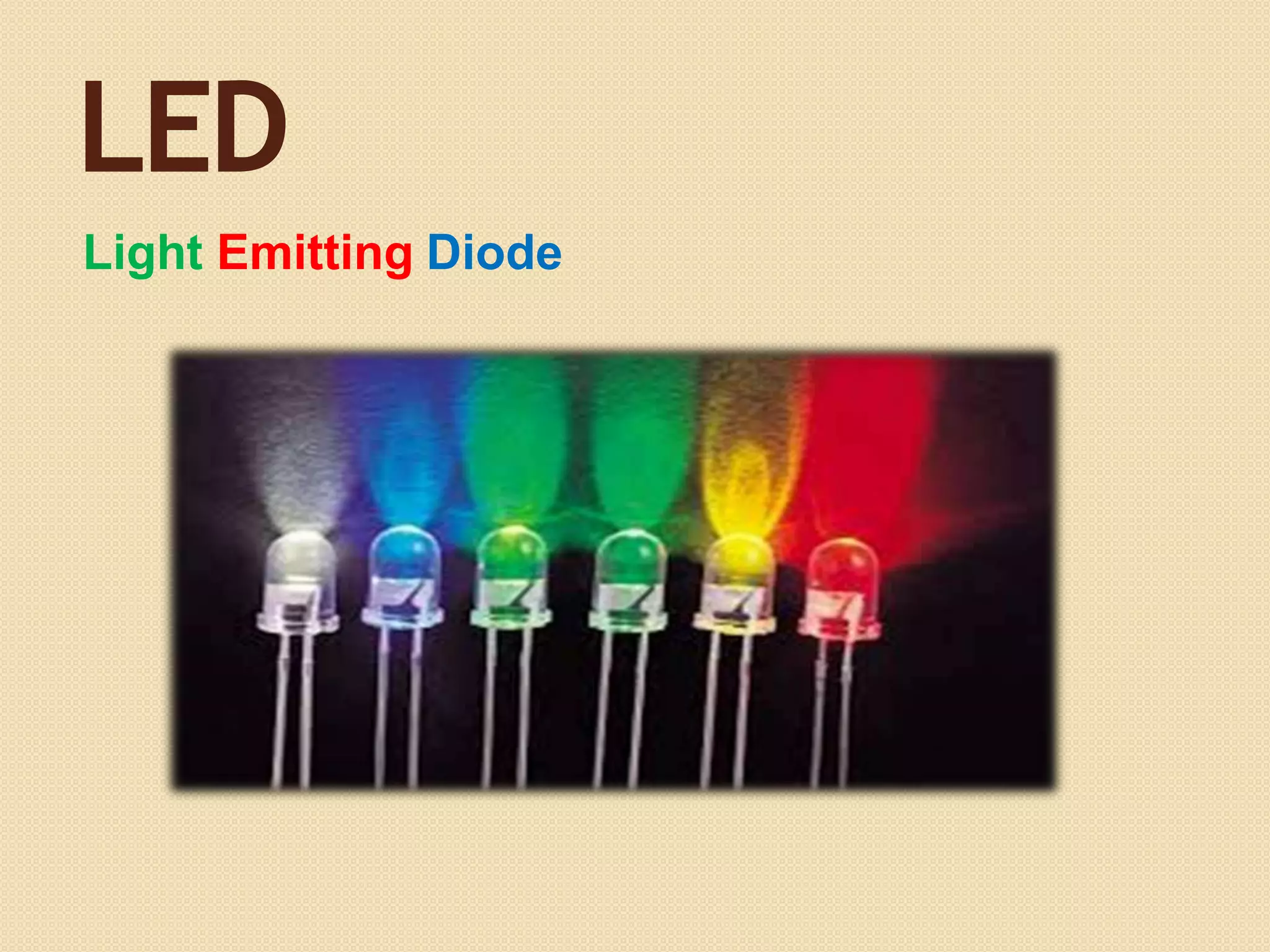
The Light-Emitting Diode
The Photodiode
The Laser Diode
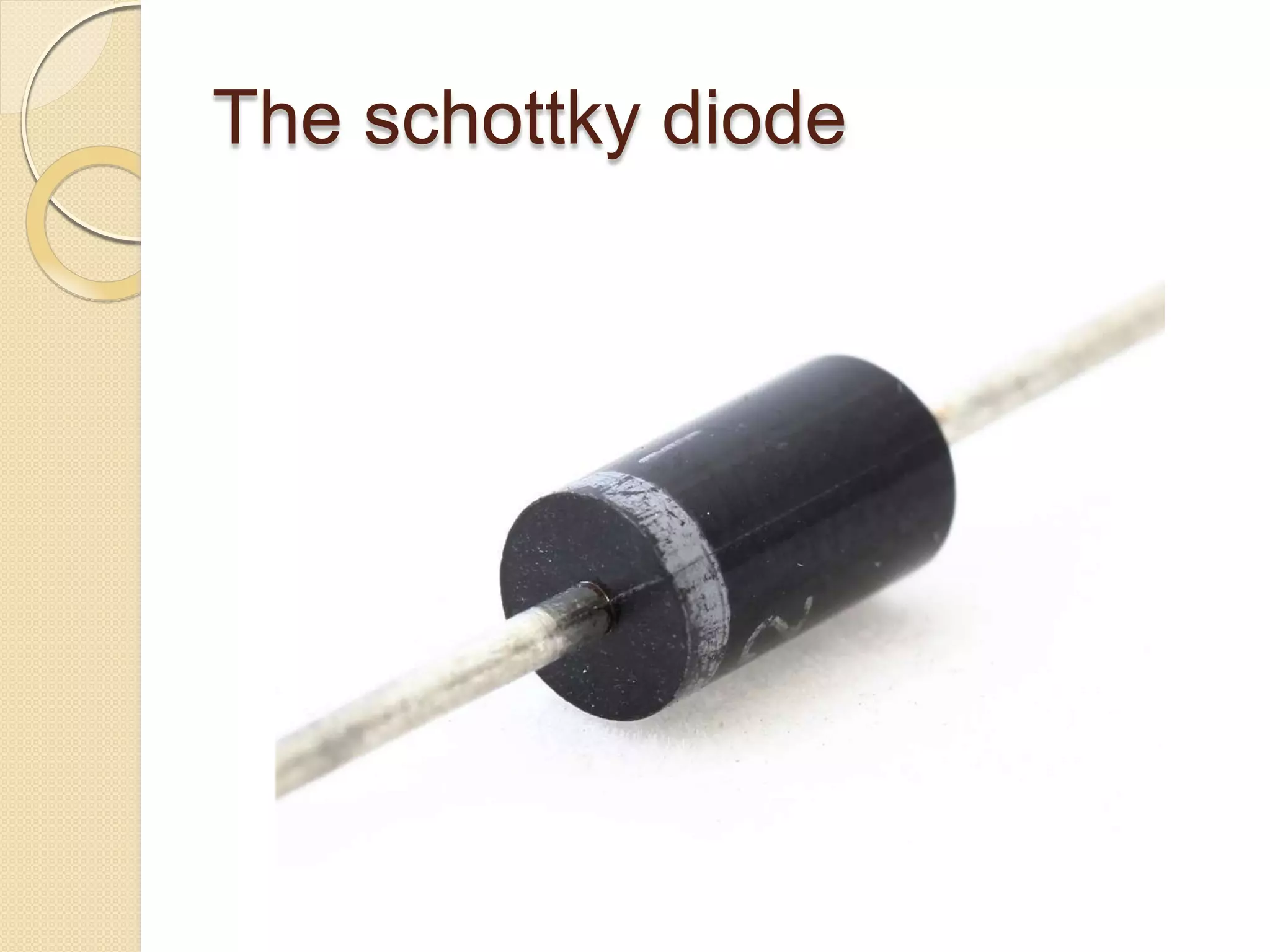
The Schottky Diode
The PIN Diode
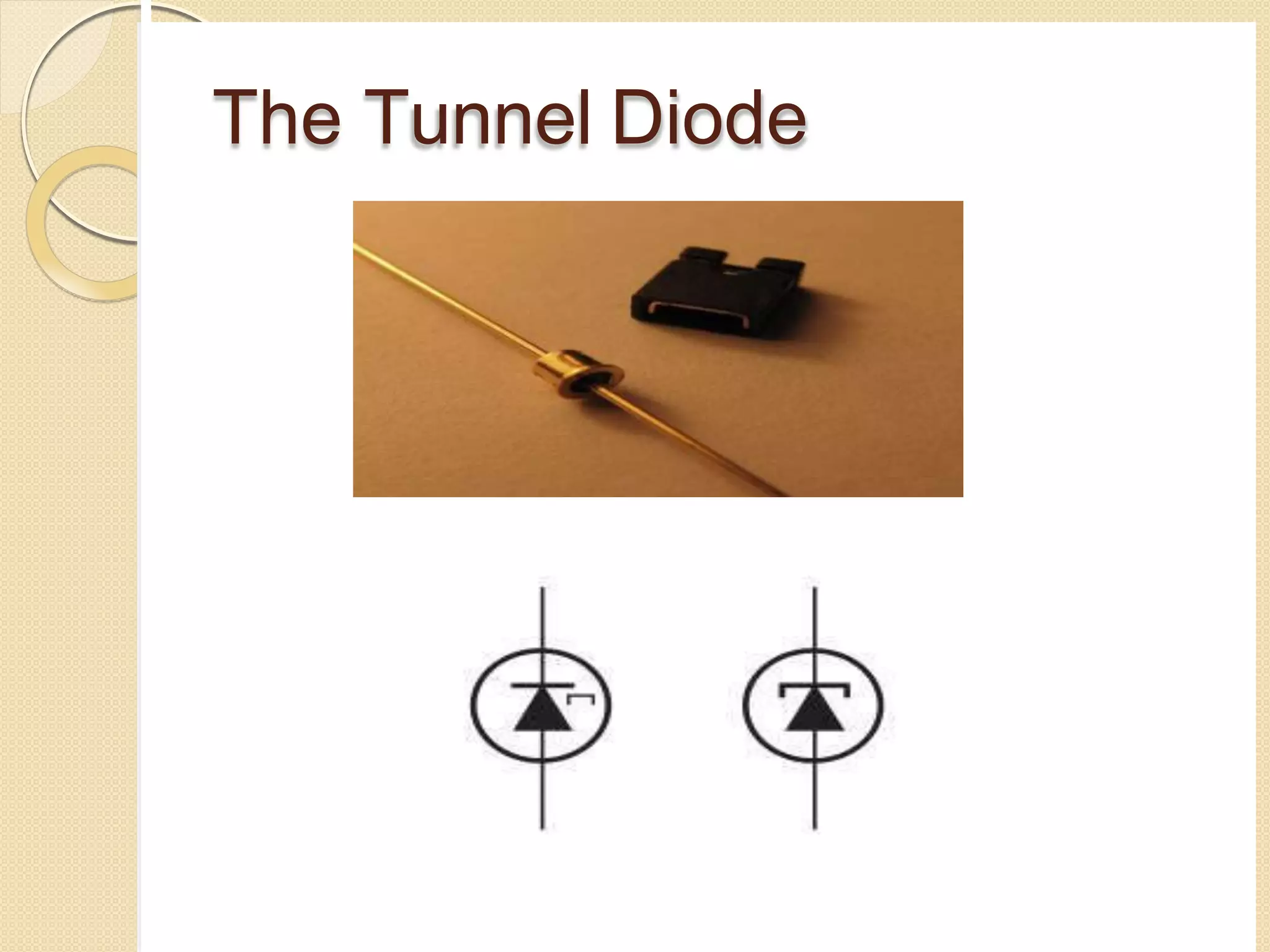
The Tunnel Diode
Light-Emitting Diode (LED)
AnLED emits light when forward-
biased.
LEDs are available for either infrared
or visible light.
High-intensity LEDs are used in large-
screen displays , traffic lights,
automotive lighting, and home lighting
etc.
Symbol:
5.
Explanation:-
When the deviceis forward-biased, electrons
cross the p-n junction from the n-type material
and recombine with holes in the p-type
material.
The difference in energy between the
electrons and the holes corresponds to the
energy of visible light.
When recombination takes place, the
recombining electrons release energy in
the form of photons
The light output (both intensity and color) is
also dependent on temperature. Light
intensity goes down with higher temperature
6.
The Photo Diode:
Thephotodiode is a device that
operates in reverse bias.
The photodiode exhibits an increase in
reverse current with light intensity.
A diode in which the reverse current
varies directly with the amount of light.
Symbol:-
7.
Explanation:
The photodiode hasa small
transparent window that allows light to
strike the p-n junction.
when its pn junction is exposed to
light, the reverse current increases
with the light intensity.
Some typical photodiodes are shown
in Figure
The Zener Diode:
Adiode designed for limiting the voltage
across its terminals in reverse bias.
A zener diode maintains a nearly
constant voltage across its terminals
over a specified range of zener
currents.
The zener diode reverse breakdown.
Explanation:
A Zener diodeis a silicon pn junction
device that is designed for operation in
the reverse-breakdown region. The
breakdown voltage of a zener diode is
set by carefully controlling the doping
level during manufacture. when a
diode reaches reverse breakdown, its
voltage remains almost constant even
though the current changes drastically,
and this is the key to zener diode
operation.
The Varactor Diode:
Avariable capacitance diode.
The capacitance of a varactor varies
inversely with reverse-bias voltage
The current regulator diode keeps its
forward current at a constant specified
value.
Symbol:
15.
Explanation:
A varactor isa diode that always operates
in reverse bias and is doped to maximize
the inherent capacitance of the depletion
region. The depletion region acts as a
capacitor dielectric because of its
nonconductive characteristic. The p and n
regions are conductive and act as the
capacitor
16.
The Laser Diode:
Theterm Laser stands for Light
Amplification by Stimulated Emission
of Radiation.
Laser light is Monochromatic, which
means that it consists of a single color
and not a mixture of colors.
Laser light is also called Coherent
light, which means a single
wavelength
Symbol:
18.
Aplications:
Laser diodes andare used in the pick-
up system of compact disk (CD)
players.
Laser diodes are also used in laser
printers.
Laser diodes are also used in fiber-
optic systems.
Laser diodes are used for the
treatment of cancer.
There are two types of lasers pulsed &
countinuos
The Schottky Diode
Schottkydiodes are high-current diodes
used primarily in high-frequency and
fast-switching applications.
They are also known as hot-carrier
diodes
A Schottky diode is formed by joining a
doped semiconductor region (usually n-
type) with as gold, silver, or platinum.
Symbol:
The PIN Diode:-
Thepin diode consists of heavily doped
p and n regions separated by an intrinsic
region.
When reverse-biased, the pin diode acts
like a nearly constant capacitance.
When forward-biased, it acts like a
current-controlled variable resistance.
The low forward resistance of the
intrinsic region decreases with increasing
current.
Symbol:
The Tunnel Diode:
Thetunnel diode exhibits a special
characteristic known as negative
resistance.
This feature makes it useful in oscillator
and microwave amplifier applications.
Tunnel diodes are constructed with
germanium or gallium arsenide by
doping the p and n regions much more
heavily than in a conventional rectifier
diode. This heavy do n an
extremely narrow de
ping results i
pletion region