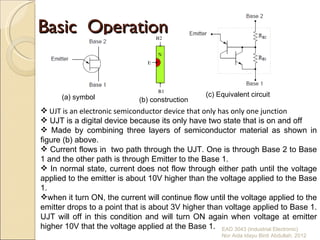
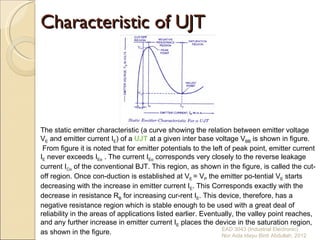
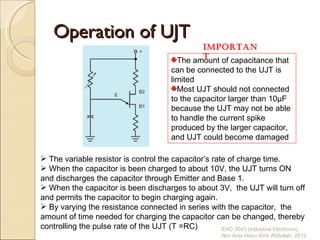
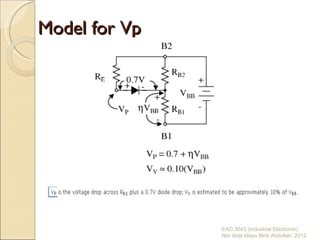
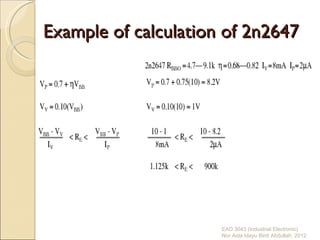
The unijunction transistor (UJT) is a three-terminal semiconductor device that has two operating states: on and off. It consists of three layers of semiconductor material. Current flows through two paths - from the emitter to base 1, and from base 2 to base 1. The UJT turns on when the emitter voltage is about 10V higher than the base 1 voltage, and turns off when the emitter voltage drops to about 3V higher. UJTs are used in relaxation oscillators where a capacitor charges until the UJT turns on and discharges the capacitor, then the UJT turns off and the process repeats.