

Chemical Finishes in Technical Textile
Technical Textile
Port City International University
Group Members
• Minhaj Chowdhury (BTE 00505245)
• Md. Wased Hussain (BTE 00505249)
• Arnab Chowdhury (BTE 00505250)
• Majharul Islam (BTE 00505254)
Technical Textile
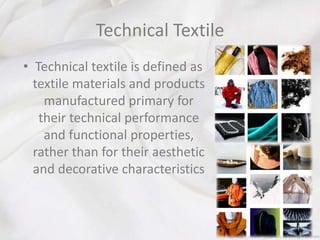
• Technical textile is defined as
textile materials and products
manufactured primary for
their technical performance
and functional properties,
rather than for their aesthetic
and decorative characteristics
Textile Finishing
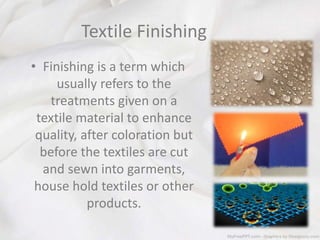
• Finishing is a term which
usually refers to the
treatments given on a
textile material to enhance
quality, after coloration but
before the textiles are cut
and sewn into garments,
house hold textiles or other
products.
Objects of textile finishing
• To improve the attractiveness and service ability of the textile
materials.
• To accentuate/inhibit some natural characteristics on the
textile materials such as softening, de-lusture, brightening etc.
• To change the surface characteristics of textile materials.
• To impart new characteristics/properties of textile materials
such as flame retardant, water repellent or water proof
finishes.
• To increase life and durability of textile materials.
• To set the fabric, so that it can be maintained its shape and
structure.
• To set the chemicals into the textile materials.
• To meet up specific end uses.
Classification of Textile Finishing
• The most basic classification is:
Aesthetic finishes
Functional finishes
• Finishes also classified as follows:
Mechanical finishes
Chemical finishes/Wet finishes
• Finishes also can be classified by their degree of performance:
Permanent finishes
Durable finishes
Semi-durable finishes
Temporary finishes
Chemical finishes/Wet finishes:
• chemical finishes are a class of textile finish, where selected
chemicals are used to enhance an already existing or
introducing a totally new property or properties to the textile
material. Wet finishes consist of the following:
Waterproof Finish
Water Repellent Finish
Flame Repellent Finish
Resin Finish
Anti-microbial Finish
Anti-Static Finish
Anti-moth Finish
Anti-rot & mildew Finish etc.
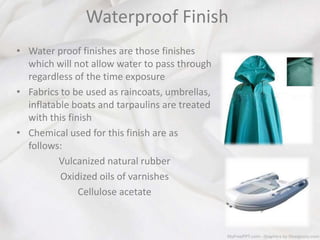
Waterproof Finish
• Water proof finishes are those finishes
which will not allow water to pass through
regardless of the time exposure
• Fabrics to be used as raincoats, umbrellas,
inflatable boats and tarpaulins are treated
with this finish
• Chemical used for this finish are as
follows:
Vulcanized natural rubber
Oxidized oils of varnishes
Cellulose acetate
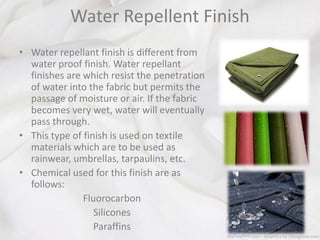
Water Repellent Finish
• Water repellant finish is different from
water proof finish. Water repellant
finishes are which resist the penetration
of water into the fabric but permits the
passage of moisture or air. If the fabric
becomes very wet, water will eventually
pass through.
• This type of finish is used on textile
materials which are to be used as
rainwear, umbrellas, tarpaulins, etc.
• Chemical used for this finish are as
follows:
Fluorocarbon
Silicones
Paraffins
Flame Repellent Finish
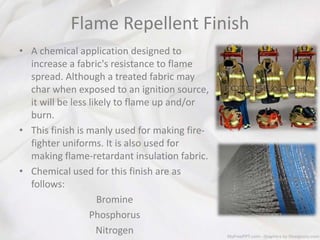
• A chemical application designed to
increase a fabric's resistance to flame
spread. Although a treated fabric may
char when exposed to an ignition source,
it will be less likely to flame up and/or
burn.
• This finish is manly used for making fire-
fighter uniforms. It is also used for
making flame-retardant insulation fabric.
• Chemical used for this finish are as
follows:
Bromine
Phosphorus
Nitrogen
Resin Finish
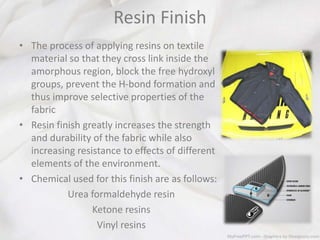
• The process of applying resins on textile
material so that they cross link inside the
amorphous region, block the free hydroxyl
groups, prevent the H-bond formation and
thus improve selective properties of the
fabric
• Resin finish greatly increases the strength
and durability of the fabric while also
increasing resistance to effects of different
elements of the environment.
• Chemical used for this finish are as follows:
Urea formaldehyde resin
Ketone resins
Vinyl resins
Anti-microbial Finish
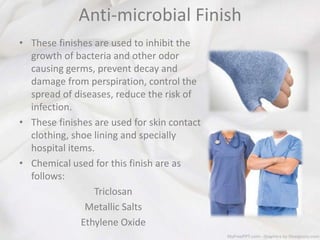
• These finishes are used to inhibit the
growth of bacteria and other odor
causing germs, prevent decay and
damage from perspiration, control the
spread of diseases, reduce the risk of
infection.
• These finishes are used for skin contact
clothing, shoe lining and specially
hospital items.
• Chemical used for this finish are as
follows:
Triclosan
Metallic Salts
Ethylene Oxide
Anti-Static Finish
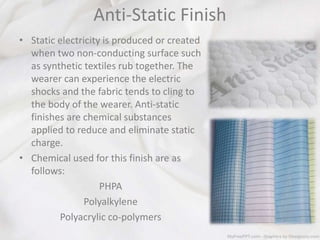
• Static electricity is produced or created
when two non-conducting surface such
as synthetic textiles rub together. The
wearer can experience the electric
shocks and the fabric tends to cling to
the body of the wearer. Anti-static
finishes are chemical substances
applied to reduce and eliminate static
charge.
• Chemical used for this finish are as
follows:
PHPA
Polyalkylene
Polyacrylic co-polymers
Anti-moth Finish
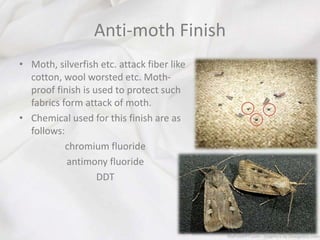
• Moth, silverfish etc. attack fiber like
cotton, wool worsted etc. Moth-
proof finish is used to protect such
fabrics form attack of moth.
• Chemical used for this finish are as
follows:
chromium fluoride
antimony fluoride
DDT
Anti-rot & mildew Finish
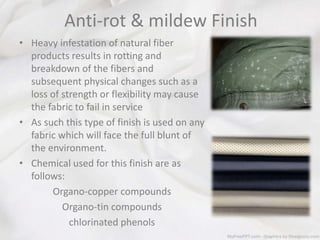
• Heavy infestation of natural fiber
products results in rotting and
breakdown of the fibers and
subsequent physical changes such as a
loss of strength or flexibility may cause
the fabric to fail in service
• As such this type of finish is used on any
fabric which will face the full blunt of
the environment.
• Chemical used for this finish are as
follows:
Organo-copper compounds
Organo-tin compounds
chlorinated phenols
Conclusion
• Fabric finishes play a major role in the garment. These finishes
are derived from both natural as well as manmade sources.
Finishes improve appearance of fabric along with its
performance and hence are divided on the basis of aesthetic
and functional properties. Finishes decrease crease, improve
flame retardation, provide softness and stiffness, decrease
pilling, raise fibers from fabric surface and also provide
protection against microbes, insects and bacteria. Overall
finishes play an important role in determining cost and
improving quality of fabric.
Thank you

Textile finishing

  • 1.
    Chemical Finishes inTechnical Textile Technical Textile Port City International University
  • 2.
    Group Members • MinhajChowdhury (BTE 00505245) • Md. Wased Hussain (BTE 00505249) • Arnab Chowdhury (BTE 00505250) • Majharul Islam (BTE 00505254)
  • 3.
    Technical Textile • Technicaltextile is defined as textile materials and products manufactured primary for their technical performance and functional properties, rather than for their aesthetic and decorative characteristics
  • 4.
    Textile Finishing • Finishingis a term which usually refers to the treatments given on a textile material to enhance quality, after coloration but before the textiles are cut and sewn into garments, house hold textiles or other products.
  • 5.
    Objects of textilefinishing • To improve the attractiveness and service ability of the textile materials. • To accentuate/inhibit some natural characteristics on the textile materials such as softening, de-lusture, brightening etc. • To change the surface characteristics of textile materials. • To impart new characteristics/properties of textile materials such as flame retardant, water repellent or water proof finishes. • To increase life and durability of textile materials. • To set the fabric, so that it can be maintained its shape and structure. • To set the chemicals into the textile materials. • To meet up specific end uses.
  • 6.
    Classification of TextileFinishing • The most basic classification is: Aesthetic finishes Functional finishes • Finishes also classified as follows: Mechanical finishes Chemical finishes/Wet finishes • Finishes also can be classified by their degree of performance: Permanent finishes Durable finishes Semi-durable finishes Temporary finishes
  • 7.
    Chemical finishes/Wet finishes: •chemical finishes are a class of textile finish, where selected chemicals are used to enhance an already existing or introducing a totally new property or properties to the textile material. Wet finishes consist of the following: Waterproof Finish Water Repellent Finish Flame Repellent Finish Resin Finish Anti-microbial Finish Anti-Static Finish Anti-moth Finish Anti-rot & mildew Finish etc.
  • 8.
    Waterproof Finish • Waterproof finishes are those finishes which will not allow water to pass through regardless of the time exposure • Fabrics to be used as raincoats, umbrellas, inflatable boats and tarpaulins are treated with this finish • Chemical used for this finish are as follows: Vulcanized natural rubber Oxidized oils of varnishes Cellulose acetate
  • 9.
    Water Repellent Finish •Water repellant finish is different from water proof finish. Water repellant finishes are which resist the penetration of water into the fabric but permits the passage of moisture or air. If the fabric becomes very wet, water will eventually pass through. • This type of finish is used on textile materials which are to be used as rainwear, umbrellas, tarpaulins, etc. • Chemical used for this finish are as follows: Fluorocarbon Silicones Paraffins
  • 10.
    Flame Repellent Finish •A chemical application designed to increase a fabric's resistance to flame spread. Although a treated fabric may char when exposed to an ignition source, it will be less likely to flame up and/or burn. • This finish is manly used for making fire- fighter uniforms. It is also used for making flame-retardant insulation fabric. • Chemical used for this finish are as follows: Bromine Phosphorus Nitrogen
  • 11.
    Resin Finish • Theprocess of applying resins on textile material so that they cross link inside the amorphous region, block the free hydroxyl groups, prevent the H-bond formation and thus improve selective properties of the fabric • Resin finish greatly increases the strength and durability of the fabric while also increasing resistance to effects of different elements of the environment. • Chemical used for this finish are as follows: Urea formaldehyde resin Ketone resins Vinyl resins
  • 12.
    Anti-microbial Finish • Thesefinishes are used to inhibit the growth of bacteria and other odor causing germs, prevent decay and damage from perspiration, control the spread of diseases, reduce the risk of infection. • These finishes are used for skin contact clothing, shoe lining and specially hospital items. • Chemical used for this finish are as follows: Triclosan Metallic Salts Ethylene Oxide
  • 13.
    Anti-Static Finish • Staticelectricity is produced or created when two non-conducting surface such as synthetic textiles rub together. The wearer can experience the electric shocks and the fabric tends to cling to the body of the wearer. Anti-static finishes are chemical substances applied to reduce and eliminate static charge. • Chemical used for this finish are as follows: PHPA Polyalkylene Polyacrylic co-polymers
  • 14.
    Anti-moth Finish • Moth,silverfish etc. attack fiber like cotton, wool worsted etc. Moth- proof finish is used to protect such fabrics form attack of moth. • Chemical used for this finish are as follows: chromium fluoride antimony fluoride DDT
  • 15.
    Anti-rot & mildewFinish • Heavy infestation of natural fiber products results in rotting and breakdown of the fibers and subsequent physical changes such as a loss of strength or flexibility may cause the fabric to fail in service • As such this type of finish is used on any fabric which will face the full blunt of the environment. • Chemical used for this finish are as follows: Organo-copper compounds Organo-tin compounds chlorinated phenols
  • 16.
    Conclusion • Fabric finishesplay a major role in the garment. These finishes are derived from both natural as well as manmade sources. Finishes improve appearance of fabric along with its performance and hence are divided on the basis of aesthetic and functional properties. Finishes decrease crease, improve flame retardation, provide softness and stiffness, decrease pilling, raise fibers from fabric surface and also provide protection against microbes, insects and bacteria. Overall finishes play an important role in determining cost and improving quality of fabric.
  • 17.