•In modern civilization, pollution from textile
industry is a great threat.
•Each year the world generates 400 billion tons
of industrial waste.
•The wastage generate due to garments
washing is also can be a curse for our
environment.
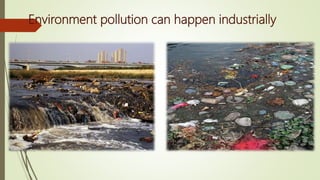
Environment pollution can happen industrially
NATURAL DYEING OF COTTON FABRIC
USING TURMERIC (Curcuma longa) AND
ANTI-MICROBIAL FINISHSubmitted By
Abdullah Al Bitar
Roll-702,Reg-4581
B. M. Tanimul Islam
Roll-700,Reg-4578
Md. Naimul Hasan
Roll-698,Reg-4576
Md. Anisur Rahman
Roll-699,Reg-4577
Ananna Rahman
Roll-703,Reg-4587
Khandakar Hasanuzzaman
Roll-704, Reg-4589
Md. Shariful Huda
Roll-711,Reg-4602
Md. Naim Hasan Towhid
Roll-707, Reg-4592
S.K. Asgar Hossain
Roll-701,Reg-4580
Submitted To
Avik Kumar Dhar
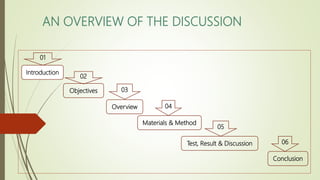
AN OVERVIEW OF THE DISCUSSION
02
03
04
05
06
Introduction
Objectives
Overview
Materials & Method
Test, Result & Discussion
Conclusion
01
Chapter-01
02
03
04
05
06
Introduction
Objectives
Overview
Materials &
Method
Test, Result &
Discussion
Conclusion
01
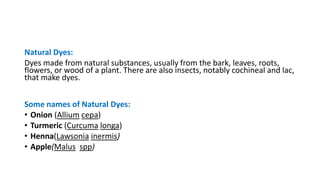
Natural Dyes:
Dyes made from natural substances, usually from the bark, leaves, roots,
flowers, or wood of a plant. There are also insects, notably cochineal and lac,
that make dyes.
Some names of Natural Dyes:
• Onion (Allium cepa)
• Turmeric (Curcuma longa)
• Henna(Lawsonia inermis)
• Apple(Malus spp)
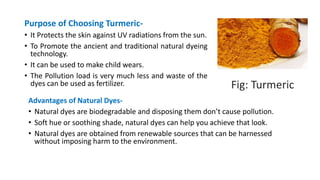
Purpose of Choosing Turmeric-
• It Protects the skin against UV radiations from the sun.
• To Promote the ancient and traditional natural dyeing
technology.
• It can be used to make child wears.
• The Pollution load is very much less and waste of the
dyes can be used as fertilizer.
Advantages of Natural Dyes-
• Natural dyes are biodegradable and disposing them don’t cause pollution.
• Soft hue or soothing shade, natural dyes can help you achieve that look.
• Natural dyes are obtained from renewable sources that can be harnessed
without imposing harm to the environment.
Fig: Turmeric
Mordant:
Mettalic substance that creates a chemical affinity
between the substrate and the dyestuffs and fix the
coloring matter on the materials permanently. We
use Alum [KAl(SO4)2.12H2O] as a mordant.
Purpose of Mordant-
• Better absorption of dyes
• Improved color fastness properties
• Inhanced color shades.
Fig: ALUM
Antimicrobial Finish:
Textile materials are not only related to microorganisms
such as pathogenic bacteria, odour generating bacteria
and mould fungi, but also good media for growth of
microorganisms. Though the use of antimicrobials have
been known for the decades, it is only in the recent
couple of years several attempts have been made on
finishing textiles with antimicrobial compounds.
Some of Antimicrobial Chemical Names-
• Organic silicon with tertiary ammonium salts
• Biozol,
• Thimol,
• Alkylenbisphenol sodium salt
• 3,4,4-Trichlorocarbanilin
• Chitosan
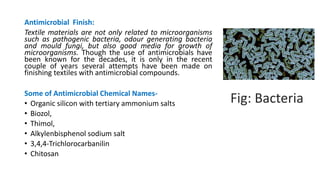
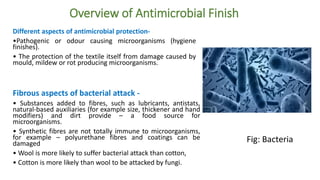
Fig: Bacteria
Necessity of antimicrobial finishes-
• To control micro-organisms
• To protect from viral infections caused by pathogenic bacteria
• To optimise the rate of metabolism in microbes to reduce the
generation of odour
• To save the quality of the textile materials from unexpected staining,
fade out of colour and quality deterioration.
Antimicrobial finish should possess following facts-
• Durability to wash, dry clean and hot press process.
• It should not be hazardous to the producer, final user and the
environmental conditions.
• Suitability with the various chemical processes.
• Ease of application.
• Retention of fabric quality up to the mark.
• To avoid body fluids.
• To avoid the disinfections/sterilization.
Significant of study-
• The fastness properties ( wash, light, color ) should be maintained.
• To decrease the lost of dyes and to avoid from fading.
• To increase the usage of natural dyes because they are
advantageous to humans.
• To assure the aesthetic properties as well as antimicrobial
properties.
CHAPTER-02
02
03
04
05
06
Introduction
Objectives
Overview
Materials &
Method
Test, Result &
Discussion
Conclusion
01
1
2
3
4
5
6
To establish an eco-friendly dyeing and finishing
To protect environment from harmful effect of poisonous chemical
To increase the usage of natural dyes because they are advantages to humans
To keep hygiene and freshness of the fabric
To safeguard the textile products from staining, discoloration and quality
deterioration
To make a wastage bio-degradable
CHAPTER-03
02
03
04
05
06
Introduction
Objectives
Overview
Materials &
Method
Test, Result &
Discussion
Conclusion
01
Overview of Natural Dye
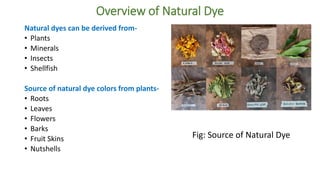
Natural dyes can be derived from-
• Plants
• Minerals
• Insects
• Shellfish
Source of natural dye colors from plants-
• Roots
• Leaves
• Flowers
• Barks
• Fruit Skins
• Nutshells
Fig: Source of Natural Dye
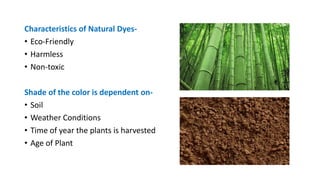
Characteristics of Natural Dyes-
• Eco-Friendly
• Harmless
• Non-toxic
Shade of the color is dependent on-
• Soil
• Weather Conditions
• Time of year the plants is harvested
• Age of Plant
Overview of Antimicrobial Finish
Different aspects of antimicrobial protection-
•Pathogenic or odour causing microorganisms (hygiene
finishes).
• The protection of the textile itself from damage caused by
mould, mildew or rot producing microorganisms.
Fibrous aspects of bacterial attack -
• Substances added to fibres, such as lubricants, antistats,
natural-based auxiliaries (for example size, thickener and hand
modifiers) and dirt provide – a food source for
microorganisms.
• Synthetic fibres are not totally immune to microorganisms,
for example – polyurethane fibres and coatings can be
damaged
• Wool is more likely to suffer bacterial attack than cotton,
• Cotton is more likely than wool to be attacked by fungi.
Fig: Bacteria
Properties of an effective antimicrobial finish-
• The growth rate of microbes can be astoundingly rapid.
• The bacteria population, for example, will double every 20 to 30
min under ideal conditions (36–40 °C or 77– 98 °F, pH 5–9)
• At this rate, one single bacteria cell can increase to 1 048 576
cells in just 7 hours.
• Therefore, antimicrobial finishes must be quick acting to be
effective.
Actual mechanisms of control microbial
growth-
• The actual mechanisms by which antimicrobial finishes control
microbial growth are extremely varied.
• Preventing cell reproduction,
• Blocking of enzymes,
• Reaction with the cell membrane (for example with silver ions) to
the destruction of the cell walls
• And poisoning the cell from within.
CHAPTER-04
02
03
04
05
06
Introduction
Objectives
Overview
Materials &
Method
Test, Result &
Discussion
Conclusion
01
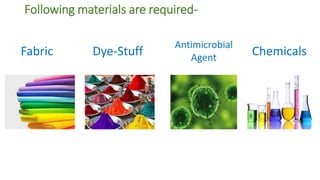
Following materials are required-
Fabric Chemicals
Antimicrobial
Agent
Dye-Stuff
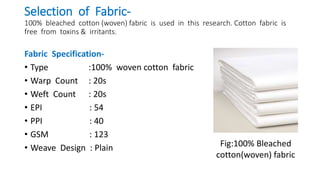
Selection of Fabric-
100% bleached cotton (woven) fabric is used in this research. Cotton fabric is
free from toxins & irritants.
Fabric Specification-
• Type :100% woven cotton fabric
• Warp Count : 20s
• Weft Count : 20s
• EPI : 54
• PPI : 40
• GSM : 123
• Weave Design : Plain Fig:100% Bleached
cotton(woven) fabric
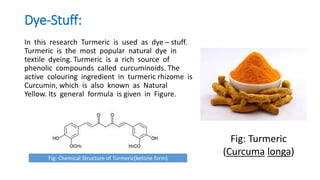
Dye-Stuff:
In this research Turmeric is used as dye – stuff.
Turmeric is the most popular natural dye in
textile dyeing. Turmeric is a rich source of
phenolic compounds called curcuminoids. The
active colouring ingredient in turmeric rhizome is
Curcumin, which is also known as Natural
Yellow. Its general formula is given in Figure.
Fig: Chemical Structure of Turmeric(ketone form)
Fig: Turmeric
(Curcuma longa)
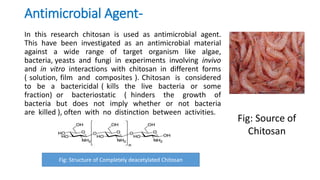
Antimicrobial Agent-
In this research chitosan is used as antimicrobial agent.
This have been investigated as an antimicrobial material
against a wide range of target organism like algae,
bacteria, yeasts and fungi in experiments involving invivo
and in vitro interactions with chitosan in different forms
( solution, film and composites ). Chitosan is considered
to be a bactericidal ( kills the live bacteria or some
fraction) or bacteriostatic ( hinders the growth of
bacteria but does not imply whether or not bacteria
are killed ), often with no distinction between activities.
Fig: Structure of Completely deacetylated Chitosan
Fig: Source of
Chitosan
Chemicals-
Dyeing
Washing
Finishing
Alum [KAl(SO4)2.12H2O]
• Knittex CHN
• Pyrovatex CP
• Invadine PBN
• Turpex
• Phosphoric Acid
• Acetic Acid
Acetic Acid [CH3COOH]
ALUM
Acetic Acid
Phosphoric Acid
Apparatus-
• Beakers
• Stirrer
• pH Meter
• Electric Balance
• Scissor
• Thermometer
• Dye Bath
• Washing Machine
• Drying Machine
• Curing Machine
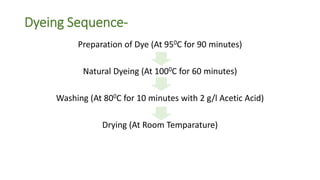
Dyeing Sequence-
Preparation of Dye (At 950C for 90 minutes)
Natural Dyeing (At 1000C for 60 minutes)
Washing (At 800C for 10 minutes with 2 g/l Acetic Acid)
Drying (At Room Temparature)
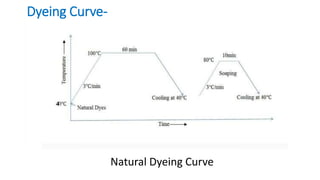
Dyeing Curve-
Natural Dyeing Curve
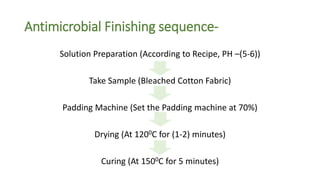
Antimicrobial Finishing sequence-
Solution Preparation (According to Recipe, PH –(5-6))
Take Sample (Bleached Cotton Fabric)
Padding Machine (Set the Padding machine at 70%)
Drying (At 1200C for (1-2) minutes)
Curing (At 1500C for 5 minutes)
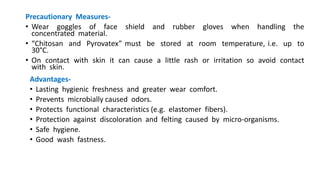
Precautionary Measures-
• Wear goggles of face shield and rubber gloves when handling the
concentrated material.
• “Chitosan and Pyrovatex” must be stored at room temperature, i.e. up to
30°C.
• On contact with skin it can cause a little rash or irritation so avoid contact
with skin.
Advantages-
• Lasting hygienic freshness and greater wear comfort.
• Prevents microbially caused odors.
• Protects functional characteristics (e.g. elastomer fibers).
• Protection against discoloration and felting caused by micro-organisms.
• Safe hygiene.
• Good wash fastness.
CHAPTER-05
02
03
04
05
06
Introduction
Objectives
Overview
Materials &
Method
Test, Result &
Discussion
Conclusion
01
Tests for Natural Dyed fabric and antimicrobial
finished fabric-
For Natural dyed fabric-
• Wash Fastness
• Rubbing Fastness
• Light Fastness
For Antimicrobial finished fabric-
• Bromo phenol Blue (BPB) test
1. Test for Dark Substrates
2. Test for Light Substrates
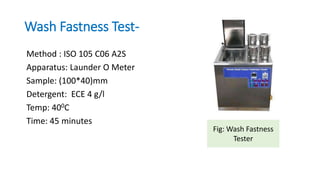
Wash Fastness Test-
Method : ISO 105 C06 A2S
Apparatus: Launder O Meter
Sample: (100*40)mm
Detergent: ECE 4 g/l
Temp: 400C
Time: 45 minutes
Fig: Wash Fastness
Tester
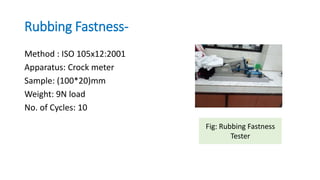
Rubbing Fastness-
Method : ISO 105x12:2001
Apparatus: Crock meter
Sample: (100*20)mm
Weight: 9N load
No. of Cycles: 10
Fig: Rubbing Fastness
Tester
Light Fastness-
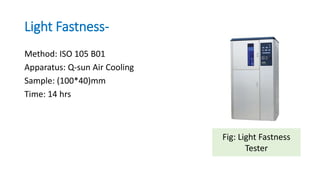
Method: ISO 105 B01
Apparatus: Q-sun Air Cooling
Sample: (100*40)mm
Time: 14 hrs
Fig: Light Fastness
Tester
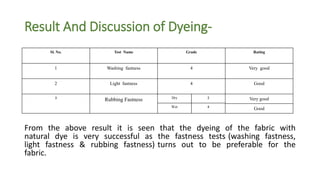
Result And Discussion of Dyeing-
Sl. No. Test Name Grade Rating
1 Washing fastness 4 Very good
2 Light fastness 4 Good
3
Rubbing Fastness Dry 2 Very good
Wet 4
Good
From the above result it is seen that the dyeing of the fabric with
natural dye is very successful as the fastness tests (washing fastness,
light fastness & rubbing fastness) turns out to be preferable for the
fabric.
Test of Antimicrobial Finish-
BPB (Bromo Phenol Blue)-
This is a qualitative method for detecting the presence of
antimicrobial finishes on light and dark colored substrates. Actually
BPB is a sodium salt of bromo-phenol blue. We will discuss this
test for both types of substrates.
1. Test for Dark Substrates
2. Test for Light Substrates
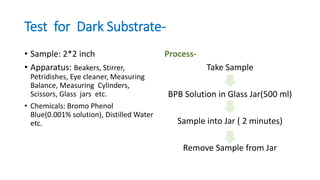
Test for Dark Substrate-
• Sample: 2*2 inch
• Apparatus: Beakers, Stirrer,
Petridishes, Eye cleaner, Measuring
Balance, Measuring Cylinders,
Scissors, Glass jars etc.
• Chemicals: Bromo Phenol
Blue(0.001% solution), Distilled Water
etc.
Process-
Take Sample
BPB Solution in Glass Jar(500 ml)
Sample into Jar ( 2 minutes)
Remove Sample from Jar
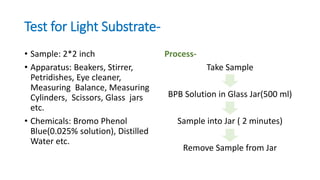
Test for Light Substrate-
• Sample: 2*2 inch
• Apparatus: Beakers, Stirrer,
Petridishes, Eye cleaner,
Measuring Balance, Measuring
Cylinders, Scissors, Glass jars
etc.
• Chemicals: Bromo Phenol
Blue(0.025% solution), Distilled
Water etc.
Process-
Take Sample
BPB Solution in Glass Jar(500 ml)
Sample into Jar ( 2 minutes)
Remove Sample from Jar
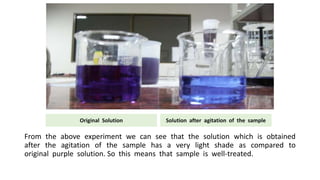
From the above experiment we can see that the solution which is obtained
after the agitation of the sample has a very light shade as compared to
original purple solution. So this means that sample is well-treated.
Original Solution Solution after agitation of the sample
Result And Discussion of Antimicrobial Finish-
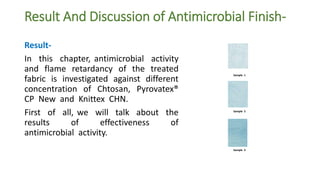
Result-
In this chapter, antimicrobial activity
and flame retardancy of the treated
fabric is investigated against different
concentration of Chtosan, Pyrovatex®
CP New and Knittex CHN.
First of all, we will talk about the
results of effectiveness of
antimicrobial activity.
Sample 1
Sample 2
Sample 3
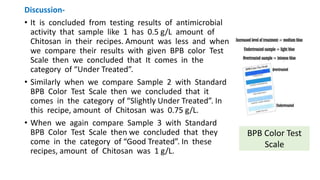
Discussion-
• It is concluded from testing results of antimicrobial
activity that sample like 1 has 0.5 g/L amount of
Chitosan in their recipes. Amount was less and when
we compare their results with given BPB color Test
Scale then we concluded that It comes in the
category of “Under Treated”.
• Similarly when we compare Sample 2 with Standard
BPB Color Test Scale then we concluded that it
comes in the category of “Slightly Under Treated”. In
this recipe, amount of Chitosan was 0.75 g/L.
• When we again compare Sample 3 with Standard
BPB Color Test Scale then we concluded that they
come in the category of “Good Treated”. In these
recipes, amount of Chitosan was 1 g/L.
BPB Color Test
Scale
CHAPTER-06
02
03
04
05
0
6
Introduction
Objectives
Overview
Materials &
Method
Test, Result &
Discussion
Conclusion
01
As it is expressed earlier that the adverse effect on environment due to
synthetic dying and chemical finishing have is very much huge. So there is no
exception without replacing these harmful chemicals with natural components. In
this research it is shown that turmeric used as natural dye and chitosan as
antimicrobial agent is compatible with cotton fabric. It is known that these are
totally harmless for the environment as well as human body. This type of
operation can be carried out in various field (e.g. medical clothing, sportswear,
home textiles etc.). With further research it may be possible to apply these
ecofriendly and hygienic materials in other fields.
Thesis

Thesis

  • 1.
    •In modern civilization,pollution from textile industry is a great threat. •Each year the world generates 400 billion tons of industrial waste. •The wastage generate due to garments washing is also can be a curse for our environment.
  • 2.
    Environment pollution canhappen industrially
  • 4.
    NATURAL DYEING OFCOTTON FABRIC USING TURMERIC (Curcuma longa) AND ANTI-MICROBIAL FINISHSubmitted By Abdullah Al Bitar Roll-702,Reg-4581 B. M. Tanimul Islam Roll-700,Reg-4578 Md. Naimul Hasan Roll-698,Reg-4576 Md. Anisur Rahman Roll-699,Reg-4577 Ananna Rahman Roll-703,Reg-4587 Khandakar Hasanuzzaman Roll-704, Reg-4589 Md. Shariful Huda Roll-711,Reg-4602 Md. Naim Hasan Towhid Roll-707, Reg-4592 S.K. Asgar Hossain Roll-701,Reg-4580 Submitted To Avik Kumar Dhar
  • 5.
    AN OVERVIEW OFTHE DISCUSSION 02 03 04 05 06 Introduction Objectives Overview Materials & Method Test, Result & Discussion Conclusion 01
  • 6.
  • 7.
    Natural Dyes: Dyes madefrom natural substances, usually from the bark, leaves, roots, flowers, or wood of a plant. There are also insects, notably cochineal and lac, that make dyes. Some names of Natural Dyes: • Onion (Allium cepa) • Turmeric (Curcuma longa) • Henna(Lawsonia inermis) • Apple(Malus spp)
  • 8.
    Purpose of ChoosingTurmeric- • It Protects the skin against UV radiations from the sun. • To Promote the ancient and traditional natural dyeing technology. • It can be used to make child wears. • The Pollution load is very much less and waste of the dyes can be used as fertilizer. Advantages of Natural Dyes- • Natural dyes are biodegradable and disposing them don’t cause pollution. • Soft hue or soothing shade, natural dyes can help you achieve that look. • Natural dyes are obtained from renewable sources that can be harnessed without imposing harm to the environment. Fig: Turmeric
  • 9.
    Mordant: Mettalic substance thatcreates a chemical affinity between the substrate and the dyestuffs and fix the coloring matter on the materials permanently. We use Alum [KAl(SO4)2.12H2O] as a mordant. Purpose of Mordant- • Better absorption of dyes • Improved color fastness properties • Inhanced color shades. Fig: ALUM
  • 10.
    Antimicrobial Finish: Textile materialsare not only related to microorganisms such as pathogenic bacteria, odour generating bacteria and mould fungi, but also good media for growth of microorganisms. Though the use of antimicrobials have been known for the decades, it is only in the recent couple of years several attempts have been made on finishing textiles with antimicrobial compounds. Some of Antimicrobial Chemical Names- • Organic silicon with tertiary ammonium salts • Biozol, • Thimol, • Alkylenbisphenol sodium salt • 3,4,4-Trichlorocarbanilin • Chitosan Fig: Bacteria
  • 11.
    Necessity of antimicrobialfinishes- • To control micro-organisms • To protect from viral infections caused by pathogenic bacteria • To optimise the rate of metabolism in microbes to reduce the generation of odour • To save the quality of the textile materials from unexpected staining, fade out of colour and quality deterioration.
  • 12.
    Antimicrobial finish shouldpossess following facts- • Durability to wash, dry clean and hot press process. • It should not be hazardous to the producer, final user and the environmental conditions. • Suitability with the various chemical processes. • Ease of application. • Retention of fabric quality up to the mark. • To avoid body fluids. • To avoid the disinfections/sterilization.
  • 13.
    Significant of study- •The fastness properties ( wash, light, color ) should be maintained. • To decrease the lost of dyes and to avoid from fading. • To increase the usage of natural dyes because they are advantageous to humans. • To assure the aesthetic properties as well as antimicrobial properties.
  • 14.
  • 15.
    1 2 3 4 5 6 To establish aneco-friendly dyeing and finishing To protect environment from harmful effect of poisonous chemical To increase the usage of natural dyes because they are advantages to humans To keep hygiene and freshness of the fabric To safeguard the textile products from staining, discoloration and quality deterioration To make a wastage bio-degradable
  • 16.
  • 17.
    Overview of NaturalDye Natural dyes can be derived from- • Plants • Minerals • Insects • Shellfish Source of natural dye colors from plants- • Roots • Leaves • Flowers • Barks • Fruit Skins • Nutshells Fig: Source of Natural Dye
  • 18.
    Characteristics of NaturalDyes- • Eco-Friendly • Harmless • Non-toxic Shade of the color is dependent on- • Soil • Weather Conditions • Time of year the plants is harvested • Age of Plant
  • 19.
    Overview of AntimicrobialFinish Different aspects of antimicrobial protection- •Pathogenic or odour causing microorganisms (hygiene finishes). • The protection of the textile itself from damage caused by mould, mildew or rot producing microorganisms. Fibrous aspects of bacterial attack - • Substances added to fibres, such as lubricants, antistats, natural-based auxiliaries (for example size, thickener and hand modifiers) and dirt provide – a food source for microorganisms. • Synthetic fibres are not totally immune to microorganisms, for example – polyurethane fibres and coatings can be damaged • Wool is more likely to suffer bacterial attack than cotton, • Cotton is more likely than wool to be attacked by fungi. Fig: Bacteria
  • 20.
    Properties of aneffective antimicrobial finish- • The growth rate of microbes can be astoundingly rapid. • The bacteria population, for example, will double every 20 to 30 min under ideal conditions (36–40 °C or 77– 98 °F, pH 5–9) • At this rate, one single bacteria cell can increase to 1 048 576 cells in just 7 hours. • Therefore, antimicrobial finishes must be quick acting to be effective. Actual mechanisms of control microbial growth- • The actual mechanisms by which antimicrobial finishes control microbial growth are extremely varied. • Preventing cell reproduction, • Blocking of enzymes, • Reaction with the cell membrane (for example with silver ions) to the destruction of the cell walls • And poisoning the cell from within.
  • 21.
  • 22.
    Following materials arerequired- Fabric Chemicals Antimicrobial Agent Dye-Stuff
  • 23.
    Selection of Fabric- 100%bleached cotton (woven) fabric is used in this research. Cotton fabric is free from toxins & irritants. Fabric Specification- • Type :100% woven cotton fabric • Warp Count : 20s • Weft Count : 20s • EPI : 54 • PPI : 40 • GSM : 123 • Weave Design : Plain Fig:100% Bleached cotton(woven) fabric
  • 24.
    Dye-Stuff: In this researchTurmeric is used as dye – stuff. Turmeric is the most popular natural dye in textile dyeing. Turmeric is a rich source of phenolic compounds called curcuminoids. The active colouring ingredient in turmeric rhizome is Curcumin, which is also known as Natural Yellow. Its general formula is given in Figure. Fig: Chemical Structure of Turmeric(ketone form) Fig: Turmeric (Curcuma longa)
  • 25.
    Antimicrobial Agent- In thisresearch chitosan is used as antimicrobial agent. This have been investigated as an antimicrobial material against a wide range of target organism like algae, bacteria, yeasts and fungi in experiments involving invivo and in vitro interactions with chitosan in different forms ( solution, film and composites ). Chitosan is considered to be a bactericidal ( kills the live bacteria or some fraction) or bacteriostatic ( hinders the growth of bacteria but does not imply whether or not bacteria are killed ), often with no distinction between activities. Fig: Structure of Completely deacetylated Chitosan Fig: Source of Chitosan
  • 26.
    Chemicals- Dyeing Washing Finishing Alum [KAl(SO4)2.12H2O] • KnittexCHN • Pyrovatex CP • Invadine PBN • Turpex • Phosphoric Acid • Acetic Acid Acetic Acid [CH3COOH] ALUM Acetic Acid Phosphoric Acid
  • 27.
    Apparatus- • Beakers • Stirrer •pH Meter • Electric Balance • Scissor • Thermometer • Dye Bath • Washing Machine • Drying Machine • Curing Machine
  • 28.
    Dyeing Sequence- Preparation ofDye (At 950C for 90 minutes) Natural Dyeing (At 1000C for 60 minutes) Washing (At 800C for 10 minutes with 2 g/l Acetic Acid) Drying (At Room Temparature)
  • 29.
  • 30.
    Antimicrobial Finishing sequence- SolutionPreparation (According to Recipe, PH –(5-6)) Take Sample (Bleached Cotton Fabric) Padding Machine (Set the Padding machine at 70%) Drying (At 1200C for (1-2) minutes) Curing (At 1500C for 5 minutes)
  • 31.
    Precautionary Measures- • Weargoggles of face shield and rubber gloves when handling the concentrated material. • “Chitosan and Pyrovatex” must be stored at room temperature, i.e. up to 30°C. • On contact with skin it can cause a little rash or irritation so avoid contact with skin. Advantages- • Lasting hygienic freshness and greater wear comfort. • Prevents microbially caused odors. • Protects functional characteristics (e.g. elastomer fibers). • Protection against discoloration and felting caused by micro-organisms. • Safe hygiene. • Good wash fastness.
  • 32.
  • 33.
    Tests for NaturalDyed fabric and antimicrobial finished fabric- For Natural dyed fabric- • Wash Fastness • Rubbing Fastness • Light Fastness For Antimicrobial finished fabric- • Bromo phenol Blue (BPB) test 1. Test for Dark Substrates 2. Test for Light Substrates
  • 34.
    Wash Fastness Test- Method: ISO 105 C06 A2S Apparatus: Launder O Meter Sample: (100*40)mm Detergent: ECE 4 g/l Temp: 400C Time: 45 minutes Fig: Wash Fastness Tester
  • 35.
    Rubbing Fastness- Method :ISO 105x12:2001 Apparatus: Crock meter Sample: (100*20)mm Weight: 9N load No. of Cycles: 10 Fig: Rubbing Fastness Tester
  • 36.
    Light Fastness- Method: ISO105 B01 Apparatus: Q-sun Air Cooling Sample: (100*40)mm Time: 14 hrs Fig: Light Fastness Tester
  • 37.
    Result And Discussionof Dyeing- Sl. No. Test Name Grade Rating 1 Washing fastness 4 Very good 2 Light fastness 4 Good 3 Rubbing Fastness Dry 2 Very good Wet 4 Good From the above result it is seen that the dyeing of the fabric with natural dye is very successful as the fastness tests (washing fastness, light fastness & rubbing fastness) turns out to be preferable for the fabric.
  • 38.
    Test of AntimicrobialFinish- BPB (Bromo Phenol Blue)- This is a qualitative method for detecting the presence of antimicrobial finishes on light and dark colored substrates. Actually BPB is a sodium salt of bromo-phenol blue. We will discuss this test for both types of substrates. 1. Test for Dark Substrates 2. Test for Light Substrates
  • 39.
    Test for DarkSubstrate- • Sample: 2*2 inch • Apparatus: Beakers, Stirrer, Petridishes, Eye cleaner, Measuring Balance, Measuring Cylinders, Scissors, Glass jars etc. • Chemicals: Bromo Phenol Blue(0.001% solution), Distilled Water etc. Process- Take Sample BPB Solution in Glass Jar(500 ml) Sample into Jar ( 2 minutes) Remove Sample from Jar
  • 40.
    Test for LightSubstrate- • Sample: 2*2 inch • Apparatus: Beakers, Stirrer, Petridishes, Eye cleaner, Measuring Balance, Measuring Cylinders, Scissors, Glass jars etc. • Chemicals: Bromo Phenol Blue(0.025% solution), Distilled Water etc. Process- Take Sample BPB Solution in Glass Jar(500 ml) Sample into Jar ( 2 minutes) Remove Sample from Jar
  • 41.
    From the aboveexperiment we can see that the solution which is obtained after the agitation of the sample has a very light shade as compared to original purple solution. So this means that sample is well-treated. Original Solution Solution after agitation of the sample
  • 42.
    Result And Discussionof Antimicrobial Finish- Result- In this chapter, antimicrobial activity and flame retardancy of the treated fabric is investigated against different concentration of Chtosan, Pyrovatex® CP New and Knittex CHN. First of all, we will talk about the results of effectiveness of antimicrobial activity. Sample 1 Sample 2 Sample 3
  • 43.
    Discussion- • It isconcluded from testing results of antimicrobial activity that sample like 1 has 0.5 g/L amount of Chitosan in their recipes. Amount was less and when we compare their results with given BPB color Test Scale then we concluded that It comes in the category of “Under Treated”. • Similarly when we compare Sample 2 with Standard BPB Color Test Scale then we concluded that it comes in the category of “Slightly Under Treated”. In this recipe, amount of Chitosan was 0.75 g/L. • When we again compare Sample 3 with Standard BPB Color Test Scale then we concluded that they come in the category of “Good Treated”. In these recipes, amount of Chitosan was 1 g/L. BPB Color Test Scale
  • 44.
  • 45.
    As it isexpressed earlier that the adverse effect on environment due to synthetic dying and chemical finishing have is very much huge. So there is no exception without replacing these harmful chemicals with natural components. In this research it is shown that turmeric used as natural dye and chitosan as antimicrobial agent is compatible with cotton fabric. It is known that these are totally harmless for the environment as well as human body. This type of operation can be carried out in various field (e.g. medical clothing, sportswear, home textiles etc.). With further research it may be possible to apply these ecofriendly and hygienic materials in other fields.