By-
Neha Kulkarni
ME Computer
Pune Insitute of Computer Technology
 What is spatial data?
 Types of spatial data
 Types of queries
 Applications
 Indexing Techniques
 Comparison of Indexing techniques
 GiST
 Indexing High-dimensional data
 Conclusion
• Spatial data represent the location ,size
and shape of an object on earth
• Ex. Building, lake
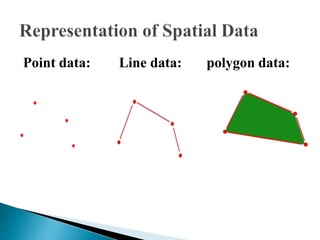
Point data: Line data: polygon data:
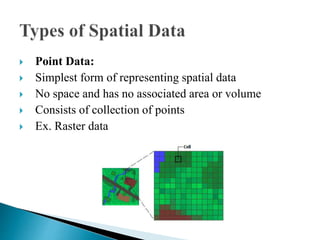
 Point Data:
 Simplest form of representing spatial data
 No space and has no associated area or volume
 Consists of collection of points
 Ex. Raster data
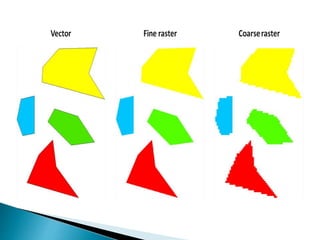
 Region data:
 Has spatial extend with location and boundaries
 Represented using of points, line, polygons
 Ex. roads, rivers: line data
1) Spatial range queries:
Related with region data
Ex. “Find all cities within 50 miles of Pune”
2)Nearest Neighbor queries:
Related with point data
Ex. “Find 10 cities nearest to Pune”
In ordered cities
Use in multimedia database
3) Spatial Join Queries:
- use both point and region data.
- Ex. “Find pairs of cities within 200 miles of each other
AND “ Find all cities near a lake”
- More complex
- Expensive to evaluate
1) Geographic Information System(GIS)
Ex. MAP
2) Computer Aided Design/Manufacturing(CAD/CAM)
Ex. Surface of design object
Range and Spatial join queries used
3) Multimedia Database
video, audio, image, text also required spatial data
Nearest neighbor queries and point data
Point Data: Grid files, ḥE trees, Kdtrees, point quad
trees
Region data: Quad trees, R trees, SKD trees,
-Yet no best indexing technique
- R trees are commonly used :
due to simplicity, ability to handle both data
performance to complex queries
Three main indexing techniques :
 Region Quad-Trees and Z-Ordering – handle
both point and region data
 Grid Files – only point data
 R-Trees – handle both point and region data
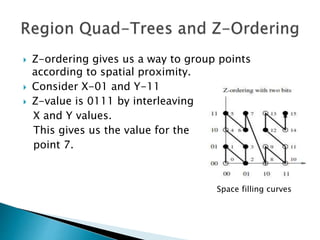
 Z-ordering gives us a way to group points
according to spatial proximity.
 Consider X-01 and Y-11
 Z-value is 0111 by interleaving
X and Y values.
This gives us the value for the
point 7.
Space filling curves
The Region Quad tree structure corresponds directly to the
recursive decomposition of the data space.
Each node in the tree corresponds to a square-shaped region of
the data space.
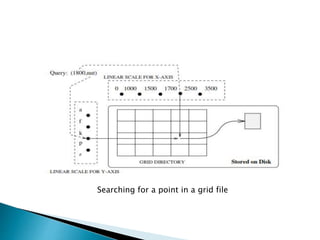
 Grid files rely upon a grid directory to identify the
data page containing a desired point.
 The Grid file partitions space into rectangular
regions using lines that are parallel to the axes.
 If the X axis is cut into i segments and the Y
axis is cut into j segments, we have a total of i
x j partitions. The grid directory is an i by j
array with one entry per partition.
 This description is maintained in an array
called a linear scale; there is one linear scale
per axis.
Searching for a point in a grid file
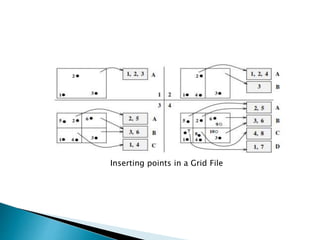
Inserting points in a Grid File
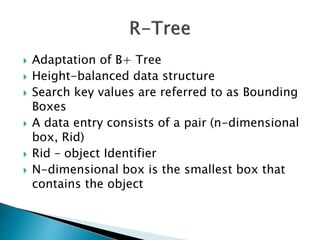
 Adaptation of B+ Tree
 Height-balanced data structure
 Search key values are referred to as Bounding
Boxes
 A data entry consists of a pair (n-dimensional
box, Rid)
 Rid – object Identifier
 N-dimensional box is the smallest box that
contains the object
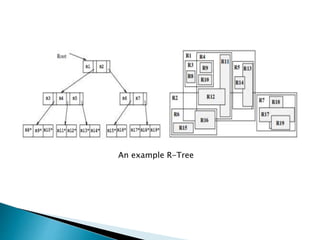
An example R-Tree
 Search for Objects Overlapping Box Q
Start at root.
1. If current node is non-leaf, for each
entry <E, ptr>, if box E overlaps Q,
search subtree identified by ptr.
2. If current node is leaf, for each entry
<E, rid>, if E overlaps Q, rid identifies
an object that might overlap Q.
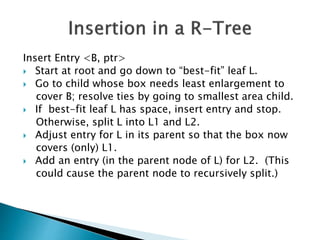
Insert Entry <B, ptr>
 Start at root and go down to “best-fit” leaf L.
 Go to child whose box needs least enlargement to
cover B; resolve ties by going to smallest area child.
 If best-fit leaf L has space, insert entry and stop.
Otherwise, split L into L1 and L2.
 Adjust entry for L in its parent so that the box now
covers (only) L1.
 Add an entry (in the parent node of L) for L2. (This
could cause the parent node to recursively split.)
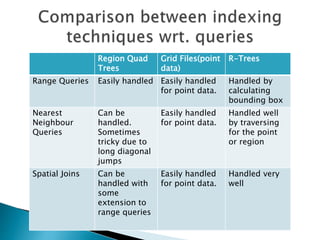
Region Quad
Trees
Grid Files(point
data)
R-Trees
Range Queries Easily handled Easily handled
for point data.
Handled by
calculating
bounding box
Nearest
Neighbour
Queries
Can be
handled.
Sometimes
tricky due to
long diagonal
jumps
Easily handled
for point data.
Handled well
by traversing
for the point
or region
Spatial Joins Can be
handled with
some
extension to
range queries
Easily handled
for point data.
Handled very
well
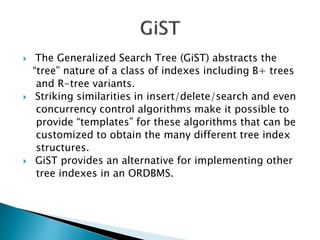
 The Generalized Search Tree (GiST) abstracts the
“tree” nature of a class of indexes including B+ trees
and R-tree variants.
 Striking similarities in insert/delete/search and even
concurrency control algorithms make it possible to
provide “templates” for these algorithms that can be
customized to obtain the many different tree index
structures.
 GiST provides an alternative for implementing other
tree indexes in an ORDBMS.
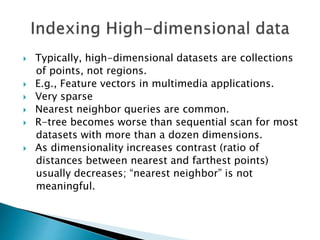
 Typically, high-dimensional datasets are collections
of points, not regions.
 E.g., Feature vectors in multimedia applications.
 Very sparse
 Nearest neighbor queries are common.
 R-tree becomes worse than sequential scan for most
datasets with more than a dozen dimensions.
 As dimensionality increases contrast (ratio of
distances between nearest and farthest points)
usually decreases; “nearest neighbor” is not
meaningful.
 Spatial data management has many
applications, including GIS, CAD/CAM,
multimedia indexing, Point and region data
 R-tree approach is widely used in GIS
systems
 Used in spatial data mining approaches.
 Popular SDBMS : MySQL(geometry datatype),
Neo4j, AllegroGraph, SpaceBase, CouchDB,
PostGreSQL, SpatialDB
 “Database Management Systems” by Raghu
Ramakrishnan, 3rd Edition
 www.techopedia.com/definition
 dna.fernuni-hagen.de/IntroSpatialDBMS
 www.geol-amu.org/notes
Spatial databases
Spatial databases

Spatial databases

  • 1.
    By- Neha Kulkarni ME Computer PuneInsitute of Computer Technology
  • 2.
     What isspatial data?  Types of spatial data  Types of queries  Applications  Indexing Techniques  Comparison of Indexing techniques  GiST  Indexing High-dimensional data  Conclusion
  • 3.
    • Spatial datarepresent the location ,size and shape of an object on earth • Ex. Building, lake
  • 4.
    Point data: Linedata: polygon data:
  • 5.
     Point Data: Simplest form of representing spatial data  No space and has no associated area or volume  Consists of collection of points  Ex. Raster data
  • 6.
     Region data: Has spatial extend with location and boundaries  Represented using of points, line, polygons  Ex. roads, rivers: line data
  • 8.
    1) Spatial rangequeries: Related with region data Ex. “Find all cities within 50 miles of Pune” 2)Nearest Neighbor queries: Related with point data Ex. “Find 10 cities nearest to Pune” In ordered cities Use in multimedia database
  • 9.
    3) Spatial JoinQueries: - use both point and region data. - Ex. “Find pairs of cities within 200 miles of each other AND “ Find all cities near a lake” - More complex - Expensive to evaluate
  • 10.
    1) Geographic InformationSystem(GIS) Ex. MAP 2) Computer Aided Design/Manufacturing(CAD/CAM) Ex. Surface of design object Range and Spatial join queries used 3) Multimedia Database video, audio, image, text also required spatial data Nearest neighbor queries and point data
  • 11.
    Point Data: Gridfiles, ḥE trees, Kdtrees, point quad trees Region data: Quad trees, R trees, SKD trees, -Yet no best indexing technique - R trees are commonly used : due to simplicity, ability to handle both data performance to complex queries
  • 12.
    Three main indexingtechniques :  Region Quad-Trees and Z-Ordering – handle both point and region data  Grid Files – only point data  R-Trees – handle both point and region data
  • 13.
     Z-ordering givesus a way to group points according to spatial proximity.  Consider X-01 and Y-11  Z-value is 0111 by interleaving X and Y values. This gives us the value for the point 7. Space filling curves
  • 14.
    The Region Quadtree structure corresponds directly to the recursive decomposition of the data space. Each node in the tree corresponds to a square-shaped region of the data space.
  • 15.
     Grid filesrely upon a grid directory to identify the data page containing a desired point.  The Grid file partitions space into rectangular regions using lines that are parallel to the axes.  If the X axis is cut into i segments and the Y axis is cut into j segments, we have a total of i x j partitions. The grid directory is an i by j array with one entry per partition.  This description is maintained in an array called a linear scale; there is one linear scale per axis.
  • 16.
    Searching for apoint in a grid file
  • 17.
  • 18.
     Adaptation ofB+ Tree  Height-balanced data structure  Search key values are referred to as Bounding Boxes  A data entry consists of a pair (n-dimensional box, Rid)  Rid – object Identifier  N-dimensional box is the smallest box that contains the object
  • 19.
  • 20.
     Search forObjects Overlapping Box Q Start at root. 1. If current node is non-leaf, for each entry <E, ptr>, if box E overlaps Q, search subtree identified by ptr. 2. If current node is leaf, for each entry <E, rid>, if E overlaps Q, rid identifies an object that might overlap Q.
  • 21.
    Insert Entry <B,ptr>  Start at root and go down to “best-fit” leaf L.  Go to child whose box needs least enlargement to cover B; resolve ties by going to smallest area child.  If best-fit leaf L has space, insert entry and stop. Otherwise, split L into L1 and L2.  Adjust entry for L in its parent so that the box now covers (only) L1.  Add an entry (in the parent node of L) for L2. (This could cause the parent node to recursively split.)
  • 22.
    Region Quad Trees Grid Files(point data) R-Trees RangeQueries Easily handled Easily handled for point data. Handled by calculating bounding box Nearest Neighbour Queries Can be handled. Sometimes tricky due to long diagonal jumps Easily handled for point data. Handled well by traversing for the point or region Spatial Joins Can be handled with some extension to range queries Easily handled for point data. Handled very well
  • 23.
     The GeneralizedSearch Tree (GiST) abstracts the “tree” nature of a class of indexes including B+ trees and R-tree variants.  Striking similarities in insert/delete/search and even concurrency control algorithms make it possible to provide “templates” for these algorithms that can be customized to obtain the many different tree index structures.  GiST provides an alternative for implementing other tree indexes in an ORDBMS.
  • 24.
     Typically, high-dimensionaldatasets are collections of points, not regions.  E.g., Feature vectors in multimedia applications.  Very sparse  Nearest neighbor queries are common.  R-tree becomes worse than sequential scan for most datasets with more than a dozen dimensions.  As dimensionality increases contrast (ratio of distances between nearest and farthest points) usually decreases; “nearest neighbor” is not meaningful.
  • 25.
     Spatial datamanagement has many applications, including GIS, CAD/CAM, multimedia indexing, Point and region data  R-tree approach is widely used in GIS systems  Used in spatial data mining approaches.  Popular SDBMS : MySQL(geometry datatype), Neo4j, AllegroGraph, SpaceBase, CouchDB, PostGreSQL, SpatialDB
  • 26.
     “Database ManagementSystems” by Raghu Ramakrishnan, 3rd Edition  www.techopedia.com/definition  dna.fernuni-hagen.de/IntroSpatialDBMS  www.geol-amu.org/notes