Ch. Eick: Spatial Data Mining (inspired by a talk given at UH by Shashi Shekhar (UMN))
Organization Spatial Data Mining Fall 2011
1. Introduction
2. Region Discovery—Finding Interesting Places in Spatial
Datasets
3. Project3
4. CLEVER: a Spatial Clustering Algorithm Supporting Plug-in
Fitness Functions
5. [Spatial Regression]
Brief Introduction
to Spatial Data Mining
Spatial data mining is the process of discovering
interesting, useful, non-trivial patterns from large spatial
datasets
Reading Material: http://en.wikipedia.org/wiki/Spatial_analysis
Spatial Statistics Software: http://www.spatial-statistics.com/
Ch. Eick: Spatial Data Mining (inspired by a talk given at UH by Shashi Shekhar (UMN))
Examples of Spatial Patterns
Historic Examples (section 7.1.5, pp. 186)
1855 Asiatic Cholera in London: A water pump identified as the source
Fluoride and healthy gums near Colorado river
Theory of Gondwanaland - continents fit like pieces of a jigsaw puzlle
Modern Examples
Cancer clusters to investigate environment health hazards
Crime hotspots for planning police patrol routes
Bald eagles nest on tall trees near open water
Nile virus spreading from north east USA to south and west
Unusual warming of Pacific ocean (El Nino) affects weather in USA
Ch. Eick: Spatial Data Mining (inspired by a talk given at UH by Shashi Shekhar (UMN))
Why Learn about Spatial Data Mining?
Two basic reasons for new work
Consideration of use in certain application domains
Provide fundamental new understanding
Application domains
Scale up secondary spatial (statistical) analysis to very large datasets
• Describe/explain locations of human settlements in last 5000 years
• Find cancer clusters to locate hazardous environments
• Prepare land-use maps from satellite imagery
• Predict habitat suitable for endangered species
Find new spatial patterns
• Find groups of co-located geographic features
Exercise. Name 2 application domains not listed above.
Ch. Eick: Spatial Data Mining (inspired by a talk given at UH by Shashi Shekhar (UMN))
Why Learn about Spatial Data Mining? - 2
New understanding of geographic processes for Critical questions
Ex. How is the health of planet Earth?
Ex. Characterize effects of human activity on environment and ecology
Ex. Predict effect of El Nino on weather, and economy
Traditional approach: manually generate and test hypothesis
But, spatial data is growing too fast to analyze manually
• Satellite imagery, GPS tracks, sensors on highways, …
Number of possible geographic hypothesis too large to explore manually
• Large number of geographic features and locations
• Number of interacting subsets of features grow exponentially
• Ex. Find tele connections between weather events across ocean and land areas
SDM may reduce the set of plausible hypothesis
Identify hypothesis supported by the data
For further exploration using traditional statistical methods
Ch. Eick: Spatial Data Mining (inspired by a talk given at UH by Shashi Shekhar (UMN))
Autocorrelation
Items in a traditional data are independent of each other,
whereas properties of locations in a map are often “auto-correlated”.
First law of geography [Tobler]:
Everything is related to everything, but nearby things are more related
than distant things.
People with similar backgrounds tend to live in the same area
Economies of nearby regions tend to be similar
Changes in temperature occur gradually over space(and time)
Waldo Tobler in 2000
Papers on “Laws in Geography”: http://www.geog.ucsb.edu/~good/papers/393.pdf
http://www.cs.uh.edu/~ceick/DM/GOO10.pdf
Ch. Eick: Spatial Data Mining (inspired by a talk given at UH by Shashi Shekhar (UMN))
Characteristics of Spatial Data Mining
Auto correlation
Patterns usually have to be defined in the spatial attribute subspace
and not in the complete attribute space
Longitude and latitude (or other coordinate systems) are the glue that
link different data collections together
People are used to maps in GIS; therefore, data mining results have
to be summarized on the top of maps
Patterns not only refer to points, but can also refer to lines, or
polygons or other higher order geometrical objects
Patterns exist at different levels of granularity
Large number of patterns, large dataset sizes
Spatial patterns, e.g. spatial clusters can have arbitrary shapes
Regional knowledge is of particular importance due to lack of global
knowledge in geography (spatial heterogeniety)
Ch. Eick: Spatial Data Mining (inspired by a talk given at UH by Shashi Shekhar (UMN))
Why Regional Knowledge Important in Spatial Data Mining?
A special challenge in spatial data mining is that
information is usually not uniformly distributed in spatial
datasets.
It has been pointed out in the literature that “whole map
statistics are seldom useful”, that “most relationships in
spatial data sets are geographically regional, rather than
global”, and that “there is no average place on the Earth’s
surface” [Goodchild03, Openshaw99].
Therefore, it is not surprising that domain experts are
mostly interested in discovering hidden patterns at a
regional scale rather than a global scale.
Michael Frank Goodchild
Ch. Eick: Spatial Data Mining (inspired by a talk given at UH by Shashi Shekhar (UMN))
Spatial Autocorrelation: Distance-based measure
K-function Definition (http://dhf.ddc.moph.go.th/abstract/s22.pdf )
Test against randomness for point pattern
• λ is intensity of event
Model departure from randomness in a wide range of scales
Inference
For Poisson complete spatial randomness (CSR): K(h) = πh2
Plot Khat(h) against h, compare to Poisson CSR
• >: cluster
• <: decluster/regularity
EhK 1
)( 
  [number of events within distance h of an arbitrary event]
K-Function based Spatial Autocorrelation
Ch. Eick: Spatial Data Mining (inspired by a talk given at UH by Shashi Shekhar (UMN))
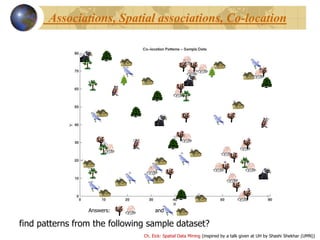
Answers: and
find patterns from the following sample dataset?
Associations, Spatial associations, Co-location
Ch. Eick: Spatial Data Mining (inspired by a talk given at UH by Shashi Shekhar (UMN))
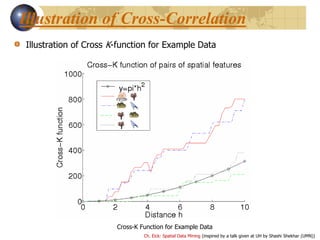
Illustration of Cross-Correlation
Illustration of Cross K-function for Example Data
Cross-K Function for Example Data
Ch. Eick: Spatial Data Mining (inspired by a talk given at UH by Shashi Shekhar (UMN))
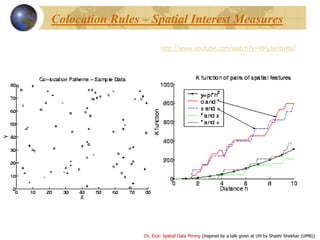
Colocation Rules – Spatial Interest Measures
http://www.youtube.com/watch?v=RPyJwYqyBuI
Ch. Eick: Spatial Data Mining (inspired by a talk given at UH by Shashi Shekhar (UMN))
Cross-Correlation
Cross K-Function Definition
Cross K-function of some pair of spatial feature types
Example
• Which pairs are frequently co-located
• Statistical significance
EhK jji
1
)( 
  [number of type j event within distance h of a randomly chosen
type i event]
Ch. Eick: Spatial Data Mining (inspired by a talk given at UH by Shashi Shekhar (UMN))
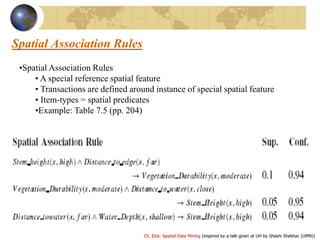
Spatial Association Rules
•Spatial Association Rules
• A special reference spatial feature
• Transactions are defined around instance of special spatial feature
• Item-types = spatial predicates
•Example: Table 7.5 (pp. 204)
Ch. Eick: Spatial Data Mining (inspired by a talk given at UH by Shashi Shekhar (UMN))
Participation index = min{pr(fi, c)}
Where pr(fi, c) of feature fi in co-location c = {f1, f2, …, fk}:
= fraction of instances of fi with feature {f1, …, fi-1, fi+1, …, fk} nearby
N(L) = neighborhood of location L
Pr.[ A in N(L) | B at location L ]Pr.[ A in T | B in T ]conditional probability metric
Neighborhood (N)Transaction (T)collection
events /Boolean spatial featuresitem-typesitem-types
support
discrete sets
Association rules Co-location rules
participation indexprevalence measure
continuous spaceUnderlying space
Co-location rules vs. traditional association rules
Ch. Eick: Spatial Data Mining (inspired by a talk given at UH by Shashi Shekhar (UMN))
Conclusions Spatial Data Mining
Spatial patterns are opposite of random
Common spatial patterns: location prediction, feature interaction, hot spots,
geographically referenced statistical patterns, co-location, emergent patterns,…
SDM = search for unexpected interesting patterns in large spatial databases
Spatial patterns may be discovered using
Techniques like classification, associations, clustering and outlier detection
New techniques are needed for SDM due to
• Spatial Auto-correlation
• Importance of non-point data types (e.g. polygons)
• Continuity of space
• Regional knowledge; also establishes a need for scoping
• Separation between spatial and non-spatial subspace—in traditional
approaches clusters are usually defined over the complete attribute space
Knowledge sources are available now
Raw knowledge to perform spatial data mining is mostly available online now
(e.g. relational databases, Google Earth)
GIS tools are available that facilitate integrating knowledge from different
source
Ch. Eick: Spatial Data Mining (inspired by a talk given at UH by Shashi Shekhar (UMN))
Spatial Regression
Spatial Regression.pptx
Ch. Eick: Spatial Data Mining (inspired by a talk given at UH by Shashi Shekhar (UMN))
Example Videos Discussing Spatial Analysis
http://www.esri.com/what-is-gis/index.html What is GIS?
http://www.youtube.com/watch?v=ZqMul3OIQNI&feature=related (Geo-
graphically weighted regression software advertisement video)
http://www.youtube.com/watch?v=RhDdtqgIy9Q&feature=related
(Spatial Analysis and Remote Sensing Degree at UA)
http://www.youtube.com/watch?v=_SBLBkP9O9I&feature=related
ArcGIS Spatial Analyst Overview
http://www.youtube.com/watch?v=mBSXBqEP-7Y&feature=related
(ArcGIS 9.3: Advanced planning and analysis - Part 1)
http://www.youtube.com/watch?v=agzjyi0rnOo&feature=related
(Example using Spatial Analysis to Analyze Medical Data; the video is not
really that “great”; if you know a better one share it with us!
http://acmgis2011.cs.umn.edu/ ACM GIS Conference, discusses advances
in Geographical Information Systems and related areas
http://www.houstonareagisday.org/ Houston Area GIS Day Nov. 10, 2011

Introduction to spatial data mining

  • 1.
    Ch. Eick: SpatialData Mining (inspired by a talk given at UH by Shashi Shekhar (UMN)) Organization Spatial Data Mining Fall 2011 1. Introduction 2. Region Discovery—Finding Interesting Places in Spatial Datasets 3. Project3 4. CLEVER: a Spatial Clustering Algorithm Supporting Plug-in Fitness Functions 5. [Spatial Regression]
  • 2.
    Brief Introduction to SpatialData Mining Spatial data mining is the process of discovering interesting, useful, non-trivial patterns from large spatial datasets Reading Material: http://en.wikipedia.org/wiki/Spatial_analysis Spatial Statistics Software: http://www.spatial-statistics.com/
  • 3.
    Ch. Eick: SpatialData Mining (inspired by a talk given at UH by Shashi Shekhar (UMN)) Examples of Spatial Patterns Historic Examples (section 7.1.5, pp. 186) 1855 Asiatic Cholera in London: A water pump identified as the source Fluoride and healthy gums near Colorado river Theory of Gondwanaland - continents fit like pieces of a jigsaw puzlle Modern Examples Cancer clusters to investigate environment health hazards Crime hotspots for planning police patrol routes Bald eagles nest on tall trees near open water Nile virus spreading from north east USA to south and west Unusual warming of Pacific ocean (El Nino) affects weather in USA
  • 4.
    Ch. Eick: SpatialData Mining (inspired by a talk given at UH by Shashi Shekhar (UMN)) Why Learn about Spatial Data Mining? Two basic reasons for new work Consideration of use in certain application domains Provide fundamental new understanding Application domains Scale up secondary spatial (statistical) analysis to very large datasets • Describe/explain locations of human settlements in last 5000 years • Find cancer clusters to locate hazardous environments • Prepare land-use maps from satellite imagery • Predict habitat suitable for endangered species Find new spatial patterns • Find groups of co-located geographic features Exercise. Name 2 application domains not listed above.
  • 5.
    Ch. Eick: SpatialData Mining (inspired by a talk given at UH by Shashi Shekhar (UMN)) Why Learn about Spatial Data Mining? - 2 New understanding of geographic processes for Critical questions Ex. How is the health of planet Earth? Ex. Characterize effects of human activity on environment and ecology Ex. Predict effect of El Nino on weather, and economy Traditional approach: manually generate and test hypothesis But, spatial data is growing too fast to analyze manually • Satellite imagery, GPS tracks, sensors on highways, … Number of possible geographic hypothesis too large to explore manually • Large number of geographic features and locations • Number of interacting subsets of features grow exponentially • Ex. Find tele connections between weather events across ocean and land areas SDM may reduce the set of plausible hypothesis Identify hypothesis supported by the data For further exploration using traditional statistical methods
  • 6.
    Ch. Eick: SpatialData Mining (inspired by a talk given at UH by Shashi Shekhar (UMN)) Autocorrelation Items in a traditional data are independent of each other, whereas properties of locations in a map are often “auto-correlated”. First law of geography [Tobler]: Everything is related to everything, but nearby things are more related than distant things. People with similar backgrounds tend to live in the same area Economies of nearby regions tend to be similar Changes in temperature occur gradually over space(and time) Waldo Tobler in 2000 Papers on “Laws in Geography”: http://www.geog.ucsb.edu/~good/papers/393.pdf http://www.cs.uh.edu/~ceick/DM/GOO10.pdf
  • 7.
    Ch. Eick: SpatialData Mining (inspired by a talk given at UH by Shashi Shekhar (UMN)) Characteristics of Spatial Data Mining Auto correlation Patterns usually have to be defined in the spatial attribute subspace and not in the complete attribute space Longitude and latitude (or other coordinate systems) are the glue that link different data collections together People are used to maps in GIS; therefore, data mining results have to be summarized on the top of maps Patterns not only refer to points, but can also refer to lines, or polygons or other higher order geometrical objects Patterns exist at different levels of granularity Large number of patterns, large dataset sizes Spatial patterns, e.g. spatial clusters can have arbitrary shapes Regional knowledge is of particular importance due to lack of global knowledge in geography (spatial heterogeniety)
  • 8.
    Ch. Eick: SpatialData Mining (inspired by a talk given at UH by Shashi Shekhar (UMN)) Why Regional Knowledge Important in Spatial Data Mining? A special challenge in spatial data mining is that information is usually not uniformly distributed in spatial datasets. It has been pointed out in the literature that “whole map statistics are seldom useful”, that “most relationships in spatial data sets are geographically regional, rather than global”, and that “there is no average place on the Earth’s surface” [Goodchild03, Openshaw99]. Therefore, it is not surprising that domain experts are mostly interested in discovering hidden patterns at a regional scale rather than a global scale. Michael Frank Goodchild
  • 9.
    Ch. Eick: SpatialData Mining (inspired by a talk given at UH by Shashi Shekhar (UMN)) Spatial Autocorrelation: Distance-based measure K-function Definition (http://dhf.ddc.moph.go.th/abstract/s22.pdf ) Test against randomness for point pattern • λ is intensity of event Model departure from randomness in a wide range of scales Inference For Poisson complete spatial randomness (CSR): K(h) = πh2 Plot Khat(h) against h, compare to Poisson CSR • >: cluster • <: decluster/regularity EhK 1 )(    [number of events within distance h of an arbitrary event] K-Function based Spatial Autocorrelation
  • 10.
    Ch. Eick: SpatialData Mining (inspired by a talk given at UH by Shashi Shekhar (UMN)) Answers: and find patterns from the following sample dataset? Associations, Spatial associations, Co-location
  • 11.
    Ch. Eick: SpatialData Mining (inspired by a talk given at UH by Shashi Shekhar (UMN)) Illustration of Cross-Correlation Illustration of Cross K-function for Example Data Cross-K Function for Example Data
  • 12.
    Ch. Eick: SpatialData Mining (inspired by a talk given at UH by Shashi Shekhar (UMN)) Colocation Rules – Spatial Interest Measures http://www.youtube.com/watch?v=RPyJwYqyBuI
  • 13.
    Ch. Eick: SpatialData Mining (inspired by a talk given at UH by Shashi Shekhar (UMN)) Cross-Correlation Cross K-Function Definition Cross K-function of some pair of spatial feature types Example • Which pairs are frequently co-located • Statistical significance EhK jji 1 )(    [number of type j event within distance h of a randomly chosen type i event]
  • 14.
    Ch. Eick: SpatialData Mining (inspired by a talk given at UH by Shashi Shekhar (UMN)) Spatial Association Rules •Spatial Association Rules • A special reference spatial feature • Transactions are defined around instance of special spatial feature • Item-types = spatial predicates •Example: Table 7.5 (pp. 204)
  • 15.
    Ch. Eick: SpatialData Mining (inspired by a talk given at UH by Shashi Shekhar (UMN)) Participation index = min{pr(fi, c)} Where pr(fi, c) of feature fi in co-location c = {f1, f2, …, fk}: = fraction of instances of fi with feature {f1, …, fi-1, fi+1, …, fk} nearby N(L) = neighborhood of location L Pr.[ A in N(L) | B at location L ]Pr.[ A in T | B in T ]conditional probability metric Neighborhood (N)Transaction (T)collection events /Boolean spatial featuresitem-typesitem-types support discrete sets Association rules Co-location rules participation indexprevalence measure continuous spaceUnderlying space Co-location rules vs. traditional association rules
  • 16.
    Ch. Eick: SpatialData Mining (inspired by a talk given at UH by Shashi Shekhar (UMN)) Conclusions Spatial Data Mining Spatial patterns are opposite of random Common spatial patterns: location prediction, feature interaction, hot spots, geographically referenced statistical patterns, co-location, emergent patterns,… SDM = search for unexpected interesting patterns in large spatial databases Spatial patterns may be discovered using Techniques like classification, associations, clustering and outlier detection New techniques are needed for SDM due to • Spatial Auto-correlation • Importance of non-point data types (e.g. polygons) • Continuity of space • Regional knowledge; also establishes a need for scoping • Separation between spatial and non-spatial subspace—in traditional approaches clusters are usually defined over the complete attribute space Knowledge sources are available now Raw knowledge to perform spatial data mining is mostly available online now (e.g. relational databases, Google Earth) GIS tools are available that facilitate integrating knowledge from different source
  • 17.
    Ch. Eick: SpatialData Mining (inspired by a talk given at UH by Shashi Shekhar (UMN)) Spatial Regression Spatial Regression.pptx
  • 18.
    Ch. Eick: SpatialData Mining (inspired by a talk given at UH by Shashi Shekhar (UMN)) Example Videos Discussing Spatial Analysis http://www.esri.com/what-is-gis/index.html What is GIS? http://www.youtube.com/watch?v=ZqMul3OIQNI&feature=related (Geo- graphically weighted regression software advertisement video) http://www.youtube.com/watch?v=RhDdtqgIy9Q&feature=related (Spatial Analysis and Remote Sensing Degree at UA) http://www.youtube.com/watch?v=_SBLBkP9O9I&feature=related ArcGIS Spatial Analyst Overview http://www.youtube.com/watch?v=mBSXBqEP-7Y&feature=related (ArcGIS 9.3: Advanced planning and analysis - Part 1) http://www.youtube.com/watch?v=agzjyi0rnOo&feature=related (Example using Spatial Analysis to Analyze Medical Data; the video is not really that “great”; if you know a better one share it with us! http://acmgis2011.cs.umn.edu/ ACM GIS Conference, discusses advances in Geographical Information Systems and related areas http://www.houstonareagisday.org/ Houston Area GIS Day Nov. 10, 2011