IT Infrastructure Management Services
SPAN - Offshore
1
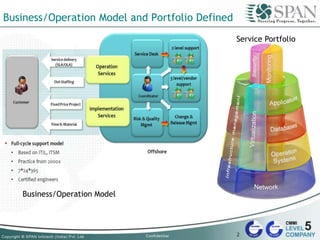
Business/Operation Model and Portfolio Defined
Service Portfolio
Business/Operation Model
2
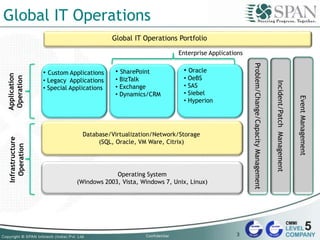
Global IT Operations
Operating System
(Windows 2003, Vista, Windows 7, Unix, Linux)
Problem/Change/CapacityManagement
Incident/PatchManagement
EventManagement
• Custom Applications
• Legacy Applications
• Special Applications
• SharePoint
• BizTalk
• Exchange
• Dynamics/CRM
• Oracle
• OeBS
• SAS
• Siebel
• Hyperion
Database/Virtualization/Network/Storage
(SQL, Oracle, VM Ware, Citrix)
Global IT Operations Portfolio
Application
Operation
Infrastructure
Operation
Enterprise Applications
3
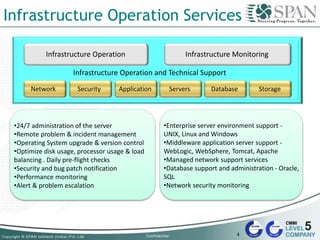
Infrastructure Operation Services
Network Security Application Servers Database Storage
Infrastructure Operation and Technical Support
Infrastructure Operation Infrastructure Monitoring
•24/7 administration of the server
•Remote problem & incident management
•Operating System upgrade & version control
•Optimize disk usage, processor usage & load
balancing . Daily pre-flight checks
•Security and bug patch notification
•Performance monitoring
•Alert & problem escalation
•Enterprise server environment support -
UNIX, Linux and Windows
•Middleware application server support -
WebLogic, WebSphere, Tomcat, Apache
•Managed network support services
•Database support and administration - Oracle,
SQL
•Network security monitoring
4
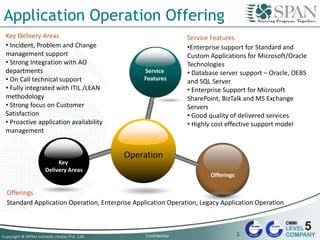
Application Operation Offering
Key
Delivery Areas
Service
Features
Operation
Key Delivery Areas
• Incident, Problem and Change
management support
• Strong Integration with AO
departments
• On Call technical support
• Fully integrated with ITIL /LEAN
methodology
• Strong focus on Customer
Satisfaction
• Proactive application availability
management
Service Features
•Enterprise support for Standard and
Custom Applications for Microsoft/Oracle
Technologies
• Database server support – Oracle, OEBS
and SQL Server
• Enterprise Support for Microsoft
SharePoint, BizTalk and MS Exchange
Servers
• Good quality of delivered services
• Highly cost effective support model
Offerings
Offerings
Standard Application Operation, Enterprise Application Operation, Legacy Application Operation
5
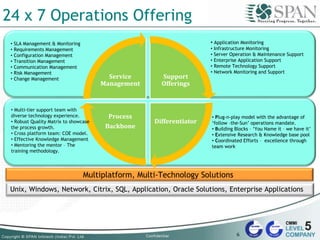
24 x 7 Operations Offering
Multiplatform, Multi-Technology Solutions
Support
Offerings
Differentiator
Process
Backbone
Service
Management
• SLA Management & Monitoring
• Requirements Management
• Configuration Management
• Transition Management
• Communication Management
• Risk Management
• Change Management
• Multi-tier support team with
diverse technology experience.
• Robust Quality Matrix to showcase
the process growth.
• Cross platform team: COE model.
• Effective Knowledge Management
• Mentoring the mentor – The
training methodology.
• Plug-n-play model with the advantage of
‘follow –the-Sun’ operations mandate.
• Building Blocks – ‘You Name it – we have it’
• Extensive Research & Knowledge base pool
• Coordinated Efforts – excellence through
team work
• Application Monitoring
• Infrastructure Monitoring
• Server Operation & Maintenance Support
• Enterprise Application Support
• Remote Technology Support
• Network Monitoring and Support
Unix, Windows, Network, Citrix, SQL, Application, Oracle Solutions, Enterprise Applications
6
Delivery/Quality Model
7
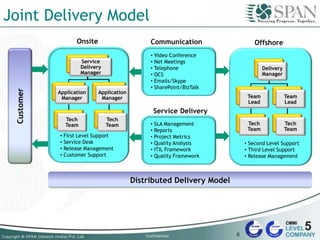
Joint Delivery Model
Onsite Communication Offshore
Service
Delivery
Manager
Application
Manager
Tech
Team
Application
Manager
Tech
Team
Delivery
Manager
Team
Lead
Tech
Team
Team
Lead
Tech
Team
• Video Conference
• Net Meetings
• Telephone
• OCS
• Emails/Skype
• SharePoint/BizTalk
Service Delivery
• SLA Management
• Reports
• Project Metrics
• Quality Analysis
• ITIL Framework
• Quality Framework
Distributed Delivery Model
Customer
• First Level Support
• Service Desk
• Release Management
• Customer Support
• Second Level Support
• Third Level Support
• Release Management
8
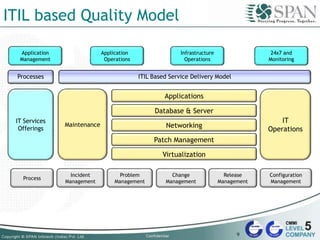
ITIL based Quality Model
Maintenance
IT
Operations
Applications
Database & Server
Networking
Patch Management
Virtualization
Process
Incident
Management
Change
Management
Release
Management
Problem
Management
Configuration
Management
IT Services
Offerings
24x7 and
Monitoring
Infrastructure
Operations
Application
Operations
Application
Management
ITIL Based Service Delivery ModelProcesses
9
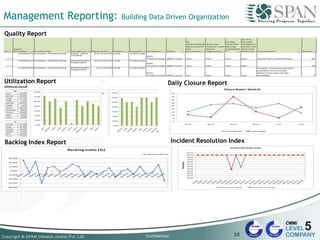
Management Reporting: Building Data Driven Organization
Quality Report
Utilization Report Daily Closure Report
Backlog Index Report Incident Resolution Index
10
Service Delivery Methodology
11
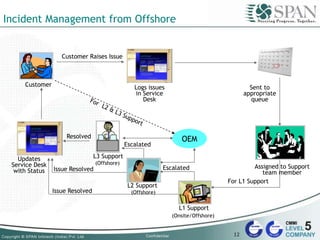
Incident Management from Offshore
Customer Logs issues
in Service
Desk
Sent to
appropriate
queue
Assigned to Support
team member
Updates
Service Desk
with Status
L1 Support
(Onsite/Offshore)
L2 Support
(Offshore)
L3 Support
(Offshore)
OEM
For L1 Support
Issue Resolved
Issue Resolved
Resolved
Escalated
Escalated
Customer Raises Issue
12
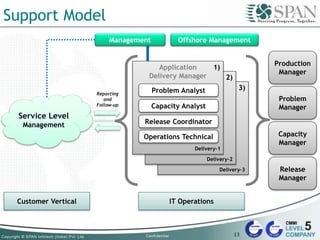
Support Model
3)
2)
Production
Manager
Problem
Manager
Capacity
Manager
Release
Manager
Service Level
Management
1)
Problem Analyst
Capacity Analyst
Release Coordinator
Operations Technical
Delivery-1
Application
Delivery Manager
Offshore ManagementManagement
Reporting
and
Follow-up
Customer Vertical IT Operations
Delivery-2
Delivery-3
13
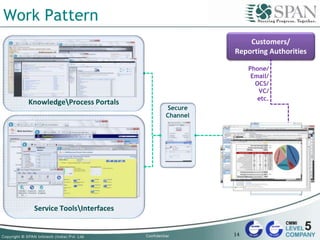
Work Pattern
Service ToolsInterfaces
Secure
Channel
GITO:
Offshore
KnowledgeProcess Portals
Customers/
Reporting Authorities
Phone/
Email/
OCS/
VC/
etc.
14
Case Studies
15
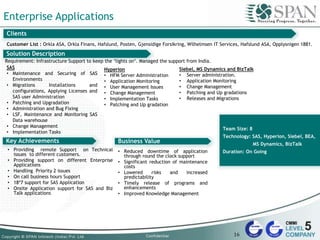
16
• Providing remote Support on Technical
issues to different customers.
• Providing support on different Enterprise
Applications
• Handling Priority 2 issues
• On call business hours Support
• 18*7 support for SAS Application
• Onsite Application support for SAS and Biz
Talk applications
SAS
• Maintenance and Securing of SAS
Environments
• Migrations Installations and
configurations, Applying Licenses and
SAS user Administration
• Patching and Upgradation
• Administration and Bug Fixing
• LSF, Maintenance and Monitoring SAS
Data warehouse
• Change Management
• Implementation Tasks
Customer List : Orkla ASA, Orkla Finans, Hafslund, Posten, Gjensidige Forsikring, Wilhelmsen IT Services, Hafslund ASA, Opplysnigen 1881.
• Reduced downtime of application
through round the clock support
• Significant reduction of maintenance
costs
• Lowered risks and increased
predictability
• Timely release of programs and
enhancements
• Improved Knowledge Management
Clients
Solution Description
Key Achievements Business Value
Team Size: 8
Technology: SAS, Hyperion, Siebel, BEA,
MS Dynamics, BizTalk
Duration: On Going
Siebel, MS Dynamics and BizTalk
• Server administration.
• Application Monitoring
• Change Management
• Patching and Up gradations
• Releases and Migrations
Hyperion
• HFM Server Administration
• Application Monitoring
• User Management Issues
• Change Management
• Implementation Tasks
• Patching and Up gradation
Enterprise Applications
Requirement: Infrastructure Support to keep the ‘lights on’. Managed the support from India.
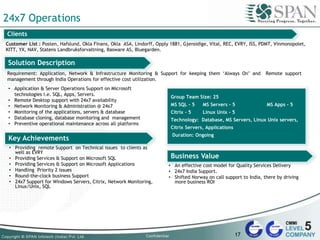
24x7 Operations
17
• Providing remote Support on Technical issues to clients as
well as EVRY
• Providing Services & Support on Microsoft SQL
• Providing Services & Support on Microsoft Applications
• Handling Priority 2 issues
• Round-the-clock business Support
• 24x7 Support for Windows Servers, Citrix, Network Monitoring,
Linux/Unix, SQL
• Application & Server Operations Support on Microsoft
technologies i.e. SQL, Apps, Servers.
• Remote Desktop support with 24x7 availability
• Network Monitoring & Administration @ 24x7
• Monitoring of the applications, servers & database
• Database cloning, database monitoring and management
• Preventive operational maintenance across all platforms
Customer List : Posten, Hafslund, Okla Finans, Okla ASA, Lindorff, Opply 1881, Gjensidige, Vital, REC, EVRY, ISS, PDMT, Vinmonopolet,
KITT, YX, NAV, Statens Landbruksforvaltning, Basware AS, Bluegarden.
• An effective cost model for Quality Services Delivery
• 24x7 India Support.
• Shifted Norway on call support to India, there by driving
more business ROI
Clients
Solution Description
Key Achievements
Business Value
Group Team Size: 25
MS SQL – 5 MS Servers – 5 MS Apps – 5
Citrix – 5 Linux Unix - 5
Technology: Database, MS Servers, Linux Unix servers,
Citrix Servers, Applications
Duration: Ongoing
Requirement: Application, Network & Infrastructure Monitoring & Support for keeping them ‘Always On’ and Remote support
management through India Operations for effective cost utilization.
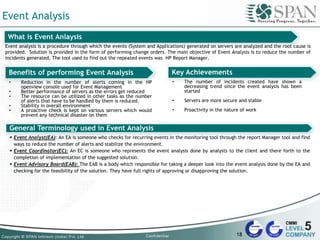
18
• The number of incidents created have shown a
decreasing trend since the event analysis has been
started
• Servers are more secure and stable
• Proactivity in the nature of work
• Reduction in the number of alerts coming in the HP
openview console used for Event Management
• Better performance of servers as the errors get reduced
• The resource can be utilized in other tasks as the number
of alerts that have to be handled by them is reduced.
• Stability in overall environment
• A proactive check is kept on various servers which would
prevent any technical disaster on them
 Event Analyst(EA): An EA is someone who checks for recurring events in the monitoring tool through the report Manager tool and find
ways to reduce the number of alerts and stabilize the environment.
 Event Coordinator(EC): An EC is someone who represents the event analysis done by analysts to the client and there forth to the
completion of implementation of the suggested solution.
 Event Advisory Board(EAB): The EAB is a body which responsible for taking a deeper look into the event analysis done by the EA and
checking for the feasibility of the solution. They have full rights of approving or disapproving the solution.
What is Event Anlaysis
Benefits of performing Event Analysis Key Achievements
General Terminology used in Event Analysis
Event analysis is a procedure through which the events (System and Applications) generated on servers are analyzed and the root cause is
provided. Solution is provided in the form of performing change orders. The main objective of Event Analysis is to reduce the number of
incidents generated. The tool used to find out the repeated events was HP Report Manager.
Event Analysis
THANK YOU
Copyright © 2012 by SPAN. All rights reserved. The Contents of this document are protected by copyright law and international
treaties. SPAN acknowledges the proprietary rights of the trademarks and product names of other companies mentioned in this
document. The reproduction or distribution of the document or any portion of it thereof, in any form or by any means without the
prior written permission of SPAN is prohibited.
19

Remote IT Infra - lower cost & higher efficiency

  • 1.
    IT Infrastructure ManagementServices SPAN - Offshore 1
  • 2.
    Business/Operation Model andPortfolio Defined Service Portfolio Business/Operation Model 2
  • 3.
    Global IT Operations OperatingSystem (Windows 2003, Vista, Windows 7, Unix, Linux) Problem/Change/CapacityManagement Incident/PatchManagement EventManagement • Custom Applications • Legacy Applications • Special Applications • SharePoint • BizTalk • Exchange • Dynamics/CRM • Oracle • OeBS • SAS • Siebel • Hyperion Database/Virtualization/Network/Storage (SQL, Oracle, VM Ware, Citrix) Global IT Operations Portfolio Application Operation Infrastructure Operation Enterprise Applications 3
  • 4.
    Infrastructure Operation Services NetworkSecurity Application Servers Database Storage Infrastructure Operation and Technical Support Infrastructure Operation Infrastructure Monitoring •24/7 administration of the server •Remote problem & incident management •Operating System upgrade & version control •Optimize disk usage, processor usage & load balancing . Daily pre-flight checks •Security and bug patch notification •Performance monitoring •Alert & problem escalation •Enterprise server environment support - UNIX, Linux and Windows •Middleware application server support - WebLogic, WebSphere, Tomcat, Apache •Managed network support services •Database support and administration - Oracle, SQL •Network security monitoring 4
  • 5.
    Application Operation Offering Key DeliveryAreas Service Features Operation Key Delivery Areas • Incident, Problem and Change management support • Strong Integration with AO departments • On Call technical support • Fully integrated with ITIL /LEAN methodology • Strong focus on Customer Satisfaction • Proactive application availability management Service Features •Enterprise support for Standard and Custom Applications for Microsoft/Oracle Technologies • Database server support – Oracle, OEBS and SQL Server • Enterprise Support for Microsoft SharePoint, BizTalk and MS Exchange Servers • Good quality of delivered services • Highly cost effective support model Offerings Offerings Standard Application Operation, Enterprise Application Operation, Legacy Application Operation 5
  • 6.
    24 x 7Operations Offering Multiplatform, Multi-Technology Solutions Support Offerings Differentiator Process Backbone Service Management • SLA Management & Monitoring • Requirements Management • Configuration Management • Transition Management • Communication Management • Risk Management • Change Management • Multi-tier support team with diverse technology experience. • Robust Quality Matrix to showcase the process growth. • Cross platform team: COE model. • Effective Knowledge Management • Mentoring the mentor – The training methodology. • Plug-n-play model with the advantage of ‘follow –the-Sun’ operations mandate. • Building Blocks – ‘You Name it – we have it’ • Extensive Research & Knowledge base pool • Coordinated Efforts – excellence through team work • Application Monitoring • Infrastructure Monitoring • Server Operation & Maintenance Support • Enterprise Application Support • Remote Technology Support • Network Monitoring and Support Unix, Windows, Network, Citrix, SQL, Application, Oracle Solutions, Enterprise Applications 6
  • 7.
  • 8.
    Joint Delivery Model OnsiteCommunication Offshore Service Delivery Manager Application Manager Tech Team Application Manager Tech Team Delivery Manager Team Lead Tech Team Team Lead Tech Team • Video Conference • Net Meetings • Telephone • OCS • Emails/Skype • SharePoint/BizTalk Service Delivery • SLA Management • Reports • Project Metrics • Quality Analysis • ITIL Framework • Quality Framework Distributed Delivery Model Customer • First Level Support • Service Desk • Release Management • Customer Support • Second Level Support • Third Level Support • Release Management 8
  • 9.
    ITIL based QualityModel Maintenance IT Operations Applications Database & Server Networking Patch Management Virtualization Process Incident Management Change Management Release Management Problem Management Configuration Management IT Services Offerings 24x7 and Monitoring Infrastructure Operations Application Operations Application Management ITIL Based Service Delivery ModelProcesses 9
  • 10.
    Management Reporting: BuildingData Driven Organization Quality Report Utilization Report Daily Closure Report Backlog Index Report Incident Resolution Index 10
  • 11.
  • 12.
    Incident Management fromOffshore Customer Logs issues in Service Desk Sent to appropriate queue Assigned to Support team member Updates Service Desk with Status L1 Support (Onsite/Offshore) L2 Support (Offshore) L3 Support (Offshore) OEM For L1 Support Issue Resolved Issue Resolved Resolved Escalated Escalated Customer Raises Issue 12
  • 13.
    Support Model 3) 2) Production Manager Problem Manager Capacity Manager Release Manager Service Level Management 1) ProblemAnalyst Capacity Analyst Release Coordinator Operations Technical Delivery-1 Application Delivery Manager Offshore ManagementManagement Reporting and Follow-up Customer Vertical IT Operations Delivery-2 Delivery-3 13
  • 14.
    Work Pattern Service ToolsInterfaces Secure Channel GITO: Offshore KnowledgeProcessPortals Customers/ Reporting Authorities Phone/ Email/ OCS/ VC/ etc. 14
  • 15.
  • 16.
    16 • Providing remoteSupport on Technical issues to different customers. • Providing support on different Enterprise Applications • Handling Priority 2 issues • On call business hours Support • 18*7 support for SAS Application • Onsite Application support for SAS and Biz Talk applications SAS • Maintenance and Securing of SAS Environments • Migrations Installations and configurations, Applying Licenses and SAS user Administration • Patching and Upgradation • Administration and Bug Fixing • LSF, Maintenance and Monitoring SAS Data warehouse • Change Management • Implementation Tasks Customer List : Orkla ASA, Orkla Finans, Hafslund, Posten, Gjensidige Forsikring, Wilhelmsen IT Services, Hafslund ASA, Opplysnigen 1881. • Reduced downtime of application through round the clock support • Significant reduction of maintenance costs • Lowered risks and increased predictability • Timely release of programs and enhancements • Improved Knowledge Management Clients Solution Description Key Achievements Business Value Team Size: 8 Technology: SAS, Hyperion, Siebel, BEA, MS Dynamics, BizTalk Duration: On Going Siebel, MS Dynamics and BizTalk • Server administration. • Application Monitoring • Change Management • Patching and Up gradations • Releases and Migrations Hyperion • HFM Server Administration • Application Monitoring • User Management Issues • Change Management • Implementation Tasks • Patching and Up gradation Enterprise Applications Requirement: Infrastructure Support to keep the ‘lights on’. Managed the support from India.
  • 17.
    24x7 Operations 17 • Providingremote Support on Technical issues to clients as well as EVRY • Providing Services & Support on Microsoft SQL • Providing Services & Support on Microsoft Applications • Handling Priority 2 issues • Round-the-clock business Support • 24x7 Support for Windows Servers, Citrix, Network Monitoring, Linux/Unix, SQL • Application & Server Operations Support on Microsoft technologies i.e. SQL, Apps, Servers. • Remote Desktop support with 24x7 availability • Network Monitoring & Administration @ 24x7 • Monitoring of the applications, servers & database • Database cloning, database monitoring and management • Preventive operational maintenance across all platforms Customer List : Posten, Hafslund, Okla Finans, Okla ASA, Lindorff, Opply 1881, Gjensidige, Vital, REC, EVRY, ISS, PDMT, Vinmonopolet, KITT, YX, NAV, Statens Landbruksforvaltning, Basware AS, Bluegarden. • An effective cost model for Quality Services Delivery • 24x7 India Support. • Shifted Norway on call support to India, there by driving more business ROI Clients Solution Description Key Achievements Business Value Group Team Size: 25 MS SQL – 5 MS Servers – 5 MS Apps – 5 Citrix – 5 Linux Unix - 5 Technology: Database, MS Servers, Linux Unix servers, Citrix Servers, Applications Duration: Ongoing Requirement: Application, Network & Infrastructure Monitoring & Support for keeping them ‘Always On’ and Remote support management through India Operations for effective cost utilization.
  • 18.
    18 • The numberof incidents created have shown a decreasing trend since the event analysis has been started • Servers are more secure and stable • Proactivity in the nature of work • Reduction in the number of alerts coming in the HP openview console used for Event Management • Better performance of servers as the errors get reduced • The resource can be utilized in other tasks as the number of alerts that have to be handled by them is reduced. • Stability in overall environment • A proactive check is kept on various servers which would prevent any technical disaster on them  Event Analyst(EA): An EA is someone who checks for recurring events in the monitoring tool through the report Manager tool and find ways to reduce the number of alerts and stabilize the environment.  Event Coordinator(EC): An EC is someone who represents the event analysis done by analysts to the client and there forth to the completion of implementation of the suggested solution.  Event Advisory Board(EAB): The EAB is a body which responsible for taking a deeper look into the event analysis done by the EA and checking for the feasibility of the solution. They have full rights of approving or disapproving the solution. What is Event Anlaysis Benefits of performing Event Analysis Key Achievements General Terminology used in Event Analysis Event analysis is a procedure through which the events (System and Applications) generated on servers are analyzed and the root cause is provided. Solution is provided in the form of performing change orders. The main objective of Event Analysis is to reduce the number of incidents generated. The tool used to find out the repeated events was HP Report Manager. Event Analysis
  • 19.
    THANK YOU Copyright ©2012 by SPAN. All rights reserved. The Contents of this document are protected by copyright law and international treaties. SPAN acknowledges the proprietary rights of the trademarks and product names of other companies mentioned in this document. The reproduction or distribution of the document or any portion of it thereof, in any form or by any means without the prior written permission of SPAN is prohibited. 19