

Target Operating Model Design
Chris Oddy
Chris Oddy
• A Plan is only of value if it is successfully implemented
• A good Strategy is important… A Great Target Operating Model is more
beneficial to everyone involved in the business
• A Target Operating Model ensures everyone is aligned and knows what to do
• A Target Operating Model is a critical step on the path to building a
sustainable and scalable business
1
Chris Oddy
What Is a Target Operating Model?
2
What is an Operating Model?
• A breakdown of a business into its key components
• A framework for how an organization operates in terms of people, processes
and technology
• A basis for formulating strategy and making informed decisions
• A structure that dictates how the business should be organized
• A target state informed by strategy and opportunities for optimization
• An operational design that depicts how the business strategy will be achieved
• A basis for developing operational improvement and transformation plans
• A framework that enables goal congruence
Chris Oddy
Why is a Target Operating Model Important?
• Without a Target Operating Model operations often evolve and do not fully
align to the business vision and strategy
– People, processes and technologies build and a complicated web of
inefficient and ineffective systems and processes is created
• A Target Operating Model often leads to a significant competitive advantage:
– Faster decision making in launching products, services and partnerships
– Improved client service through greater role clarity
– Better investments, assessed and prioritized based on business impact
– Reduced risk from a more controlled and stable operating environment
– Higher colleague engagement and alignment
– Greater long-term operational efficiency and optimization
• Businesses without a Target Operating Model typically:
– Deploy increasingly greater resources to address operational deficiencies
– React slowly, struggling to make decisions due to a lack of clarity and data
– Experience exponential growth in costs as they evolve and try to scale
3
Chris Oddy
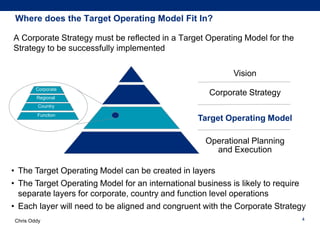
Where does the Target Operating Model Fit In?
4
A Corporate Strategy must be reflected in a Target Operating Model for the
Strategy to be successfully implemented
• The Target Operating Model can be created in layers
• The Target Operating Model for an international business is likely to require
separate layers for corporate, country and function level operations
• Each layer will need to be aligned and congruent with the Corporate Strategy
Country
Regional
Corporate
Function
Vision
Corporate Strategy
Target Operating Model
Operational Planning
and Execution
Chris Oddy 5
Building and Enhancing Local, Regional
and Global Process Optimization and
Technology Plans
Client Value
Proposition(s)
Business Process
Simplification
Reduce repetitive
processes across the
company,
clients and
other
third parties
Templates Monitoring Performance
Track progress along the
service delivery chain
Regionalization
Including hub
branches
Role Clarity,
Training &
Development
Drive efficiency through automation
Strengthen controls and mitigate risks
of E&Os and data protection breaches
Provide e-connectivity to clients,
employees and third parties
1 2 3 4
5
6 7
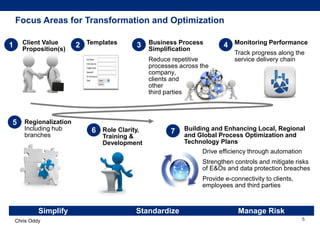
Focus Areas for Transformation and Optimization
Simplify Standardize Manage Risk
Chris Oddy 6
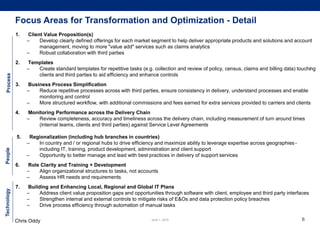
1. Client Value Proposition(s)
– Develop clearly defined offerings for each market segment to help deliver appropriate products and solutions and account
management, moving to more "value add" services such as claims analytics
– Robust collaboration with third parties
2. Templates
– Create standard templates for repetitive tasks (e.g. collection and review of policy, census, claims and billing data) touching
clients and third parties to aid efficiency and enhance controls
3. Business Process Simplification
– Reduce repetitive processes across with third parties, ensure consistency in delivery, understand processes and enable
monitoring and control
– More structured workflow, with additional commissions and fees earned for extra services provided to carriers and clients
4. Monitoring Performance across the Delivery Chain
– Review completeness, accuracy and timeliness across the delivery chain, including measurement of turn around times
(internal teams, clients and third parties) against Service Level Agreements
5. Regionalization (including hub branches in countries)
– In country and / or regional hubs to drive efficiency and maximize ability to leverage expertise across geographies -
including IT, training, product development, administration and client support
– Opportunity to better manage and lead with best practices in delivery of support services
6. Role Clarity and Training + Development
– Align organizational structures to tasks, not accounts
– Assess HR needs and requirements
7. Building and Enhancing Local, Regional and Global IT Plans
– Address client value proposition gaps and opportunities through software with client, employee and third party interfaces
– Strengthen internal and external controls to mitigate risks of E&Os and data protection policy breaches
– Drive process efficiency through automation of manual tasks
ProcessPeopleTechnology
Focus Areas for Transformation and Optimization - Detail
Chris Oddy 7
Document
Current and
Target Operating
Models
Implement
Target
Operating
Model
Execution
Hold
Workshops
and Interviews
Approach to Target Operating Model Planning and Design
Leadership. Commitment. Project Management. Execution Planning. Communications. Training.
Develop
Transformation
Playbook
Planning and Design
Chris Oddy 8
Understand Market
Opportunity +
Client Value Proposition
• Consider clients’ changing needs and
evolving opportunities in your market
• Establish project
management and
assemble the right
resources
• Engage and gain support from country
leadership
1
Document Current
Operating Model
• Conduct analysis of current model
including people, process and
technology
• Document existing
processes and develop
process maps
• Identify current KPIs and
confirm baseline
2
Develop Target
Operating Model
• Document target state business
model and processes
• Establish target KPIs and metrics
• Develop technology
framework
3
4
Implement Plan to
Transform the Business
• Execute against project plan
• Strengthen role clarity
and extend training where needed
• Track progress and
measure KPIs
• Deploy and enhance
IT solutions
5
6 Sustain and Improve
Performance
• Deliver outstanding client service
and mitigate risk
• Ongoing tracking of
KPIs across service
delivery model against
established targets
Identify Improvement
Opportunities
• Perform gap analysis on
current versus target
operating model
• Prioritize people, process,
and technology
improvement opportunities
• Develop phased project plan with
colleagues
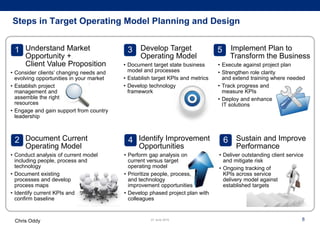
Steps in Target Operating Model Planning and Design
Chris Oddy
Market
Segments
Client Value
Proposition
Products &
Services
Internal Operations
Marketing &
Lead Generation
Sales Account
Management
Delivery Client Service Technology
Infrastructure
Research &
Development
Corporate Strategy. Leadership & Governance. Finance. Human Resources. Legal. Training.
9
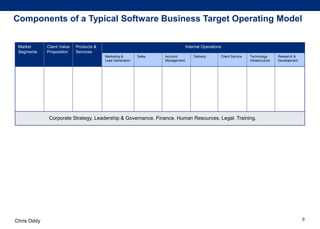
Components of a Typical Software Business Target Operating Model
Chris Oddy 10
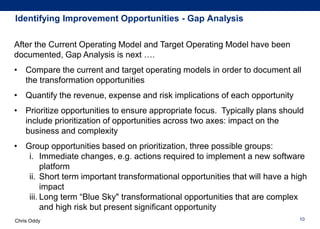
Identifying Improvement Opportunities - Gap Analysis
After the Current Operating Model and Target Operating Model have been
documented, Gap Analysis is next ….
• Compare the current and target operating models in order to document all
the transformation opportunities
• Quantify the revenue, expense and risk implications of each opportunity
• Prioritize opportunities to ensure appropriate focus. Typically plans should
include prioritization of opportunities across two axes: impact on the
business and complexity
• Group opportunities based on prioritization, three possible groups:
i. Immediate changes, e.g. actions required to implement a new software
platform
ii. Short term important transformational opportunities that will have a high
impact
iii. Long term “Blue Sky" transformational opportunities that are complex
and high risk but present significant opportunity
Chris Oddy 11
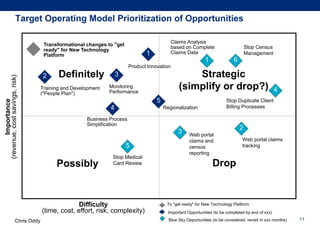
Target Operating Model Prioritization of Opportunities
Transformational changes to "get
ready" for New Technology
Platform 1
Product Innovation
2
Training and Development
("People Plan")
3
Monitoring
Performance
4
Business Process
Simplification
5
Regionalization
Difficulty
(time, cost, effort, risk, complexity)
Importance
(revenue,costsavings,risk)
Possibly Drop
Strategic
(simplify or drop?)
Definitely
1
Claims Analysis
based on Complete
Claims Data
3
2
Web portal claims
tracking
Web portal
claims and
census
reporting
4
Stop Duplicate Client
Billing Processes
5
Stop Medical
Card Review
6
Stop Census
Management
Important Opportunities (to be completed by end of xxx)
Blue Sky Opportunities (to be considered, revisit in xxx months)
To "get ready" for New Technology Platform
Chris Oddy
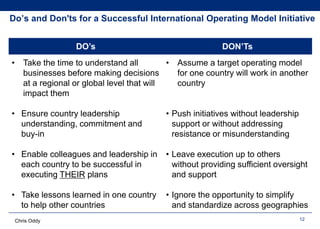
Do’s and Don'ts for a Successful International Operating Model Initiative
12
DO’s DON’Ts
• Take the time to understand all
businesses before making decisions
at a regional or global level that will
impact them
• Ensure country leadership
understanding, commitment and
buy-in
• Enable colleagues and leadership in
each country to be successful in
executing THEIR plans
• Take lessons learned in one country
to help other countries
• Assume a target operating model
for one country will work in another
country
• Push initiatives without leadership
support or without addressing
resistance or misunderstanding
• Leave execution up to others
without providing sufficient oversight
and support
• Ignore the opportunity to simplify
and standardize across geographies
Chris Oddy 13
Points to Remember
• Defining the Target Operating Model is an important step in the successful execution
of any Business Strategy
• A Target Operating Model initiative, particularly one spanning multiple countries, will
require support and commitment of leadership
• Operating Model documentation for more complex organizations, particularly those
with International operations, must be layered to reflect how the business is organized
• To achieve the Target Operating Model, the related Transformation Plan must include:
a. Documentation of the Current Operating Model
b. Documentation of the Target Operating Model
c. Gap Analysis
d. Roadmap of Prioritized Transformation Opportunities
e. Specific Project Plans with the relevant tasks, responsible individuals, target
timelines and benefits (quantified / qualitatively qualified) for each opportunity
Chris Oddy
Questions
14
Last slide

International Target Operating Model Design

  • 1.
    Target Operating ModelDesign Chris Oddy
  • 2.
    Chris Oddy • APlan is only of value if it is successfully implemented • A good Strategy is important… A Great Target Operating Model is more beneficial to everyone involved in the business • A Target Operating Model ensures everyone is aligned and knows what to do • A Target Operating Model is a critical step on the path to building a sustainable and scalable business 1
  • 3.
    Chris Oddy What Isa Target Operating Model? 2 What is an Operating Model? • A breakdown of a business into its key components • A framework for how an organization operates in terms of people, processes and technology • A basis for formulating strategy and making informed decisions • A structure that dictates how the business should be organized • A target state informed by strategy and opportunities for optimization • An operational design that depicts how the business strategy will be achieved • A basis for developing operational improvement and transformation plans • A framework that enables goal congruence
  • 4.
    Chris Oddy Why isa Target Operating Model Important? • Without a Target Operating Model operations often evolve and do not fully align to the business vision and strategy – People, processes and technologies build and a complicated web of inefficient and ineffective systems and processes is created • A Target Operating Model often leads to a significant competitive advantage: – Faster decision making in launching products, services and partnerships – Improved client service through greater role clarity – Better investments, assessed and prioritized based on business impact – Reduced risk from a more controlled and stable operating environment – Higher colleague engagement and alignment – Greater long-term operational efficiency and optimization • Businesses without a Target Operating Model typically: – Deploy increasingly greater resources to address operational deficiencies – React slowly, struggling to make decisions due to a lack of clarity and data – Experience exponential growth in costs as they evolve and try to scale 3
  • 5.
    Chris Oddy Where doesthe Target Operating Model Fit In? 4 A Corporate Strategy must be reflected in a Target Operating Model for the Strategy to be successfully implemented • The Target Operating Model can be created in layers • The Target Operating Model for an international business is likely to require separate layers for corporate, country and function level operations • Each layer will need to be aligned and congruent with the Corporate Strategy Country Regional Corporate Function Vision Corporate Strategy Target Operating Model Operational Planning and Execution
  • 6.
    Chris Oddy 5 Buildingand Enhancing Local, Regional and Global Process Optimization and Technology Plans Client Value Proposition(s) Business Process Simplification Reduce repetitive processes across the company, clients and other third parties Templates Monitoring Performance Track progress along the service delivery chain Regionalization Including hub branches Role Clarity, Training & Development Drive efficiency through automation Strengthen controls and mitigate risks of E&Os and data protection breaches Provide e-connectivity to clients, employees and third parties 1 2 3 4 5 6 7 Focus Areas for Transformation and Optimization Simplify Standardize Manage Risk
  • 7.
    Chris Oddy 6 1.Client Value Proposition(s) – Develop clearly defined offerings for each market segment to help deliver appropriate products and solutions and account management, moving to more "value add" services such as claims analytics – Robust collaboration with third parties 2. Templates – Create standard templates for repetitive tasks (e.g. collection and review of policy, census, claims and billing data) touching clients and third parties to aid efficiency and enhance controls 3. Business Process Simplification – Reduce repetitive processes across with third parties, ensure consistency in delivery, understand processes and enable monitoring and control – More structured workflow, with additional commissions and fees earned for extra services provided to carriers and clients 4. Monitoring Performance across the Delivery Chain – Review completeness, accuracy and timeliness across the delivery chain, including measurement of turn around times (internal teams, clients and third parties) against Service Level Agreements 5. Regionalization (including hub branches in countries) – In country and / or regional hubs to drive efficiency and maximize ability to leverage expertise across geographies - including IT, training, product development, administration and client support – Opportunity to better manage and lead with best practices in delivery of support services 6. Role Clarity and Training + Development – Align organizational structures to tasks, not accounts – Assess HR needs and requirements 7. Building and Enhancing Local, Regional and Global IT Plans – Address client value proposition gaps and opportunities through software with client, employee and third party interfaces – Strengthen internal and external controls to mitigate risks of E&Os and data protection policy breaches – Drive process efficiency through automation of manual tasks ProcessPeopleTechnology Focus Areas for Transformation and Optimization - Detail
  • 8.
    Chris Oddy 7 Document Currentand Target Operating Models Implement Target Operating Model Execution Hold Workshops and Interviews Approach to Target Operating Model Planning and Design Leadership. Commitment. Project Management. Execution Planning. Communications. Training. Develop Transformation Playbook Planning and Design
  • 9.
    Chris Oddy 8 UnderstandMarket Opportunity + Client Value Proposition • Consider clients’ changing needs and evolving opportunities in your market • Establish project management and assemble the right resources • Engage and gain support from country leadership 1 Document Current Operating Model • Conduct analysis of current model including people, process and technology • Document existing processes and develop process maps • Identify current KPIs and confirm baseline 2 Develop Target Operating Model • Document target state business model and processes • Establish target KPIs and metrics • Develop technology framework 3 4 Implement Plan to Transform the Business • Execute against project plan • Strengthen role clarity and extend training where needed • Track progress and measure KPIs • Deploy and enhance IT solutions 5 6 Sustain and Improve Performance • Deliver outstanding client service and mitigate risk • Ongoing tracking of KPIs across service delivery model against established targets Identify Improvement Opportunities • Perform gap analysis on current versus target operating model • Prioritize people, process, and technology improvement opportunities • Develop phased project plan with colleagues Steps in Target Operating Model Planning and Design
  • 10.
    Chris Oddy Market Segments Client Value Proposition Products& Services Internal Operations Marketing & Lead Generation Sales Account Management Delivery Client Service Technology Infrastructure Research & Development Corporate Strategy. Leadership & Governance. Finance. Human Resources. Legal. Training. 9 Components of a Typical Software Business Target Operating Model
  • 11.
    Chris Oddy 10 IdentifyingImprovement Opportunities - Gap Analysis After the Current Operating Model and Target Operating Model have been documented, Gap Analysis is next …. • Compare the current and target operating models in order to document all the transformation opportunities • Quantify the revenue, expense and risk implications of each opportunity • Prioritize opportunities to ensure appropriate focus. Typically plans should include prioritization of opportunities across two axes: impact on the business and complexity • Group opportunities based on prioritization, three possible groups: i. Immediate changes, e.g. actions required to implement a new software platform ii. Short term important transformational opportunities that will have a high impact iii. Long term “Blue Sky" transformational opportunities that are complex and high risk but present significant opportunity
  • 12.
    Chris Oddy 11 TargetOperating Model Prioritization of Opportunities Transformational changes to "get ready" for New Technology Platform 1 Product Innovation 2 Training and Development ("People Plan") 3 Monitoring Performance 4 Business Process Simplification 5 Regionalization Difficulty (time, cost, effort, risk, complexity) Importance (revenue,costsavings,risk) Possibly Drop Strategic (simplify or drop?) Definitely 1 Claims Analysis based on Complete Claims Data 3 2 Web portal claims tracking Web portal claims and census reporting 4 Stop Duplicate Client Billing Processes 5 Stop Medical Card Review 6 Stop Census Management Important Opportunities (to be completed by end of xxx) Blue Sky Opportunities (to be considered, revisit in xxx months) To "get ready" for New Technology Platform
  • 13.
    Chris Oddy Do’s andDon'ts for a Successful International Operating Model Initiative 12 DO’s DON’Ts • Take the time to understand all businesses before making decisions at a regional or global level that will impact them • Ensure country leadership understanding, commitment and buy-in • Enable colleagues and leadership in each country to be successful in executing THEIR plans • Take lessons learned in one country to help other countries • Assume a target operating model for one country will work in another country • Push initiatives without leadership support or without addressing resistance or misunderstanding • Leave execution up to others without providing sufficient oversight and support • Ignore the opportunity to simplify and standardize across geographies
  • 14.
    Chris Oddy 13 Pointsto Remember • Defining the Target Operating Model is an important step in the successful execution of any Business Strategy • A Target Operating Model initiative, particularly one spanning multiple countries, will require support and commitment of leadership • Operating Model documentation for more complex organizations, particularly those with International operations, must be layered to reflect how the business is organized • To achieve the Target Operating Model, the related Transformation Plan must include: a. Documentation of the Current Operating Model b. Documentation of the Target Operating Model c. Gap Analysis d. Roadmap of Prioritized Transformation Opportunities e. Specific Project Plans with the relevant tasks, responsible individuals, target timelines and benefits (quantified / qualitatively qualified) for each opportunity
  • 15.
  • 16.