SPACE TIME CODING IN
        MIMO
     PRESENTED BY:
          ILA SHARMA
       102001, MTECH ECE
OUTLINE
•    INTRODUCTION
•    MIMO
•    SPACE TIME CODE
•    ALAMOUTI CODE
•    APPLICATION OF MIMO
•    REFERENCES


17 April 2012              2
INTRODUCTION
• Goal of modern wireless communication
  systems:
     - High Data Rates for Broadband, Video Conferencing etc.
• Challenges to the goal:
     - Power, Bandwidth & Complexity.

• Constraints to the goal:
     - To deal with noise
      - Multipath propagation
      - Interference

17 April 2012                                                   3
MIMO
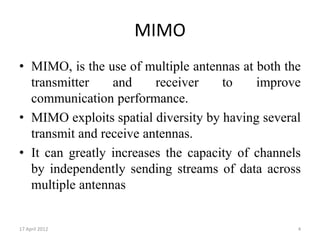
• MIMO, is the use of multiple antennas at both the
  transmitter    and     receiver    to    improve
  communication performance.
• MIMO exploits spatial diversity by having several
  transmit and receive antennas.
• It can greatly increases the capacity of channels
  by independently sending streams of data across
  multiple antennas


17 April 2012                                     4
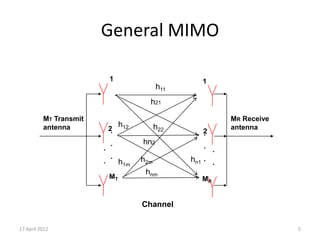
General MIMO

                            1                         1
                                             h11
                                         h21

          MT Transmit                                          MR Receive
          antenna                h12         h22               antenna
                            2.                        2
                                                      .
                             .         hn2            .
                        .                                  .
                             .         h2m         hn1 . .
                        .        h1m
                                        hnm
                            MT                        MR


                                       Channel

17 April 2012                                                               5
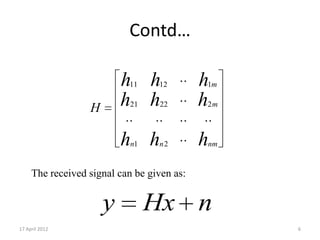
Contd…

                          h h
                           11     12
                                       ..   h
                                            1m


                  H       h h
                            21    22
                                       ..   h
                                            2m
                          ..     ..    ..   ..
                          h h
                            n1    n2
                                       ..   h
                                            nm


     The received signal can be given as:


                      y          Hx n
17 April 2012                                    6
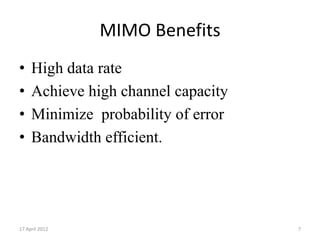
MIMO Benefits
•    High data rate
•    Achieve high channel capacity
•    Minimize probability of error
•    Bandwidth efficient.


17 April 2012                        7
Introduction to Space-Time Coding
• What is Space-Time Coding?
       •   Space diversity at antenna
       •   Time diversity

• Why STC?
       •    Maximum diversity
       •    Maximum Coding Gain
       •    Maximum possible throughput

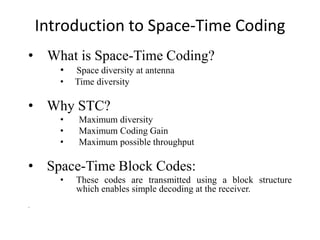
• Space-Time Block Codes:
       •   These codes are transmitted using a block structure
           which enables simple decoding at the receiver.
.
Alamouti Codes
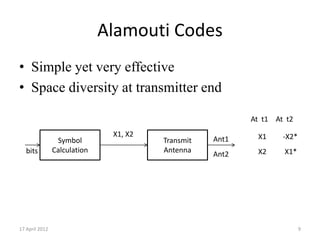
• Simple yet very effective
• Space diversity at transmitter end

                                                          At t1 At t2
                               X1, X2                      X1     -X2*
                 Symbol                 Transmit   Ant1
   bits         Calculation             Antenna            X2     X1*
                                                   Ant2


17 April 2012                                                            9
Alamouti Code
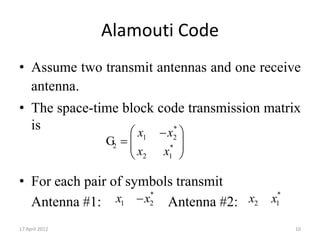
• Assume two transmit antennas and one receive
  antenna.
• The space-time block code transmission matrix
  is                x    x*
                      1     2
                G2        *
                     x2   x
                          1


• For each pair of symbols transmit
                       *                 *
  Antenna #1:    x1   x2 Antenna #2: x2 x1

17 April 2012                                 10
CONTD ……….
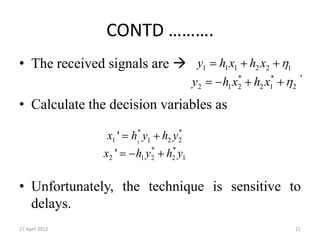
• The received signals are  y1 h1 x1 h2 x2              1
                                               *     *
                                                                 .
                                        y2   hx
                                             1 2   hx
                                                   2 1       2

• Calculate the decision variables as

                 x1 '   h1* y1 h2 y2*

                              *   *
                x2 '     h1 y2 h2 y1

• Unfortunately, the technique is sensitive to
  delays.
17 April 2012                                                11
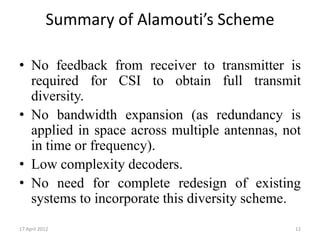
Summary of Alamouti’s Scheme

• No feedback from receiver to transmitter is
  required for CSI to obtain full transmit
  diversity.
• No bandwidth expansion (as redundancy is
  applied in space across multiple antennas, not
  in time or frequency).
• Low complexity decoders.
• No need for complete redesign of existing
  systems to incorporate this diversity scheme.
17 April 2012                                  12
Advantages and Disadvantages
                        of Block STC
• Advantages:
       – Space-time block coding utilizes multiple antennas to
         create spatial diversity, this allows a system to have better
         performance in a fading environment.
       – Good performance with minimal decoding complexity.
       – Can achieve maximum diversity gain
       – Receivers that use only linear processing.
• Disadvantages:
       – Does not have much coding gain .
       – Can not always achieve the maximum data rates


17 April 2012                                                       13
APPLICATIONS OF MIMO
• Combined with OFDM, where the problems created
  by multi-path channel are handled efficiently.
• MIMO gives reliable communication
• MIMO increases capacity
       – MIMO uses independent channel fading due to multipath
         propagation to increase capacity.
       – No extra expensive bandwidth required


17 April 2012                                               14
REFERENCES
• Hameed Jafarkhani, “Space-Time Coding-Theory & Practices”, 1st
  ed., Cambridge University Press.
• V. Tarokh, H. Jafarkhani and A. R. Calderbank, “Space-time block
  codes for orthogonal designs,” IEEE Trans. Inform. Theory, vol. 45,
  pp. 1456–1466, July 1999.
• V. Tarokh, N. Seshadri and A. R. Calderbank, “Space-time codes for
  high data rate wireless communication: performance criterion and
  code construction,” IEEE Trans. Inform. Theory, vol. 44, pp. 744–
  765, Mar. 1998.
• Ezio Biglieri, Robert Calderbank, Anthony Constentinicks, Andrea
  Goldsmith,      Arogyaswami      Paubraj,     “MIMO       Wireless
  communication”, 2nd edition, Cambridge University press,2007.

17 April 2012                                                      15
17 April 2012   16

Space time coding in mimo

  • 1.
    SPACE TIME CODINGIN MIMO PRESENTED BY: ILA SHARMA 102001, MTECH ECE
  • 2.
    OUTLINE • INTRODUCTION • MIMO • SPACE TIME CODE • ALAMOUTI CODE • APPLICATION OF MIMO • REFERENCES 17 April 2012 2
  • 3.
    INTRODUCTION • Goal ofmodern wireless communication systems: - High Data Rates for Broadband, Video Conferencing etc. • Challenges to the goal: - Power, Bandwidth & Complexity. • Constraints to the goal: - To deal with noise - Multipath propagation - Interference 17 April 2012 3
  • 4.
    MIMO • MIMO, isthe use of multiple antennas at both the transmitter and receiver to improve communication performance. • MIMO exploits spatial diversity by having several transmit and receive antennas. • It can greatly increases the capacity of channels by independently sending streams of data across multiple antennas 17 April 2012 4
  • 5.
    General MIMO 1 1 h11 h21 MT Transmit MR Receive antenna h12 h22 antenna 2. 2 . . hn2 . . . . h2m hn1 . . . h1m hnm MT MR Channel 17 April 2012 5
  • 6.
    Contd… h h 11 12 .. h 1m H h h 21 22 .. h 2m .. .. .. .. h h n1 n2 .. h nm The received signal can be given as: y Hx n 17 April 2012 6
  • 7.
    MIMO Benefits • High data rate • Achieve high channel capacity • Minimize probability of error • Bandwidth efficient. 17 April 2012 7
  • 8.
    Introduction to Space-TimeCoding • What is Space-Time Coding? • Space diversity at antenna • Time diversity • Why STC? • Maximum diversity • Maximum Coding Gain • Maximum possible throughput • Space-Time Block Codes: • These codes are transmitted using a block structure which enables simple decoding at the receiver. .
  • 9.
    Alamouti Codes • Simpleyet very effective • Space diversity at transmitter end At t1 At t2 X1, X2 X1 -X2* Symbol Transmit Ant1 bits Calculation Antenna X2 X1* Ant2 17 April 2012 9
  • 10.
    Alamouti Code • Assumetwo transmit antennas and one receive antenna. • The space-time block code transmission matrix is x x* 1 2 G2 * x2 x 1 • For each pair of symbols transmit * * Antenna #1: x1 x2 Antenna #2: x2 x1 17 April 2012 10
  • 11.
    CONTD ………. • Thereceived signals are  y1 h1 x1 h2 x2 1 * * . y2 hx 1 2 hx 2 1 2 • Calculate the decision variables as x1 ' h1* y1 h2 y2* * * x2 ' h1 y2 h2 y1 • Unfortunately, the technique is sensitive to delays. 17 April 2012 11
  • 12.
    Summary of Alamouti’sScheme • No feedback from receiver to transmitter is required for CSI to obtain full transmit diversity. • No bandwidth expansion (as redundancy is applied in space across multiple antennas, not in time or frequency). • Low complexity decoders. • No need for complete redesign of existing systems to incorporate this diversity scheme. 17 April 2012 12
  • 13.
    Advantages and Disadvantages of Block STC • Advantages: – Space-time block coding utilizes multiple antennas to create spatial diversity, this allows a system to have better performance in a fading environment. – Good performance with minimal decoding complexity. – Can achieve maximum diversity gain – Receivers that use only linear processing. • Disadvantages: – Does not have much coding gain . – Can not always achieve the maximum data rates 17 April 2012 13
  • 14.
    APPLICATIONS OF MIMO •Combined with OFDM, where the problems created by multi-path channel are handled efficiently. • MIMO gives reliable communication • MIMO increases capacity – MIMO uses independent channel fading due to multipath propagation to increase capacity. – No extra expensive bandwidth required 17 April 2012 14
  • 15.
    REFERENCES • Hameed Jafarkhani,“Space-Time Coding-Theory & Practices”, 1st ed., Cambridge University Press. • V. Tarokh, H. Jafarkhani and A. R. Calderbank, “Space-time block codes for orthogonal designs,” IEEE Trans. Inform. Theory, vol. 45, pp. 1456–1466, July 1999. • V. Tarokh, N. Seshadri and A. R. Calderbank, “Space-time codes for high data rate wireless communication: performance criterion and code construction,” IEEE Trans. Inform. Theory, vol. 44, pp. 744– 765, Mar. 1998. • Ezio Biglieri, Robert Calderbank, Anthony Constentinicks, Andrea Goldsmith, Arogyaswami Paubraj, “MIMO Wireless communication”, 2nd edition, Cambridge University press,2007. 17 April 2012 15
  • 16.

Editor's Notes

  • #8 Array gain : improves resistance to noise, thereby improving the coverage and the range of a wireless networkSpatial diversity gain : mitigates fading and is realized by providing the receiver with multiple copies of the transmitted signal in space, frequency or time.Spatial multiplexing gain : The spatial multiplexing gain increases the capacity of a wireless network.Interference reduction and avoidance : It improve the coverage and range of a wireless network.
  • #9 Space time coding is a method employed to improve the reliability of data transmission in wireless communication system using multiple transmit antenna.STCs rely on transmitting multiple , copies of a data stream to the receiver in the hope that at least some of them may survive the physical path between transmission and reception in a good enough state to allow reliable decoding.Space time codes(STC) provide transmit diversity for the MIMO.Achieve near optimal diversity gain.STC is concerned withMaximize the transmitted information rate.Minimize the error probability.