1© 2012 The MathWorks, Inc.
Modeling a 4G-LTE System in MATLAB
Houman Zarrinkoub PhD.
Product Manager
Signal Processing & Communications
MathWorks
2
 4G LTE and LTE Advanced standards
 MATLAB and communications system design
 Case study: A 4G LTE system model in MATLAB
– Modeling & simulation
– Simulation acceleration
– Path to implementation
 Summary
Agenda
3
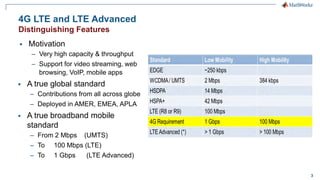
 Motivation
– Very high capacity & throughput
– Support for video streaming, web
browsing, VoIP, mobile apps
 A true global standard
– Contributions from all across globe
– Deployed in AMER, EMEA, APLA
 A true broadband mobile
standard
– From 2 Mbps (UMTS)
– To 100 Mbps (LTE)
– To 1 Gbps (LTE Advanced)
4G LTE and LTE Advanced
Distinguishing Features
4
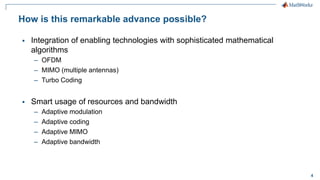
How is this remarkable advance possible?
 Integration of enabling technologies with sophisticated mathematical
algorithms
– OFDM
– MIMO (multiple antennas)
– Turbo Coding
 Smart usage of resources and bandwidth
– Adaptive modulation
– Adaptive coding
– Adaptive MIMO
– Adaptive bandwidth
(Multi-carrier transmission, large bandwidth requires attention to multipath fading)
(near Shannon limit, e.g., near capacity channel coding)
(smart engineering techniques)
5
What MATLAB users care about LTE standard?
 Academics
– Researchers contributing to future standards
– Professors
– Students
 Practitioners
– System Engineers
– Software designers
– Implementers of wireless systems
 Challenge in interaction and cooperation between these two groups
 MATLAB is their common language
6
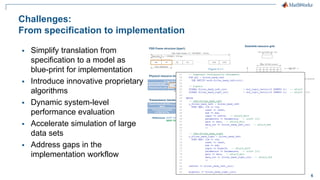
Challenges:
From specification to implementation
 Simplify translation from
specification to a model as
blue-print for implementation
 Introduce innovative proprietary
algorithms
 Dynamic system-level
performance evaluation
 Accelerate simulation of large
data sets
 Address gaps in the
implementation workflow
7
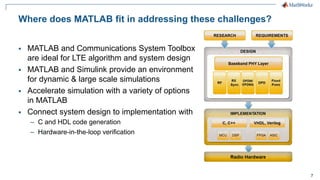
Where does MATLAB fit in addressing these challenges?
 MATLAB and Communications System Toolbox
are ideal for LTE algorithm and system design
 MATLAB and Simulink provide an environment
for dynamic & large scale simulations
 Accelerate simulation with a variety of options
in MATLAB
 Connect system design to implementation with
– C and HDL code generation
– Hardware-in-the-loop verification
8© 2012 The MathWorks, Inc.
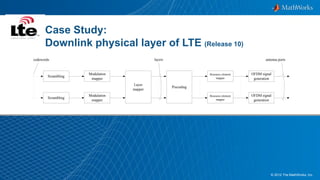
Case Study:
Downlink physical layer of LTE (Release 10)
Scrambling
Modulation
mapper
Layer
mapper
Precoding
Resource element
mapper
OFDM signal
generation
Resource element
mapper
OFDM signal
generation
Scrambling
Modulation
mapper
layers antenna portscodewords
9© 2012 The MathWorks, Inc.
Modeling and simulation
10
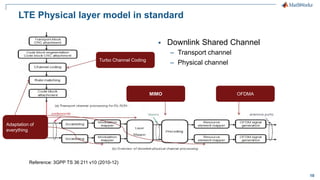
LTE Physical layer model in standard
Turbo Channel Coding
MIMO OFDMA
Adaptation of
everything
Reference: 3GPP TS 36 211 v10 (2010-12)
 Downlink Shared Channel
– Transport channel
– Physical channel
11
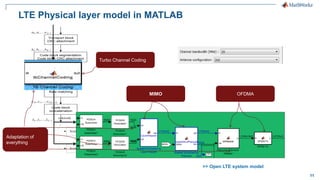
Scrambling
Modulation
mapper
Layer
mapper
Precoding
Resource element
mapper
OFDM signal
generation
Resource element
mapper
OFDM signal
generation
Scrambling
Modulation
mapper
layers antenna portscodewords
LTE Physical layer model in MATLAB
Turbo Channel Coding
MIMO OFDMA
Adaptation of
everything
Channel coding
Rate matching
Code block
concatenation
110 ,...,, Aaaa
110 ,...,, Bbbb
 110 ,...,, rKrrr ccc
 
)(
1
)(
1
)(
0 ,...,, i
Dr
i
r
i
r r
ddd 
 110 ,...,, rErrr eee
110 ,...,, Gfff
Transport block
CRC attachment
Code block segmentation
Code block CRC attachment
>> Open LTE system model
12
 Error correction & coding
technology of LTE standard
 Performance: Approach the
channel capacity (Shannon
bound)
 Represents an evolution of
convolutional coding
 Based on an iterative decoding
scheme
Overview of Turbo Coding
13
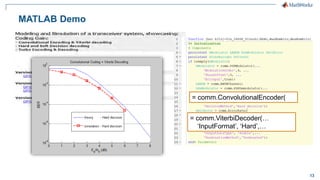
MATLAB Demo
= comm.ConvolutionalEncoder(
= comm.ViterbiDecoder(…
‘InputFormat’, ‘Hard’,…
14
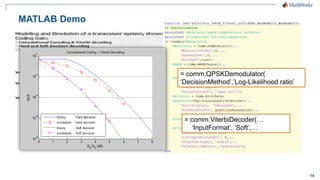
MATLAB Demo
= comm.ViterbiDecoder(…
‘InputFormat’, ‘Soft’,…
= comm.QPSKDemodulator(
‘DecisionMethod’,’Log-Likelihood ratio’
15
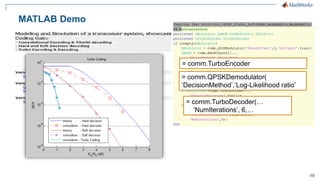
MATLAB Demo
= comm.TurboEncoder
= comm.TurboDecoder(…
‘NumIterations’, 6,…
= comm.QPSKDemodulator(
‘DecisionMethod’,’Log-Likelihood ratio’
16
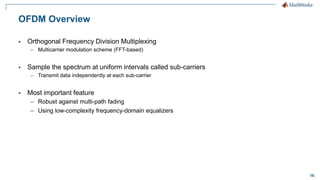
 Orthogonal Frequency Division Multiplexing
– Multicarrier modulation scheme (FFT-based)
 Sample the spectrum at uniform intervals called sub-carriers
– Transmit data independently at each sub-carrier
 Most important feature
– Robust against multi-path fading
– Using low-complexity frequency-domain equalizers
OFDM Overview
17
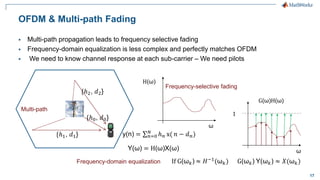
 Multi-path propagation leads to frequency selective fading
 Frequency-domain equalization is less complex and perfectly matches OFDM
 We need to know channel response at each sub-carrier – We need pilots
OFDM & Multi-path Fading
y(n) = ℎ 𝑛 x( 𝑛 − 𝑑 𝑛)𝑁
𝑛=0*ℎ1, 𝑑1}
*ℎ2, 𝑑2}
*ℎ0, 𝑑0}
Y(ω) = H(ω)X(ω)
Multi-path
If G(ω 𝑘) ≈ 𝐻−1(ω 𝑘) G(ω 𝑘) Y(ω 𝑘) ≈ 𝑋(ω 𝑘)Frequency-domain equalization
ω
Frequency-selective fading
H(ω)
G(ω)H(ω)
1
ω
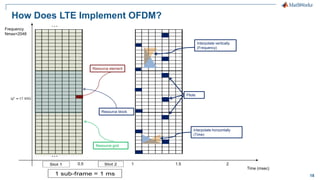
18
Frequency
Nmax=2048
…
…
Time (msec)
Resource block
Resource element
0.5 1
Resource grid
1.5 2
How Does LTE Implement OFDM?
Pilots
Interpolate vertically
(Frequency)
Interpolate horizontally
(Time)
19
How to Implement LTE OFDM in MATLAB
switch prmLTEPDSCH.Nrb
Depending on
Channel Bandwidth
Case 25, N=512;
Set Frequency-domain
FFT size
= 6*numRb + mod(v+vsh, 6) + 1;
Transmitter:
Place pilots in regular intervals
Case 100, N=2048;
= mean([hp(:,1,1,n) hp(:,3,1,n)])
Receiver:
Estimate channel by interpolating in
time & frequency
= mean([hp(k,2,1,:) hp(k,4,1,:)])
X=ifft(tmp,N,1);
Create OFDM signal
20
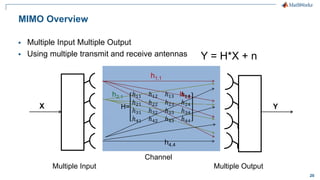
MIMO Overview
 Multiple Input Multiple Output
 Using multiple transmit and receive antennas
Multiple Input Multiple Output
h1,1
h1,2
h4,4
h2,1
X Y
Y = H*X + n
H=
ℎ11 ℎ12 ℎ13 ℎ14
ℎ21 ℎ22 ℎ23 ℎ24
ℎ31 ℎ32 ℎ33 ℎ34
ℎ41 ℎ42 ℎ43 ℎ44
Channel
21
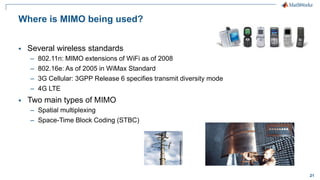
Where is MIMO being used?
 Several wireless standards
– 802.11n: MIMO extensions of WiFi as of 2008
– 802.16e: As of 2005 in WiMax Standard
– 3G Cellular: 3GPP Release 6 specifies transmit diversity mode
– 4G LTE
 Two main types of MIMO
– Spatial multiplexing
– Space-Time Block Coding (STBC)
22
Spatial Multiplexing
 MIMO technique used in LTE standard
 Divide the data stream into independent sub-streams and use multiple
transmit antennas
 MIMO is one of the main reasons for boost in data rates
– More transmit antennas leads to higher capacity
 MIMO Receiver essentially solves this system of linear equations
Y = HX + n
23
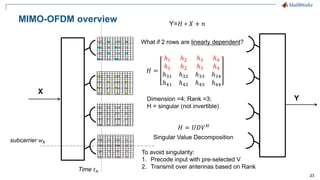
MIMO-OFDM overview
X
Y
Time 𝑡 𝑛
subcarrier 𝑤 𝑘
Y=𝐻 ∗ 𝑋 + 𝑛
To avoid singularity:
1. Precode input with pre-selected V
2. Transmit over antennas based on Rank
𝐻 =
ℎ1 ℎ2 ℎ3 ℎ4
ℎ1 ℎ2 ℎ3 ℎ4
ℎ31 ℎ32 ℎ33 ℎ34
ℎ41 ℎ42 ℎ43 ℎ44
𝐻 = 𝑈𝐷𝑉 𝐻
Dimension =4; Rank =3;
H = singular (not invertible)
What if 2 rows are linearly dependent?
Singular Value Decomposition
24
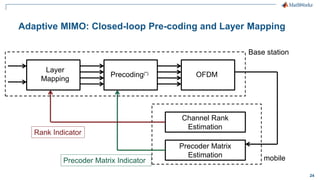
Adaptive MIMO: Closed-loop Pre-coding and Layer Mapping
Layer
Mapping
Precoding(*) OFDM
Channel Rank
Estimation
Precoder Matrix
Estimation
Base station
mobile
Rank Indicator
Precoder Matrix Indicator
25
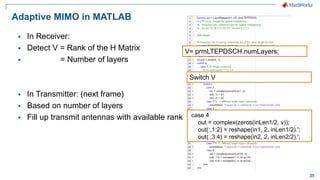
Adaptive MIMO in MATLAB
 In Receiver:
 Detect V = Rank of the H Matrix
 = Number of layers
 In Transmitter: (next frame)
 Based on number of layers
 Fill up transmit antennas with available rank case 4
out = complex(zeros(inLen1/2, v));
out(:,1:2) = reshape(in1, 2, inLen1/2).';
out(:,3:4) = reshape(in2, 2, inLen2/2).';
V= prmLTEPDSCH.numLayers;
Switch V
26
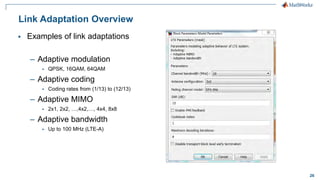
Link Adaptation Overview
 Examples of link adaptations
– Adaptive modulation
 QPSK, 16QAM, 64QAM
– Adaptive coding
 Coding rates from (1/13) to (12/13)
– Adaptive MIMO
 2x1, 2x2, …,4x2,…, 4x4, 8x8
– Adaptive bandwidth
 Up to 100 MHz (LTE-A)
27
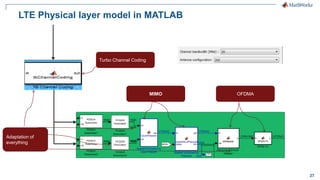
LTE Physical layer model in MATLAB
Turbo Channel Coding
MIMO OFDMA
Adaptation of
everything
28© 2012 The MathWorks, Inc.
Simulation Acceleration
29
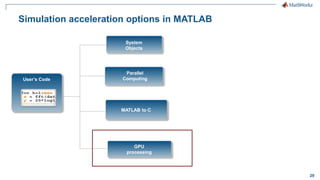
Simulation acceleration options in MATLAB
System
Objects
MATLAB to C
User’s Code
GPU
processing
Parallel
Computing
30
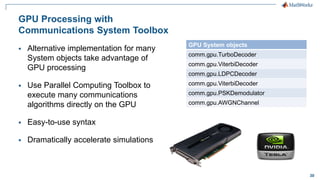
GPU Processing with
Communications System Toolbox
 Alternative implementation for many
System objects take advantage of
GPU processing
 Use Parallel Computing Toolbox to
execute many communications
algorithms directly on the GPU
 Easy-to-use syntax
 Dramatically accelerate simulations
GPU System objects
comm.gpu.TurboDecoder
comm.gpu.ViterbiDecoder
comm.gpu.LDPCDecoder
comm.gpu.ViterbiDecoder
comm.gpu.PSKDemodulator
comm.gpu.AWGNChannel
31
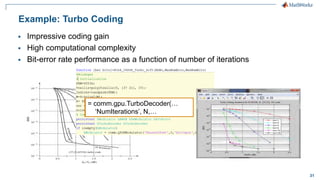
 Impressive coding gain
 High computational complexity
 Bit-error rate performance as a function of number of iterations
Example: Turbo Coding
= comm.TurboDecoder(…
‘NumIterations’, N,…
= comm.gpu.TurboDecoder(…
‘NumIterations’, N,…
32
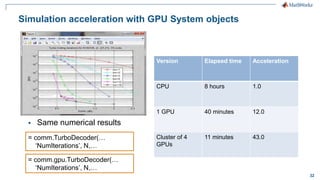
Simulation acceleration with GPU System objects
Version Elapsed time Acceleration
CPU 8 hours 1.0
1 GPU 40 minutes 12.0
Cluster of 4
GPUs
11 minutes 43.0
 Same numerical results
= comm.TurboDecoder(…
‘NumIterations’, N,…
= comm.gpu.TurboDecoder(…
‘NumIterations’, N,…
33© 2012 The MathWorks, Inc.
Path to implementation
C/C++ and HDL Code Generation
34
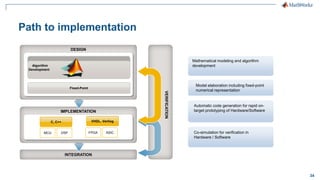
Path to implementation
INTEGRATION
IMPLEMENTATION
DESIGN
VERIFICATION
MCU DSP FPGA ASIC
VHDL, VerilogC, C++
Fixed-Point
Co-simulation for verification in
Hardware / Software
Model elaboration including fixed-point
numerical representation
Automatic code generation for rapid on-
target prototyping of Hardware/Software
Mathematical modeling and algorithm
developmentAlgorithm
Development
35
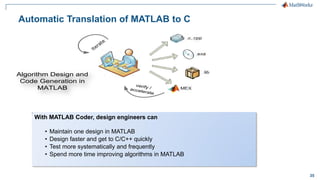
Algorithm Design and
Code Generation in
MATLAB
With MATLAB Coder, design engineers can
• Maintain one design in MATLAB
• Design faster and get to C/C++ quickly
• Test more systematically and frequently
• Spend more time improving algorithms in MATLAB
Automatic Translation of MATLAB to C
verify /accelerateiterate
36
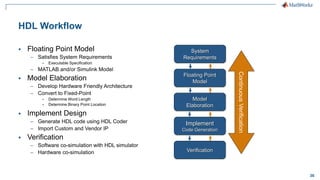
HDL Workflow
 Floating Point Model
– Satisfies System Requirements
 Executable Specification
– MATLAB and/or Simulink Model
 Model Elaboration
– Develop Hardware Friendly Architecture
– Convert to Fixed-Point
 Determine Word Length
 Determine Binary Point Location
 Implement Design
– Generate HDL code using HDL Coder
– Import Custom and Vendor IP
 Verification
– Software co-simulation with HDL simulator
– Hardware co-simulation Verification
Implement
Code Generation
Model
Elaboration
ContinuousVerification
Floating Point
Model
System
Requirements
37
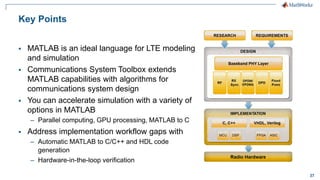
Key Points
 MATLAB is an ideal language for LTE modeling
and simulation
 Communications System Toolbox extends
MATLAB capabilities with algorithms for
communications system design
 You can accelerate simulation with a variety of
options in MATLAB
– Parallel computing, GPU processing, MATLAB to C
 Address implementation workflow gaps with
– Automatic MATLAB to C/C++ and HDL code
generation
– Hardware-in-the-loop verification

4g lte matlab

  • 1.
    1© 2012 TheMathWorks, Inc. Modeling a 4G-LTE System in MATLAB Houman Zarrinkoub PhD. Product Manager Signal Processing & Communications MathWorks
  • 2.
    2  4G LTEand LTE Advanced standards  MATLAB and communications system design  Case study: A 4G LTE system model in MATLAB – Modeling & simulation – Simulation acceleration – Path to implementation  Summary Agenda
  • 3.
    3  Motivation – Veryhigh capacity & throughput – Support for video streaming, web browsing, VoIP, mobile apps  A true global standard – Contributions from all across globe – Deployed in AMER, EMEA, APLA  A true broadband mobile standard – From 2 Mbps (UMTS) – To 100 Mbps (LTE) – To 1 Gbps (LTE Advanced) 4G LTE and LTE Advanced Distinguishing Features
  • 4.
    4 How is thisremarkable advance possible?  Integration of enabling technologies with sophisticated mathematical algorithms – OFDM – MIMO (multiple antennas) – Turbo Coding  Smart usage of resources and bandwidth – Adaptive modulation – Adaptive coding – Adaptive MIMO – Adaptive bandwidth (Multi-carrier transmission, large bandwidth requires attention to multipath fading) (near Shannon limit, e.g., near capacity channel coding) (smart engineering techniques)
  • 5.
    5 What MATLAB userscare about LTE standard?  Academics – Researchers contributing to future standards – Professors – Students  Practitioners – System Engineers – Software designers – Implementers of wireless systems  Challenge in interaction and cooperation between these two groups  MATLAB is their common language
  • 6.
    6 Challenges: From specification toimplementation  Simplify translation from specification to a model as blue-print for implementation  Introduce innovative proprietary algorithms  Dynamic system-level performance evaluation  Accelerate simulation of large data sets  Address gaps in the implementation workflow
  • 7.
    7 Where does MATLABfit in addressing these challenges?  MATLAB and Communications System Toolbox are ideal for LTE algorithm and system design  MATLAB and Simulink provide an environment for dynamic & large scale simulations  Accelerate simulation with a variety of options in MATLAB  Connect system design to implementation with – C and HDL code generation – Hardware-in-the-loop verification
  • 8.
    8© 2012 TheMathWorks, Inc. Case Study: Downlink physical layer of LTE (Release 10) Scrambling Modulation mapper Layer mapper Precoding Resource element mapper OFDM signal generation Resource element mapper OFDM signal generation Scrambling Modulation mapper layers antenna portscodewords
  • 9.
    9© 2012 TheMathWorks, Inc. Modeling and simulation
  • 10.
    10 LTE Physical layermodel in standard Turbo Channel Coding MIMO OFDMA Adaptation of everything Reference: 3GPP TS 36 211 v10 (2010-12)  Downlink Shared Channel – Transport channel – Physical channel
  • 11.
    11 Scrambling Modulation mapper Layer mapper Precoding Resource element mapper OFDM signal generation Resourceelement mapper OFDM signal generation Scrambling Modulation mapper layers antenna portscodewords LTE Physical layer model in MATLAB Turbo Channel Coding MIMO OFDMA Adaptation of everything Channel coding Rate matching Code block concatenation 110 ,...,, Aaaa 110 ,...,, Bbbb  110 ,...,, rKrrr ccc   )( 1 )( 1 )( 0 ,...,, i Dr i r i r r ddd   110 ,...,, rErrr eee 110 ,...,, Gfff Transport block CRC attachment Code block segmentation Code block CRC attachment >> Open LTE system model
  • 12.
    12  Error correction& coding technology of LTE standard  Performance: Approach the channel capacity (Shannon bound)  Represents an evolution of convolutional coding  Based on an iterative decoding scheme Overview of Turbo Coding
  • 13.
    13 MATLAB Demo = comm.ConvolutionalEncoder( =comm.ViterbiDecoder(… ‘InputFormat’, ‘Hard’,…
  • 14.
    14 MATLAB Demo = comm.ViterbiDecoder(… ‘InputFormat’,‘Soft’,… = comm.QPSKDemodulator( ‘DecisionMethod’,’Log-Likelihood ratio’
  • 15.
    15 MATLAB Demo = comm.TurboEncoder =comm.TurboDecoder(… ‘NumIterations’, 6,… = comm.QPSKDemodulator( ‘DecisionMethod’,’Log-Likelihood ratio’
  • 16.
    16  Orthogonal FrequencyDivision Multiplexing – Multicarrier modulation scheme (FFT-based)  Sample the spectrum at uniform intervals called sub-carriers – Transmit data independently at each sub-carrier  Most important feature – Robust against multi-path fading – Using low-complexity frequency-domain equalizers OFDM Overview
  • 17.
    17  Multi-path propagationleads to frequency selective fading  Frequency-domain equalization is less complex and perfectly matches OFDM  We need to know channel response at each sub-carrier – We need pilots OFDM & Multi-path Fading y(n) = ℎ 𝑛 x( 𝑛 − 𝑑 𝑛)𝑁 𝑛=0*ℎ1, 𝑑1} *ℎ2, 𝑑2} *ℎ0, 𝑑0} Y(ω) = H(ω)X(ω) Multi-path If G(ω 𝑘) ≈ 𝐻−1(ω 𝑘) G(ω 𝑘) Y(ω 𝑘) ≈ 𝑋(ω 𝑘)Frequency-domain equalization ω Frequency-selective fading H(ω) G(ω)H(ω) 1 ω
  • 18.
    18 Frequency Nmax=2048 … … Time (msec) Resource block Resourceelement 0.5 1 Resource grid 1.5 2 How Does LTE Implement OFDM? Pilots Interpolate vertically (Frequency) Interpolate horizontally (Time)
  • 19.
    19 How to ImplementLTE OFDM in MATLAB switch prmLTEPDSCH.Nrb Depending on Channel Bandwidth Case 25, N=512; Set Frequency-domain FFT size = 6*numRb + mod(v+vsh, 6) + 1; Transmitter: Place pilots in regular intervals Case 100, N=2048; = mean([hp(:,1,1,n) hp(:,3,1,n)]) Receiver: Estimate channel by interpolating in time & frequency = mean([hp(k,2,1,:) hp(k,4,1,:)]) X=ifft(tmp,N,1); Create OFDM signal
  • 20.
    20 MIMO Overview  MultipleInput Multiple Output  Using multiple transmit and receive antennas Multiple Input Multiple Output h1,1 h1,2 h4,4 h2,1 X Y Y = H*X + n H= ℎ11 ℎ12 ℎ13 ℎ14 ℎ21 ℎ22 ℎ23 ℎ24 ℎ31 ℎ32 ℎ33 ℎ34 ℎ41 ℎ42 ℎ43 ℎ44 Channel
  • 21.
    21 Where is MIMObeing used?  Several wireless standards – 802.11n: MIMO extensions of WiFi as of 2008 – 802.16e: As of 2005 in WiMax Standard – 3G Cellular: 3GPP Release 6 specifies transmit diversity mode – 4G LTE  Two main types of MIMO – Spatial multiplexing – Space-Time Block Coding (STBC)
  • 22.
    22 Spatial Multiplexing  MIMOtechnique used in LTE standard  Divide the data stream into independent sub-streams and use multiple transmit antennas  MIMO is one of the main reasons for boost in data rates – More transmit antennas leads to higher capacity  MIMO Receiver essentially solves this system of linear equations Y = HX + n
  • 23.
    23 MIMO-OFDM overview X Y Time 𝑡𝑛 subcarrier 𝑤 𝑘 Y=𝐻 ∗ 𝑋 + 𝑛 To avoid singularity: 1. Precode input with pre-selected V 2. Transmit over antennas based on Rank 𝐻 = ℎ1 ℎ2 ℎ3 ℎ4 ℎ1 ℎ2 ℎ3 ℎ4 ℎ31 ℎ32 ℎ33 ℎ34 ℎ41 ℎ42 ℎ43 ℎ44 𝐻 = 𝑈𝐷𝑉 𝐻 Dimension =4; Rank =3; H = singular (not invertible) What if 2 rows are linearly dependent? Singular Value Decomposition
  • 24.
    24 Adaptive MIMO: Closed-loopPre-coding and Layer Mapping Layer Mapping Precoding(*) OFDM Channel Rank Estimation Precoder Matrix Estimation Base station mobile Rank Indicator Precoder Matrix Indicator
  • 25.
    25 Adaptive MIMO inMATLAB  In Receiver:  Detect V = Rank of the H Matrix  = Number of layers  In Transmitter: (next frame)  Based on number of layers  Fill up transmit antennas with available rank case 4 out = complex(zeros(inLen1/2, v)); out(:,1:2) = reshape(in1, 2, inLen1/2).'; out(:,3:4) = reshape(in2, 2, inLen2/2).'; V= prmLTEPDSCH.numLayers; Switch V
  • 26.
    26 Link Adaptation Overview Examples of link adaptations – Adaptive modulation  QPSK, 16QAM, 64QAM – Adaptive coding  Coding rates from (1/13) to (12/13) – Adaptive MIMO  2x1, 2x2, …,4x2,…, 4x4, 8x8 – Adaptive bandwidth  Up to 100 MHz (LTE-A)
  • 27.
    27 LTE Physical layermodel in MATLAB Turbo Channel Coding MIMO OFDMA Adaptation of everything
  • 28.
    28© 2012 TheMathWorks, Inc. Simulation Acceleration
  • 29.
    29 Simulation acceleration optionsin MATLAB System Objects MATLAB to C User’s Code GPU processing Parallel Computing
  • 30.
    30 GPU Processing with CommunicationsSystem Toolbox  Alternative implementation for many System objects take advantage of GPU processing  Use Parallel Computing Toolbox to execute many communications algorithms directly on the GPU  Easy-to-use syntax  Dramatically accelerate simulations GPU System objects comm.gpu.TurboDecoder comm.gpu.ViterbiDecoder comm.gpu.LDPCDecoder comm.gpu.ViterbiDecoder comm.gpu.PSKDemodulator comm.gpu.AWGNChannel
  • 31.
    31  Impressive codinggain  High computational complexity  Bit-error rate performance as a function of number of iterations Example: Turbo Coding = comm.TurboDecoder(… ‘NumIterations’, N,… = comm.gpu.TurboDecoder(… ‘NumIterations’, N,…
  • 32.
    32 Simulation acceleration withGPU System objects Version Elapsed time Acceleration CPU 8 hours 1.0 1 GPU 40 minutes 12.0 Cluster of 4 GPUs 11 minutes 43.0  Same numerical results = comm.TurboDecoder(… ‘NumIterations’, N,… = comm.gpu.TurboDecoder(… ‘NumIterations’, N,…
  • 33.
    33© 2012 TheMathWorks, Inc. Path to implementation C/C++ and HDL Code Generation
  • 34.
    34 Path to implementation INTEGRATION IMPLEMENTATION DESIGN VERIFICATION MCUDSP FPGA ASIC VHDL, VerilogC, C++ Fixed-Point Co-simulation for verification in Hardware / Software Model elaboration including fixed-point numerical representation Automatic code generation for rapid on- target prototyping of Hardware/Software Mathematical modeling and algorithm developmentAlgorithm Development
  • 35.
    35 Algorithm Design and CodeGeneration in MATLAB With MATLAB Coder, design engineers can • Maintain one design in MATLAB • Design faster and get to C/C++ quickly • Test more systematically and frequently • Spend more time improving algorithms in MATLAB Automatic Translation of MATLAB to C verify /accelerateiterate
  • 36.
    36 HDL Workflow  FloatingPoint Model – Satisfies System Requirements  Executable Specification – MATLAB and/or Simulink Model  Model Elaboration – Develop Hardware Friendly Architecture – Convert to Fixed-Point  Determine Word Length  Determine Binary Point Location  Implement Design – Generate HDL code using HDL Coder – Import Custom and Vendor IP  Verification – Software co-simulation with HDL simulator – Hardware co-simulation Verification Implement Code Generation Model Elaboration ContinuousVerification Floating Point Model System Requirements
  • 37.
    37 Key Points  MATLABis an ideal language for LTE modeling and simulation  Communications System Toolbox extends MATLAB capabilities with algorithms for communications system design  You can accelerate simulation with a variety of options in MATLAB – Parallel computing, GPU processing, MATLAB to C  Address implementation workflow gaps with – Automatic MATLAB to C/C++ and HDL code generation – Hardware-in-the-loop verification