1/65
SPACE TIME CODING
Jie Ren
ASPITRG Drexel
2/65
•  B. Vucetic and J. Yuan, Space-Time Coding, Wiley, 2003
•  Erik G. Larsson and Petre Stoica Space-Time Block
Coding for Wireless Communications, Cambridge, 2005
3/65
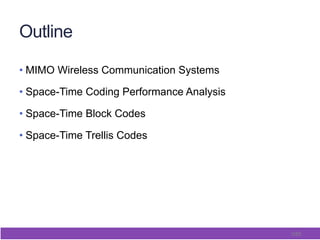
Outline
• MIMO Wireless Communication Systems
• Space-Time Coding Performance Analysis
• Space-Time Block Codes
• Space-Time Trellis Codes
4/65
Outline
• MIMO Wireless Communication Systems
o MIMO System Model
o MIMO System Capacity Derivation
o MIMO Capacity Examples
• Space-Time Coding Performance Analysis
• Space-Time Block Codes
• Space-Time Trellis Codes
5/65
Outline
• MIMO Wireless Communication Systems
o MIMO System Model
o MIMO System Capacity Derivation
o MIMO Capacity Examples
• Space-Time Coding Performance Analysis
• Space-Time Block Codes
• Space-Time Trellis Codes
6/65
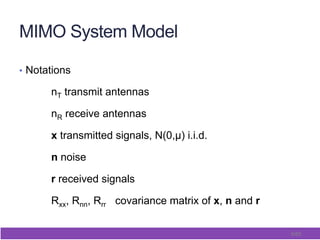
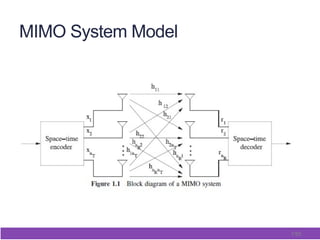
MIMO System Model
•  Notations
nT transmit antennas
nR receive antennas
x transmitted signals, N(0,µ) i.i.d.
n noise
r received signals
Rxx, Rnn, Rrr covariance matrix of x, n and r
7/65
MIMO System Model
8/65
MIMO System Model
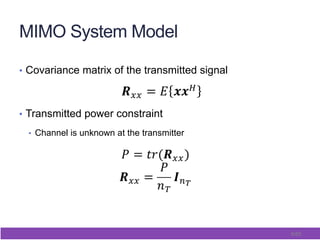
•  Covariance matrix of the transmitted signal
•  Transmitted power constraint
•  Channel is unknown at the transmitter
9/65
MIMO System Model
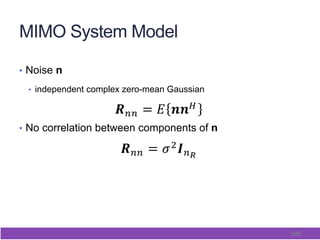
•  Noise n
•  independent complex zero-mean Gaussian
•  No correlation between components of n
10/65
MIMO System Model
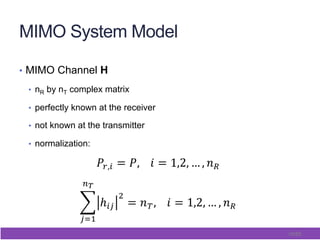
•  MIMO Channel H
•  nR by nT complex matrix
•  perfectly known at the receiver
•  not known at the transmitter
•  normalization:
11/65
MIMO System Model
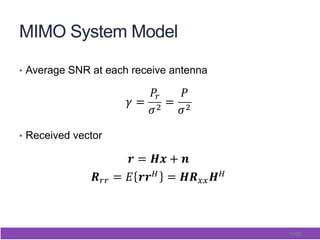
•  Average SNR at each receive antenna
•  Received vector
! =
!!
!! =
!
!!!
12/65
Outline
• MIMO Wireless Communication Systems
o MIMO System Model
o MIMO System Capacity Derivation
o MIMO Capacity Examples
• Space-Time Coding Performance Analysis
• Space-Time Block Codes
• Space-Time Trellis Codes
13/65
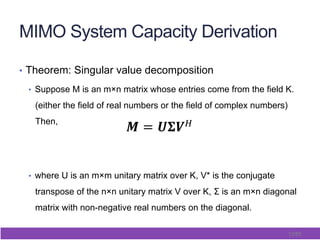
MIMO System Capacity Derivation
•  Theorem: Singular value decomposition
•  Suppose M is an m×n matrix whose entries come from the field K.
(either the field of real numbers or the field of complex numbers)
Then,
•  where U is an m×m unitary matrix over K, V* is the conjugate
transpose of the n×n unitary matrix V over K, Σ is an m×n diagonal
matrix with non-negative real numbers on the diagonal.
! = !!!!!
!
14/65
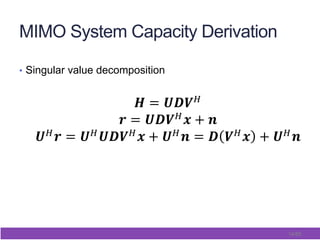
MIMO System Capacity Derivation
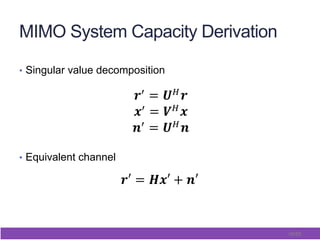
•  Singular value decomposition
! = !"!!!
! = !"!!! + !!
!!! = !!!"!!! + !!! = ! !!! + !!!!
!
!
15/65
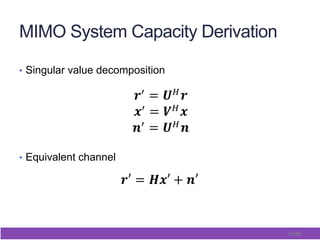
MIMO System Capacity Derivation
•  Singular value decomposition
•  Equivalent channel
16/65
MIMO System Capacity Derivation
•  Singular value decomposition
•  Equivalent channel
17/65
MIMO System Capacity Derivation
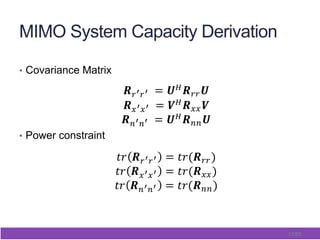
•  Covariance Matrix
•  Power constraint
18/65
MIMO System Capacity Derivation
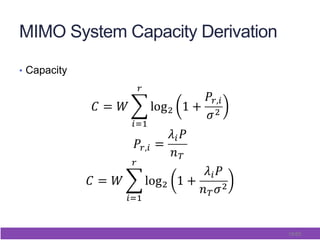
•  Capacity
19/65
MIMO System Capacity Derivation
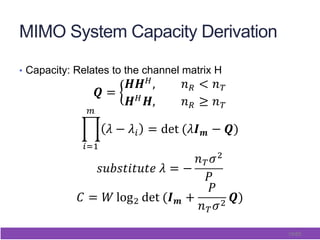
•  Capacity: Relates to the channel matrix H
! =
!!!, !! < !!
!!!, !! ≥ !!
!
! − !! = det!(!!! − !)
!
!!!
!
!"#!$%$"$&!! = −
!!!!
!
!
! = ! log! det!(!! +
!
!!!! !)!
20/65
Outline
• MIMO Wireless Communication Systems
o MIMO System Model
o MIMO System Capacity Derivation
o MIMO Capacity Examples
• Space-Time Coding Performance Analysis
• Space-Time Block Codes
• Space-Time Trellis Codes
21/65
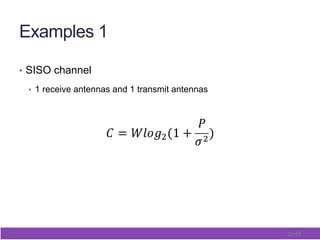
Examples 1
•  SISO channel
•  1 receive antennas and 1 transmit antennas
22/65
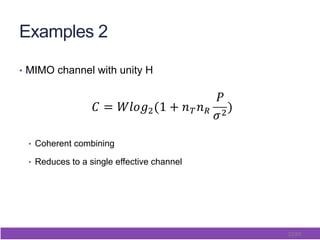
Examples 2
•  MIMO channel with unity H
•  Coherent combining
•  Reduces to a single effective channel
23/65
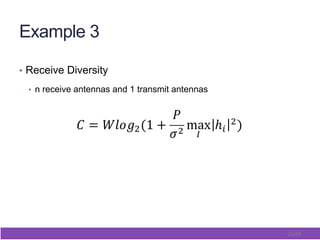
Example 3
•  Receive Diversity
•  n receive antennas and 1 transmit antennas
24/65
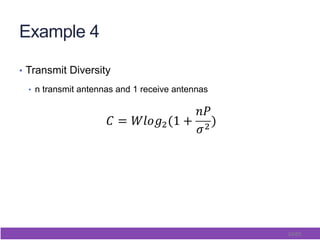
Example 4
•  Transmit Diversity
•  n transmit antennas and 1 receive antennas
25/65
Outline
• MIMO Wireless Communication Systems
• Space-Time Coding Performance Analysis
• Space-Time Block Codes
• Space-Time Trellis Codes
26/65
Outline
• MIMO Wireless Communication Systems
• Space-Time Coding Performance Analysis
o Diversity-Multiplexing Tradeoff
o ML Detection
o Error Analysis
o Space-Time Code Design Criteria
• Space-Time Block Codes
• Space-Time Trellis Codes
27/65
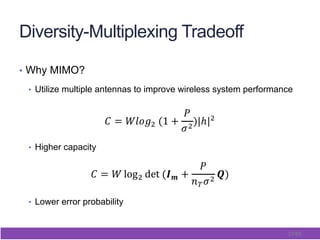
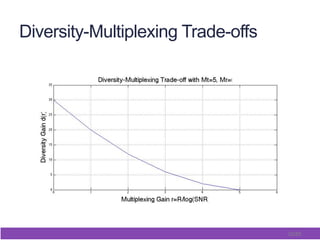
Diversity-Multiplexing Tradeoff
•  Why MIMO?
•  Utilize multiple antennas to improve wireless system performance
•  Higher capacity
•  Lower error probability
28/65
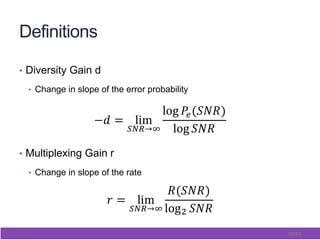
Definitions
•  Diversity Gain d
•  Change in slope of the error probability
•  Multiplexing Gain r
•  Change in slope of the rate
29/65
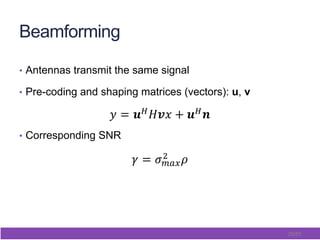
Beamforming
•  Antennas transmit the same signal
•  Pre-coding and shaping matrices (vectors): u, v
•  Corresponding SNR
30/65
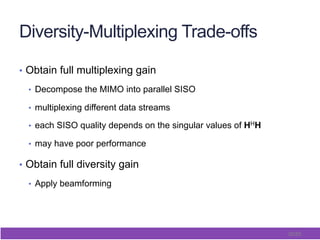
Diversity-Multiplexing Trade-offs
•  Obtain full multiplexing gain
•  Decompose the MIMO into parallel SISO
•  multiplexing different data streams
•  each SISO quality depends on the singular values of HHH
•  may have poor performance
•  Obtain full diversity gain
•  Apply beamforming
31/65
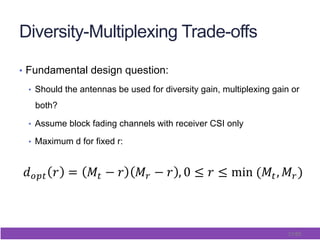
Diversity-Multiplexing Trade-offs
•  Fundamental design question:
•  Should the antennas be used for diversity gain, multiplexing gain or
both?
•  Assume block fading channels with receiver CSI only
•  Maximum d for fixed r:
32/65
Diversity-Multiplexing Trade-offs
33/65
Outline
• MIMO Wireless Communication Systems
• Space-Time Coding Performance Analysis
o Diversity-Multiplexing Tradeoff
o ML Detection
o Error Analysis
o Space-Time Code Design Criteria
• Space-Time Block Codes
• Space-Time Trellis Codes
34/65
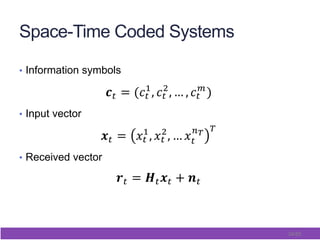
Space-Time Coded Systems
•  Information symbols
•  Input vector
•  Received vector
35/65
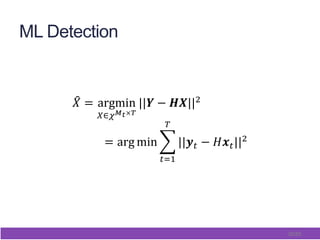
ML Detection
! = argmin
!∈!!!×!
||! − !"||!
!
= arg min ||!! − !!!||!
!
!!!
!
36/65
Space-Time Coded Systems
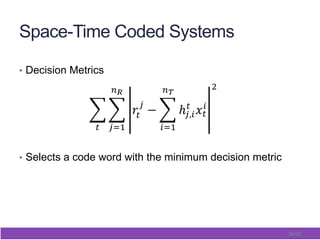
•  Decision Metrics
•  Selects a code word with the minimum decision metric
37/65
Outline
• MIMO Wireless Communication Systems
• Space-Time Coding Performance Analysis
o Diversity-Multiplexing Tradeoff
o ML Detection
o Error Analysis
o Space-Time Code Design Criteria
• Space-Time Block Codes
• Space-Time Trellis Codes
38/65
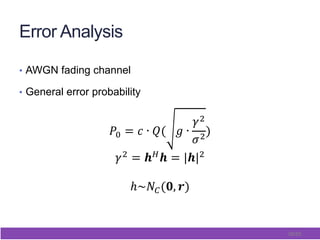
Error Analysis
•  AWGN fading channel
•  General error probability
!! = ! ∙ !( ! ∙
!!
!!
)!
!!
= !!
! = |!|!
!
!
ℎ~!!(!, !)!
39/65
Error Analysis
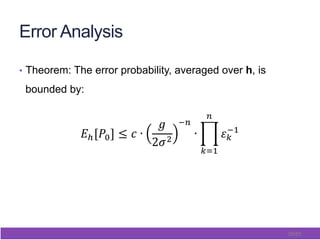
•  Theorem: The error probability, averaged over h, is
bounded by:
40/65
Error Analysis
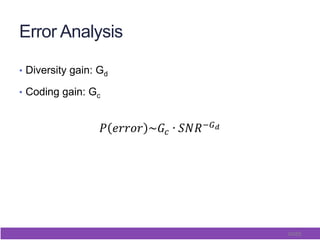
•  Diversity gain: Gd
•  Coding gain: Gc
41/65
Outline
• MIMO Wireless Communication Systems
• Space-Time Coding Performance Analysis
o Diversity-Mutiplexing Tradeoff
o ML Detection
o Error Analysis
o Space-Time Code Design Criteria
• Space-Time Block Codes
• Space-Time Trellis Codes
42/65
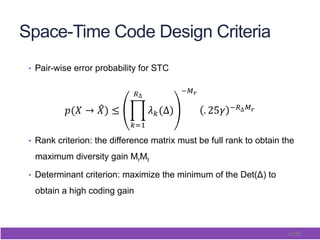
Space-Time Code Design Criteria
•  Pair-wise error probability for STC
•  Rank criterion: the difference matrix must be full rank to obtain the
maximum diversity gain MrMt
•  Determinant criterion: maximize the minimum of the Det(Δ) to
obtain a high coding gain
43/65
Outline
• MIMO Wireless Communication Systems
• Space-Time Coding Performance Analysis
• Space-Time Block Codes
•  Alamouti’s Space-Time Code
•  STBC
• Space-Time Trellis Codes
44/65
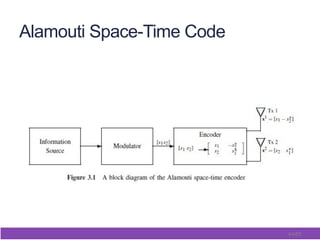
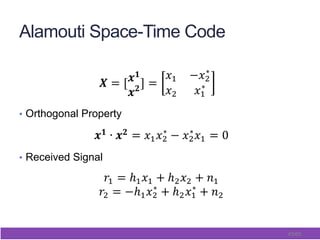
Alamouti Space-Time Code
45/65
Alamouti Space-Time Code
•  Orthogonal Property
•  Received Signal
46/65
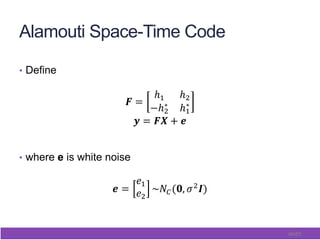
Alamouti Space-Time Code
•  Define
•  where e is white noise
47/65
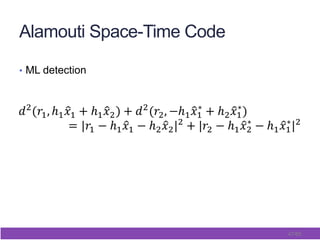
Alamouti Space-Time Code
•  ML detection
48/65
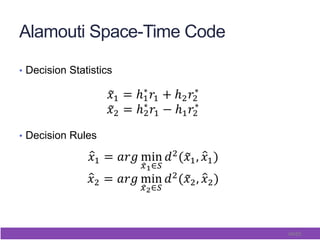
Alamouti Space-Time Code
•  Decision Statistics
•  Decision Rules
49/65
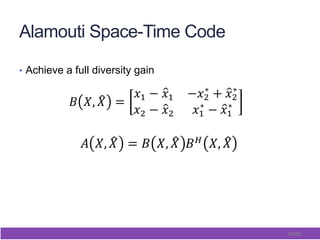
Alamouti Space-Time Code
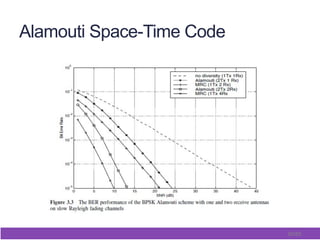
•  Achieve a full diversity gain
50/65
Alamouti Space-Time Code
51/65
Outline
• MIMO Wireless Communication Systems
• Space-Time Coding Performance Analysis
• Space-Time Block Codes
•  Alamouti’s Space-Time Code
•  STBC
• Space-Time Trellis Codes
52/65
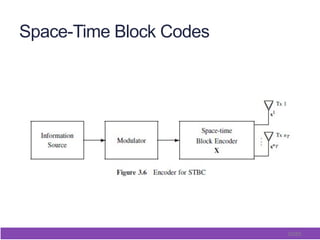
Space-Time Block Codes
53/65
Space-Time Block Codes
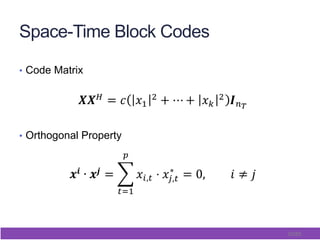
•  Code Matrix
•  Orthogonal Property
54/65
Decoding of STBC
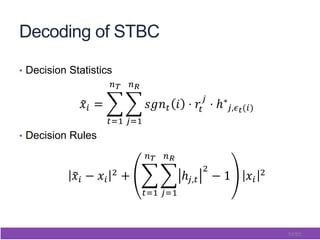
•  Decision Statistics
•  Decision Rules
55/65
Outline
• MIMO Wireless Communication Systems
• Space-Time Coding Performance Analysis
• Space-Time Block Codes
• Space-Time Trellis Codes
o Delay Diversity Code
o General STTC
56/65
Delay Diversity
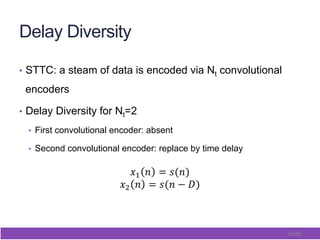
•  STTC: a steam of data is encoded via Nt convolutional
encoders
•  Delay Diversity for Nt=2
•  First convolutional encoder: absent
•  Second convolutional encoder: replace by time delay
57/65
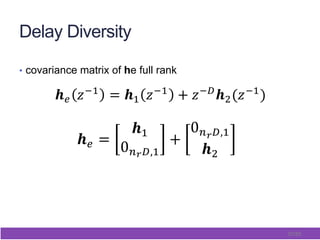
Delay Diversity
•  covariance matrix of he full rank
58/65
Outline
• MIMO Wireless Communication Systems
• Space-Time Coding Performance Analysis
• Space-Time Block Codes
• Space-Time Trellis Codes
o Delay Diversity Code
o General STTC
59/65
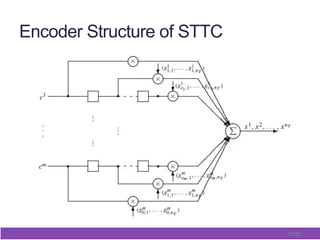
Encoder Structure of STTC
60/65
Encoder Structure of STTC
•  Generator Description
•  Generator Polynomial Description
61/65
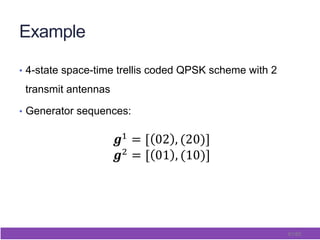
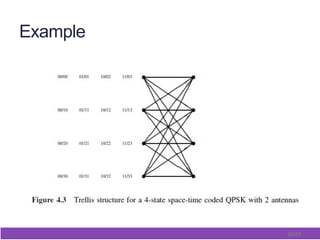
Example
•  4-state space-time trellis coded QPSK scheme with 2
transmit antennas
•  Generator sequences:
62/65
Example
63/65
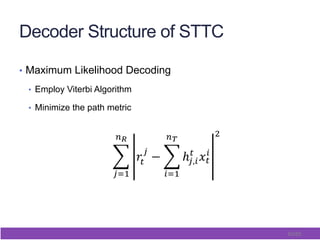
Decoder Structure of STTC
•  Maximum Likelihood Decoding
•  Employ Viterbi Algorithm
•  Minimize the path metric

space time codes