A member of CGIAR consortium www.iita.org
SOYBEAN AND COWPEA SEED
PRODUCTION
Baffour Asafo-Adjei
IITA, Ibadan
Aug. 12, 2015
A member of CGIAR consortium www.iita.org
OUTLINE
• Introduction (Importance and Classes of seeds)
• Establishment and management of seed fields
• Harvesting and postharvest conditioning of seeds
• Quality control
A member of CGIAR consortium www.iita.org
INTRODUCTION
• The yield (genetic) potential of a crop resides
in the seeds.
• Seed is therefore the most important input
that determines the productivity of any crop
• Access and use of quality seeds of improved
varieties are crucial for food and income
security at household, community and
national levels.
A member of CGIAR consortium www.iita.org
CLASSES OF SEED
Breeder Seed
Small pure seed quantity directly produced by the
originating plant breeder or institution.
Basic (Foundation) Seed
The progeny of breeder seed or pre-basic seed
Certified Seed
Progeny of foundation seed
A member of CGIAR consortium www.iita.org
ESTABLISHMENT AND MANAGEMENT OF SEED FIELDS
• Similar to grain crop field except that seed fields
require more care and quality standards must be
met before seeds can be certified by the mandated
institution/organization.
A member of CGIAR consortium www.iita.org
ESTABLISHMENT AND MANAGEMENT OF SEEDS FIELDS
Establishment of seed field:
• Choice of varieties/seed source
• Site selection and Land preparation
• Planting: Where, when and how to plant
Management of fields:
• Roguing,
• Fertilizer application,
• Weed control, diseases, insects and other pests control
measures
A member of CGIAR consortium www.iita.org
CHOICE OF VARIETIES/SEED SOURCE
• Produce seeds of recommended released varieties
• The varieties must be among the those that are most sought
after by farmers – These may be existing varieties or new
varieties with higher yield potential and /or has special traits
of importance.
• Purchase foundation seeds from approved sources
A member of CGIAR consortium www.iita.org
CHOICE OF VARIETIES/SEED SOURCE
 Research institutions have the mandate to produce breeder
seeds of varieties they develop. They may also produce
foundation seeds of their varieties if the law allows it.
 Private seed companies and public institutions may also be
given approval by law to produce foundation seeds.
 Certified seed producing entities (companies, FBOs, NGOs
etc.) should buy foundation seeds from approved sources
only to produce certified seeds.
A member of CGIAR consortium www.iita.org
Approved sources of foundation seeds of cowpea and
soybean in Nigeria and Ghana
Crop Approved Sources/Institutions
Cowpea
Nigeria: IAR, IAR&T, and IITA
Ghana: GLDB, CRI (?) & SARI (?)
Soybean
Nigeria: IAR, NCRI-Badeggi & IITA
Ghana: GLDB, CRI (?) & SARI (?)
A member of CGIAR consortium www.iita.org
CHOICE OF VARIETIES/SEED SOURCE Contd.
Make sure that:
• Seeds packages/bags bear appropriate certification
label indicating name of producer, date of
production/packaging, purity and germination
percentage.
• Seeds not ready to be used should be stored
properly in the cold room if available or in a cool
dry place to prevent deterioration and loss of
viability
A member of CGIAR consortium www.iita.org
PLANTING
• Where to plant (Site selection)
• When to plant
• How to plant
A member of CGIAR consortium www.iita.org
WHERE TO PLANT: SITE SELECTION
• Site selection is crucial in seed production. A bad
choice reduces the potential yields of seeds.
• Very important to consider climate (especially
rainfall), soil type and topography (slope) of the
area among other factors.
A member of CGIAR consortium www.iita.org
SITE SELECTION contd.
Choose areas:
 With deep well drained fertile soils
 That are fairly flat – with gentle slopes
 That are easily accessible
 That are well isolated from fields planted to same species -
especially for cross pollinated crops
 Where possible, that have easy access to water – that may
be needed to spray pesticides.
• Avoid areas that have large shady trees, ant hills and termite
colonies
A member of CGIAR consortium www.iita.org
LAND PREPARATION
 Land preparation is important because it influences
seed germination, seedling establishment and plant
vigour.
 Poor land preparation can lead to soil erosion, poor
weed control, water logging conditions, incidence of
diseases and poor yields.
 Prepare land such that seed bed or soil is loose to
ensure good aeration, good moisture holding
capacity and is free from weeds
A member of CGIAR consortium www.iita.org
LAND PREPARATION
Three Main Methods
- Manual land preparation (Machetes & hoes)
- Mechanised land preparation (use of tractors and
animal traction)
- Minimum Tillage/Zero Tillage (application of
glyphosate at a rate of 3-5l/ha)
A member of CGIAR consortium www.iita.org
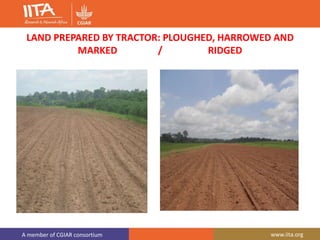
LAND PREPARED BY TRACTOR: PLOUGHED, HARROWED AND
MARKED / RIDGED
A member of CGIAR consortium www.iita.org
WHICH METHOD TO CHOOSE?
 All three methods of land preparation have
advantages and disadvantages.
 Choice of method may depend on the nature of the
land/field, financial resource of seed producer and
availability of facilities to support the method
chosen.
A member of CGIAR consortium www.iita.org
WHEN TO PLANT?
• When do farmers in your area normally plant their
soybean?
• When does the rainy season start, stabilize and end in
your operational area?
• What is the growth duration of your variety - early,
medium or late maturing?
A member of CGIAR consortium www.iita.org
WHEN TO PLANT? cont.
 Knowledge about the climatic conditions in your area should
guide you to determine the best time to plant
soybean/cowpea and harvest good quality seeds.
 Always plant soybean/cowpea such that there will be
adequate rain throughout the growth of your crop and that
maturity will coincide with the end of the rains for good
yield of good quality seeds.
A member of CGIAR consortium www.iita.org
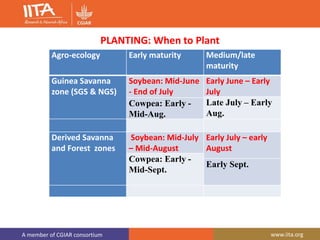
PLANTING: When to Plant
Agro-ecology Early maturity Medium/late
maturity
Guinea Savanna
zone (SGS & NGS)
Soybean: Mid-June
- End of July
Early June – Early
July
Late July – Early
Aug.
Cowpea: Early -
Mid-Aug.
Derived Savanna
and Forest zones
Soybean: Mid-July
– Mid-August
Early July – early
August
Cowpea: Early -
Mid-Sept.
Early Sept.
A member of CGIAR consortium www.iita.org
GERMINATION TEST
Always conduct germination test on your seed one week before
planting.
 If germination is 85% or more, plant using recommended
seeding rate.
 If germination is less than 85% but greater than or equal to
60%, adjust seeding rate accordingly
 If germination is less than 60%, get new seed or double the
seeding rate
A member of CGIAR consortium www.iita.org
PLANTING: How to plant
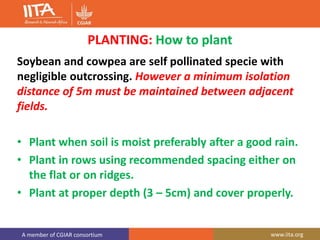
Soybean and cowpea are self pollinated specie with
negligible outcrossing. However a minimum isolation
distance of 5m must be maintained between adjacent
fields.
• Plant when soil is moist preferably after a good rain.
• Plant in rows using recommended spacing either on
the flat or on ridges.
• Plant at proper depth (3 – 5cm) and cover properly.
A member of CGIAR consortium www.iita.org
PLANTING: How to plant contd.
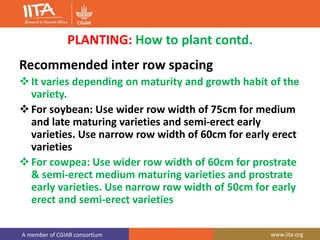
Recommended inter row spacing
It varies depending on maturity and growth habit of the
variety.
For soybean: Use wider row width of 75cm for medium
and late maturing varieties and semi-erect early
varieties. Use narrow row width of 60cm for early erect
varieties
For cowpea: Use wider row width of 60cm for prostrate
& semi-erect medium maturing varieties and prostrate
early varieties. Use narrow row width of 50cm for early
erect and semi-erect varieties
A member of CGIAR consortium www.iita.org
PLANTING: How to plant contd.
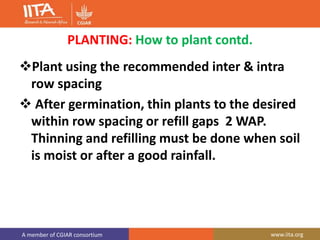
Plant using the recommended inter & intra
row spacing
 After germination, thin plants to the desired
within row spacing or refill gaps 2 WAP.
Thinning and refilling must be done when soil
is moist or after a good rainfall.
A member of CGIAR consortium www.iita.org
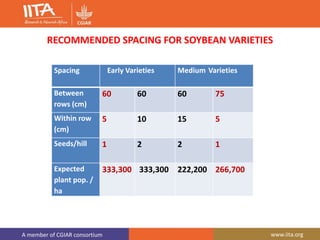
RECOMMENDED SPACING FOR SOYBEAN VARIETIES
Spacing Early Varieties Medium Varieties
Between
rows (cm)
60 60 60 75
Within row
(cm)
5 10 15 5
Seeds/hill 1 2 2 1
Expected
plant pop. /
ha
333,300 333,300 222,200 266,700
A member of CGIAR consortium www.iita.org
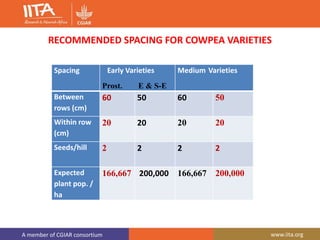
RECOMMENDED SPACING FOR COWPEA VARIETIES
Spacing Early Varieties
Prost. E & S-E
Medium Varieties
Between
rows (cm)
60 50 60 50
Within row
(cm)
20 20 20 20
Seeds/hill 2 2 2 2
Expected
plant pop. /
ha
166,667 200,000 166,667 200,000
A member of CGIAR consortium www.iita.org
MANAGEMENT OF SEED FIELDS
Key activities in the management of seed fields
 Roguing
 Application fertilizer at recommended rate
 Control weeds
 Control diseases, insect pests and other pests as and when
necessary
A member of CGIAR consortium www.iita.org
MANAGEMENT: Roguing
• Removing unwanted plants(off-types, diseased and
damaged plants from the seed field as a way of
maintaining the genetic & physical purity of the
variety.
• Done from seedling stage to harvest time.
• Must be thorough to meet certification standards
(0.5% off-types for Certified seeds)
A member of CGIAR consortium www.iita.org
MANAGEMENT: Fertilizer application
 Fertilizer requirements for soybean and cowpea
depend on fertility of the soil.
No fertilizer is required on fertile soils
 Apply fertilizer on poor soils or continuously
cropped fields with little or no fertilizer applied
 Apply fertilizer at planting or 7 – 10 days after
germination
A member of CGIAR consortium www.iita.org
MANAGEMENT: Fertilizer application cont.
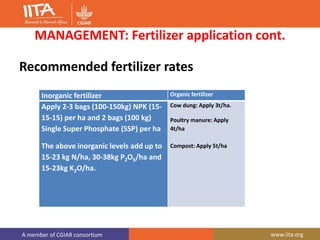
Recommended fertilizer rates
Inorganic fertilizer Organic fertilizer
Apply 2-3 bags (100-150kg) NPK (15-
15-15) per ha and 2 bags (100 kg)
Single Super Phosphate (SSP) per ha
The above inorganic levels add up to
15-23 kg N/ha, 30-38kg P2O5/ha and
15-23kg K2O/ha.
Cow dung: Apply 3t/ha.
Poultry manure: Apply
4t/ha
Compost: Apply 5t/ha
A member of CGIAR consortium www.iita.org
MANAGEMENT: Weed control
Weeds can cause yield losses because they
compete with soybean for nutrients, water and
sunlight and may harbour pests and diseases.
Keep seed fields weed-free especially during the
first six weeks after planting
Weeds may be controlled manually using
hoes/machetes, and also by using herbicides.
A member of CGIAR consortium www.iita.org
MANAGEMENT: Weed control
• Manual: If land was well prepared, two hand weeding
3wap and 5-6wap will give adequate weed control
since crop canopy may have closed by 7–8wap
• Chemical: If glyphosate was used in land preparation
or a recommended pre-emergence herbicide was
applied they give good weed control in first 3wap.
Only one hand weeding 5-6wap may be required plus
selective weeding if necessary
Note: Seek advice from your weed scientists on the
correct weedicide to use and the rate of application
A member of CGIAR consortium www.iita.org
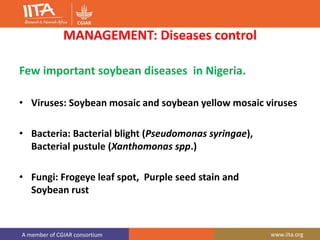
MANAGEMENT: Diseases control
Few important soybean diseases in Nigeria.
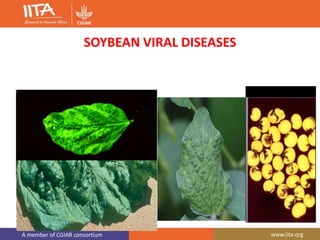
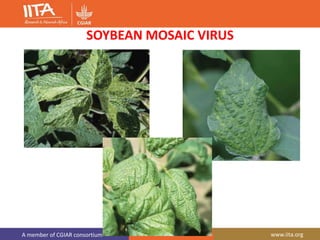
• Viruses: Soybean mosaic and soybean yellow mosaic viruses
• Bacteria: Bacterial blight (Pseudomonas syringae),
Bacterial pustule (Xanthomonas spp.)
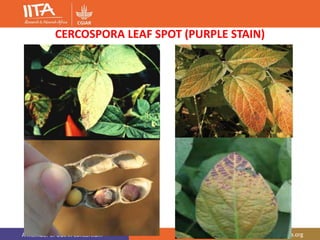
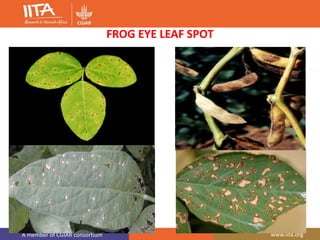
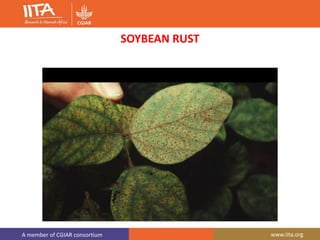
• Fungi: Frogeye leaf spot, Purple seed stain and
Soybean rust
A member of CGIAR consortium www.iita.org
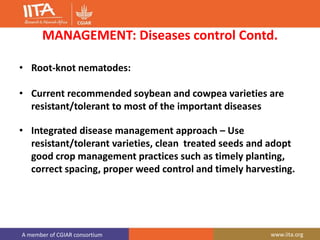
MANAGEMENT: Diseases control Contd.
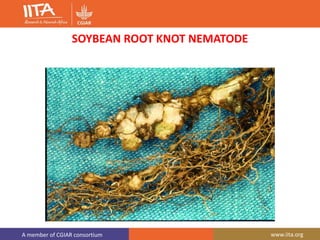
• Root-knot nematodes:
• Current recommended soybean and cowpea varieties are
resistant/tolerant to most of the important diseases
• Integrated disease management approach – Use
resistant/tolerant varieties, clean treated seeds and adopt
good crop management practices such as timely planting,
correct spacing, proper weed control and timely harvesting.
A member of CGIAR consortium www.iita.org
SOYBEAN VIRAL DISEASES
A member of CGIAR consortium www.iita.org
SOYBEAN MOSAIC VIRUS
A member of CGIAR consortium www.iita.org
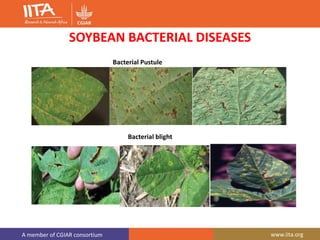
SOYBEAN BACTERIAL DISEASES
Bacterial Pustule
Bacterial blight
A member of CGIAR consortium www.iita.org
CERCOSPORA LEAF SPOT (PURPLE STAIN)
A member of CGIAR consortium www.iita.org
FROG EYE LEAF SPOT
A member of CGIAR consortium www.iita.org
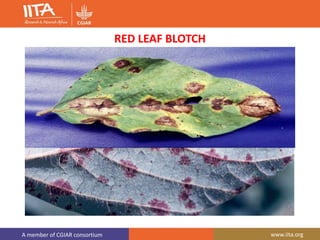
RED LEAF BLOTCH
A member of CGIAR consortium www.iita.org
SOYBEAN RUST
A member of CGIAR consortium www.iita.org
SOYBEAN ROOT KNOT NEMATODE
A member of CGIAR consortium www.iita.org
MANAGEMENT: Insect pests control
Soybean has few insect pest problems in W. Africa
compared to cowpea.
 Pod-sucking bugs (PSBs) and leaf-eating caterpillars
may cause serious yield losses if not controlled.
 Control them by applying Cymethoate super at a rate
of 1l/ha (100 ml/15 l water) or Diamethoate or
Perfekthion at 2l/ha (200 ml/15 l water).
 The insects are easier to spot in the morning than
midday or evening.
A member of CGIAR consortium www.iita.org
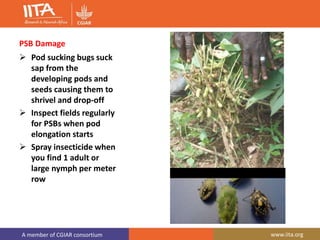
PSB Damage
 Pod sucking bugs suck
sap from the
developing pods and
seeds causing them to
shrivel and drop-off
 Inspect fields regularly
for PSBs when pod
elongation starts
 Spray insecticide when
you find 1 adult or
large nymph per meter
row
A member of CGIAR consortium www.iita.org
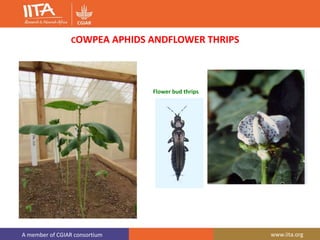
COWPEA APHIDS ANDFLOWER THRIPS
Flower bud thrips
A member of CGIAR consortium www.iita.org
MANAGEMENT: Rodents and Birds control
• Rodents (especially rats, mice and wild rabbits) can
cause serious damage by eating the seedlings and
green pods. Rodent damage is most common when
fields and their surroundings are weedy.
• Birds (such as doves, partridges and crows) also pick
seeds after planting; eat cotyledons or seedlings and
immature seeds in pods.
• Scare rodents and birds (where possible), especially
early in the morning and evenings and keep your farm
and its immediate vicinity free from weeds.
A member of CGIAR consortium www.iita.org
HARVESTING
• Your knowledge of the varieties maturity and
the time you planted should give you an idea
about the expected time to harvest
• The crop is matured and ready for harvesting
when over 95% of pods turn brown/gray/tawny
(mature pod color). At this stage, most of the leaves
may have shed, and seeds feel harder when felt
between your fingers, and pod rattles when shaken
A member of CGIAR consortium www.iita.org
HARVESTING Cont.
• Harvest promptly when the crop is matured.
• Harvest at mid-morning or late in the afternoon when pods
are dry (not dump or too dry to shatter).
• Harvest manually (soybean - by cutting plants at soil level or
uprooting them; cowpea – by picking matured pods). Spread
harvested plants on a clean flat dry area or on tarpaulin and
thresh when pods are dry enough for threshing.
A member of CGIAR consortium www.iita.org
WHY HARVEST PROMPTLY?
• Avoid field weathering that result in seed deterioration
• Avoid diseases and prevent pest attack and infestation
• Prevent shattering
• Minimize loss of crop to bush fire, theft and destruction by
animals
• Ensure good quality seed and better economic returns.
A member of CGIAR consortium www.iita.org
POST-HARVEST PROCESSING / CONDITIONING
It involves the following sequence of activities:
• Threshing of harvested dry soybean/cowpea (at 14 -16%
moisture content)
• Further drying of seeds to 8 - 12% moisture content
• Cleaning of seeds
• Grading or sorting out seeds according to size.
• Treating seeds with recommended seed treatment chemical
• Bagging/packaging of seeds in varying quantities
A member of CGIAR consortium www.iita.org
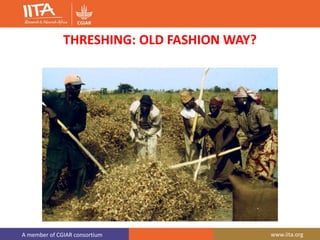
THRESHING: OLD FASHION WAY?
A member of CGIAR consortium www.iita.org
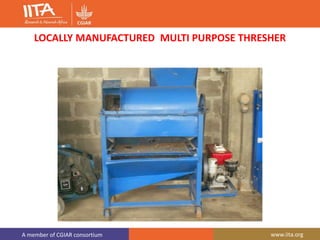
LOCALLY MANUFACTURED MULTI PURPOSE THRESHER
A member of CGIAR consortium www.iita.org
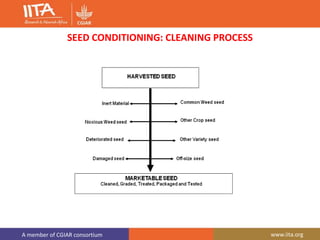
SEED CONDITIONING: CLEANING PROCESS
A member of CGIAR consortium www.iita.org
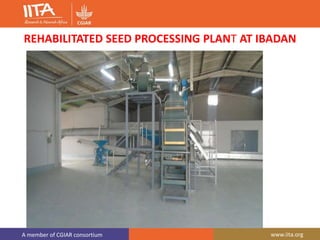
REHABILITATED SEED PROCESSING PLANT AT IBADAN
A member of CGIAR consortium www.iita.org
QUALITY CONTROL
• The Regulatory Agency and seed producers
have the collective responsibility of ensuring
that only good quality seeds are produced
and marketed.
• They must play their respective roles
diligently at all times to ensure good quality
seeds are produced for sale.
A member of CGIAR consortium www.iita.org
QUALITY CONTROL: ROLE OF REGULATORY AGENCY
 Responsible for enforcing compliance to regulations
governing seed production in the country
 Only seeds that meet regulatory requirements
should be certified
 Ensure F/S used to produce C/S are from approved
sources (check certification tag or purchase receipts
as proof)
A member of CGIAR consortium www.iita.org
QUALITY CONTROL: ROLE OF REGULATORY AGENCY
 Inspect site for seed production to confirm field is
properly isolated from fields of other varieties of
the same crop and at planting to ascertain seed
source .
 Inspect fields at flowering and harvesting periods to
confirm off-types, diseases infected and damaged
plants are removed (proper roguing done).
 Test seeds for purity and germination
A member of CGIAR consortium www.iita.org
QUALITY CONTROL: ROLE OF REGULATORY AGENCY
Prepare and issue inspection report after
each inspection.
If all requirements are met, certify seed and
tag accordingly.
A member of CGIAR consortium www.iita.org
QUALITY CONTROL: ROLE OF SEED PRODUCERS
Make sure:
 Foundation seed is purchased from approved
sources
 Seed fields are properly isolated
 You remove off types, diseases infected and
damaged plants from seed fields
 Proper weed, diseases and insect pest control
measure are taken to maintain clean and healthy
seed fields
A member of CGIAR consortium www.iita.org
SEED TESTING
• Objective is to assess the quality of seeds for
sowing
• Minimize risk of farmers using seeds that do not
have the capacity to produce a good crop.
• May be conducted on raw seed, freshly conditioned
seed or seed that has been storage for some time
A member of CGIAR consortium www.iita.org
SEED TESTING Contd.
It involves sampling and analysis for
• Seed purity, to determine percentage by weight of other
varieties, other crops & weed seeds, inert materials etc.
• Germination capacity - most important method used by
Certification Agencies
• Moisture content
• Seed health testing
A member of CGIAR consortium www.iita.org
THANK YOU

Soybean and cowpea seed production

  • 1.
    A member ofCGIAR consortium www.iita.org SOYBEAN AND COWPEA SEED PRODUCTION Baffour Asafo-Adjei IITA, Ibadan Aug. 12, 2015
  • 2.
    A member ofCGIAR consortium www.iita.org
  • 3.
    A member ofCGIAR consortium www.iita.org
  • 4.
    A member ofCGIAR consortium www.iita.org OUTLINE • Introduction (Importance and Classes of seeds) • Establishment and management of seed fields • Harvesting and postharvest conditioning of seeds • Quality control
  • 5.
    A member ofCGIAR consortium www.iita.org INTRODUCTION • The yield (genetic) potential of a crop resides in the seeds. • Seed is therefore the most important input that determines the productivity of any crop • Access and use of quality seeds of improved varieties are crucial for food and income security at household, community and national levels.
  • 6.
    A member ofCGIAR consortium www.iita.org CLASSES OF SEED Breeder Seed Small pure seed quantity directly produced by the originating plant breeder or institution. Basic (Foundation) Seed The progeny of breeder seed or pre-basic seed Certified Seed Progeny of foundation seed
  • 7.
    A member ofCGIAR consortium www.iita.org ESTABLISHMENT AND MANAGEMENT OF SEED FIELDS • Similar to grain crop field except that seed fields require more care and quality standards must be met before seeds can be certified by the mandated institution/organization.
  • 8.
    A member ofCGIAR consortium www.iita.org ESTABLISHMENT AND MANAGEMENT OF SEEDS FIELDS Establishment of seed field: • Choice of varieties/seed source • Site selection and Land preparation • Planting: Where, when and how to plant Management of fields: • Roguing, • Fertilizer application, • Weed control, diseases, insects and other pests control measures
  • 9.
    A member ofCGIAR consortium www.iita.org CHOICE OF VARIETIES/SEED SOURCE • Produce seeds of recommended released varieties • The varieties must be among the those that are most sought after by farmers – These may be existing varieties or new varieties with higher yield potential and /or has special traits of importance. • Purchase foundation seeds from approved sources
  • 10.
    A member ofCGIAR consortium www.iita.org CHOICE OF VARIETIES/SEED SOURCE  Research institutions have the mandate to produce breeder seeds of varieties they develop. They may also produce foundation seeds of their varieties if the law allows it.  Private seed companies and public institutions may also be given approval by law to produce foundation seeds.  Certified seed producing entities (companies, FBOs, NGOs etc.) should buy foundation seeds from approved sources only to produce certified seeds.
  • 11.
    A member ofCGIAR consortium www.iita.org Approved sources of foundation seeds of cowpea and soybean in Nigeria and Ghana Crop Approved Sources/Institutions Cowpea Nigeria: IAR, IAR&T, and IITA Ghana: GLDB, CRI (?) & SARI (?) Soybean Nigeria: IAR, NCRI-Badeggi & IITA Ghana: GLDB, CRI (?) & SARI (?)
  • 12.
    A member ofCGIAR consortium www.iita.org CHOICE OF VARIETIES/SEED SOURCE Contd. Make sure that: • Seeds packages/bags bear appropriate certification label indicating name of producer, date of production/packaging, purity and germination percentage. • Seeds not ready to be used should be stored properly in the cold room if available or in a cool dry place to prevent deterioration and loss of viability
  • 13.
    A member ofCGIAR consortium www.iita.org PLANTING • Where to plant (Site selection) • When to plant • How to plant
  • 14.
    A member ofCGIAR consortium www.iita.org WHERE TO PLANT: SITE SELECTION • Site selection is crucial in seed production. A bad choice reduces the potential yields of seeds. • Very important to consider climate (especially rainfall), soil type and topography (slope) of the area among other factors.
  • 15.
    A member ofCGIAR consortium www.iita.org SITE SELECTION contd. Choose areas:  With deep well drained fertile soils  That are fairly flat – with gentle slopes  That are easily accessible  That are well isolated from fields planted to same species - especially for cross pollinated crops  Where possible, that have easy access to water – that may be needed to spray pesticides. • Avoid areas that have large shady trees, ant hills and termite colonies
  • 16.
    A member ofCGIAR consortium www.iita.org LAND PREPARATION  Land preparation is important because it influences seed germination, seedling establishment and plant vigour.  Poor land preparation can lead to soil erosion, poor weed control, water logging conditions, incidence of diseases and poor yields.  Prepare land such that seed bed or soil is loose to ensure good aeration, good moisture holding capacity and is free from weeds
  • 17.
    A member ofCGIAR consortium www.iita.org LAND PREPARATION Three Main Methods - Manual land preparation (Machetes & hoes) - Mechanised land preparation (use of tractors and animal traction) - Minimum Tillage/Zero Tillage (application of glyphosate at a rate of 3-5l/ha)
  • 18.
    A member ofCGIAR consortium www.iita.org LAND PREPARED BY TRACTOR: PLOUGHED, HARROWED AND MARKED / RIDGED
  • 19.
    A member ofCGIAR consortium www.iita.org WHICH METHOD TO CHOOSE?  All three methods of land preparation have advantages and disadvantages.  Choice of method may depend on the nature of the land/field, financial resource of seed producer and availability of facilities to support the method chosen.
  • 20.
    A member ofCGIAR consortium www.iita.org WHEN TO PLANT? • When do farmers in your area normally plant their soybean? • When does the rainy season start, stabilize and end in your operational area? • What is the growth duration of your variety - early, medium or late maturing?
  • 21.
    A member ofCGIAR consortium www.iita.org WHEN TO PLANT? cont.  Knowledge about the climatic conditions in your area should guide you to determine the best time to plant soybean/cowpea and harvest good quality seeds.  Always plant soybean/cowpea such that there will be adequate rain throughout the growth of your crop and that maturity will coincide with the end of the rains for good yield of good quality seeds.
  • 22.
    A member ofCGIAR consortium www.iita.org PLANTING: When to Plant Agro-ecology Early maturity Medium/late maturity Guinea Savanna zone (SGS & NGS) Soybean: Mid-June - End of July Early June – Early July Late July – Early Aug. Cowpea: Early - Mid-Aug. Derived Savanna and Forest zones Soybean: Mid-July – Mid-August Early July – early August Cowpea: Early - Mid-Sept. Early Sept.
  • 23.
    A member ofCGIAR consortium www.iita.org GERMINATION TEST Always conduct germination test on your seed one week before planting.  If germination is 85% or more, plant using recommended seeding rate.  If germination is less than 85% but greater than or equal to 60%, adjust seeding rate accordingly  If germination is less than 60%, get new seed or double the seeding rate
  • 24.
    A member ofCGIAR consortium www.iita.org PLANTING: How to plant Soybean and cowpea are self pollinated specie with negligible outcrossing. However a minimum isolation distance of 5m must be maintained between adjacent fields. • Plant when soil is moist preferably after a good rain. • Plant in rows using recommended spacing either on the flat or on ridges. • Plant at proper depth (3 – 5cm) and cover properly.
  • 25.
    A member ofCGIAR consortium www.iita.org PLANTING: How to plant contd. Recommended inter row spacing It varies depending on maturity and growth habit of the variety. For soybean: Use wider row width of 75cm for medium and late maturing varieties and semi-erect early varieties. Use narrow row width of 60cm for early erect varieties For cowpea: Use wider row width of 60cm for prostrate & semi-erect medium maturing varieties and prostrate early varieties. Use narrow row width of 50cm for early erect and semi-erect varieties
  • 26.
    A member ofCGIAR consortium www.iita.org PLANTING: How to plant contd. Plant using the recommended inter & intra row spacing  After germination, thin plants to the desired within row spacing or refill gaps 2 WAP. Thinning and refilling must be done when soil is moist or after a good rainfall.
  • 27.
    A member ofCGIAR consortium www.iita.org RECOMMENDED SPACING FOR SOYBEAN VARIETIES Spacing Early Varieties Medium Varieties Between rows (cm) 60 60 60 75 Within row (cm) 5 10 15 5 Seeds/hill 1 2 2 1 Expected plant pop. / ha 333,300 333,300 222,200 266,700
  • 28.
    A member ofCGIAR consortium www.iita.org RECOMMENDED SPACING FOR COWPEA VARIETIES Spacing Early Varieties Prost. E & S-E Medium Varieties Between rows (cm) 60 50 60 50 Within row (cm) 20 20 20 20 Seeds/hill 2 2 2 2 Expected plant pop. / ha 166,667 200,000 166,667 200,000
  • 29.
    A member ofCGIAR consortium www.iita.org MANAGEMENT OF SEED FIELDS Key activities in the management of seed fields  Roguing  Application fertilizer at recommended rate  Control weeds  Control diseases, insect pests and other pests as and when necessary
  • 30.
    A member ofCGIAR consortium www.iita.org MANAGEMENT: Roguing • Removing unwanted plants(off-types, diseased and damaged plants from the seed field as a way of maintaining the genetic & physical purity of the variety. • Done from seedling stage to harvest time. • Must be thorough to meet certification standards (0.5% off-types for Certified seeds)
  • 31.
    A member ofCGIAR consortium www.iita.org MANAGEMENT: Fertilizer application  Fertilizer requirements for soybean and cowpea depend on fertility of the soil. No fertilizer is required on fertile soils  Apply fertilizer on poor soils or continuously cropped fields with little or no fertilizer applied  Apply fertilizer at planting or 7 – 10 days after germination
  • 32.
    A member ofCGIAR consortium www.iita.org MANAGEMENT: Fertilizer application cont. Recommended fertilizer rates Inorganic fertilizer Organic fertilizer Apply 2-3 bags (100-150kg) NPK (15- 15-15) per ha and 2 bags (100 kg) Single Super Phosphate (SSP) per ha The above inorganic levels add up to 15-23 kg N/ha, 30-38kg P2O5/ha and 15-23kg K2O/ha. Cow dung: Apply 3t/ha. Poultry manure: Apply 4t/ha Compost: Apply 5t/ha
  • 33.
    A member ofCGIAR consortium www.iita.org MANAGEMENT: Weed control Weeds can cause yield losses because they compete with soybean for nutrients, water and sunlight and may harbour pests and diseases. Keep seed fields weed-free especially during the first six weeks after planting Weeds may be controlled manually using hoes/machetes, and also by using herbicides.
  • 34.
    A member ofCGIAR consortium www.iita.org MANAGEMENT: Weed control • Manual: If land was well prepared, two hand weeding 3wap and 5-6wap will give adequate weed control since crop canopy may have closed by 7–8wap • Chemical: If glyphosate was used in land preparation or a recommended pre-emergence herbicide was applied they give good weed control in first 3wap. Only one hand weeding 5-6wap may be required plus selective weeding if necessary Note: Seek advice from your weed scientists on the correct weedicide to use and the rate of application
  • 35.
    A member ofCGIAR consortium www.iita.org MANAGEMENT: Diseases control Few important soybean diseases in Nigeria. • Viruses: Soybean mosaic and soybean yellow mosaic viruses • Bacteria: Bacterial blight (Pseudomonas syringae), Bacterial pustule (Xanthomonas spp.) • Fungi: Frogeye leaf spot, Purple seed stain and Soybean rust
  • 36.
    A member ofCGIAR consortium www.iita.org MANAGEMENT: Diseases control Contd. • Root-knot nematodes: • Current recommended soybean and cowpea varieties are resistant/tolerant to most of the important diseases • Integrated disease management approach – Use resistant/tolerant varieties, clean treated seeds and adopt good crop management practices such as timely planting, correct spacing, proper weed control and timely harvesting.
  • 37.
    A member ofCGIAR consortium www.iita.org SOYBEAN VIRAL DISEASES
  • 38.
    A member ofCGIAR consortium www.iita.org SOYBEAN MOSAIC VIRUS
  • 39.
    A member ofCGIAR consortium www.iita.org SOYBEAN BACTERIAL DISEASES Bacterial Pustule Bacterial blight
  • 40.
    A member ofCGIAR consortium www.iita.org CERCOSPORA LEAF SPOT (PURPLE STAIN)
  • 41.
    A member ofCGIAR consortium www.iita.org FROG EYE LEAF SPOT
  • 42.
    A member ofCGIAR consortium www.iita.org RED LEAF BLOTCH
  • 43.
    A member ofCGIAR consortium www.iita.org SOYBEAN RUST
  • 44.
    A member ofCGIAR consortium www.iita.org SOYBEAN ROOT KNOT NEMATODE
  • 45.
    A member ofCGIAR consortium www.iita.org MANAGEMENT: Insect pests control Soybean has few insect pest problems in W. Africa compared to cowpea.  Pod-sucking bugs (PSBs) and leaf-eating caterpillars may cause serious yield losses if not controlled.  Control them by applying Cymethoate super at a rate of 1l/ha (100 ml/15 l water) or Diamethoate or Perfekthion at 2l/ha (200 ml/15 l water).  The insects are easier to spot in the morning than midday or evening.
  • 46.
    A member ofCGIAR consortium www.iita.org PSB Damage  Pod sucking bugs suck sap from the developing pods and seeds causing them to shrivel and drop-off  Inspect fields regularly for PSBs when pod elongation starts  Spray insecticide when you find 1 adult or large nymph per meter row
  • 47.
    A member ofCGIAR consortium www.iita.org COWPEA APHIDS ANDFLOWER THRIPS Flower bud thrips
  • 48.
    A member ofCGIAR consortium www.iita.org MANAGEMENT: Rodents and Birds control • Rodents (especially rats, mice and wild rabbits) can cause serious damage by eating the seedlings and green pods. Rodent damage is most common when fields and their surroundings are weedy. • Birds (such as doves, partridges and crows) also pick seeds after planting; eat cotyledons or seedlings and immature seeds in pods. • Scare rodents and birds (where possible), especially early in the morning and evenings and keep your farm and its immediate vicinity free from weeds.
  • 49.
    A member ofCGIAR consortium www.iita.org HARVESTING • Your knowledge of the varieties maturity and the time you planted should give you an idea about the expected time to harvest • The crop is matured and ready for harvesting when over 95% of pods turn brown/gray/tawny (mature pod color). At this stage, most of the leaves may have shed, and seeds feel harder when felt between your fingers, and pod rattles when shaken
  • 50.
    A member ofCGIAR consortium www.iita.org HARVESTING Cont. • Harvest promptly when the crop is matured. • Harvest at mid-morning or late in the afternoon when pods are dry (not dump or too dry to shatter). • Harvest manually (soybean - by cutting plants at soil level or uprooting them; cowpea – by picking matured pods). Spread harvested plants on a clean flat dry area or on tarpaulin and thresh when pods are dry enough for threshing.
  • 51.
    A member ofCGIAR consortium www.iita.org WHY HARVEST PROMPTLY? • Avoid field weathering that result in seed deterioration • Avoid diseases and prevent pest attack and infestation • Prevent shattering • Minimize loss of crop to bush fire, theft and destruction by animals • Ensure good quality seed and better economic returns.
  • 52.
    A member ofCGIAR consortium www.iita.org POST-HARVEST PROCESSING / CONDITIONING It involves the following sequence of activities: • Threshing of harvested dry soybean/cowpea (at 14 -16% moisture content) • Further drying of seeds to 8 - 12% moisture content • Cleaning of seeds • Grading or sorting out seeds according to size. • Treating seeds with recommended seed treatment chemical • Bagging/packaging of seeds in varying quantities
  • 53.
    A member ofCGIAR consortium www.iita.org THRESHING: OLD FASHION WAY?
  • 54.
    A member ofCGIAR consortium www.iita.org LOCALLY MANUFACTURED MULTI PURPOSE THRESHER
  • 55.
    A member ofCGIAR consortium www.iita.org SEED CONDITIONING: CLEANING PROCESS
  • 56.
    A member ofCGIAR consortium www.iita.org REHABILITATED SEED PROCESSING PLANT AT IBADAN
  • 57.
    A member ofCGIAR consortium www.iita.org QUALITY CONTROL • The Regulatory Agency and seed producers have the collective responsibility of ensuring that only good quality seeds are produced and marketed. • They must play their respective roles diligently at all times to ensure good quality seeds are produced for sale.
  • 58.
    A member ofCGIAR consortium www.iita.org QUALITY CONTROL: ROLE OF REGULATORY AGENCY  Responsible for enforcing compliance to regulations governing seed production in the country  Only seeds that meet regulatory requirements should be certified  Ensure F/S used to produce C/S are from approved sources (check certification tag or purchase receipts as proof)
  • 59.
    A member ofCGIAR consortium www.iita.org QUALITY CONTROL: ROLE OF REGULATORY AGENCY  Inspect site for seed production to confirm field is properly isolated from fields of other varieties of the same crop and at planting to ascertain seed source .  Inspect fields at flowering and harvesting periods to confirm off-types, diseases infected and damaged plants are removed (proper roguing done).  Test seeds for purity and germination
  • 60.
    A member ofCGIAR consortium www.iita.org QUALITY CONTROL: ROLE OF REGULATORY AGENCY Prepare and issue inspection report after each inspection. If all requirements are met, certify seed and tag accordingly.
  • 61.
    A member ofCGIAR consortium www.iita.org QUALITY CONTROL: ROLE OF SEED PRODUCERS Make sure:  Foundation seed is purchased from approved sources  Seed fields are properly isolated  You remove off types, diseases infected and damaged plants from seed fields  Proper weed, diseases and insect pest control measure are taken to maintain clean and healthy seed fields
  • 62.
    A member ofCGIAR consortium www.iita.org SEED TESTING • Objective is to assess the quality of seeds for sowing • Minimize risk of farmers using seeds that do not have the capacity to produce a good crop. • May be conducted on raw seed, freshly conditioned seed or seed that has been storage for some time
  • 63.
    A member ofCGIAR consortium www.iita.org SEED TESTING Contd. It involves sampling and analysis for • Seed purity, to determine percentage by weight of other varieties, other crops & weed seeds, inert materials etc. • Germination capacity - most important method used by Certification Agencies • Moisture content • Seed health testing
  • 64.
    A member ofCGIAR consortium www.iita.org THANK YOU

Editor's Notes

  • #23 This is only a general guide. Plant at the most appropriate time based on knowledge about climate of the area.
  • #35 Pre-emergence herbicides such as Galex (4 l/ha), Cotodon (4l/ha) or Stomp 330 E (6.5 l/ha).