Yield and storage
Yield:
•A 5-year-old tree may provide 35 kg fresh fruits.
Storage:
• Fruits are highly perishable.
•Fruits harvested at optimum maturity can be stored for a week
at 5`C and 85 % relative humidity.
Presented by
Panchaal Bhattacharjee
PhD. (Hort.) 1st sem.
Fruit Science
Department of Horticulture
Yield and storage
Yield:
•A 5-year-old tree may provide 35 kg fresh fruits.
Storage:
• Fruits are highly perishable.
•Fruits harvested at optimum maturity can be stored for a week
at 5`C and 85 % relative humidity.
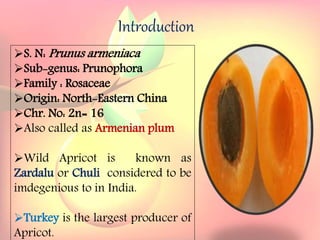
Introduction
S. N: Prunus armeniaca
Sub-genus: Prunophora
Family : Rosaceae
Origin: North-Eastern China
Chr. No: 2n= 16
Also called as Armenian plum
Wild Apricot is known as
Zardalu or Chuli considered to be
imdegenious to in India.
Turkey is the largest producer of
Apricot.
Yield and storage
Yield:
•A 5-year-old tree may provide 35 kg fresh fruits.
Storage:
• Fruits are highly perishable.
•Fruits harvested at optimum maturity can be stored for a week
at 5`C and 85 % relative humidity.
Because of it’s popularity it appears in the
stamps of Armenia
Yield and storage
Yield:
•A 5-year-old tree may provide 35 kg fresh fruits.
Storage:
• Fruits are highly perishable.
•Fruits harvested at optimum maturity can be stored for a week
at 5`C and 85 % relative humidity.
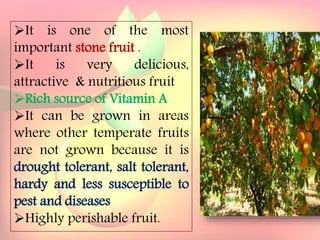
It is one of the most
important stone fruit .
It is very delicious,
attractive & nutritious fruit
Rich source of Vitamin A
It can be grown in areas
where other temperate fruits
are not grown because it is
drought tolerant, salt tolerant,
hardy and less susceptible to
pest and diseases
Highly perishable fruit.
Yield and storage
Yield:
•A 5-year-old tree may provide 35 kg fresh fruits.
Storage:
• Fruits are highly perishable.
•Fruits harvested at optimum maturity can be stored for a week
at 5`C and 85 % relative humidity.
COMPOSITION
Rich source of vit A, fat, fibre, ascorbic acid, Ca
Rich source of oil (40-45%)
Aroma of fruit is due to Benzaldehyde and Lindrol
Major acids present are Mallic acid and Citric acid
Contains higher amount of Carotenoids
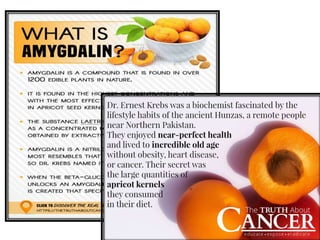
Seeds contain high content of amygdalin (vitamin
B17) (>5.5g/100g amygdalin content makes the bitter
kernal poisonous for consumption)
Yield and storage
Yield:
•A 5-year-old tree may provide 35 kg fresh fruits.
Storage:
• Fruits are highly perishable.
•Fruits harvested at optimum maturity can be stored for a week
at 5`C and 85 % relative humidity.
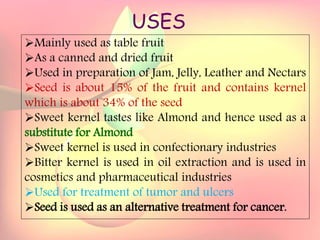
USES
Mainly used as table fruit
As a canned and dried fruit
Used in preparation of Jam, Jelly, Leather and Nectars
Seed is about 15% of the fruit and contains kernel
which is about 34% of the seed
Sweet kernel tastes like Almond and hence used as a
substitute for Almond
Sweet kernel is used in confectionary industries
Bitter kernel is used in oil extraction and is used in
cosmetics and pharmaceutical industries
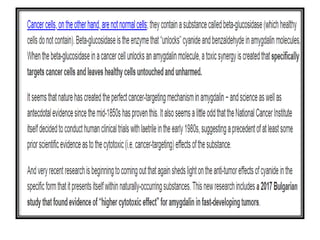
Used for treatment of tumor and ulcers
Seed is used as an alternative treatment for cancer.
Yield and storage
Yield:
•A 5-year-old tree may provide 35 kg fresh fruits.
Storage:
• Fruits are highly perishable.
•Fruits harvested at optimum maturity can be stored for a week
at 5`C and 85 % relative humidity.
Origin and distribution
•Origin: N-E China
•Major apricot producing countries: China, USSR, Turkey,
Italy, Spain, Greece, France and USA
•Commercial cultivation of apricot in India was started by
Europeans during 1870
•Presently in India it is grown commercially in hills of HP,
J & K, Uttarakhand
•Some drying type of apricots are grown in the dry
temperate regions of J & K, HP.
Yield and storage
Yield:
•A 5-year-old tree may provide 35 kg fresh fruits.
Storage:
• Fruits are highly perishable.
•Fruits harvested at optimum maturity can be stored for a week
at 5`C and 85 % relative humidity.
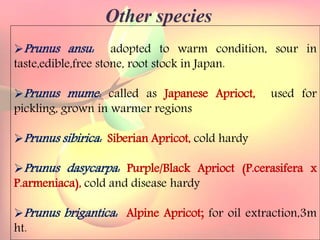
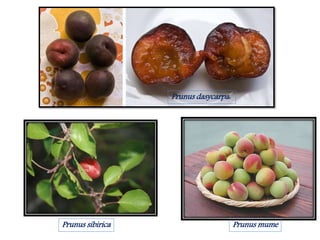
Other species
Prunus ansu: adopted to warm condition, sour in
taste,edible,free stone, root stock in Japan.
Prunus mume: called as Japanese Aprioct, used for
pickling, grown in warmer regions
Prunus sibirica: Siberian Apricot, cold hardy
Prunus dasycarpa: Purple/Black Aprioct (P.cerasifera x
P.armeniaca), cold and disease hardy
Prunus brigantica: Alpine Apricot; for oil extraction,3m
ht.
Prunus dasycarpa:
Prunus mumePrunus sibirica
Yield and storage
Yield:
•A 5-year-old tree may provide 35 kg fresh fruits.
Storage:
• Fruits are highly perishable.
•Fruits harvested at optimum maturity can be stored for a week
at 5`C and 85 % relative humidity.
cultivars
Early Shipley - used for table and drying purpose,
bitter kernal
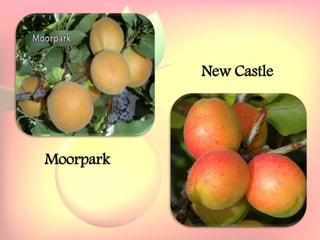
New Castle - used for table and drying purpose
Moorpark – best for outdoor cultivation in small
gardens, pubescent in outer layer.
Nugget – good quality, regular bearer, heavy yielder,
kernel is sweet, used for table purpose
Royal – large fruits, heat resistant, table variety
Yield and storage
Yield:
•A 5-year-old tree may provide 35 kg fresh fruits.
Storage:
• Fruits are highly perishable.
•Fruits harvested at optimum maturity can be stored for a week
at 5`C and 85 % relative humidity.
Royal
Nugget
Yield and storage
Yield:
•A 5-year-old tree may provide 35 kg fresh fruits.
Storage:
• Fruits are highly perishable.
•Fruits harvested at optimum maturity can be stored for a week
at 5`C and 85 % relative humidity.
Moorpark
New Castle
Yield and storage
Yield:
•A 5-year-old tree may provide 35 kg fresh fruits.
Storage:
• Fruits are highly perishable.
•Fruits harvested at optimum maturity can be stored for a week
at 5`C and 85 % relative humidity.
High Chilling Variety-
Shakarpara – very sweet and good aroma shy bearer,
Afghan introduction, requires high chilling
hours.(TSS-26%)
Charmagz – self incompatible variety, used for table
and drying purpose, shy bearer, requires high
chilling hours.
Kaisha – good quality, prolific bearer, kernel is
bitter.
Halman – grown in Ladhak region, used for table
and drying purpose(TSS-27-28%)
Yield and storage
Yield:
•A 5-year-old tree may provide 35 kg fresh fruits.
Storage:
• Fruits are highly perishable.
•Fruits harvested at optimum maturity can be stored for a week
at 5`C and 85 % relative humidity.
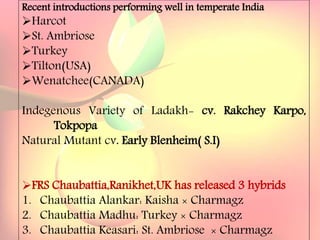
Recent introductions performing well in temperate India
Harcot
St. Ambriose
Turkey
Tilton(USA)
Wenatchee(CANADA)
Indegenous Variety of Ladakh- cv. Rakchey Karpo,
Tokpopa
Natural Mutant cv. Early Blenheim( S.I)
FRS Chaubattia,Ranikhet,UK has released 3 hybrids
1. Chaubattia Alankar: Kaisha × Charmagz
2. Chaubattia Madhu: Turkey × Charmagz
3. Chaubattia Keasari: St. Ambriose × Charmagz
Yield and storage
Yield:
•A 5-year-old tree may provide 35 kg fresh fruits.
Storage:
• Fruits are highly perishable.
•Fruits harvested at optimum maturity can be stored for a week
at 5`C and 85 % relative humidity.
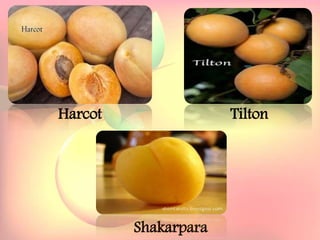
Harcot
Shakarpara
Tilton
Yield and storage
Yield:
•A 5-year-old tree may provide 35 kg fresh fruits.
Storage:
• Fruits are highly perishable.
•Fruits harvested at optimum maturity can be stored for a week
at 5`C and 85 % relative humidity.
Soil And Climate
It is a hardy crop
pH: 6-6.8
Deep fertile, well drained loamy soils are readily suitable
for cultivation
Grown at an altitude of 900-2000m MSL
Chilling requirement 300-900hrs, below 7°C for
fruiting
Rain fall: 100cm, well distributed through out the year
Summer temperature: 16.6-32.2°C
For flowering temperature is 5-6°C
Long cool weather and frost free areas are the best
High humidity during summer increases the Brown Rot.
Yield and storage
Yield:
•A 5-year-old tree may provide 35 kg fresh fruits.
Storage:
• Fruits are highly perishable.
•Fruits harvested at optimum maturity can be stored for a week
at 5`C and 85 % relative humidity.
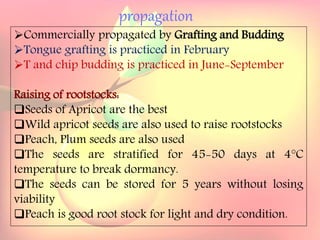
propagation
Commercially propagated by Grafting and Budding
Tongue grafting is practiced in February
T and chip budding is practiced in June-September
Raising of rootstocks:
Seeds of Apricot are the best
Wild apricot seeds are also used to raise rootstocks
Peach, Plum seeds are also used
The seeds are stratified for 45-50 days at 4°C
temperature to break dormancy.
The seeds can be stored for 5 years without losing
viability
Peach is good root stock for light and dry condition.
Yield and storage
Yield:
•A 5-year-old tree may provide 35 kg fresh fruits.
Storage:
• Fruits are highly perishable.
•Fruits harvested at optimum maturity can be stored for a week
at 5`C and 85 % relative humidity.
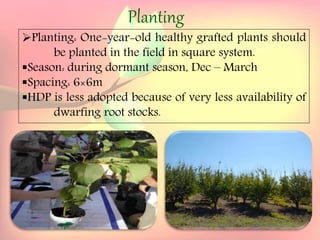
Planting: One-year-old healthy grafted plants should
be planted in the field in square system.
Season: during dormant season, Dec – March
Spacing: 6×6m
HDP is less adopted because of very less availability of
dwarfing root stocks.
Planting
Yield and storage
Yield:
•A 5-year-old tree may provide 35 kg fresh fruits.
Storage:
• Fruits are highly perishable.
•Fruits harvested at optimum maturity can be stored for a week
at 5`C and 85 % relative humidity.
Nutrient-
500:250:200 [N:P:K] (g/tree for 7 yr old bearing
tree)
Irrigation-
•Can be grown as a rain fed crop
•Irrigation is essential during initial years and during
critical stage-Pit hardening stage (April-June)
Nutrient management and
Irrigation
Yield and storage
Yield:
•A 5-year-old tree may provide 35 kg fresh fruits.
Storage:
• Fruits are highly perishable.
•Fruits harvested at optimum maturity can be stored for a week
at 5`C and 85 % relative humidity.
Yield and storage
Yield:
•A 5-year-old tree may provide 35 kg fresh fruits.
Storage:
• Fruits are highly perishable.
•Fruits harvested at optimum maturity can be stored for a week
at 5`C and 85 % relative humidity.
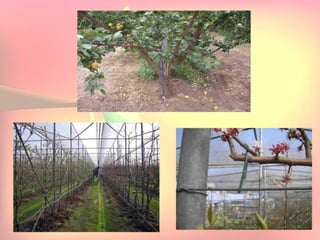
Training :
•Apricot trees are trained to
modified central leader system
•Open vas e and palmate types
are also followed where
mechanical harvesting is
done.
Training and pruning
Yield and storage
Yield:
•A 5-year-old tree may provide 35 kg fresh fruits.
Storage:
• Fruits are highly perishable.
•Fruits harvested at optimum maturity can be stored for a week
at 5`C and 85 % relative humidity.
pruning
•Apricot bears fruits on previous year’s growth and short
spurs.
•The spur bearing branches die after 3-4 years.
•Therefore pruning should be done aimed to induce new
growth on such braches and to provide fruiting spurs for
the subsequent years.
• It consists of heading back(1/3rd) and thinning
out(25%) 1year old wood and has balanced vegetative
growth.
•Pruning in January-end to second week of February to
encourage production of more fruiting spurs.
Yield and storage
Yield:
•A 5-year-old tree may provide 35 kg fresh fruits.
Storage:
• Fruits are highly perishable.
•Fruits harvested at optimum maturity can be stored for a week
at 5`C and 85 % relative humidity.
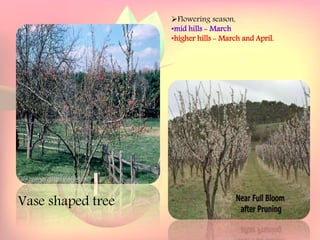
Vase shaped tree
Flowering season,
•mid hills - March
•higher hills - March and April.
Yield and storage
Yield:
•A 5-year-old tree may provide 35 kg fresh fruits.
Storage:
• Fruits are highly perishable.
•Fruits harvested at optimum maturity can be stored for a week
at 5`C and 85 % relative humidity.
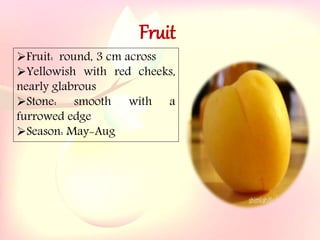
Fruit: round, 3 cm across
Yellowish with red cheeks,
nearly glabrous
Stone: smooth with a
furrowed edge
Season: May-Aug
Fruit
Yield and storage
Yield:
•A 5-year-old tree may provide 35 kg fresh fruits.
Storage:
• Fruits are highly perishable.
•Fruits harvested at optimum maturity can be stored for a week
at 5`C and 85 % relative humidity.
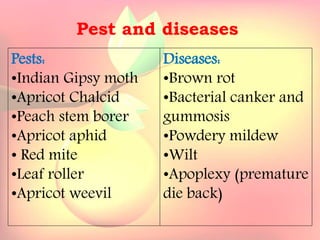
Pests:
•Indian Gipsy moth
•Apricot Chalcid
•Peach stem borer
•Apricot aphid
• Red mite
•Leaf roller
•Apricot weevil
Pest and diseases
Diseases:
•Brown rot
•Bacterial canker and
gummosis
•Powdery mildew
•Wilt
•Apoplexy (premature
die back)
Yield and storage
Yield:
•A 5-year-old tree may provide 35 kg fresh fruits.
Storage:
• Fruits are highly perishable.
•Fruits harvested at optimum maturity can be stored for a week
at 5`C and 85 % relative humidity.
Harvesting and post harvest management
Maturity indices:
Fruit size
Color change from green to yellow
 lose flesh firmness
high TSS (10°B)
The fruits become ready for picking from first week of May – June
Manual harvesting is more practiced
For distant markets, fruits should be hand picked individually at
semi-hard stage when they develop green to amber color.
Keep them in a cool place and pack in perforated CFB boxes of 1-4
kg capacity with straw cushion.
 Care should be taken that the damaged fruits are not packed with
healthy ones.
Yield and storage
Yield:
•A 5-year-old tree may provide 35 kg fresh fruits.
Storage:
• Fruits are highly perishable.
•Fruits harvested at optimum maturity can be stored for a week
at 5`C and 85 % relative humidity.
Yield and storage
Yield:
•A 5-year-old tree may provide 35 kg fresh fruits.
Storage:
• Fruits are highly perishable.
•Fruits harvested at optimum maturity can be stored for a week
at 5`C and 85 % relative humidity.
Yield and storage
Yield:
•A 5-year-old tree may provide 35 kg fresh fruits.
Storage:
• Fruits are highly perishable.
•Fruits harvested at optimum maturity can be stored for a week
at 5`C and 85 % relative humidity.
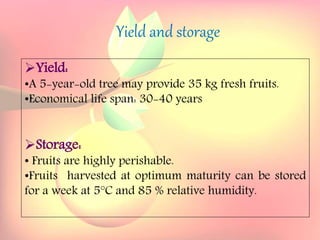
Yield and storage
Yield:
•A 5-year-old tree may provide 35 kg fresh fruits.
•Economical life span: 30-40 years
Storage:
• Fruits are highly perishable.
•Fruits harvested at optimum maturity can be stored
for a week at 5°C and 85 % relative humidity.
Yield and storage
Yield:
•A 5-year-old tree may provide 35 kg fresh fruits.
Storage:
• Fruits are highly perishable.
•Fruits harvested at optimum maturity can be stored for a week
at 5`C and 85 % relative humidity.
Grades
Grade Fruit size
(mm)
No. Of
layers
No. Of
fruits/ layer
Box (inner)
size cm
Special 42 and
above
3 28 - 32 37 ×16.5 ×
16.5
Grade 1 36 – 42 4 38 – 43 37 ×16.5 ×
16.5
Grade 2 Below 36 4 50 - 56 37 ×16.5 ×
16.5
Yield and storage
Yield:
•A 5-year-old tree may provide 35 kg fresh fruits.
Storage:
• Fruits are highly perishable.
•Fruits harvested at optimum maturity can be stored for a week
at 5`C and 85 % relative humidity.
Physiological disorders
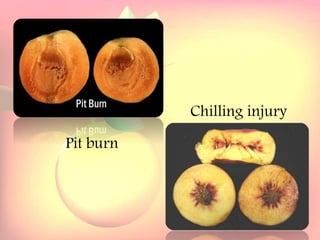
1. Pit burn:
Occurs when the apricots are exposed to temp
above 38°C before harvest
Under such condition the flesh tissue around the
stone softens and turns brown
This is due to heat injury and it increases with
higher temperatures and longer duration of exposure
to sun
Control:
avoiding the heat injury by providing some shade
to the fruits
Yield and storage
Yield:
•A 5-year-old tree may provide 35 kg fresh fruits.
Storage:
• Fruits are highly perishable.
•Fruits harvested at optimum maturity can be stored for a week
at 5`C and 85 % relative humidity.
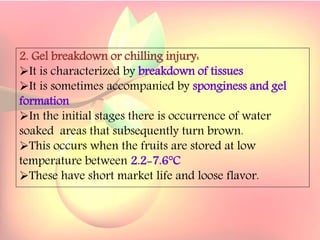
2. Gel breakdown or chilling injury:
It is characterized by breakdown of tissues
It is sometimes accompanied by sponginess and gel
formation
In the initial stages there is occurrence of water
soaked areas that subsequently turn brown.
This occurs when the fruits are stored at low
temperature between 2.2-7.6°C
These have short market life and loose flavor.
Yield and storage
Yield:
•A 5-year-old tree may provide 35 kg fresh fruits.
Storage:
• Fruits are highly perishable.
•Fruits harvested at optimum maturity can be stored for a week
at 5`C and 85 % relative humidity.
Pit burn
Chilling injury
Yield and storage
Yield:
•A 5-year-old tree may provide 35 kg fresh fruits.
Storage:
• Fruits are highly perishable.
•Fruits harvested at optimum maturity can be stored for a week
at 5`C and 85 % relative humidity.

Advances in Apricot production

  • 1.
    Yield and storage Yield: •A5-year-old tree may provide 35 kg fresh fruits. Storage: • Fruits are highly perishable. •Fruits harvested at optimum maturity can be stored for a week at 5`C and 85 % relative humidity. Presented by Panchaal Bhattacharjee PhD. (Hort.) 1st sem. Fruit Science Department of Horticulture
  • 2.
    Yield and storage Yield: •A5-year-old tree may provide 35 kg fresh fruits. Storage: • Fruits are highly perishable. •Fruits harvested at optimum maturity can be stored for a week at 5`C and 85 % relative humidity. Introduction S. N: Prunus armeniaca Sub-genus: Prunophora Family : Rosaceae Origin: North-Eastern China Chr. No: 2n= 16 Also called as Armenian plum Wild Apricot is known as Zardalu or Chuli considered to be imdegenious to in India. Turkey is the largest producer of Apricot.
  • 3.
    Yield and storage Yield: •A5-year-old tree may provide 35 kg fresh fruits. Storage: • Fruits are highly perishable. •Fruits harvested at optimum maturity can be stored for a week at 5`C and 85 % relative humidity. Because of it’s popularity it appears in the stamps of Armenia
  • 5.
    Yield and storage Yield: •A5-year-old tree may provide 35 kg fresh fruits. Storage: • Fruits are highly perishable. •Fruits harvested at optimum maturity can be stored for a week at 5`C and 85 % relative humidity. It is one of the most important stone fruit . It is very delicious, attractive & nutritious fruit Rich source of Vitamin A It can be grown in areas where other temperate fruits are not grown because it is drought tolerant, salt tolerant, hardy and less susceptible to pest and diseases Highly perishable fruit.
  • 6.
    Yield and storage Yield: •A5-year-old tree may provide 35 kg fresh fruits. Storage: • Fruits are highly perishable. •Fruits harvested at optimum maturity can be stored for a week at 5`C and 85 % relative humidity. COMPOSITION Rich source of vit A, fat, fibre, ascorbic acid, Ca Rich source of oil (40-45%) Aroma of fruit is due to Benzaldehyde and Lindrol Major acids present are Mallic acid and Citric acid Contains higher amount of Carotenoids Seeds contain high content of amygdalin (vitamin B17) (>5.5g/100g amygdalin content makes the bitter kernal poisonous for consumption)
  • 7.
    Yield and storage Yield: •A5-year-old tree may provide 35 kg fresh fruits. Storage: • Fruits are highly perishable. •Fruits harvested at optimum maturity can be stored for a week at 5`C and 85 % relative humidity. USES Mainly used as table fruit As a canned and dried fruit Used in preparation of Jam, Jelly, Leather and Nectars Seed is about 15% of the fruit and contains kernel which is about 34% of the seed Sweet kernel tastes like Almond and hence used as a substitute for Almond Sweet kernel is used in confectionary industries Bitter kernel is used in oil extraction and is used in cosmetics and pharmaceutical industries Used for treatment of tumor and ulcers Seed is used as an alternative treatment for cancer.
  • 10.
    Yield and storage Yield: •A5-year-old tree may provide 35 kg fresh fruits. Storage: • Fruits are highly perishable. •Fruits harvested at optimum maturity can be stored for a week at 5`C and 85 % relative humidity. Origin and distribution •Origin: N-E China •Major apricot producing countries: China, USSR, Turkey, Italy, Spain, Greece, France and USA •Commercial cultivation of apricot in India was started by Europeans during 1870 •Presently in India it is grown commercially in hills of HP, J & K, Uttarakhand •Some drying type of apricots are grown in the dry temperate regions of J & K, HP.
  • 11.
    Yield and storage Yield: •A5-year-old tree may provide 35 kg fresh fruits. Storage: • Fruits are highly perishable. •Fruits harvested at optimum maturity can be stored for a week at 5`C and 85 % relative humidity. Other species Prunus ansu: adopted to warm condition, sour in taste,edible,free stone, root stock in Japan. Prunus mume: called as Japanese Aprioct, used for pickling, grown in warmer regions Prunus sibirica: Siberian Apricot, cold hardy Prunus dasycarpa: Purple/Black Aprioct (P.cerasifera x P.armeniaca), cold and disease hardy Prunus brigantica: Alpine Apricot; for oil extraction,3m ht.
  • 12.
  • 13.
    Yield and storage Yield: •A5-year-old tree may provide 35 kg fresh fruits. Storage: • Fruits are highly perishable. •Fruits harvested at optimum maturity can be stored for a week at 5`C and 85 % relative humidity. cultivars Early Shipley - used for table and drying purpose, bitter kernal New Castle - used for table and drying purpose Moorpark – best for outdoor cultivation in small gardens, pubescent in outer layer. Nugget – good quality, regular bearer, heavy yielder, kernel is sweet, used for table purpose Royal – large fruits, heat resistant, table variety
  • 14.
    Yield and storage Yield: •A5-year-old tree may provide 35 kg fresh fruits. Storage: • Fruits are highly perishable. •Fruits harvested at optimum maturity can be stored for a week at 5`C and 85 % relative humidity. Royal Nugget
  • 15.
    Yield and storage Yield: •A5-year-old tree may provide 35 kg fresh fruits. Storage: • Fruits are highly perishable. •Fruits harvested at optimum maturity can be stored for a week at 5`C and 85 % relative humidity. Moorpark New Castle
  • 16.
    Yield and storage Yield: •A5-year-old tree may provide 35 kg fresh fruits. Storage: • Fruits are highly perishable. •Fruits harvested at optimum maturity can be stored for a week at 5`C and 85 % relative humidity. High Chilling Variety- Shakarpara – very sweet and good aroma shy bearer, Afghan introduction, requires high chilling hours.(TSS-26%) Charmagz – self incompatible variety, used for table and drying purpose, shy bearer, requires high chilling hours. Kaisha – good quality, prolific bearer, kernel is bitter. Halman – grown in Ladhak region, used for table and drying purpose(TSS-27-28%)
  • 17.
    Yield and storage Yield: •A5-year-old tree may provide 35 kg fresh fruits. Storage: • Fruits are highly perishable. •Fruits harvested at optimum maturity can be stored for a week at 5`C and 85 % relative humidity. Recent introductions performing well in temperate India Harcot St. Ambriose Turkey Tilton(USA) Wenatchee(CANADA) Indegenous Variety of Ladakh- cv. Rakchey Karpo, Tokpopa Natural Mutant cv. Early Blenheim( S.I) FRS Chaubattia,Ranikhet,UK has released 3 hybrids 1. Chaubattia Alankar: Kaisha × Charmagz 2. Chaubattia Madhu: Turkey × Charmagz 3. Chaubattia Keasari: St. Ambriose × Charmagz
  • 18.
    Yield and storage Yield: •A5-year-old tree may provide 35 kg fresh fruits. Storage: • Fruits are highly perishable. •Fruits harvested at optimum maturity can be stored for a week at 5`C and 85 % relative humidity. Harcot Shakarpara Tilton
  • 19.
    Yield and storage Yield: •A5-year-old tree may provide 35 kg fresh fruits. Storage: • Fruits are highly perishable. •Fruits harvested at optimum maturity can be stored for a week at 5`C and 85 % relative humidity. Soil And Climate It is a hardy crop pH: 6-6.8 Deep fertile, well drained loamy soils are readily suitable for cultivation Grown at an altitude of 900-2000m MSL Chilling requirement 300-900hrs, below 7°C for fruiting Rain fall: 100cm, well distributed through out the year Summer temperature: 16.6-32.2°C For flowering temperature is 5-6°C Long cool weather and frost free areas are the best High humidity during summer increases the Brown Rot.
  • 20.
    Yield and storage Yield: •A5-year-old tree may provide 35 kg fresh fruits. Storage: • Fruits are highly perishable. •Fruits harvested at optimum maturity can be stored for a week at 5`C and 85 % relative humidity. propagation Commercially propagated by Grafting and Budding Tongue grafting is practiced in February T and chip budding is practiced in June-September Raising of rootstocks: Seeds of Apricot are the best Wild apricot seeds are also used to raise rootstocks Peach, Plum seeds are also used The seeds are stratified for 45-50 days at 4°C temperature to break dormancy. The seeds can be stored for 5 years without losing viability Peach is good root stock for light and dry condition.
  • 21.
    Yield and storage Yield: •A5-year-old tree may provide 35 kg fresh fruits. Storage: • Fruits are highly perishable. •Fruits harvested at optimum maturity can be stored for a week at 5`C and 85 % relative humidity. Planting: One-year-old healthy grafted plants should be planted in the field in square system. Season: during dormant season, Dec – March Spacing: 6×6m HDP is less adopted because of very less availability of dwarfing root stocks. Planting
  • 22.
    Yield and storage Yield: •A5-year-old tree may provide 35 kg fresh fruits. Storage: • Fruits are highly perishable. •Fruits harvested at optimum maturity can be stored for a week at 5`C and 85 % relative humidity. Nutrient- 500:250:200 [N:P:K] (g/tree for 7 yr old bearing tree) Irrigation- •Can be grown as a rain fed crop •Irrigation is essential during initial years and during critical stage-Pit hardening stage (April-June) Nutrient management and Irrigation
  • 23.
    Yield and storage Yield: •A5-year-old tree may provide 35 kg fresh fruits. Storage: • Fruits are highly perishable. •Fruits harvested at optimum maturity can be stored for a week at 5`C and 85 % relative humidity.
  • 24.
    Yield and storage Yield: •A5-year-old tree may provide 35 kg fresh fruits. Storage: • Fruits are highly perishable. •Fruits harvested at optimum maturity can be stored for a week at 5`C and 85 % relative humidity. Training : •Apricot trees are trained to modified central leader system •Open vas e and palmate types are also followed where mechanical harvesting is done. Training and pruning
  • 25.
    Yield and storage Yield: •A5-year-old tree may provide 35 kg fresh fruits. Storage: • Fruits are highly perishable. •Fruits harvested at optimum maturity can be stored for a week at 5`C and 85 % relative humidity. pruning •Apricot bears fruits on previous year’s growth and short spurs. •The spur bearing branches die after 3-4 years. •Therefore pruning should be done aimed to induce new growth on such braches and to provide fruiting spurs for the subsequent years. • It consists of heading back(1/3rd) and thinning out(25%) 1year old wood and has balanced vegetative growth. •Pruning in January-end to second week of February to encourage production of more fruiting spurs.
  • 26.
    Yield and storage Yield: •A5-year-old tree may provide 35 kg fresh fruits. Storage: • Fruits are highly perishable. •Fruits harvested at optimum maturity can be stored for a week at 5`C and 85 % relative humidity. Vase shaped tree Flowering season, •mid hills - March •higher hills - March and April.
  • 27.
    Yield and storage Yield: •A5-year-old tree may provide 35 kg fresh fruits. Storage: • Fruits are highly perishable. •Fruits harvested at optimum maturity can be stored for a week at 5`C and 85 % relative humidity. Fruit: round, 3 cm across Yellowish with red cheeks, nearly glabrous Stone: smooth with a furrowed edge Season: May-Aug Fruit
  • 28.
    Yield and storage Yield: •A5-year-old tree may provide 35 kg fresh fruits. Storage: • Fruits are highly perishable. •Fruits harvested at optimum maturity can be stored for a week at 5`C and 85 % relative humidity. Pests: •Indian Gipsy moth •Apricot Chalcid •Peach stem borer •Apricot aphid • Red mite •Leaf roller •Apricot weevil Pest and diseases Diseases: •Brown rot •Bacterial canker and gummosis •Powdery mildew •Wilt •Apoplexy (premature die back)
  • 29.
    Yield and storage Yield: •A5-year-old tree may provide 35 kg fresh fruits. Storage: • Fruits are highly perishable. •Fruits harvested at optimum maturity can be stored for a week at 5`C and 85 % relative humidity. Harvesting and post harvest management Maturity indices: Fruit size Color change from green to yellow  lose flesh firmness high TSS (10°B) The fruits become ready for picking from first week of May – June Manual harvesting is more practiced For distant markets, fruits should be hand picked individually at semi-hard stage when they develop green to amber color. Keep them in a cool place and pack in perforated CFB boxes of 1-4 kg capacity with straw cushion.  Care should be taken that the damaged fruits are not packed with healthy ones.
  • 30.
    Yield and storage Yield: •A5-year-old tree may provide 35 kg fresh fruits. Storage: • Fruits are highly perishable. •Fruits harvested at optimum maturity can be stored for a week at 5`C and 85 % relative humidity.
  • 31.
    Yield and storage Yield: •A5-year-old tree may provide 35 kg fresh fruits. Storage: • Fruits are highly perishable. •Fruits harvested at optimum maturity can be stored for a week at 5`C and 85 % relative humidity.
  • 32.
    Yield and storage Yield: •A5-year-old tree may provide 35 kg fresh fruits. Storage: • Fruits are highly perishable. •Fruits harvested at optimum maturity can be stored for a week at 5`C and 85 % relative humidity. Yield and storage Yield: •A 5-year-old tree may provide 35 kg fresh fruits. •Economical life span: 30-40 years Storage: • Fruits are highly perishable. •Fruits harvested at optimum maturity can be stored for a week at 5°C and 85 % relative humidity.
  • 33.
    Yield and storage Yield: •A5-year-old tree may provide 35 kg fresh fruits. Storage: • Fruits are highly perishable. •Fruits harvested at optimum maturity can be stored for a week at 5`C and 85 % relative humidity. Grades Grade Fruit size (mm) No. Of layers No. Of fruits/ layer Box (inner) size cm Special 42 and above 3 28 - 32 37 ×16.5 × 16.5 Grade 1 36 – 42 4 38 – 43 37 ×16.5 × 16.5 Grade 2 Below 36 4 50 - 56 37 ×16.5 × 16.5
  • 34.
    Yield and storage Yield: •A5-year-old tree may provide 35 kg fresh fruits. Storage: • Fruits are highly perishable. •Fruits harvested at optimum maturity can be stored for a week at 5`C and 85 % relative humidity. Physiological disorders 1. Pit burn: Occurs when the apricots are exposed to temp above 38°C before harvest Under such condition the flesh tissue around the stone softens and turns brown This is due to heat injury and it increases with higher temperatures and longer duration of exposure to sun Control: avoiding the heat injury by providing some shade to the fruits
  • 35.
    Yield and storage Yield: •A5-year-old tree may provide 35 kg fresh fruits. Storage: • Fruits are highly perishable. •Fruits harvested at optimum maturity can be stored for a week at 5`C and 85 % relative humidity. 2. Gel breakdown or chilling injury: It is characterized by breakdown of tissues It is sometimes accompanied by sponginess and gel formation In the initial stages there is occurrence of water soaked areas that subsequently turn brown. This occurs when the fruits are stored at low temperature between 2.2-7.6°C These have short market life and loose flavor.
  • 36.
    Yield and storage Yield: •A5-year-old tree may provide 35 kg fresh fruits. Storage: • Fruits are highly perishable. •Fruits harvested at optimum maturity can be stored for a week at 5`C and 85 % relative humidity. Pit burn Chilling injury
  • 37.
    Yield and storage Yield: •A5-year-old tree may provide 35 kg fresh fruits. Storage: • Fruits are highly perishable. •Fruits harvested at optimum maturity can be stored for a week at 5`C and 85 % relative humidity.