INTRODUCTION
ď‚— COMMON NAME: Cowpea or black-eyed
pea
ď‚— SCIENTIFIC NAME: Vigna unguiculata
ď‚— FAMILY : Fabaceae
ď‚— ORIGIN: Africa
ď‚— CHROMOSOME NO. :2n=22
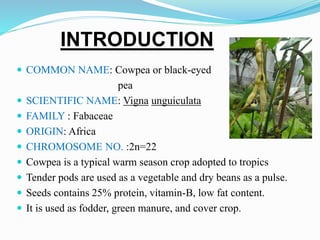
ď‚— Cowpea is a typical warm season crop adopted to tropics
ď‚— Tender pods are used as a vegetable and dry beans as a pulse.
ď‚— Seeds contains 25% protein, vitamin-B, low fat content.
ď‚— It is used as fodder, green manure, and cover crop.
AREA :
ď‚— India :5800ha
PRODUCTION :
ď‚— India :4.8lakh tonnes
PRODUCTIVITY :
ď‚— India :8.44t/ha
ď‚— Grown all over India, more particularly in Central and
Peninsular India. Karnataka, Maharashtra, M.P, Bihar, etc
are major states.
LAND REQUIREMENT
ď‚— Land to be used for seed production should be free of
volunteer plants. It can be grown successfully in different
types of soil from loamy to sandy loam. The optimum soil
pH should be between 6.0 to 7.0.
PREPARATION OF LAND
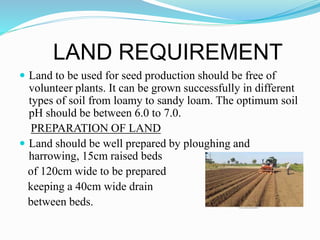
ď‚— Land should be well prepared by ploughing and
harrowing, 15cm raised beds
of 120cm wide to be prepared
keeping a 40cm wide drain
between beds.
TIME OF SOWING
ď‚— NORTHERN PLAINS: End of February to middle of
April.
ď‚— MONSOON CROP: Middle of June to the end of July.
ď‚— SOUTHERN PLAINS: December-January
ď‚— HILLS: April-May
SEED TREATMENT
ď‚— Treat the seed with Thirum (2gm.) + Carbendazim (1gm.).
It is also desirable to treat the seed with Rhizobium
culture @ 10g/kg seed.
SOURCE OF SEEDS
ď‚— Obtain nucleus/breeders/foundation seed from source
approved by a seed certification agency
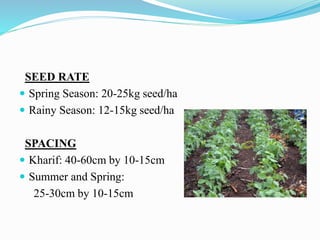
SEED RATE
ď‚— Spring Season: 20-25kg seed/ha
ď‚— Rainy Season: 12-15kg seed/ha
SPACING
ď‚— Kharif: 40-60cm by 10-15cm
ď‚— Summer and Spring:
25-30cm by 10-15cm
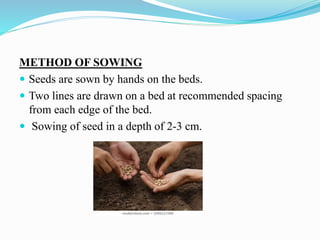
METHOD OF SOWING
ď‚— Seeds are sown by hands on the beds.
ď‚— Two lines are drawn on a bed at recommended spacing
from each edge of the bed.
ď‚— Sowing of seed in a depth of 2-3 cm.
FERTILIZER
ď‚— Being a leguminous crop, cowpea requires less
nitrogen.
ď‚— However, 10-20kg/ha nitrogen should be incorporated
in the soil before sowing.
ď‚— Phosphorous and Potassium 50-70kg/ha each should
be drilled in the soil before sowing.
IRRIGATION
ď‚— Sufficient irrigation should be provided when flowering
starts.
ď‚— Previous irrigations should be light and as per
requirements.
ď‚— IMPORTANT OPERATIONS
ď‚— 2-3 weedings and hoeings would be required to check the
growth.
ď‚— About 150-170cm high trellis are to be provided for every
two lines of a bed, trellis to be created in such a way that
tops of sticks are bounded together to form a triangular
structure with beds.
ANTHESIS AND FLOWERING
ď‚— There are 2-3 flowering period.
ď‚— Takes 11-14 days for the flowers to develop and bloom.
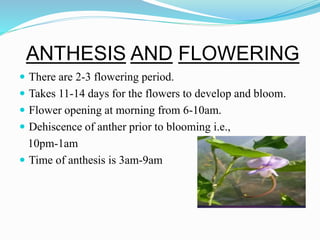
ď‚— Flower opening at morning from 6-10am.
ď‚— Dehiscence of anther prior to blooming i.e.,
10pm-1am
ď‚— Time of anthesis is 3am-9am
FLOWER BIOLOGY
ď‚— Inflorescence is an unbranched, axillary raceme bearing
several flowers at the tip of peduncle.
ď‚— Flowers are in alternate pairs, gamosepalous.
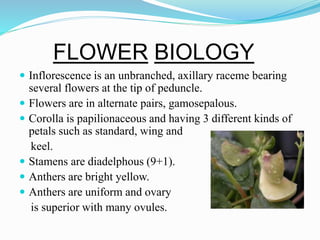
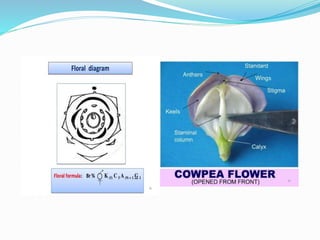
ď‚— Corolla is papilionaceous and having 3 different kinds of
petals such as standard, wing and
keel.
ď‚— Stamens are diadelphous (9+1).
ď‚— Anthers are bright yellow.
ď‚— Anthers are uniform and ovary
is superior with many ovules.
ď‚— Pollination
Highly self pollinated because of Cleistogamy, Close proximity of
the anthers and stigma and Simultaneous maturity of anthers and
stigma
ď‚— Selfing
Keeping the plants in insect proof cages will lead to selfing.
Covering of individual flower buds will lead to poor pod setting.
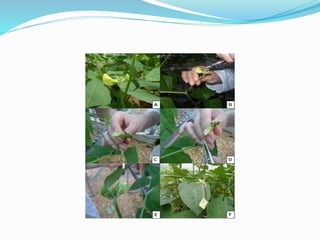
ď‚— Crossing
Select young buds, in an inflorescence and remove all immature
buds. Split open the keel petals and remove the stamens one by one
holding the filaments. Bring corolla back to position and cover the
bud with a folded leaflet. Protection is given by keeping the plants in
insect proof cages. Pollination is done on the next day morning by
exposing the stigma from the keel petal and brushing it with the
pollen collected from the male parent.
HYBRID SEED PRODUCTION
CGMS SYSTEM
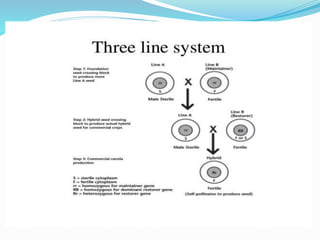
THREE LINE SYSTEM
ď‚— In this method there are three different lines i.e. A-line or
male sterile line, B-line or maintainer line and R-line or
restorer line.
ď‚— For maintaining A-line it has to be crossed with B-line and
for producing hybrid seed A-line has to be crossed with R-
line.
Hybrid seed production involves two steps:
1) Maintenance of parental line (A-line, B-line and R-line)
2) Commercial hybrid seed production (A x R)
Maintenance of parental lines is generally referred as
foundation seed production and hybrid seed production
as certified seed class. The A-line can be maintained by
crossing with B-line in an isolated plot, while in hybrid
seed production A-line is crossed with R-line or fertility
restorer line. The B-line and R-line can be maintained
just like normal varieties by following required isolation
and field standards.
ROGUING
ď‚— The off types and volunteer plants are to be removed as
and when they occur from vegetative to harvesting stage
based on leaf color, growth status, flower color, pod color,
seed color etc.
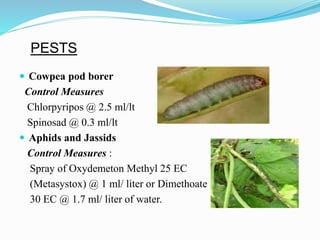
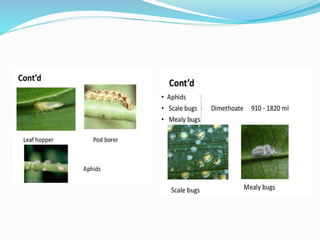
PESTS
ď‚— Cowpea pod borer
Control Measures
Chlorpyripos @ 2.5 ml/lt
Spinosad @ 0.3 ml/lt
ď‚— Aphids and Jassids
Control Measures :
Spray of Oxydemeton Methyl 25 EC
(Metasystox) @ 1 ml/ liter or Dimethoate
30 EC @ 1.7 ml/ liter of water.
DISEASE
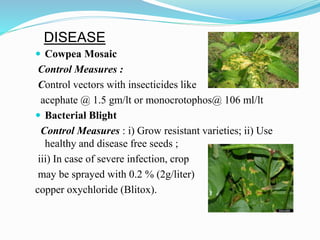
ď‚— Cowpea Mosaic
Control Measures :
Control vectors with insecticides like
acephate @ 1.5 gm/lt or monocrotophos@ 106 ml/lt
ď‚— Bacterial Blight
Control Measures : i) Grow resistant varieties; ii) Use
healthy and disease free seeds ;
iii) In case of severe infection, crop
may be sprayed with 0.2 % (2g/liter)
copper oxychloride (Blitox).
HARVESTING
ď‚— Due to continuous flowering habit the pod setting will be
continuous. Seed attains physiological maturity 27-30
days after anthesis.
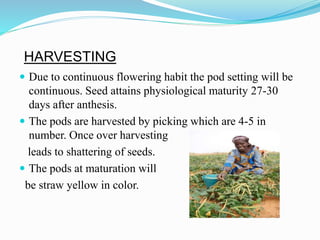
ď‚— The pods are harvested by picking which are 4-5 in
number. Once over harvesting
leads to shattering of seeds.
ď‚— The pods at maturation will
be straw yellow in color.
THRESHING
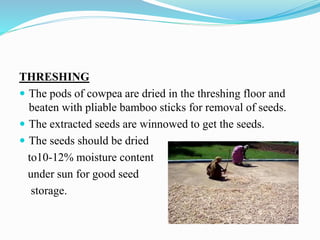
ď‚— The pods of cowpea are dried in the threshing floor and
beaten with pliable bamboo sticks for removal of seeds.
ď‚— The extracted seeds are winnowed to get the seeds.
ď‚— The seeds should be dried
to10-12% moisture content
under sun for good seed
storage.
GRADING
ď‚— The bulk seeds are graded using 3.96-4.6 mm metal round
sieve.
STORAGE
ď‚— The treated seeds can be stored up to one year in open
storage and up to 2yrs in moisture vapour proof
containers, provided the seeds are devoid of bruchid
infestation both primarily and secondarily.
SEED YIELD:10-12q/ha
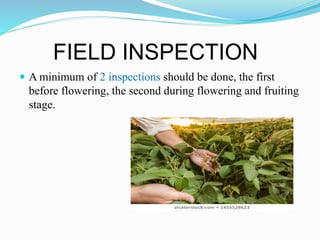
FIELD INSPECTION
ď‚— A minimum of 2 inspections should be done, the first
before flowering, the second during flowering and fruiting
stage.
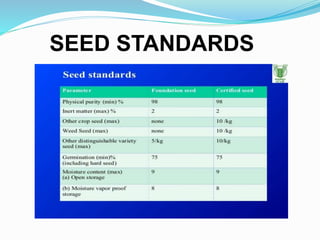
SEED STANDARDS
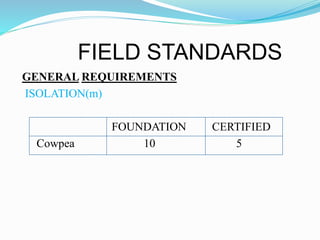
FIELD STANDARDS
GENERAL REQUIREMENTS
ISOLATION(m)
FOUNDATION CERTIFIED
Cowpea 10 5
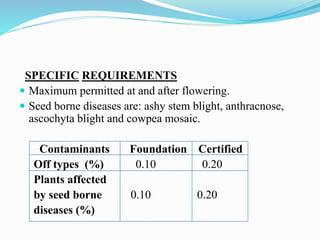
SPECIFIC REQUIREMENTS
ď‚— Maximum permitted at and after flowering.
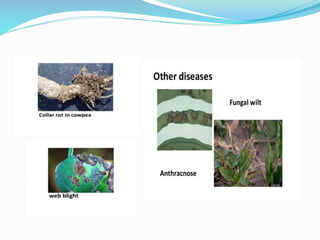
ď‚— Seed borne diseases are: ashy stem blight, anthracnose,
ascochyta blight and cowpea mosaic.
Contaminants Foundation Certified
Off types (%) 0.10 0.20
Plants affected
by seed borne 0.10 0.20
diseases (%)
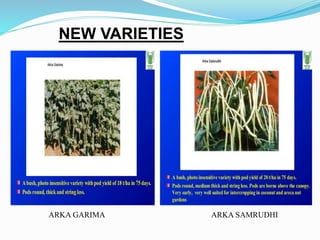
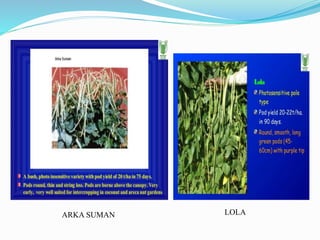
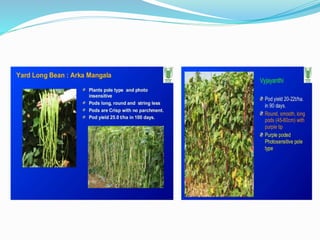
NEW VARIETIES
ARKA GARIMA ARKA SAMRUDHI
ARKA SUMAN LOLA
VARIETIES/HYBRIDS RECOMMENDED BY IARI
AND NBPGR, New Delhi :
ď‚— Pusa Barsati
ď‚— Pusa Do-fasli
ď‚— Pusa Komal
ď‚— Pusa Phalguni
ď‚— Pusa Rituraj

Cowpea

  • 2.
    INTRODUCTION ď‚— COMMON NAME:Cowpea or black-eyed pea ď‚— SCIENTIFIC NAME: Vigna unguiculata ď‚— FAMILY : Fabaceae ď‚— ORIGIN: Africa ď‚— CHROMOSOME NO. :2n=22 ď‚— Cowpea is a typical warm season crop adopted to tropics ď‚— Tender pods are used as a vegetable and dry beans as a pulse. ď‚— Seeds contains 25% protein, vitamin-B, low fat content. ď‚— It is used as fodder, green manure, and cover crop.
  • 3.
    AREA : ď‚— India:5800ha PRODUCTION : ď‚— India :4.8lakh tonnes PRODUCTIVITY : ď‚— India :8.44t/ha ď‚— Grown all over India, more particularly in Central and Peninsular India. Karnataka, Maharashtra, M.P, Bihar, etc are major states.
  • 4.
    LAND REQUIREMENT ď‚— Landto be used for seed production should be free of volunteer plants. It can be grown successfully in different types of soil from loamy to sandy loam. The optimum soil pH should be between 6.0 to 7.0. PREPARATION OF LAND ď‚— Land should be well prepared by ploughing and harrowing, 15cm raised beds of 120cm wide to be prepared keeping a 40cm wide drain between beds.
  • 5.
    TIME OF SOWING ď‚—NORTHERN PLAINS: End of February to middle of April. ď‚— MONSOON CROP: Middle of June to the end of July. ď‚— SOUTHERN PLAINS: December-January ď‚— HILLS: April-May
  • 6.
    SEED TREATMENT ď‚— Treatthe seed with Thirum (2gm.) + Carbendazim (1gm.). It is also desirable to treat the seed with Rhizobium culture @ 10g/kg seed. SOURCE OF SEEDS ď‚— Obtain nucleus/breeders/foundation seed from source approved by a seed certification agency
  • 7.
    SEED RATE ď‚— SpringSeason: 20-25kg seed/ha ď‚— Rainy Season: 12-15kg seed/ha SPACING ď‚— Kharif: 40-60cm by 10-15cm ď‚— Summer and Spring: 25-30cm by 10-15cm
  • 8.
    METHOD OF SOWING ď‚—Seeds are sown by hands on the beds. ď‚— Two lines are drawn on a bed at recommended spacing from each edge of the bed. ď‚— Sowing of seed in a depth of 2-3 cm.
  • 9.
    FERTILIZER ď‚— Being aleguminous crop, cowpea requires less nitrogen. ď‚— However, 10-20kg/ha nitrogen should be incorporated in the soil before sowing. ď‚— Phosphorous and Potassium 50-70kg/ha each should be drilled in the soil before sowing.
  • 10.
    IRRIGATION ď‚— Sufficient irrigationshould be provided when flowering starts. ď‚— Previous irrigations should be light and as per requirements. ď‚— IMPORTANT OPERATIONS ď‚— 2-3 weedings and hoeings would be required to check the growth. ď‚— About 150-170cm high trellis are to be provided for every two lines of a bed, trellis to be created in such a way that tops of sticks are bounded together to form a triangular structure with beds.
  • 11.
    ANTHESIS AND FLOWERING ď‚—There are 2-3 flowering period. ď‚— Takes 11-14 days for the flowers to develop and bloom. ď‚— Flower opening at morning from 6-10am. ď‚— Dehiscence of anther prior to blooming i.e., 10pm-1am ď‚— Time of anthesis is 3am-9am
  • 12.
    FLOWER BIOLOGY ď‚— Inflorescenceis an unbranched, axillary raceme bearing several flowers at the tip of peduncle. ď‚— Flowers are in alternate pairs, gamosepalous. ď‚— Corolla is papilionaceous and having 3 different kinds of petals such as standard, wing and keel. ď‚— Stamens are diadelphous (9+1). ď‚— Anthers are bright yellow. ď‚— Anthers are uniform and ovary is superior with many ovules.
  • 14.
    ď‚— Pollination Highly selfpollinated because of Cleistogamy, Close proximity of the anthers and stigma and Simultaneous maturity of anthers and stigma ď‚— Selfing Keeping the plants in insect proof cages will lead to selfing. Covering of individual flower buds will lead to poor pod setting. ď‚— Crossing Select young buds, in an inflorescence and remove all immature buds. Split open the keel petals and remove the stamens one by one holding the filaments. Bring corolla back to position and cover the bud with a folded leaflet. Protection is given by keeping the plants in insect proof cages. Pollination is done on the next day morning by exposing the stigma from the keel petal and brushing it with the pollen collected from the male parent.
  • 16.
    HYBRID SEED PRODUCTION CGMSSYSTEM THREE LINE SYSTEM ď‚— In this method there are three different lines i.e. A-line or male sterile line, B-line or maintainer line and R-line or restorer line. ď‚— For maintaining A-line it has to be crossed with B-line and for producing hybrid seed A-line has to be crossed with R- line.
  • 17.
    Hybrid seed productioninvolves two steps: 1) Maintenance of parental line (A-line, B-line and R-line) 2) Commercial hybrid seed production (A x R) Maintenance of parental lines is generally referred as foundation seed production and hybrid seed production as certified seed class. The A-line can be maintained by crossing with B-line in an isolated plot, while in hybrid seed production A-line is crossed with R-line or fertility restorer line. The B-line and R-line can be maintained just like normal varieties by following required isolation and field standards.
  • 19.
    ROGUING ď‚— The offtypes and volunteer plants are to be removed as and when they occur from vegetative to harvesting stage based on leaf color, growth status, flower color, pod color, seed color etc.
  • 20.
    PESTS ď‚— Cowpea podborer Control Measures Chlorpyripos @ 2.5 ml/lt Spinosad @ 0.3 ml/lt ď‚— Aphids and Jassids Control Measures : Spray of Oxydemeton Methyl 25 EC (Metasystox) @ 1 ml/ liter or Dimethoate 30 EC @ 1.7 ml/ liter of water.
  • 22.
    DISEASE ď‚— Cowpea Mosaic ControlMeasures : Control vectors with insecticides like acephate @ 1.5 gm/lt or monocrotophos@ 106 ml/lt ď‚— Bacterial Blight Control Measures : i) Grow resistant varieties; ii) Use healthy and disease free seeds ; iii) In case of severe infection, crop may be sprayed with 0.2 % (2g/liter) copper oxychloride (Blitox).
  • 24.
    HARVESTING ď‚— Due tocontinuous flowering habit the pod setting will be continuous. Seed attains physiological maturity 27-30 days after anthesis. ď‚— The pods are harvested by picking which are 4-5 in number. Once over harvesting leads to shattering of seeds. ď‚— The pods at maturation will be straw yellow in color.
  • 25.
    THRESHING ď‚— The podsof cowpea are dried in the threshing floor and beaten with pliable bamboo sticks for removal of seeds. ď‚— The extracted seeds are winnowed to get the seeds. ď‚— The seeds should be dried to10-12% moisture content under sun for good seed storage.
  • 26.
    GRADING ď‚— The bulkseeds are graded using 3.96-4.6 mm metal round sieve. STORAGE ď‚— The treated seeds can be stored up to one year in open storage and up to 2yrs in moisture vapour proof containers, provided the seeds are devoid of bruchid infestation both primarily and secondarily. SEED YIELD:10-12q/ha
  • 27.
    FIELD INSPECTION ď‚— Aminimum of 2 inspections should be done, the first before flowering, the second during flowering and fruiting stage.
  • 28.
  • 29.
  • 30.
    SPECIFIC REQUIREMENTS ď‚— Maximumpermitted at and after flowering. ď‚— Seed borne diseases are: ashy stem blight, anthracnose, ascochyta blight and cowpea mosaic. Contaminants Foundation Certified Off types (%) 0.10 0.20 Plants affected by seed borne 0.10 0.20 diseases (%)
  • 31.
  • 32.
  • 34.
    VARIETIES/HYBRIDS RECOMMENDED BYIARI AND NBPGR, New Delhi : ď‚— Pusa Barsati ď‚— Pusa Do-fasli ď‚— Pusa Komal ď‚— Pusa Phalguni ď‚— Pusa Rituraj