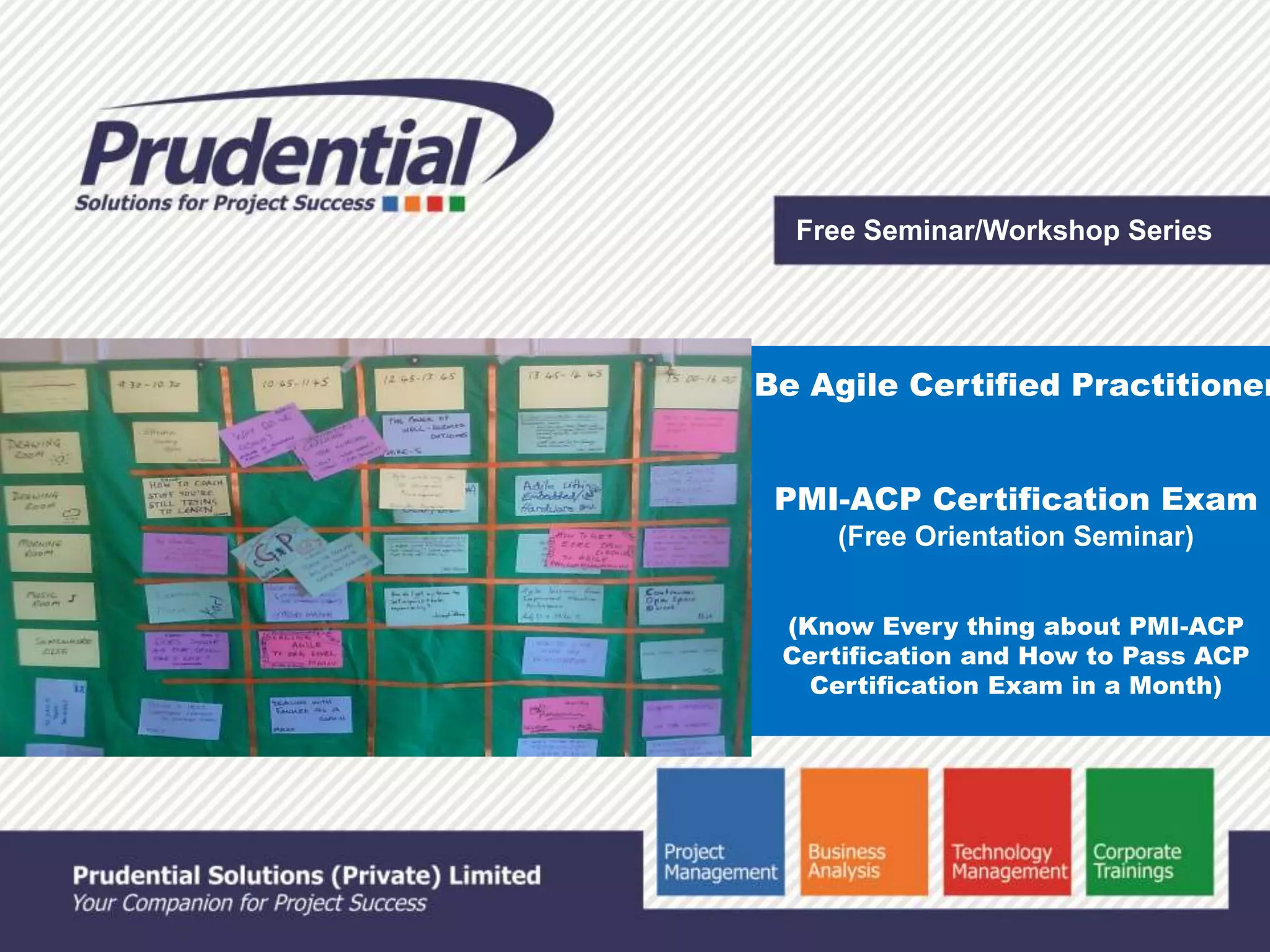
Free Seminar/Workshop Series
Be Agile Certified Practitioner
PMI-ACP Certification Exam
(Free Orientation Seminar)
(Know Every thing about PMI-ACP
Certification and How to Pass ACP
Certification Exam in a Month)
Agenda
 Overview of Agile & SCRUM
 Introduction to PMI & PMI-ACP Certification
 PMI-ACP Certification Requirements & Exam Fee
 PMI-ACP Exam Contents & Reading Materials
 Prudential Exam Prep Methodology (Pass PMI-ACP In a Month)
 Prudential PMI-ACP Exam Prep Training Workshop
 About Prudential Solutions & Its Training Programs
PMI®, PMP®, CAPM® and PMBOK® Guide are trademarks of the Project Management Institute, Inc.
PMI® has not endorsed & did not participate in the development of this product.
Note: Any views OR Opinion OR Techniques presented and showcased in this
presentation is solely those of the authors & may not necessary represent those of company.
What is Agile?
Agile is the ability to adapt to changes as fast or faster than
changes occur. Agile is an umbrella term for a set of
values, principals and practices that have been shown to improve
the efficiency, productivity, and quality of software delivery.
The Agile Manifesto was written
 In 2001, a group of 17 “lightweight” methodologists met
Including Representative of
 eXtreme Programming (XP)
 Scrum
 DSDM Adaptive Software
Development
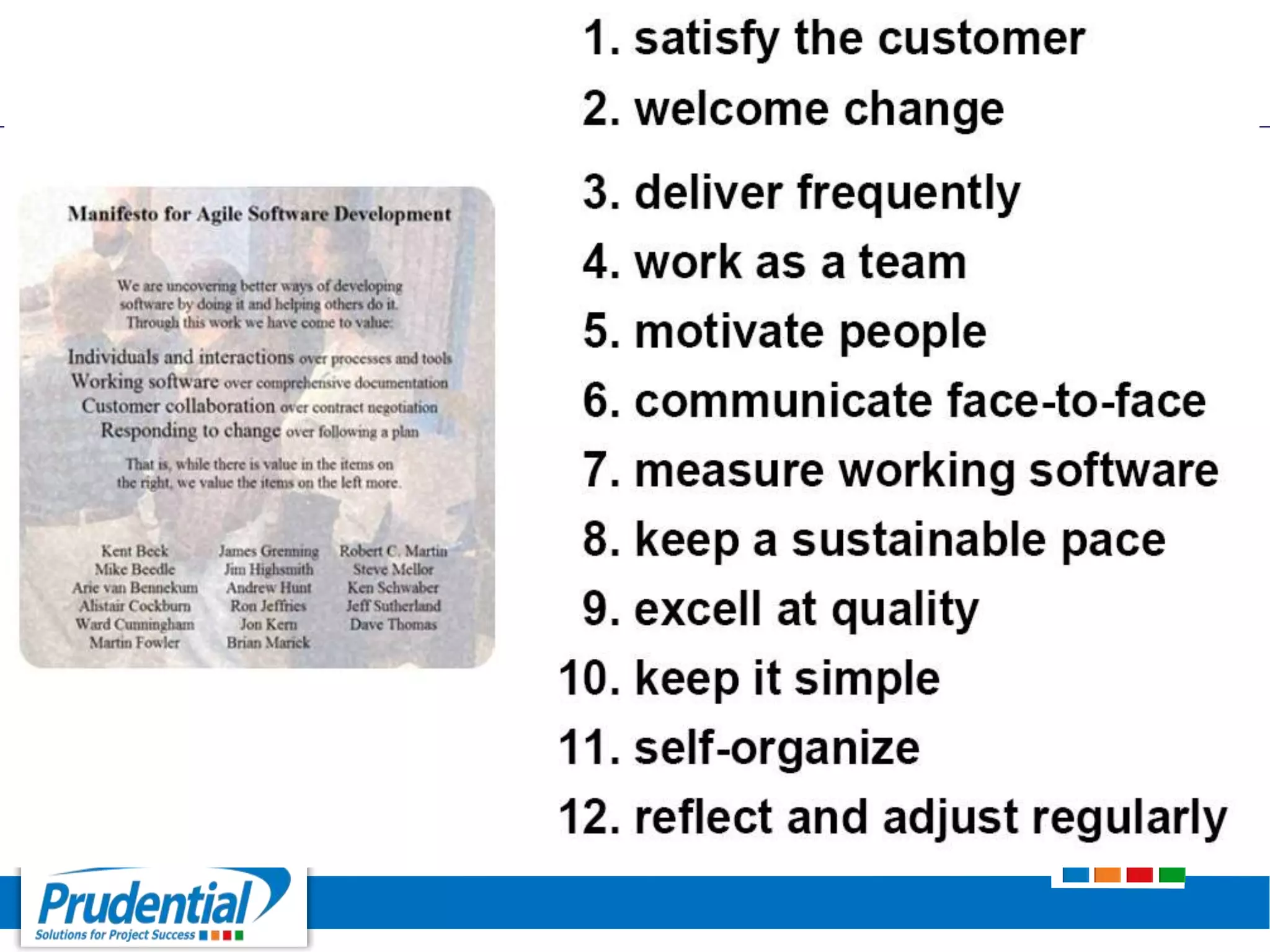
Agile Manifesto
The Agile Manifesto
We are uncovering better ways of developing software by doing
it and helping others do it.
Individuals and interactions over processes and tools
Working software over comprehensive documentation
Customer collaboration over contract negotiation
Responding to change over following a plan
That is, while there is value in the items on the right, we value
the items on the left more.
Source: www.agilemanifesto.org
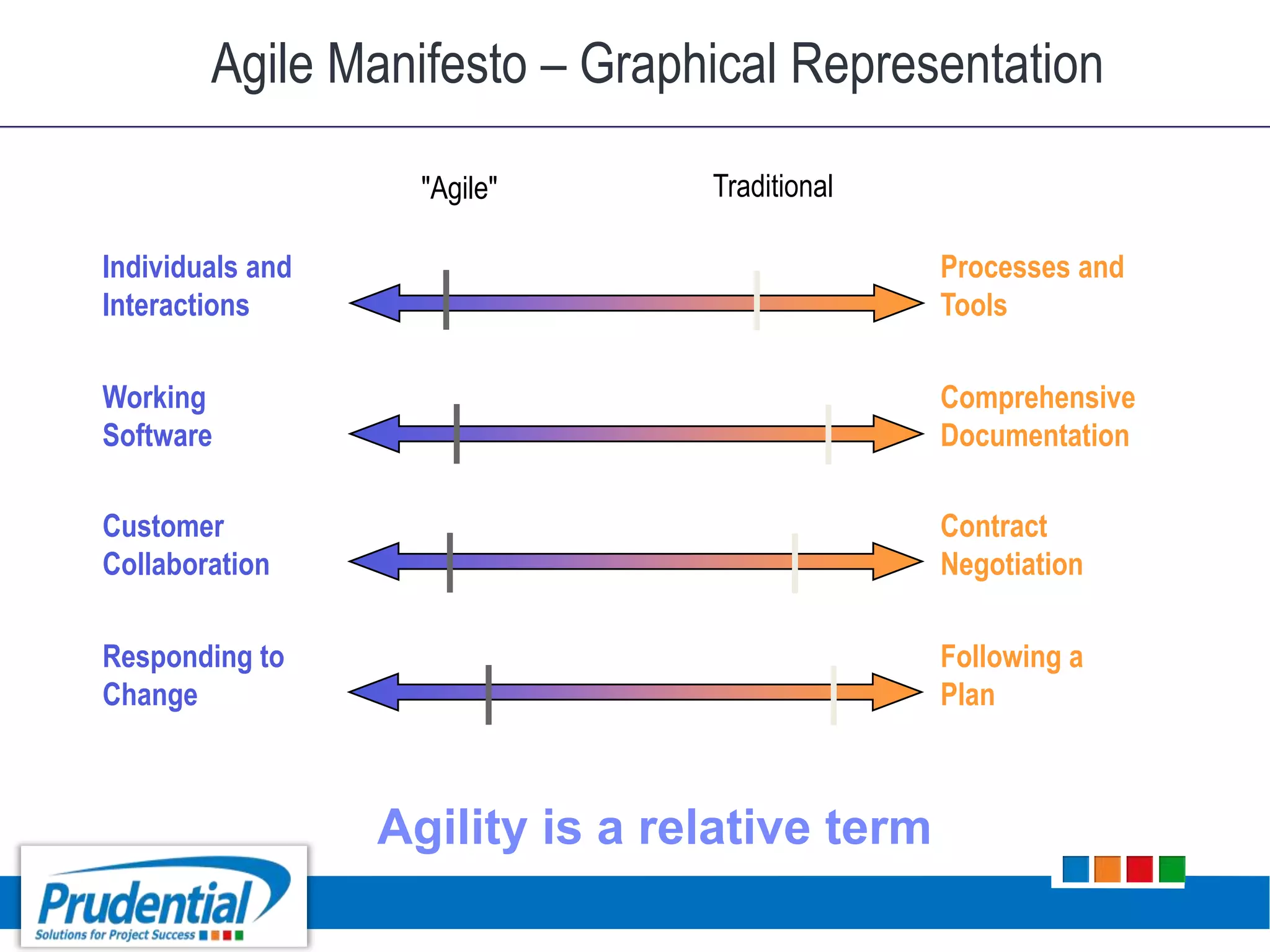
Agile Manifesto – Graphical Representation
Individuals and
Interactions
Processes and
Tools
Working
Software
Comprehensive
Documentation
Customer
Collaboration
Contract
Negotiation
Responding to
Change
Following a
Plan
"Agile"
|
|
|
|
|
|
|
|
Traditional
Agility is a relative term
 Focus on empowered, self-managing teams;
 Autonomous teams do not need the day-to-day intervention of
management
 Management protects team from outside interference
 Agile teams are composed of a mix of skills
 Agile team members are able to step in for each other as
necessary
Individuals And Interactions Over Processes And Tools
 Traditionally we measure progress by the percent complete of
the functional milestones
 Agile teams provide actual working product as a status report,
“product review”
 Design changes as the system is built, results in outdated
documentation
 Agile teams prefer face-to-face communication over
documentation because it is simpler, faster, and more reliable.
Working Software over Comprehensive Documentation
 Contract negotiation, Identify and define everything and spells
out the payment and date specifications
 Customers become a part of the development process
 Writing specs down and throwing them over the fence is
simply not effective
Customer Collaboration over Contract Negotiation
 It’s much easier to respond to change when the organization
and the customer share a clear understanding of the project’s
status
 In plan-driven environments, all requirements are specified up
front, broken down to the task level and estimated
 Agile plans follow more of a rolling wave approach using top-
down planning
Responding to Change over Following a Plan
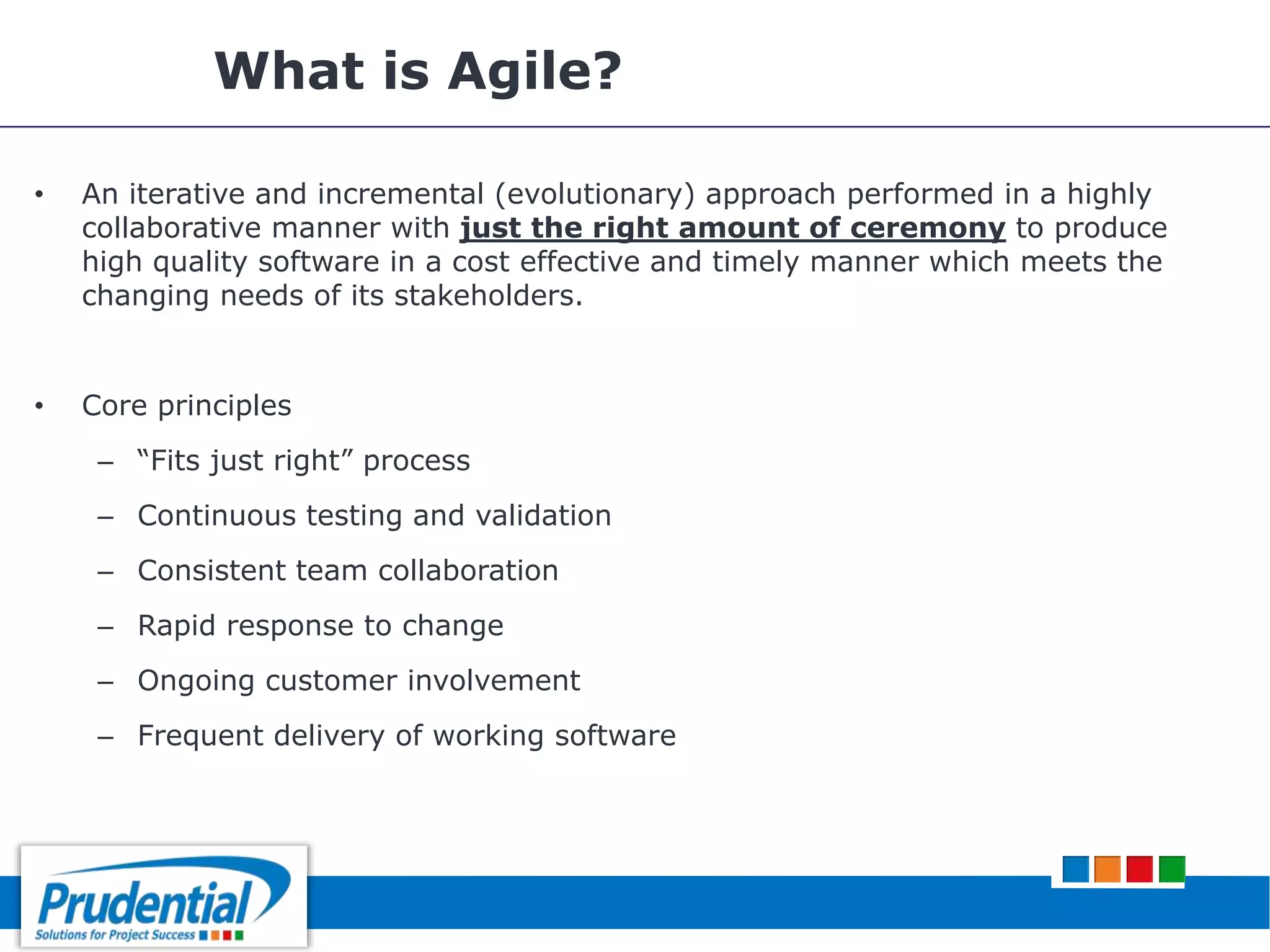
What is Agile?
• An iterative and incremental (evolutionary) approach performed in a highly
collaborative manner with just the right amount of ceremony to produce
high quality software in a cost effective and timely manner which meets the
changing needs of its stakeholders.
• Core principles
– “Fits just right” process
– Continuous testing and validation
– Consistent team collaboration
– Rapid response to change
– Ongoing customer involvement
– Frequent delivery of working software
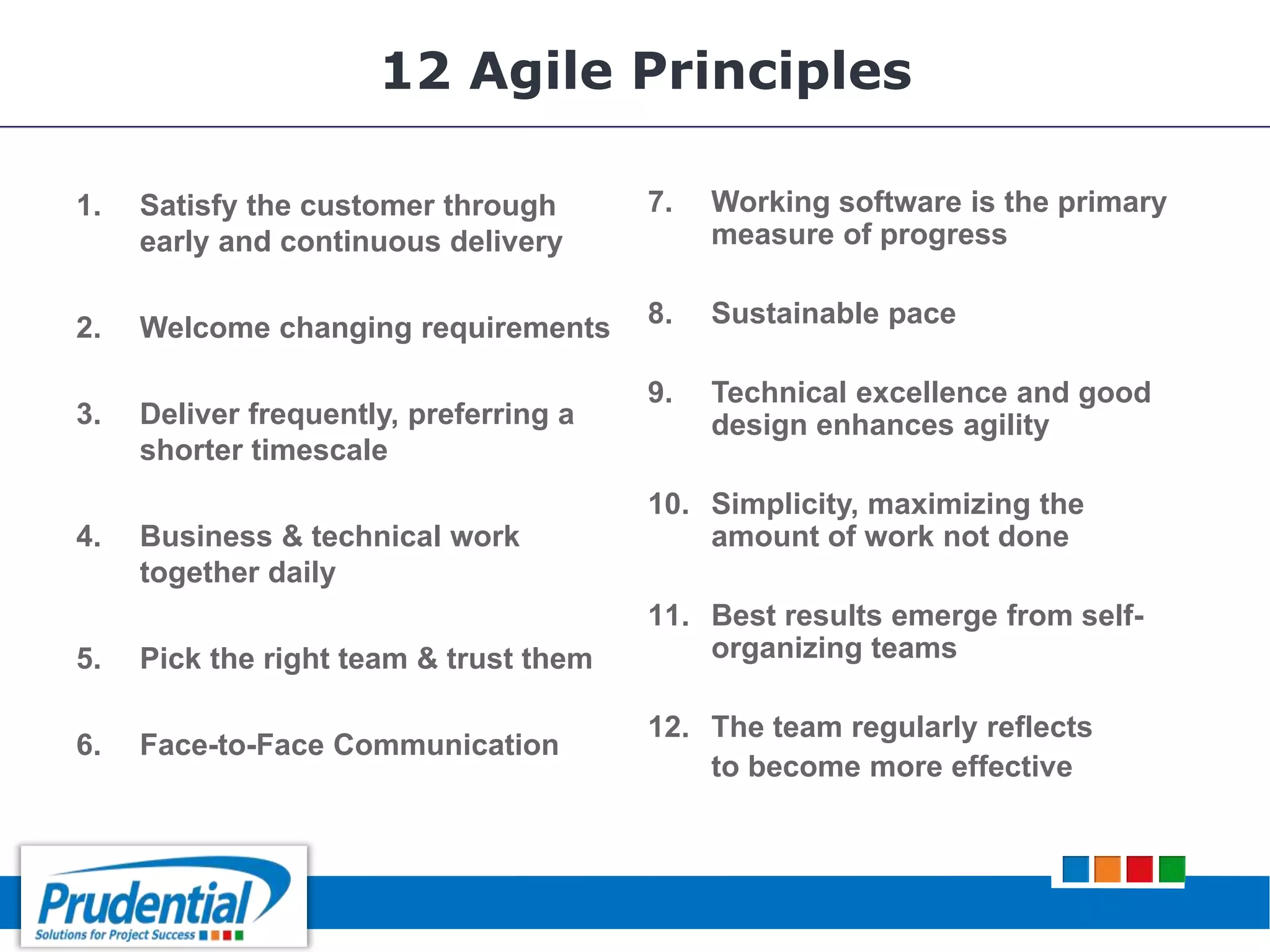
1. Satisfy the customer through
early and continuous delivery
2. Welcome changing requirements
3. Deliver frequently, preferring a
shorter timescale
4. Business & technical work
together daily
5. Pick the right team & trust them
6. Face-to-Face Communication
7. Working software is the primary
measure of progress
8. Sustainable pace
9. Technical excellence and good
design enhances agility
10. Simplicity, maximizing the
amount of work not done
11. Best results emerge from self-
organizing teams
12. The team regularly reflects
to become more effective
12 Agile Principles
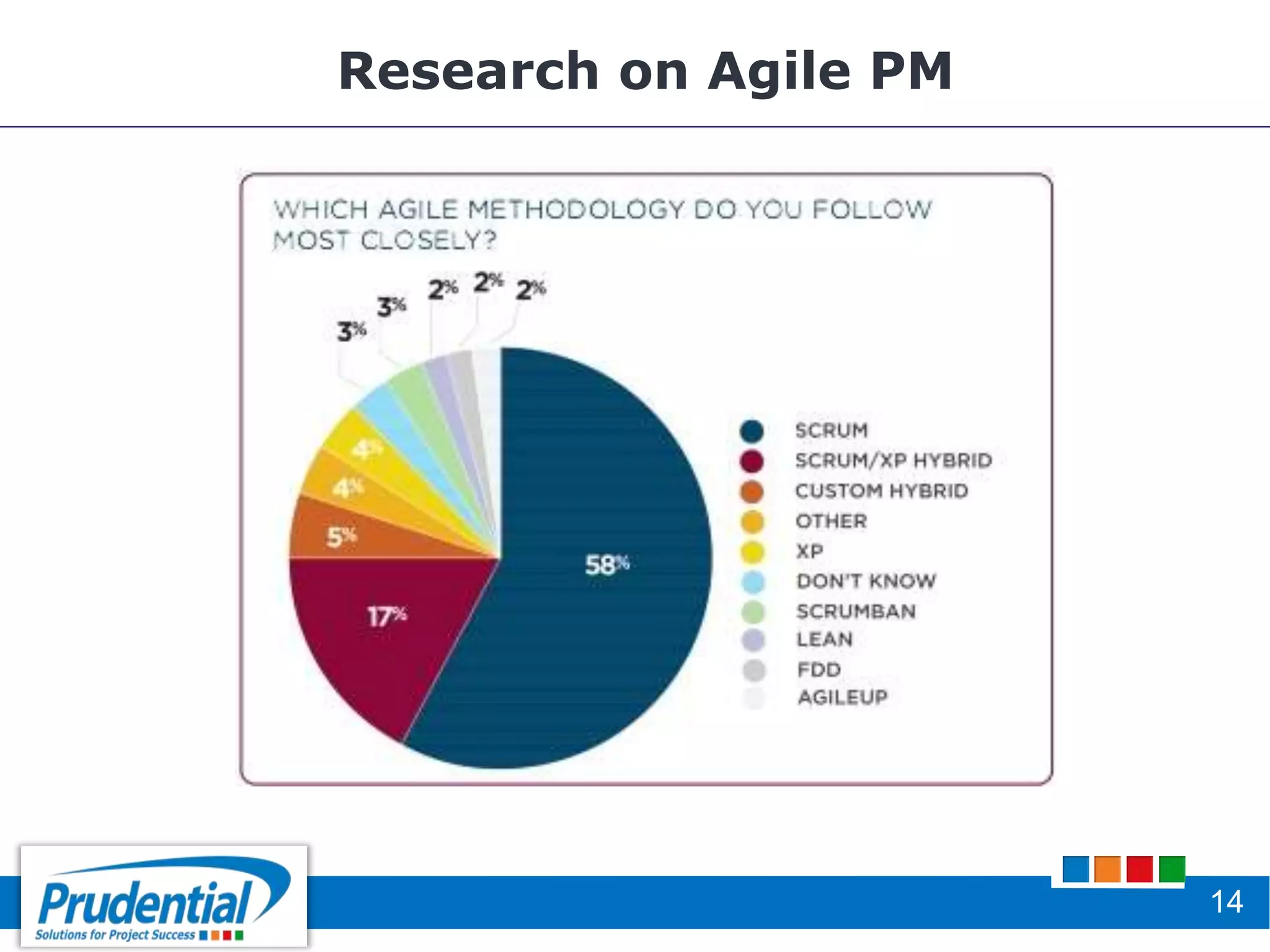
Research on Agile PM
14
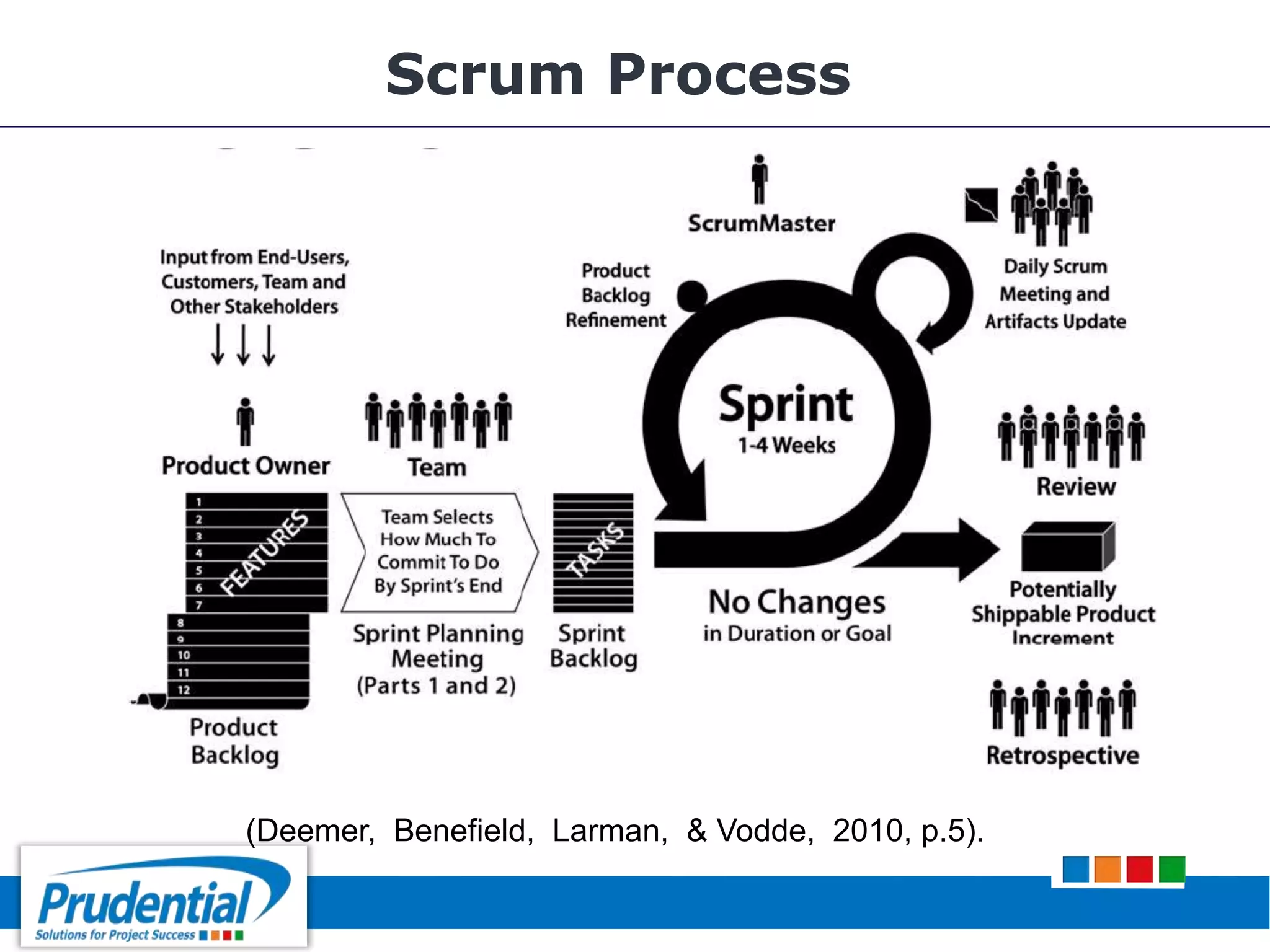
Scrum Process
(Deemer, Benefield, Larman, & Vodde, 2010, p.5).
PMI-ACP Certification
Exam Prep Mentoring Seminar
Session - 3: PMI-ACP Certification
Are You Agile Ready?
• Do you use Agile practices, tools, and techniques in your
projects?
• Do you belong to an organization that is in the process of
adopting or is already implementing projects using the Agile
philosophy, methodologies, principles, and practices?
• Do you want to demonstrate your expertise in Agile
practices, tools, and techniques?
• Then you may be ready to take the next step and become a
PMI® Agile Certified Practitioner (PMI-ACP) ®.
• The PMI-ACP is not limited to project managers or Project
Management Professional (PMP) credential holders;
individuals with experience working on Agile project teams
can also apply
Pro
®
The world’s leading not-for-profit global
professional organization for project management
knowledge, information and professionalism
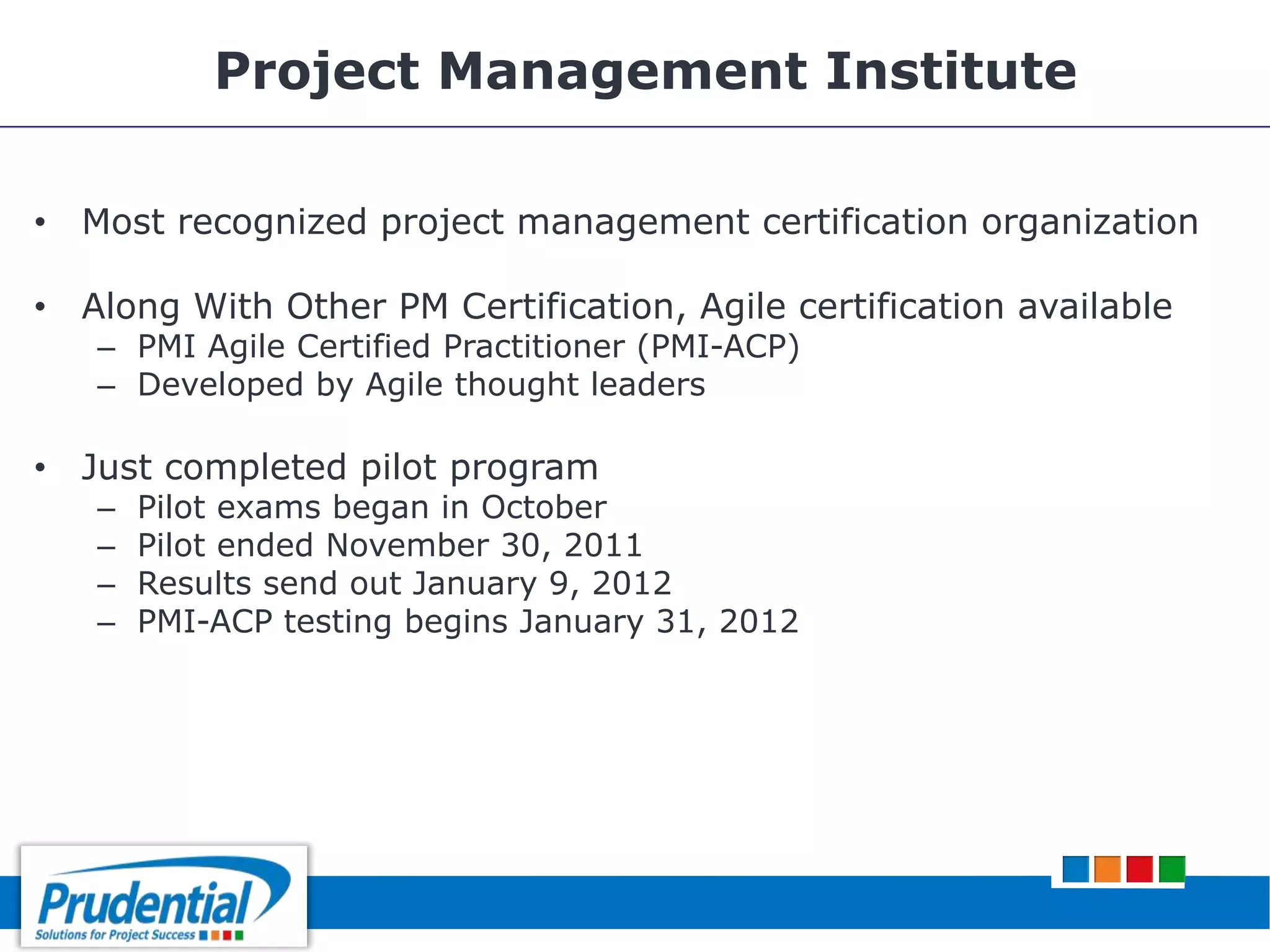
Project Management Institute
• Most recognized project management certification organization
• Along With Other PM Certification, Agile certification available
– PMI Agile Certified Practitioner (PMI-ACP)
– Developed by Agile thought leaders
• Just completed pilot program
– Pilot exams began in October
– Pilot ended November 30, 2011
– Results send out January 9, 2012
– PMI-ACP testing begins January 31, 2012
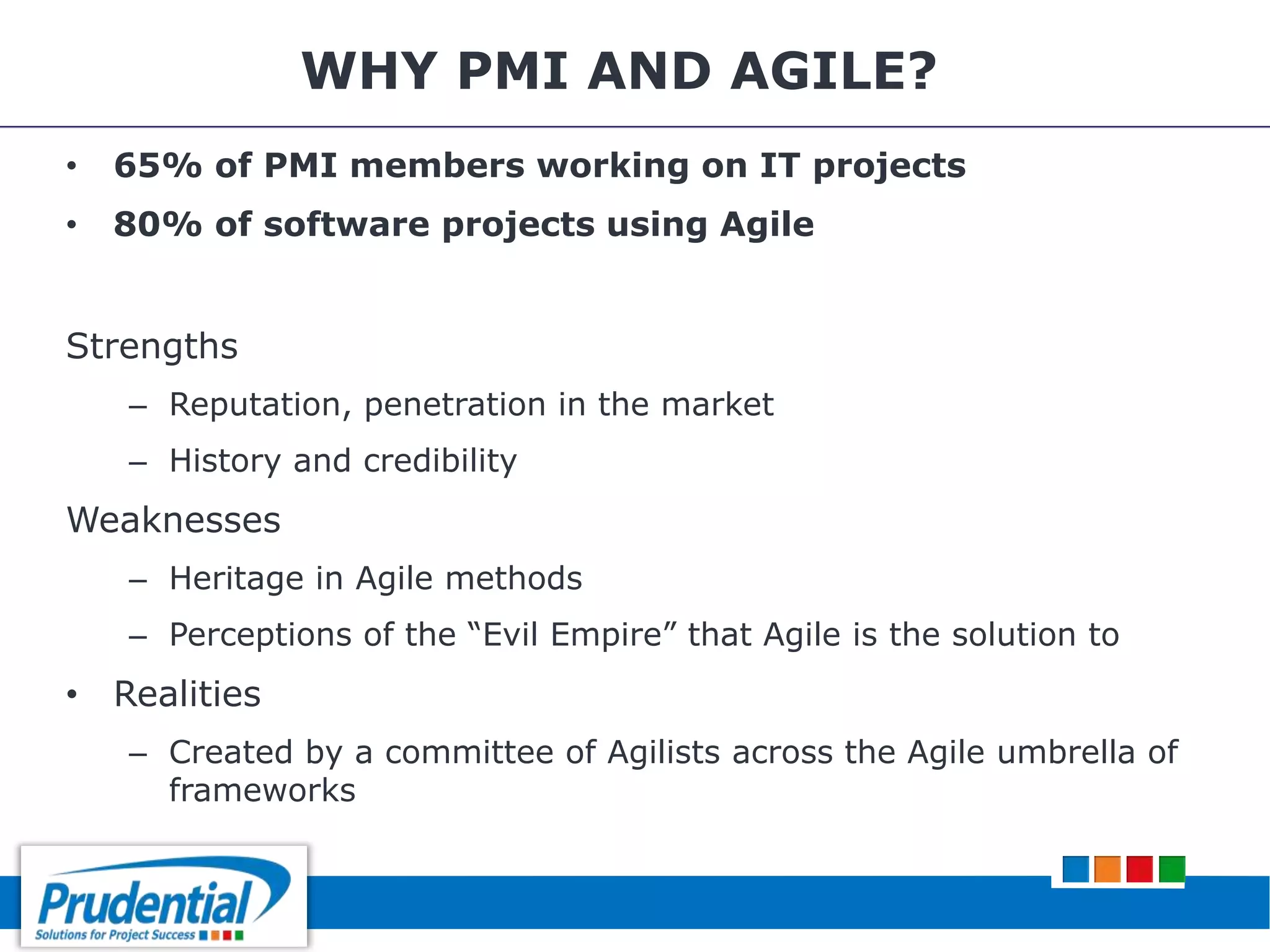
WHY PMI AND AGILE?
• 65% of PMI members working on IT projects
• 80% of software projects using Agile
Strengths
– Reputation, penetration in the market
– History and credibility
Weaknesses
– Heritage in Agile methods
– Perceptions of the “Evil Empire” that Agile is the solution to
• Realities
– Created by a committee of Agilists across the Agile umbrella of
frameworks
PMI-ACP - Who should apply & Why?
• If you are working in organizations using agile to manage projects, the
PMI-ACP can provide an opportunity to demonstrate your knowledge of
agile practices.
• The PMI-ACP is not limited to project managers or Project
Management Professional (PMP)® credential holders;
individuals with experience working on agile project teams can apply.
• For practitioners, PMI-ACP® helps:
– Demonstrate to employers their level of professionalism in agile practices of
project management
– Increase their professional versatility in both Waterfall and agile techniques
– Hold a certification that is more credible than existing entry-level, training or
exam-only based offerings
• For organizations, PMI-ACP® demonstrates a practitioner’s:
– Knowledge of Agile practices, which shows the practitioner has greater breadth
and depth as a PM
– General Project Management Experience – 2000 hours
(12 months) within last 5 years.
(If you have an active PMP, you meet this requirement.)
– Agile Project Management Experience – 1500 hours
( 8 months) within last 3 years.
– Agile Project Management Education – 21 contact hours.
– Maintenance – 30 PDU's every 3 years. These hours count
towards fulfilling PMP requirements as well.
PMI-ACP : Requirements
• Fixed Cost
– 435 $ PMI-Members
– 495 $ Non Members
• Variable Cost
– 21 Contact Hour Training : Rs. 20,000 to Rs.
25,000
– Books : 0 to Rs. 10,000
– Retake : 335 $
Cost of Exam & Training
Exam Design Objectives
• Test Agile project knowledge and application:
– Most projects
– Most of the time
• Some remote team members Not another
Scrum (or XP, FDD) exam
• • Combines Agile, Lean, and Kanban Meet
Agile Alliance Exam Guidance “…employers
should have confidence only in certifications
that are skill-based and difficult to achieve.”
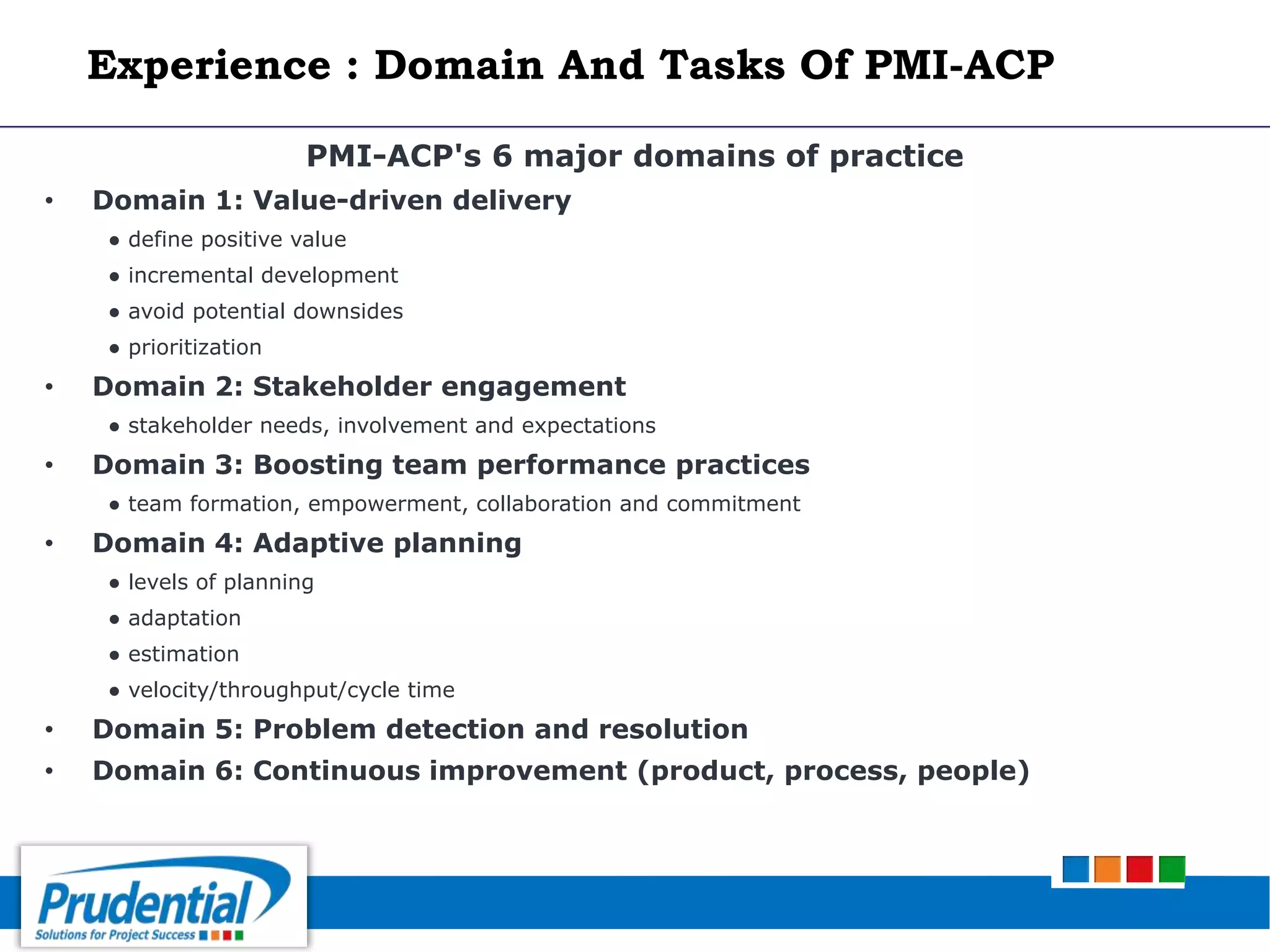
PMI-ACP's 6 major domains of practice
• Domain 1: Value-driven delivery
● define positive value
● incremental development
● avoid potential downsides
● prioritization
• Domain 2: Stakeholder engagement
● stakeholder needs, involvement and expectations
• Domain 3: Boosting team performance practices
● team formation, empowerment, collaboration and commitment
• Domain 4: Adaptive planning
● levels of planning
● adaptation
● estimation
● velocity/throughput/cycle time
• Domain 5: Problem detection and resolution
• Domain 6: Continuous improvement (product, process, people)
Experience : Domain And Tasks Of PMI-ACP
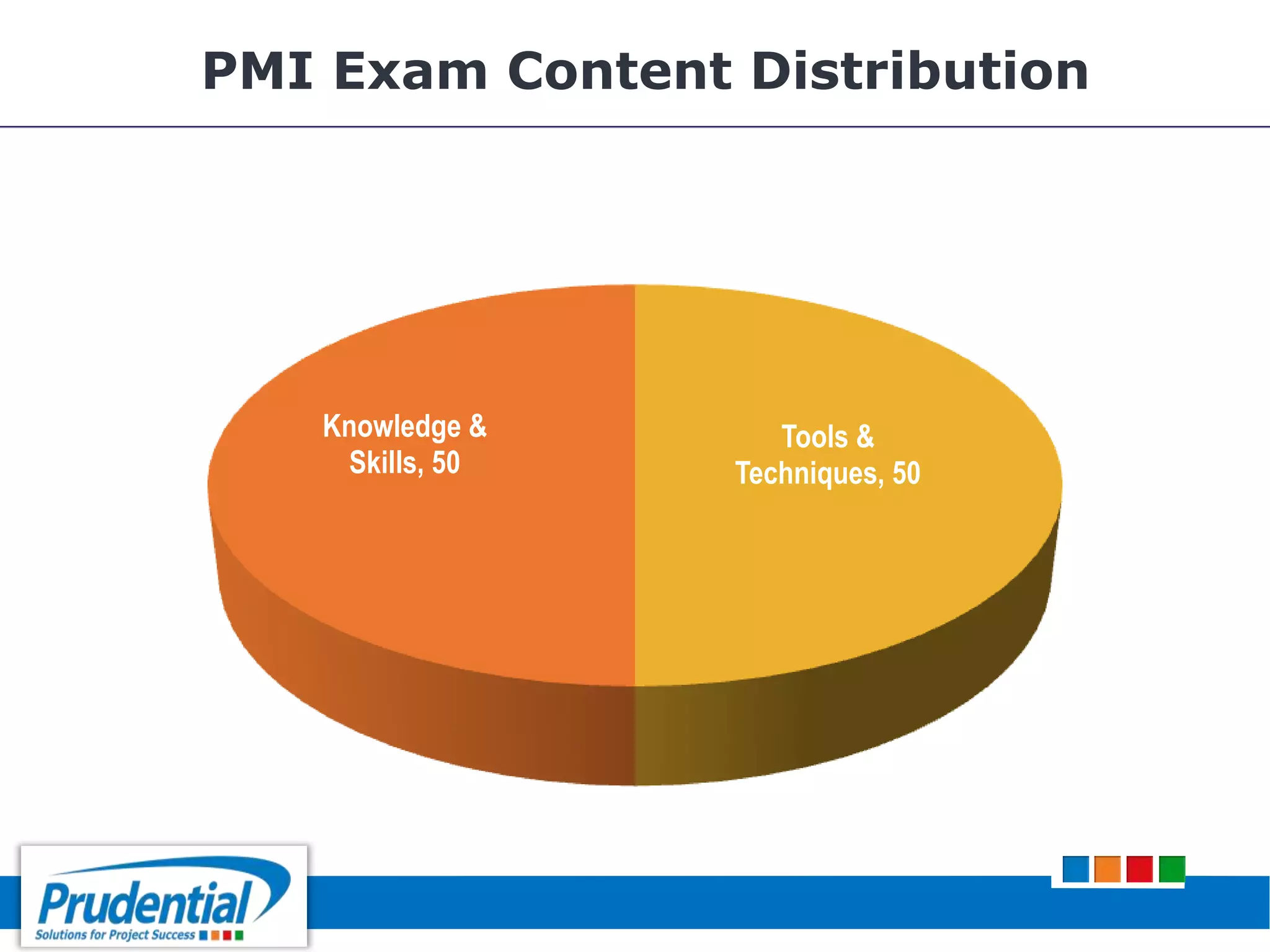
PMI Exam Content Distribution
Tools &
Techniques, 50
Knowledge &
Skills, 50
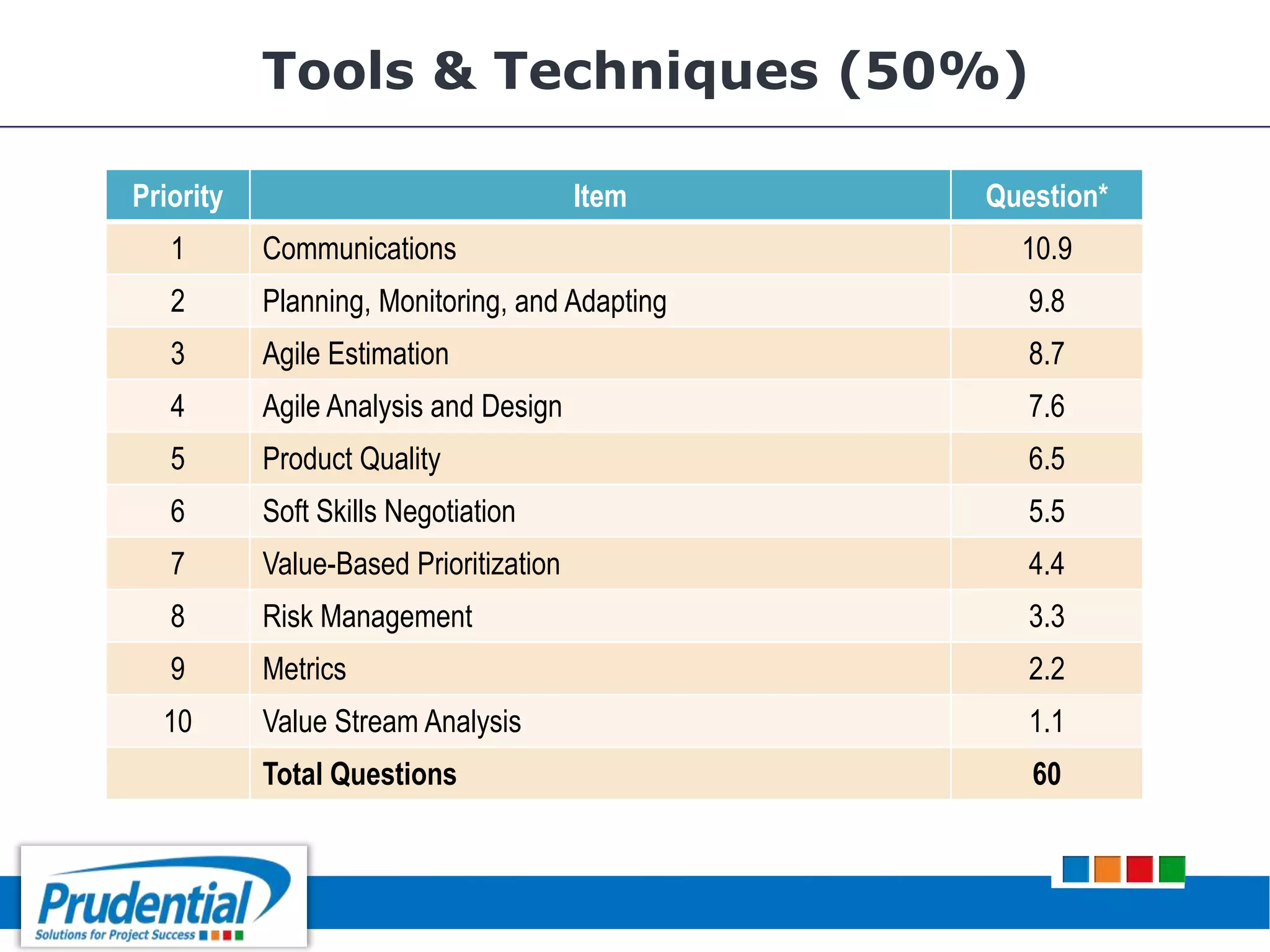
Tools & Techniques (50%)
Priority Item Question*
1 Communications 10.9
2 Planning, Monitoring, and Adapting 9.8
3 Agile Estimation 8.7
4 Agile Analysis and Design 7.6
5 Product Quality 6.5
6 Soft Skills Negotiation 5.5
7 Value-Based Prioritization 4.4
8 Risk Management 3.3
9 Metrics 2.2
10 Value Stream Analysis 1.1
Total Questions 60
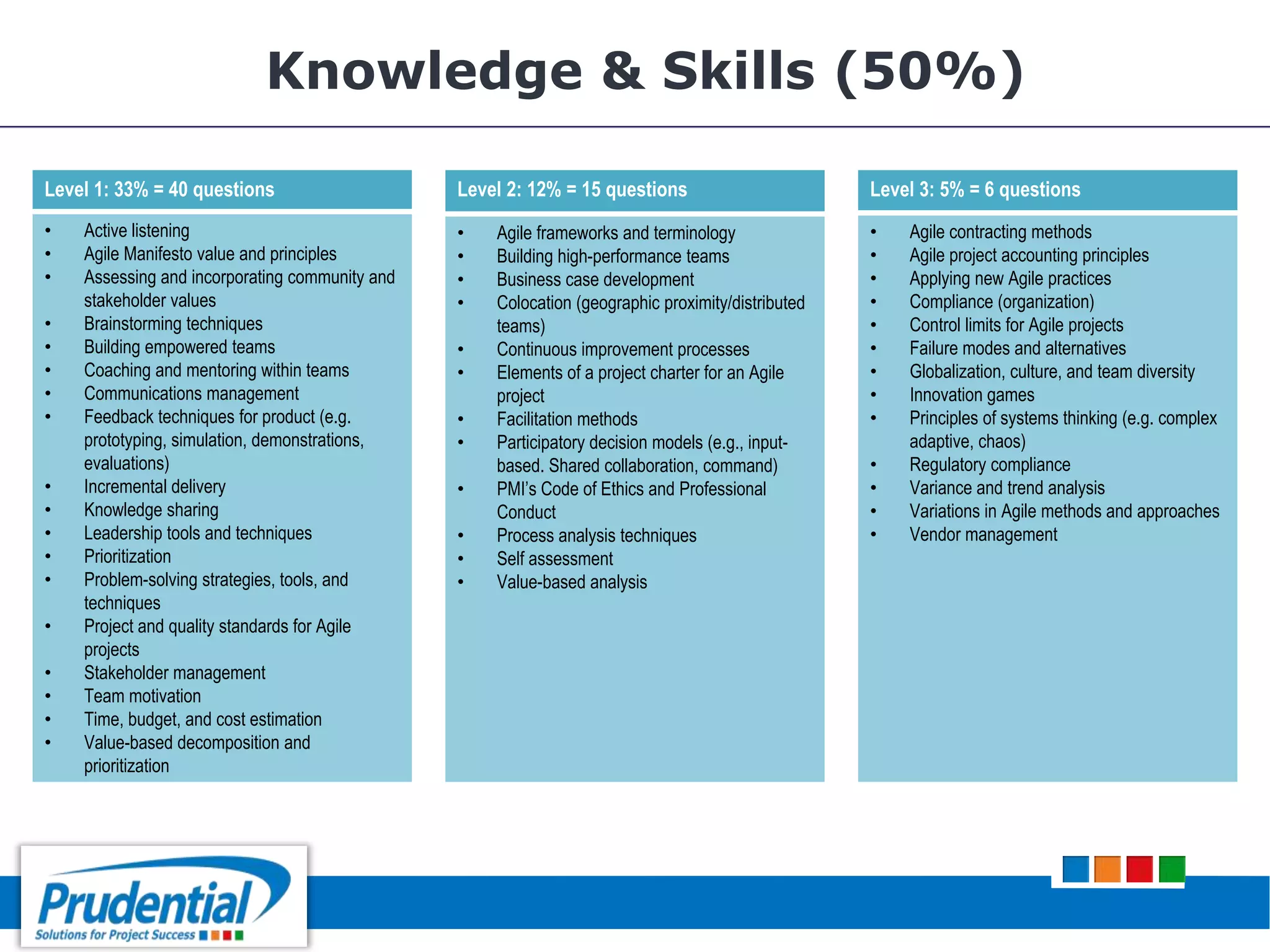
Knowledge & Skills (50%)
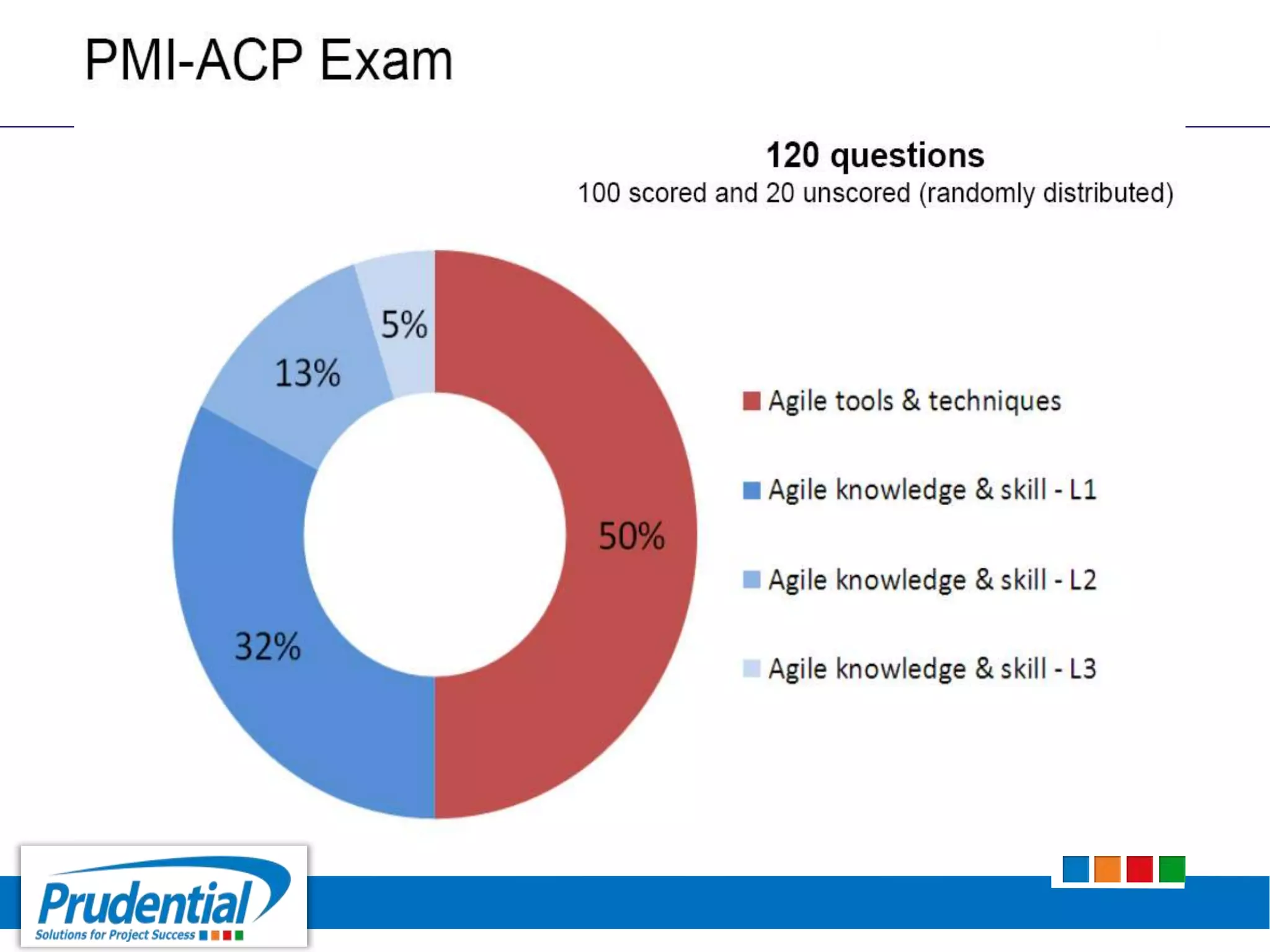
Level 1: 33% = 40 questions
• Active listening
• Agile Manifesto value and principles
• Assessing and incorporating community and
stakeholder values
• Brainstorming techniques
• Building empowered teams
• Coaching and mentoring within teams
• Communications management
• Feedback techniques for product (e.g.
prototyping, simulation, demonstrations,
evaluations)
• Incremental delivery
• Knowledge sharing
• Leadership tools and techniques
• Prioritization
• Problem-solving strategies, tools, and
techniques
• Project and quality standards for Agile
projects
• Stakeholder management
• Team motivation
• Time, budget, and cost estimation
• Value-based decomposition and
prioritization
Level 2: 12% = 15 questions
• Agile frameworks and terminology
• Building high-performance teams
• Business case development
• Colocation (geographic proximity/distributed
teams)
• Continuous improvement processes
• Elements of a project charter for an Agile
project
• Facilitation methods
• Participatory decision models (e.g., input-
based. Shared collaboration, command)
• PMI’s Code of Ethics and Professional
Conduct
• Process analysis techniques
• Self assessment
• Value-based analysis
Level 3: 5% = 6 questions
• Agile contracting methods
• Agile project accounting principles
• Applying new Agile practices
• Compliance (organization)
• Control limits for Agile projects
• Failure modes and alternatives
• Globalization, culture, and team diversity
• Innovation games
• Principles of systems thinking (e.g. complex
adaptive, chaos)
• Regulatory compliance
• Variance and trend analysis
• Variations in Agile methods and approaches
• Vendor management
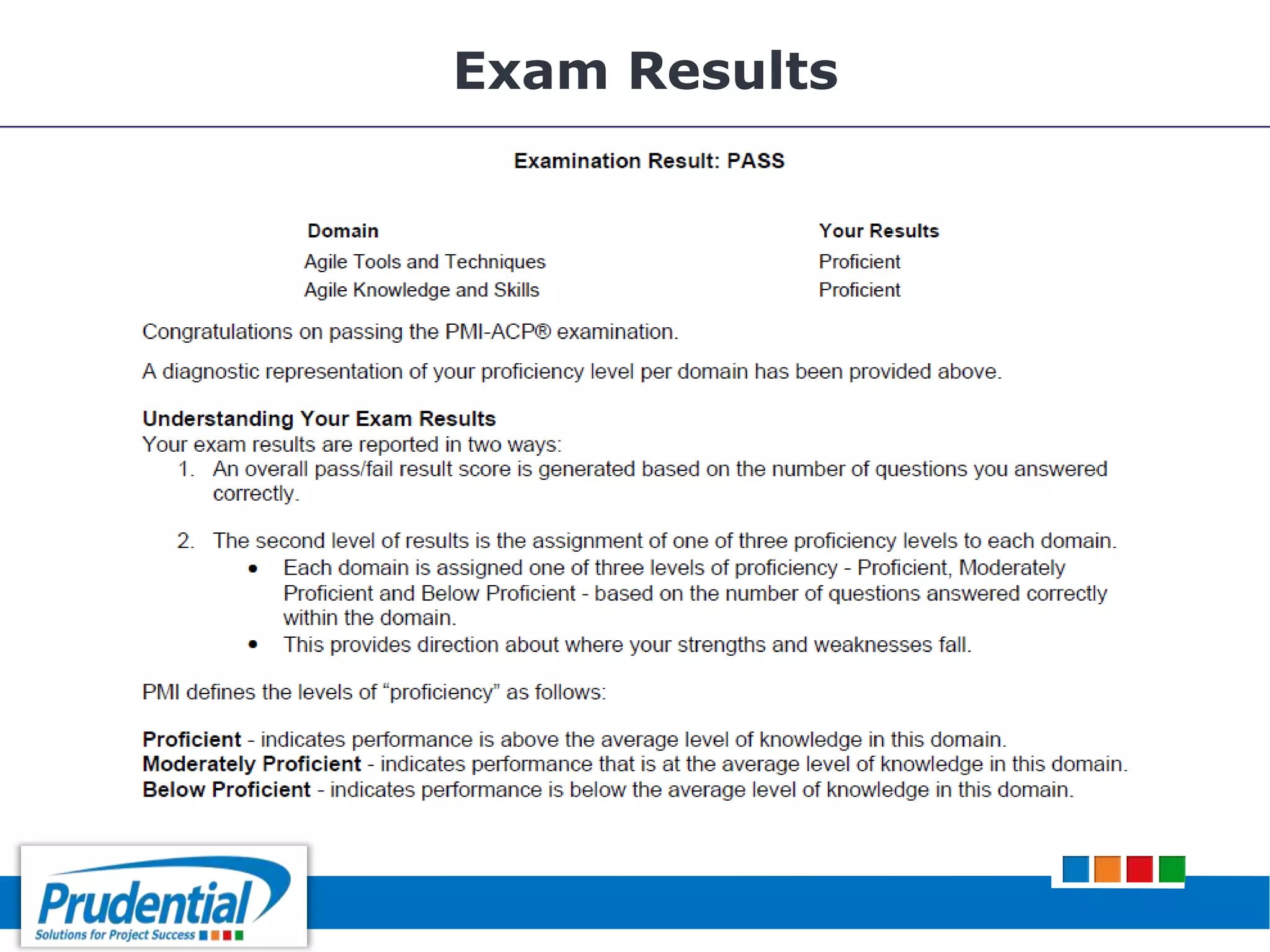
Exam Results
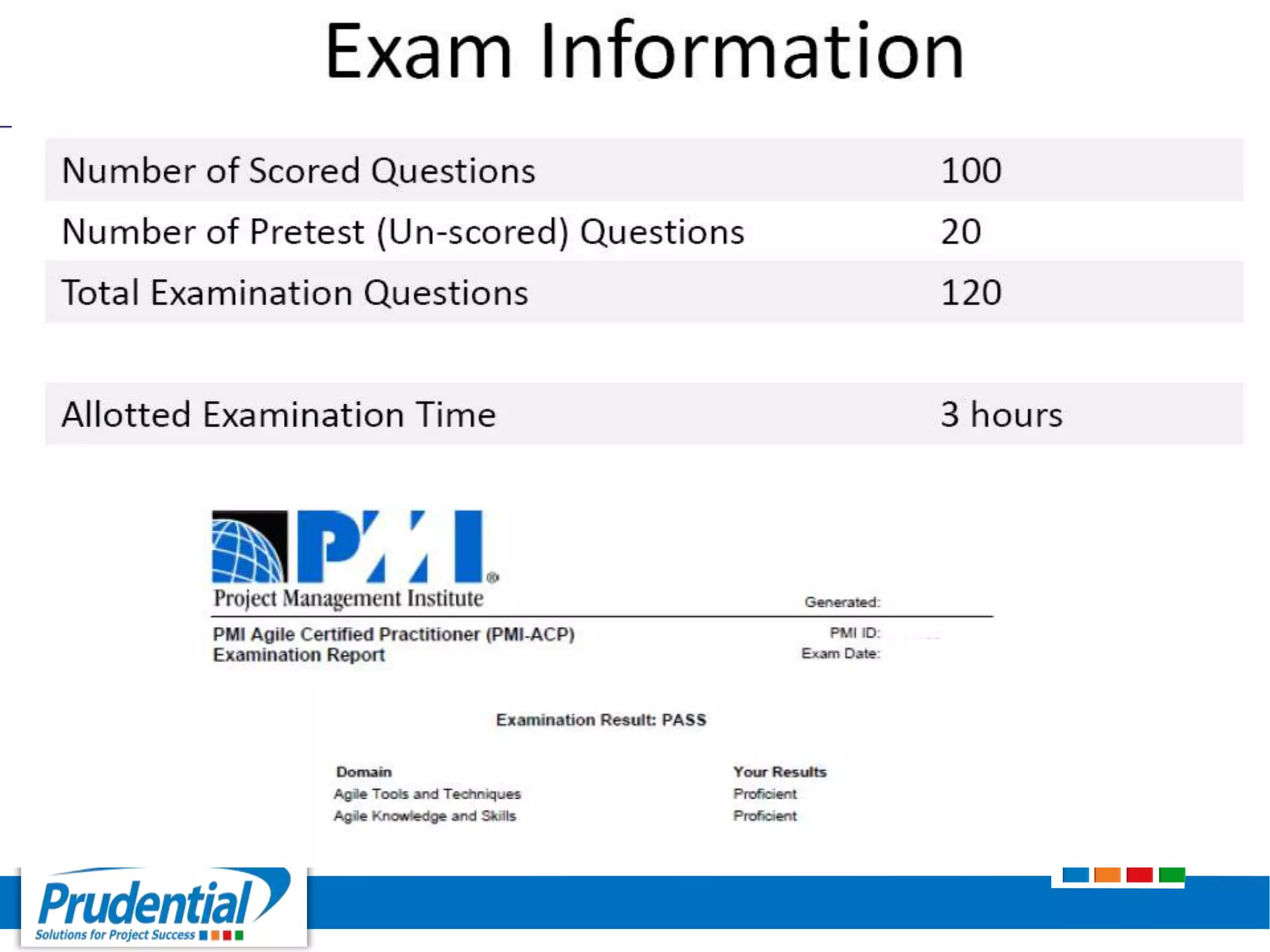
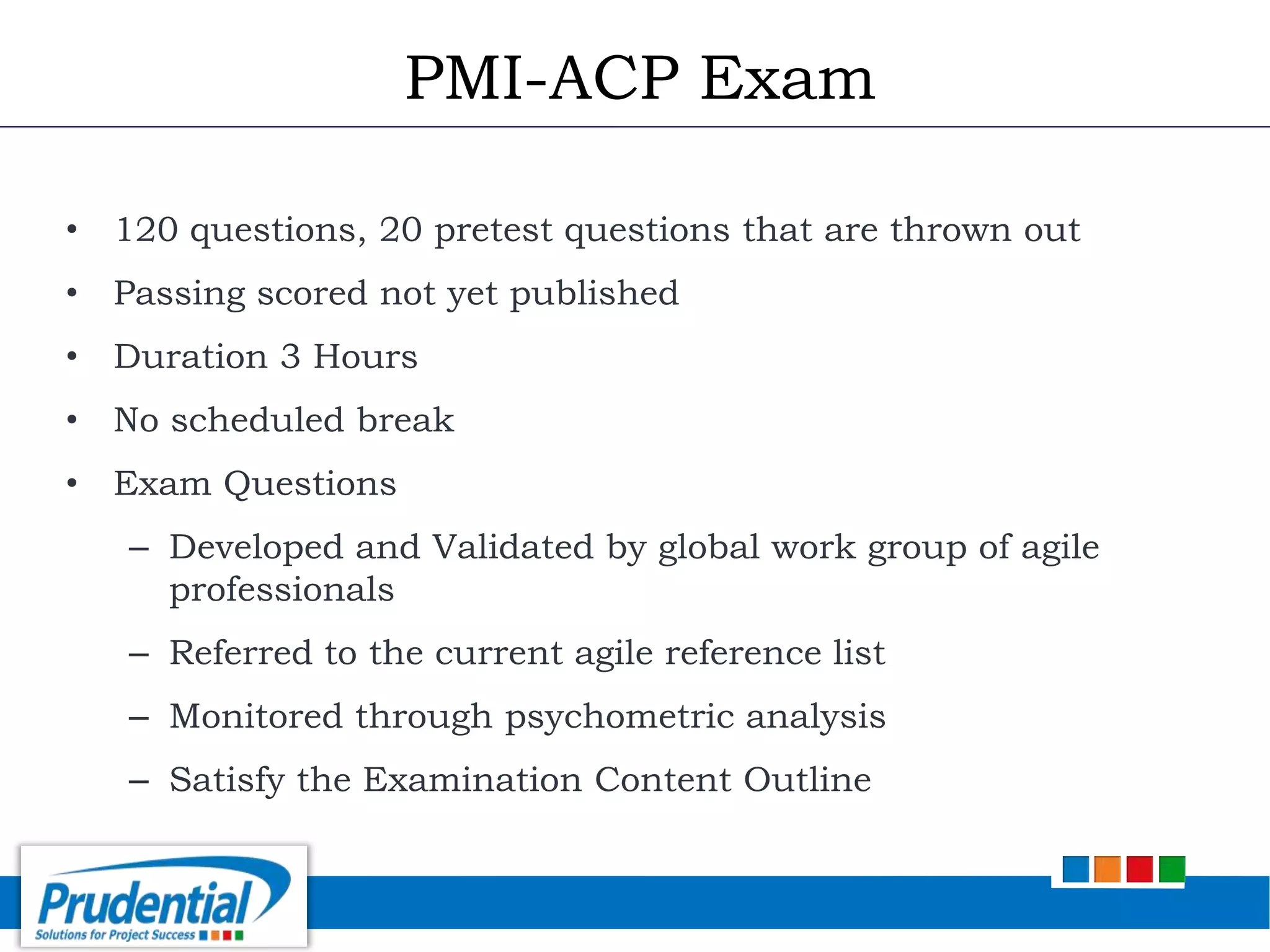
• 120 questions, 20 pretest questions that are thrown out
• Passing scored not yet published
• Duration 3 Hours
• No scheduled break
• Exam Questions
– Developed and Validated by global work group of agile
professionals
– Referred to the current agile reference list
– Monitored through psychometric analysis
– Satisfy the Examination Content Outline
PMI-ACP Exam
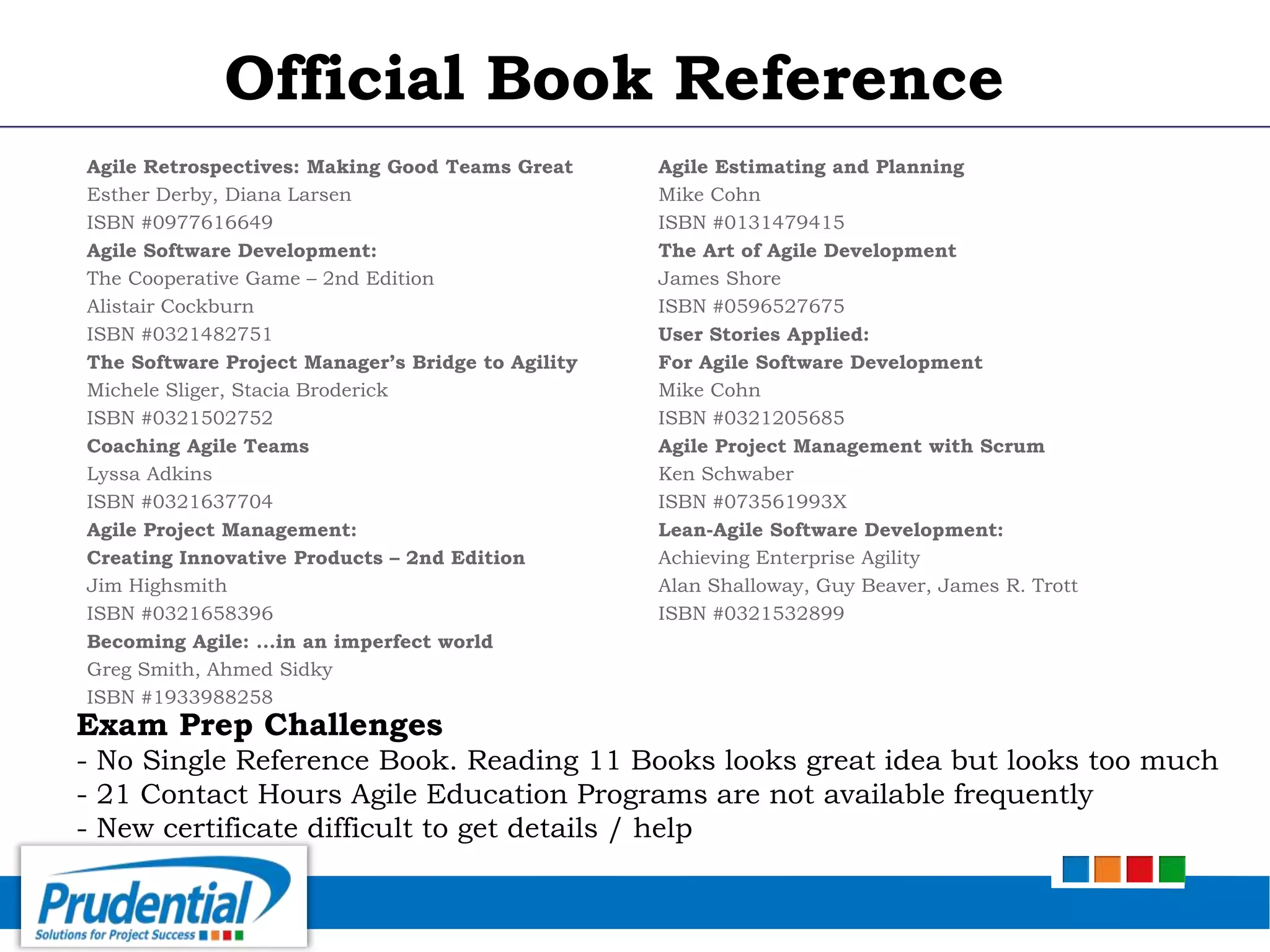
Agile Estimating and Planning
Mike Cohn
ISBN #0131479415
The Art of Agile Development
James Shore
ISBN #0596527675
User Stories Applied:
For Agile Software Development
Mike Cohn
ISBN #0321205685
Agile Project Management with Scrum
Ken Schwaber
ISBN #073561993X
Lean-Agile Software Development:
Achieving Enterprise Agility
Alan Shalloway, Guy Beaver, James R. Trott
ISBN #0321532899
Agile Retrospectives: Making Good Teams Great
Esther Derby, Diana Larsen
ISBN #0977616649
Agile Software Development:
The Cooperative Game – 2nd Edition
Alistair Cockburn
ISBN #0321482751
The Software Project Manager’s Bridge to Agility
Michele Sliger, Stacia Broderick
ISBN #0321502752
Coaching Agile Teams
Lyssa Adkins
ISBN #0321637704
Agile Project Management:
Creating Innovative Products – 2nd Edition
Jim Highsmith
ISBN #0321658396
Becoming Agile: ...in an imperfect world
Greg Smith, Ahmed Sidky
ISBN #1933988258
Exam Prep Challenges
- No Single Reference Book. Reading 11 Books looks great idea but looks too much
- 21 Contact Hours Agile Education Programs are not available frequently
- New certificate difficult to get details / help
Official Book Reference
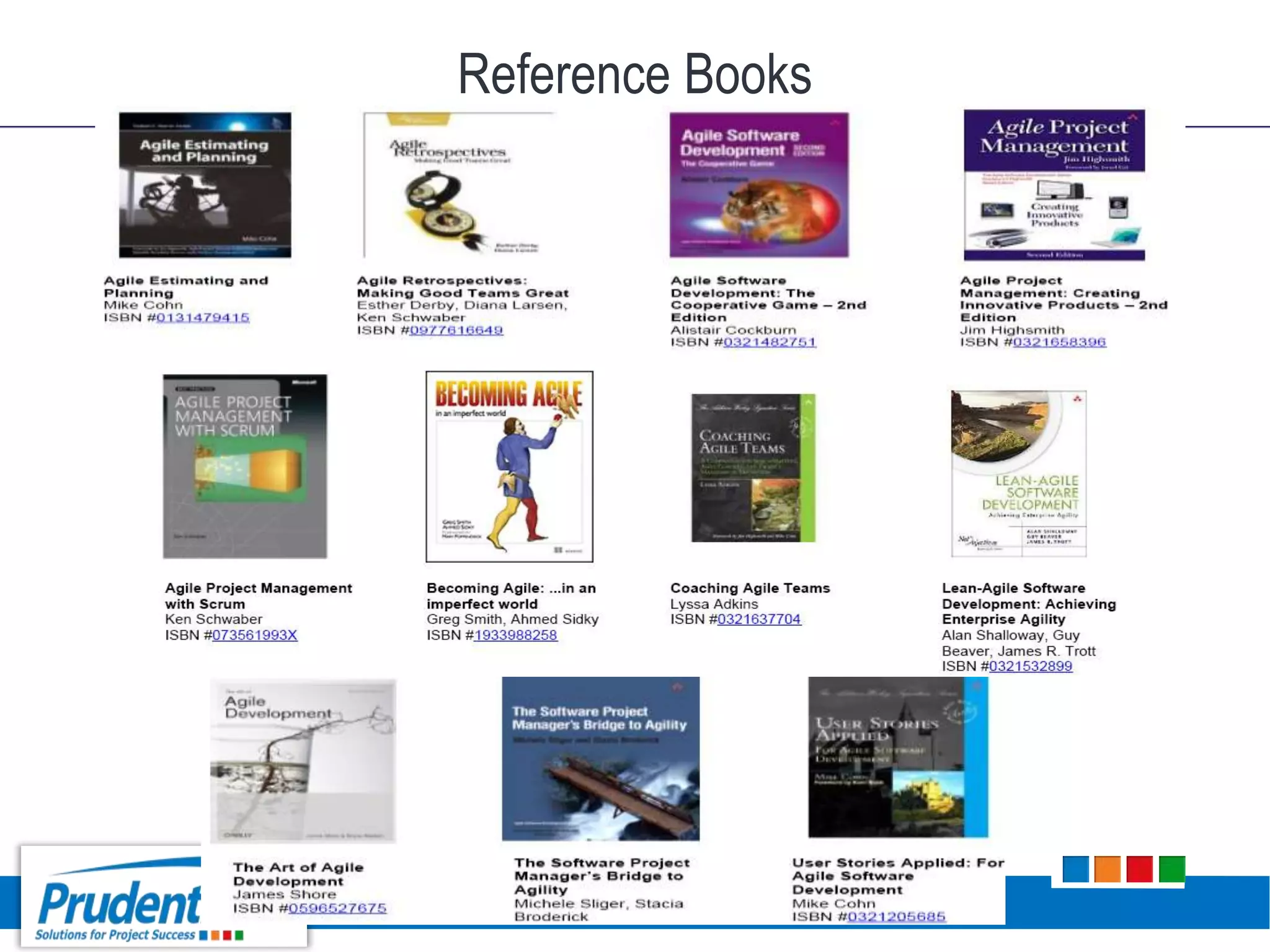
Reference Books
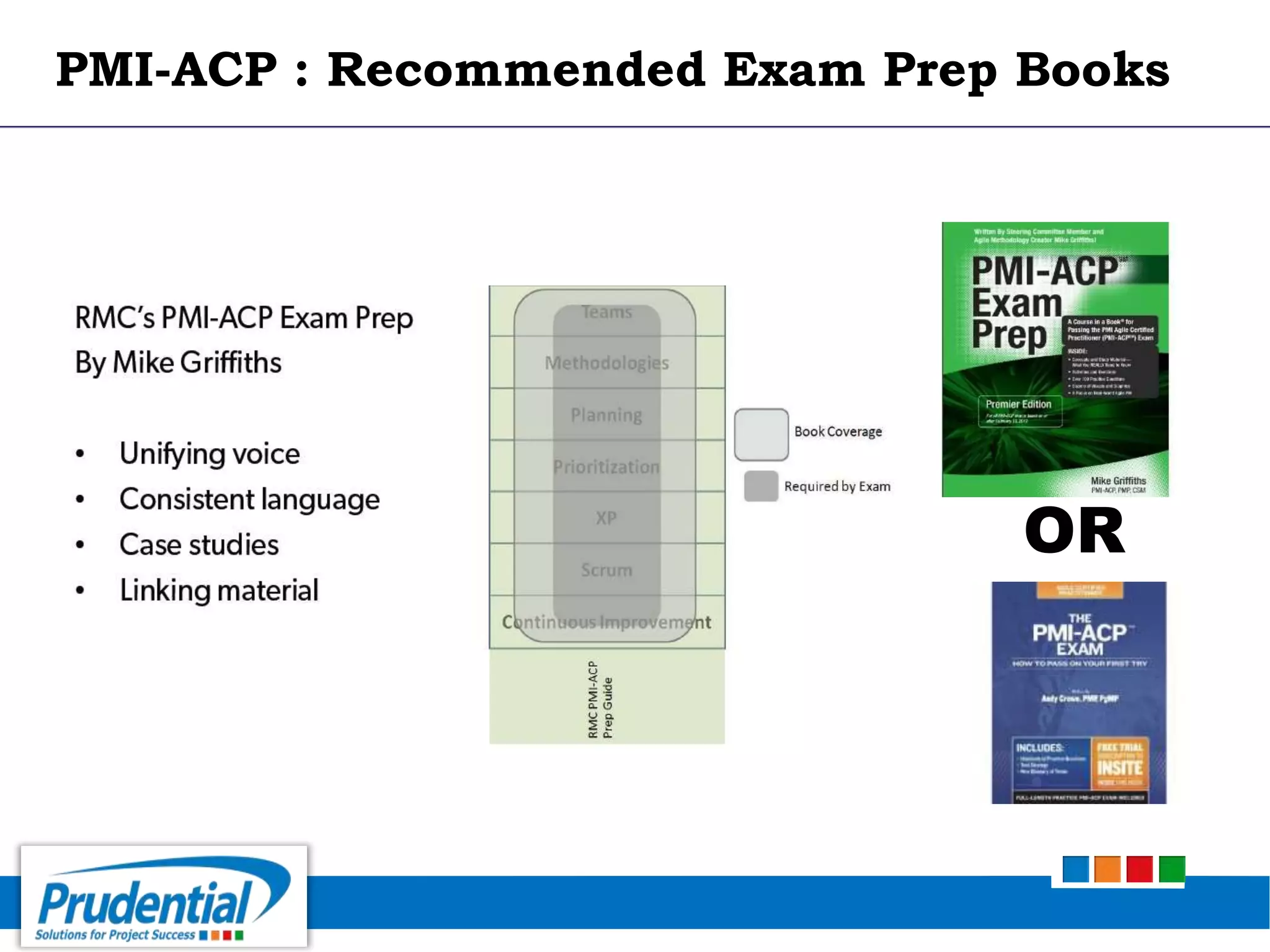
OR
PMI-ACP : Recommended Exam Prep Books
How Should You Prepare for the PMI-ACP Exam?
• Know your own learning and testing style and use whatever
resources and study techniques work best for you
• Many people form study groups to provide support and peer
pressure
• The PMI-ACP is influence by Software industry. The exam includes
conceptual, situational, application, and evaluative questions. Be
ready for each type
• Study the material with eyes of Professional Not Student. Try to
relate your experience with knowledge
• Study the Selected Material & Process Group/Activity Matrix by
Knowledge Area and understand what each activity involves
• Start study when decide to attempt exam.
• Develop and Focus on Study plan as per your schedule for PMI-ACP
• 120 questions are multiple-choice with 4 choices. It is easy to
over study, but if you fail, you need to pay to retake the exam
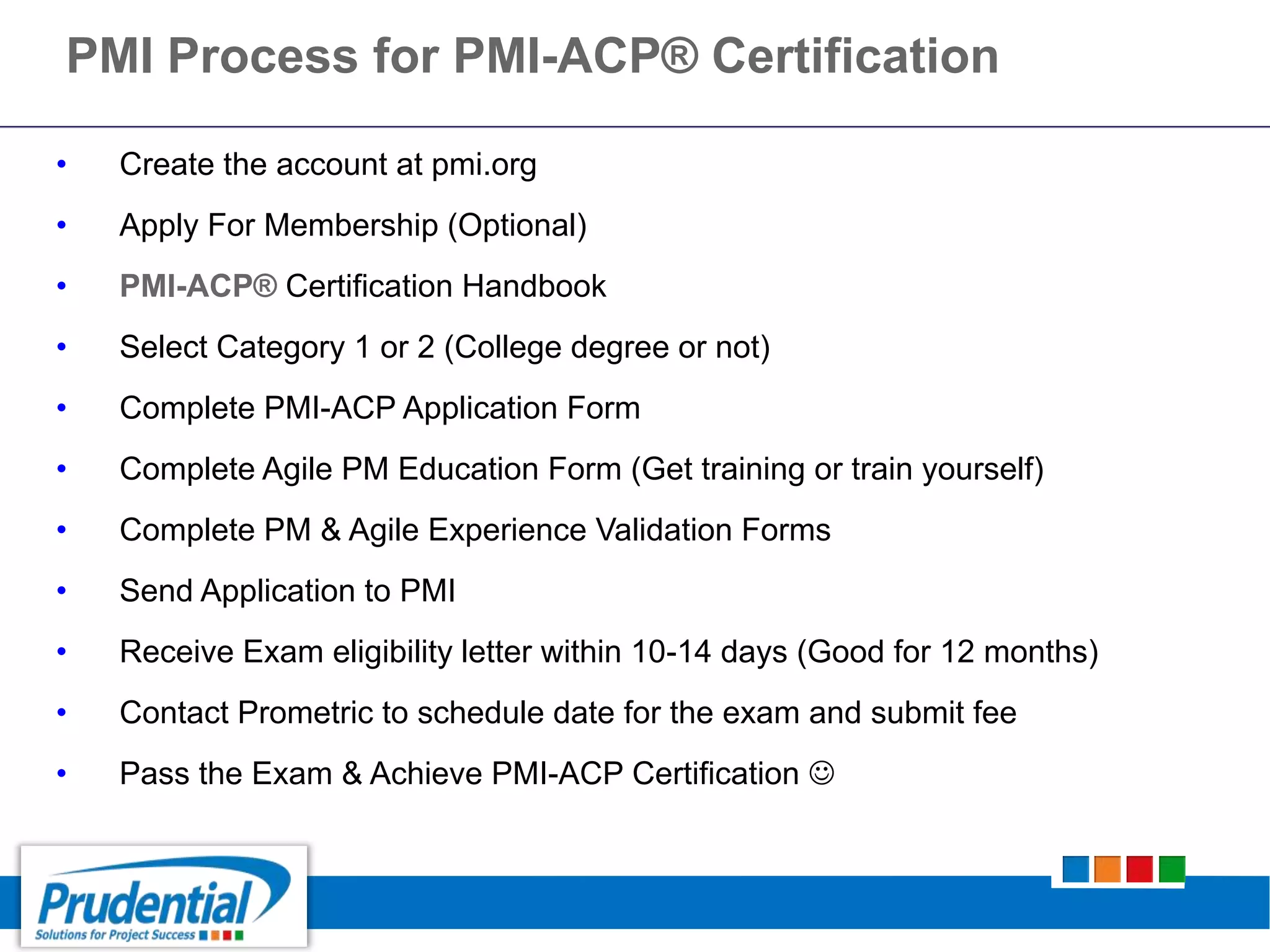
• Create the account at pmi.org
• Apply For Membership (Optional)
• PMI-ACP® Certification Handbook
• Select Category 1 or 2 (College degree or not)
• Complete PMI-ACP Application Form
• Complete Agile PM Education Form (Get training or train yourself)
• Complete PM & Agile Experience Validation Forms
• Send Application to PMI
• Receive Exam eligibility letter within 10-14 days (Good for 12 months)
• Contact Prometric to schedule date for the exam and submit fee
• Pass the Exam & Achieve PMI-ACP Certification 
PMI Process for PMI-ACP® Certification
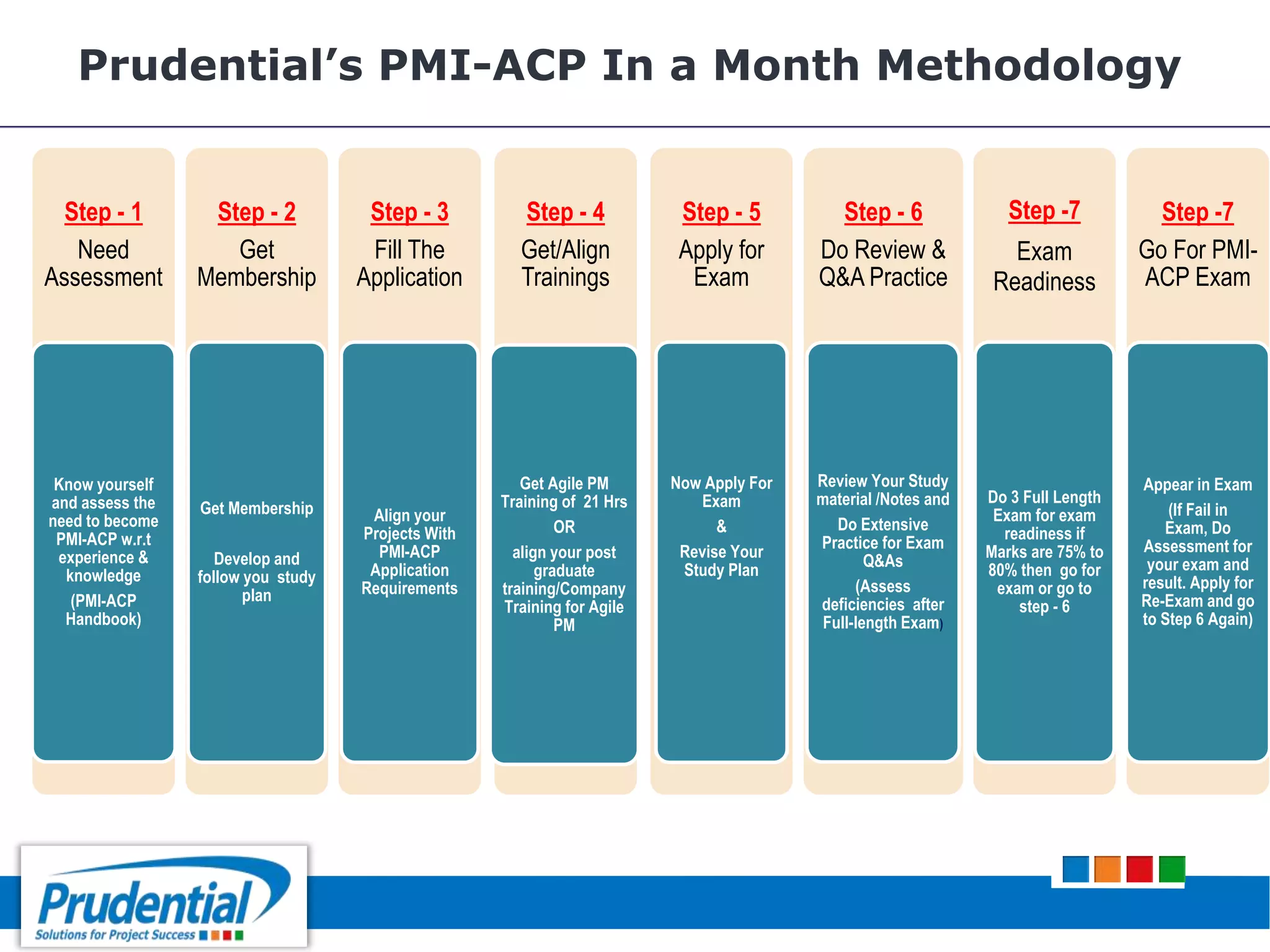
Prudential’s PMI-ACP In a Month Methodology
Step - 1
Need
Assessment
Know yourself
and assess the
need to become
PMI-ACP w.r.t
experience &
knowledge
(PMI-ACP
Handbook)
Step - 2
Get
Membership
Get Membership
Develop and
follow you study
plan
Step - 3
Fill The
Application
Align your
Projects With
PMI-ACP
Application
Requirements
Step - 4
Get/Align
Trainings
Get Agile PM
Training of 21 Hrs
OR
align your post
graduate
training/Company
Training for Agile
PM
Step - 5
Apply for
Exam
Now Apply For
Exam
&
Revise Your
Study Plan
Step - 6
Do Review &
Q&A Practice
Review Your Study
material /Notes and
Do Extensive
Practice for Exam
Q&As
(Assess
deficiencies after
Full-length Exam)
Step -7
Exam
Readiness
Do 3 Full Length
Exam for exam
readiness if
Marks are 75% to
80% then go for
exam or go to
step - 6
Step -7
Go For PMI-
ACP Exam
Appear in Exam
(If Fail in
Exam, Do
Assessment for
your exam and
result. Apply for
Re-Exam and go
to Step 6 Again)
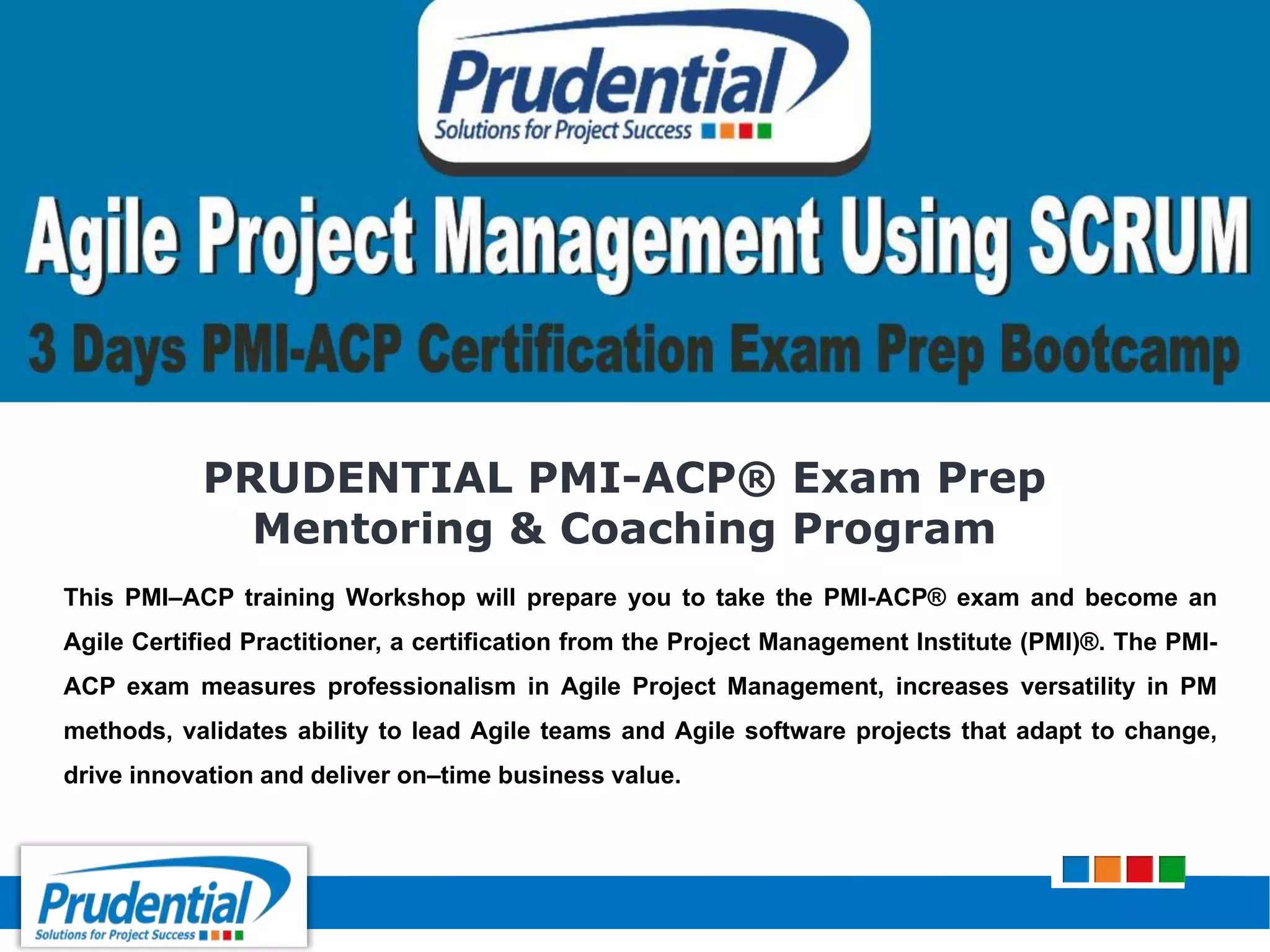
PRUDENTIAL PMI-ACP® Exam Prep
Mentoring & Coaching Program
This PMI–ACP training Workshop will prepare you to take the PMI-ACP® exam and become an
Agile Certified Practitioner, a certification from the Project Management Institute (PMI)®. The PMI-
ACP exam measures professionalism in Agile Project Management, increases versatility in PM
methods, validates ability to lead Agile teams and Agile software projects that adapt to change,
drive innovation and deliver on–time business value.
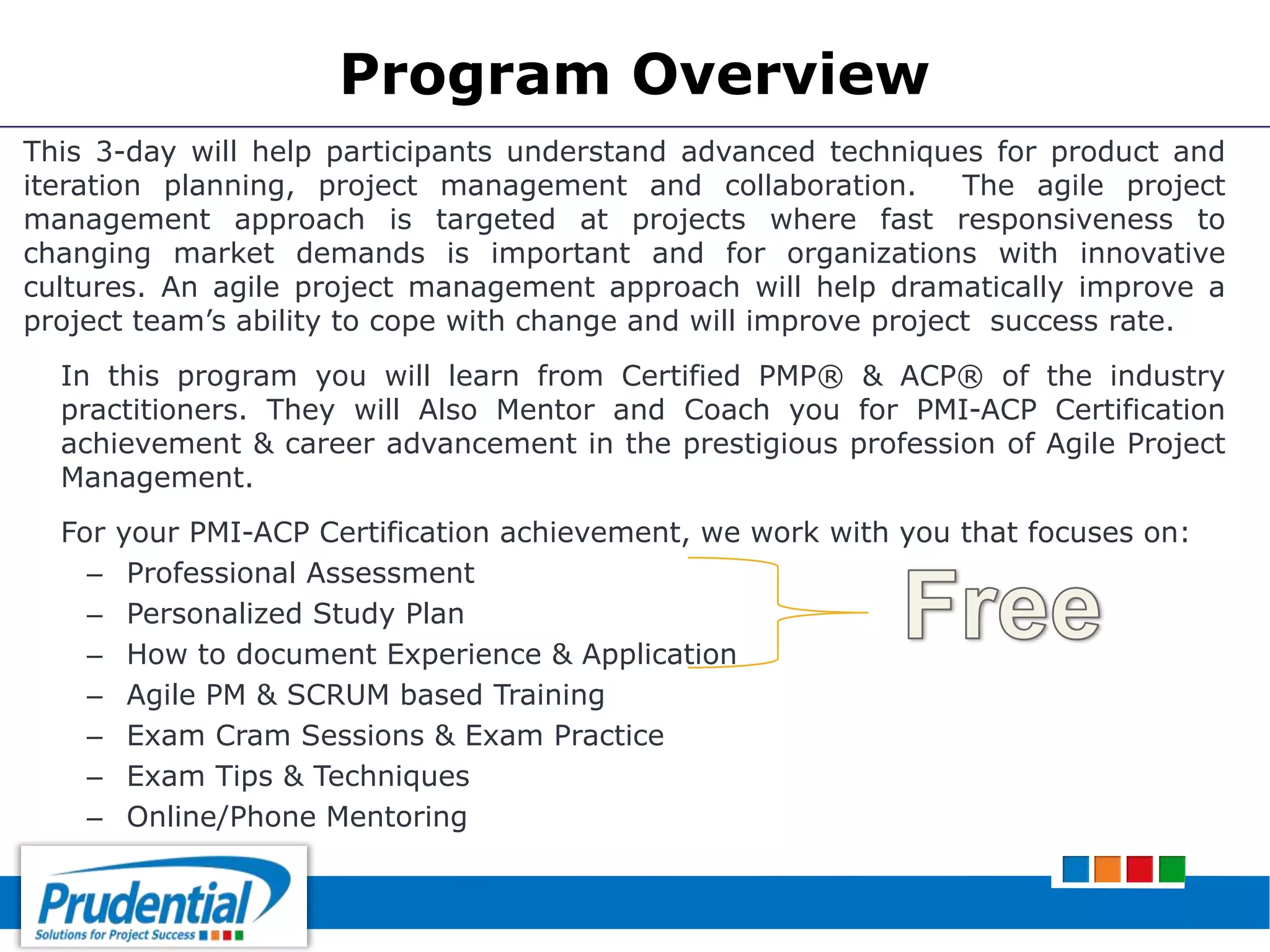
Program Overview
This 3-day will help participants understand advanced techniques for product and
iteration planning, project management and collaboration. The agile project
management approach is targeted at projects where fast responsiveness to
changing market demands is important and for organizations with innovative
cultures. An agile project management approach will help dramatically improve a
project team’s ability to cope with change and will improve project success rate.
In this program you will learn from Certified PMP® & ACP® of the industry
practitioners. They will Also Mentor and Coach you for PMI-ACP Certification
achievement & career advancement in the prestigious profession of Agile Project
Management.
For your PMI-ACP Certification achievement, we work with you that focuses on:
– Professional Assessment
– Personalized Study Plan
– How to document Experience & Application
– Agile PM & SCRUM based Training
– Exam Cram Sessions & Exam Practice
– Exam Tips & Techniques
– Online/Phone Mentoring
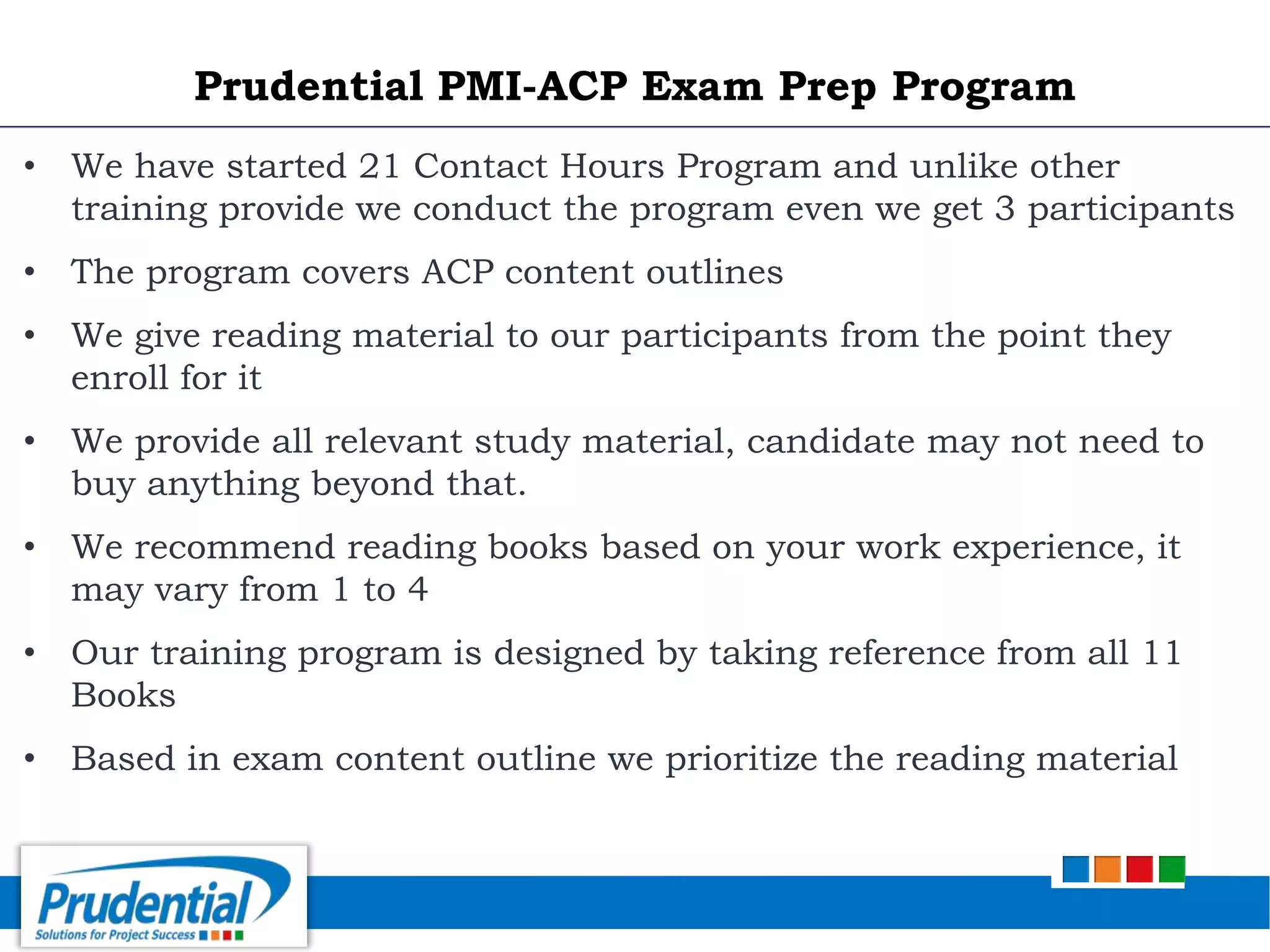
• We have started 21 Contact Hours Program and unlike other
training provide we conduct the program even we get 3 participants
• The program covers ACP content outlines
• We give reading material to our participants from the point they
enroll for it
• We provide all relevant study material, candidate may not need to
buy anything beyond that.
• We recommend reading books based on your work experience, it
may vary from 1 to 4
• Our training program is designed by taking reference from all 11
Books
• Based in exam content outline we prioritize the reading material
Prudential PMI-ACP Exam Prep Program
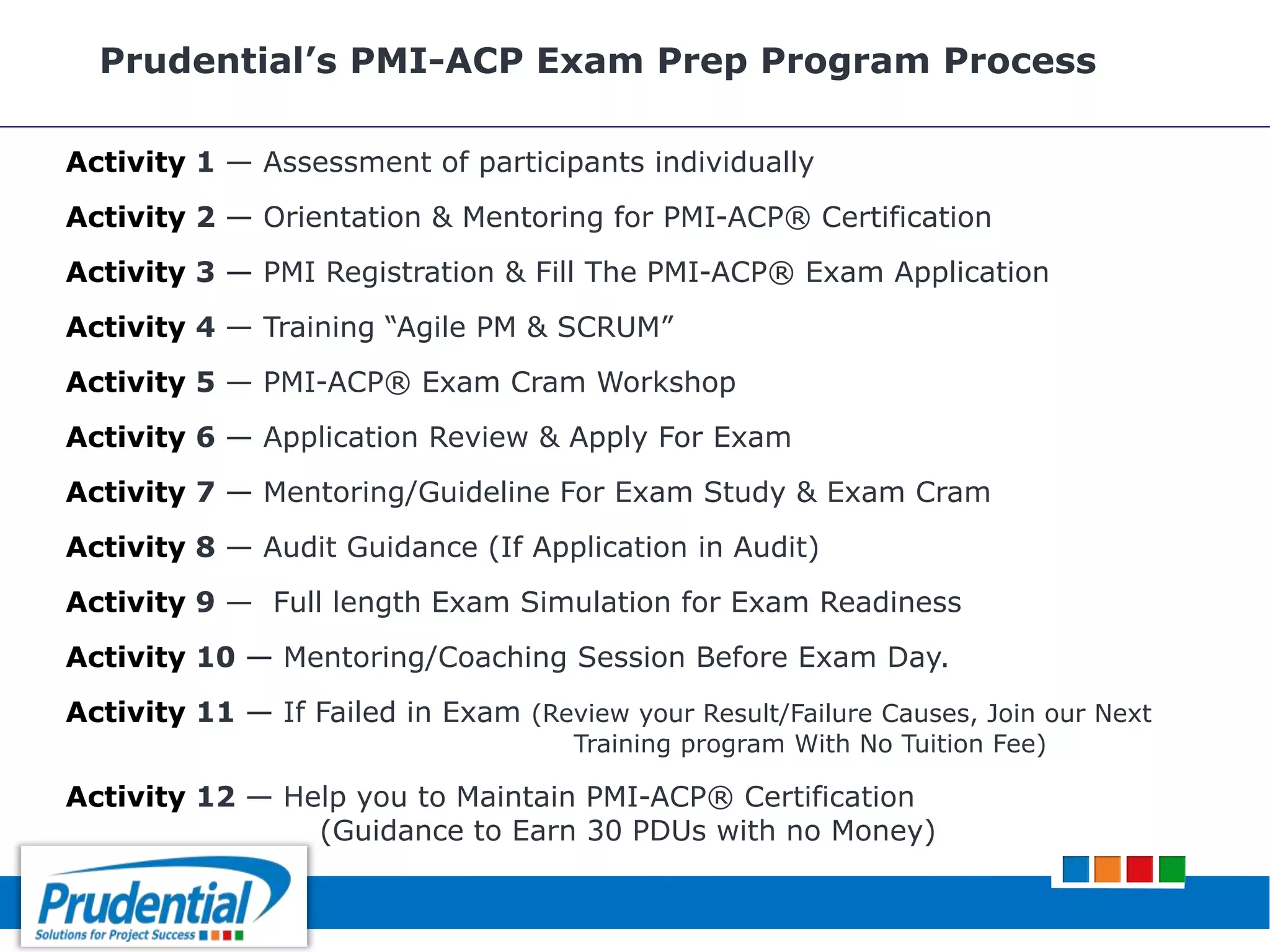
Prudential’s PMI-ACP Exam Prep Program Process
Activity 1 — Assessment of participants individually
Activity 2 — Orientation & Mentoring for PMI-ACP® Certification
Activity 3 — PMI Registration & Fill The PMI-ACP® Exam Application
Activity 4 — Training “Agile PM & SCRUM”
Activity 5 — PMI-ACP® Exam Cram Workshop
Activity 6 — Application Review & Apply For Exam
Activity 7 — Mentoring/Guideline For Exam Study & Exam Cram
Activity 8 — Audit Guidance (If Application in Audit)
Activity 9 — Full length Exam Simulation for Exam Readiness
Activity 10 — Mentoring/Coaching Session Before Exam Day.
Activity 11 — If Failed in Exam (Review your Result/Failure Causes, Join our Next
Training program With No Tuition Fee)
Activity 12 — Help you to Maintain PMI-ACP® Certification
(Guidance to Earn 30 PDUs with no Money)
Company Profile
Transform your Business
Requirements into Prudent
Solution for Project and
Organizational Success
About Us:
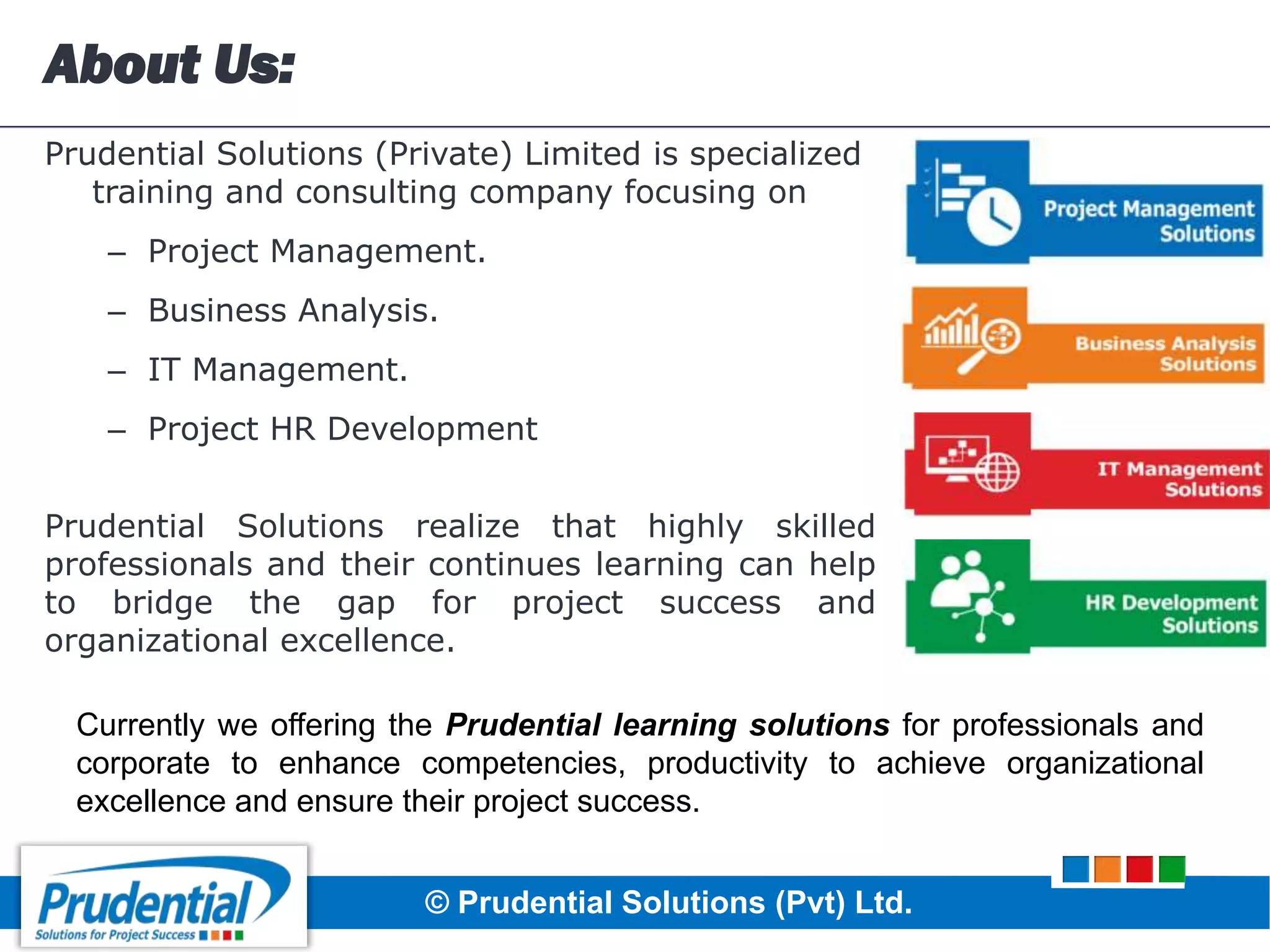
Prudential Solutions (Private) Limited is specialized
training and consulting company focusing on
– Project Management.
– Business Analysis.
– IT Management.
– Project HR Development
Prudential Solutions realize that highly skilled
professionals and their continues learning can help
to bridge the gap for project success and
organizational excellence.
© Prudential Solutions (Pvt) Ltd.
Currently we offering the Prudential learning solutions for professionals and
corporate to enhance competencies, productivity to achieve organizational
excellence and ensure their project success.
Prudential Learning Solutions
Executive Management Training/ Mentoring
• Trainings for executive management are an important
investment—especially those people, who execute
organizational strategies and lead people.
• We offer Half-Day to Two-Day Executive Training Workshops
for Management Teams, addressing their specific business
needs, with focus to solve and overcome tomorrow's business
challenges today.
Professional Certification Exam Prep Bootcamps
• We offer high-class Professional Certification Exam Prep
Training Programs, at faster pace and affordable price with
GUARANTEE to pass in first attempt.
Corporate Training/Coaching/Mentoring Programs
• We offer training solutions that reflect organizational specific
learning needs, processes, culture & industry. We also help
organizations to prepare and conduct custom-design training
programs that meet their environment specific requirements.
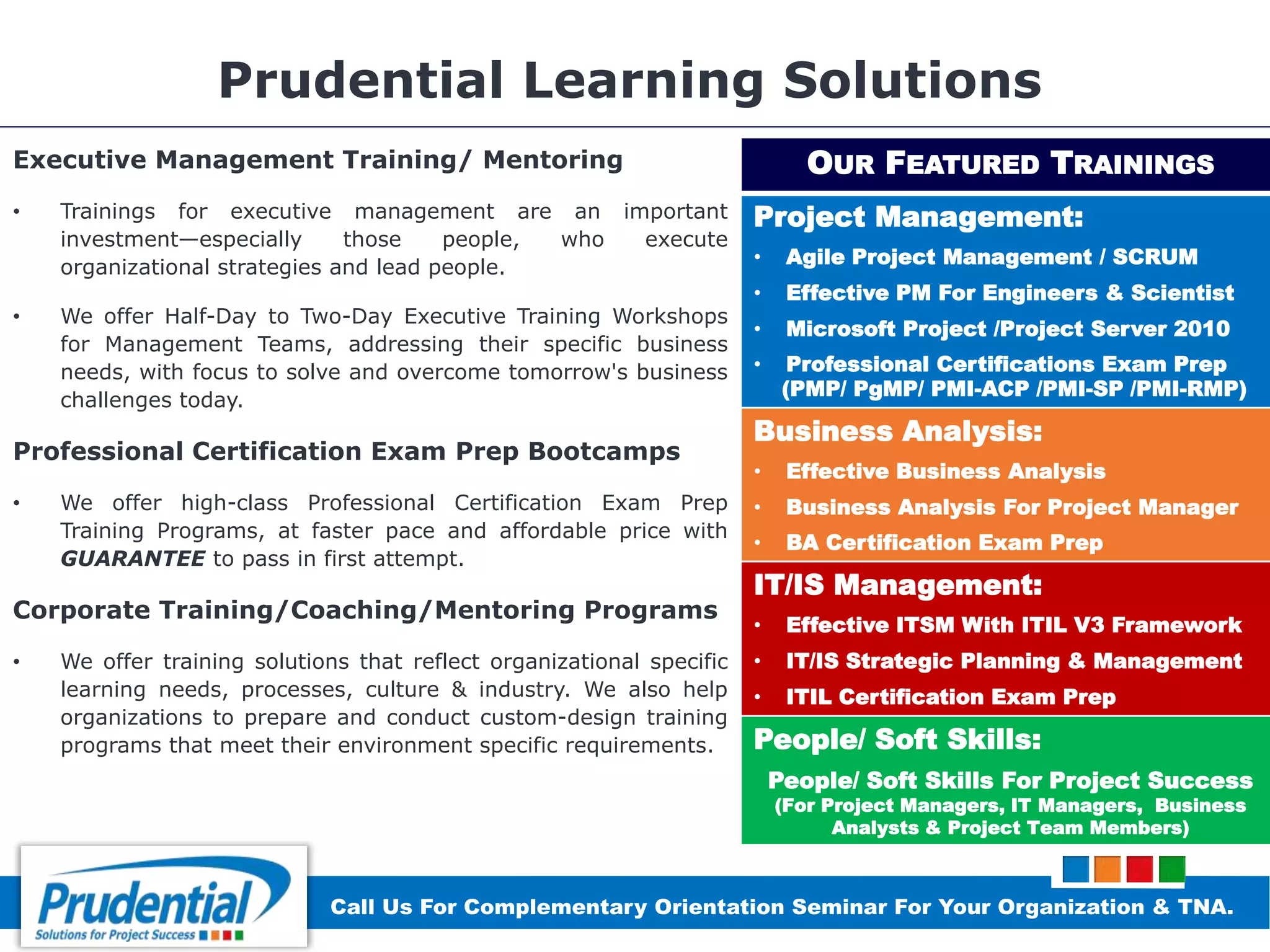
OUR FEATURED TRAININGS
Project Management:
• Agile Project Management / SCRUM
• Effective PM For Engineers & Scientist
• Microsoft Project /Project Server 2010
• Professional Certifications Exam Prep
(PMP/ PgMP/ PMI-ACP /PMI-SP /PMI-RMP)
Business Analysis:
• Effective Business Analysis
• Business Analysis For Project Manager
• BA Certification Exam Prep
IT/IS Management:
• Effective ITSM With ITIL V3 Framework
• IT/IS Strategic Planning & Management
• ITIL Certification Exam Prep
People/ Soft Skills:
People/ Soft Skills For Project Success
(For Project Managers, IT Managers, Business
Analysts & Project Team Members)
Call Us For Complementary Orientation Seminar For Your Organization & TNA.
Some of Our Clients’ Organizations
Contact Us and Follow Us
For Trainings & Consulting
Thank you for your interest in Prudential Solutions; If you have any query
call us or email us.
Prudential Office
Office # 2, 2nd Floor Huzaifa Center, I-8 Markaz Islamabad
Cell: (+92) 0333 – PRUDSOL (7783765) / 0311-8556281
Phone: (+92) 051- 122-000-456
Fax: (+92) 051-4862314
Email: info@prudsol.com
trainings@prudsol.com
Website: www.prudsol.com

PMI - ACP (Agile Certified Practitionar) Certification Exam Prep

  • 1.
    Free Seminar/Workshop Series BeAgile Certified Practitioner PMI-ACP Certification Exam (Free Orientation Seminar) (Know Every thing about PMI-ACP Certification and How to Pass ACP Certification Exam in a Month)
  • 2.
    Agenda  Overview ofAgile & SCRUM  Introduction to PMI & PMI-ACP Certification  PMI-ACP Certification Requirements & Exam Fee  PMI-ACP Exam Contents & Reading Materials  Prudential Exam Prep Methodology (Pass PMI-ACP In a Month)  Prudential PMI-ACP Exam Prep Training Workshop  About Prudential Solutions & Its Training Programs PMI®, PMP®, CAPM® and PMBOK® Guide are trademarks of the Project Management Institute, Inc. PMI® has not endorsed & did not participate in the development of this product. Note: Any views OR Opinion OR Techniques presented and showcased in this presentation is solely those of the authors & may not necessary represent those of company.
  • 3.
    What is Agile? Agileis the ability to adapt to changes as fast or faster than changes occur. Agile is an umbrella term for a set of values, principals and practices that have been shown to improve the efficiency, productivity, and quality of software delivery. The Agile Manifesto was written  In 2001, a group of 17 “lightweight” methodologists met Including Representative of  eXtreme Programming (XP)  Scrum  DSDM Adaptive Software Development Agile Manifesto
  • 4.
    The Agile Manifesto Weare uncovering better ways of developing software by doing it and helping others do it. Individuals and interactions over processes and tools Working software over comprehensive documentation Customer collaboration over contract negotiation Responding to change over following a plan That is, while there is value in the items on the right, we value the items on the left more. Source: www.agilemanifesto.org
  • 5.
    Agile Manifesto –Graphical Representation Individuals and Interactions Processes and Tools Working Software Comprehensive Documentation Customer Collaboration Contract Negotiation Responding to Change Following a Plan "Agile" | | | | | | | | Traditional Agility is a relative term
  • 6.
     Focus onempowered, self-managing teams;  Autonomous teams do not need the day-to-day intervention of management  Management protects team from outside interference  Agile teams are composed of a mix of skills  Agile team members are able to step in for each other as necessary Individuals And Interactions Over Processes And Tools
  • 7.
     Traditionally wemeasure progress by the percent complete of the functional milestones  Agile teams provide actual working product as a status report, “product review”  Design changes as the system is built, results in outdated documentation  Agile teams prefer face-to-face communication over documentation because it is simpler, faster, and more reliable. Working Software over Comprehensive Documentation
  • 8.
     Contract negotiation,Identify and define everything and spells out the payment and date specifications  Customers become a part of the development process  Writing specs down and throwing them over the fence is simply not effective Customer Collaboration over Contract Negotiation
  • 9.
     It’s mucheasier to respond to change when the organization and the customer share a clear understanding of the project’s status  In plan-driven environments, all requirements are specified up front, broken down to the task level and estimated  Agile plans follow more of a rolling wave approach using top- down planning Responding to Change over Following a Plan
  • 10.
    What is Agile? •An iterative and incremental (evolutionary) approach performed in a highly collaborative manner with just the right amount of ceremony to produce high quality software in a cost effective and timely manner which meets the changing needs of its stakeholders. • Core principles – “Fits just right” process – Continuous testing and validation – Consistent team collaboration – Rapid response to change – Ongoing customer involvement – Frequent delivery of working software
  • 11.
    1. Satisfy thecustomer through early and continuous delivery 2. Welcome changing requirements 3. Deliver frequently, preferring a shorter timescale 4. Business & technical work together daily 5. Pick the right team & trust them 6. Face-to-Face Communication 7. Working software is the primary measure of progress 8. Sustainable pace 9. Technical excellence and good design enhances agility 10. Simplicity, maximizing the amount of work not done 11. Best results emerge from self- organizing teams 12. The team regularly reflects to become more effective 12 Agile Principles
  • 14.
  • 15.
    Scrum Process (Deemer, Benefield,Larman, & Vodde, 2010, p.5).
  • 16.
    PMI-ACP Certification Exam PrepMentoring Seminar Session - 3: PMI-ACP Certification
  • 17.
    Are You AgileReady? • Do you use Agile practices, tools, and techniques in your projects? • Do you belong to an organization that is in the process of adopting or is already implementing projects using the Agile philosophy, methodologies, principles, and practices? • Do you want to demonstrate your expertise in Agile practices, tools, and techniques? • Then you may be ready to take the next step and become a PMI® Agile Certified Practitioner (PMI-ACP) ®. • The PMI-ACP is not limited to project managers or Project Management Professional (PMP) credential holders; individuals with experience working on Agile project teams can also apply
  • 18.
    Pro ® The world’s leadingnot-for-profit global professional organization for project management knowledge, information and professionalism
  • 19.
    Project Management Institute •Most recognized project management certification organization • Along With Other PM Certification, Agile certification available – PMI Agile Certified Practitioner (PMI-ACP) – Developed by Agile thought leaders • Just completed pilot program – Pilot exams began in October – Pilot ended November 30, 2011 – Results send out January 9, 2012 – PMI-ACP testing begins January 31, 2012
  • 20.
    WHY PMI ANDAGILE? • 65% of PMI members working on IT projects • 80% of software projects using Agile Strengths – Reputation, penetration in the market – History and credibility Weaknesses – Heritage in Agile methods – Perceptions of the “Evil Empire” that Agile is the solution to • Realities – Created by a committee of Agilists across the Agile umbrella of frameworks
  • 21.
    PMI-ACP - Whoshould apply & Why? • If you are working in organizations using agile to manage projects, the PMI-ACP can provide an opportunity to demonstrate your knowledge of agile practices. • The PMI-ACP is not limited to project managers or Project Management Professional (PMP)® credential holders; individuals with experience working on agile project teams can apply. • For practitioners, PMI-ACP® helps: – Demonstrate to employers their level of professionalism in agile practices of project management – Increase their professional versatility in both Waterfall and agile techniques – Hold a certification that is more credible than existing entry-level, training or exam-only based offerings • For organizations, PMI-ACP® demonstrates a practitioner’s: – Knowledge of Agile practices, which shows the practitioner has greater breadth and depth as a PM
  • 22.
    – General ProjectManagement Experience – 2000 hours (12 months) within last 5 years. (If you have an active PMP, you meet this requirement.) – Agile Project Management Experience – 1500 hours ( 8 months) within last 3 years. – Agile Project Management Education – 21 contact hours. – Maintenance – 30 PDU's every 3 years. These hours count towards fulfilling PMP requirements as well. PMI-ACP : Requirements
  • 23.
    • Fixed Cost –435 $ PMI-Members – 495 $ Non Members • Variable Cost – 21 Contact Hour Training : Rs. 20,000 to Rs. 25,000 – Books : 0 to Rs. 10,000 – Retake : 335 $ Cost of Exam & Training
  • 24.
    Exam Design Objectives •Test Agile project knowledge and application: – Most projects – Most of the time • Some remote team members Not another Scrum (or XP, FDD) exam • • Combines Agile, Lean, and Kanban Meet Agile Alliance Exam Guidance “…employers should have confidence only in certifications that are skill-based and difficult to achieve.”
  • 25.
    PMI-ACP's 6 majordomains of practice • Domain 1: Value-driven delivery ● define positive value ● incremental development ● avoid potential downsides ● prioritization • Domain 2: Stakeholder engagement ● stakeholder needs, involvement and expectations • Domain 3: Boosting team performance practices ● team formation, empowerment, collaboration and commitment • Domain 4: Adaptive planning ● levels of planning ● adaptation ● estimation ● velocity/throughput/cycle time • Domain 5: Problem detection and resolution • Domain 6: Continuous improvement (product, process, people) Experience : Domain And Tasks Of PMI-ACP
  • 26.
    PMI Exam ContentDistribution Tools & Techniques, 50 Knowledge & Skills, 50
  • 28.
    Tools & Techniques(50%) Priority Item Question* 1 Communications 10.9 2 Planning, Monitoring, and Adapting 9.8 3 Agile Estimation 8.7 4 Agile Analysis and Design 7.6 5 Product Quality 6.5 6 Soft Skills Negotiation 5.5 7 Value-Based Prioritization 4.4 8 Risk Management 3.3 9 Metrics 2.2 10 Value Stream Analysis 1.1 Total Questions 60
  • 29.
    Knowledge & Skills(50%) Level 1: 33% = 40 questions • Active listening • Agile Manifesto value and principles • Assessing and incorporating community and stakeholder values • Brainstorming techniques • Building empowered teams • Coaching and mentoring within teams • Communications management • Feedback techniques for product (e.g. prototyping, simulation, demonstrations, evaluations) • Incremental delivery • Knowledge sharing • Leadership tools and techniques • Prioritization • Problem-solving strategies, tools, and techniques • Project and quality standards for Agile projects • Stakeholder management • Team motivation • Time, budget, and cost estimation • Value-based decomposition and prioritization Level 2: 12% = 15 questions • Agile frameworks and terminology • Building high-performance teams • Business case development • Colocation (geographic proximity/distributed teams) • Continuous improvement processes • Elements of a project charter for an Agile project • Facilitation methods • Participatory decision models (e.g., input- based. Shared collaboration, command) • PMI’s Code of Ethics and Professional Conduct • Process analysis techniques • Self assessment • Value-based analysis Level 3: 5% = 6 questions • Agile contracting methods • Agile project accounting principles • Applying new Agile practices • Compliance (organization) • Control limits for Agile projects • Failure modes and alternatives • Globalization, culture, and team diversity • Innovation games • Principles of systems thinking (e.g. complex adaptive, chaos) • Regulatory compliance • Variance and trend analysis • Variations in Agile methods and approaches • Vendor management
  • 31.
  • 32.
    • 120 questions,20 pretest questions that are thrown out • Passing scored not yet published • Duration 3 Hours • No scheduled break • Exam Questions – Developed and Validated by global work group of agile professionals – Referred to the current agile reference list – Monitored through psychometric analysis – Satisfy the Examination Content Outline PMI-ACP Exam
  • 33.
    Agile Estimating andPlanning Mike Cohn ISBN #0131479415 The Art of Agile Development James Shore ISBN #0596527675 User Stories Applied: For Agile Software Development Mike Cohn ISBN #0321205685 Agile Project Management with Scrum Ken Schwaber ISBN #073561993X Lean-Agile Software Development: Achieving Enterprise Agility Alan Shalloway, Guy Beaver, James R. Trott ISBN #0321532899 Agile Retrospectives: Making Good Teams Great Esther Derby, Diana Larsen ISBN #0977616649 Agile Software Development: The Cooperative Game – 2nd Edition Alistair Cockburn ISBN #0321482751 The Software Project Manager’s Bridge to Agility Michele Sliger, Stacia Broderick ISBN #0321502752 Coaching Agile Teams Lyssa Adkins ISBN #0321637704 Agile Project Management: Creating Innovative Products – 2nd Edition Jim Highsmith ISBN #0321658396 Becoming Agile: ...in an imperfect world Greg Smith, Ahmed Sidky ISBN #1933988258 Exam Prep Challenges - No Single Reference Book. Reading 11 Books looks great idea but looks too much - 21 Contact Hours Agile Education Programs are not available frequently - New certificate difficult to get details / help Official Book Reference
  • 34.
  • 35.
    OR PMI-ACP : RecommendedExam Prep Books
  • 36.
    How Should YouPrepare for the PMI-ACP Exam? • Know your own learning and testing style and use whatever resources and study techniques work best for you • Many people form study groups to provide support and peer pressure • The PMI-ACP is influence by Software industry. The exam includes conceptual, situational, application, and evaluative questions. Be ready for each type • Study the material with eyes of Professional Not Student. Try to relate your experience with knowledge • Study the Selected Material & Process Group/Activity Matrix by Knowledge Area and understand what each activity involves • Start study when decide to attempt exam. • Develop and Focus on Study plan as per your schedule for PMI-ACP • 120 questions are multiple-choice with 4 choices. It is easy to over study, but if you fail, you need to pay to retake the exam
  • 37.
    • Create theaccount at pmi.org • Apply For Membership (Optional) • PMI-ACP® Certification Handbook • Select Category 1 or 2 (College degree or not) • Complete PMI-ACP Application Form • Complete Agile PM Education Form (Get training or train yourself) • Complete PM & Agile Experience Validation Forms • Send Application to PMI • Receive Exam eligibility letter within 10-14 days (Good for 12 months) • Contact Prometric to schedule date for the exam and submit fee • Pass the Exam & Achieve PMI-ACP Certification  PMI Process for PMI-ACP® Certification
  • 38.
    Prudential’s PMI-ACP Ina Month Methodology Step - 1 Need Assessment Know yourself and assess the need to become PMI-ACP w.r.t experience & knowledge (PMI-ACP Handbook) Step - 2 Get Membership Get Membership Develop and follow you study plan Step - 3 Fill The Application Align your Projects With PMI-ACP Application Requirements Step - 4 Get/Align Trainings Get Agile PM Training of 21 Hrs OR align your post graduate training/Company Training for Agile PM Step - 5 Apply for Exam Now Apply For Exam & Revise Your Study Plan Step - 6 Do Review & Q&A Practice Review Your Study material /Notes and Do Extensive Practice for Exam Q&As (Assess deficiencies after Full-length Exam) Step -7 Exam Readiness Do 3 Full Length Exam for exam readiness if Marks are 75% to 80% then go for exam or go to step - 6 Step -7 Go For PMI- ACP Exam Appear in Exam (If Fail in Exam, Do Assessment for your exam and result. Apply for Re-Exam and go to Step 6 Again)
  • 39.
    PRUDENTIAL PMI-ACP® ExamPrep Mentoring & Coaching Program This PMI–ACP training Workshop will prepare you to take the PMI-ACP® exam and become an Agile Certified Practitioner, a certification from the Project Management Institute (PMI)®. The PMI- ACP exam measures professionalism in Agile Project Management, increases versatility in PM methods, validates ability to lead Agile teams and Agile software projects that adapt to change, drive innovation and deliver on–time business value.
  • 40.
    Program Overview This 3-daywill help participants understand advanced techniques for product and iteration planning, project management and collaboration. The agile project management approach is targeted at projects where fast responsiveness to changing market demands is important and for organizations with innovative cultures. An agile project management approach will help dramatically improve a project team’s ability to cope with change and will improve project success rate. In this program you will learn from Certified PMP® & ACP® of the industry practitioners. They will Also Mentor and Coach you for PMI-ACP Certification achievement & career advancement in the prestigious profession of Agile Project Management. For your PMI-ACP Certification achievement, we work with you that focuses on: – Professional Assessment – Personalized Study Plan – How to document Experience & Application – Agile PM & SCRUM based Training – Exam Cram Sessions & Exam Practice – Exam Tips & Techniques – Online/Phone Mentoring
  • 41.
    • We havestarted 21 Contact Hours Program and unlike other training provide we conduct the program even we get 3 participants • The program covers ACP content outlines • We give reading material to our participants from the point they enroll for it • We provide all relevant study material, candidate may not need to buy anything beyond that. • We recommend reading books based on your work experience, it may vary from 1 to 4 • Our training program is designed by taking reference from all 11 Books • Based in exam content outline we prioritize the reading material Prudential PMI-ACP Exam Prep Program
  • 42.
    Prudential’s PMI-ACP ExamPrep Program Process Activity 1 — Assessment of participants individually Activity 2 — Orientation & Mentoring for PMI-ACP® Certification Activity 3 — PMI Registration & Fill The PMI-ACP® Exam Application Activity 4 — Training “Agile PM & SCRUM” Activity 5 — PMI-ACP® Exam Cram Workshop Activity 6 — Application Review & Apply For Exam Activity 7 — Mentoring/Guideline For Exam Study & Exam Cram Activity 8 — Audit Guidance (If Application in Audit) Activity 9 — Full length Exam Simulation for Exam Readiness Activity 10 — Mentoring/Coaching Session Before Exam Day. Activity 11 — If Failed in Exam (Review your Result/Failure Causes, Join our Next Training program With No Tuition Fee) Activity 12 — Help you to Maintain PMI-ACP® Certification (Guidance to Earn 30 PDUs with no Money)
  • 43.
    Company Profile Transform yourBusiness Requirements into Prudent Solution for Project and Organizational Success
  • 44.
    About Us: Prudential Solutions(Private) Limited is specialized training and consulting company focusing on – Project Management. – Business Analysis. – IT Management. – Project HR Development Prudential Solutions realize that highly skilled professionals and their continues learning can help to bridge the gap for project success and organizational excellence. © Prudential Solutions (Pvt) Ltd. Currently we offering the Prudential learning solutions for professionals and corporate to enhance competencies, productivity to achieve organizational excellence and ensure their project success.
  • 45.
    Prudential Learning Solutions ExecutiveManagement Training/ Mentoring • Trainings for executive management are an important investment—especially those people, who execute organizational strategies and lead people. • We offer Half-Day to Two-Day Executive Training Workshops for Management Teams, addressing their specific business needs, with focus to solve and overcome tomorrow's business challenges today. Professional Certification Exam Prep Bootcamps • We offer high-class Professional Certification Exam Prep Training Programs, at faster pace and affordable price with GUARANTEE to pass in first attempt. Corporate Training/Coaching/Mentoring Programs • We offer training solutions that reflect organizational specific learning needs, processes, culture & industry. We also help organizations to prepare and conduct custom-design training programs that meet their environment specific requirements. OUR FEATURED TRAININGS Project Management: • Agile Project Management / SCRUM • Effective PM For Engineers & Scientist • Microsoft Project /Project Server 2010 • Professional Certifications Exam Prep (PMP/ PgMP/ PMI-ACP /PMI-SP /PMI-RMP) Business Analysis: • Effective Business Analysis • Business Analysis For Project Manager • BA Certification Exam Prep IT/IS Management: • Effective ITSM With ITIL V3 Framework • IT/IS Strategic Planning & Management • ITIL Certification Exam Prep People/ Soft Skills: People/ Soft Skills For Project Success (For Project Managers, IT Managers, Business Analysts & Project Team Members) Call Us For Complementary Orientation Seminar For Your Organization & TNA.
  • 46.
    Some of OurClients’ Organizations
  • 47.
    Contact Us andFollow Us For Trainings & Consulting Thank you for your interest in Prudential Solutions; If you have any query call us or email us. Prudential Office Office # 2, 2nd Floor Huzaifa Center, I-8 Markaz Islamabad Cell: (+92) 0333 – PRUDSOL (7783765) / 0311-8556281 Phone: (+92) 051- 122-000-456 Fax: (+92) 051-4862314 Email: info@prudsol.com trainings@prudsol.com Website: www.prudsol.com