PMI-ACP®
Certification Preparation - Introduction 20.May 15, Frank H. Ritz, ritz@ritzeng.com Page 1
PMI Agile Certified Practitioner (PMI-ACP)®
Information Webinar – Exam Preparation Course
PMI-ACP®
Certification Preparation - Introduction 20.May 15, Frank H. Ritz, ritz@ritzeng.com Page 2
Introduction PMI-ACP® Certification Preparation
 Introductory session
 Exam Preparation
 At the end
 understanding about agile exam
 lern fundamentals of agile certification & course
 all lessons should be visited to comprehend the course
 Quiz questions at the end of each session
 strongly recommendation to answer them
 Upon completion of the course you are able to understand fundamental concepts
and terminology in agile certified practitioner as required by PMI.
 knowledge to attempt PMI-ACP certification exam
PMI-ACP®
Certification Preparation - Introduction 20.May 15, Frank H. Ritz, ritz@ritzeng.com Page 3
Agenda
 Introduction, Training Partners
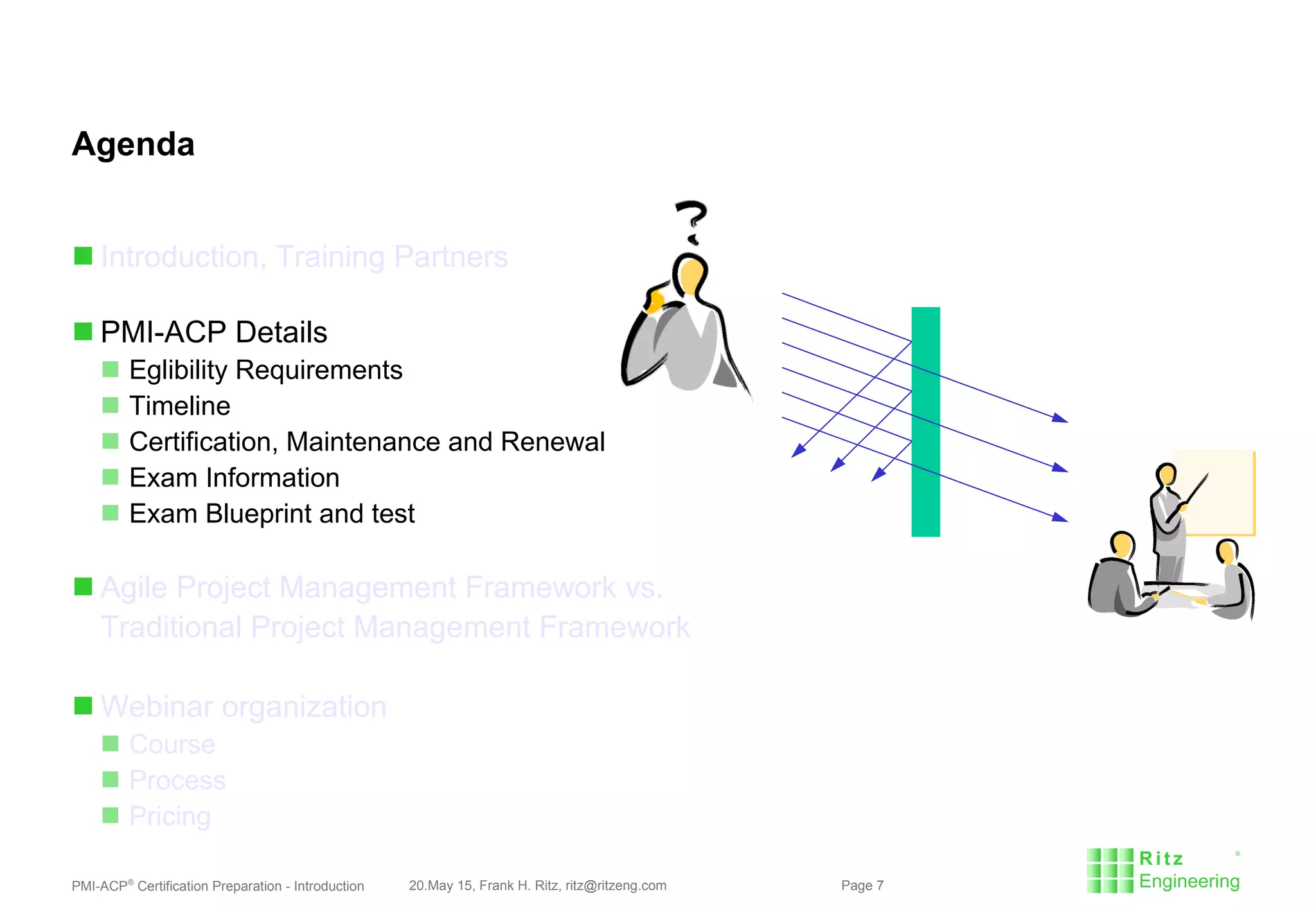
 PMI-ACP Details
 Eglibility Requirements
 Timeline
 Certification, Maintenance and Renewal
 Exam Information
 Exam Blueprint and test
 Agile Project Management Framework vs.
Traditional Project Management Framework
 Webinar organization
 Course
 Process
 Pricing
PMI-ACP®
Certification Preparation - Introduction 20.May 15, Frank H. Ritz, ritz@ritzeng.com Page 4
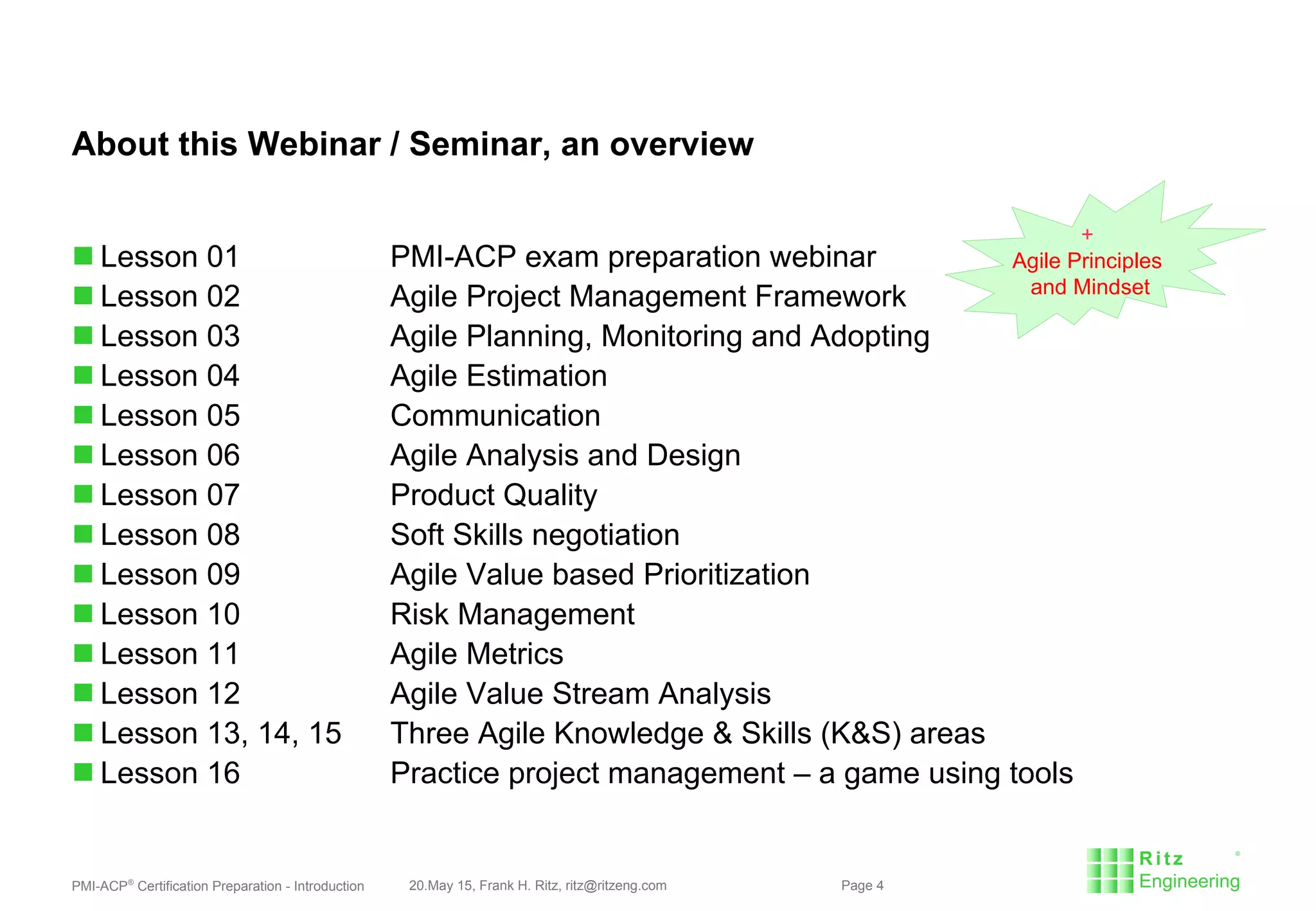
About this Webinar / Seminar, an overview
 Lesson 01 PMI-ACP exam preparation webinar
 Lesson 02 Agile Project Management Framework
 Lesson 03 Agile Planning, Monitoring and Adopting
 Lesson 04 Agile Estimation
 Lesson 05 Communication
 Lesson 06 Agile Analysis and Design
 Lesson 07 Product Quality
 Lesson 08 Soft Skills negotiation
 Lesson 09 Agile Value based Prioritization
 Lesson 10 Risk Management
 Lesson 11 Agile Metrics
 Lesson 12 Agile Value Stream Analysis
 Lesson 13, 14, 15 Three Agile Knowledge & Skills (K&S) areas
 Lesson 16 Practice project management – a game using tools
+
Agile Principles
and Mindset
PMI-ACP®
Certification Preparation - Introduction 20.May 15, Frank H. Ritz, ritz@ritzeng.com Page 5
Introduction – Training Partners
 The Project Management Institute (PMI®
)
 is a not-for-profit professional organization
 for the project management profession
 with the purpose of advancing project management.
 Santis Training AG (R.E.P. ID 2851) provides different PMI®
based trainings like:
 PMP®
 CAPM®
 PMI-ACP®
(historically written as PMI-ACP℠ )
 Ritz Engineering GmbH is a consultant company with strong profession on Agile
Project Management and Agile Requirements Engineering
(see http://pmi-acp.methoden.ch)
®
PMI-ACP®
Certification Preparation - Introduction 20.May 15, Frank H. Ritz, ritz@ritzeng.com Page 6
Course – the trainer
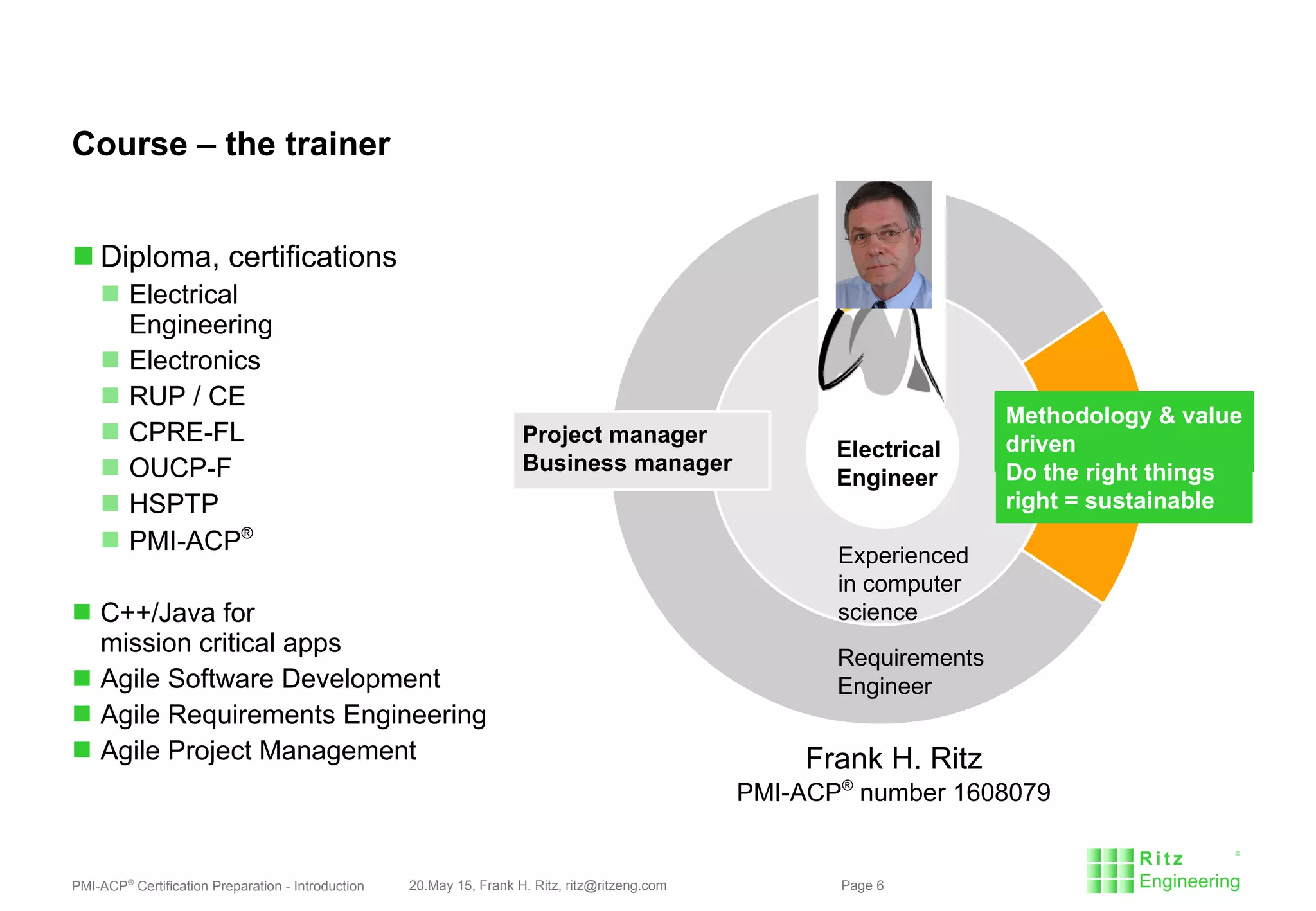
Frank H. Ritz
PMI-ACP®
number 1608079
 Diploma, certifications
 Electrical
Engineering
 Electronics
 RUP / CE
 CPRE-FL
 OUCP-F
 HSPTP
 PMI-ACP®
 C++/Java for
mission critical apps
 Agile Software Development
 Agile Requirements Engineering
 Agile Project Management
Electrical
Engineer
Experienced
in computer
science
Requirements
Engineer
Project manager
Business manager
Methodology & value
driven
Do the right things
right = sustainable
PMI-ACP®
Certification Preparation - Introduction 20.May 15, Frank H. Ritz, ritz@ritzeng.com Page 7
Agenda
 Introduction, Training Partners
 PMI-ACP Details
 Eglibility Requirements
 Timeline
 Certification, Maintenance and Renewal
 Exam Information
 Exam Blueprint and test
 Agile Project Management Framework vs.
Traditional Project Management Framework
 Webinar organization
 Course
 Process
 Pricing
PMI-ACP®
Certification Preparation - Introduction 20.May 15, Frank H. Ritz, ritz@ritzeng.com Page 8
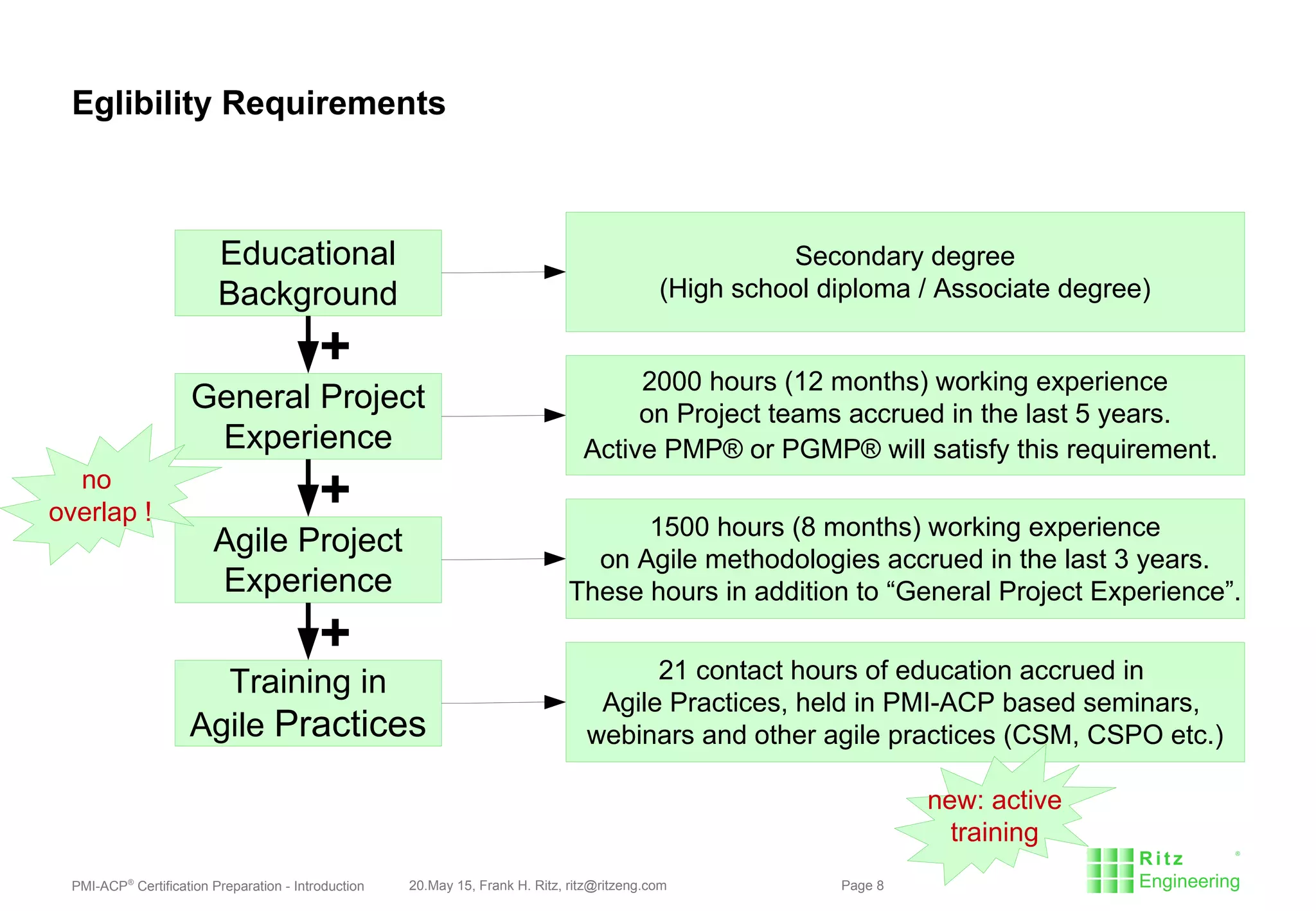
Eglibility Requirements
Agile Project
Experience
General Project
Experience
Educational
Background
Training in
Agile Practices
1500 hours (8 months) working experience
on Agile methodologies accrued in the last 3 years.
These hours in addition to “General Project Experience”.
2000 hours (12 months) working experience
on Project teams accrued in the last 5 years.
Active PMP® or PGMP® will satisfy this requirement.
Secondary degree
(High school diploma / Associate degree)
21 contact hours of education accrued in
Agile Practices, held in PMI-ACP based seminars,
webinars and other agile practices (CSM, CSPO etc.)
+
+
+
no
overlap !
new: active
training
PMI-ACP®
Certification Preparation - Introduction 20.May 15, Frank H. Ritz, ritz@ritzeng.com Page 9
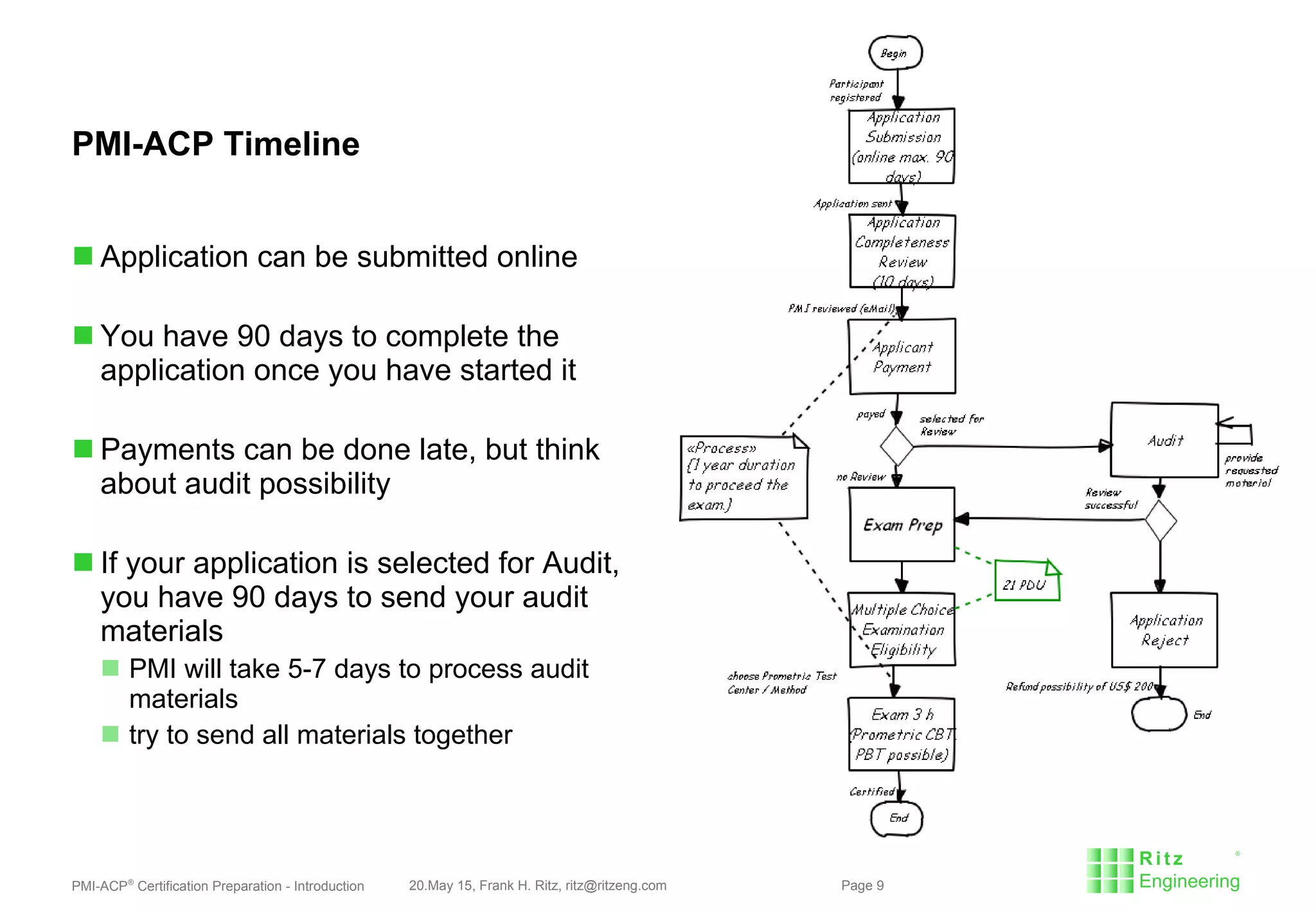
PMI-ACP Timeline
 Application can be submitted online
 You have 90 days to complete the
application once you have started it
 Payments can be done late, but think
about audit possibility
 If your application is selected for Audit,
you have 90 days to send your audit
materials
 PMI will take 5-7 days to process audit
materials
 try to send all materials together
PMI-ACP®
Certification Preparation - Introduction 20.May 15, Frank H. Ritz, ritz@ritzeng.com Page 10
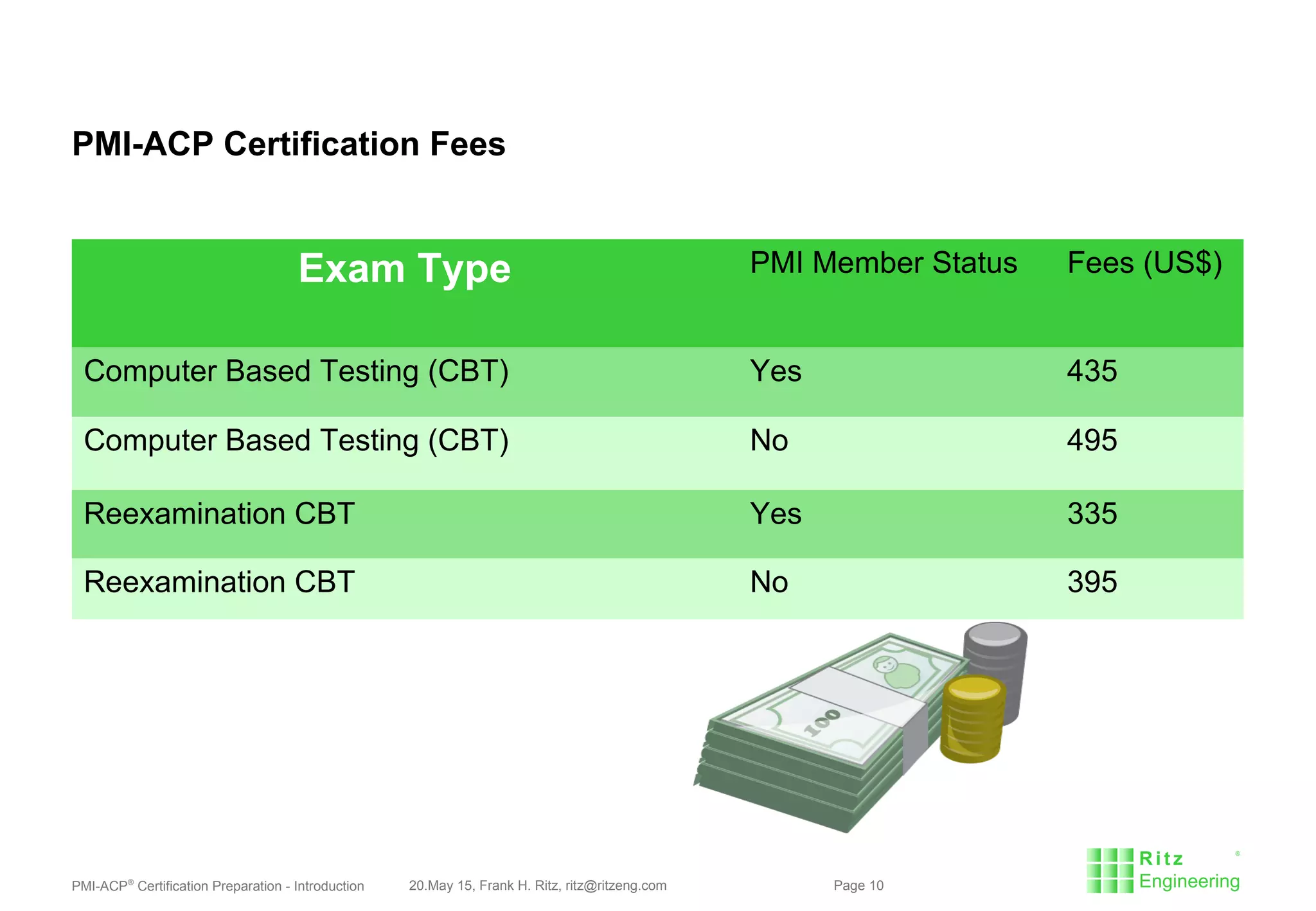
PMI-ACP Certification Fees
Exam Type PMI Member Status Fees (US$)
Computer Based Testing (CBT) Yes 435
Computer Based Testing (CBT) No 495
Reexamination CBT Yes 335
Reexamination CBT No 395
PMI-ACP®
Certification Preparation - Introduction 20.May 15, Frank H. Ritz, ritz@ritzeng.com Page 11
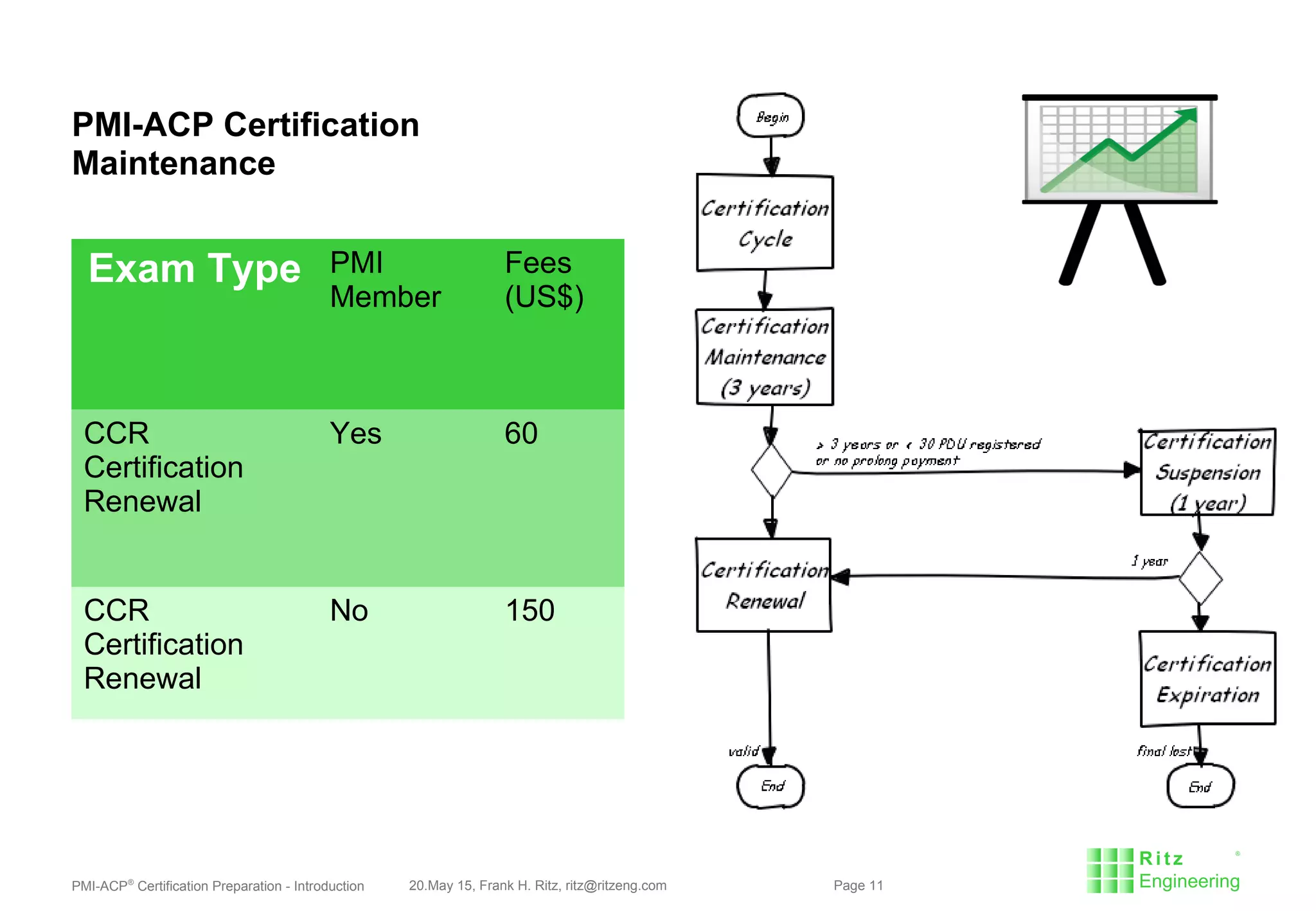
PMI-ACP Certification
Maintenance
Exam Type PMI
Member
Fees
(US$)
CCR
Certification
Renewal
Yes 60
CCR
Certification
Renewal
No 150
PMI-ACP®
Certification Preparation - Introduction 20.May 15, Frank H. Ritz, ritz@ritzeng.com Page 12
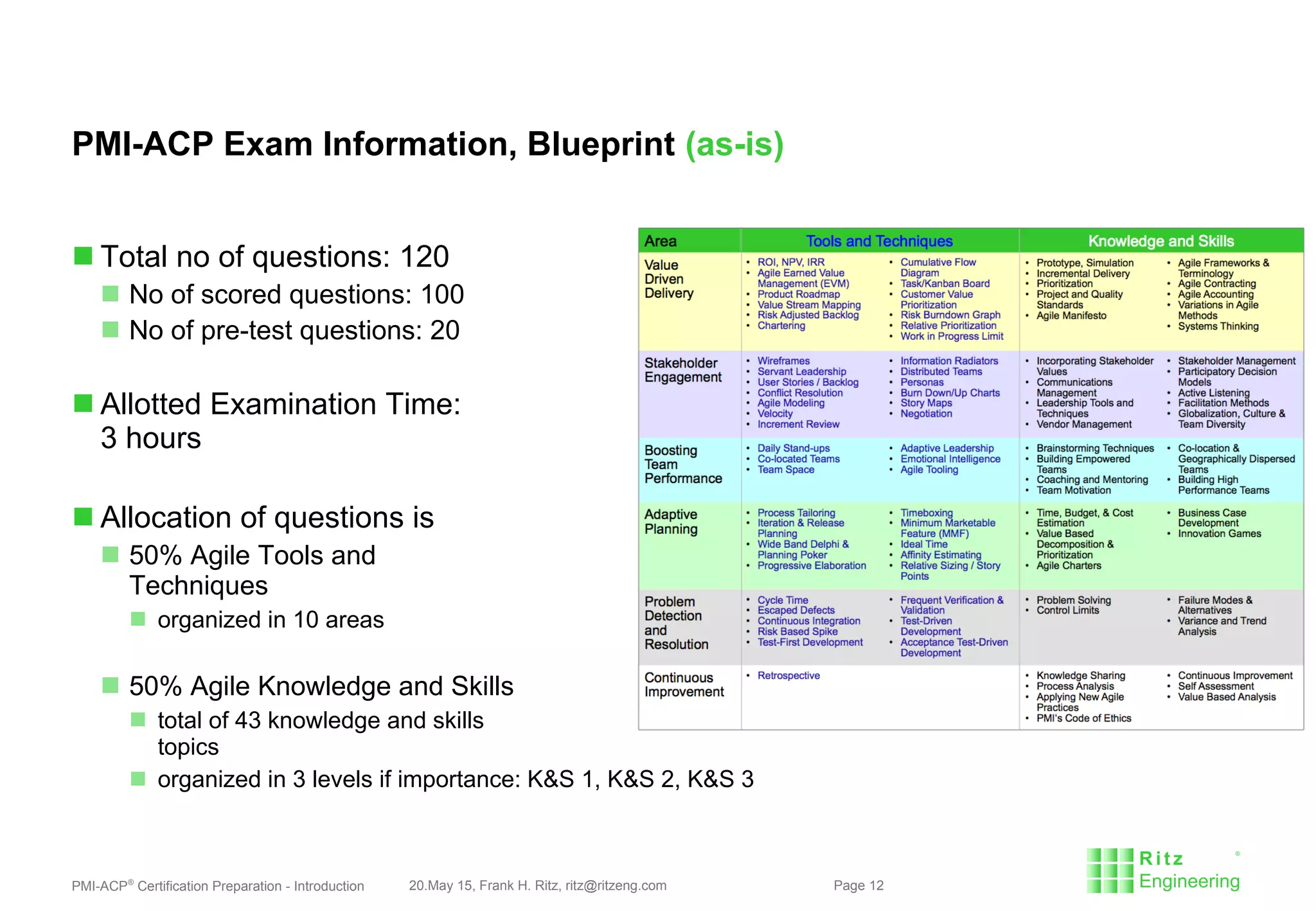
PMI-ACP Exam Information, Blueprint (as-is)
 Total no of questions: 120
 No of scored questions: 100
 No of pre-test questions: 20
 Allotted Examination Time:
3 hours
 Allocation of questions is
 50% Agile Tools and
Techniques
 organized in 10 areas
 50% Agile Knowledge and Skills
 total of 43 knowledge and skills
topics
 organized in 3 levels if importance: K&S 1, K&S 2, K&S 3
PMI-ACP®
Certification Preparation - Introduction 20.May 15, Frank H. Ritz, ritz@ritzeng.com Page 13
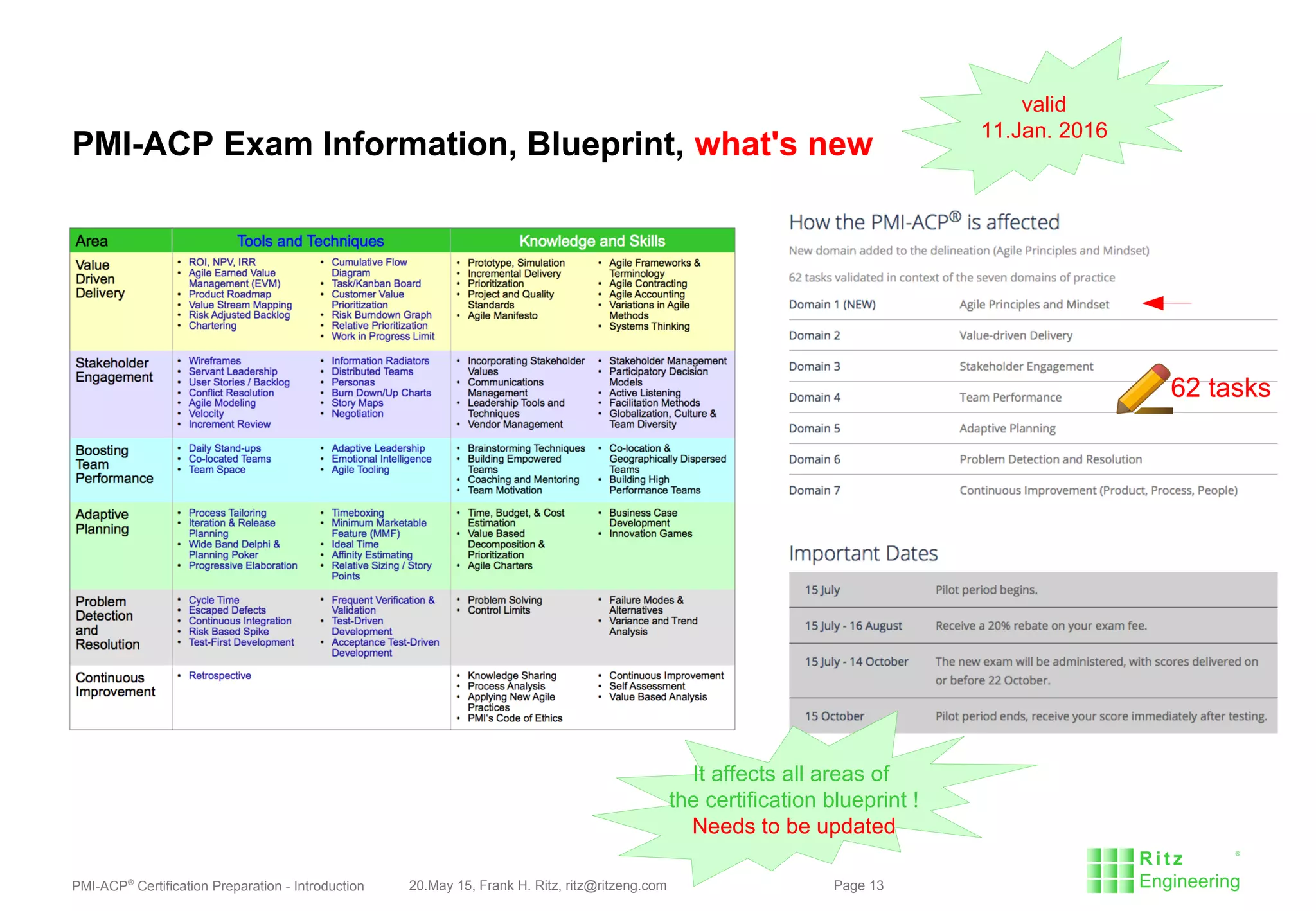
PMI-ACP Exam Information, Blueprint, what's new
It affects all areas of
the certification blueprint !
Needs to be updated
valid
11.Jan. 2016
62 tasks
PMI-ACP®
Certification Preparation - Introduction 20.May 15, Frank H. Ritz, ritz@ritzeng.com Page 14
PMI-ACP Exam Information, Blueprint, what's new
It affects all areas of
the certification blueprint !
Needs to be updated
valid
11.Jan. 2016
PMI-ACP®
Certification Preparation - Introduction 20.May 15, Frank H. Ritz, ritz@ritzeng.com Page 15
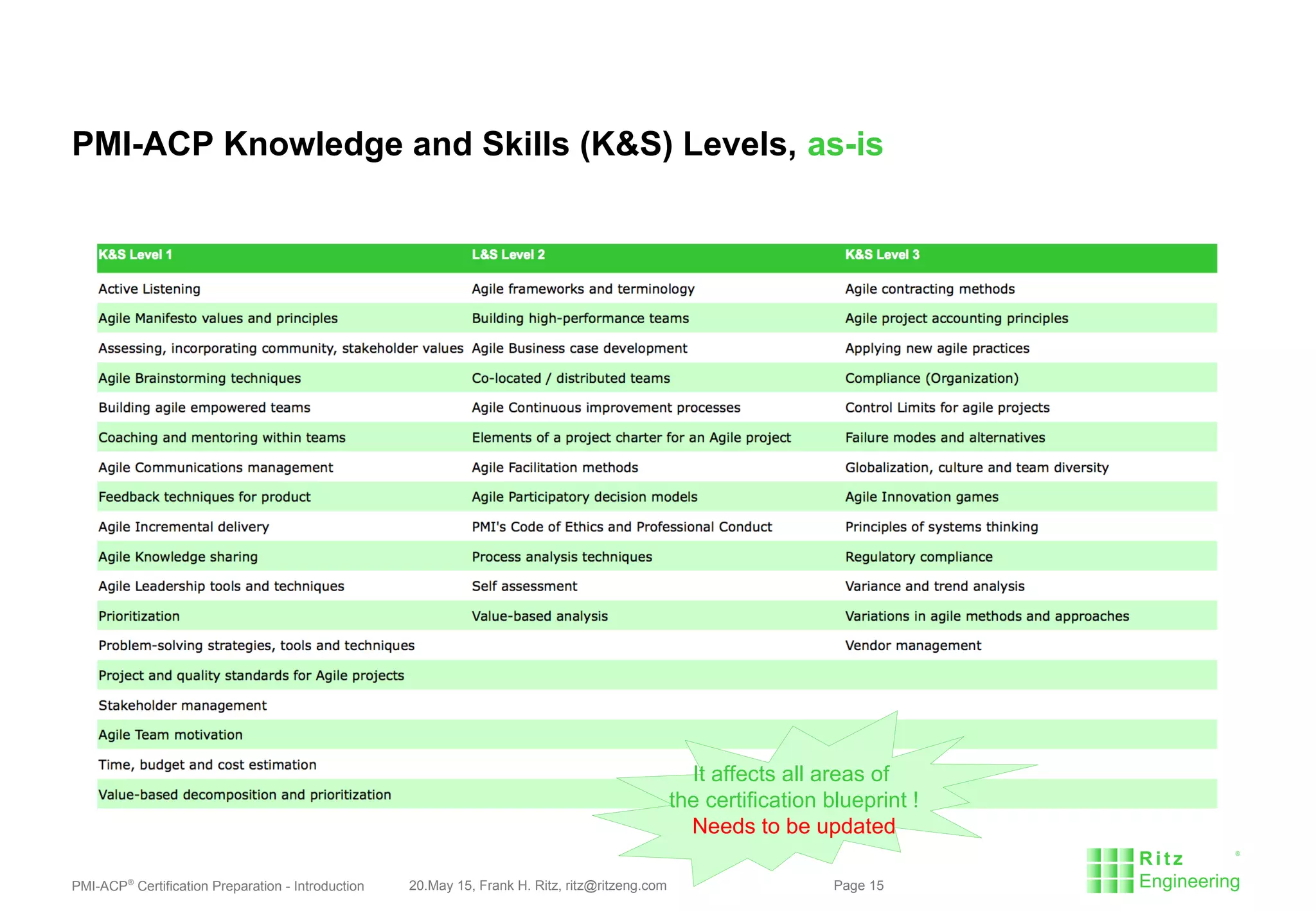
PMI-ACP Knowledge and Skills (K&S) Levels, as-is
It affects all areas of
the certification blueprint !
Needs to be updated
PMI-ACP®
Certification Preparation - Introduction 20.May 15, Frank H. Ritz, ritz@ritzeng.com Page 16
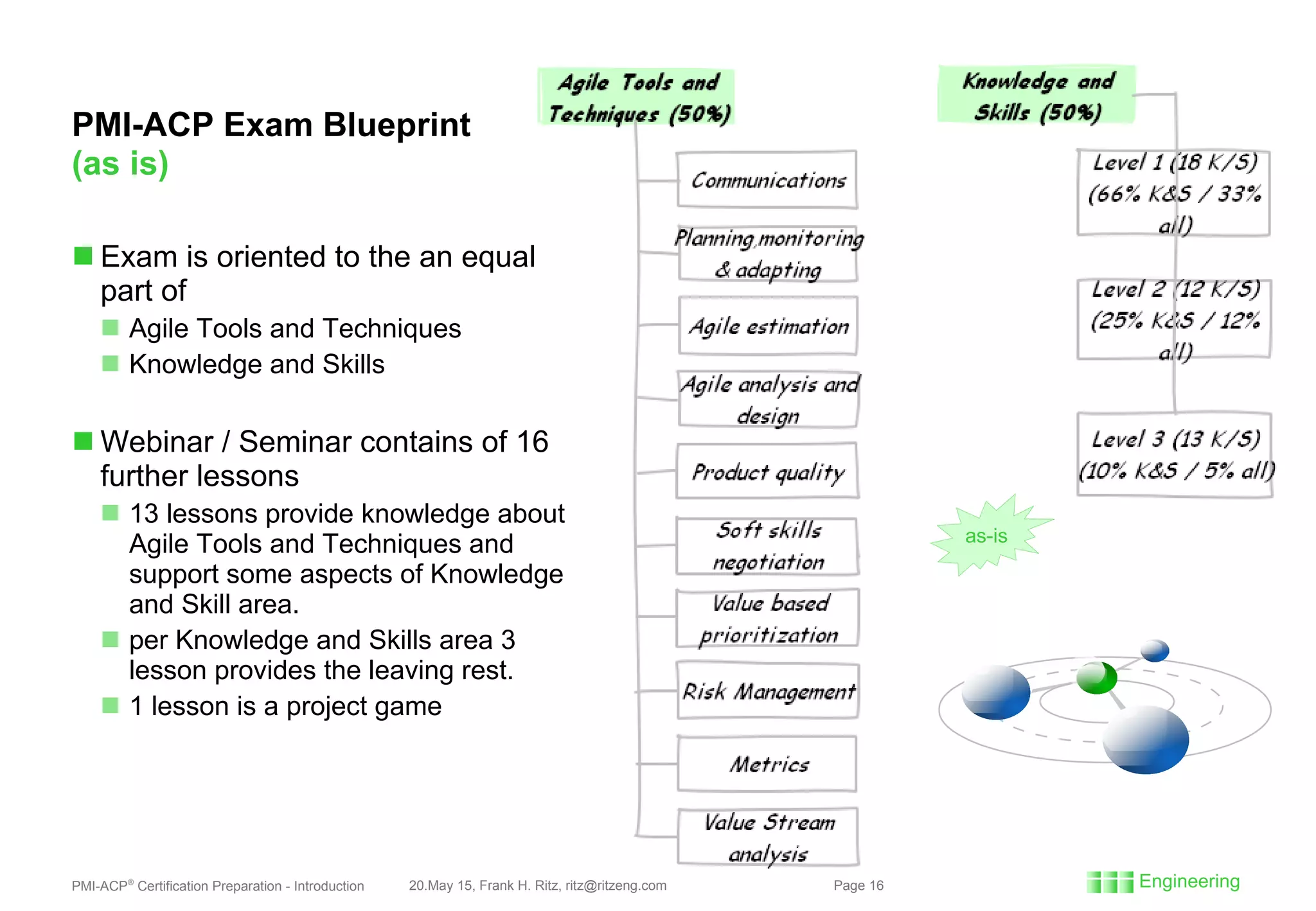
PMI-ACP Exam Blueprint
(as is)
 Exam is oriented to the an equal
part of
 Agile Tools and Techniques
 Knowledge and Skills
 Webinar / Seminar contains of 16
further lessons
 13 lessons provide knowledge about
Agile Tools and Techniques and
support some aspects of Knowledge
and Skill area.
 per Knowledge and Skills area 3
lesson provides the leaving rest.
 1 lesson is a project game
as-is
PMI-ACP®
Certification Preparation - Introduction 20.May 15, Frank H. Ritz, ritz@ritzeng.com Page 17
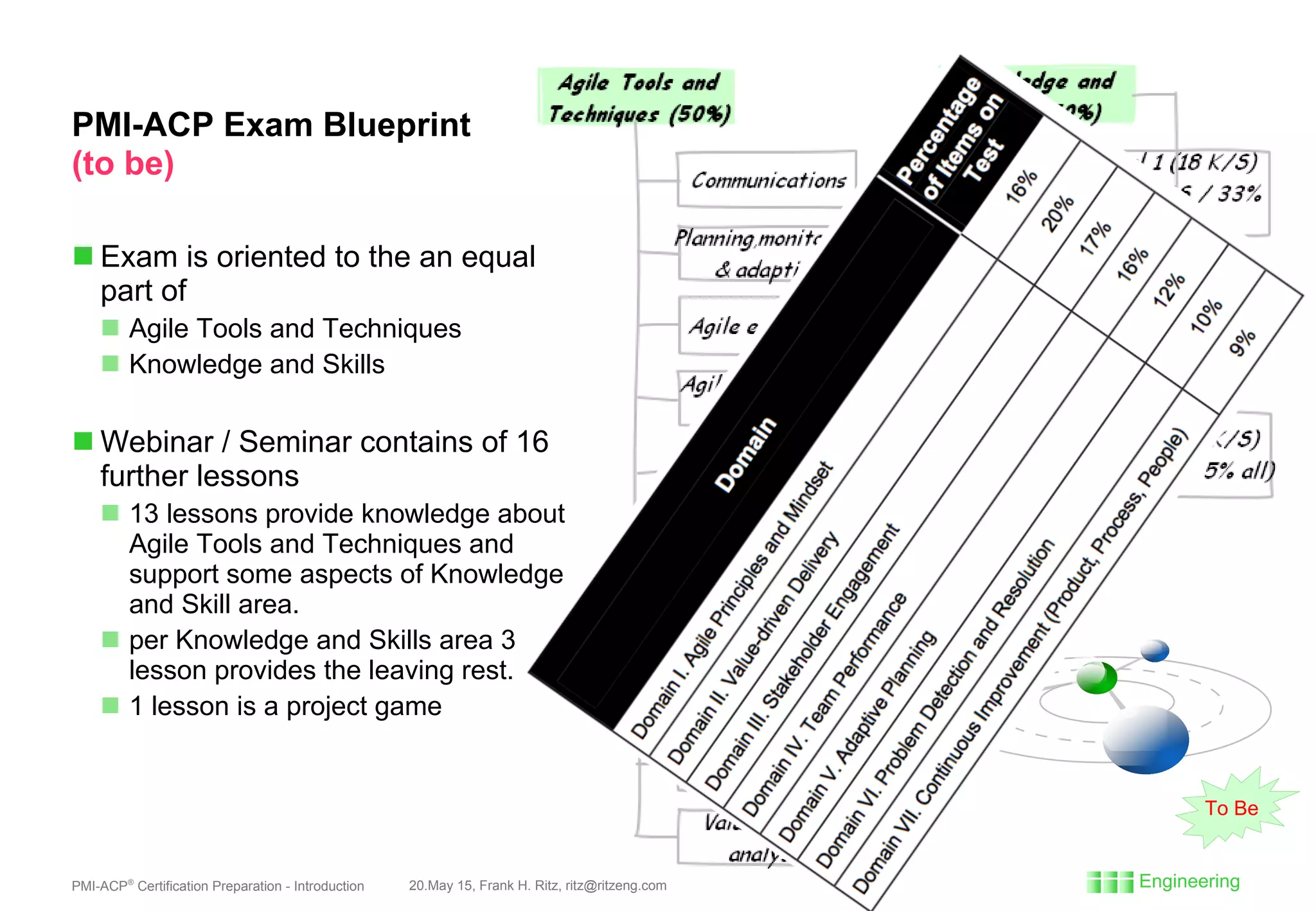
PMI-ACP Exam Blueprint
(to be)
 Exam is oriented to the an equal
part of
 Agile Tools and Techniques
 Knowledge and Skills
 Webinar / Seminar contains of 16
further lessons
 13 lessons provide knowledge about
Agile Tools and Techniques and
support some aspects of Knowledge
and Skill area.
 per Knowledge and Skills area 3
lesson provides the leaving rest.
 1 lesson is a project game
To Be
PMI-ACP®
Certification Preparation - Introduction 20.May 15, Frank H. Ritz, ritz@ritzeng.com Page 18
Agenda
 Introduction, Training Partners
 PMI-ACP Details
 Eglibility Requirements
 Timeline
 Certification, Maintenance and Renewal
 Exam Information
 Exam Blueprint and test
 Agile Project Management Framework vs.
Traditional Project Management Framework
 Webinar organization
 Course
 Process
 Pricing
PMI-ACP®
Certification Preparation - Introduction 20.May 15, Frank H. Ritz, ritz@ritzeng.com Page 19
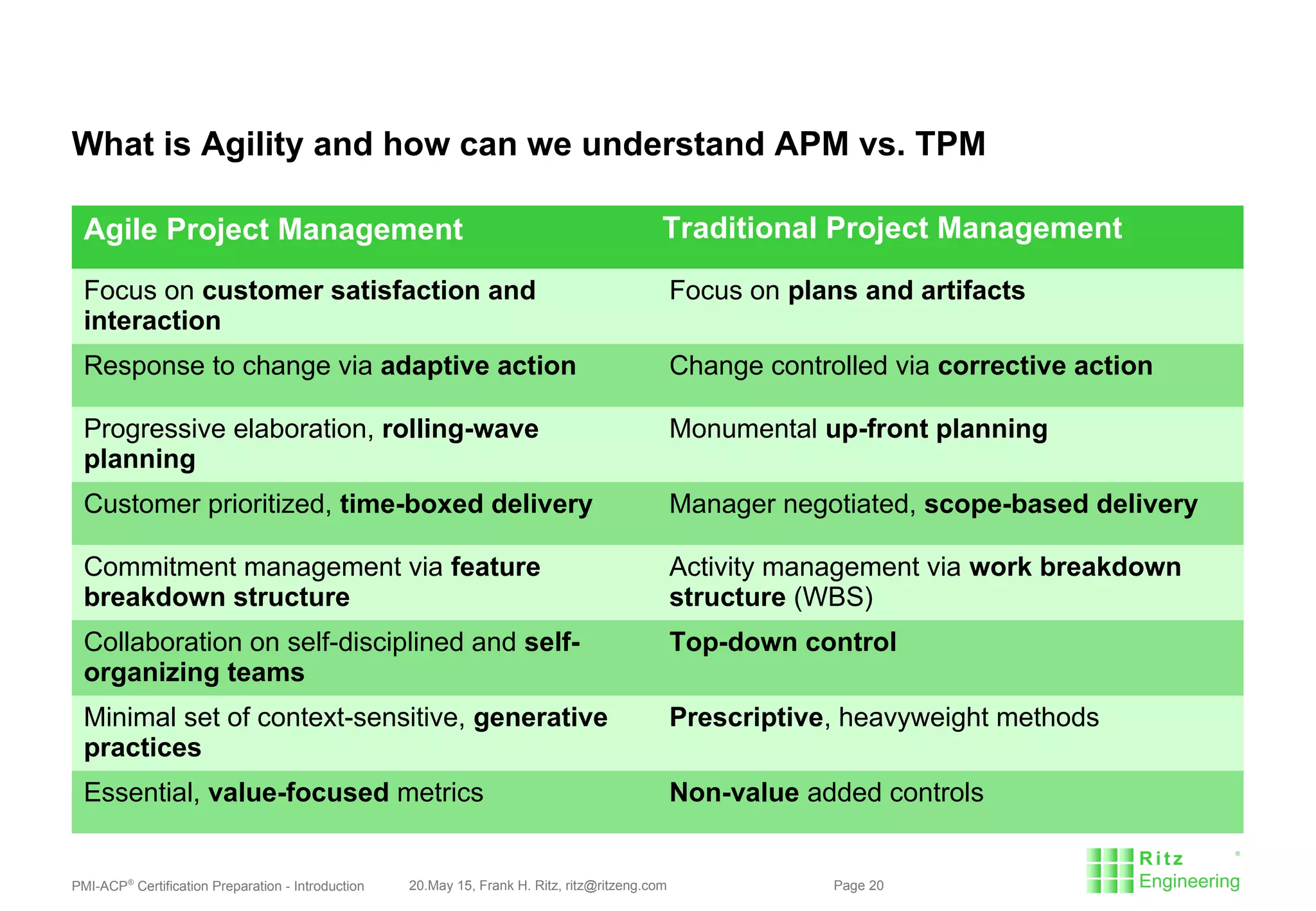
What is Agility and how can we understand APM vs. TPM
Agile Project Management Traditional Project Management
Focus on customer satisfaction and
interaction
Focus on plans and artifacts
Response to change via adaptive action Change controlled via corrective action
Progressive elaboration, rolling-wave
planning
Monumental up-front planning
Customer prioritized, time-boxed delivery Manager negotiated, scope-based delivery
Commitment management via feature
breakdown structure
Activity management via work breakdown
structure (WBS)
Collaboration on self-disciplined and self-
organizing teams
Top-down control
Minimal set of context-sensitive, generative
practices
Prescriptive, heavyweight methods
Essential, value-focused metrics Non-value added controls
PMI-ACP®
Certification Preparation - Introduction 20.May 15, Frank H. Ritz, ritz@ritzeng.com Page 20
What is Agility and how can we understand APM vs. TPM
Agile Project Management Traditional Project Management
Focus on customer satisfaction and
interaction
Focus on plans and artifacts
Response to change via adaptive action Change controlled via corrective action
Progressive elaboration, rolling-wave
planning
Monumental up-front planning
Customer prioritized, time-boxed delivery Manager negotiated, scope-based delivery
Commitment management via feature
breakdown structure
Activity management via work breakdown
structure (WBS)
Collaboration on self-disciplined and self-
organizing teams
Top-down control
Minimal set of context-sensitive, generative
practices
Prescriptive, heavyweight methods
Essential, value-focused metrics Non-value added controls
PMI-ACP®
Certification Preparation - Introduction 20.May 15, Frank H. Ritz, ritz@ritzeng.com Page 21
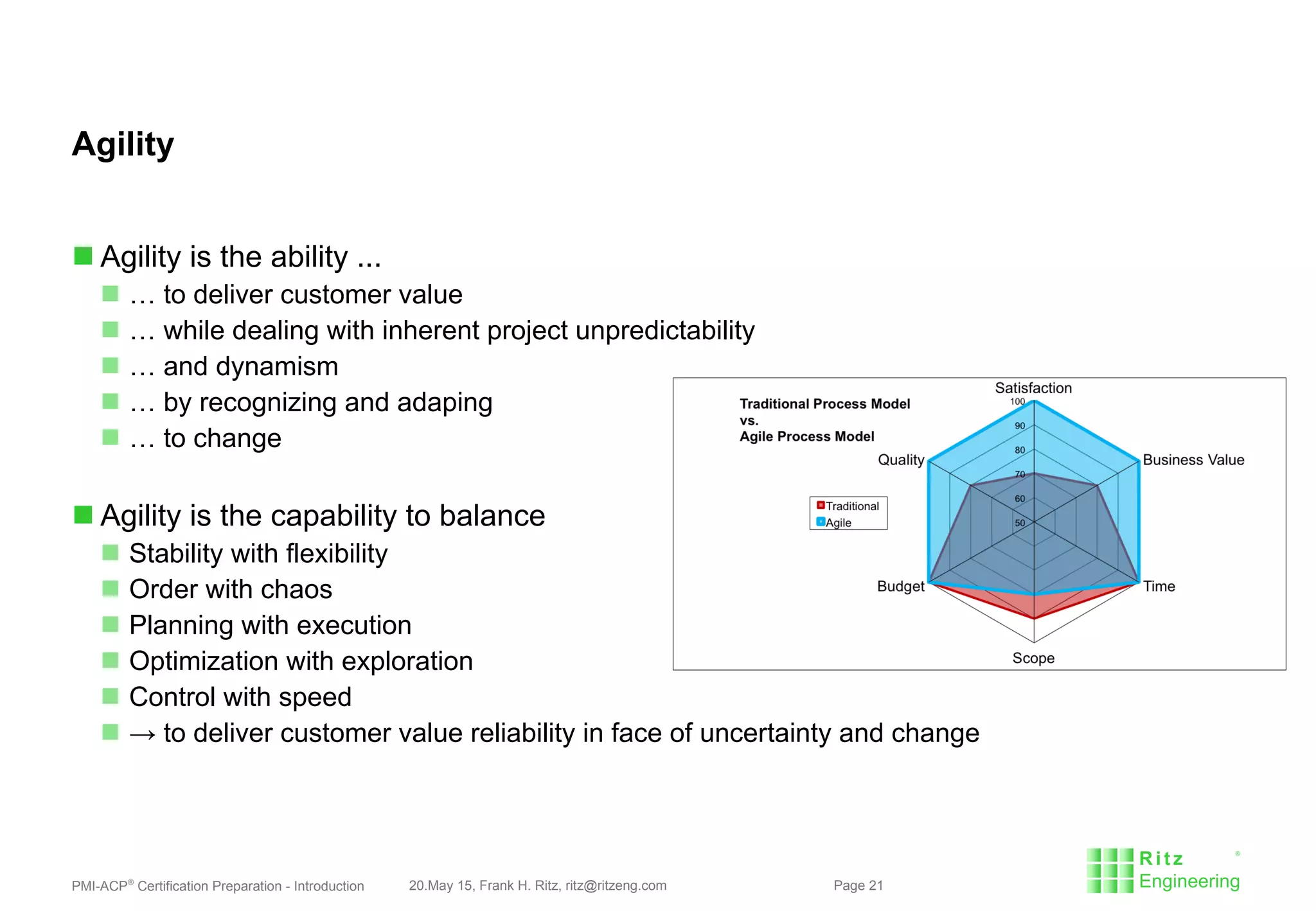
Agility
 Agility is the ability ...
 … to deliver customer value
 … while dealing with inherent project unpredictability
 … and dynamism
 … by recognizing and adaping
 … to change
 Agility is the capability to balance
 Stability with flexibility
 Order with chaos
 Planning with execution
 Optimization with exploration
 Control with speed
 → to deliver customer value reliability in face of uncertainty and change
PMI-ACP®
Certification Preparation - Introduction 20.May 15, Frank H. Ritz, ritz@ritzeng.com Page 22
Agility
 Agility is the ability ...
 … to deliver customer value
 … while dealing with inherent project unpredictability
 … and dynamism
 … by recognizing and adaping
 … to change
 Agility is the capability to balance
 Stability with flexibility
 Order with chaos
 Planning with execution
 Optimization with exploration
 Control with speed
 → to deliver customer value reliability in face of uncertainty and change
PMI-ACP®
Certification Preparation - Introduction 20.May 15, Frank H. Ritz, ritz@ritzeng.com Page 23
Agile Manifesto
Values Principles
PMI-ACP®
Certification Preparation - Introduction 20.May 15, Frank H. Ritz, ritz@ritzeng.com Page 24
Agile Manifesto
K&S 1
PMI-ACP®
Certification Preparation - Introduction 20.May 15, Frank H. Ritz, ritz@ritzeng.com Page 25
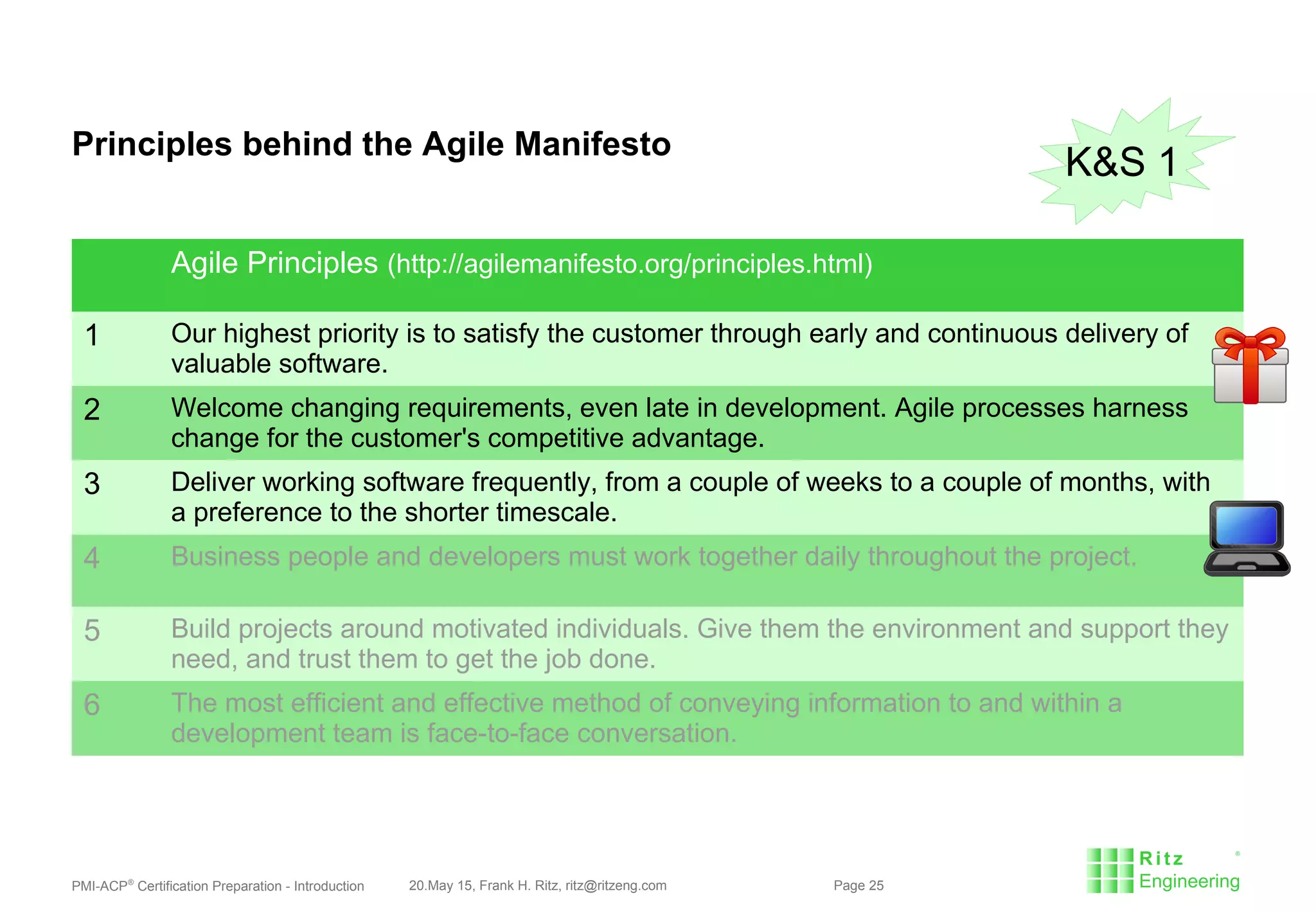
Principles behind the Agile Manifesto
K&S 1
Agile Principles (http://agilemanifesto.org/principles.html)
1 Our highest priority is to satisfy the customer through early and continuous delivery of
valuable software.
2 Welcome changing requirements, even late in development. Agile processes harness
change for the customer's competitive advantage.
3 Deliver working software frequently, from a couple of weeks to a couple of months, with
a preference to the shorter timescale.
4 Business people and developers must work together daily throughout the project.
5 Build projects around motivated individuals. Give them the environment and support they
need, and trust them to get the job done.
6 The most efficient and effective method of conveying information to and within a
development team is face-to-face conversation.
PMI-ACP®
Certification Preparation - Introduction 20.May 15, Frank H. Ritz, ritz@ritzeng.com Page 26
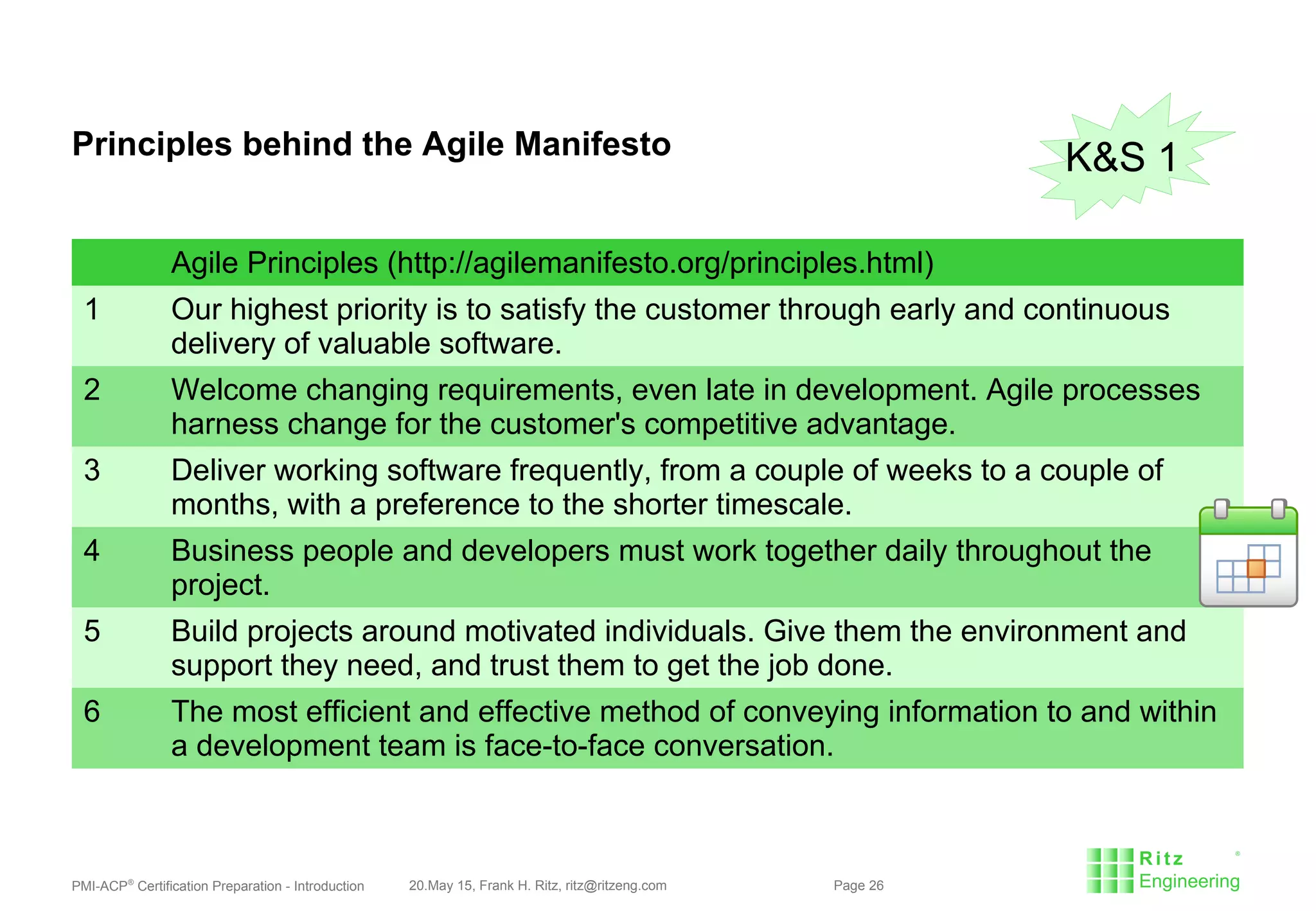
Principles behind the Agile Manifesto K&S 1
Agile Principles (http://agilemanifesto.org/principles.html)
1 Our highest priority is to satisfy the customer through early and continuous
delivery of valuable software.
2 Welcome changing requirements, even late in development. Agile processes
harness change for the customer's competitive advantage.
3 Deliver working software frequently, from a couple of weeks to a couple of
months, with a preference to the shorter timescale.
4 Business people and developers must work together daily throughout the
project.
5 Build projects around motivated individuals. Give them the environment and
support they need, and trust them to get the job done.
6 The most efficient and effective method of conveying information to and within
a development team is face-to-face conversation.
PMI-ACP®
Certification Preparation - Introduction 20.May 15, Frank H. Ritz, ritz@ritzeng.com Page 27
Principles behind the Agile Manifesto K&S 1
Agile Principles (http://agilemanifesto.org/principles.html)
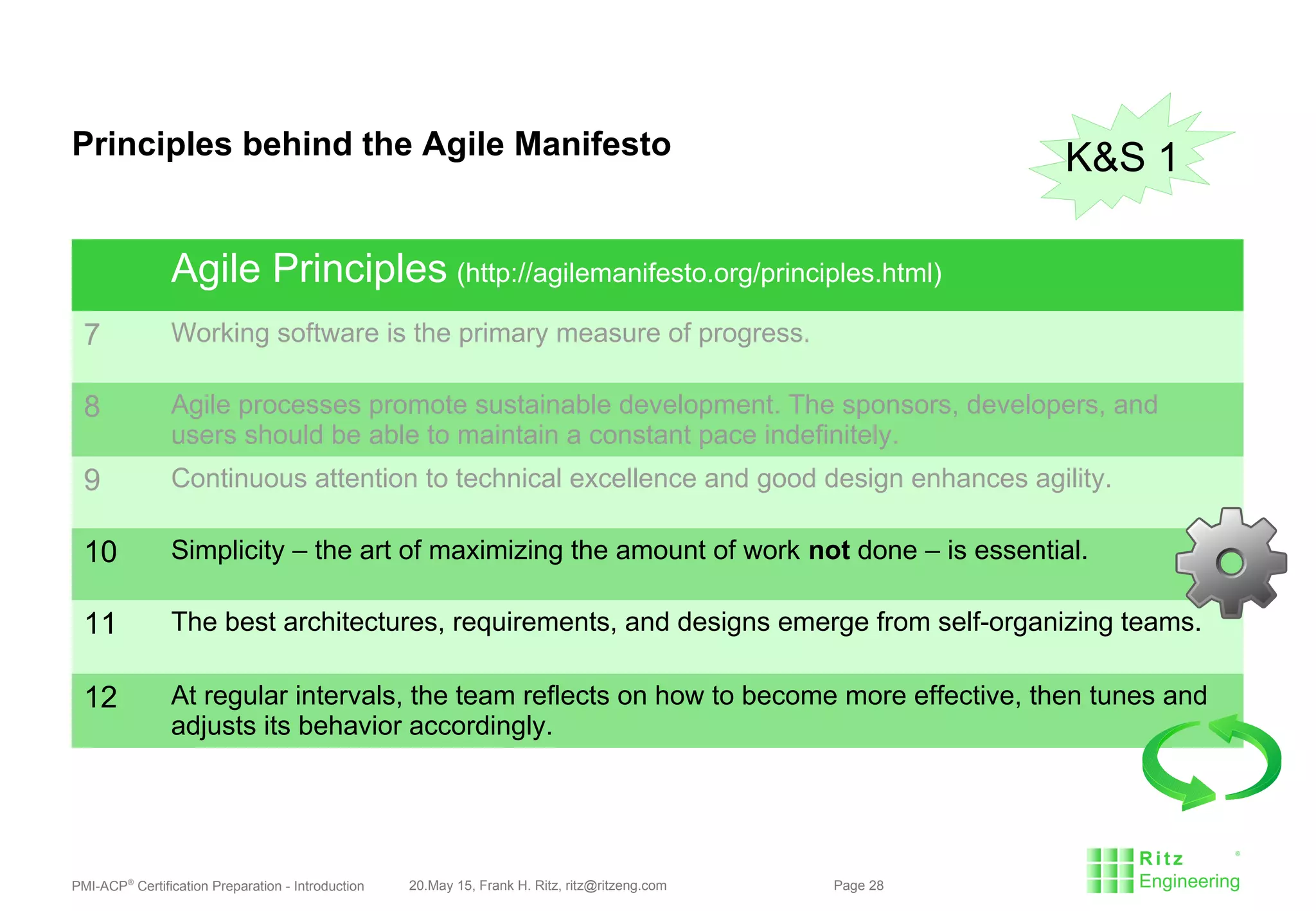
7 Working software is the primary measure of progress.
8 Agile processes promote sustainable development. The sponsors, developers, and
users should be able to maintain a constant pace indefinitely.
9 Continuous attention to technical excellence and good design enhances agility.
10 Simplicity – the art of maximizing the amount of work not done – is essential.
11 The best architectures, requirements, and designs emerge from self-organizing teams.
12 At regular intervals, the team reflects on how to become more effective, then tunes and
adjusts its behavior accordingly.
It's not only all about
working software
PMI-ACP®
Certification Preparation - Introduction 20.May 15, Frank H. Ritz, ritz@ritzeng.com Page 28
Principles behind the Agile Manifesto K&S 1
Agile Principles (http://agilemanifesto.org/principles.html)
7 Working software is the primary measure of progress.
8 Agile processes promote sustainable development. The sponsors, developers, and
users should be able to maintain a constant pace indefinitely.
9 Continuous attention to technical excellence and good design enhances agility.
10 Simplicity – the art of maximizing the amount of work not done – is essential.
11 The best architectures, requirements, and designs emerge from self-organizing teams.
12 At regular intervals, the team reflects on how to become more effective, then tunes and
adjusts its behavior accordingly.
PMI-ACP®
Certification Preparation - Introduction 20.May 15, Frank H. Ritz, ritz@ritzeng.com Page 29
Principles
 Focus on business need
 Deliver on time
 Collaborate
 Never compromise quality
 Build incrementally from
firm foundations
 Develop iteratively
 Communicate continuously
and clearly
 Demonstrate control
K&S 1
PMI-ACP®
Certification Preparation - Introduction 20.May 15, Frank H. Ritz, ritz@ritzeng.com Page 30
Principles
 Focus on business need
 Deliver on time
 Collaborate
 Never compromise quality
 Build incrementally from
firm foundations
 Develop iteratively
 Communicate continuously
and clearly
 Demonstrate control
K&S 1
PMI-ACP®
Certification Preparation - Introduction 20.May 15, Frank H. Ritz, ritz@ritzeng.com Page 31
Principles
 Focus on business need
 Deliver on time
 Collaborate
 Never compromise quality
 Build incrementally from
firm foundations
 Develop iteratively
 Communicate continuously
and clearly
 Demonstrate control
K&S 1
PMI-ACP®
Certification Preparation - Introduction 20.May 15, Frank H. Ritz, ritz@ritzeng.com Page 32
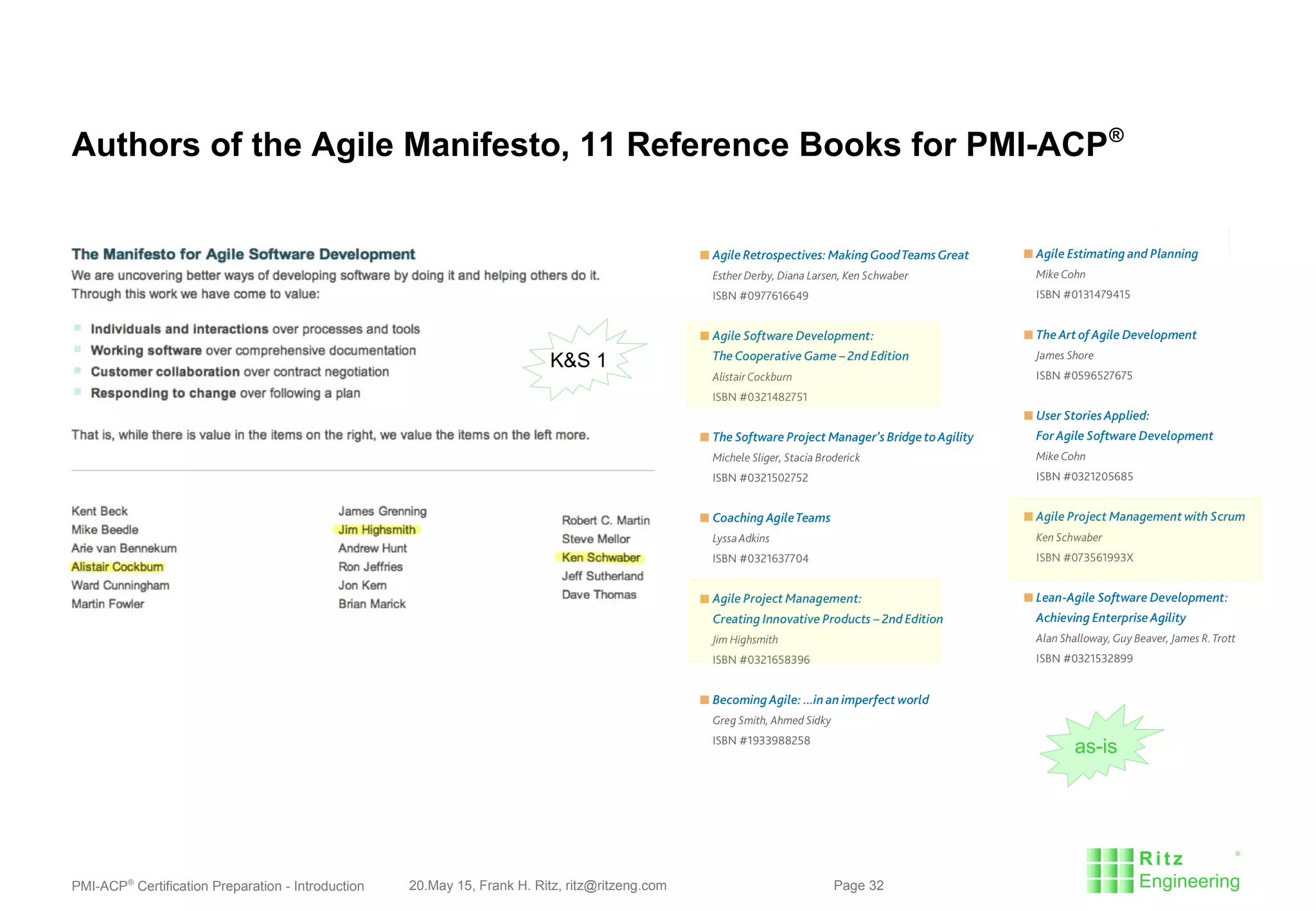
Authors of the Agile Manifesto, 11 Reference Books for PMI-ACP®
K&S 1
as-is
PMI-ACP®
Certification Preparation - Introduction 20.May 15, Frank H. Ritz, ritz@ritzeng.com Page 33
Authors of the Agile Manifesto, 12 Reference Books for PMI-ACP®
K&S 1
to-be
new
PMI-ACP®
Certification Preparation - Introduction 20.May 15, Frank H. Ritz, ritz@ritzeng.com Page 34
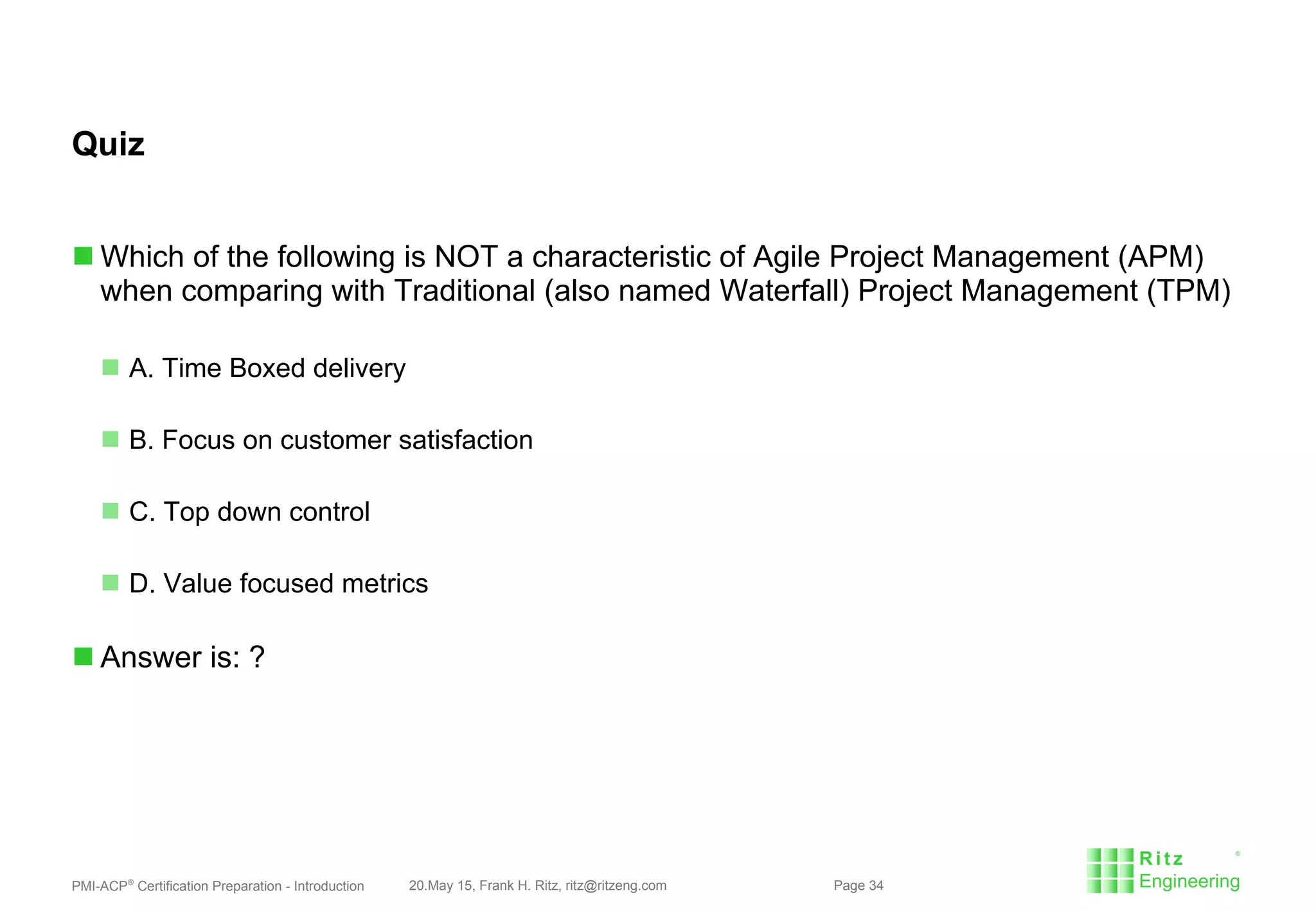
Quiz
 Which of the following is NOT a characteristic of Agile Project Management (APM)
when comparing with Traditional (also named Waterfall) Project Management (TPM)
 A. Time Boxed delivery
 B. Focus on customer satisfaction
 C. Top down control
 D. Value focused metrics
 Answer is: ?
PMI-ACP®
Certification Preparation - Introduction 20.May 15, Frank H. Ritz, ritz@ritzeng.com Page 35
Quiz
 Which of the following is NOT a characteristic of Agile Project Management (APM)
when comparing with Traditional (also named Waterfall) Project Management (TPM)
 A. Time Boxed delivery
 B. Focus on customer satisfaction
 C. Top down control
 D. Value focused metrics
 Answer is: C
 Top down control is not a characteristic of Agile Project Management (APM) whereas
i.e. Self Organizing Teams and the consequences of Timebox, Customer Satisfaction,
Value delivery is a characteristic of Agile Project Teams.
PMI-ACP®
Certification Preparation - Introduction 20.May 15, Frank H. Ritz, ritz@ritzeng.com Page 36
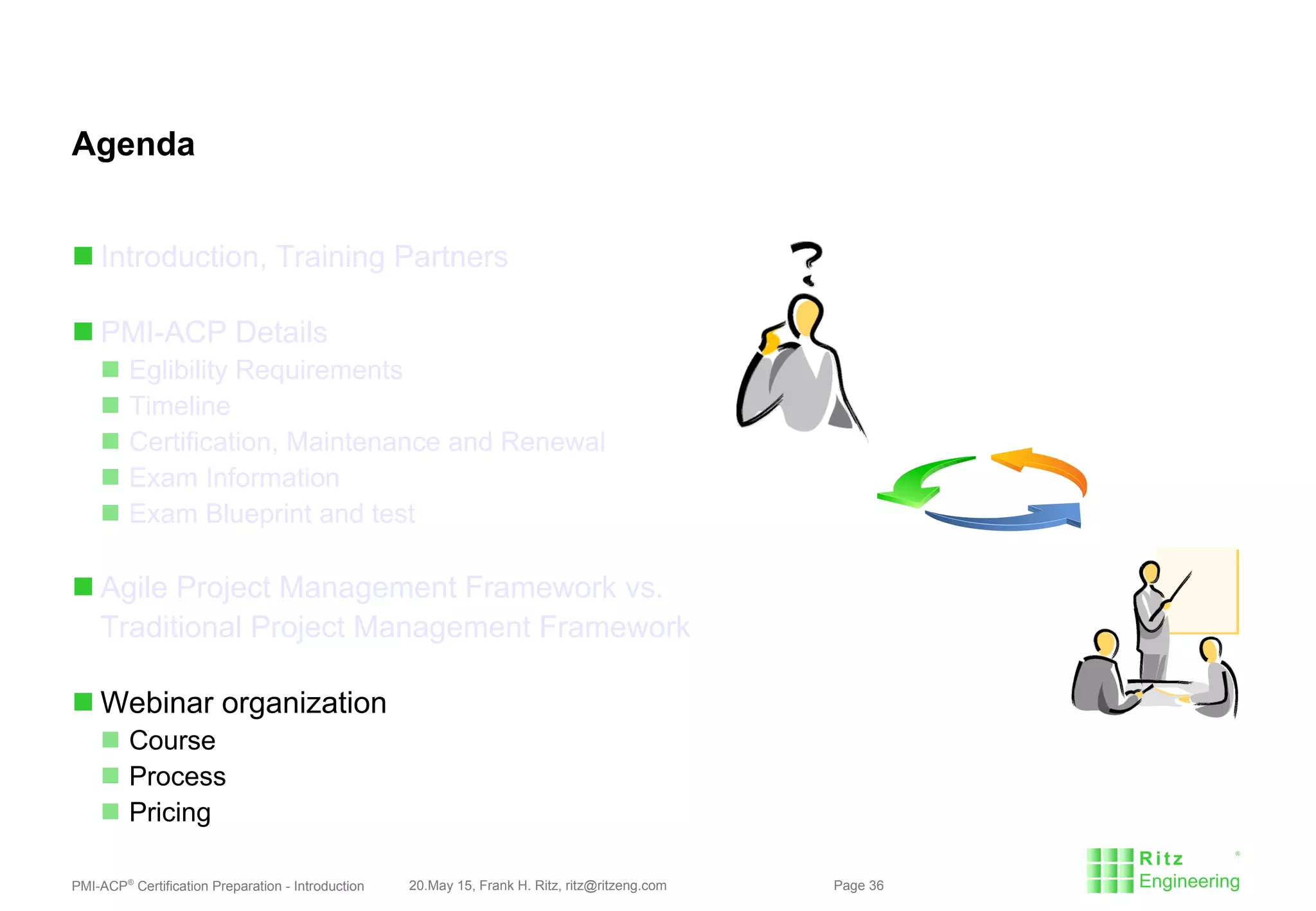
Agenda
 Introduction, Training Partners
 PMI-ACP Details
 Eglibility Requirements
 Timeline
 Certification, Maintenance and Renewal
 Exam Information
 Exam Blueprint and test
 Agile Project Management Framework vs.
Traditional Project Management Framework
 Webinar organization
 Course
 Process
 Pricing
PMI-ACP®
Certification Preparation - Introduction 20.May 15, Frank H. Ritz, ritz@ritzeng.com Page 37
Lessons and Structure
 Lesson 01 PMI-ACP exam preparation webinar
 Lesson 02 Agile Project Management Framework
 Lesson 03 Agile Planning, Monitoring and Adopting
 Lesson 04 Agile Estimation
 Lesson 05 Communication
 Lesson 06 Agile Analysis and Design
 Lesson 07 Product Quality
 Lesson 08 Soft Skills negotiation
 Lesson 09 Agile Value based Prioritization
 Lesson 10 Risk Management
 Lesson 11 Agile Metrics
 Lesson 12 Agile Value Stream Analysis
 Lesson 13, 14, 15 Three Agile Knowledge & Skills (K&S) areas
 Lesson 16 Practice project management – a game using tools
as-is
to be: +
Agile Principles
and Mindset
+
62 tasks changed
PMI-ACP®
Certification Preparation - Introduction 20.May 15, Frank H. Ritz, ritz@ritzeng.com Page 38
Webinar process steps
 Register at edudip to record your online attendance by name (no pseudos !)
 Make payment at http://pmi-acp.methoden.ch or at Santis Training
 Provide your edudip eMail address in payment (invoice sent to this eMail !)
 10-40 students / classroom = 1 stream
 Stream lasts 10-11 weeks.
 Stream starts if min. students / classroom is reached
 if class doesn't reach 10 students, stream starts with min. 5 students within 3 weeks
 1st
introducing session organize setup like stream, communication, schedule and
provides again the following content
 Immediately after the 30th session Santis Training AG (PMI R.E.P. ID 2851) issues a
“Certificate of Completion” certify 21 PDU to the student
®
PMI-ACP®
Certification Preparation - Introduction 20.May 15, Frank H. Ritz, ritz@ritzeng.com Page 39
Webinar Organization
 Class Organization
 Commitment to 3 webinars / week, 10 weeks
 2 evening webinars during Monday – Friday e.g. 19:30
 1 webinar at Saturday morning e.g. 10:00
 Share of the class members contacts (private per webinar class)
 recommended to build student groups
 recommended to share questions in the webinar edudip forum
 Unbound Class members can switch between classes until exam was passed
 Webinar organization
 45-50 min. of content presentation (English)
 10-15 min. of discussions and questions (English or German)
 Students can raise their hands and takeover
 Students can use the microphone, camera, screen
 Video recording on all webinars of the class
 21 hours (of 30 possible hours) of online attendance needed to reach 21 PDU
 offering the possibility to visit 21 sessions and watch other sessions by recorded video.
PMI-ACP®
Certification Preparation - Introduction 20.May 15, Frank H. Ritz, ritz@ritzeng.com Page 40
Organization of Questions Catalogue, Tools, and the access closure
 If we have received the payment, 1 year access to all tools and material is provided.
Note: access is at least opened when the class starts its 1st session.
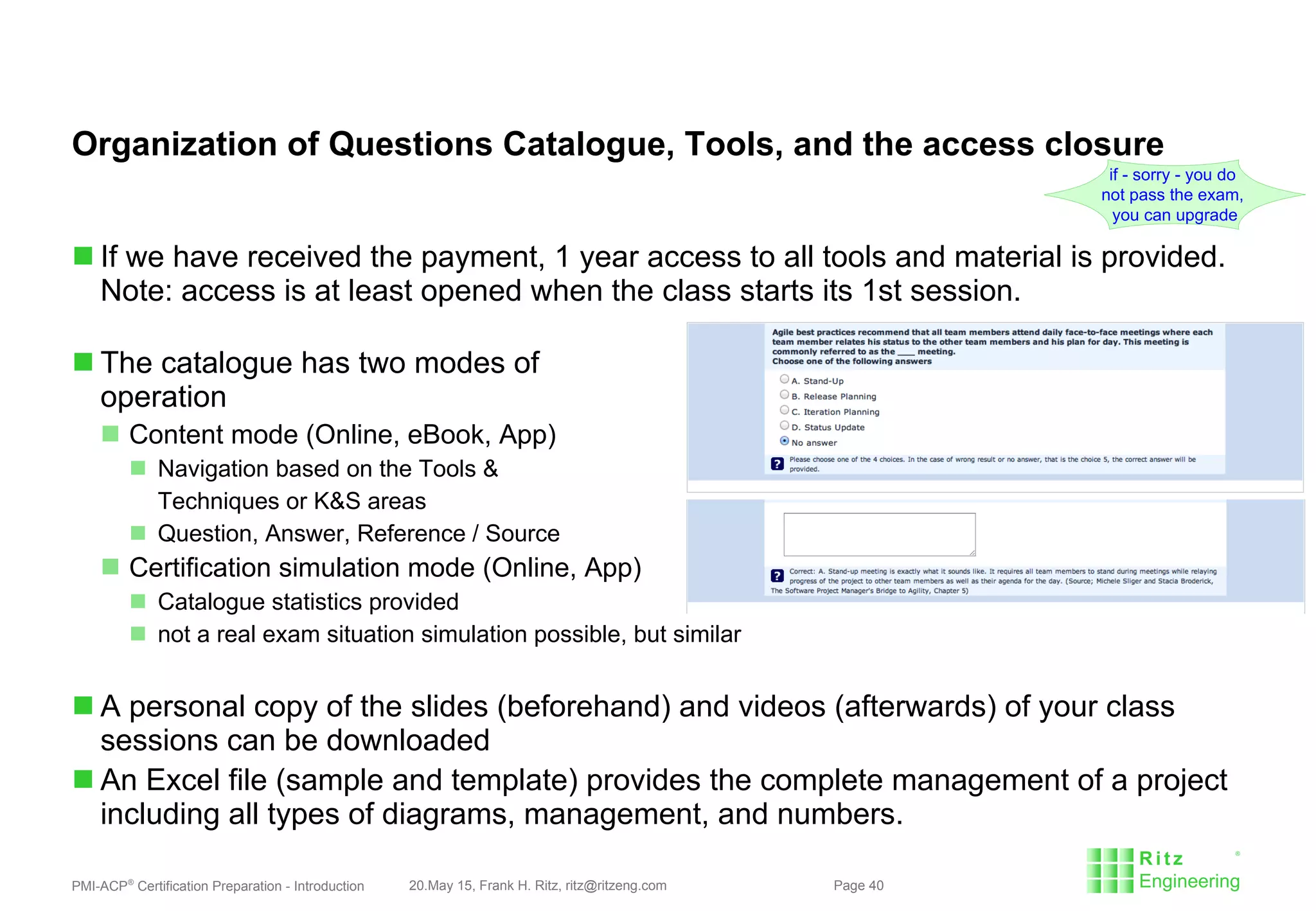
 The catalogue has two modes of
operation
 Content mode (Online, eBook, App)
 Navigation based on the Tools &
Techniques or K&S areas
 Question, Answer, Reference / Source
 Certification simulation mode (Online, App)
 Catalogue statistics provided
 not a real exam situation simulation possible, but similar
 A personal copy of the slides (beforehand) and videos (afterwards) of your class
sessions can be downloaded
 An Excel file (sample and template) provides the complete management of a project
including all types of diagrams, management, and numbers.
if - sorry - you do
not pass the exam,
you can upgrade
PMI-ACP®
Certification Preparation - Introduction 20.May 15, Frank H. Ritz, ritz@ritzeng.com Page 41
Webinar Class Organization
 Collaboration is welcome (forum, private)
 Exchange your eMail, contact each other and learn together
(best in peer groups) e.g. using the edudip forum
 Provide questions to the class in the forum (edudip)
 Schedule is a class decision
 Review sessions by watching the video recording
 Check your knowledge
 Exam Question survey
 More than 2000 exam questions (800+ from the reference books)
 Theme based study mode
 Exam study mode
 Recommended literature
 Excel sheets
PMI-ACP®
Certification Preparation - Introduction 20.May 15, Frank H. Ritz, ritz@ritzeng.com Page 42
Pricing, Conditions
Options, Prices* in CHF (at 20.May 15: 1 € = 1.05 CHF, 1 USD = 0.94 CHF)
Webinar 1 closed class / stream
Webinar 1 year free classes / streams
Seminar at Santis Training, Zurich-Altstetten
Seminar at Santis Training + Webinar Class
Upgrade to Webinar free classes / streams
Optional**: Exam Prep 800+ Questions
1000 CHF
1400 CHF
2100 CHF
2200 CHF
400 CHF
50 CHF
* all prices do not contain VAT. For Switzerland customers, you have to add VAT (8%).
** always included in Seminar / Webinar, the exam preparation 800+ question tool can also be booked separate
and contains Web Online-Access, App (iOS) and eBook
PMI-ACP®
Certification Preparation - Introduction 20.May 15, Frank H. Ritz, ritz@ritzeng.com Page 43
Q & A
 Chat
 Rise your hand and speak
 Survey, Vote
 chat the options
 who is interested in going through this
training?

PMI-ACP Introduction (1PDU)

  • 1.
    PMI-ACP® Certification Preparation -Introduction 20.May 15, Frank H. Ritz, ritz@ritzeng.com Page 1 PMI Agile Certified Practitioner (PMI-ACP)® Information Webinar – Exam Preparation Course
  • 2.
    PMI-ACP® Certification Preparation -Introduction 20.May 15, Frank H. Ritz, ritz@ritzeng.com Page 2 Introduction PMI-ACP® Certification Preparation  Introductory session  Exam Preparation  At the end  understanding about agile exam  lern fundamentals of agile certification & course  all lessons should be visited to comprehend the course  Quiz questions at the end of each session  strongly recommendation to answer them  Upon completion of the course you are able to understand fundamental concepts and terminology in agile certified practitioner as required by PMI.  knowledge to attempt PMI-ACP certification exam
  • 3.
    PMI-ACP® Certification Preparation -Introduction 20.May 15, Frank H. Ritz, ritz@ritzeng.com Page 3 Agenda  Introduction, Training Partners  PMI-ACP Details  Eglibility Requirements  Timeline  Certification, Maintenance and Renewal  Exam Information  Exam Blueprint and test  Agile Project Management Framework vs. Traditional Project Management Framework  Webinar organization  Course  Process  Pricing
  • 4.
    PMI-ACP® Certification Preparation -Introduction 20.May 15, Frank H. Ritz, ritz@ritzeng.com Page 4 About this Webinar / Seminar, an overview  Lesson 01 PMI-ACP exam preparation webinar  Lesson 02 Agile Project Management Framework  Lesson 03 Agile Planning, Monitoring and Adopting  Lesson 04 Agile Estimation  Lesson 05 Communication  Lesson 06 Agile Analysis and Design  Lesson 07 Product Quality  Lesson 08 Soft Skills negotiation  Lesson 09 Agile Value based Prioritization  Lesson 10 Risk Management  Lesson 11 Agile Metrics  Lesson 12 Agile Value Stream Analysis  Lesson 13, 14, 15 Three Agile Knowledge & Skills (K&S) areas  Lesson 16 Practice project management – a game using tools + Agile Principles and Mindset
  • 5.
    PMI-ACP® Certification Preparation -Introduction 20.May 15, Frank H. Ritz, ritz@ritzeng.com Page 5 Introduction – Training Partners  The Project Management Institute (PMI® )  is a not-for-profit professional organization  for the project management profession  with the purpose of advancing project management.  Santis Training AG (R.E.P. ID 2851) provides different PMI® based trainings like:  PMP®  CAPM®  PMI-ACP® (historically written as PMI-ACP℠ )  Ritz Engineering GmbH is a consultant company with strong profession on Agile Project Management and Agile Requirements Engineering (see http://pmi-acp.methoden.ch) ®
  • 6.
    PMI-ACP® Certification Preparation -Introduction 20.May 15, Frank H. Ritz, ritz@ritzeng.com Page 6 Course – the trainer Frank H. Ritz PMI-ACP® number 1608079  Diploma, certifications  Electrical Engineering  Electronics  RUP / CE  CPRE-FL  OUCP-F  HSPTP  PMI-ACP®  C++/Java for mission critical apps  Agile Software Development  Agile Requirements Engineering  Agile Project Management Electrical Engineer Experienced in computer science Requirements Engineer Project manager Business manager Methodology & value driven Do the right things right = sustainable
  • 7.
    PMI-ACP® Certification Preparation -Introduction 20.May 15, Frank H. Ritz, ritz@ritzeng.com Page 7 Agenda  Introduction, Training Partners  PMI-ACP Details  Eglibility Requirements  Timeline  Certification, Maintenance and Renewal  Exam Information  Exam Blueprint and test  Agile Project Management Framework vs. Traditional Project Management Framework  Webinar organization  Course  Process  Pricing
  • 8.
    PMI-ACP® Certification Preparation -Introduction 20.May 15, Frank H. Ritz, ritz@ritzeng.com Page 8 Eglibility Requirements Agile Project Experience General Project Experience Educational Background Training in Agile Practices 1500 hours (8 months) working experience on Agile methodologies accrued in the last 3 years. These hours in addition to “General Project Experience”. 2000 hours (12 months) working experience on Project teams accrued in the last 5 years. Active PMP® or PGMP® will satisfy this requirement. Secondary degree (High school diploma / Associate degree) 21 contact hours of education accrued in Agile Practices, held in PMI-ACP based seminars, webinars and other agile practices (CSM, CSPO etc.) + + + no overlap ! new: active training
  • 9.
    PMI-ACP® Certification Preparation -Introduction 20.May 15, Frank H. Ritz, ritz@ritzeng.com Page 9 PMI-ACP Timeline  Application can be submitted online  You have 90 days to complete the application once you have started it  Payments can be done late, but think about audit possibility  If your application is selected for Audit, you have 90 days to send your audit materials  PMI will take 5-7 days to process audit materials  try to send all materials together
  • 10.
    PMI-ACP® Certification Preparation -Introduction 20.May 15, Frank H. Ritz, ritz@ritzeng.com Page 10 PMI-ACP Certification Fees Exam Type PMI Member Status Fees (US$) Computer Based Testing (CBT) Yes 435 Computer Based Testing (CBT) No 495 Reexamination CBT Yes 335 Reexamination CBT No 395
  • 11.
    PMI-ACP® Certification Preparation -Introduction 20.May 15, Frank H. Ritz, ritz@ritzeng.com Page 11 PMI-ACP Certification Maintenance Exam Type PMI Member Fees (US$) CCR Certification Renewal Yes 60 CCR Certification Renewal No 150
  • 12.
    PMI-ACP® Certification Preparation -Introduction 20.May 15, Frank H. Ritz, ritz@ritzeng.com Page 12 PMI-ACP Exam Information, Blueprint (as-is)  Total no of questions: 120  No of scored questions: 100  No of pre-test questions: 20  Allotted Examination Time: 3 hours  Allocation of questions is  50% Agile Tools and Techniques  organized in 10 areas  50% Agile Knowledge and Skills  total of 43 knowledge and skills topics  organized in 3 levels if importance: K&S 1, K&S 2, K&S 3
  • 13.
    PMI-ACP® Certification Preparation -Introduction 20.May 15, Frank H. Ritz, ritz@ritzeng.com Page 13 PMI-ACP Exam Information, Blueprint, what's new It affects all areas of the certification blueprint ! Needs to be updated valid 11.Jan. 2016 62 tasks
  • 14.
    PMI-ACP® Certification Preparation -Introduction 20.May 15, Frank H. Ritz, ritz@ritzeng.com Page 14 PMI-ACP Exam Information, Blueprint, what's new It affects all areas of the certification blueprint ! Needs to be updated valid 11.Jan. 2016
  • 15.
    PMI-ACP® Certification Preparation -Introduction 20.May 15, Frank H. Ritz, ritz@ritzeng.com Page 15 PMI-ACP Knowledge and Skills (K&S) Levels, as-is It affects all areas of the certification blueprint ! Needs to be updated
  • 16.
    PMI-ACP® Certification Preparation -Introduction 20.May 15, Frank H. Ritz, ritz@ritzeng.com Page 16 PMI-ACP Exam Blueprint (as is)  Exam is oriented to the an equal part of  Agile Tools and Techniques  Knowledge and Skills  Webinar / Seminar contains of 16 further lessons  13 lessons provide knowledge about Agile Tools and Techniques and support some aspects of Knowledge and Skill area.  per Knowledge and Skills area 3 lesson provides the leaving rest.  1 lesson is a project game as-is
  • 17.
    PMI-ACP® Certification Preparation -Introduction 20.May 15, Frank H. Ritz, ritz@ritzeng.com Page 17 PMI-ACP Exam Blueprint (to be)  Exam is oriented to the an equal part of  Agile Tools and Techniques  Knowledge and Skills  Webinar / Seminar contains of 16 further lessons  13 lessons provide knowledge about Agile Tools and Techniques and support some aspects of Knowledge and Skill area.  per Knowledge and Skills area 3 lesson provides the leaving rest.  1 lesson is a project game To Be
  • 18.
    PMI-ACP® Certification Preparation -Introduction 20.May 15, Frank H. Ritz, ritz@ritzeng.com Page 18 Agenda  Introduction, Training Partners  PMI-ACP Details  Eglibility Requirements  Timeline  Certification, Maintenance and Renewal  Exam Information  Exam Blueprint and test  Agile Project Management Framework vs. Traditional Project Management Framework  Webinar organization  Course  Process  Pricing
  • 19.
    PMI-ACP® Certification Preparation -Introduction 20.May 15, Frank H. Ritz, ritz@ritzeng.com Page 19 What is Agility and how can we understand APM vs. TPM Agile Project Management Traditional Project Management Focus on customer satisfaction and interaction Focus on plans and artifacts Response to change via adaptive action Change controlled via corrective action Progressive elaboration, rolling-wave planning Monumental up-front planning Customer prioritized, time-boxed delivery Manager negotiated, scope-based delivery Commitment management via feature breakdown structure Activity management via work breakdown structure (WBS) Collaboration on self-disciplined and self- organizing teams Top-down control Minimal set of context-sensitive, generative practices Prescriptive, heavyweight methods Essential, value-focused metrics Non-value added controls
  • 20.
    PMI-ACP® Certification Preparation -Introduction 20.May 15, Frank H. Ritz, ritz@ritzeng.com Page 20 What is Agility and how can we understand APM vs. TPM Agile Project Management Traditional Project Management Focus on customer satisfaction and interaction Focus on plans and artifacts Response to change via adaptive action Change controlled via corrective action Progressive elaboration, rolling-wave planning Monumental up-front planning Customer prioritized, time-boxed delivery Manager negotiated, scope-based delivery Commitment management via feature breakdown structure Activity management via work breakdown structure (WBS) Collaboration on self-disciplined and self- organizing teams Top-down control Minimal set of context-sensitive, generative practices Prescriptive, heavyweight methods Essential, value-focused metrics Non-value added controls
  • 21.
    PMI-ACP® Certification Preparation -Introduction 20.May 15, Frank H. Ritz, ritz@ritzeng.com Page 21 Agility  Agility is the ability ...  … to deliver customer value  … while dealing with inherent project unpredictability  … and dynamism  … by recognizing and adaping  … to change  Agility is the capability to balance  Stability with flexibility  Order with chaos  Planning with execution  Optimization with exploration  Control with speed  → to deliver customer value reliability in face of uncertainty and change
  • 22.
    PMI-ACP® Certification Preparation -Introduction 20.May 15, Frank H. Ritz, ritz@ritzeng.com Page 22 Agility  Agility is the ability ...  … to deliver customer value  … while dealing with inherent project unpredictability  … and dynamism  … by recognizing and adaping  … to change  Agility is the capability to balance  Stability with flexibility  Order with chaos  Planning with execution  Optimization with exploration  Control with speed  → to deliver customer value reliability in face of uncertainty and change
  • 23.
    PMI-ACP® Certification Preparation -Introduction 20.May 15, Frank H. Ritz, ritz@ritzeng.com Page 23 Agile Manifesto Values Principles
  • 24.
    PMI-ACP® Certification Preparation -Introduction 20.May 15, Frank H. Ritz, ritz@ritzeng.com Page 24 Agile Manifesto K&S 1
  • 25.
    PMI-ACP® Certification Preparation -Introduction 20.May 15, Frank H. Ritz, ritz@ritzeng.com Page 25 Principles behind the Agile Manifesto K&S 1 Agile Principles (http://agilemanifesto.org/principles.html) 1 Our highest priority is to satisfy the customer through early and continuous delivery of valuable software. 2 Welcome changing requirements, even late in development. Agile processes harness change for the customer's competitive advantage. 3 Deliver working software frequently, from a couple of weeks to a couple of months, with a preference to the shorter timescale. 4 Business people and developers must work together daily throughout the project. 5 Build projects around motivated individuals. Give them the environment and support they need, and trust them to get the job done. 6 The most efficient and effective method of conveying information to and within a development team is face-to-face conversation.
  • 26.
    PMI-ACP® Certification Preparation -Introduction 20.May 15, Frank H. Ritz, ritz@ritzeng.com Page 26 Principles behind the Agile Manifesto K&S 1 Agile Principles (http://agilemanifesto.org/principles.html) 1 Our highest priority is to satisfy the customer through early and continuous delivery of valuable software. 2 Welcome changing requirements, even late in development. Agile processes harness change for the customer's competitive advantage. 3 Deliver working software frequently, from a couple of weeks to a couple of months, with a preference to the shorter timescale. 4 Business people and developers must work together daily throughout the project. 5 Build projects around motivated individuals. Give them the environment and support they need, and trust them to get the job done. 6 The most efficient and effective method of conveying information to and within a development team is face-to-face conversation.
  • 27.
    PMI-ACP® Certification Preparation -Introduction 20.May 15, Frank H. Ritz, ritz@ritzeng.com Page 27 Principles behind the Agile Manifesto K&S 1 Agile Principles (http://agilemanifesto.org/principles.html) 7 Working software is the primary measure of progress. 8 Agile processes promote sustainable development. The sponsors, developers, and users should be able to maintain a constant pace indefinitely. 9 Continuous attention to technical excellence and good design enhances agility. 10 Simplicity – the art of maximizing the amount of work not done – is essential. 11 The best architectures, requirements, and designs emerge from self-organizing teams. 12 At regular intervals, the team reflects on how to become more effective, then tunes and adjusts its behavior accordingly. It's not only all about working software
  • 28.
    PMI-ACP® Certification Preparation -Introduction 20.May 15, Frank H. Ritz, ritz@ritzeng.com Page 28 Principles behind the Agile Manifesto K&S 1 Agile Principles (http://agilemanifesto.org/principles.html) 7 Working software is the primary measure of progress. 8 Agile processes promote sustainable development. The sponsors, developers, and users should be able to maintain a constant pace indefinitely. 9 Continuous attention to technical excellence and good design enhances agility. 10 Simplicity – the art of maximizing the amount of work not done – is essential. 11 The best architectures, requirements, and designs emerge from self-organizing teams. 12 At regular intervals, the team reflects on how to become more effective, then tunes and adjusts its behavior accordingly.
  • 29.
    PMI-ACP® Certification Preparation -Introduction 20.May 15, Frank H. Ritz, ritz@ritzeng.com Page 29 Principles  Focus on business need  Deliver on time  Collaborate  Never compromise quality  Build incrementally from firm foundations  Develop iteratively  Communicate continuously and clearly  Demonstrate control K&S 1
  • 30.
    PMI-ACP® Certification Preparation -Introduction 20.May 15, Frank H. Ritz, ritz@ritzeng.com Page 30 Principles  Focus on business need  Deliver on time  Collaborate  Never compromise quality  Build incrementally from firm foundations  Develop iteratively  Communicate continuously and clearly  Demonstrate control K&S 1
  • 31.
    PMI-ACP® Certification Preparation -Introduction 20.May 15, Frank H. Ritz, ritz@ritzeng.com Page 31 Principles  Focus on business need  Deliver on time  Collaborate  Never compromise quality  Build incrementally from firm foundations  Develop iteratively  Communicate continuously and clearly  Demonstrate control K&S 1
  • 32.
    PMI-ACP® Certification Preparation -Introduction 20.May 15, Frank H. Ritz, ritz@ritzeng.com Page 32 Authors of the Agile Manifesto, 11 Reference Books for PMI-ACP® K&S 1 as-is
  • 33.
    PMI-ACP® Certification Preparation -Introduction 20.May 15, Frank H. Ritz, ritz@ritzeng.com Page 33 Authors of the Agile Manifesto, 12 Reference Books for PMI-ACP® K&S 1 to-be new
  • 34.
    PMI-ACP® Certification Preparation -Introduction 20.May 15, Frank H. Ritz, ritz@ritzeng.com Page 34 Quiz  Which of the following is NOT a characteristic of Agile Project Management (APM) when comparing with Traditional (also named Waterfall) Project Management (TPM)  A. Time Boxed delivery  B. Focus on customer satisfaction  C. Top down control  D. Value focused metrics  Answer is: ?
  • 35.
    PMI-ACP® Certification Preparation -Introduction 20.May 15, Frank H. Ritz, ritz@ritzeng.com Page 35 Quiz  Which of the following is NOT a characteristic of Agile Project Management (APM) when comparing with Traditional (also named Waterfall) Project Management (TPM)  A. Time Boxed delivery  B. Focus on customer satisfaction  C. Top down control  D. Value focused metrics  Answer is: C  Top down control is not a characteristic of Agile Project Management (APM) whereas i.e. Self Organizing Teams and the consequences of Timebox, Customer Satisfaction, Value delivery is a characteristic of Agile Project Teams.
  • 36.
    PMI-ACP® Certification Preparation -Introduction 20.May 15, Frank H. Ritz, ritz@ritzeng.com Page 36 Agenda  Introduction, Training Partners  PMI-ACP Details  Eglibility Requirements  Timeline  Certification, Maintenance and Renewal  Exam Information  Exam Blueprint and test  Agile Project Management Framework vs. Traditional Project Management Framework  Webinar organization  Course  Process  Pricing
  • 37.
    PMI-ACP® Certification Preparation -Introduction 20.May 15, Frank H. Ritz, ritz@ritzeng.com Page 37 Lessons and Structure  Lesson 01 PMI-ACP exam preparation webinar  Lesson 02 Agile Project Management Framework  Lesson 03 Agile Planning, Monitoring and Adopting  Lesson 04 Agile Estimation  Lesson 05 Communication  Lesson 06 Agile Analysis and Design  Lesson 07 Product Quality  Lesson 08 Soft Skills negotiation  Lesson 09 Agile Value based Prioritization  Lesson 10 Risk Management  Lesson 11 Agile Metrics  Lesson 12 Agile Value Stream Analysis  Lesson 13, 14, 15 Three Agile Knowledge & Skills (K&S) areas  Lesson 16 Practice project management – a game using tools as-is to be: + Agile Principles and Mindset + 62 tasks changed
  • 38.
    PMI-ACP® Certification Preparation -Introduction 20.May 15, Frank H. Ritz, ritz@ritzeng.com Page 38 Webinar process steps  Register at edudip to record your online attendance by name (no pseudos !)  Make payment at http://pmi-acp.methoden.ch or at Santis Training  Provide your edudip eMail address in payment (invoice sent to this eMail !)  10-40 students / classroom = 1 stream  Stream lasts 10-11 weeks.  Stream starts if min. students / classroom is reached  if class doesn't reach 10 students, stream starts with min. 5 students within 3 weeks  1st introducing session organize setup like stream, communication, schedule and provides again the following content  Immediately after the 30th session Santis Training AG (PMI R.E.P. ID 2851) issues a “Certificate of Completion” certify 21 PDU to the student ®
  • 39.
    PMI-ACP® Certification Preparation -Introduction 20.May 15, Frank H. Ritz, ritz@ritzeng.com Page 39 Webinar Organization  Class Organization  Commitment to 3 webinars / week, 10 weeks  2 evening webinars during Monday – Friday e.g. 19:30  1 webinar at Saturday morning e.g. 10:00  Share of the class members contacts (private per webinar class)  recommended to build student groups  recommended to share questions in the webinar edudip forum  Unbound Class members can switch between classes until exam was passed  Webinar organization  45-50 min. of content presentation (English)  10-15 min. of discussions and questions (English or German)  Students can raise their hands and takeover  Students can use the microphone, camera, screen  Video recording on all webinars of the class  21 hours (of 30 possible hours) of online attendance needed to reach 21 PDU  offering the possibility to visit 21 sessions and watch other sessions by recorded video.
  • 40.
    PMI-ACP® Certification Preparation -Introduction 20.May 15, Frank H. Ritz, ritz@ritzeng.com Page 40 Organization of Questions Catalogue, Tools, and the access closure  If we have received the payment, 1 year access to all tools and material is provided. Note: access is at least opened when the class starts its 1st session.  The catalogue has two modes of operation  Content mode (Online, eBook, App)  Navigation based on the Tools & Techniques or K&S areas  Question, Answer, Reference / Source  Certification simulation mode (Online, App)  Catalogue statistics provided  not a real exam situation simulation possible, but similar  A personal copy of the slides (beforehand) and videos (afterwards) of your class sessions can be downloaded  An Excel file (sample and template) provides the complete management of a project including all types of diagrams, management, and numbers. if - sorry - you do not pass the exam, you can upgrade
  • 41.
    PMI-ACP® Certification Preparation -Introduction 20.May 15, Frank H. Ritz, ritz@ritzeng.com Page 41 Webinar Class Organization  Collaboration is welcome (forum, private)  Exchange your eMail, contact each other and learn together (best in peer groups) e.g. using the edudip forum  Provide questions to the class in the forum (edudip)  Schedule is a class decision  Review sessions by watching the video recording  Check your knowledge  Exam Question survey  More than 2000 exam questions (800+ from the reference books)  Theme based study mode  Exam study mode  Recommended literature  Excel sheets
  • 42.
    PMI-ACP® Certification Preparation -Introduction 20.May 15, Frank H. Ritz, ritz@ritzeng.com Page 42 Pricing, Conditions Options, Prices* in CHF (at 20.May 15: 1 € = 1.05 CHF, 1 USD = 0.94 CHF) Webinar 1 closed class / stream Webinar 1 year free classes / streams Seminar at Santis Training, Zurich-Altstetten Seminar at Santis Training + Webinar Class Upgrade to Webinar free classes / streams Optional**: Exam Prep 800+ Questions 1000 CHF 1400 CHF 2100 CHF 2200 CHF 400 CHF 50 CHF * all prices do not contain VAT. For Switzerland customers, you have to add VAT (8%). ** always included in Seminar / Webinar, the exam preparation 800+ question tool can also be booked separate and contains Web Online-Access, App (iOS) and eBook
  • 43.
    PMI-ACP® Certification Preparation -Introduction 20.May 15, Frank H. Ritz, ritz@ritzeng.com Page 43 Q & A  Chat  Rise your hand and speak  Survey, Vote  chat the options  who is interested in going through this training?