Change management and business
performance improvement
Extract: Module 2 Section 11
Ged Melia
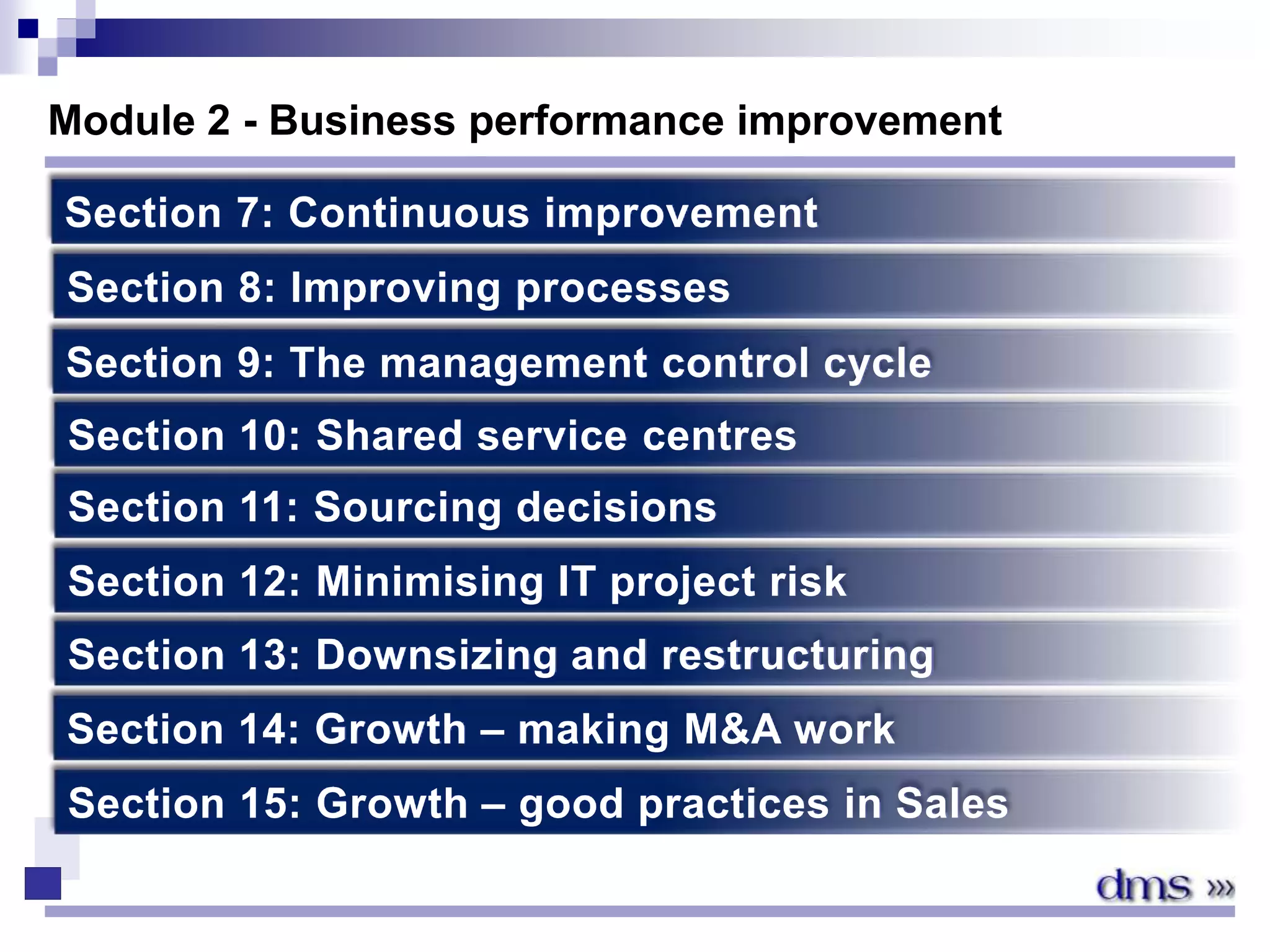
Section 10: Shared service centres
Section 11: Sourcing decisions
Section 12: Minimising IT project risk
Section 13: Downsizing and restructuring
Section 14: Growth – making M&A work
Section 15: Growth – good practices in Sales
Module 2 - Business performance improvement
Section 8: Improving processes
Section 9: The management control cycle
Section 7: Continuous improvement
Section 11: Sourcing decisions
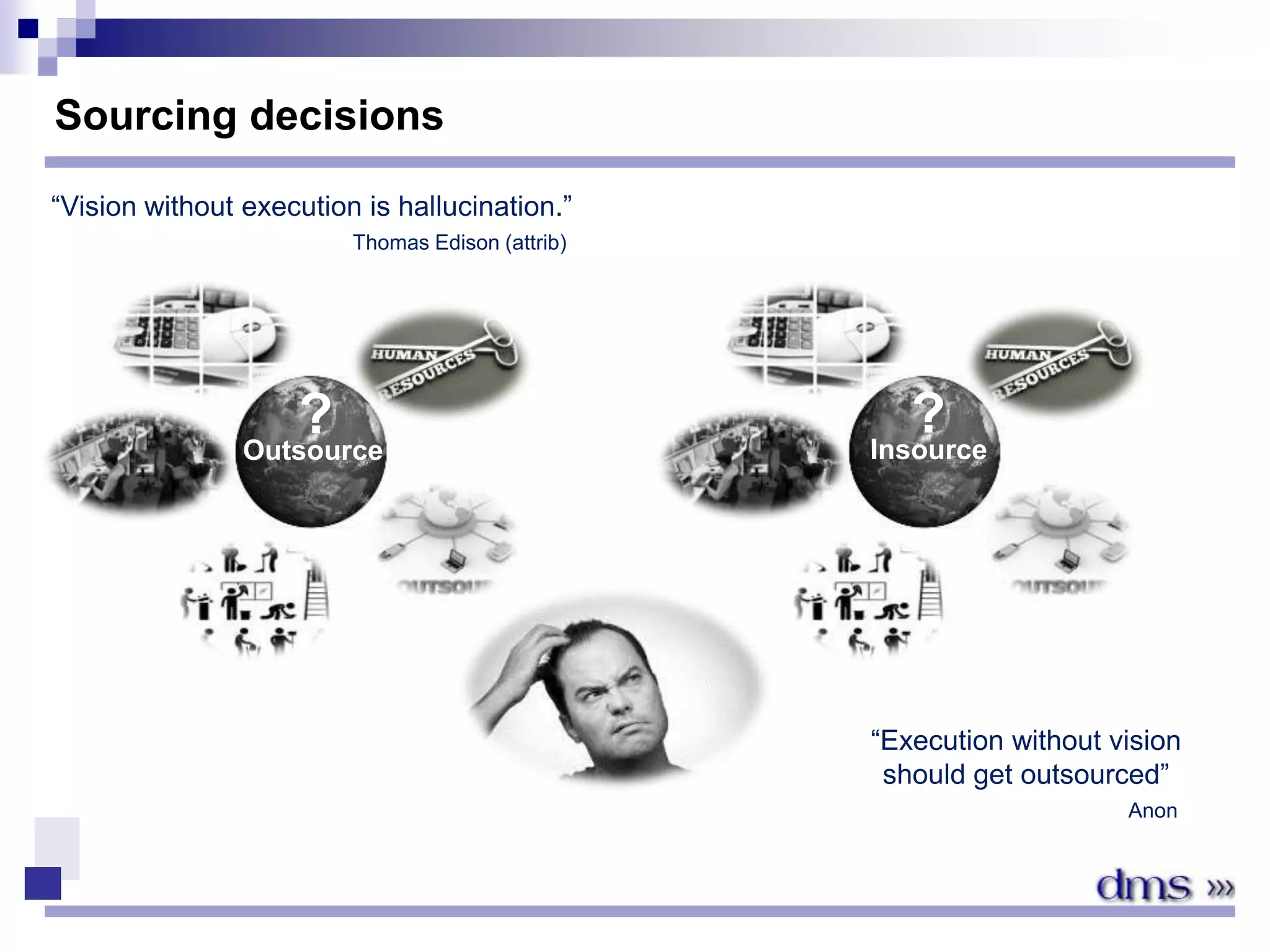
Outsource Insource
Sourcing decisions
? ?
“Vision without execution is hallucination.”
Thomas Edison (attrib)
“Execution without vision
should get outsourced”
Anon
Sourcing decisions
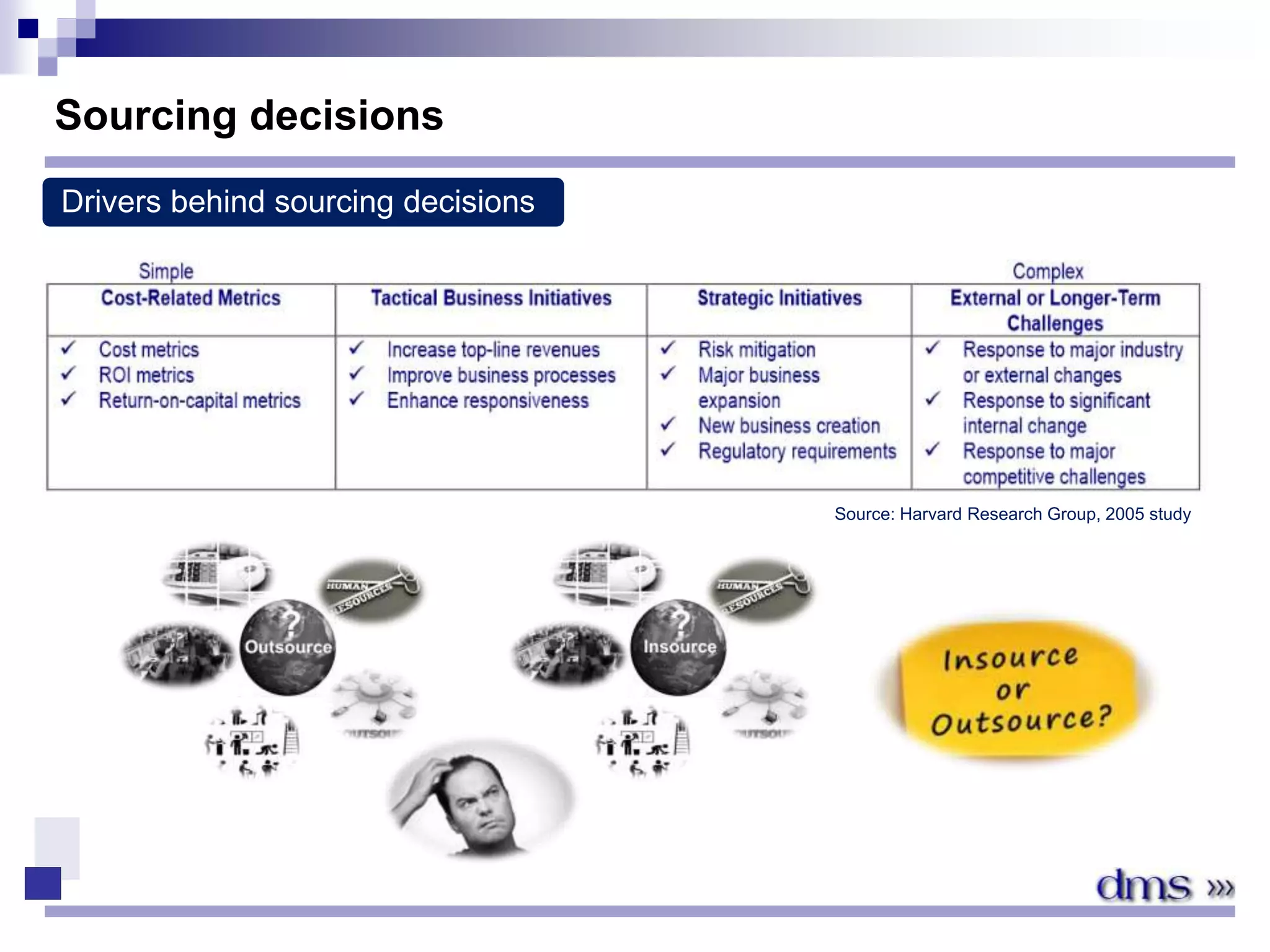
Source: Harvard Research Group, 2005 study
Drivers behind sourcing decisions
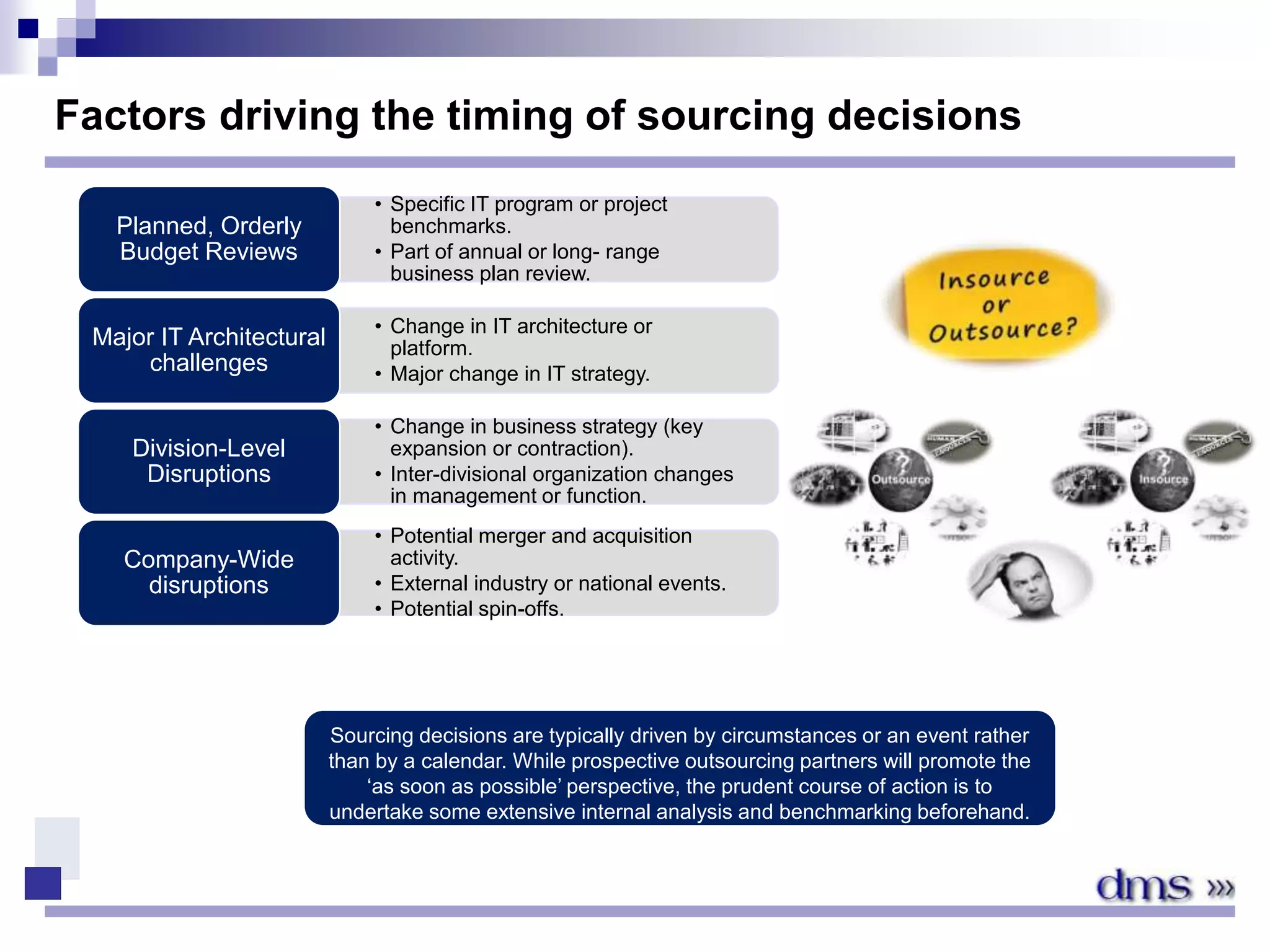
Factors driving the timing of sourcing decisions
• Specific IT program or project
benchmarks.
• Part of annual or long- range
business plan review.
Planned, Orderly
Budget Reviews
• Change in IT architecture or
platform.
• Major change in IT strategy.
Major IT Architectural
challenges
• Change in business strategy (key
expansion or contraction).
• Inter-divisional organization changes
in management or function.
Division-Level
Disruptions
• Potential merger and acquisition
activity.
• External industry or national events.
• Potential spin-offs.
Company-Wide
disruptions
Sourcing decisions are typically driven by circumstances or an event rather
than by a calendar. While prospective outsourcing partners will promote the
‘as soon as possible’ perspective, the prudent course of action is to
undertake some extensive internal analysis and benchmarking beforehand.
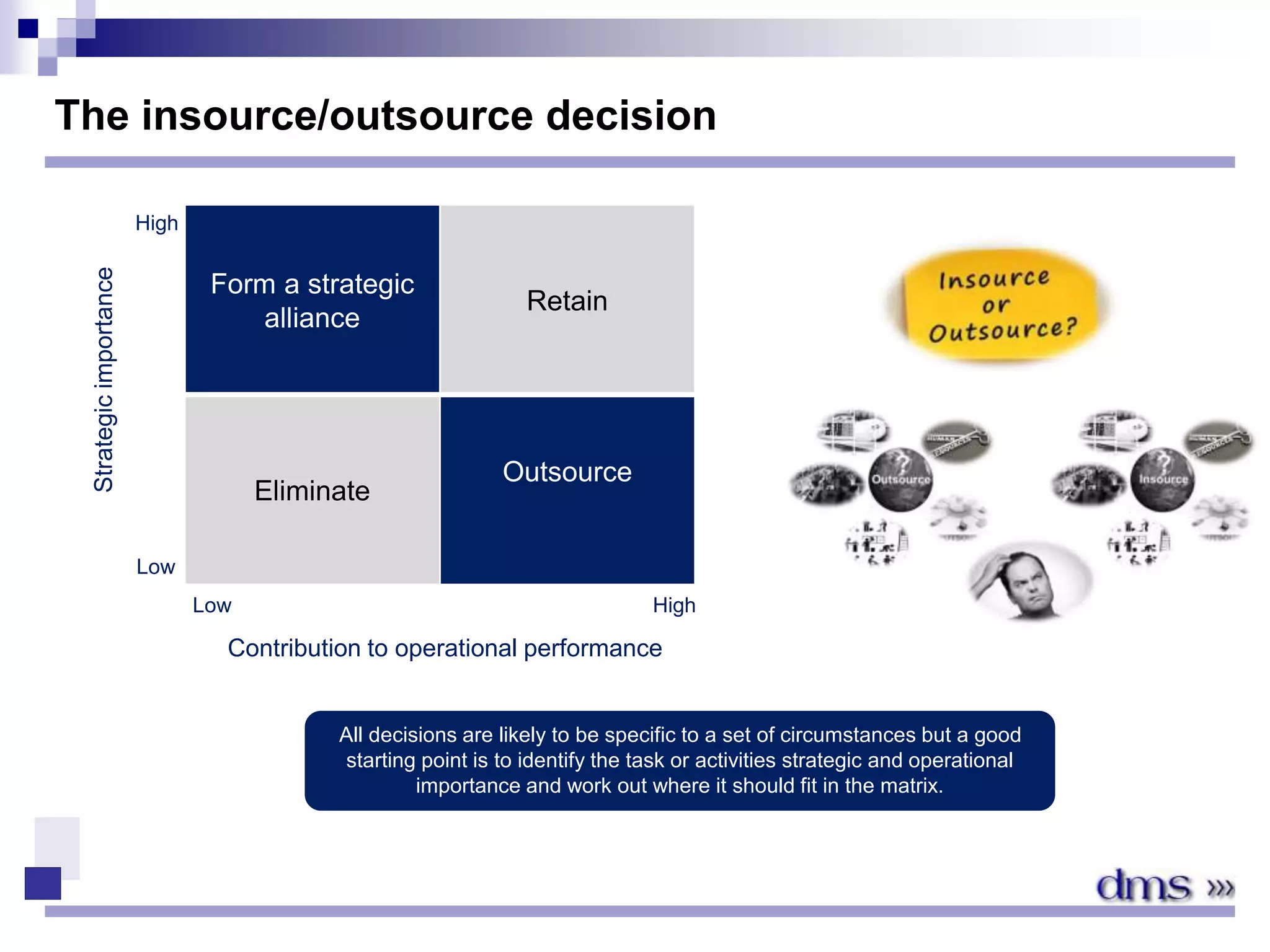
Form a strategic
alliance
Retain
Eliminate
Outsource
Strategicimportance
Contribution to operational performance
Low
High
High
Low
The insource/outsource decision
All decisions are likely to be specific to a set of circumstances but a good
starting point is to identify the task or activities strategic and operational
importance and work out where it should fit in the matrix.
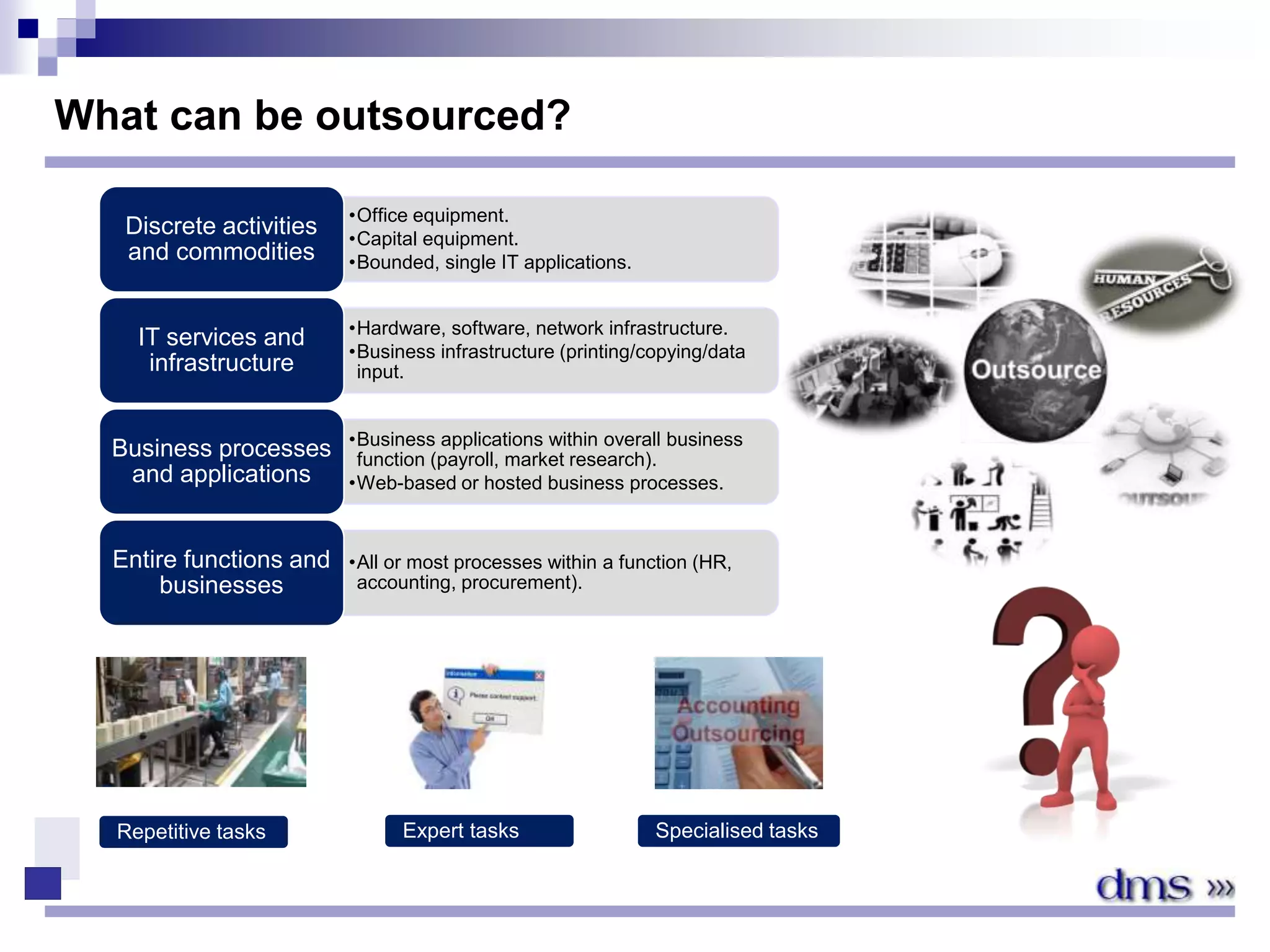
What can be outsourced?
•Office equipment.
•Capital equipment.
•Bounded, single IT applications.
Discrete activities
and commodities
•Hardware, software, network infrastructure.
•Business infrastructure (printing/copying/data
input.
IT services and
infrastructure
•Business applications within overall business
function (payroll, market research).
•Web-based or hosted business processes.
Business processes
and applications
•All or most processes within a function (HR,
accounting, procurement).
Entire functions and
businesses
Repetitive tasks Expert tasks Specialised tasks
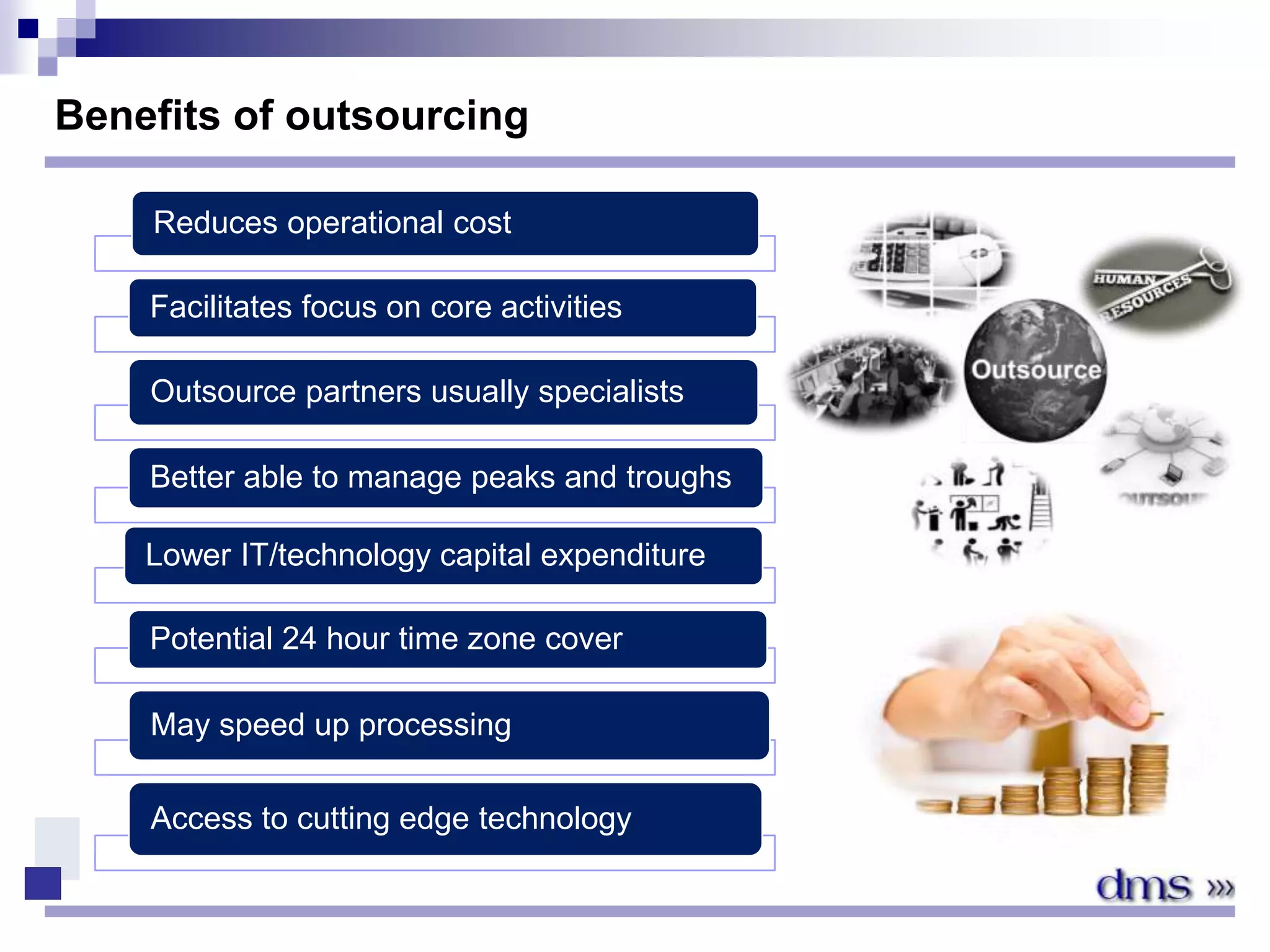
Benefits of outsourcing
Reduces operational cost
Facilitates focus on core activities
Outsource partners usually specialists
Better able to manage peaks and troughs
Lower IT/technology capital expenditure
Potential 24 hour time zone cover
May speed up processing
Access to cutting edge technology
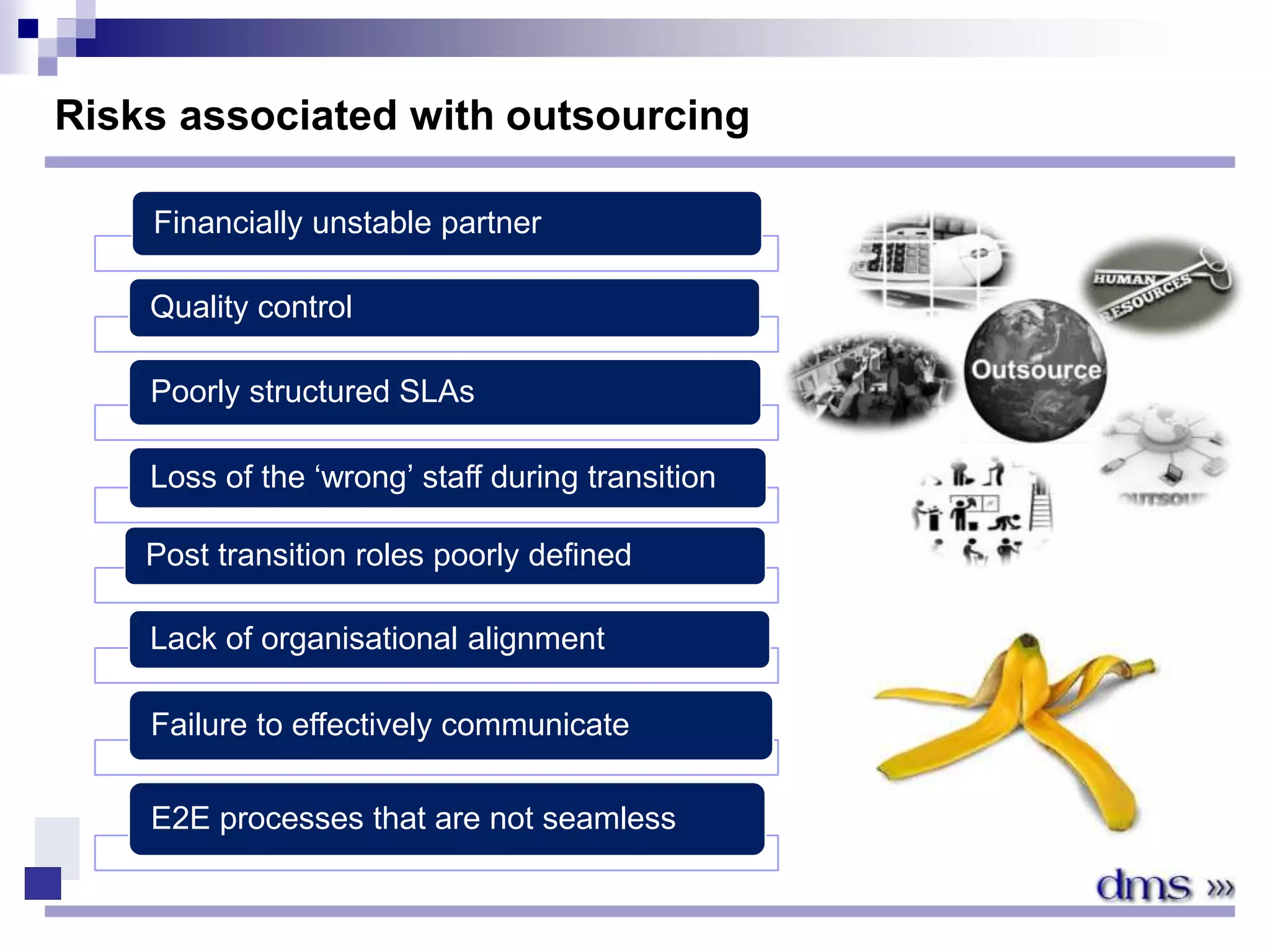
Risks associated with outsourcing
Financially unstable partner
Quality control
Poorly structured SLAs
Loss of the ‘wrong’ staff during transition
Post transition roles poorly defined
Lack of organisational alignment
Failure to effectively communicate
E2E processes that are not seamless
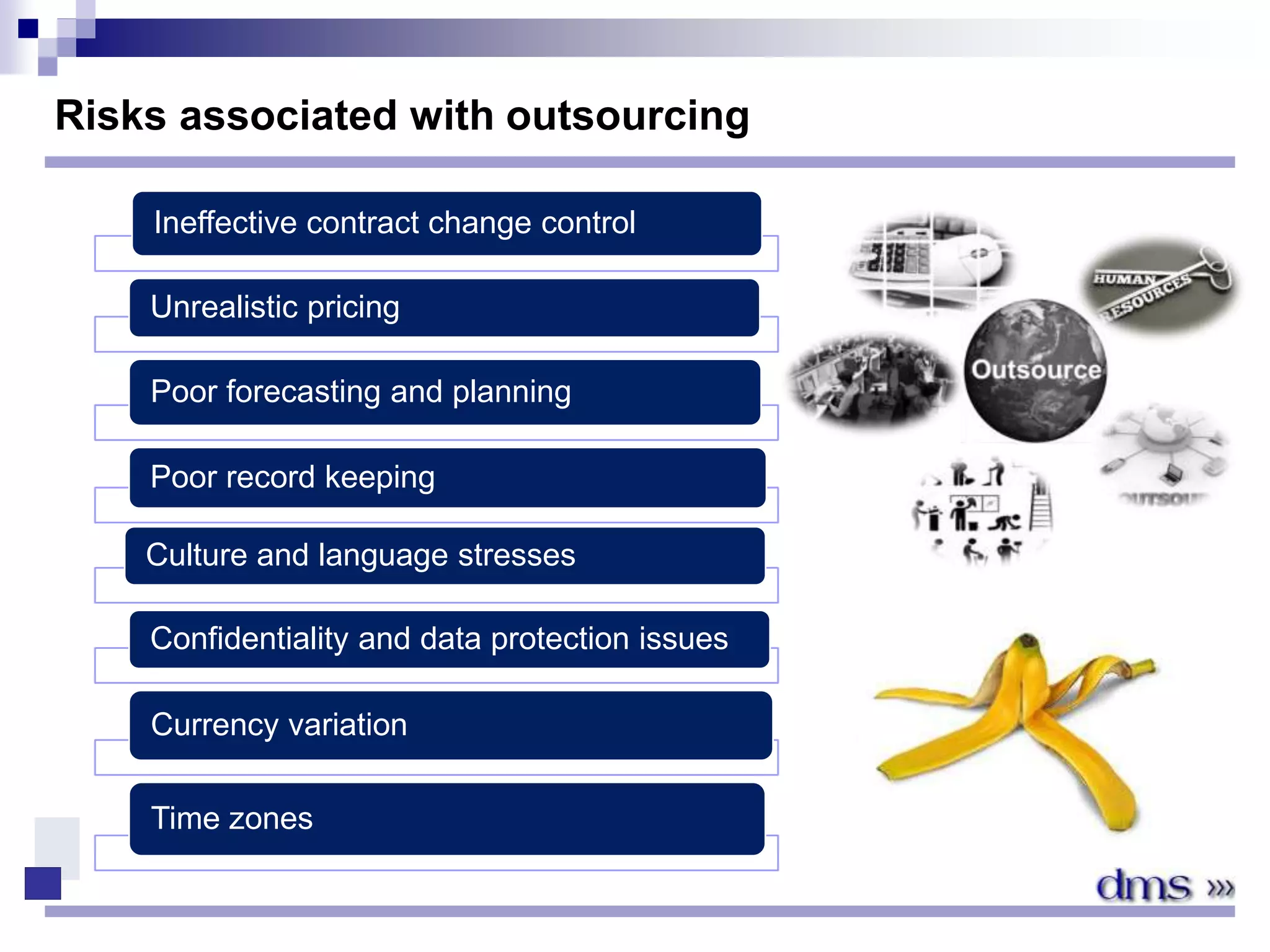
Ineffective contract change control
Unrealistic pricing
Poor forecasting and planning
Poor record keeping
Culture and language stresses
Confidentiality and data protection issues
Currency variation
Time zones
Risks associated with outsourcing
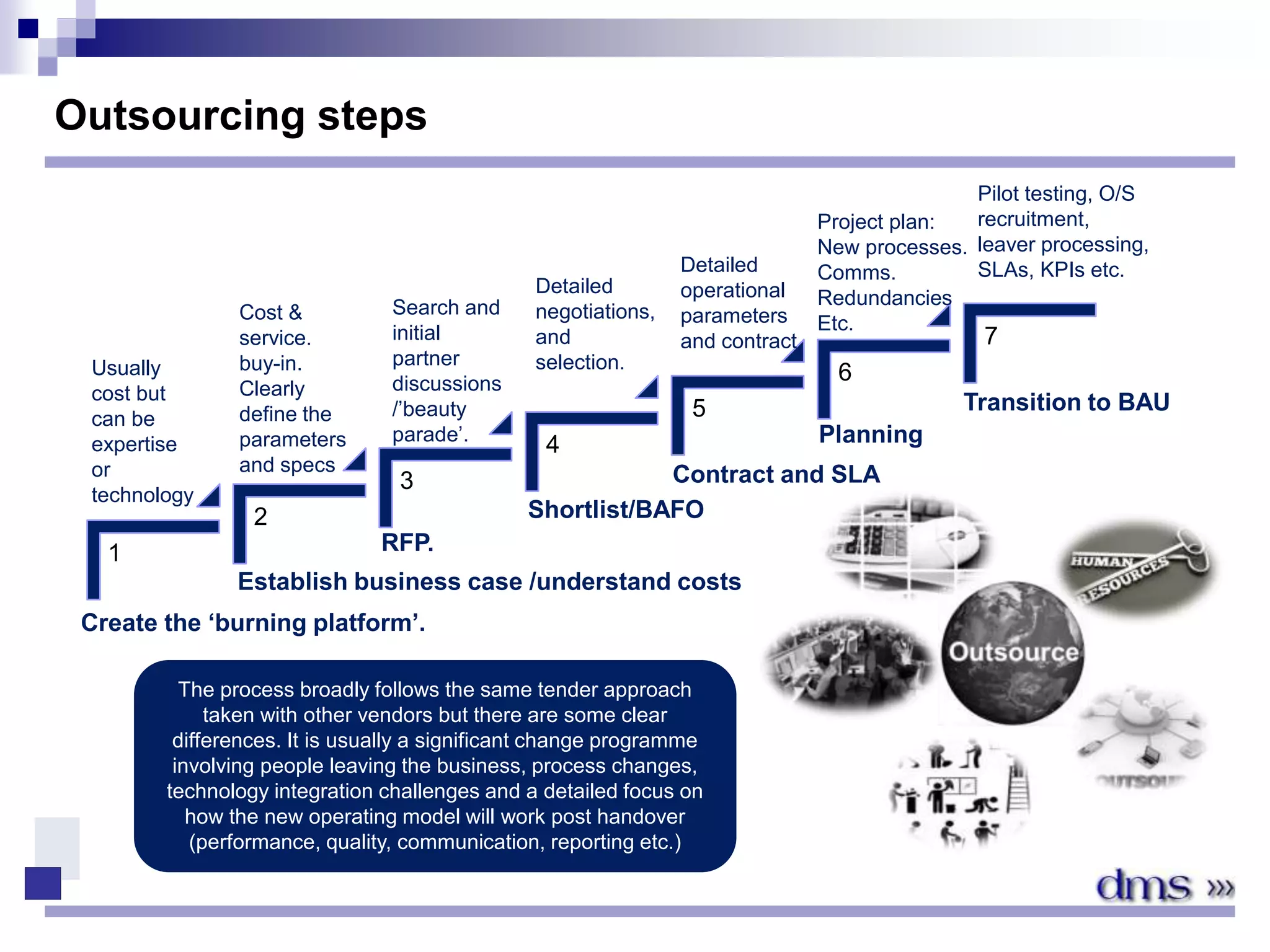
Outsourcing steps
1
2
3
4
5
6
7
Create the ‘burning platform’.
Establish business case /understand costs
RFP.
Shortlist/BAFO
Contract and SLA
Planning
The process broadly follows the same tender approach
taken with other vendors but there are some clear
differences. It is usually a significant change programme
involving people leaving the business, process changes,
technology integration challenges and a detailed focus on
how the new operating model will work post handover
(performance, quality, communication, reporting etc.)
Cost &
service.
buy-in.
Clearly
define the
parameters
and specs
Usually
cost but
can be
expertise
or
technology
Project plan:
New processes.
Comms.
Redundancies
Etc.
Search and
initial
partner
discussions
/’beauty
parade’.
Detailed
negotiations,
and
selection.
Detailed
operational
parameters
and contract
Transition to BAU
Pilot testing, O/S
recruitment,
leaver processing,
SLAs, KPIs etc.
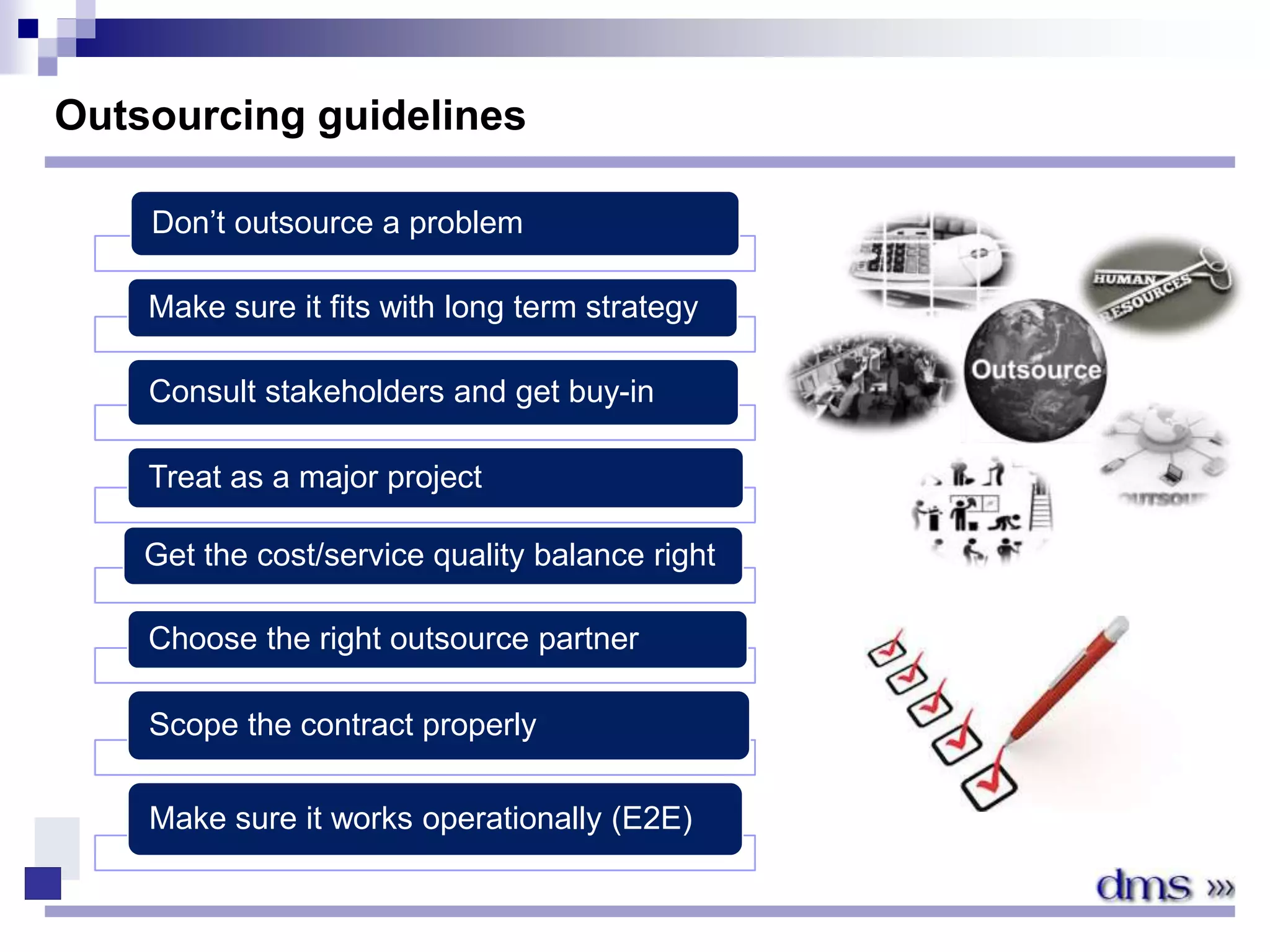
Outsourcing guidelines
Don’t outsource a problem
Make sure it fits with long term strategy
Consult stakeholders and get buy-in
Treat as a major project
Get the cost/service quality balance right
Choose the right outsource partner
Scope the contract properly
Make sure it works operationally (E2E)
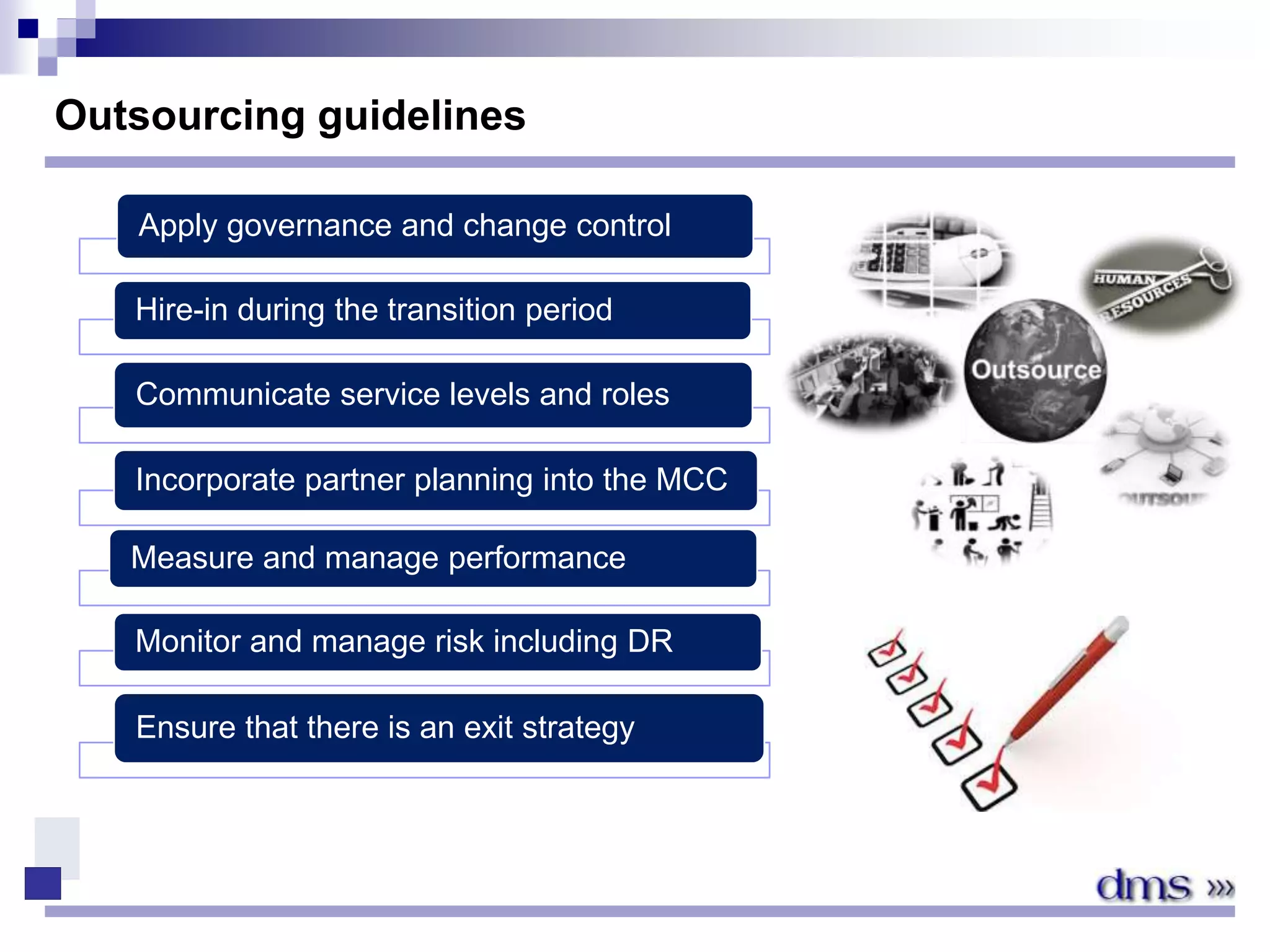
Outsourcing guidelines
Apply governance and change control
Hire-in during the transition period
Communicate service levels and roles
Incorporate partner planning into the MCC
Measure and manage performance
Monitor and manage risk including DR
Ensure that there is an exit strategy
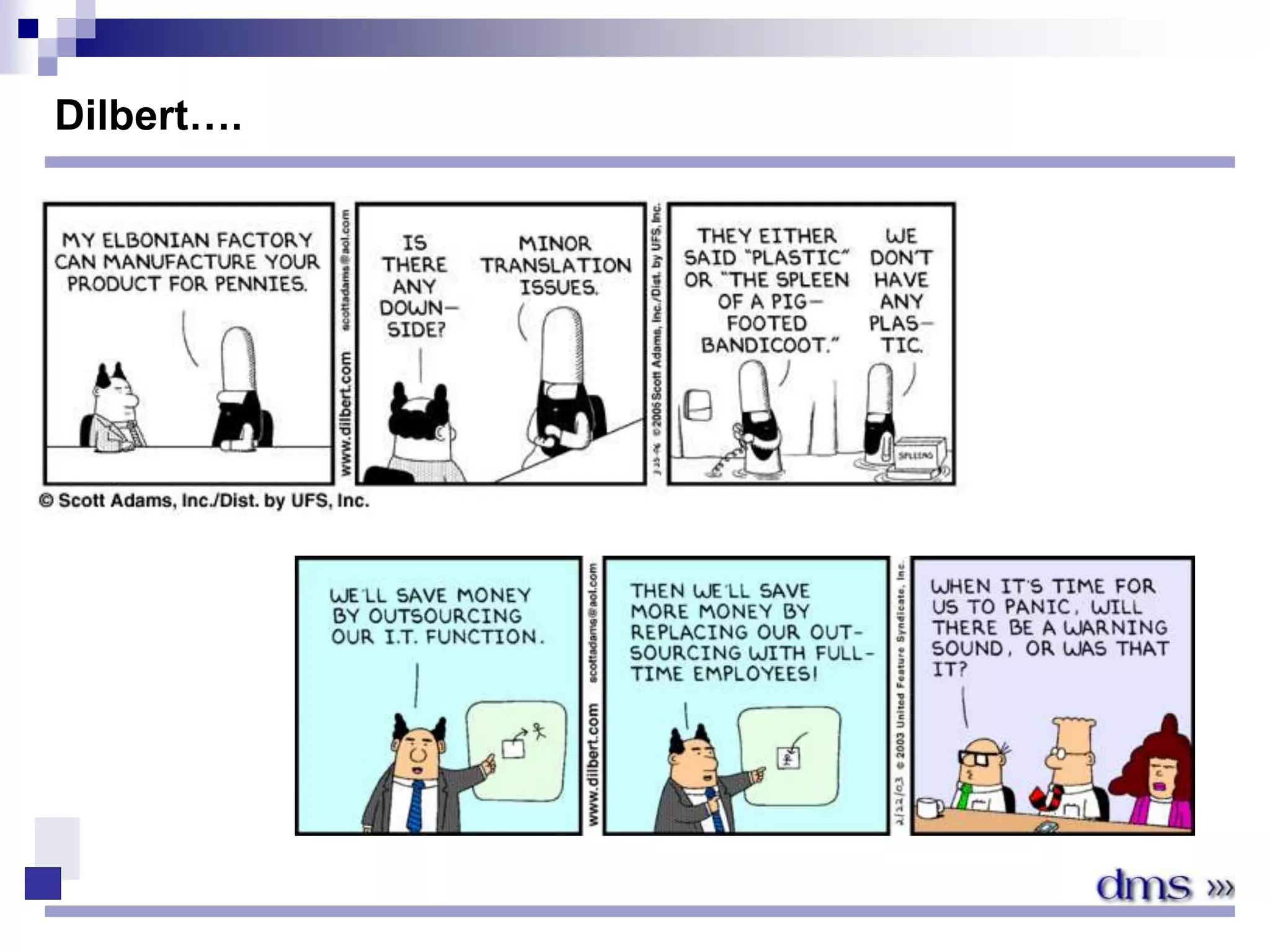
Dilbert….

Extracts Module 2 Section 11 Sourcing Decisions

  • 1.
    Change management andbusiness performance improvement Extract: Module 2 Section 11 Ged Melia
  • 2.
    Section 10: Sharedservice centres Section 11: Sourcing decisions Section 12: Minimising IT project risk Section 13: Downsizing and restructuring Section 14: Growth – making M&A work Section 15: Growth – good practices in Sales Module 2 - Business performance improvement Section 8: Improving processes Section 9: The management control cycle Section 7: Continuous improvement
  • 3.
  • 4.
    Outsource Insource Sourcing decisions ?? “Vision without execution is hallucination.” Thomas Edison (attrib) “Execution without vision should get outsourced” Anon
  • 5.
    Sourcing decisions Source: HarvardResearch Group, 2005 study Drivers behind sourcing decisions
  • 6.
    Factors driving thetiming of sourcing decisions • Specific IT program or project benchmarks. • Part of annual or long- range business plan review. Planned, Orderly Budget Reviews • Change in IT architecture or platform. • Major change in IT strategy. Major IT Architectural challenges • Change in business strategy (key expansion or contraction). • Inter-divisional organization changes in management or function. Division-Level Disruptions • Potential merger and acquisition activity. • External industry or national events. • Potential spin-offs. Company-Wide disruptions Sourcing decisions are typically driven by circumstances or an event rather than by a calendar. While prospective outsourcing partners will promote the ‘as soon as possible’ perspective, the prudent course of action is to undertake some extensive internal analysis and benchmarking beforehand.
  • 7.
    Form a strategic alliance Retain Eliminate Outsource Strategicimportance Contributionto operational performance Low High High Low The insource/outsource decision All decisions are likely to be specific to a set of circumstances but a good starting point is to identify the task or activities strategic and operational importance and work out where it should fit in the matrix.
  • 8.
    What can beoutsourced? •Office equipment. •Capital equipment. •Bounded, single IT applications. Discrete activities and commodities •Hardware, software, network infrastructure. •Business infrastructure (printing/copying/data input. IT services and infrastructure •Business applications within overall business function (payroll, market research). •Web-based or hosted business processes. Business processes and applications •All or most processes within a function (HR, accounting, procurement). Entire functions and businesses Repetitive tasks Expert tasks Specialised tasks
  • 9.
    Benefits of outsourcing Reducesoperational cost Facilitates focus on core activities Outsource partners usually specialists Better able to manage peaks and troughs Lower IT/technology capital expenditure Potential 24 hour time zone cover May speed up processing Access to cutting edge technology
  • 10.
    Risks associated withoutsourcing Financially unstable partner Quality control Poorly structured SLAs Loss of the ‘wrong’ staff during transition Post transition roles poorly defined Lack of organisational alignment Failure to effectively communicate E2E processes that are not seamless
  • 11.
    Ineffective contract changecontrol Unrealistic pricing Poor forecasting and planning Poor record keeping Culture and language stresses Confidentiality and data protection issues Currency variation Time zones Risks associated with outsourcing
  • 12.
    Outsourcing steps 1 2 3 4 5 6 7 Create the‘burning platform’. Establish business case /understand costs RFP. Shortlist/BAFO Contract and SLA Planning The process broadly follows the same tender approach taken with other vendors but there are some clear differences. It is usually a significant change programme involving people leaving the business, process changes, technology integration challenges and a detailed focus on how the new operating model will work post handover (performance, quality, communication, reporting etc.) Cost & service. buy-in. Clearly define the parameters and specs Usually cost but can be expertise or technology Project plan: New processes. Comms. Redundancies Etc. Search and initial partner discussions /’beauty parade’. Detailed negotiations, and selection. Detailed operational parameters and contract Transition to BAU Pilot testing, O/S recruitment, leaver processing, SLAs, KPIs etc.
  • 13.
    Outsourcing guidelines Don’t outsourcea problem Make sure it fits with long term strategy Consult stakeholders and get buy-in Treat as a major project Get the cost/service quality balance right Choose the right outsource partner Scope the contract properly Make sure it works operationally (E2E)
  • 14.
    Outsourcing guidelines Apply governanceand change control Hire-in during the transition period Communicate service levels and roles Incorporate partner planning into the MCC Measure and manage performance Monitor and manage risk including DR Ensure that there is an exit strategy
  • 15.