www.dsdm.org
Agile Programme Management
Steve Messenger
Lead Author, Chairman DSDM Consortium
www.dsdm.org
• Why Agile Programme Management?
• Who has been involved and how did we do it?
• What is Agile Programme Management?
• When and where released
Agenda
www.dsdm.org
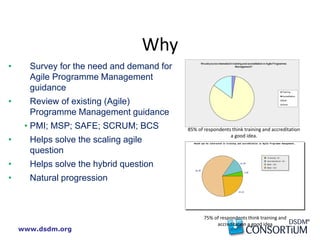
• Survey for the need and demand for
Agile Programme Management
guidance
• Review of existing (Agile)
Programme Management guidance
• PMI; MSP; SAFE; SCRUM; BCS
• Helps solve the scaling agile
question
• Helps solve the hybrid question
• Natural progression
85% of respondents think training and accreditation
a good idea.
75% of respondents think training and
accreditation a good idea
Why
www.dsdm.org
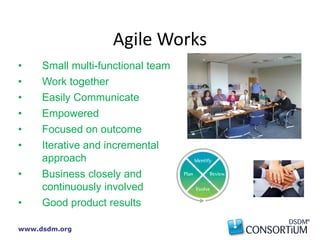
• Small multi-functional team
• Work together
• Easily Communicate
• Empowered
• Focused on outcome
• Iterative and incremental
approach
• Business closely and
continuously involved
• Good product results
Agile Works
www.dsdm.org
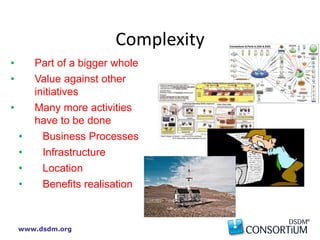
• Part of a bigger whole
• Value against other
initiatives
• Many more activities
have to be done
• Business Processes
• Infrastructure
• Location
• Benefits realisation
Complexity
www.dsdm.org
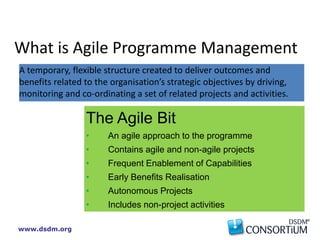
The Agile Bit
• An agile approach to the programme
• Contains agile and non-agile projects
• Frequent Enablement of Capabilities
• Early Benefits Realisation
• Autonomous Projects
• Includes non-project activities
A temporary, flexible structure created to deliver outcomes and
benefits related to the organisation’s strategic objectives by driving,
monitoring and co-ordinating a set of related projects and activities.
What is Agile Programme Management
www.dsdm.org
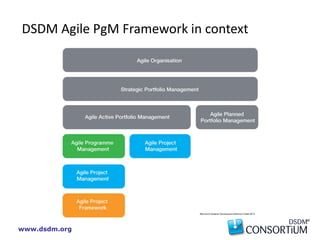
DSDM Agile PgM Framework in context
www.dsdm.org
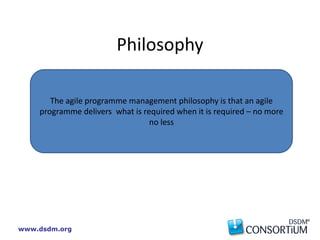
Philosophy
The agile programme management philosophy is that an agile
programme delivers what is required when it is required – no more
no less
www.dsdm.org
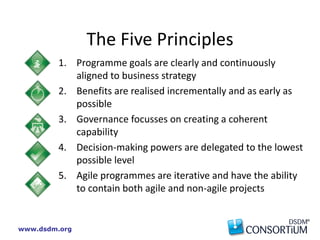
The Five Principles
1. Programme goals are clearly and continuously
aligned to business strategy
2. Benefits are realised incrementally and as early as
possible
3. Governance focusses on creating a coherent
capability
4. Decision-making powers are delegated to the lowest
possible level
5. Agile programmes are iterative and have the ability
to contain both agile and non-agile projects
www.dsdm.org
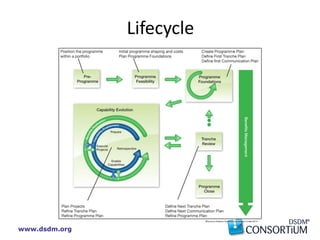
Lifecycle
www.dsdm.org
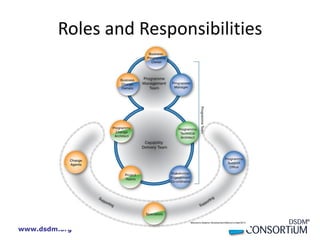
Roles and Responsibilities
www.dsdm.org
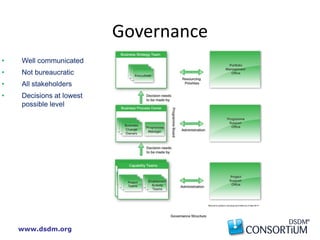
• Well communicated
• Not bureaucratic
• All stakeholders
• Decisions at lowest
possible level
Governance
www.dsdm.org
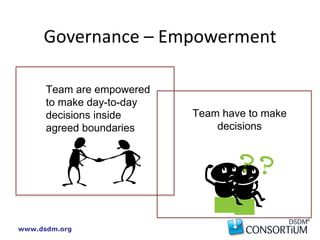
Governance – Empowerment
Team are empowered
to make day-to-day
decisions inside
agreed boundaries
Team have to make
decisions
www.dsdm.org
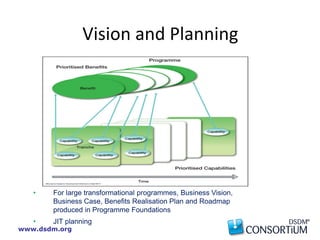
• For large transformational programmes, Business Vision,
Business Case, Benefits Realisation Plan and Roadmap
produced in Programme Foundations
• JIT planning
Vision and Planning
www.dsdm.org
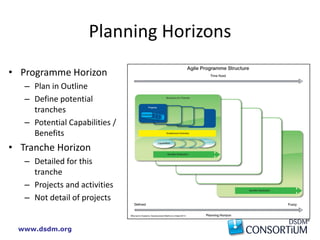
• Programme Horizon
– Plan in Outline
– Define potential
tranches
– Potential Capabilities /
Benefits
• Tranche Horizon
– Detailed for this
tranche
– Projects and activities
– Not detail of projects
Planning Horizons
www.dsdm.org
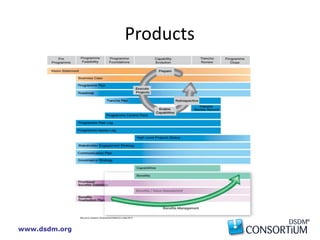
Products
www.dsdm.org
• Monitoring and Control -
hybrids
• Risk
• Quality
And …
www.dsdm.org
• Printed guidance available from DSDM
• Foundation Training Materials available
from APMG
• Foundation Syllabus and Exam
launched
• Handbook and pocketbook
When and Where
www.dsdm.org
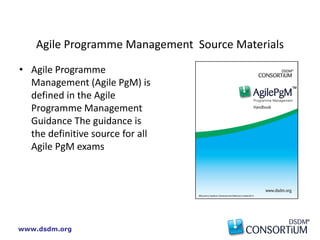
Agile Programme Management Source Materials
• Agile Programme
Management (Agile PgM) is
defined in the Agile
Programme Management
Guidance The guidance is
the definitive source for all
Agile PgM exams
www.dsdm.org
This presentation was delivered
at an APM event
To find out more about
upcoming events please visit our
website www.apm.org.uk/events

Agile programme management, Wednesday 21st January 2015

  • 1.
    www.dsdm.org Agile Programme Management SteveMessenger Lead Author, Chairman DSDM Consortium
  • 2.
    www.dsdm.org • Why AgileProgramme Management? • Who has been involved and how did we do it? • What is Agile Programme Management? • When and where released Agenda
  • 3.
    www.dsdm.org • Survey forthe need and demand for Agile Programme Management guidance • Review of existing (Agile) Programme Management guidance • PMI; MSP; SAFE; SCRUM; BCS • Helps solve the scaling agile question • Helps solve the hybrid question • Natural progression 85% of respondents think training and accreditation a good idea. 75% of respondents think training and accreditation a good idea Why
  • 4.
    www.dsdm.org • Small multi-functionalteam • Work together • Easily Communicate • Empowered • Focused on outcome • Iterative and incremental approach • Business closely and continuously involved • Good product results Agile Works
  • 5.
    www.dsdm.org • Part ofa bigger whole • Value against other initiatives • Many more activities have to be done • Business Processes • Infrastructure • Location • Benefits realisation Complexity
  • 6.
    www.dsdm.org The Agile Bit •An agile approach to the programme • Contains agile and non-agile projects • Frequent Enablement of Capabilities • Early Benefits Realisation • Autonomous Projects • Includes non-project activities A temporary, flexible structure created to deliver outcomes and benefits related to the organisation’s strategic objectives by driving, monitoring and co-ordinating a set of related projects and activities. What is Agile Programme Management
  • 7.
    www.dsdm.org DSDM Agile PgMFramework in context
  • 8.
    www.dsdm.org Philosophy The agile programmemanagement philosophy is that an agile programme delivers what is required when it is required – no more no less
  • 9.
    www.dsdm.org The Five Principles 1.Programme goals are clearly and continuously aligned to business strategy 2. Benefits are realised incrementally and as early as possible 3. Governance focusses on creating a coherent capability 4. Decision-making powers are delegated to the lowest possible level 5. Agile programmes are iterative and have the ability to contain both agile and non-agile projects
  • 10.
  • 11.
  • 12.
    www.dsdm.org • Well communicated •Not bureaucratic • All stakeholders • Decisions at lowest possible level Governance
  • 13.
    www.dsdm.org Governance – Empowerment Teamare empowered to make day-to-day decisions inside agreed boundaries Team have to make decisions
  • 14.
    www.dsdm.org • For largetransformational programmes, Business Vision, Business Case, Benefits Realisation Plan and Roadmap produced in Programme Foundations • JIT planning Vision and Planning
  • 15.
    www.dsdm.org • Programme Horizon –Plan in Outline – Define potential tranches – Potential Capabilities / Benefits • Tranche Horizon – Detailed for this tranche – Projects and activities – Not detail of projects Planning Horizons
  • 16.
  • 17.
    www.dsdm.org • Monitoring andControl - hybrids • Risk • Quality And …
  • 18.
    www.dsdm.org • Printed guidanceavailable from DSDM • Foundation Training Materials available from APMG • Foundation Syllabus and Exam launched • Handbook and pocketbook When and Where
  • 19.
    www.dsdm.org Agile Programme ManagementSource Materials • Agile Programme Management (Agile PgM) is defined in the Agile Programme Management Guidance The guidance is the definitive source for all Agile PgM exams
  • 20.
    www.dsdm.org This presentation wasdelivered at an APM event To find out more about upcoming events please visit our website www.apm.org.uk/events