Assisted Reproduction
     Technology


    Presented by
        Abdulkareem Sultan Al-Olama   1
Introduction
   Infertility is a very common condition
    affecting approximately 13-14% of
    couples in the reproductive age group.
    Although this prevalence has remained
    stable over the last few years, the
    demand for infertility services has
    increased substantially.
   This increase is due primarily to the
    Baby Boom generation entering into the
    reproductive age group at a time of
    highly publicized technological
    advances.
           Abdulkareem Sultan Al-Olama
                                    2
Topics of Discussion
   Definition of Infertility & ART
   Common causes of infertility
   Who is eligible for ART
   Methodology of ovulation induction
   Improving SPA
   Other techniques
   Counseling couple


      Abdulkareem Sultan Al-Olama
                               3
Topics of Discussion Cont’d
    Failure rate
    Cost effectiveness


       Abdulkareem Sultan Al-Olama
                                4
Definition of Infertility &
ART
   Infertility is defined classically as
    the inability to conceive after 1
    year of unprotected intercourse.
    This definition is based on the
    cumulative probability of
    pregnancy:


       Abdulkareem Sultan Al-Olama
                                5
Definition of Infertility &
              ART Cont’d
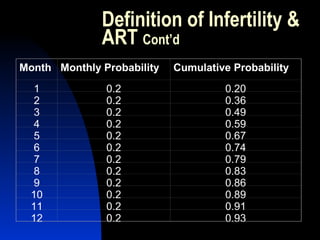
Month Monthly Probability     Cumulative Probability
  1            0.2                       0.20
  2            0.2                       0.36
  3            0.2                       0.49
  4            0.2                       0.59
  5            0.2                       0.67
  6            0.2                       0.74
  7            0.2                       0.79
  8            0.2                       0.83
  9            0.2                       0.86
  10           0.2                       0.89
  11           0.2                       0.91
  12           0.2                       0.93
                     Abdulkareem Sultan Al-Olama
                                              6
Definition of Infertility &
ART Cont’d
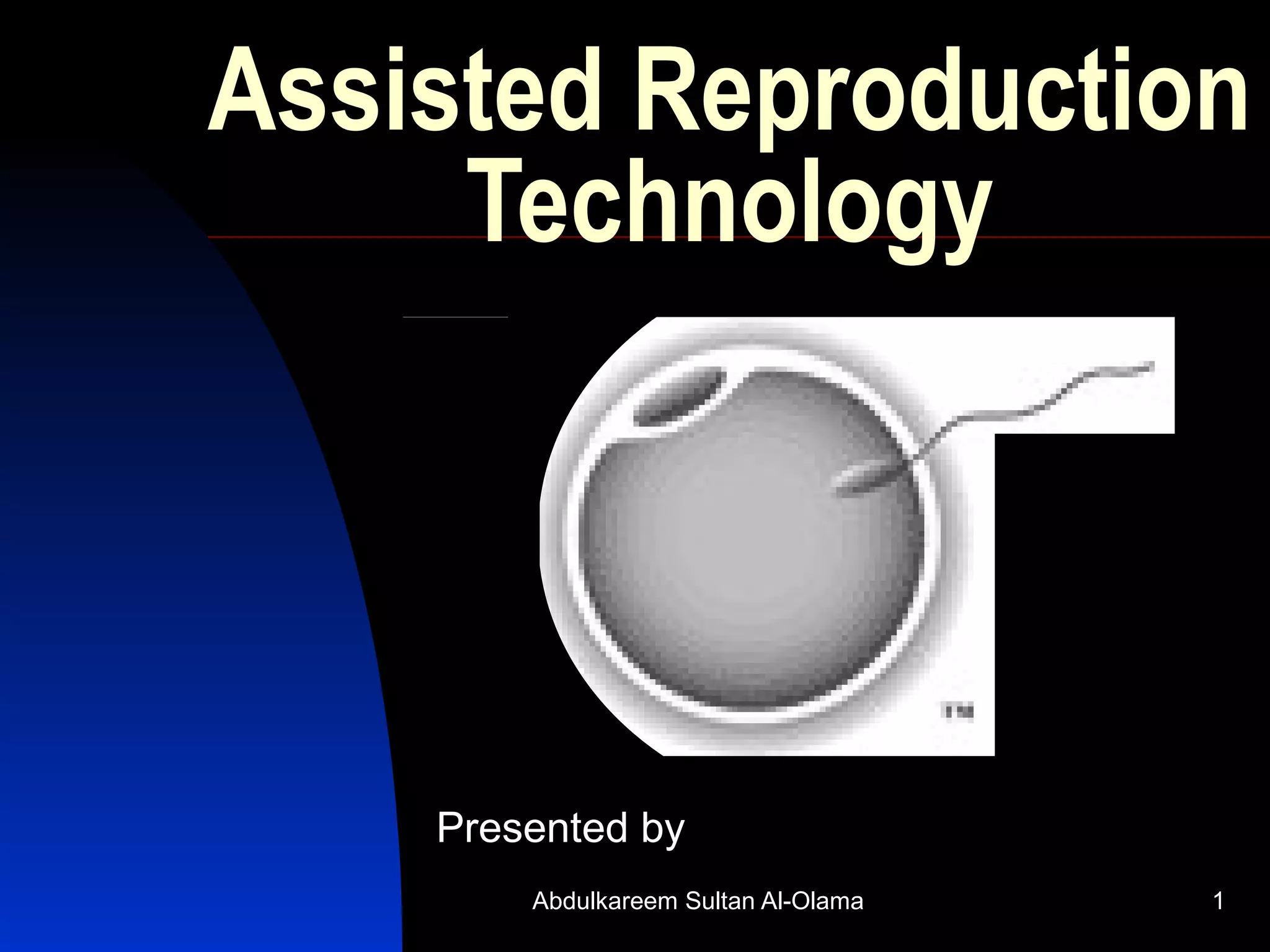
    ART refers to all techniques
    involving direct retrieval of oocytes
    from the ovary
   ART procedures include IVF,
    GIFT, ZIFT, and ICSI.
   The simplest ART procedure, IVF
    has been around for over 20 years
    and is perhaps the most commonly
    recognized ART of all procedures.
      Abdulkareem Sultan Al-Olama
                               7
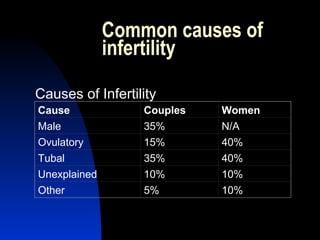
Common causes of
              infertility

Causes of Infertility
Cause              Couples        Women
Male               35%            N/A
Ovulatory          15%            40%
Tubal              35%            40%
Unexplained        10%            10%
Other              5%             10%


                Abdulkareem Sultan Al-Olama
                                         8
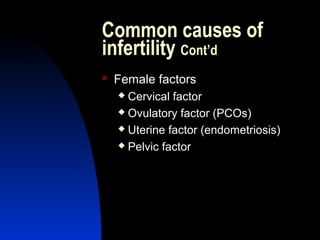
Common causes of
infertility Cont’d
   Female factors
     Cervical factor
     Ovulatory factor (PCOs)

     Uterine factor (endometriosis)

     Pelvic factor


        Abdulkareem Sultan Al-Olama
                                 9
Common causes of
infertility Cont’d
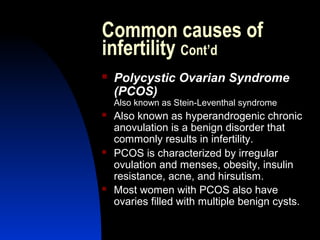
   Polycystic Ovarian Syndrome
    (PCOS)
    Also known as Stein-Leventhal syndrome
   Also known as hyperandrogenic chronic
    anovulation is a benign disorder that
    commonly results in infertility.
   PCOS is characterized by irregular
    ovulation and menses, obesity, insulin
    resistance, acne, and hirsutism.
   Most women with PCOS also have
    ovaries filled with multiple benign cysts.

       Abdulkareem Sultan Al-Olama
                                10
Common causes of
infertility (PCOS) Cont’d
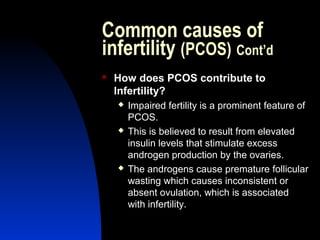
   How does PCOS contribute to
    Infertility?
       Impaired fertility is a prominent feature of
        PCOS.
       This is believed to result from elevated
        insulin levels that stimulate excess
        androgen production by the ovaries.
       The androgens cause premature follicular
        wasting which causes inconsistent or
        absent ovulation, which is associated
        with infertility.

        Abdulkareem Sultan Al-Olama
                                 11
Common causes of
            infertility (PCOS) Cont’d
Diagnosis: 1.   Symptoms
                 Irregular or absent periods

                 Lack of ovulation

                 Weight gain

                 Hirsutism (excessive hair growth)

                 Insulin resistance

                 Acne

                 Male-pattern balding

                 Multiple small ovarian cysts-these may
                  be seen by an ultrasound examination
                 Ancthosis nigrans (darkening of the skin
                  at the nape of the neck and under the
                  arms and breasts).
                  Abdulkareem Sultan Al-Olama
                                           12
Common causes of
          infertility (PCOS) Cont’d
Diagnosis: 2. Blood Work/Hormonal Testing:
                Laboratory testing is important for
                 diagnosis but it is crucial to look
                 at multiple values collectively.


                Abdulkareem Sultan Al-Olama
                                         13
Common causes of
            infertility (PCOS) Cont’d
Diagnosis: 3.   Ultrasound:
                   Ultrasound of the pelvis is typically
                    performed when the clinician suspects
                    PCOS.
                   If >10 cysts are found in either ovary
                    that are less than 10mm, this meets the
                    ultrasound criteria for PCOS.
                    Furthermore, polycystic ovaries are
                    typically 1.5 to 3 times the normal size.
                   Just the presence of polycystic ovaries,
                    without symptoms and/or consistent
                    blood work, does not confirm a
                    diagnosis of PCOS.
                    Abdulkareem Sultan Al-Olama
                                             14
Common causes of
infertility (PCOS) Cont’d
   Treatment
       Weight Loss, Progestins, Oral
        Contraceptives, Anti-Androgens,
        GnRH agonists, Fertility drugs,
        Surgical therapy:
          a) Ovarian wedge resection
          b) Laparoscopic ovarian drilling


        Abdulkareem Sultan Al-Olama
                                 15
Common causes of
infertility Cont’d
   Endometriosis
       Endometriosis can be defined as a
        nonmalignant disorder in which
        functioning endometrial tissue is present
        outside the uterus.
       The incidence of this disease ranges
        from 10-15% in women between the ages
        of 25 and 44 who are actively
        menstruating, but it also occurs in
        teenagers.
       It is estimated that 25-50% of infertile
        women have this disease.

        Abdulkareem Sultan Al-Olama
                                 16
Common causes of
infertility (Endometriosis) Cont’d
   The incidence is higher in first
    degree relatives of women with
    endometriosis, which suggests that
    heredity may play a role.
   In addition, there is also a higher

    prevalence of the disease in
    women who delay childbearing or
    who are of Asian descent.


      Abdulkareem Sultan Al-Olama
                               17
Common causes of
infertility (Endometriosis) Cont’d
   Causes and Symptoms
       The cause of endometriosis is unknown,
        however there are several theories.
       The first theory is known as retrograde
        menstruation, or the movement of
        sloughed endometrial tissue back
        through the fallopian tubes and into the
        abdominal cavity. This tissue can then
        attach itself to various internal organs or
        tissues outside of the uterus.
       Immune system dysfunction. It is
        believed that certain women may develop
        endometriosis due to deficiencies in their
        immune system.
        Abdulkareem Sultan Al-Olama
                                 18
Common causes of
infertility (Endometriosis) Cont’d
     In women without endometriosis, the
      immune system destroys any ectopic
      implants that may develop. However, in
      women with endometriosis, there is an
      altered immune response and the body is
      unable to destroy the growth of the
      implants.
     Furthermore, some scientists believe that
      endometriosis is an autoimmune
      disorder. This means that the body
      makes antibodies to endometrial cells.
      These antibodies may destroy the
      healthy endometrium found in the uterus,
      but are ineffective in destroying ectopic
      implants.
      Abdulkareem Sultan Al-Olama
                               19
Common causes of
infertility (Endometriosis) Cont’d
   Symptoms
     Pelvic pain and cramping before
      and during periods
     Pain during intercourse

     Inability to conceive

     Fatigue

     Painful urination during periods

     Gastrointestinal symptoms such as
      diarrhea, constipation, and nausea

        Abdulkareem Sultan Al-Olama
                                 20
Common causes of
infertility (Endometriosis) Cont’d
     There are other medical conditions that
      have similar symptoms and should be
      considered prior to making a diagnosis of
      endometriosis. Conditions that may
      cause generalized pelvic pain include:
     Pelvic inflammatory disease (PID)
     Pelvic adhesions
     Neoplasms (cancers), both benign or
      malignant
     Ovarian torsion
     Sexual or physical abuse
     Other causes that are not gynecologic in
      nature
      Abdulkareem Sultan Al-Olama
                               21
Common causes of
infertility (Endometriosis) Cont’d
   How does endometriosis contribute to
    infertility?
       The cause of infertility is believed to
        result from the scarring and adhesions
        that form in the reproductive tract as a
        result of inflammation.
       Scar tissue and adhesions may reduce
        fertility by either obstructing or distorting
        the shape of the fallopian tubes, which in
        turn impedes the passage of sperm to the
        egg.

        Abdulkareem Sultan Al-Olama
                                 22
Common causes of
infertility (Endometriosis) Cont’d
   In the event that sperm do reach
    the egg, they may encounter a
    hostile environment unfavorable to
    fertilization.
   Finally, scarring from

    endometriosis may obstruct the
    fallopian tubes so that if an egg is
    fertilized, it may be unable to travel
    to the uterus for implantation.


      Abdulkareem Sultan Al-Olama
                               23
Common causes of
infertility (Endometriosis) Cont’d
   Diagnosis
       One of two techniques may be used to
        confirm the diagnosis of endometriosis.
        Both procedures involve visualization of
        the pelvic cavity in order to confirm the
        presence or absence of ectopic implants.
            laparoscopy
            laparotomy
       If there are any suspected ectopic
        implants, they are biopsied in order to
        determine the presence of endometrial
        cells.

        Abdulkareem Sultan Al-Olama
                                 24
Who is eligible for ART
   Women with tubal diseases
   Unexplained infertility
   Endometriosis
   Immunologic causes for infertility
   Women with premature ovarian
    failure
   Individuals with male factor
    infertility (e.g., abnormalities in sperm
    production, function or transport or
    prior vasectomy)
     Abdulkareem Sultan Al-Olama
                              25
Methodology of
ovulation induction Cont’d
   Basically, this term refers to the use of
    medications to stimulate your body to
    produce one or more eggs.
   Ovulation induction can be as simple as
    taking a daily pill or more complicated,
    like injecting fertility medications and
    seeing your specialist daily for necessary
    monitoring. The simplest form of
    ovulation induction involves taking
    clomiphene.

       Abdulkareem Sultan Al-Olama
                                26
Methodology of
ovulation induction Cont’d
   More potent medications, known as the
    gonadotropins, are available for more
    intensive ovulation induction.
   Gonadotropins are injectable
    medications that are made up of a
    combination of follicle stimulating
    hormone (FSH) and luteinizing hormone
    (LH) or just FSH alone.
   These hormones can be very helpful in
    getting a woman to produce and release
    her eggs.

      Abdulkareem Sultan Al-Olama
                               27
Methodology of
ovulation induction
   The success of ovulation induction
    in achieving a pregnancy is highly
    variable. It depends on the
    diagnosis, age, the medication
    being used, and numerous other
    factors.


      Abdulkareem Sultan Al-Olama
                               28
Improving SPA

   Sperm penetration assay (SPA) is a
    multi-step laboratory test that offers a
    biological assessment of human sperm
    fertilizing ability.


       Abdulkareem Sultan Al-Olama
                                29
Other techniques
   ZIFT
   GIFT
   TEST
   POST
   ICSI
   TESE
   MESA


     Abdulkareem Sultan Al-Olama
                              30
Other techniques Cont’d
   ZIFT
       Zygote Intrafallopian Transfer. ZIFT may
        be recommended if the husband has
        severe male fertility factor or if there has
        been difficulty confirming fertilization with
        past procedures. ZIFT has the
        advantages of allowing fertilization to be
        confirmed and it has demonstrated higher
        success rates than IVF when used for the
        appropriate indications.
       One disadvantage with ZIFT is that the
        transfer of the zygote must be performed
        through a laparoscope.
        Abdulkareem Sultan Al-Olama
                                 31
Other techniques Cont’d
   GIFT
       Gamete intrafallopian transfer was
        developing in 1984 as a variation of in
        vitro fertilization (IVF).
       Gift is recommended when
            unexplained infertility
            infertility due to immunological factors
            endometriosis
            selected cases of male infertility
            Tubal infertility
       A requirement for the procedure is that
        the female partner having at least one
        open (patent) fallopian tube.
        Abdulkareem Sultan Al-Olama
                                 32
Other techniques Cont’d
   TEST
       Tubal Embryo Transfer; the
        placing of cleaving embryos into
        the fallopian tube.
   POST
       Peritoneal Oocyte and Sperm
        Transfer; the placement of oocytes
        and sperm into the pelvic cavity


        Abdulkareem Sultan Al-Olama
                                 33
Other techniques Cont’d
   ICSI
       Intracytoplasmic sperm injection, or ICSI,
        was developed to treat couples who
        previously had a very poor probability of
        achieving fertilization due to the male
        partner's extremely low numbers of viable
        sperm.
       This treatment, when combined with in
        vitro fertilization, allows these couples a
        more favorable probability of achieving
        conception.

        Abdulkareem Sultan Al-Olama
                                 34
Other techniques Cont’d
   TESE
       Testicular Sperm Extraction
   MESA
       Microsurgical Epididymal Sperm
        Aspiration


        Abdulkareem Sultan Al-Olama
                                 35
Counseling couple
   The use of skills that enable a client to
    recognize and identify his (sic) own
    problems, and the ability to help client
    find his own solution or resolution.
   The Human Fertilization and Embryology
    Authority (HFEA) state in their code of
    practice that three sorts of counseling
    must be available at licensed treatment
    center. These are:
       Support counseling
       Implications counseling
       Therapeutic counseling
        Abdulkareem Sultan Al-Olama
                                 36
Success rates
"take home baby rate"
   One of the first questions that most
    people ask is "what is the chance for
    success?" The best estimate is that the
    birth of a live baby occurs in
    approximately 15-25% of women in
    whom embryos are transferred into the
    uterus.
   The 1998 nationwide live birth rate as
    reported in the IVF-ET Registry, was
    24.9%.
   The corresponding rate for 1989 was
    14%.
      Abdulkareem Sultan Al-Olama
                               37
Success rates Cont’d
   Success varies with many factors,
    including the number of embryos that are
    transferred.
   If one embryo is transferred, there is
    approximately a 7% chance of
    successful     implantation;    with  two
    embryos, the success rate increases to
    18%.
   The rate peaks with the transfer of three
    to four embryos.           Presently, the
    collection of oocytes, fertilization, and
    early embryo growth are accomplished
    with a high degree of efficiency.
       Abdulkareem Sultan Al-Olama38
Success rates Cont’d
   The major hurdles to success are
    implantation after embryo transfer and
    early pregnancy loss. The rate of early
    pregnancy loss is slightly, but not
    significantly, higher with ART compared
    to spontaneous conception.
   The risk of early pregnancy loss
    increases with age of the female partner.
     Over age 40, ART success rates decline
    dramatically.
   Pregnancy complications tend to be
    higher with ART pregnancies, primarily
    because of the much higher rate of
    multiple pregnancy.
       Abdulkareem Sultan Al-Olama
                                39
Success rates Cont’d
   Twins occur in about 25% of ART
    pregnancies versus 1-2%of spontaneous
    pregnancies. The risk of more than a
    twin pregnancy is less than 5%.
   To put these figures into perspective,
    studies have shown that the rate of
    pregnancy in couples with proven fertility
    in the past is approximately 20% per
    cycle. Therefore, although a figure of
    15-25% may sound low, it is equal to or
    greater than the chance that a fertile
    couple will conceive in any given cycle.
       Abdulkareem Sultan Al-Olama
                                40
Cost effectiveness


    Abdulkareem Sultan Al-Olama
                             41
Abdulkareem Sultan Al-Olama
                         42

Assisted reproduction technology

  • 1.
    Assisted Reproduction Technology Presented by Abdulkareem Sultan Al-Olama 1
  • 2.
    Introduction  Infertility is a very common condition affecting approximately 13-14% of couples in the reproductive age group.  Although this prevalence has remained stable over the last few years, the demand for infertility services has increased substantially.  This increase is due primarily to the Baby Boom generation entering into the reproductive age group at a time of highly publicized technological advances. Abdulkareem Sultan Al-Olama 2
  • 3.
    Topics of Discussion  Definition of Infertility & ART  Common causes of infertility  Who is eligible for ART  Methodology of ovulation induction  Improving SPA  Other techniques  Counseling couple Abdulkareem Sultan Al-Olama 3
  • 4.
    Topics of DiscussionCont’d  Failure rate  Cost effectiveness Abdulkareem Sultan Al-Olama 4
  • 5.
    Definition of Infertility& ART  Infertility is defined classically as the inability to conceive after 1 year of unprotected intercourse. This definition is based on the cumulative probability of pregnancy: Abdulkareem Sultan Al-Olama 5
  • 6.
    Definition of Infertility& ART Cont’d Month Monthly Probability Cumulative Probability 1 0.2 0.20 2 0.2 0.36 3 0.2 0.49 4 0.2 0.59 5 0.2 0.67 6 0.2 0.74 7 0.2 0.79 8 0.2 0.83 9 0.2 0.86 10 0.2 0.89 11 0.2 0.91 12 0.2 0.93 Abdulkareem Sultan Al-Olama 6
  • 7.
    Definition of Infertility& ART Cont’d  ART refers to all techniques involving direct retrieval of oocytes from the ovary  ART procedures include IVF, GIFT, ZIFT, and ICSI.  The simplest ART procedure, IVF has been around for over 20 years and is perhaps the most commonly recognized ART of all procedures. Abdulkareem Sultan Al-Olama 7
  • 8.
    Common causes of infertility Causes of Infertility Cause Couples Women Male 35% N/A Ovulatory 15% 40% Tubal 35% 40% Unexplained 10% 10% Other 5% 10% Abdulkareem Sultan Al-Olama 8
  • 9.
    Common causes of infertilityCont’d  Female factors  Cervical factor  Ovulatory factor (PCOs)  Uterine factor (endometriosis)  Pelvic factor Abdulkareem Sultan Al-Olama 9
  • 10.
    Common causes of infertilityCont’d  Polycystic Ovarian Syndrome (PCOS) Also known as Stein-Leventhal syndrome  Also known as hyperandrogenic chronic anovulation is a benign disorder that commonly results in infertility.  PCOS is characterized by irregular ovulation and menses, obesity, insulin resistance, acne, and hirsutism.  Most women with PCOS also have ovaries filled with multiple benign cysts. Abdulkareem Sultan Al-Olama 10
  • 11.
    Common causes of infertility(PCOS) Cont’d  How does PCOS contribute to Infertility?  Impaired fertility is a prominent feature of PCOS.  This is believed to result from elevated insulin levels that stimulate excess androgen production by the ovaries.  The androgens cause premature follicular wasting which causes inconsistent or absent ovulation, which is associated with infertility. Abdulkareem Sultan Al-Olama 11
  • 12.
    Common causes of infertility (PCOS) Cont’d Diagnosis: 1. Symptoms  Irregular or absent periods  Lack of ovulation  Weight gain  Hirsutism (excessive hair growth)  Insulin resistance  Acne  Male-pattern balding  Multiple small ovarian cysts-these may be seen by an ultrasound examination  Ancthosis nigrans (darkening of the skin at the nape of the neck and under the arms and breasts). Abdulkareem Sultan Al-Olama 12
  • 13.
    Common causes of infertility (PCOS) Cont’d Diagnosis: 2. Blood Work/Hormonal Testing:  Laboratory testing is important for diagnosis but it is crucial to look at multiple values collectively. Abdulkareem Sultan Al-Olama 13
  • 14.
    Common causes of infertility (PCOS) Cont’d Diagnosis: 3. Ultrasound:  Ultrasound of the pelvis is typically performed when the clinician suspects PCOS.  If >10 cysts are found in either ovary that are less than 10mm, this meets the ultrasound criteria for PCOS. Furthermore, polycystic ovaries are typically 1.5 to 3 times the normal size.  Just the presence of polycystic ovaries, without symptoms and/or consistent blood work, does not confirm a diagnosis of PCOS. Abdulkareem Sultan Al-Olama 14
  • 15.
    Common causes of infertility(PCOS) Cont’d  Treatment  Weight Loss, Progestins, Oral Contraceptives, Anti-Androgens, GnRH agonists, Fertility drugs, Surgical therapy:  a) Ovarian wedge resection  b) Laparoscopic ovarian drilling Abdulkareem Sultan Al-Olama 15
  • 16.
    Common causes of infertilityCont’d  Endometriosis  Endometriosis can be defined as a nonmalignant disorder in which functioning endometrial tissue is present outside the uterus.  The incidence of this disease ranges from 10-15% in women between the ages of 25 and 44 who are actively menstruating, but it also occurs in teenagers.  It is estimated that 25-50% of infertile women have this disease. Abdulkareem Sultan Al-Olama 16
  • 17.
    Common causes of infertility(Endometriosis) Cont’d  The incidence is higher in first degree relatives of women with endometriosis, which suggests that heredity may play a role.  In addition, there is also a higher prevalence of the disease in women who delay childbearing or who are of Asian descent. Abdulkareem Sultan Al-Olama 17
  • 18.
    Common causes of infertility(Endometriosis) Cont’d  Causes and Symptoms  The cause of endometriosis is unknown, however there are several theories.  The first theory is known as retrograde menstruation, or the movement of sloughed endometrial tissue back through the fallopian tubes and into the abdominal cavity. This tissue can then attach itself to various internal organs or tissues outside of the uterus.  Immune system dysfunction. It is believed that certain women may develop endometriosis due to deficiencies in their immune system. Abdulkareem Sultan Al-Olama 18
  • 19.
    Common causes of infertility(Endometriosis) Cont’d  In women without endometriosis, the immune system destroys any ectopic implants that may develop. However, in women with endometriosis, there is an altered immune response and the body is unable to destroy the growth of the implants.  Furthermore, some scientists believe that endometriosis is an autoimmune disorder. This means that the body makes antibodies to endometrial cells. These antibodies may destroy the healthy endometrium found in the uterus, but are ineffective in destroying ectopic implants. Abdulkareem Sultan Al-Olama 19
  • 20.
    Common causes of infertility(Endometriosis) Cont’d  Symptoms  Pelvic pain and cramping before and during periods  Pain during intercourse  Inability to conceive  Fatigue  Painful urination during periods  Gastrointestinal symptoms such as diarrhea, constipation, and nausea Abdulkareem Sultan Al-Olama 20
  • 21.
    Common causes of infertility(Endometriosis) Cont’d  There are other medical conditions that have similar symptoms and should be considered prior to making a diagnosis of endometriosis. Conditions that may cause generalized pelvic pain include:  Pelvic inflammatory disease (PID)  Pelvic adhesions  Neoplasms (cancers), both benign or malignant  Ovarian torsion  Sexual or physical abuse  Other causes that are not gynecologic in nature Abdulkareem Sultan Al-Olama 21
  • 22.
    Common causes of infertility(Endometriosis) Cont’d  How does endometriosis contribute to infertility?  The cause of infertility is believed to result from the scarring and adhesions that form in the reproductive tract as a result of inflammation.  Scar tissue and adhesions may reduce fertility by either obstructing or distorting the shape of the fallopian tubes, which in turn impedes the passage of sperm to the egg. Abdulkareem Sultan Al-Olama 22
  • 23.
    Common causes of infertility(Endometriosis) Cont’d  In the event that sperm do reach the egg, they may encounter a hostile environment unfavorable to fertilization.  Finally, scarring from endometriosis may obstruct the fallopian tubes so that if an egg is fertilized, it may be unable to travel to the uterus for implantation. Abdulkareem Sultan Al-Olama 23
  • 24.
    Common causes of infertility(Endometriosis) Cont’d  Diagnosis  One of two techniques may be used to confirm the diagnosis of endometriosis. Both procedures involve visualization of the pelvic cavity in order to confirm the presence or absence of ectopic implants.  laparoscopy  laparotomy  If there are any suspected ectopic implants, they are biopsied in order to determine the presence of endometrial cells. Abdulkareem Sultan Al-Olama 24
  • 25.
    Who is eligiblefor ART  Women with tubal diseases  Unexplained infertility  Endometriosis  Immunologic causes for infertility  Women with premature ovarian failure  Individuals with male factor infertility (e.g., abnormalities in sperm production, function or transport or prior vasectomy) Abdulkareem Sultan Al-Olama 25
  • 26.
    Methodology of ovulation inductionCont’d  Basically, this term refers to the use of medications to stimulate your body to produce one or more eggs.  Ovulation induction can be as simple as taking a daily pill or more complicated, like injecting fertility medications and seeing your specialist daily for necessary monitoring. The simplest form of ovulation induction involves taking clomiphene. Abdulkareem Sultan Al-Olama 26
  • 27.
    Methodology of ovulation inductionCont’d  More potent medications, known as the gonadotropins, are available for more intensive ovulation induction.  Gonadotropins are injectable medications that are made up of a combination of follicle stimulating hormone (FSH) and luteinizing hormone (LH) or just FSH alone.  These hormones can be very helpful in getting a woman to produce and release her eggs. Abdulkareem Sultan Al-Olama 27
  • 28.
    Methodology of ovulation induction  The success of ovulation induction in achieving a pregnancy is highly variable. It depends on the diagnosis, age, the medication being used, and numerous other factors. Abdulkareem Sultan Al-Olama 28
  • 29.
    Improving SPA  Sperm penetration assay (SPA) is a multi-step laboratory test that offers a biological assessment of human sperm fertilizing ability. Abdulkareem Sultan Al-Olama 29
  • 30.
    Other techniques  ZIFT  GIFT  TEST  POST  ICSI  TESE  MESA Abdulkareem Sultan Al-Olama 30
  • 31.
    Other techniques Cont’d  ZIFT  Zygote Intrafallopian Transfer. ZIFT may be recommended if the husband has severe male fertility factor or if there has been difficulty confirming fertilization with past procedures. ZIFT has the advantages of allowing fertilization to be confirmed and it has demonstrated higher success rates than IVF when used for the appropriate indications.  One disadvantage with ZIFT is that the transfer of the zygote must be performed through a laparoscope. Abdulkareem Sultan Al-Olama 31
  • 32.
    Other techniques Cont’d  GIFT  Gamete intrafallopian transfer was developing in 1984 as a variation of in vitro fertilization (IVF).  Gift is recommended when  unexplained infertility  infertility due to immunological factors  endometriosis  selected cases of male infertility  Tubal infertility  A requirement for the procedure is that the female partner having at least one open (patent) fallopian tube. Abdulkareem Sultan Al-Olama 32
  • 33.
    Other techniques Cont’d  TEST  Tubal Embryo Transfer; the placing of cleaving embryos into the fallopian tube.  POST  Peritoneal Oocyte and Sperm Transfer; the placement of oocytes and sperm into the pelvic cavity Abdulkareem Sultan Al-Olama 33
  • 34.
    Other techniques Cont’d  ICSI  Intracytoplasmic sperm injection, or ICSI, was developed to treat couples who previously had a very poor probability of achieving fertilization due to the male partner's extremely low numbers of viable sperm.  This treatment, when combined with in vitro fertilization, allows these couples a more favorable probability of achieving conception. Abdulkareem Sultan Al-Olama 34
  • 35.
    Other techniques Cont’d  TESE  Testicular Sperm Extraction  MESA  Microsurgical Epididymal Sperm Aspiration Abdulkareem Sultan Al-Olama 35
  • 36.
    Counseling couple  The use of skills that enable a client to recognize and identify his (sic) own problems, and the ability to help client find his own solution or resolution.  The Human Fertilization and Embryology Authority (HFEA) state in their code of practice that three sorts of counseling must be available at licensed treatment center. These are:  Support counseling  Implications counseling  Therapeutic counseling Abdulkareem Sultan Al-Olama 36
  • 37.
    Success rates "take homebaby rate"  One of the first questions that most people ask is "what is the chance for success?" The best estimate is that the birth of a live baby occurs in approximately 15-25% of women in whom embryos are transferred into the uterus.  The 1998 nationwide live birth rate as reported in the IVF-ET Registry, was 24.9%.  The corresponding rate for 1989 was 14%. Abdulkareem Sultan Al-Olama 37
  • 38.
    Success rates Cont’d  Success varies with many factors, including the number of embryos that are transferred.  If one embryo is transferred, there is approximately a 7% chance of successful implantation; with two embryos, the success rate increases to 18%.  The rate peaks with the transfer of three to four embryos. Presently, the collection of oocytes, fertilization, and early embryo growth are accomplished with a high degree of efficiency. Abdulkareem Sultan Al-Olama38
  • 39.
    Success rates Cont’d  The major hurdles to success are implantation after embryo transfer and early pregnancy loss. The rate of early pregnancy loss is slightly, but not significantly, higher with ART compared to spontaneous conception.  The risk of early pregnancy loss increases with age of the female partner. Over age 40, ART success rates decline dramatically.  Pregnancy complications tend to be higher with ART pregnancies, primarily because of the much higher rate of multiple pregnancy. Abdulkareem Sultan Al-Olama 39
  • 40.
    Success rates Cont’d  Twins occur in about 25% of ART pregnancies versus 1-2%of spontaneous pregnancies. The risk of more than a twin pregnancy is less than 5%.  To put these figures into perspective, studies have shown that the rate of pregnancy in couples with proven fertility in the past is approximately 20% per cycle. Therefore, although a figure of 15-25% may sound low, it is equal to or greater than the chance that a fertile couple will conceive in any given cycle. Abdulkareem Sultan Al-Olama 40
  • 41.
    Cost effectiveness Abdulkareem Sultan Al-Olama 41
  • 42.