Some Relationship between
Lexical Items
Chapter 7: Meaning-based Translation
A guide to Cross-Language Equivalence
By Mildred L. Larson
Linguistics for Translators and Interpreters
Puspita Pertiwi
16202241016
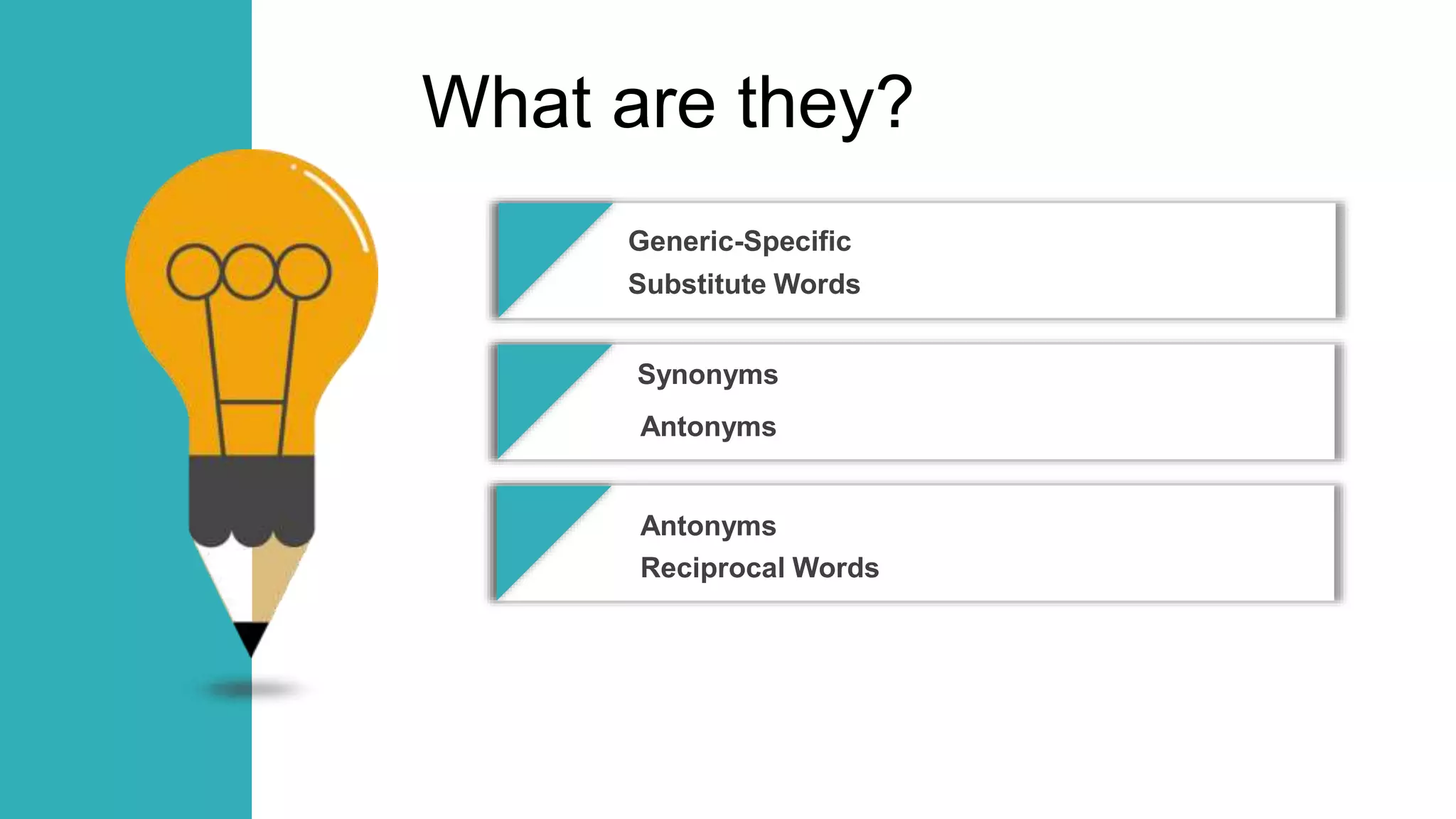
What are they?
04
Generic-Specific
Substitute Words
Antonyms
Reciprocal Words
Synonyms
Antonyms
It is very important that the translator be aware of the fact that the vocabulary of the source
language will not match the vocabulary of the target language. Awareness of the way that
vocabularies are structured should help the translator to find equivalent through looking for
generic or specific vocabulary, words that are synonymous or near synonymous,
and by looking for antonyms and reciprocal words.
“ “
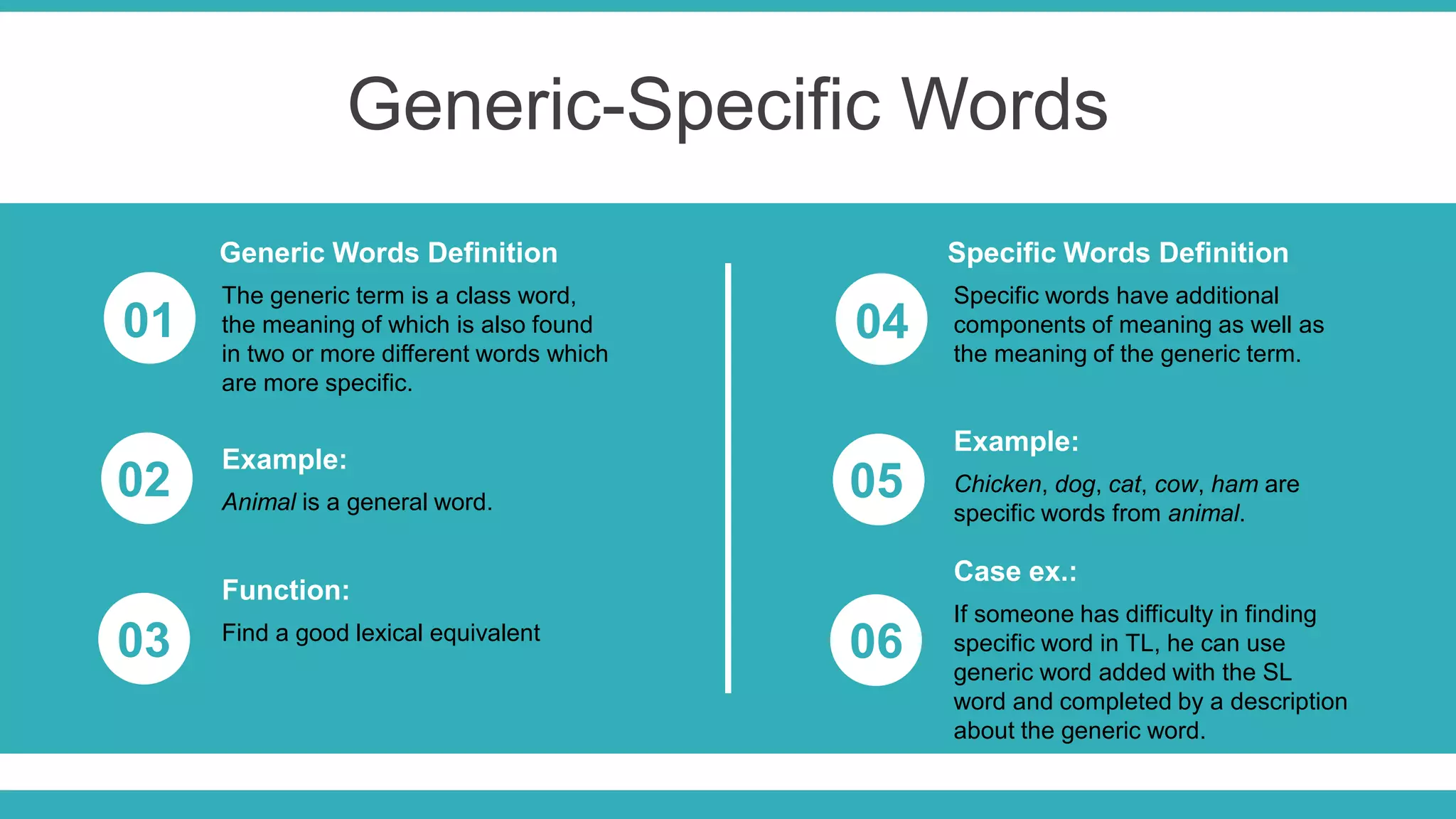
Generic-Specific Words
The generic term is a class word,
the meaning of which is also found
in two or more different words which
are more specific.
Generic Words Definition
Animal is a general word.
Example:
Find a good lexical equivalent
Function:
Specific words have additional
components of meaning as well as
the meaning of the generic term.
Specific Words Definition
Chicken, dog, cat, cow, ham are
specific words from animal.
Example:
If someone has difficulty in finding
specific word in TL, he can use
generic word added with the SL
word and completed by a description
about the generic word.
Case ex.:
01
02
03
04
05
06
Languages tend to differ most in generic terminology rather than in specific.
The translation of abstract or more generic terms is often very complex,
especially if the cultural contexts of the two languages are quite different.
Generic-Specific Words
Substitute
Words
Substitute words or also called as indefinite, that is, they are
referring to a generic class and do not specify a particular thing
or event. A substitute word refers to something already
introduced to the context.
For example, “My Plymouth broke down again. It has been a
good car. But it is time to get rid of the old thing.”
The words It, car, thing are the substitute words for the
antecedent Plymouth.
Sometimes the substitute word will be more generic word.
Target languages may not have a specific word for each of
the synonyms of the source language and they sometimes
have more words to choose than the source language. It is
very important that the translator be aware of the very detail
differences in meaning between words and near synonyms
so as to choose the word that has the right connotation.
Synonyms
Antonyms
The antonym of a word is the exact opposite, or contrast
in some particular part of its meaning. It can sometimes
be very helpful to a translator who is looking for a
particular word to realize that if he thinks about the
antonym, he may be able to find the desired word by
constructing a negative form of that antonym.
In some instances, a target language may already use a
construction with negative as a normal way of handling
certain positive concepts. For example, in Bila’an of
Philippines, the expression it is not possible we will not is
how we must is expressed.
Reciprocal
Words
Example of reciprocal words are, the word give and
receive. One can say, “John gave Mary a book,” or one
can also say, “Mary received a book from John.”
The meaning is the same since the two actions are
reciprocal actions.
This may be very helpful in translating where the target
language does not have a specific word used in the
same way as the source language. It may be that
the same meaning can be communicated by using
a reciprocal word.
Reciprocal Words
Thank you

Chapter 7 Some Relationship between Lexical Items

  • 1.
    Some Relationship between LexicalItems Chapter 7: Meaning-based Translation A guide to Cross-Language Equivalence By Mildred L. Larson Linguistics for Translators and Interpreters Puspita Pertiwi 16202241016
  • 2.
    What are they? 04 Generic-Specific SubstituteWords Antonyms Reciprocal Words Synonyms Antonyms
  • 3.
    It is veryimportant that the translator be aware of the fact that the vocabulary of the source language will not match the vocabulary of the target language. Awareness of the way that vocabularies are structured should help the translator to find equivalent through looking for generic or specific vocabulary, words that are synonymous or near synonymous, and by looking for antonyms and reciprocal words. “ “
  • 4.
    Generic-Specific Words The genericterm is a class word, the meaning of which is also found in two or more different words which are more specific. Generic Words Definition Animal is a general word. Example: Find a good lexical equivalent Function: Specific words have additional components of meaning as well as the meaning of the generic term. Specific Words Definition Chicken, dog, cat, cow, ham are specific words from animal. Example: If someone has difficulty in finding specific word in TL, he can use generic word added with the SL word and completed by a description about the generic word. Case ex.: 01 02 03 04 05 06
  • 5.
    Languages tend todiffer most in generic terminology rather than in specific. The translation of abstract or more generic terms is often very complex, especially if the cultural contexts of the two languages are quite different. Generic-Specific Words
  • 6.
    Substitute Words Substitute words oralso called as indefinite, that is, they are referring to a generic class and do not specify a particular thing or event. A substitute word refers to something already introduced to the context. For example, “My Plymouth broke down again. It has been a good car. But it is time to get rid of the old thing.” The words It, car, thing are the substitute words for the antecedent Plymouth. Sometimes the substitute word will be more generic word.
  • 7.
    Target languages maynot have a specific word for each of the synonyms of the source language and they sometimes have more words to choose than the source language. It is very important that the translator be aware of the very detail differences in meaning between words and near synonyms so as to choose the word that has the right connotation. Synonyms
  • 8.
    Antonyms The antonym ofa word is the exact opposite, or contrast in some particular part of its meaning. It can sometimes be very helpful to a translator who is looking for a particular word to realize that if he thinks about the antonym, he may be able to find the desired word by constructing a negative form of that antonym. In some instances, a target language may already use a construction with negative as a normal way of handling certain positive concepts. For example, in Bila’an of Philippines, the expression it is not possible we will not is how we must is expressed.
  • 9.
    Reciprocal Words Example of reciprocalwords are, the word give and receive. One can say, “John gave Mary a book,” or one can also say, “Mary received a book from John.” The meaning is the same since the two actions are reciprocal actions. This may be very helpful in translating where the target language does not have a specific word used in the same way as the source language. It may be that the same meaning can be communicated by using a reciprocal word. Reciprocal Words
  • 10.