M.A. Honors I Paper VII SME
Unit II: Sound and Sound System
in English
Outline
• Phonology and Phonetics
• Phone, Phoneme and Allophone
• Principles of Classification of Speech Sounds
• Complementary Distribution
• Contrastive Distribution
• Other Principles
Basic Concepts
Phone Phoneme Allophone
Sound in a stream of
speech
The smallest distinctive unit in
the sound system of a language
A set of multiple possible
speech sounds.
A phoneme is an abstract entity. Allophone is a realization.
Phonemic transcription
represents only phonemes. It
uses slanting bars. //
e.g. /p/
Phonetic transcription
represents allophones. It uses
brackets [ ]
e.g. [ph]
Phonemes are determined by
the principles of contrastive
distribution of speech sounds of
a particular language
Allophones are determined by
the principles of
complementary distribution of
speech sounds of a language.
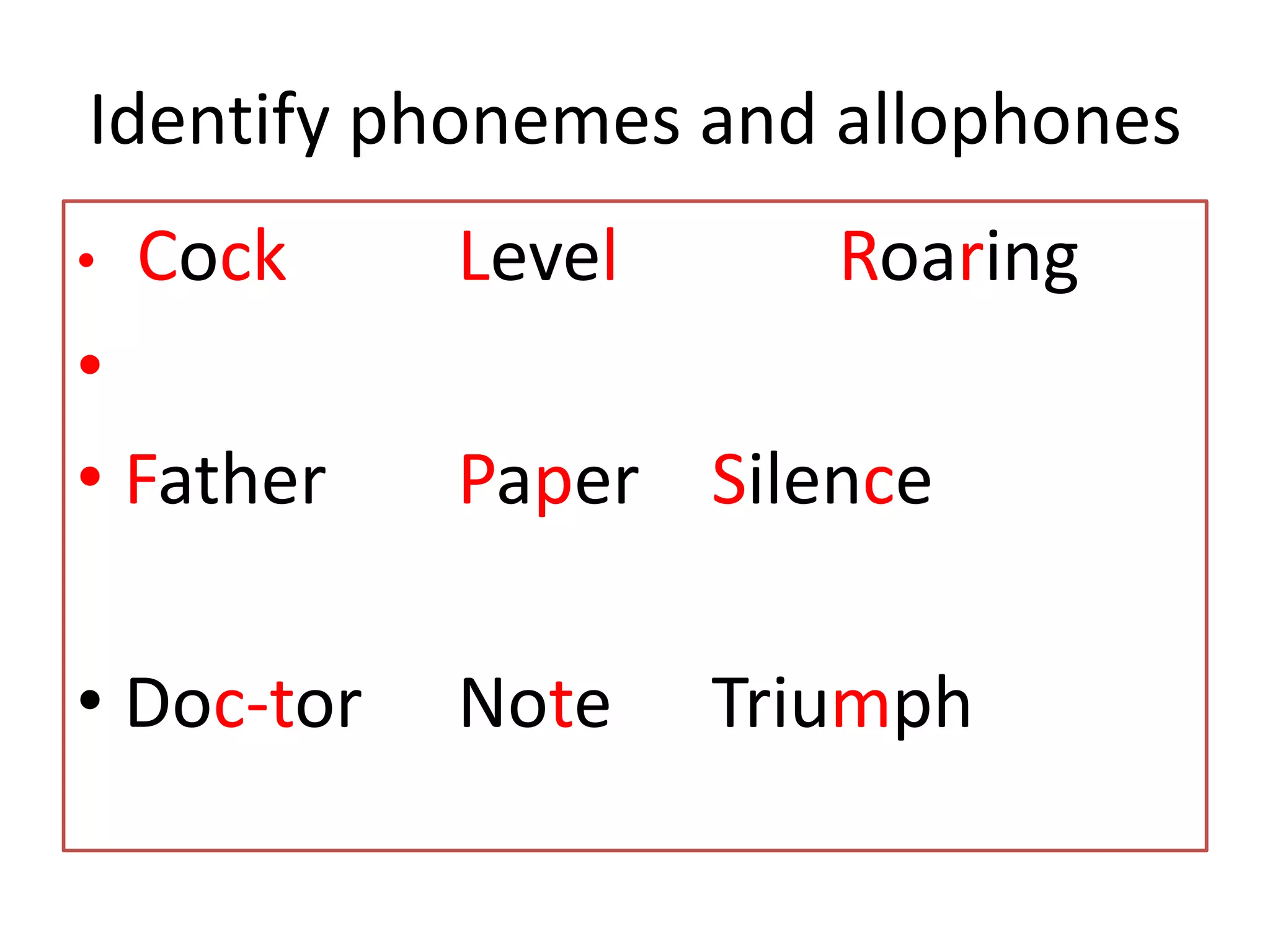
Identify phonemes and allophones
• Cock Level Roaring
•
• Father Paper Silence
• Doc-tor Note Triumph
Phonology Phonetics
phonology is about sound systems of
language. It is the basis for further
work in Morphology, syntax, discourse
and Orthography design
Phonetics is a descriptive tool
necessary to the study of the
phonological aspects of a language. Its
is the basis for phonological analysis
Studies (1) how the speech sounds of a
language are used in that language to
distinguish meaningful units (such as
words) from each other, and (2) how
sounds are patterned in a language.
Phoneme is the basic unit of
phonological analysis in Phonology.
Analyzes the production of all human
speech sounds, regardless of language,
particularly how sounds are produced,
transmitted and received
The phonological system of a language
includes an inventory of sounds and
their features and pragmatic rules
which specify how sounds interact with
each other.
Phonetics studies which sounds are
present in a language
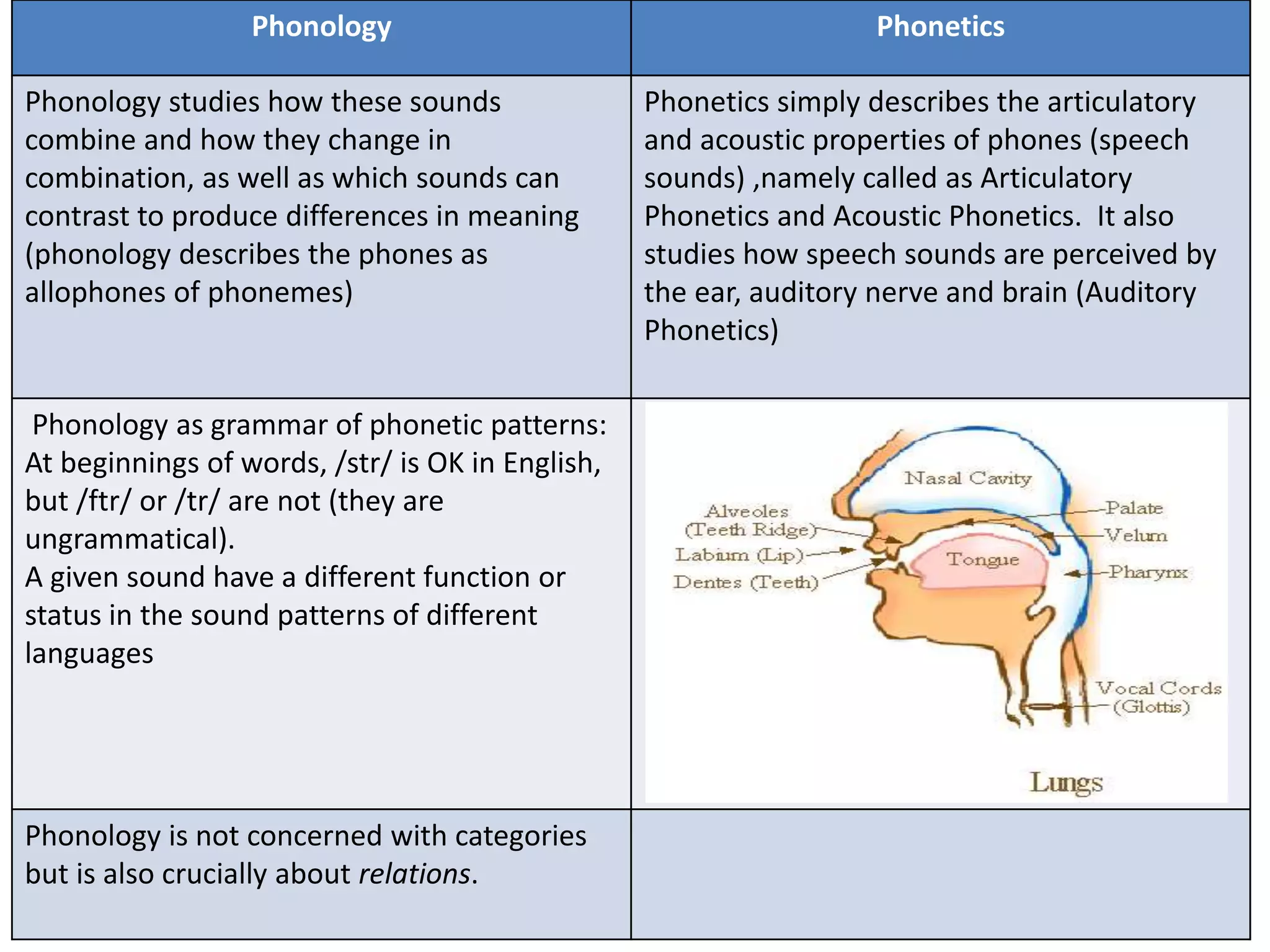
Phonology Phonetics
Phonology studies how these sounds
combine and how they change in
combination, as well as which sounds can
contrast to produce differences in meaning
(phonology describes the phones as
allophones of phonemes)
Phonetics simply describes the articulatory
and acoustic properties of phones (speech
sounds) ,namely called as Articulatory
Phonetics and Acoustic Phonetics. It also
studies how speech sounds are perceived by
the ear, auditory nerve and brain (Auditory
Phonetics)
Phonology as grammar of phonetic patterns:
At beginnings of words, /str/ is OK in English,
but /ftr/ or /tr/ are not (they are
ungrammatical).
A given sound have a different function or
status in the sound patterns of different
languages
Phonology is not concerned with categories
but is also crucially about relations.
CLASSIFICATION OF SPEECH
SOUNDS
Principle of Contrastive Distribution
• If two sounds are in contrastive distribution,
then they belong to different phonemes.
• When the substitution of one sound with the
other brings about a change in the meaning of
a word then the sounds are contrastive or
distinctive.
• The term distribution implies the different
positions (initial, middle or final)
• Environment means what precedes and
follows a particular sound.
Minimal Pair
• Phonemes are most easily identified through
minimal pairs.
• A minimal pair is the one where there is a
distinction only of one (minimal) sound.
• Thus Pit [pit] and bit [bit] differ only in that where
[pit] has [p], [bit] has [b]. These two words make a
minimal pair that shows that [p] and [b] represent
separate phonemes in English which we symbolize
as /p/, /b/.
• One objective of phonology is to identify which
sound differences are contrastive and which are
not.
• Minimal pairs are enclosed in curly brackets.
Fun Time
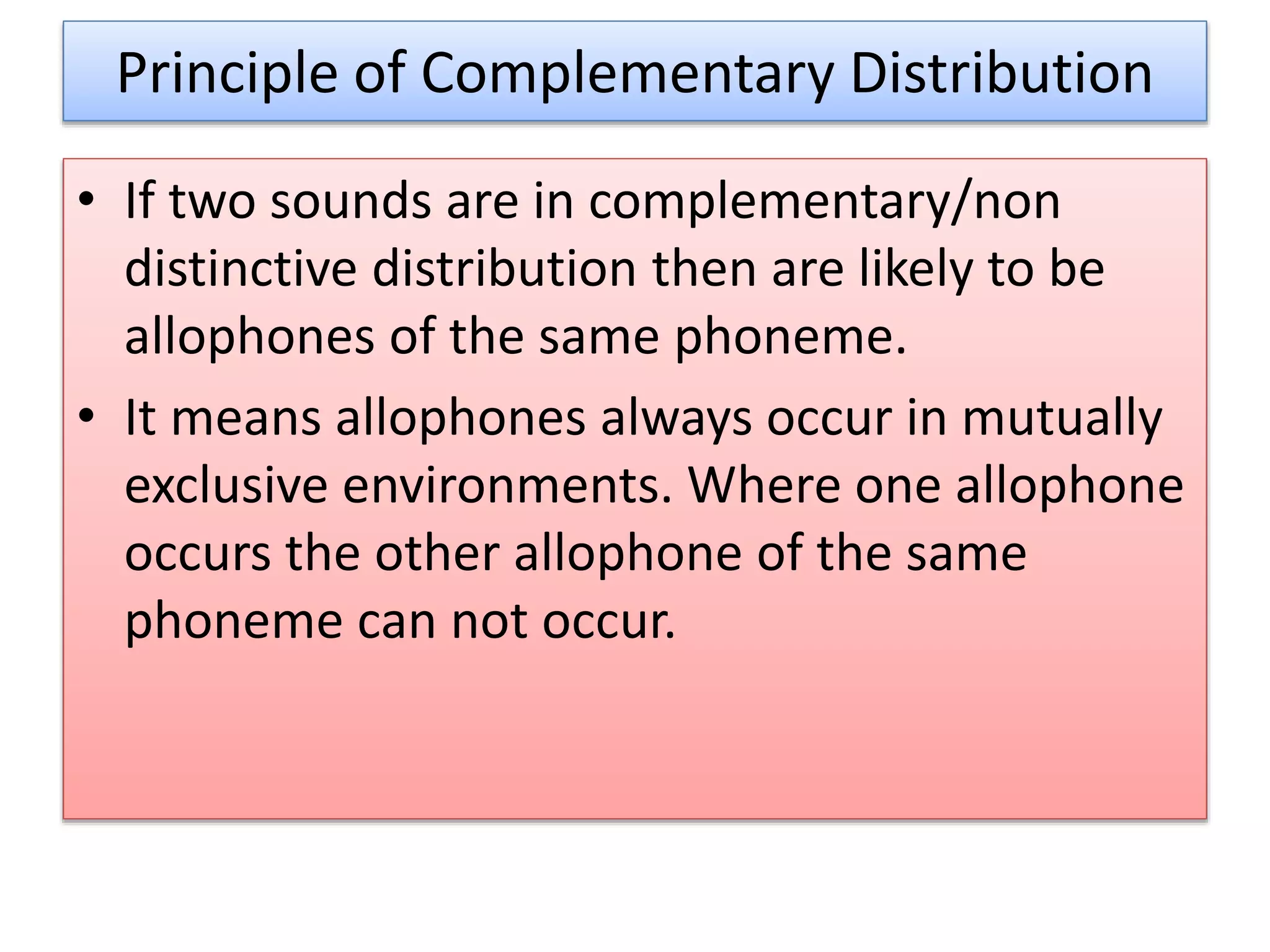
Principle of Complementary Distribution
• If two sounds are in complementary/non
distinctive distribution then are likely to be
allophones of the same phoneme.
• It means allophones always occur in mutually
exclusive environments. Where one allophone
occurs the other allophone of the same
phoneme can not occur.
Other Principles
• The Principle of Phonetic similarity
If two sounds have no phonetic similarity then
they are likely to belong to two different
phonemes. They can never be allophones of the
same phoneme.
• The Principle of Pattern Congruity:
• There is usually a pattern in the way sounds are
organized in a language. /p/, /b/ for instance.
• The principle of Economy:
• The smaller the number of phonemes in a
language the better it is.
Any Question?

Phonology in English- Introduction

  • 1.
    M.A. Honors IPaper VII SME Unit II: Sound and Sound System in English
  • 2.
    Outline • Phonology andPhonetics • Phone, Phoneme and Allophone • Principles of Classification of Speech Sounds • Complementary Distribution • Contrastive Distribution • Other Principles
  • 3.
    Basic Concepts Phone PhonemeAllophone Sound in a stream of speech The smallest distinctive unit in the sound system of a language A set of multiple possible speech sounds. A phoneme is an abstract entity. Allophone is a realization. Phonemic transcription represents only phonemes. It uses slanting bars. // e.g. /p/ Phonetic transcription represents allophones. It uses brackets [ ] e.g. [ph] Phonemes are determined by the principles of contrastive distribution of speech sounds of a particular language Allophones are determined by the principles of complementary distribution of speech sounds of a language.
  • 4.
    Identify phonemes andallophones • Cock Level Roaring • • Father Paper Silence • Doc-tor Note Triumph
  • 5.
    Phonology Phonetics phonology isabout sound systems of language. It is the basis for further work in Morphology, syntax, discourse and Orthography design Phonetics is a descriptive tool necessary to the study of the phonological aspects of a language. Its is the basis for phonological analysis Studies (1) how the speech sounds of a language are used in that language to distinguish meaningful units (such as words) from each other, and (2) how sounds are patterned in a language. Phoneme is the basic unit of phonological analysis in Phonology. Analyzes the production of all human speech sounds, regardless of language, particularly how sounds are produced, transmitted and received The phonological system of a language includes an inventory of sounds and their features and pragmatic rules which specify how sounds interact with each other. Phonetics studies which sounds are present in a language
  • 6.
    Phonology Phonetics Phonology studieshow these sounds combine and how they change in combination, as well as which sounds can contrast to produce differences in meaning (phonology describes the phones as allophones of phonemes) Phonetics simply describes the articulatory and acoustic properties of phones (speech sounds) ,namely called as Articulatory Phonetics and Acoustic Phonetics. It also studies how speech sounds are perceived by the ear, auditory nerve and brain (Auditory Phonetics) Phonology as grammar of phonetic patterns: At beginnings of words, /str/ is OK in English, but /ftr/ or /tr/ are not (they are ungrammatical). A given sound have a different function or status in the sound patterns of different languages Phonology is not concerned with categories but is also crucially about relations.
  • 7.
  • 8.
    Principle of ContrastiveDistribution • If two sounds are in contrastive distribution, then they belong to different phonemes. • When the substitution of one sound with the other brings about a change in the meaning of a word then the sounds are contrastive or distinctive. • The term distribution implies the different positions (initial, middle or final) • Environment means what precedes and follows a particular sound.
  • 9.
    Minimal Pair • Phonemesare most easily identified through minimal pairs. • A minimal pair is the one where there is a distinction only of one (minimal) sound. • Thus Pit [pit] and bit [bit] differ only in that where [pit] has [p], [bit] has [b]. These two words make a minimal pair that shows that [p] and [b] represent separate phonemes in English which we symbolize as /p/, /b/. • One objective of phonology is to identify which sound differences are contrastive and which are not. • Minimal pairs are enclosed in curly brackets.
  • 10.
  • 11.
    Principle of ComplementaryDistribution • If two sounds are in complementary/non distinctive distribution then are likely to be allophones of the same phoneme. • It means allophones always occur in mutually exclusive environments. Where one allophone occurs the other allophone of the same phoneme can not occur.
  • 12.
    Other Principles • ThePrinciple of Phonetic similarity If two sounds have no phonetic similarity then they are likely to belong to two different phonemes. They can never be allophones of the same phoneme. • The Principle of Pattern Congruity: • There is usually a pattern in the way sounds are organized in a language. /p/, /b/ for instance. • The principle of Economy: • The smaller the number of phonemes in a language the better it is.
  • 13.