MEANING RELATION
BETWEEN WORDS
Atraditional way of investigating the
meaning of a word is to study the
relationships between its meaning and
the meanings of other words: which
words have the same meaning,
opposite meanings, etc.
Strictly speaking these relations hold
between specific senses, rather than
between words; that is why we refer to
them as sense relations.
For example, one sense of mad is a
synonym of angry, while another sense
is a synonym of crazy
the most familiar classes of sense
relations: synonymy, several types
of antonymy, hyponymy, and
meronymy.
We will define each of these
relations in terms of relations
between sentence meanings, since
it is easier for speakers to make
reliable judgments about sentences
than about words in isolation.
4.
IDENTIFYING SENSE
RELATIONS
If weare interested in the
meaning of the word big, it seems
natural to look at its meaning
relations with words like large,
small, enormous, etc.
But comparing big with words like
multilingual or extradite seems
unlikely to be very enlightening.
The range of useful comparisons
seems to be limited by some
concept of semantic similarity or
comparability.
Paradigmatic Sense Relations:
These involve words that can
replace each other in the same
sentence without changing its
grammatical structure.
Example: Look at that
big/large/small/enormous/?
#discontinuous/*snore mosquito!
The words big, large, small,
enormous can be substituted for
each other, making them
paradigmatically related.
Syntagmatic Sense Relations:These
involve words that naturally occur
together in a sentence rather than
being interchangeable.
Example: Look at that big
mosquito/elephant, but not big
surname or big color.
The word big can modify nouns like
mosquito or elephant, but it does not
make sense with surname or color.
5.
SYNONYMS
We often speakof synonyms as
being words that “mean the same
thing”.
As a more rigorous definition, we will
say that two words are synonymous
(for a specific sense of each word) if
substituting one word for the other
does not change the meaning of a
sentence.
For example: a.John frightened the
children. b. John scared the children.
The two sentences are semantically
equivalent (each entails the other).
This shows that frightened is a
synonym of scared.
“Perfect” synonymy is extremely rare,
and some linguists would say that it
never occurs.
Even for senses that are truly
equivalent in meaning, there are often
collocational differences.
for example, in the sentence “John
filled the bucket/pail”. Replacing
bucket with pail does not change the
meaning. however in sentence “John
kicked the bucket/ ⁇ pail”, the
idiomatic meaning that is possible
with bucket is not available with pail.
Another example is: Susan
lives in a big/large house.
Replacing big with large does
not change meaning in most
contexts .however, when
used as a modifier for certain
kinship terms, the two words
are no longer equivalent (big
becomes a synonym for
elder), as illustrated in
sentence: Susan lives with her
big/large sister.
6.
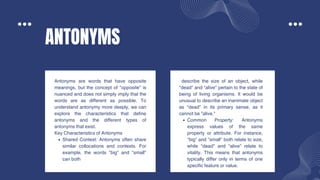
ANTONYMS
Antonyms are wordsthat have opposite
meanings, but the concept of "opposite" is
nuanced and does not simply imply that the
words are as different as possible. To
understand antonymy more deeply, we can
explore the characteristics that define
antonyms and the different types of
antonyms that exist.
Key Characteristics of Antonyms
Shared Context: Antonyms often share
similar collocations and contexts. For
example, the words "big" and "small"
can both
describe the size of an object, while
"dead" and "alive" pertain to the state of
being of living organisms. It would be
unusual to describe an inanimate object
as "dead" in its primary sense, as it
cannot be "alive."
Common Property: Antonyms
express values of the same
property or attribute. For instance,
"big" and "small" both relate to size,
while "dead" and "alive" relate to
vitality. This means that antonyms
typically differ only in terms of one
specific feature or value.
7.
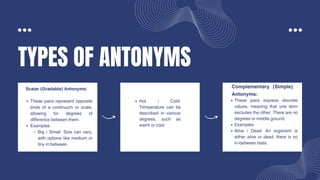
TYPES OF ANTONYMS
Thesepairs represent opposite
ends of a continuum or scale,
allowing for degrees of
difference between them.
Examples:
Big / Small: Size can vary,
with options like medium or
tiny in between.
Scalar (Gradable) Antonyms:
Hot / Cold:
Temperature can be
described in various
degrees, such as
warm or cool.
These pairs express discrete
values, meaning that one term
excludes the other. There are no
degrees or middle ground.
Examples:
Alive / Dead: An organism is
either alive or dead; there is no
in-between state.
Complementary (Simple)
Antonyms:
8.
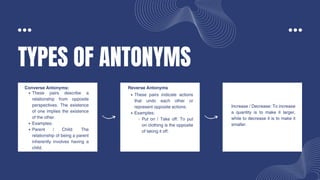
TYPES OF ANTONYMS
Thesepairs describe a
relationship from opposite
perspectives. The existence
of one implies the existence
of the other.
Examples:
Parent / Child: The
relationship of being a parent
inherently involves having a
child.
Converse Antonyms:
These pairs indicate actions
that undo each other or
represent opposite actions.
Examples:
Put on / Take off: To put
on clothing is the opposite
of taking it off.
Reverse Antonyms
Increase / Decrease: To increase
a quantity is to make it larger,
while to decrease it is to make it
smaller.
9.
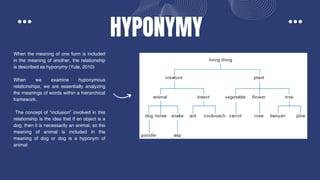
HYPONYMY
When the meaningof one form is included
in the meaning of another, the relationship
is described as hyponymy (Yule, 2010)
When we examine hyponymous
relationships, we are essentially analyzing
the meanings of words within a hierarchical
framework.
The concept of “inclusion” involved in this
relationship is the idea that if an object is a
dog, then it is necessarily an animal, so the
meaning of animal is included in the
meaning of dog or dog is a hyponym of
animal
10.
TAXONOMY
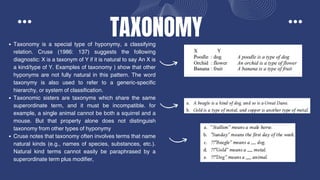
Taxonomy is aspecial type of hyponymy, a classifying
relation. Cruse (1986: 137) suggests the following
diagnostic: X is a taxonym of Y if it is natural to say An X is
a kind/type of Y. Examples of taxonomy ) show that other
hyponyms are not fully natural in this pattern. The word
taxonymy is also used to refer to a generic-specific
hierarchy, or system of classification.
Taxonomic sisters are taxonyms which share the same
superordinate term, and it must be incompatible. for
example, a single animal cannot be both a squirrel and a
mouse. But that property alone does not distinguish
taxonomy from other types of hyponymy
Cruse notes that taxonomy often involves terms that name
natural kinds (e.g., names of species, substances, etc.).
Natural kind terms cannot easily be paraphrased by a
superordinate term plus modifier,
11.
MERONYMY
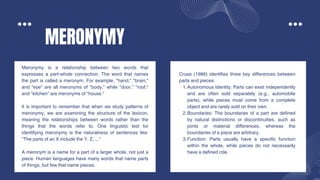
Meronymy is arelationship between two words that
expresses a part-whole connection. The word that names
the part is called a meronym. For example, "hand," "brain,"
and "eye" are all meronyms of "body," while "door," "roof,"
and "kitchen" are meronyms of "house."
It is important to remember that when we study patterns of
meronymy, we are examining the structure of the lexicon,
meaning the relationships between words rather than the
things that the words refer to. One linguistic test for
identifying meronymy is the naturalness of sentences like:
"The parts of an X include the Y, Z, ..."
A meronym is a name for a part of a larger whole, not just a
piece. Human languages have many words that name parts
of things, but few that name pieces.
Cruse (1986) identifies three key differences between
parts and pieces:
Autonomous Identity: Parts can exist independently
and are often sold separately (e.g., automobile
parts), while pieces must come from a complete
object and are rarely sold on their own.
1.
Boundaries: The boundaries of a part are defined
by natural distinctions or discontinuities, such as
joints or material differences, whereas the
boundaries of a piece are arbitrary.
2.
Function: Parts usually have a specific function
within the whole, while pieces do not necessarily
have a defined role.
3.
12.
DEFINING WORDS INTERMS OF
SENSE RELATIONS
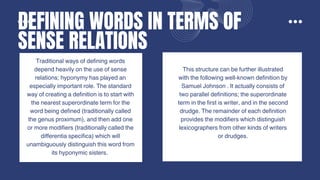
Traditional ways of defining words
depend heavily on the use of sense
relations; hyponymy has played an
especially important role. The standard
way of creating a definition is to start with
the nearest superordinate term for the
word being defined (traditionally called
the genus proximum), and then add one
or more modifiers (traditionally called the
differentia specifica) which will
unambiguously distinguish this word from
its hyponymic sisters.
Another approach is extensional
definitions, which specify the
denotation of a word rather than its
sense. For instance, "New England"
refers to specific states in the
northeastern United States, while
"cat" describes a family of
carnivorous mammals. Some modern
dictionaries, like COBUILD, use full
sentence definitions, such as defining
"confidential" as information meant to
be kept secret or private.
This structure can be further illustrated
with the following well-known definition by
Samuel Johnson . It actually consists of
two parallel definitions; the superordinate
term in the first is writer, and in the second
drudge. The remainder of each definition
provides the modifiers which distinguish
lexicographers from other kinds of writers
or drudges.
13.
CONCLUSION
Words have differentmeanings and relationships that help us understand
language better. some words have similar meaning (synonyms), while others
have opposite meanings (antonyms). Some words belong to a category
(hyponymy), like a rose being a type of flower, and some words represent part of
whole ( meronymy), like a door being a part of a house. Words can also be
comprared based on how they are used in sentences. understanding these
relationship helps us define words, improve communication, and organize
meaning in our minds.




![L201A Week 1- Linguistic toolkit Chaters 123[1].pptx](https://cdn.slidesharecdn.com/ss_thumbnails/l201aweek1-linguistictoolkitchaters1231-251018133954-d997258a-thumbnail.jpg?width=640&height=640&fit=bounds)


