MORPHOSYNTACTIC
ANALYSIS
Analyzing a speech and a
monologue
Meaghan Janis
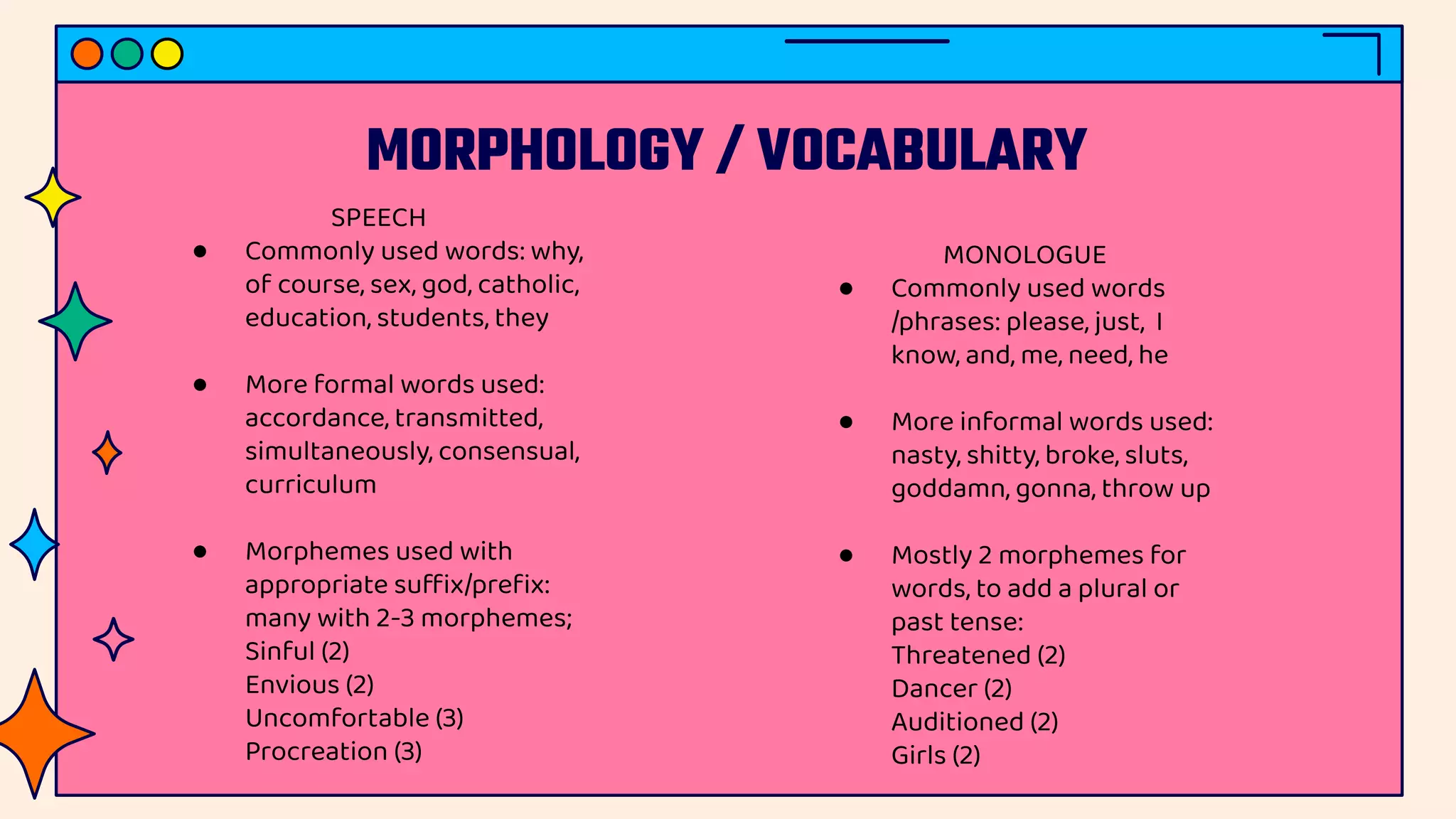
MORPHOLOGY / VOCABULARY
SPEECH
● Commonly used words: why,
of course, sex, god, catholic,
education, students, they
● More formal words used:
accordance, transmitted,
simultaneously, consensual,
curriculum
● Morphemes used with
appropriate suffix/prefix:
many with 2-3 morphemes;
Sinful (2)
Envious (2)
Uncomfortable (3)
Procreation (3)
MONOLOGUE
● Commonly used words
/phrases: please, just, I
know, and, me, need, he
● More informal words used:
nasty, shitty, broke, sluts,
goddamn, gonna, throw up
● Mostly 2 morphemes for
words, to add a plural or
past tense:
Threatened (2)
Dancer (2)
Auditioned (2)
Girls (2)
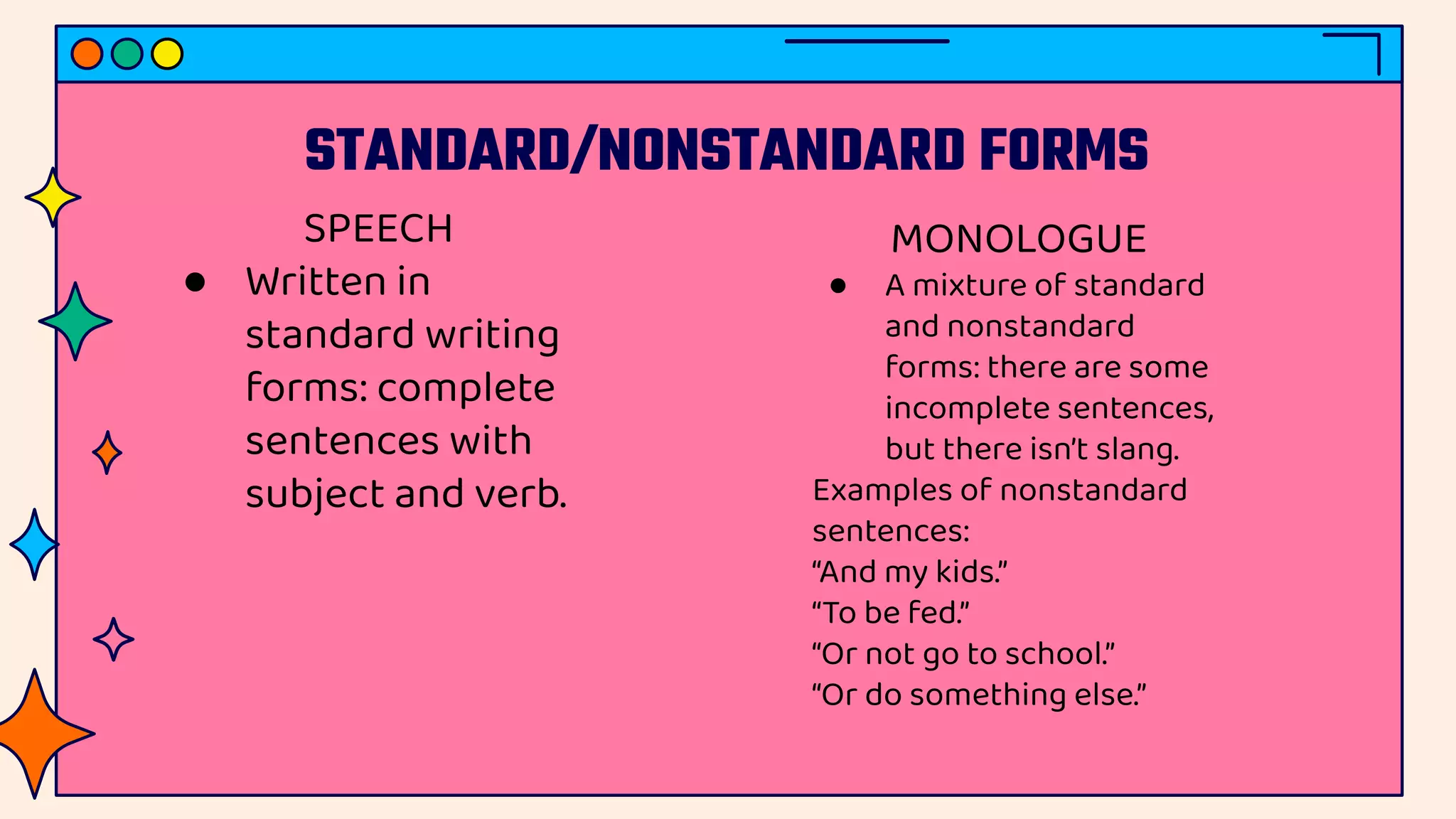
STANDARD/NONSTANDARD FORMS
SPEECH
● Written in
standard writing
forms: complete
sentences with
subject and verb.
MONOLOGUE
● A mixture of standard
and nonstandard
forms: there are some
incomplete sentences,
but there isn’t slang.
Examples of nonstandard
sentences:
“And my kids.”
“To be fed.”
“Or not go to school.”
“Or do something else.”
TONE
SPEECH
● Informative,
assertive, and
critical
Ex: “The Catholic
educational curriculum
does not think that it is
necessary to teach sex
education courses…”
“It is dangerous for
Catholic schools to act as
if this information on safe
sex doesn’t exist.”
MONOLOGUE
● Candid, persuasive,
and urgent.
Ex: “I need you, please.
Please say yes.”
“I’ve see how he’s affected
you...and you can’t deny
that.”
“We can get our jobs
back...and we can get paid
real money.”
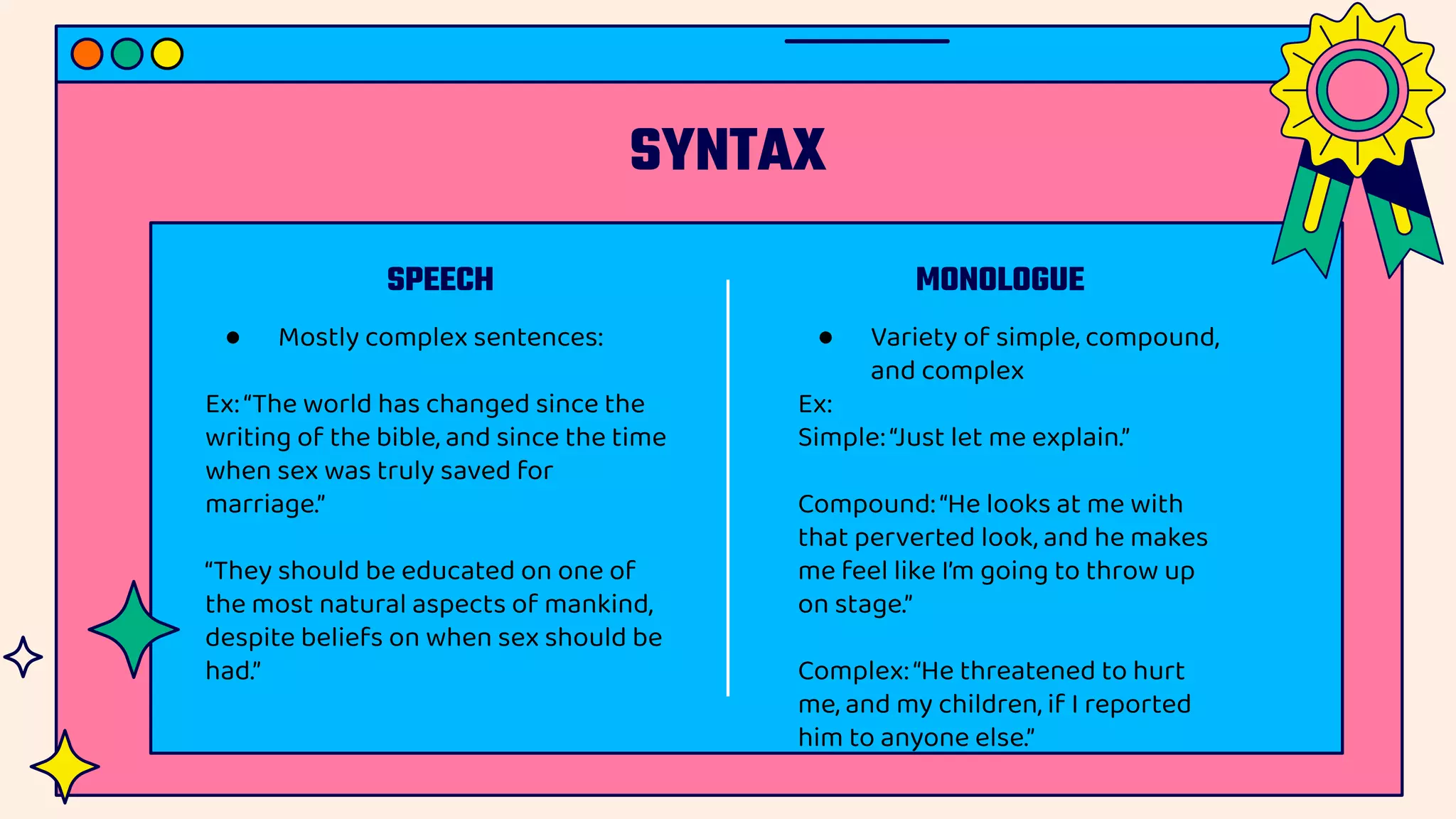
SYNTAX
SPEECH MONOLOGUE
● Mostly complex sentences:
Ex:“The world has changed since the
writing of the bible, and since the time
when sex was truly saved for
marriage.”
“They should be educated on one of
the most natural aspects of mankind,
despite beliefs on when sex should be
had.”
● Variety of simple, compound,
and complex
Ex:
Simple:“Just let me explain.”
Compound:“He looks at me with
that perverted look, and he makes
me feel like I’m going to throw up
on stage.”
Complex:“He threatened to hurt
me, and my children, if I reported
him to anyone else.”
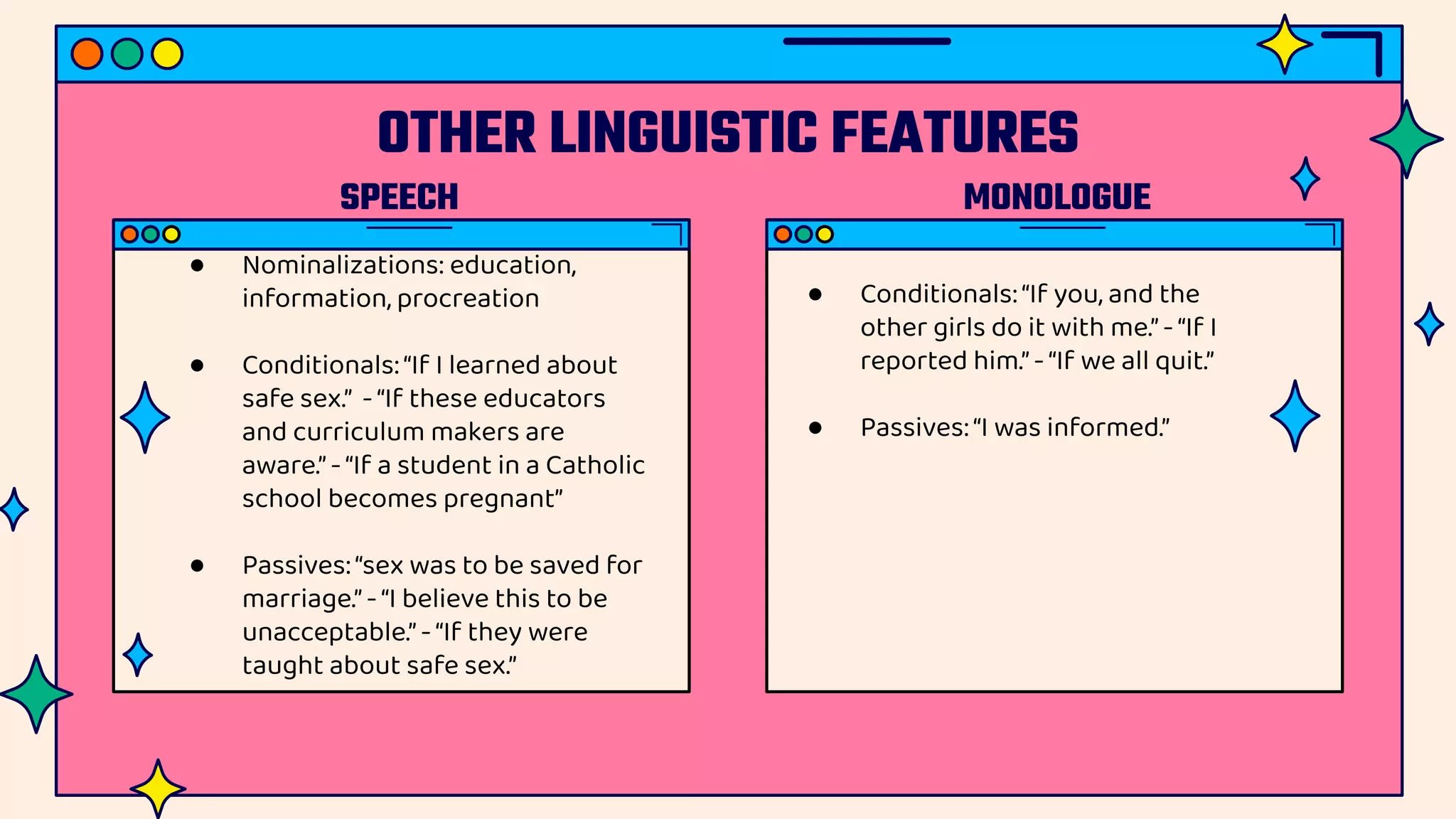
OTHER LINGUISTIC FEATURES
SPEECH MONOLOGUE
● Nominalizations: education,
information, procreation
● Conditionals: “If I learned about
safe sex.” - “If these educators
and curriculum makers are
aware.”-“If a student in a Catholic
school becomes pregnant”
● Passives:“sex was to be saved for
marriage.” -“I believe this to be
unacceptable.” -“If they were
taught about safe sex.”
● Conditionals:“If you, and the
other girls do it with me.”- “If I
reported him.”-“If we all quit.”
● Passives:“I was informed.”
LENGTH AND WORD DIFFICULTY
SPEECH
● About 730 words (3 pages).
● More formal vocabulary, but still
easy to understand.
● More variety of words compared
to monologue: enhances
informative tone
MONOLOGUE
● About 400 words (1
page)
● More informal
vocabulary, and not
much variety of word
choice: words are to
the point: adds to
urgent / candid tone.
● Length is short and
sweet, adds to tone.

Morphosyntactic analysis

  • 1.
    MORPHOSYNTACTIC ANALYSIS Analyzing a speechand a monologue Meaghan Janis
  • 2.
    MORPHOLOGY / VOCABULARY SPEECH ●Commonly used words: why, of course, sex, god, catholic, education, students, they ● More formal words used: accordance, transmitted, simultaneously, consensual, curriculum ● Morphemes used with appropriate suffix/prefix: many with 2-3 morphemes; Sinful (2) Envious (2) Uncomfortable (3) Procreation (3) MONOLOGUE ● Commonly used words /phrases: please, just, I know, and, me, need, he ● More informal words used: nasty, shitty, broke, sluts, goddamn, gonna, throw up ● Mostly 2 morphemes for words, to add a plural or past tense: Threatened (2) Dancer (2) Auditioned (2) Girls (2)
  • 3.
    STANDARD/NONSTANDARD FORMS SPEECH ● Writtenin standard writing forms: complete sentences with subject and verb. MONOLOGUE ● A mixture of standard and nonstandard forms: there are some incomplete sentences, but there isn’t slang. Examples of nonstandard sentences: “And my kids.” “To be fed.” “Or not go to school.” “Or do something else.”
  • 4.
    TONE SPEECH ● Informative, assertive, and critical Ex:“The Catholic educational curriculum does not think that it is necessary to teach sex education courses…” “It is dangerous for Catholic schools to act as if this information on safe sex doesn’t exist.” MONOLOGUE ● Candid, persuasive, and urgent. Ex: “I need you, please. Please say yes.” “I’ve see how he’s affected you...and you can’t deny that.” “We can get our jobs back...and we can get paid real money.”
  • 5.
    SYNTAX SPEECH MONOLOGUE ● Mostlycomplex sentences: Ex:“The world has changed since the writing of the bible, and since the time when sex was truly saved for marriage.” “They should be educated on one of the most natural aspects of mankind, despite beliefs on when sex should be had.” ● Variety of simple, compound, and complex Ex: Simple:“Just let me explain.” Compound:“He looks at me with that perverted look, and he makes me feel like I’m going to throw up on stage.” Complex:“He threatened to hurt me, and my children, if I reported him to anyone else.”
  • 6.
    OTHER LINGUISTIC FEATURES SPEECHMONOLOGUE ● Nominalizations: education, information, procreation ● Conditionals: “If I learned about safe sex.” - “If these educators and curriculum makers are aware.”-“If a student in a Catholic school becomes pregnant” ● Passives:“sex was to be saved for marriage.” -“I believe this to be unacceptable.” -“If they were taught about safe sex.” ● Conditionals:“If you, and the other girls do it with me.”- “If I reported him.”-“If we all quit.” ● Passives:“I was informed.”
  • 7.
    LENGTH AND WORDDIFFICULTY SPEECH ● About 730 words (3 pages). ● More formal vocabulary, but still easy to understand. ● More variety of words compared to monologue: enhances informative tone MONOLOGUE ● About 400 words (1 page) ● More informal vocabulary, and not much variety of word choice: words are to the point: adds to urgent / candid tone. ● Length is short and sweet, adds to tone.