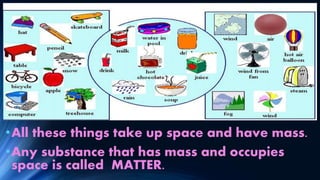
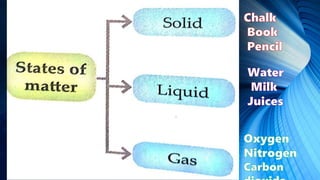

•All these things take up space and have mass.
•Any substance that has mass and occupies
space is called MATTER.
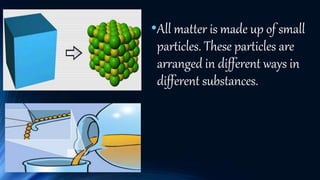
•All matter is made up of small
particles. These particles are
arranged in different ways in
different substances.
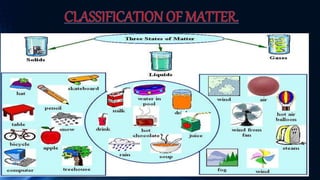
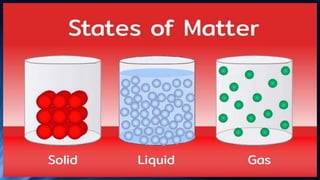
In a solid, the particles are packed closely together
and are not free to move about within the
substance. in a solid, molecules are packed
together, and it keep its shape.
In liquids particles are not as closely packed as in
solids. This is the reason liquids can take the shape
of the container they are poured into.
In gases particles are very loosely packed and
they can easily flow from one place to another.
So gasses can take up the available space.
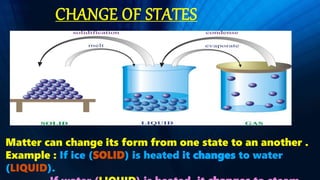
CHANGE OF STATES
SOLID GASLIQUID
CHANGE OF STATES
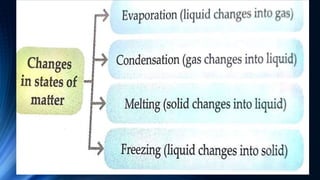
Matter can change its form from one state to an another .
Example : If ice (SOLID) is heated it changes to water
(LIQUID).
MELTING
The process by which a solid changes into liquid on
heating is called melting .
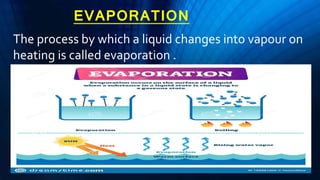
EVAPORATION
The process by which a liquid changes into vapour on
heating is called evaporation .
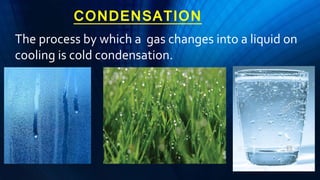
CONDENSATION
The process by which a gas changes into a liquid on
cooling is cold condensation.
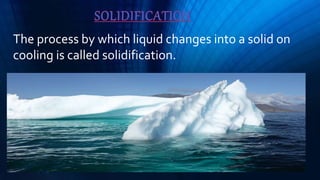
The process by which liquid changes into a solid on
cooling is called solidification.
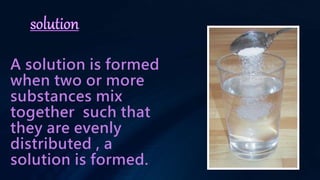
A solution is formed
when two or more
substances mix
together such that
they are evenly
distributed , a
solution is formed.
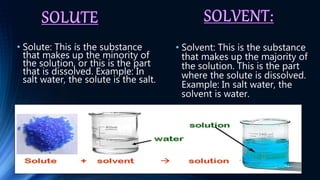
• Solute: This is the substance
that makes up the minority of
the solution, or this is the part
that is dissolved. Example: In
salt water, the solute is the salt.
• Solvent: This is the substance
that makes up the majority of
the solution. This is the part
where the solute is dissolved.
Example: In salt water, the
solvent is water.
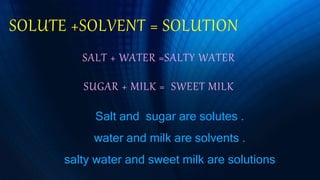
SOLUTE +SOLVENT = SOLUTION
SALT + WATER =SALTY WATER
SUGAR + MILK = SWEET MILK
Salt and sugar are solutes .
water and milk are solvents .
salty water and sweet milk are solutions
SEPARATION OF SUBSTANCES
Separation of substances can be done in
different ways .
1. sedimentation and
Decantation
2. Filtration
1. sedimentation and Decantation - Insoluble
substances can be separated from a solution
by the process of sedimentation and
decantation.
2. Filtration – Fine particles of insoluble
substance can be separated by the process
called filtration .
3. Evaporation – Soluble substance can be
separated from a solution by heating the
solution is known as evaporation .
SEDIMENTATION AND DECANTATION
• During sedimentation, the liquid is
left undisturbed for some time . The
heavy insoluble solids settle down at
the bottom . This process in which
insoluble substance settle down is
called sedimentation .
• After sedimentation , the upper clear
liquid is poured into another
container without disturbing the
insoluble solids . This process is
called decantation.
• Example : Sand is separated from
FILTRATION
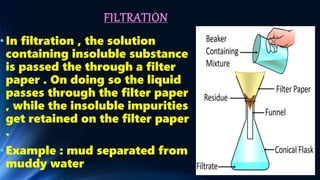
•In filtration , the solution
containing insoluble substance
is passed the through a filter
paper . On doing so the liquid
passes through the filter paper
, while the insoluble impurities
get retained on the filter paper
.
•Example : mud separated from
muddy water
EVAPORATION
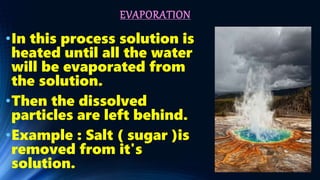
•In this process solution is
heated until all the water
will be evaporated from
the solution.
•Then the dissolved
particles are left behind.
•Example : Salt ( sugar )is
removed from it's
solution.
END

Solid liquid and gases class 4 cbse_deepa unnikrishnan

  • 2.
    •All these thingstake up space and have mass. •Any substance that has mass and occupies space is called MATTER.
  • 4.
    •All matter ismade up of small particles. These particles are arranged in different ways in different substances.
  • 7.
    In a solid,the particles are packed closely together and are not free to move about within the substance. in a solid, molecules are packed together, and it keep its shape. In liquids particles are not as closely packed as in solids. This is the reason liquids can take the shape of the container they are poured into. In gases particles are very loosely packed and they can easily flow from one place to another. So gasses can take up the available space.
  • 8.
  • 9.
    CHANGE OF STATES Mattercan change its form from one state to an another . Example : If ice (SOLID) is heated it changes to water (LIQUID).
  • 10.
    MELTING The process bywhich a solid changes into liquid on heating is called melting .
  • 11.
    EVAPORATION The process bywhich a liquid changes into vapour on heating is called evaporation .
  • 12.
    CONDENSATION The process bywhich a gas changes into a liquid on cooling is cold condensation.
  • 13.
    The process bywhich liquid changes into a solid on cooling is called solidification.
  • 15.
    A solution isformed when two or more substances mix together such that they are evenly distributed , a solution is formed.
  • 16.
    • Solute: Thisis the substance that makes up the minority of the solution, or this is the part that is dissolved. Example: In salt water, the solute is the salt. • Solvent: This is the substance that makes up the majority of the solution. This is the part where the solute is dissolved. Example: In salt water, the solvent is water.
  • 17.
    SOLUTE +SOLVENT =SOLUTION SALT + WATER =SALTY WATER SUGAR + MILK = SWEET MILK Salt and sugar are solutes . water and milk are solvents . salty water and sweet milk are solutions
  • 19.
    SEPARATION OF SUBSTANCES Separationof substances can be done in different ways . 1. sedimentation and Decantation 2. Filtration
  • 20.
    1. sedimentation andDecantation - Insoluble substances can be separated from a solution by the process of sedimentation and decantation. 2. Filtration – Fine particles of insoluble substance can be separated by the process called filtration . 3. Evaporation – Soluble substance can be separated from a solution by heating the solution is known as evaporation .
  • 21.
    SEDIMENTATION AND DECANTATION •During sedimentation, the liquid is left undisturbed for some time . The heavy insoluble solids settle down at the bottom . This process in which insoluble substance settle down is called sedimentation . • After sedimentation , the upper clear liquid is poured into another container without disturbing the insoluble solids . This process is called decantation. • Example : Sand is separated from
  • 22.
    FILTRATION •In filtration ,the solution containing insoluble substance is passed the through a filter paper . On doing so the liquid passes through the filter paper , while the insoluble impurities get retained on the filter paper . •Example : mud separated from muddy water
  • 23.
    EVAPORATION •In this processsolution is heated until all the water will be evaporated from the solution. •Then the dissolved particles are left behind. •Example : Salt ( sugar )is removed from it's solution.
  • 24.