Light
• Light is a form of energy which is
responsible for the sense of sight . It
enables to see things around us.
• Light enables us to see every object around
us like trees, vehicles, houses, people, etc.
• At night due to the absence of sunlight, it
becomes dark, which reduces our visibility.
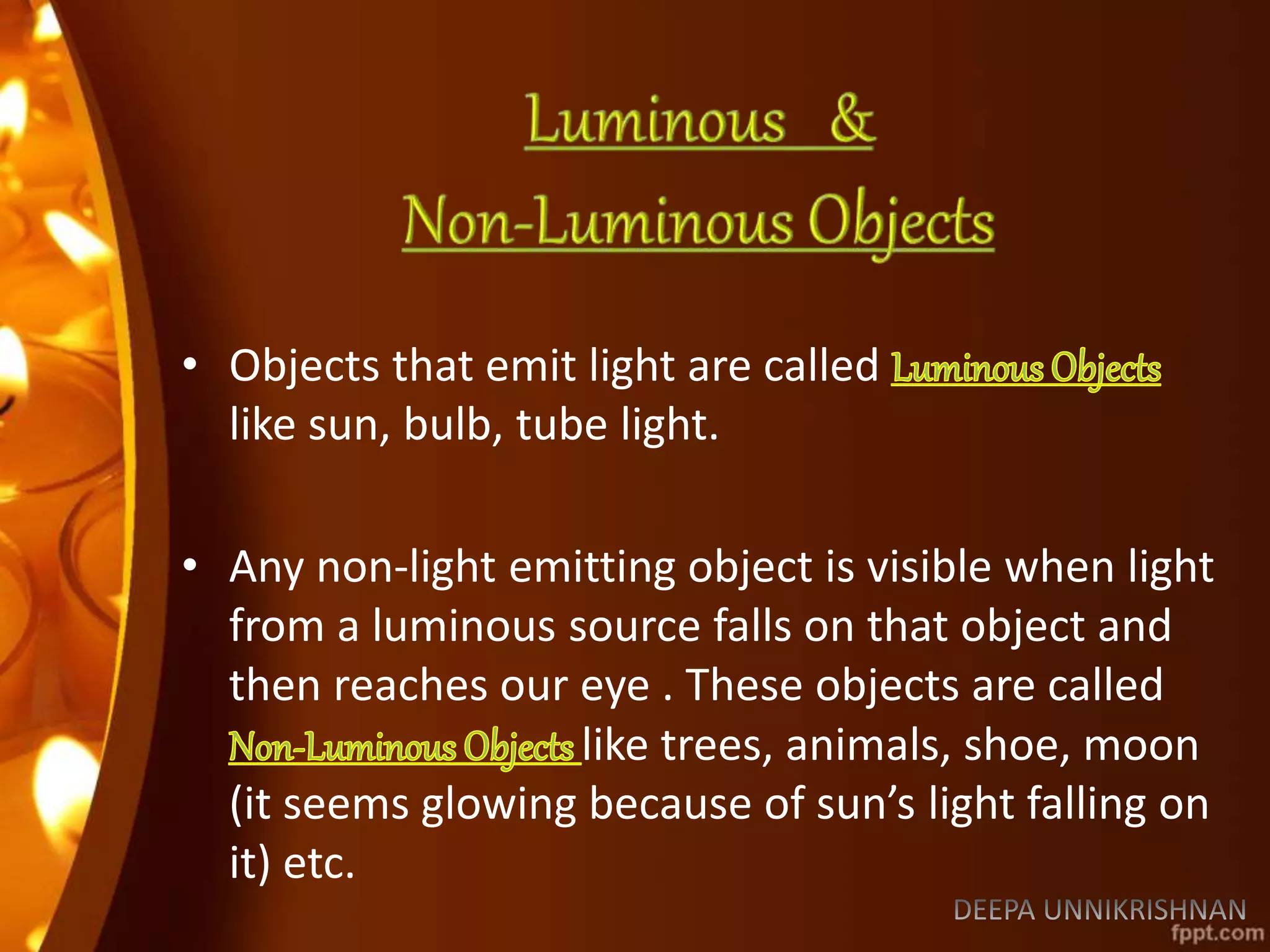
• Objects that emit light are called
like sun, bulb, tube light.
• Any non-light emitting object is visible when light
from a luminous source falls on that object and
then reaches our eye . These objects are called
like trees, animals, shoe, moon
(it seems glowing because of sun’s light falling on
it) etc.
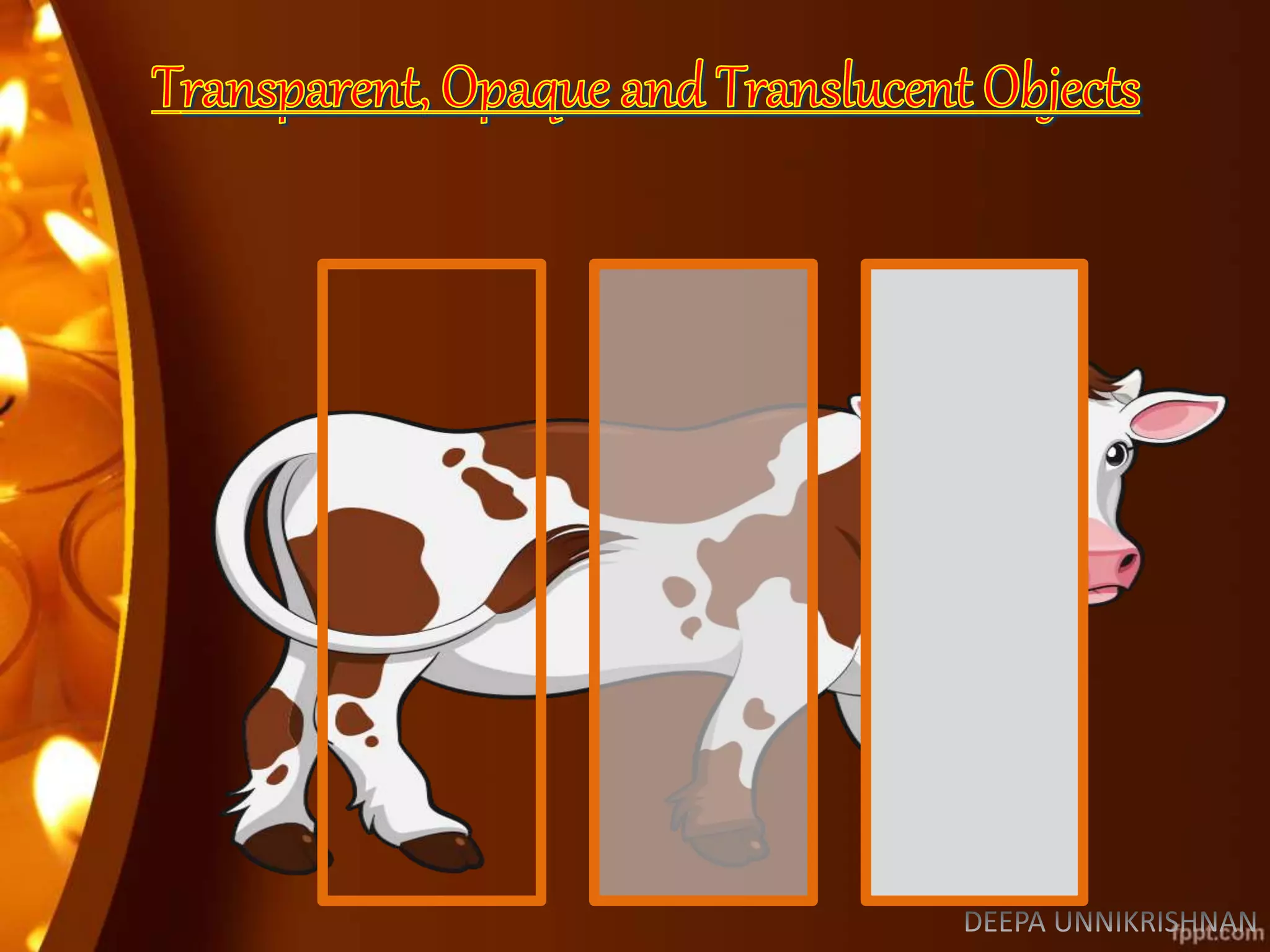
•Objects are classified
based on amount of
light that can pass
through them.
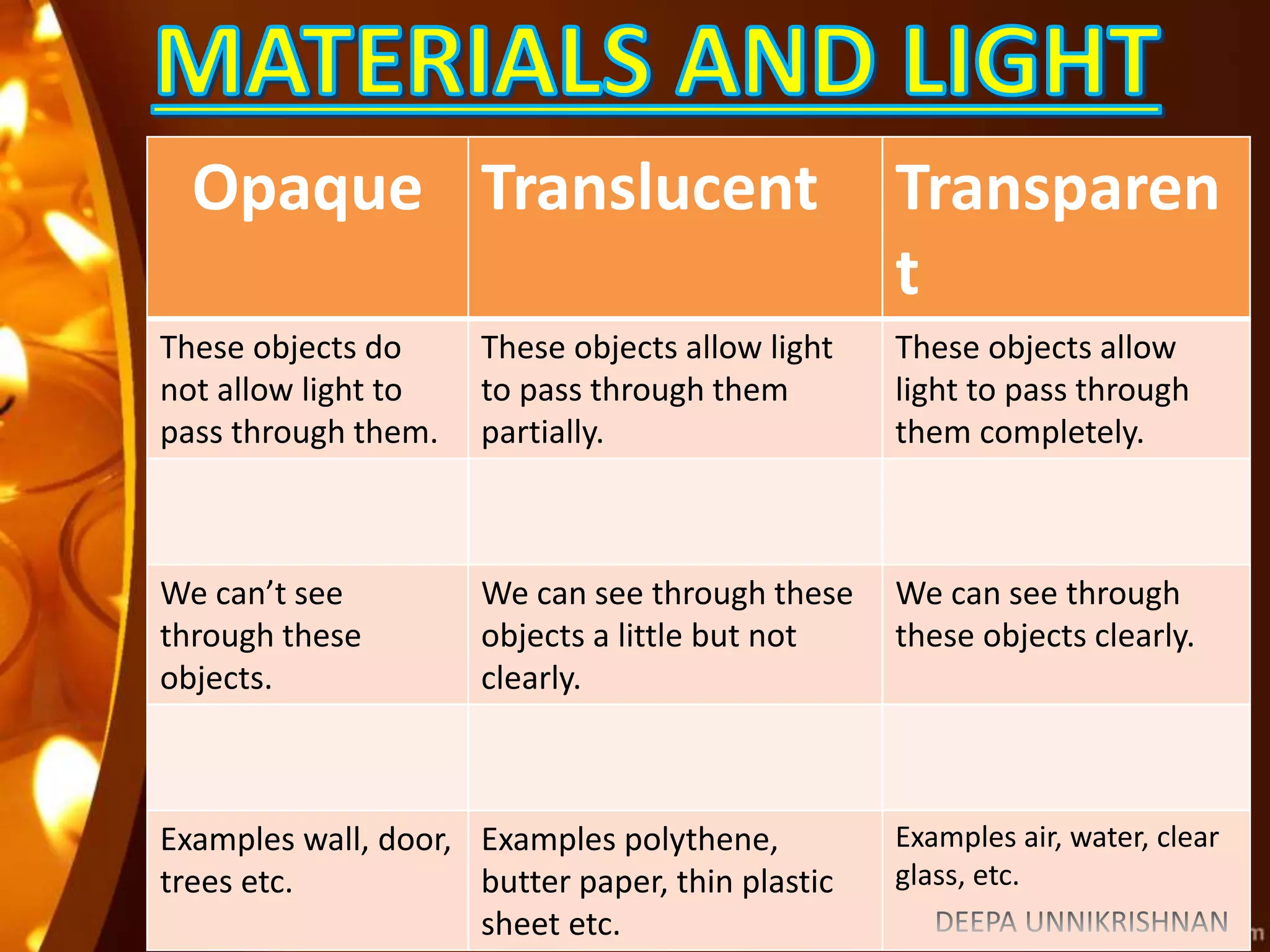
Opaque Translucent Transparen
t
These objects do
not allow light to
pass through them.
These objects allow light
to pass through them
partially.
These objects allow
light to pass through
them completely.
We can’t see
through these
objects.
We can see through these
objects a little but not
clearly.
We can see through
these objects clearly.
Examples wall, door,
trees etc.
Examples polythene,
butter paper, thin plastic
sheet etc.
Examples air, water, clear
glass, etc.
• A shadow is a space where light from a
light source is blocked by an opaque
object.
• A shadow is formed when a part of light
is blocked by the object.
• If all the light is blocked by an object,
then there will not be any shadow.
• Shape of the shadow is always similar
to that of the object but the size varies.
• When it translucent or an opaque
object is placed before a source of
light ,a dark spot forms on the
opposite side of the light .
• The dark spot formed by a
translucent or an opaque object
when it blocks the light is called a
shadow .
SHADOWS AND TYPE OF OBJECTS
1. Transparent objects do not
form shadows as they do not
block light .
2. Translucent object forms light
shadow as they partially blocks
the light .
3. Opaque object forms dark
shadow as they completely
blocks the light .
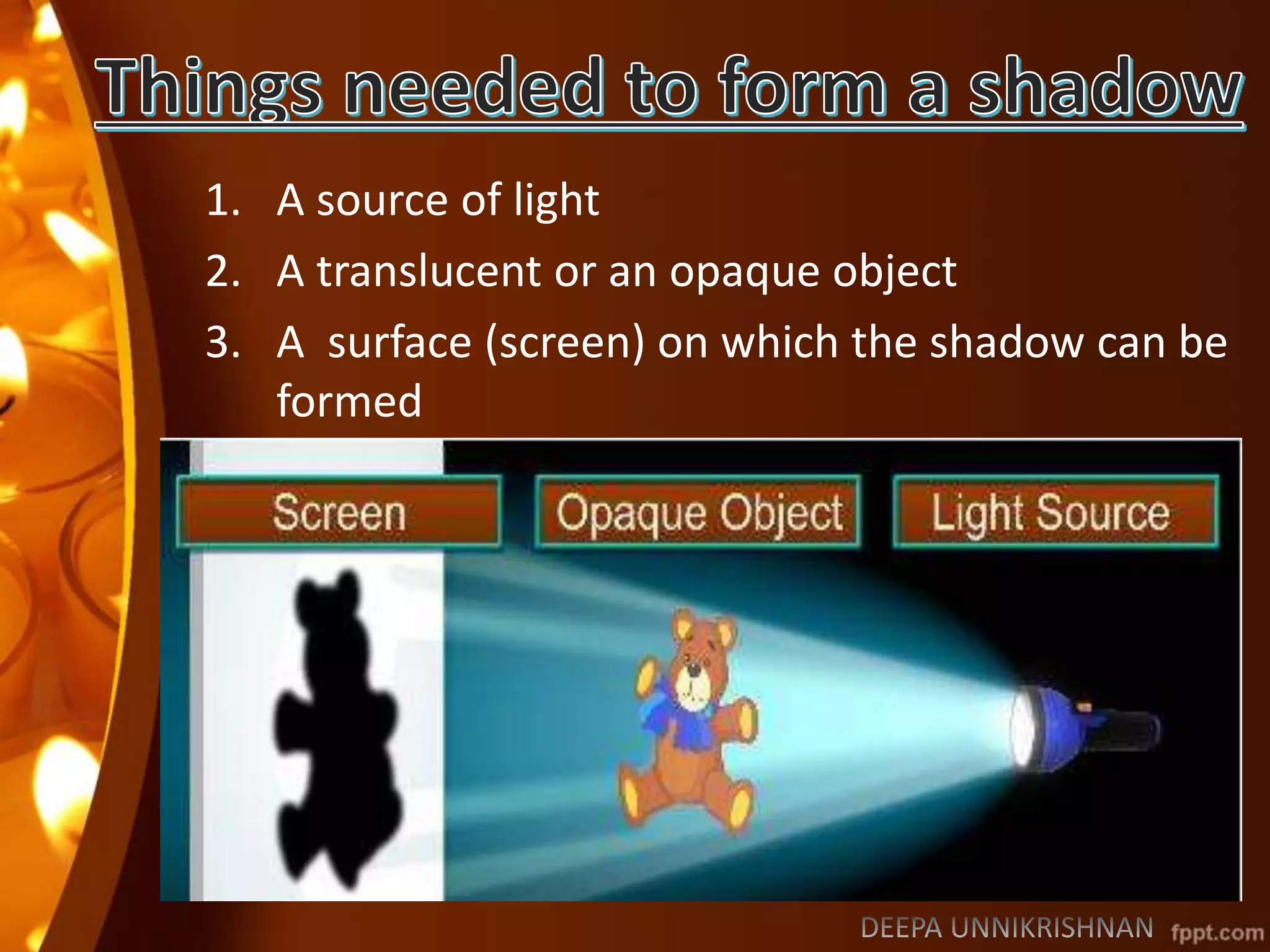
1. A source of light
2. A translucent or an opaque object
3. A surface (screen) on which the shadow can be
formed
1. A shadow is formed on the opposite side
of the light source .
2. A shadow is black even when the object is
of any other color .
3. A shadow shows only the shape or outline
of the object , not the details .
4. The size of the shadow depends on the
distance between the object and a source
of light . it also depends on the distance
between the object and the surface where
it formed .
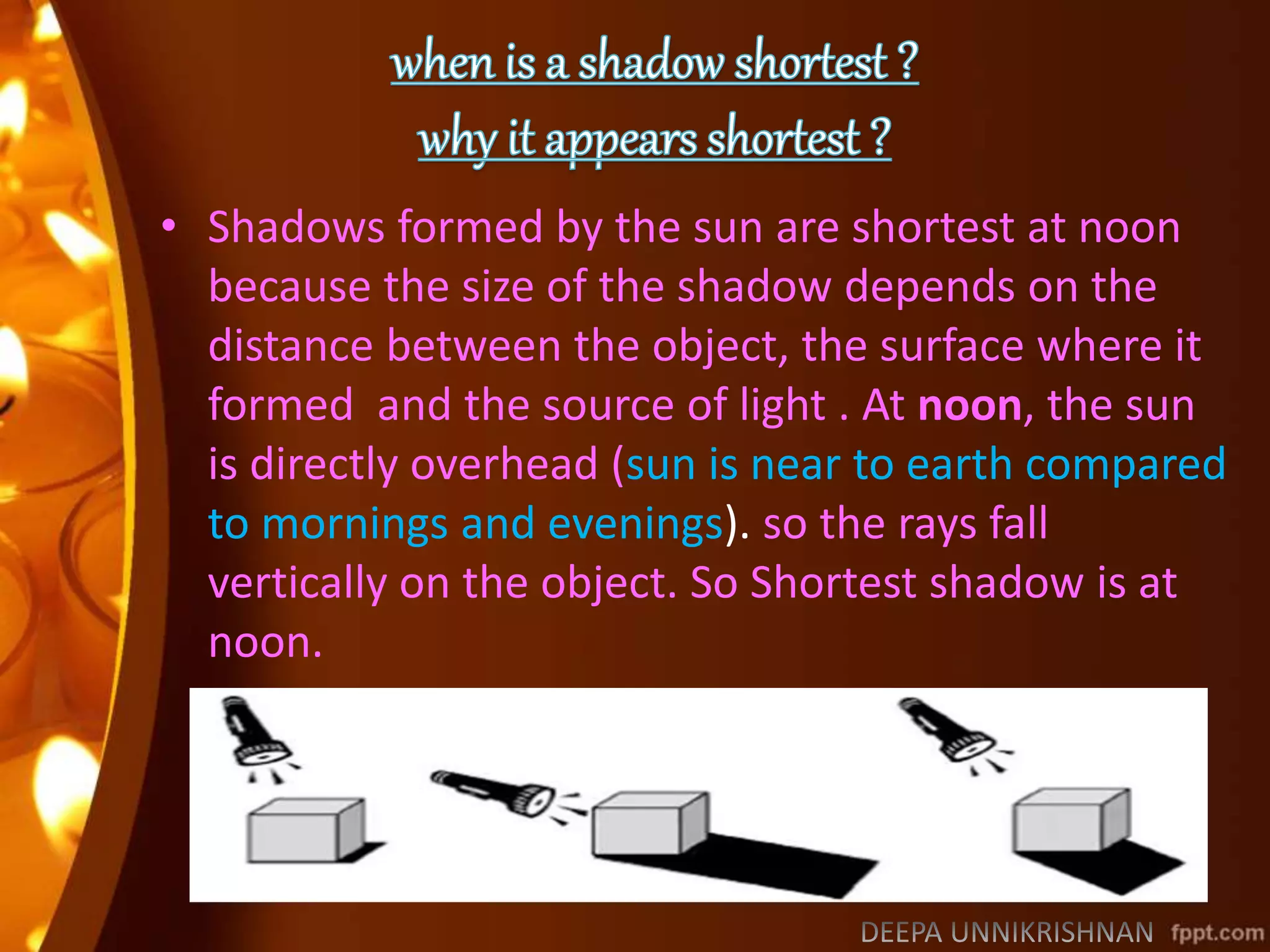
• Shadows formed by the sun are shortest at noon
because the size of the shadow depends on the
distance between the object, the surface where it
formed and the source of light . At noon, the sun
is directly overhead (sun is near to earth compared
to mornings and evenings). so the rays fall
vertically on the object. So Shortest shadow is at
noon.
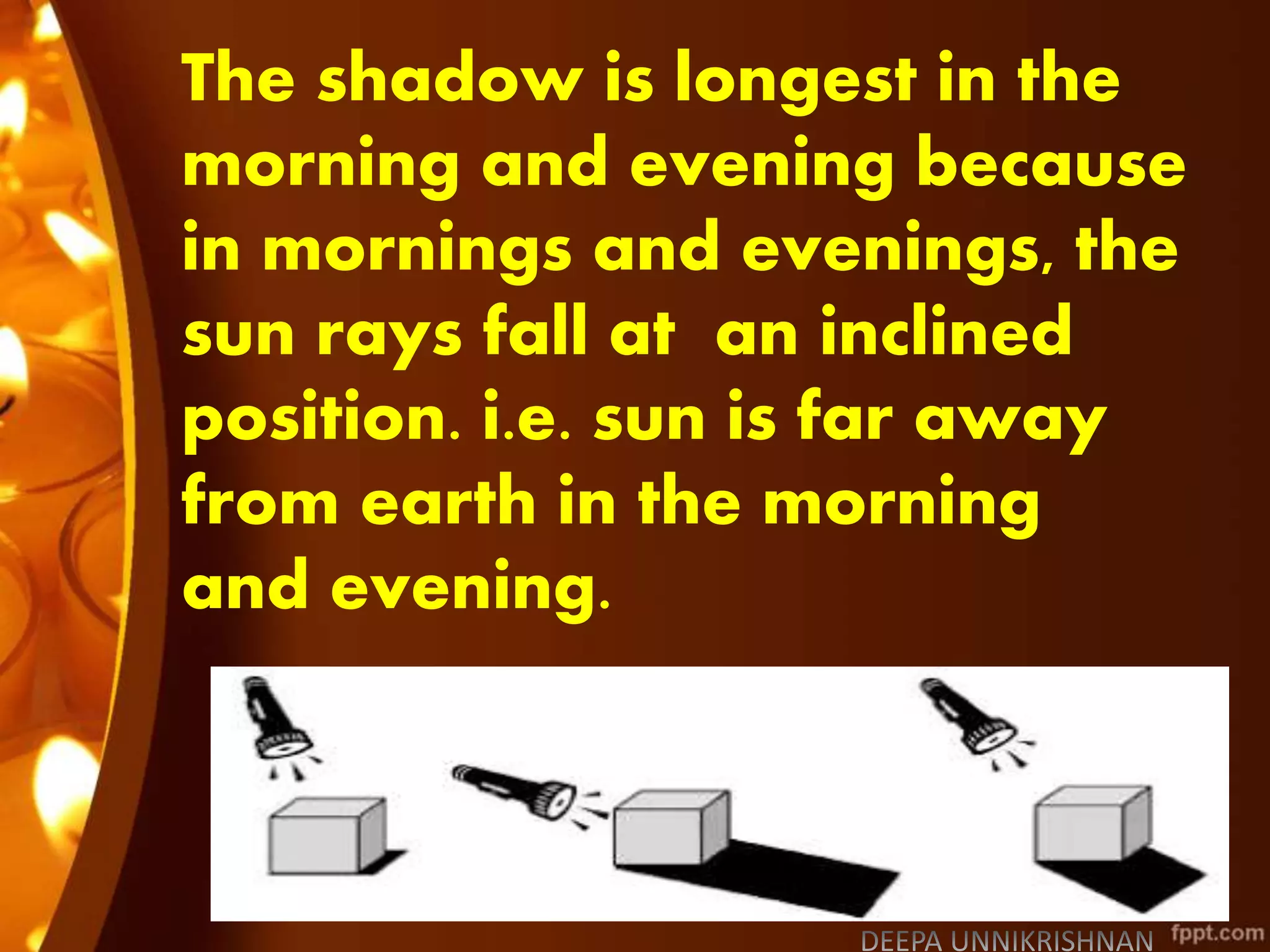
The shadow is longest in the
morning and evening because
in mornings and evenings, the
sun rays fall at an inclined
position. i.e. sun is far away
from earth in the morning
and evening.
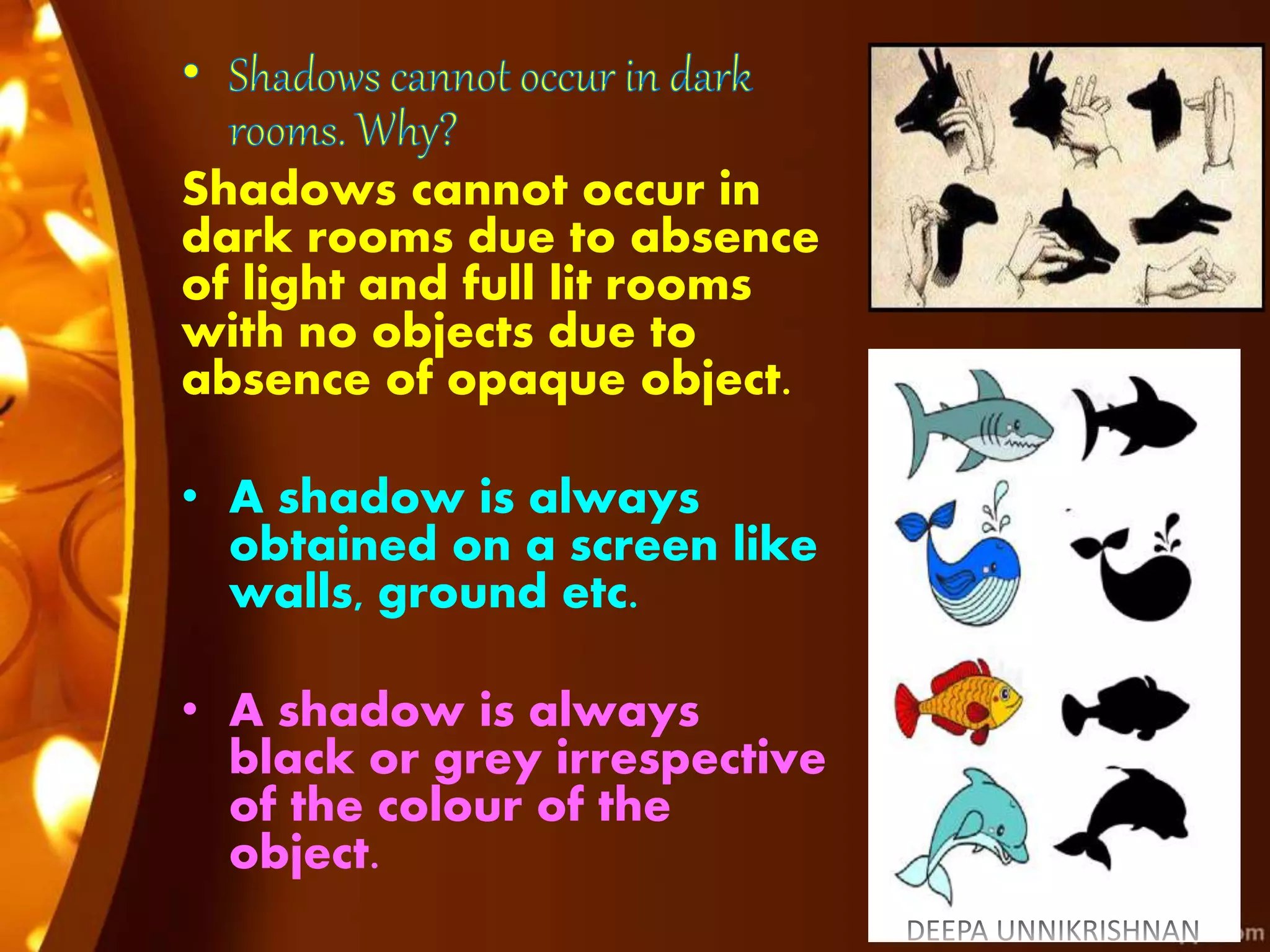
Shadows cannot occur in
dark rooms due to absence
of light and full lit rooms
with no objects due to
absence of opaque object.
• A shadow is always
obtained on a screen like
walls, ground etc.
• A shadow is always
black or grey irrespective
of the colour of the
object.
1. https://youtu.be/WNKIdIE4Aec?list=PLHOGBLPrsnMox
4LaHbMIaUA4fvbl0bu1z&t=33
2. https://youtu.be/bh-
JCO5UmrA?list=PLHOGBLPrsnMox4LaHbMIaUA4fvbl0b
u1z
3. https://youtu.be/FtIz9BktzG4?list=PLHOGBLPrsnMox4L
aHbMIaUA4fvbl0bu1z
4. https://youtu.be/P6Uihn8V3h4?list=PLHOGBLPrsnMox4
LaHbMIaUA4fvbl0bu1z
5. https://youtu.be/V6pjHnA39CQ?list=PLHOGBLPrsnMox
4LaHbMIaUA4fvbl0bu1z
6. https://youtu.be/DavnmxgVwaw?list=PLHOGBLPrsnMo
x4LaHbMIaUA4fvbl0bu1z
7. https://youtu.be/OAgRTdIgZGs?list=PLHOGBLPrsnMox4
LaHbMIaUA4fvbl0bu1z
8. https://youtu.be/yd5WRAgl1cQ

Light and shadows grade 5 cbse_Deepa Unnikrishnan

  • 4.
    Light • Light isa form of energy which is responsible for the sense of sight . It enables to see things around us. • Light enables us to see every object around us like trees, vehicles, houses, people, etc. • At night due to the absence of sunlight, it becomes dark, which reduces our visibility.
  • 5.
    • Objects thatemit light are called like sun, bulb, tube light. • Any non-light emitting object is visible when light from a luminous source falls on that object and then reaches our eye . These objects are called like trees, animals, shoe, moon (it seems glowing because of sun’s light falling on it) etc.
  • 6.
    •Objects are classified basedon amount of light that can pass through them.
  • 7.
    Opaque Translucent Transparen t Theseobjects do not allow light to pass through them. These objects allow light to pass through them partially. These objects allow light to pass through them completely. We can’t see through these objects. We can see through these objects a little but not clearly. We can see through these objects clearly. Examples wall, door, trees etc. Examples polythene, butter paper, thin plastic sheet etc. Examples air, water, clear glass, etc.
  • 9.
    • A shadowis a space where light from a light source is blocked by an opaque object. • A shadow is formed when a part of light is blocked by the object. • If all the light is blocked by an object, then there will not be any shadow. • Shape of the shadow is always similar to that of the object but the size varies.
  • 10.
    • When ittranslucent or an opaque object is placed before a source of light ,a dark spot forms on the opposite side of the light . • The dark spot formed by a translucent or an opaque object when it blocks the light is called a shadow .
  • 11.
    SHADOWS AND TYPEOF OBJECTS 1. Transparent objects do not form shadows as they do not block light . 2. Translucent object forms light shadow as they partially blocks the light . 3. Opaque object forms dark shadow as they completely blocks the light .
  • 12.
    1. A sourceof light 2. A translucent or an opaque object 3. A surface (screen) on which the shadow can be formed
  • 13.
    1. A shadowis formed on the opposite side of the light source . 2. A shadow is black even when the object is of any other color . 3. A shadow shows only the shape or outline of the object , not the details . 4. The size of the shadow depends on the distance between the object and a source of light . it also depends on the distance between the object and the surface where it formed .
  • 14.
    • Shadows formedby the sun are shortest at noon because the size of the shadow depends on the distance between the object, the surface where it formed and the source of light . At noon, the sun is directly overhead (sun is near to earth compared to mornings and evenings). so the rays fall vertically on the object. So Shortest shadow is at noon.
  • 15.
    The shadow islongest in the morning and evening because in mornings and evenings, the sun rays fall at an inclined position. i.e. sun is far away from earth in the morning and evening.
  • 16.
    Shadows cannot occurin dark rooms due to absence of light and full lit rooms with no objects due to absence of opaque object. • A shadow is always obtained on a screen like walls, ground etc. • A shadow is always black or grey irrespective of the colour of the object.
  • 17.
    1. https://youtu.be/WNKIdIE4Aec?list=PLHOGBLPrsnMox 4LaHbMIaUA4fvbl0bu1z&t=33 2. https://youtu.be/bh- JCO5UmrA?list=PLHOGBLPrsnMox4LaHbMIaUA4fvbl0b u1z 3.https://youtu.be/FtIz9BktzG4?list=PLHOGBLPrsnMox4L aHbMIaUA4fvbl0bu1z 4. https://youtu.be/P6Uihn8V3h4?list=PLHOGBLPrsnMox4 LaHbMIaUA4fvbl0bu1z 5. https://youtu.be/V6pjHnA39CQ?list=PLHOGBLPrsnMox 4LaHbMIaUA4fvbl0bu1z 6. https://youtu.be/DavnmxgVwaw?list=PLHOGBLPrsnMo x4LaHbMIaUA4fvbl0bu1z 7. https://youtu.be/OAgRTdIgZGs?list=PLHOGBLPrsnMox4 LaHbMIaUA4fvbl0bu1z 8. https://youtu.be/yd5WRAgl1cQ