Soil experiments
Experiment 1: Determining Soil texture
Introduction
• Soil texture refers to the proportion of sand, silt, and clay in a soil.
Clay particle is 25 times smaller than the largest silt particle and a
thousand times smaller than the largest sand particle.
• Soil texture is the most important soil property as it can influence
soil-water relationships, gas exchange, and plant nutrition.
• The relative amount of particles has a large influence on the
physical, chemical, and biological properties of a soil.
Objective: to determine texture of a given soil
Materials used: • Mesh sieve
• Clear jar
• Water
• Soil
• Marker
• Ruler
4/13/2023 1
Procedure:
1. Using a mesh sieve or old colander, sift the soil to remove any debris, rocks, and
large organic matter (leaves, sticks, roots, etc.).
2. Fill the jar ⅓ full of the soil to be tested.
3. Fill the remainder of the jar with clean water, but leave some space at the top.
4. Cap the jar and shake vigorously until the soil turns into a uniform slurry.
5. Set on a level surface and time for one minute. Place a mark the outside of the
jar, showing the coarse sand layer settled at the bottom of the jar.
6. Leave the jar in a level spot for 2 hours. Mark the top of the next settled layer
with the permanent marker. This is the silt layer.
7. Leave the jar on a level spot for 48 hours. Mark the top of the next settled layer
with the permanent marker. This is the clay layer that has settled on top of the
silt layer.
8. Using a ruler, measure and record the height of each layer, and the total height of
all three layers. Use the soil texture analysis worksheet below to record results.
4/13/2023 2
Soil Texture Analysis “The Jar Test” Worksheet
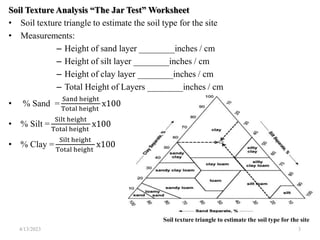
• Soil texture triangle to estimate the soil type for the site
• Measurements:
– Height of sand layer ________inches / cm
– Height of silt layer ________inches / cm
– Height of clay layer ________inches / cm
– Total Height of Layers ________inches / cm
• % Sand =
Sand height
Total height
x100
• % Silt =
Silt height
Total height
x100
• % Clay =
Silt height
Total height
x100
Soil texture triangle to estimate the soil type for the site
4/13/2023 3
Experiment 2: Determination of Moisture Content of Soil
Introduction
• Soil moisture is a key variable in controlling the exchange of water and
heat energy between the land surface and the atmosphere through
evaporation and plant transpiration.
• The smaller a soil's particles are, the greater the soil's surface area is, and
so the more water the soil retains. Sand, with its larger particles and low
nutritional content, retains the least amount of water.
• Soil moisture is a measure of soil health, the water content present in a
certain area of the ground. All plants need to be in a specific soil moisture
range - the majority of plants thrive in soil with a moisture level that
ranges between 20% and 60%.
Objective:
• To determine the natural moisture content of the given soil sample.
4/13/2023 4
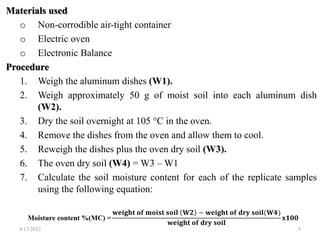
Materials used
o Non-corrodible air-tight container
o Electric oven
o Electronic Balance
Procedure
1. Weigh the aluminum dishes (W1).
2. Weigh approximately 50 g of moist soil into each aluminum dish
(W2).
3. Dry the soil overnight at 105 °C in the oven.
4. Remove the dishes from the oven and allow them to cool.
5. Reweigh the dishes plus the oven dry soil (W3).
6. The oven dry soil (W4) = W3 – W1
7. Calculate the soil moisture content for each of the replicate samples
using the following equation:
Moisture content %(MC) =
𝐰𝐞𝐢𝐠𝐡𝐭 𝐨𝐟 𝐦𝐨𝐢𝐬𝐭 𝐬𝐨𝐢𝐥 𝐖𝟐 − 𝐰𝐞𝐢𝐠𝐡𝐭 𝐨𝐟 𝐝𝐫𝐲 𝐬𝐨𝐢𝐥(𝐖𝟒)
𝐰𝐞𝐢𝐠𝐡𝐭 𝐨𝐟 𝐝𝐫𝐲 𝐬𝐨𝐢𝐥
𝐱𝟏𝟎𝟎
4/13/2023 5
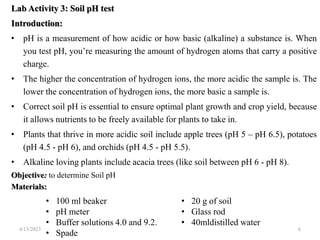
Lab Activity 3: Soil pH test
Introduction:
• pH is a measurement of how acidic or how basic (alkaline) a substance is. When
you test pH, you’re measuring the amount of hydrogen atoms that carry a positive
charge.
• The higher the concentration of hydrogen ions, the more acidic the sample is. The
lower the concentration of hydrogen ions, the more basic a sample is.
• Correct soil pH is essential to ensure optimal plant growth and crop yield, because
it allows nutrients to be freely available for plants to take in.
• Plants that thrive in more acidic soil include apple trees (pH 5 – pH 6.5), potatoes
(pH 4.5 - pH 6), and orchids (pH 4.5 - pH 5.5).
• Alkaline loving plants include acacia trees (like soil between pH 6 - pH 8).
Objective: to determine Soil pH
Materials:
• 100 ml beaker
• pH meter
• Buffer solutions 4.0 and 9.2.
• Spade
• 20 g of soil
• Glass rod
• 40mldistilled water
4/13/2023 6
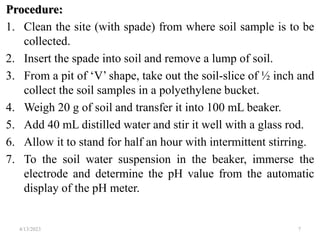
Procedure:
1. Clean the site (with spade) from where soil sample is to be
collected.
2. Insert the spade into soil and remove a lump of soil.
3. From a pit of ‘V’ shape, take out the soil-slice of ½ inch and
collect the soil samples in a polyethylene bucket.
4. Weigh 20 g of soil and transfer it into 100 mL beaker.
5. Add 40 mL distilled water and stir it well with a glass rod.
6. Allow it to stand for half an hour with intermittent stirring.
7. To the soil water suspension in the beaker, immerse the
electrode and determine the pH value from the automatic
display of the pH meter.
4/13/2023 7

Soil experiment.pptx

  • 1.
    Soil experiments Experiment 1:Determining Soil texture Introduction • Soil texture refers to the proportion of sand, silt, and clay in a soil. Clay particle is 25 times smaller than the largest silt particle and a thousand times smaller than the largest sand particle. • Soil texture is the most important soil property as it can influence soil-water relationships, gas exchange, and plant nutrition. • The relative amount of particles has a large influence on the physical, chemical, and biological properties of a soil. Objective: to determine texture of a given soil Materials used: • Mesh sieve • Clear jar • Water • Soil • Marker • Ruler 4/13/2023 1
  • 2.
    Procedure: 1. Using amesh sieve or old colander, sift the soil to remove any debris, rocks, and large organic matter (leaves, sticks, roots, etc.). 2. Fill the jar ⅓ full of the soil to be tested. 3. Fill the remainder of the jar with clean water, but leave some space at the top. 4. Cap the jar and shake vigorously until the soil turns into a uniform slurry. 5. Set on a level surface and time for one minute. Place a mark the outside of the jar, showing the coarse sand layer settled at the bottom of the jar. 6. Leave the jar in a level spot for 2 hours. Mark the top of the next settled layer with the permanent marker. This is the silt layer. 7. Leave the jar on a level spot for 48 hours. Mark the top of the next settled layer with the permanent marker. This is the clay layer that has settled on top of the silt layer. 8. Using a ruler, measure and record the height of each layer, and the total height of all three layers. Use the soil texture analysis worksheet below to record results. 4/13/2023 2
  • 3.
    Soil Texture Analysis“The Jar Test” Worksheet • Soil texture triangle to estimate the soil type for the site • Measurements: – Height of sand layer ________inches / cm – Height of silt layer ________inches / cm – Height of clay layer ________inches / cm – Total Height of Layers ________inches / cm • % Sand = Sand height Total height x100 • % Silt = Silt height Total height x100 • % Clay = Silt height Total height x100 Soil texture triangle to estimate the soil type for the site 4/13/2023 3
  • 4.
    Experiment 2: Determinationof Moisture Content of Soil Introduction • Soil moisture is a key variable in controlling the exchange of water and heat energy between the land surface and the atmosphere through evaporation and plant transpiration. • The smaller a soil's particles are, the greater the soil's surface area is, and so the more water the soil retains. Sand, with its larger particles and low nutritional content, retains the least amount of water. • Soil moisture is a measure of soil health, the water content present in a certain area of the ground. All plants need to be in a specific soil moisture range - the majority of plants thrive in soil with a moisture level that ranges between 20% and 60%. Objective: • To determine the natural moisture content of the given soil sample. 4/13/2023 4
  • 5.
    Materials used o Non-corrodibleair-tight container o Electric oven o Electronic Balance Procedure 1. Weigh the aluminum dishes (W1). 2. Weigh approximately 50 g of moist soil into each aluminum dish (W2). 3. Dry the soil overnight at 105 °C in the oven. 4. Remove the dishes from the oven and allow them to cool. 5. Reweigh the dishes plus the oven dry soil (W3). 6. The oven dry soil (W4) = W3 – W1 7. Calculate the soil moisture content for each of the replicate samples using the following equation: Moisture content %(MC) = 𝐰𝐞𝐢𝐠𝐡𝐭 𝐨𝐟 𝐦𝐨𝐢𝐬𝐭 𝐬𝐨𝐢𝐥 𝐖𝟐 − 𝐰𝐞𝐢𝐠𝐡𝐭 𝐨𝐟 𝐝𝐫𝐲 𝐬𝐨𝐢𝐥(𝐖𝟒) 𝐰𝐞𝐢𝐠𝐡𝐭 𝐨𝐟 𝐝𝐫𝐲 𝐬𝐨𝐢𝐥 𝐱𝟏𝟎𝟎 4/13/2023 5
  • 6.
    Lab Activity 3:Soil pH test Introduction: • pH is a measurement of how acidic or how basic (alkaline) a substance is. When you test pH, you’re measuring the amount of hydrogen atoms that carry a positive charge. • The higher the concentration of hydrogen ions, the more acidic the sample is. The lower the concentration of hydrogen ions, the more basic a sample is. • Correct soil pH is essential to ensure optimal plant growth and crop yield, because it allows nutrients to be freely available for plants to take in. • Plants that thrive in more acidic soil include apple trees (pH 5 – pH 6.5), potatoes (pH 4.5 - pH 6), and orchids (pH 4.5 - pH 5.5). • Alkaline loving plants include acacia trees (like soil between pH 6 - pH 8). Objective: to determine Soil pH Materials: • 100 ml beaker • pH meter • Buffer solutions 4.0 and 9.2. • Spade • 20 g of soil • Glass rod • 40mldistilled water 4/13/2023 6
  • 7.
    Procedure: 1. Clean thesite (with spade) from where soil sample is to be collected. 2. Insert the spade into soil and remove a lump of soil. 3. From a pit of ‘V’ shape, take out the soil-slice of ½ inch and collect the soil samples in a polyethylene bucket. 4. Weigh 20 g of soil and transfer it into 100 mL beaker. 5. Add 40 mL distilled water and stir it well with a glass rod. 6. Allow it to stand for half an hour with intermittent stirring. 7. To the soil water suspension in the beaker, immerse the electrode and determine the pH value from the automatic display of the pH meter. 4/13/2023 7