Item 13
Introduction to the interpretation of
soil tests
Rob De Hayr (ASPAC)
Nopmanee Suvannang (GLOSOLAN)
Phil Moody (University of Queensland)
The goals of a professional soil testing lab
• Provide quality-assured soil test results
(Repeatable soil test results that are in agreement
with results from other QA certified labs)
• Provide interpretive guidelines for the soil tests
(Clients value this service, and it enhances the lab’s
reputation as a valuable asset)
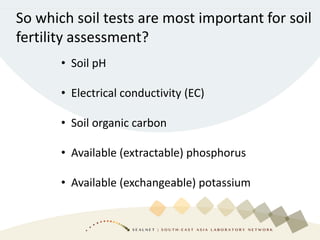
So which soil tests are most important for soil
fertility assessment?
• Soil pH
• Electrical conductivity (EC)
• Soil organic carbon
• Available (extractable) phosphorus
• Available (exchangeable) potassium
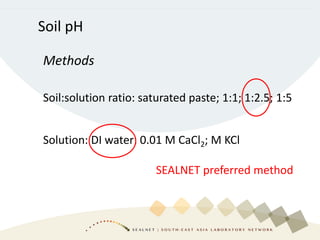
Soil pH
Soil:solution ratio: saturated paste; 1:1; 1:2.5; 1:5
Solution: DI water; 0.01 M CaCl2; M KCl
Methods
SEALNET preferred method
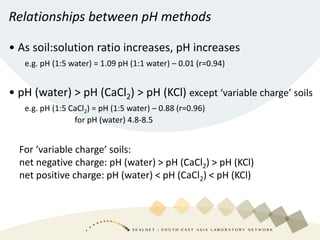
Relationships between pH methods
• As soil:solution ratio increases, pH increases
e.g. pH (1:5 water) = 1.09 pH (1:1 water) – 0.01 (r=0.94)
• pH (water) > pH (CaCl2) > pH (KCl) except ‘variable charge’ soils
e.g. pH (1:5 CaCl2) = pH (1:5 water) – 0.88 (r=0.96)
for pH (water) 4.8-8.5
For ‘variable charge’ soils:
net negative charge: pH (water) > pH (CaCl2) > pH (KCl)
net positive charge: pH (water) < pH (CaCl2) < pH (KCl)
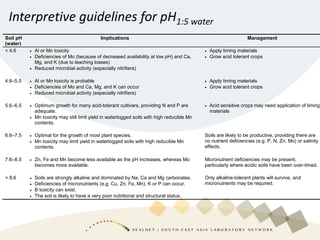
Soil pH
(water)
Implications Management
< 4.6  Al or Mn toxicity
 Deficiencies of Mo (because of decreased availability at low pH) and Ca,
Mg, and K (due to leaching losses)
 Reduced microbial activity (especially nitrifiers)
 Apply liming materials
 Grow acid tolerant crops
4.6–5.5  Al or Mn toxicity is probable
 Deficiencies of Mo and Ca, Mg, and K can occur
 Reduced microbial activity (especially nitrifiers)
 Apply liming materials
 Grow acid tolerant crops
5.6–6.5  Optimum growth for many acid-tolerant cultivars, providing N and P are
adequate.
 Mn toxicity may still limit yield in waterlogged soils with high reducible Mn
contents.
 Acid sensitive crops may need application of liming
materials
6.6–7.5  Optimal for the growth of most plant species.
 Mn toxicity may limit yield in waterlogged soils with high reducible Mn
contents.
Soils are likely to be productive, providing there are
no nutrient deficiencies (e.g. P, N, Zn, Mo) or salinity
effects.
7.6–8.5  Zn, Fe and Mn become less available as the pH increases, whereas Mo
becomes more available.
Micronutrient deficiencies may be present,
particularly where acidic soils have been over-limed.
> 8.6  Soils are strongly alkaline and dominated by Na, Ca and Mg carbonates.
 Deficiencies of micronutrients (e.g. Cu, Zn, Fe, Mn), K or P can occur.
 B toxicity can exist.
 The soil is likely to have a very poor nutritional and structural status.
Only alkaline-tolerant plants will survive, and
micronutrients may be required.
Interpretive guidelines for pH1:5 water
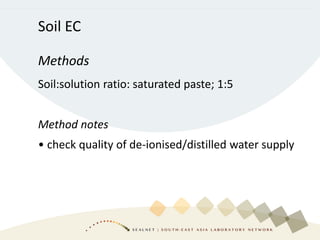
Soil:solution ratio: saturated paste; 1:5
Methods
Method notes
• check quality of de-ionised/distilled water supply
Soil EC
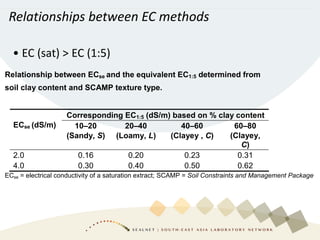
• EC (sat) > EC (1:5)
Relationship between ECse and the equivalent EC1:5 determined from
soil clay content and SCAMP texture type.
Corresponding EC1:5 (dS/m) based on % clay content
ECse (dS/m) 10–20
(Sandy, S)
20–40
(Loamy, L)
40–60
(Clayey , C)
60–80
(Clayey,
C)
2.0 0.16 0.20 0.23 0.31
4.0 0.30 0.40 0.50 0.62
ECse = electrical conductivity of a saturation extract; SCAMP = Soil Constraints and Management Package
Relationships between EC methods
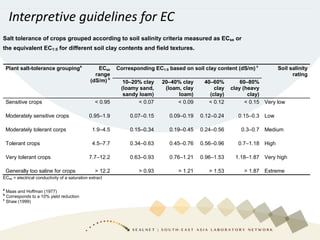
Salt tolerance of crops grouped according to soil salinity criteria measured as ECse or
the equivalent EC1:5 for different soil clay contents and field textures.
Corresponding EC1:5 based on soil clay content (dS/m) c
Soil salinity
rating
Plant salt-tolerance groupinga
ECse
range
(dS/m) b
10–20% clay
(loamy sand,
sandy loam)
20–40% clay
(loam, clay
loam)
40–60%
clay
(clay)
60–80%
clay (heavy
clay)
Sensitive crops < 0.95 < 0.07 < 0.09 < 0.12 < 0.15 Very low
Moderately sensitive crops 0.95–1.9 0.07–0.15 0.09–0.19 0.12–0.24 0.15–0.3 Low
Moderately tolerant corps 1.9–4.5 0.15–0.34 0.19–0.45 0.24–0.56 0.3–0.7 Medium
Tolerant crops 4.5–7.7 0.34–0.63 0.45–0.76 0.56–0.96 0.7–1.18 High
Very tolerant crops 7.7–12.2 0.63–0.93 0.76–1.21 0.96–1.53 1.18–1.87 Very high
Generally too saline for crops > 12.2 > 0.93 > 1.21 > 1.53 > 1.87 Extreme
ECse = electrical conductivity of a saturation extract
a
Maas and Hoffman (1977)
b
Corresponds to a 10% yield reduction
c
Shaw (1999)
Interpretive guidelines for EC
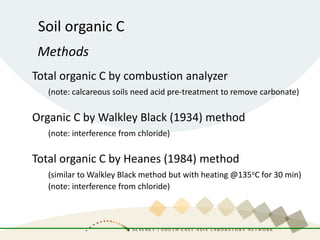
Total organic C by combustion analyzer
(note: calcareous soils need acid pre-treatment to remove carbonate)
Total organic C by Heanes (1984) method
(similar to Walkley Black method but with heating @135oC for 30 min)
(note: interference from chloride)
Methods
Organic C by Walkley Black (1934) method
(note: interference from chloride)
Soil organic C
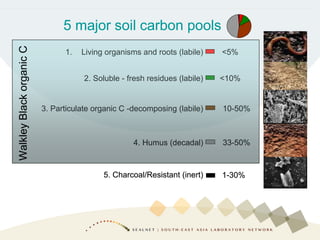
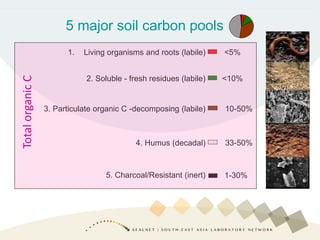
5 major soil carbon pools
<10%2. Soluble - fresh residues (labile)
<5%1. Living organisms and roots (labile)
10-50%3. Particulate organic C -decomposing (labile)
33-50%4. Humus (decadal)
1-30%5. Charcoal/Resistant (inert)
WalkleyBlackorganicC 5 major soil carbon pools
<10%2. Soluble - fresh residues (labile)
<5%1. Living organisms and roots (labile)
10-50%3. Particulate organic C -decomposing (labile)
33-50%4. Humus (decadal)
1-30%5. Charcoal/Resistant (inert)
WalkleyBlackorganicC 5 major soil carbon pools
<10%<10%2. Soluble - fresh residues (labile)
<5%<5%1. Living organisms and roots (labile)
10-50%10-50%3. Particulate organic C -decomposing (labile)
33-50%33-50%4. Humus (decadal)
1-30%5. Charcoal/Resistant (inert)
WalkleyBlackorganicC
5 major soil carbon pools
<10%2. Soluble - fresh residues (labile)
<5%1. Living organisms and roots (labile)
10-50%3. Particulate organic C -decomposing (labile)
33-50%4. Humus (decadal)
1-30%5. Charcoal/Resistant (inert)
TotalorganicC
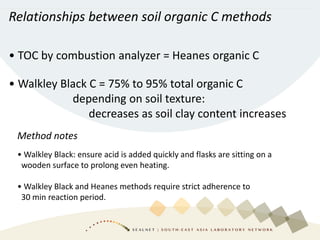
• TOC by combustion analyzer = Heanes organic C
• Walkley Black C = 75% to 95% total organic C
depending on soil texture:
decreases as soil clay content increases
Method notes
• Walkley Black: ensure acid is added quickly and flasks are sitting on a
wooden surface to prolong even heating.
• Walkley Black and Heanes methods require strict adherence to
30 min reaction period.
Relationships between soil organic C methods
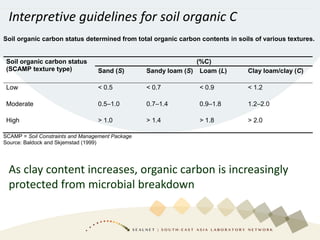
Soil organic carbon status determined from total organic carbon contents in soils of various textures.
(%C)Soil organic carbon status
(SCAMP texture type) Sand (S) Sandy loam (S) Loam (L) Clay loam/clay (C)
Low < 0.5 < 0.7 < 0.9 < 1.2
Moderate 0.5–1.0 0.7–1.4 0.9–1.8 1.2–2.0
High > 1.0 > 1.4 > 1.8 > 2.0
SCAMP = Soil Constraints and Management Package
Source: Baldock and Skjemstad (1999)
As clay content increases, organic carbon is increasingly
protected from microbial breakdown
Interpretive guidelines for soil organic C
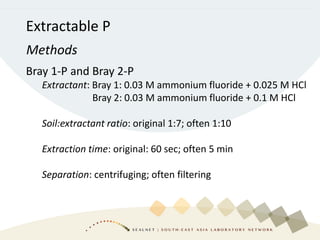
Bray 1-P and Bray 2-P
Extractant: Bray 1: 0.03 M ammonium fluoride + 0.025 M HCl
Bray 2: 0.03 M ammonium fluoride + 0.1 M HCl
Soil:extractant ratio: original 1:7; often 1:10
Extraction time: original: 60 sec; often 5 min
Separation: centrifuging; often filtering
Extractable P
Methods
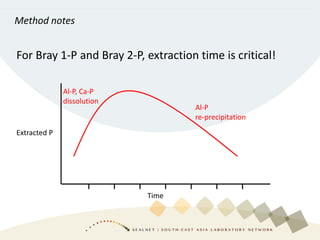
For Bray 1-P and Bray 2-P, extraction time is critical!
Time
Extracted P
Al-P, Ca-P
dissolution
Al-P
re-precipitation
Method notes
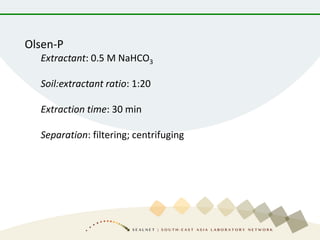
Olsen-P
Extractant: 0.5 M NaHCO3
Soil:extractant ratio: 1:20
Extraction time: 30 min
Separation: filtering; centrifuging
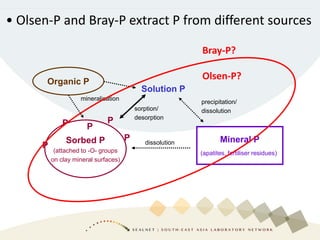
Sorbed P
(attached to -O- groups
on clay mineral surfaces)
Mineral P
(apatites, fertiliser residues)
P
P P
P
Solution P
P
precipitation/
dissolutionsorption/
desorption
dissolution
Organic P
mineralisation
Bray-P?
Olsen-P?
• Olsen-P and Bray-P extract P from different sources
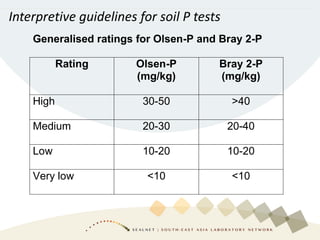
Generalised ratings for Olsen-P and Bray 2-P
Rating Olsen-P
(mg/kg)
Bray 2-P
(mg/kg)
High 30-50 >40
Medium 20-30 20-40
Low 10-20 10-20
Very low <10 <10
Interpretive guidelines for soil P tests
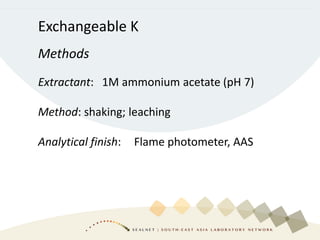
Extractant: 1M ammonium acetate (pH 7)
Method: shaking; leaching
Analytical finish: Flame photometer, AAS
Methods
Exchangeable K
• ammonium acetate K = ammonium chloride K
• shaking = leaching, but check for ‘leachate channels’
in the leaching column
Relationships between exchangeable K methods
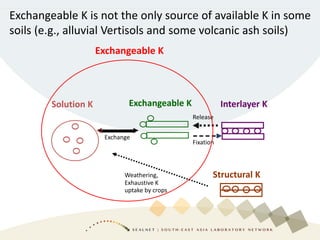
Exchange
Release
Fixation
Weathering,
Exhaustive K
uptake by crops
Exchangeable K Interlayer K
Structural K
Solution K
Exchangeable K
Exchangeable K is not the only source of available K in some
soils (e.g., alluvial Vertisols and some volcanic ash soils)
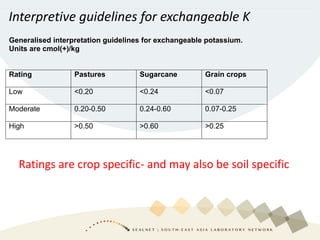
Generalised interpretation guidelines for exchangeable potassium.
Units are cmol(+)/kg
Rating Pastures Sugarcane Grain crops
Low <0.20 <0.24 <0.07
Moderate 0.20-0.50 0.24-0.60 0.07-0.25
High >0.50 >0.60 >0.25
Ratings are crop specific- and may also be soil specific
Interpretive guidelines for exchangeable K
In summary
• Changing conditions for any soil test method
(e.g., soil: solution ratio; extraction time) may give
different results for the same soil sample
• Soil test methods for a particular parameter (e.g., P)
are not always correlated with each other
• Interpretive guidelines for many soil tests (e.g., P, K)
are often soil- and crop-specific
Thanks for your attention
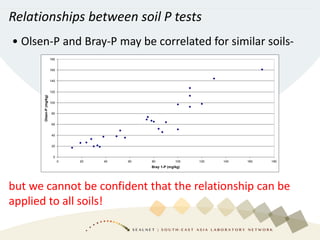
• Olsen-P and Bray-P may be correlated for similar soils-
0
20
40
60
80
100
120
140
160
180
0 20 40 60 80 100 120 140 160 180
Bray 1-P (mg/kg)
Olsen-P(mg/kg)
but we cannot be confident that the relationship can be
applied to all soils!
Relationships between soil P tests

Item 13 soil test methods

  • 1.
    Item 13 Introduction tothe interpretation of soil tests Rob De Hayr (ASPAC) Nopmanee Suvannang (GLOSOLAN) Phil Moody (University of Queensland)
  • 2.
    The goals ofa professional soil testing lab • Provide quality-assured soil test results (Repeatable soil test results that are in agreement with results from other QA certified labs) • Provide interpretive guidelines for the soil tests (Clients value this service, and it enhances the lab’s reputation as a valuable asset)
  • 3.
    So which soiltests are most important for soil fertility assessment? • Soil pH • Electrical conductivity (EC) • Soil organic carbon • Available (extractable) phosphorus • Available (exchangeable) potassium
  • 4.
    Soil pH Soil:solution ratio:saturated paste; 1:1; 1:2.5; 1:5 Solution: DI water; 0.01 M CaCl2; M KCl Methods SEALNET preferred method
  • 5.
    Relationships between pHmethods • As soil:solution ratio increases, pH increases e.g. pH (1:5 water) = 1.09 pH (1:1 water) – 0.01 (r=0.94) • pH (water) > pH (CaCl2) > pH (KCl) except ‘variable charge’ soils e.g. pH (1:5 CaCl2) = pH (1:5 water) – 0.88 (r=0.96) for pH (water) 4.8-8.5 For ‘variable charge’ soils: net negative charge: pH (water) > pH (CaCl2) > pH (KCl) net positive charge: pH (water) < pH (CaCl2) < pH (KCl)
  • 6.
    Soil pH (water) Implications Management <4.6  Al or Mn toxicity  Deficiencies of Mo (because of decreased availability at low pH) and Ca, Mg, and K (due to leaching losses)  Reduced microbial activity (especially nitrifiers)  Apply liming materials  Grow acid tolerant crops 4.6–5.5  Al or Mn toxicity is probable  Deficiencies of Mo and Ca, Mg, and K can occur  Reduced microbial activity (especially nitrifiers)  Apply liming materials  Grow acid tolerant crops 5.6–6.5  Optimum growth for many acid-tolerant cultivars, providing N and P are adequate.  Mn toxicity may still limit yield in waterlogged soils with high reducible Mn contents.  Acid sensitive crops may need application of liming materials 6.6–7.5  Optimal for the growth of most plant species.  Mn toxicity may limit yield in waterlogged soils with high reducible Mn contents. Soils are likely to be productive, providing there are no nutrient deficiencies (e.g. P, N, Zn, Mo) or salinity effects. 7.6–8.5  Zn, Fe and Mn become less available as the pH increases, whereas Mo becomes more available. Micronutrient deficiencies may be present, particularly where acidic soils have been over-limed. > 8.6  Soils are strongly alkaline and dominated by Na, Ca and Mg carbonates.  Deficiencies of micronutrients (e.g. Cu, Zn, Fe, Mn), K or P can occur.  B toxicity can exist.  The soil is likely to have a very poor nutritional and structural status. Only alkaline-tolerant plants will survive, and micronutrients may be required. Interpretive guidelines for pH1:5 water
  • 7.
    Soil:solution ratio: saturatedpaste; 1:5 Methods Method notes • check quality of de-ionised/distilled water supply Soil EC
  • 8.
    • EC (sat)> EC (1:5) Relationship between ECse and the equivalent EC1:5 determined from soil clay content and SCAMP texture type. Corresponding EC1:5 (dS/m) based on % clay content ECse (dS/m) 10–20 (Sandy, S) 20–40 (Loamy, L) 40–60 (Clayey , C) 60–80 (Clayey, C) 2.0 0.16 0.20 0.23 0.31 4.0 0.30 0.40 0.50 0.62 ECse = electrical conductivity of a saturation extract; SCAMP = Soil Constraints and Management Package Relationships between EC methods
  • 9.
    Salt tolerance ofcrops grouped according to soil salinity criteria measured as ECse or the equivalent EC1:5 for different soil clay contents and field textures. Corresponding EC1:5 based on soil clay content (dS/m) c Soil salinity rating Plant salt-tolerance groupinga ECse range (dS/m) b 10–20% clay (loamy sand, sandy loam) 20–40% clay (loam, clay loam) 40–60% clay (clay) 60–80% clay (heavy clay) Sensitive crops < 0.95 < 0.07 < 0.09 < 0.12 < 0.15 Very low Moderately sensitive crops 0.95–1.9 0.07–0.15 0.09–0.19 0.12–0.24 0.15–0.3 Low Moderately tolerant corps 1.9–4.5 0.15–0.34 0.19–0.45 0.24–0.56 0.3–0.7 Medium Tolerant crops 4.5–7.7 0.34–0.63 0.45–0.76 0.56–0.96 0.7–1.18 High Very tolerant crops 7.7–12.2 0.63–0.93 0.76–1.21 0.96–1.53 1.18–1.87 Very high Generally too saline for crops > 12.2 > 0.93 > 1.21 > 1.53 > 1.87 Extreme ECse = electrical conductivity of a saturation extract a Maas and Hoffman (1977) b Corresponds to a 10% yield reduction c Shaw (1999) Interpretive guidelines for EC
  • 10.
    Total organic Cby combustion analyzer (note: calcareous soils need acid pre-treatment to remove carbonate) Total organic C by Heanes (1984) method (similar to Walkley Black method but with heating @135oC for 30 min) (note: interference from chloride) Methods Organic C by Walkley Black (1934) method (note: interference from chloride) Soil organic C
  • 11.
    5 major soilcarbon pools <10%2. Soluble - fresh residues (labile) <5%1. Living organisms and roots (labile) 10-50%3. Particulate organic C -decomposing (labile) 33-50%4. Humus (decadal) 1-30%5. Charcoal/Resistant (inert) WalkleyBlackorganicC 5 major soil carbon pools <10%2. Soluble - fresh residues (labile) <5%1. Living organisms and roots (labile) 10-50%3. Particulate organic C -decomposing (labile) 33-50%4. Humus (decadal) 1-30%5. Charcoal/Resistant (inert) WalkleyBlackorganicC 5 major soil carbon pools <10%<10%2. Soluble - fresh residues (labile) <5%<5%1. Living organisms and roots (labile) 10-50%10-50%3. Particulate organic C -decomposing (labile) 33-50%33-50%4. Humus (decadal) 1-30%5. Charcoal/Resistant (inert) WalkleyBlackorganicC
  • 12.
    5 major soilcarbon pools <10%2. Soluble - fresh residues (labile) <5%1. Living organisms and roots (labile) 10-50%3. Particulate organic C -decomposing (labile) 33-50%4. Humus (decadal) 1-30%5. Charcoal/Resistant (inert) TotalorganicC
  • 13.
    • TOC bycombustion analyzer = Heanes organic C • Walkley Black C = 75% to 95% total organic C depending on soil texture: decreases as soil clay content increases Method notes • Walkley Black: ensure acid is added quickly and flasks are sitting on a wooden surface to prolong even heating. • Walkley Black and Heanes methods require strict adherence to 30 min reaction period. Relationships between soil organic C methods
  • 14.
    Soil organic carbonstatus determined from total organic carbon contents in soils of various textures. (%C)Soil organic carbon status (SCAMP texture type) Sand (S) Sandy loam (S) Loam (L) Clay loam/clay (C) Low < 0.5 < 0.7 < 0.9 < 1.2 Moderate 0.5–1.0 0.7–1.4 0.9–1.8 1.2–2.0 High > 1.0 > 1.4 > 1.8 > 2.0 SCAMP = Soil Constraints and Management Package Source: Baldock and Skjemstad (1999) As clay content increases, organic carbon is increasingly protected from microbial breakdown Interpretive guidelines for soil organic C
  • 15.
    Bray 1-P andBray 2-P Extractant: Bray 1: 0.03 M ammonium fluoride + 0.025 M HCl Bray 2: 0.03 M ammonium fluoride + 0.1 M HCl Soil:extractant ratio: original 1:7; often 1:10 Extraction time: original: 60 sec; often 5 min Separation: centrifuging; often filtering Extractable P Methods
  • 16.
    For Bray 1-Pand Bray 2-P, extraction time is critical! Time Extracted P Al-P, Ca-P dissolution Al-P re-precipitation Method notes
  • 17.
    Olsen-P Extractant: 0.5 MNaHCO3 Soil:extractant ratio: 1:20 Extraction time: 30 min Separation: filtering; centrifuging
  • 18.
    Sorbed P (attached to-O- groups on clay mineral surfaces) Mineral P (apatites, fertiliser residues) P P P P Solution P P precipitation/ dissolutionsorption/ desorption dissolution Organic P mineralisation Bray-P? Olsen-P? • Olsen-P and Bray-P extract P from different sources
  • 19.
    Generalised ratings forOlsen-P and Bray 2-P Rating Olsen-P (mg/kg) Bray 2-P (mg/kg) High 30-50 >40 Medium 20-30 20-40 Low 10-20 10-20 Very low <10 <10 Interpretive guidelines for soil P tests
  • 20.
    Extractant: 1M ammoniumacetate (pH 7) Method: shaking; leaching Analytical finish: Flame photometer, AAS Methods Exchangeable K
  • 21.
    • ammonium acetateK = ammonium chloride K • shaking = leaching, but check for ‘leachate channels’ in the leaching column Relationships between exchangeable K methods
  • 22.
    Exchange Release Fixation Weathering, Exhaustive K uptake bycrops Exchangeable K Interlayer K Structural K Solution K Exchangeable K Exchangeable K is not the only source of available K in some soils (e.g., alluvial Vertisols and some volcanic ash soils)
  • 23.
    Generalised interpretation guidelinesfor exchangeable potassium. Units are cmol(+)/kg Rating Pastures Sugarcane Grain crops Low <0.20 <0.24 <0.07 Moderate 0.20-0.50 0.24-0.60 0.07-0.25 High >0.50 >0.60 >0.25 Ratings are crop specific- and may also be soil specific Interpretive guidelines for exchangeable K
  • 24.
    In summary • Changingconditions for any soil test method (e.g., soil: solution ratio; extraction time) may give different results for the same soil sample • Soil test methods for a particular parameter (e.g., P) are not always correlated with each other • Interpretive guidelines for many soil tests (e.g., P, K) are often soil- and crop-specific
  • 25.
    Thanks for yourattention
  • 26.
    • Olsen-P andBray-P may be correlated for similar soils- 0 20 40 60 80 100 120 140 160 180 0 20 40 60 80 100 120 140 160 180 Bray 1-P (mg/kg) Olsen-P(mg/kg) but we cannot be confident that the relationship can be applied to all soils! Relationships between soil P tests