WWW.GTRI.COM
© 2016 Global Technology Resources, Inc.
All rights reserved.
Organizational Change
Management Overview
Steve Mollen - smollen@gtri.com - (908) 331-1833
© 2016 Global Technology Resources, Inc. All Rights Reserved.
2
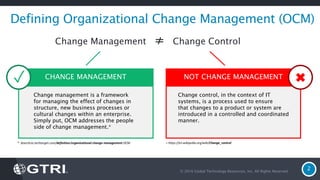
Defining Organizational Change Management (OCM)
* Searchcio.techtarget.com/definition/organizational-change-management-OCM + https://en.wikipedia.org/wiki/Change_control
CHANGE MANAGEMENT NOT CHANGE MANAGEMENT
Change management is a framework
for managing the effect of changes in
structure, new business processes or
cultural changes within an enterprise.
Simply put, OCM addresses the people
side of change management.*
Change control, in the context of IT
systems, is a process used to ensure
that changes to a product or system are
introduced in a controlled and coordinated
manner.
Change Management ≠ Change Control
✓
© 2016 Global Technology Resources, Inc. All Rights Reserved.
3
© 2016 Global Technology Resources, Inc. All Rights Reserved.
4
© 2016 Global Technology Resources, Inc. All Rights Reserved.
5
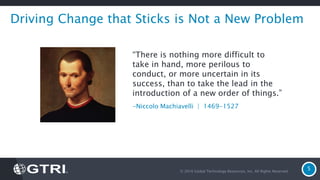
Driving Change that Sticks is Not a New Problem
“There is nothing more difficult to
take in hand, more perilous to
conduct, or more uncertain in its
success, than to take the lead in the
introduction of a new order of things.”
-Niccolo Machiavelli | 1469-1527
© 2016 Global Technology Resources, Inc. All Rights Reserved.
6
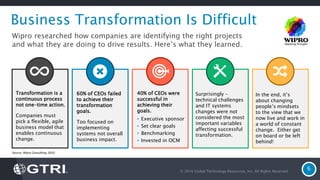
Business Transformation Is Difficult
Wipro researched how companies are identifying the right projects
and what they are doing to drive results. Here’s what they learned.
Transformation is a
continuous process
not one-time action.
Companies must
pick a flexible, agile
business model that
enables continuous
change.
60% of CEOs failed
to achieve their
transformation
goals.
Too focused on
implementing
systems not overall
business impact.
40% of CEOs were
successful in
achieving their
goals.
• Executive sponsor
• Set clear goals
• Benchmarking
• Invested in OCM
Surprisingly -
technical challenges
and IT systems
changes were not
considered the most
important variables
affecting successful
transformation.
In the end, it’s
about changing
people’s mindsets
to the view that we
now live and work in
a world of constant
change. Either get
on board or be left
behind!
Source: Wipro Consulting, 2010
© 2016 Global Technology Resources, Inc. All Rights Reserved.
7
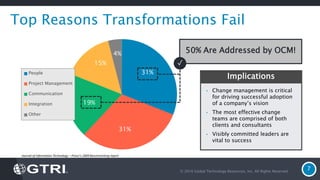
Top Reasons Transformations Fail
31%
31%
19%
15%
4%
People
Project Management
Communication
Integration
Other
• Change management is critical
for driving successful adoption
of a company’s vision
• The most effective change
teams are comprised of both
clients and consultants
• Visibly committed leaders are
vital to success
Implications
50% Are Addressed by OCM!
✓
Journal of Information Technology – Prosci’s 2009 Benchmarking report
Common Change Challenges
© 2016 Global Technology Resources, Inc. All Rights Reserved.
8
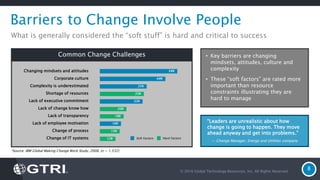
Barriers to Change Involve People
“Leaders are unrealistic about how
change is going to happen. They move
ahead anyway and get into problems.”
— Change Manager, Energy and Utilities company
*Source: IBM Global Making Change Work Study, 2008, (n = 1,532)
Changing mindsets and attitudes
Corporate culture
Complexity is underestimated
Shortage of resources
Lack of executive commitment
Lack of change know how
Lack of transparency
Lack of employee motivation
Change of process
Change of IT systems
58%
49%
35%
33%
32%
20%
18%
16%
15%
12% Soft Factors Hard Factors
What is generally considered the “soft stuff” is hard and critical to success
• Key barriers are changing
mindsets, attitudes, culture and
complexity
• These “soft factors” are rated more
important than resource
constraints illustrating they are
hard to manage
© 2016 Global Technology Resources, Inc. All Rights Reserved.
9
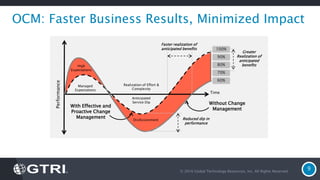
OCM: Faster Business Results, Minimized Impact
Greater
Realization of
anticipated
benefitsHigh
Expectations
Managed
Expectations
Realization of Effort &
Complexity
Anticipated
Service Dip
Disillusionment
100%
90%
80%
70%
60%
Faster realization of
anticipated benefits
Time
Without Change
Management
With Effective and
Proactive Change
Management
Performance
Reduced dip in
performance
© 2016 Global Technology Resources, Inc. All Rights Reserved.
10
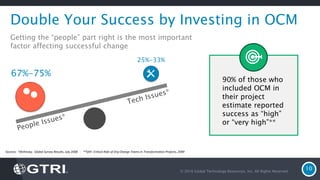
Double Your Success by Investing in OCM
67%-75%
25%-33%
Getting the “people” part right is the most important
factor affecting successful change
Sources: *McKinsey, Global Survey Results, July 2008 - **SAP, Critical Role of Org Change Teams in Transformation Projects, 2009
90% of those who
included OCM in
their project
estimate reported
success as “high”
or “very high”**
© 2016 Global Technology Resources, Inc. All Rights Reserved.
11
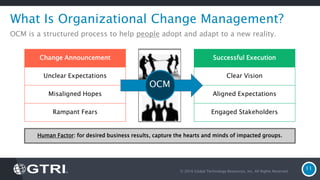
What Is Organizational Change Management?
OCM is a structured process to help people adopt and adapt to a new reality.
Change Announcement
Unclear Expectations
Misaligned Hopes
Rampant Fears
Successful Execution
Clear Vision
Aligned Expectations
Engaged Stakeholders
OCM
Human Factor: for desired business results, capture the hearts and minds of impacted groups.
© 2016 Global Technology Resources, Inc. All Rights Reserved.
12
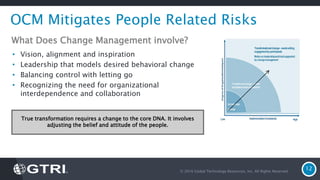
OCM Mitigates People Related Risks
• Vision, alignment and inspiration
• Leadership that models desired behavioral change
• Balancing control with letting go
• Recognizing the need for organizational
interdependence and collaboration
What Does Change Management involve?
True transformation requires a change to the core DNA. It involves
adjusting the belief and attitude of the people.
© 2016 Global Technology Resources, Inc. All Rights Reserved.
13
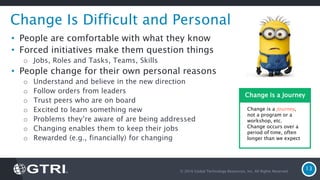
Change Is Difficult and Personal
• People are comfortable with what they know
• Forced initiatives make them question things
o Jobs, Roles and Tasks, Teams, Skills
• People change for their own personal reasons
o Understand and believe in the new direction
o Follow orders from leaders
o Trust peers who are on board
o Excited to learn something new
o Problems they’re aware of are being addressed
o Changing enables them to keep their jobs
o Rewarded (e.g., financially) for changing
Change is a Journey,
not a program or a
workshop, etc.
Change occurs over a
period of time, often
longer than we expect
Change Is a Journey
© 2016 Global Technology Resources, Inc. All Rights Reserved.
14
Governance
• Change initiatives are often driven by one
function in the organization
• Success depends on adoption from other
employees
• Creates friction as the owner may not have
“authority” over the impacted functions
• Successful change initiatives are led by active,
visible, cross-functional leaders
“If leaders did what
they were supposed
to with driving
change, we wouldn’t
need OCM”
HR Manager, Beverage
Company
“
© 2016 Global Technology Resources, Inc. All Rights Reserved.
15
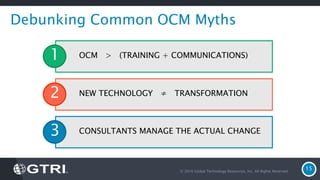
Debunking Common OCM Myths
OCM > (TRAINING + COMMUNICATIONS)1
NEW TECHNOLOGY ≠ TRANSFORMATION2
CONSULTANTS MANAGE THE ACTUAL CHANGE3
© 2016 Global Technology Resources, Inc. All Rights Reserved.
16
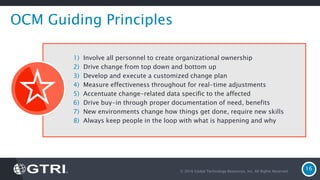
OCM Guiding Principles
1) Involve all personnel to create organizational ownership
2) Drive change from top down and bottom up
3) Develop and execute a customized change plan
4) Measure effectiveness throughout for real-time adjustments
5) Accentuate change-related data specific to the affected
6) Drive buy-in through proper documentation of need, benefits
7) New environments change how things get done, require new skills
8) Always keep people in the loop with what is happening and why
Business led
Simple vision,
strategy
Creative and
emotional
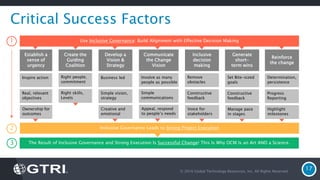
Establish a
sense of
urgency
Develop a
Vision &
Strategy
Communicate
the Change
Vision
Inclusive
decision
making
Generate
short-
term wins
Create the
Guiding
Coalition
Reinforce
the change
Inspire action
Real, relevant
objectives
Ownership for
outcomes
Right people,
commitment
Right skills,
Levels
Involve as many
people as possible
Simple
communications
Appeal, respond
to people’s needs
Remove
obstacles
Constructive
feedback
Voice for
stakeholders
Set Bite-sized
goals
Constructive
feedback
Manage pace
in stages
Determination,
persistence
Progress
Reporting
Highlight
milestones
Inclusive Governance Leads to Strong Project Execution
The Result of Inclusive Governance and Strong Execution Is Successful Change! This Is Why OCM Is an Art AND a Science.
© 2016 Global Technology Resources, Inc. All Rights Reserved.
17
Critical Success Factors
Use Inclusive Governance: Build Alignment with Effective Decision Making1
2
3
© 2016 Global Technology Resources, Inc. All Rights Reserved.
18
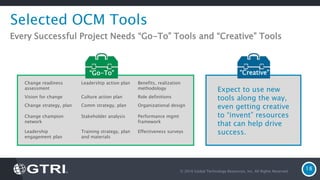
Selected OCM Tools
Change readiness
assessment
Leadership action plan Benefits, realization
methodology
Vision for change Culture action plan Role definitions
Change strategy, plan Comm strategy, plan Organizational design
Change champion
network
Stakeholder analysis Performance mgmt
framework
Leadership
engagement plan
Training strategy, plan
and materials
Effectiveness surveys
Every Successful Project Needs “Go-To” Tools and “Creative” Tools
“Go-To”
Expect to use new
tools along the way,
even getting creative
to “invent” resources
that can help drive
success.
“Creative”
WWW.GTRI.COM
© 2016 Global Technology Resources, Inc.
All rights reserved.
Thank You!
Steve Mollen - smollen@gtri.com - (908) 331-1833

Organizational Change Management

  • 1.
    WWW.GTRI.COM © 2016 GlobalTechnology Resources, Inc. All rights reserved. Organizational Change Management Overview Steve Mollen - smollen@gtri.com - (908) 331-1833
  • 2.
    © 2016 GlobalTechnology Resources, Inc. All Rights Reserved. 2 Defining Organizational Change Management (OCM) * Searchcio.techtarget.com/definition/organizational-change-management-OCM + https://en.wikipedia.org/wiki/Change_control CHANGE MANAGEMENT NOT CHANGE MANAGEMENT Change management is a framework for managing the effect of changes in structure, new business processes or cultural changes within an enterprise. Simply put, OCM addresses the people side of change management.* Change control, in the context of IT systems, is a process used to ensure that changes to a product or system are introduced in a controlled and coordinated manner. Change Management ≠ Change Control ✓
  • 3.
    © 2016 GlobalTechnology Resources, Inc. All Rights Reserved. 3
  • 4.
    © 2016 GlobalTechnology Resources, Inc. All Rights Reserved. 4
  • 5.
    © 2016 GlobalTechnology Resources, Inc. All Rights Reserved. 5 Driving Change that Sticks is Not a New Problem “There is nothing more difficult to take in hand, more perilous to conduct, or more uncertain in its success, than to take the lead in the introduction of a new order of things.” -Niccolo Machiavelli | 1469-1527
  • 6.
    © 2016 GlobalTechnology Resources, Inc. All Rights Reserved. 6 Business Transformation Is Difficult Wipro researched how companies are identifying the right projects and what they are doing to drive results. Here’s what they learned. Transformation is a continuous process not one-time action. Companies must pick a flexible, agile business model that enables continuous change. 60% of CEOs failed to achieve their transformation goals. Too focused on implementing systems not overall business impact. 40% of CEOs were successful in achieving their goals. • Executive sponsor • Set clear goals • Benchmarking • Invested in OCM Surprisingly - technical challenges and IT systems changes were not considered the most important variables affecting successful transformation. In the end, it’s about changing people’s mindsets to the view that we now live and work in a world of constant change. Either get on board or be left behind! Source: Wipro Consulting, 2010
  • 7.
    © 2016 GlobalTechnology Resources, Inc. All Rights Reserved. 7 Top Reasons Transformations Fail 31% 31% 19% 15% 4% People Project Management Communication Integration Other • Change management is critical for driving successful adoption of a company’s vision • The most effective change teams are comprised of both clients and consultants • Visibly committed leaders are vital to success Implications 50% Are Addressed by OCM! ✓ Journal of Information Technology – Prosci’s 2009 Benchmarking report
  • 8.
    Common Change Challenges ©2016 Global Technology Resources, Inc. All Rights Reserved. 8 Barriers to Change Involve People “Leaders are unrealistic about how change is going to happen. They move ahead anyway and get into problems.” — Change Manager, Energy and Utilities company *Source: IBM Global Making Change Work Study, 2008, (n = 1,532) Changing mindsets and attitudes Corporate culture Complexity is underestimated Shortage of resources Lack of executive commitment Lack of change know how Lack of transparency Lack of employee motivation Change of process Change of IT systems 58% 49% 35% 33% 32% 20% 18% 16% 15% 12% Soft Factors Hard Factors What is generally considered the “soft stuff” is hard and critical to success • Key barriers are changing mindsets, attitudes, culture and complexity • These “soft factors” are rated more important than resource constraints illustrating they are hard to manage
  • 9.
    © 2016 GlobalTechnology Resources, Inc. All Rights Reserved. 9 OCM: Faster Business Results, Minimized Impact Greater Realization of anticipated benefitsHigh Expectations Managed Expectations Realization of Effort & Complexity Anticipated Service Dip Disillusionment 100% 90% 80% 70% 60% Faster realization of anticipated benefits Time Without Change Management With Effective and Proactive Change Management Performance Reduced dip in performance
  • 10.
    © 2016 GlobalTechnology Resources, Inc. All Rights Reserved. 10 Double Your Success by Investing in OCM 67%-75% 25%-33% Getting the “people” part right is the most important factor affecting successful change Sources: *McKinsey, Global Survey Results, July 2008 - **SAP, Critical Role of Org Change Teams in Transformation Projects, 2009 90% of those who included OCM in their project estimate reported success as “high” or “very high”**
  • 11.
    © 2016 GlobalTechnology Resources, Inc. All Rights Reserved. 11 What Is Organizational Change Management? OCM is a structured process to help people adopt and adapt to a new reality. Change Announcement Unclear Expectations Misaligned Hopes Rampant Fears Successful Execution Clear Vision Aligned Expectations Engaged Stakeholders OCM Human Factor: for desired business results, capture the hearts and minds of impacted groups.
  • 12.
    © 2016 GlobalTechnology Resources, Inc. All Rights Reserved. 12 OCM Mitigates People Related Risks • Vision, alignment and inspiration • Leadership that models desired behavioral change • Balancing control with letting go • Recognizing the need for organizational interdependence and collaboration What Does Change Management involve? True transformation requires a change to the core DNA. It involves adjusting the belief and attitude of the people.
  • 13.
    © 2016 GlobalTechnology Resources, Inc. All Rights Reserved. 13 Change Is Difficult and Personal • People are comfortable with what they know • Forced initiatives make them question things o Jobs, Roles and Tasks, Teams, Skills • People change for their own personal reasons o Understand and believe in the new direction o Follow orders from leaders o Trust peers who are on board o Excited to learn something new o Problems they’re aware of are being addressed o Changing enables them to keep their jobs o Rewarded (e.g., financially) for changing Change is a Journey, not a program or a workshop, etc. Change occurs over a period of time, often longer than we expect Change Is a Journey
  • 14.
    © 2016 GlobalTechnology Resources, Inc. All Rights Reserved. 14 Governance • Change initiatives are often driven by one function in the organization • Success depends on adoption from other employees • Creates friction as the owner may not have “authority” over the impacted functions • Successful change initiatives are led by active, visible, cross-functional leaders “If leaders did what they were supposed to with driving change, we wouldn’t need OCM” HR Manager, Beverage Company “
  • 15.
    © 2016 GlobalTechnology Resources, Inc. All Rights Reserved. 15 Debunking Common OCM Myths OCM > (TRAINING + COMMUNICATIONS)1 NEW TECHNOLOGY ≠ TRANSFORMATION2 CONSULTANTS MANAGE THE ACTUAL CHANGE3
  • 16.
    © 2016 GlobalTechnology Resources, Inc. All Rights Reserved. 16 OCM Guiding Principles 1) Involve all personnel to create organizational ownership 2) Drive change from top down and bottom up 3) Develop and execute a customized change plan 4) Measure effectiveness throughout for real-time adjustments 5) Accentuate change-related data specific to the affected 6) Drive buy-in through proper documentation of need, benefits 7) New environments change how things get done, require new skills 8) Always keep people in the loop with what is happening and why
  • 17.
    Business led Simple vision, strategy Creativeand emotional Establish a sense of urgency Develop a Vision & Strategy Communicate the Change Vision Inclusive decision making Generate short- term wins Create the Guiding Coalition Reinforce the change Inspire action Real, relevant objectives Ownership for outcomes Right people, commitment Right skills, Levels Involve as many people as possible Simple communications Appeal, respond to people’s needs Remove obstacles Constructive feedback Voice for stakeholders Set Bite-sized goals Constructive feedback Manage pace in stages Determination, persistence Progress Reporting Highlight milestones Inclusive Governance Leads to Strong Project Execution The Result of Inclusive Governance and Strong Execution Is Successful Change! This Is Why OCM Is an Art AND a Science. © 2016 Global Technology Resources, Inc. All Rights Reserved. 17 Critical Success Factors Use Inclusive Governance: Build Alignment with Effective Decision Making1 2 3
  • 18.
    © 2016 GlobalTechnology Resources, Inc. All Rights Reserved. 18 Selected OCM Tools Change readiness assessment Leadership action plan Benefits, realization methodology Vision for change Culture action plan Role definitions Change strategy, plan Comm strategy, plan Organizational design Change champion network Stakeholder analysis Performance mgmt framework Leadership engagement plan Training strategy, plan and materials Effectiveness surveys Every Successful Project Needs “Go-To” Tools and “Creative” Tools “Go-To” Expect to use new tools along the way, even getting creative to “invent” resources that can help drive success. “Creative”
  • 19.
    WWW.GTRI.COM © 2016 GlobalTechnology Resources, Inc. All rights reserved. Thank You! Steve Mollen - smollen@gtri.com - (908) 331-1833