

SDN & NFV Day @ITB
Software Defined Networking
Eueung Mulyana
http://eueung.github.io/talks/sdnnfv
21/03/2016 | Attribution-ShareAlike CC BY-SA
1 / 26
Outline
This Event
SDN & NFV - Short Introduction
What Should I Remember About SDN?
SDN Today
2 / 26

 SDN & NFV - Short Introduction
3 / 26
4 / 26
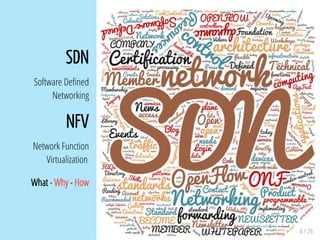
SDN
Software De ned
Networking
NFV
Network Function
Virtualization
What - Why - How
5 / 26
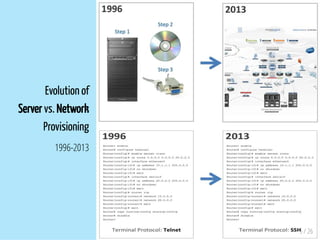
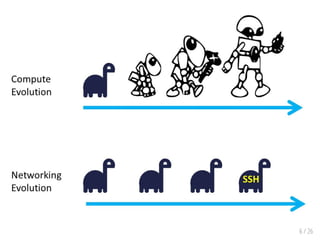
Evolution of
Server vs. Network
Provisioning
1996-2013
6 / 26
7 / 26
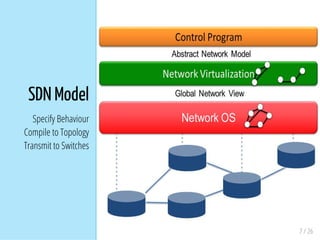
SDN Model
Specify Behaviour
Compile to Topology
Transmit to Switches
8 / 26
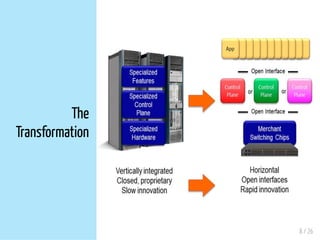
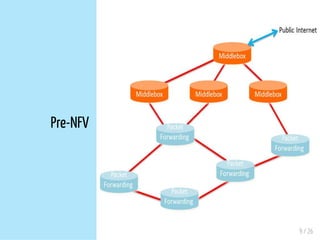
The
Transformation
9 / 26
Pre-NFV
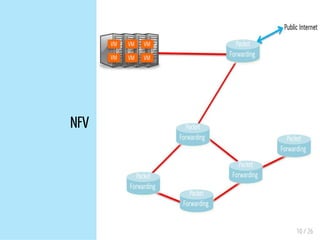
10 / 26
NFV
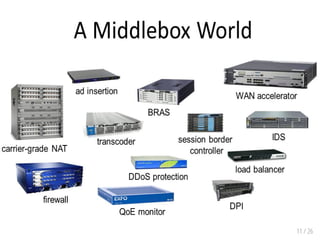
11 / 26
12 / 26
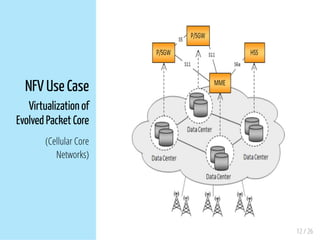
NFV Use Case
Virtualization of
Evolved Packet Core
(Cellular Core
Networks)

 What Should I Remember About
SDN?
13 / 26
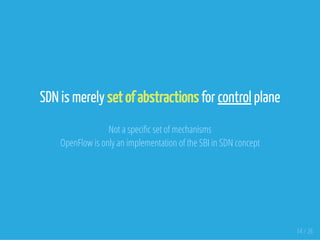
SDN is merely set of abstractions for control plane
Not a speci c set of mechanisms
OpenFlow is only an implementation of the SBI in SDN concept
14 / 26
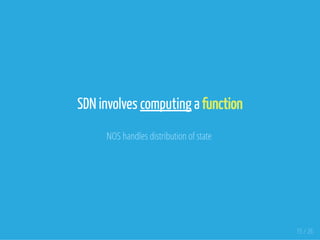
SDN involves computing a function
NOS handles distribution of state
15 / 26
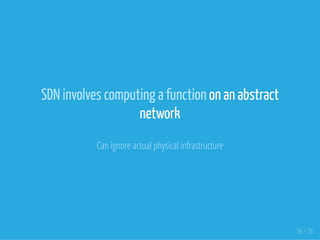
SDN involves computing a function on an abstract
network
Can ignore actual physical infrastructure
16 / 26
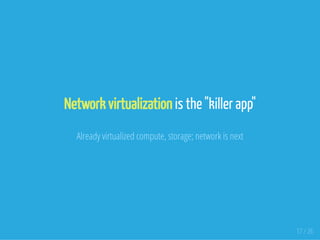
Network virtualization is the "killer app"
Already virtualized compute, storage; network is next
17 / 26

 SDN Today
Some Cases & Issues
18 / 26
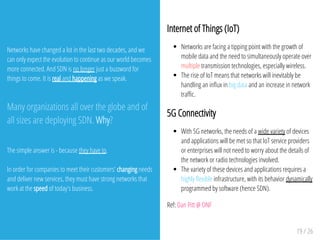
Networks have changed a lot in the last two decades, and we
can only expect the evolution to continue as our world becomes
more connected. And SDN is no longer just a buzzword for
things to come. It is real and happening as we speak.
Many organizations all over the globe and of
all sizes are deploying SDN. Why?
The simple answer is - because they have to.
In order for companies to meet their customers' changing needs
and deliver new services, they must have strong networks that
work at the speed of today's business.
Internet of Things (IoT)
Networks are facing a tipping point with the growth of
mobile data and the need to simultaneously operate over
multiple transmission technologies, especially wireless.
The rise of IoT means that networks will inevitably be
handling an in¯ux in big data and an increase in network
traþc.
5G Connectivity
With 5G networks, the needs of a wide variety of devices
and applications will be met so that IoT service providers
or enterprises will not need to worry about the details of
the network or radio technologies involved.
The variety of these devices and applications requires a
highly ¯exible infrastructure, with its behavior dynamically
programmed by software (hence SDN).
Ref: Dan Pitt @ ONF
19 / 26
20 / 26
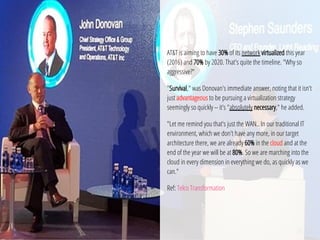
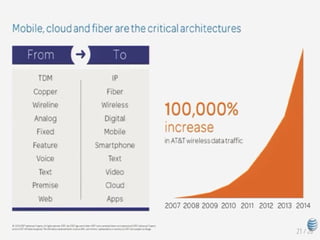
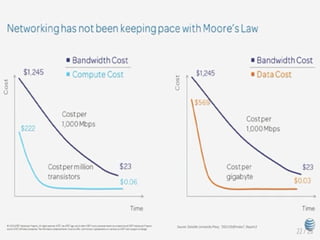
AT&T is aiming to have 30% of its network virtualized this year
(2016) and 70% by 2020. That's quite the timeline. "Why so
aggressive?"
"Survival," was Donovan's immediate answer, noting that it isn't
just advantageous to be pursuing a virtualization strategy
seemingly so quickly -- it's "absolutely necessary," he added.
"Let me remind you that's just the WAN.. In our traditional IT
environment, which we don't have any more, in our target
architecture there, we are already 60% in the cloud and at the
end of the year we will be at 80%. So we are marching into the
cloud in every dimension in everything we do, as quickly as we
can."
Ref: Telco Transformation
21 / 26
22 / 26
23 / 26
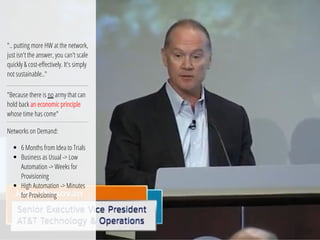
".. putting more HW at the network,
just isn't the answer, you can't scale
quickly & cost-e!ectively. It's simply
not sustainable.."
"Because there is no army that can
hold back an economic principle
whose time has come"
Networks on Demand:
6 Months from Idea to Trials
Business as Usual -> Low
Automation -> Weeks for
Provisioning
High Automation -> Minutes
for Provisioning

 Refs
24 / 26
Refs
1. Scott Shenker, The Future of Networking and the Past of Protocols
2. Nick McKeown, Stanford University, Many Talks/Articles
3. Jennifer Rexford, COS 597E, Princeton University
4. Guido Appenzeller, Network Virtualization in Multi-tenant Datacenters,
VMware
5. SDN Today for Tomorrow's Network
6. Telco Transformation
25 / 26


END
Eueung Mulyana
http://eueung.github.io/talks/sdnnfv
SDN & NFV Day @ITB | Attribution-ShareAlike CC BY-SA
26 / 26

SDN & NFV Introduction (SDN NFV Day ITB 2016)

  • 1.
      SDN & NFVDay @ITB Software Defined Networking Eueung Mulyana http://eueung.github.io/talks/sdnnfv 21/03/2016 | Attribution-ShareAlike CC BY-SA 1 / 26
  • 2.
    Outline This Event SDN &NFV - Short Introduction What Should I Remember About SDN? SDN Today 2 / 26
  • 3.
      SDN &NFV - Short Introduction 3 / 26
  • 4.
    4 / 26 SDN SoftwareDe ned Networking NFV Network Function Virtualization What - Why - How
  • 5.
    5 / 26 Evolutionof Server vs. Network Provisioning 1996-2013
  • 6.
  • 7.
    7 / 26 SDNModel Specify Behaviour Compile to Topology Transmit to Switches
  • 8.
  • 9.
  • 10.
  • 11.
  • 12.
    12 / 26 NFVUse Case Virtualization of Evolved Packet Core (Cellular Core Networks)
  • 13.
      What ShouldI Remember About SDN? 13 / 26
  • 14.
    SDN is merelyset of abstractions for control plane Not a speci c set of mechanisms OpenFlow is only an implementation of the SBI in SDN concept 14 / 26
  • 15.
    SDN involves computinga function NOS handles distribution of state 15 / 26
  • 16.
    SDN involves computinga function on an abstract network Can ignore actual physical infrastructure 16 / 26
  • 17.
    Network virtualization isthe "killer app" Already virtualized compute, storage; network is next 17 / 26
  • 18.
      SDN Today SomeCases & Issues 18 / 26
  • 19.
    Networks have changeda lot in the last two decades, and we can only expect the evolution to continue as our world becomes more connected. And SDN is no longer just a buzzword for things to come. It is real and happening as we speak. Many organizations all over the globe and of all sizes are deploying SDN. Why? The simple answer is - because they have to. In order for companies to meet their customers' changing needs and deliver new services, they must have strong networks that work at the speed of today's business. Internet of Things (IoT) Networks are facing a tipping point with the growth of mobile data and the need to simultaneously operate over multiple transmission technologies, especially wireless. The rise of IoT means that networks will inevitably be handling an in¯ux in big data and an increase in network traþc. 5G Connectivity With 5G networks, the needs of a wide variety of devices and applications will be met so that IoT service providers or enterprises will not need to worry about the details of the network or radio technologies involved. The variety of these devices and applications requires a highly ¯exible infrastructure, with its behavior dynamically programmed by software (hence SDN). Ref: Dan Pitt @ ONF 19 / 26
  • 20.
    20 / 26 AT&Tis aiming to have 30% of its network virtualized this year (2016) and 70% by 2020. That's quite the timeline. "Why so aggressive?" "Survival," was Donovan's immediate answer, noting that it isn't just advantageous to be pursuing a virtualization strategy seemingly so quickly -- it's "absolutely necessary," he added. "Let me remind you that's just the WAN.. In our traditional IT environment, which we don't have any more, in our target architecture there, we are already 60% in the cloud and at the end of the year we will be at 80%. So we are marching into the cloud in every dimension in everything we do, as quickly as we can." Ref: Telco Transformation
  • 21.
  • 22.
  • 23.
    23 / 26 "..putting more HW at the network, just isn't the answer, you can't scale quickly & cost-e!ectively. It's simply not sustainable.." "Because there is no army that can hold back an economic principle whose time has come" Networks on Demand: 6 Months from Idea to Trials Business as Usual -> Low Automation -> Weeks for Provisioning High Automation -> Minutes for Provisioning
  • 24.
  • 25.
    Refs 1. Scott Shenker,The Future of Networking and the Past of Protocols 2. Nick McKeown, Stanford University, Many Talks/Articles 3. Jennifer Rexford, COS 597E, Princeton University 4. Guido Appenzeller, Network Virtualization in Multi-tenant Datacenters, VMware 5. SDN Today for Tomorrow's Network 6. Telco Transformation 25 / 26
  • 26.
      END Eueung Mulyana http://eueung.github.io/talks/sdnnfv SDN &NFV Day @ITB | Attribution-ShareAlike CC BY-SA 26 / 26