The document discusses the importance and definitions of software architecture, encompassing its role in system design, stakeholder communication, and quality assurance. It covers various architectural styles, viewpoints, and the responsibilities of software architects throughout different phases of the development life cycle. Additionally, the document emphasizes the need for clear documentation of design decisions to facilitate understanding and future changes in architectural projects.
#2 Is the notion of software architecture really important?
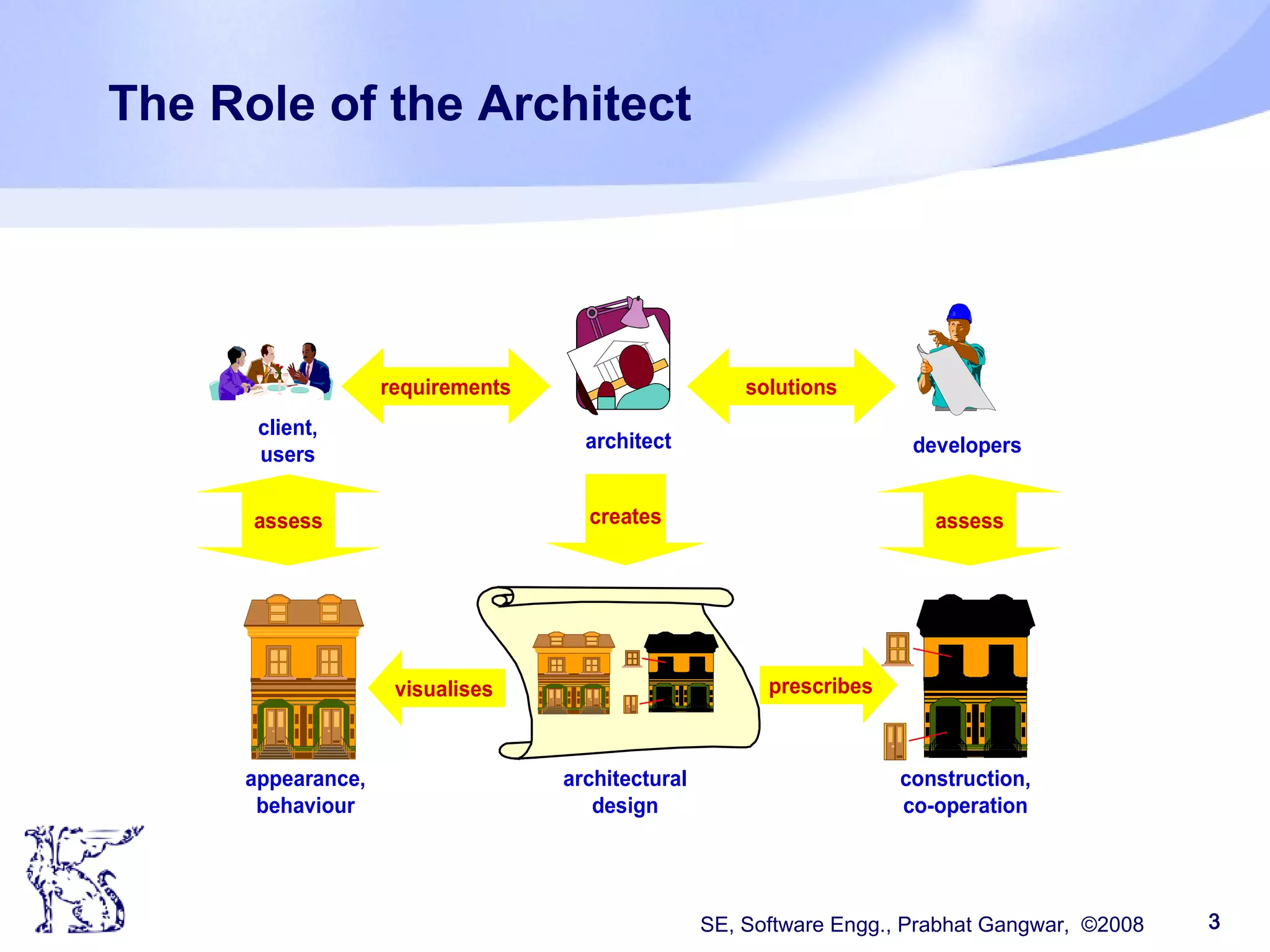
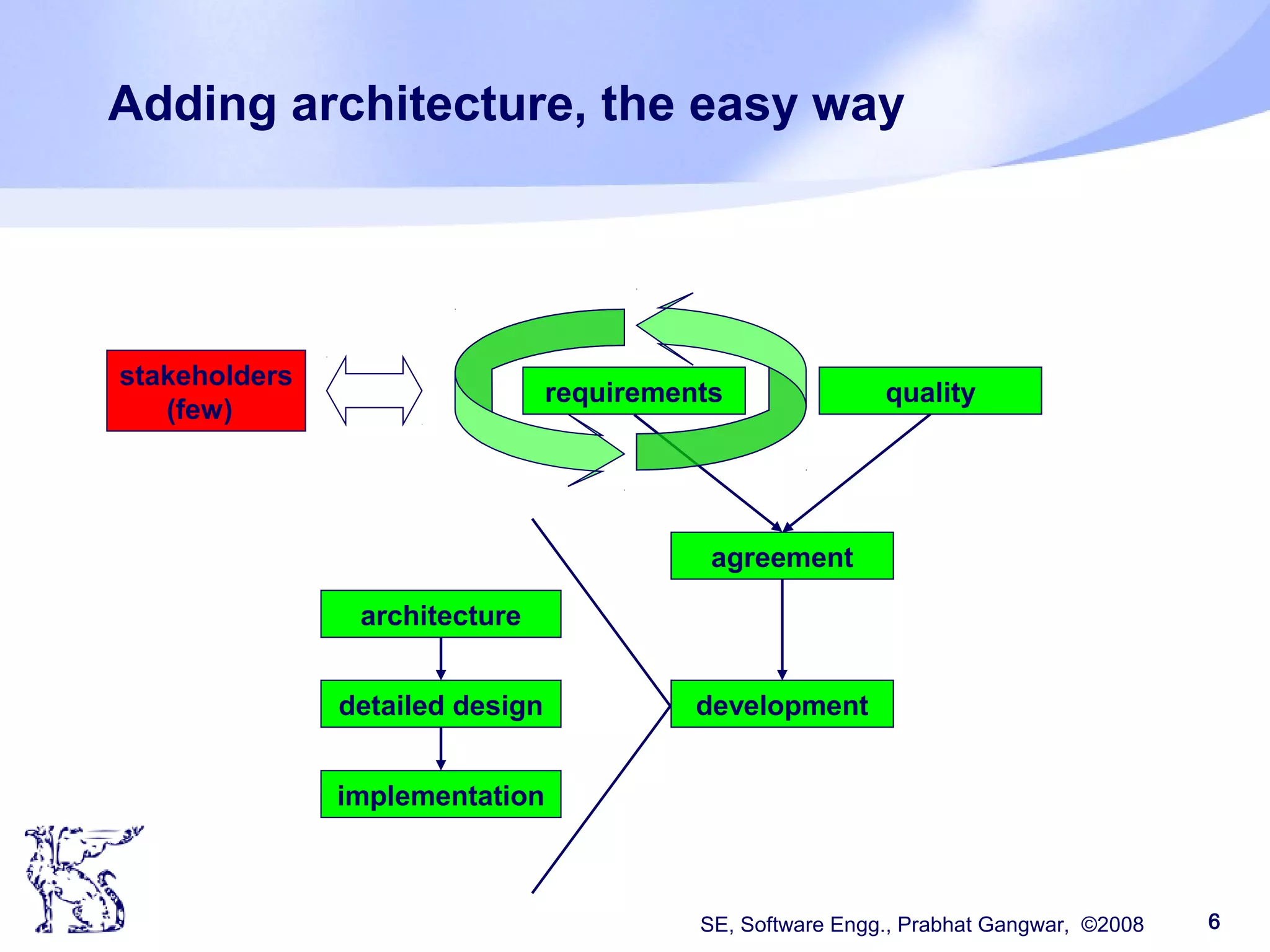
#4 In a sense, the two elements on the lower left are new: the elements labeled appearance/behaviour, and the one labelled architectural design
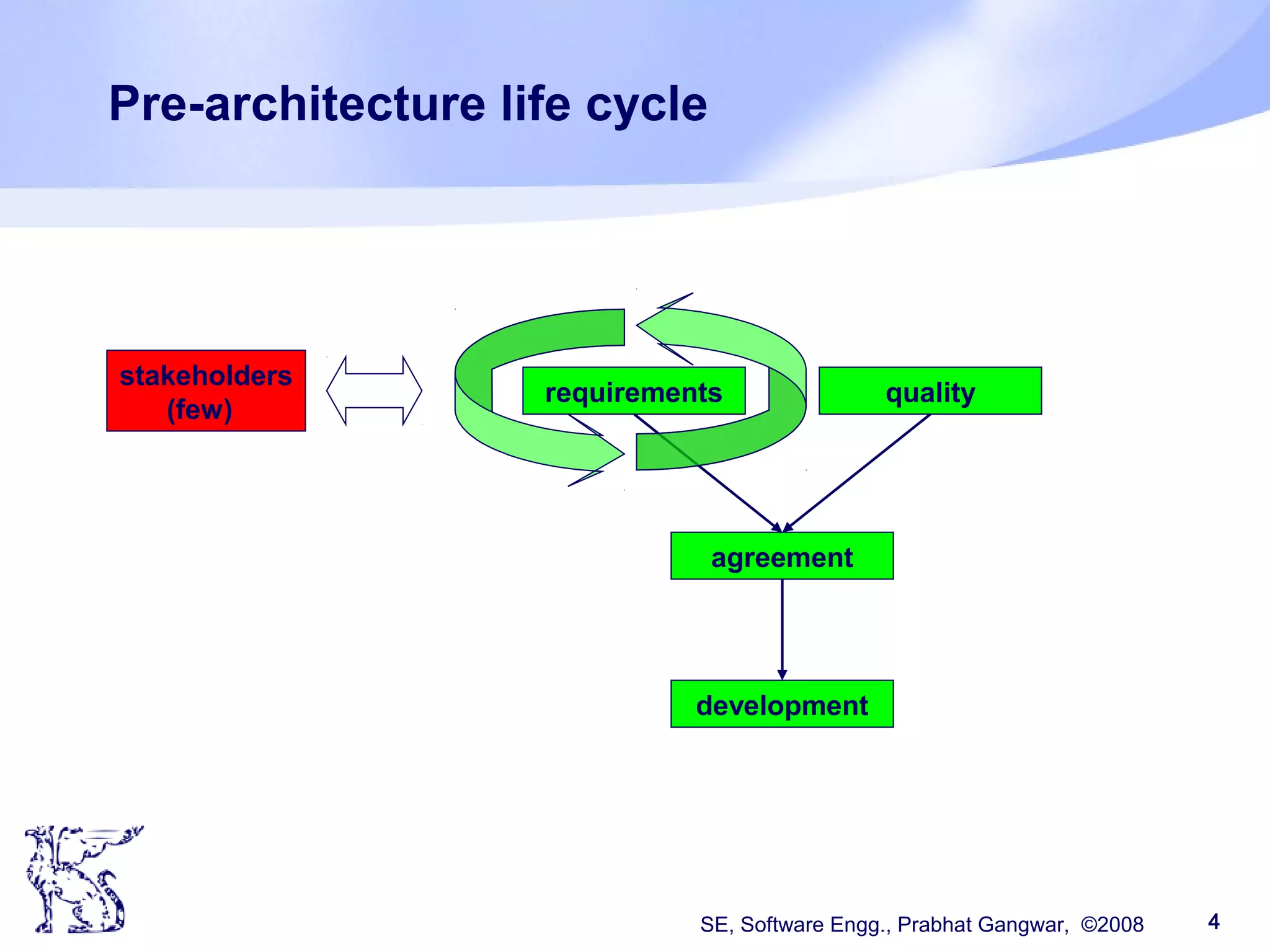
#5 Iteratie in dit model zit vooral in de requirements, en met slechts een paar stakeholders: onwerpers, opdrachtgever en gebruiker, met name.
Anzelfsprekend is er ook iteratie omdat bv kwaliteitskenmerken niet re realiseren zijn, eea te duur wordt, enz. Maar dat is vaak nadat de overeenkomst gesloten is.
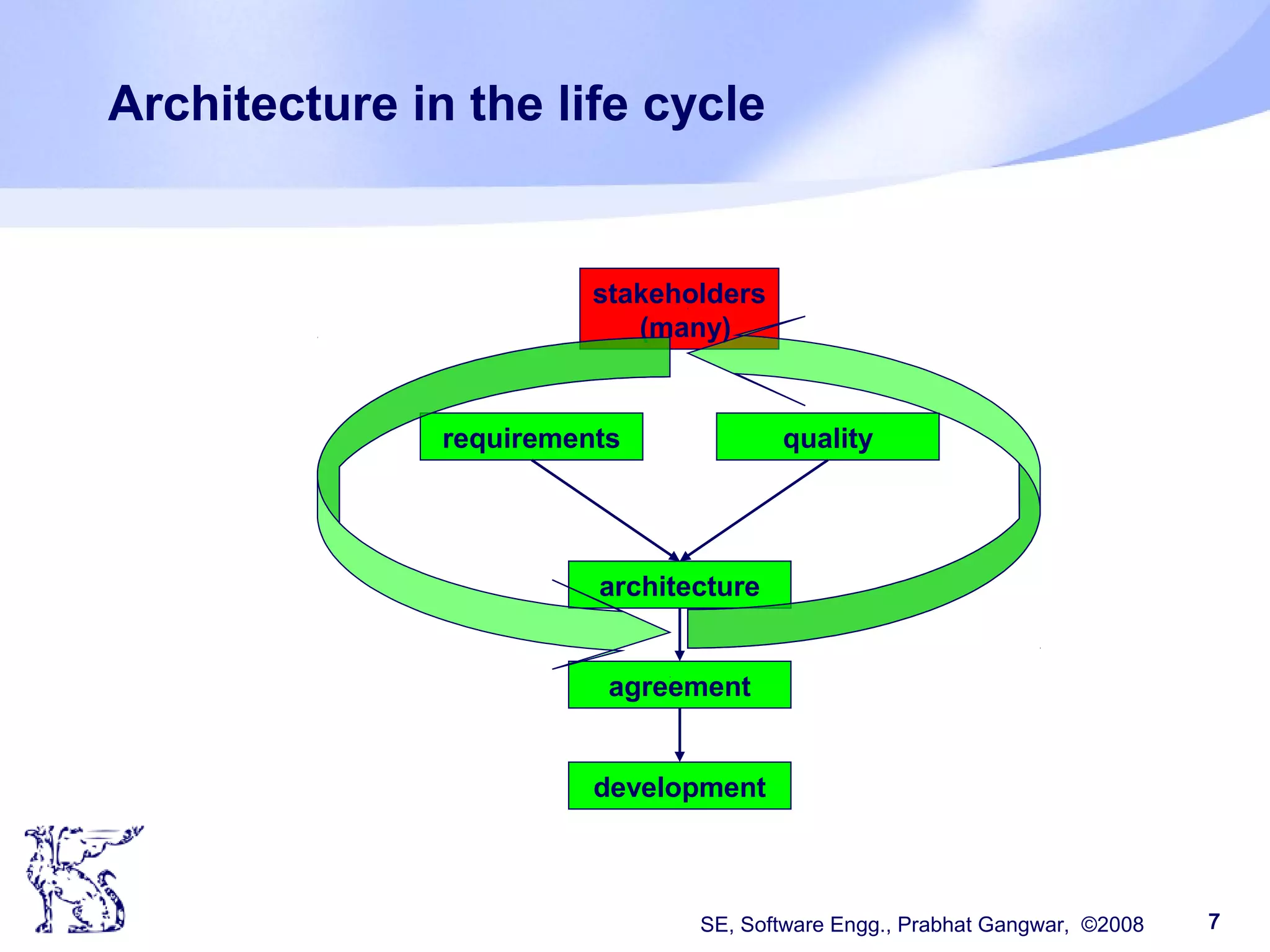
#7 Iteratie in dit model zit vooral in de requirements, en met slechts een paar stakeholders: onwerpers, opdrachtgever en gebruiker, met name.
Anzelfsprekend is er ook iteratie omdat bv kwaliteitskenmerken niet re realiseren zijn, eea te duur wordt, enz. Maar dat is vaak nadat de overeenkomst gesloten is.
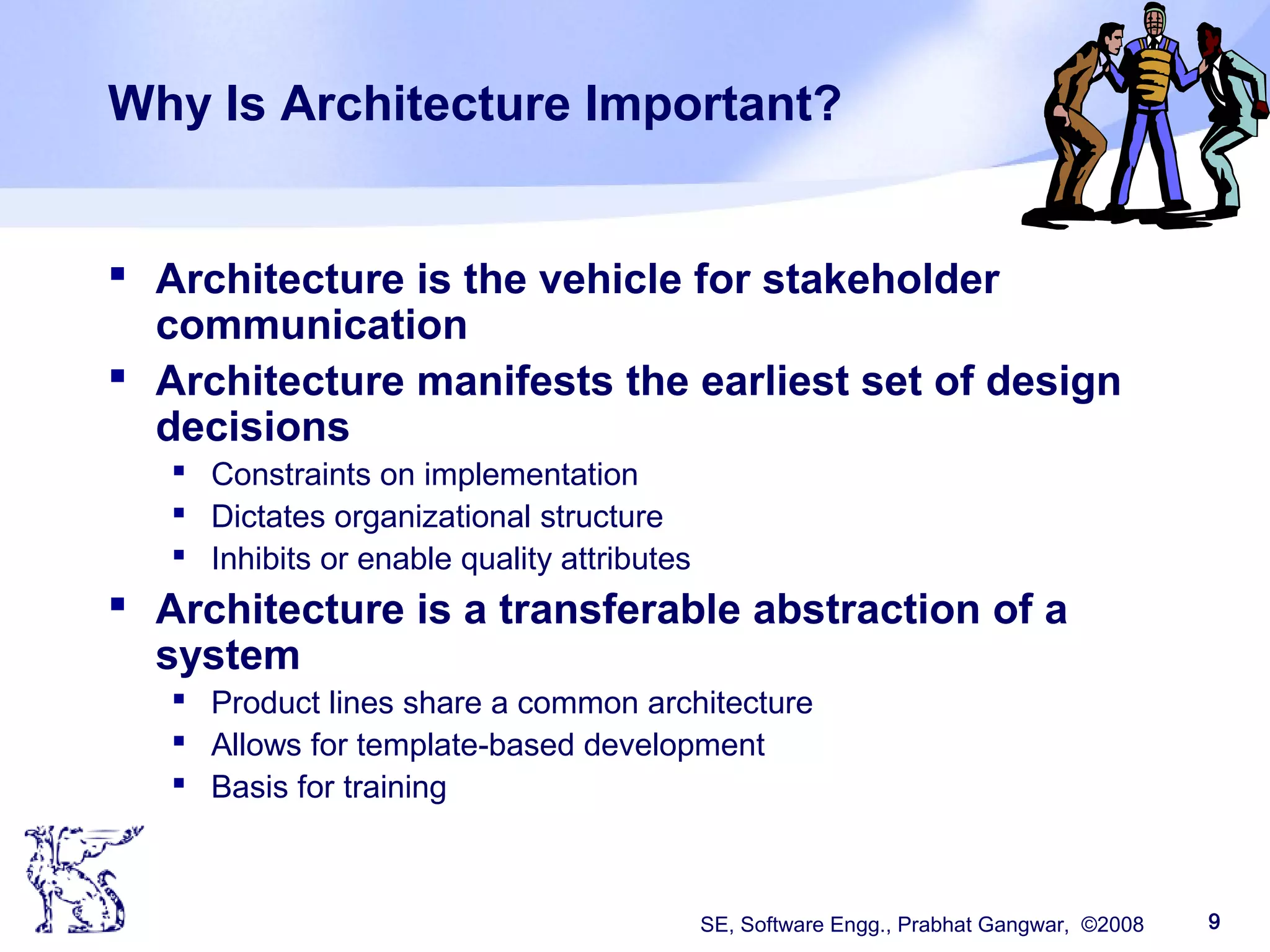
#9 Hier valt natuurlijk nog veel meer over te zeggen, bv in relatie tot hergebruik, product lines, enz.
#10 Vehicle: it is global, often graphical, often uses scenarios.
Early design decisions are important (cost of rework)
Means for planning and control: via the work breakdown structure which is derived from the architecture.
Transferable abstraction: architecture as a linguistic notion, as a basis for reuse, product lines, its use in traing people.
#11 1992: Foundatins for the study of software architecture, Software Engineering Notes
1987: Zachman in IBM Systems Journal: Framework for Information Architecture
1989: Shaw , Larger Scale Systems require Higher Level Abstractions
1972: Dijkstra in Notes on Structured Programming, Note #10. This same text is also present in the proceedings of the 1969 SE conference
Intriguing question: What if the NATO conference was called Software Architecture?
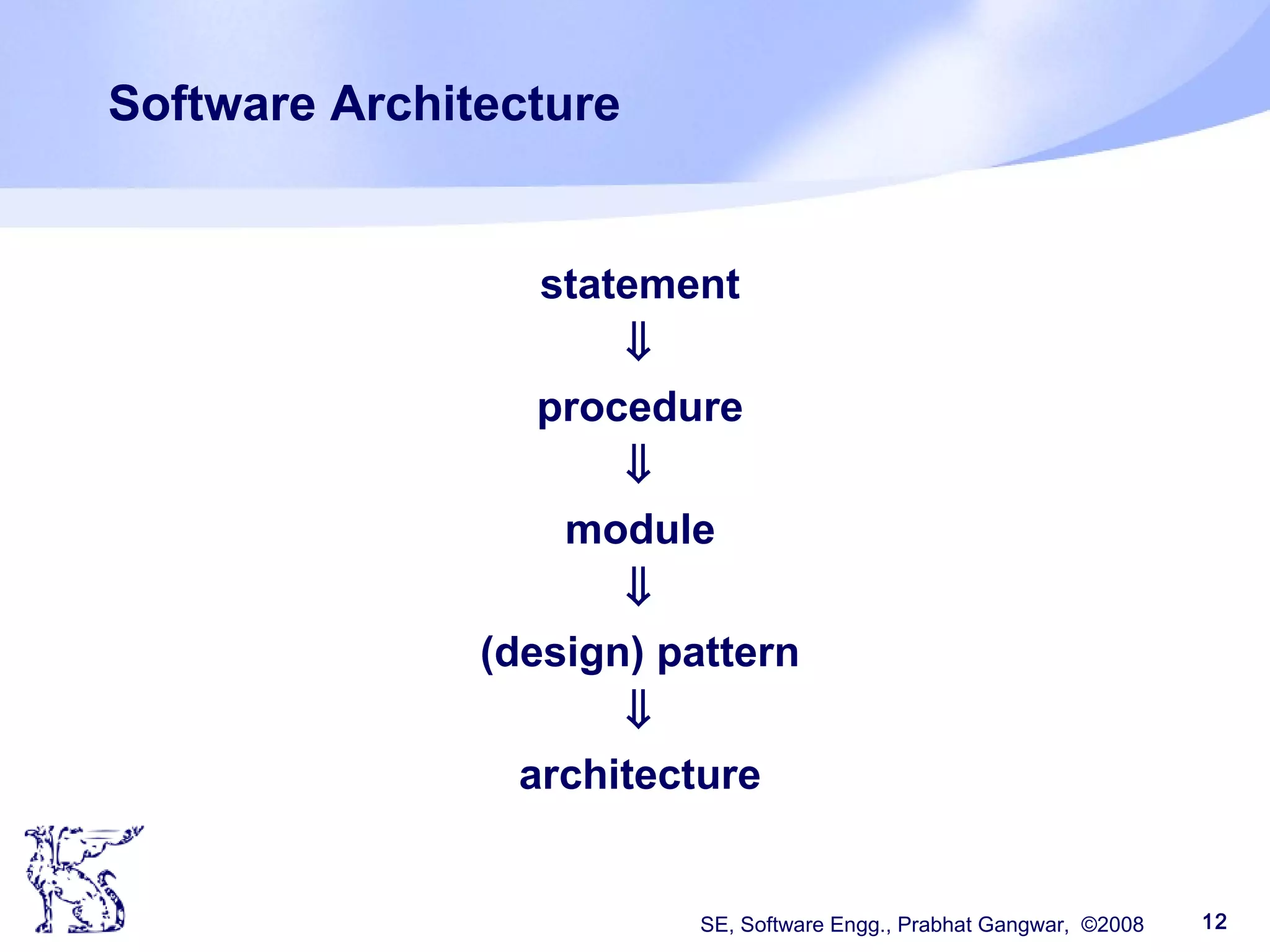
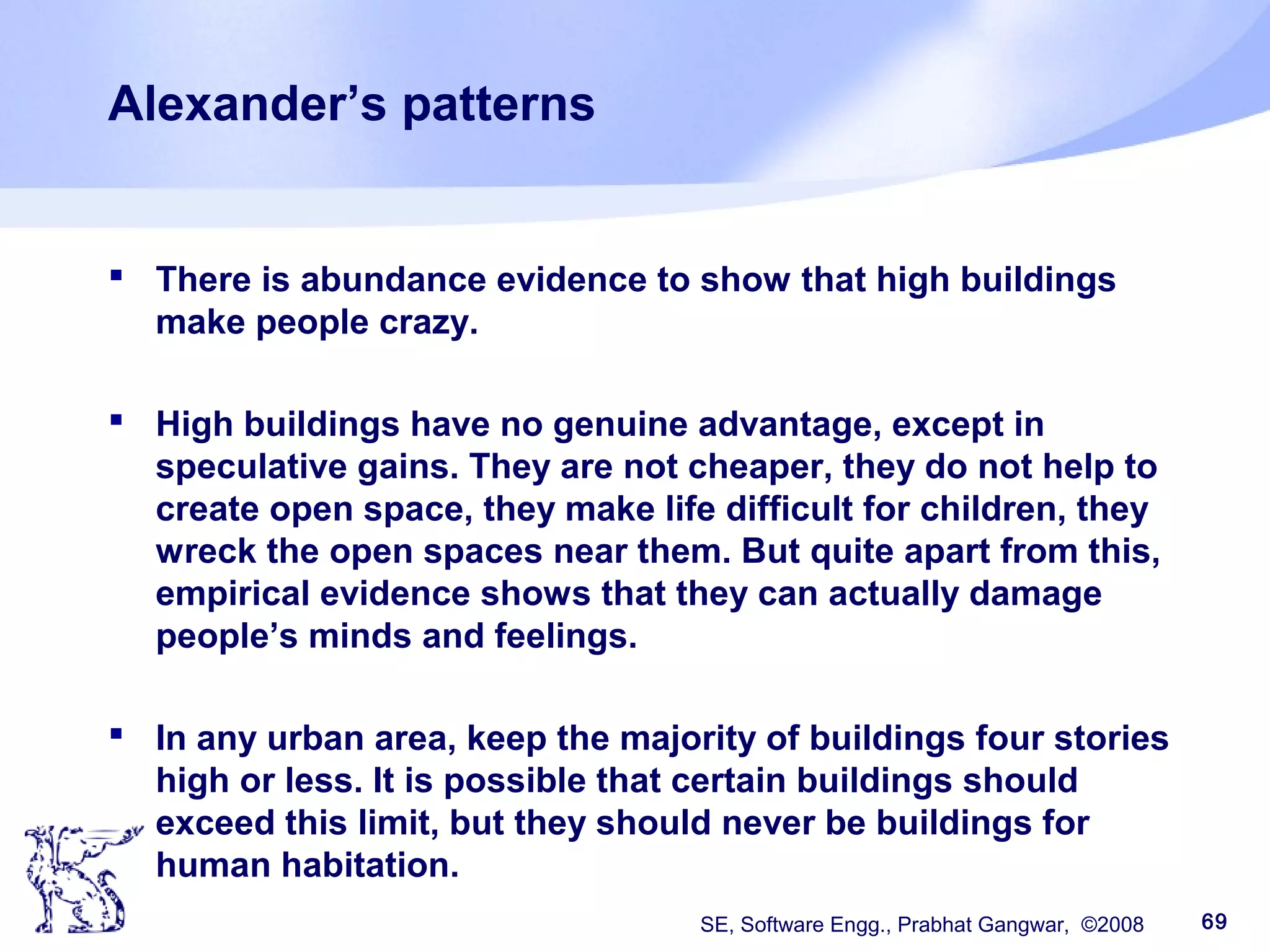
#13 This is all about abstraction.
These abstractions first had a specific goal, and later turned into a notion of its own. E.g., procedures at first only served as a shorthand; memory was expensive, and people didn’t want to repeat the same sequence of instructions over and over again. Only later, did the notion of procedural abstraction evolve. Once people have discovered this broader notion, they can use it more effectively.
The same holds for the other abstraction notions, including patterns and architecture.
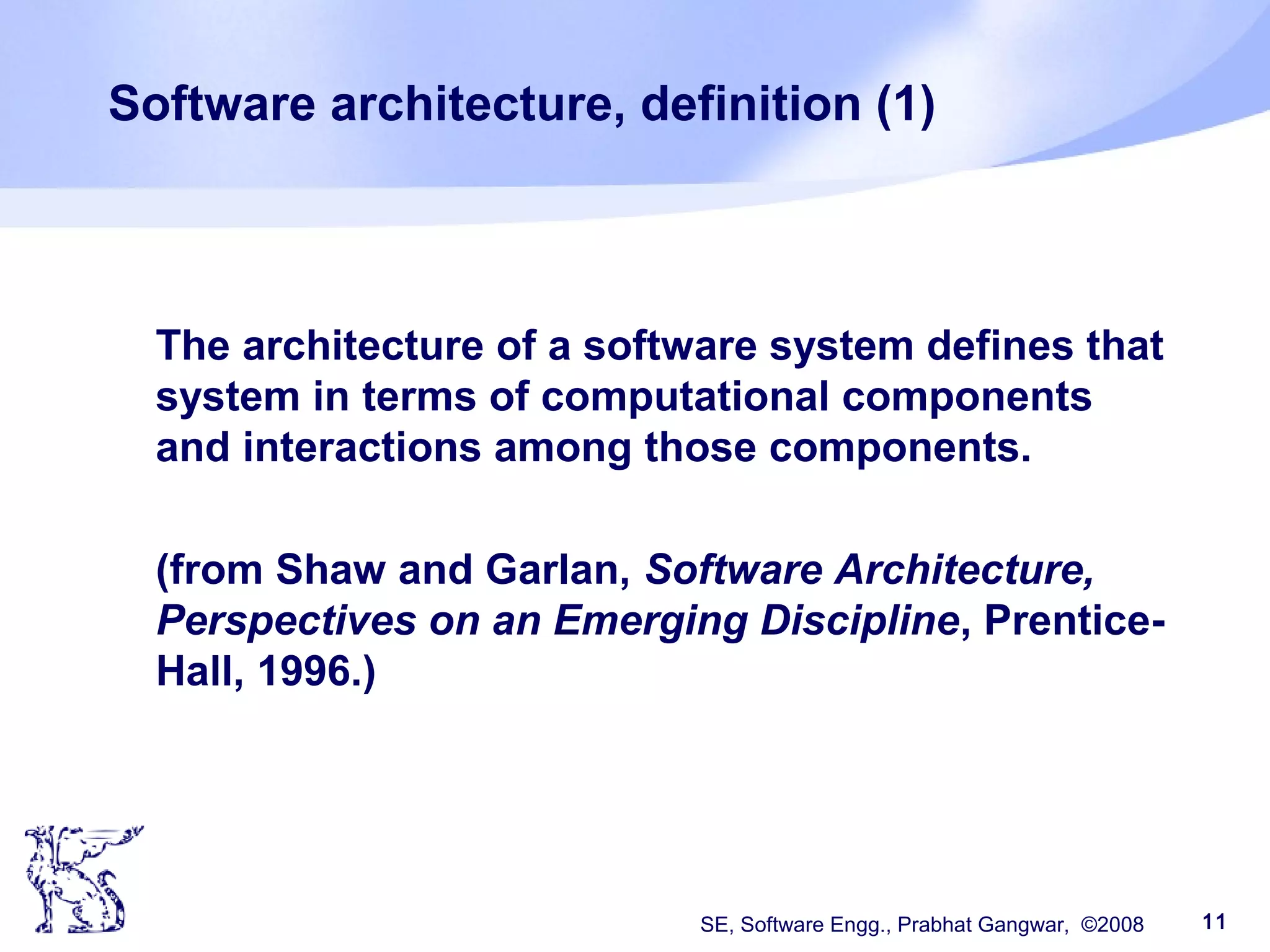
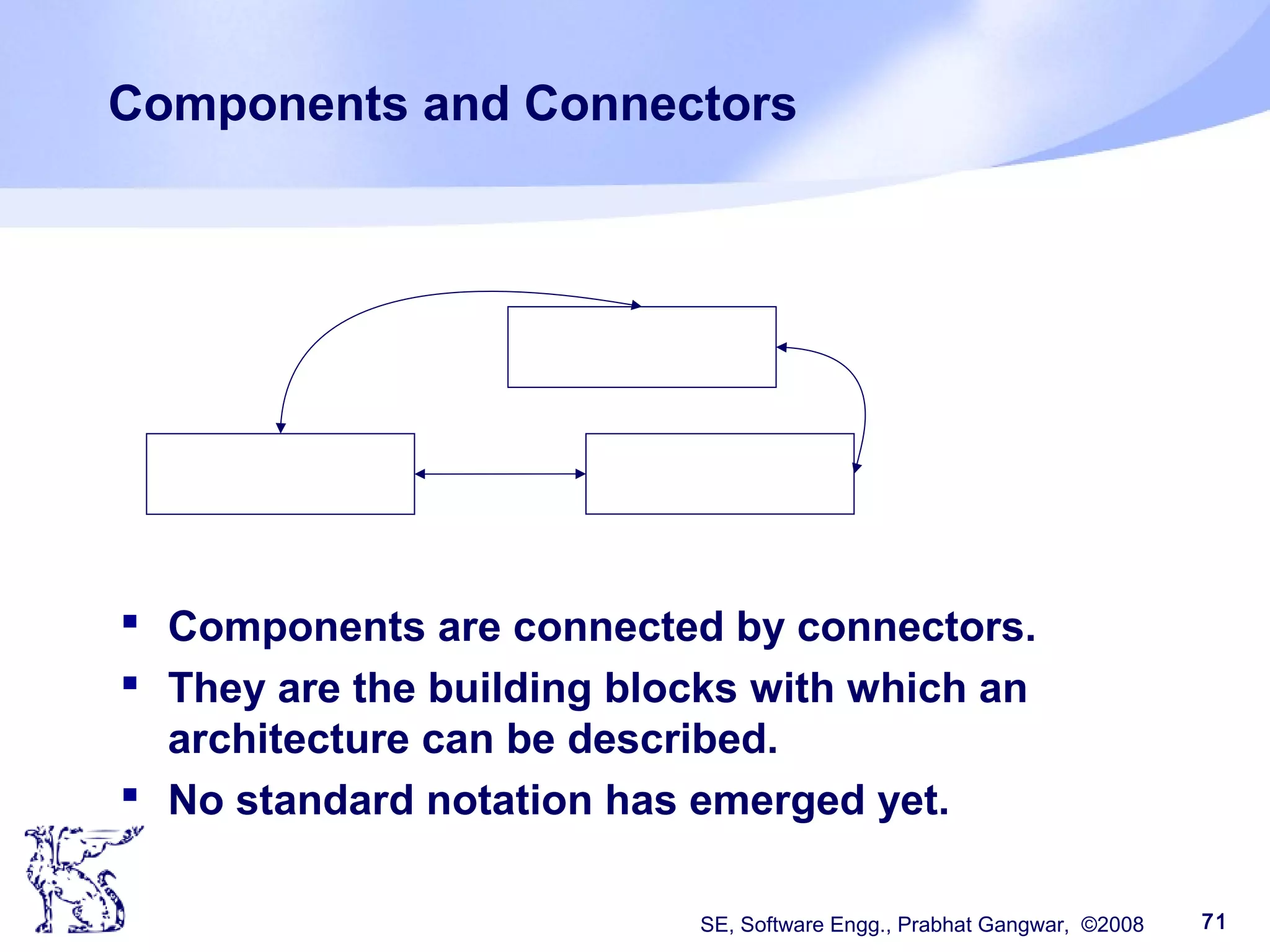
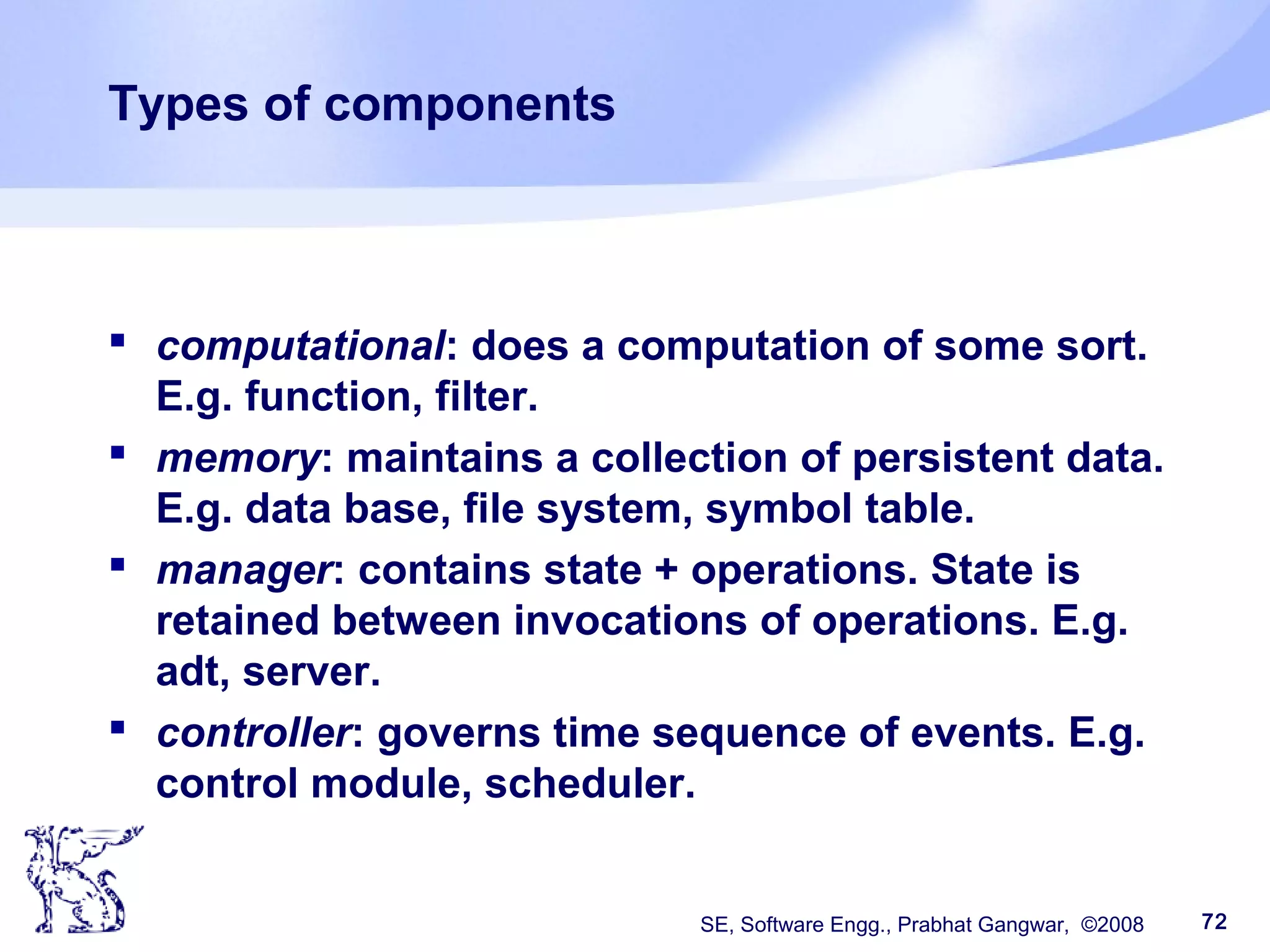
#14 Note: in edition 1, they talked about components, not elements.
Reason for change is that component has a rather (runtime) specific meanng within CBSE: a component is something that can be invoked/activated; but this line is not really followed throughout the book. Ergens verderop staat bv “component is a unit for reuse”
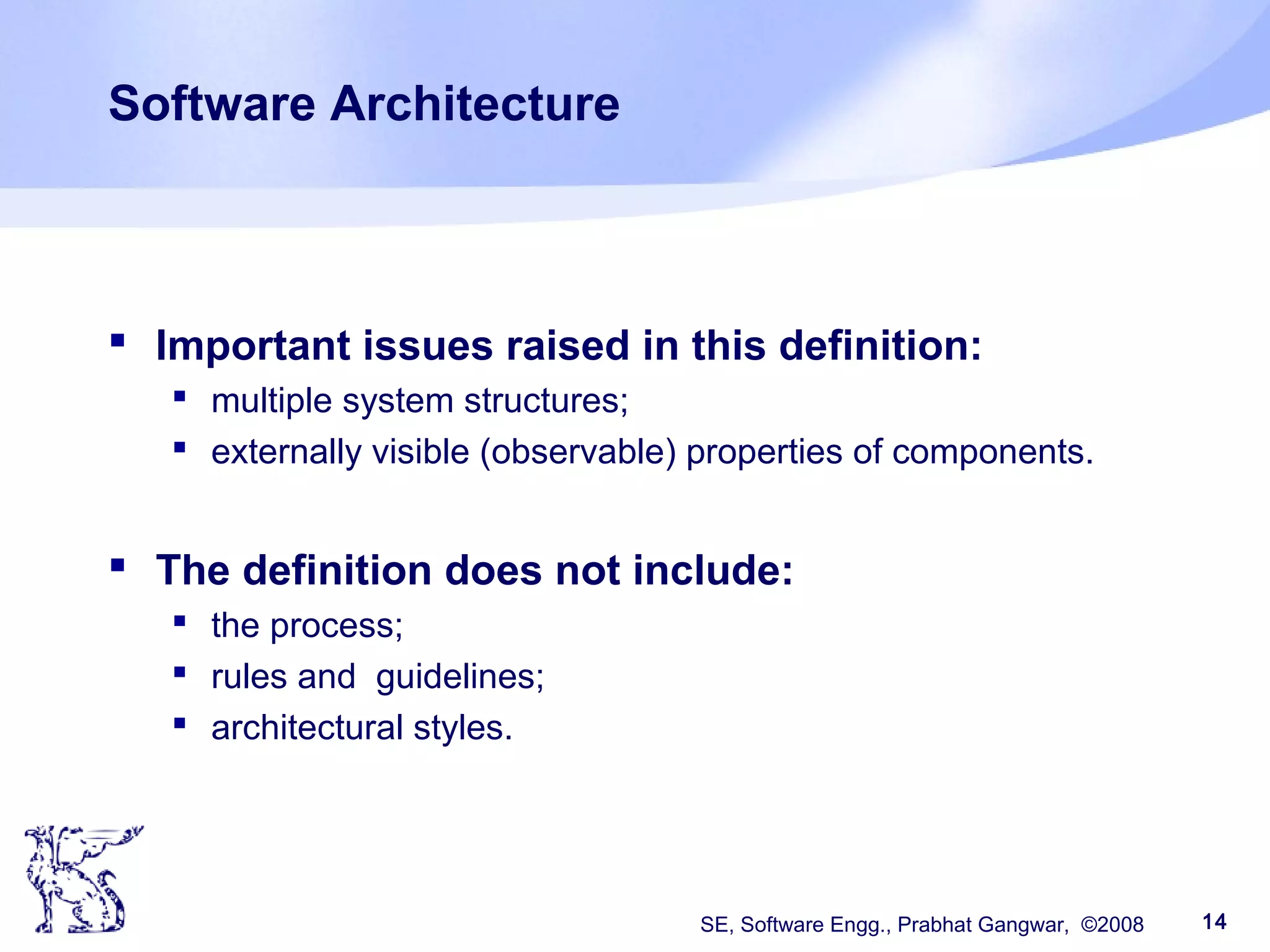
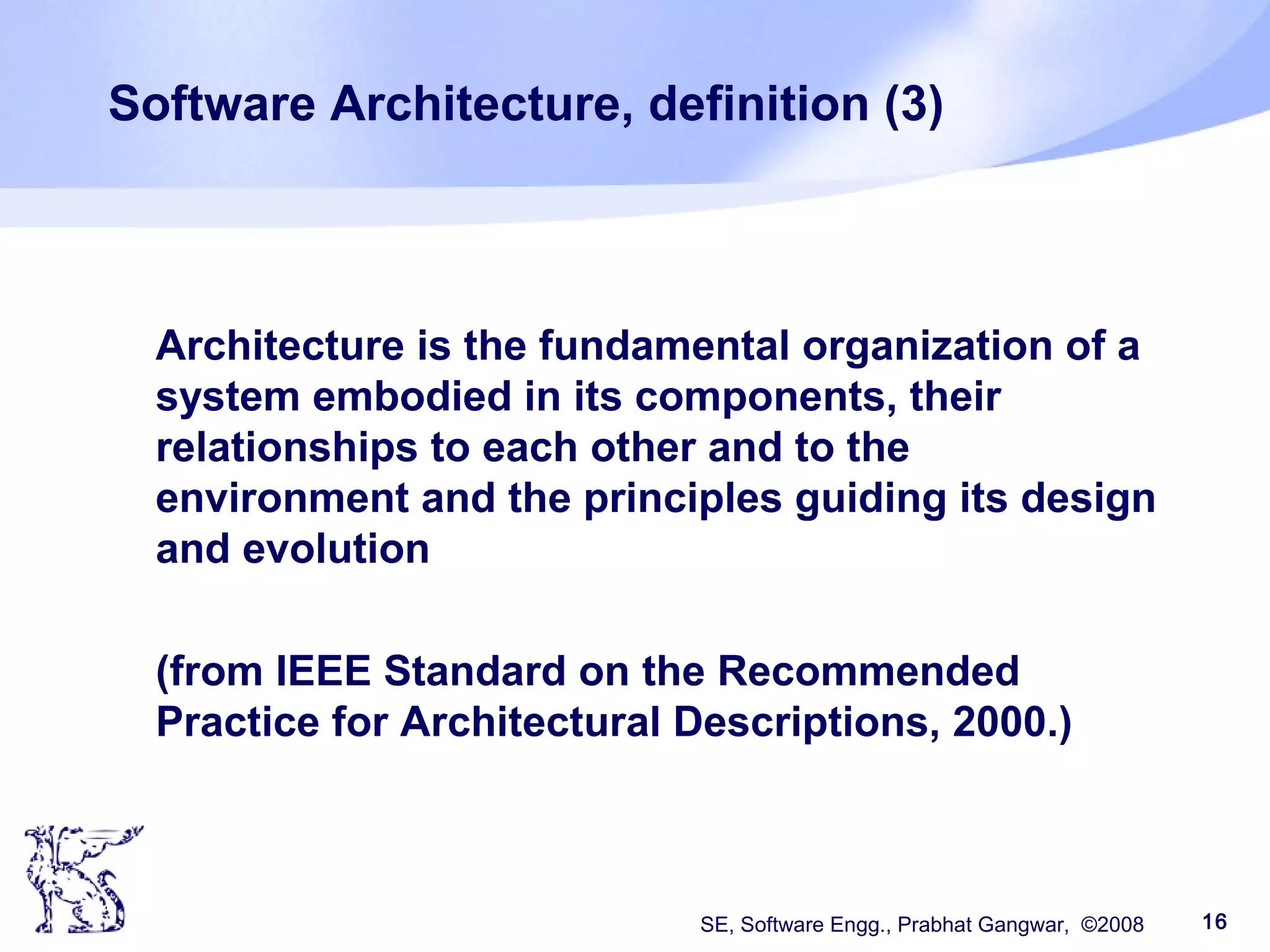
#15 Externally visible: so you are abstracting from something
architecture defines components; only their interaction counts, not their internals.
Every system has an architecture, and this architecture is not the same as its description (see also next IEEE definition)
Architecture can be good or bad: hence evaluation
Process: how do you get an architecture.
Rules: what should be/not be, in an architecture?
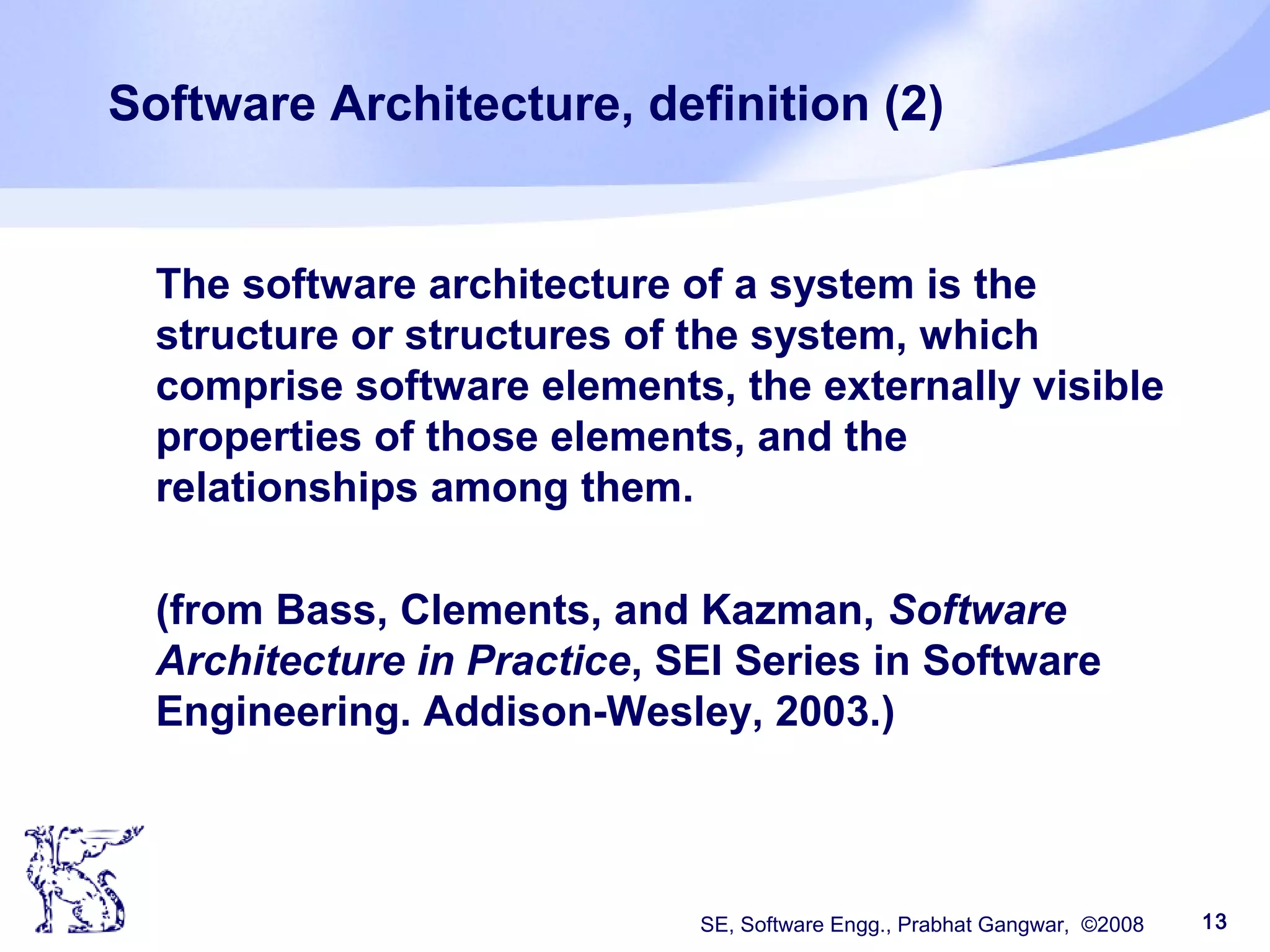
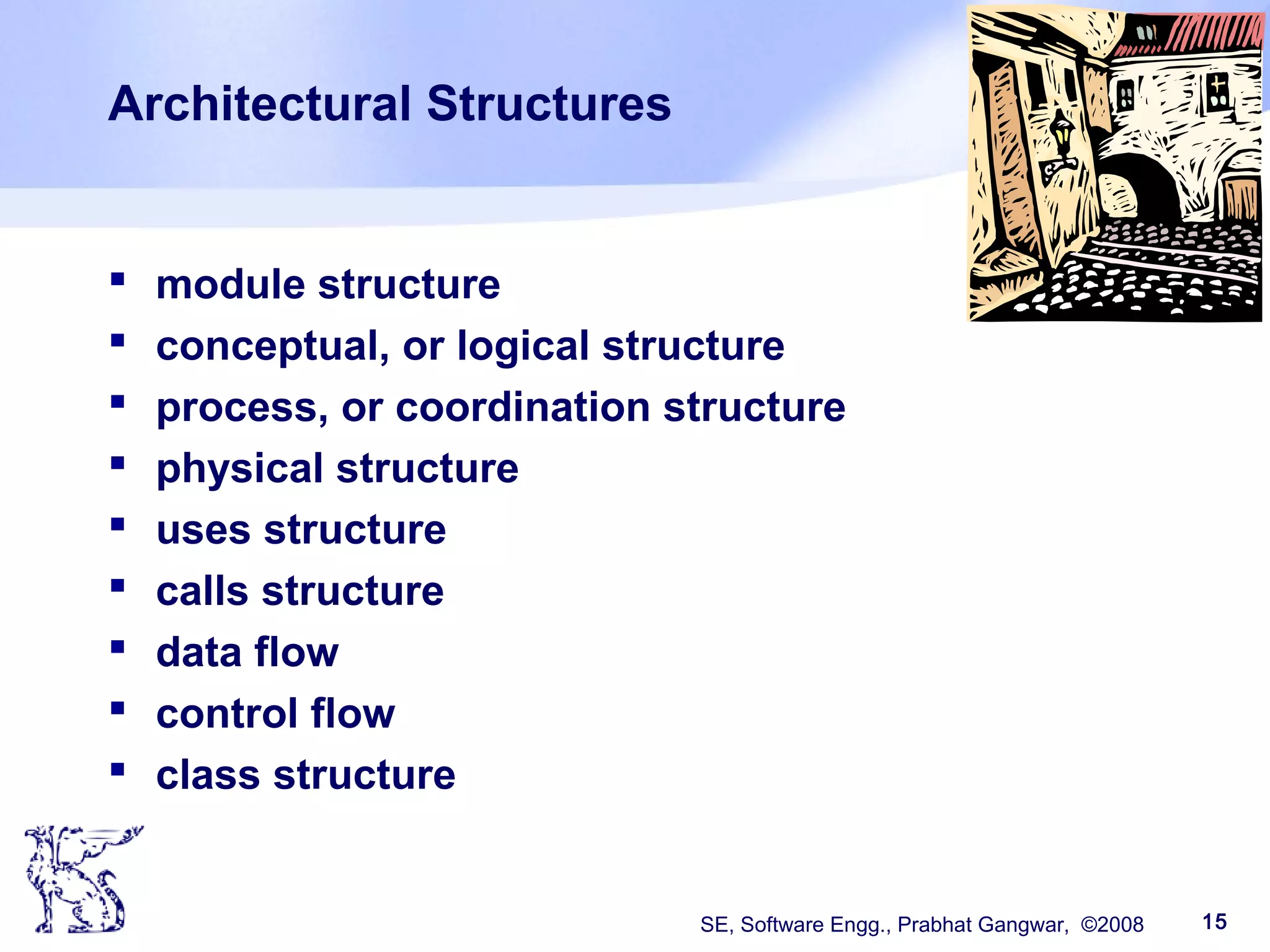
#16 Module structure: static, aimed at the implementation
Open question: what is the relation between structures?
Later on, in IEEE, and by now generally accepted, these structures are called viewpoints.
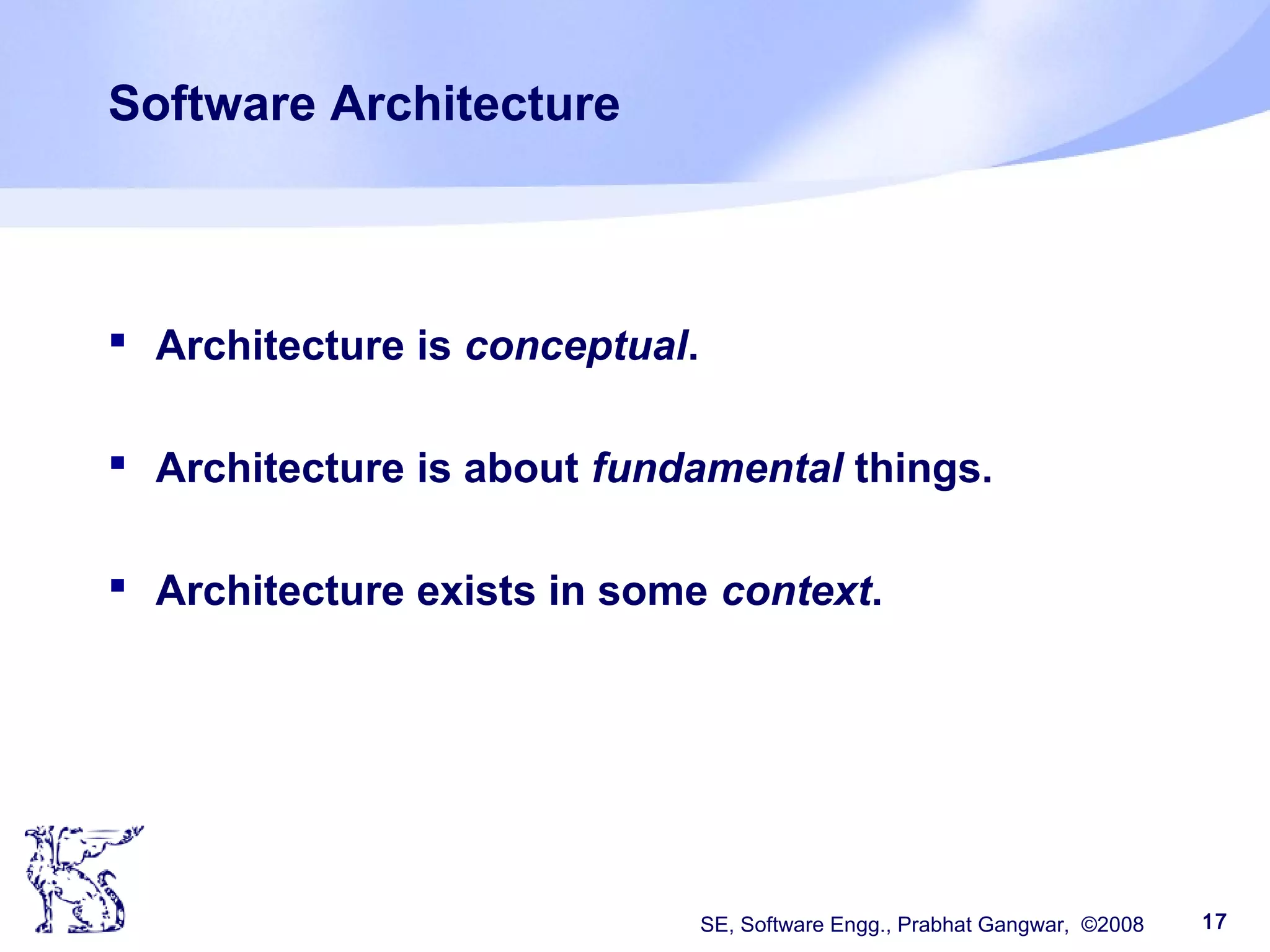
#18 The architectural descriptions are concrete, but the architecture itself is ingherently conceptual, and cannot be captured in any (set of) views.
Fundamental: so you concentrate on the important things, and abstract from the rest.
An architecture does not exist in the abstract, but always in some context. We can only understand its qualities in its context.
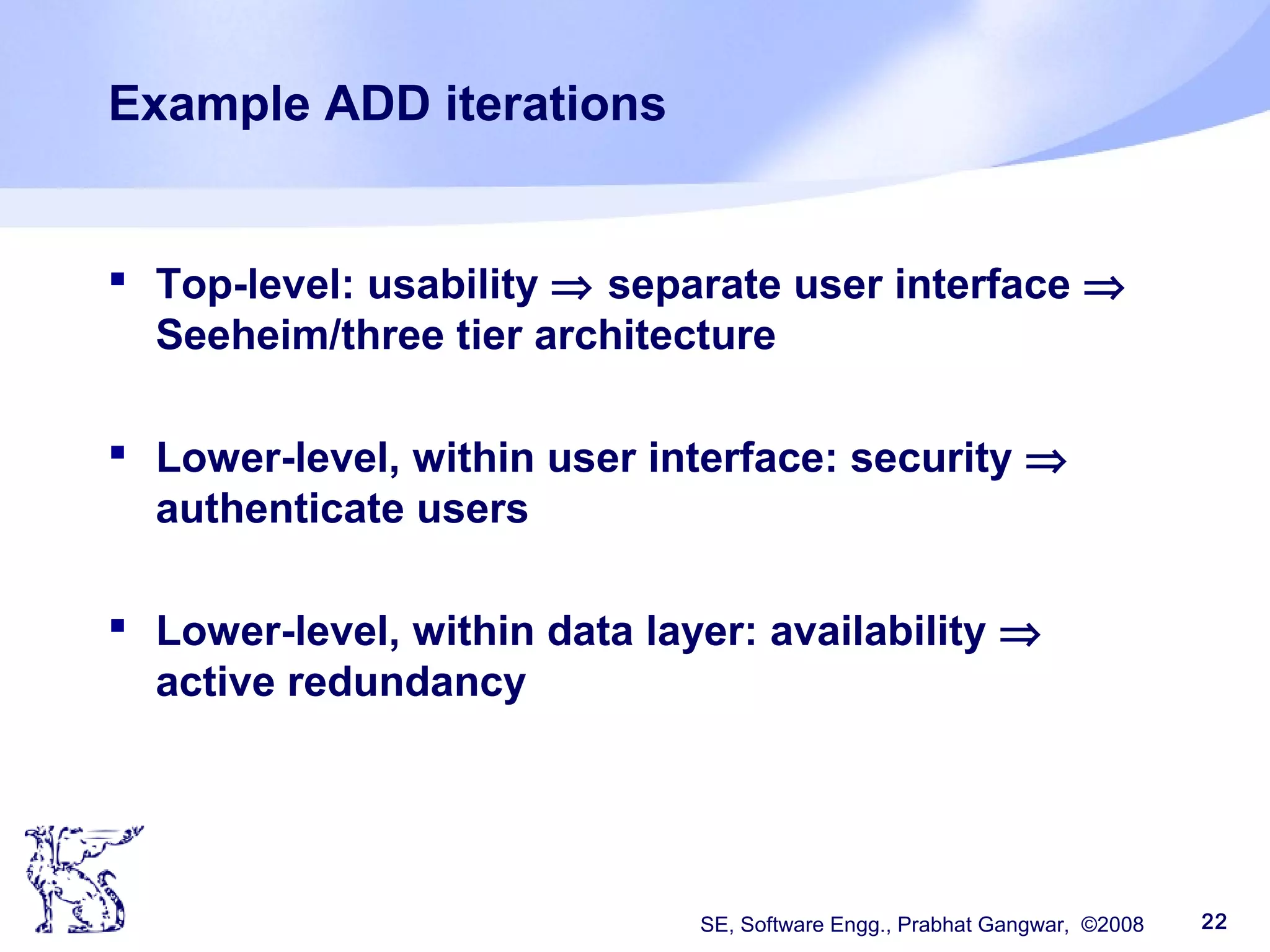
#22 ADD takes as input a set of quality attribute scenarios (source, stimulus, etc), and employs knowledge about relation between quality and architectural patterns that achieve it.
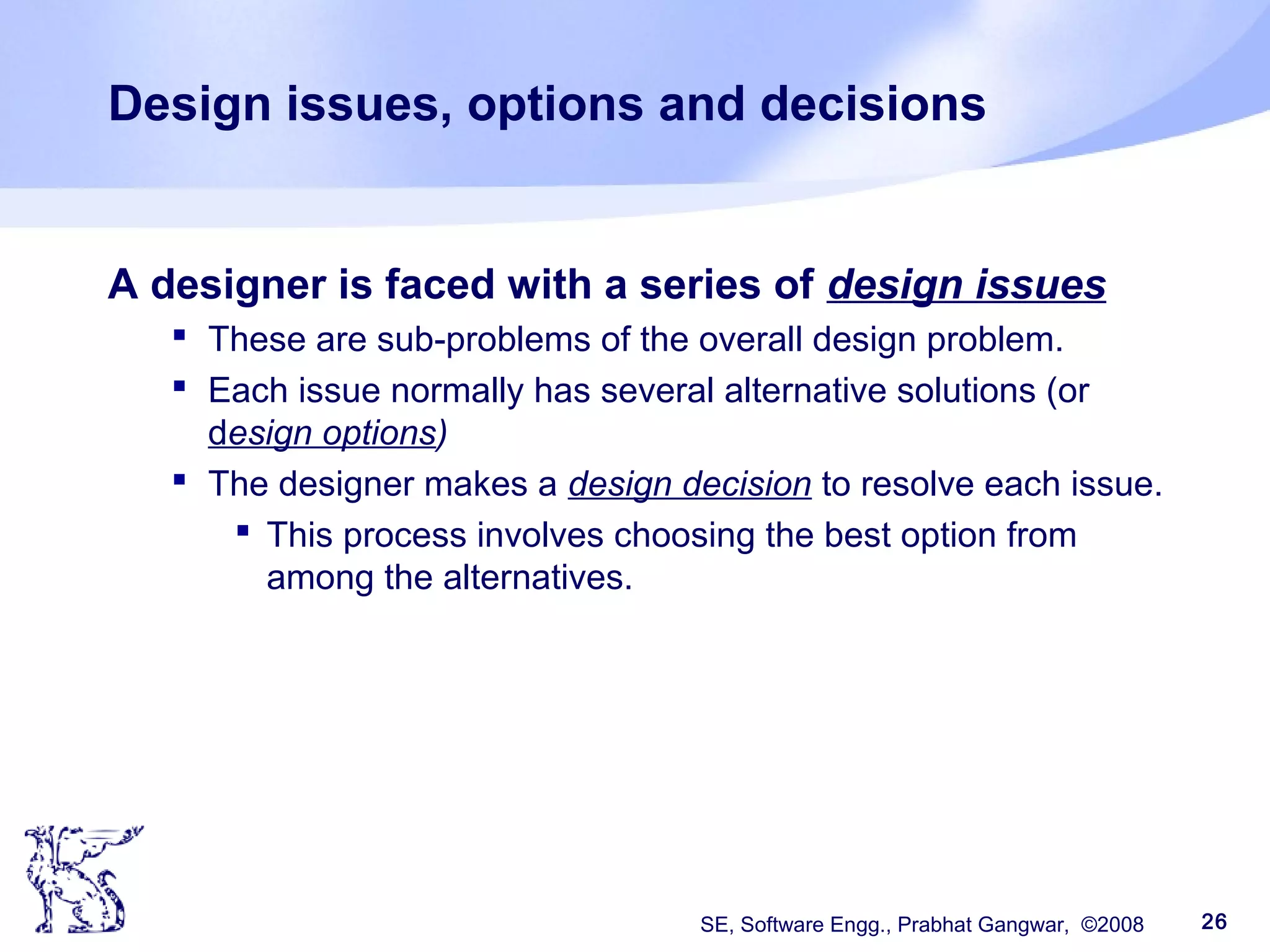
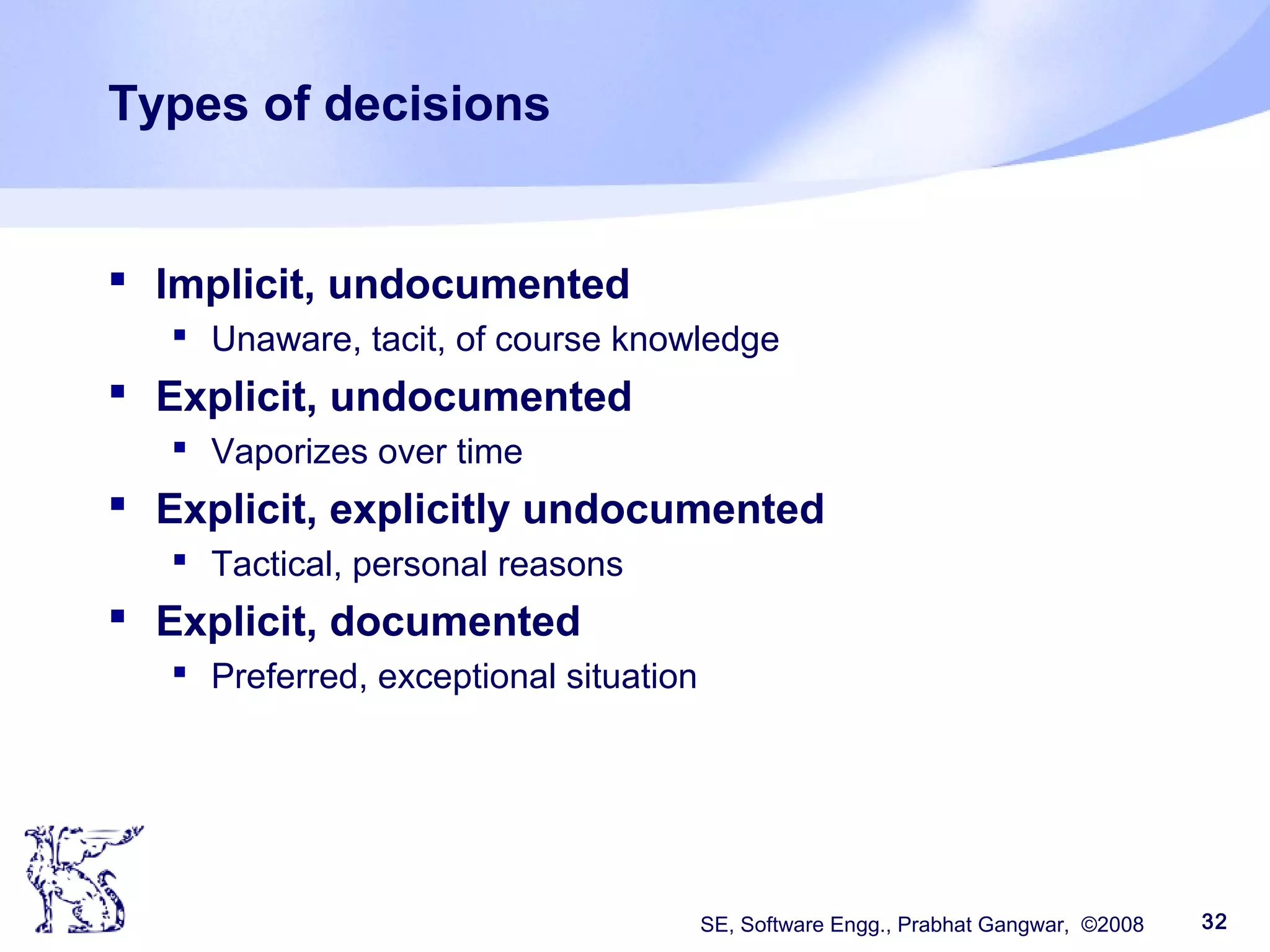
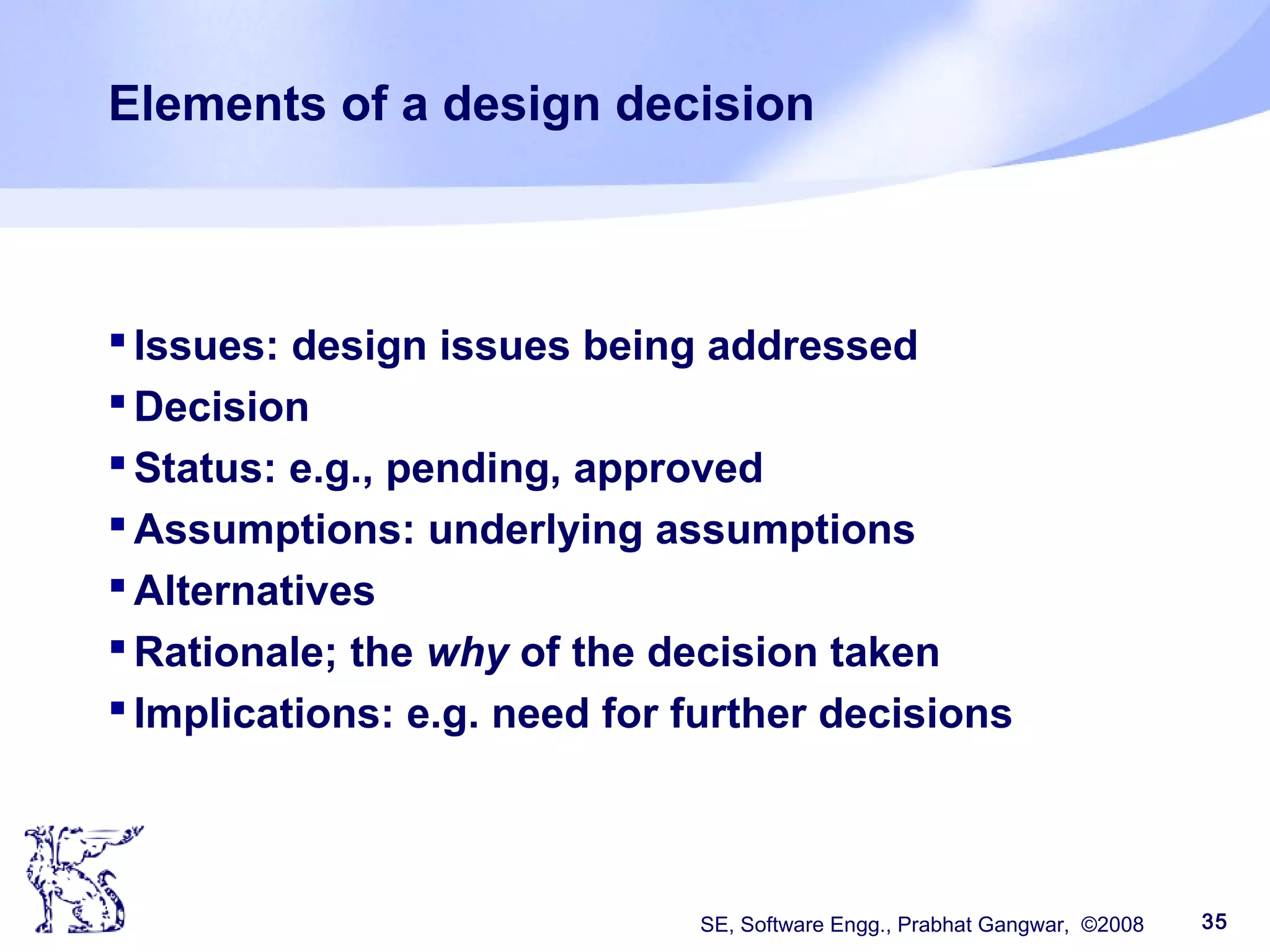
#27 Design decisions are the reasons why a certain architecture is the way it is. In this way, a software architecture can be considered as a series of DD.
In taking these DD, the architect is faced with desing issues and options.
...
For example, a design issue can be the type and level of security. Security can be decoposed into authentication (user recognition), authorization (user access to data), privacy (enchryption of data exchanged on a public network).
If the architecture is for a medical system, than both security types are compulsory. If it is for gaming applications, probably not all of them are required, and could be dropped in favor of e.g., higher performance.
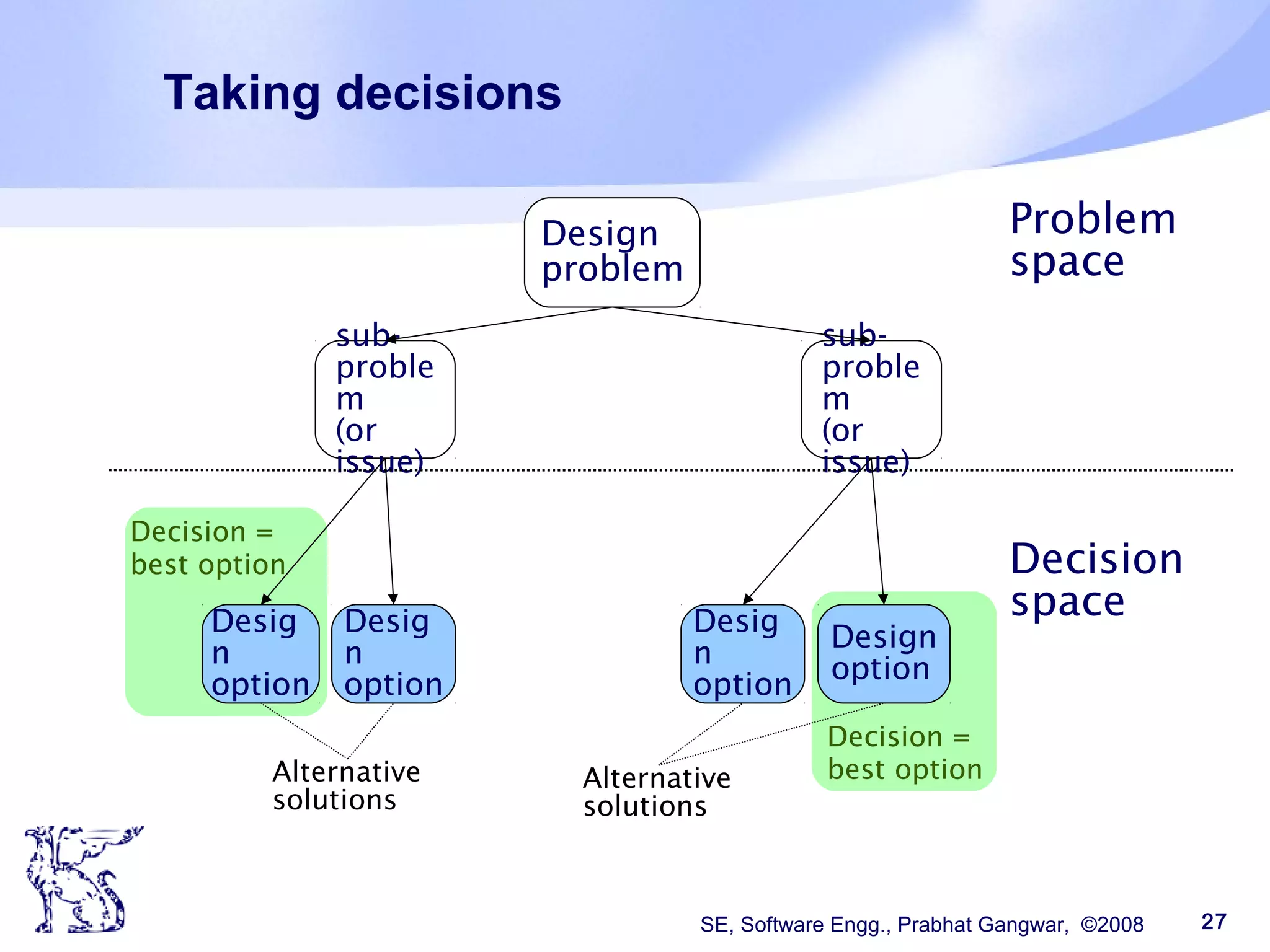
#28 Organization of the decision process.
- Issues belong to the problem space: expressed as problems to be solved.
- Options belong to the decision space (i.e., possible alternative solutions).
Note: the decision we take is or should be the BEST in this moment, and always with respect to some criterion. If the criterion changes the decision might be not the BEST anymore, and maybe another option is more appropriate.
#29 Very concrete example, maybe too low level.
Issues that can be relevant here in the decision process are: level of flexibility; outsourcing/external acquisition of client technology (that mans need for separate presentation – also relevant for the budget); if using the Web/Internet; performace; ...
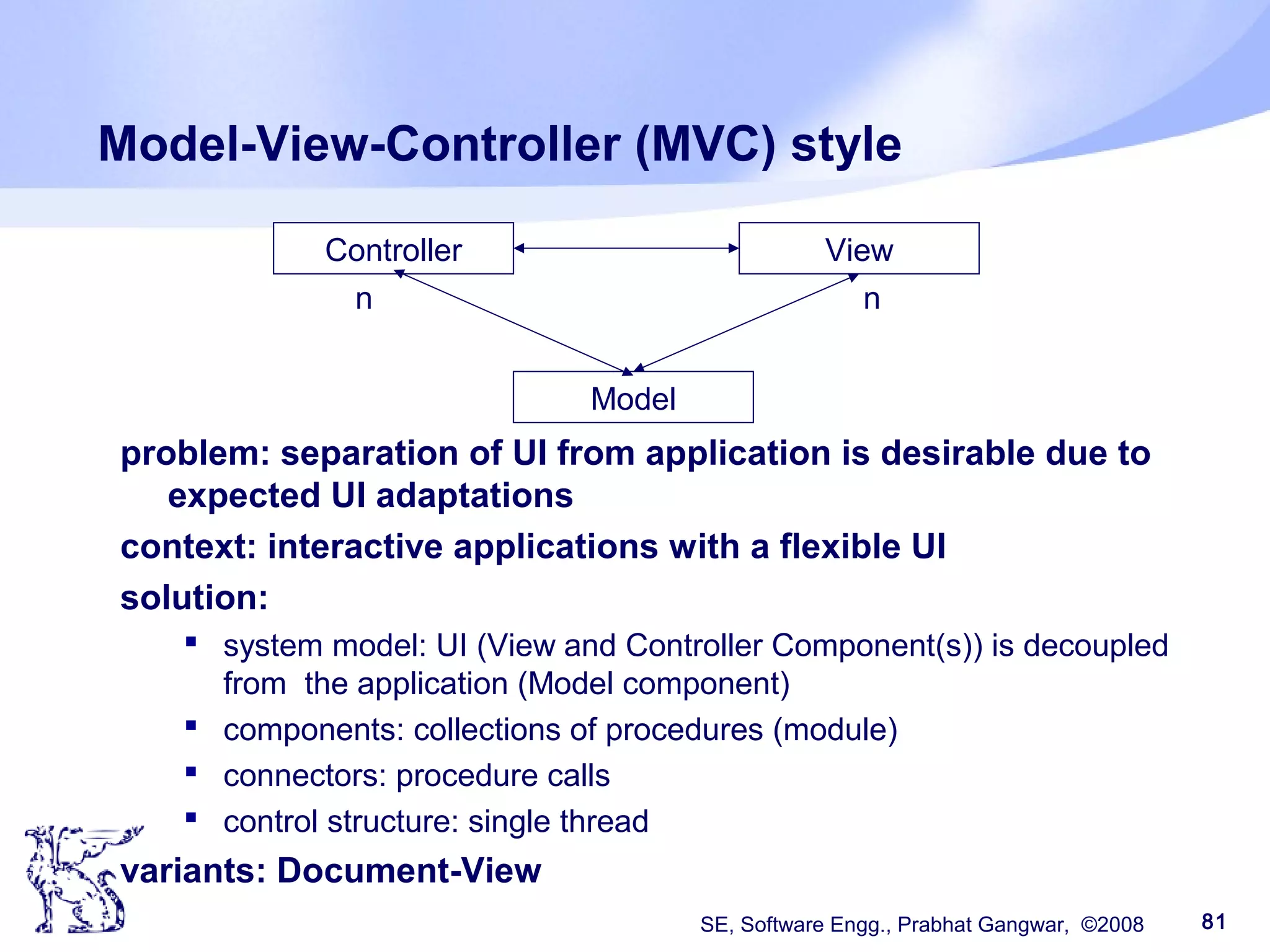
#30 We need to observe that design issues are not independent.Example: a number of options become invalid due to a desireable NFR (quality). For example, flexibility could be achieved through certain design patterns, like MVC implementing separation of concerns that can be implemented by corresponding replaceable components, and layered architecture that restricts the client&server interations and hence allows to formalize the role of each component.
If we choose any among the two, we exclude the 'monolithic' subtree and also we need a separate GUI layer.
#31 A similar depedency exists between tech and non-tech options.
Here we have an example
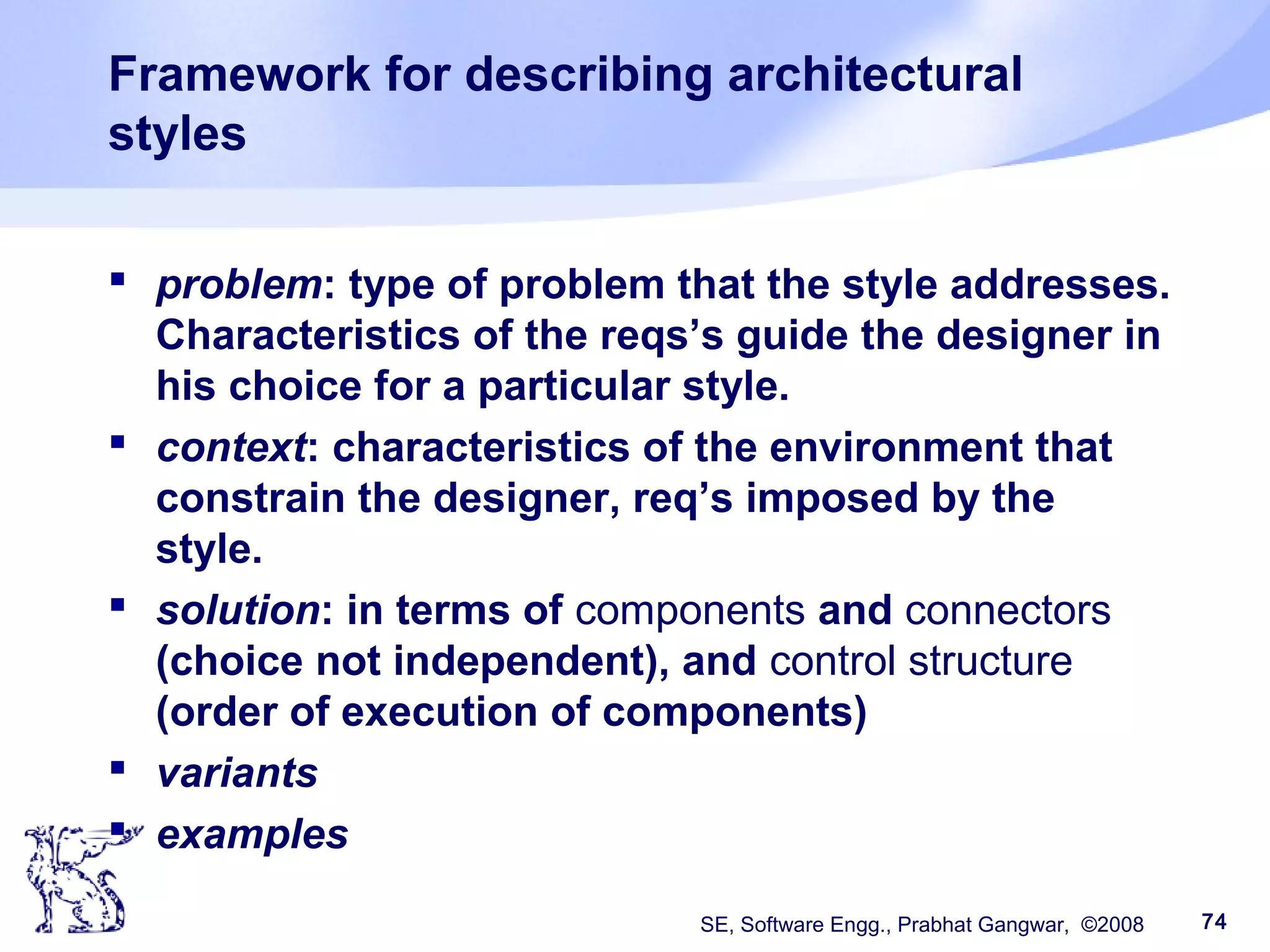
#49 Al die plaatjes hebben wel een soort dubbele functie: ze zijn zowel descriptief (beschrijven iets) als prescriptief (zeggen hoe het moet).
Dat gold trouwens ook voor de plaatjes van de studenten
#50 Dat wiebertje betekent: aggregatie: een view is een deel van een architectuurbeschrijving (part-whole relationship)
#52 Hier gaat het om hun communication needs (p 204).
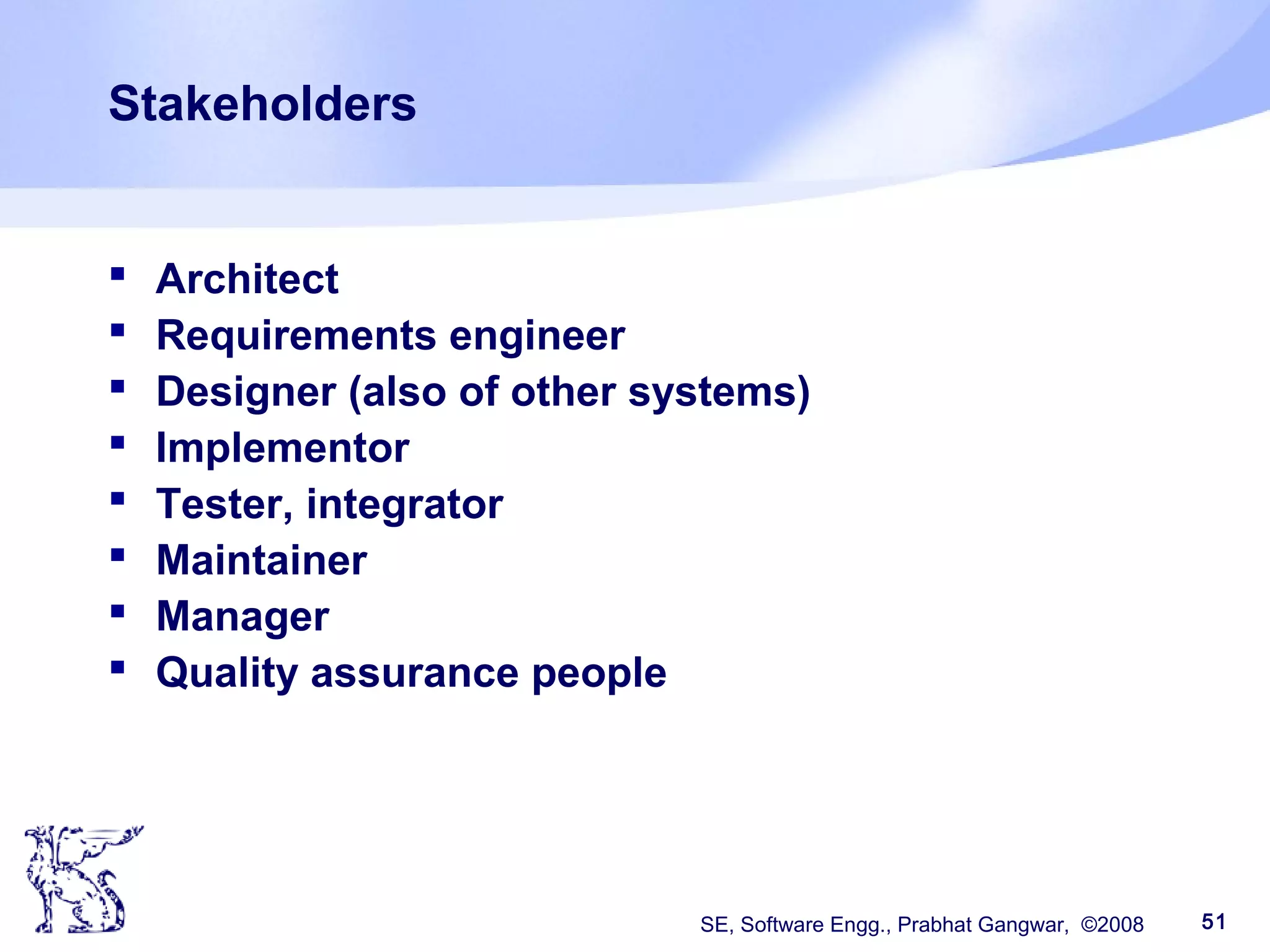
Architect: negotiates, makes tade-offs
Reqs engineer: idem
Designer: resolve issues, bv rond resource consumption, performance issues
Implementor: constraints and freedoms richting downstream activities.
Tester, integrator: correct black-box behavior of parts.
Maintainer: areas a prospective change will affect.
Manager: maken development team, assign tasks, plan resources, track progress.
QA: basis for conformance checking
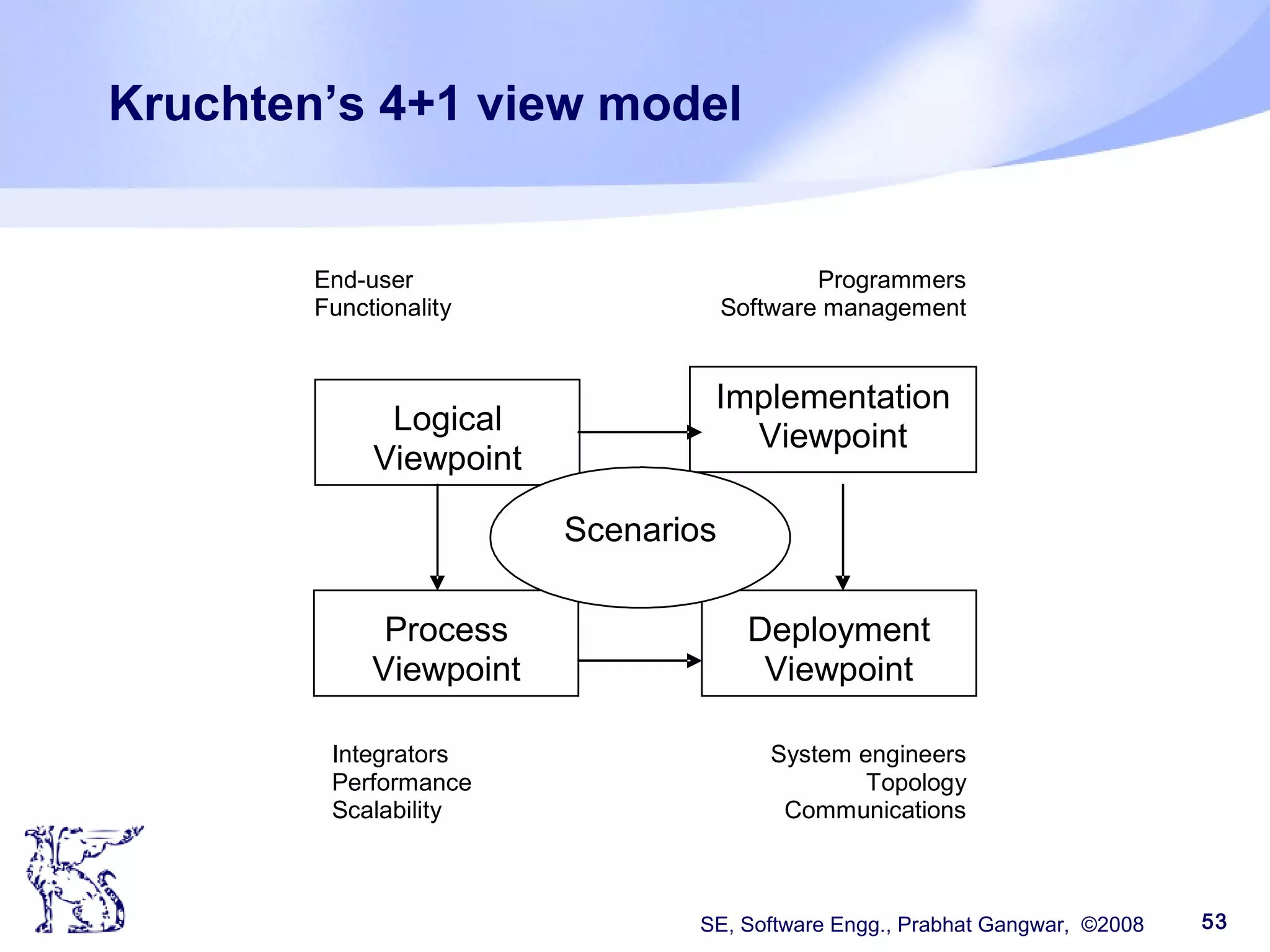
#55 The logical view primarily supports the functional requirements; the services the system should provide to its end users.It depicts the major design elements and their interaction.
Designers decompose the system into a set of key abstractions, taken mainly from the problem domain. These abstractions are objects or object classes that exploit the principles of abstraction, encapsulation, and inheritance. In addition to aiding functional analysis, decomposition identifies mechanisms and design elements that are common across the system.
Components are related by “shares data with”
In termen van het boek is dit een module view
#56 The process view takes into account some nonfunctional requirements, such as performance and system availability. It addresses concurrency and distribution, system integrity, and fault-tolerance. The process view also specifies which thread of control executes each operation of each class identified in the logical view.
So the process view describes the mapping of functions to runtime elements. It concenrs the dynamics of the system. A process is a group of tasks which form a logical unit. A process can be started, stopped, resumed, etc., and there is communication between processes.
Components are related by “synchronizes with”
In termen van het boek: een C&C view
#57 The physical view takes into account the system's nonfunctional requirements such as system availability, reliability (fault-tolerance), performance (throughput), and scalability. The software executes on a network of computers (the processing nodes). The various elements identified in the logical, process, and development views-networks, processes, tasks, and objects-must be mapped onto the various nodes. Several different physical configurations will be used-some for development and testing, others for system deployment at various sites or for different customers. The mapping of the software to the nodes must therefore be highly flexible and have a minimal impact on the source code itself.
Components are related by “communicates with”
In termen van het boek: een allocation view
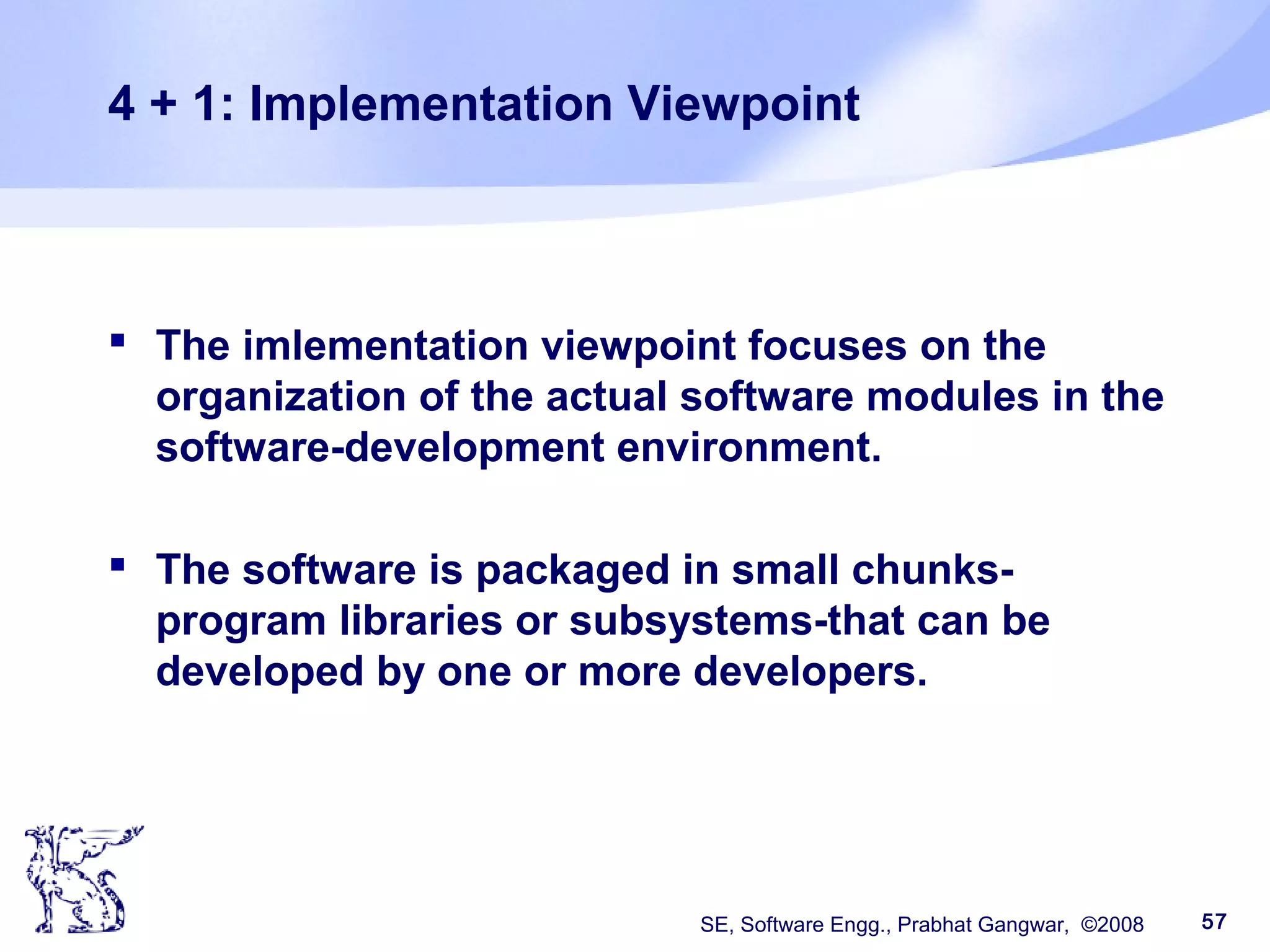
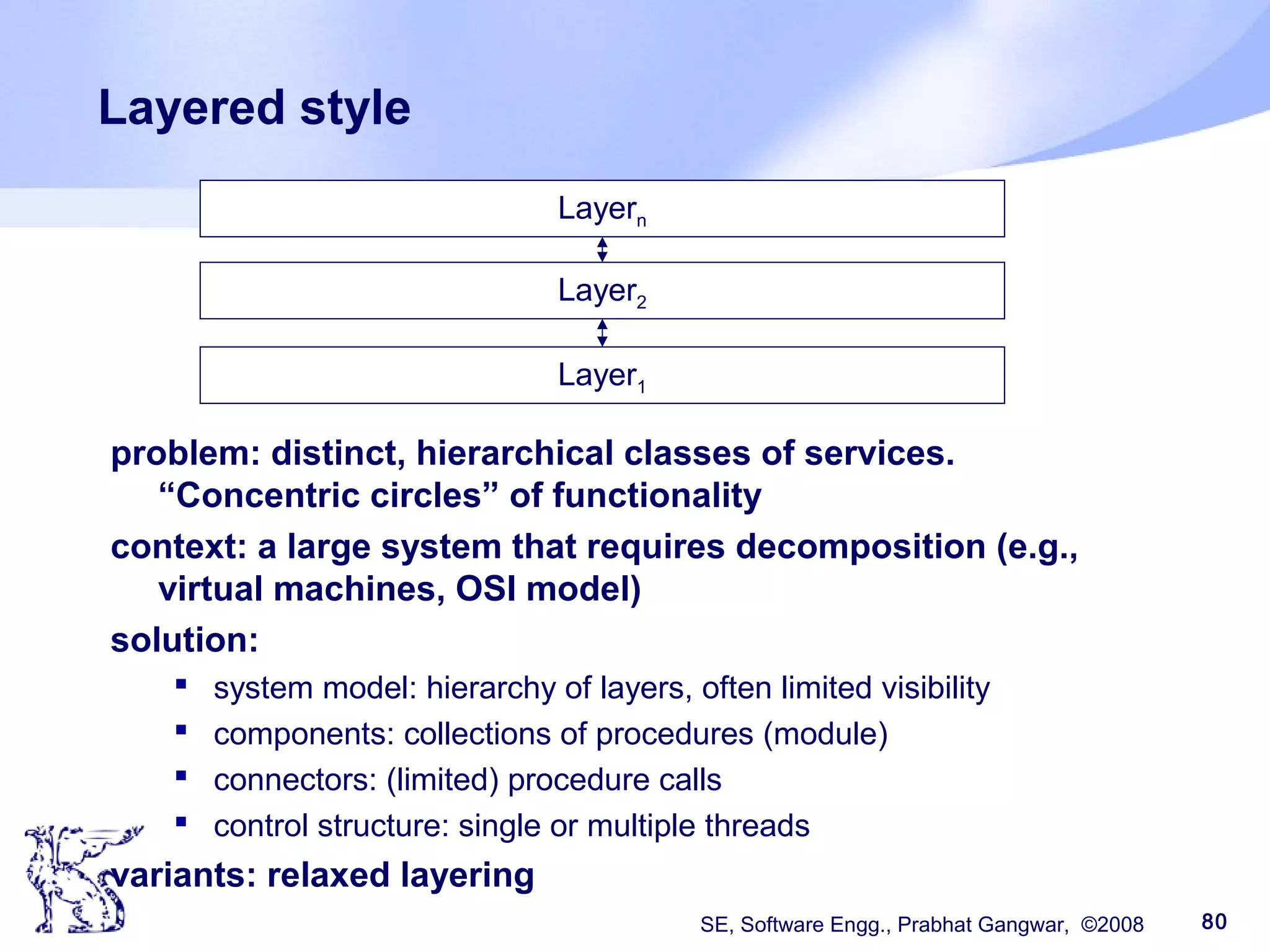
#58 The development view focuses on the organization of the actual software modules in the software-development environment. The software is packaged in small chunks-program libraries or subsystems-that can be developed by one or more developers. The subsystems are organized in a hierarchy of layers, each layer providing a narrow and well-defined interface to the layers above it.
Components are related by “is submodule of”.
In termen van het boek: een allocation view
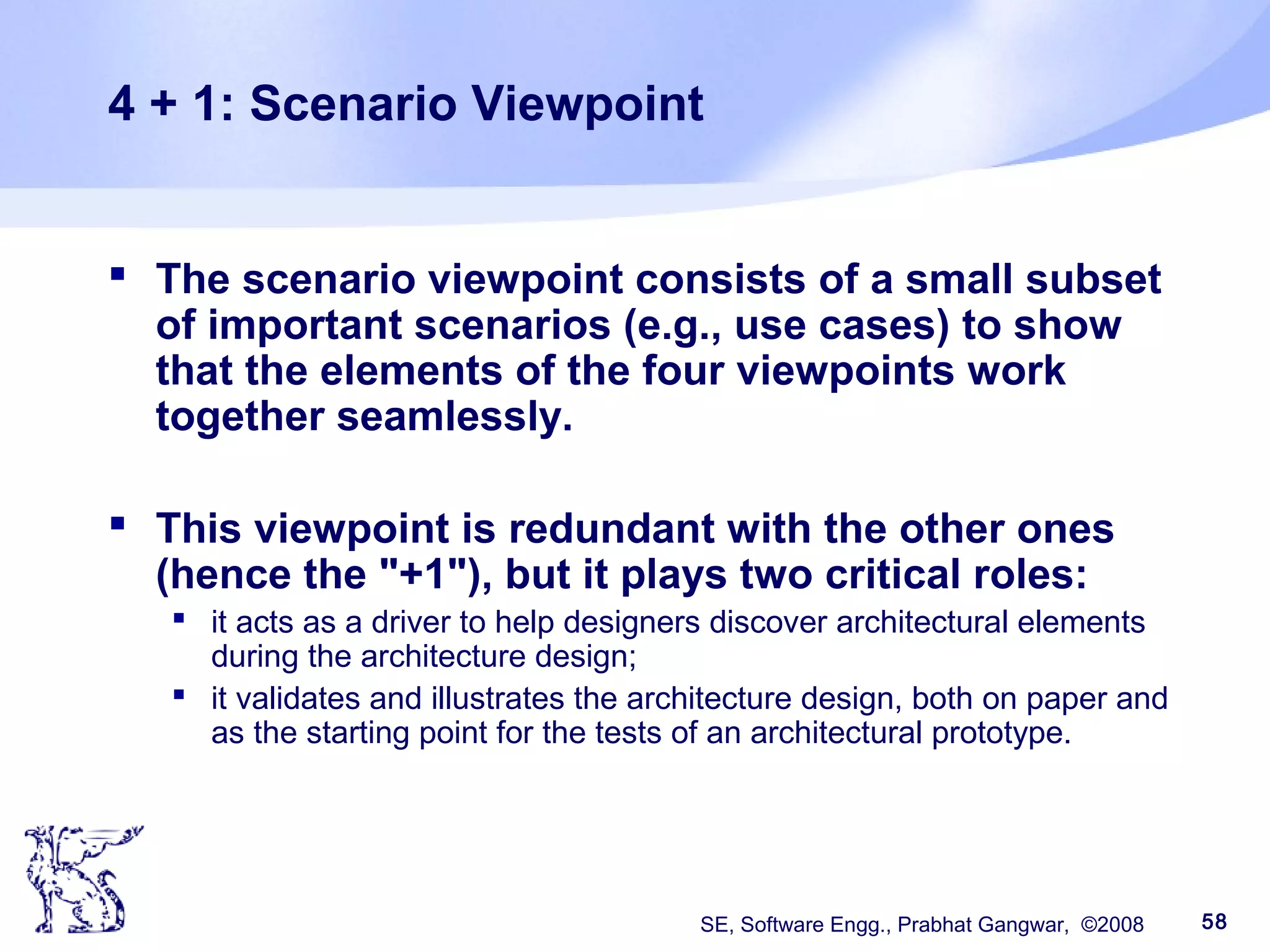
#59 The scenario view consists of a small subset of important scenarios-instances of use cases-to show that the elements of the four views work together seamlessly. For each scenario, we describe the corresponding scripts (sequences of interactions between objects and between processes). This view is redundant with the other ones (hence the "+1"), but it plays two critical roles:
it acts as a driver to help designers discover architectural elements during the architecture design;
it validates and illustrates the architecture design, both on paper and as the starting point for the tests of an architectural prototype.
The scenario view is important for stakeholder communication.
#60 Module structure: static, aimed at the implementation
Open question: what is the relation between structures?
The structure refers to the system itself, the corresponding view is how it is documented.
#61 Decomposition: vaak sartpunt voor design, nuttig vor modifiability (likely changes fall within a few modules), basis for project organization, structure of documentation, testplans, etc.
Uses: kun je gebruiken om functional subsets te bepalen. Maakt het dus mogelijk incrementele ontwikkeling te realiseren.
Layered: vaak “taal”, virtual machine.
Class: dan kun je redeneren over reuse, incremental addition of functionality.
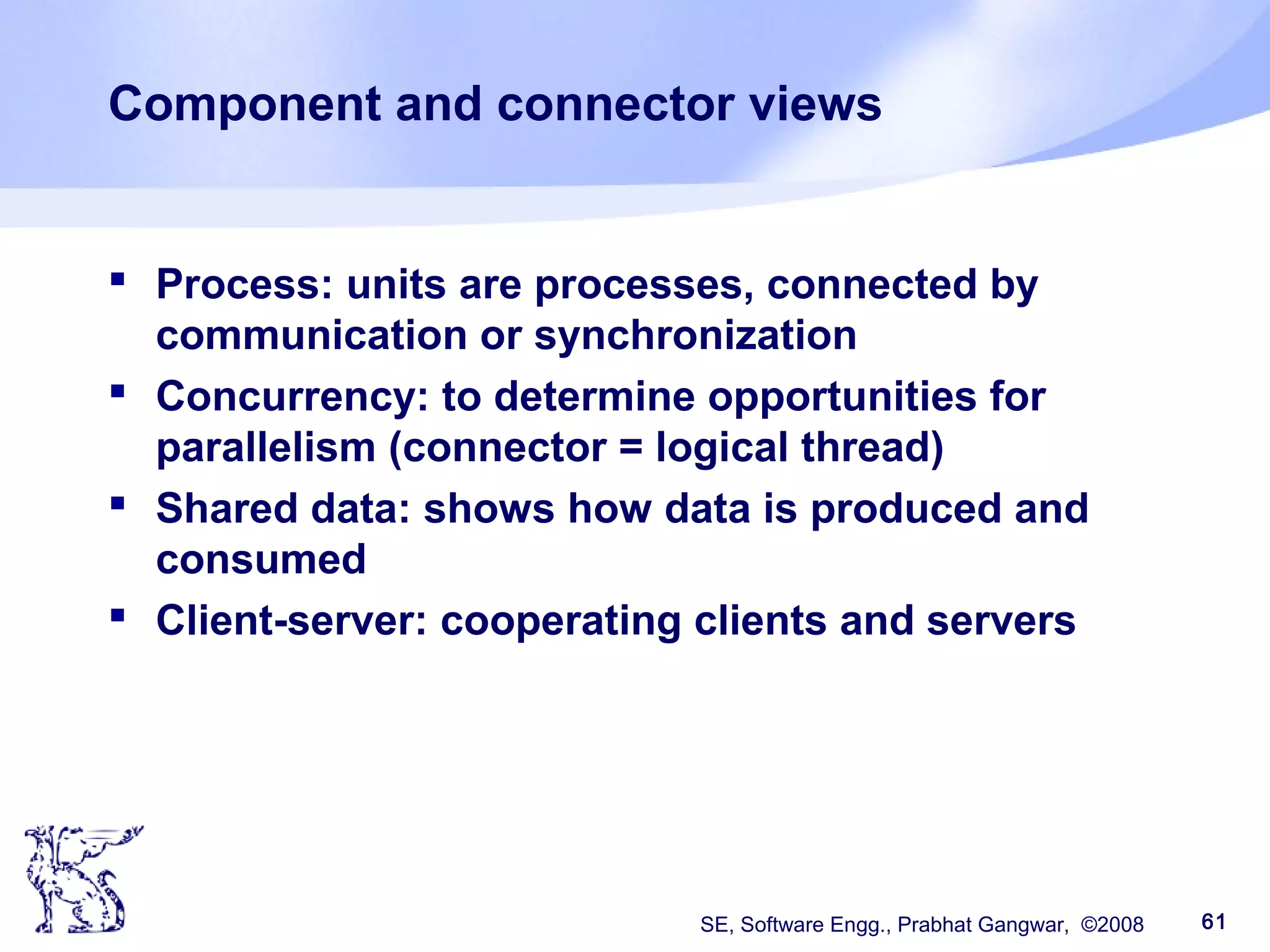
#62 Process: relation is “attachment”, how are cmponents hooked together. Belangrijk voor performance, availability.
Concurrency: logical thread: sequence of computation that can be allocated to a separate physical thread later in the design rpocess. Used to determine possibilities for concurrency.
Shared data: gaatibution, load balancing (runtime performamce) over componenten die persistent data maken, opslaan, gebruiken. Handig als systeem dat voral doet. Goed voor performace, data integrity.
Client-server: connectors are the protocols and messages they exchange. Goed voor separation of concerns (modifiabilty), physical distribution
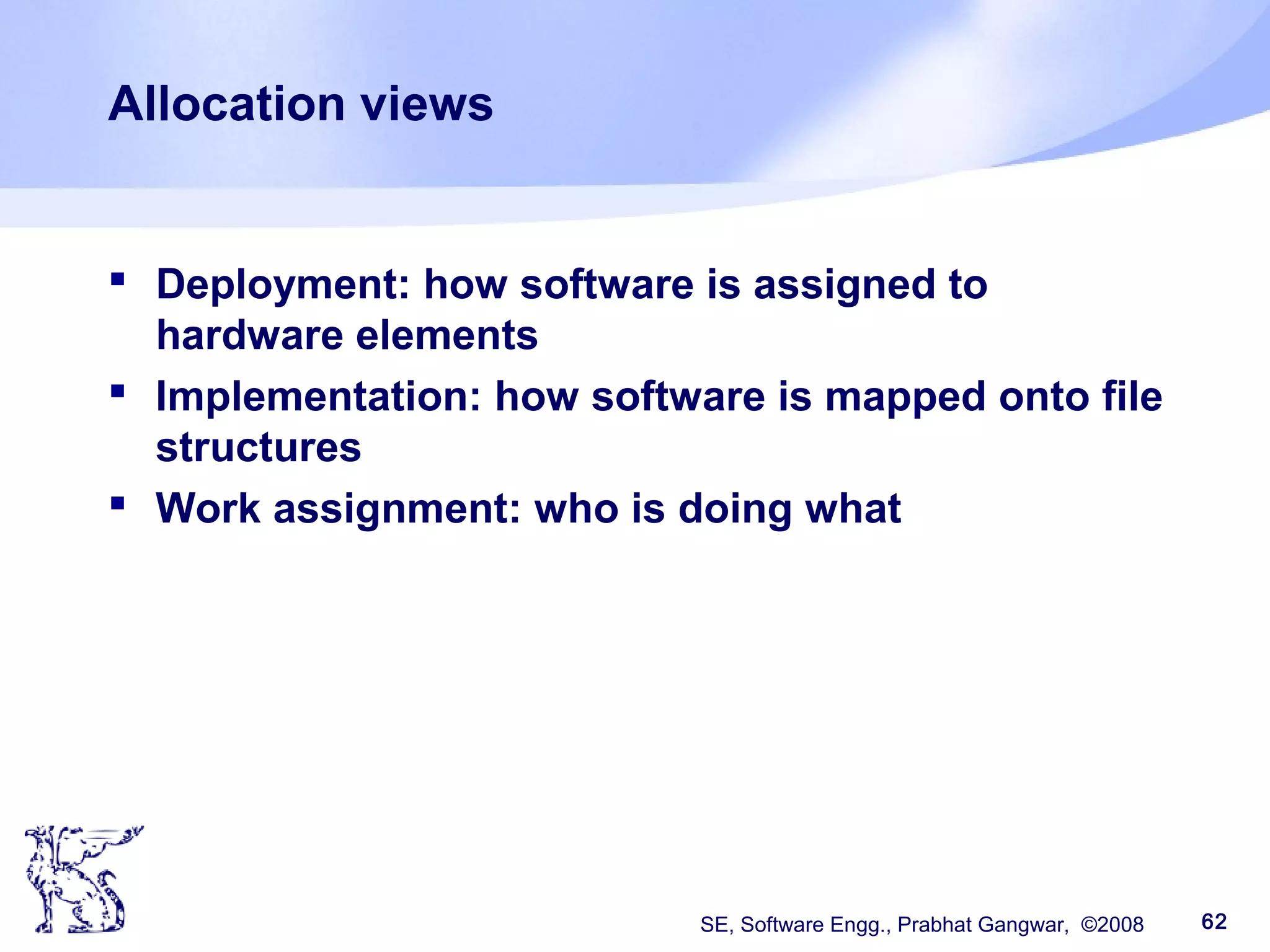
#63 Deployment: elements: software (meestal process van C&C view), hardware elements and communication pathways. Geeft aan waar software zit, en hoe het evt migreert. Dan kun je redeneren over performance, security, availability, ed.
Implementation: voor management van ontwikkelactiviteiten, build processes.
Work assignment: welke kennis heb je waar nodig?, functional commonality aan 1 team toewijzen, etc.
#64 Bv via het maken van een stakeholder/view list. Geef aan hoeveel uit elke vew de stakeholders nodig hebben.
Vaak zul je views willen combineren, want je wilt er geen 12 maken. (bv module decomposition and implementation view kun je vaak combineren. Of module decomposition en layered of uses).
#65 Londense arts, Snow. Platje komt uit Wikipedia
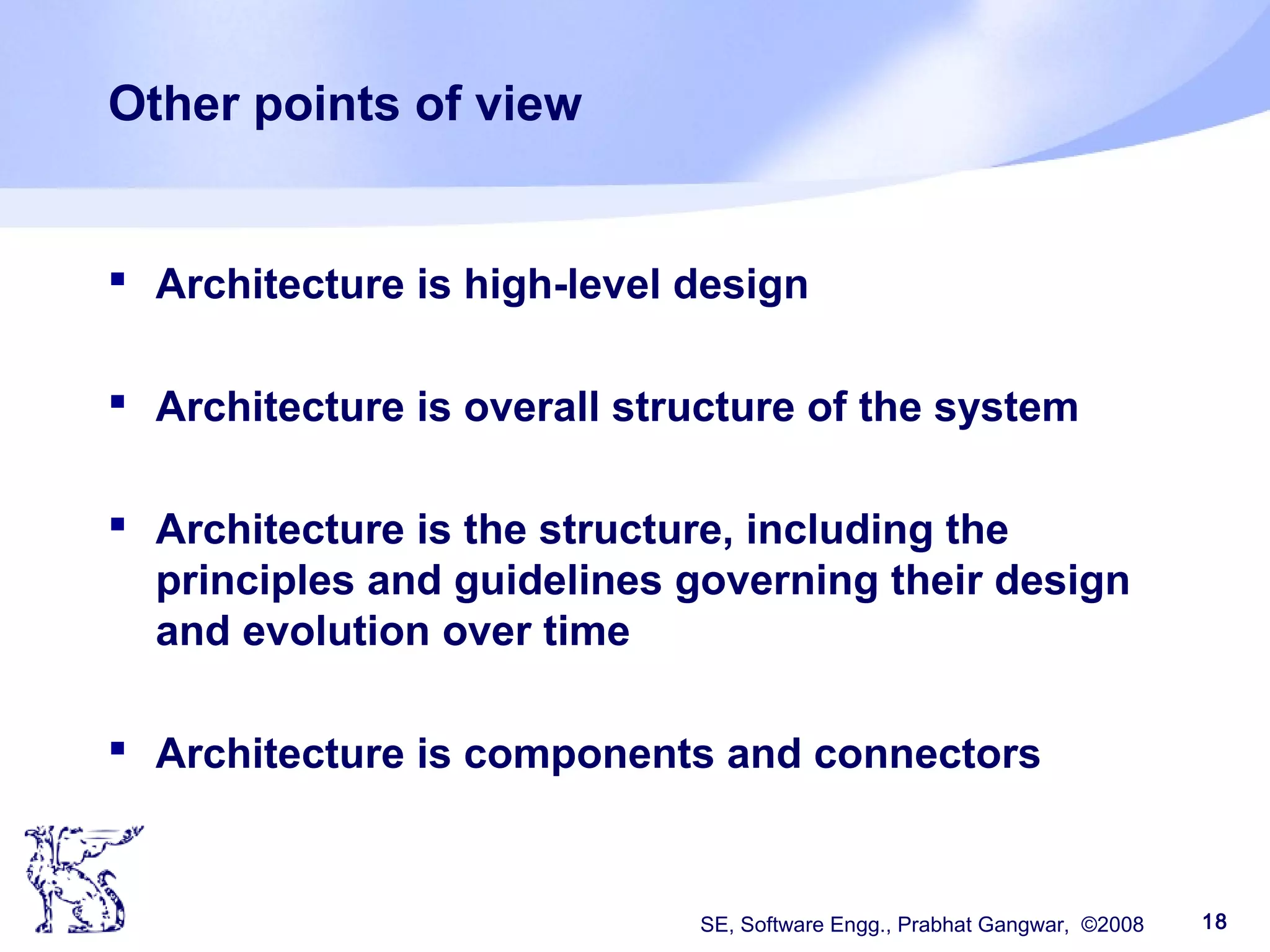
#67 No single description (view) captures an architecture completely
Note that these views concern the system itself (the micro-architecture), and not the system in its environment (the macro architecture).
The 4+1 views are from the 1995 IEEE Software article. A similar set of views is given in Soni et al, 1995, ICSE proceedings.
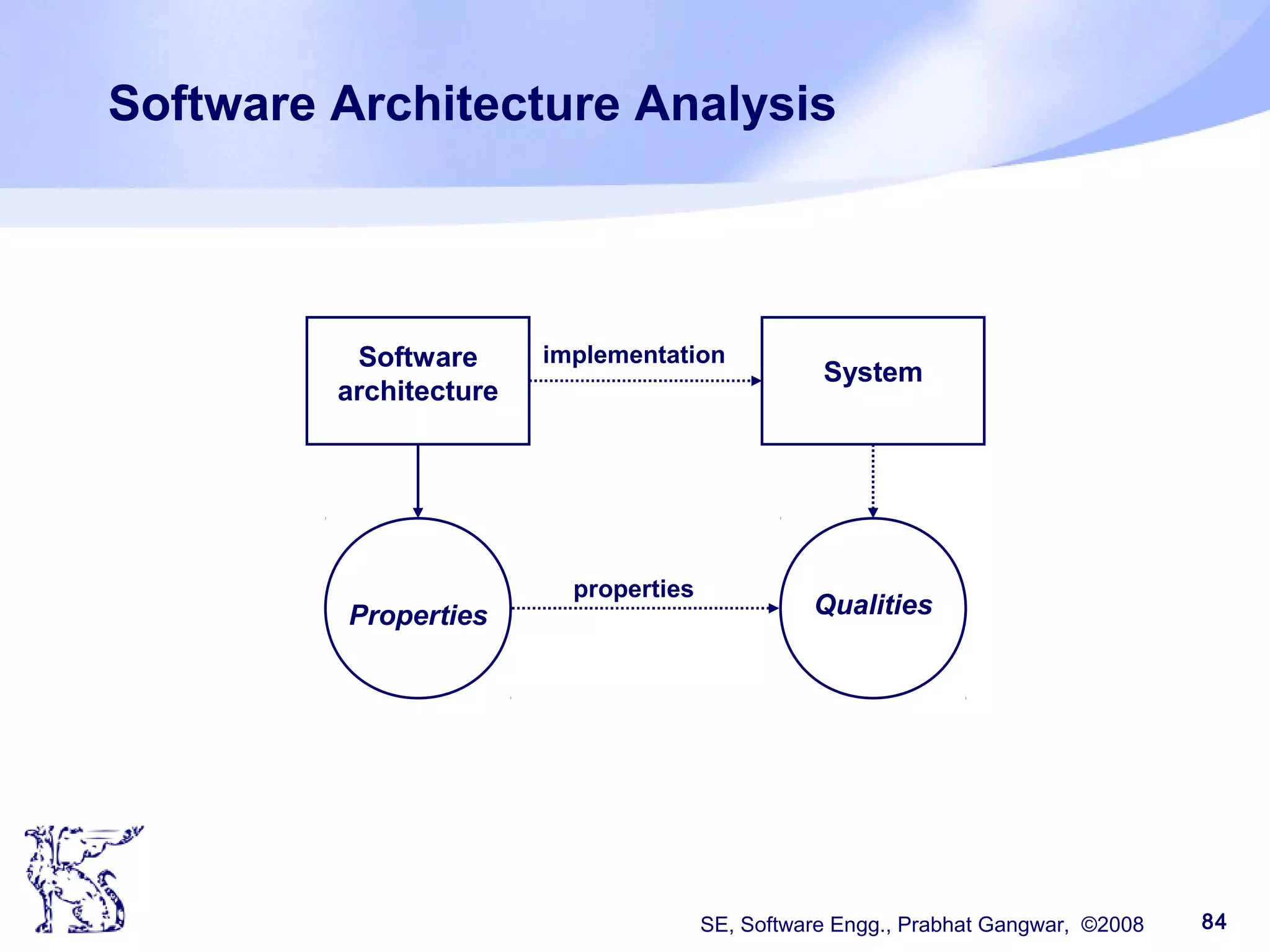
#85 Je “test” dus die properties, en je hoopt dat, als het systeem eenmaal geimlementeerd is, dat systeem de betreffende kwaliteitseigenschappen zal hebben.
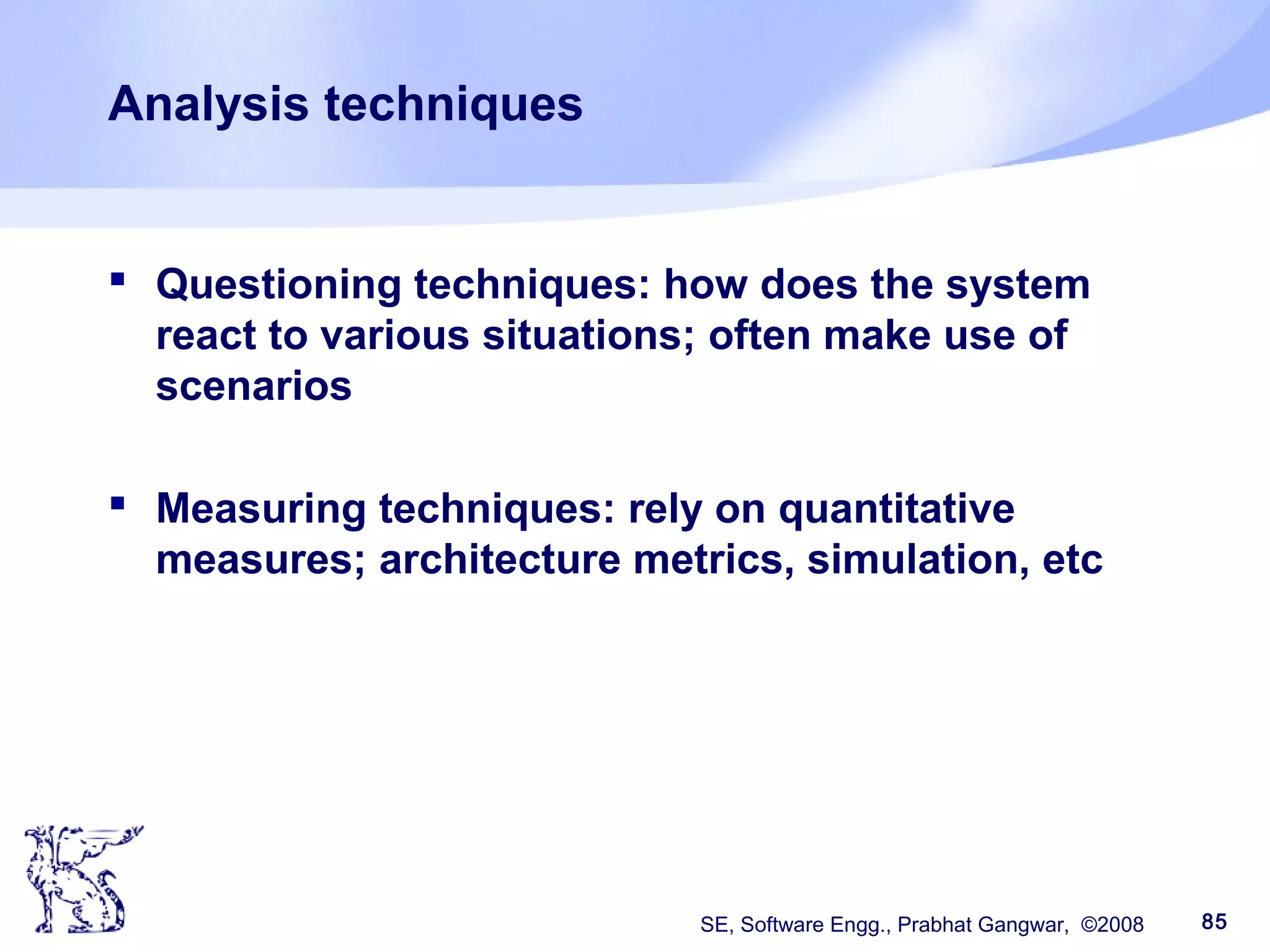
#86 Metrics kun je je voorstellen als bij “gewone” programma’s: tellen van aantallen nterfaces, aantallen functies, vorm van een gelayerde architectuur, ed. Heeft dan allemaal met coupling en cohesion te maken.
Simulatie is behoorljk ingewikkeld. Je maakt dan iha gebruik van tools, doet bepaalde aannamen over onderdelen van de architectuur (gemiddelde dorlooptijd van compnenten ed, snelheid netwerk, etc), en doet op basis daarvan uitspraken.
Scenarios worden waarschijnlijk het meest gebruikt. Zijn ook een manier om stakehlders erbij te betrekken. Een beetje zoals facilitated workshops bij requirements analyse dat doen.
#87 A change scenario is a description of a concrete event that might lead to a change in the system. E.g. a move from Windows 2000 to Windows NT.
Often, the architect will be asked for likely changes. Chances are he will come up with changes already anticipated by the architecture. This is somewhat akin to testing your own software.
Is 10 scenarios enough? Or 1000? There are no good stopping criteria, yet.
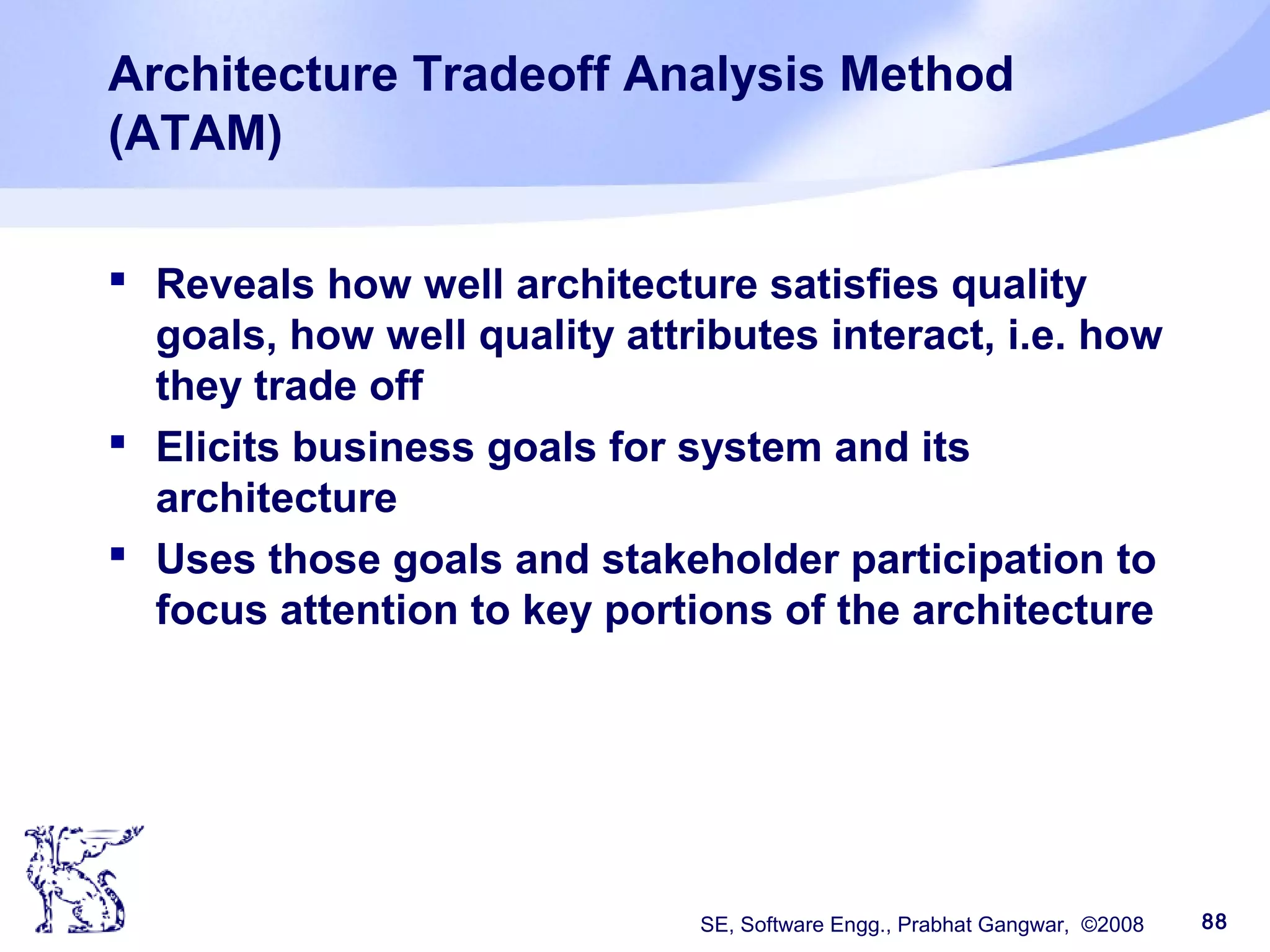
#88 Een architectuur heeft alleen betekenis in de context van een set kwaliteitseisen. Als je die niet hebt is elke architectuur goed.
Je kunt, met de hand en n een groep, niet teveel tegelijk doen. Dus scope beperken. Bv alleen modifiability, of modifiability + performance.
Kosten moeten < opbrengsten zijn
Key personnell: architect oid : stakeholders die bij major concerns horen
Liefst een apart team: onafhankelijk, objectief, goed. Anders wordt het niet opgevolgd. Misschien moeten ze wel een zekere macht hebben.
Verwachtingen van assessment: welke, wat levert het op, wat gebeurt daarmee, wie krijgt de resultaten.
#89 Het is een soort inspectie, waarbij je met een groep stakeholders in een dialoog komt over de architectuur.
Het enge, nauwe, doel is om quality te testen. Maar vaak is wat eruit kmt breder, en gaat het m meer zaken. Wat dat betreft is het net als andere techneken om samen met betrokkenen gestructureerd over een systeem te praten.
Active design reviews van Parnas hebben aan de basis van ATAM ed gestan.
#90 Ervaringen bij AT&T: 10% reductie in kosten. Er zijn veel anecdotes, weinig harde getallen.
Forced preparation: je moet documentatie maken, dus nadenken over je beslissingen.
Zo krijg je rationale, en die is tijdens evolutie van zeer groot belang.
Early detetction: als alle vroege testtechnieken
Veel requirements worden zmaar “gesteld”, en niemand weet of ze haalbaar zijn. Requirements kunnen ook conflicten opleveren. Bij architectuurevaluatie kom je die hopelijk tegen, en dan kn je er over onderhandelen, en afspraken maken waarbij je dan weet wat je afgesproken hebt.
En tenslotte, de architectuur kan er aleen maar beter van worden. En dat geldt niet alleen voor de architectuur in kwestie, maar ook voor volgende architecturen. Net als bij testen, je wordt een betere ontwikkelaar als je nspecties doet. Het is een leerproces voor betrokkenen.
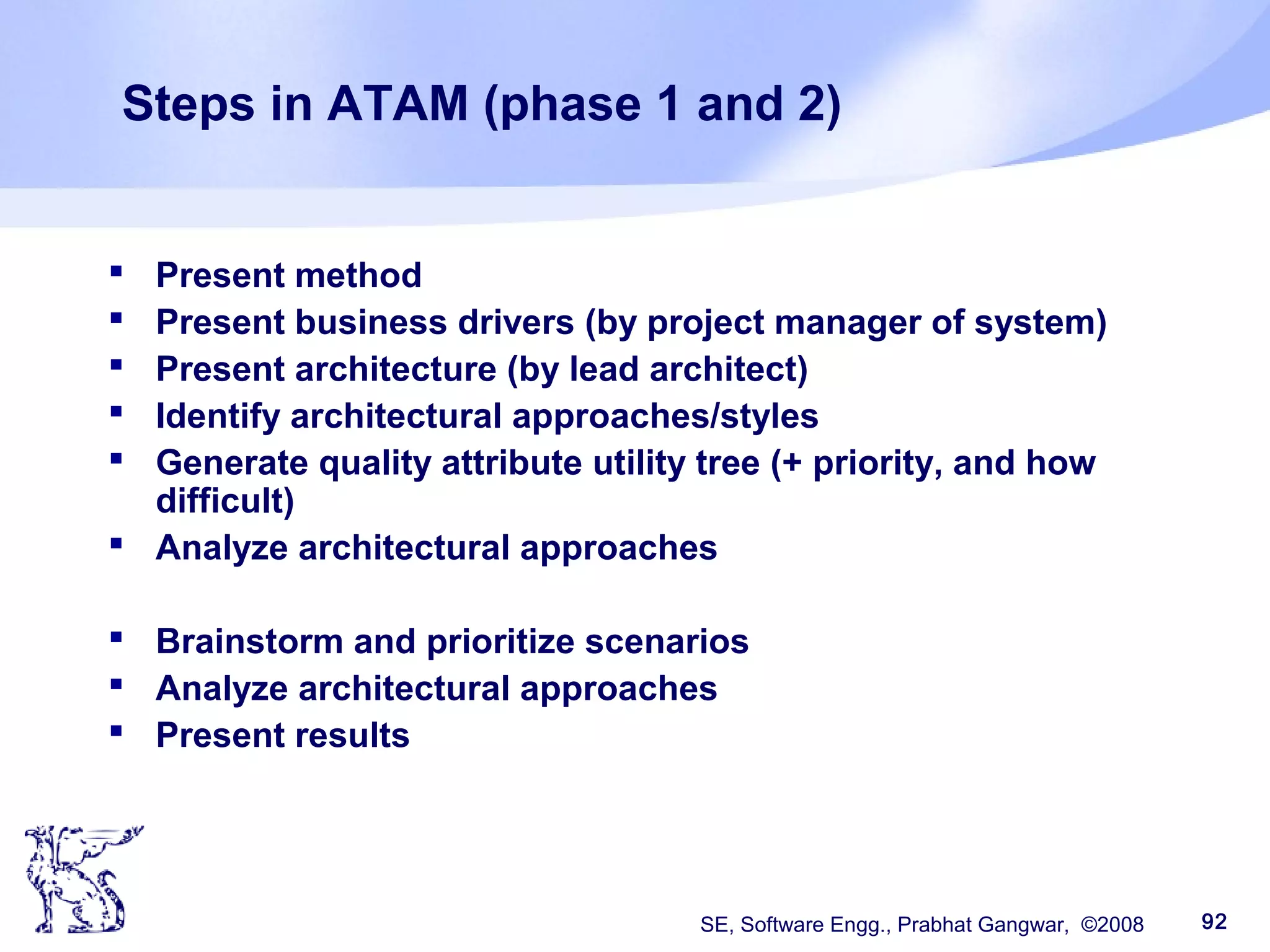
#93 Utility tree: tree whose root is “utility”, and whose leafs are scenarios (see next slide). This utility tree guides the rest of the analysis.
During the analysis, the architecture is analyzed to see whether the the selected styles “hold promise for meeting the attribute specific requirements for which it is intended”. The key is to link architectural decisions and quality attribute requirements that need to be satisfied.
#95 Sensitivity point: property of component that is critical to achieve a particular quality attribute response. Bv gemiddeld aantal dagen voor onderhoud kan gevoelig zijn voor de mate van encapsulatie van file formats. Of latency (slapend; wrsch wachttijd) voor processing message kan afhankelijk zijn van prioriteit van processen die deze message verwerken.
Tradeoff point: property die op meer dan een attribuut slaat en sensitivity point voor meer dan 1 attribuut is. Als je bv het nivo van encryptie verandert heeft dat een significante invloed op zowel security als performance (maar wel in verschillende richtingen). Dus je wilt speciaal op tradeoff points letten.
#96 Example sensitivity points: level of confidentiality is sensitive to number of bits of encryption. Average number of persondays needed for maintenance might be sensitive to degree of encapsulation
Tadeoff: changing level of encryption -> more security, less performance.
#97 SAAM is eenvoudiger dan ATAM.
If two scenarios affect the same component, these scenarios are said to interact. If there is an interaction between scenarios that are semantically not related, the decomposition is, potentially, not so good.
#98 Allocation of functionality: if semantically unrelated scenarios interact, decomposition is not proper. Semantically unrelated things are in the same component.
On the oher hand, we may have to decompose the architecture further, to get smaller subcomponents that do not interact.
#100 In my view, making decisions, in concultation with ALL stakeholders, is the most crucial issue for the software architect.