1
Design Concepts in Software
Engineering
2
What is Design in SE?
• It is the place where creativity rules—where
stakeholder requirements, business needs,
and technical considerations all come together
in the formulation of a product or system.
• The design model provides detail about
software architecture, data structures,
interfaces, and components that are
necessary to implement the system.
3
Why is it important?
• It allows you to model the system or product
that is to be built. This model can be assessed
for quality and improved before code is
generated, tests are conducted, and end users
become involved in large numbers. Design is
the place where software quality is
established.
4
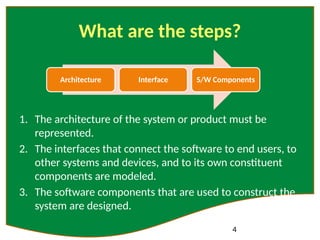
What are the steps?
1. The architecture of the system or product must be
represented.
2. The interfaces that connect the software to end users, to
other systems and devices, and to its own constituent
components are modeled.
3. The software components that are used to construct the
system are designed.
Architecture Interface S/W Components
5
What is the work product?
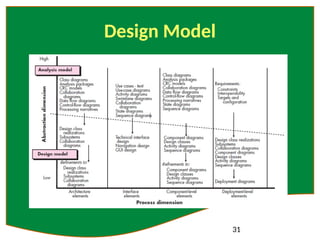
• The design model that encompasses
architectural, interface, componentlevel, and
deployment representations is the primary
work product that is produced during software
design.
6
How do I ensure that I’ve done it right?
• The design model is assessed by the software
team in an effort to determine whether it
contains errors, inconsistencies, or omissions;
whether better alternatives exist; and whether
the model can be implemented within the
constraints, schedule, and cost that have been
established.
7
Roman architecture critic Vitruvius
• Well-designed buildings were those which
exhibited firmness, commodity, and delight.
• Firmness: A program should not have any
bugs that inhibit its function.
• Commodity: A program should be suitable for
the purposes for which it was intended.
• Delight: The experience of using the program
should be a pleasurable one.
8
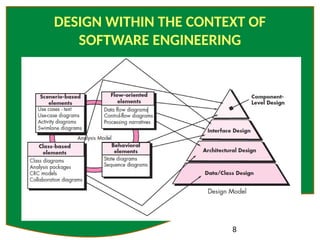
DESIGN WITHIN THE CONTEXT OF
SOFTWARE ENGINEERING
9
10
3.2.2. The Evolution of Software Design
• Procedural aspects of design definition evolved into
a philosophy called structured programming
• Newer design approaches (e.g., [Jac92], [Gam95])
proposed an object-oriented approach to design
derivation.
• Growing emphasis on
– aspect-oriented methods (e.g., [Cla05], [Jac04]),
– model-driven development [Sch06], and
– test-driven development [Ast04]
• emphasize techniques for achieving more effective
modularity and architectural structure in the
designs that are created
Structured
Programming
Object Oriented
Programming
11
Each software design method characterizes design
quality
(1) a mechanism for the translation of the requirements
model into a design representation,
(2) a notation for representing functional components
and their interfaces,
(3) heuristics for refinement and partitioning, and
(4) guidelines for quality assessment.
you should apply a set of basic concepts to data,
architectural, interface, and component-level design.
12
3.3. DESIGN CONCEPTS
• You answer the following questions:
• What criteria can be used to partition software
into individual components?
• How is function or data structure detail
separated from a conceptual representation
of the software?
• What uniform criteria define the technical
quality of a software design?
13
overview of important software design
concepts that span both traditional and object-
oriented software development.
1. Abstraction
2. Architecture
3. Patterns
4. Separation of Concerns
5. Modularity
6. Information Hiding
7. Functional Independence
8. Refinement
9. Aspects
10. Refactoring
11. Object-Oriented Design Concepts
12. Design Classes
14
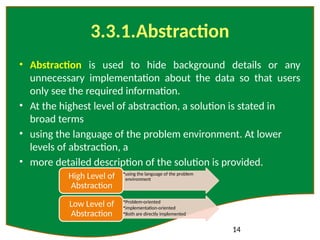
3.3.1.Abstraction
• Abstraction is used to hide background details or any
unnecessary implementation about the data so that users
only see the required information.
• At the highest level of abstraction, a solution is stated in
broad terms
• using the language of the problem environment. At lower
levels of abstraction, a
• more detailed description of the solution is provided.
•using the language of the problem
environment
High Level of
Abstraction
•Problem-oriented
•implementation-oriented
•Both are directly implemented
Low Level of
Abstraction
15
As different levels of abstraction:
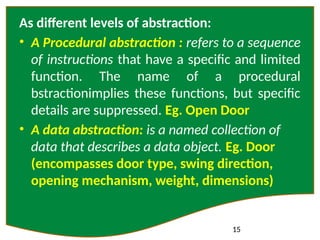
• A Procedural abstraction : refers to a sequence
of instructions that have a specific and limited
function. The name of a procedural
bstractionimplies these functions, but specific
details are suppressed. Eg. Open Door
• A data abstraction: is a named collection of
data that describes a data object. Eg. Door
(encompasses door type, swing direction,
opening mechanism, weight, dimensions)
16
3.3.2 Architecture
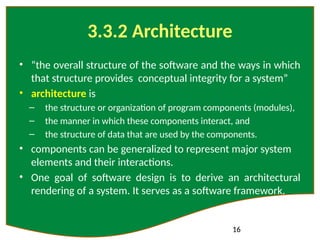
• “the overall structure of the software and the ways in which
that structure provides conceptual integrity for a system”
• architecture is
– the structure or organization of program components (modules),
– the manner in which these components interact, and
– the structure of data that are used by the components.
• components can be generalized to represent major system
elements and their interactions.
• One goal of software design is to derive an architectural
rendering of a system. It serves as a software framework.
17
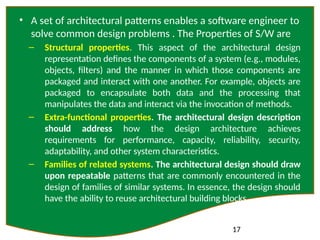
• A set of architectural patterns enables a software engineer to
solve common design problems . The Properties of S/W are
– Structural properties. This aspect of the architectural design
representation defines the components of a system (e.g., modules,
objects, filters) and the manner in which those components are
packaged and interact with one another. For example, objects are
packaged to encapsulate both data and the processing that
manipulates the data and interact via the invocation of methods.
– Extra-functional properties. The architectural design description
should address how the design architecture achieves
requirements for performance, capacity, reliability, security,
adaptability, and other system characteristics.
– Families of related systems. The architectural design should draw
upon repeatable patterns that are commonly encountered in the
design of families of similar systems. In essence, the design should
have the ability to reuse architectural building blocks.
18
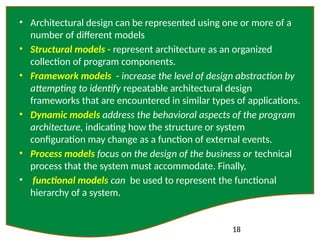
• Architectural design can be represented using one or more of a
number of different models
• Structural models - represent architecture as an organized
collection of program components.
• Framework models - increase the level of design abstraction by
attempting to identify repeatable architectural design
frameworks that are encountered in similar types of applications.
• Dynamic models address the behavioral aspects of the program
architecture, indicating how the structure or system
configuration may change as a function of external events.
• Process models focus on the design of the business or technical
process that the system must accommodate. Finally,
• functional models can be used to represent the functional
hierarchy of a system.
19
• A number of different architectural description
languages (ADLs) have been developed to
represent these models
• provide mechanisms for describing system
components and the manner in which they
are connected to one another.
20
Patterns
• Brad Appleton defines a design pattern -
a design pattern describes a design structure that solves a
particular design problem within a specific context and amid
“forces” that may have an impact on the manner in which the
pattern is applied and used.
• design pattern is to provide a description that enables a
designer to determine
– (1) whether the pattern is applicable to the current work,
– (2) whether the pattern can be reused (hence, saving design
time), and
– (3) whether the pattern can serve as a guide for developing a
similar, but functionally or structurally different pattern.
21
3.3.4 Separation of Concerns
• Separation of concerns is a design concept [Dij82] that
suggests that any complex problem can be more easily
handled if it is subdivided into pieces that can each be
solved and/or optimized independently.
• concern is a feature or behavior that is specified as part of
the requirements model for the software. By separating
concerns into smaller, and therefore more manageable
pieces, a problem takes less effort and time to solve.
• Separation of concerns is manifested in other related
design concepts: modularity, aspects, functional
independence, and refinement.
22
3.3.5 Modularity
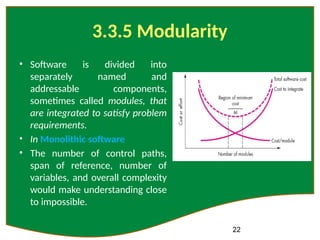
• Software is divided into
separately named and
addressable components,
sometimes called modules, that
are integrated to satisfy problem
requirements.
• In Monolithic software
• The number of control paths,
span of reference, number of
variables, and overall complexity
would make understanding close
to impossible.
23
3.3.6 Information Hiding
• How do I decompose a software solution to obtain
the best set of modules?
• Modules should be specified and designed so that
information (algorithms and data) contained within
a module is inaccessible to other modules that have
no need for such information.
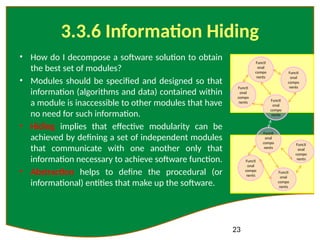
• Hiding implies that effective modularity can be
achieved by defining a set of independent modules
that communicate with one another only that
information necessary to achieve software function.
• Abstraction helps to define the procedural (or
informational) entities that make up the software.
Functi
onal
compo
nents
Functi
onal
compo
nents
Functi
onal
compo
nents
Functi
onal
compo
nents
Functi
onal
compo
nents
Functi
onal
compo
nents
Functi
onal
compo
nents
Functi
onal
compo
nents
24
3.3.7 Functional Independence
• It is the concepts of abstraction and information hiding.
• It is achieved by developing modules with “single minded” function and an
“aversion” to excessive interaction with other modules.
• you should design software so that each module addresses a specific subset of
requirements and has a simple interface when viewed from other parts of the
program structure. It is fair to ask why independence is important.
• Independence is assessed using two qualitative criteria: cohesion and coupling.
• Cohesion is an indication of the relative functional strength of a module. A cohesive
module performs a single task, requiring little interaction with other components in
other parts of a program.
• Coupling is an indication of the relative interdependence among modules. It is an
indication of interconnection among modules in a software structure. Coupling
depends on the interface complexity between modules, the point at which entry or
reference is made to a module, and what data pass across the interface
25
3.3.8 Refinement
• Refinement is actually a process of elaboration.
• You begin with a statement of function (or description of
information) that is defined at a high level of abstraction.
• That is, the statement describes function or information
conceptually but provides no information about the internal
workings of the function or the internal structure of the
information.
• Abstraction enables
• you to specify procedure and data internally but suppress
the need for “outsiders” to have knowledge of low-level
details.
26
3.3.9 Aspects
• Concerns “include requirements, use cases,
features, data structures, quality-of-service
issues,variants, intellectual property
boundaries, collaborations, patterns and
contracts”
27
3.3.10 Refactoring
• Refactoring is a reorganization technique that
simplifies the design (or code) of a component
without changing its function or behavior.
• When software is refactored, the existing
design is examined for redundancy, unused
design elements, inefficient or unnecessary
algorithms, poorly constructed or inappropriate
data structures, or any other design failure that
can be corrected to yield a better design.
28
3.3.11 Object-Oriented Design Concepts
• The object-oriented (OO) paradigm is widely
used in modern software engineering.
• OO -design concepts such as classes and
objects, inheritance, messages, and
polymorphism, among others.
29
3.3.12 Design Classes
• The requirements model defines a set of analysis classes.
• you will define a set of design classes that refine the analysis classes
– User interface classes define all abstractions that are necessary for human
computer interaction (HCI)
– Business domain classes are often refinements of the analysis classes
defined earlier. The classes identify the attributes and services (methods)
that are required to implement some element of the business domain.
– Process classes implement lower-level business abstractions required to fully
manage the business domain classes.
– Persistent classes represent data stores (e.g., a database) that will persist
beyond the execution of the software.
– System classes implement software management and control functions that
enable the system to operate and communicate within its computing
environment and with the outside world
30
• Complete and sufficient. A design class should
be the complete encapsulation of all attributes
and
• Primitiveness. Methods associated with a
design class should be focused on
accomplishing one service for the class.
• High cohesion. A cohesive design class has a
small, focused set of responsibilities and
single-mindedly
• Low coupling. Within the design model, it is
necessary for design classes to Collaborate
with one another.
31
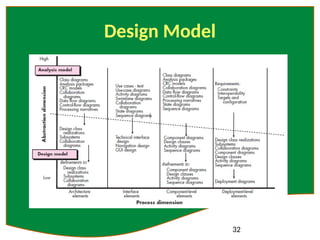
Design Model
32
Design Model
33
Thank
you
34
Thank
you

design concepts in software engineering.pptx

  • 1.
    1 Design Concepts inSoftware Engineering
  • 2.
    2 What is Designin SE? • It is the place where creativity rules—where stakeholder requirements, business needs, and technical considerations all come together in the formulation of a product or system. • The design model provides detail about software architecture, data structures, interfaces, and components that are necessary to implement the system.
  • 3.
    3 Why is itimportant? • It allows you to model the system or product that is to be built. This model can be assessed for quality and improved before code is generated, tests are conducted, and end users become involved in large numbers. Design is the place where software quality is established.
  • 4.
    4 What are thesteps? 1. The architecture of the system or product must be represented. 2. The interfaces that connect the software to end users, to other systems and devices, and to its own constituent components are modeled. 3. The software components that are used to construct the system are designed. Architecture Interface S/W Components
  • 5.
    5 What is thework product? • The design model that encompasses architectural, interface, componentlevel, and deployment representations is the primary work product that is produced during software design.
  • 6.
    6 How do Iensure that I’ve done it right? • The design model is assessed by the software team in an effort to determine whether it contains errors, inconsistencies, or omissions; whether better alternatives exist; and whether the model can be implemented within the constraints, schedule, and cost that have been established.
  • 7.
    7 Roman architecture criticVitruvius • Well-designed buildings were those which exhibited firmness, commodity, and delight. • Firmness: A program should not have any bugs that inhibit its function. • Commodity: A program should be suitable for the purposes for which it was intended. • Delight: The experience of using the program should be a pleasurable one.
  • 8.
    8 DESIGN WITHIN THECONTEXT OF SOFTWARE ENGINEERING
  • 9.
  • 10.
    10 3.2.2. The Evolutionof Software Design • Procedural aspects of design definition evolved into a philosophy called structured programming • Newer design approaches (e.g., [Jac92], [Gam95]) proposed an object-oriented approach to design derivation. • Growing emphasis on – aspect-oriented methods (e.g., [Cla05], [Jac04]), – model-driven development [Sch06], and – test-driven development [Ast04] • emphasize techniques for achieving more effective modularity and architectural structure in the designs that are created Structured Programming Object Oriented Programming
  • 11.
    11 Each software designmethod characterizes design quality (1) a mechanism for the translation of the requirements model into a design representation, (2) a notation for representing functional components and their interfaces, (3) heuristics for refinement and partitioning, and (4) guidelines for quality assessment. you should apply a set of basic concepts to data, architectural, interface, and component-level design.
  • 12.
    12 3.3. DESIGN CONCEPTS •You answer the following questions: • What criteria can be used to partition software into individual components? • How is function or data structure detail separated from a conceptual representation of the software? • What uniform criteria define the technical quality of a software design?
  • 13.
    13 overview of importantsoftware design concepts that span both traditional and object- oriented software development. 1. Abstraction 2. Architecture 3. Patterns 4. Separation of Concerns 5. Modularity 6. Information Hiding 7. Functional Independence 8. Refinement 9. Aspects 10. Refactoring 11. Object-Oriented Design Concepts 12. Design Classes
  • 14.
    14 3.3.1.Abstraction • Abstraction isused to hide background details or any unnecessary implementation about the data so that users only see the required information. • At the highest level of abstraction, a solution is stated in broad terms • using the language of the problem environment. At lower levels of abstraction, a • more detailed description of the solution is provided. •using the language of the problem environment High Level of Abstraction •Problem-oriented •implementation-oriented •Both are directly implemented Low Level of Abstraction
  • 15.
    15 As different levelsof abstraction: • A Procedural abstraction : refers to a sequence of instructions that have a specific and limited function. The name of a procedural bstractionimplies these functions, but specific details are suppressed. Eg. Open Door • A data abstraction: is a named collection of data that describes a data object. Eg. Door (encompasses door type, swing direction, opening mechanism, weight, dimensions)
  • 16.
    16 3.3.2 Architecture • “theoverall structure of the software and the ways in which that structure provides conceptual integrity for a system” • architecture is – the structure or organization of program components (modules), – the manner in which these components interact, and – the structure of data that are used by the components. • components can be generalized to represent major system elements and their interactions. • One goal of software design is to derive an architectural rendering of a system. It serves as a software framework.
  • 17.
    17 • A setof architectural patterns enables a software engineer to solve common design problems . The Properties of S/W are – Structural properties. This aspect of the architectural design representation defines the components of a system (e.g., modules, objects, filters) and the manner in which those components are packaged and interact with one another. For example, objects are packaged to encapsulate both data and the processing that manipulates the data and interact via the invocation of methods. – Extra-functional properties. The architectural design description should address how the design architecture achieves requirements for performance, capacity, reliability, security, adaptability, and other system characteristics. – Families of related systems. The architectural design should draw upon repeatable patterns that are commonly encountered in the design of families of similar systems. In essence, the design should have the ability to reuse architectural building blocks.
  • 18.
    18 • Architectural designcan be represented using one or more of a number of different models • Structural models - represent architecture as an organized collection of program components. • Framework models - increase the level of design abstraction by attempting to identify repeatable architectural design frameworks that are encountered in similar types of applications. • Dynamic models address the behavioral aspects of the program architecture, indicating how the structure or system configuration may change as a function of external events. • Process models focus on the design of the business or technical process that the system must accommodate. Finally, • functional models can be used to represent the functional hierarchy of a system.
  • 19.
    19 • A numberof different architectural description languages (ADLs) have been developed to represent these models • provide mechanisms for describing system components and the manner in which they are connected to one another.
  • 20.
    20 Patterns • Brad Appletondefines a design pattern - a design pattern describes a design structure that solves a particular design problem within a specific context and amid “forces” that may have an impact on the manner in which the pattern is applied and used. • design pattern is to provide a description that enables a designer to determine – (1) whether the pattern is applicable to the current work, – (2) whether the pattern can be reused (hence, saving design time), and – (3) whether the pattern can serve as a guide for developing a similar, but functionally or structurally different pattern.
  • 21.
    21 3.3.4 Separation ofConcerns • Separation of concerns is a design concept [Dij82] that suggests that any complex problem can be more easily handled if it is subdivided into pieces that can each be solved and/or optimized independently. • concern is a feature or behavior that is specified as part of the requirements model for the software. By separating concerns into smaller, and therefore more manageable pieces, a problem takes less effort and time to solve. • Separation of concerns is manifested in other related design concepts: modularity, aspects, functional independence, and refinement.
  • 22.
    22 3.3.5 Modularity • Softwareis divided into separately named and addressable components, sometimes called modules, that are integrated to satisfy problem requirements. • In Monolithic software • The number of control paths, span of reference, number of variables, and overall complexity would make understanding close to impossible.
  • 23.
    23 3.3.6 Information Hiding •How do I decompose a software solution to obtain the best set of modules? • Modules should be specified and designed so that information (algorithms and data) contained within a module is inaccessible to other modules that have no need for such information. • Hiding implies that effective modularity can be achieved by defining a set of independent modules that communicate with one another only that information necessary to achieve software function. • Abstraction helps to define the procedural (or informational) entities that make up the software. Functi onal compo nents Functi onal compo nents Functi onal compo nents Functi onal compo nents Functi onal compo nents Functi onal compo nents Functi onal compo nents Functi onal compo nents
  • 24.
    24 3.3.7 Functional Independence •It is the concepts of abstraction and information hiding. • It is achieved by developing modules with “single minded” function and an “aversion” to excessive interaction with other modules. • you should design software so that each module addresses a specific subset of requirements and has a simple interface when viewed from other parts of the program structure. It is fair to ask why independence is important. • Independence is assessed using two qualitative criteria: cohesion and coupling. • Cohesion is an indication of the relative functional strength of a module. A cohesive module performs a single task, requiring little interaction with other components in other parts of a program. • Coupling is an indication of the relative interdependence among modules. It is an indication of interconnection among modules in a software structure. Coupling depends on the interface complexity between modules, the point at which entry or reference is made to a module, and what data pass across the interface
  • 25.
    25 3.3.8 Refinement • Refinementis actually a process of elaboration. • You begin with a statement of function (or description of information) that is defined at a high level of abstraction. • That is, the statement describes function or information conceptually but provides no information about the internal workings of the function or the internal structure of the information. • Abstraction enables • you to specify procedure and data internally but suppress the need for “outsiders” to have knowledge of low-level details.
  • 26.
    26 3.3.9 Aspects • Concerns“include requirements, use cases, features, data structures, quality-of-service issues,variants, intellectual property boundaries, collaborations, patterns and contracts”
  • 27.
    27 3.3.10 Refactoring • Refactoringis a reorganization technique that simplifies the design (or code) of a component without changing its function or behavior. • When software is refactored, the existing design is examined for redundancy, unused design elements, inefficient or unnecessary algorithms, poorly constructed or inappropriate data structures, or any other design failure that can be corrected to yield a better design.
  • 28.
    28 3.3.11 Object-Oriented DesignConcepts • The object-oriented (OO) paradigm is widely used in modern software engineering. • OO -design concepts such as classes and objects, inheritance, messages, and polymorphism, among others.
  • 29.
    29 3.3.12 Design Classes •The requirements model defines a set of analysis classes. • you will define a set of design classes that refine the analysis classes – User interface classes define all abstractions that are necessary for human computer interaction (HCI) – Business domain classes are often refinements of the analysis classes defined earlier. The classes identify the attributes and services (methods) that are required to implement some element of the business domain. – Process classes implement lower-level business abstractions required to fully manage the business domain classes. – Persistent classes represent data stores (e.g., a database) that will persist beyond the execution of the software. – System classes implement software management and control functions that enable the system to operate and communicate within its computing environment and with the outside world
  • 30.
    30 • Complete andsufficient. A design class should be the complete encapsulation of all attributes and • Primitiveness. Methods associated with a design class should be focused on accomplishing one service for the class. • High cohesion. A cohesive design class has a small, focused set of responsibilities and single-mindedly • Low coupling. Within the design model, it is necessary for design classes to Collaborate with one another.
  • 31.
  • 32.
  • 33.
  • 34.