G.H.PATEL COLLEGE OF ENGINEERING &
TECHNOLOGY
Design Concept
Software Engineering
(2160701)
Prepared By::
Metaliya Darshit (130110107020)
Gujarat technological University
Faculty Guide:
Prof. Namrata Dave
DESIGN CONCEPT
“The beginning of wisdom for a software engineer is to recognize the
difference between getting a program to work, and getting it right“.
Fundamental software Design Concepts provide the necessary
framework for
"getting it right."
DESIGN CONCEPT
I. Abstraction
II. Refinement
III. Architecture
IV. Modularity
V. Information hiding
VI. Refactoring
VII.Structural Partitioning
ABSTRACTION
Abstraction allows designers to focus on solving a problem without being
concerned about irrelevant lower level details.
When we consider a modular solution to any problem, many levels of
abstraction can
be posed. At the highest level of abstraction, a solution is stated in broad
terms using
the language of the problem environment. At lower levels of abstraction, a
more procedural
orientation is taken.
There are two types of abstraction available,
 Procedural abstraction – a sequence of instructions that have a specific
REFINEMENT
Refinement is actually a process of elaboration. We begin with a statement
of function (or description of information) that is defined at a high level of
abstraction and reach at the lower level of abstraction.
In each step (of the refinement), one or several instructions of the given
program are decomposed into more detailed instructions.
This successive decomposition or refinement of specifications terminates
when all instructions are expressed in terms of any underlying computer
or programming language.
Abstraction and refinement are complementary concepts. Abstraction
enables a designer to specify procedure and data and yet suppress low-
level details. Refinement helps the designer to reveal low-level details as
design progresses.
ARCHITECTURE
The overall structure of the software and the ways in which the structure
provides conceptual integrity for a system.
Consists of components, connectors, and the relationship between them.
Some of the Architecture models are described below,
Structural models – architecture as organized collection of components
Framework models – attempt to identify repeatable architectural patterns
Dynamic models – indicate how program structure changes as a function of
external events
Process models – focus on the design of the business or technical process
that system must accommodate
Functional models – used to represent system functional hierarchy
MODULARITY
Software is divided into separately named and addressable
components, often called modules, that are integrated to satisfy
problem requirements.(divide and conquer principle).
This leads to a "divide and conquer" conclusion—it's easier to solve a
complex problem when you break it into manageable pieces.
It has been stated that "modularity is the single attribute of software
that allows a program to be intellectually manageable“.
MODULARITY
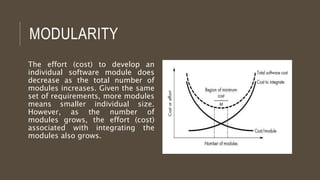
The effort (cost) to develop an
individual software module does
decrease as the total number of
modules increases. Given the same
set of requirements, more modules
means smaller individual size.
However, as the number of
modules grows, the effort (cost)
associated with integrating the
modules also grows.
MODULARITY
These characteristics lead to a
total cost or effort curve shown in
the figure. There is a number, M,
of modules that would result in
minimum development cost, but
we do not have the necessary
sophistication to predict M with
assurance.
INFORMATION HIDING
Modules should be specified and designed so that information
(procedure and data) contained within a module is inaccessible to other
modules that have no need for such information.
Hiding implies that effective modularity can be achieved by defining a
set of independent modules that communicate with one another only
that information necessary to achieve software function.
This enforces access constraints to both procedural (i.e.,
implementation) detail and local data structures.
REFACTORING
Refactoring is a reorganization technique that simplifies the
design (or internal code structure) of a component without
changing its function or external behaviour.
It removes redundancy, unused design elements, inefficient or
unnecessary algorithms, poorly constructed or inappropriate data
structures, or any other design failures.
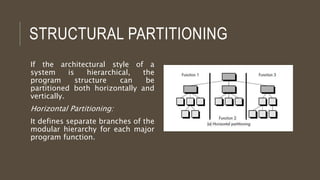
STRUCTURAL PARTITIONING
If the architectural style of a
system is hierarchical, the
program structure can be
partitioned both horizontally and
vertically.
Horizontal Partitioning:
It defines separate branches of the
modular hierarchy for each major
program function.
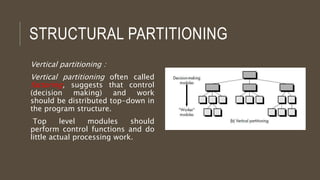
STRUCTURAL PARTITIONING
Vertical partitioning :
Vertical partitioning often called
factoring, suggests that control
(decision making) and work
should be distributed top-down in
the program structure.
Top level modules should
perform control functions and do
little actual processing work.
THANK YOU 
14

Design Concept software engineering

  • 1.
    G.H.PATEL COLLEGE OFENGINEERING & TECHNOLOGY Design Concept Software Engineering (2160701) Prepared By:: Metaliya Darshit (130110107020) Gujarat technological University Faculty Guide: Prof. Namrata Dave
  • 2.
    DESIGN CONCEPT “The beginningof wisdom for a software engineer is to recognize the difference between getting a program to work, and getting it right“. Fundamental software Design Concepts provide the necessary framework for "getting it right."
  • 3.
    DESIGN CONCEPT I. Abstraction II.Refinement III. Architecture IV. Modularity V. Information hiding VI. Refactoring VII.Structural Partitioning
  • 4.
    ABSTRACTION Abstraction allows designersto focus on solving a problem without being concerned about irrelevant lower level details. When we consider a modular solution to any problem, many levels of abstraction can be posed. At the highest level of abstraction, a solution is stated in broad terms using the language of the problem environment. At lower levels of abstraction, a more procedural orientation is taken. There are two types of abstraction available,  Procedural abstraction – a sequence of instructions that have a specific
  • 5.
    REFINEMENT Refinement is actuallya process of elaboration. We begin with a statement of function (or description of information) that is defined at a high level of abstraction and reach at the lower level of abstraction. In each step (of the refinement), one or several instructions of the given program are decomposed into more detailed instructions. This successive decomposition or refinement of specifications terminates when all instructions are expressed in terms of any underlying computer or programming language. Abstraction and refinement are complementary concepts. Abstraction enables a designer to specify procedure and data and yet suppress low- level details. Refinement helps the designer to reveal low-level details as design progresses.
  • 6.
    ARCHITECTURE The overall structureof the software and the ways in which the structure provides conceptual integrity for a system. Consists of components, connectors, and the relationship between them. Some of the Architecture models are described below, Structural models – architecture as organized collection of components Framework models – attempt to identify repeatable architectural patterns Dynamic models – indicate how program structure changes as a function of external events Process models – focus on the design of the business or technical process that system must accommodate Functional models – used to represent system functional hierarchy
  • 7.
    MODULARITY Software is dividedinto separately named and addressable components, often called modules, that are integrated to satisfy problem requirements.(divide and conquer principle). This leads to a "divide and conquer" conclusion—it's easier to solve a complex problem when you break it into manageable pieces. It has been stated that "modularity is the single attribute of software that allows a program to be intellectually manageable“.
  • 8.
    MODULARITY The effort (cost)to develop an individual software module does decrease as the total number of modules increases. Given the same set of requirements, more modules means smaller individual size. However, as the number of modules grows, the effort (cost) associated with integrating the modules also grows.
  • 9.
    MODULARITY These characteristics leadto a total cost or effort curve shown in the figure. There is a number, M, of modules that would result in minimum development cost, but we do not have the necessary sophistication to predict M with assurance.
  • 10.
    INFORMATION HIDING Modules shouldbe specified and designed so that information (procedure and data) contained within a module is inaccessible to other modules that have no need for such information. Hiding implies that effective modularity can be achieved by defining a set of independent modules that communicate with one another only that information necessary to achieve software function. This enforces access constraints to both procedural (i.e., implementation) detail and local data structures.
  • 11.
    REFACTORING Refactoring is areorganization technique that simplifies the design (or internal code structure) of a component without changing its function or external behaviour. It removes redundancy, unused design elements, inefficient or unnecessary algorithms, poorly constructed or inappropriate data structures, or any other design failures.
  • 12.
    STRUCTURAL PARTITIONING If thearchitectural style of a system is hierarchical, the program structure can be partitioned both horizontally and vertically. Horizontal Partitioning: It defines separate branches of the modular hierarchy for each major program function.
  • 13.
    STRUCTURAL PARTITIONING Vertical partitioning: Vertical partitioning often called factoring, suggests that control (decision making) and work should be distributed top-down in the program structure. Top level modules should perform control functions and do little actual processing work.
  • 14.