Fracture, classification
and Fracture healing
Dr Dipendra Maharjan
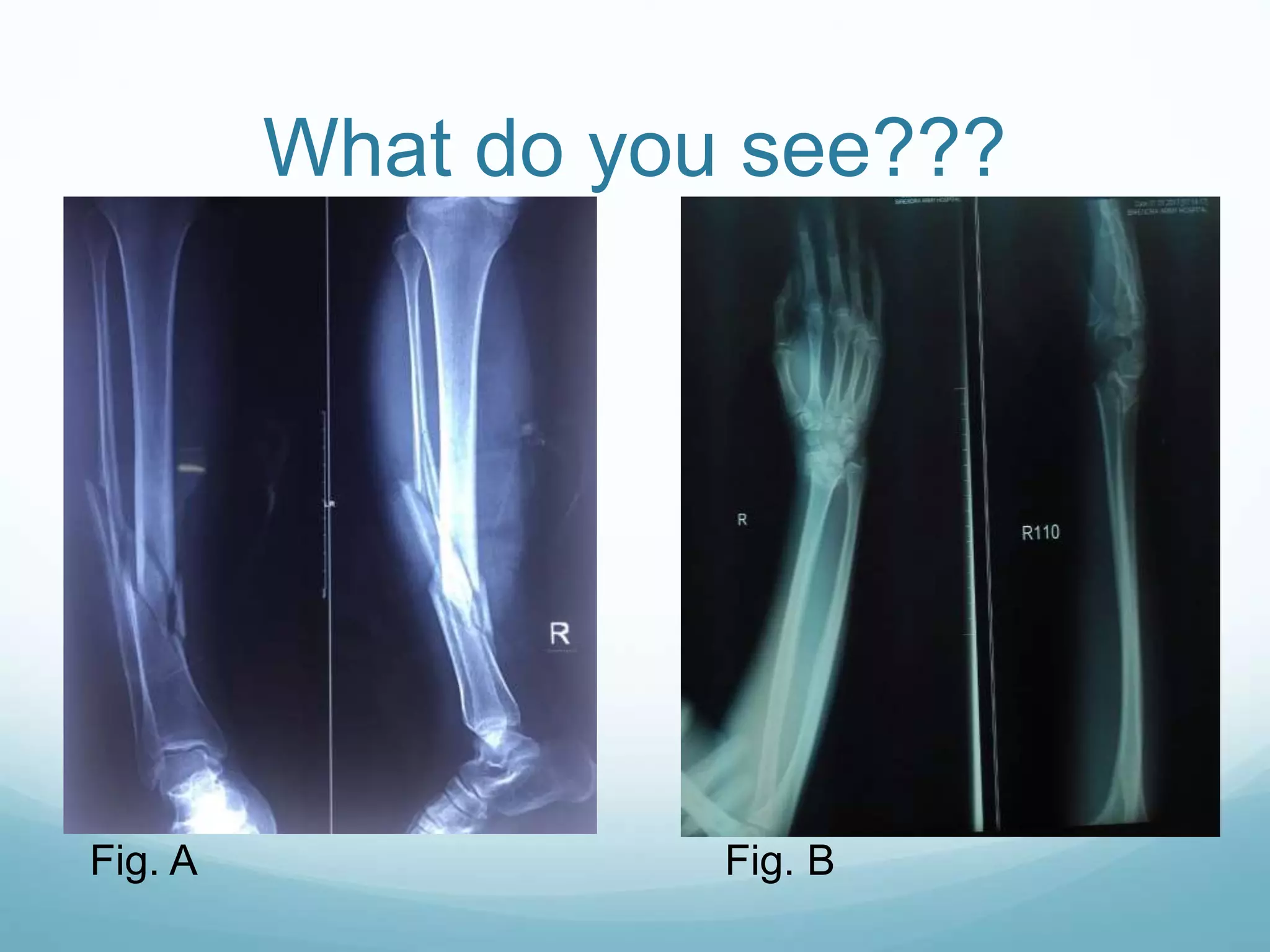
What do you see???
Fig. A Fig. B
Fracture
 A disruption or break in
the continuity of the
structure of bone
 Traumatic injuries
account for the majority
of fractures
How does a fracture occur?
 Results from
 Injury
 Direct (soft tissue injury is common)
 Indirect
 Twisting
 Compression
 Bending
 tension
 Repetitive stress
 Abnormal weakening
Classification of fracture
 On the basis of etiology
 On the basis of displacement
 On the basis of communication with external
environment
 On the basis of site of fracture
 On the basis of fracture morphology
 On the basis of stability
‘
 On the basis of
etiology
 Traumatic
 Atraumatic
 Pathological
 Stress
fracture
 Insufficiency
fracture
Stress Fracture
Pathological Fracture
Insufficiency Fracture
Traumatic Fracture
Un-displaced Fracture
 On the basis of displacement
 Un-displaced
 Displaced
 Translation
 Angulation
 Rotation
 Length
Displaced Fracture
 On the basis of communication with external
environment
 Closed Fracture
 Open Fracture
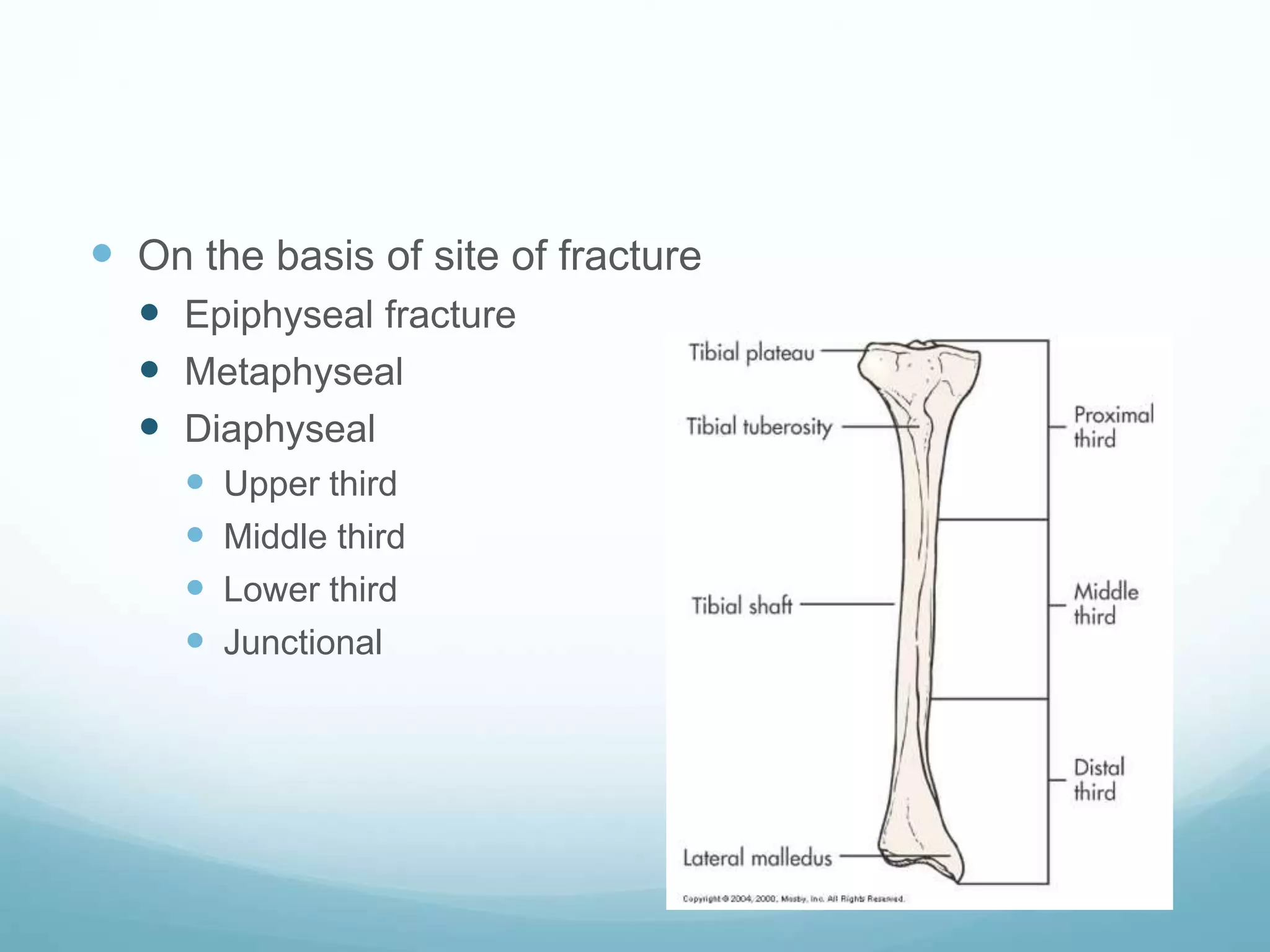
 On the basis of site of fracture
 Epiphyseal fracture
 Metaphyseal
 Diaphyseal
 Upper third
 Middle third
 Lower third
 Junctional
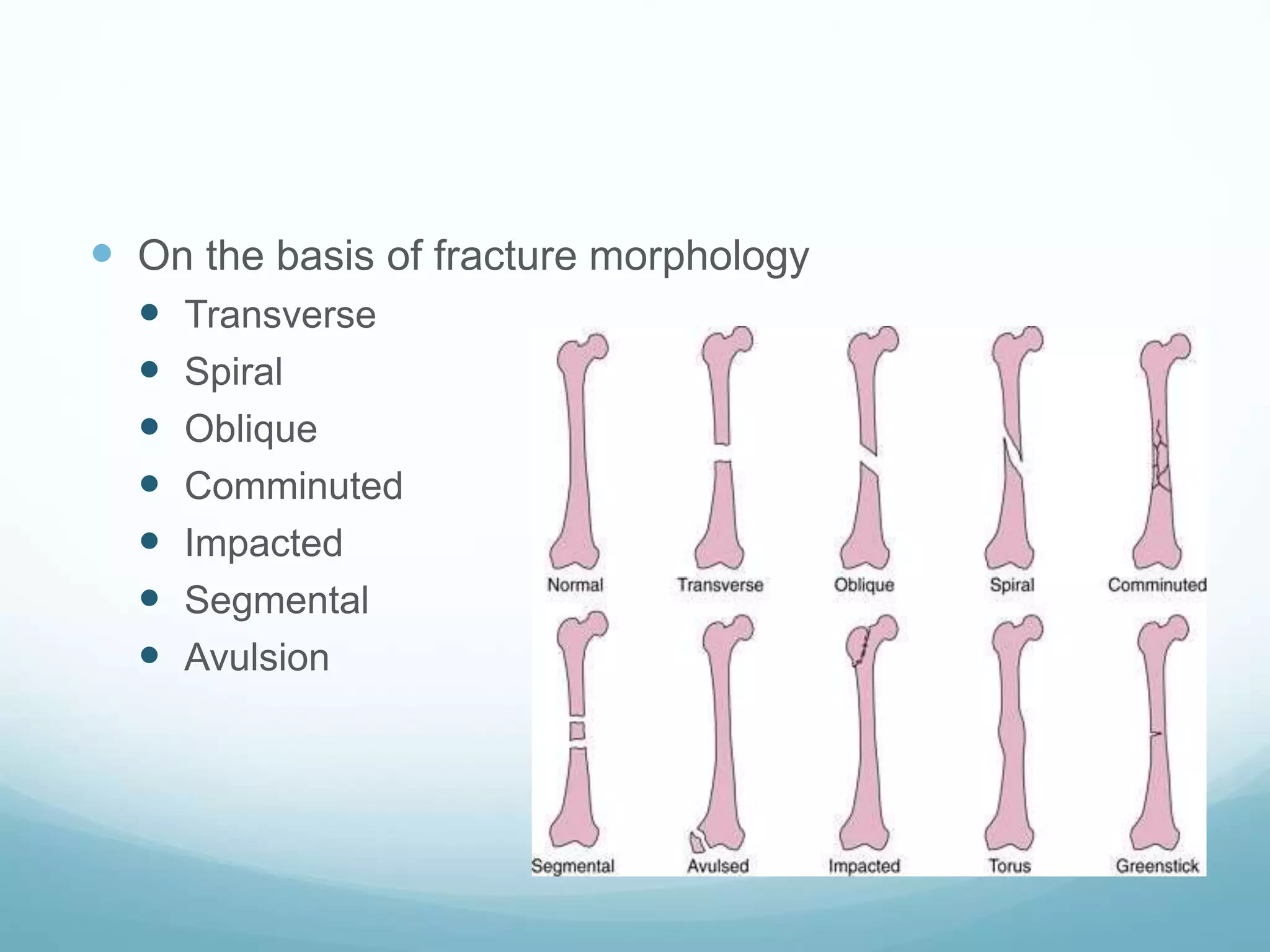
 On the basis of fracture morphology
 Transverse
 Spiral
 Oblique
 Comminuted
 Impacted
 Segmental
 Avulsion
 On the basis of stability
 Stable
 Occur when a piece of the
periosteum is intact across
the fracture
 Unstable
 Grossly displaced
 Periosteum completely torn
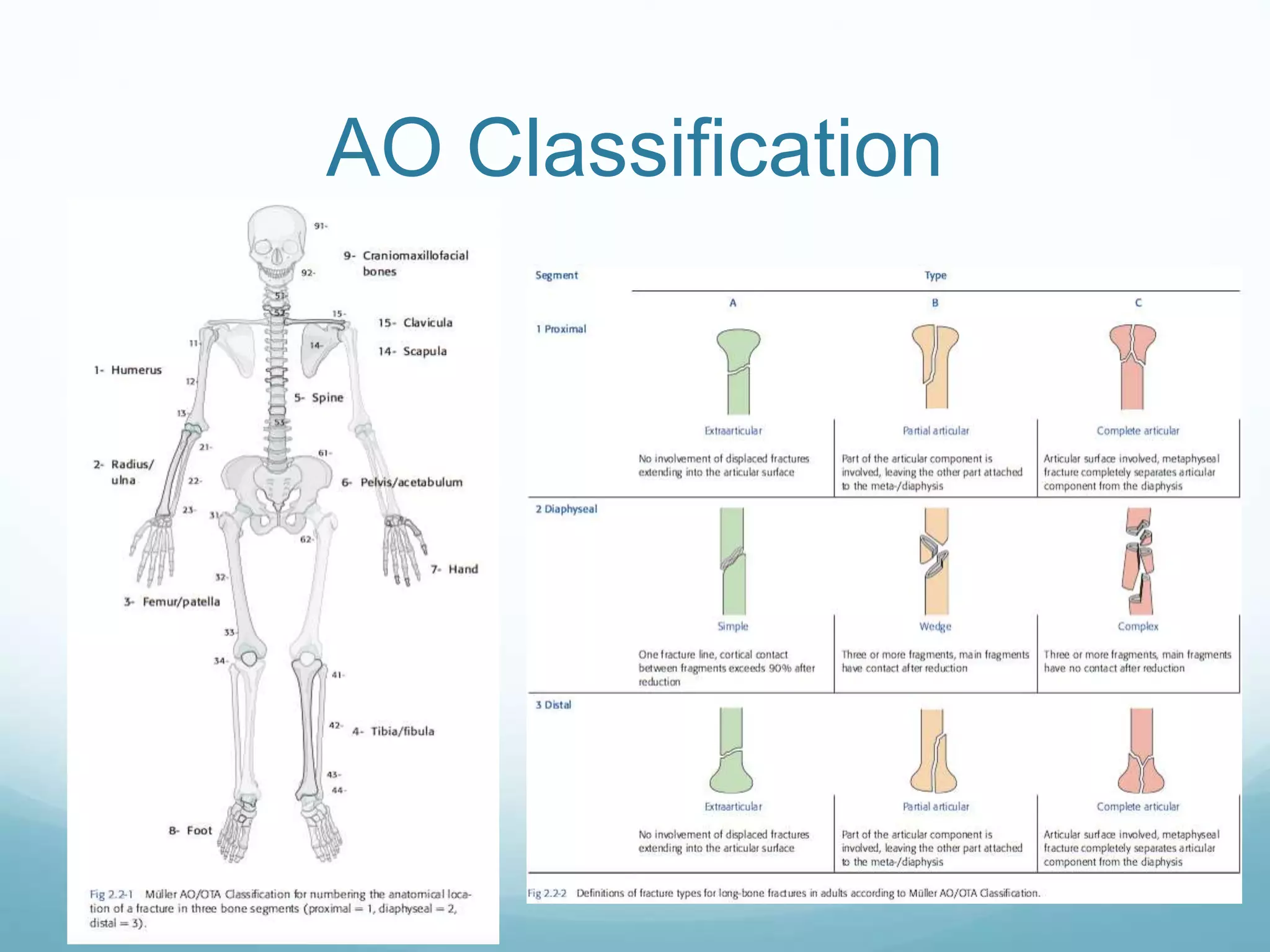
AO Classification
AO classification
Fracture Healing
 Proliferative physiological
state
 Restores the tissue to its
original physical and
mechanical properties
 Influenced by a variety of
systemic and local factors
Types of Fracture Healing
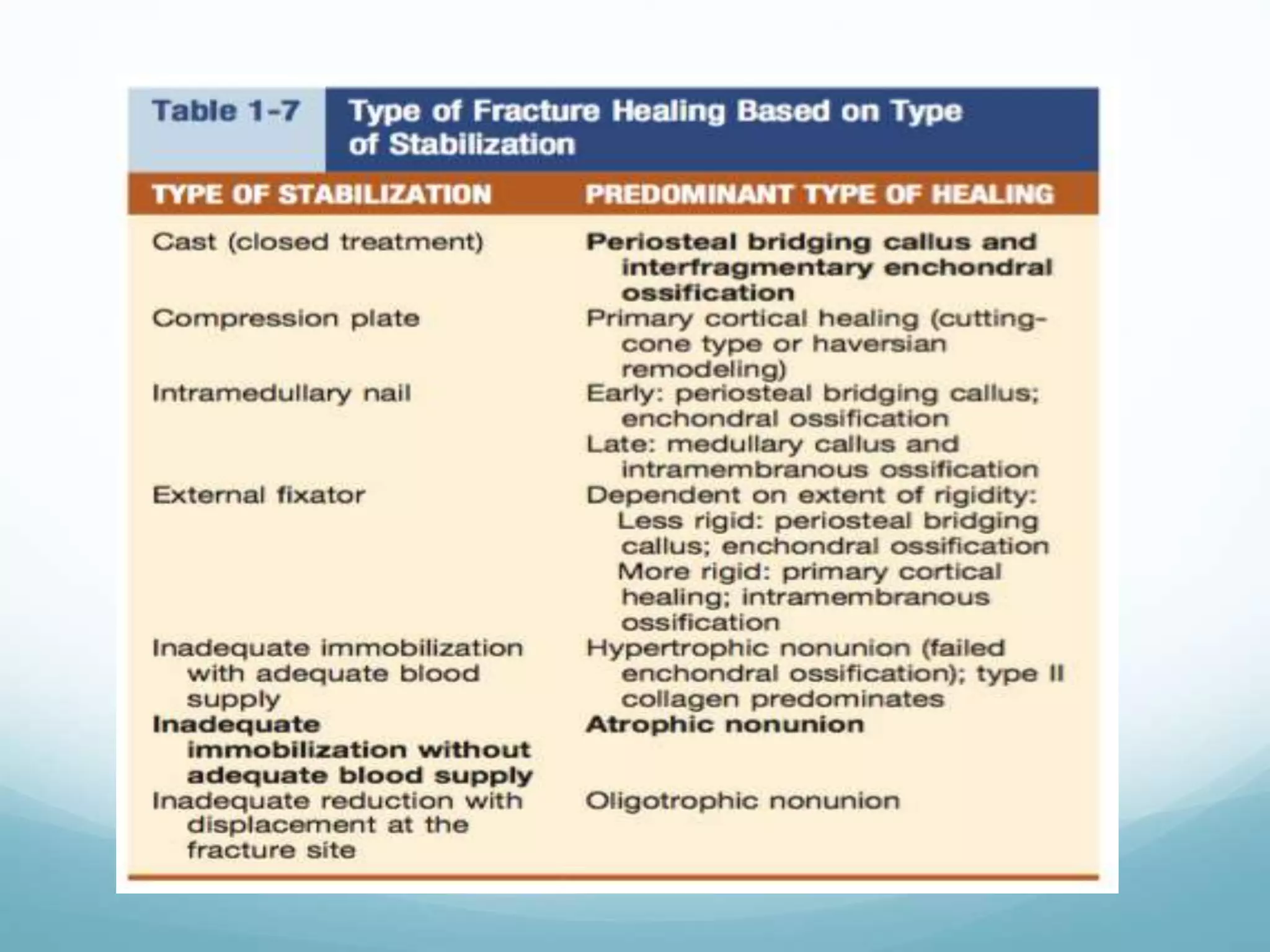
 Primary Healing (Direct)
 Secondary Healing (Indirect)
 Distraction Osteogenesis
Primary Healing
 Osteonal Healing
 Involves direct attempt by the cortex
to reestablish itself
 Gaps in reduction heal by vessel
ingrowth-mesenchymal cells-
osteoblasts-osteoclast cutting cones
 Direct contact areas heal by cutting
cones allowing passage of vessels
 Resembles normal remodelling
 Occurs only with anatomic reduction &
rigid fixation
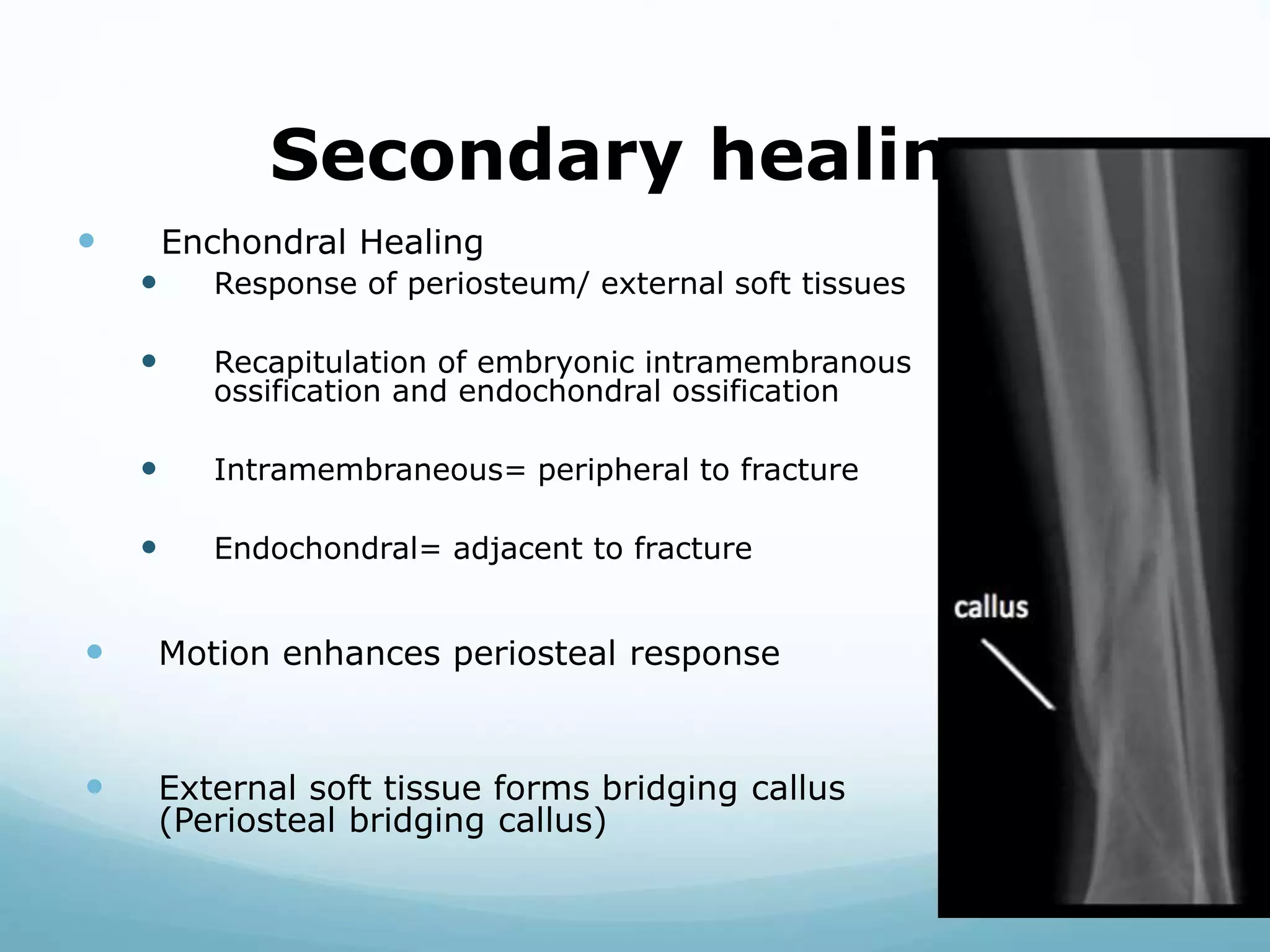
Secondary healing
 Enchondral Healing
 Response of periosteum/ external soft tissues
 Recapitulation of embryonic intramembranous
ossification and endochondral ossification
 Intramembraneous= peripheral to fracture
 Endochondral= adjacent to fracture
 Motion enhances periosteal response
 External soft tissue forms bridging callus
(Periosteal bridging callus)
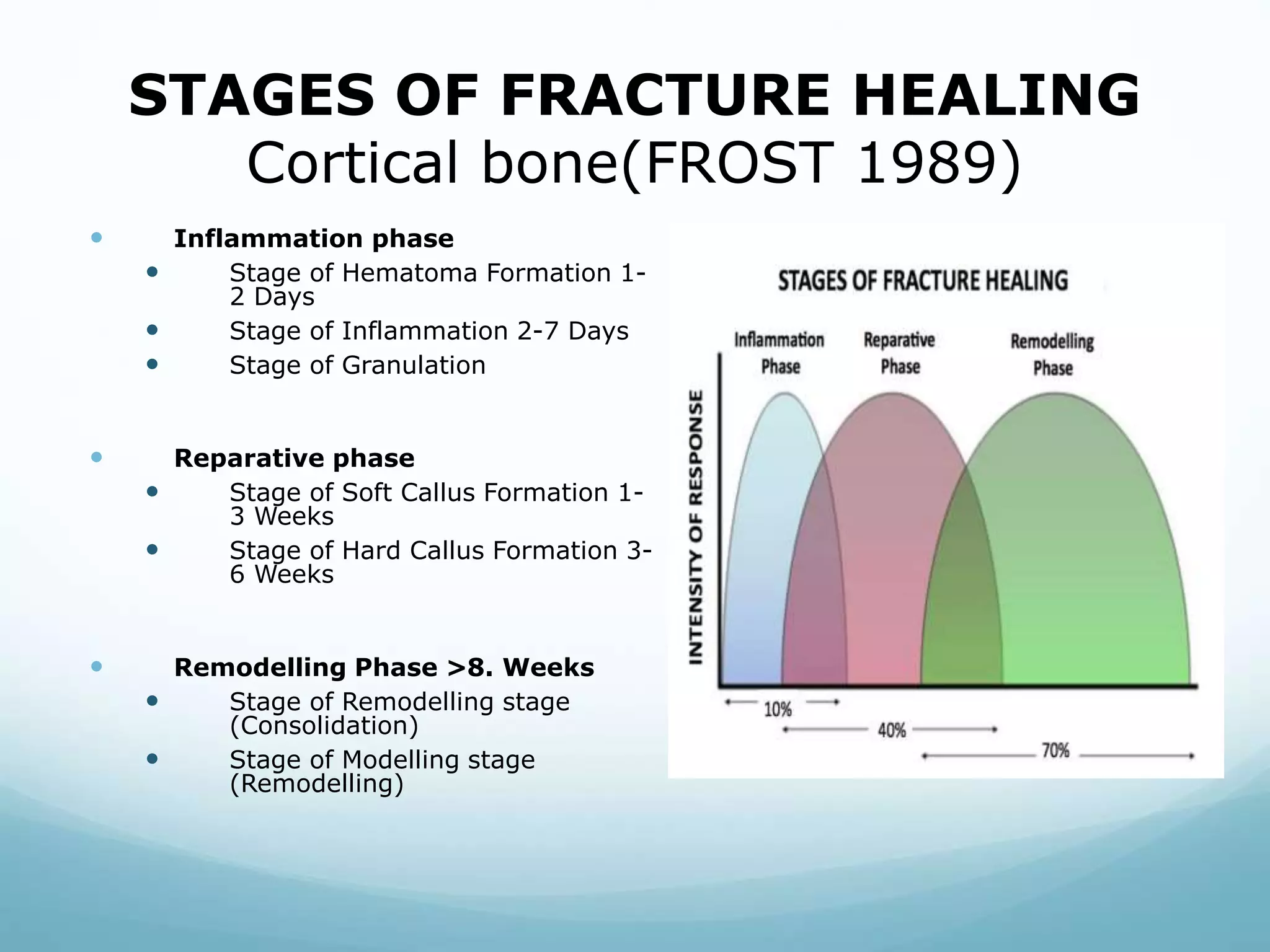
STAGES OF FRACTURE HEALING
Cortical bone(FROST 1989)
 Inflammation phase
 Stage of Hematoma Formation 1-
2 Days
 Stage of Inflammation 2-7 Days
 Stage of Granulation
 Reparative phase
 Stage of Soft Callus Formation 1-
3 Weeks
 Stage of Hard Callus Formation 3-
6 Weeks
 Remodelling Phase >8. Weeks
 Stage of Remodelling stage
(Consolidation)
 Stage of Modelling stage
(Remodelling)
Inflammation Phase
 Hematoma (fibrin clot)
 Macrophages
 Inflammatory leukocytes
 Osteoprogenitor cells
 Hematopoietic cells secrete growth factors
 Granulation tissue
Reparative phase
 Primary callus response (2 weeks)
 Inflammation triggers cell division and angiogenesis
 Chondrocytes secrete collagen and proteoglycans
 Creates fibrocartilage
 Bone formation
 Soft callus turns to hard callus (lamellar bone)
Re-modelling phase
 Begins during the middle of the repair phase
 Continues up to years
 Allows the bone to assume its normal configuration
 Wolff’s law
 The stresses on the bone is directly proportional to
remodelling
Growth Factors
 Bone Morphogenic Protein
 Osteoinductive
 Mesenchymal cells to osteoblasts
 Transforming growth factor beta
 Induces mesenchymal cells and osteoblast to produce
type II collagen
 Regulates cartilage and bone formation in fracture callus
 Insulin like growth factor II
 Promote cell proliferation and matrix synthesis by
chondrocytes and osteoblasts
 Responsible for formation of fracture callus
 Platelet derived growth factor
 Stimulate osteoblast or osteoprogenitor cell activity
 Promote bone formation
Principles of Fracture Healing
Stability and fracture Healing
 Stability determines strain
 Stain
 Strain is defined as change in fracture gap divided by the fracture gap (ΔL/L)
 Highest fracture site strain is seen in a simple fracture
 Stability
 Absolute stability
 Relative stability
 Strain determines type of healing
 Strain less than 2% results in primary bone healing (endosteal healing).
 Strain 2% to 10% results in secondary bone healing (enchondral ossi cation).
 Strain greater than 10% does not permit bone formation.
The End!!!

Fracture , classification and healing

  • 1.
    Fracture, classification and Fracturehealing Dr Dipendra Maharjan
  • 2.
    What do yousee??? Fig. A Fig. B
  • 3.
    Fracture  A disruptionor break in the continuity of the structure of bone  Traumatic injuries account for the majority of fractures
  • 4.
    How does afracture occur?  Results from  Injury  Direct (soft tissue injury is common)  Indirect  Twisting  Compression  Bending  tension  Repetitive stress  Abnormal weakening
  • 5.
    Classification of fracture On the basis of etiology  On the basis of displacement  On the basis of communication with external environment  On the basis of site of fracture  On the basis of fracture morphology  On the basis of stability
  • 6.
    ‘  On thebasis of etiology  Traumatic  Atraumatic  Pathological  Stress fracture  Insufficiency fracture Stress Fracture Pathological Fracture Insufficiency Fracture Traumatic Fracture
  • 7.
    Un-displaced Fracture  Onthe basis of displacement  Un-displaced  Displaced  Translation  Angulation  Rotation  Length Displaced Fracture
  • 8.
     On thebasis of communication with external environment  Closed Fracture  Open Fracture
  • 9.
     On thebasis of site of fracture  Epiphyseal fracture  Metaphyseal  Diaphyseal  Upper third  Middle third  Lower third  Junctional
  • 10.
     On thebasis of fracture morphology  Transverse  Spiral  Oblique  Comminuted  Impacted  Segmental  Avulsion
  • 11.
     On thebasis of stability  Stable  Occur when a piece of the periosteum is intact across the fracture  Unstable  Grossly displaced  Periosteum completely torn
  • 12.
  • 13.
  • 14.
    Fracture Healing  Proliferativephysiological state  Restores the tissue to its original physical and mechanical properties  Influenced by a variety of systemic and local factors
  • 15.
    Types of FractureHealing  Primary Healing (Direct)  Secondary Healing (Indirect)  Distraction Osteogenesis
  • 16.
    Primary Healing  OsteonalHealing  Involves direct attempt by the cortex to reestablish itself  Gaps in reduction heal by vessel ingrowth-mesenchymal cells- osteoblasts-osteoclast cutting cones  Direct contact areas heal by cutting cones allowing passage of vessels  Resembles normal remodelling  Occurs only with anatomic reduction & rigid fixation
  • 17.
    Secondary healing  EnchondralHealing  Response of periosteum/ external soft tissues  Recapitulation of embryonic intramembranous ossification and endochondral ossification  Intramembraneous= peripheral to fracture  Endochondral= adjacent to fracture  Motion enhances periosteal response  External soft tissue forms bridging callus (Periosteal bridging callus)
  • 18.
    STAGES OF FRACTUREHEALING Cortical bone(FROST 1989)  Inflammation phase  Stage of Hematoma Formation 1- 2 Days  Stage of Inflammation 2-7 Days  Stage of Granulation  Reparative phase  Stage of Soft Callus Formation 1- 3 Weeks  Stage of Hard Callus Formation 3- 6 Weeks  Remodelling Phase >8. Weeks  Stage of Remodelling stage (Consolidation)  Stage of Modelling stage (Remodelling)
  • 19.
    Inflammation Phase  Hematoma(fibrin clot)  Macrophages  Inflammatory leukocytes  Osteoprogenitor cells  Hematopoietic cells secrete growth factors  Granulation tissue
  • 20.
    Reparative phase  Primarycallus response (2 weeks)  Inflammation triggers cell division and angiogenesis  Chondrocytes secrete collagen and proteoglycans  Creates fibrocartilage  Bone formation  Soft callus turns to hard callus (lamellar bone)
  • 21.
    Re-modelling phase  Beginsduring the middle of the repair phase  Continues up to years  Allows the bone to assume its normal configuration  Wolff’s law  The stresses on the bone is directly proportional to remodelling
  • 22.
    Growth Factors  BoneMorphogenic Protein  Osteoinductive  Mesenchymal cells to osteoblasts  Transforming growth factor beta  Induces mesenchymal cells and osteoblast to produce type II collagen  Regulates cartilage and bone formation in fracture callus
  • 23.
     Insulin likegrowth factor II  Promote cell proliferation and matrix synthesis by chondrocytes and osteoblasts  Responsible for formation of fracture callus  Platelet derived growth factor  Stimulate osteoblast or osteoprogenitor cell activity  Promote bone formation
  • 24.
  • 25.
    Stability and fractureHealing  Stability determines strain  Stain  Strain is defined as change in fracture gap divided by the fracture gap (ΔL/L)  Highest fracture site strain is seen in a simple fracture  Stability  Absolute stability  Relative stability  Strain determines type of healing  Strain less than 2% results in primary bone healing (endosteal healing).  Strain 2% to 10% results in secondary bone healing (enchondral ossi cation).  Strain greater than 10% does not permit bone formation.
  • 28.