Fracture around elbow and hand
Maj. Dr. Dipendra Maharjan
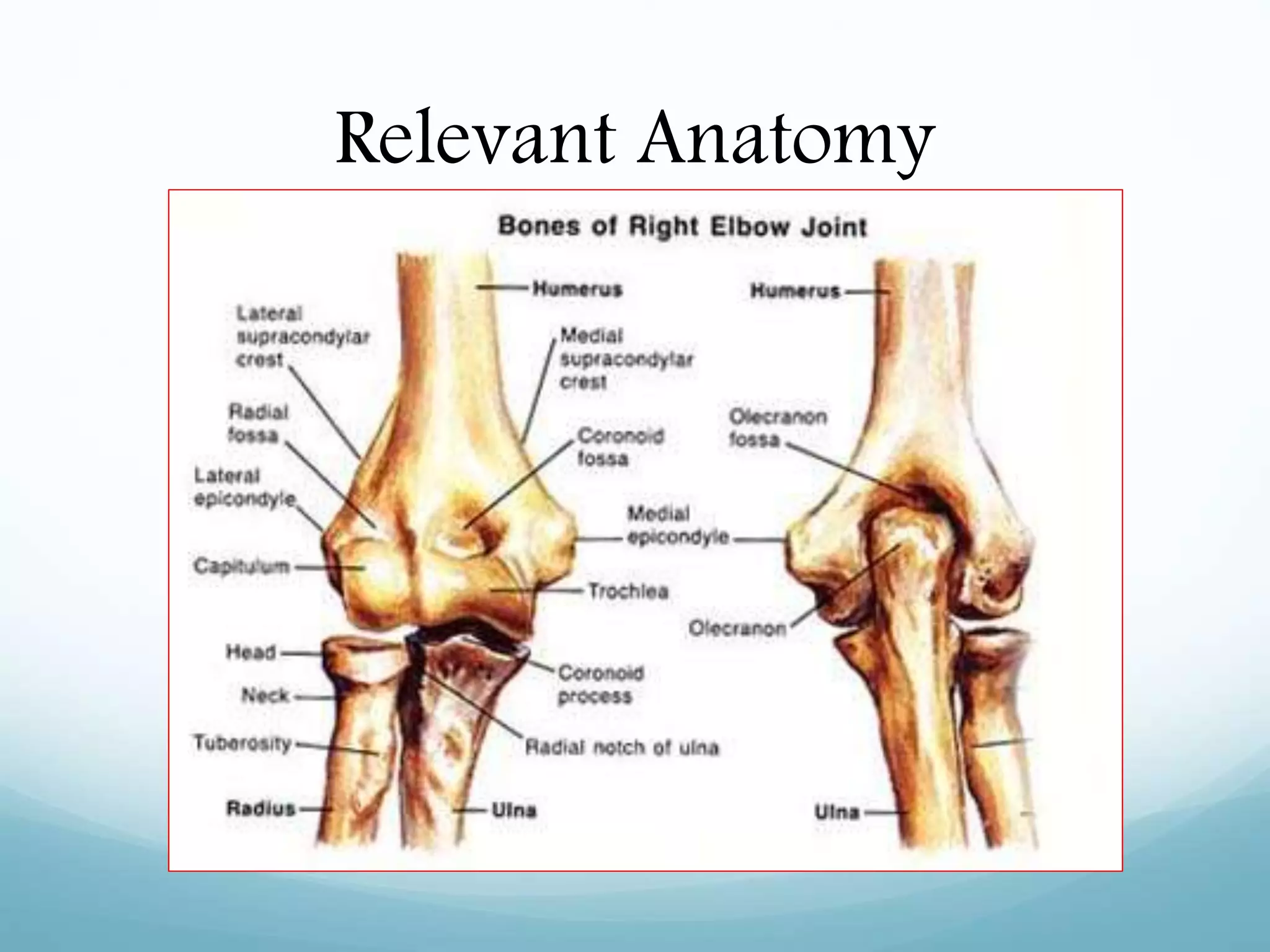
Relevant Anatomy
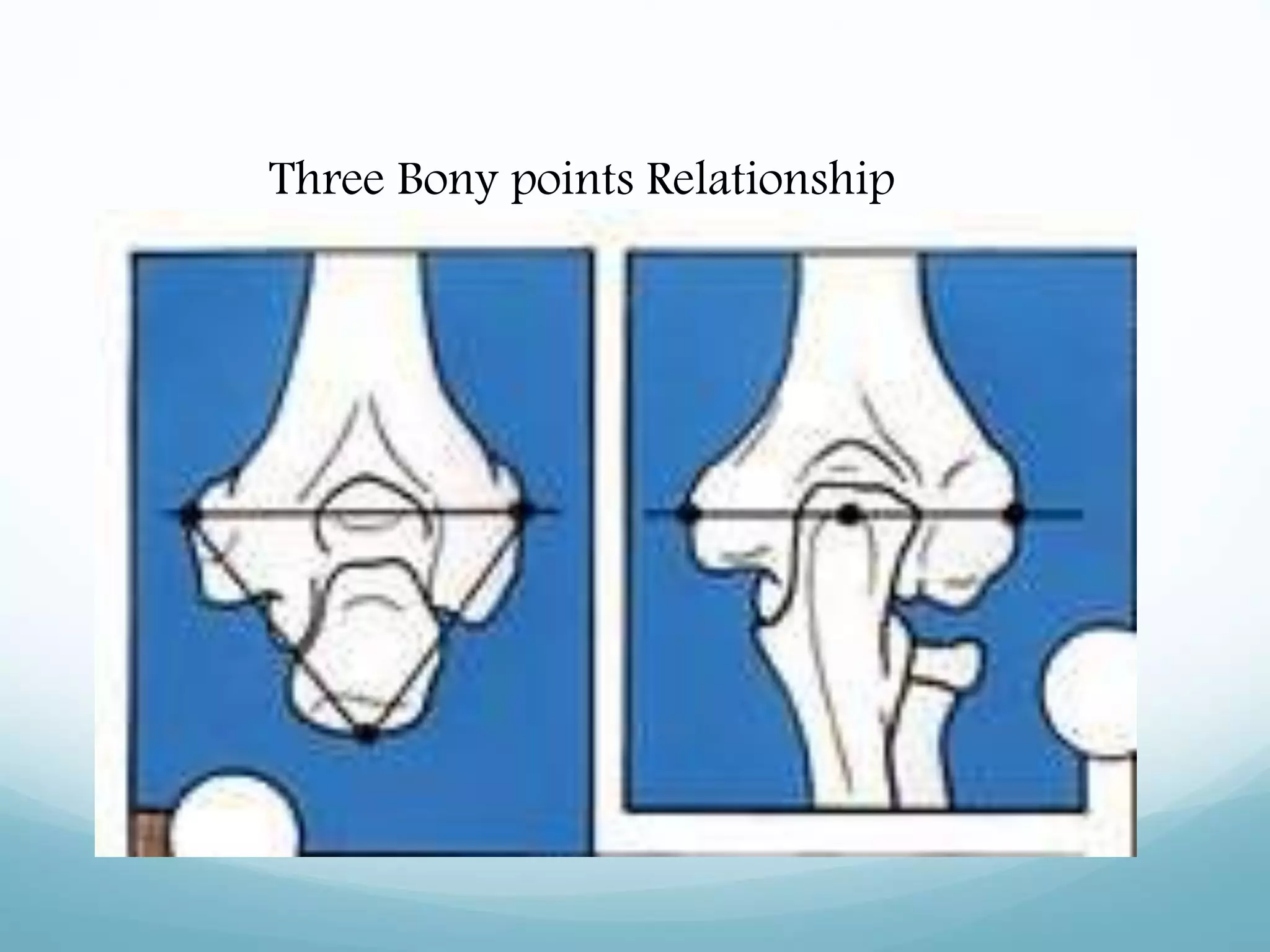
Three Bony points Relationship
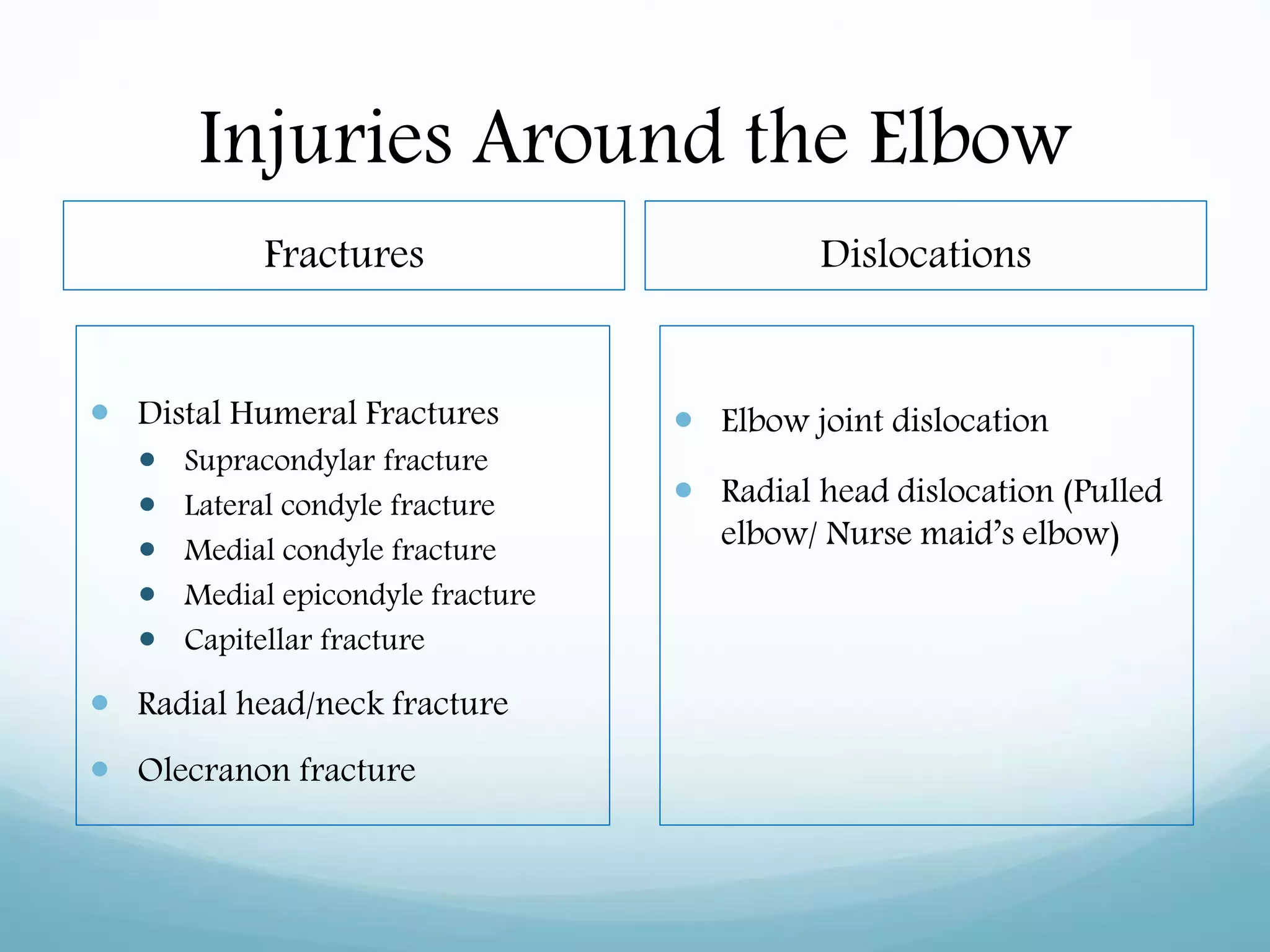
Injuries Around the Elbow
Fractures
 Distal Humeral Fractures
 Supracondylar fracture
 Lateral condyle fracture
 Medial condyle fracture
 Medial epicondyle fracture
 Capitellar fracture
 Radial head/neck fracture
 Olecranon fracture
Dislocations
 Elbow joint dislocation
 Radial head dislocation (Pulled
elbow/ Nurse maid’s elbow)
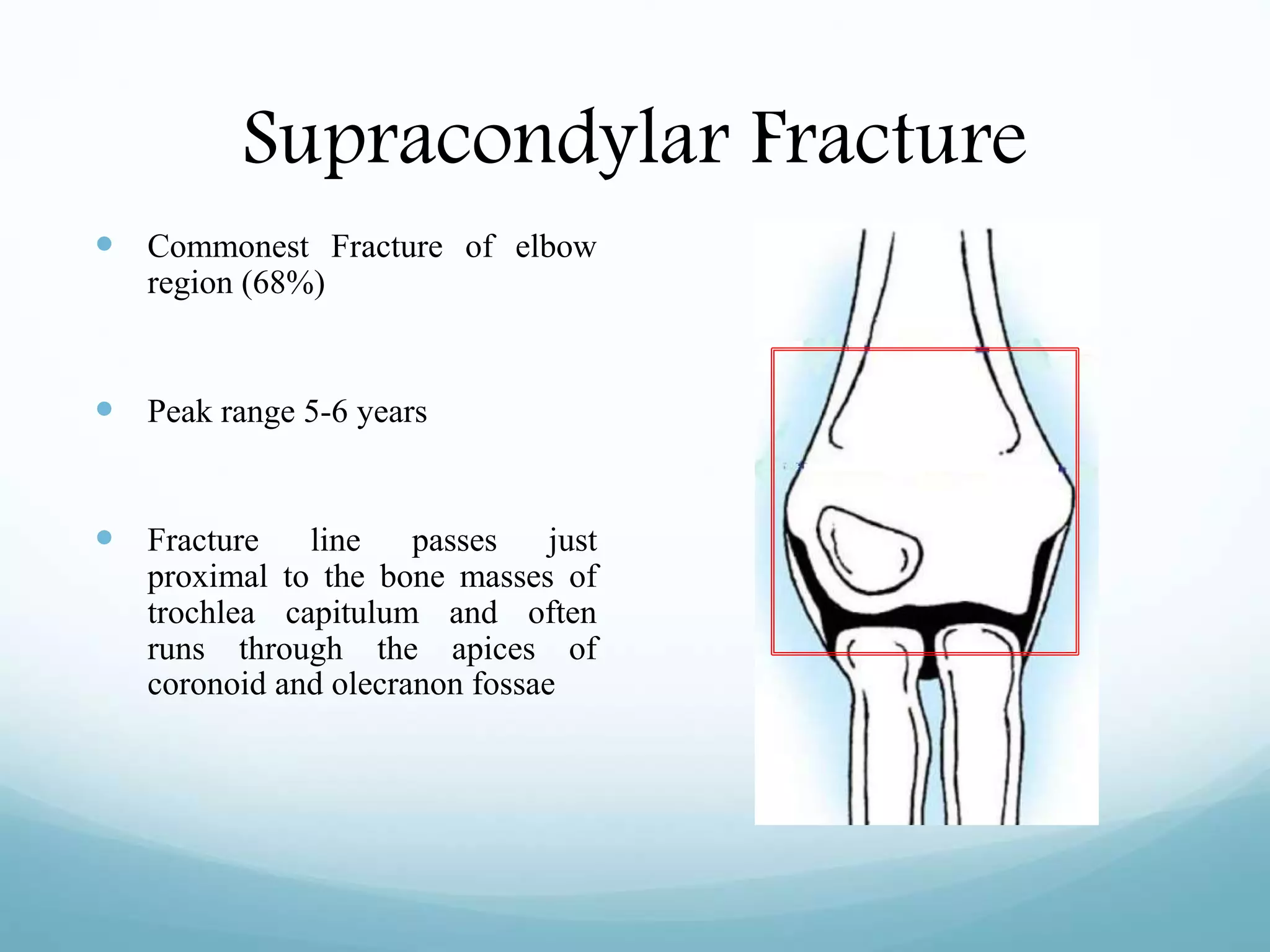
Supracondylar Fracture
 Commonest Fracture of elbow
region (68%)
 Peak range 5-6 years
 Fracture line passes just
proximal to the bone masses of
trochlea capitulum and often
runs through the apices of
coronoid and olecranon fossae
Why common in children?
 Bony architecture at the supracondylar region is weak and
vulnerable because:
 Bone is remodelling
 It is less cylindrical
 Metaphysis is just distal to 2 fossae, coronoid and radial fossa
 Here the cortex is thin
 Anterior cortex has a defect in the area of coronoid fossa
 Laxity of ligaments permits hyperextension at the elbow
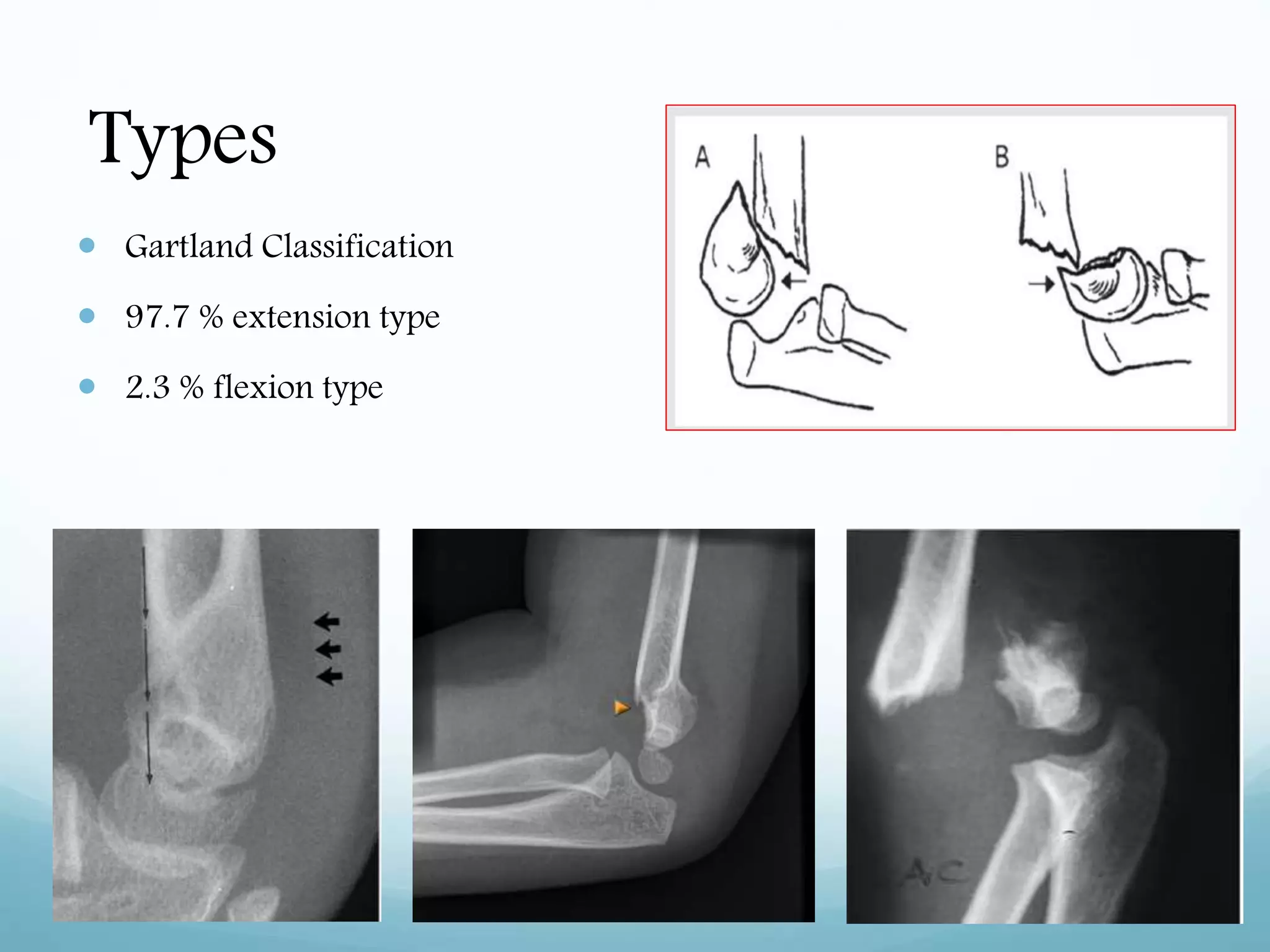
Types
 Gartland Classification
 97.7 % extension type
 2.3 % flexion type
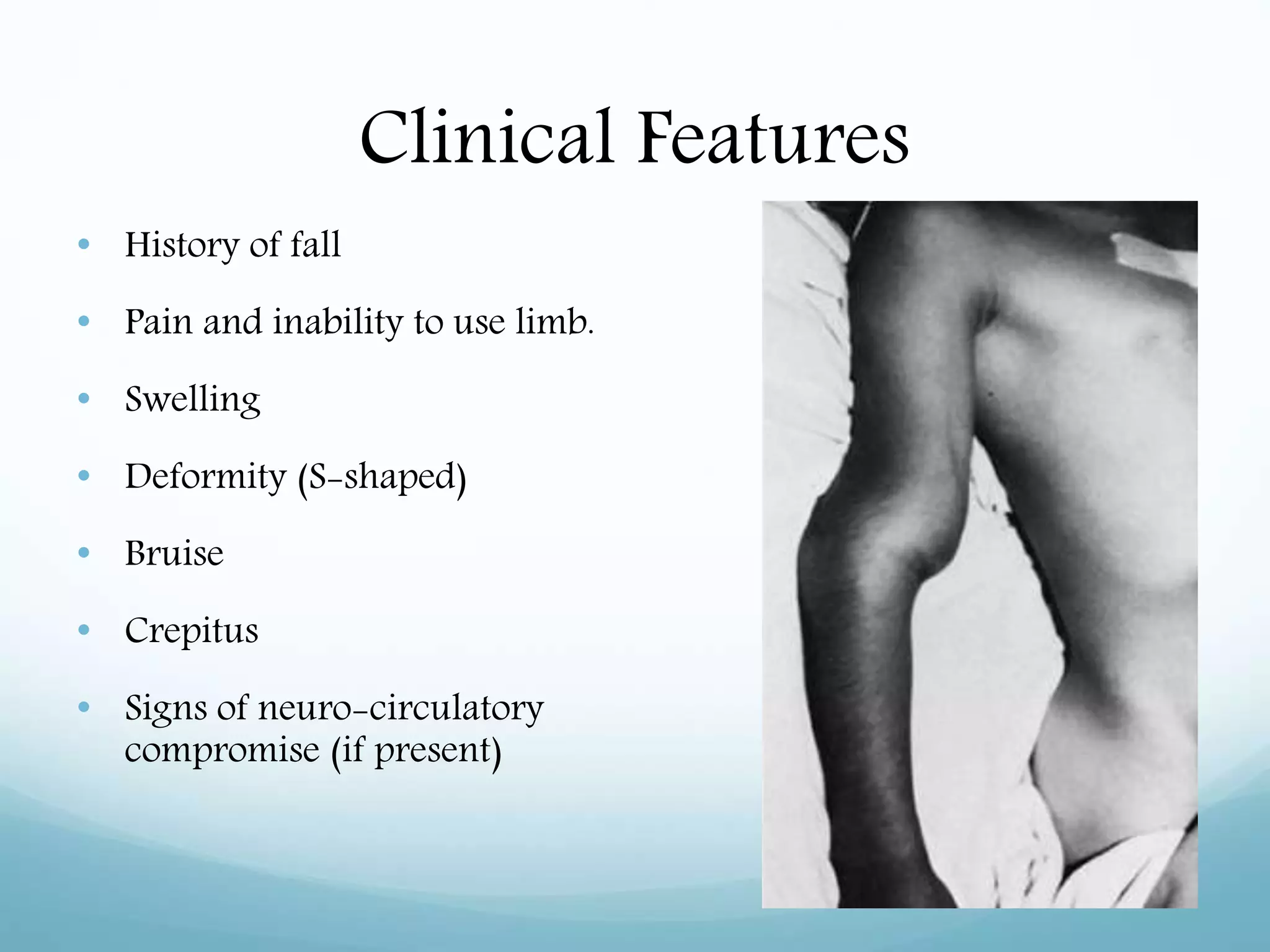
Clinical Features
• History of fall
• Pain and inability to use limb.
• Swelling
• Deformity (S-shaped)
• Bruise
• Crepitus
• Signs of neuro-circulatory
compromise (if present)
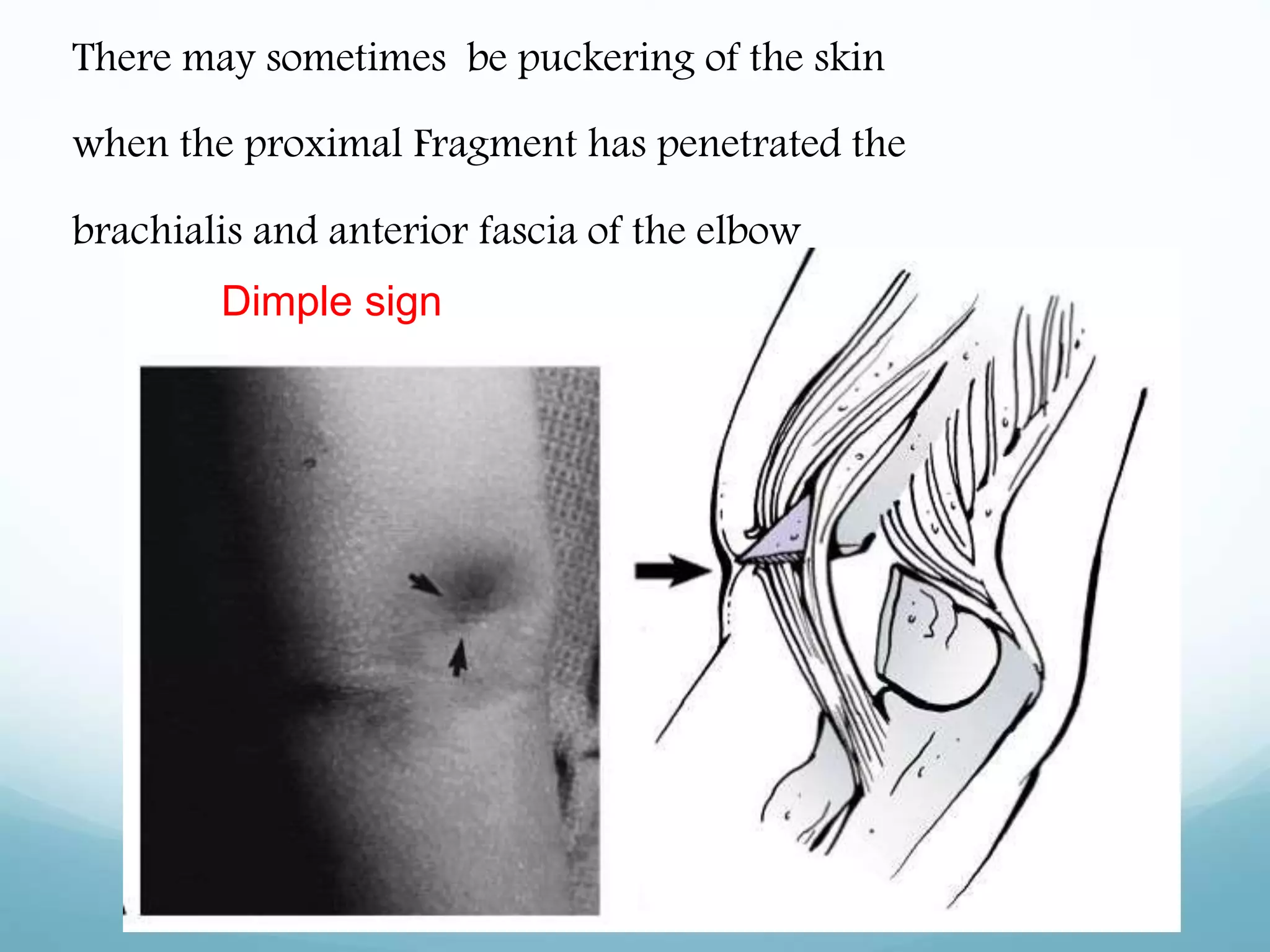
There may sometimes be puckering of the skin
when the proximal Fragment has penetrated the
brachialis and anterior fascia of the elbow
Dimple sign
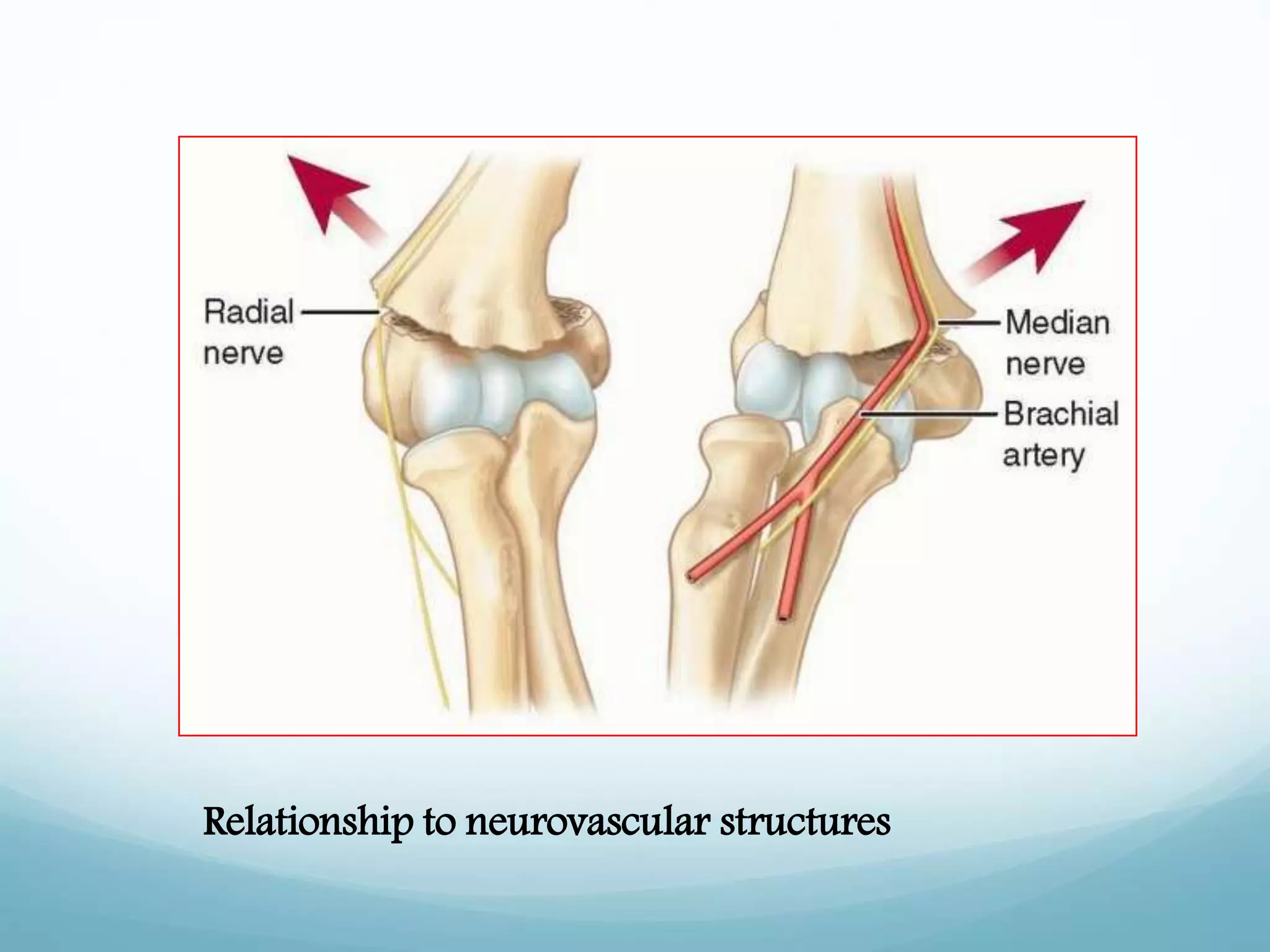
Relationship to neurovascular structures
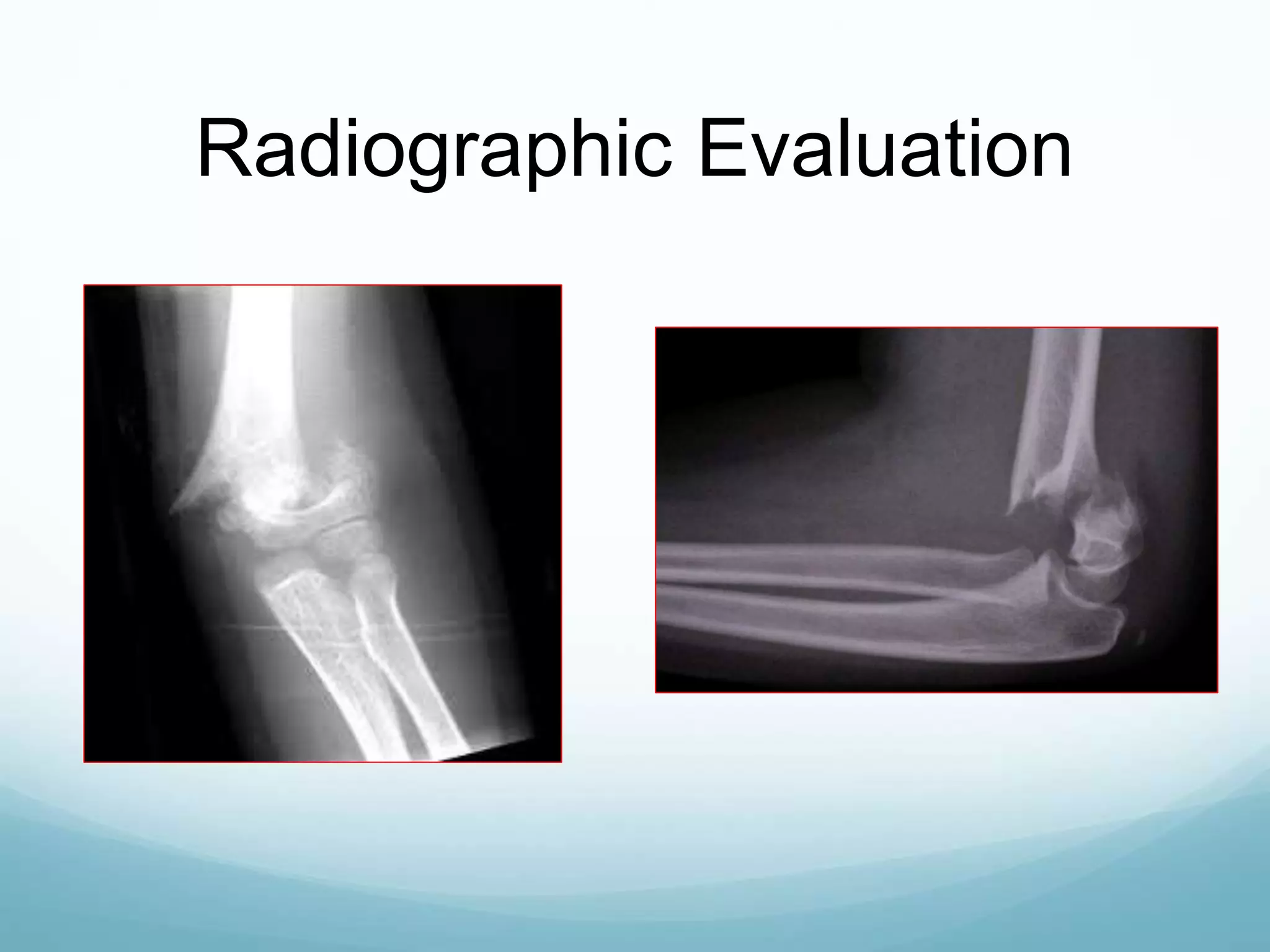
Radiographic Evaluation
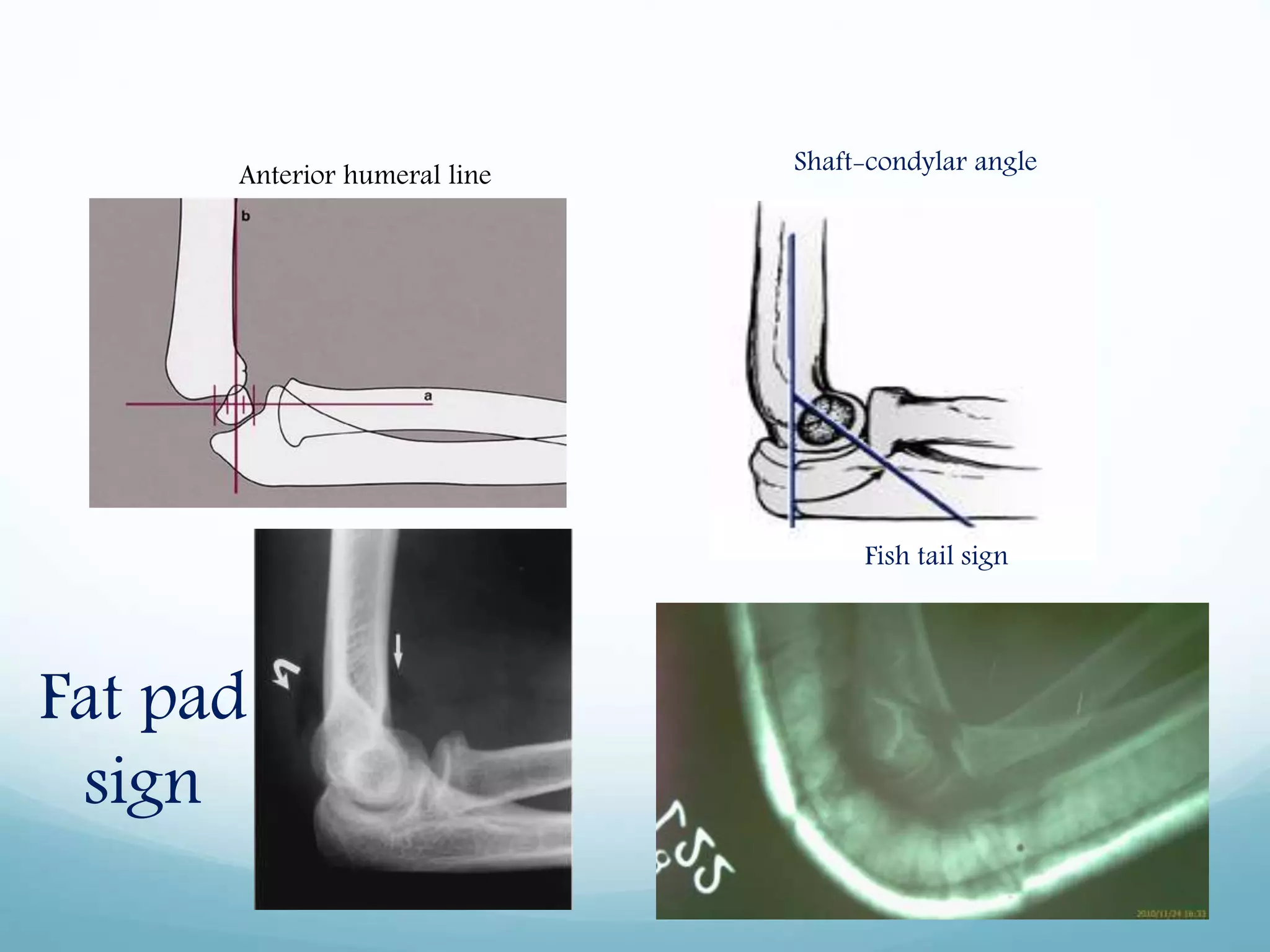
Anterior humeral line Shaft-condylar angle
Fat pad
sign
Fish tail sign
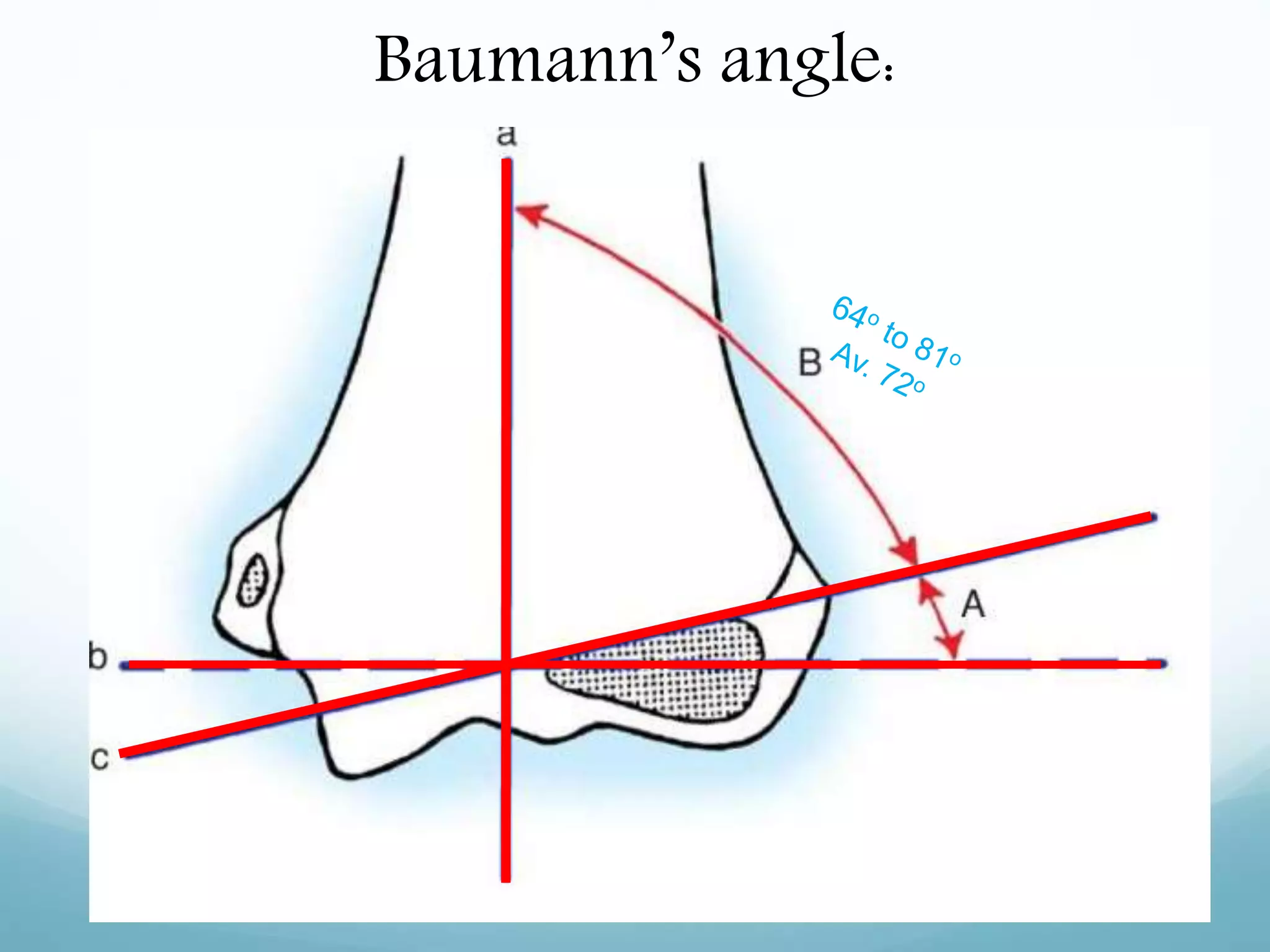
Baumann’s angle:
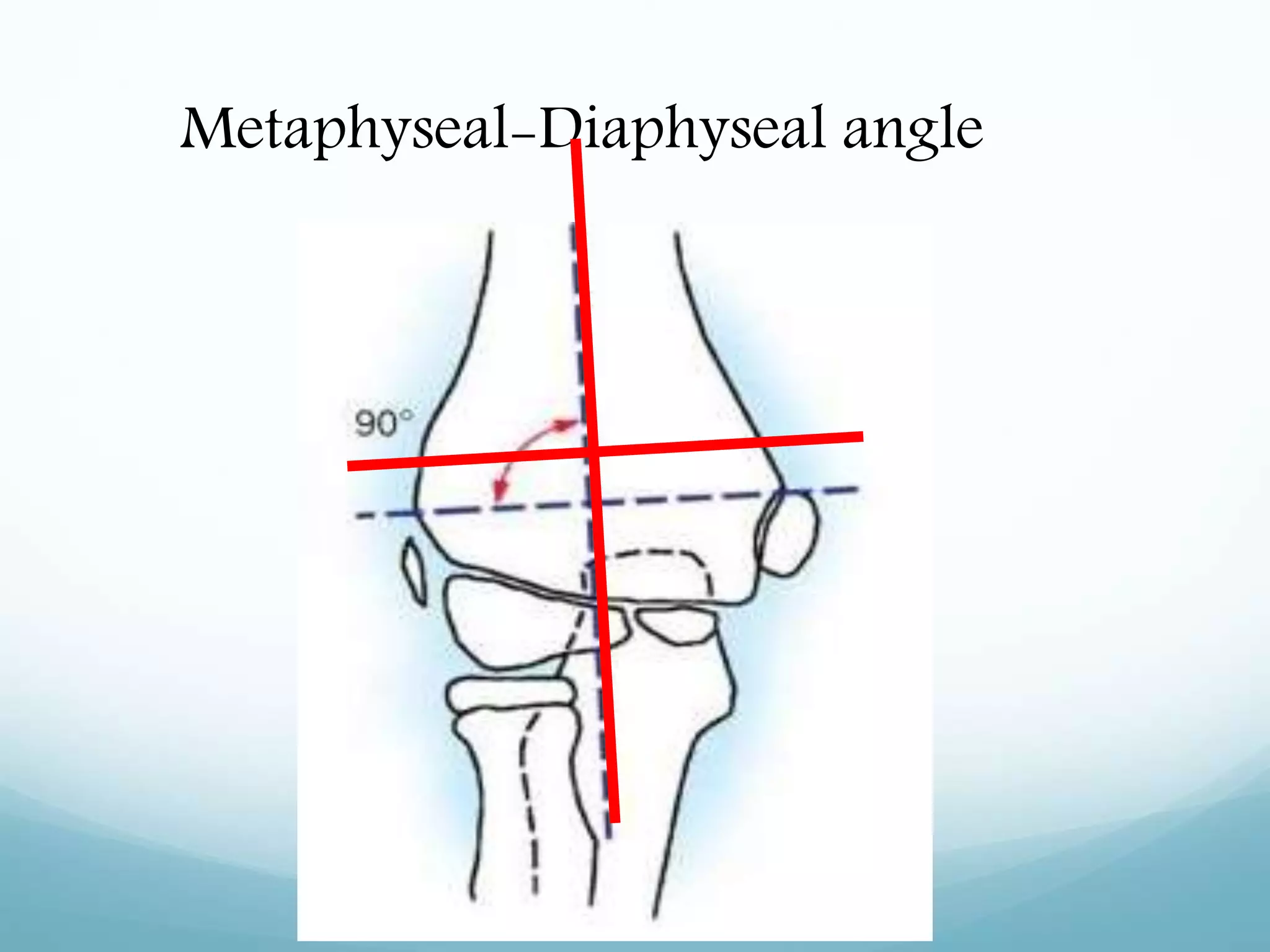
Metaphyseal-Diaphyseal angle
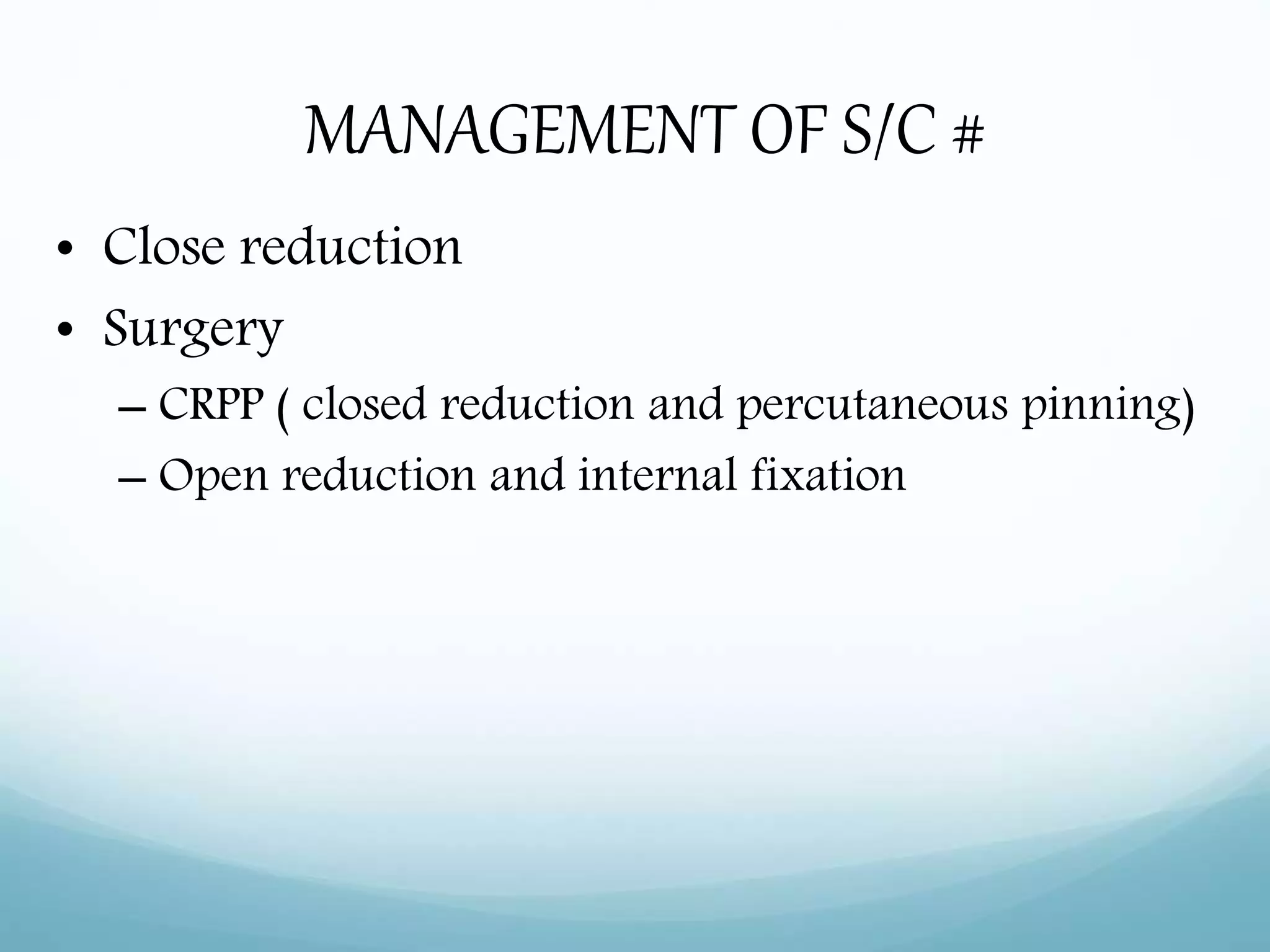
MANAGEMENT OF S/C #
• Close reduction
• Surgery
– CRPP ( closed reduction and percutaneous pinning)
– Open reduction and internal fixation
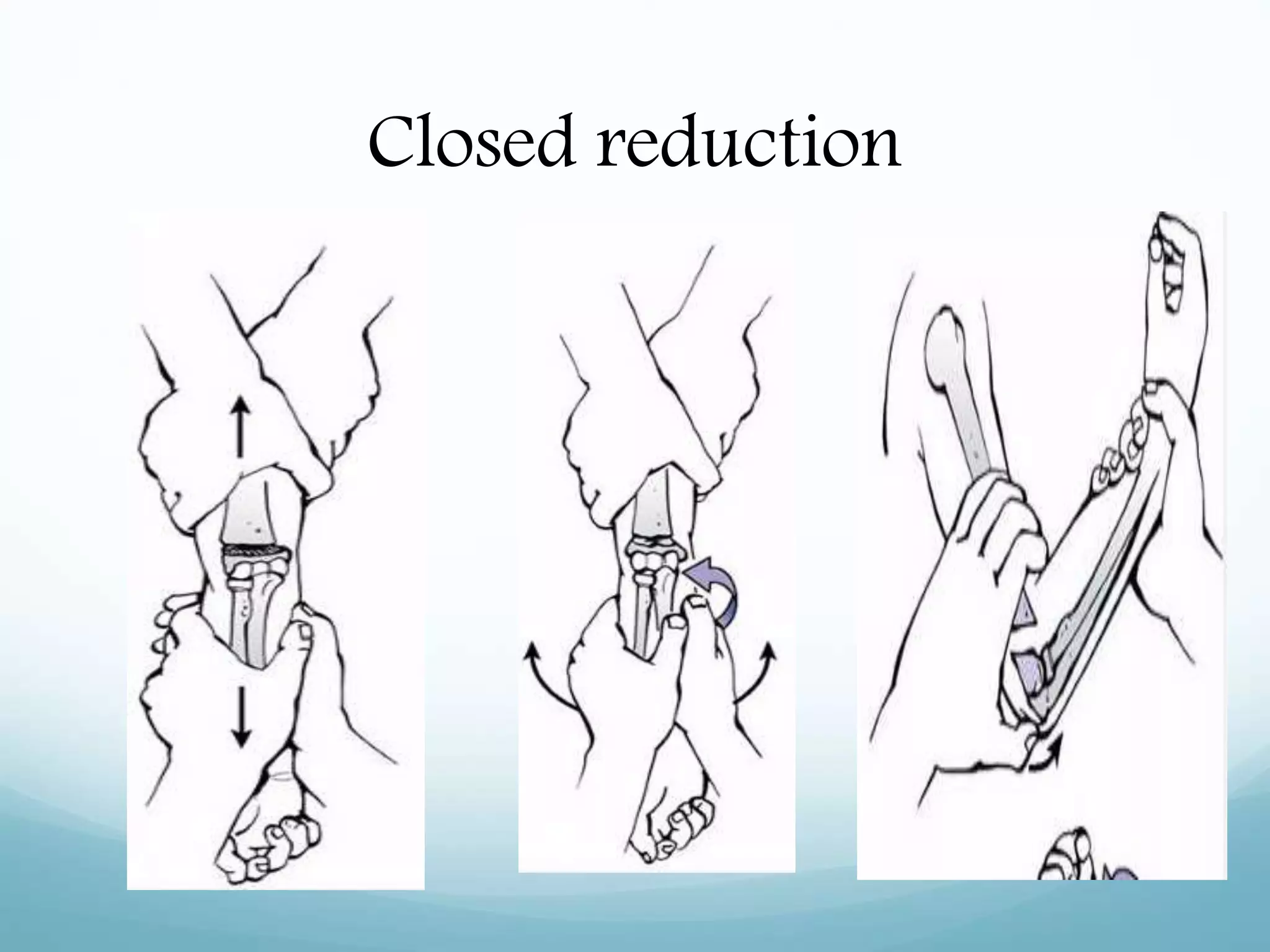
Closed reduction
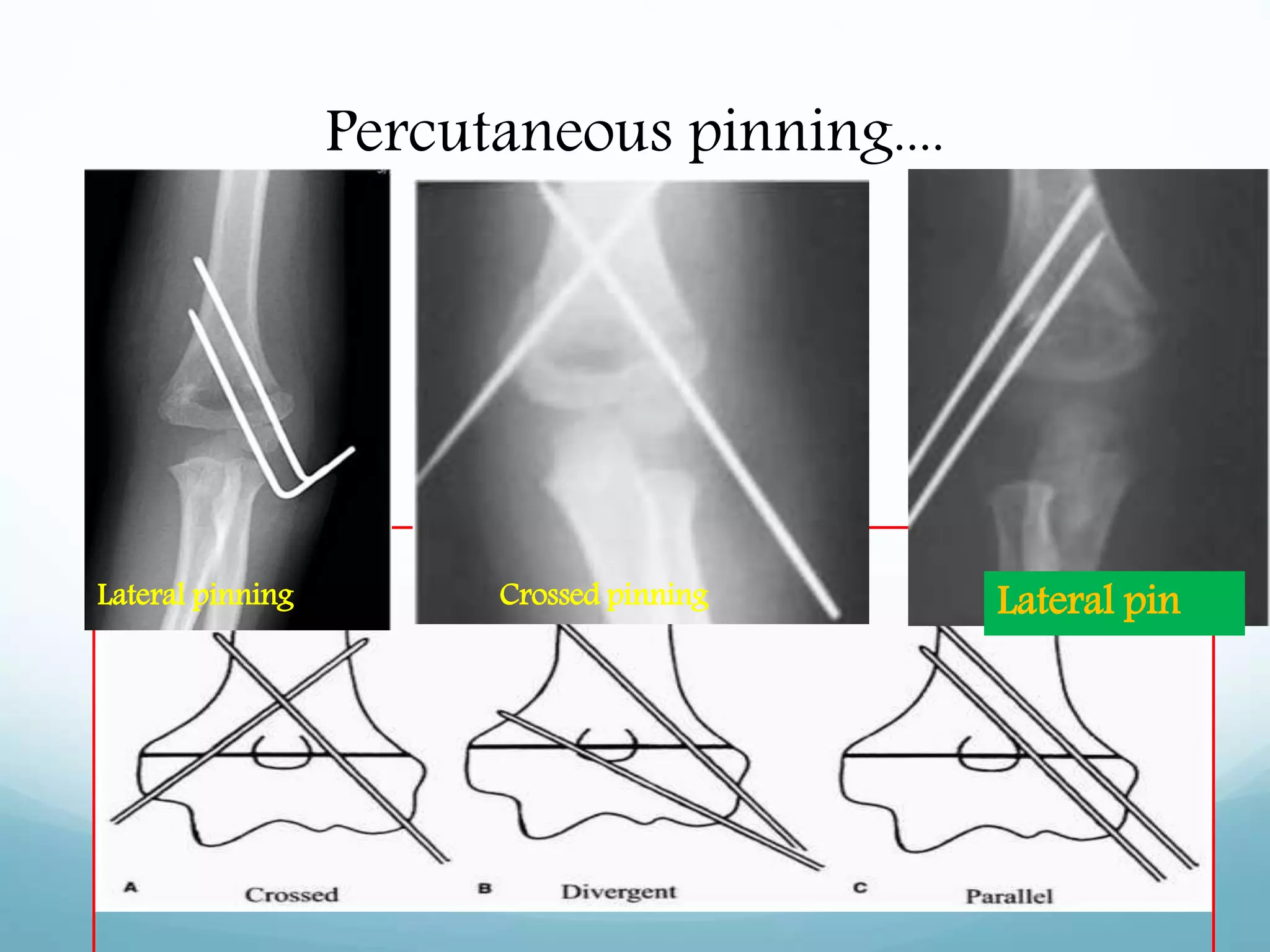
Percutaneous pinning
 Before the development of the fluoroscopic unit, blind
pinning was performed
 Modern imaging techniques and improved power
equipment have made percutaneous pinning the standard
treatment.
Percutaneous pinning....
Lateral pinning Crossed pinning Lateral pin
ORIF
Indications of ORIF
 Closed reduction may not be possible because of interposed soft tissue or
neurovascular bundle.
 When there is gross swelling of elbow so that hyperflexion is not possible
after reduction.
 Injury to neurovascular bundle
 After open reduction of the fracture, fixed with pins.
 Good callus should be observed at the fracture before pin removal,
generally 3 to 4 weeks after injury.
 The most frequent complication of surgical management appears to be a
loss of range of motion.
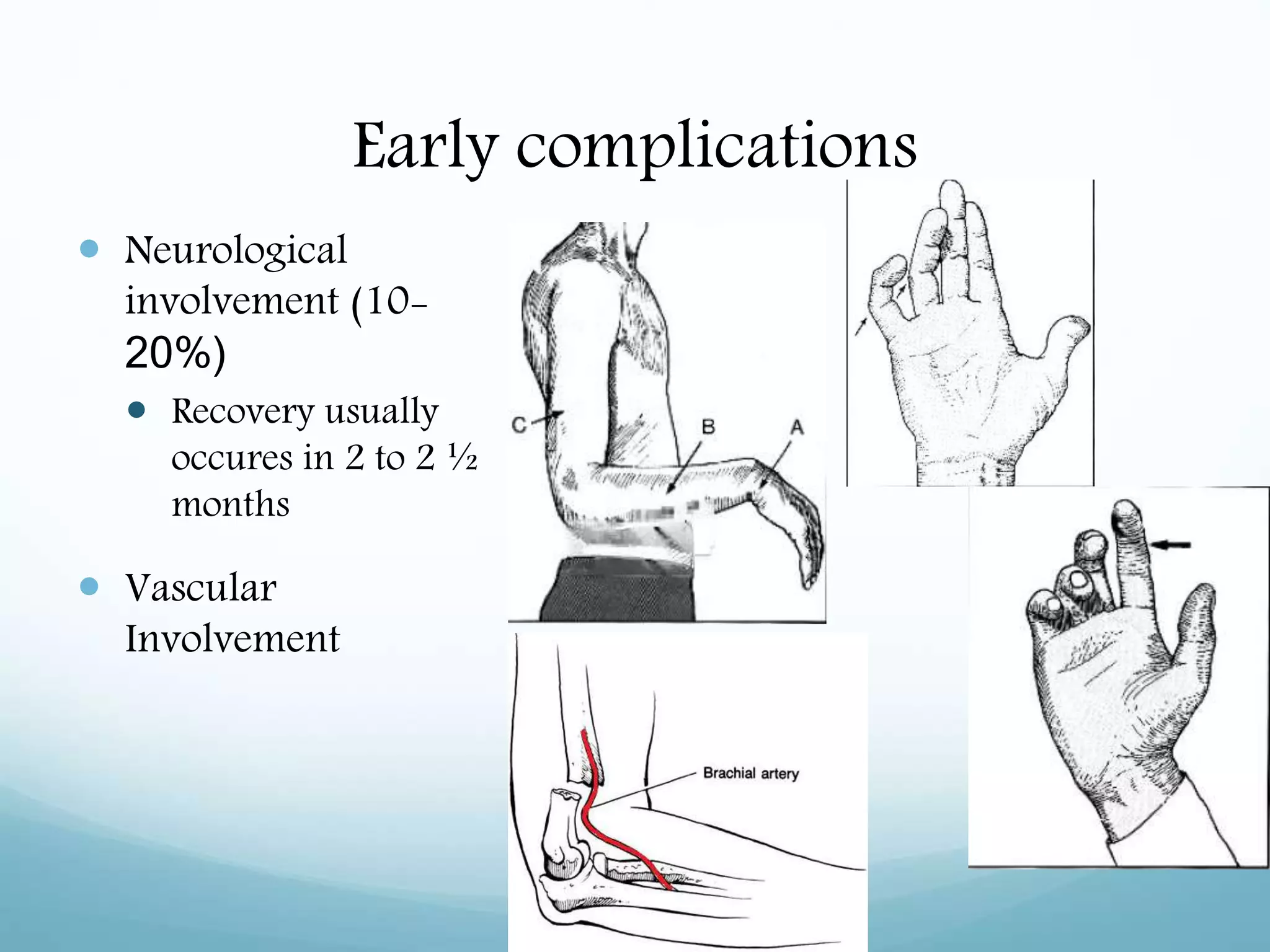
Early complications
 Neurological
involvement (10-
20%)
 Recovery usually
occures in 2 to 2 ½
months
 Vascular
Involvement
 Physeal damage due to repeated manipulation
 Compartment syndrome (1%)
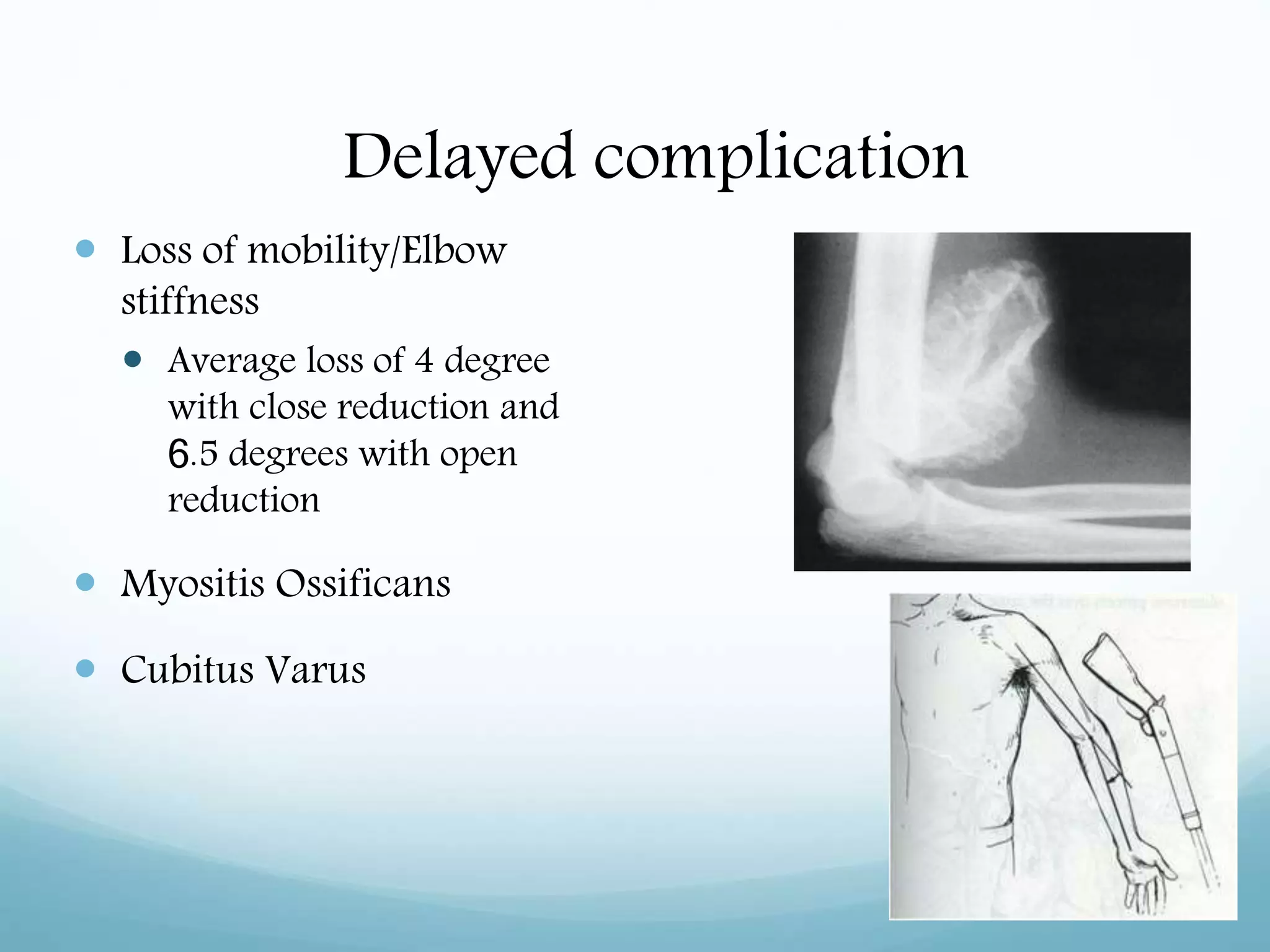
Delayed complication
 Loss of mobility/Elbow
stiffness
 Average loss of 4 degree
with close reduction and
6.5 degrees with open
reduction
 Myositis Ossificans
 Cubitus Varus
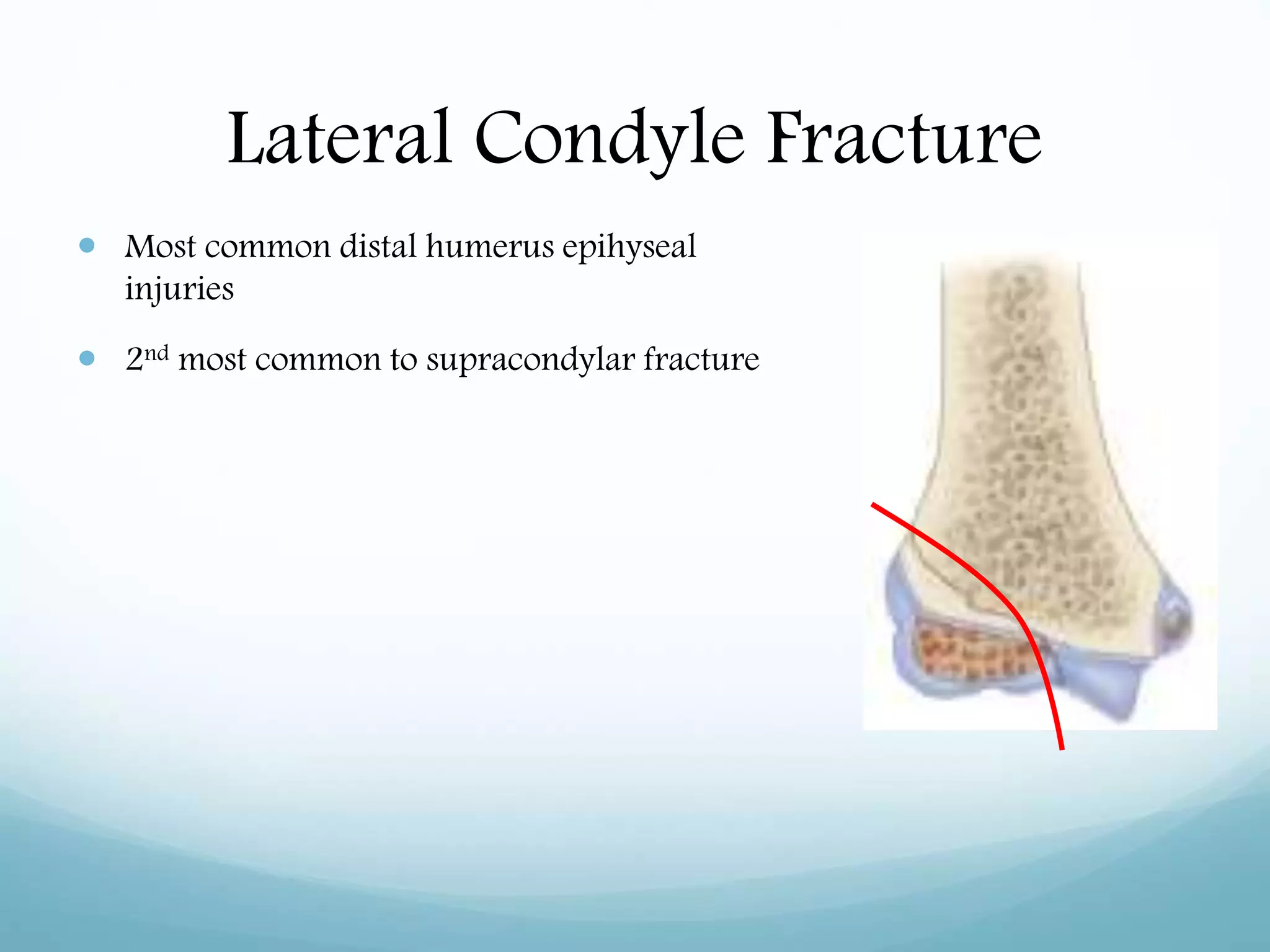
Lateral Condyle Fracture
 Most common distal humerus epihyseal
injuries
 2nd most common to supracondylar fracture
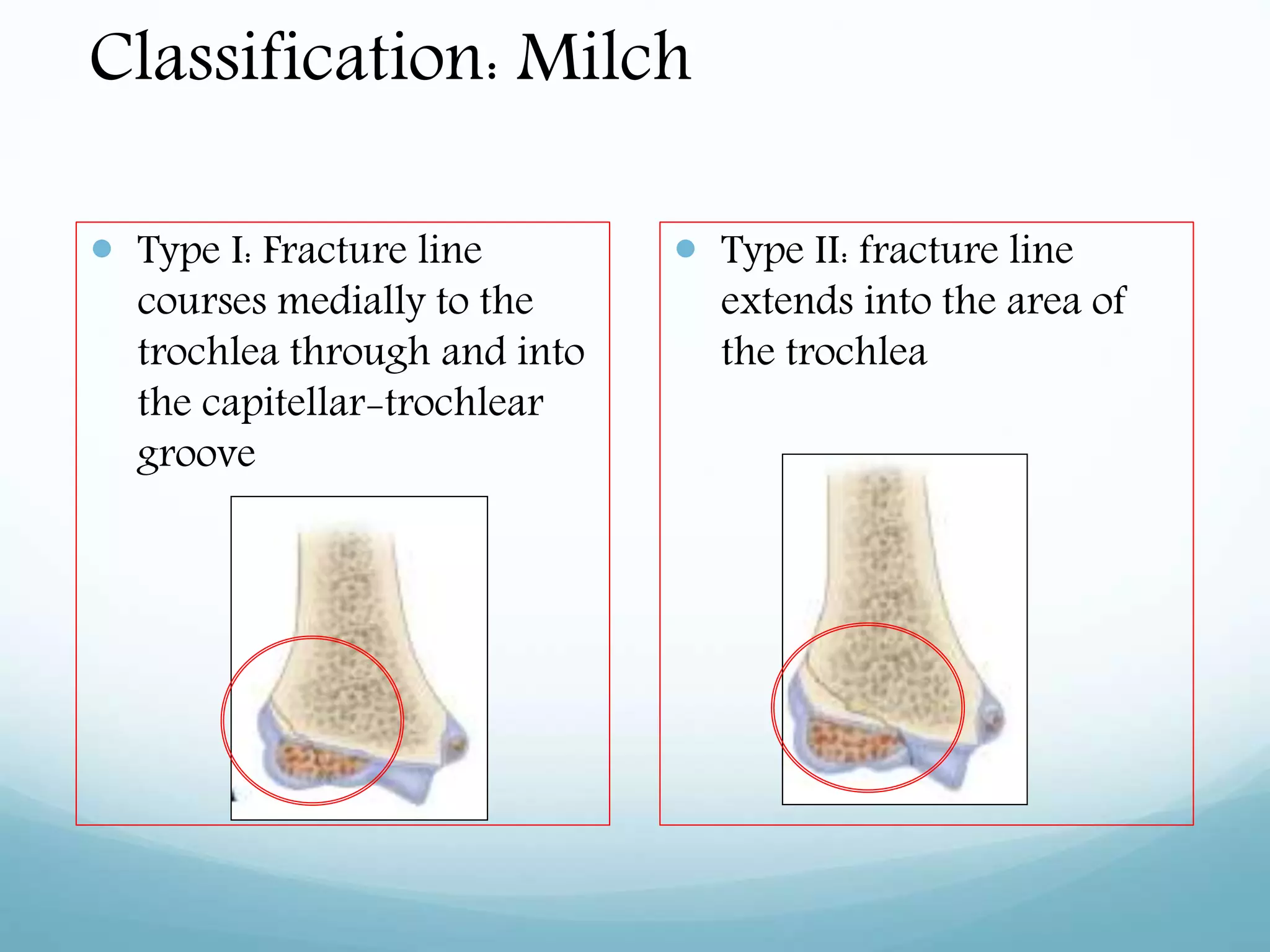
Classification: Milch
 Type I: Fracture line
courses medially to the
trochlea through and into
the capitellar-trochlear
groove
 Type II: fracture line
extends into the area of
the trochlea
Different stages of displacement of lateral condylar fracture:
Undisplaced (A), Moderately displaced (B), and Completely displaced
and rotated (C).
 Fracture of necessity: Fracture invariably displaces if not
treated operatively
Management
 Undisplaced fracture: Cast application (Needs Close
monitoring)
 Displaced fracture: ORIF
Different methods of lateral condyle fixation
Complications
 Non-Union
 Cubitus Valgus deformity
 Tardy ulnar nerve palsy
 Osteoarthritis
 Osteonecrosis of capitellum
Intercondylar Fracture
 Occurs between medial and
lateral condyles of distal
humerus
 Condyles split and with
metaphyseal diaphyseal
fracture
 Takes the shape of Y or T
 Badly comminuted and
displace
 Operative management
 K wires
 Plating
 Cannulated cancellous screws
Medial Humeral Condyle Fracture
 Rare
 1% of pediatric elbow
fracture
 Slight older children
 Caused by direct fall onto the
elbow or a fall onto an
outstretched hand with the
elbow in a varus position
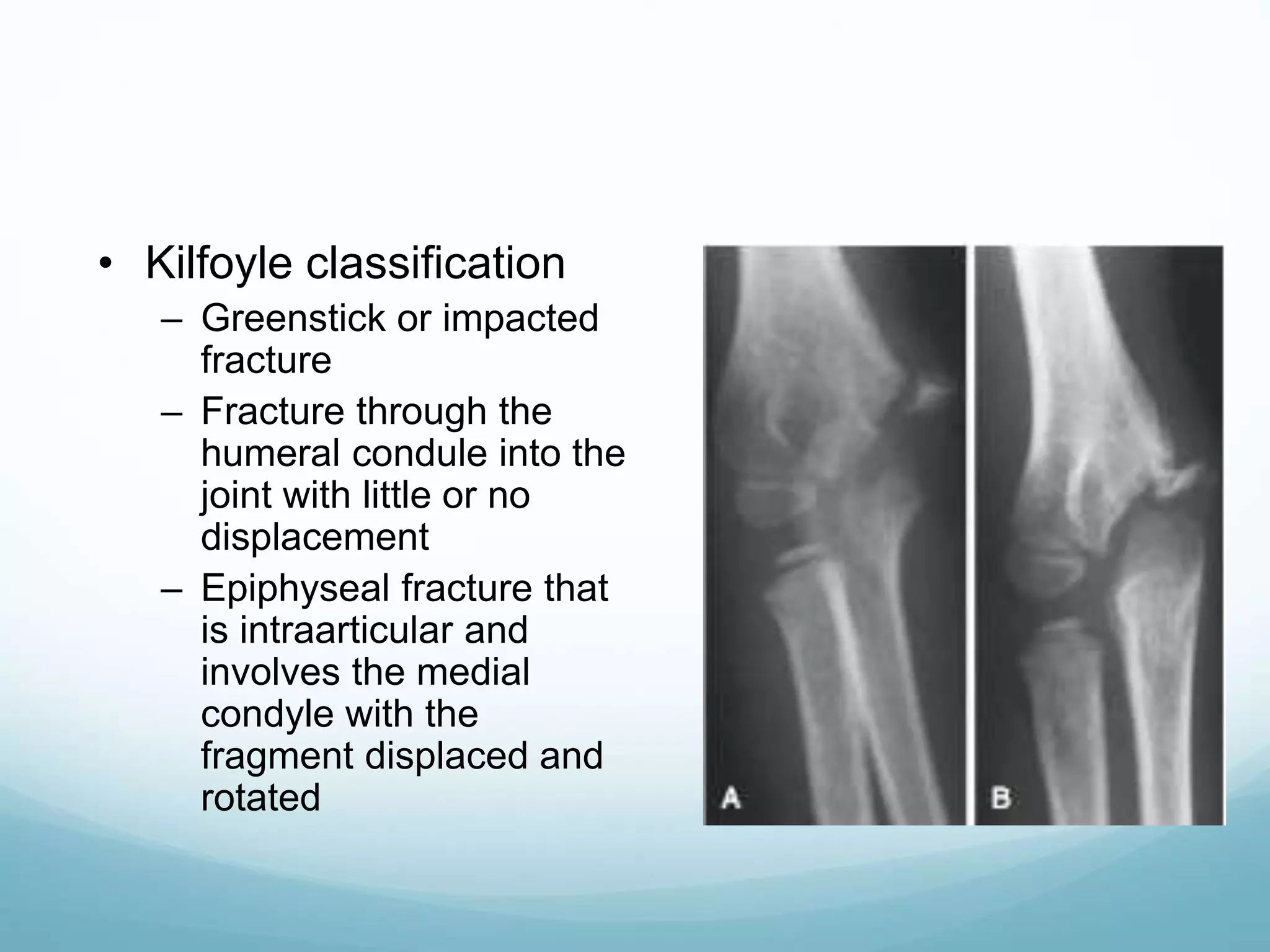
• Kilfoyle classification
– Greenstick or impacted
fracture
– Fracture through the
humeral condule into the
joint with little or no
displacement
– Epiphyseal fracture that
is intraarticular and
involves the medial
condyle with the
fragment displaced and
rotated
Treatment
 Conservative
 Operative
Pulled Elbow
 Traumatic subluxation of the
radial head produced by sudden
traction on the hand with the
elbow extended and the forearm
pronated
McLaughlins line
Radio-capitellar line
Fracture around Hand
 Bennett Fracture
 Rolando Fracture
 Thumb carpometacarpal joint dislocation
 Fingers Metacarpal Fracture
 Intra-articular fracture of the fifth metacarpal base
 Metacarpal shaft or neck fracture
 Metacarpal head fracture
 Middle or proximal phalanx fracture
Treatment
 Consevative management
 Buddy strapping
 POP slab
 Operative management
 CRPP
 Mini plate
 Mini screw
 K wire fixation
 External fixators
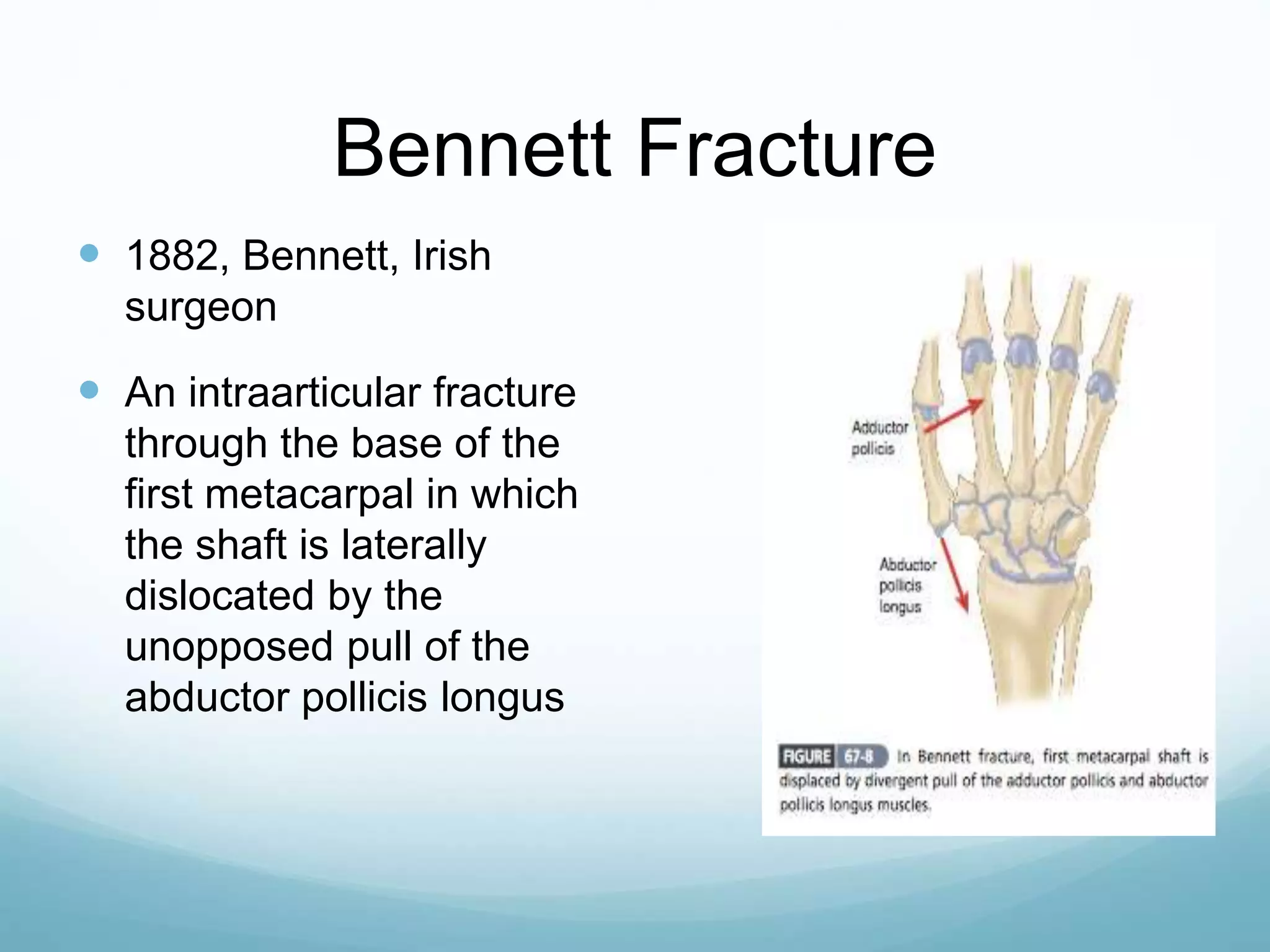
Bennett Fracture
 1882, Bennett, Irish
surgeon
 An intraarticular fracture
through the base of the
first metacarpal in which
the shaft is laterally
dislocated by the
unopposed pull of the
abductor pollicis longus
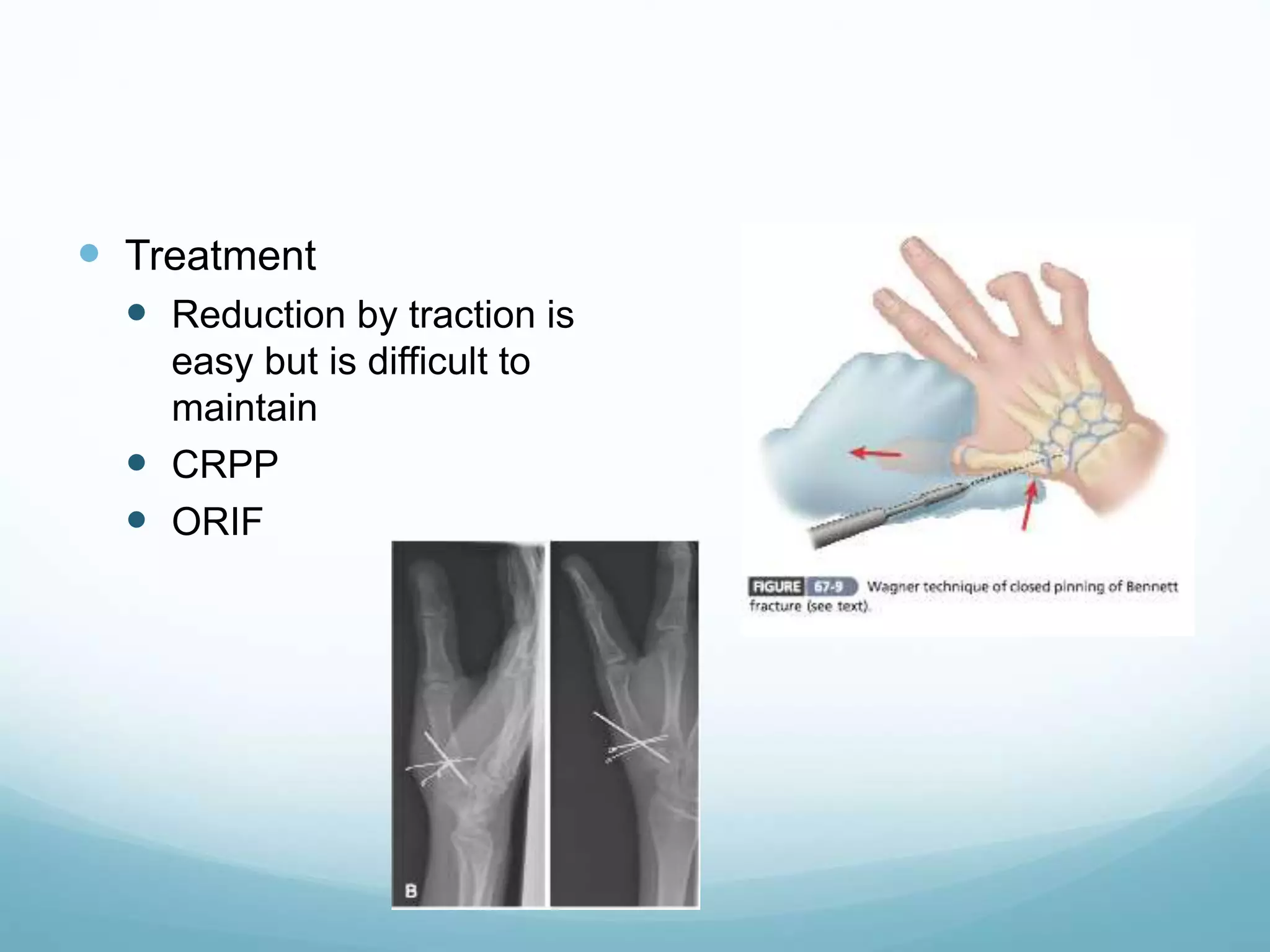
 Treatment
 Reduction by traction is
easy but is difficult to
maintain
 CRPP
 ORIF
Rolando Fracture
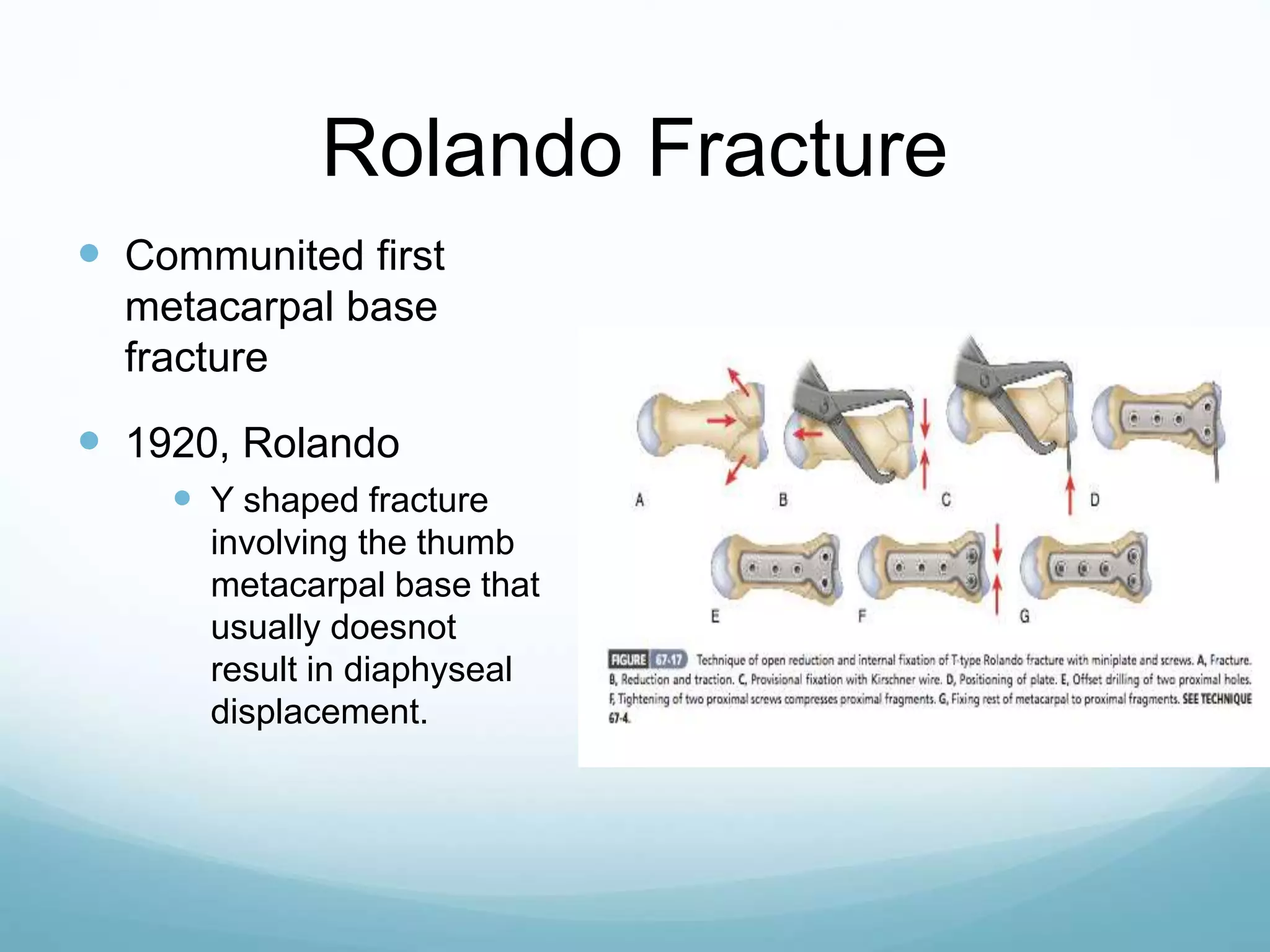
 Communited first
metacarpal base
fracture
 1920, Rolando
 Y shaped fracture
involving the thumb
metacarpal base that
usually doesnot
result in diaphyseal
displacement.
Reverse Bennett Fracture
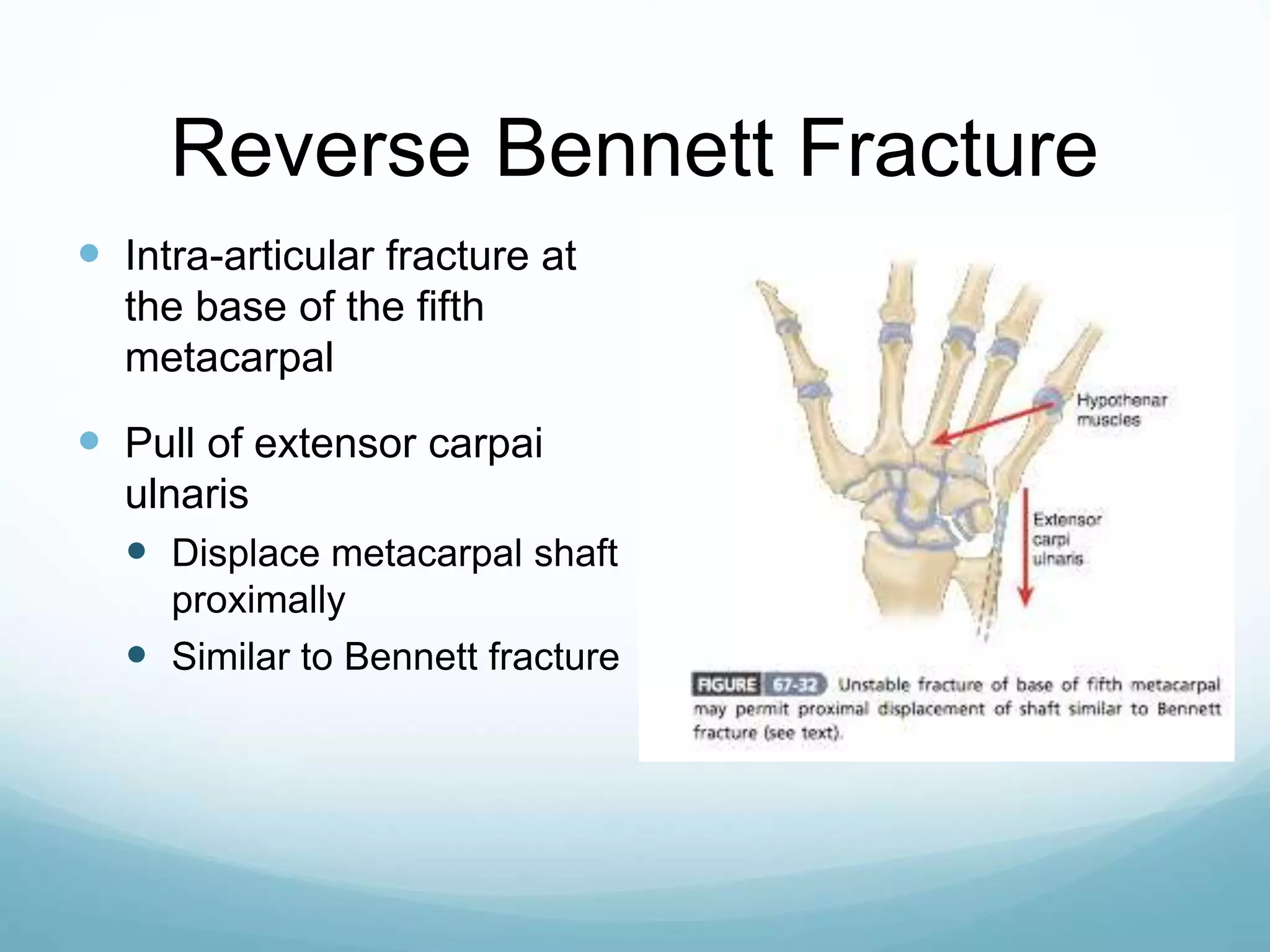
 Intra-articular fracture at
the base of the fifth
metacarpal
 Pull of extensor carpai
ulnaris
 Displace metacarpal shaft
proximally
 Similar to Bennett fracture
Metacarpal Fracture
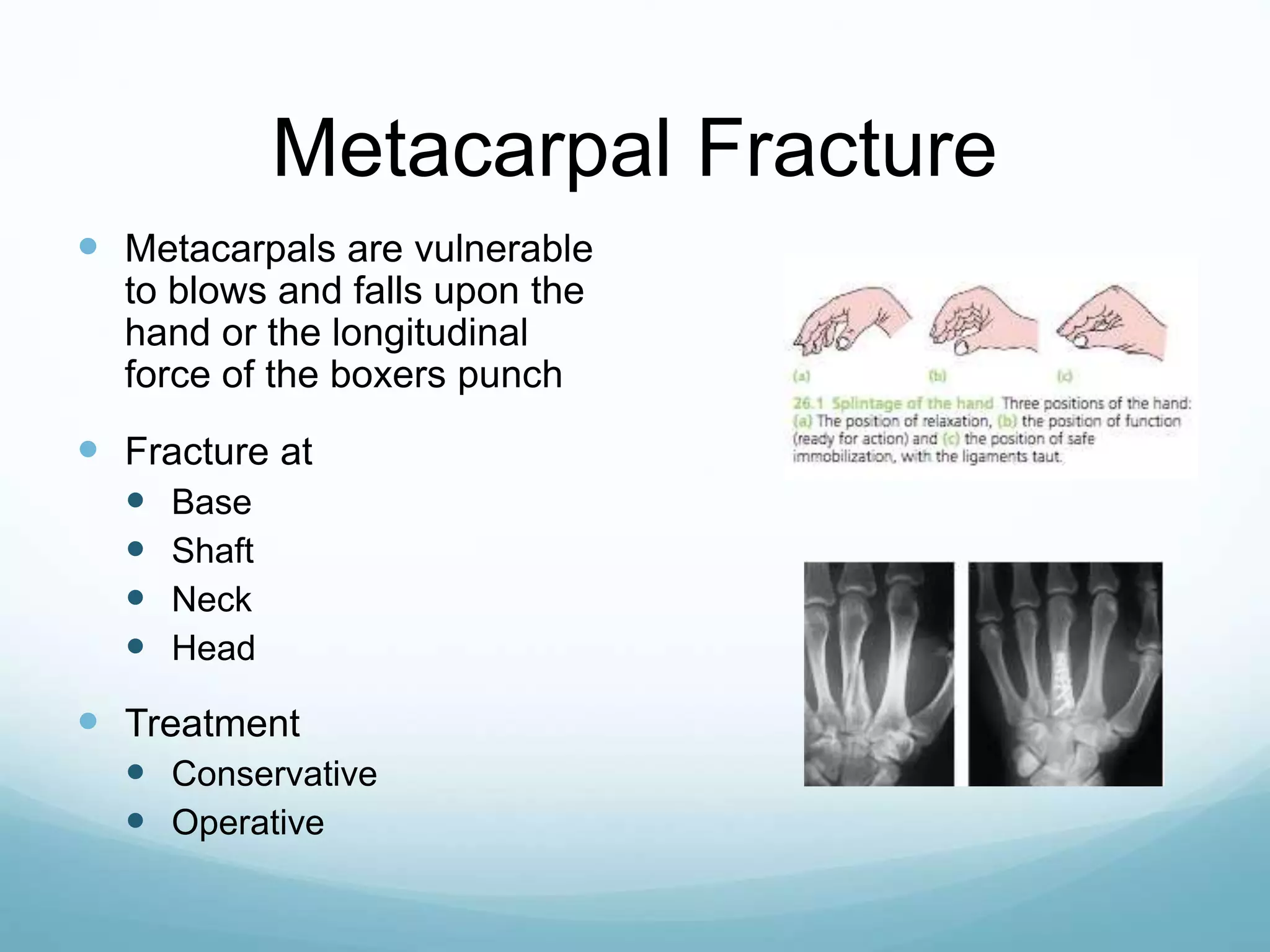
 Metacarpals are vulnerable
to blows and falls upon the
hand or the longitudinal
force of the boxers punch
 Fracture at
 Base
 Shaft
 Neck
 Head
 Treatment
 Conservative
 Operative
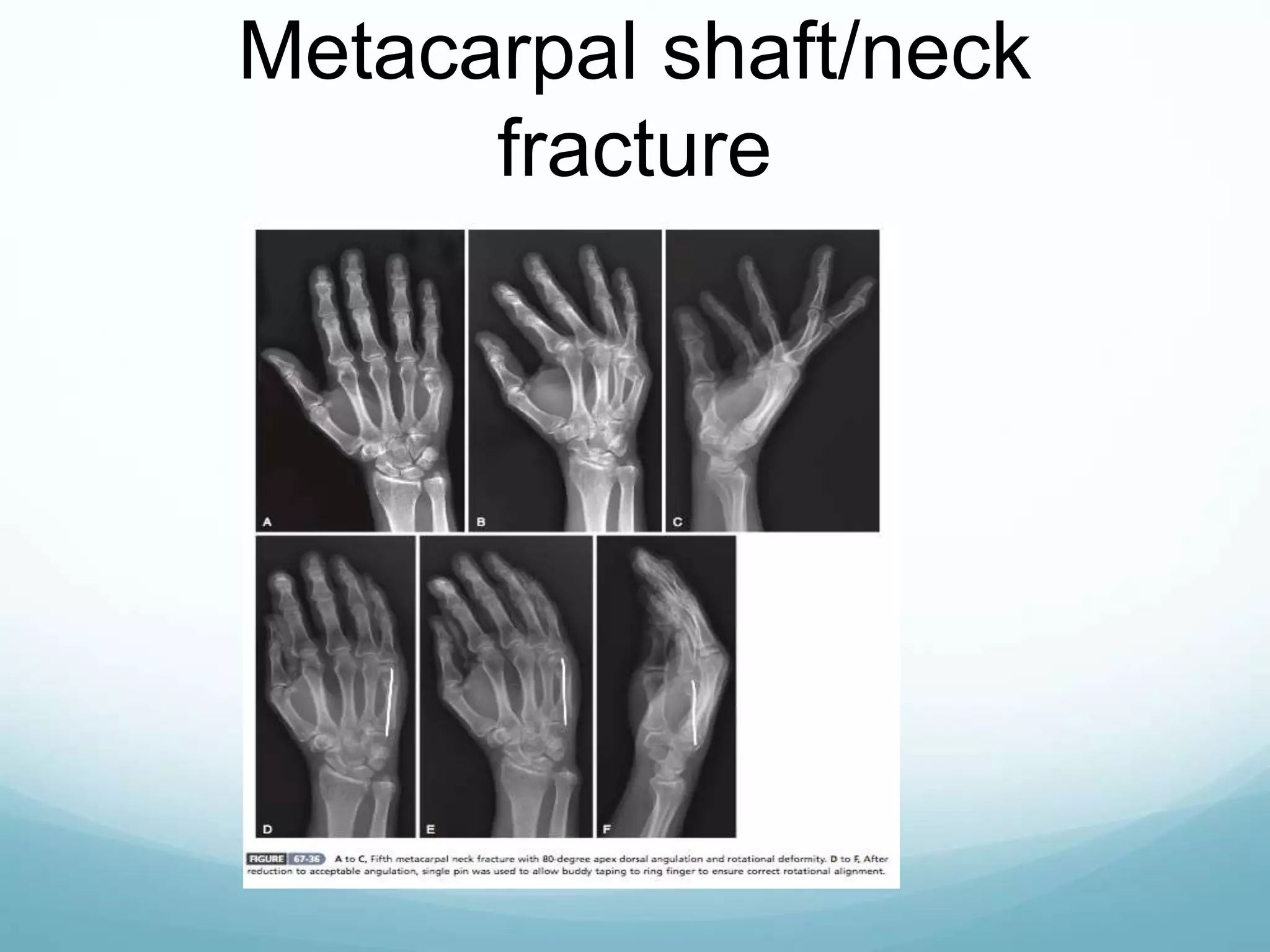
Metacarpal shaft/neck
fracture
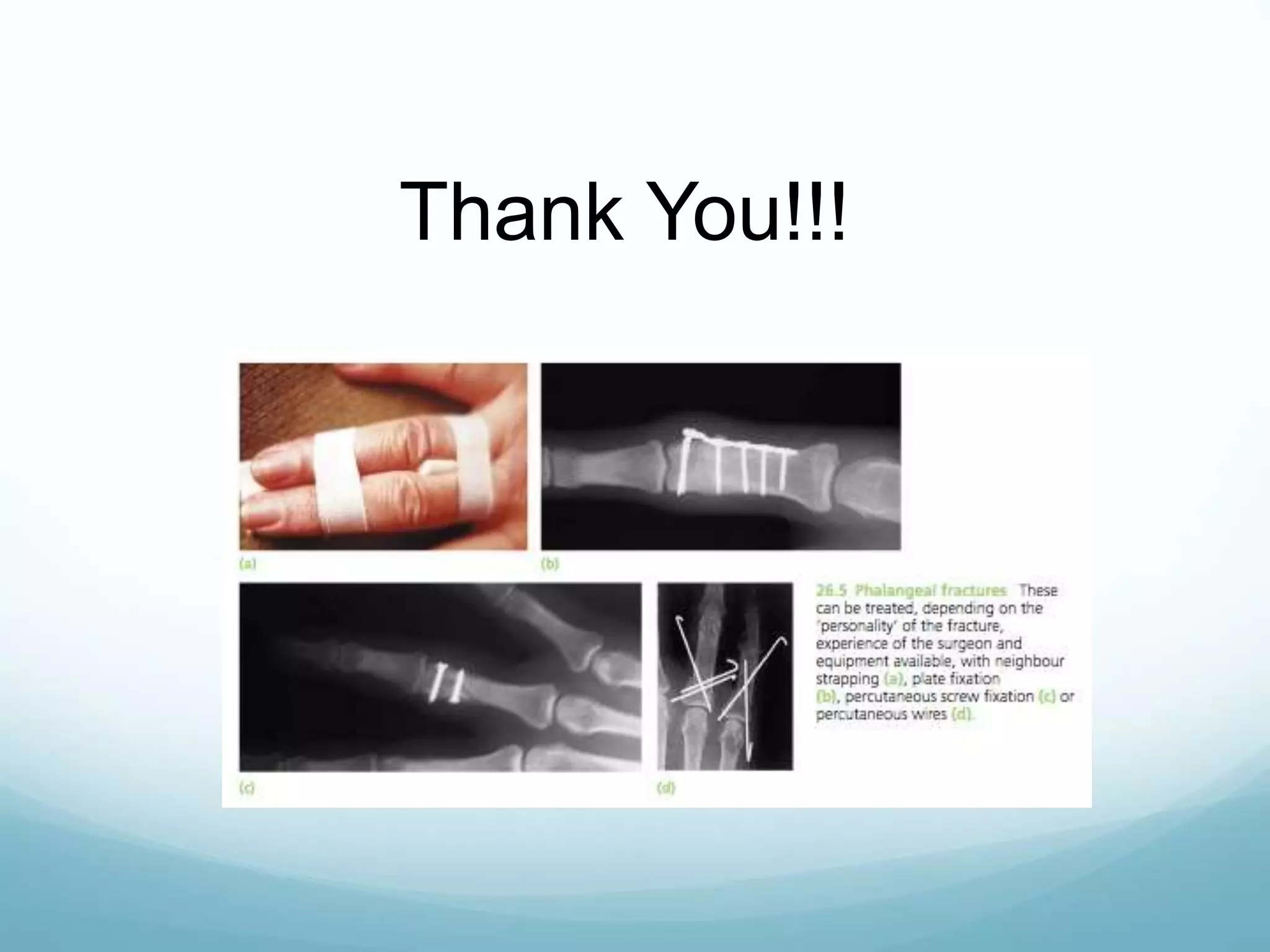
Thank You!!!

Fracture around elbow and hand

  • 1.
    Fracture around elbowand hand Maj. Dr. Dipendra Maharjan
  • 2.
  • 3.
    Three Bony pointsRelationship
  • 4.
    Injuries Around theElbow Fractures  Distal Humeral Fractures  Supracondylar fracture  Lateral condyle fracture  Medial condyle fracture  Medial epicondyle fracture  Capitellar fracture  Radial head/neck fracture  Olecranon fracture Dislocations  Elbow joint dislocation  Radial head dislocation (Pulled elbow/ Nurse maid’s elbow)
  • 5.
    Supracondylar Fracture  CommonestFracture of elbow region (68%)  Peak range 5-6 years  Fracture line passes just proximal to the bone masses of trochlea capitulum and often runs through the apices of coronoid and olecranon fossae
  • 6.
    Why common inchildren?  Bony architecture at the supracondylar region is weak and vulnerable because:  Bone is remodelling  It is less cylindrical  Metaphysis is just distal to 2 fossae, coronoid and radial fossa  Here the cortex is thin  Anterior cortex has a defect in the area of coronoid fossa  Laxity of ligaments permits hyperextension at the elbow
  • 7.
    Types  Gartland Classification 97.7 % extension type  2.3 % flexion type
  • 8.
    Clinical Features • Historyof fall • Pain and inability to use limb. • Swelling • Deformity (S-shaped) • Bruise • Crepitus • Signs of neuro-circulatory compromise (if present)
  • 9.
    There may sometimesbe puckering of the skin when the proximal Fragment has penetrated the brachialis and anterior fascia of the elbow Dimple sign
  • 10.
  • 11.
  • 12.
    Anterior humeral lineShaft-condylar angle Fat pad sign Fish tail sign
  • 13.
  • 14.
  • 15.
    MANAGEMENT OF S/C# • Close reduction • Surgery – CRPP ( closed reduction and percutaneous pinning) – Open reduction and internal fixation
  • 16.
  • 17.
    Percutaneous pinning  Beforethe development of the fluoroscopic unit, blind pinning was performed  Modern imaging techniques and improved power equipment have made percutaneous pinning the standard treatment.
  • 18.
    Percutaneous pinning.... Lateral pinningCrossed pinning Lateral pin
  • 19.
    ORIF Indications of ORIF Closed reduction may not be possible because of interposed soft tissue or neurovascular bundle.  When there is gross swelling of elbow so that hyperflexion is not possible after reduction.  Injury to neurovascular bundle  After open reduction of the fracture, fixed with pins.  Good callus should be observed at the fracture before pin removal, generally 3 to 4 weeks after injury.  The most frequent complication of surgical management appears to be a loss of range of motion.
  • 20.
    Early complications  Neurological involvement(10- 20%)  Recovery usually occures in 2 to 2 ½ months  Vascular Involvement
  • 21.
     Physeal damagedue to repeated manipulation  Compartment syndrome (1%)
  • 22.
    Delayed complication  Lossof mobility/Elbow stiffness  Average loss of 4 degree with close reduction and 6.5 degrees with open reduction  Myositis Ossificans  Cubitus Varus
  • 23.
    Lateral Condyle Fracture Most common distal humerus epihyseal injuries  2nd most common to supracondylar fracture
  • 24.
    Classification: Milch  TypeI: Fracture line courses medially to the trochlea through and into the capitellar-trochlear groove  Type II: fracture line extends into the area of the trochlea
  • 25.
    Different stages ofdisplacement of lateral condylar fracture: Undisplaced (A), Moderately displaced (B), and Completely displaced and rotated (C).
  • 26.
     Fracture ofnecessity: Fracture invariably displaces if not treated operatively
  • 27.
    Management  Undisplaced fracture:Cast application (Needs Close monitoring)  Displaced fracture: ORIF
  • 28.
    Different methods oflateral condyle fixation
  • 29.
    Complications  Non-Union  CubitusValgus deformity  Tardy ulnar nerve palsy  Osteoarthritis  Osteonecrosis of capitellum
  • 30.
    Intercondylar Fracture  Occursbetween medial and lateral condyles of distal humerus  Condyles split and with metaphyseal diaphyseal fracture  Takes the shape of Y or T  Badly comminuted and displace  Operative management  K wires  Plating  Cannulated cancellous screws
  • 31.
    Medial Humeral CondyleFracture  Rare  1% of pediatric elbow fracture  Slight older children  Caused by direct fall onto the elbow or a fall onto an outstretched hand with the elbow in a varus position
  • 32.
    • Kilfoyle classification –Greenstick or impacted fracture – Fracture through the humeral condule into the joint with little or no displacement – Epiphyseal fracture that is intraarticular and involves the medial condyle with the fragment displaced and rotated
  • 33.
  • 34.
    Pulled Elbow  Traumaticsubluxation of the radial head produced by sudden traction on the hand with the elbow extended and the forearm pronated
  • 35.
  • 36.
    Fracture around Hand Bennett Fracture  Rolando Fracture  Thumb carpometacarpal joint dislocation  Fingers Metacarpal Fracture  Intra-articular fracture of the fifth metacarpal base  Metacarpal shaft or neck fracture  Metacarpal head fracture  Middle or proximal phalanx fracture
  • 37.
    Treatment  Consevative management Buddy strapping  POP slab  Operative management  CRPP  Mini plate  Mini screw  K wire fixation  External fixators
  • 38.
    Bennett Fracture  1882,Bennett, Irish surgeon  An intraarticular fracture through the base of the first metacarpal in which the shaft is laterally dislocated by the unopposed pull of the abductor pollicis longus
  • 39.
     Treatment  Reductionby traction is easy but is difficult to maintain  CRPP  ORIF
  • 40.
    Rolando Fracture  Communitedfirst metacarpal base fracture  1920, Rolando  Y shaped fracture involving the thumb metacarpal base that usually doesnot result in diaphyseal displacement.
  • 41.
    Reverse Bennett Fracture Intra-articular fracture at the base of the fifth metacarpal  Pull of extensor carpai ulnaris  Displace metacarpal shaft proximally  Similar to Bennett fracture
  • 42.
    Metacarpal Fracture  Metacarpalsare vulnerable to blows and falls upon the hand or the longitudinal force of the boxers punch  Fracture at  Base  Shaft  Neck  Head  Treatment  Conservative  Operative
  • 43.
  • 44.

Editor's Notes

  • #14 It is a radiographic measurement in AP vies x-ray. It is the angle formed by drawing line along midline of diaphysis of humeral shaft, a line perpedicular to the midline and a line along the physis of lateral condyle. The angle A is original Baumann’s angle and B is used commonly. Normal Baumann’s angle is 64 to 81 degrees. Average is 72 degrees (Williamson).
  • #15 It is a radiographic angle in AP view. A longitudinal line is drawn through long axis of diaphysis and widest part of metaphysis. The angle between the proximal part of diaphyseal line and lateral part of metaphyseal line is meataphyseal-diaphyseal angle. Normal angle is 90o. Angle greater than 90 degree denotes cubitus varus and lesser than 90 degrees denotes cubitus valgus.