Burns wound care
Dr. ARVIND MAHARAJ. P. M
MBBS., MS., MCh (PLASTIC & RECONSTRUCTIVE SURGERY)
Consultant
Plastic, Aesthetic and Reconstructive Surgery
Department of Plastic And Advanced Aesthetics
Gleneagle Global Health City
Chennai
MANAGEMENT OF
PA
TIENT WITH BURNS
Definition
Burn injury is a syndrome of Local and Systemic manifestations of
exposure to
• High temperature,
• Electrical energy,
• Chemicals
• Radiation
CLASSIFICATION
• Thermal
• Flame burns – 50%
• Scalds from hot liquids, e.g. boiling water, cooking oil – 40%
• Contact burn, e.g. stoves, heaters, irons,
• Non thermal
• Electrical burn
• Chemical Burns
• Friction burn
• Radiation burn
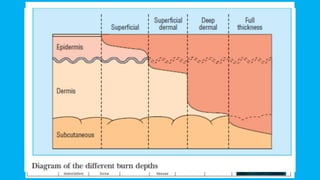
Depth of burn
• Superficial
• Superficial partial thickness
(dermal)
• Deep partial thickness (dermal)
• Full thickness
• 1st degree
• 2nd degree
• A
• B
• 3rd degree
• 4th degree
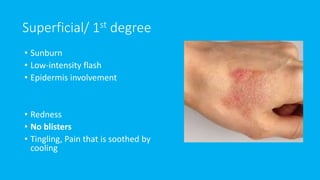
Superficial/ 1st degree
• Sunburn
• Low-intensity flash
• Epidermis involvement
• Redness
• No blisters
• Tingling, Pain that is soothed by
cooling
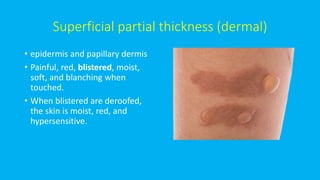
Superficial partial thickness (dermal)
• epidermis and papillary dermis
• Painful, red, blistered, moist,
soft, and blanching when
touched.
• When blistered are deroofed,
the skin is moist, red, and
hypersensitive.
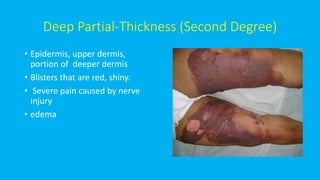
Deep Partial-Thickness (Second Degree)
• Epidermis, upper dermis,
portion of deeper dermis
• Blisters that are red, shiny.
• Severe pain caused by nerve
injury
• edema
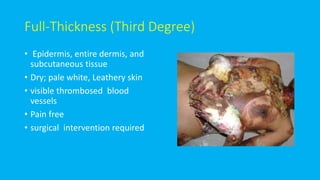
Full-Thickness (Third Degree)
• Epidermis, entire dermis, and
subcutaneous tissue
• Dry; pale white, Leathery skin
• visible thrombosed blood
vessels
• Pain free
• surgical intervention required
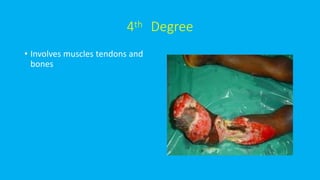
4th Degree
• Involves muscles tendons and
bones
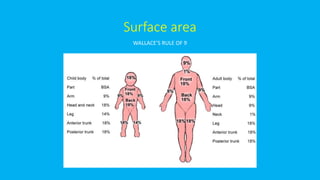
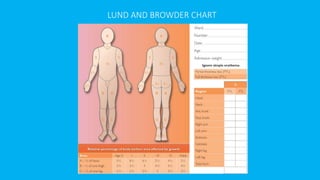
Extent of Body Surface Area Injured
• Wallace’s Rule Of Nines,
• Lund And Browder Method,
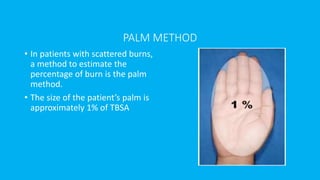
• Palm Method.
Surface area
WALLACE’S RULE OF 9
LUND AND BROWDER CHART
PALM METHOD
• In patients with scattered burns,
a method to estimate the
percentage of burn is the palm
method.
• The size of the patient’s palm is
approximately 1% of TBSA
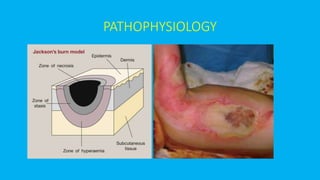
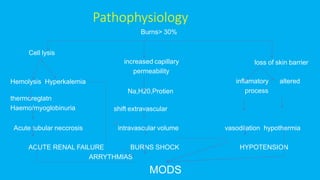
PATHOPHYSIOLOGY
Pathophysiology
Burns> 30%
Cell lysis
increased capillary
permeability
Hemolysis Hyperkalemia
Na,H20,Protien
loss of skin barrier
inflamatory altered
process
thermoreglatn
Haemo/myoglobinuria shift extravascular
Acute tubular neccrosis intravascular volume vasodilation hypothermia
HYPOTENSION
ACUTE RENAL FAILURE BURNS SHOCK
ARRYTHMIAS
MODS
COMPLICATIONS
• Infections
• MODS- Death
• Scarring
• Contractures
• Psychological
MANAGEMENT
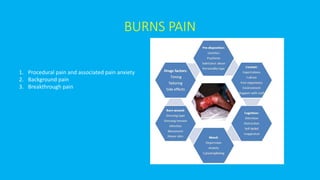
BURNS PAIN
1. Procedural pain and associated pain anxiety
2. Background pain
3. Breakthrough pain
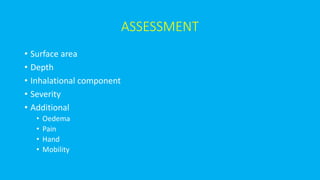
ASSESSMENT
• Surface area
• Depth
• Inhalational component
• Severity
• Additional
• Oedema
• Pain
• Hand
• Mobility
INHALATIONAL BURNS
• Physical signs to observe:
• Hoarse vocal quality
• Stridor
• Singed facial / nasal hair
• Soot stained sputum
• Erythema (Superficial reddening of the skin, usually in patches, as a result of
injury or irritation causing dilatation of the blood capillaries)
• Oedema of face
• Inspiratory and end expiratory crackles on auscultation
• Chest x-ray changes
SEVERITY OF BURNS
• Factors to Consider
• Type
• Depth
• Body Surface area burned
• Age: Adult vs Paediatric
• Pre-existing medical conditions
• Associated Trauma
• blast injury
• fall injury
• Airway compromise
• Child abuse
• Mild
• Paediatric <10%
• 10 yrs < 20% BSA
• 20 yrs < 20% BSA
• 30 yrs< 15% BSA
• Moderate
• Pediatric 10-20%
• 20 yrs 20-30% BSA
• 30 yrs 15-20% BSA
• Excluding hands, face, feet, or genitalia
• Without complicating factors
• Severe burns
• Pediatric >10% BSA
• 20yrs > 30% BSA
• 30yrs > 20% BSA
• Burns with respiratory injury
• Hands, face, feet, or genitalia
• Burns complicated by other trauma
• Electrical and deep chemical burns
• Underlying health problems
HOSPITALISATION IN ALL SEVERE AND MOST MODERATE BURNS
PRE HOSPITAL MANAGEMENT
• Rescuer to avoid injuring himself
• Remove patient from source of injury
• Stop burn process
• Burning clothing; jewelry, watches, belts to be removed
• Pour ample water on burnt area (not ice/ ice packs – skin injury & hypothermia)
• Chemical burns:
• Remove saturated clothing
• Brush skin if agent is powder
• Irrigation with copious amount water to be started and continued in hospital
• Electrical burns:
• Turn off the current
• Use non-conductor item to separate from source
• Small thermal burns (<10% TBSA ) may be covered with a clean, tap water-damped towel for patient comfort
and protection until definite medical care instituted.
• Cooling of injured area within 1 minute helps minimize the depth of injury.
• If the burn injury is large (>10% TBSA) it is not advisable to immerse the body part in cool water since doing
so might lead to extensive heat loss.
• Do not break blisters.
• Do not apply lotions, powders, grease, ghee, gentian violet, calamine lotion, toothpastes, butter and other
sticky agents over the burn wound.
• Prevent contamination: Wrap burn part in clean dry sheet /cloth.
• Assess for life threatening injuries.
EMERGENT/RESUSCITATIVE PHASE
• This phase may last 24-48 hours after injury
• This phase characterized by
• Life-threatening airway problems
• Cardiopulmonary instability
• Hypovolemia
• Goal Maintain vital organ function and perfusion
• Physical examination
• Assess A B C
• AIRWAY
• BREATHING
• CIRCULATION
• INVESTIGATIONS
• Labs: CBC, electrolytes, BUN
• Pulmonary assessment: ABG, CXR, carboxyhemoglobin
• AIRWAY & BREATHING
• Overt signs and symptoms of airway obstruction- Progressive hoarseness
• Suspected inhalational injury (smoke/ carbon monoxide intoxication)
• Unconscious patient/ rapidly deteriorating patient
• Acute respiratory distress
• Burns of face & neck
• Extensive Burns (> 40% TBSA)
ET intubation + assisted ventilation with 100% O2
FLUID RESUCITATION
• Parkland Formula
• Evan’s formula
• Brooke formula
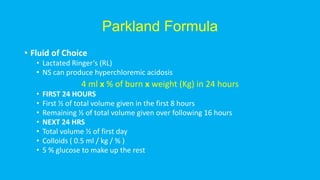
Parkland Formula
• Fluid of Choice
• Lactated Ringer’s (RL)
• NS can produce hyperchloremic acidosis
4 ml x % of burn x weight (Kg) in 24 hours
• FIRST 24 HOURS
• First ½ of total volume given in the first 8 hours
• Remaining ½ of total volume given over following 16 hours
• NEXT 24 HRS
• Total volume ½ of first day
• Colloids ( 0.5 ml / kg / % )
• 5 % glucose to make up the rest
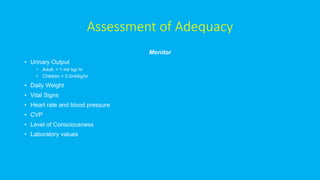
Assessment of Adequacy
Monitor
• Urinary Output
• Adult: > 1 ml/ kg/ hr
• Children > 0.5ml/kg/hr
• Daily Weight
• Vital Signs
• Heart rate and blood pressure
• CVP
• Level of Consciousness
• Laboratory values
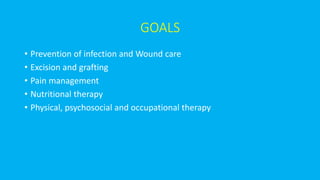
GOALS
• Prevention of infection and Wound care
• Excision and grafting
• Pain management
• Nutritional therapy
• Physical, psychosocial and occupational therapy
Wound care
• Wound care should be delayed until a patent airway, adequate
circulation and adequate fluid replacement have been established.
Microbiology
• Frequent monitoring for bacterial infection
• Wound swabs
• biopsies
• Early cultures positive/ high counts
• Increasing colony counts
• Virulent / resistant organisms in culture
• Impending invasive wound infection.
• Wound colony counts
• High risk of graft failure.
Hydrotherapy
•Shower, bed baths or clear water spray
•Maintain appropriate water and room temperature Limit
duration to 20-30 minutes
•Don’t burst blisters, aspirate them !!! Trim hair
around wound
•Dry with towel; don’t rub!
•Clean unburned skin and hair
Wound care
• Full thickness and deep dermal burns require antibacterial dressings
to prevent infections prior to surgery.
• Superficial burns require simple dressings as they heal completely
within 3 weeks
• Optimal dressings environment can make significant difference in
healing.
• 2 types of wound treatment used to control infection
• open method
• Closed multiple dressing change method
Antimicrobial Agent
• Silver sulfadiazine 1% cream:
• Most bactericidal agent
• Minimal penetration of eschar
• Mafenide acetate 5% to 10% (Sulfamylon) hydrophilic-based
cream
• Effective against gram-negative and gram-positive organisms
• Diffuses rapidly through eschar
• In 10% strength, it is the agent of choice for electrical burns
because of its ability to penetrate thick eschar
• Silver nitrate 0.5% aqueous solution-
• Bacteriostatic and fungicidal
• Does not penetrate eschar
• Bacitracin/ Neomycin/ Polymyxin B
• Not broad spectrum, painless, easy to apply
• Nystatin
• Antifungal
• Mupirocin
• Anti staphylococcal
• Betadine
• Drying effect makes debridement of the eschar easier
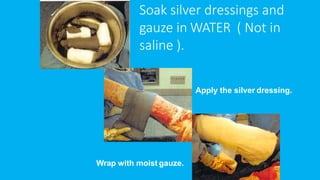
• Acticoat ( Antimicrobial occlusive dressing )
• A silver impregnated gauze - left in place for 5 days Apply sterile water
every 3-4 hours
Soak silver dressings and
gauze in WATER ( Not in
saline ).

Apply the silver dressing.
Wrap with moist gauze.
Dressing in superficial burns
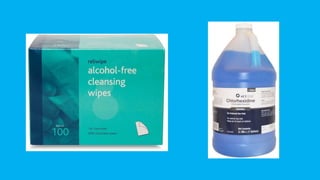
• Non irritative anti microbial cleanser
• Non adhesive barrier
• Dry and absorbant dressing material
• Collagen sheets
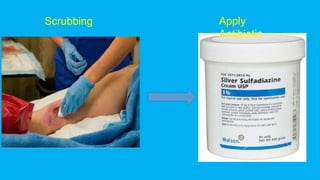
Apply
Antibiotic
Scrubbing
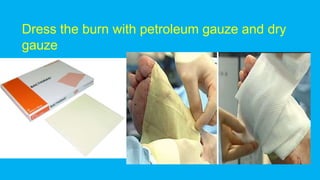
Dress the burn with petroleum gauze and dry
gauze
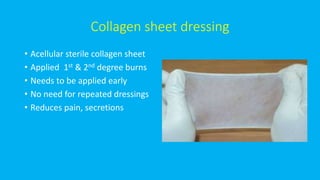
Collagen sheet dressing
• Acellular sterile collagen sheet
• Applied 1st & 2nd degree burns
• Needs to be applied early
• No need for repeated dressings
• Reduces pain, secretions
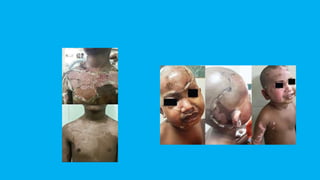
• Special Considerations:
• Wrap Joint area lightly to allow mobility Facial wounds may be left
open Circumferential burns: wrap distal to proximal
• All fingers and toes should be wrapped separately Splints over
dressings
Debridement
• May be completed at the bedside or as a surgical procedure.
• Types of Debridement:
• Natural
• Body & bacterial enzymes dissolve eschar; takes a long time
• Mechanical
• Sharp (scissors), Wet-to-Dry Dressings or Enzymatic Agents
• Surgical
• Tangential Excision
• Full thickness excision
• Escharotomy
• Escharectomy
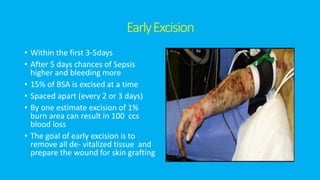
EarlyExcision
• Within the first 3-5days
• After 5 days chances of Sepsis
higher and bleeding more
• 15% of BSA is excised at a time
• Spaced apart (every 2 or 3 days)
• By one estimate excision of 1%
burn area can result in 100 ccs
blood loss
• The goal of early excision is to
remove all de- vitalized tissue and
prepare the wound for skin grafting
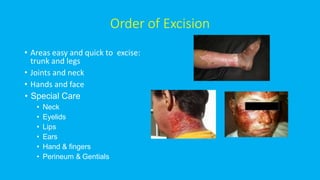
Order of Excision
• Areas easy and quick to excise:
trunk and legs
• Joints and neck
• Hands and face
• Special Care
• Neck
• Eyelids
• Lips
• Ears
• Hand & fingers
• Perineum & Gentials
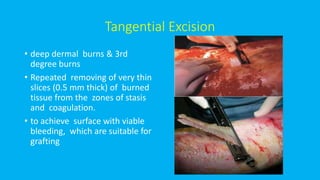
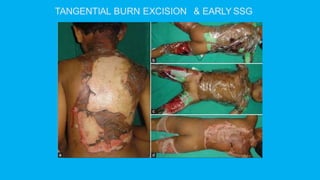
Tangential Excision
• deep dermal burns & 3rd
degree burns
• Repeated removing of very thin
slices (0.5 mm thick) of burned
tissue from the zones of stasis
and coagulation.
• to achieve surface with viable
bleeding, which are suitable for
grafting
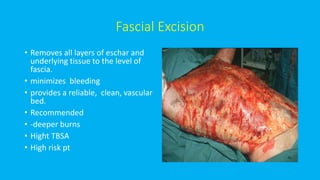
Fascial Excision
• Removes all layers of eschar and
underlying tissue to the level of
fascia.
• minimizes bleeding
• provides a reliable, clean, vascular
bed.
• Recommended
• -deeper burns
• Hight TBSA
• High risk pt
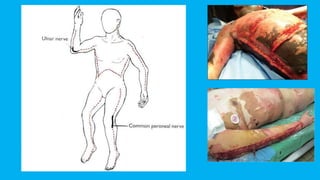
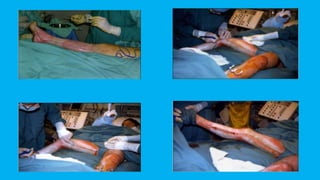
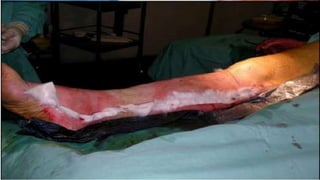
Eschartomy
• An escharotomy is a surgical procedure used to treat full thickness
(third-degree) circumferential burns.
• Full-thickness circumferential burn of an extremity or Trunk can
result in vascular/ respiratory compromise.
Indications
• Indicated when the circulation is
compromised due to increased
pressure in the burned limb and
can not be relieved by simple
elevation.
• Circumferential chest, abdomen
& limbs
• Pain on passive extension
• Pallor
• Paresthesia
• Poikilothermia
• Paresis
• Pulselessness
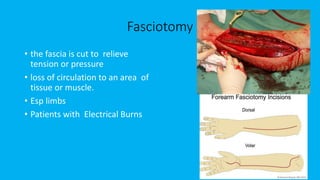
Fasciotomy
• the fascia is cut to relieve
tension or pressure
• loss of circulation to an area of
tissue or muscle.
• Esp limbs
• Patients with Electrical Burns
Wound Closure
• After excision the wound, there is wound closure.
• Goals:
• Reestablish barrier (epidermis) to prevent bacterial invasion and
evaporative water loss
• Reconstitute the dermis to provide durability, pliability and acceptable
cosmetics.
• If wounds are deep (full-thickness) or extensive, spontaneous re-
epithelialization is not possible. Therefore, coverage of the burn wound is
necessary by using patients own skin or other methods.
• This is called as grafting
• few days to several months.
• undergoing regular dressings.
• Regular pain relief is essential
• Inadequate pain relief in the early stages can result in a complete
reluctance of the patient to participate in their rehabilitation in both
the short and long term.
• Early commencement of reconstruction and rehabilitation is the key
• Staged introduction of multi modal rehab
• REMEMBER TOMORROW MIGHT BE TOO LATE!
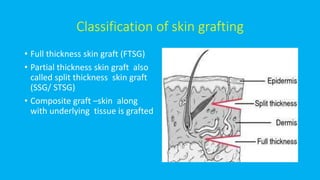
Classification of skin grafting
• Full thickness skin graft (FTSG)
• Partial thickness skin graft also
called split thickness skin graft
(SSG/ STSG)
• Composite graft –skin along
with underlying tissue is grafted
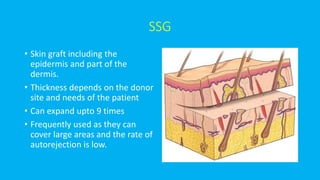
SSG
• Skin graft including the
epidermis and part of the
dermis.
• Thickness depends on the donor
site and needs of the patient
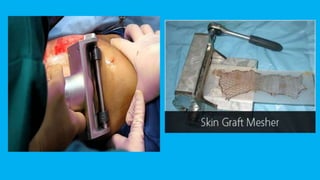
• Can expand upto 9 times
• Frequently used as they can
cover large areas and the rate of
autorejection is low.
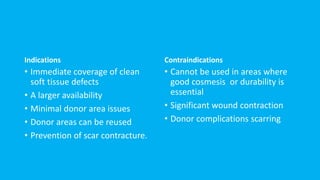
Indications
• Immediate coverage of clean
soft tissue defects
• A larger availability
• Minimal donor area issues
• Donor areas can be reused
• Prevention of scar contracture.
Contraindications
• Cannot be used in areas where
good cosmesis or durability is
essential
• Significant wound contraction
• Donor complications scarring
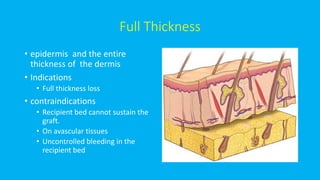
Full Thickness
• epidermis and the entire
thickness of the dermis
• Indications
• Full thickness loss
• contraindications
• Recipient bed cannot sustain the
graft.
• On avascular tissues
• Uncontrolled bleeding in the
recipient bed
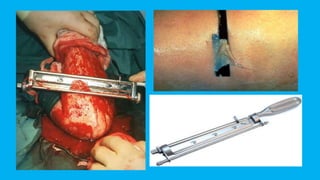
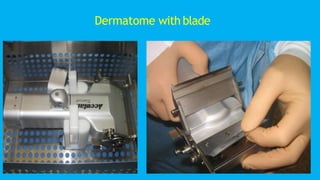
Dermatome with blade
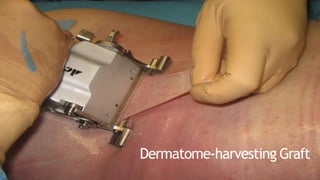
Dermatome-harvesting Graft
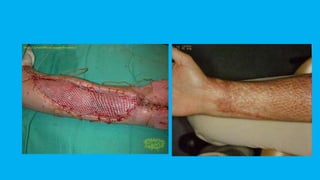
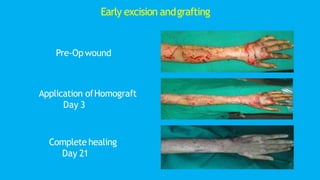
Pre-Op wound
Application ofHomograft
Day 3
Complete healing
Day 21
Early excision andgrafting
• Permanent
• Autografts
• Cultured Epithelial Autografts
• Temporary
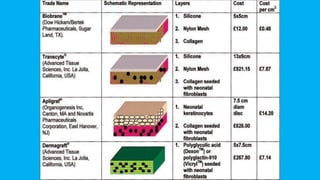
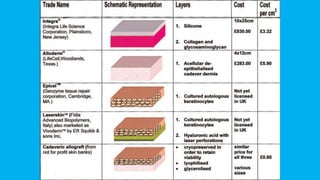
• Biosynthetic - Homograft ( Cadaveric ) / Xenograft ( Porcine )
• Synthetic Skin Substitutes - Trancyte/ Integra / Biobrane
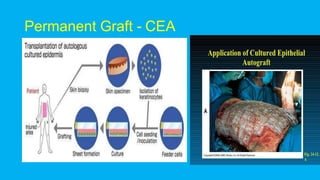
Permanent Graft - CEA
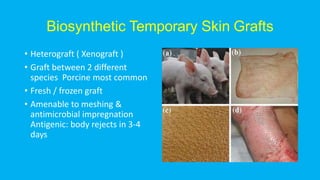
Biosynthetic Temporary Skin Grafts
• Heterograft ( Xenograft )
• Graft between 2 different
species Porcine most common
• Fresh / frozen graft
• Amenable to meshing &
antimicrobial impregnation
Antigenic: body rejects in 3-4
days
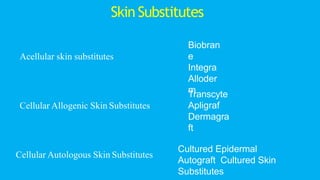
Acellular skin substitutes
Cellular Allogenic Skin Substitutes
Cellular Autologous Skin Substitutes
Biobran
e
Integra
Alloder
m
Transcyte
Apligraf
Dermagra
ft
Cultured Epidermal
Autograft Cultured Skin
Substitutes
Skin Substitutes
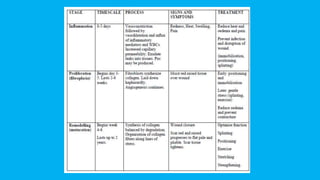
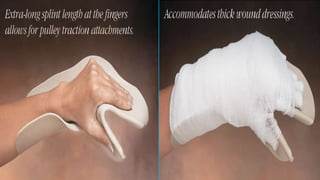
Splinting & Positioning
• Done to Prevent Contracture
• After skin grafting to secure and stabilize graft
• The positioning of the burn patient is vital in bringing about the best
functional outcomes in rehabilitation
• Begin immediately after the injury occurs
• Positioning should be designed for the specific individual’s needs
• Should not compromise mobility and function
Primary
Splints
• acute phase and
pre grafting
period
• used to position the
involved joints during
sleep, inactivity, or
periods of
unresponsiveness.
Postural
Splints
• Immediate post
graft phase
• Worn continuously for 5
to 14 days until the graft
is secure.
Types Of Splinting
Follow up Splints
• Chronic phase of burn care begins with wound closure.
• Dynamic splints (movable parts) are used to increase function.
• Provide slow steady force to stretch a skin contracture, or provide
resistive force for exercise.
Splinting
• Reduces edema
• Maintains joint alignment
• Maintains tissues elongated
• Prevents contracture formation
• Promotes wound healing
• Relieves pressure
• Protects joints, exposed tendons and new grafts/flaps
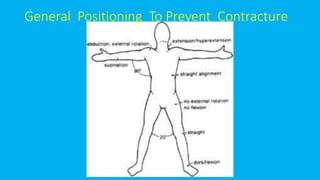
General Positioning To Prevent Contracture
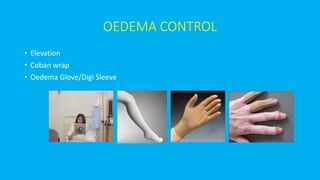
OEDEMA CONTROL
• Elevation
• Coban wrap
• Oedema Glove/Digi Sleeve
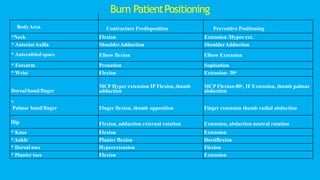
BodyArea Contracture Predisposition Preventive Positioning
*Neck Flexion Extension /Hyper ext.
* AnteriorAxilla ShoulderAdduction ShoulderAdduction
* Antecubital space Elbow flexion Elbow Extension
* Forearm Pronation Supination
* Wrist Flexion Extension- 30o
Dorsal/hand/finger
MCP Hyper extension IP Flexion,thumb
adduction
MCP Flexion-80o, IF Extension, thumb palmar
abduction
*
Palmar hand/finger Finger flexion, thumb opposition Finger extension thumb radial abduction
Hip Flexion, adduction external rotation Extension, abduction neutral rotation
* Knee Flexion Extension
*Ankle Planter flexion Dorsiflexion
* Dorsal toes Hyperextension Flexion
* Planter toes Flexion Extension
Burn PatientPositioning
NUTRITIONAL THERAPY
• High-protein & high-calorie diet
• Often requiring various supplements
• Routes:
• ORAL (BEST)
• Enteral
• Gut is the preferred alternative route
• G-tube or J-tube (Head injury/ surgery/ unconscious)
• Parenteral
• TPN and PPN
• Associated with an increased risk of infections
• Pressure therapy
• Silicone gel sheet
• Intra lesional injection
• Split skin graft
• Laser therapy
• Cryotherapy
• Radio therapy
• Combination therapy
SCAR MANAGEMENT
Complications
• EMERGENT PHASE
• CVS
• dysrhythmias and hypovolemic shock
• RS
• upper RT injury, pulmonary edema,
ARDS, pneumonia
• Urinary
• Acute Tubular necrosis,ARF
• ACUTE PHASE
• Infection
• sepsis, septicemia ( pseudomonas)
• G.I
• Paralytic ileus, curlings ulcer
• REHABILITATION PHASE
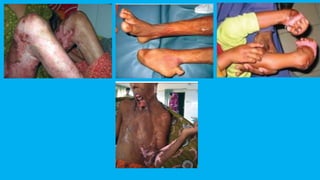
• Contracture
• abnormal condition of a joint
characterised by flexion and fixation
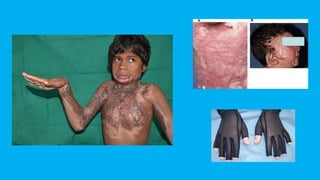
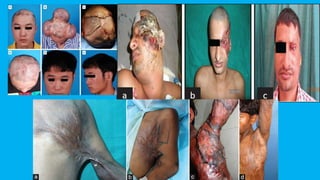
• Unstable scar
• Recurrent ulcerations
• Hypertrophic scars
• Keloids
• Marjolin’s ulcer
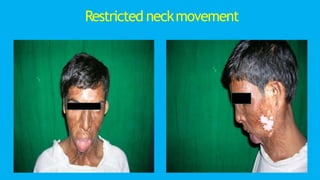
Restricted neckmovement
Conclusion
• Early, aggressive, controlled fluids
• Close Monitoring for adequate resuscitation
• Prevent extension of injury
• Liberal use of Analgesia
• Provide for increased metabolic demands
• Early aggressive surgical intervention
• Early mobilization and appropriate splinting
• Education of person and family for social support
• Total/ Social rehabilitation
• Physical
• Mental
• financial
Aims of Rehabilitation
• Prevention of additional/deeper injuries
• Rapid wound closure
• Preservation of active and passive ROM
• Prevention of infection
• Prevention of loss of functional structures
• Early functional rehabilitation
Early phase
• few days to several months.
• inpatient or outpatient
• undergoing regular dressings.
• Regular pain relief is essential
• Inadequate pain relief in the early stages can result in a complete
reluctance of the patient to participate in their rehabilitation in both the
short and long term.
• Early commencement of reconstruction and rehabilitation is the key
• Staged introduction of multi modal rehab
• REMEMBER TOMORROW MIGHT BE TOO LATE!
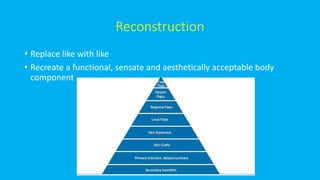
Reconstruction
• Replace like with like
• Recreate a functional, sensate and aesthetically acceptable body
component
Rehabilitation phase
• Reduce oedema
• Immobilise
• Mobilise
• Strengthen
• Mixing immobilisatilon and early mobilisation
• Prevent deformities
• Maintenance of range of motion
• Promote Healing
• Protection
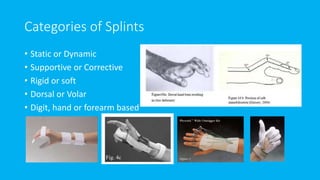
Categories of Splints
• Static or Dynamic
• Supportive or Corrective
• Rigid or soft
• Dorsal or Volar
• Digit, hand or forearm based
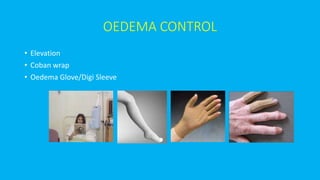
OEDEMA CONTROL
• Elevation
• Coban wrap
• Oedema Glove/Digi Sleeve
Physiotherapy
• Aims
• Optimise scar appearance
• Limit effects of scar contraction/prolonged positioning on range of motion
and function
• Address effects of prolonged bed rest
• Common modalities
• Mobilisation- both mobility and specific joint mobilisation
• Scar management adjuncts
• Pressure garments, silicone, massage
• Continuation of oedema/ positioning management where necessary
Practical factors to consider when mobilising
• dressing schedule
• Timing of pain relief.
• Observe the patient carrying out the AROM and PROM exercises prior to beginning treatment. Also observe
the patient taking on/off splints.
• Always monitor for post exercise pain and wound breakdown.
• Avoid blanching for long period as you may compromise vascularity.
• The patient may present with a reduced capacity for exercise secondary to increased metabolic rate, altered
thermoregulation and increased nutritional demands.
• Postural hypotension may be present due to prolonged bed rest and low haemoglobin.
• Active ROM
• Passive ROM
• Duration and intensity
• Contraindications
• Suspected muscle or bony or tendon injury
• When a skin cover has been done
Scarring
• Abnormal scarring is the most common complication of burn injuries
• prevalence of > 70%
• psychosocial difficulties through their cosmetic appearance
• Painful
• Pruritic
• limit range of motion where they occur on or near a joint
Scar modulation
• Silicone gel
• Pressure garment therapy
• Massage.
• Positioning and mobilization
• Scar excision & resurfacing
• Lasers
• Scar Outcome Measures
1. Vancouver Burn Scar Scale (VBSS/VSS)
2. Patient and Observer Scar Assessment Scale (POSAS)
Silicone
• Hydration Effect
• Increase in temperature
• Presence of silicone oil
• Oxygen tension
• Mast cells
• Static electricity & Polarized Electric Fields
Pressure Garment Therapy (PGT)
• common treatment modality for reducing oedema and managing hypertrophic scars
• Reduce scarring by hastening maturation
• Pressure decreases blood flow
• Local hypoxia of hypervascular scars
• Reduction in collagen deposition
• Decreases scar thickness
• Decreases scar redness
• Decreases swelling
• Reduces itch
• Protects new skin/grafts
• Maintains contours
Complications/ Confounding Factors
• Lack of a scientific evidence to established optimum pressure
• Non-Compliance ( due to comfort, movement, appearance)
• Heat and perspiration
• Swelling of extremities caused by inhibited venous return
• Skin breakdown
• Web space discomfort
• Inconvenience
• Personal hygiene difficulties possibility of infection
• Allergies to material
Scar massage
• Prevent adherence
• Reduce redness
• Reduce elevation of scar tissue
• Relieve pruritus
• Moisturise
Scar Massage Techniques
• Retrograde massage to aid venous return, increase lymphatic
drainage, mobilise fluid
• Effleurage to increase circulation
• Static pressure to reduce pockets of swelling
• Finger and thumb kneading to mobilise the scar and surrounding
tissue
• Skin rolling to restore mobility to tissue interfaces
• Wringing the scar to stretch and promote collagenous remodelling
• Frictions to loosen adhesions
Contraindications
• Compromised integrity of epidermis
• Acute infection
• Bleeding
• Wound dehiscence,
• Graft failure
• Intolerable discomfort
• Hypersensitivity to emollient
Social rehabilitation
• individuals can feel isolated and alone
• difficult to integrate back into society and take up life
• particularly if they have visible burns scars
• Suffer from PTSD & depression
• Re establish family and friend circle
• Re start original or appropriate professional jobs
• Support society of similar individuals
• a major injury can take some significant adjusting
Conclusion
• Rehabilitation is a lengthy process
• Dedicated multidisciplinary team
• While the path is not always easy, with the right support and therapeutic intervention, the commitment of
the team to not accept even one contracture, and provide understanding of the physical, psychological and
social challenges, the patient can reach their maximum physical, psychological and functional outcomes.
BURNS MANAGEMENT - ACUTE (1).pptx

BURNS MANAGEMENT - ACUTE (1).pptx

  • 1.
    Burns wound care Dr.ARVIND MAHARAJ. P. M MBBS., MS., MCh (PLASTIC & RECONSTRUCTIVE SURGERY) Consultant Plastic, Aesthetic and Reconstructive Surgery Department of Plastic And Advanced Aesthetics Gleneagle Global Health City Chennai
  • 2.
  • 3.
    Definition Burn injury isa syndrome of Local and Systemic manifestations of exposure to • High temperature, • Electrical energy, • Chemicals • Radiation
  • 4.
    CLASSIFICATION • Thermal • Flameburns – 50% • Scalds from hot liquids, e.g. boiling water, cooking oil – 40% • Contact burn, e.g. stoves, heaters, irons, • Non thermal • Electrical burn • Chemical Burns • Friction burn • Radiation burn
  • 5.
    Depth of burn •Superficial • Superficial partial thickness (dermal) • Deep partial thickness (dermal) • Full thickness • 1st degree • 2nd degree • A • B • 3rd degree • 4th degree
  • 7.
    Superficial/ 1st degree •Sunburn • Low-intensity flash • Epidermis involvement • Redness • No blisters • Tingling, Pain that is soothed by cooling
  • 8.
    Superficial partial thickness(dermal) • epidermis and papillary dermis • Painful, red, blistered, moist, soft, and blanching when touched. • When blistered are deroofed, the skin is moist, red, and hypersensitive.
  • 9.
    Deep Partial-Thickness (SecondDegree) • Epidermis, upper dermis, portion of deeper dermis • Blisters that are red, shiny. • Severe pain caused by nerve injury • edema
  • 10.
    Full-Thickness (Third Degree) •Epidermis, entire dermis, and subcutaneous tissue • Dry; pale white, Leathery skin • visible thrombosed blood vessels • Pain free • surgical intervention required
  • 11.
    4th Degree • Involvesmuscles tendons and bones
  • 12.
    Extent of BodySurface Area Injured • Wallace’s Rule Of Nines, • Lund And Browder Method, • Palm Method.
  • 13.
  • 14.
  • 15.
    PALM METHOD • Inpatients with scattered burns, a method to estimate the percentage of burn is the palm method. • The size of the patient’s palm is approximately 1% of TBSA
  • 16.
  • 17.
    Pathophysiology Burns> 30% Cell lysis increasedcapillary permeability Hemolysis Hyperkalemia Na,H20,Protien loss of skin barrier inflamatory altered process thermoreglatn Haemo/myoglobinuria shift extravascular Acute tubular neccrosis intravascular volume vasodilation hypothermia HYPOTENSION ACUTE RENAL FAILURE BURNS SHOCK ARRYTHMIAS MODS
  • 18.
    COMPLICATIONS • Infections • MODS-Death • Scarring • Contractures • Psychological
  • 19.
  • 21.
    BURNS PAIN 1. Proceduralpain and associated pain anxiety 2. Background pain 3. Breakthrough pain
  • 22.
    ASSESSMENT • Surface area •Depth • Inhalational component • Severity • Additional • Oedema • Pain • Hand • Mobility
  • 23.
    INHALATIONAL BURNS • Physicalsigns to observe: • Hoarse vocal quality • Stridor • Singed facial / nasal hair • Soot stained sputum • Erythema (Superficial reddening of the skin, usually in patches, as a result of injury or irritation causing dilatation of the blood capillaries) • Oedema of face • Inspiratory and end expiratory crackles on auscultation • Chest x-ray changes
  • 24.
    SEVERITY OF BURNS •Factors to Consider • Type • Depth • Body Surface area burned • Age: Adult vs Paediatric • Pre-existing medical conditions • Associated Trauma • blast injury • fall injury • Airway compromise • Child abuse
  • 25.
    • Mild • Paediatric<10% • 10 yrs < 20% BSA • 20 yrs < 20% BSA • 30 yrs< 15% BSA • Moderate • Pediatric 10-20% • 20 yrs 20-30% BSA • 30 yrs 15-20% BSA • Excluding hands, face, feet, or genitalia • Without complicating factors
  • 26.
    • Severe burns •Pediatric >10% BSA • 20yrs > 30% BSA • 30yrs > 20% BSA • Burns with respiratory injury • Hands, face, feet, or genitalia • Burns complicated by other trauma • Electrical and deep chemical burns • Underlying health problems HOSPITALISATION IN ALL SEVERE AND MOST MODERATE BURNS
  • 27.
    PRE HOSPITAL MANAGEMENT •Rescuer to avoid injuring himself • Remove patient from source of injury • Stop burn process • Burning clothing; jewelry, watches, belts to be removed • Pour ample water on burnt area (not ice/ ice packs – skin injury & hypothermia) • Chemical burns: • Remove saturated clothing • Brush skin if agent is powder • Irrigation with copious amount water to be started and continued in hospital • Electrical burns: • Turn off the current • Use non-conductor item to separate from source
  • 28.
    • Small thermalburns (<10% TBSA ) may be covered with a clean, tap water-damped towel for patient comfort and protection until definite medical care instituted. • Cooling of injured area within 1 minute helps minimize the depth of injury. • If the burn injury is large (>10% TBSA) it is not advisable to immerse the body part in cool water since doing so might lead to extensive heat loss. • Do not break blisters. • Do not apply lotions, powders, grease, ghee, gentian violet, calamine lotion, toothpastes, butter and other sticky agents over the burn wound. • Prevent contamination: Wrap burn part in clean dry sheet /cloth. • Assess for life threatening injuries.
  • 29.
    EMERGENT/RESUSCITATIVE PHASE • Thisphase may last 24-48 hours after injury • This phase characterized by • Life-threatening airway problems • Cardiopulmonary instability • Hypovolemia • Goal Maintain vital organ function and perfusion • Physical examination • Assess A B C • AIRWAY • BREATHING • CIRCULATION • INVESTIGATIONS • Labs: CBC, electrolytes, BUN • Pulmonary assessment: ABG, CXR, carboxyhemoglobin
  • 30.
    • AIRWAY &BREATHING • Overt signs and symptoms of airway obstruction- Progressive hoarseness • Suspected inhalational injury (smoke/ carbon monoxide intoxication) • Unconscious patient/ rapidly deteriorating patient • Acute respiratory distress • Burns of face & neck • Extensive Burns (> 40% TBSA) ET intubation + assisted ventilation with 100% O2
  • 31.
    FLUID RESUCITATION • ParklandFormula • Evan’s formula • Brooke formula
  • 32.
    Parkland Formula • Fluidof Choice • Lactated Ringer’s (RL) • NS can produce hyperchloremic acidosis 4 ml x % of burn x weight (Kg) in 24 hours • FIRST 24 HOURS • First ½ of total volume given in the first 8 hours • Remaining ½ of total volume given over following 16 hours • NEXT 24 HRS • Total volume ½ of first day • Colloids ( 0.5 ml / kg / % ) • 5 % glucose to make up the rest
  • 33.
    Assessment of Adequacy Monitor •Urinary Output • Adult: > 1 ml/ kg/ hr • Children > 0.5ml/kg/hr • Daily Weight • Vital Signs • Heart rate and blood pressure • CVP • Level of Consciousness • Laboratory values
  • 34.
    GOALS • Prevention ofinfection and Wound care • Excision and grafting • Pain management • Nutritional therapy • Physical, psychosocial and occupational therapy
  • 35.
    Wound care • Woundcare should be delayed until a patent airway, adequate circulation and adequate fluid replacement have been established.
  • 36.
    Microbiology • Frequent monitoringfor bacterial infection • Wound swabs • biopsies • Early cultures positive/ high counts • Increasing colony counts • Virulent / resistant organisms in culture • Impending invasive wound infection. • Wound colony counts • High risk of graft failure.
  • 37.
    Hydrotherapy •Shower, bed bathsor clear water spray •Maintain appropriate water and room temperature Limit duration to 20-30 minutes •Don’t burst blisters, aspirate them !!! Trim hair around wound •Dry with towel; don’t rub! •Clean unburned skin and hair
  • 38.
    Wound care • Fullthickness and deep dermal burns require antibacterial dressings to prevent infections prior to surgery. • Superficial burns require simple dressings as they heal completely within 3 weeks • Optimal dressings environment can make significant difference in healing. • 2 types of wound treatment used to control infection • open method • Closed multiple dressing change method
  • 39.
    Antimicrobial Agent • Silversulfadiazine 1% cream: • Most bactericidal agent • Minimal penetration of eschar • Mafenide acetate 5% to 10% (Sulfamylon) hydrophilic-based cream • Effective against gram-negative and gram-positive organisms • Diffuses rapidly through eschar • In 10% strength, it is the agent of choice for electrical burns because of its ability to penetrate thick eschar • Silver nitrate 0.5% aqueous solution- • Bacteriostatic and fungicidal • Does not penetrate eschar
  • 40.
    • Bacitracin/ Neomycin/Polymyxin B • Not broad spectrum, painless, easy to apply • Nystatin • Antifungal • Mupirocin • Anti staphylococcal • Betadine • Drying effect makes debridement of the eschar easier • Acticoat ( Antimicrobial occlusive dressing ) • A silver impregnated gauze - left in place for 5 days Apply sterile water every 3-4 hours
  • 41.
    Soak silver dressingsand gauze in WATER ( Not in saline ). Apply the silver dressing. Wrap with moist gauze.
  • 42.
    Dressing in superficialburns • Non irritative anti microbial cleanser • Non adhesive barrier • Dry and absorbant dressing material • Collagen sheets
  • 44.
  • 45.
    Dress the burnwith petroleum gauze and dry gauze
  • 46.
    Collagen sheet dressing •Acellular sterile collagen sheet • Applied 1st & 2nd degree burns • Needs to be applied early • No need for repeated dressings • Reduces pain, secretions
  • 48.
    • Special Considerations: •Wrap Joint area lightly to allow mobility Facial wounds may be left open Circumferential burns: wrap distal to proximal • All fingers and toes should be wrapped separately Splints over dressings
  • 49.
    Debridement • May becompleted at the bedside or as a surgical procedure. • Types of Debridement: • Natural • Body & bacterial enzymes dissolve eschar; takes a long time • Mechanical • Sharp (scissors), Wet-to-Dry Dressings or Enzymatic Agents • Surgical • Tangential Excision • Full thickness excision • Escharotomy • Escharectomy
  • 50.
    EarlyExcision • Within thefirst 3-5days • After 5 days chances of Sepsis higher and bleeding more • 15% of BSA is excised at a time • Spaced apart (every 2 or 3 days) • By one estimate excision of 1% burn area can result in 100 ccs blood loss • The goal of early excision is to remove all de- vitalized tissue and prepare the wound for skin grafting
  • 51.
    Order of Excision •Areas easy and quick to excise: trunk and legs • Joints and neck • Hands and face • Special Care • Neck • Eyelids • Lips • Ears • Hand & fingers • Perineum & Gentials
  • 52.
    Tangential Excision • deepdermal burns & 3rd degree burns • Repeated removing of very thin slices (0.5 mm thick) of burned tissue from the zones of stasis and coagulation. • to achieve surface with viable bleeding, which are suitable for grafting
  • 53.
    Fascial Excision • Removesall layers of eschar and underlying tissue to the level of fascia. • minimizes bleeding • provides a reliable, clean, vascular bed. • Recommended • -deeper burns • Hight TBSA • High risk pt
  • 54.
    Eschartomy • An escharotomyis a surgical procedure used to treat full thickness (third-degree) circumferential burns. • Full-thickness circumferential burn of an extremity or Trunk can result in vascular/ respiratory compromise.
  • 55.
    Indications • Indicated whenthe circulation is compromised due to increased pressure in the burned limb and can not be relieved by simple elevation. • Circumferential chest, abdomen & limbs • Pain on passive extension • Pallor • Paresthesia • Poikilothermia • Paresis • Pulselessness
  • 59.
    Fasciotomy • the fasciais cut to relieve tension or pressure • loss of circulation to an area of tissue or muscle. • Esp limbs • Patients with Electrical Burns
  • 60.
    Wound Closure • Afterexcision the wound, there is wound closure. • Goals: • Reestablish barrier (epidermis) to prevent bacterial invasion and evaporative water loss • Reconstitute the dermis to provide durability, pliability and acceptable cosmetics. • If wounds are deep (full-thickness) or extensive, spontaneous re- epithelialization is not possible. Therefore, coverage of the burn wound is necessary by using patients own skin or other methods. • This is called as grafting
  • 61.
    • few daysto several months. • undergoing regular dressings. • Regular pain relief is essential • Inadequate pain relief in the early stages can result in a complete reluctance of the patient to participate in their rehabilitation in both the short and long term. • Early commencement of reconstruction and rehabilitation is the key • Staged introduction of multi modal rehab • REMEMBER TOMORROW MIGHT BE TOO LATE!
  • 62.
    Classification of skingrafting • Full thickness skin graft (FTSG) • Partial thickness skin graft also called split thickness skin graft (SSG/ STSG) • Composite graft –skin along with underlying tissue is grafted
  • 63.
    SSG • Skin graftincluding the epidermis and part of the dermis. • Thickness depends on the donor site and needs of the patient • Can expand upto 9 times • Frequently used as they can cover large areas and the rate of autorejection is low.
  • 64.
    Indications • Immediate coverageof clean soft tissue defects • A larger availability • Minimal donor area issues • Donor areas can be reused • Prevention of scar contracture. Contraindications • Cannot be used in areas where good cosmesis or durability is essential • Significant wound contraction • Donor complications scarring
  • 65.
    Full Thickness • epidermisand the entire thickness of the dermis • Indications • Full thickness loss • contraindications • Recipient bed cannot sustain the graft. • On avascular tissues • Uncontrolled bleeding in the recipient bed
  • 67.
  • 68.
  • 71.
    Pre-Op wound Application ofHomograft Day3 Complete healing Day 21 Early excision andgrafting
  • 73.
    • Permanent • Autografts •Cultured Epithelial Autografts • Temporary • Biosynthetic - Homograft ( Cadaveric ) / Xenograft ( Porcine ) • Synthetic Skin Substitutes - Trancyte/ Integra / Biobrane
  • 74.
  • 75.
    Biosynthetic Temporary SkinGrafts • Heterograft ( Xenograft ) • Graft between 2 different species Porcine most common • Fresh / frozen graft • Amenable to meshing & antimicrobial impregnation Antigenic: body rejects in 3-4 days
  • 76.
    Acellular skin substitutes CellularAllogenic Skin Substitutes Cellular Autologous Skin Substitutes Biobran e Integra Alloder m Transcyte Apligraf Dermagra ft Cultured Epidermal Autograft Cultured Skin Substitutes Skin Substitutes
  • 79.
    Splinting & Positioning •Done to Prevent Contracture • After skin grafting to secure and stabilize graft • The positioning of the burn patient is vital in bringing about the best functional outcomes in rehabilitation • Begin immediately after the injury occurs • Positioning should be designed for the specific individual’s needs • Should not compromise mobility and function
  • 80.
    Primary Splints • acute phaseand pre grafting period • used to position the involved joints during sleep, inactivity, or periods of unresponsiveness. Postural Splints • Immediate post graft phase • Worn continuously for 5 to 14 days until the graft is secure. Types Of Splinting
  • 81.
    Follow up Splints •Chronic phase of burn care begins with wound closure. • Dynamic splints (movable parts) are used to increase function. • Provide slow steady force to stretch a skin contracture, or provide resistive force for exercise.
  • 83.
    Splinting • Reduces edema •Maintains joint alignment • Maintains tissues elongated • Prevents contracture formation • Promotes wound healing • Relieves pressure • Protects joints, exposed tendons and new grafts/flaps
  • 84.
    General Positioning ToPrevent Contracture
  • 85.
    OEDEMA CONTROL • Elevation •Coban wrap • Oedema Glove/Digi Sleeve
  • 86.
    BodyArea Contracture PredispositionPreventive Positioning *Neck Flexion Extension /Hyper ext. * AnteriorAxilla ShoulderAdduction ShoulderAdduction * Antecubital space Elbow flexion Elbow Extension * Forearm Pronation Supination * Wrist Flexion Extension- 30o Dorsal/hand/finger MCP Hyper extension IP Flexion,thumb adduction MCP Flexion-80o, IF Extension, thumb palmar abduction * Palmar hand/finger Finger flexion, thumb opposition Finger extension thumb radial abduction Hip Flexion, adduction external rotation Extension, abduction neutral rotation * Knee Flexion Extension *Ankle Planter flexion Dorsiflexion * Dorsal toes Hyperextension Flexion * Planter toes Flexion Extension Burn PatientPositioning
  • 87.
    NUTRITIONAL THERAPY • High-protein& high-calorie diet • Often requiring various supplements • Routes: • ORAL (BEST) • Enteral • Gut is the preferred alternative route • G-tube or J-tube (Head injury/ surgery/ unconscious) • Parenteral • TPN and PPN • Associated with an increased risk of infections
  • 88.
    • Pressure therapy •Silicone gel sheet • Intra lesional injection • Split skin graft • Laser therapy • Cryotherapy • Radio therapy • Combination therapy SCAR MANAGEMENT
  • 89.
    Complications • EMERGENT PHASE •CVS • dysrhythmias and hypovolemic shock • RS • upper RT injury, pulmonary edema, ARDS, pneumonia • Urinary • Acute Tubular necrosis,ARF • ACUTE PHASE • Infection • sepsis, septicemia ( pseudomonas) • G.I • Paralytic ileus, curlings ulcer • REHABILITATION PHASE • Contracture • abnormal condition of a joint characterised by flexion and fixation • Unstable scar • Recurrent ulcerations • Hypertrophic scars • Keloids • Marjolin’s ulcer
  • 91.
  • 93.
    Conclusion • Early, aggressive,controlled fluids • Close Monitoring for adequate resuscitation • Prevent extension of injury • Liberal use of Analgesia • Provide for increased metabolic demands • Early aggressive surgical intervention • Early mobilization and appropriate splinting • Education of person and family for social support
  • 95.
    • Total/ Socialrehabilitation • Physical • Mental • financial
  • 96.
    Aims of Rehabilitation •Prevention of additional/deeper injuries • Rapid wound closure • Preservation of active and passive ROM • Prevention of infection • Prevention of loss of functional structures • Early functional rehabilitation
  • 97.
    Early phase • fewdays to several months. • inpatient or outpatient • undergoing regular dressings. • Regular pain relief is essential • Inadequate pain relief in the early stages can result in a complete reluctance of the patient to participate in their rehabilitation in both the short and long term. • Early commencement of reconstruction and rehabilitation is the key • Staged introduction of multi modal rehab • REMEMBER TOMORROW MIGHT BE TOO LATE!
  • 98.
    Reconstruction • Replace likewith like • Recreate a functional, sensate and aesthetically acceptable body component
  • 101.
    Rehabilitation phase • Reduceoedema • Immobilise • Mobilise • Strengthen
  • 102.
    • Mixing immobilisatilonand early mobilisation • Prevent deformities • Maintenance of range of motion • Promote Healing • Protection
  • 104.
    Categories of Splints •Static or Dynamic • Supportive or Corrective • Rigid or soft • Dorsal or Volar • Digit, hand or forearm based
  • 105.
    OEDEMA CONTROL • Elevation •Coban wrap • Oedema Glove/Digi Sleeve
  • 106.
    Physiotherapy • Aims • Optimisescar appearance • Limit effects of scar contraction/prolonged positioning on range of motion and function • Address effects of prolonged bed rest • Common modalities • Mobilisation- both mobility and specific joint mobilisation • Scar management adjuncts • Pressure garments, silicone, massage • Continuation of oedema/ positioning management where necessary
  • 107.
    Practical factors toconsider when mobilising • dressing schedule • Timing of pain relief. • Observe the patient carrying out the AROM and PROM exercises prior to beginning treatment. Also observe the patient taking on/off splints. • Always monitor for post exercise pain and wound breakdown. • Avoid blanching for long period as you may compromise vascularity. • The patient may present with a reduced capacity for exercise secondary to increased metabolic rate, altered thermoregulation and increased nutritional demands. • Postural hypotension may be present due to prolonged bed rest and low haemoglobin.
  • 108.
    • Active ROM •Passive ROM • Duration and intensity • Contraindications • Suspected muscle or bony or tendon injury • When a skin cover has been done
  • 109.
    Scarring • Abnormal scarringis the most common complication of burn injuries • prevalence of > 70% • psychosocial difficulties through their cosmetic appearance • Painful • Pruritic • limit range of motion where they occur on or near a joint
  • 110.
    Scar modulation • Siliconegel • Pressure garment therapy • Massage. • Positioning and mobilization • Scar excision & resurfacing • Lasers • Scar Outcome Measures 1. Vancouver Burn Scar Scale (VBSS/VSS) 2. Patient and Observer Scar Assessment Scale (POSAS)
  • 111.
    Silicone • Hydration Effect •Increase in temperature • Presence of silicone oil • Oxygen tension • Mast cells • Static electricity & Polarized Electric Fields
  • 112.
    Pressure Garment Therapy(PGT) • common treatment modality for reducing oedema and managing hypertrophic scars • Reduce scarring by hastening maturation • Pressure decreases blood flow • Local hypoxia of hypervascular scars • Reduction in collagen deposition • Decreases scar thickness • Decreases scar redness • Decreases swelling • Reduces itch • Protects new skin/grafts • Maintains contours
  • 113.
    Complications/ Confounding Factors •Lack of a scientific evidence to established optimum pressure • Non-Compliance ( due to comfort, movement, appearance) • Heat and perspiration • Swelling of extremities caused by inhibited venous return • Skin breakdown • Web space discomfort • Inconvenience • Personal hygiene difficulties possibility of infection • Allergies to material
  • 114.
    Scar massage • Preventadherence • Reduce redness • Reduce elevation of scar tissue • Relieve pruritus • Moisturise
  • 115.
    Scar Massage Techniques •Retrograde massage to aid venous return, increase lymphatic drainage, mobilise fluid • Effleurage to increase circulation • Static pressure to reduce pockets of swelling • Finger and thumb kneading to mobilise the scar and surrounding tissue • Skin rolling to restore mobility to tissue interfaces • Wringing the scar to stretch and promote collagenous remodelling • Frictions to loosen adhesions
  • 116.
    Contraindications • Compromised integrityof epidermis • Acute infection • Bleeding • Wound dehiscence, • Graft failure • Intolerable discomfort • Hypersensitivity to emollient
  • 117.
    Social rehabilitation • individualscan feel isolated and alone • difficult to integrate back into society and take up life • particularly if they have visible burns scars • Suffer from PTSD & depression • Re establish family and friend circle • Re start original or appropriate professional jobs • Support society of similar individuals • a major injury can take some significant adjusting
  • 118.
    Conclusion • Rehabilitation isa lengthy process • Dedicated multidisciplinary team • While the path is not always easy, with the right support and therapeutic intervention, the commitment of the team to not accept even one contracture, and provide understanding of the physical, psychological and social challenges, the patient can reach their maximum physical, psychological and functional outcomes.

Editor's Notes

  • #47 of Fluid Resuscitation