SocializationSocialization
 The process of installing fundamentalThe process of installing fundamental
elements of culture in a society’s newelements of culture in a society’s new
member ismember is calledcalled socializationsocialization
SocializationSocialization
 Human child comes into this world withHuman child comes into this world with
animal needs butanimal needs but moldedmolded in society to ain society to a
social being, that issocial being, that is socializationsocialization
 Every society prescribes itsEvery society prescribes its own wayown way andand
means of giving social training to newmeans of giving social training to new
born so that they may develop ownborn so that they may develop own
personalitypersonality
 Each society shapes its children in theEach society shapes its children in the
image of itsimage of its own cultureown culture
Aspects ofAspects of
socializationsocialization
1.The process whereby individuals are1.The process whereby individuals are
made to fit within the social ordermade to fit within the social order
2.2. Learn to live within a group (s)Learn to live within a group (s)
3. Creates individuals who are part of3. Creates individuals who are part of
human communityhuman community
4.4.Learn to be competent members of theLearn to be competent members of the
society in which we are born/livesociety in which we are born/live
Aspects ofAspects of
socialization (con.)socialization (con.)
5. Process whereby an individual5. Process whereby an individual
internalizesinternalizes the norms of the group andthe norms of the group and
makes it part of theirmakes it part of their personalitypersonality
6. Process whereby a society reproduces6. Process whereby a society reproduces
itself in a new generationitself in a new generation
7.Values and traditions of the past are7.Values and traditions of the past are
carried forward and perpetuatedcarried forward and perpetuated
Which one is importantWhich one is important
??
 NurtureNurture
Infant is a blankInfant is a blank
slate, and that theslate, and that the
kind of person s/hekind of person s/he
becomes isbecomes is
determined bydetermined by
experienceexperience
 NatureNature
What we become isWhat we become is
determined bydetermined by
heredity, and thatheredity, and that
experience cannotexperience cannot
change what naturechange what nature
ordained.ordained.
SociobiologySociobiology
 Systematic study of the biological basesSystematic study of the biological bases
of social behaviourof social behaviour
 Influenced by Darwinism…naturalInfluenced by Darwinism…natural
selectionselection
 All behaviour is the result of genetic orAll behaviour is the result of genetic or
biological factors –Extremist suggestbiological factors –Extremist suggest
 Interested on how human nature isInterested on how human nature is
affected by the genetic composition of aaffected by the genetic composition of a
group of people …not individualgroup of people …not individual
behaviourbehaviour
SociobiologySociobiology
 Criticized by sociologist that it createsCriticized by sociologist that it creates
deflected interest on serious study ofdeflected interest on serious study of
significant factors that influensing humansignificant factors that influensing human
behaviourbehaviour
 Fail to recognized social system, insteadFail to recognized social system, instead
of arguing biological traitsof arguing biological traits
 Disable peopleDisable people
 Disadvantaged people and their academicDisadvantaged people and their academic
performancesperformances
Agents of socializationAgents of socialization
(con.)(con.)
 Main agents of socialization are : family andMain agents of socialization are : family and
parents, peers, school/teacher, mass media,parents, peers, school/teacher, mass media,
etc.etc.
 Agents play different roles in children’s livesAgents play different roles in children’s lives
and have differentand have different goalsgoals,, responsibilitiesresponsibilities, and, and
impactimpact on their developmenton their development
- Agents mayAgents may reinforcereinforce oror contradictcontradict inin
socializationsocialization
Agents - family/parentsAgents - family/parents
 Why family is an important agent?Why family is an important agent?
- Introduces children to intimate personalIntroduces children to intimate personal
relationshiprelationship
- Give them first experience of beingGive them first experience of being
treated as a distinct individualtreated as a distinct individual
- First reference group for childrenFirst reference group for children
- Introduces children to group lifeIntroduces children to group life
Agents - family/parentsAgents - family/parents
(con.)(con.)
 Parents introduce children to the cultureParents introduce children to the culture
of his/her family/groupsof his/her family/groups
 Socialization Is blended withSocialization Is blended with
love/punishmentlove/punishment
 Introduces children to intimate personalIntroduces children to intimate personal
relationshiprelationship
 Learning gender roles: expectationLearning gender roles: expectation
regarding proper behaviour, attitudes,regarding proper behaviour, attitudes,
and activities of male and femalesand activities of male and females
Agents - peersAgents - peers
 Provides children with first experience ofProvides children with first experience of
egalitarian relationshipegalitarian relationship
 Peer teaches new skills or help to solvePeer teaches new skills or help to solve
problemsproblems
 Children can be selective in selectingChildren can be selective in selecting
peerspeers
 Peers also teach one another tabooPeers also teach one another taboo
 During adolescence influence of peers inDuring adolescence influence of peers in
great and parental influence declinesgreat and parental influence declines
Agents - school andAgents - school and
teacherteacher
 Students are graded for what they doStudents are graded for what they do
 Children are expected to conform toChildren are expected to conform to
certain rules and regulationscertain rules and regulations
 Teaches culture, values and attitudes -Teaches culture, values and attitudes -
prepares them for the roles as adultsprepares them for the roles as adults
 Introduces students to impersonalIntroduces students to impersonal
bureaucratic organizationsbureaucratic organizations
Agents - mass mediaAgents - mass media
 Gives us their message - developsGives us their message - develops
certain attitudes andcertain attitudes and ideologiesideologies in usin us
 Present days roles of television in thePresent days roles of television in the
development of personality is greatdevelopment of personality is great
Agents - observationAgents - observation
 Socialization does not follow a clear-cutSocialization does not follow a clear-cut
path to a predetermined goalspath to a predetermined goals
 Because there are manyBecause there are many overlappingoverlapping andand
unrecognizedunrecognized influences on the child,influences on the child,
and manyand many possiblepossible outcomesoutcomes
Types of socializationTypes of socialization
 Types of socialization: (1) primary, (2)Types of socialization: (1) primary, (2)
anticipatory, (3) developmental, and (4) re-anticipatory, (3) developmental, and (4) re-
socializationsocialization
 Primary socializationPrimary socialization: essential and basic types: essential and basic types
of socialization. Takes place at early ageof socialization. Takes place at early age
-- Concern with: (1) teaching of language, (2)Concern with: (1) teaching of language, (2)
establishment of emotional ties, (3)establishment of emotional ties, (3)
appreciation of others role/perspectives, andappreciation of others role/perspectives, and
(4) internalization of norms, values(4) internalization of norms, values
Types of socializationTypes of socialization
(con.)(con.)
 Anticipatory socializationAnticipatory socialization: Man may also: Man may also
learn the culture of group to which theylearn the culture of group to which they
do not belong. Socialize to join the groupdo not belong. Socialize to join the group
 Developmental socializationDevelopmental socialization: Built on: Built on
already acquired skills/knowledge as thealready acquired skills/knowledge as the
adult progresses through new situationadult progresses through new situation
 Re-socializationRe-socialization: stripping away of: stripping away of
learning patters and substitution of newlearning patters and substitution of new
one for themone for them
Condition ofCondition of
successful learningsuccessful learning
 Discrimination:Discrimination:
- Able to differentiate between new objects- Able to differentiate between new objects
to be learned and behavior patternsto be learned and behavior patterns
which are already knownwhich are already known
- Socializing agent must provide some- Socializing agent must provide some
‘hint’ which help the learner to learn new‘hint’ which help the learner to learn new
thingthing
Condition ofCondition of
successful learningsuccessful learning
(con.)(con.)
 Reward and punishment:Reward and punishment:
- Socializing agent must give reward to the- Socializing agent must give reward to the
child for ‘correct’ performance, and eitherchild for ‘correct’ performance, and either
withhold reward or give punishment forwithhold reward or give punishment for
‘incorrect’ performance‘incorrect’ performance
- Reward and punishment are- Reward and punishment are
‘reinforcement’ in desired behavior‘reinforcement’ in desired behavior
patternpattern
Condition ofCondition of
successful learningsuccessful learning
(con.)(con.)
 Control of the effects of frustrationControl of the effects of frustration
-- All learners in socialization has to faceAll learners in socialization has to face
frustrationfrustration
-- There might be a reaction to frustration,There might be a reaction to frustration,
e.g., aggressive feeling, non-cooperatione.g., aggressive feeling, non-cooperation
- Socializing agent should counteract the- Socializing agent should counteract the
effects of frustration, e.g., giving rewardeffects of frustration, e.g., giving reward
Theories ofTheories of
socializationsocialization
Major theoretical perspectives ofMajor theoretical perspectives of
socialization:socialization:
Looking-Glass self: Charles Horton CooleyLooking-Glass self: Charles Horton Cooley
Role Taking: George Herbert MeadRole Taking: George Herbert Mead
Theories ofTheories of
socialization (con.)socialization (con.)
 Characteristics of theoreticalCharacteristics of theoretical
perspectivesperspectives
-- Not mutually exclusiveNot mutually exclusive
-- Complements each otherComplements each other
-- The theories together provide a fullThe theories together provide a full
outline of socializationoutline of socialization
-- Micro level analysisMicro level analysis
Looking-Glass SelfLooking-Glass Self
 Some definitions of Self:Some definitions of Self:
-- The notion that we posses about self -The notion that we posses about self -
unique andunique and distinctdistinct identityidentity that we setthat we set
apart from other things and peopleapart from other things and people
- Cluster of- Cluster of ideasideas that we employ inthat we employ in
defining ourselvesdefining ourselves
Looking-Glass SelfLooking-Glass Self
(con.)(con.)
 How we develop self?How we develop self?
- We acquire our sense of self by:We acquire our sense of self by:
- seeing ourselves reflected in otherseeing ourselves reflected in other
people’s attitudes,people’s attitudes,
- behaviors toward us, andbehaviors toward us, and
- by imagining what they think of usby imagining what they think of us
Looking-Glass SelfLooking-Glass Self
(con.)(con.)
 Three parts of Looking-Glass SelfThree parts of Looking-Glass Self
-- What we imagine ofWhat we imagine of others seeothers see in usin us
-- What we imagine about theWhat we imagine about the judgementjudgement
they make out of what they see in usthey make out of what they see in us
-- How weHow we feelfeel about those judgementsabout those judgements
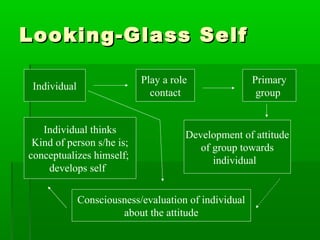
Looking-Glass SelfLooking-Glass Self
Individual
Play a role
contact
Primary
group
Individual thinks
Kind of person s/he is;
conceptualizes himself;
develops self
Development of attitude
of group towards
individual
Consciousness/evaluation of individual
about the attitude
Feature of Looking-Feature of Looking-
Glass SelfGlass Self
 Cooley in his book ‘Human nature andCooley in his book ‘Human nature and
Social Order’ remarked:Social Order’ remarked:
- I am not what I think I am- I am not what I think I am
- I am not what you think I am- I am not what you think I am
- I am what I think you think I am- I am what I think you think I am
Feature (con.)Feature (con.)
 SelfSelf andand societysociety are twin-born, we knoware twin-born, we know
one as immediately as we know the otherone as immediately as we know the other
 Mixture of observation, imagination, andMixture of observation, imagination, and
subjective interpretationsubjective interpretation
 It is also a social construction, involvingIt is also a social construction, involving
influences such as values and socialinfluences such as values and social
classclass
 The mind is socialThe mind is social
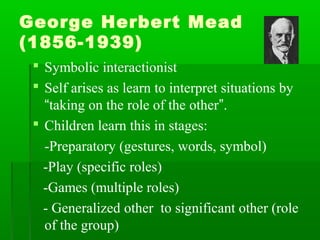
George Herbert Mead
(1856-1939)
 Symbolic interactionist
 Self arises as learn to interpret situations by
“taking on the role of the other”.
 Children learn this in stages:
-Preparatory (gestures, words, symbol)
-Play (specific roles)
-Games (multiple roles)
- Generalized other to significant other (role
of the group)
Mead: Development of
Self
 Self is an internal conversation between:
- “I”: the self as subject.
- “Me”: the self as object.
- “Generalized other”: society.
 Each socialized person is a society in
miniature.

Socialization (sociology)

  • 1.
    SocializationSocialization  The processof installing fundamentalThe process of installing fundamental elements of culture in a society’s newelements of culture in a society’s new member ismember is calledcalled socializationsocialization
  • 2.
    SocializationSocialization  Human childcomes into this world withHuman child comes into this world with animal needs butanimal needs but moldedmolded in society to ain society to a social being, that issocial being, that is socializationsocialization  Every society prescribes itsEvery society prescribes its own wayown way andand means of giving social training to newmeans of giving social training to new born so that they may develop ownborn so that they may develop own personalitypersonality  Each society shapes its children in theEach society shapes its children in the image of itsimage of its own cultureown culture
  • 3.
    Aspects ofAspects of socializationsocialization 1.Theprocess whereby individuals are1.The process whereby individuals are made to fit within the social ordermade to fit within the social order 2.2. Learn to live within a group (s)Learn to live within a group (s) 3. Creates individuals who are part of3. Creates individuals who are part of human communityhuman community 4.4.Learn to be competent members of theLearn to be competent members of the society in which we are born/livesociety in which we are born/live
  • 4.
    Aspects ofAspects of socialization(con.)socialization (con.) 5. Process whereby an individual5. Process whereby an individual internalizesinternalizes the norms of the group andthe norms of the group and makes it part of theirmakes it part of their personalitypersonality 6. Process whereby a society reproduces6. Process whereby a society reproduces itself in a new generationitself in a new generation 7.Values and traditions of the past are7.Values and traditions of the past are carried forward and perpetuatedcarried forward and perpetuated
  • 5.
    Which one isimportantWhich one is important ??  NurtureNurture Infant is a blankInfant is a blank slate, and that theslate, and that the kind of person s/hekind of person s/he becomes isbecomes is determined bydetermined by experienceexperience  NatureNature What we become isWhat we become is determined bydetermined by heredity, and thatheredity, and that experience cannotexperience cannot change what naturechange what nature ordained.ordained.
  • 6.
    SociobiologySociobiology  Systematic studyof the biological basesSystematic study of the biological bases of social behaviourof social behaviour  Influenced by Darwinism…naturalInfluenced by Darwinism…natural selectionselection  All behaviour is the result of genetic orAll behaviour is the result of genetic or biological factors –Extremist suggestbiological factors –Extremist suggest  Interested on how human nature isInterested on how human nature is affected by the genetic composition of aaffected by the genetic composition of a group of people …not individualgroup of people …not individual behaviourbehaviour
  • 7.
    SociobiologySociobiology  Criticized bysociologist that it createsCriticized by sociologist that it creates deflected interest on serious study ofdeflected interest on serious study of significant factors that influensing humansignificant factors that influensing human behaviourbehaviour  Fail to recognized social system, insteadFail to recognized social system, instead of arguing biological traitsof arguing biological traits  Disable peopleDisable people  Disadvantaged people and their academicDisadvantaged people and their academic performancesperformances
  • 8.
    Agents of socializationAgentsof socialization (con.)(con.)  Main agents of socialization are : family andMain agents of socialization are : family and parents, peers, school/teacher, mass media,parents, peers, school/teacher, mass media, etc.etc.  Agents play different roles in children’s livesAgents play different roles in children’s lives and have differentand have different goalsgoals,, responsibilitiesresponsibilities, and, and impactimpact on their developmenton their development - Agents mayAgents may reinforcereinforce oror contradictcontradict inin socializationsocialization
  • 9.
    Agents - family/parentsAgents- family/parents  Why family is an important agent?Why family is an important agent? - Introduces children to intimate personalIntroduces children to intimate personal relationshiprelationship - Give them first experience of beingGive them first experience of being treated as a distinct individualtreated as a distinct individual - First reference group for childrenFirst reference group for children - Introduces children to group lifeIntroduces children to group life
  • 10.
    Agents - family/parentsAgents- family/parents (con.)(con.)  Parents introduce children to the cultureParents introduce children to the culture of his/her family/groupsof his/her family/groups  Socialization Is blended withSocialization Is blended with love/punishmentlove/punishment  Introduces children to intimate personalIntroduces children to intimate personal relationshiprelationship  Learning gender roles: expectationLearning gender roles: expectation regarding proper behaviour, attitudes,regarding proper behaviour, attitudes, and activities of male and femalesand activities of male and females
  • 11.
    Agents - peersAgents- peers  Provides children with first experience ofProvides children with first experience of egalitarian relationshipegalitarian relationship  Peer teaches new skills or help to solvePeer teaches new skills or help to solve problemsproblems  Children can be selective in selectingChildren can be selective in selecting peerspeers  Peers also teach one another tabooPeers also teach one another taboo  During adolescence influence of peers inDuring adolescence influence of peers in great and parental influence declinesgreat and parental influence declines
  • 12.
    Agents - schoolandAgents - school and teacherteacher  Students are graded for what they doStudents are graded for what they do  Children are expected to conform toChildren are expected to conform to certain rules and regulationscertain rules and regulations  Teaches culture, values and attitudes -Teaches culture, values and attitudes - prepares them for the roles as adultsprepares them for the roles as adults  Introduces students to impersonalIntroduces students to impersonal bureaucratic organizationsbureaucratic organizations
  • 13.
    Agents - massmediaAgents - mass media  Gives us their message - developsGives us their message - develops certain attitudes andcertain attitudes and ideologiesideologies in usin us  Present days roles of television in thePresent days roles of television in the development of personality is greatdevelopment of personality is great
  • 14.
    Agents - observationAgents- observation  Socialization does not follow a clear-cutSocialization does not follow a clear-cut path to a predetermined goalspath to a predetermined goals  Because there are manyBecause there are many overlappingoverlapping andand unrecognizedunrecognized influences on the child,influences on the child, and manyand many possiblepossible outcomesoutcomes
  • 15.
    Types of socializationTypesof socialization  Types of socialization: (1) primary, (2)Types of socialization: (1) primary, (2) anticipatory, (3) developmental, and (4) re-anticipatory, (3) developmental, and (4) re- socializationsocialization  Primary socializationPrimary socialization: essential and basic types: essential and basic types of socialization. Takes place at early ageof socialization. Takes place at early age -- Concern with: (1) teaching of language, (2)Concern with: (1) teaching of language, (2) establishment of emotional ties, (3)establishment of emotional ties, (3) appreciation of others role/perspectives, andappreciation of others role/perspectives, and (4) internalization of norms, values(4) internalization of norms, values
  • 16.
    Types of socializationTypesof socialization (con.)(con.)  Anticipatory socializationAnticipatory socialization: Man may also: Man may also learn the culture of group to which theylearn the culture of group to which they do not belong. Socialize to join the groupdo not belong. Socialize to join the group  Developmental socializationDevelopmental socialization: Built on: Built on already acquired skills/knowledge as thealready acquired skills/knowledge as the adult progresses through new situationadult progresses through new situation  Re-socializationRe-socialization: stripping away of: stripping away of learning patters and substitution of newlearning patters and substitution of new one for themone for them
  • 17.
    Condition ofCondition of successfullearningsuccessful learning  Discrimination:Discrimination: - Able to differentiate between new objects- Able to differentiate between new objects to be learned and behavior patternsto be learned and behavior patterns which are already knownwhich are already known - Socializing agent must provide some- Socializing agent must provide some ‘hint’ which help the learner to learn new‘hint’ which help the learner to learn new thingthing
  • 18.
    Condition ofCondition of successfullearningsuccessful learning (con.)(con.)  Reward and punishment:Reward and punishment: - Socializing agent must give reward to the- Socializing agent must give reward to the child for ‘correct’ performance, and eitherchild for ‘correct’ performance, and either withhold reward or give punishment forwithhold reward or give punishment for ‘incorrect’ performance‘incorrect’ performance - Reward and punishment are- Reward and punishment are ‘reinforcement’ in desired behavior‘reinforcement’ in desired behavior patternpattern
  • 19.
    Condition ofCondition of successfullearningsuccessful learning (con.)(con.)  Control of the effects of frustrationControl of the effects of frustration -- All learners in socialization has to faceAll learners in socialization has to face frustrationfrustration -- There might be a reaction to frustration,There might be a reaction to frustration, e.g., aggressive feeling, non-cooperatione.g., aggressive feeling, non-cooperation - Socializing agent should counteract the- Socializing agent should counteract the effects of frustration, e.g., giving rewardeffects of frustration, e.g., giving reward
  • 20.
    Theories ofTheories of socializationsocialization Majortheoretical perspectives ofMajor theoretical perspectives of socialization:socialization: Looking-Glass self: Charles Horton CooleyLooking-Glass self: Charles Horton Cooley Role Taking: George Herbert MeadRole Taking: George Herbert Mead
  • 21.
    Theories ofTheories of socialization(con.)socialization (con.)  Characteristics of theoreticalCharacteristics of theoretical perspectivesperspectives -- Not mutually exclusiveNot mutually exclusive -- Complements each otherComplements each other -- The theories together provide a fullThe theories together provide a full outline of socializationoutline of socialization -- Micro level analysisMicro level analysis
  • 22.
    Looking-Glass SelfLooking-Glass Self Some definitions of Self:Some definitions of Self: -- The notion that we posses about self -The notion that we posses about self - unique andunique and distinctdistinct identityidentity that we setthat we set apart from other things and peopleapart from other things and people - Cluster of- Cluster of ideasideas that we employ inthat we employ in defining ourselvesdefining ourselves
  • 23.
    Looking-Glass SelfLooking-Glass Self (con.)(con.) How we develop self?How we develop self? - We acquire our sense of self by:We acquire our sense of self by: - seeing ourselves reflected in otherseeing ourselves reflected in other people’s attitudes,people’s attitudes, - behaviors toward us, andbehaviors toward us, and - by imagining what they think of usby imagining what they think of us
  • 24.
    Looking-Glass SelfLooking-Glass Self (con.)(con.) Three parts of Looking-Glass SelfThree parts of Looking-Glass Self -- What we imagine ofWhat we imagine of others seeothers see in usin us -- What we imagine about theWhat we imagine about the judgementjudgement they make out of what they see in usthey make out of what they see in us -- How weHow we feelfeel about those judgementsabout those judgements
  • 25.
    Looking-Glass SelfLooking-Glass Self Individual Playa role contact Primary group Individual thinks Kind of person s/he is; conceptualizes himself; develops self Development of attitude of group towards individual Consciousness/evaluation of individual about the attitude
  • 26.
    Feature of Looking-Featureof Looking- Glass SelfGlass Self  Cooley in his book ‘Human nature andCooley in his book ‘Human nature and Social Order’ remarked:Social Order’ remarked: - I am not what I think I am- I am not what I think I am - I am not what you think I am- I am not what you think I am - I am what I think you think I am- I am what I think you think I am
  • 27.
    Feature (con.)Feature (con.) SelfSelf andand societysociety are twin-born, we knoware twin-born, we know one as immediately as we know the otherone as immediately as we know the other  Mixture of observation, imagination, andMixture of observation, imagination, and subjective interpretationsubjective interpretation  It is also a social construction, involvingIt is also a social construction, involving influences such as values and socialinfluences such as values and social classclass  The mind is socialThe mind is social
  • 28.
    George Herbert Mead (1856-1939) Symbolic interactionist  Self arises as learn to interpret situations by “taking on the role of the other”.  Children learn this in stages: -Preparatory (gestures, words, symbol) -Play (specific roles) -Games (multiple roles) - Generalized other to significant other (role of the group)
  • 29.
    Mead: Development of Self Self is an internal conversation between: - “I”: the self as subject. - “Me”: the self as object. - “Generalized other”: society.  Each socialized person is a society in miniature.