
SOCIAL GROUPS
Ms Manisha
Ms Manisha
INTRODUCTION
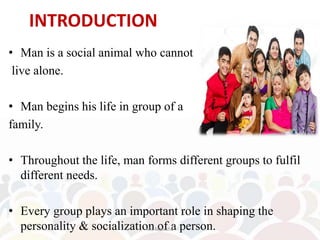
• Man is a social animal who cannot
live alone.
• Man begins his life in group of a
family.
• Throughout the life, man forms different groups to fulfil
different needs.
• Every group plays an important role in shaping the
personality & socialization of a person.
Ms Manisha
MEANING
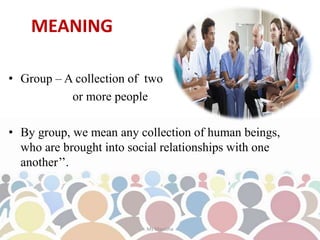
• Group – A collection of two
or more people
• By group, we mean any collection of human beings,
who are brought into social relationships with one
another’’.
Ms Manisha
DEFINITIONS
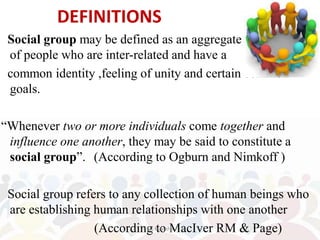
Social group may be defined as an aggregate of a number
of people who are inter-related and have a
common identity ,feeling of unity and certain common
goals.
“Whenever two or more individuals come together and
influence one another, they may be said to constitute a
social group”. (According to Ogburn and Nimkoff )
Social group refers to any collection of human beings who
are establishing human relationships with one another
(According to MacIver RM & Page)
Ms Manisha
CHARACTERISTICS OF GROUPS
• Collection of individuals : Social groups consist of two and
more than two persons.
• Reciprocal relationships (Interdependent) : The group
members are inter-related to each other and inter-dependent
on each other.
• Communication & IPR : People of the groups have regular
interactions and communication.
• Similar behaviour : Members of a group behave in a similar
way for achieving the common goals and interests.
Ms Manisha
• Common goals : The goals of all members in a group are
same.
• Feeling of unity and sympathy: The members of a group
have a feeling of unity and sympathy towards each other.
• Common interests , beliefs and ideals.
CHARACTERISTICS OF GROUPS
(Contd..)
Ms Manisha
• Group norms: Every group has it’s own set of rules and
norms.
• Division of labour : All the members in a group have
defined roles and works to do.
• Groups are dynamic : Social groups are not static but
dynamic. Some members older members die, some new
members are born, some people leave groups.
CHARACTERISTICS OF GROUPS
(Contd..)
Ms Manisha
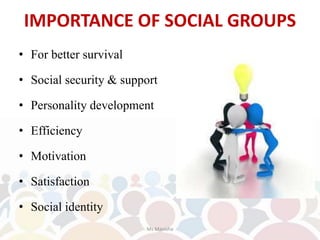
IMPORTANCE OF SOCIAL GROUPS
• For better survival
• Social security & support
• Personality development
• Efficiency
• Motivation
• Satisfaction
• Social identity
Ms Manisha
GROUP STRUCTURE
Groups are not unorganized.
They have a structure that shapes the behaviour of
members. They have ;
• Formal Leadership
• Roles
• Norms
• Status
• Size
• Composition (diversity, group demography)
• Cohesiveness
Ms Manisha
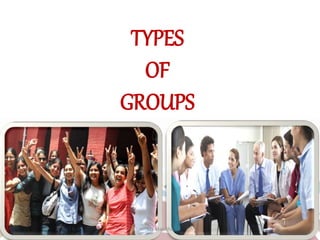
TYPES
OF
GROUPS
Ms Manisha
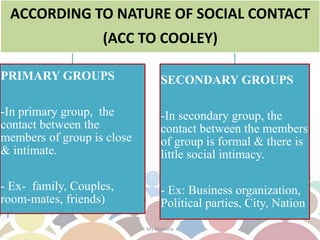
ACCORDING TO NATURE OF SOCIAL CONTACT
(ACC TO COOLEY)
PRIMARY GROUPS
-In primary group, the
contact between the
members of group is close
& intimate.
- Ex- family, Couples,
room-mates, friends)
SECONDARY GROUPS
-In secondary group, the
contact between the members
of group is formal & there is
little social intimacy.
- Ex: Business organization,
Political parties, City, Nation
Ms Manisha
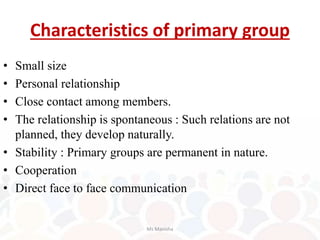
Characteristics of primary group
• Small size
• Personal relationship
• Close contact among members.
• The relationship is spontaneous : Such relations are not
planned, they develop naturally.
• Stability : Primary groups are permanent in nature.
• Cooperation
• Direct face to face communication
Ms Manisha
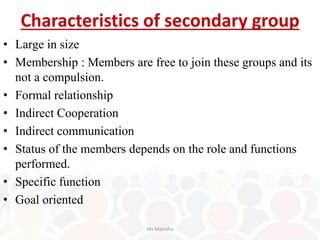
Characteristics of secondary group
• Large in size
• Membership : Members are free to join these groups and its
not a compulsion.
• Formal relationship
• Indirect Cooperation
• Indirect communication
• Status of the members depends on the role and functions
performed.
• Specific function
• Goal oriented
Ms Manisha
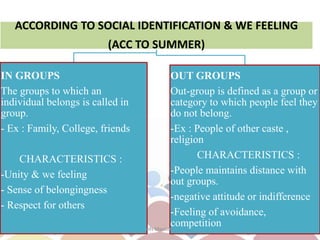
ACCORDING TO SOCIAL IDENTIFICATION & WE FEELING
(ACC TO SUMMER)
IN GROUPS
The groups to which an
individual belongs is called in
group.
- Ex : Family, College, friends
CHARACTERISTICS :
-Unity & we feeling
- Sense of belongingness
- Respect for others
OUT GROUPS
Out-group is defined as a group or
category to which people feel they
do not belong.
-Ex : People of other caste ,
religion
CHARACTERISTICS :
-People maintains distance with
out groups.
-negative attitude or indifference
-Feeling of avoidance,
competition
Ms Manisha
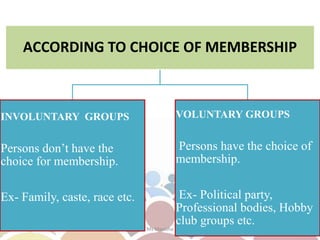
ACCORDING TO CHOICE OF MEMBERSHIP
INVOLUNTARY GROUPS
Persons don’t have the
choice for membership.
Ex- Family, caste, race etc.
VOLUNTARY GROUPS
Persons have the choice of
membership.
Ex- Political party,
Professional bodies, Hobby
club groups etc.
Ms Manisha
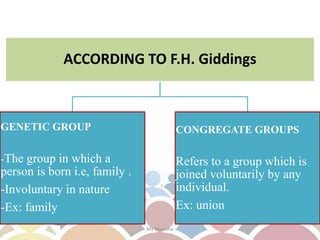
ACCORDING TO F.H. Giddings
GENETIC GROUP
-The group in which a
person is born i.e, family .
-Involuntary in nature
-Ex: family
CONGREGATE GROUPS
Refers to a group which is
joined voluntarily by any
individual.
Ex: union
Ms Manisha
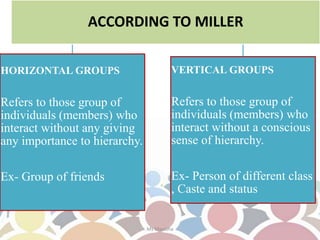
ACCORDING TO MILLER
HORIZONTAL GROUPS
Refers to those group of
individuals (members) who
interact without any giving
any importance to hierarchy.
Ex- Group of friends
VERTICAL GROUPS
Refers to those group of
individuals (members) who
interact without a conscious
sense of hierarchy.
Ex- Person of different class
, Caste and status
Ms Manisha
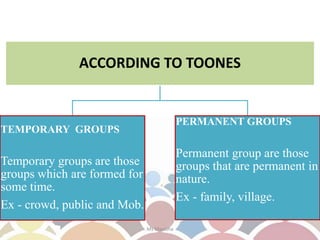
ACCORDING TO TOONES
TEMPORARY GROUPS
Temporary groups are those
groups which are formed for
some time.
Ex - crowd, public and Mob.
PERMANENT GROUPS
Permanent group are those
groups that are permanent in
nature.
Ex - family, village.
Ms Manisha
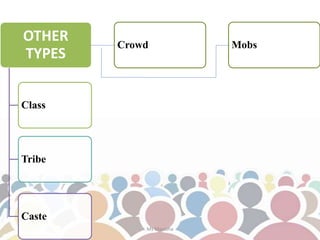
OTHER
TYPES
Class
Tribe
Caste
Crowd Mobs
Ms Manisha
CROWD
• The crowd is a collection of people which is temporary and
formed suddenly.
• A crowd is quickly created and quickly dissolved.
Ms Manisha
Ms Manisha
Definition : Crowd
“It is a physically compact aggregation of human being
brought into direct, temporary and un-organized contact
with one another”.
(MacIver )
“ Crowd is a temporary collection of persons who react
to a common focus of attention, and engage in
spontaneous interaction.
(Lundberg)
Ms Manisha
Characteristics of Crowd
• Crowd is a gathering.
• Temporary group
• Unorganized group
• Anonymity
• Narrow attention (The attention of a crowd is only
towards a particular thing at one time)
• Emotional Irresponsibility
Ms Manisha
Types of Crowd
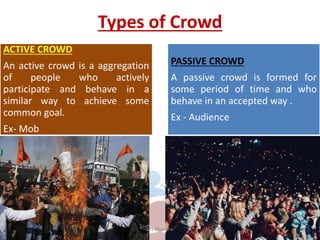
ACTIVE CROWD
An active crowd is a aggregation
of people who actively
participate and behave in a
similar way to achieve some
common goal.
Ex- Mob
PASSIVE CROWD
A passive crowd is formed for
some period of time and who
behave in an accepted way .
Ex - Audience
Ms Manisha
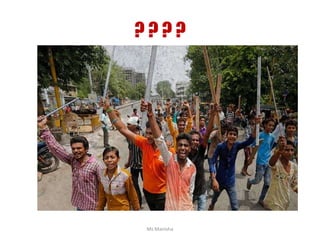
? ? ? ?
Ms Manisha
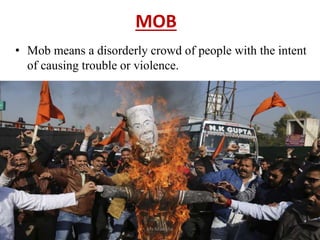
MOB
• Mob means a disorderly crowd of people with the intent
of causing trouble or violence.
Ms Manisha
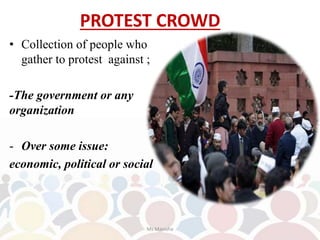
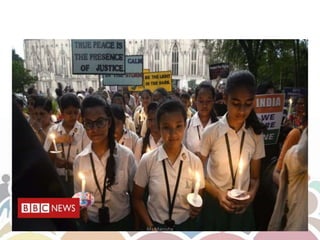
PROTEST CROWD
• Collection of people who
gather to protest against ;
-The government or any
organization
- Over some issue:
economic, political or social
Ms Manisha
Ms Manisha
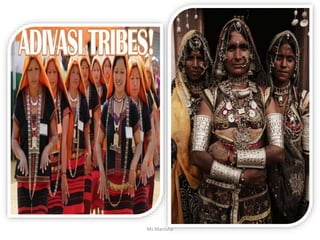
TRIBE
Definition : A tribe is a collection of families
bearing a common name, speaking common
dialect/ language , occupying a common
territory and having a common culture.
• Ex- Schedule tribes in India
- Santals in Bihar
Ms Manisha
Ms Manisha
Characteristics of Tribe
• Common territory : Remain within a definite area
• Unity
• Common language
• Endogamous
• Religious ties
• Common culture
Ms Manisha
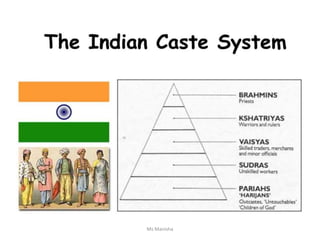
CASTE
• Refers to a group of people bearing a common name and
having traditional occupation and forming a homogenous
community.
• Caste is defined as “the extreme form of social
organisation in which position of individuals in the status
hierarchy is determined by descend and birth”.
(ACC TO ANDERSON & PARKER)
Ms Manisha
SUDRAS VAISHYAS KSHATRIYAS BRAHMINS
Ms Manisha
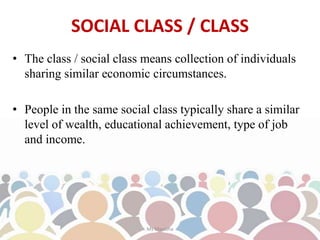
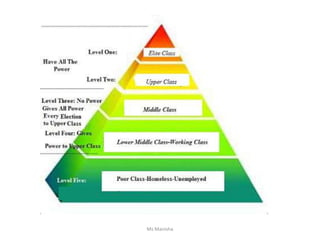
SOCIAL CLASS / CLASS
• The class / social class means collection of individuals
sharing similar economic circumstances.
• People in the same social class typically share a similar
level of wealth, educational achievement, type of job
and income.
Ms Manisha
Definition : Social Class
• A group of people within a society who possess the
same socioeconomic status.
• Social class refers to a group of people with similar
levels of wealth, influence, and status
Ms Manisha
Ms Manisha
Social groups are everywhere
and are a basic part of human
life.
Everywhere you look there
seem to be groups of people!
Ms Manisha

Editor's Notes