BUILDING A PROFESSIONAL
DIGITAL IDENTITY
By @nic_fair
www.nicfair.co.uk
https://www.linkedin.com/in/nicfair/
n.s.fair@soton.ac.uk
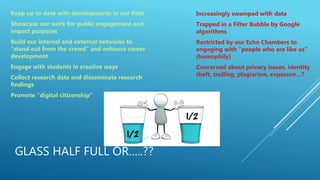
GLASS HALF FULL OR…..??
Increasingly swamped with data
Trapped in a Filter Bubble by Google
algorithms
Restricted by our Echo Chambers to
engaging with “people who are like us”
(homophily)
Concerned about privacy issues, identity
theft, trolling, plagiarism, exposure…?
Keep up to date with developments in our field
Showcase our work for public engagement and
impact purposes
Build our internal and external networks to
“stand out from the crowd” and enhance career
development
Engage with students in creative ways
Collect research data and disseminate research
findings
Promote “digital citizenship”
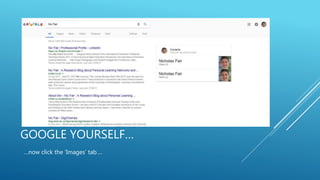
GOOGLE YOURSELF…
…now click the ‘Images’ tab….
THE THEORY BEHIND DIGITAL PROFILES:
NETWORKS
 In the 1990s, “a number of social, technological, economic and cultural transformations came together to give rise to a new form of
society, the network society, … made of networks in all the key dimensions of social organization and social practice”, and which
covers “the entire range of human activity, from personal support networks to professional tasks and political mobilizations.”
(Castells (1996, 2010,) Forward)
 The whole of human history and culture uniquely features “networks of co-operation” and that the main reason for the current
dominance of homo sapiens as a species is “our ability to connect many humans to one another…[meaning that]…homo sapiens is the
only species on earth capable of co-operating flexibly in large numbers”.
(Harari (2017), p.153-158)
 “knowledge is distributed across a network of connections, and therefore learning consists of the ability to construct and traverse
those networks” and that “what we ‘know’ is embedded in our network of connections to each other, to resources, to the world.”
(Downes, 2007).
 “in a digital, networked, open world people become less defined by the institution to which they belong and more by the network and
online identity they establish”
(Weller (2011), p.4)
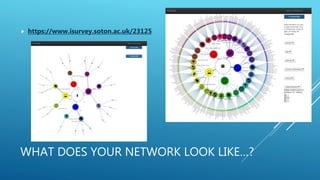
WHAT DOES YOUR NETWORK LOOK LIKE…?
 https://www.isurvey.soton.ac.uk/23125
PRACTICAL STEPS
 Develop consistent online identity:
- Same profile pic and name
- All social media linked together
- Separate personal social media profiles from professional social media accounts
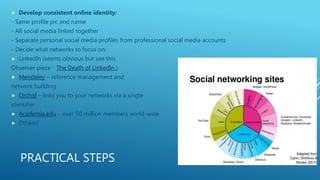
- Decide what networks to focus on:
 LinkedIn (seems obvious but see this
Observer piece - The Death of LinkedIn )
 Mendeley – reference management and
network building
 Orchid – links you to your networks via a single
identifier
 Academia.edu – over 50 million members world-wide
 Others?
PRACTICAL STEPS
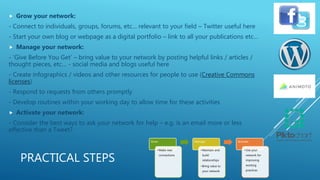
 Grow your network:
- Connect to individuals, groups, forums, etc… relevant to your field – Twitter useful here
- Start your own blog or webpage as a digital portfolio – link to all your publications etc…
 Manage your network:
- ‘Give Before You Get’ – bring value to your network by posting helpful links / articles /
thought pieces, etc… - social media and blogs useful here
- Create infographics / videos and other resources for people to use (Creative Commons
licenses)
- Respond to requests from others promptly
- Develop routines within your working day to allow time for these activities
 Activate your network:
- Consider the best ways to ask your network for help – e.g. is an email more or less
effective than a Tweet?
Grow
•Make new
connections
Manage
•Maintain and
build
relationships
•Bring value to
your network
Activate
•Use your
network for
improving
working
practices
MANAGING: USING SOCIAL MEDIA TO
CREATE A NETWORK IDENTITY
Commmunicating Your Research with Social Media:
A Practical Guide to Using Blogs, Podcasts, Data Visualisations and Video
by Amy Mollett, Cheryl Brumley, Chris Gilson, and Sierra Williams
• create and share images, audio, and video in ways that positively impact
your research
• connect and collaborate with other researchers
• measure and quantify research communication efforts for funders
• provide research evidence in innovative digital formats
• reach wider, more engaged audiences in academia and beyond
• See also Carrigan, M. (2016) Social Media for Academics
WHY DOES ANY OF THIS MATTER?
AS AN ACADEMIC:
 Impact
 Public Engagement and Reach
 New HE business models – micro-degrees / micro-masters; flexible degree programmes; competition
from online education providers; MOOCs
 Communities of Practice (Lave & Wenger, 1998), e.g. in the writing process:
Weller (2011, p.3) states “I have around 3000 followers on Twitter and around 2000 subscribers to my
blog, which represents a wide pool of experience to draw upon. Sometimes I would put a direct call
to this network, along the lines of ‘Does anyone have a good example of….’. In other cases I would
post drafts of my work to my blog and receive comments and links to relevant material”.
 New research methodologies (e.g. MOOCs for data collection)
 Building digital capital with social media (video 3 mins)
WHY DOES ANY OF THIS MATTER?
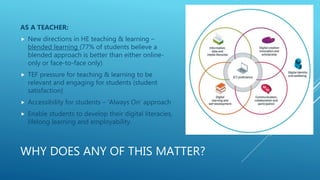
AS A TEACHER:
 New directions in HE teaching & learning –
blended learning (77% of students believe a
blended approach is better than either online-
only or face-to-face only)
 TEF pressure for teaching & learning to be
relevant and engaging for students (student
satisfaction)
 Accessibility for students – ‘Always On’ approach
 Enable students to develop their digital literacies,
lifelong learning and employability.
A FINAL QUESTION FOR YOU
What steps will you now take to enhance
your professional digital profile as a
result of this session?
REFERENCES
 Castells, M., 1996. The Rise of the Network Society (The Information Age, Vol. 1). Economy,
Society and Culture. 2nd edition 2011.
 Downes, S., 2007. What Connectivism Is [accessed 11/2/18 on
https://halfanhour.blogspot.co.uk/2007/02/what-connectivism-is.html]
 Harari, Y.N., 2016. Homo Deus: A brief history of tomorrow. Random House.
 Lave, J. and Wenger, E., 1998. Communities of practice. Retrieved June, 9, p.2008.
 Weller, M., 2011. The digital scholar: How technology is transforming scholarly practice. A&C
Black.

Building a professional digital identity 2018

  • 1.
    BUILDING A PROFESSIONAL DIGITALIDENTITY By @nic_fair www.nicfair.co.uk https://www.linkedin.com/in/nicfair/ n.s.fair@soton.ac.uk
  • 2.
    GLASS HALF FULLOR…..?? Increasingly swamped with data Trapped in a Filter Bubble by Google algorithms Restricted by our Echo Chambers to engaging with “people who are like us” (homophily) Concerned about privacy issues, identity theft, trolling, plagiarism, exposure…? Keep up to date with developments in our field Showcase our work for public engagement and impact purposes Build our internal and external networks to “stand out from the crowd” and enhance career development Engage with students in creative ways Collect research data and disseminate research findings Promote “digital citizenship”
  • 3.
    GOOGLE YOURSELF… …now clickthe ‘Images’ tab….
  • 4.
    THE THEORY BEHINDDIGITAL PROFILES: NETWORKS  In the 1990s, “a number of social, technological, economic and cultural transformations came together to give rise to a new form of society, the network society, … made of networks in all the key dimensions of social organization and social practice”, and which covers “the entire range of human activity, from personal support networks to professional tasks and political mobilizations.” (Castells (1996, 2010,) Forward)  The whole of human history and culture uniquely features “networks of co-operation” and that the main reason for the current dominance of homo sapiens as a species is “our ability to connect many humans to one another…[meaning that]…homo sapiens is the only species on earth capable of co-operating flexibly in large numbers”. (Harari (2017), p.153-158)  “knowledge is distributed across a network of connections, and therefore learning consists of the ability to construct and traverse those networks” and that “what we ‘know’ is embedded in our network of connections to each other, to resources, to the world.” (Downes, 2007).  “in a digital, networked, open world people become less defined by the institution to which they belong and more by the network and online identity they establish” (Weller (2011), p.4)
  • 5.
    WHAT DOES YOURNETWORK LOOK LIKE…?  https://www.isurvey.soton.ac.uk/23125
  • 6.
    PRACTICAL STEPS  Developconsistent online identity: - Same profile pic and name - All social media linked together - Separate personal social media profiles from professional social media accounts - Decide what networks to focus on:  LinkedIn (seems obvious but see this Observer piece - The Death of LinkedIn )  Mendeley – reference management and network building  Orchid – links you to your networks via a single identifier  Academia.edu – over 50 million members world-wide  Others?
  • 7.
    PRACTICAL STEPS  Growyour network: - Connect to individuals, groups, forums, etc… relevant to your field – Twitter useful here - Start your own blog or webpage as a digital portfolio – link to all your publications etc…  Manage your network: - ‘Give Before You Get’ – bring value to your network by posting helpful links / articles / thought pieces, etc… - social media and blogs useful here - Create infographics / videos and other resources for people to use (Creative Commons licenses) - Respond to requests from others promptly - Develop routines within your working day to allow time for these activities  Activate your network: - Consider the best ways to ask your network for help – e.g. is an email more or less effective than a Tweet? Grow •Make new connections Manage •Maintain and build relationships •Bring value to your network Activate •Use your network for improving working practices
  • 8.
    MANAGING: USING SOCIALMEDIA TO CREATE A NETWORK IDENTITY Commmunicating Your Research with Social Media: A Practical Guide to Using Blogs, Podcasts, Data Visualisations and Video by Amy Mollett, Cheryl Brumley, Chris Gilson, and Sierra Williams • create and share images, audio, and video in ways that positively impact your research • connect and collaborate with other researchers • measure and quantify research communication efforts for funders • provide research evidence in innovative digital formats • reach wider, more engaged audiences in academia and beyond • See also Carrigan, M. (2016) Social Media for Academics
  • 9.
    WHY DOES ANYOF THIS MATTER? AS AN ACADEMIC:  Impact  Public Engagement and Reach  New HE business models – micro-degrees / micro-masters; flexible degree programmes; competition from online education providers; MOOCs  Communities of Practice (Lave & Wenger, 1998), e.g. in the writing process: Weller (2011, p.3) states “I have around 3000 followers on Twitter and around 2000 subscribers to my blog, which represents a wide pool of experience to draw upon. Sometimes I would put a direct call to this network, along the lines of ‘Does anyone have a good example of….’. In other cases I would post drafts of my work to my blog and receive comments and links to relevant material”.  New research methodologies (e.g. MOOCs for data collection)  Building digital capital with social media (video 3 mins)
  • 10.
    WHY DOES ANYOF THIS MATTER? AS A TEACHER:  New directions in HE teaching & learning – blended learning (77% of students believe a blended approach is better than either online- only or face-to-face only)  TEF pressure for teaching & learning to be relevant and engaging for students (student satisfaction)  Accessibility for students – ‘Always On’ approach  Enable students to develop their digital literacies, lifelong learning and employability.
  • 11.
    A FINAL QUESTIONFOR YOU What steps will you now take to enhance your professional digital profile as a result of this session?
  • 12.
    REFERENCES  Castells, M.,1996. The Rise of the Network Society (The Information Age, Vol. 1). Economy, Society and Culture. 2nd edition 2011.  Downes, S., 2007. What Connectivism Is [accessed 11/2/18 on https://halfanhour.blogspot.co.uk/2007/02/what-connectivism-is.html]  Harari, Y.N., 2016. Homo Deus: A brief history of tomorrow. Random House.  Lave, J. and Wenger, E., 1998. Communities of practice. Retrieved June, 9, p.2008.  Weller, M., 2011. The digital scholar: How technology is transforming scholarly practice. A&C Black.

Editor's Notes

  • #3 Where do you stand in your attitude towards digital scholarship?
  • #4 Does your ‘self-google’ reflect your digital attitudes?
  • #5 1 – networked society 2 – human competitive advantage 3 - Connectivism and learning 4 - scholarship
  • #6 Take this short survey (about 10mins to complete) and find out what your Personal Learning Network looks like. Discuss findings…. Mention Digi Residents vs Visitors spectrum (White & Le Cornu, 2011) Mention Digi / Network Identity
  • #7 – link to ‘google yourself’ activity results….
  • #8 – link to ‘google yourself’ activity results….
  • #11 2017 Educause report found that while 77% of students surveyed (n=57,000 staff and students on 10 countries) preferred blended learning approaches, 45% of staff think it is not effective and a further 37% require more evidence of effectiveness MAJOR MISMATCH HERE