
Online Social Networking for
the Sciences:
How an Average Scientist
Makes Himself Visible
Antony Williams
NCSU, October 5th 2013
Visibility Means Discoverability
• Does a Social Profile matter?
• You are visible, when you share your skills,
experience and research activities by:
•
•
•
•
•
•

Establishing a public profile
Getting on the record
Collaborative Science
Demonstrating a skill set
Measured using “alternative metrics”
Contributing to the public peer review
process
The world of the online CV
• CVs and resumes are mainstream
• Re.vu
• LinkedIn Profile
• Your blog page

• Remember Google represents your
activities and can represent your CV
too….
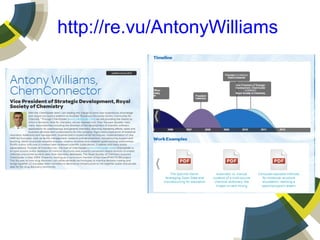
http://re.vu/AntonyWilliams
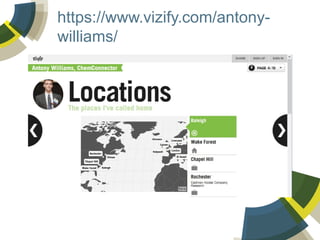
https://www.vizify.com/antonywilliams/
CAUTION! Separate Personal
from Professional
• We all know the stories of the “pictures that
shouldn’t have made it online!”
• FaceBook is probably best kept “personal”
Scientists are “Quantified”
• Scientists are quantified
• Stats are gathered and analyzed
• Employers can find them, tenure will
depend on them, and these already
happen without your participation
• Scientists Impact Factors, H-index and
many other variants.
How you can be Quantified…
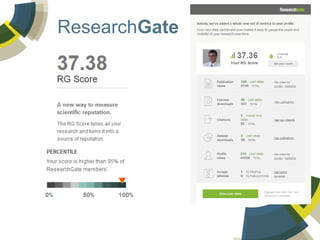
ResearchGate
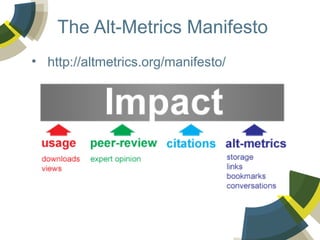
The Alt-Metrics Manifesto
• http://altmetrics.org/manifesto/
AltMetrics via Plum Analytics
Usage, Citations, Social
Media, Etc
Detailed Usage Statistics
Your Profile as a Scientist
• If you are an active scientist – i.e. already
published, active researcher, generator of
data, early, mid- or late career there is
lots to do!
• If you are a junior scientist the benefits of
investing time now will provide a strong
foundation for your future!
• So what do I do??
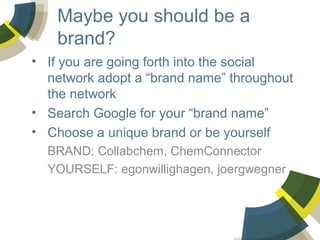
Maybe you should be a
brand?
• If you are going forth into the social
network adopt a “brand name” throughout
the network
• Search Google for your “brand name”
• Choose a unique brand or be yourself
BRAND: Collabchem, ChemConnector
YOURSELF: egonwillighagen, joergwegner
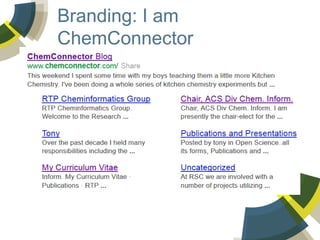
Branding: I am
ChemConnector
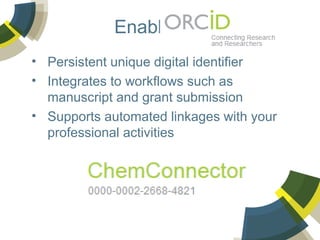
Enabled by
• Persistent unique digital identifier
• Integrates to workflows such as
manuscript and grant submission
• Supports automated linkages with your
professional activities
An Online Profile
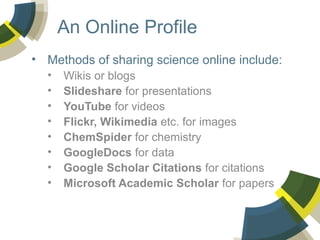
• Methods of sharing science online include:
•
•
•
•
•
•
•
•

Wikis or blogs
Slideshare for presentations
YouTube for videos
Flickr, Wikimedia etc. for images
ChemSpider for chemistry
GoogleDocs for data
Google Scholar Citations for citations
Microsoft Academic Scholar for papers
Blogs are for Stories and
Detail
•
•
•
•

A blog is your voice
Communicate and engage the community
Ask for help, share your skills, collaborate
Blogging, in general, is your most
important voice in the social network.
• Commit to a position and be honest
• They can be free or paid – I use
Wordpress
Wikipedia
http://en.wikipedia.org/wiki/Antony_John_Williams
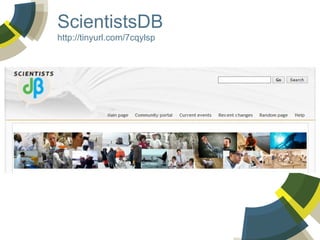
ScientistsDB
http://tinyurl.com/7cqylsp
ScientistsDB
• Write your OWN article on ScientistsDB
• It is a community-policed site but it is “your”
page
• An article, once approved by the community,
can, in theory, be moved to Wikipedia if you
meet the notability criteria
• All content is licensed under standard CCBY-SA 3.0 licensing provided by Wikipedia
Are you a-tweeting on
Twitter?
• 140 characters to connect and communicate
• Use your “brand name” on Twitter – it has
high frequency here…
• Greatest value for me – bite-sized nuggets
into information of interest and leading
people into information I wish to share
including my posts, my activities
• Faster responses than email commonly!
Are you LinkedIn Yet? You
should be
• LinkedIn for “professionals”
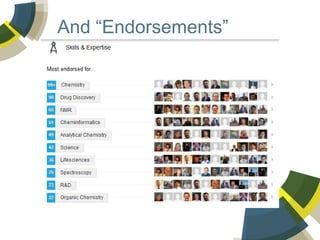
• Expose work history, skills, your professional
interests, your memberships – your profile
WILL be watched!
• Who you are linked to says a lot about who
you are. Get Linked to people in your
domain.
• Professional relationships rather than just
friendships. FaceBook-it for friends
LinkedIn
http://www.linkedin.com/in/AntonyWilliams
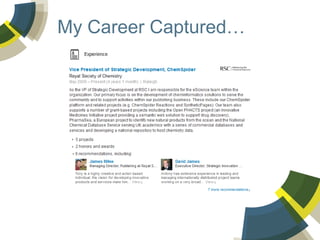
My Career Captured…
And “Endorsements”
Are you sharing your slides
online?
• Slideshare to host, expose and share your
presentations, publications, posters and
videos (subject to copyright you might have
transferred!)
http://www.slideshare.net/
• Register for an account and retain your
branding! Keep your online brand consistent
Upload and Add Details
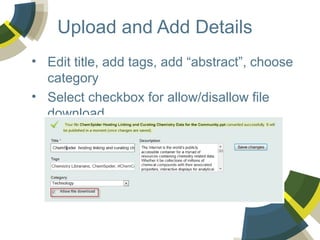
• Edit title, add tags, add “abstract”, choose
category
• Select checkbox for allow/disallow file
download
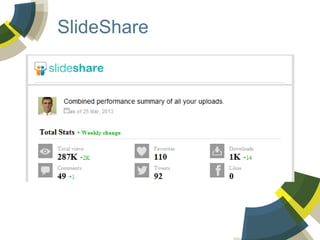
SlideShare
Social Media Tools Feed
Each Other
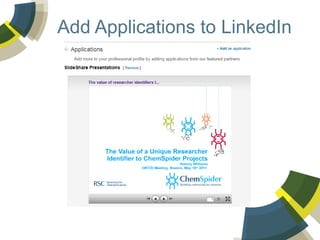
• Plugins and connectors integrate your
activities across the social media platforms
• Expose your Tweeting and your Slideshare
presentations directly on LinkedIn.
• Plug-ins allow your tweets and presentations
to be automagically displayed on LinkedIn
From Slideshare Into the
Network
Add Applications to LinkedIn
Places to Share Videos
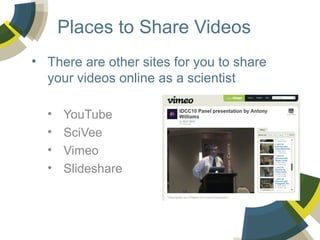
• There are other sites for you to share
your videos online as a scientist
•
•
•
•

YouTube
SciVee
Vimeo
Slideshare
Be Aware of Licensing
• Your blog, your YouTube video, your
Slideshare, presentations, your Flickr
photos, all represent your creative work
• Use licenses to protect and share your work
• Creative Commons licenses are
recommended
• Be aware of copyright transfer and what
rights you give away
Share/Manage Your
Publications
• Where do you “manage your publications”?
• Share your “activities” with the community
• My publications/slides/videos are my CV on
•
•
•
•
•

My Blog
On LinkedIn
On SlideShare
On Researchgate
On Academia.edu
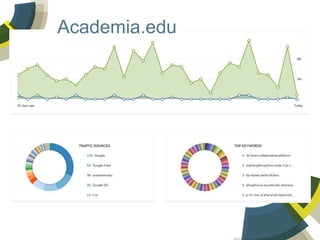
Academia.edu
Academia.edu
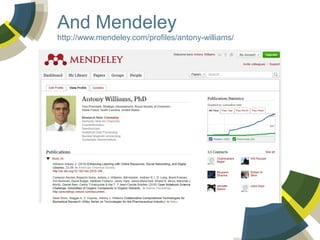
And Mendeley
http://www.mendeley.com/profiles/antony-williams/
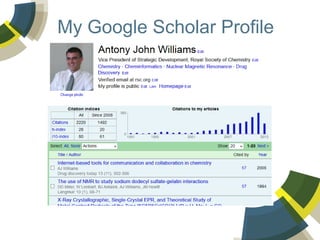
My Google Scholar Profile
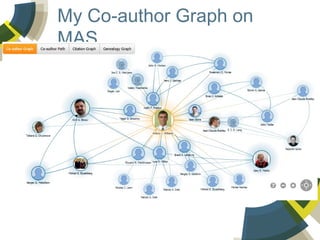
My Co-author Graph on
MAS..
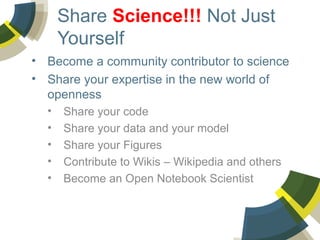
Share Science!!! Not Just
Yourself
• Become a community contributor to science
• Share your expertise in the new world of
openness
•
•
•
•
•

Share your code
Share your data and your model
Share your Figures
Contribute to Wikis – Wikipedia and others
Become an Open Notebook Scientist
Encouraging Participation with
Rewards and RECOGNITION
Honest Questions can
Disrupt…
Honest Questions can
Disrupt…
Honest Questions can
Disrupt…
Honest Questions can
Disrupt…
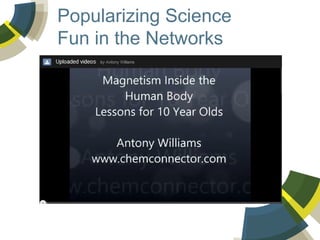
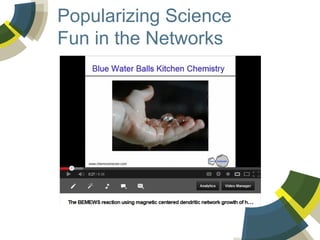
Popularizing Science
Fun in the Networks
Popularizing Science
Fun in the Networks
Popularizing Science
Fun in the Networks
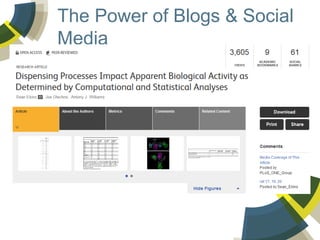
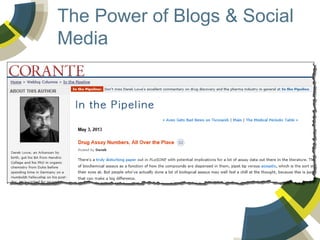
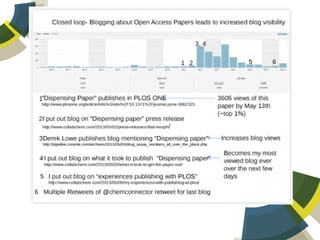
The Power of Blogs & Social
Media
The Power of Blogs & Social
Media
The Power of Blogs & Social
Media
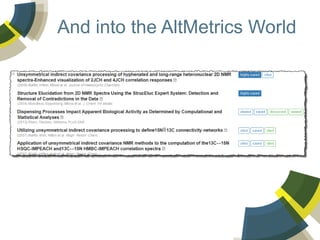
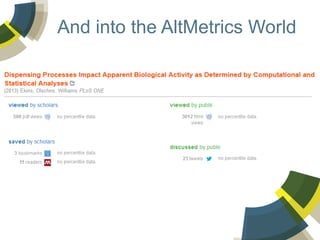
And into the AltMetrics World
Social Networking for
Scientists
• The representation of YOU on the web is
going to become increasingly important…
• Engagement and participation is a
choice…
• Consider the value to both you and to
your community regarding contribution
• Open Data, Curations, Annotations etc.
Thank you
Email: williamsa@rsc.org
Twitter: @ChemConnector
Personal Blog: www.chemconnector.com
SLIDES: www.slideshare.net/AntonyWilliams

Online social networking for the sciences and how an average scientist makes himself visible

  • 1.
    Online Social Networkingfor the Sciences: How an Average Scientist Makes Himself Visible Antony Williams NCSU, October 5th 2013
  • 2.
    Visibility Means Discoverability •Does a Social Profile matter? • You are visible, when you share your skills, experience and research activities by: • • • • • • Establishing a public profile Getting on the record Collaborative Science Demonstrating a skill set Measured using “alternative metrics” Contributing to the public peer review process
  • 3.
    The world ofthe online CV • CVs and resumes are mainstream • Re.vu • LinkedIn Profile • Your blog page • Remember Google represents your activities and can represent your CV too….
  • 4.
  • 5.
  • 6.
    CAUTION! Separate Personal fromProfessional • We all know the stories of the “pictures that shouldn’t have made it online!” • FaceBook is probably best kept “personal”
  • 7.
    Scientists are “Quantified” •Scientists are quantified • Stats are gathered and analyzed • Employers can find them, tenure will depend on them, and these already happen without your participation • Scientists Impact Factors, H-index and many other variants.
  • 8.
    How you canbe Quantified…
  • 9.
  • 10.
    The Alt-Metrics Manifesto •http://altmetrics.org/manifesto/
  • 12.
  • 13.
  • 14.
  • 15.
    Your Profile asa Scientist • If you are an active scientist – i.e. already published, active researcher, generator of data, early, mid- or late career there is lots to do! • If you are a junior scientist the benefits of investing time now will provide a strong foundation for your future! • So what do I do??
  • 16.
    Maybe you shouldbe a brand? • If you are going forth into the social network adopt a “brand name” throughout the network • Search Google for your “brand name” • Choose a unique brand or be yourself BRAND: Collabchem, ChemConnector YOURSELF: egonwillighagen, joergwegner
  • 17.
  • 18.
    Enabled by • Persistentunique digital identifier • Integrates to workflows such as manuscript and grant submission • Supports automated linkages with your professional activities
  • 19.
    An Online Profile •Methods of sharing science online include: • • • • • • • • Wikis or blogs Slideshare for presentations YouTube for videos Flickr, Wikimedia etc. for images ChemSpider for chemistry GoogleDocs for data Google Scholar Citations for citations Microsoft Academic Scholar for papers
  • 20.
    Blogs are forStories and Detail • • • • A blog is your voice Communicate and engage the community Ask for help, share your skills, collaborate Blogging, in general, is your most important voice in the social network. • Commit to a position and be honest • They can be free or paid – I use Wordpress
  • 21.
  • 22.
  • 23.
    ScientistsDB • Write yourOWN article on ScientistsDB • It is a community-policed site but it is “your” page • An article, once approved by the community, can, in theory, be moved to Wikipedia if you meet the notability criteria • All content is licensed under standard CCBY-SA 3.0 licensing provided by Wikipedia
  • 24.
    Are you a-tweetingon Twitter? • 140 characters to connect and communicate • Use your “brand name” on Twitter – it has high frequency here… • Greatest value for me – bite-sized nuggets into information of interest and leading people into information I wish to share including my posts, my activities • Faster responses than email commonly!
  • 25.
    Are you LinkedInYet? You should be • LinkedIn for “professionals” • Expose work history, skills, your professional interests, your memberships – your profile WILL be watched! • Who you are linked to says a lot about who you are. Get Linked to people in your domain. • Professional relationships rather than just friendships. FaceBook-it for friends
  • 26.
  • 27.
  • 28.
  • 29.
    Are you sharingyour slides online? • Slideshare to host, expose and share your presentations, publications, posters and videos (subject to copyright you might have transferred!) http://www.slideshare.net/ • Register for an account and retain your branding! Keep your online brand consistent
  • 30.
    Upload and AddDetails • Edit title, add tags, add “abstract”, choose category • Select checkbox for allow/disallow file download
  • 31.
  • 32.
    Social Media ToolsFeed Each Other • Plugins and connectors integrate your activities across the social media platforms • Expose your Tweeting and your Slideshare presentations directly on LinkedIn. • Plug-ins allow your tweets and presentations to be automagically displayed on LinkedIn
  • 33.
  • 34.
  • 35.
    Places to ShareVideos • There are other sites for you to share your videos online as a scientist • • • • YouTube SciVee Vimeo Slideshare
  • 36.
    Be Aware ofLicensing • Your blog, your YouTube video, your Slideshare, presentations, your Flickr photos, all represent your creative work • Use licenses to protect and share your work • Creative Commons licenses are recommended • Be aware of copyright transfer and what rights you give away
  • 37.
    Share/Manage Your Publications • Wheredo you “manage your publications”? • Share your “activities” with the community • My publications/slides/videos are my CV on • • • • • My Blog On LinkedIn On SlideShare On Researchgate On Academia.edu
  • 38.
  • 39.
  • 40.
  • 41.
  • 42.
  • 43.
    Share Science!!! NotJust Yourself • Become a community contributor to science • Share your expertise in the new world of openness • • • • • Share your code Share your data and your model Share your Figures Contribute to Wikis – Wikipedia and others Become an Open Notebook Scientist
  • 44.
  • 45.
  • 46.
  • 47.
  • 48.
  • 49.
  • 50.
  • 51.
  • 52.
    The Power ofBlogs & Social Media
  • 53.
    The Power ofBlogs & Social Media
  • 54.
    The Power ofBlogs & Social Media
  • 56.
    And into theAltMetrics World
  • 57.
    And into theAltMetrics World
  • 58.
    Social Networking for Scientists •The representation of YOU on the web is going to become increasingly important… • Engagement and participation is a choice… • Consider the value to both you and to your community regarding contribution • Open Data, Curations, Annotations etc.
  • 59.
    Thank you Email: williamsa@rsc.org Twitter:@ChemConnector Personal Blog: www.chemconnector.com SLIDES: www.slideshare.net/AntonyWilliams