Sindh Madressatul Islam
University, Karachi
Department of Information
Technology
COURSE INTRODUCTION
Course Code
MAT-104
Course Title
Discrete Structure
Credit Hours
3+0 (3hr)
COURSE OBJECTIVES
 Mathematical reasoning: introduction to logic, propositional and
predicate calculus; negation disjunction and conjunction; implication
and equivalence; truth tables; predicates; quantifiers; natural
deduction; rules of Inference; methods of proofs; use in program
proving; resolution principle; Set theory: Paradoxes in set theory;
inductive definition of sets and proof by induction; Relations,
representation of relations by graphs; properties of relations,
equivalence relations and partitions; Partial orderings; Linear and
wellordered sets; Functions: mappings, injection and surjection,
composition of functions; inverse functions; special functions; Peano
postulates; Recursive function theory; Elementary combinatorics;
counting techniques; recurrence relation; generating functions. Graph
Theory: elements of graph theory, Planar Graphs, Graph Colouring,
Euler graph, Hamiltonian path, trees and their applications.
LEARNING STRATEGIES
Active learning strategies are employed in this course to encourage students'
participation in class and to foster their abilities to gather information and data
from its sources and analyze it.
Active learning strategies include assignments/projects where students work in
individual and in teams to solve certain problems. Readings may include many
Research Papers and other related studies.
RECOMMENDED RESOURCES
• Discrete Mathematical Structure with Application to
Computer Science, J. P. Temblay and B Manohar, McGraw-
Hill, 2nd Edition.
• Discrete Mathematics, 7th edition, Richard Johnson Baugh,
2008, Prentice Hall Publishers.
• Relevant Research Papers (Journal + Conference)
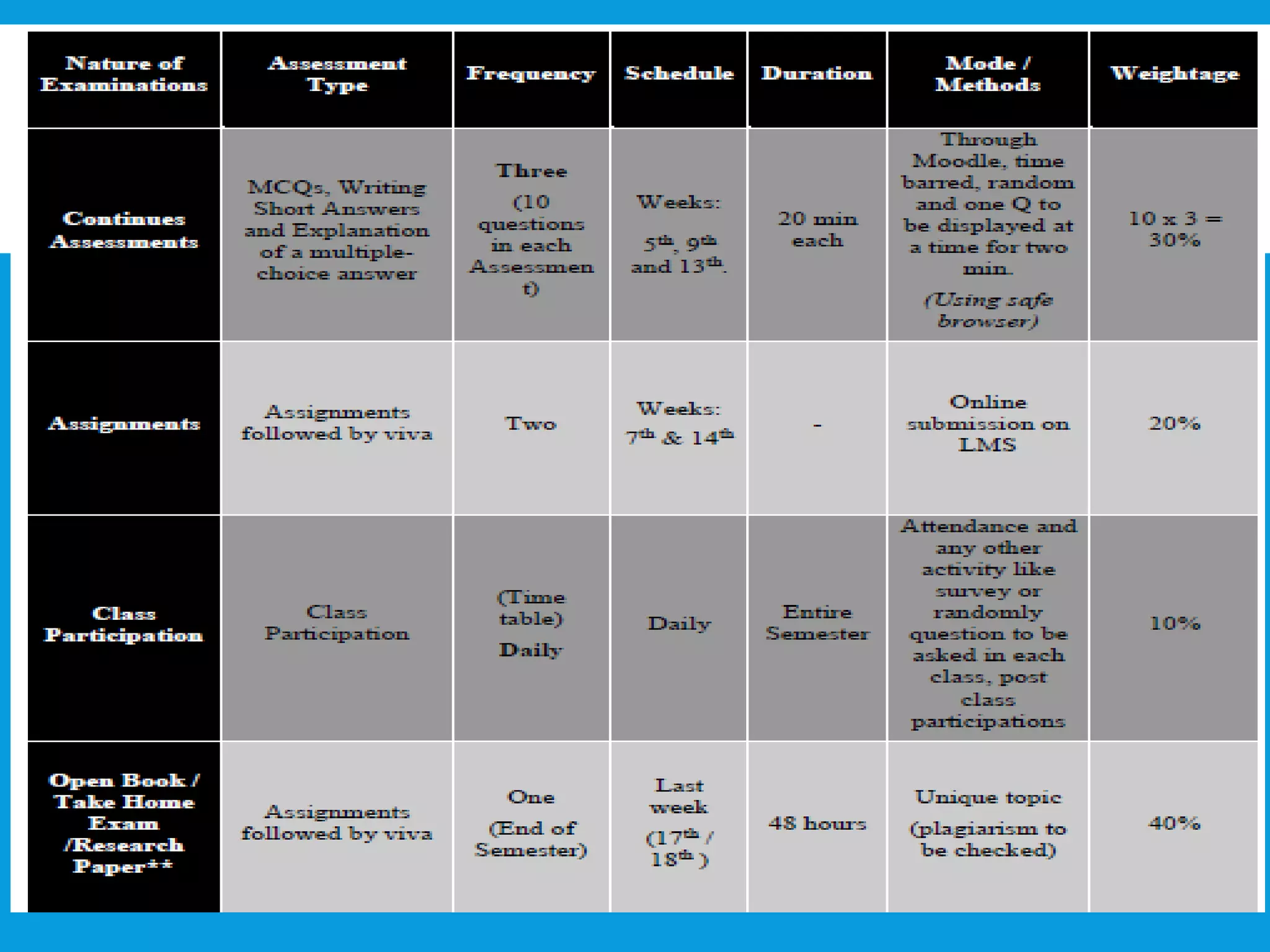
EVALUATION CRITERIA
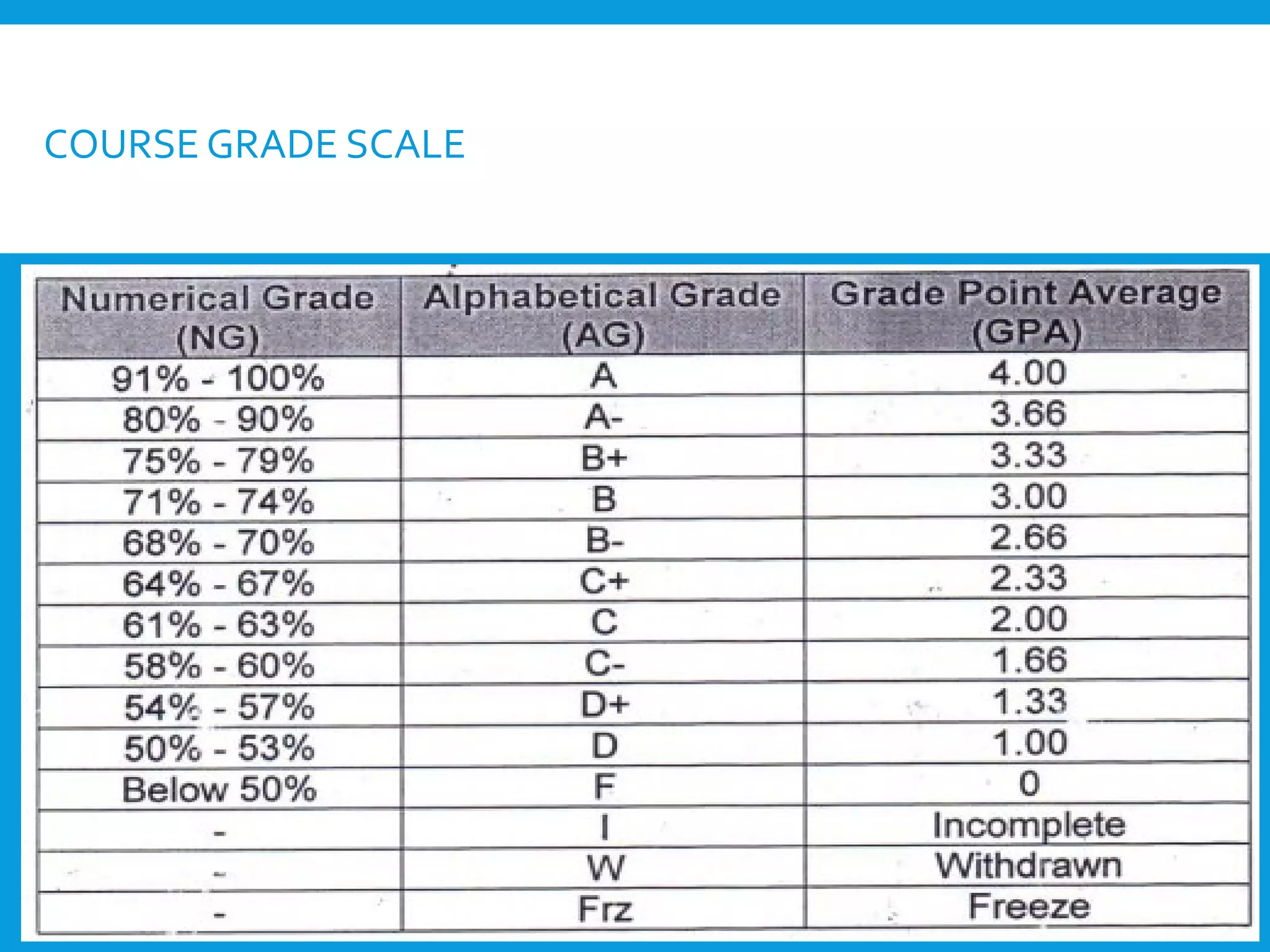
COURSE GRADE SCALE
ATTENDANCE POLICY
• Students are expected to attend their classes. Absence never exempts a
student from the work required for satisfactory completion of the courses.
• Excessive absences of any course will result in:
 First warning for absence of 10% of the class hours
 Second warning for absence of 20% of the class hours
• A failing grade in the course for an absence of 25% of the class hours (as per
HEC guidelines)
• Exception to (3) may be made in the case of serious illness or death to an
immediate family member if approved by the dean of the college. In such
case, the student will receive a W grade in the course
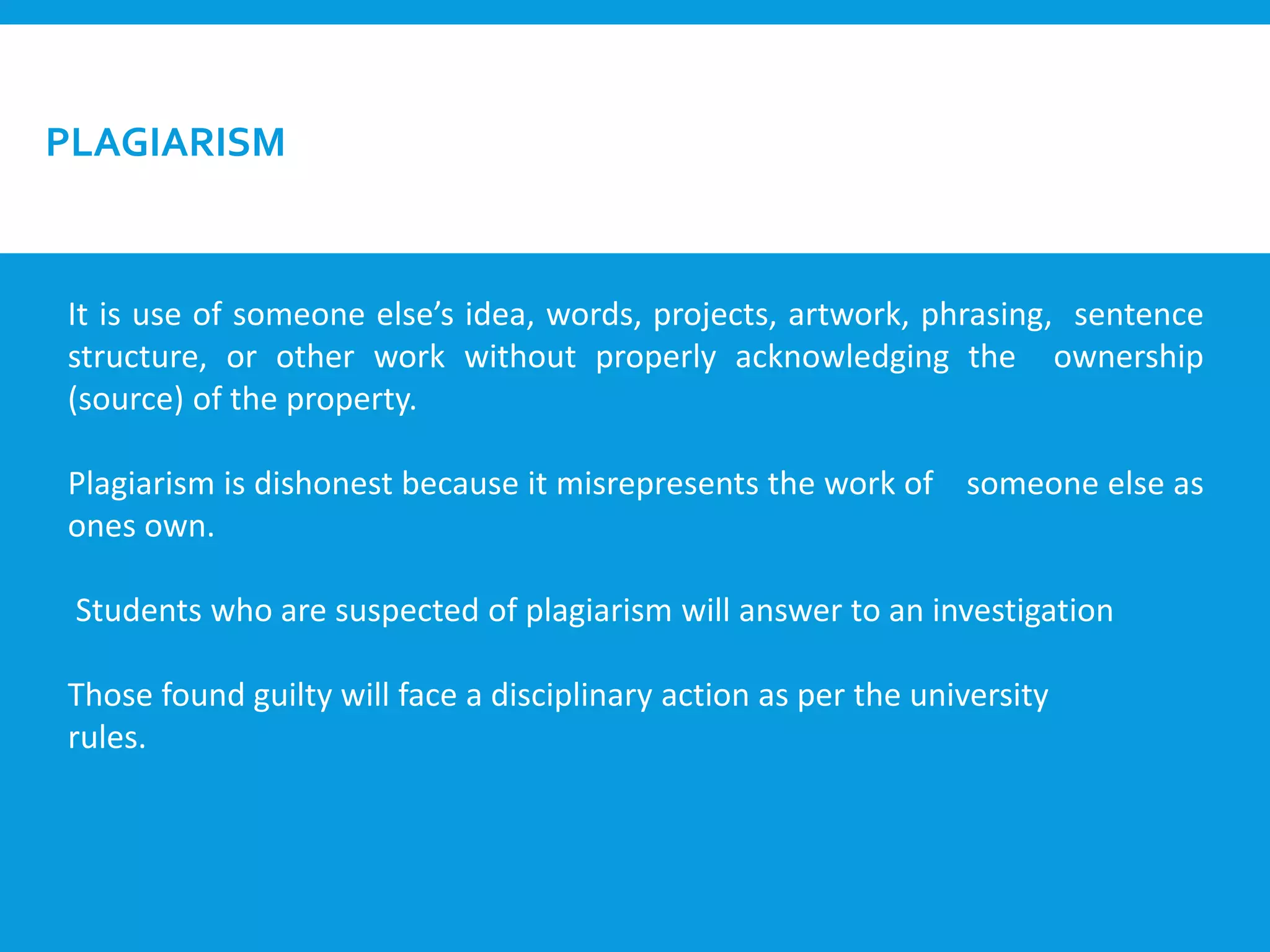
PLAGIARISM
It is use of someone else’s idea, words, projects, artwork, phrasing, sentence
structure, or other work without properly acknowledging the ownership
(source) of the property.
Plagiarism is dishonest because it misrepresents the work of someone else as
ones own.
Students who are suspected of plagiarism will answer to an investigation
Those found guilty will face a disciplinary action as per the university
rules.
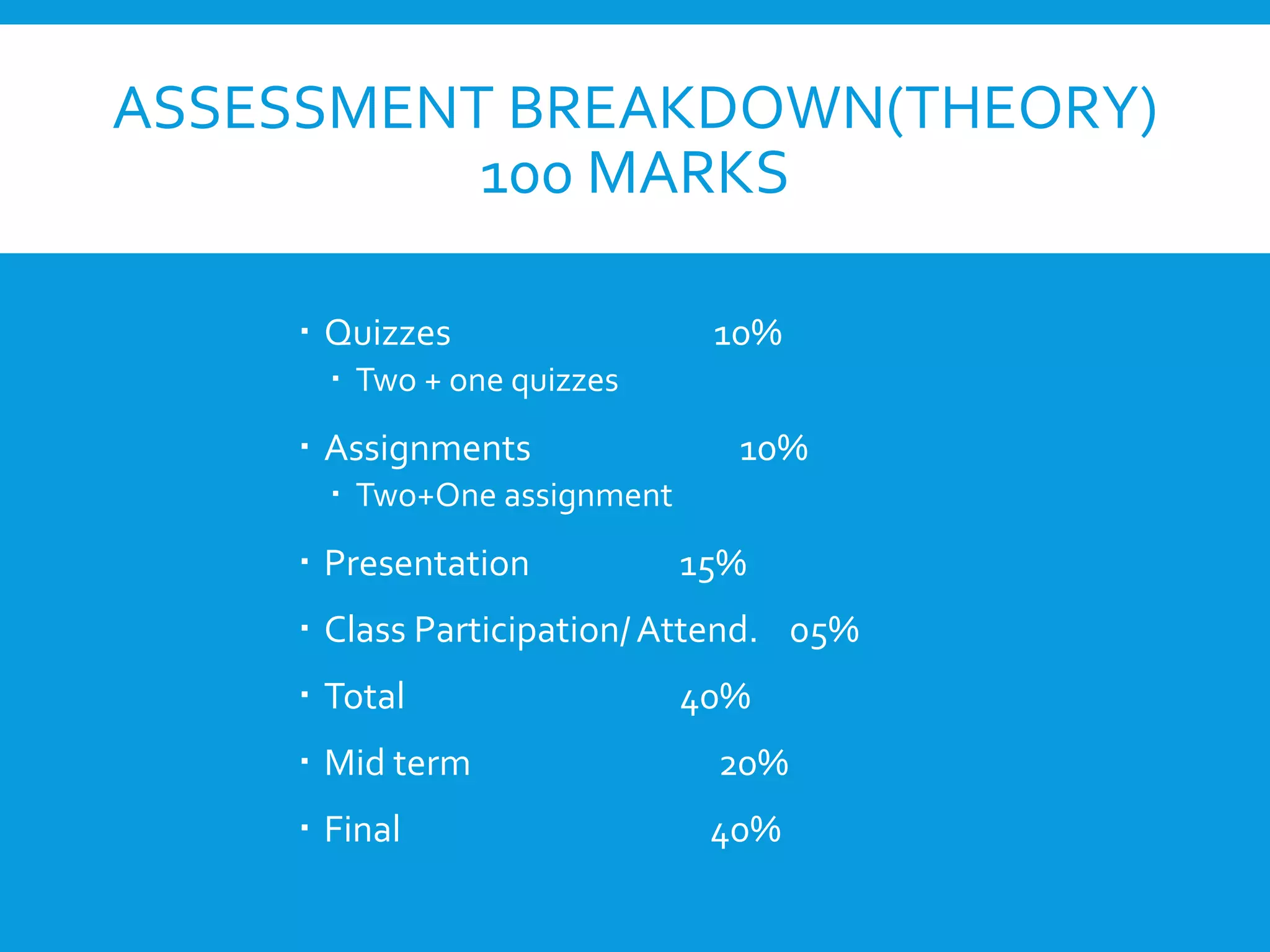
ASSESSMENT BREAKDOWN(THEORY)
100 MARKS
 Quizzes 10%
 Two + one quizzes
 Assignments 10%
 Two+One assignment
 Presentation 15%
 Class Participation/Attend. 05%
 Total 40%
 Mid term 20%
 Final 40%
OUTLINE
 Introduction to Discrete Structure
 Why Discrete Mathematics?
 Basic preliminaries
INTRODUCTIONTO DISCRETE
STRUCTURES
INTRODUCTION
 Discrete Structure describes processes that consist
of a sequence of individual steps, as compared to
forms of mathematics that describe processes that
change in a continuous manner. The major topics we
cover in this course are single-membership sets,
mathematical logic, induction, and proofs.
WHATISDISCRETEMATHEMATICS?
• Discrete mathematics focuses on problems that are not
over a continuous domain. For example, is it possible to
visit 3 islands in a river with 6 bridges without crossing
any bridge more than once? That is a discrete math
problem (because there are a finite (fixed, discrete)
number of bridges). Or, what is the smallest number of
telephone lines needed to connect 200 cities? The
numbers can be large and the logic can be complex, but
these type of problems are different from finding an
optimal value for a function where the domain can be 3,
WHATISDISCRETEMATHEMATICS?
• Discrete Mathematics concerns processes that
consist of a sequence of individual steps.
WHY DISCRETE STRUCTURE /
MATHEMATICS? (I)
 Computers use discrete structures to represent
and manipulate data.
 Computer Science is not Programming
 Computer Science is not Software Engineering
 Edsger Dijkstra: “Computer Science is no more
about computers than Astronomy is about
telescopes.”
 Computer Science is about problem solving.
WHY DISCRETE MATHEMATICS?
(II)
 Mathematics is at the heart of problem solving
 Defining a problem requires mathematical rigor
 Use and analysis of models, data structures,
algorithms requires a solid foundation of
mathematics
 To justify why a particular way of solving a
problem is correct or efficient (i.e., better than
another way) requires analysis with a well-defined
mathematical model.
PROBLEM SOLVING REQUIRES MATHEMATICAL
 Your boss is not going to ask you to solve
 an MST (Minimal SpanningTree) or
 aTSP (Travelling Salesperson Problem)
 Rarely will you encounter a problem in an abstract
setting
 However, he/she may ask you to build a rotation
of the company’s delivery trucks to minimize fuel
usage
 It is up to you to determine
 a proper model for representing the problem and
 a correct or efficient algorithm for solving it
Why Discrete Math?
Design efficient computer systems.
•How did Google manage to build a fast search engine?
•What is the foundation of internet security?
algorithms, data structures, database,
parallel computing, distributed systems,
cryptography, computer networks…
Logic, sets/functions, counting, graph theory…
What is discrete mathematics?
logic, sets, functions, relations, etc
Logic: artificial intelligence (AI), database, circuit design
Counting: probability, analysis of algorithm
Graph theory: computer network, data structures
Number theory: cryptography, coding theory
L
OGIC
Logicis the study of the principles and methods
that distinguishes between a valid and an invalid
argument.
STATEMENT
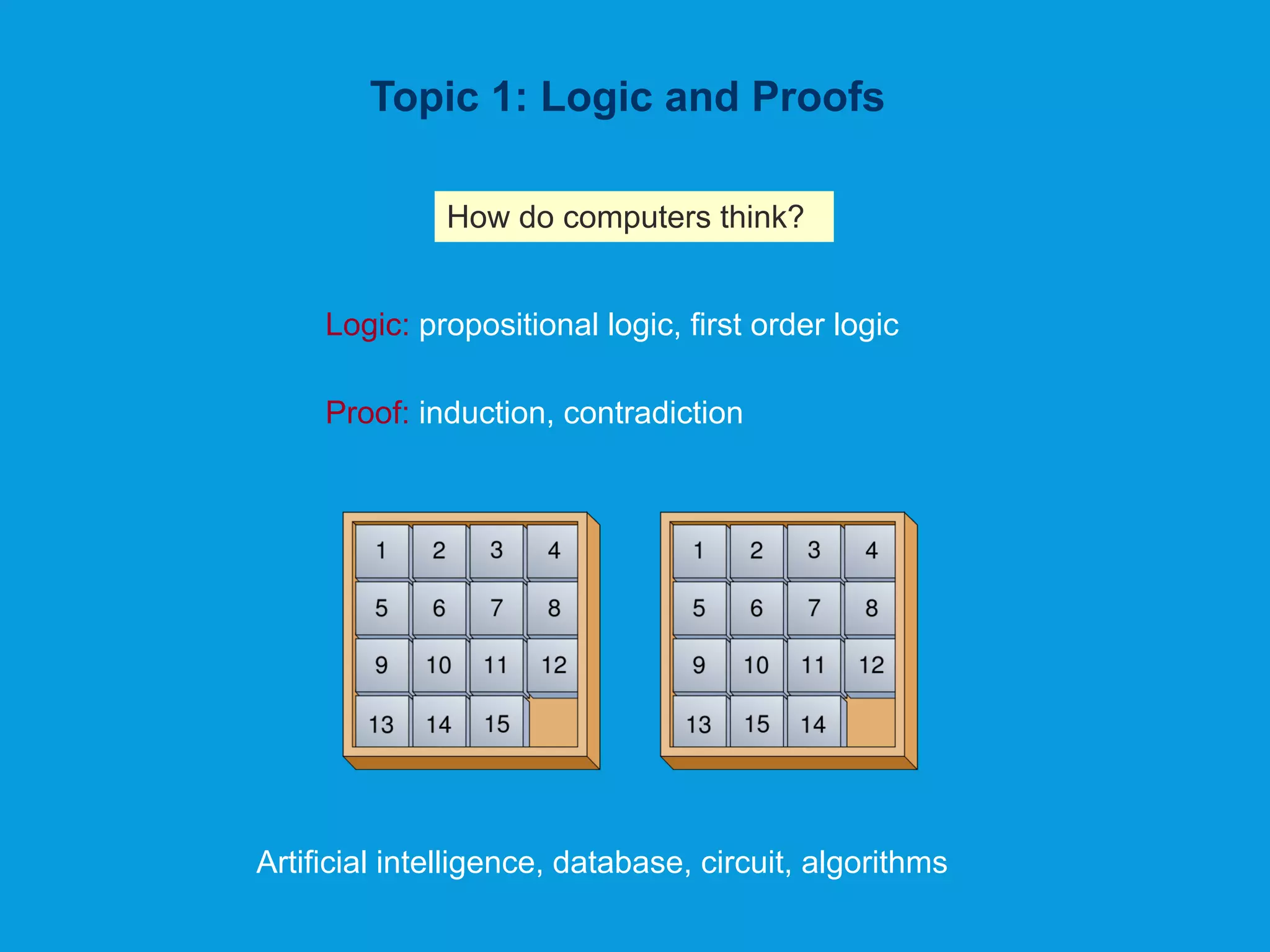
Topic 1: Logic and Proofs
Logic: propositional logic, first order logic
Proof: induction, contradiction
How do computers think?
Artificial intelligence, database, circuit, algorithms
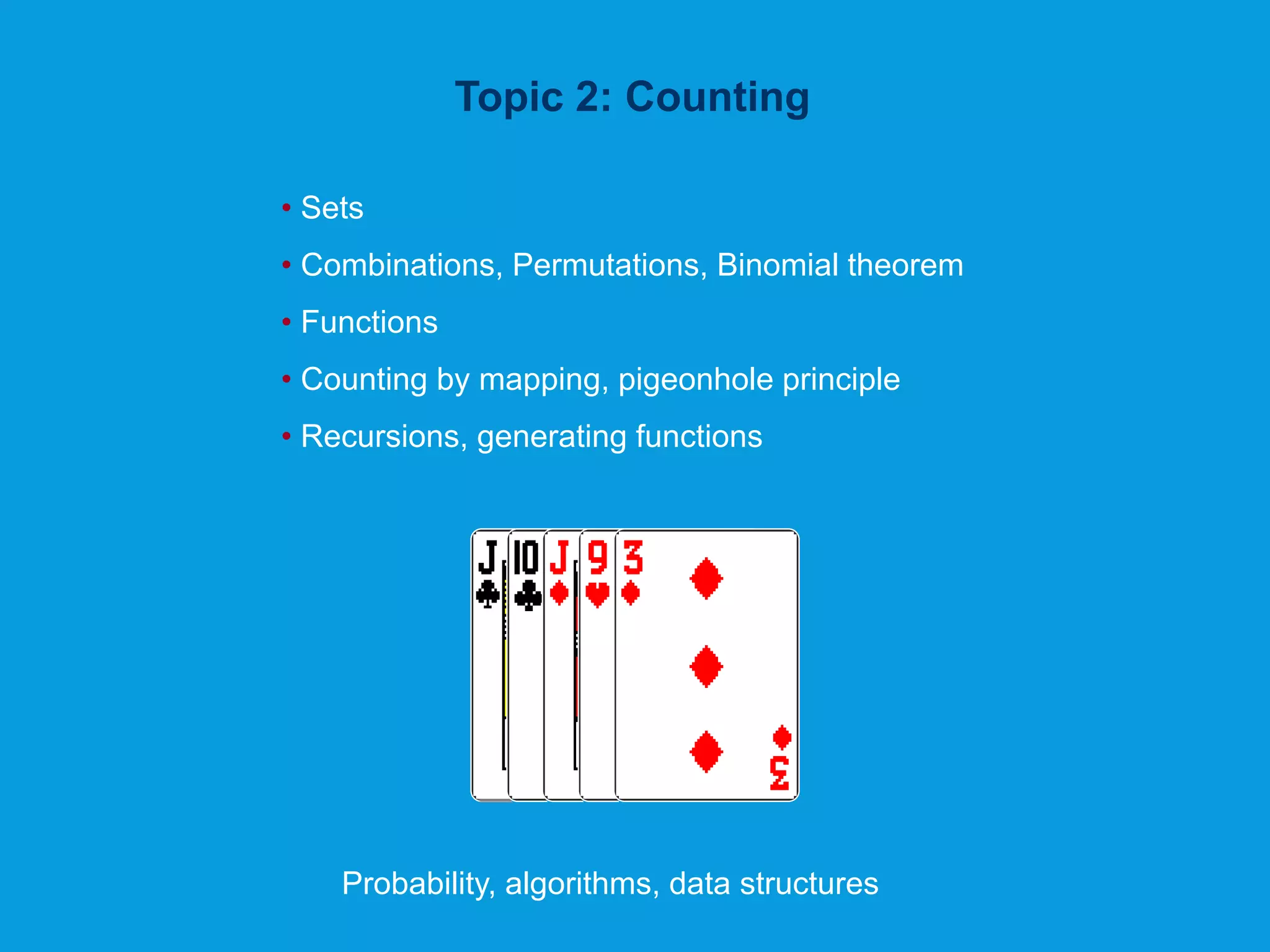
Topic 2: Counting
• Sets
• Combinations, Permutations, Binomial theorem
• Functions
• Counting by mapping, pigeonhole principle
• Recursions, generating functions
Probability, algorithms, data structures
Topic 2: Counting
How many steps are needed to sort n numbers?
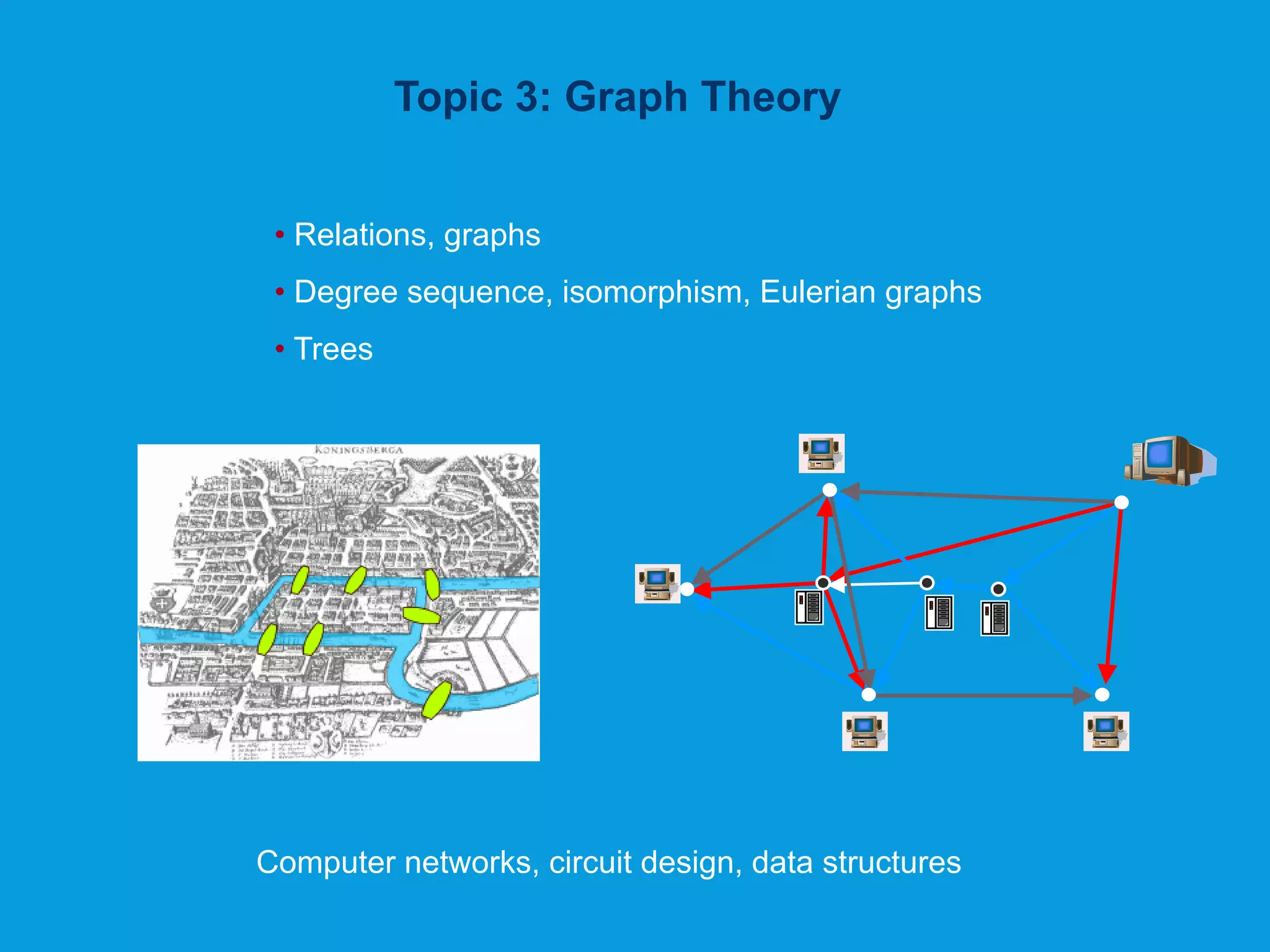
Topic 3: Graph Theory
• Relations, graphs
• Degree sequence, isomorphism, Eulerian graphs
• Trees
Computer networks, circuit design, data structures
Topic 4: Number Theory
• Number sequence
• Euclidean algorithm
• Prime number
• Modular arithmetic
Cryptography, coding theory, data structures
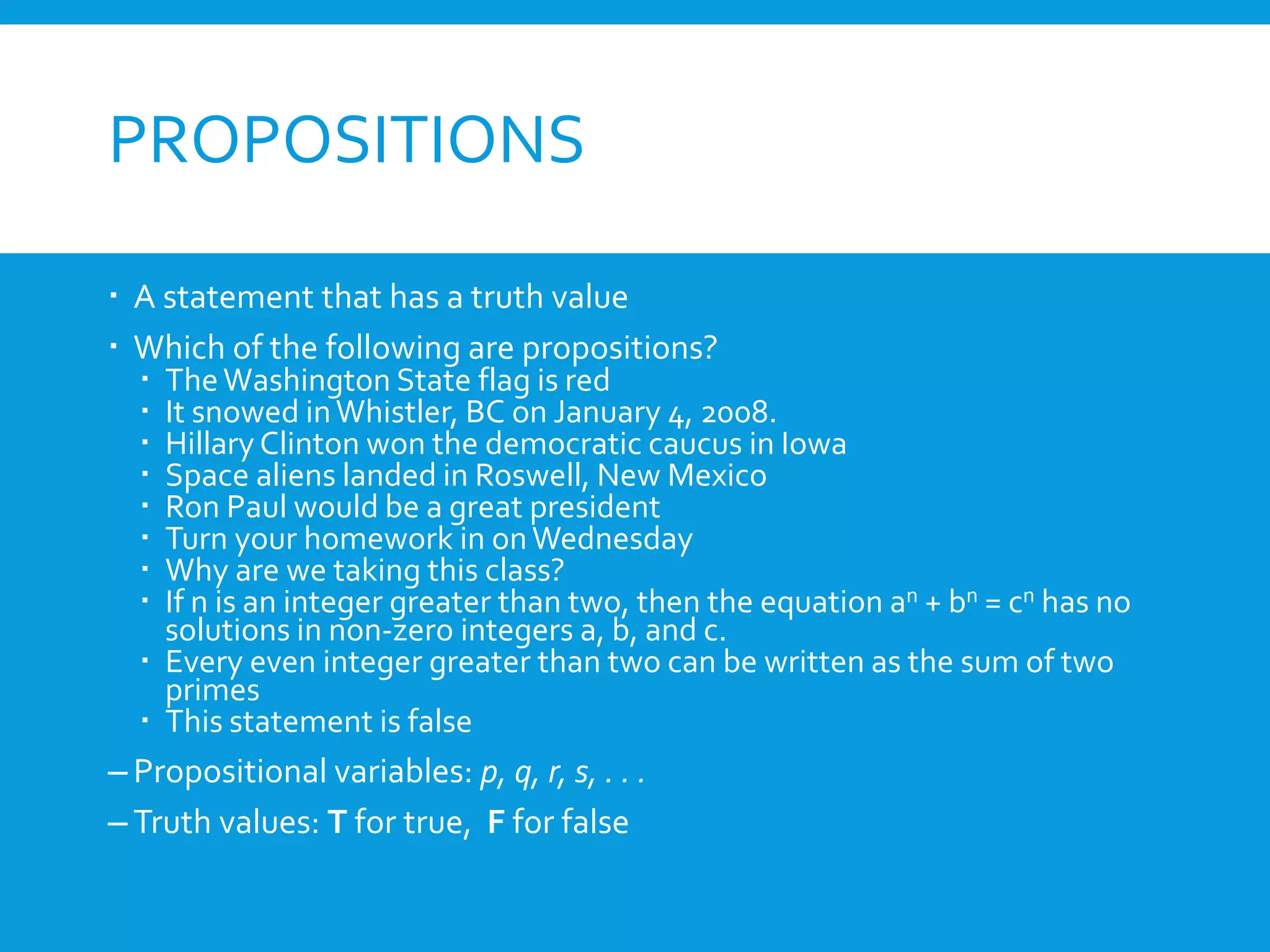
PROPOSITIONS
 A statement that has a truth value
 Which of the following are propositions?
 TheWashington State flag is red
 It snowed inWhistler, BC on January 4, 2008.
 Hillary Clinton won the democratic caucus in Iowa
 Space aliens landed in Roswell, New Mexico
 Ron Paul would be a great president
 Turn your homework in onWednesday
 Why are we taking this class?
 If n is an integer greater than two, then the equation an + bn = cn has no
solutions in non-zero integers a, b, and c.
 Every even integer greater than two can be written as the sum of two
primes
 This statement is false
– Propositional variables: p, q, r, s, . . .
– Truth values: T for true, F for false
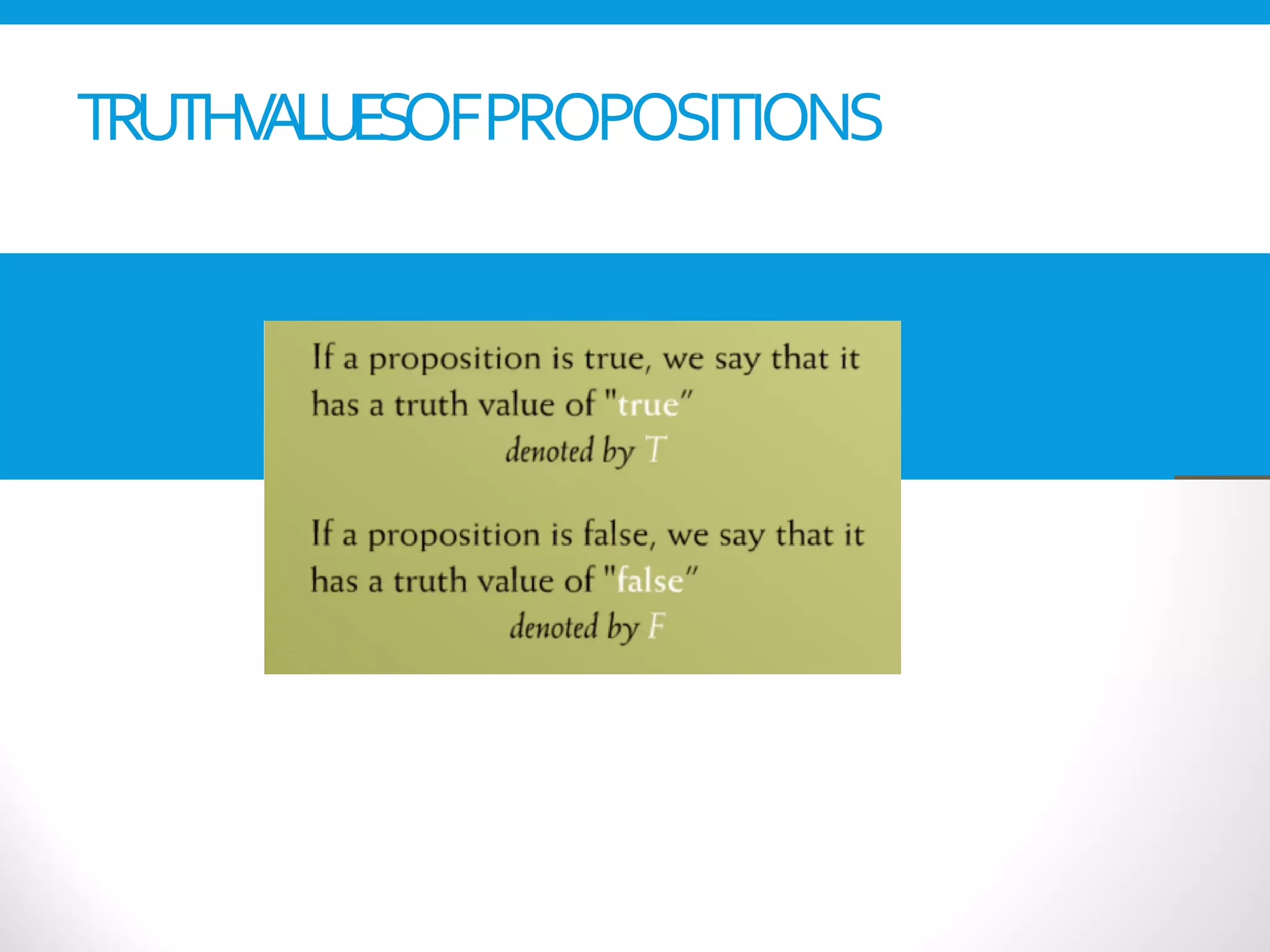
TRUTHV
ALUESOFPROPOSITIONS
E
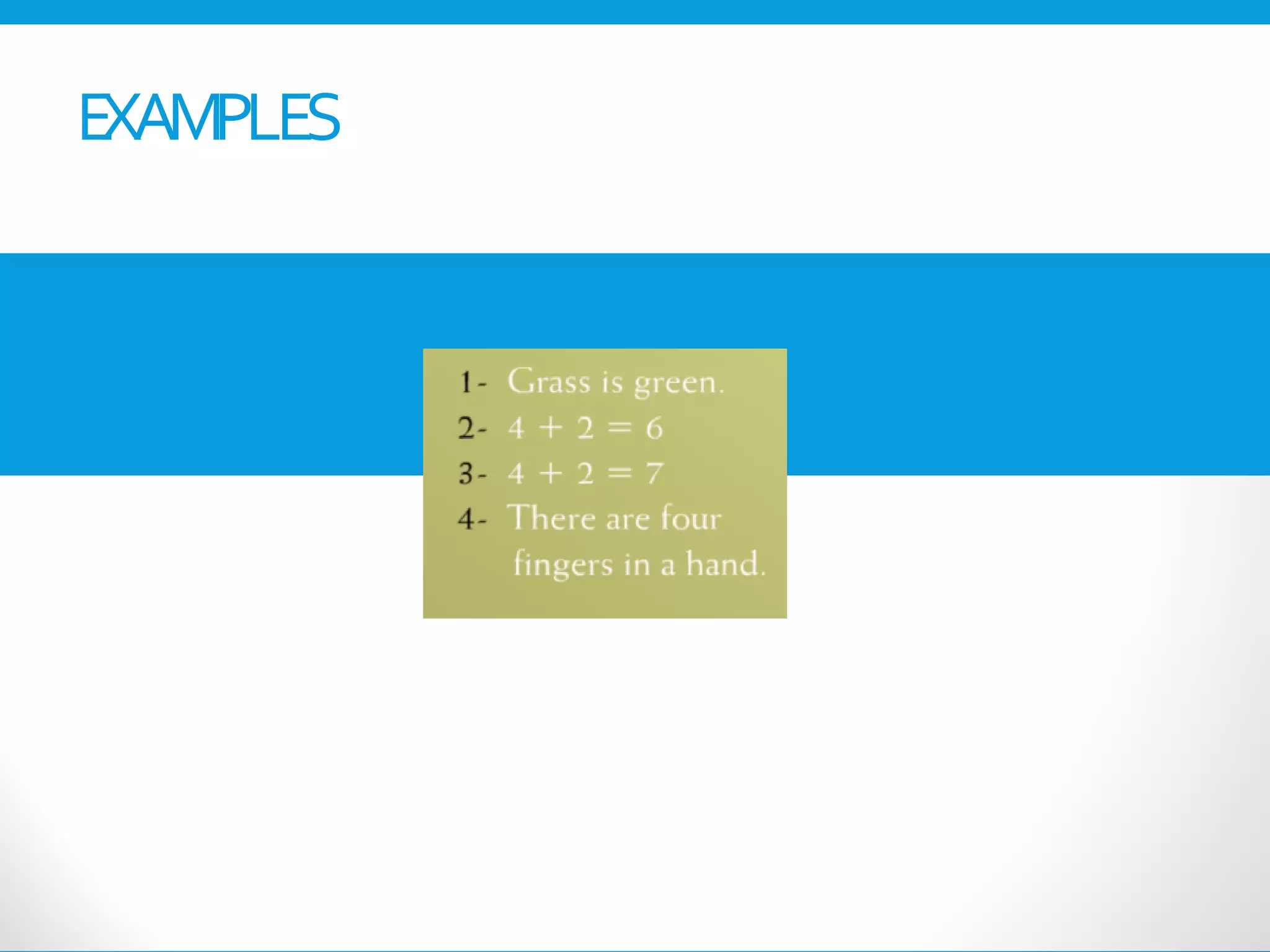
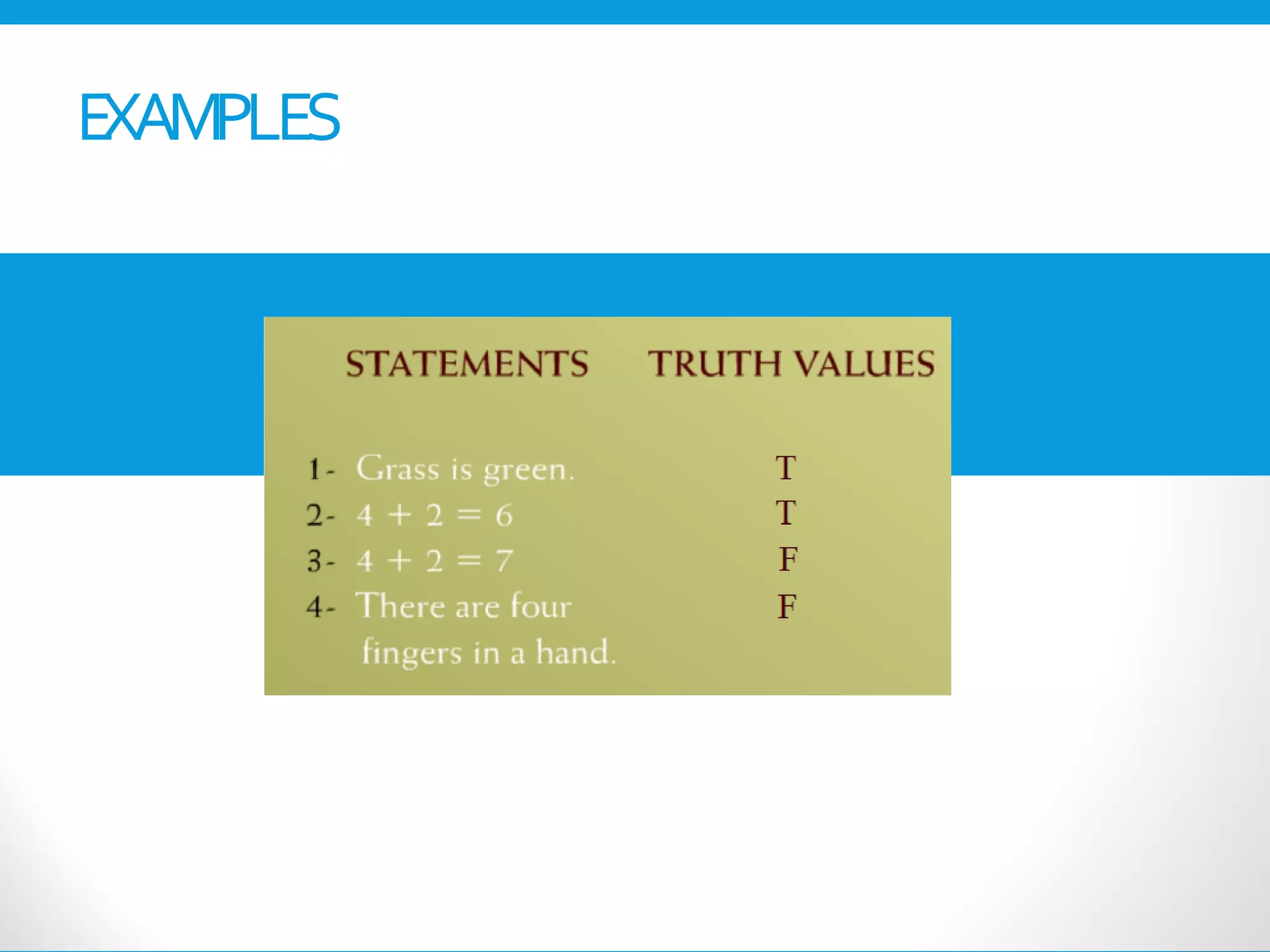
XAMPLES
E
XAMPLES
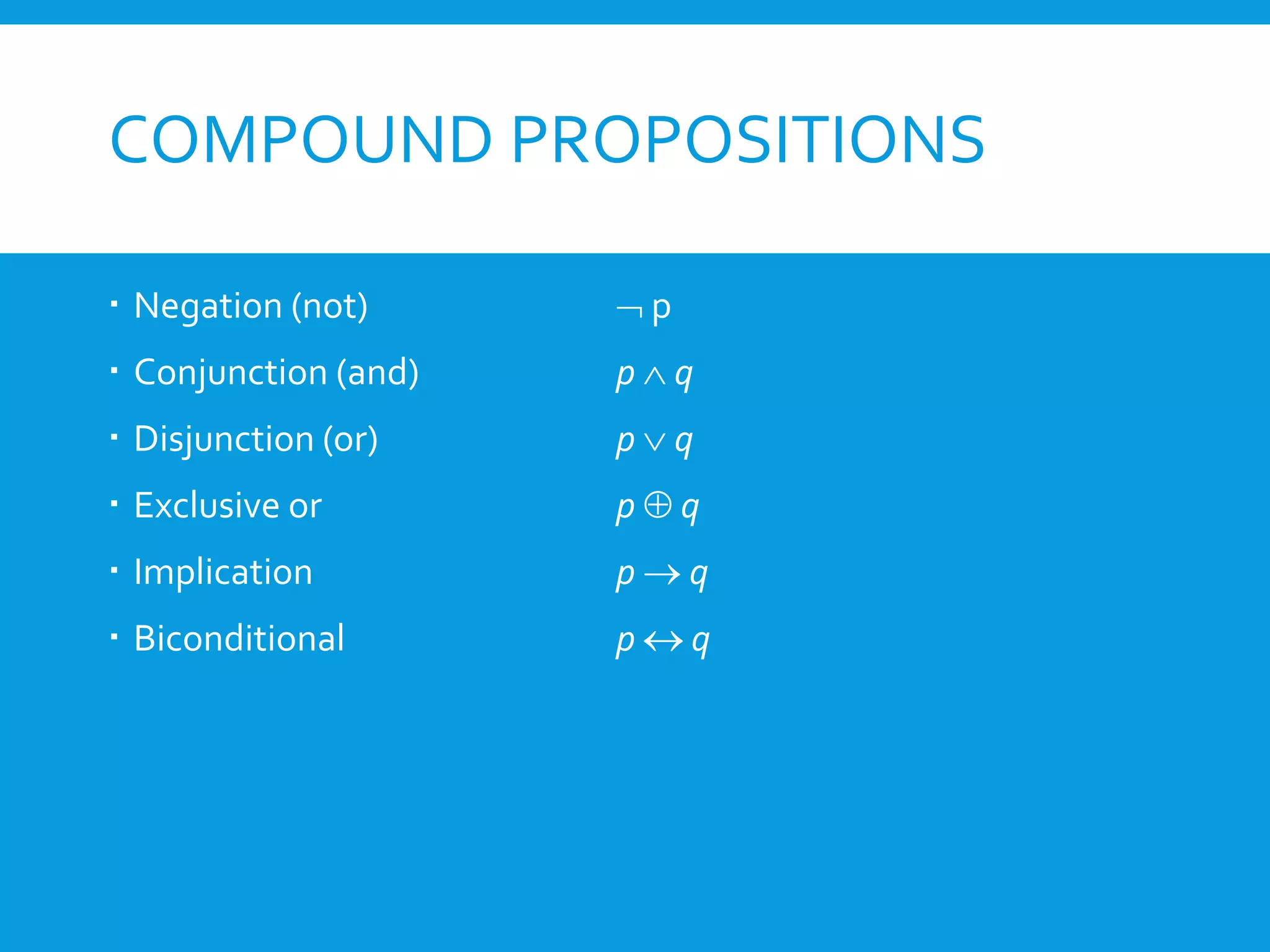
COMPOUND PROPOSITIONS
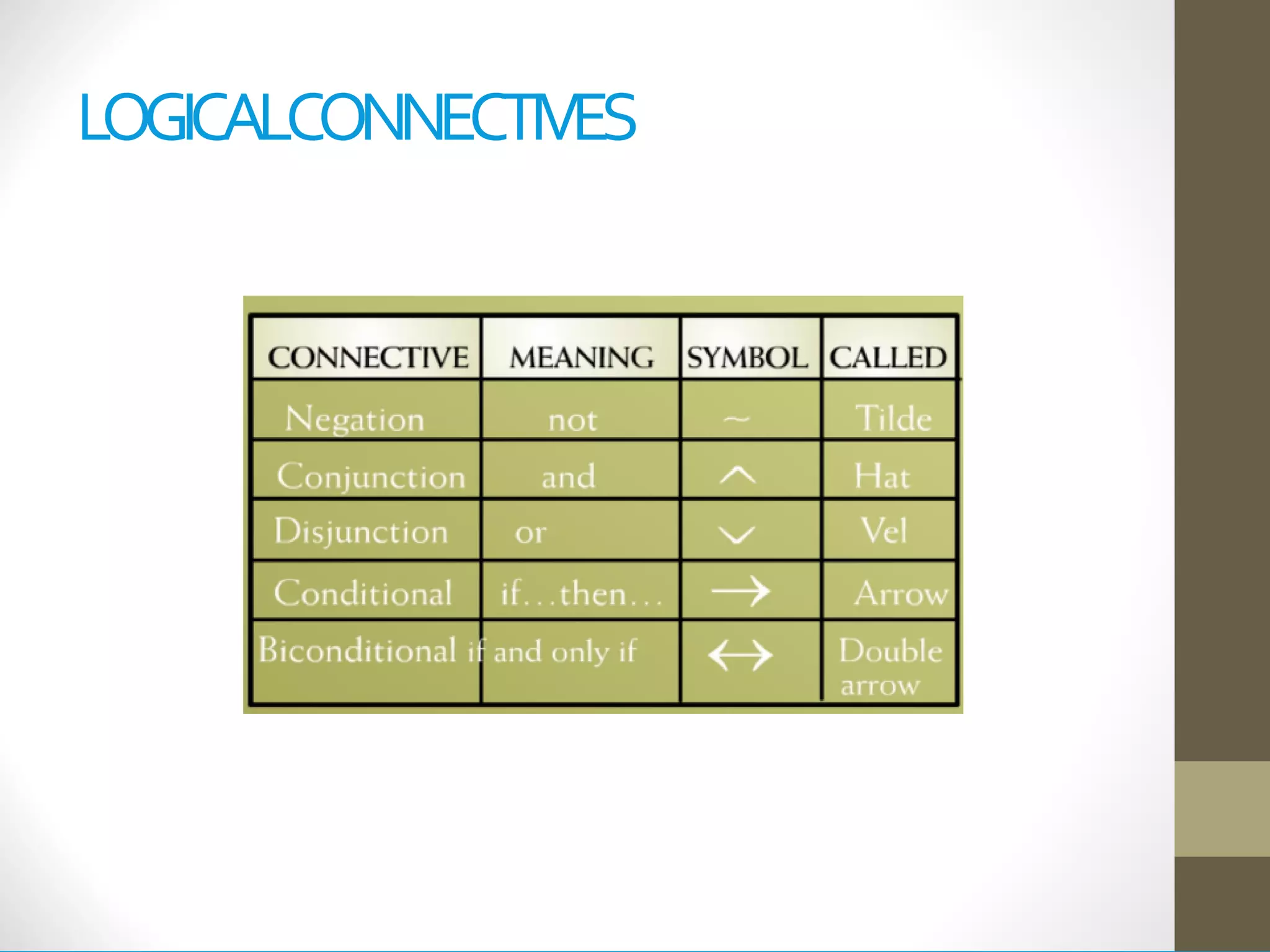
 Negation (not) ¬ p
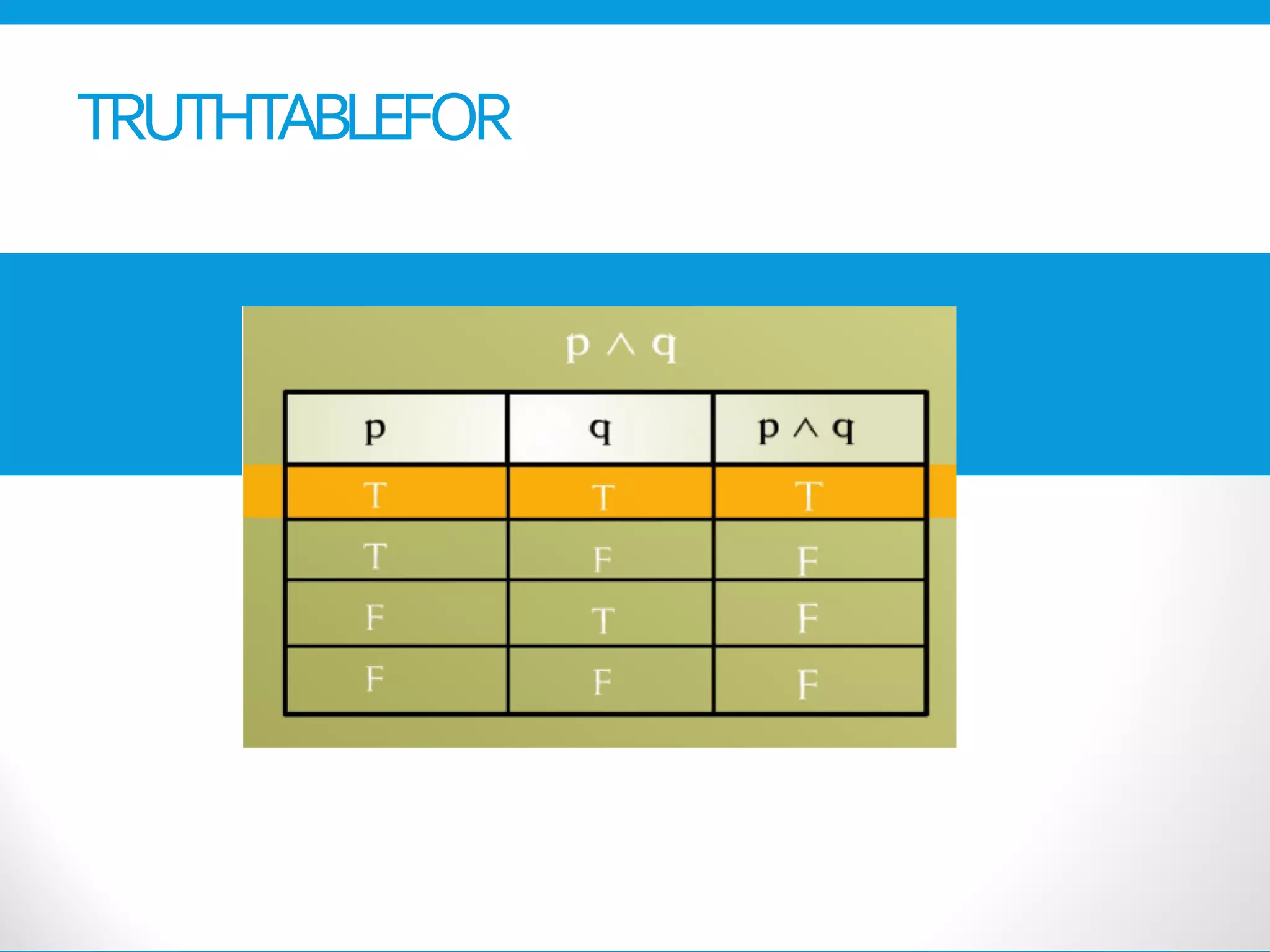
 Conjunction (and) p ∧ q
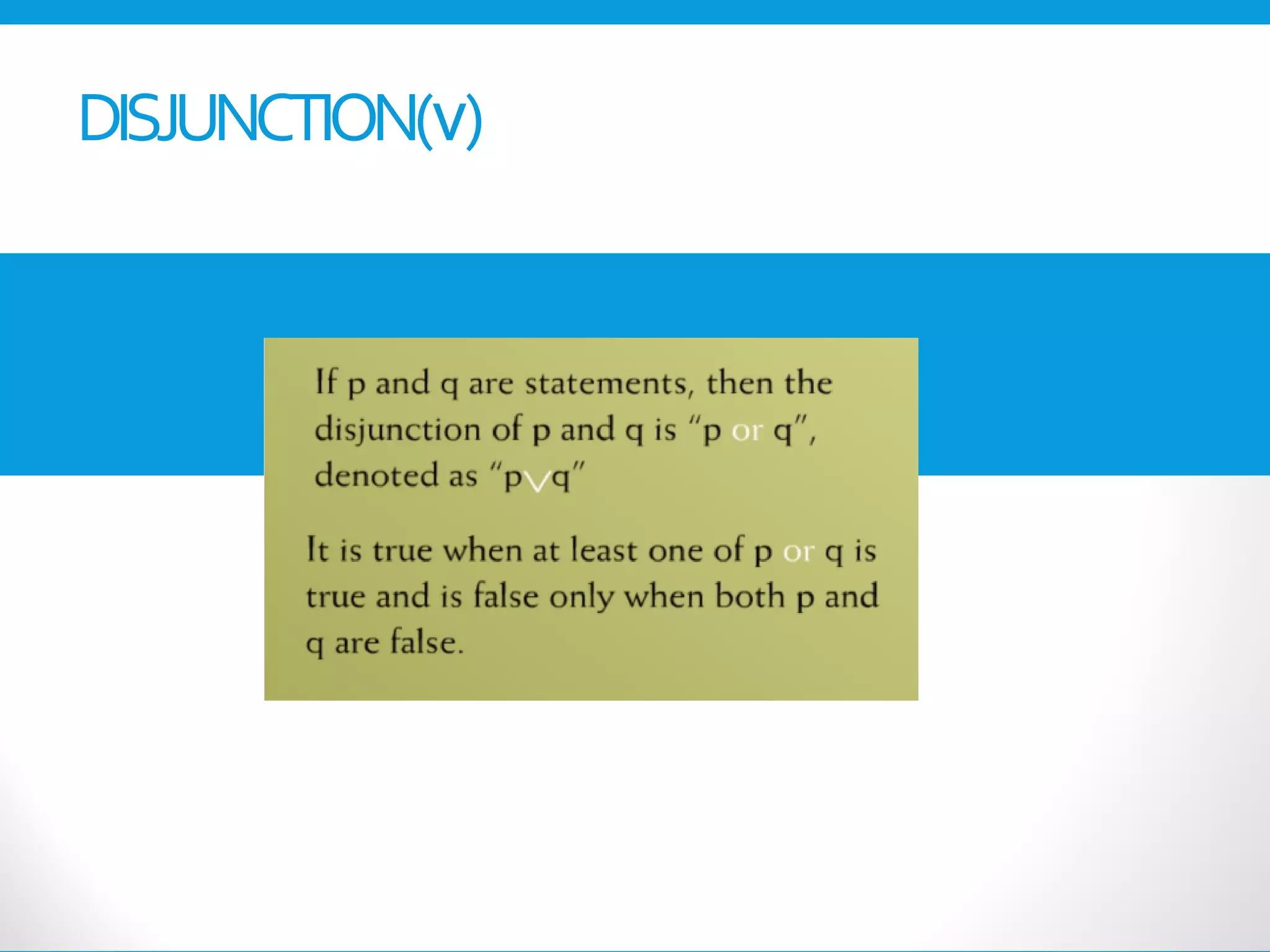
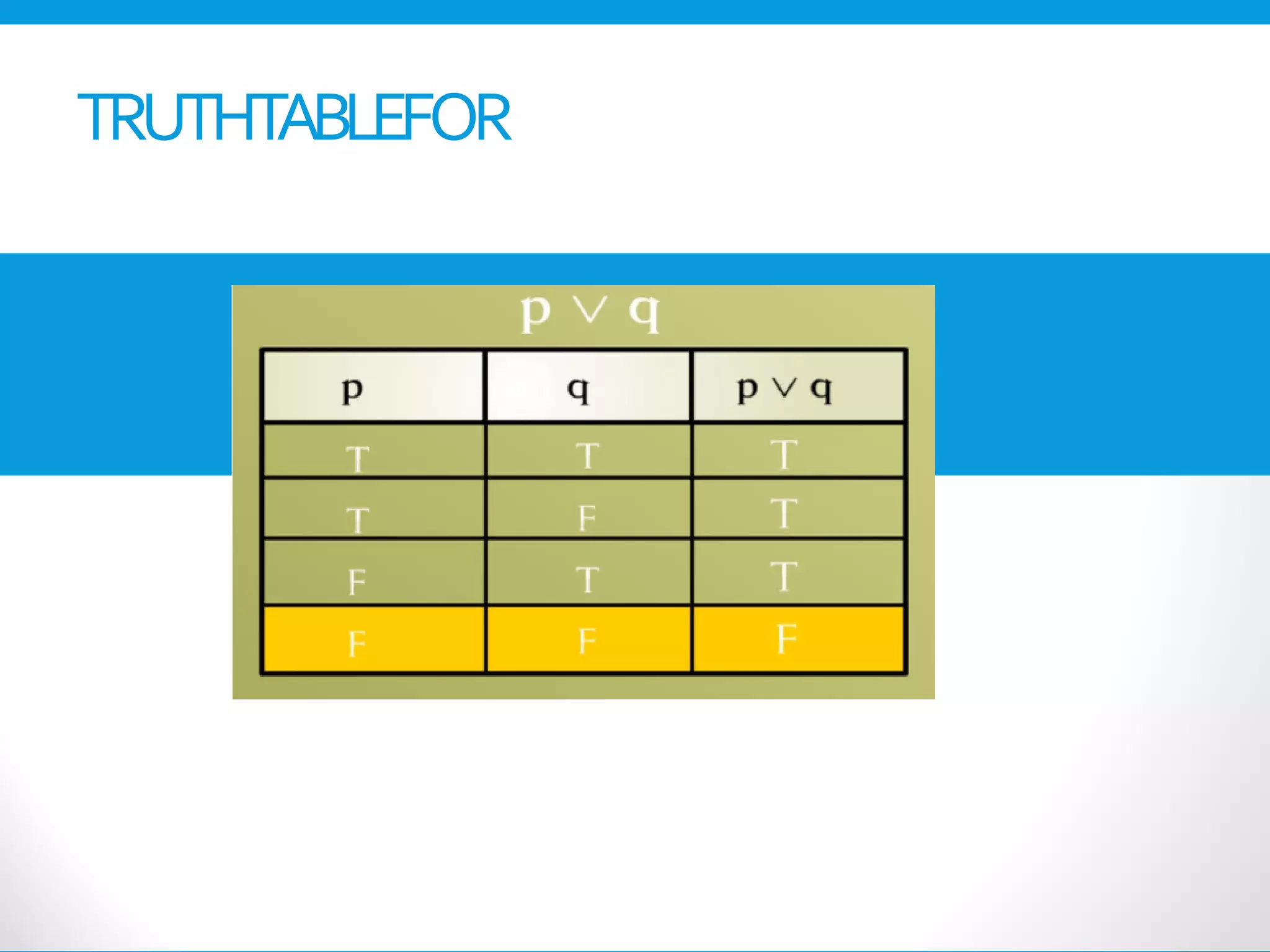
 Disjunction (or) p ∨ q
 Exclusive or p ⊕ q
 Implication p → q
 Biconditional p ↔ q
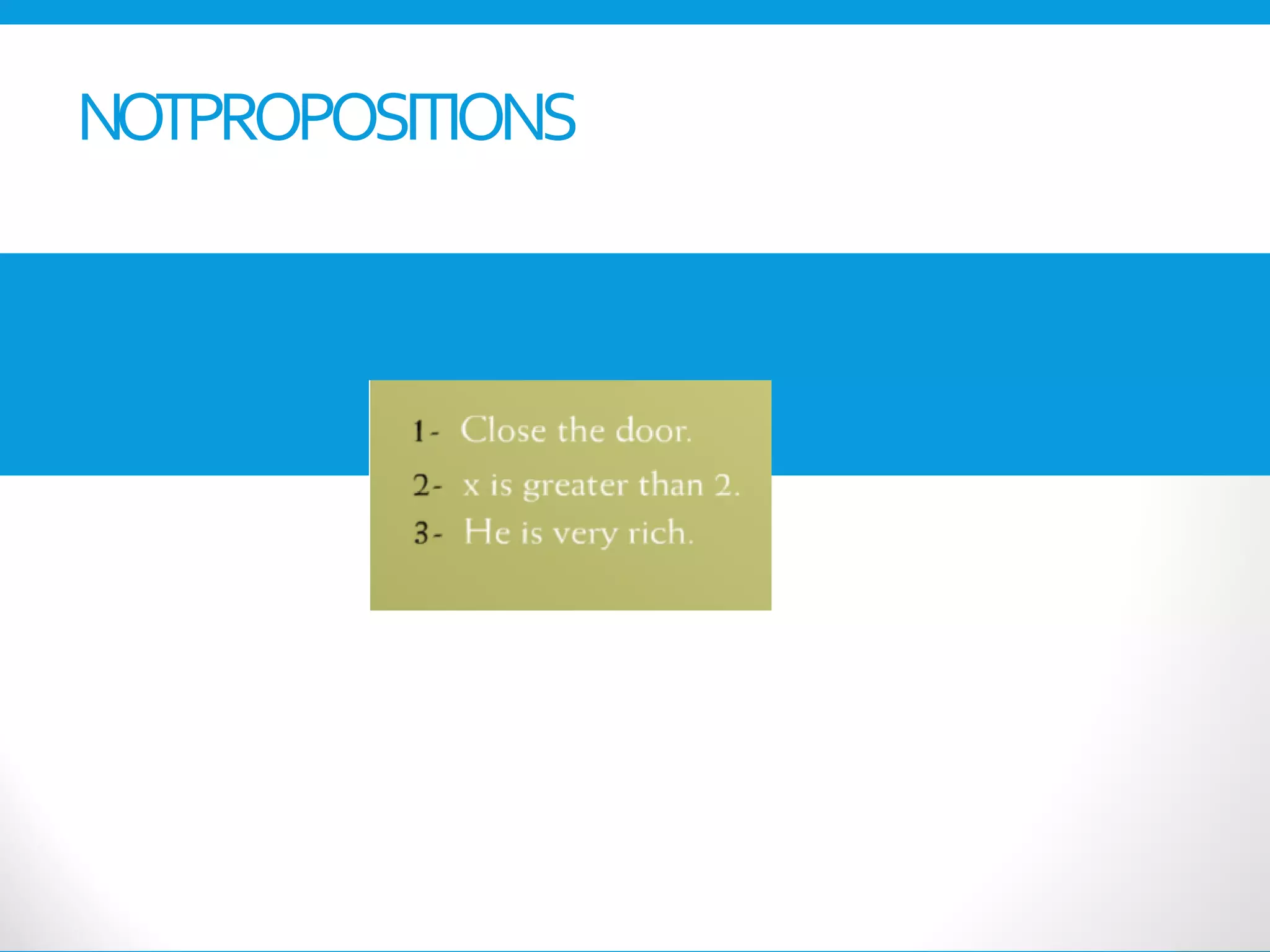
NOTPROPOSITIONS
LECTURE #2/WEEK #2
 Rules of Discrete Structure
 TruthTable
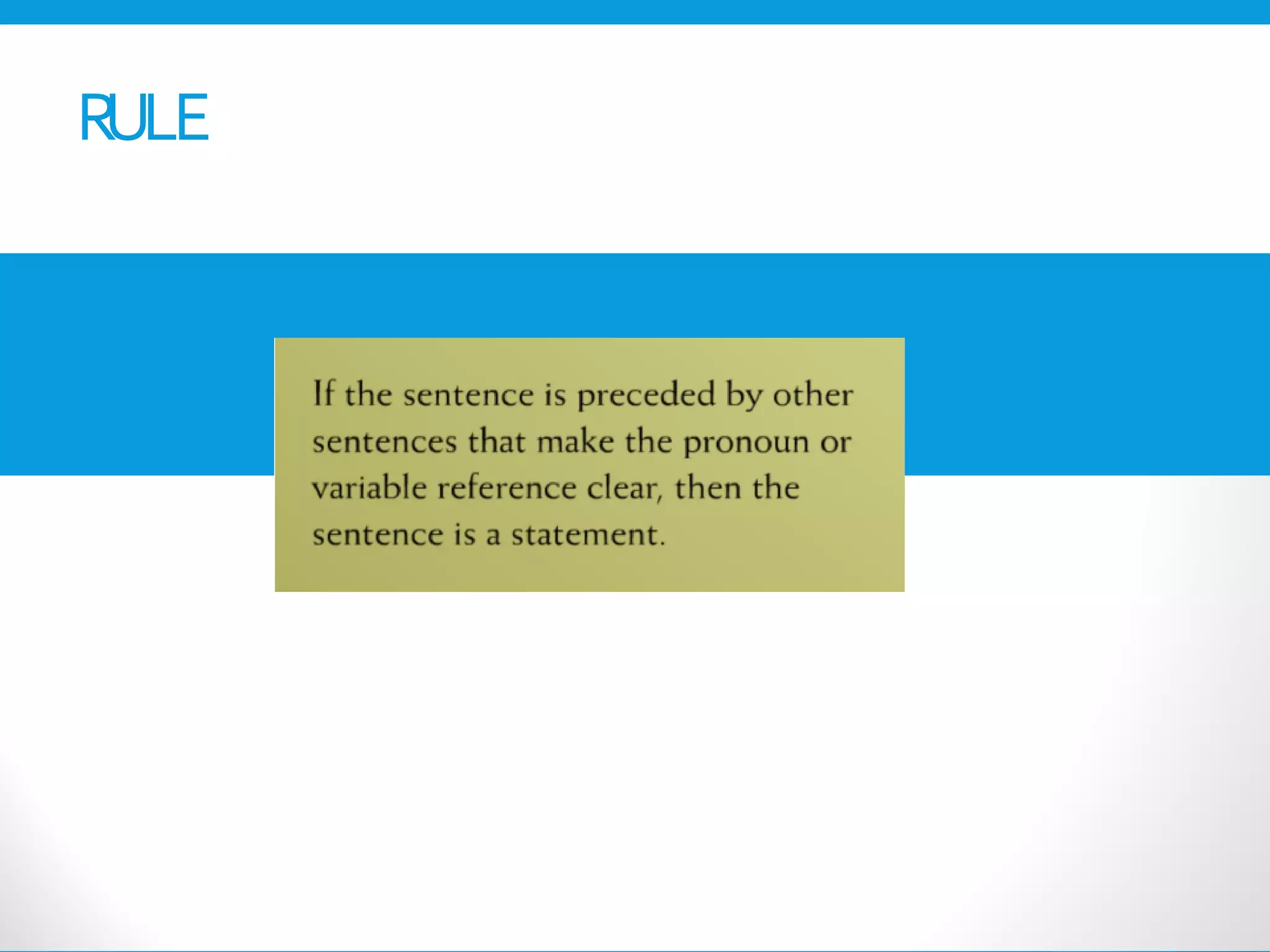
RULE
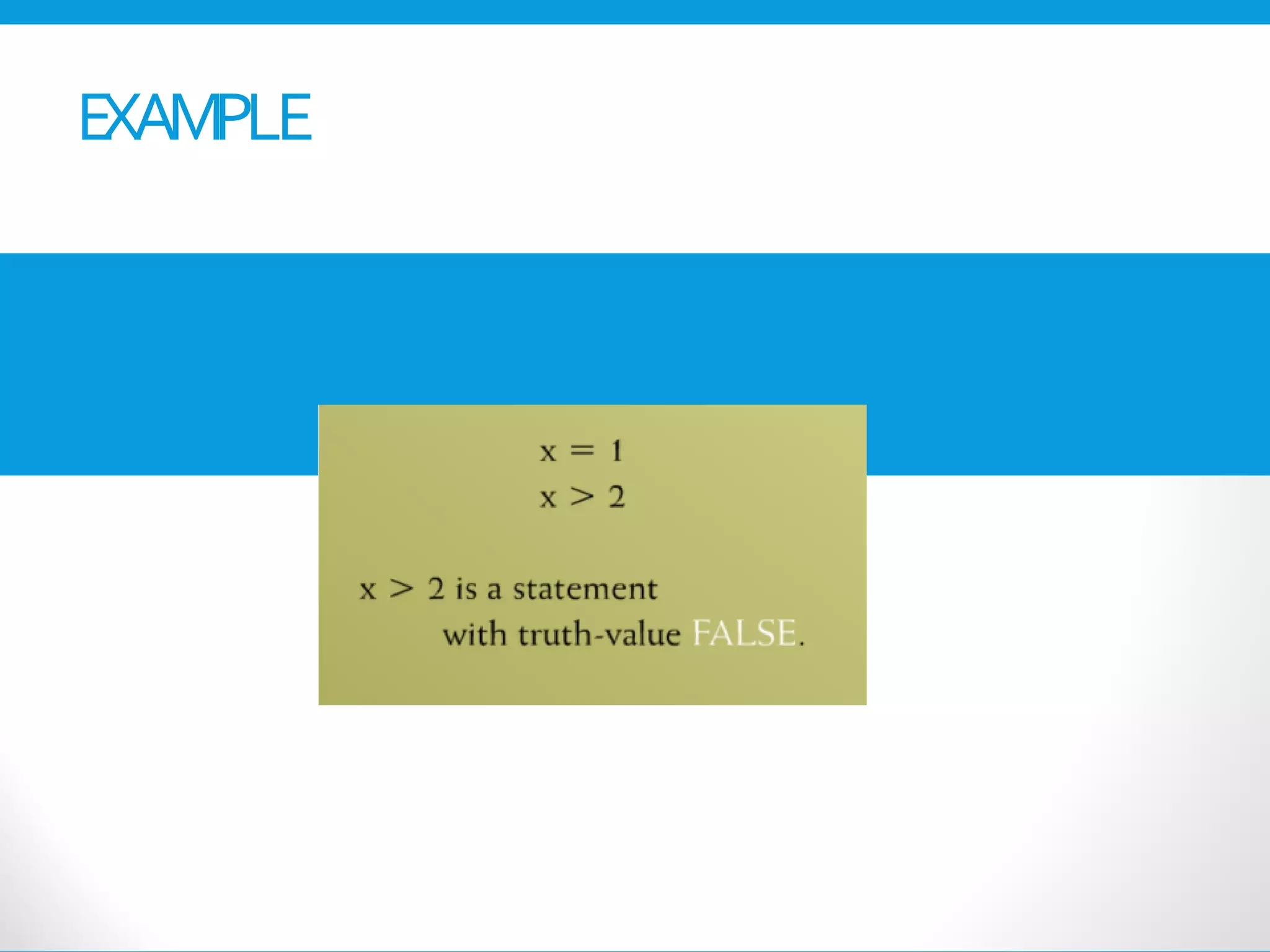
E
XAMPLE
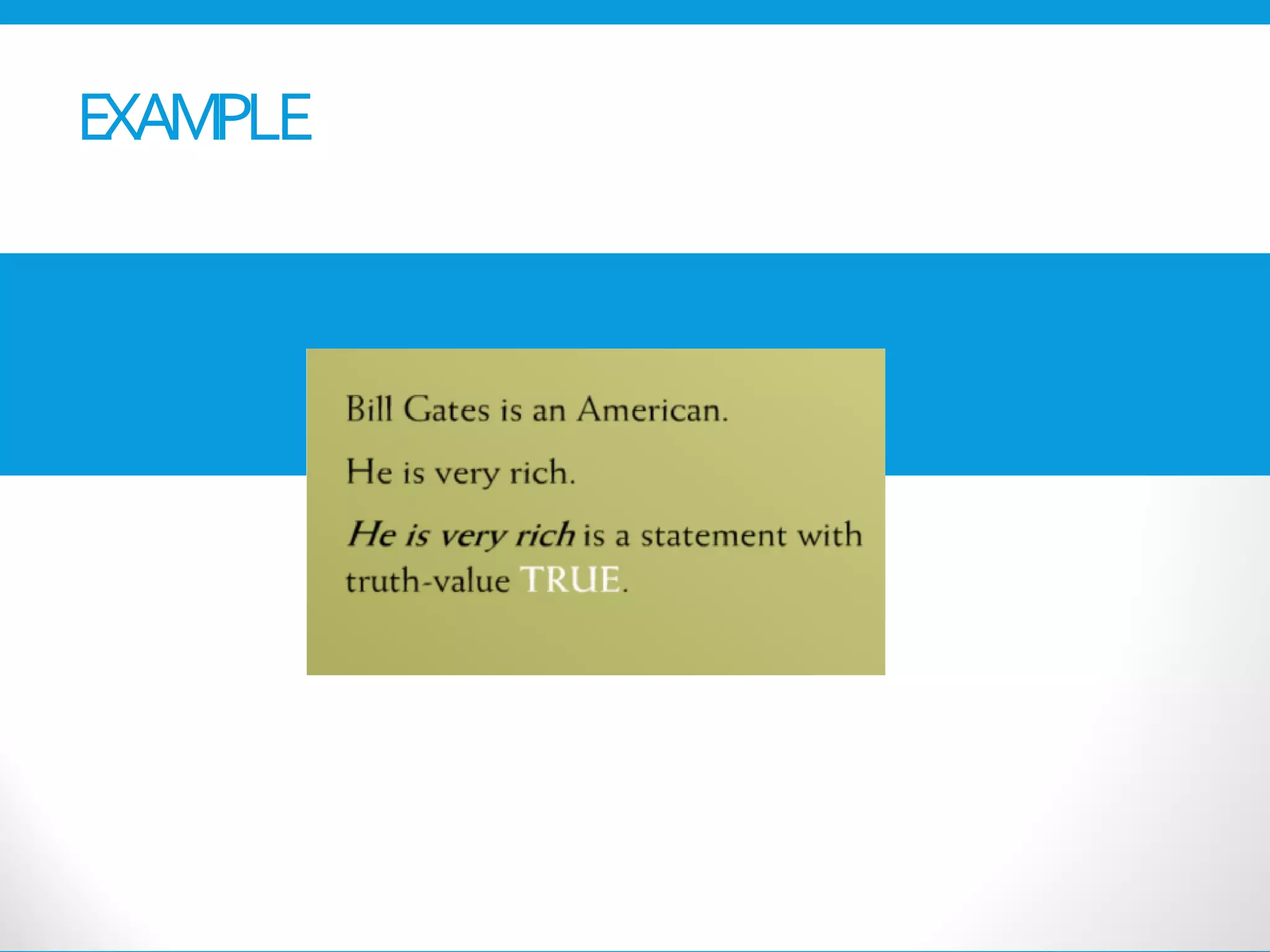
E
XAMPLE
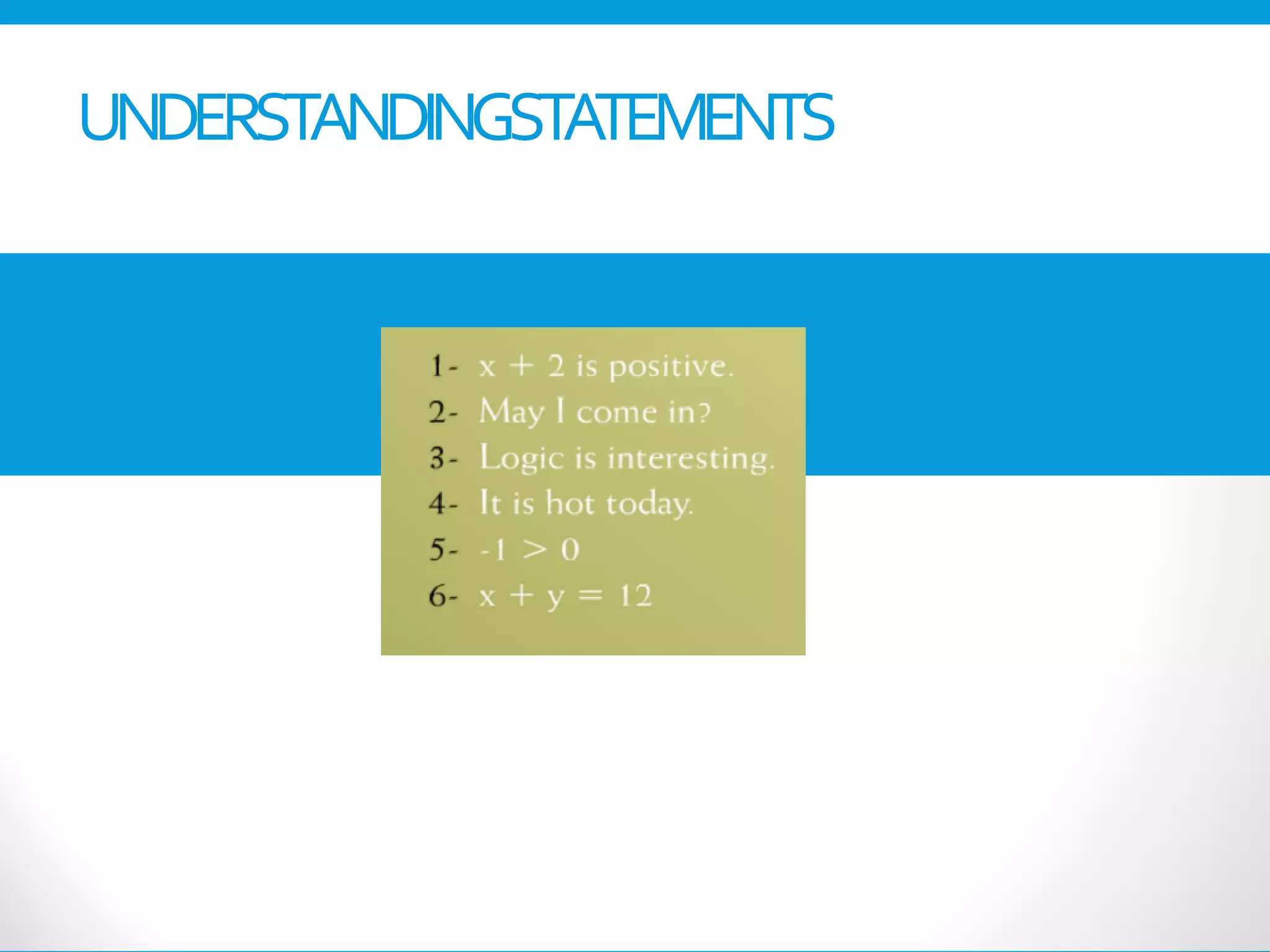
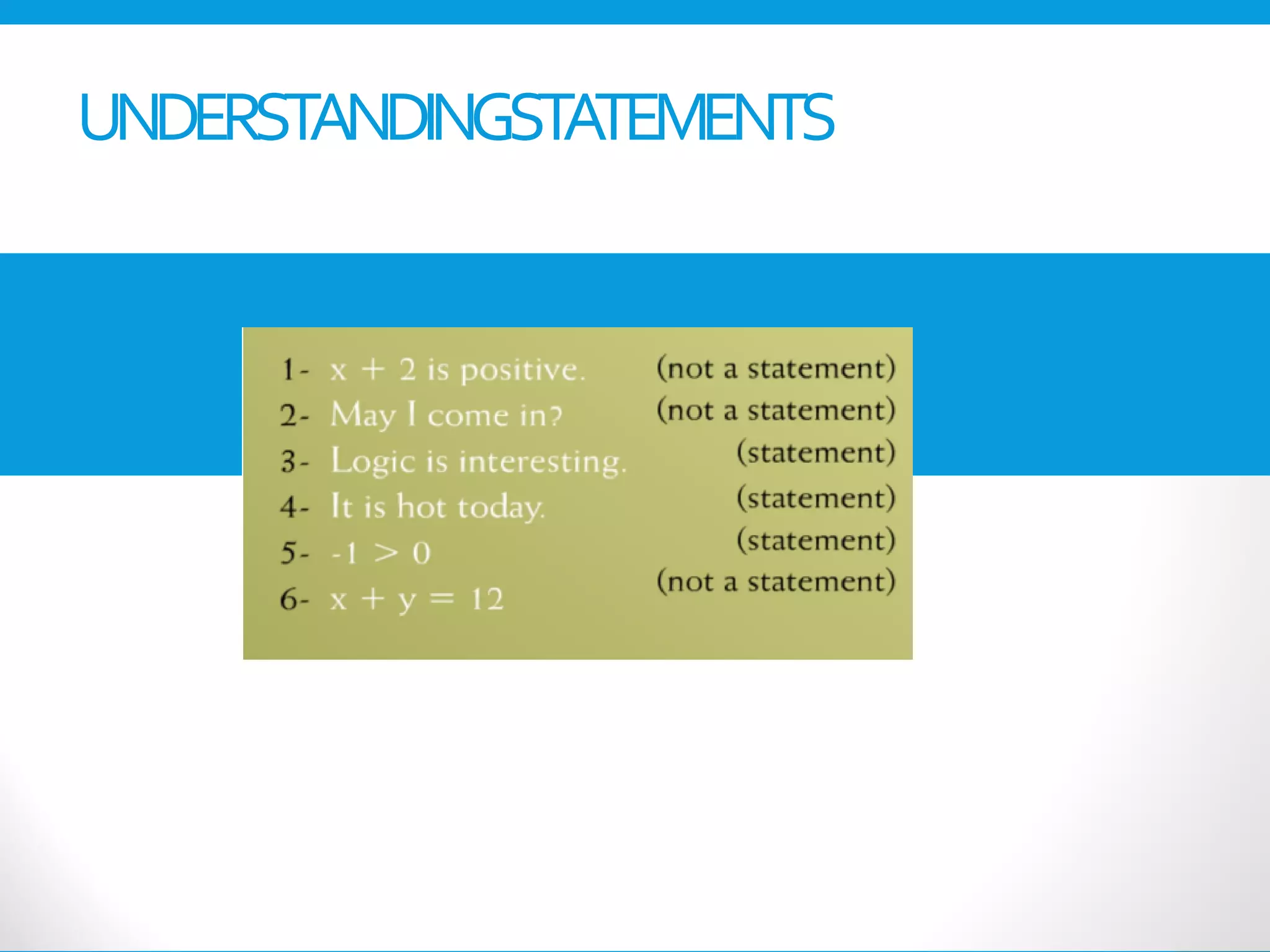
UNDERSTANDINGSTATEMENTS
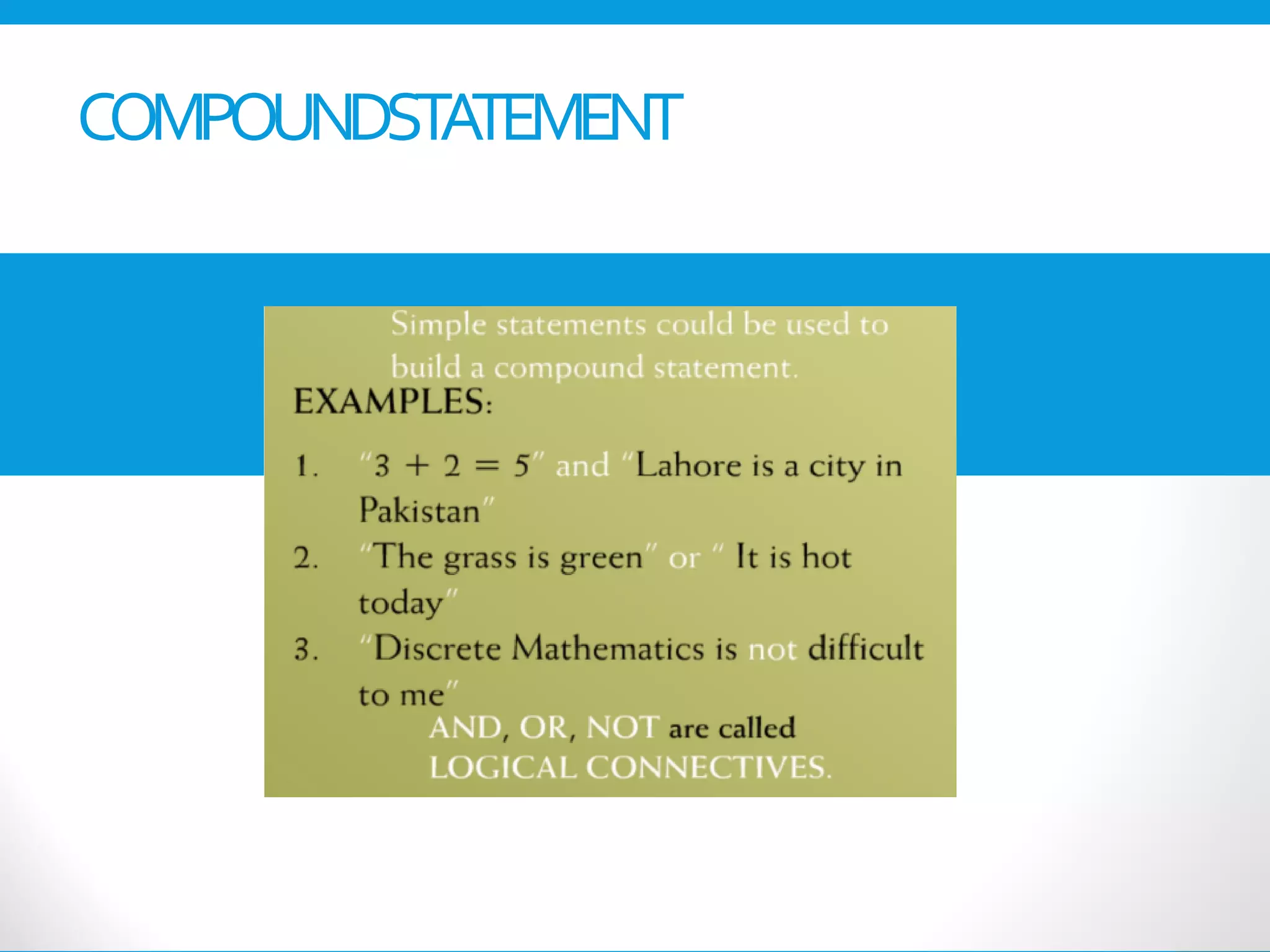
COMPOUNDSTATEMENT
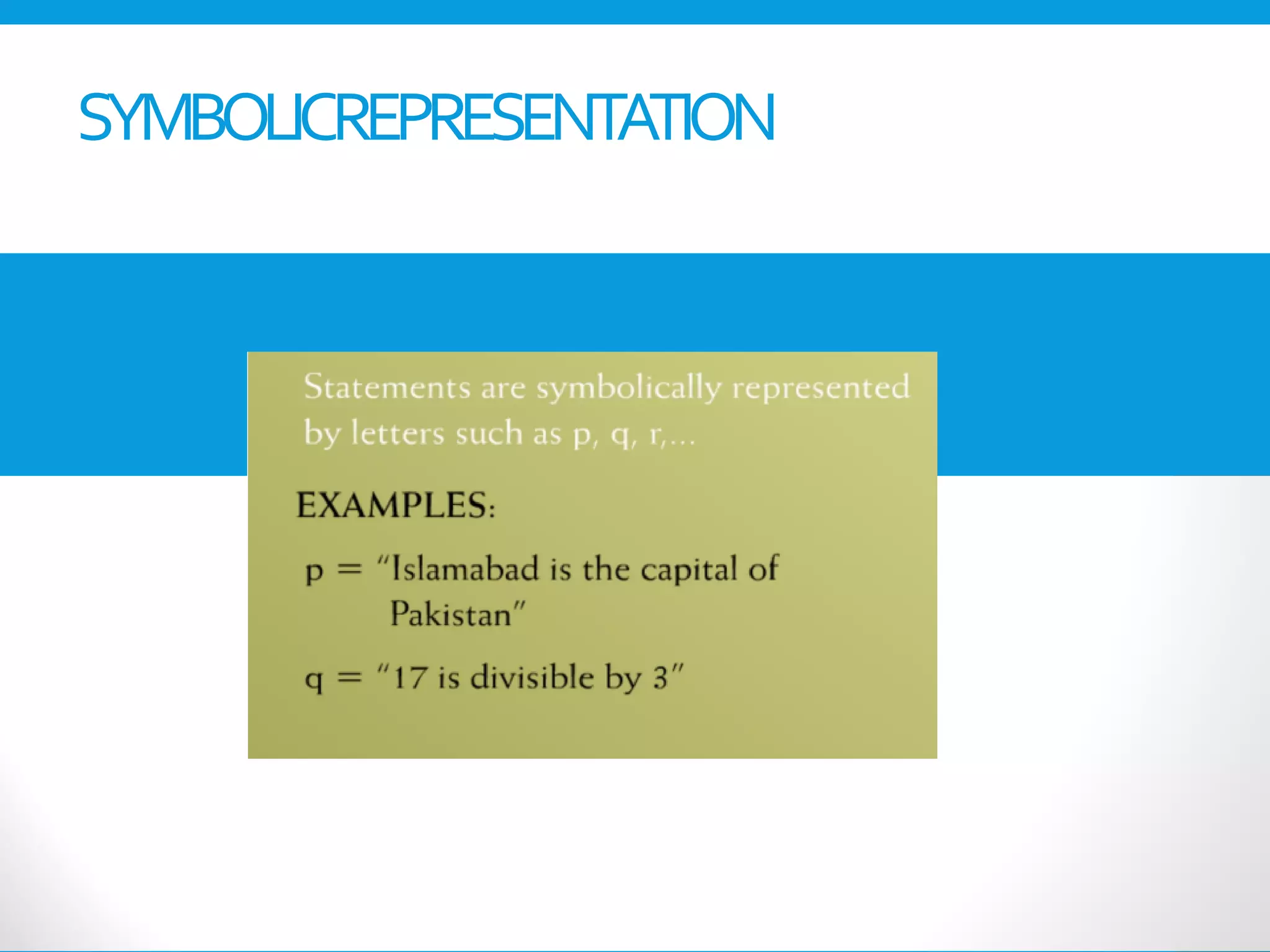
SYMBOLICREPRESENTATION
LOGICALCONNECTIVES
E
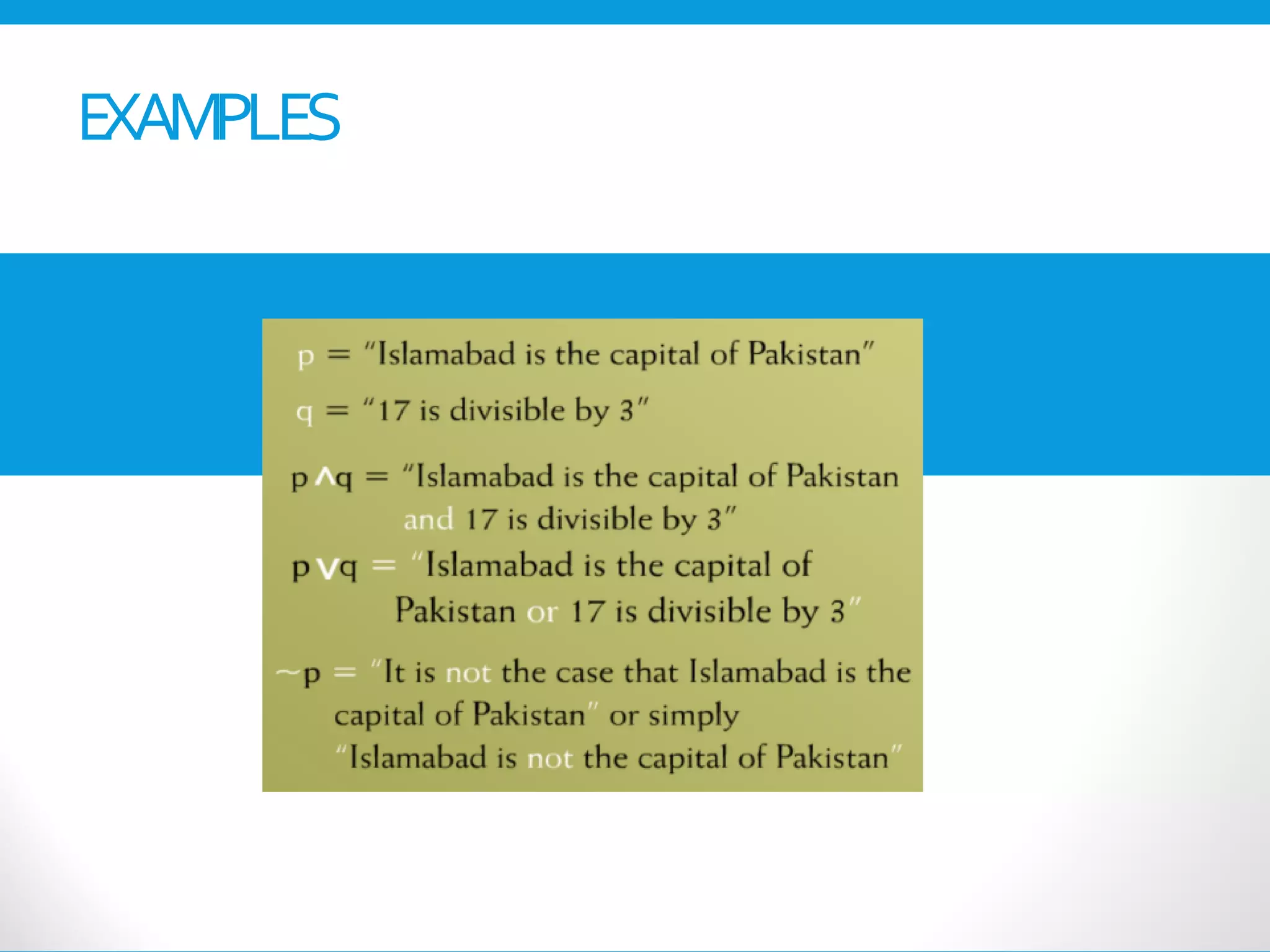
XAMPLES
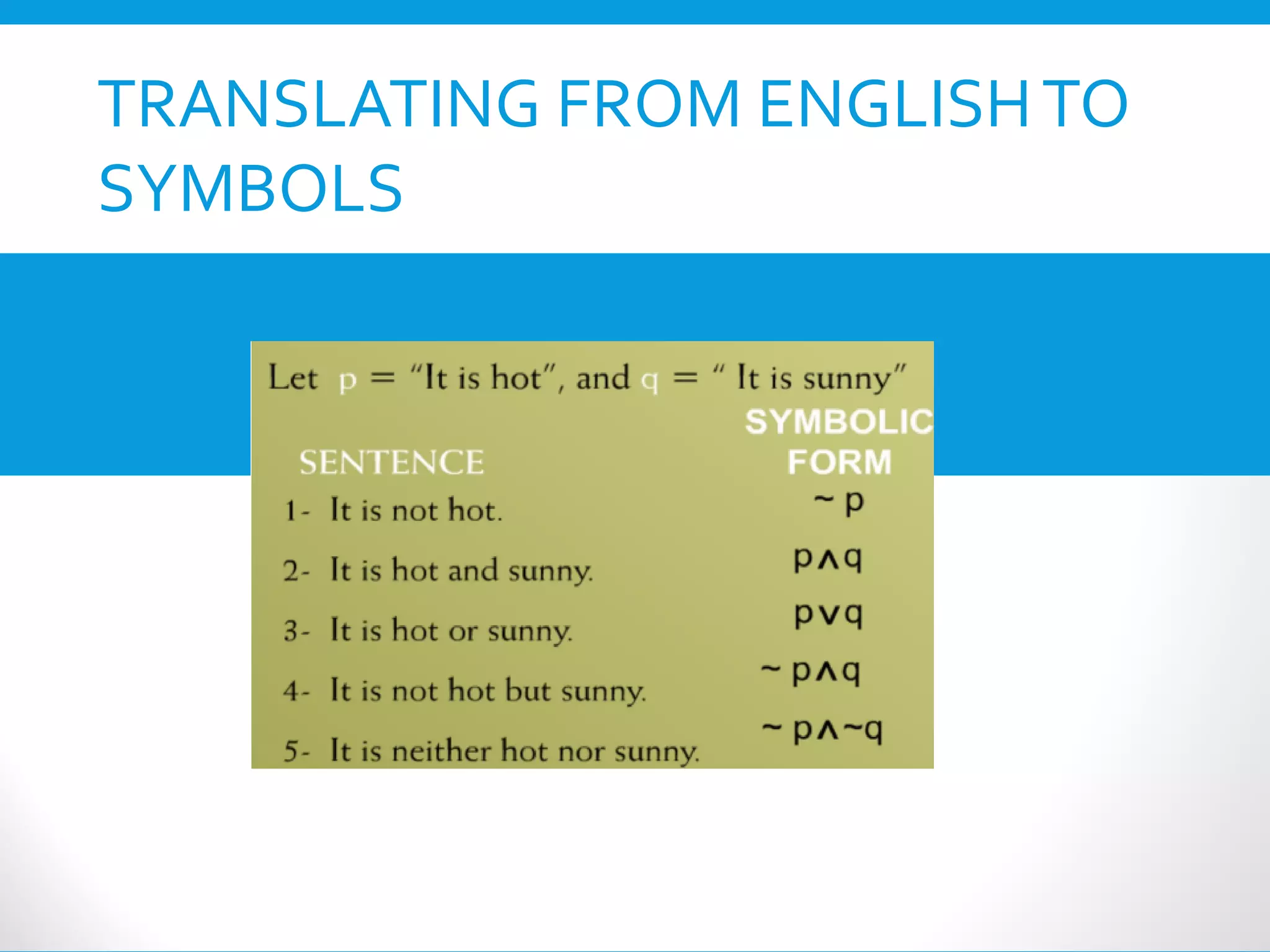
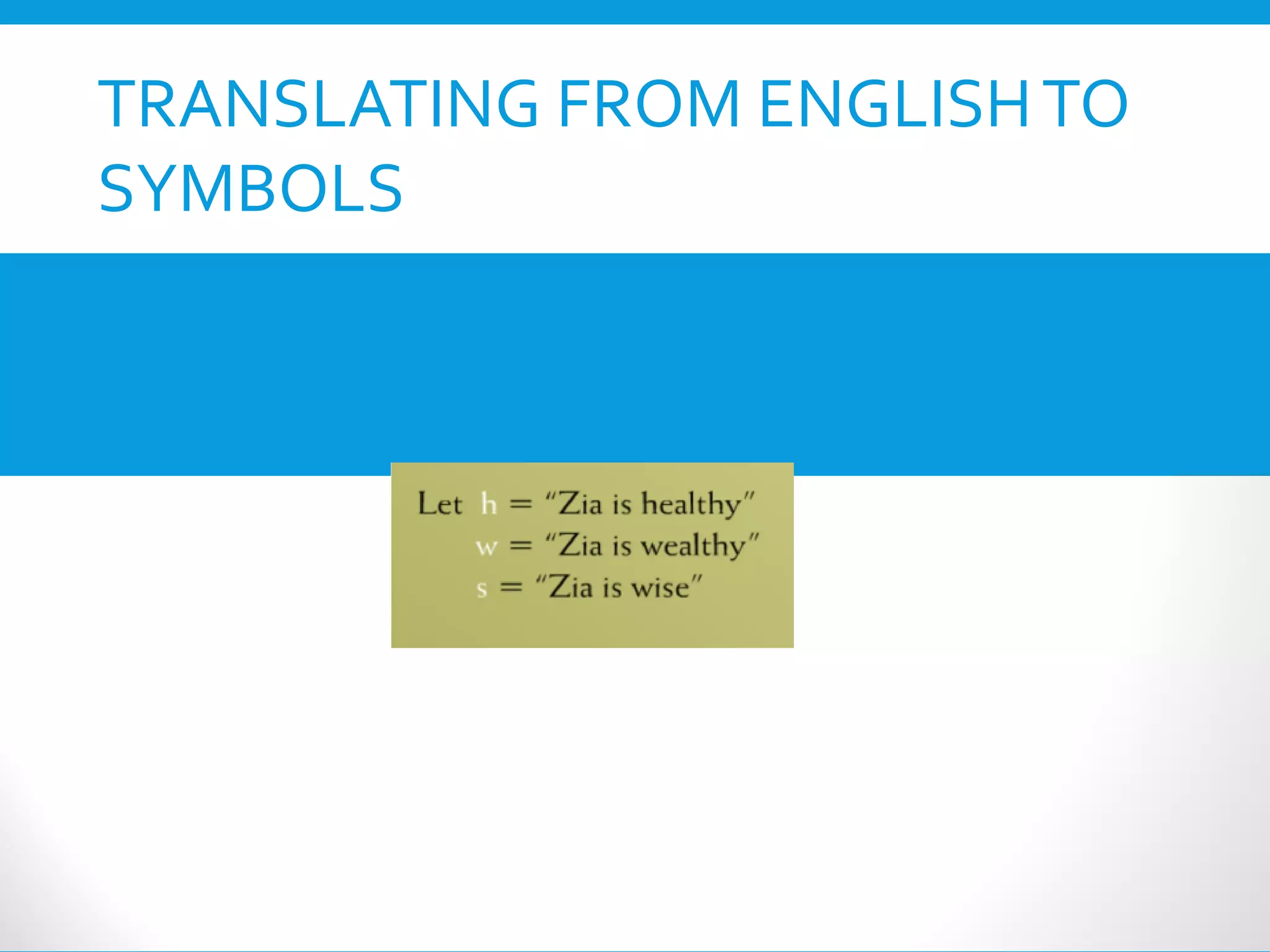
TRANSLATING FROM ENGLISHTO
SYMBOLS
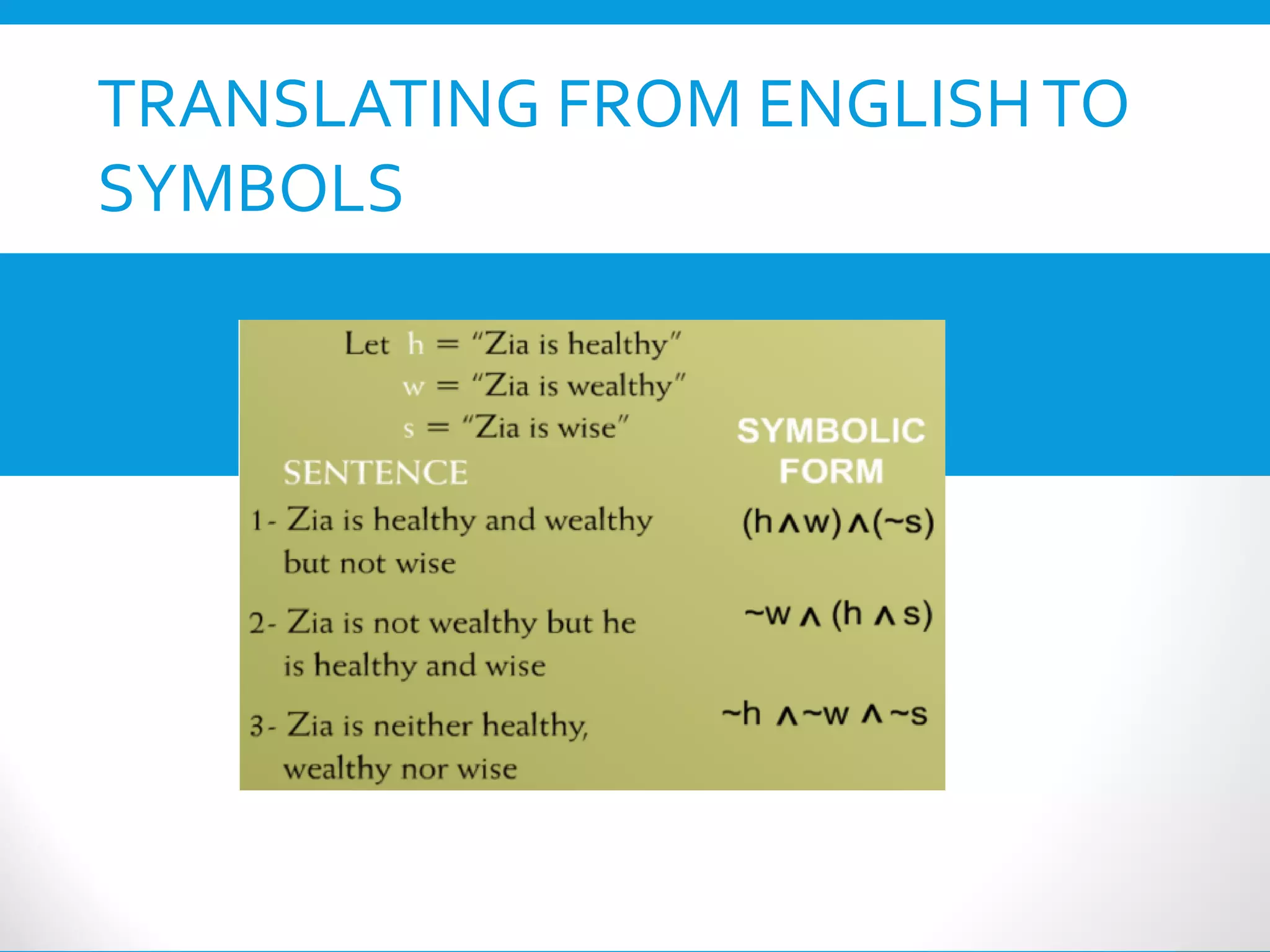
TRANSLATING FROM ENGLISHTO
SYMBOLS
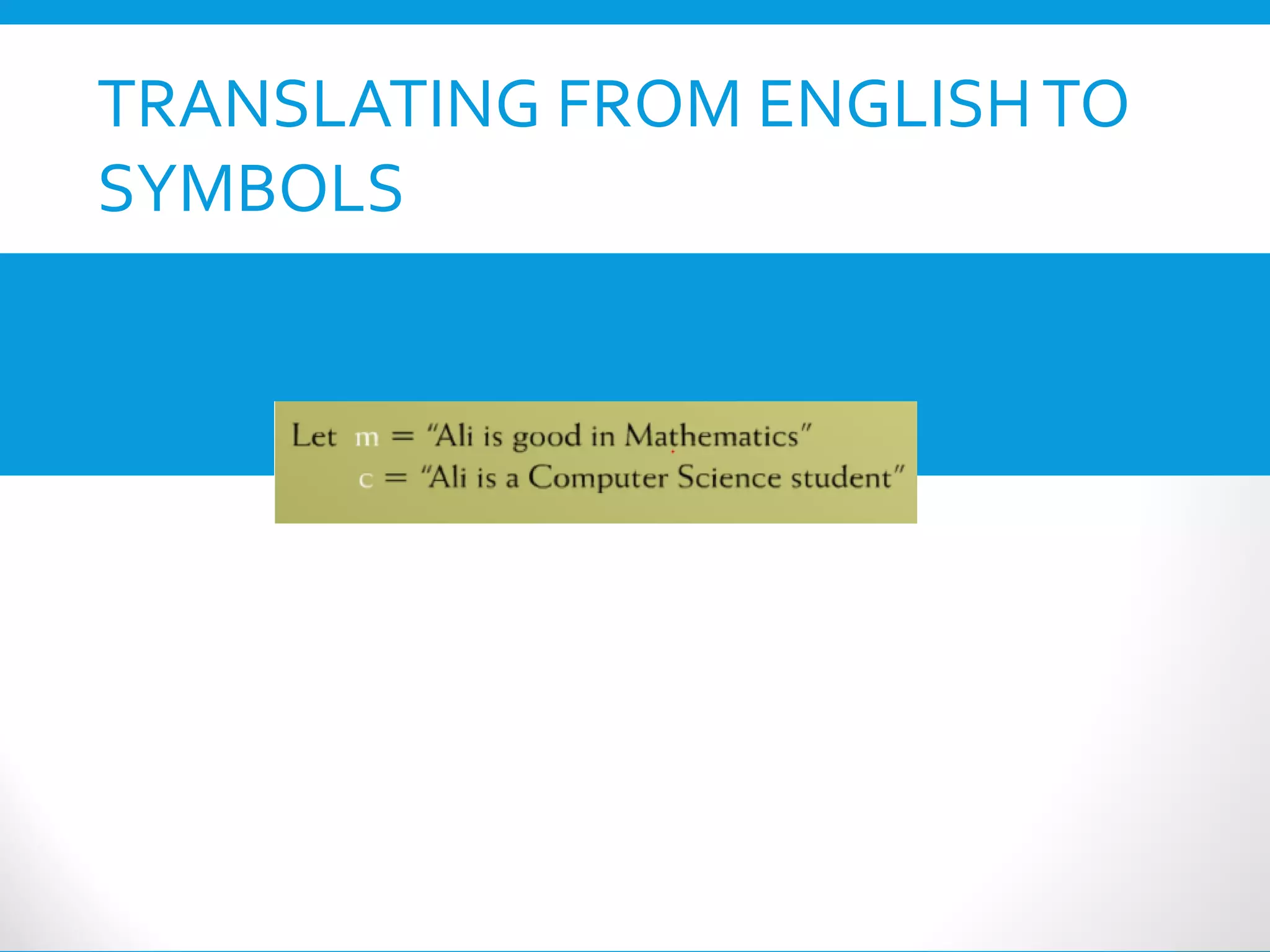
TRANSLATING FROM ENGLISHTO
SYMBOLS
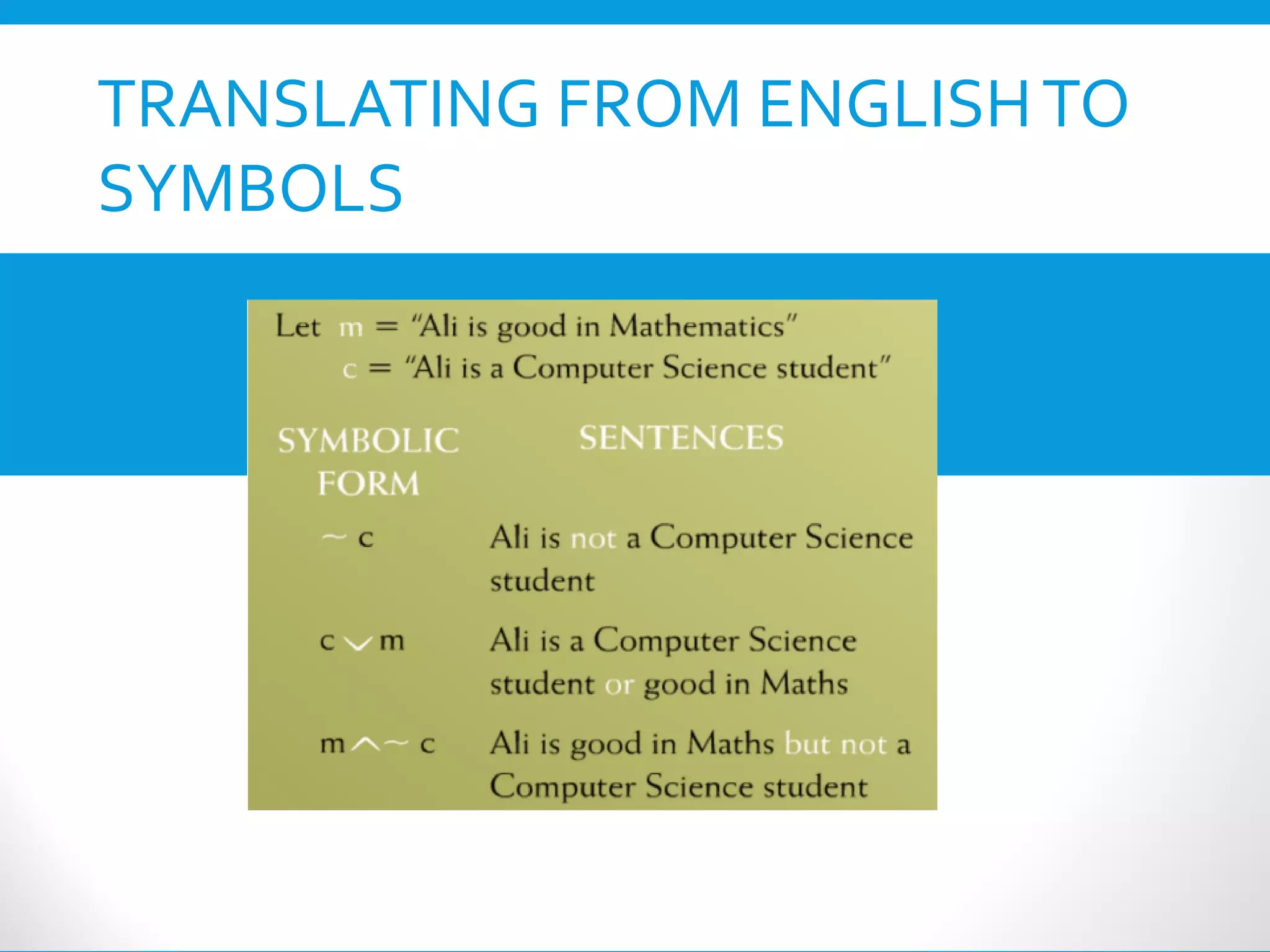
TRANSLATING FROM ENGLISHTO
SYMBOLS
TRANSLATING FROM ENGLISHTO
SYMBOLS
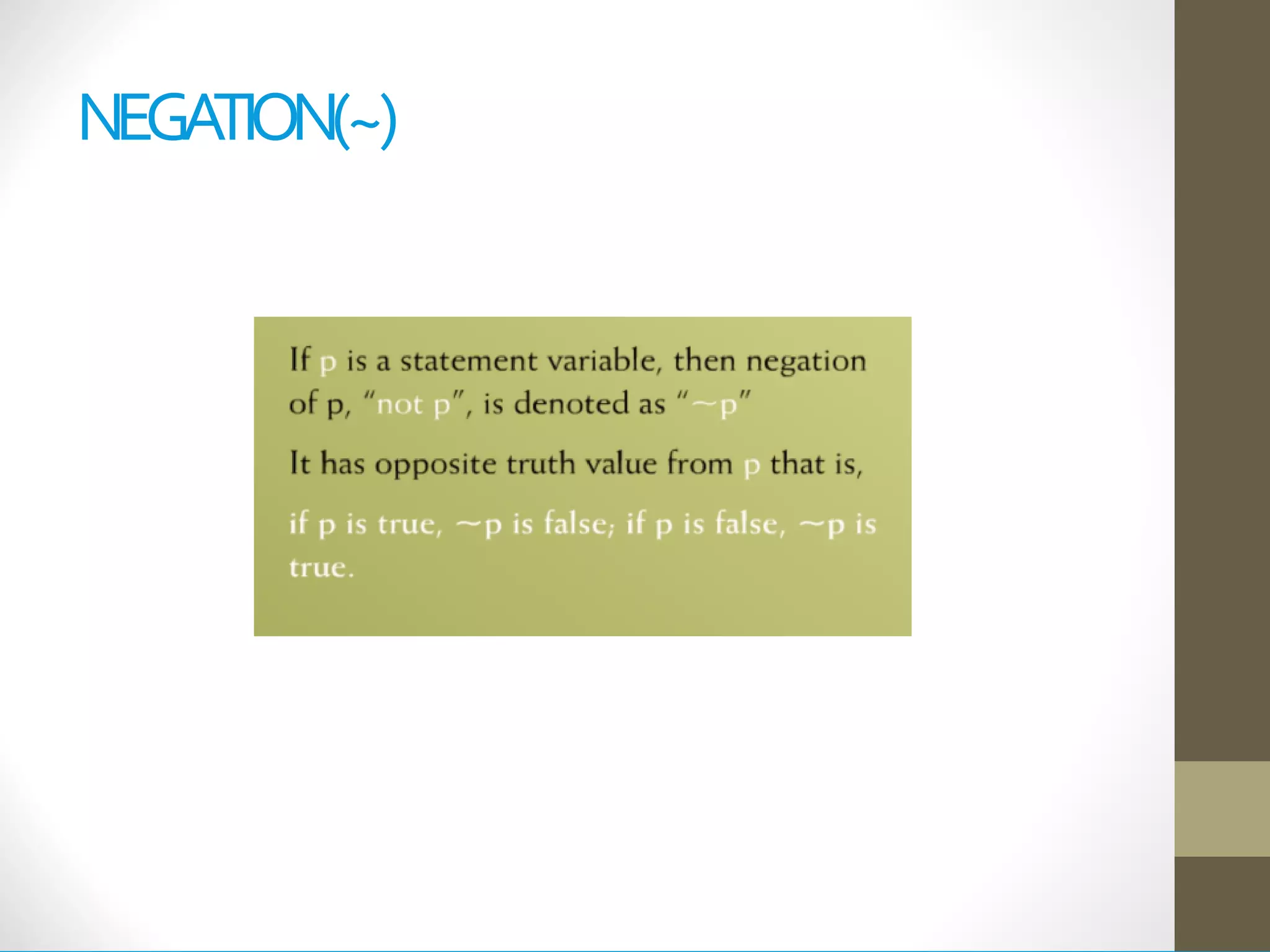
NEGATION(~)
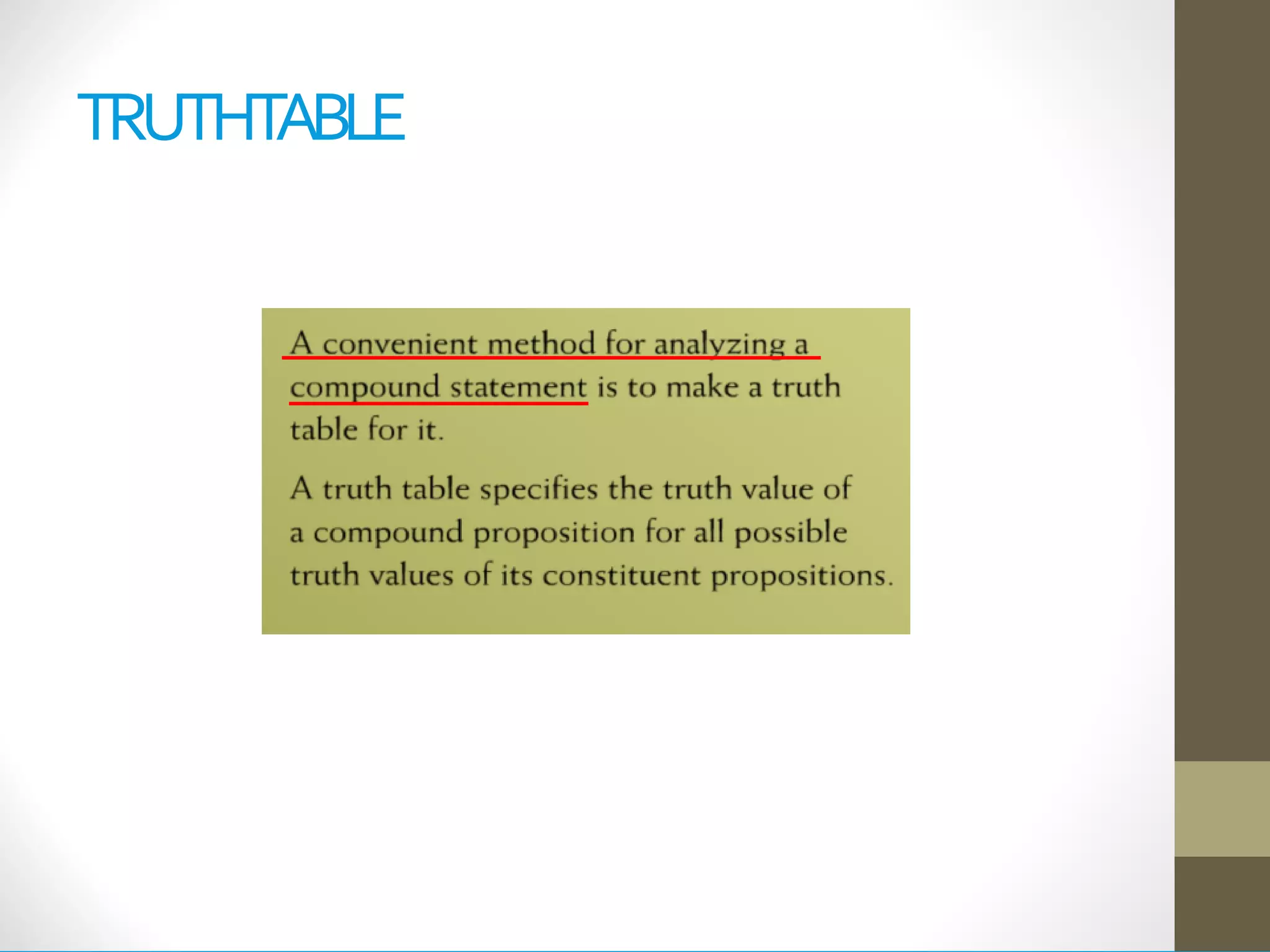
TRUTHTABLE
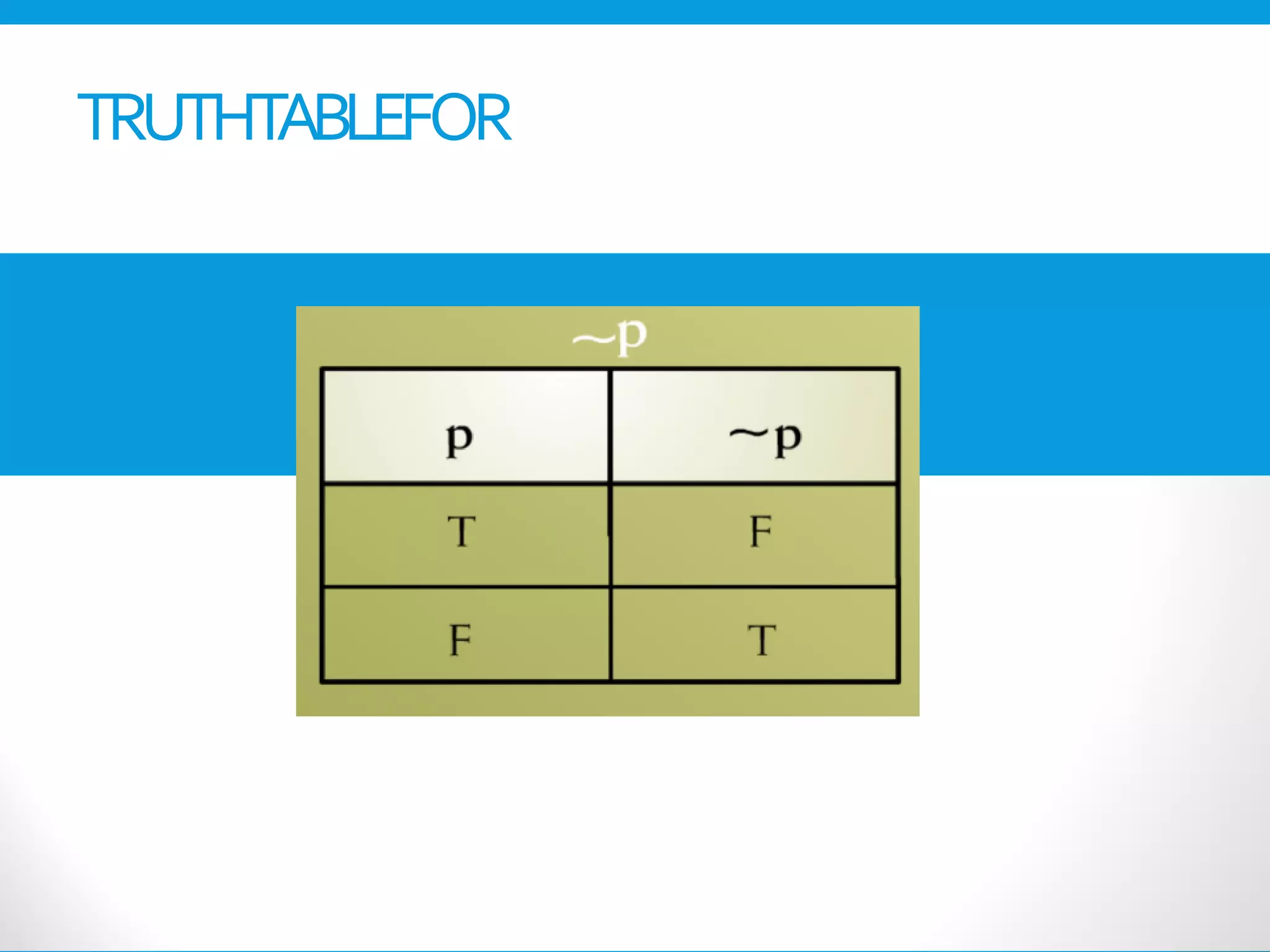
TRUTHTABLEFOR
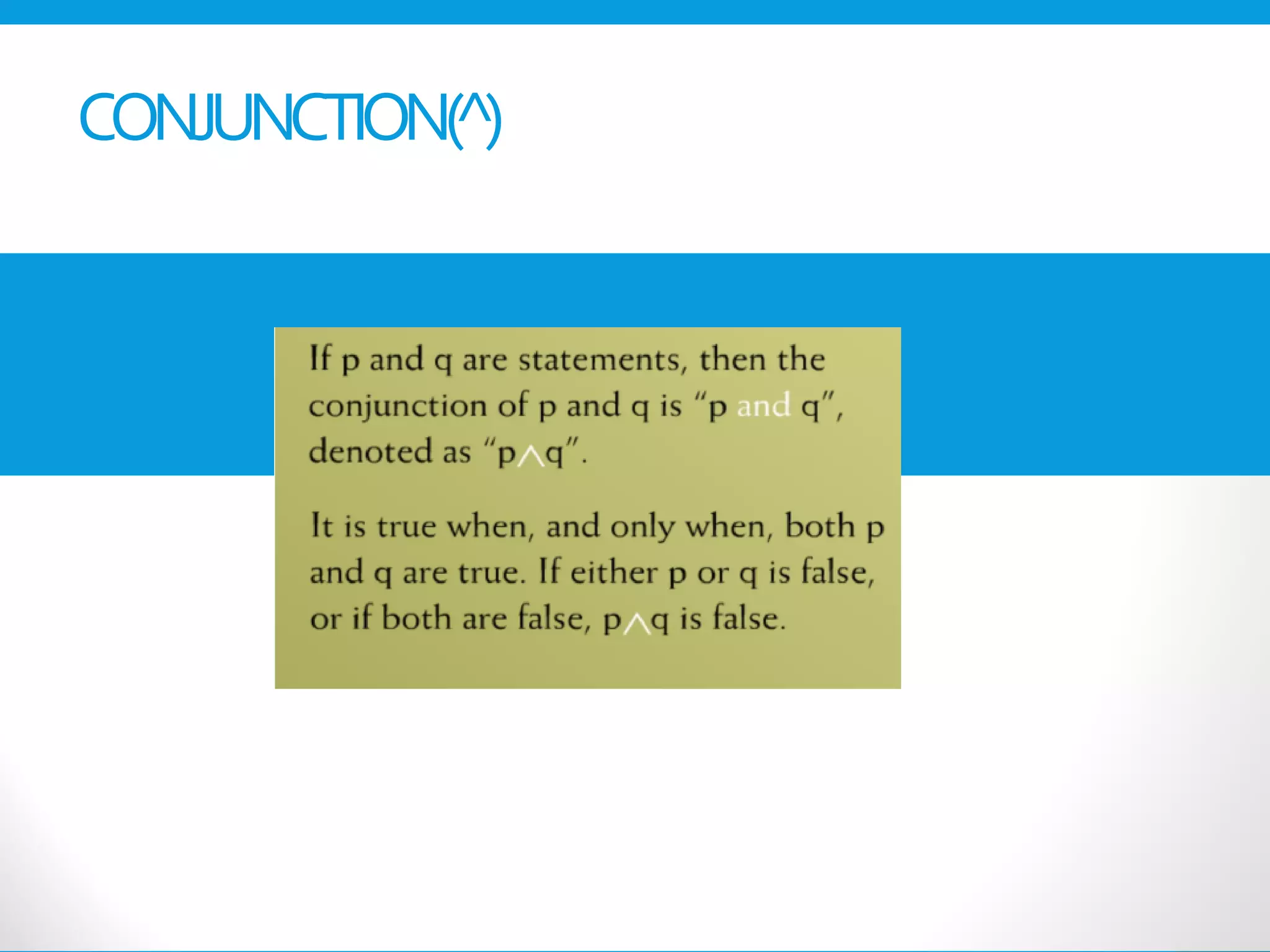
CONJUNCTION(^)
TRUTHTABLEFOR
DISJUNCTION(ᴠ)
TRUTHTABLEFOR

SMIU Lecture #1 & 2 Introduction to Discrete Structure and Truth Table.pdf

  • 1.
    Sindh Madressatul Islam University,Karachi Department of Information Technology
  • 2.
    COURSE INTRODUCTION Course Code MAT-104 CourseTitle Discrete Structure Credit Hours 3+0 (3hr)
  • 3.
    COURSE OBJECTIVES  Mathematicalreasoning: introduction to logic, propositional and predicate calculus; negation disjunction and conjunction; implication and equivalence; truth tables; predicates; quantifiers; natural deduction; rules of Inference; methods of proofs; use in program proving; resolution principle; Set theory: Paradoxes in set theory; inductive definition of sets and proof by induction; Relations, representation of relations by graphs; properties of relations, equivalence relations and partitions; Partial orderings; Linear and wellordered sets; Functions: mappings, injection and surjection, composition of functions; inverse functions; special functions; Peano postulates; Recursive function theory; Elementary combinatorics; counting techniques; recurrence relation; generating functions. Graph Theory: elements of graph theory, Planar Graphs, Graph Colouring, Euler graph, Hamiltonian path, trees and their applications.
  • 4.
    LEARNING STRATEGIES Active learningstrategies are employed in this course to encourage students' participation in class and to foster their abilities to gather information and data from its sources and analyze it. Active learning strategies include assignments/projects where students work in individual and in teams to solve certain problems. Readings may include many Research Papers and other related studies.
  • 5.
    RECOMMENDED RESOURCES • DiscreteMathematical Structure with Application to Computer Science, J. P. Temblay and B Manohar, McGraw- Hill, 2nd Edition. • Discrete Mathematics, 7th edition, Richard Johnson Baugh, 2008, Prentice Hall Publishers. • Relevant Research Papers (Journal + Conference)
  • 6.
  • 7.
  • 8.
    ATTENDANCE POLICY • Studentsare expected to attend their classes. Absence never exempts a student from the work required for satisfactory completion of the courses. • Excessive absences of any course will result in:  First warning for absence of 10% of the class hours  Second warning for absence of 20% of the class hours • A failing grade in the course for an absence of 25% of the class hours (as per HEC guidelines) • Exception to (3) may be made in the case of serious illness or death to an immediate family member if approved by the dean of the college. In such case, the student will receive a W grade in the course
  • 9.
    PLAGIARISM It is useof someone else’s idea, words, projects, artwork, phrasing, sentence structure, or other work without properly acknowledging the ownership (source) of the property. Plagiarism is dishonest because it misrepresents the work of someone else as ones own. Students who are suspected of plagiarism will answer to an investigation Those found guilty will face a disciplinary action as per the university rules.
  • 10.
    ASSESSMENT BREAKDOWN(THEORY) 100 MARKS Quizzes 10%  Two + one quizzes  Assignments 10%  Two+One assignment  Presentation 15%  Class Participation/Attend. 05%  Total 40%  Mid term 20%  Final 40%
  • 11.
    OUTLINE  Introduction toDiscrete Structure  Why Discrete Mathematics?  Basic preliminaries
  • 12.
  • 13.
    INTRODUCTION  Discrete Structuredescribes processes that consist of a sequence of individual steps, as compared to forms of mathematics that describe processes that change in a continuous manner. The major topics we cover in this course are single-membership sets, mathematical logic, induction, and proofs.
  • 14.
    WHATISDISCRETEMATHEMATICS? • Discrete mathematicsfocuses on problems that are not over a continuous domain. For example, is it possible to visit 3 islands in a river with 6 bridges without crossing any bridge more than once? That is a discrete math problem (because there are a finite (fixed, discrete) number of bridges). Or, what is the smallest number of telephone lines needed to connect 200 cities? The numbers can be large and the logic can be complex, but these type of problems are different from finding an optimal value for a function where the domain can be 3,
  • 15.
    WHATISDISCRETEMATHEMATICS? • Discrete Mathematicsconcerns processes that consist of a sequence of individual steps.
  • 16.
    WHY DISCRETE STRUCTURE/ MATHEMATICS? (I)  Computers use discrete structures to represent and manipulate data.  Computer Science is not Programming  Computer Science is not Software Engineering  Edsger Dijkstra: “Computer Science is no more about computers than Astronomy is about telescopes.”  Computer Science is about problem solving.
  • 17.
    WHY DISCRETE MATHEMATICS? (II) Mathematics is at the heart of problem solving  Defining a problem requires mathematical rigor  Use and analysis of models, data structures, algorithms requires a solid foundation of mathematics  To justify why a particular way of solving a problem is correct or efficient (i.e., better than another way) requires analysis with a well-defined mathematical model.
  • 18.
    PROBLEM SOLVING REQUIRESMATHEMATICAL  Your boss is not going to ask you to solve  an MST (Minimal SpanningTree) or  aTSP (Travelling Salesperson Problem)  Rarely will you encounter a problem in an abstract setting  However, he/she may ask you to build a rotation of the company’s delivery trucks to minimize fuel usage  It is up to you to determine  a proper model for representing the problem and  a correct or efficient algorithm for solving it
  • 19.
    Why Discrete Math? Designefficient computer systems. •How did Google manage to build a fast search engine? •What is the foundation of internet security? algorithms, data structures, database, parallel computing, distributed systems, cryptography, computer networks… Logic, sets/functions, counting, graph theory…
  • 20.
    What is discretemathematics? logic, sets, functions, relations, etc Logic: artificial intelligence (AI), database, circuit design Counting: probability, analysis of algorithm Graph theory: computer network, data structures Number theory: cryptography, coding theory
  • 21.
    L OGIC Logicis the studyof the principles and methods that distinguishes between a valid and an invalid argument.
  • 22.
  • 23.
    Topic 1: Logicand Proofs Logic: propositional logic, first order logic Proof: induction, contradiction How do computers think? Artificial intelligence, database, circuit, algorithms
  • 24.
    Topic 2: Counting •Sets • Combinations, Permutations, Binomial theorem • Functions • Counting by mapping, pigeonhole principle • Recursions, generating functions Probability, algorithms, data structures
  • 25.
    Topic 2: Counting Howmany steps are needed to sort n numbers?
  • 26.
    Topic 3: GraphTheory • Relations, graphs • Degree sequence, isomorphism, Eulerian graphs • Trees Computer networks, circuit design, data structures
  • 27.
    Topic 4: NumberTheory • Number sequence • Euclidean algorithm • Prime number • Modular arithmetic Cryptography, coding theory, data structures
  • 28.
    PROPOSITIONS  A statementthat has a truth value  Which of the following are propositions?  TheWashington State flag is red  It snowed inWhistler, BC on January 4, 2008.  Hillary Clinton won the democratic caucus in Iowa  Space aliens landed in Roswell, New Mexico  Ron Paul would be a great president  Turn your homework in onWednesday  Why are we taking this class?  If n is an integer greater than two, then the equation an + bn = cn has no solutions in non-zero integers a, b, and c.  Every even integer greater than two can be written as the sum of two primes  This statement is false – Propositional variables: p, q, r, s, . . . – Truth values: T for true, F for false
  • 29.
  • 30.
  • 31.
  • 32.
    COMPOUND PROPOSITIONS  Negation(not) ¬ p  Conjunction (and) p ∧ q  Disjunction (or) p ∨ q  Exclusive or p ⊕ q  Implication p → q  Biconditional p ↔ q
  • 33.
  • 34.
    LECTURE #2/WEEK #2 Rules of Discrete Structure  TruthTable
  • 35.
  • 36.
  • 37.
  • 38.
  • 39.
  • 40.
  • 41.
  • 42.
  • 43.
  • 44.
  • 45.
  • 46.
  • 47.
  • 48.
  • 49.
  • 50.
  • 51.
  • 52.
  • 53.
  • 54.
  • 55.