Inference in First-Order Logic
Philipp Koehn
16 March 2017
Philipp Koehn Artificial Intelligence: Inference in First-Order Logic 16 March 2017
1A Brief History of Reasoning
450B.C. Stoics propositional logic, inference (maybe)
322B.C. Aristotle “syllogisms” (inference rules), quantifiers
1565 Cardano probability theory (propositional logic + uncertainty)
1847 Boole propositional logic (again)
1879 Frege first-order logic
1922 Wittgenstein proof by truth tables
1930 G¨odel ∃ complete algorithm for FOL
1930 Herbrand complete algorithm for FOL (reduce to propositional)
1931 G¨odel ¬∃ complete algorithm for arithmetic
1960 Davis/Putnam “practical” algorithm for propositional logic
1965 Robinson “practical” algorithm for FOL—resolution
Philipp Koehn Artificial Intelligence: Inference in First-Order Logic 16 March 2017
2The Story So Far
Propositional logic
Subset of prepositional logic: horn clauses
Inference algorithms
– forward chaining
– backward chaining
– resolution (for full prepositional logic)
First order logic (FOL)
– variables
– functions
– quantifiers
– etc.
Today: inference for first order logic
Philipp Koehn Artificial Intelligence: Inference in First-Order Logic 16 March 2017
3Outline
Reducing first-order inference to propositional inference
Unification
Generalized Modus Ponens
Forward and backward chaining
Logic programming
Resolution
Philipp Koehn Artificial Intelligence: Inference in First-Order Logic 16 March 2017
4
reduction to
prepositional inference
Philipp Koehn Artificial Intelligence: Inference in First-Order Logic 16 March 2017
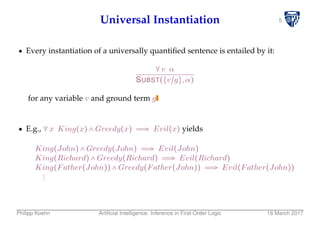
5Universal Instantiation
Every instantiation of a universally quantified sentence is entailed by it:
∀v α
SUBST({v/g},α)
for any variable v and ground term g
E.g., ∀x King(x) ∧ Greedy(x) ⇒ Evil(x) yields
King(John) ∧ Greedy(John) ⇒ Evil(John)
King(Richard) ∧ Greedy(Richard) ⇒ Evil(Richard)
King(Father(John)) ∧ Greedy(Father(John)) ⇒ Evil(Father(John))
Philipp Koehn Artificial Intelligence: Inference in First-Order Logic 16 March 2017
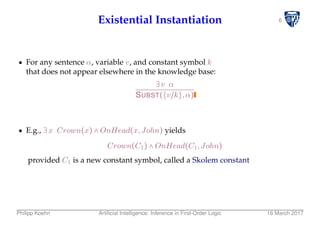
6Existential Instantiation
For any sentence α, variable v, and constant symbol k
that does not appear elsewhere in the knowledge base:
∃v α
SUBST({v/k},α)
E.g., ∃x Crown(x) ∧ OnHead(x,John) yields
Crown(C1) ∧ OnHead(C1,John)
provided C1 is a new constant symbol, called a Skolem constant
Philipp Koehn Artificial Intelligence: Inference in First-Order Logic 16 March 2017
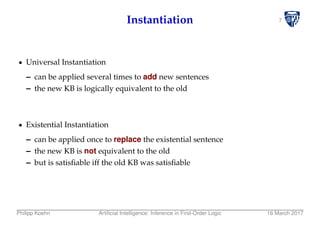
7Instantiation
Universal Instantiation
– can be applied several times to add new sentences
– the new KB is logically equivalent to the old
Existential Instantiation
– can be applied once to replace the existential sentence
– the new KB is not equivalent to the old
– but is satisfiable iff the old KB was satisfiable
Philipp Koehn Artificial Intelligence: Inference in First-Order Logic 16 March 2017
8Reduction to Propositional Inference
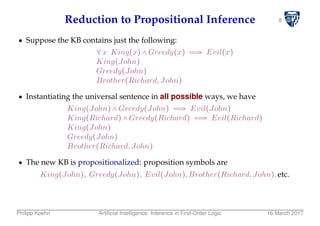
Suppose the KB contains just the following:
∀x King(x) ∧ Greedy(x) ⇒ Evil(x)
King(John)
Greedy(John)
Brother(Richard,John)
Instantiating the universal sentence in all possible ways, we have
King(John) ∧ Greedy(John) ⇒ Evil(John)
King(Richard) ∧ Greedy(Richard) ⇒ Evil(Richard)
King(John)
Greedy(John)
Brother(Richard,John)
The new KB is propositionalized: proposition symbols are
King(John), Greedy(John), Evil(John),Brother(Richard,John),etc.
Philipp Koehn Artificial Intelligence: Inference in First-Order Logic 16 March 2017
9Reduction to Propositional Inference
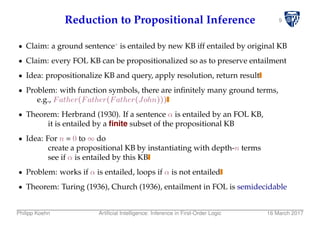
Claim: a ground sentence∗ is entailed by new KB iff entailed by original KB
Claim: every FOL KB can be propositionalized so as to preserve entailment
Idea: propositionalize KB and query, apply resolution, return result
Problem: with function symbols, there are infinitely many ground terms,
e.g., Father(Father(Father(John)))
Theorem: Herbrand (1930). If a sentence α is entailed by an FOL KB,
it is entailed by a finite subset of the propositional KB
Idea: For n = 0 to ∞ do
create a propositional KB by instantiating with depth-n terms
see if α is entailed by this KB
Problem: works if α is entailed, loops if α is not entailed
Theorem: Turing (1936), Church (1936), entailment in FOL is semidecidable
Philipp Koehn Artificial Intelligence: Inference in First-Order Logic 16 March 2017
10Practical Problems with Propositionalization
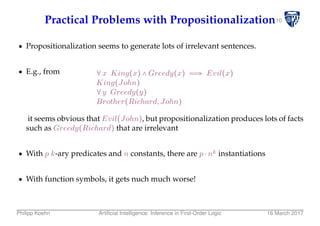
Propositionalization seems to generate lots of irrelevant sentences.
E.g., from ∀x King(x) ∧ Greedy(x) ⇒ Evil(x)
King(John)
∀y Greedy(y)
Brother(Richard,John)
it seems obvious that Evil(John), but propositionalization produces lots of facts
such as Greedy(Richard) that are irrelevant
With p k-ary predicates and n constants, there are p ⋅ nk instantiations
With function symbols, it gets nuch much worse!
Philipp Koehn Artificial Intelligence: Inference in First-Order Logic 16 March 2017
11
unification
Philipp Koehn Artificial Intelligence: Inference in First-Order Logic 16 March 2017
12Plan
We have the inference rule
– ∀x King(x) ∧ Greedy(x) ⇒ Evil(x)
We have facts that (partially) match the precondition
– King(John)
– ∀y Greedy(y)
We need to match them up with substitutions: θ = {x/John,y/John} works
– unification
– generalized modus ponens
Philipp Koehn Artificial Intelligence: Inference in First-Order Logic 16 March 2017
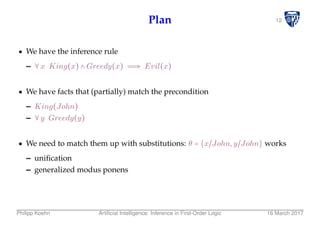
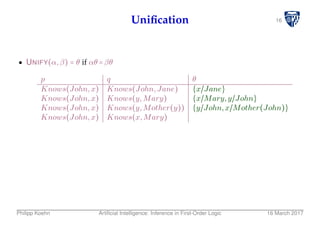
13Unification
UNIFY(α,β) = θ if αθ =βθ
p q θ
Knows(John,x) Knows(John,Jane)
Knows(John,x) Knows(y,Mary)
Knows(John,x) Knows(y,Mother(y))
Knows(John,x) Knows(x,Mary)
Philipp Koehn Artificial Intelligence: Inference in First-Order Logic 16 March 2017
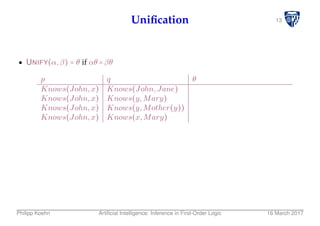
14Unification
UNIFY(α,β) = θ if αθ =βθ
p q θ
Knows(John,x) Knows(John,Jane) {x/Jane}
Knows(John,x) Knows(y,Mary)
Knows(John,x) Knows(y,Mother(y))
Knows(John,x) Knows(x,Mary)
Philipp Koehn Artificial Intelligence: Inference in First-Order Logic 16 March 2017
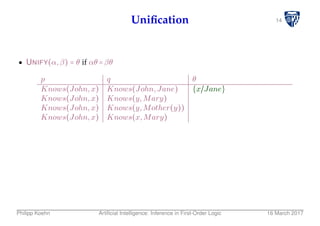
15Unification
UNIFY(α,β) = θ if αθ =βθ
p q θ
Knows(John,x) Knows(John,Jane) {x/Jane}
Knows(John,x) Knows(y,Mary) {x/Mary,y/John}
Knows(John,x) Knows(y,Mother(y))
Knows(John,x) Knows(x,Mary)
Philipp Koehn Artificial Intelligence: Inference in First-Order Logic 16 March 2017
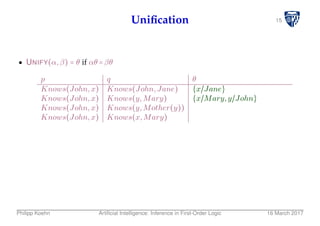
16Unification
UNIFY(α,β) = θ if αθ =βθ
p q θ
Knows(John,x) Knows(John,Jane) {x/Jane}
Knows(John,x) Knows(y,Mary) {x/Mary,y/John}
Knows(John,x) Knows(y,Mother(y)) {y/John,x/Mother(John)}
Knows(John,x) Knows(x,Mary)
Philipp Koehn Artificial Intelligence: Inference in First-Order Logic 16 March 2017
17Unification
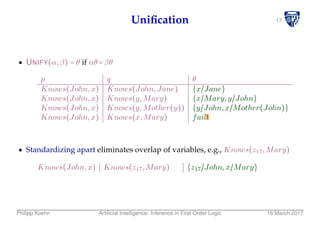
UNIFY(α,β) = θ if αθ =βθ
p q θ
Knows(John,x) Knows(John,Jane) {x/Jane}
Knows(John,x) Knows(y,Mary) {x/Mary,y/John}
Knows(John,x) Knows(y,Mother(y)) {y/John,x/Mother(John)}
Knows(John,x) Knows(x,Mary) fail
Standardizing apart eliminates overlap of variables, e.g., Knows(z17,Mary)
Knows(John,x) Knows(z17,Mary) {z17/John,x/Mary}
Philipp Koehn Artificial Intelligence: Inference in First-Order Logic 16 March 2017
18
generalized modus ponens
Philipp Koehn Artificial Intelligence: Inference in First-Order Logic 16 March 2017
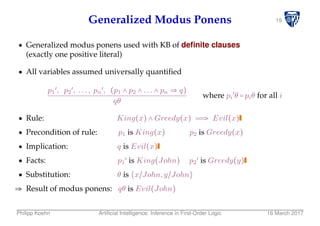
19Generalized Modus Ponens
Generalized modus ponens used with KB of definite clauses
(exactly one positive literal)
All variables assumed universally quantified
p1
′, p2
′, ..., pn
′, (p1 ∧ p2 ∧ ... ∧ pn ⇒ q)
qθ
where pi
′
θ =piθ for all i
Rule: King(x) ∧ Greedy(x) ⇒ Evil(x)
Precondition of rule: p1 is King(x) p2 is Greedy(x)
Implication: q is Evil(x)
Facts: p1
′ is King(John) p2
′ is Greedy(y)
Substitution: θ is {x/John,y/John}
⇒ Result of modus ponens: qθ is Evil(John)
Philipp Koehn Artificial Intelligence: Inference in First-Order Logic 16 March 2017
20
forward chaining
Philipp Koehn Artificial Intelligence: Inference in First-Order Logic 16 March 2017
21Example Knowledge
The law says that it is a crime for an American to sell weapons to hostile nations.
The country Nono, an enemy of America, has some missiles, and all of its
missiles were sold to it by Colonel West, who is American.
Prove that Col. West is a criminal
Philipp Koehn Artificial Intelligence: Inference in First-Order Logic 16 March 2017
22Example Knowledge Base
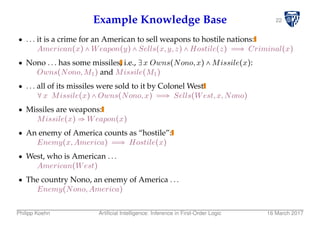
... it is a crime for an American to sell weapons to hostile nations:
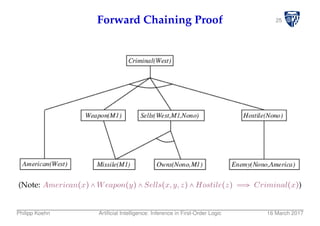
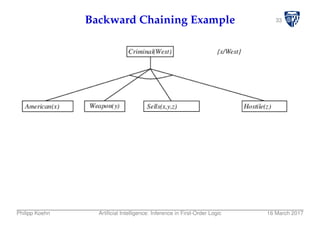
American(x) ∧ Weapon(y) ∧ Sells(x,y,z) ∧ Hostile(z) ⇒ Criminal(x)
Nono ... has some missiles, i.e., ∃x Owns(Nono,x) ∧ Missile(x):
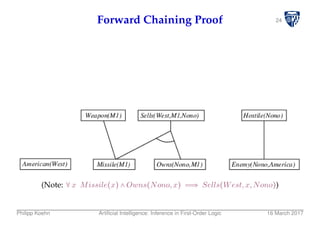
Owns(Nono,M1) and Missile(M1)
... all of its missiles were sold to it by Colonel West
∀x Missile(x) ∧ Owns(Nono,x) ⇒ Sells(West,x,Nono)
Missiles are weapons:
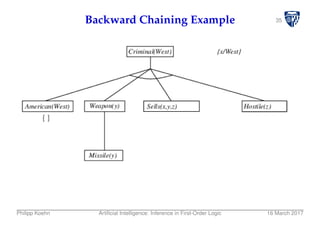
Missile(x) ⇒ Weapon(x)
An enemy of America counts as “hostile”:
Enemy(x,America) ⇒ Hostile(x)
West, who is American ...
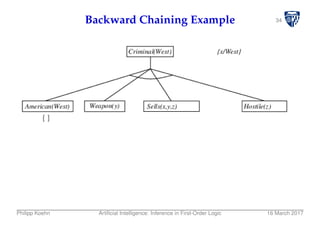
American(West)
The country Nono, an enemy of America ...
Enemy(Nono,America)
Philipp Koehn Artificial Intelligence: Inference in First-Order Logic 16 March 2017
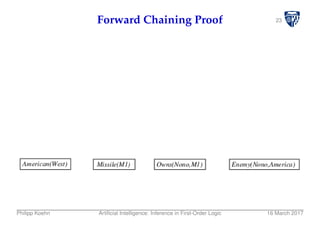
23Forward Chaining Proof
Philipp Koehn Artificial Intelligence: Inference in First-Order Logic 16 March 2017
24Forward Chaining Proof
(Note: ∀x Missile(x) ∧ Owns(Nono,x) ⇒ Sells(West,x,Nono))
Philipp Koehn Artificial Intelligence: Inference in First-Order Logic 16 March 2017
25Forward Chaining Proof
(Note: American(x) ∧ Weapon(y) ∧ Sells(x,y,z) ∧ Hostile(z) ⇒ Criminal(x))
Philipp Koehn Artificial Intelligence: Inference in First-Order Logic 16 March 2017
26Properties of Forward Chaining
Sound and complete for first-order definite clauses
(proof similar to propositional proof)
Datalog (1977) = first-order definite clauses + no functions (e.g., crime KB)
Forward chaining terminates for Datalog in poly iterations: at most p ⋅ nk literals
May not terminate in general if α is not entailed
This is unavoidable: entailment with definite clauses is semidecidable
Philipp Koehn Artificial Intelligence: Inference in First-Order Logic 16 March 2017
27Efficiency of Forward Chaining
Simple observation: no need to match a rule on iteration k
if a premise wasn’t added on iteration k − 1
⇒ match each rule whose premise contains a newly added literal
Matching itself can be expensive
Database indexing allows O(1) retrieval of known facts
e.g., query Missile(x) retrieves Missile(M1)
Matching conjunctive premises against known facts is NP-hard
Forward chaining is widely used in deductive databases
Philipp Koehn Artificial Intelligence: Inference in First-Order Logic 16 March 2017
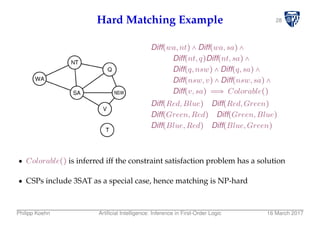
28Hard Matching Example
Diff(wa,nt) ∧ Diff(wa,sa) ∧
Diff(nt,q)Diff(nt,sa) ∧
Diff(q,nsw) ∧ Diff(q,sa) ∧
Diff(nsw,v) ∧ Diff(nsw,sa) ∧
Diff(v,sa) ⇒ Colorable()
Diff(Red,Blue) Diff(Red,Green)
Diff(Green,Red) Diff(Green,Blue)
Diff(Blue,Red) Diff(Blue,Green)
Colorable() is inferred iff the constraint satisfaction problem has a solution
CSPs include 3SAT as a special case, hence matching is NP-hard
Philipp Koehn Artificial Intelligence: Inference in First-Order Logic 16 March 2017
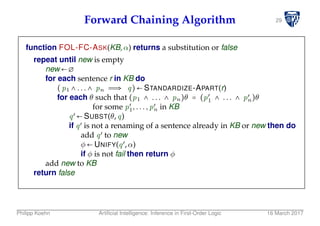
29Forward Chaining Algorithm
function FOL-FC-ASK(KB,α) returns a substitution or false
repeat until new is empty
new←∅
for each sentence r in KB do
(p1 ∧ ... ∧ pn ⇒ q)← STANDARDIZE-APART(r)
for each θ such that (p1 ∧ ... ∧ pn)θ = (p′
1 ∧ ... ∧ p′
n)θ
for some p′
1,...,p′
n in KB
q′ ← SUBST(θ,q)
if q′ is not a renaming of a sentence already in KB or new then do
add q′ to new
φ← UNIFY(q′,α)
if φ is not fail then return φ
add new to KB
return false
Philipp Koehn Artificial Intelligence: Inference in First-Order Logic 16 March 2017
30
backward chaining
Philipp Koehn Artificial Intelligence: Inference in First-Order Logic 16 March 2017
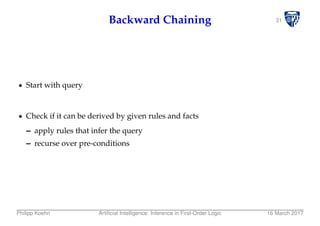
31Backward Chaining
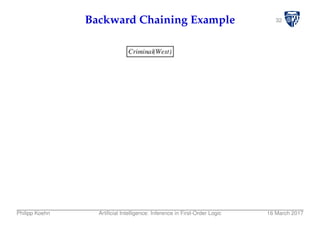
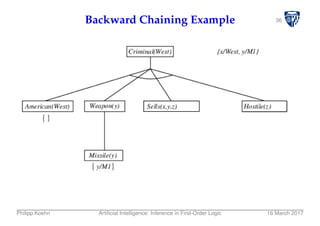
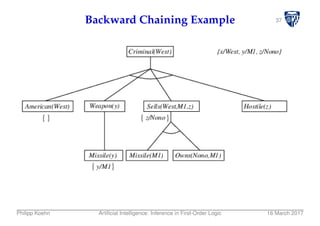
Start with query
Check if it can be derived by given rules and facts
– apply rules that infer the query
– recurse over pre-conditions
Philipp Koehn Artificial Intelligence: Inference in First-Order Logic 16 March 2017
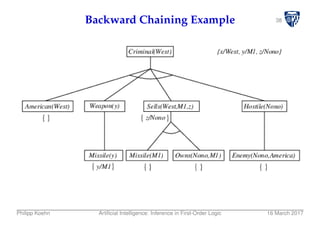
32Backward Chaining Example
Philipp Koehn Artificial Intelligence: Inference in First-Order Logic 16 March 2017
33Backward Chaining Example
Philipp Koehn Artificial Intelligence: Inference in First-Order Logic 16 March 2017
34Backward Chaining Example
Philipp Koehn Artificial Intelligence: Inference in First-Order Logic 16 March 2017
35Backward Chaining Example
Philipp Koehn Artificial Intelligence: Inference in First-Order Logic 16 March 2017
36Backward Chaining Example
Philipp Koehn Artificial Intelligence: Inference in First-Order Logic 16 March 2017
37Backward Chaining Example
Philipp Koehn Artificial Intelligence: Inference in First-Order Logic 16 March 2017
38Backward Chaining Example
Philipp Koehn Artificial Intelligence: Inference in First-Order Logic 16 March 2017
39Properties of Backward Chaining
Depth-first recursive proof search: space is linear in size of proof
Incomplete due to infinite loops
⇒ fix by checking current goal against every goal on stack
Inefficient due to repeated subgoals (both success and failure)
⇒ fix using caching of previous results (extra space!)
Widely used (without improvements!) for logic programming
Philipp Koehn Artificial Intelligence: Inference in First-Order Logic 16 March 2017
40Backward Chaining Algorithm
function FOL-BC-ASK(KB,goals,θ) returns a set of substitutions
inputs: KB, a knowledge base
goals, a list of conjuncts forming a query (θ already applied)
θ, the current substitution, initially the empty substitution ∅
local variables: answers, a set of substitutions, initially empty
if goals is empty then return {θ}
q′ ← SUBST(θ, FIRST(goals))
for each sentence r in KB
where STANDARDIZE-APART(r) = (p1 ∧ ... ∧ pn ⇒ q)
and θ′ ← UNIFY(q,q′) succeeds
new goals←[p1,...,pn REST(goals)]
answers← FOL-BC-ASK(KB,new goals, COMPOSE(θ′,θ)) ∪ answers
return answers
Philipp Koehn Artificial Intelligence: Inference in First-Order Logic 16 March 2017
41
logic programming
Philipp Koehn Artificial Intelligence: Inference in First-Order Logic 16 March 2017
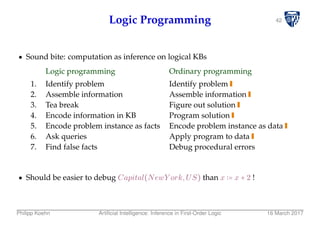
42Logic Programming
Sound bite: computation as inference on logical KBs
Logic programming Ordinary programming
1. Identify problem Identify problem
2. Assemble information Assemble information
3. Tea break Figure out solution
4. Encode information in KB Program solution
5. Encode problem instance as facts Encode problem instance as data
6. Ask queries Apply program to data
7. Find false facts Debug procedural errors
Should be easier to debug Capital(NewY ork,US) than x = x + 2 !
Philipp Koehn Artificial Intelligence: Inference in First-Order Logic 16 March 2017
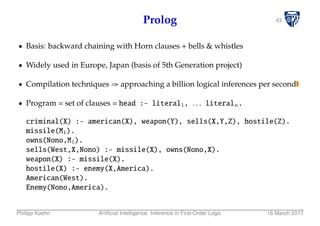
43Prolog
Basis: backward chaining with Horn clauses + bells & whistles
Widely used in Europe, Japan (basis of 5th Generation project)
Compilation techniques ⇒ approaching a billion logical inferences per second
Program = set of clauses = head :- literal1, ... literaln.
criminal(X) :- american(X), weapon(Y), sells(X,Y,Z), hostile(Z).
missile(M1).
owns(Nono,M1).
sells(West,X,Nono) :- missile(X), owns(Nono,X).
weapon(X) :- missile(X).
hostile(X) :- enemy(X,America).
American(West).
Enemy(Nono,America).
Philipp Koehn Artificial Intelligence: Inference in First-Order Logic 16 March 2017
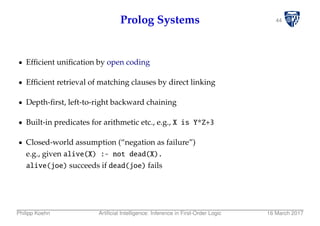
44Prolog Systems
Efficient unification by open coding
Efficient retrieval of matching clauses by direct linking
Depth-first, left-to-right backward chaining
Built-in predicates for arithmetic etc., e.g., X is Y*Z+3
Closed-world assumption (“negation as failure”)
e.g., given alive(X) :- not dead(X).
alive(joe) succeeds if dead(joe) fails
Philipp Koehn Artificial Intelligence: Inference in First-Order Logic 16 March 2017
45
resolution
Philipp Koehn Artificial Intelligence: Inference in First-Order Logic 16 March 2017
46Resolution: Brief Summary
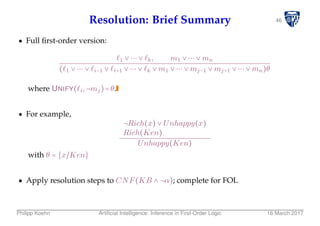
Full first-order version:
1 ∨ ⋯ ∨ k, m1 ∨ ⋯ ∨ mn
( 1 ∨ ⋯ ∨ i−1 ∨ i+1 ∨ ⋯ ∨ k ∨ m1 ∨ ⋯ ∨ mj−1 ∨ mj+1 ∨ ⋯ ∨ mn)θ
where UNIFY( i,¬mj)=θ.
For example,
¬Rich(x) ∨ Unhappy(x)
Rich(Ken)
Unhappy(Ken)
with θ = {x/Ken}
Apply resolution steps to CNF(KB ∧ ¬α); complete for FOL
Philipp Koehn Artificial Intelligence: Inference in First-Order Logic 16 March 2017
47Conversion to CNF
Everyone who loves all animals is loved by someone:
∀x [∀y Animal(y) ⇒ Loves(x,y)] ⇒ [∃y Loves(y,x)]
1. Eliminate biconditionals and implications
∀x [¬∀y ¬Animal(y) ∨ Loves(x,y)] ∨ [∃y Loves(y,x)]
2. Move ¬ inwards: ¬∀x,p ≡ ∃x ¬p, ¬∃x,p ≡ ∀x ¬p:
∀x [∃y ¬(¬Animal(y) ∨ Loves(x,y))] ∨ [∃y Loves(y,x)]
∀x [∃y ¬¬Animal(y) ∧ ¬Loves(x,y)] ∨ [∃y Loves(y,x)]
∀x [∃y Animal(y) ∧ ¬Loves(x,y)] ∨ [∃y Loves(y,x)]
Philipp Koehn Artificial Intelligence: Inference in First-Order Logic 16 March 2017
48Conversion to CNF
3. Standardize variables: each quantifier should use a different one
∀x [∃y Animal(y) ∧ ¬Loves(x,y)] ∨ [∃z Loves(z,x)]
4. Skolemize: a more general form of existential instantiation.
Each existential variable is replaced by a Skolem function
of the enclosing universally quantified variables:
∀x [Animal(F(x)) ∧ ¬Loves(x,F(x))] ∨ Loves(G(x),x)
5. Drop universal quantifiers:
[Animal(F(x)) ∧ ¬Loves(x,F(x))] ∨ Loves(G(x),x)
6. Distribute ∧ over ∨:
[Animal(F(x)) ∨ Loves(G(x),x)] ∧ [¬Loves(x,F(x)) ∨ Loves(G(x),x)]
Philipp Koehn Artificial Intelligence: Inference in First-Order Logic 16 March 2017
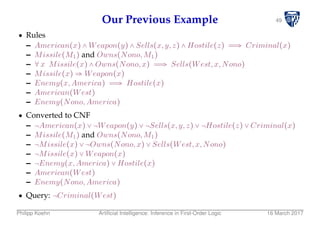
49Our Previous Example
Rules
– American(x) ∧ Weapon(y) ∧ Sells(x,y,z) ∧ Hostile(z) ⇒ Criminal(x)
– Missile(M1) and Owns(Nono,M1)
– ∀x Missile(x) ∧ Owns(Nono,x) ⇒ Sells(West,x,Nono)
– Missile(x) ⇒ Weapon(x)
– Enemy(x,America) ⇒ Hostile(x)
– American(West)
– Enemy(Nono,America)
Converted to CNF
– ¬American(x) ∨ ¬Weapon(y) ∨ ¬Sells(x,y,z) ∨ ¬Hostile(z) ∨ Criminal(x)
– Missile(M1) and Owns(Nono,M1)
– ¬Missile(x) ∨ ¬Owns(Nono,x) ∨ Sells(West,x,Nono)
– ¬Missile(x) ∨ Weapon(x)
– ¬Enemy(x,America) ∨ Hostile(x)
– American(West)
– Enemy(Nono,America)
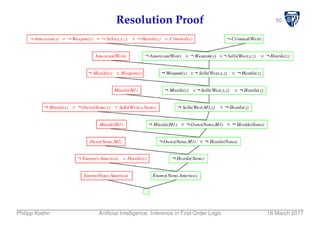
Query: ¬Criminal(West)
Philipp Koehn Artificial Intelligence: Inference in First-Order Logic 16 March 2017
50Resolution Proof
Philipp Koehn Artificial Intelligence: Inference in First-Order Logic 16 March 2017

First Order Logic resolution

  • 1.
    Inference in First-OrderLogic Philipp Koehn 16 March 2017 Philipp Koehn Artificial Intelligence: Inference in First-Order Logic 16 March 2017
  • 2.
    1A Brief Historyof Reasoning 450B.C. Stoics propositional logic, inference (maybe) 322B.C. Aristotle “syllogisms” (inference rules), quantifiers 1565 Cardano probability theory (propositional logic + uncertainty) 1847 Boole propositional logic (again) 1879 Frege first-order logic 1922 Wittgenstein proof by truth tables 1930 G¨odel ∃ complete algorithm for FOL 1930 Herbrand complete algorithm for FOL (reduce to propositional) 1931 G¨odel ¬∃ complete algorithm for arithmetic 1960 Davis/Putnam “practical” algorithm for propositional logic 1965 Robinson “practical” algorithm for FOL—resolution Philipp Koehn Artificial Intelligence: Inference in First-Order Logic 16 March 2017
  • 3.
    2The Story SoFar Propositional logic Subset of prepositional logic: horn clauses Inference algorithms – forward chaining – backward chaining – resolution (for full prepositional logic) First order logic (FOL) – variables – functions – quantifiers – etc. Today: inference for first order logic Philipp Koehn Artificial Intelligence: Inference in First-Order Logic 16 March 2017
  • 4.
    3Outline Reducing first-order inferenceto propositional inference Unification Generalized Modus Ponens Forward and backward chaining Logic programming Resolution Philipp Koehn Artificial Intelligence: Inference in First-Order Logic 16 March 2017
  • 5.
    4 reduction to prepositional inference PhilippKoehn Artificial Intelligence: Inference in First-Order Logic 16 March 2017
  • 6.
    5Universal Instantiation Every instantiationof a universally quantified sentence is entailed by it: ∀v α SUBST({v/g},α) for any variable v and ground term g E.g., ∀x King(x) ∧ Greedy(x) ⇒ Evil(x) yields King(John) ∧ Greedy(John) ⇒ Evil(John) King(Richard) ∧ Greedy(Richard) ⇒ Evil(Richard) King(Father(John)) ∧ Greedy(Father(John)) ⇒ Evil(Father(John)) Philipp Koehn Artificial Intelligence: Inference in First-Order Logic 16 March 2017
  • 7.
    6Existential Instantiation For anysentence α, variable v, and constant symbol k that does not appear elsewhere in the knowledge base: ∃v α SUBST({v/k},α) E.g., ∃x Crown(x) ∧ OnHead(x,John) yields Crown(C1) ∧ OnHead(C1,John) provided C1 is a new constant symbol, called a Skolem constant Philipp Koehn Artificial Intelligence: Inference in First-Order Logic 16 March 2017
  • 8.
    7Instantiation Universal Instantiation – canbe applied several times to add new sentences – the new KB is logically equivalent to the old Existential Instantiation – can be applied once to replace the existential sentence – the new KB is not equivalent to the old – but is satisfiable iff the old KB was satisfiable Philipp Koehn Artificial Intelligence: Inference in First-Order Logic 16 March 2017
  • 9.
    8Reduction to PropositionalInference Suppose the KB contains just the following: ∀x King(x) ∧ Greedy(x) ⇒ Evil(x) King(John) Greedy(John) Brother(Richard,John) Instantiating the universal sentence in all possible ways, we have King(John) ∧ Greedy(John) ⇒ Evil(John) King(Richard) ∧ Greedy(Richard) ⇒ Evil(Richard) King(John) Greedy(John) Brother(Richard,John) The new KB is propositionalized: proposition symbols are King(John), Greedy(John), Evil(John),Brother(Richard,John),etc. Philipp Koehn Artificial Intelligence: Inference in First-Order Logic 16 March 2017
  • 10.
    9Reduction to PropositionalInference Claim: a ground sentence∗ is entailed by new KB iff entailed by original KB Claim: every FOL KB can be propositionalized so as to preserve entailment Idea: propositionalize KB and query, apply resolution, return result Problem: with function symbols, there are infinitely many ground terms, e.g., Father(Father(Father(John))) Theorem: Herbrand (1930). If a sentence α is entailed by an FOL KB, it is entailed by a finite subset of the propositional KB Idea: For n = 0 to ∞ do create a propositional KB by instantiating with depth-n terms see if α is entailed by this KB Problem: works if α is entailed, loops if α is not entailed Theorem: Turing (1936), Church (1936), entailment in FOL is semidecidable Philipp Koehn Artificial Intelligence: Inference in First-Order Logic 16 March 2017
  • 11.
    10Practical Problems withPropositionalization Propositionalization seems to generate lots of irrelevant sentences. E.g., from ∀x King(x) ∧ Greedy(x) ⇒ Evil(x) King(John) ∀y Greedy(y) Brother(Richard,John) it seems obvious that Evil(John), but propositionalization produces lots of facts such as Greedy(Richard) that are irrelevant With p k-ary predicates and n constants, there are p ⋅ nk instantiations With function symbols, it gets nuch much worse! Philipp Koehn Artificial Intelligence: Inference in First-Order Logic 16 March 2017
  • 12.
    11 unification Philipp Koehn ArtificialIntelligence: Inference in First-Order Logic 16 March 2017
  • 13.
    12Plan We have theinference rule – ∀x King(x) ∧ Greedy(x) ⇒ Evil(x) We have facts that (partially) match the precondition – King(John) – ∀y Greedy(y) We need to match them up with substitutions: θ = {x/John,y/John} works – unification – generalized modus ponens Philipp Koehn Artificial Intelligence: Inference in First-Order Logic 16 March 2017
  • 14.
    13Unification UNIFY(α,β) = θif αθ =βθ p q θ Knows(John,x) Knows(John,Jane) Knows(John,x) Knows(y,Mary) Knows(John,x) Knows(y,Mother(y)) Knows(John,x) Knows(x,Mary) Philipp Koehn Artificial Intelligence: Inference in First-Order Logic 16 March 2017
  • 15.
    14Unification UNIFY(α,β) = θif αθ =βθ p q θ Knows(John,x) Knows(John,Jane) {x/Jane} Knows(John,x) Knows(y,Mary) Knows(John,x) Knows(y,Mother(y)) Knows(John,x) Knows(x,Mary) Philipp Koehn Artificial Intelligence: Inference in First-Order Logic 16 March 2017
  • 16.
    15Unification UNIFY(α,β) = θif αθ =βθ p q θ Knows(John,x) Knows(John,Jane) {x/Jane} Knows(John,x) Knows(y,Mary) {x/Mary,y/John} Knows(John,x) Knows(y,Mother(y)) Knows(John,x) Knows(x,Mary) Philipp Koehn Artificial Intelligence: Inference in First-Order Logic 16 March 2017
  • 17.
    16Unification UNIFY(α,β) = θif αθ =βθ p q θ Knows(John,x) Knows(John,Jane) {x/Jane} Knows(John,x) Knows(y,Mary) {x/Mary,y/John} Knows(John,x) Knows(y,Mother(y)) {y/John,x/Mother(John)} Knows(John,x) Knows(x,Mary) Philipp Koehn Artificial Intelligence: Inference in First-Order Logic 16 March 2017
  • 18.
    17Unification UNIFY(α,β) = θif αθ =βθ p q θ Knows(John,x) Knows(John,Jane) {x/Jane} Knows(John,x) Knows(y,Mary) {x/Mary,y/John} Knows(John,x) Knows(y,Mother(y)) {y/John,x/Mother(John)} Knows(John,x) Knows(x,Mary) fail Standardizing apart eliminates overlap of variables, e.g., Knows(z17,Mary) Knows(John,x) Knows(z17,Mary) {z17/John,x/Mary} Philipp Koehn Artificial Intelligence: Inference in First-Order Logic 16 March 2017
  • 19.
    18 generalized modus ponens PhilippKoehn Artificial Intelligence: Inference in First-Order Logic 16 March 2017
  • 20.
    19Generalized Modus Ponens Generalizedmodus ponens used with KB of definite clauses (exactly one positive literal) All variables assumed universally quantified p1 ′, p2 ′, ..., pn ′, (p1 ∧ p2 ∧ ... ∧ pn ⇒ q) qθ where pi ′ θ =piθ for all i Rule: King(x) ∧ Greedy(x) ⇒ Evil(x) Precondition of rule: p1 is King(x) p2 is Greedy(x) Implication: q is Evil(x) Facts: p1 ′ is King(John) p2 ′ is Greedy(y) Substitution: θ is {x/John,y/John} ⇒ Result of modus ponens: qθ is Evil(John) Philipp Koehn Artificial Intelligence: Inference in First-Order Logic 16 March 2017
  • 21.
    20 forward chaining Philipp KoehnArtificial Intelligence: Inference in First-Order Logic 16 March 2017
  • 22.
    21Example Knowledge The lawsays that it is a crime for an American to sell weapons to hostile nations. The country Nono, an enemy of America, has some missiles, and all of its missiles were sold to it by Colonel West, who is American. Prove that Col. West is a criminal Philipp Koehn Artificial Intelligence: Inference in First-Order Logic 16 March 2017
  • 23.
    22Example Knowledge Base ...it is a crime for an American to sell weapons to hostile nations: American(x) ∧ Weapon(y) ∧ Sells(x,y,z) ∧ Hostile(z) ⇒ Criminal(x) Nono ... has some missiles, i.e., ∃x Owns(Nono,x) ∧ Missile(x): Owns(Nono,M1) and Missile(M1) ... all of its missiles were sold to it by Colonel West ∀x Missile(x) ∧ Owns(Nono,x) ⇒ Sells(West,x,Nono) Missiles are weapons: Missile(x) ⇒ Weapon(x) An enemy of America counts as “hostile”: Enemy(x,America) ⇒ Hostile(x) West, who is American ... American(West) The country Nono, an enemy of America ... Enemy(Nono,America) Philipp Koehn Artificial Intelligence: Inference in First-Order Logic 16 March 2017
  • 24.
    23Forward Chaining Proof PhilippKoehn Artificial Intelligence: Inference in First-Order Logic 16 March 2017
  • 25.
    24Forward Chaining Proof (Note:∀x Missile(x) ∧ Owns(Nono,x) ⇒ Sells(West,x,Nono)) Philipp Koehn Artificial Intelligence: Inference in First-Order Logic 16 March 2017
  • 26.
    25Forward Chaining Proof (Note:American(x) ∧ Weapon(y) ∧ Sells(x,y,z) ∧ Hostile(z) ⇒ Criminal(x)) Philipp Koehn Artificial Intelligence: Inference in First-Order Logic 16 March 2017
  • 27.
    26Properties of ForwardChaining Sound and complete for first-order definite clauses (proof similar to propositional proof) Datalog (1977) = first-order definite clauses + no functions (e.g., crime KB) Forward chaining terminates for Datalog in poly iterations: at most p ⋅ nk literals May not terminate in general if α is not entailed This is unavoidable: entailment with definite clauses is semidecidable Philipp Koehn Artificial Intelligence: Inference in First-Order Logic 16 March 2017
  • 28.
    27Efficiency of ForwardChaining Simple observation: no need to match a rule on iteration k if a premise wasn’t added on iteration k − 1 ⇒ match each rule whose premise contains a newly added literal Matching itself can be expensive Database indexing allows O(1) retrieval of known facts e.g., query Missile(x) retrieves Missile(M1) Matching conjunctive premises against known facts is NP-hard Forward chaining is widely used in deductive databases Philipp Koehn Artificial Intelligence: Inference in First-Order Logic 16 March 2017
  • 29.
    28Hard Matching Example Diff(wa,nt)∧ Diff(wa,sa) ∧ Diff(nt,q)Diff(nt,sa) ∧ Diff(q,nsw) ∧ Diff(q,sa) ∧ Diff(nsw,v) ∧ Diff(nsw,sa) ∧ Diff(v,sa) ⇒ Colorable() Diff(Red,Blue) Diff(Red,Green) Diff(Green,Red) Diff(Green,Blue) Diff(Blue,Red) Diff(Blue,Green) Colorable() is inferred iff the constraint satisfaction problem has a solution CSPs include 3SAT as a special case, hence matching is NP-hard Philipp Koehn Artificial Intelligence: Inference in First-Order Logic 16 March 2017
  • 30.
    29Forward Chaining Algorithm functionFOL-FC-ASK(KB,α) returns a substitution or false repeat until new is empty new←∅ for each sentence r in KB do (p1 ∧ ... ∧ pn ⇒ q)← STANDARDIZE-APART(r) for each θ such that (p1 ∧ ... ∧ pn)θ = (p′ 1 ∧ ... ∧ p′ n)θ for some p′ 1,...,p′ n in KB q′ ← SUBST(θ,q) if q′ is not a renaming of a sentence already in KB or new then do add q′ to new φ← UNIFY(q′,α) if φ is not fail then return φ add new to KB return false Philipp Koehn Artificial Intelligence: Inference in First-Order Logic 16 March 2017
  • 31.
    30 backward chaining Philipp KoehnArtificial Intelligence: Inference in First-Order Logic 16 March 2017
  • 32.
    31Backward Chaining Start withquery Check if it can be derived by given rules and facts – apply rules that infer the query – recurse over pre-conditions Philipp Koehn Artificial Intelligence: Inference in First-Order Logic 16 March 2017
  • 33.
    32Backward Chaining Example PhilippKoehn Artificial Intelligence: Inference in First-Order Logic 16 March 2017
  • 34.
    33Backward Chaining Example PhilippKoehn Artificial Intelligence: Inference in First-Order Logic 16 March 2017
  • 35.
    34Backward Chaining Example PhilippKoehn Artificial Intelligence: Inference in First-Order Logic 16 March 2017
  • 36.
    35Backward Chaining Example PhilippKoehn Artificial Intelligence: Inference in First-Order Logic 16 March 2017
  • 37.
    36Backward Chaining Example PhilippKoehn Artificial Intelligence: Inference in First-Order Logic 16 March 2017
  • 38.
    37Backward Chaining Example PhilippKoehn Artificial Intelligence: Inference in First-Order Logic 16 March 2017
  • 39.
    38Backward Chaining Example PhilippKoehn Artificial Intelligence: Inference in First-Order Logic 16 March 2017
  • 40.
    39Properties of BackwardChaining Depth-first recursive proof search: space is linear in size of proof Incomplete due to infinite loops ⇒ fix by checking current goal against every goal on stack Inefficient due to repeated subgoals (both success and failure) ⇒ fix using caching of previous results (extra space!) Widely used (without improvements!) for logic programming Philipp Koehn Artificial Intelligence: Inference in First-Order Logic 16 March 2017
  • 41.
    40Backward Chaining Algorithm functionFOL-BC-ASK(KB,goals,θ) returns a set of substitutions inputs: KB, a knowledge base goals, a list of conjuncts forming a query (θ already applied) θ, the current substitution, initially the empty substitution ∅ local variables: answers, a set of substitutions, initially empty if goals is empty then return {θ} q′ ← SUBST(θ, FIRST(goals)) for each sentence r in KB where STANDARDIZE-APART(r) = (p1 ∧ ... ∧ pn ⇒ q) and θ′ ← UNIFY(q,q′) succeeds new goals←[p1,...,pn REST(goals)] answers← FOL-BC-ASK(KB,new goals, COMPOSE(θ′,θ)) ∪ answers return answers Philipp Koehn Artificial Intelligence: Inference in First-Order Logic 16 March 2017
  • 42.
    41 logic programming Philipp KoehnArtificial Intelligence: Inference in First-Order Logic 16 March 2017
  • 43.
    42Logic Programming Sound bite:computation as inference on logical KBs Logic programming Ordinary programming 1. Identify problem Identify problem 2. Assemble information Assemble information 3. Tea break Figure out solution 4. Encode information in KB Program solution 5. Encode problem instance as facts Encode problem instance as data 6. Ask queries Apply program to data 7. Find false facts Debug procedural errors Should be easier to debug Capital(NewY ork,US) than x = x + 2 ! Philipp Koehn Artificial Intelligence: Inference in First-Order Logic 16 March 2017
  • 44.
    43Prolog Basis: backward chainingwith Horn clauses + bells & whistles Widely used in Europe, Japan (basis of 5th Generation project) Compilation techniques ⇒ approaching a billion logical inferences per second Program = set of clauses = head :- literal1, ... literaln. criminal(X) :- american(X), weapon(Y), sells(X,Y,Z), hostile(Z). missile(M1). owns(Nono,M1). sells(West,X,Nono) :- missile(X), owns(Nono,X). weapon(X) :- missile(X). hostile(X) :- enemy(X,America). American(West). Enemy(Nono,America). Philipp Koehn Artificial Intelligence: Inference in First-Order Logic 16 March 2017
  • 45.
    44Prolog Systems Efficient unificationby open coding Efficient retrieval of matching clauses by direct linking Depth-first, left-to-right backward chaining Built-in predicates for arithmetic etc., e.g., X is Y*Z+3 Closed-world assumption (“negation as failure”) e.g., given alive(X) :- not dead(X). alive(joe) succeeds if dead(joe) fails Philipp Koehn Artificial Intelligence: Inference in First-Order Logic 16 March 2017
  • 46.
    45 resolution Philipp Koehn ArtificialIntelligence: Inference in First-Order Logic 16 March 2017
  • 47.
    46Resolution: Brief Summary Fullfirst-order version: 1 ∨ ⋯ ∨ k, m1 ∨ ⋯ ∨ mn ( 1 ∨ ⋯ ∨ i−1 ∨ i+1 ∨ ⋯ ∨ k ∨ m1 ∨ ⋯ ∨ mj−1 ∨ mj+1 ∨ ⋯ ∨ mn)θ where UNIFY( i,¬mj)=θ. For example, ¬Rich(x) ∨ Unhappy(x) Rich(Ken) Unhappy(Ken) with θ = {x/Ken} Apply resolution steps to CNF(KB ∧ ¬α); complete for FOL Philipp Koehn Artificial Intelligence: Inference in First-Order Logic 16 March 2017
  • 48.
    47Conversion to CNF Everyonewho loves all animals is loved by someone: ∀x [∀y Animal(y) ⇒ Loves(x,y)] ⇒ [∃y Loves(y,x)] 1. Eliminate biconditionals and implications ∀x [¬∀y ¬Animal(y) ∨ Loves(x,y)] ∨ [∃y Loves(y,x)] 2. Move ¬ inwards: ¬∀x,p ≡ ∃x ¬p, ¬∃x,p ≡ ∀x ¬p: ∀x [∃y ¬(¬Animal(y) ∨ Loves(x,y))] ∨ [∃y Loves(y,x)] ∀x [∃y ¬¬Animal(y) ∧ ¬Loves(x,y)] ∨ [∃y Loves(y,x)] ∀x [∃y Animal(y) ∧ ¬Loves(x,y)] ∨ [∃y Loves(y,x)] Philipp Koehn Artificial Intelligence: Inference in First-Order Logic 16 March 2017
  • 49.
    48Conversion to CNF 3.Standardize variables: each quantifier should use a different one ∀x [∃y Animal(y) ∧ ¬Loves(x,y)] ∨ [∃z Loves(z,x)] 4. Skolemize: a more general form of existential instantiation. Each existential variable is replaced by a Skolem function of the enclosing universally quantified variables: ∀x [Animal(F(x)) ∧ ¬Loves(x,F(x))] ∨ Loves(G(x),x) 5. Drop universal quantifiers: [Animal(F(x)) ∧ ¬Loves(x,F(x))] ∨ Loves(G(x),x) 6. Distribute ∧ over ∨: [Animal(F(x)) ∨ Loves(G(x),x)] ∧ [¬Loves(x,F(x)) ∨ Loves(G(x),x)] Philipp Koehn Artificial Intelligence: Inference in First-Order Logic 16 March 2017
  • 50.
    49Our Previous Example Rules –American(x) ∧ Weapon(y) ∧ Sells(x,y,z) ∧ Hostile(z) ⇒ Criminal(x) – Missile(M1) and Owns(Nono,M1) – ∀x Missile(x) ∧ Owns(Nono,x) ⇒ Sells(West,x,Nono) – Missile(x) ⇒ Weapon(x) – Enemy(x,America) ⇒ Hostile(x) – American(West) – Enemy(Nono,America) Converted to CNF – ¬American(x) ∨ ¬Weapon(y) ∨ ¬Sells(x,y,z) ∨ ¬Hostile(z) ∨ Criminal(x) – Missile(M1) and Owns(Nono,M1) – ¬Missile(x) ∨ ¬Owns(Nono,x) ∨ Sells(West,x,Nono) – ¬Missile(x) ∨ Weapon(x) – ¬Enemy(x,America) ∨ Hostile(x) – American(West) – Enemy(Nono,America) Query: ¬Criminal(West) Philipp Koehn Artificial Intelligence: Inference in First-Order Logic 16 March 2017
  • 51.
    50Resolution Proof Philipp KoehnArtificial Intelligence: Inference in First-Order Logic 16 March 2017