Sindh Madressatul Islam
University, Karachi
Department of Computer Science
Discrete Structure 3rd Semester Section E
11/20/2021 1
11/20/2021 2
Discrete Mathematics /
Discrete Structure
Basic Set Theory
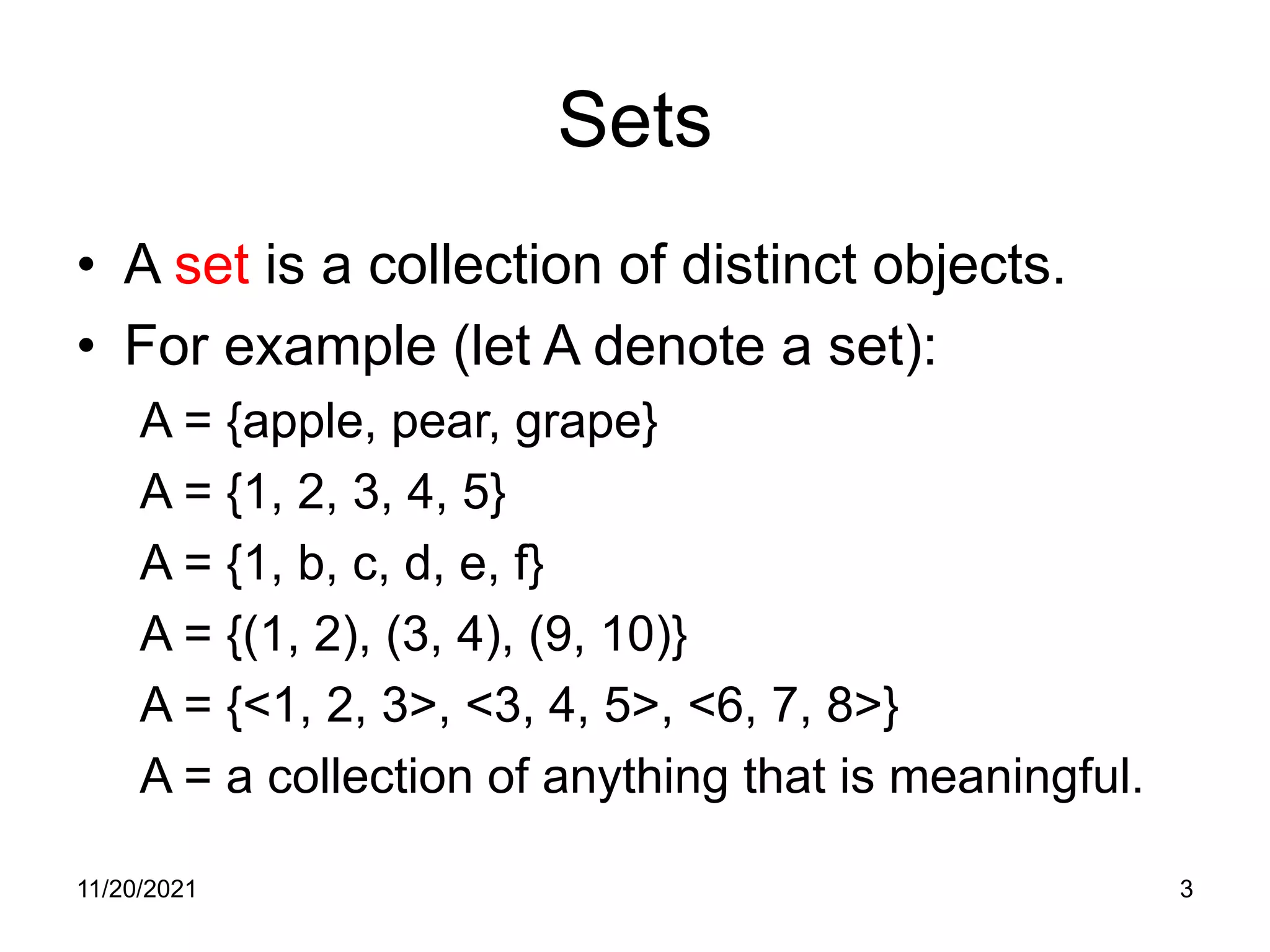
11/20/2021 3
Sets
• A set is a collection of distinct objects.
• For example (let A denote a set):
A = {apple, pear, grape}
A = {1, 2, 3, 4, 5}
A = {1, b, c, d, e, f}
A = {(1, 2), (3, 4), (9, 10)}
A = {<1, 2, 3>, <3, 4, 5>, <6, 7, 8>}
A = a collection of anything that is meaningful.
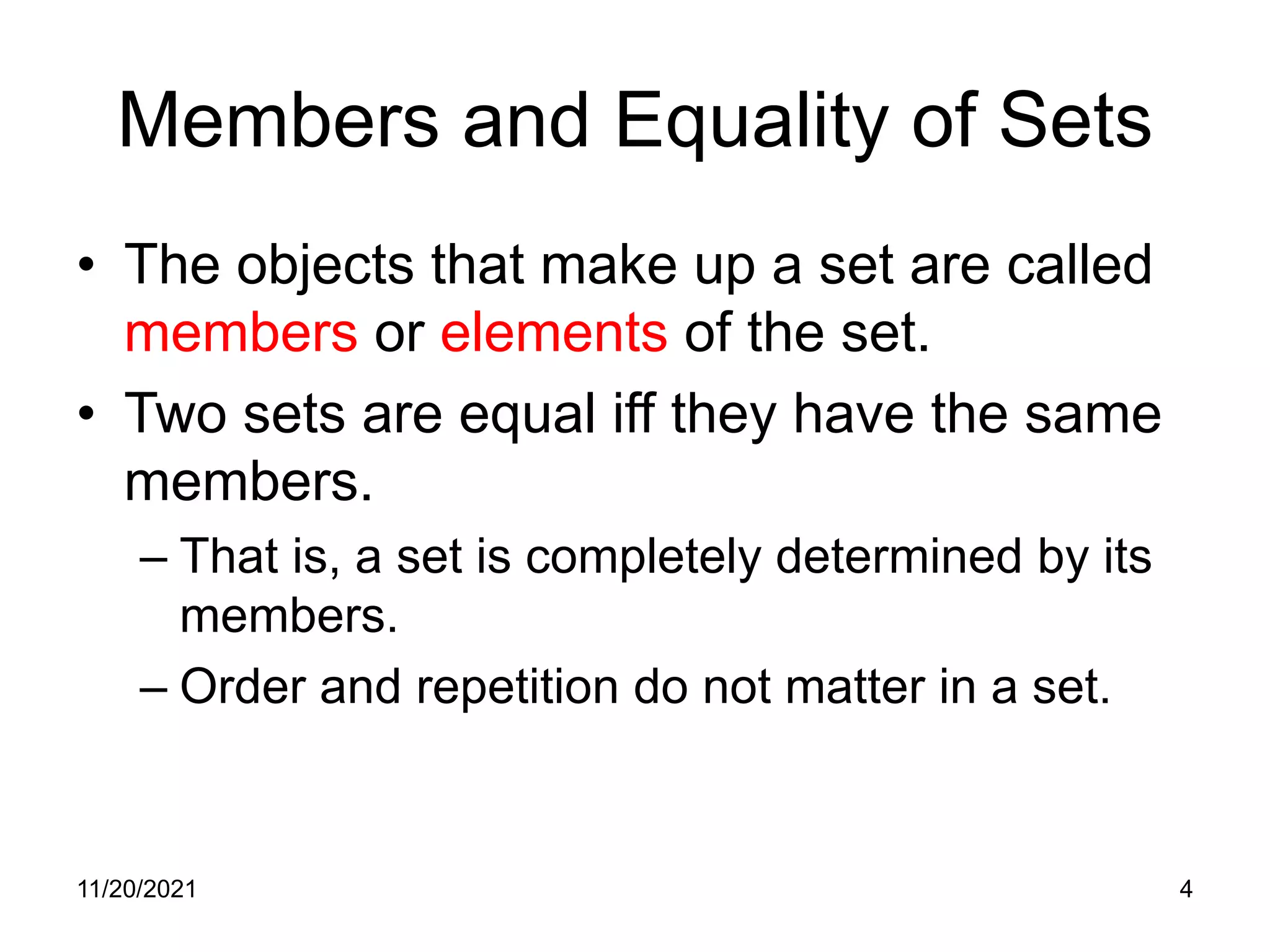
11/20/2021 4
Members and Equality of Sets
• The objects that make up a set are called
members or elements of the set.
• Two sets are equal iff they have the same
members.
– That is, a set is completely determined by its
members.
– Order and repetition do not matter in a set.
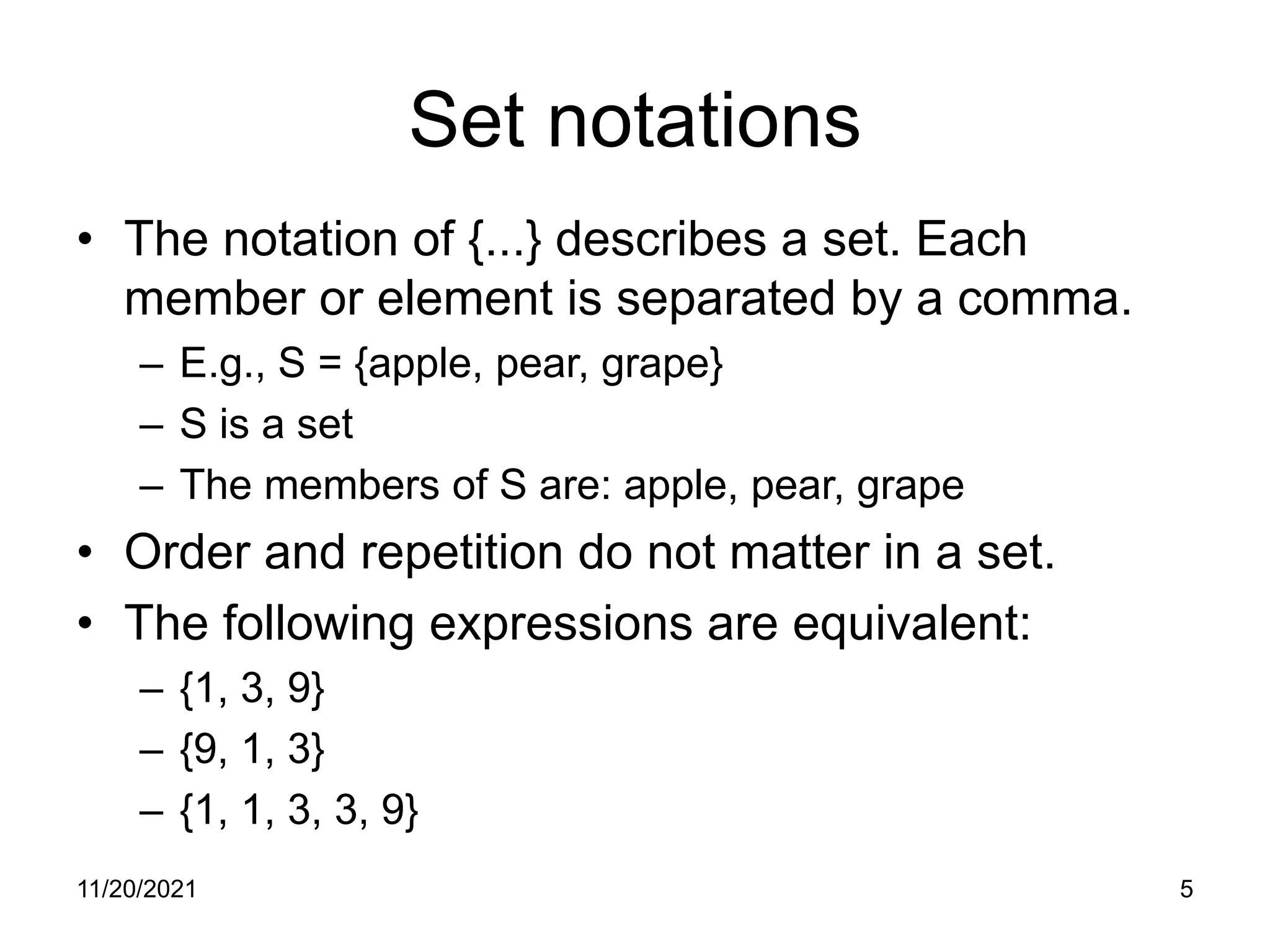
11/20/2021 5
Set notations
• The notation of {...} describes a set. Each
member or element is separated by a comma.
– E.g., S = {apple, pear, grape}
– S is a set
– The members of S are: apple, pear, grape
• Order and repetition do not matter in a set.
• The following expressions are equivalent:
– {1, 3, 9}
– {9, 1, 3}
– {1, 1, 3, 3, 9}
Sindh Madressatul Islam
University, Karachi
Department of Computer Science
Discrete Structure 3rd Semester Section E
11/20/2021 6
11/20/2021 7
Discrete Mathematics /
Discrete Structure
Basic Set Theory
11/20/2021 8
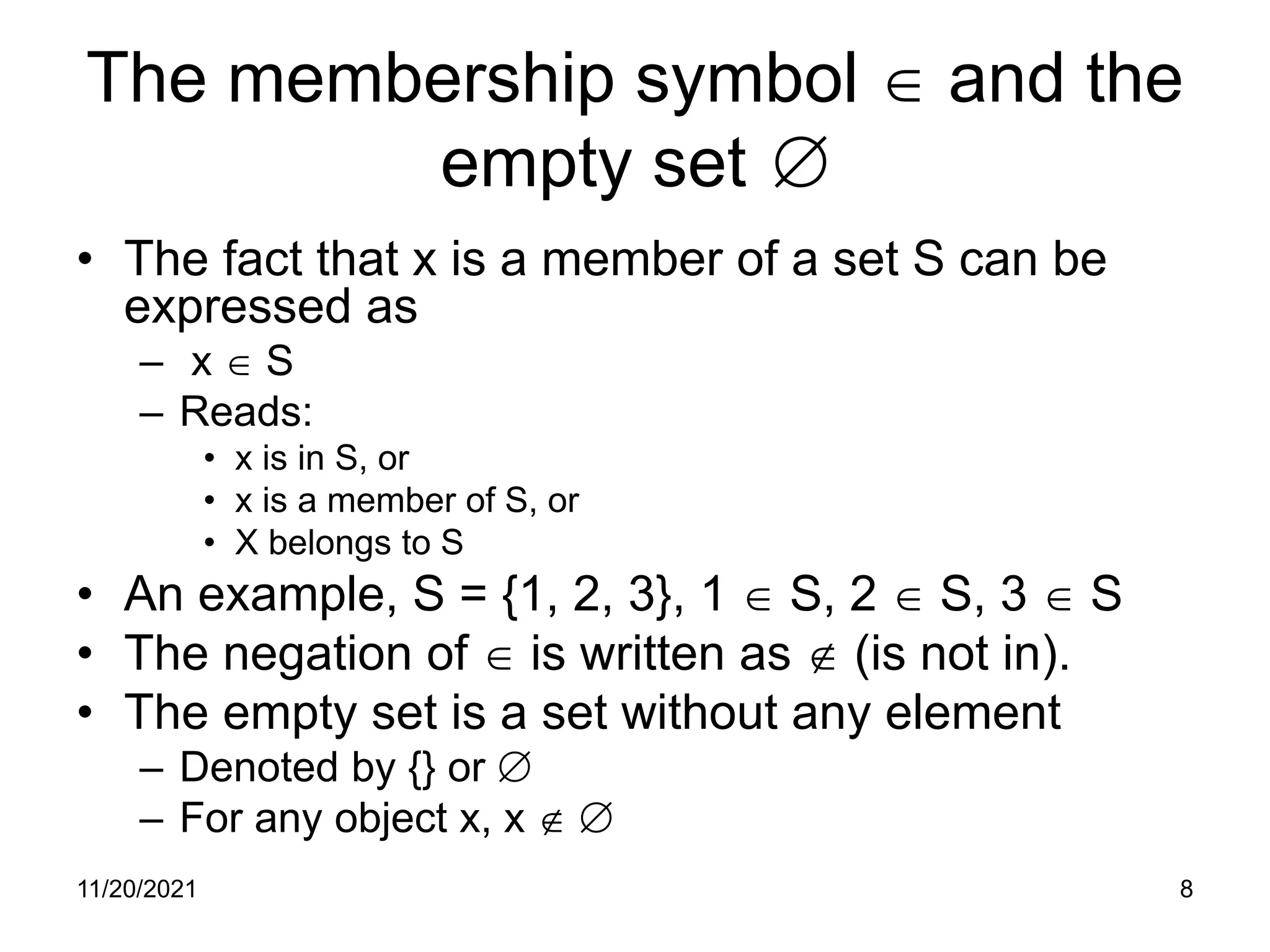
The membership symbol ∈ and the
empty set ∅
• The fact that x is a member of a set S can be
expressed as
– x ∈ S
– Reads:
• x is in S, or
• x is a member of S, or
• X belongs to S
• An example, S = {1, 2, 3}, 1 ∈ S, 2 ∈ S, 3 ∈ S
• The negation of ∈ is written as ∉ (is not in).
• The empty set is a set without any element
– Denoted by {} or ∅
– For any object x, x ∉ ∅
11/20/2021 9
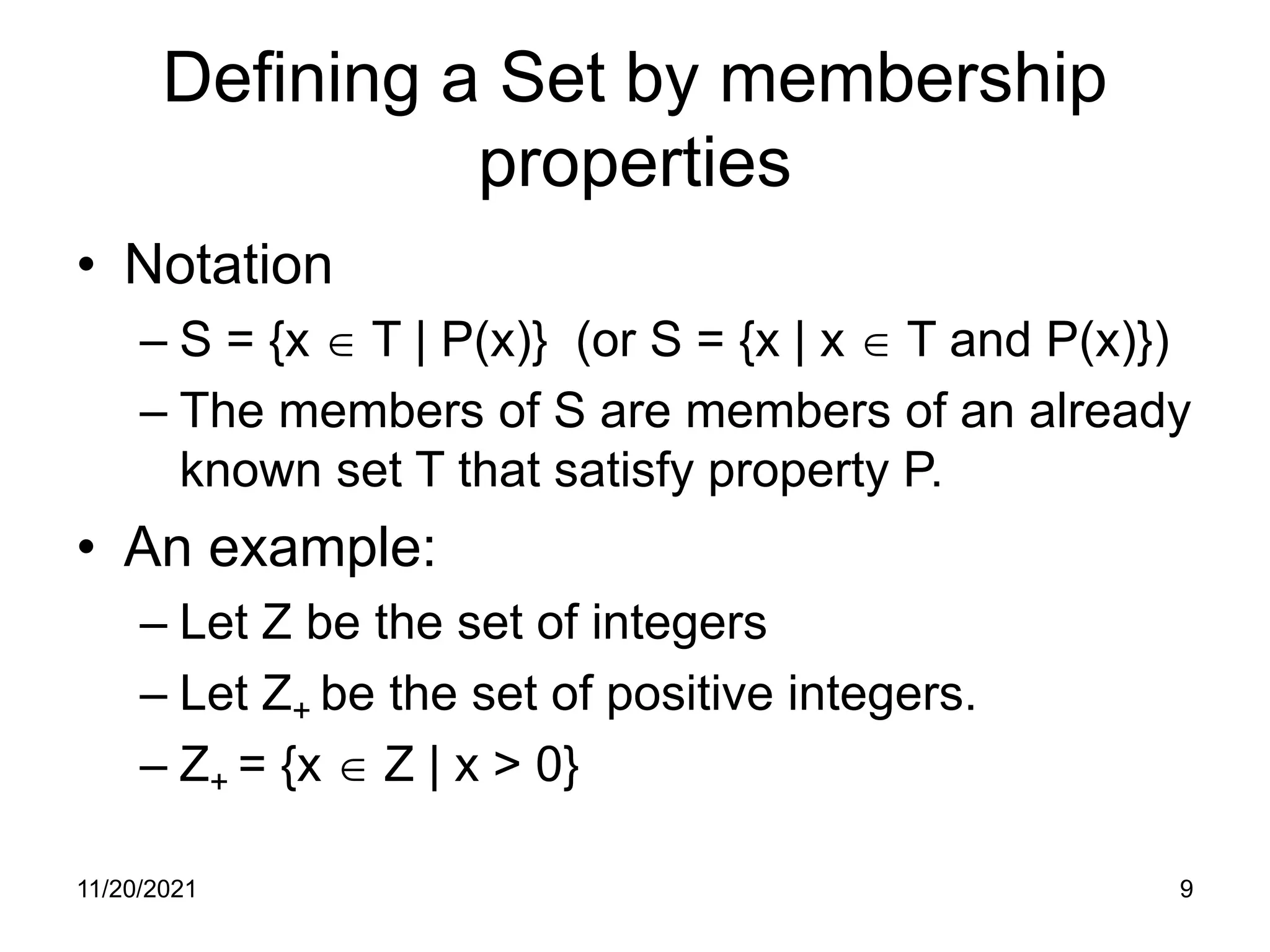
Defining a Set by membership
properties
• Notation
– S = {x ∈ T | P(x)} (or S = {x | x ∈ T and P(x)})
– The members of S are members of an already
known set T that satisfy property P.
• An example:
– Let Z be the set of integers
– Let Z+ be the set of positive integers.
– Z+ = {x ∈ Z | x > 0}
11/20/2021 10
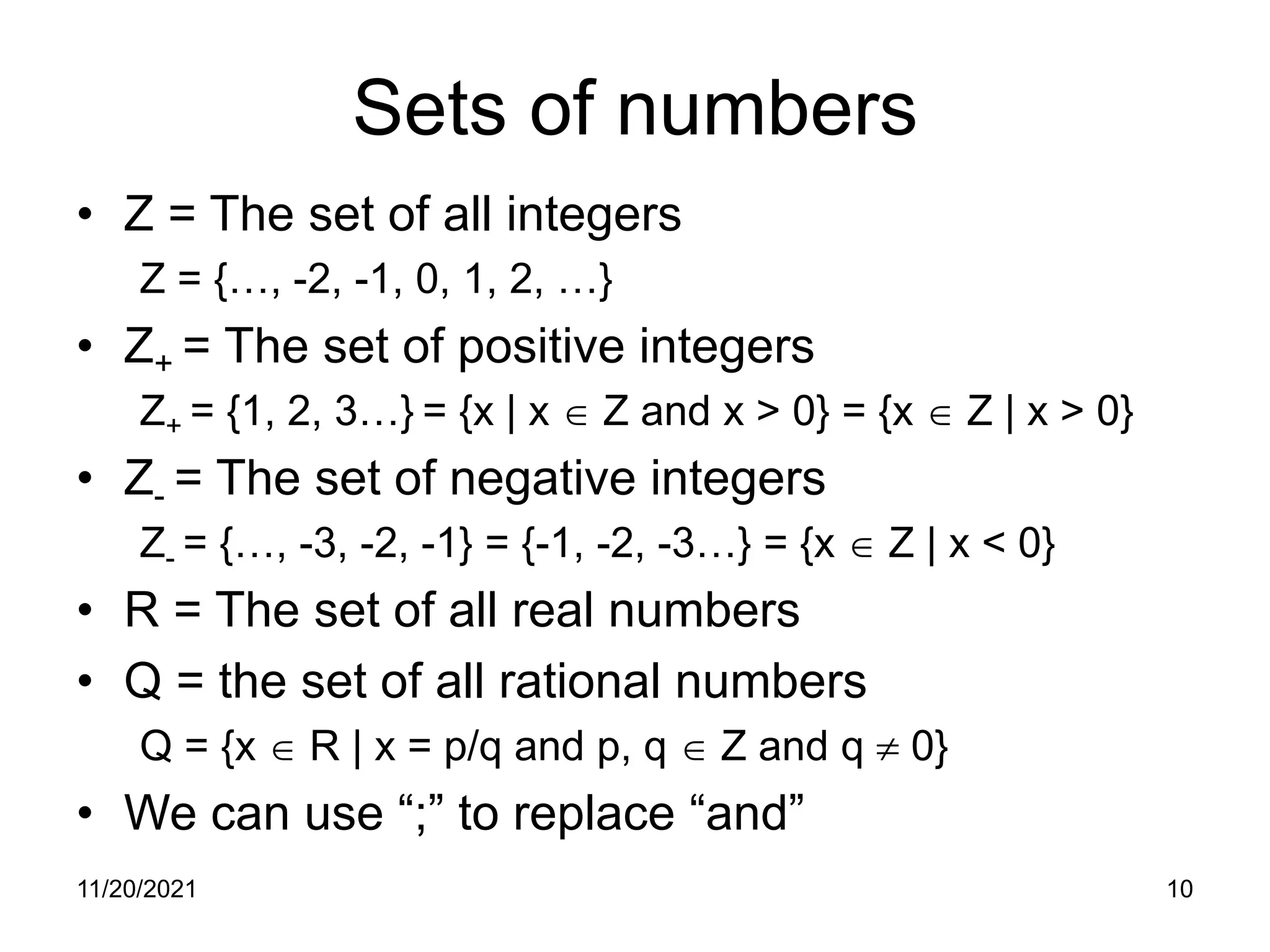
Sets of numbers
• Z = The set of all integers
Z = {…, -2, -1, 0, 1, 2, …}
• Z+ = The set of positive integers
Z+ = {1, 2, 3…} = {x | x ∈ Z and x > 0} = {x ∈ Z | x > 0}
• Z- = The set of negative integers
Z- = {…, -3, -2, -1} = {-1, -2, -3…} = {x ∈ Z | x < 0}
• R = The set of all real numbers
• Q = the set of all rational numbers
Q = {x ∈ R | x = p/q and p, q ∈ Z and q ≠ 0}
• We can use “;” to replace “and”
11/20/2021 11
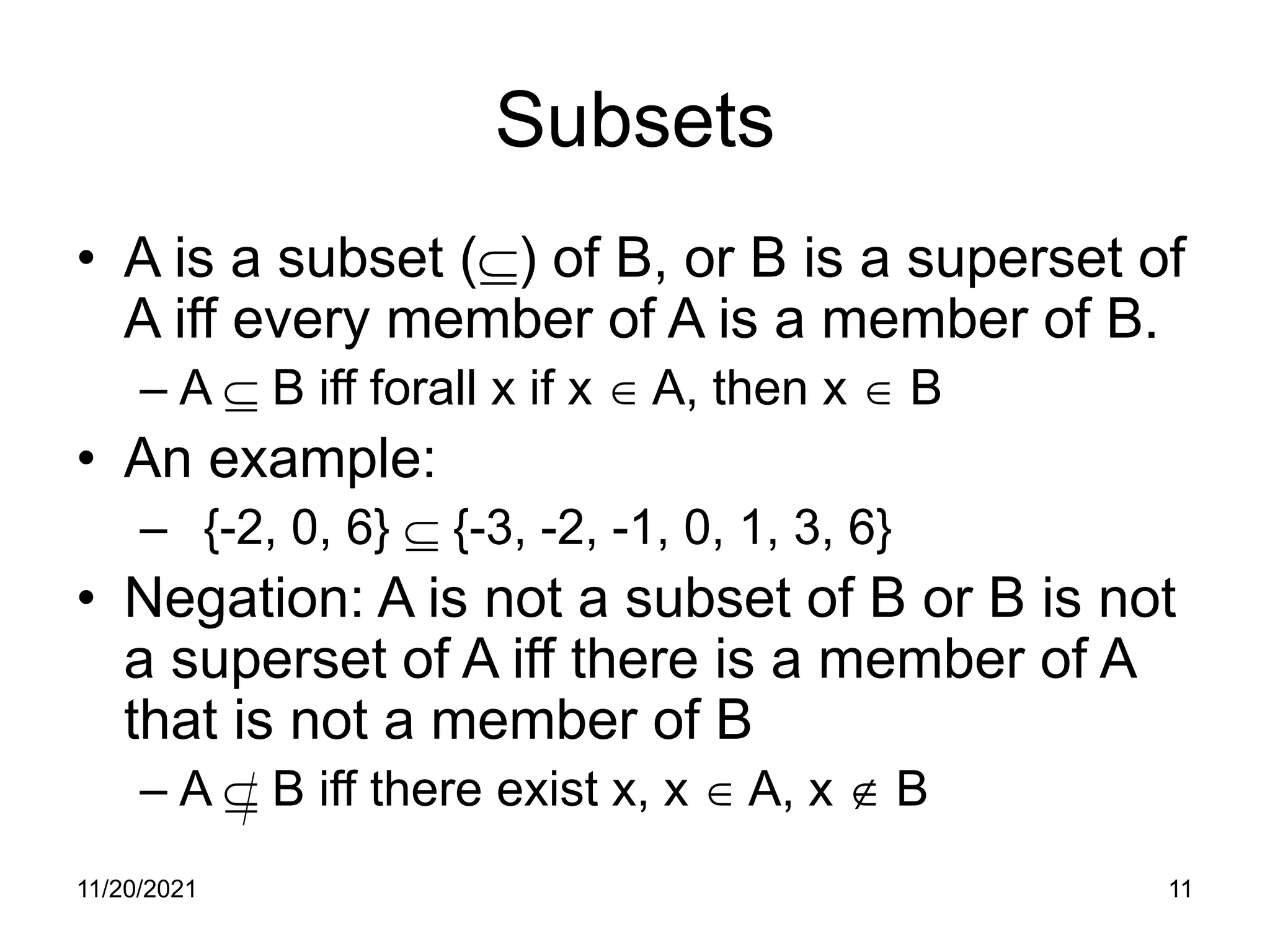
Subsets
• A is a subset (⊆) of B, or B is a superset of
A iff every member of A is a member of B.
– A ⊆ B iff forall x if x ∈ A, then x ∈ B
• An example:
– {-2, 0, 6} ⊆ {-3, -2, -1, 0, 1, 3, 6}
• Negation: A is not a subset of B or B is not
a superset of A iff there is a member of A
that is not a member of B
– A ⊆ B iff there exist x, x ∈ A, x ∉ B
11/20/2021 12
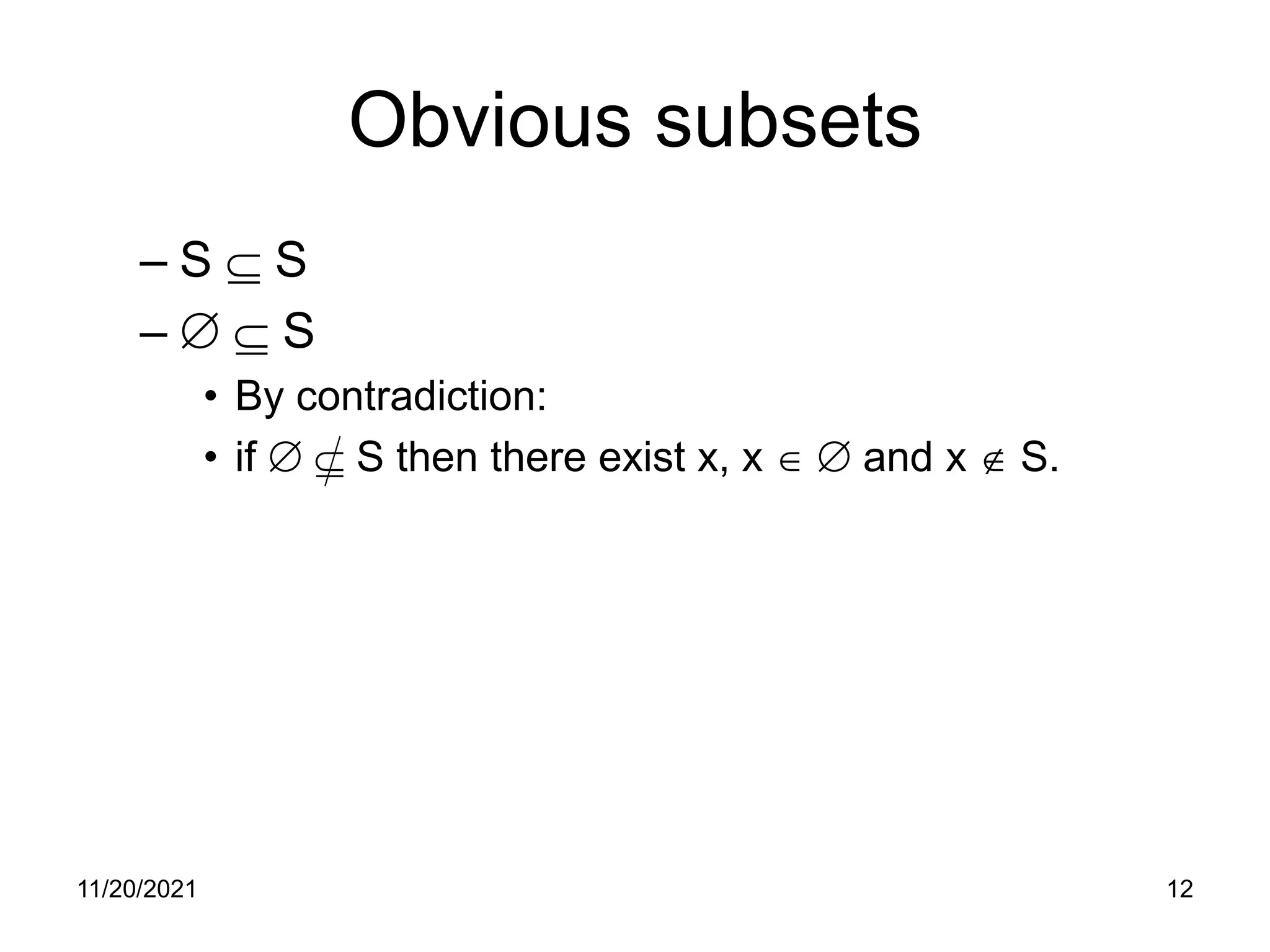
Obvious subsets
– S ⊆ S
– ∅ ⊆ S
• By contradiction:
• if ∅ ⊆ S then there exist x, x ∈ ∅ and x ∉ S.
11/20/2021 13
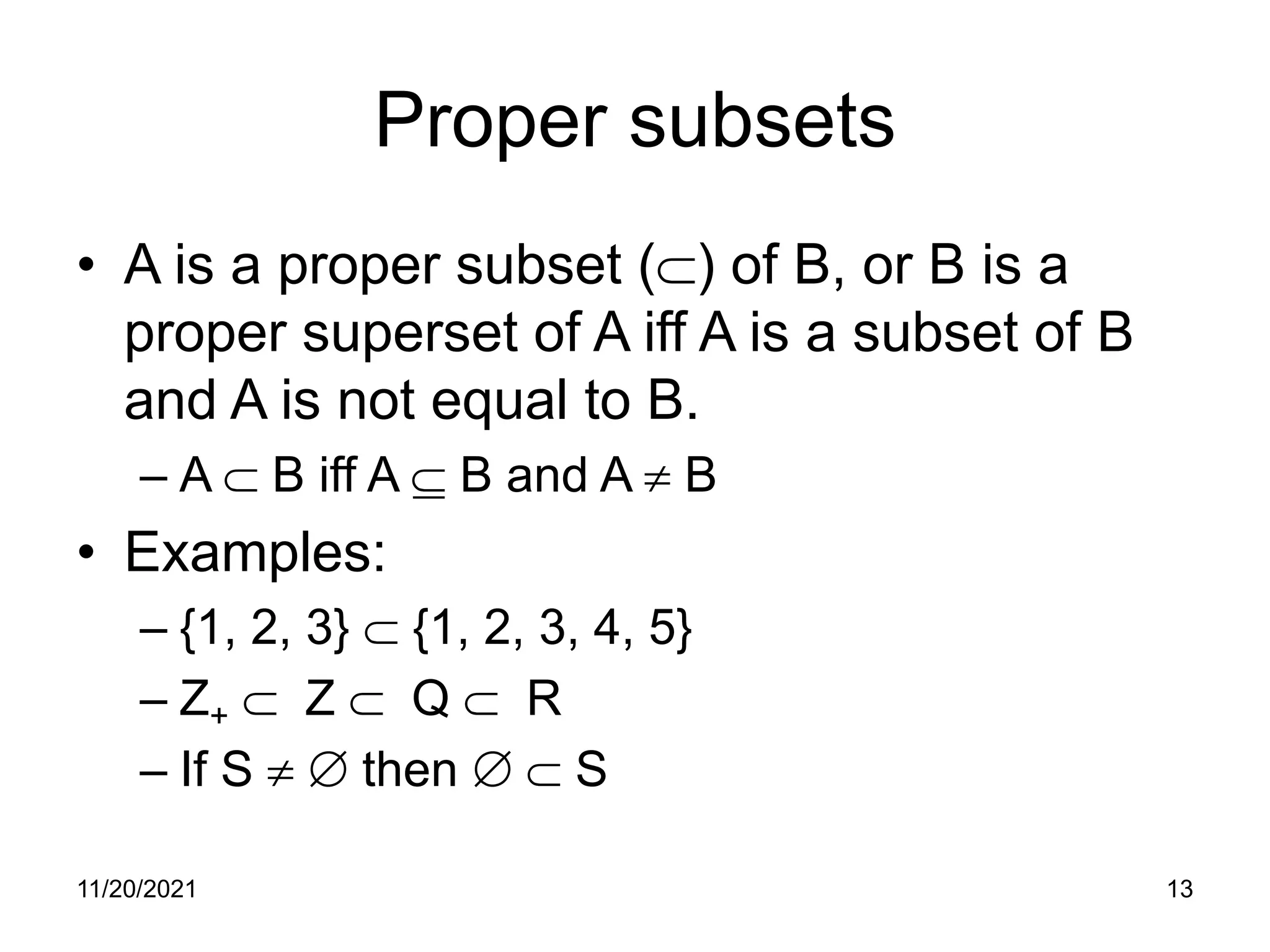
Proper subsets
• A is a proper subset (⊂) of B, or B is a
proper superset of A iff A is a subset of B
and A is not equal to B.
– A ⊂ B iff A ⊆ B and A ≠ B
• Examples:
– {1, 2, 3} ⊂ {1, 2, 3, 4, 5}
– Z+ ⊂ Z ⊂ Q ⊂ R
– If S ≠ ∅ then ∅ ⊂ S
11/20/2021 14
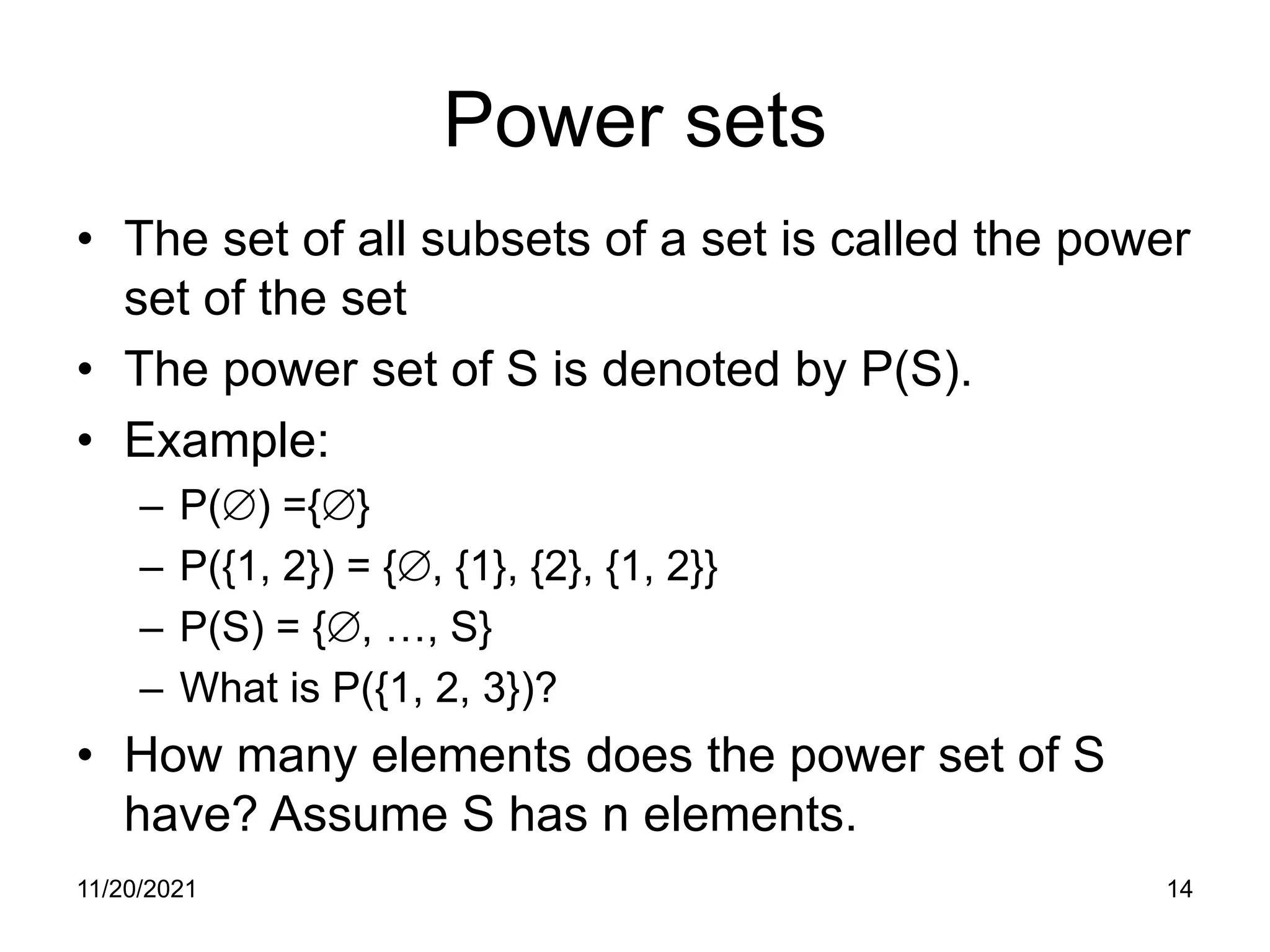
Power sets
• The set of all subsets of a set is called the power
set of the set
• The power set of S is denoted by P(S).
• Example:
– P(∅) ={∅}
– P({1, 2}) = {∅, {1}, {2}, {1, 2}}
– P(S) = {∅, …, S}
– What is P({1, 2, 3})?
• How many elements does the power set of S
have? Assume S has n elements.
11/20/2021 15
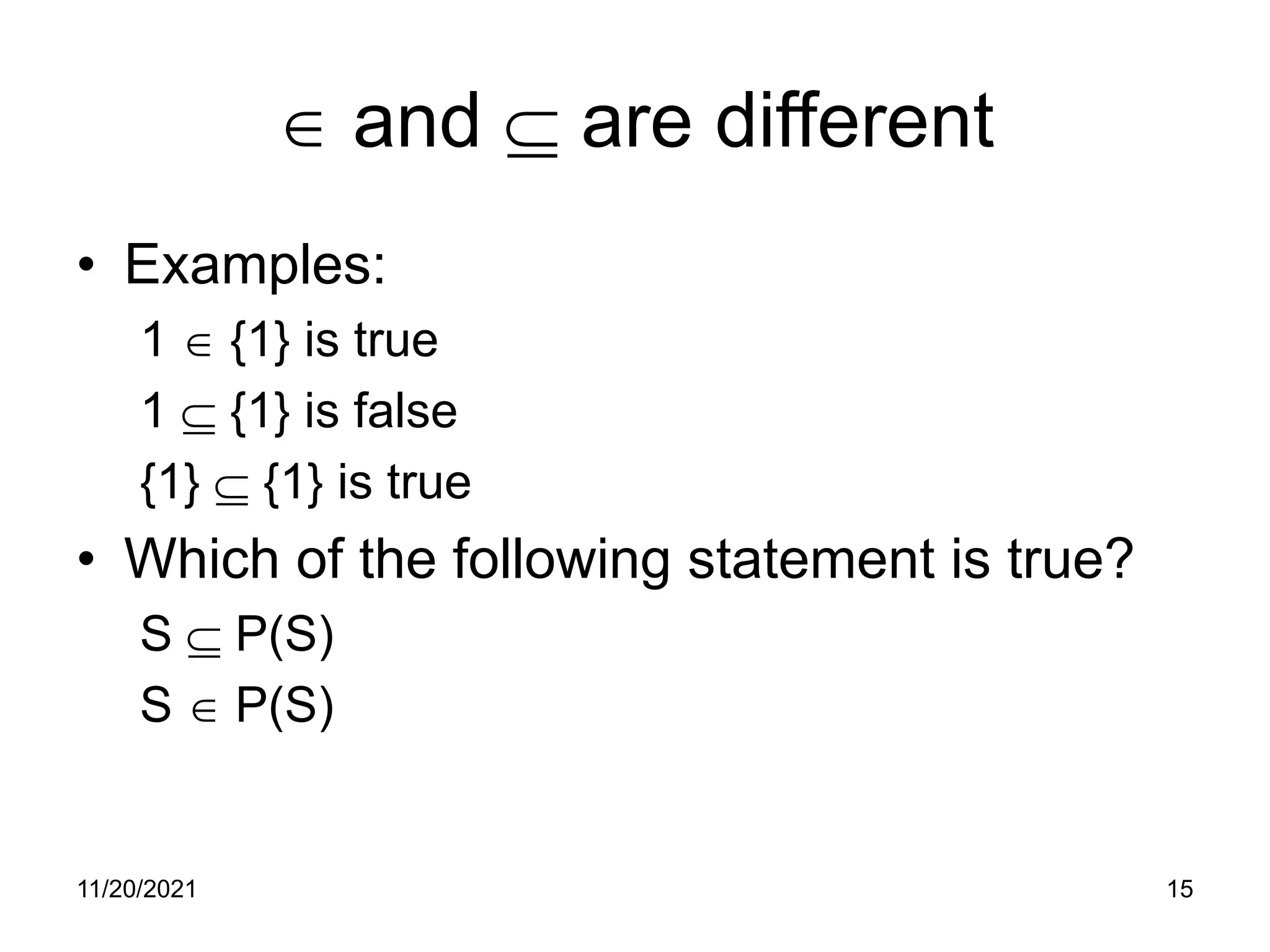
∈ and ⊆ are different
• Examples:
1 ∈ {1} is true
1 ⊆ {1} is false
{1} ⊆ {1} is true
• Which of the following statement is true?
S ⊆ P(S)
S ∈ P(S)
11/20/2021 16
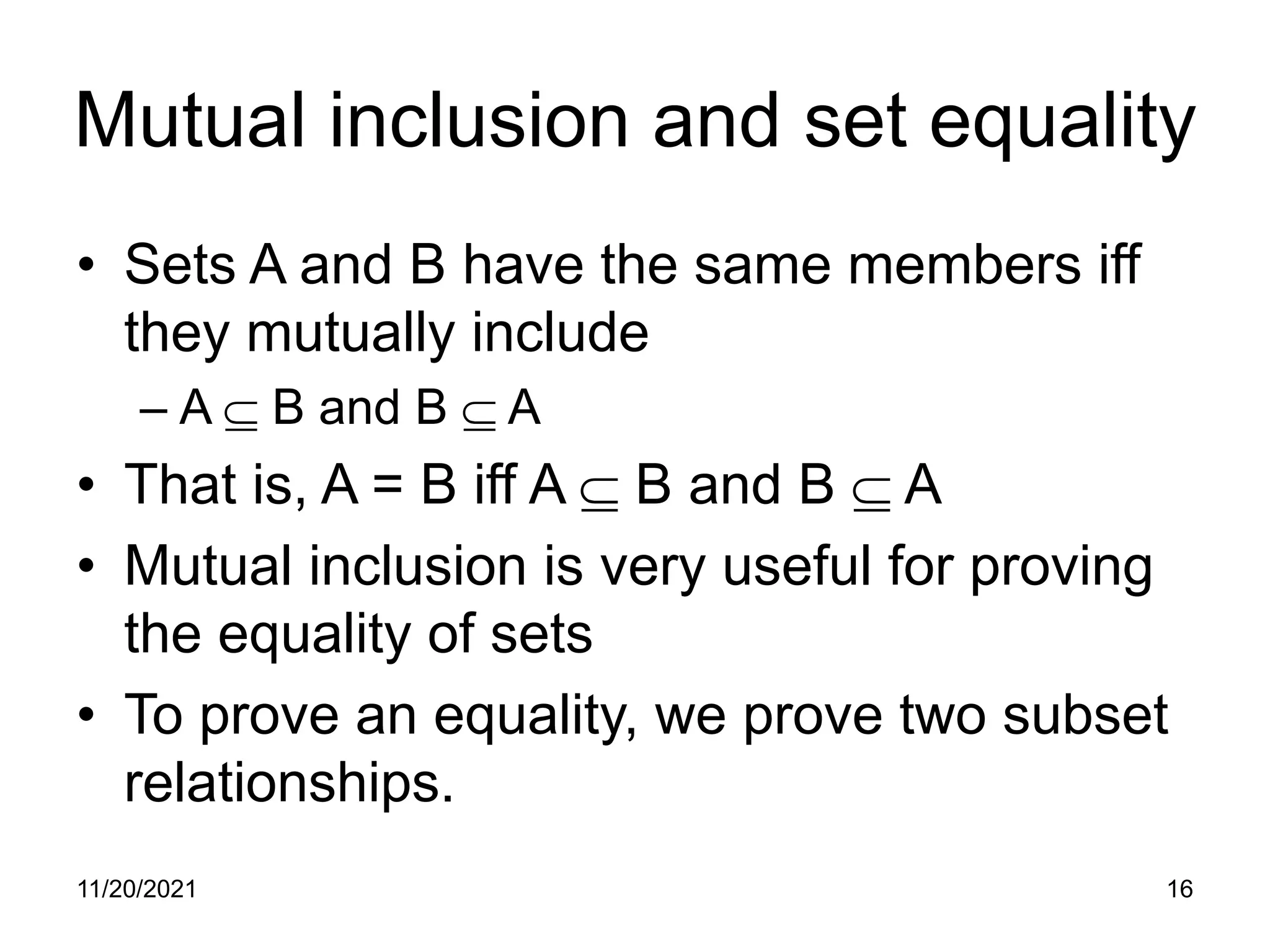
Mutual inclusion and set equality
• Sets A and B have the same members iff
they mutually include
– A ⊆ B and B ⊆ A
• That is, A = B iff A ⊆ B and B ⊆ A
• Mutual inclusion is very useful for proving
the equality of sets
• To prove an equality, we prove two subset
relationships.
11/20/2021 17
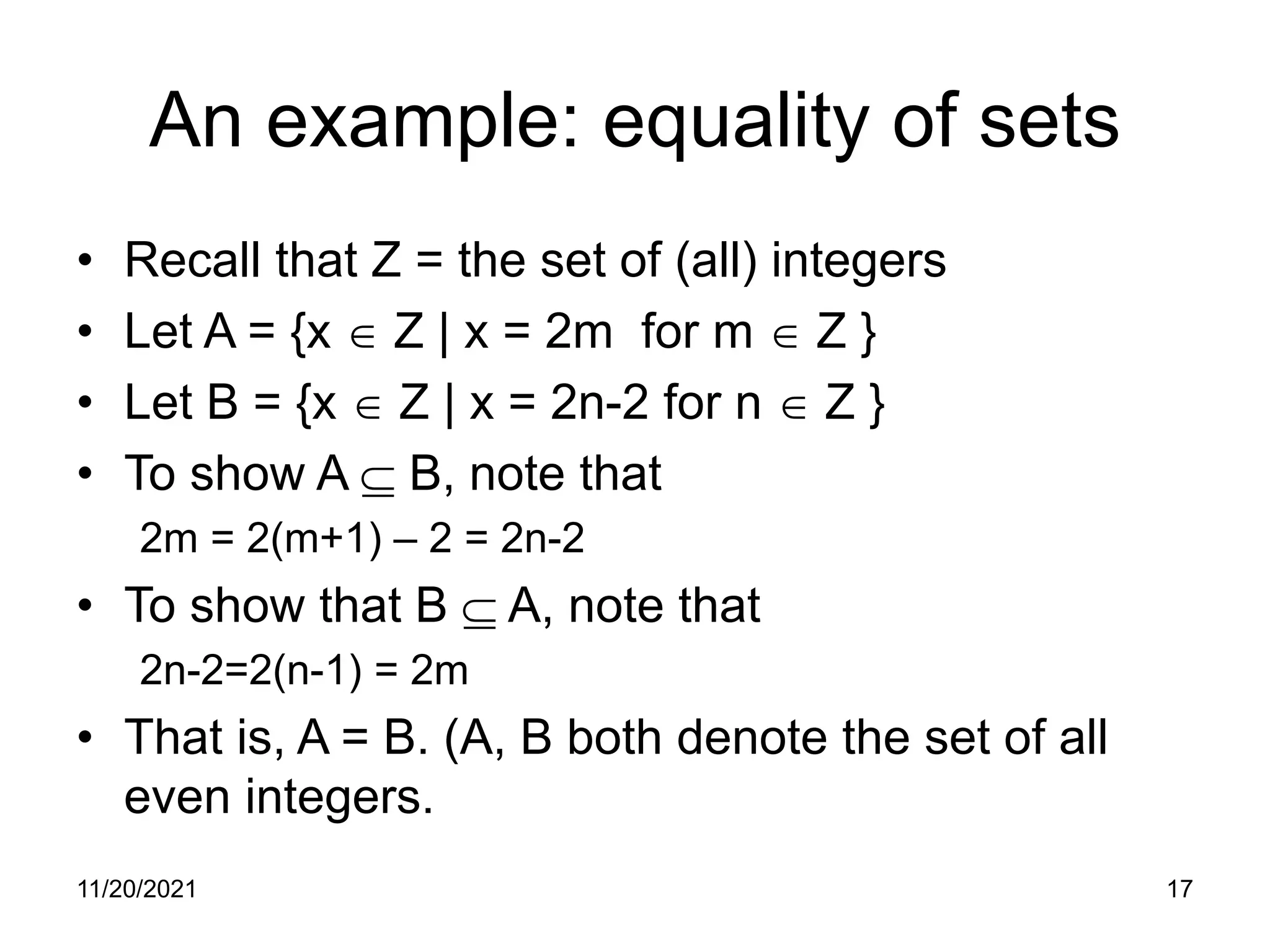
An example: equality of sets
• Recall that Z = the set of (all) integers
• Let A = {x ∈ Z | x = 2m for m ∈ Z }
• Let B = {x ∈ Z | x = 2n-2 for n ∈ Z }
• To show A ⊆ B, note that
2m = 2(m+1) – 2 = 2n-2
• To show that B ⊆ A, note that
2n-2=2(n-1) = 2m
• That is, A = B. (A, B both denote the set of all
even integers.
11/20/2021 18
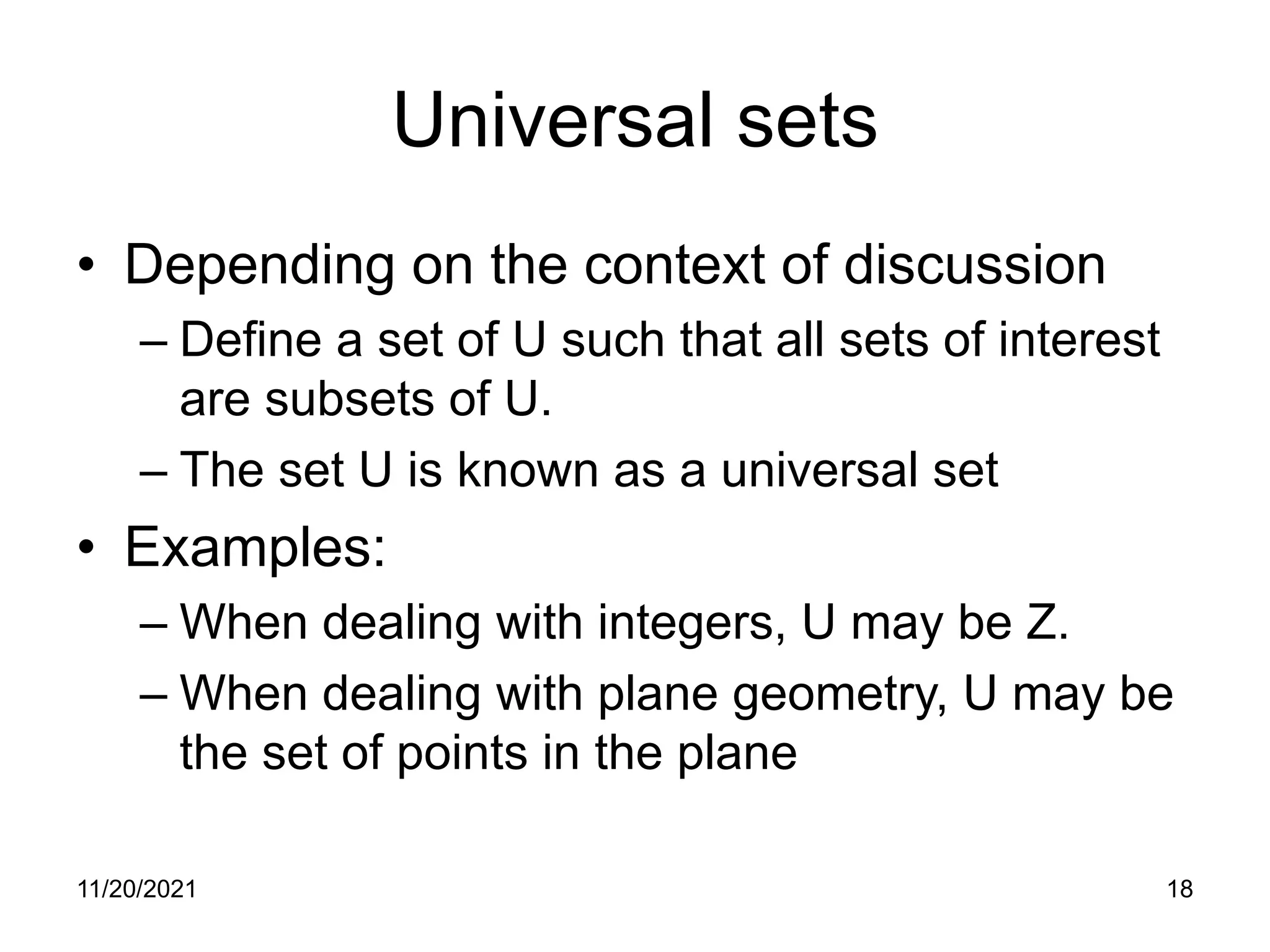
Universal sets
• Depending on the context of discussion
– Define a set of U such that all sets of interest
are subsets of U.
– The set U is known as a universal set
• Examples:
– When dealing with integers, U may be Z.
– When dealing with plane geometry, U may be
the set of points in the plane
11/20/2021 19
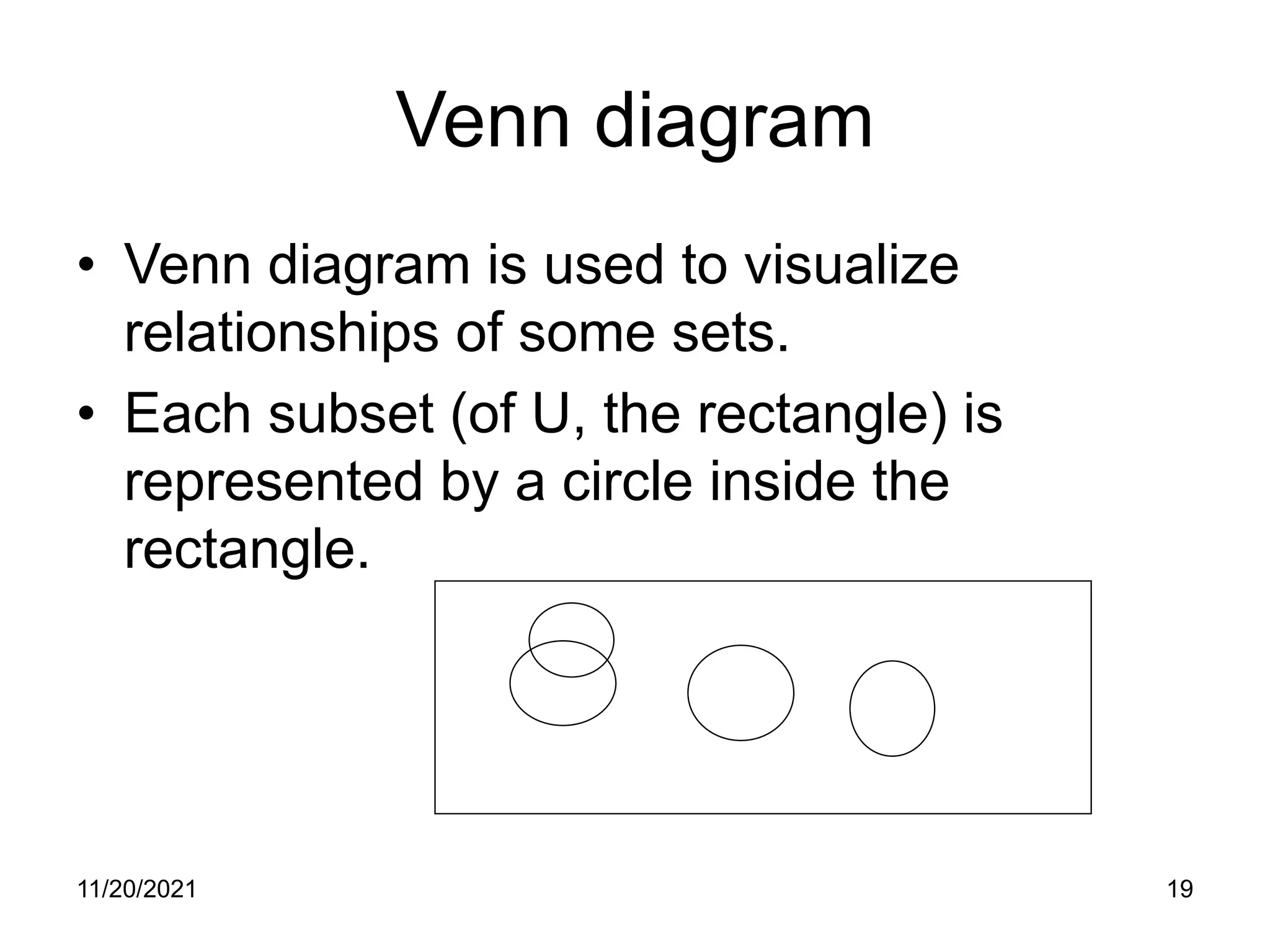
Venn diagram
• Venn diagram is used to visualize
relationships of some sets.
• Each subset (of U, the rectangle) is
represented by a circle inside the
rectangle.
11/20/2021 20
Set operations
• Let A, B be subsets of some universal set U.
• The following set operations create new sets
from A and B.
• Union:
A ∪ B = {x ∈ U | x ∈ A or x ∈ B}
• Intersection:
A ∩ B = {x ∈ U | x ∈ A and x ∈ B}
• Difference:
A − B = A  B= {x ∈ U | x ∈ A and x ∉ B}
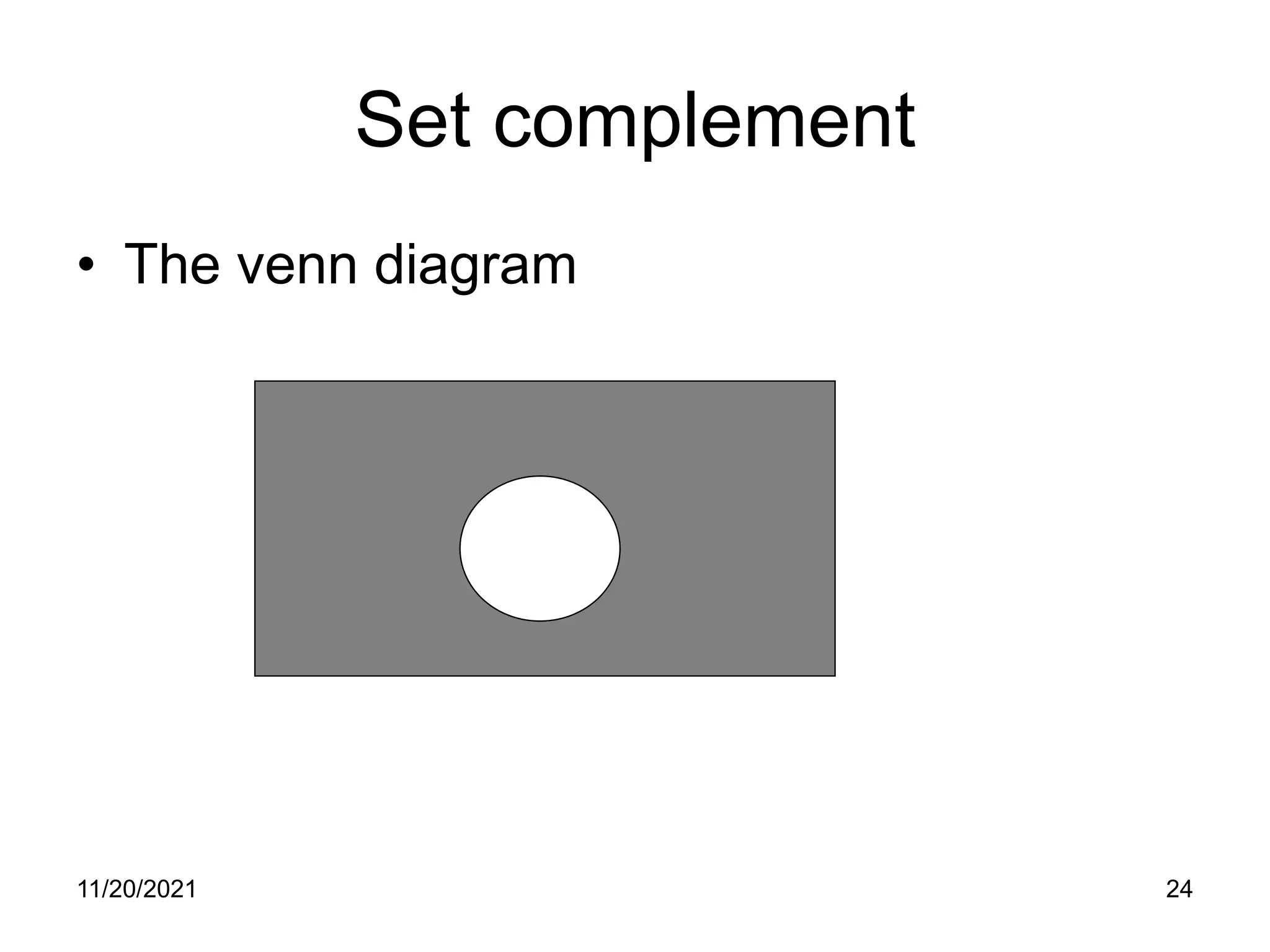
• Complement
A′ = U − A = {x ∈ U | x ∉ A}
11/20/2021 21
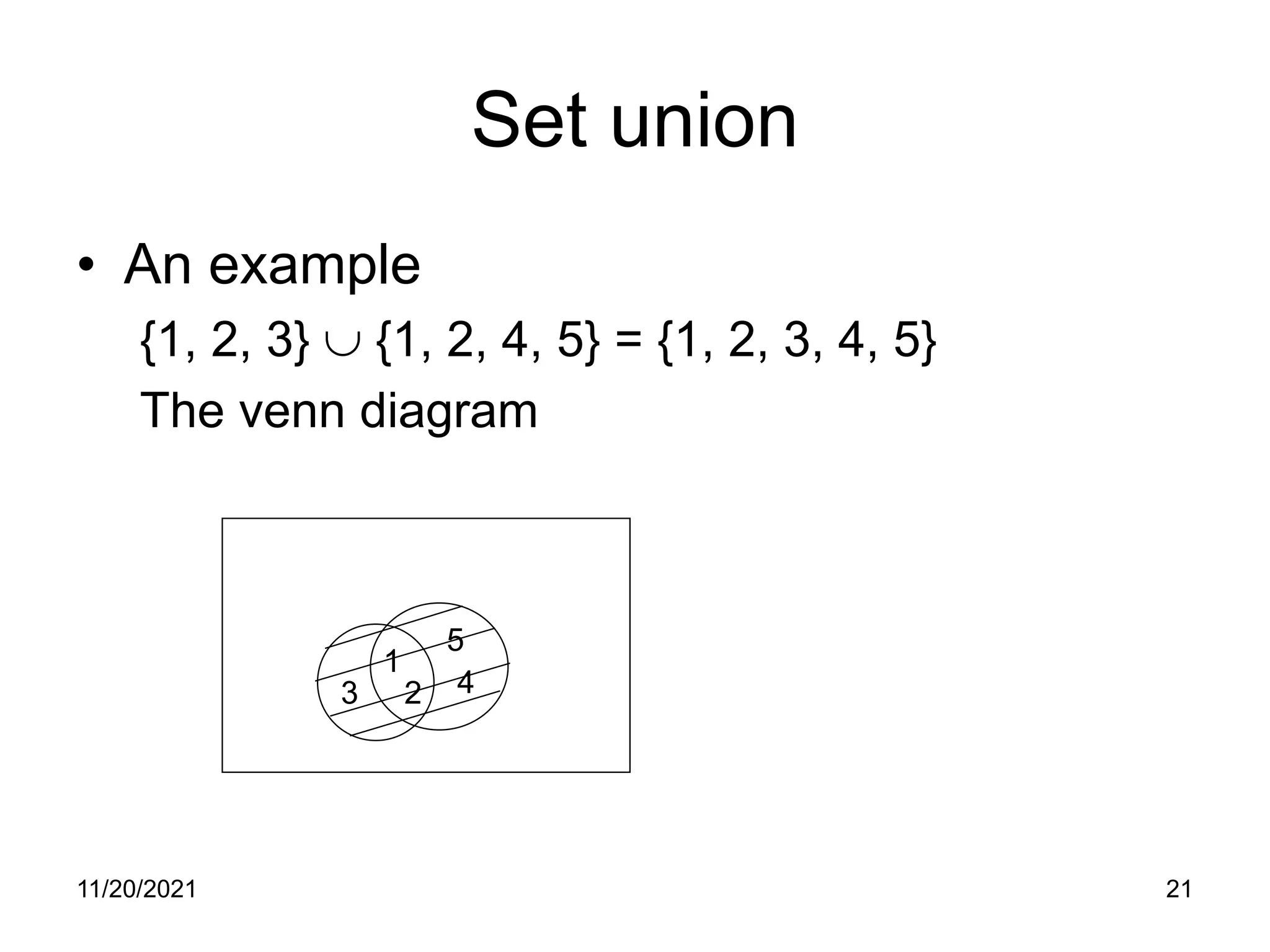
Set union
• An example
{1, 2, 3} ∪ {1, 2, 4, 5} = {1, 2, 3, 4, 5}
The venn diagram
1
2
3 4
5
11/20/2021 22
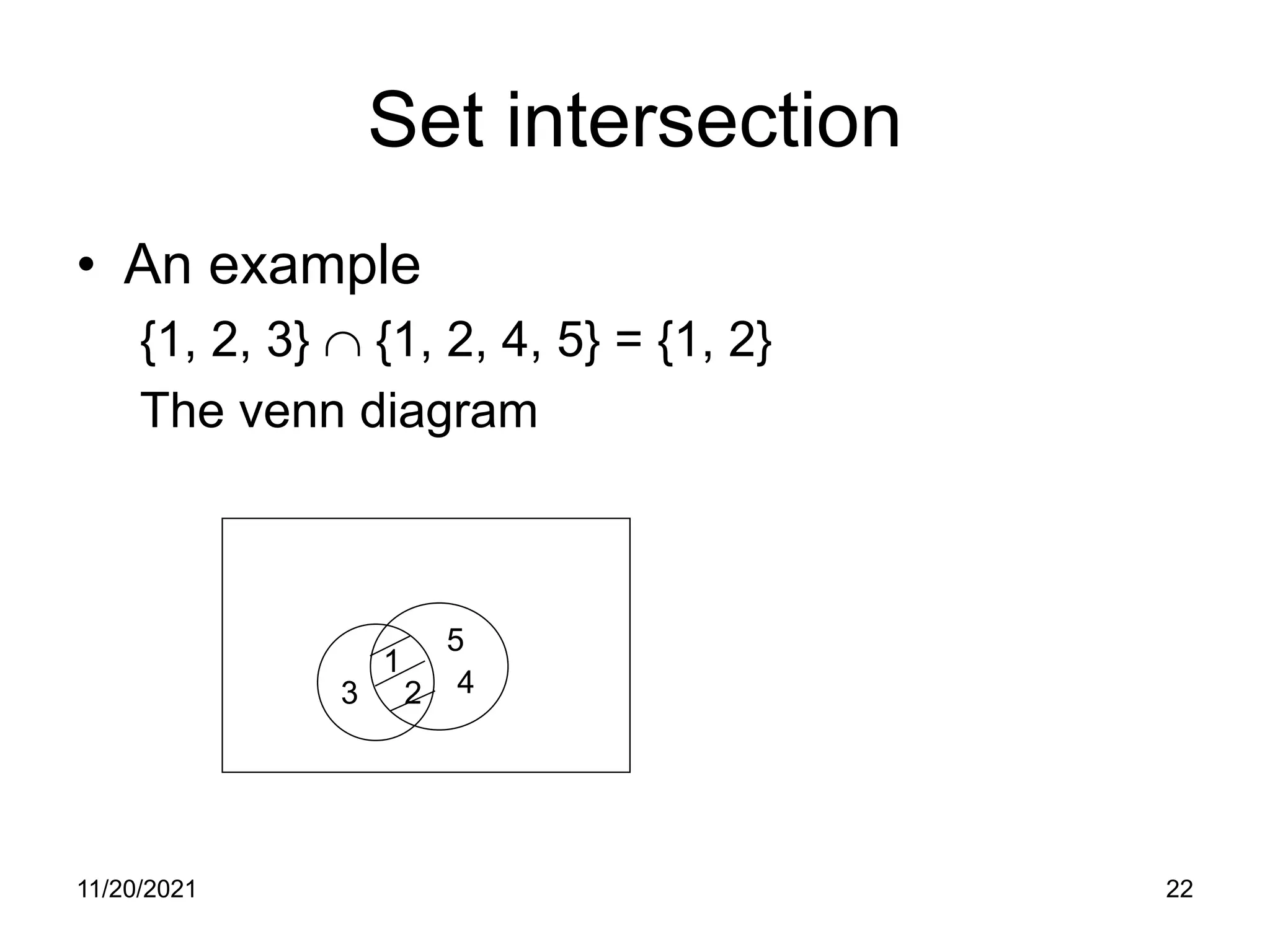
Set intersection
• An example
{1, 2, 3} ∩ {1, 2, 4, 5} = {1, 2}
The venn diagram
1
2
3 4
5
11/20/2021 23
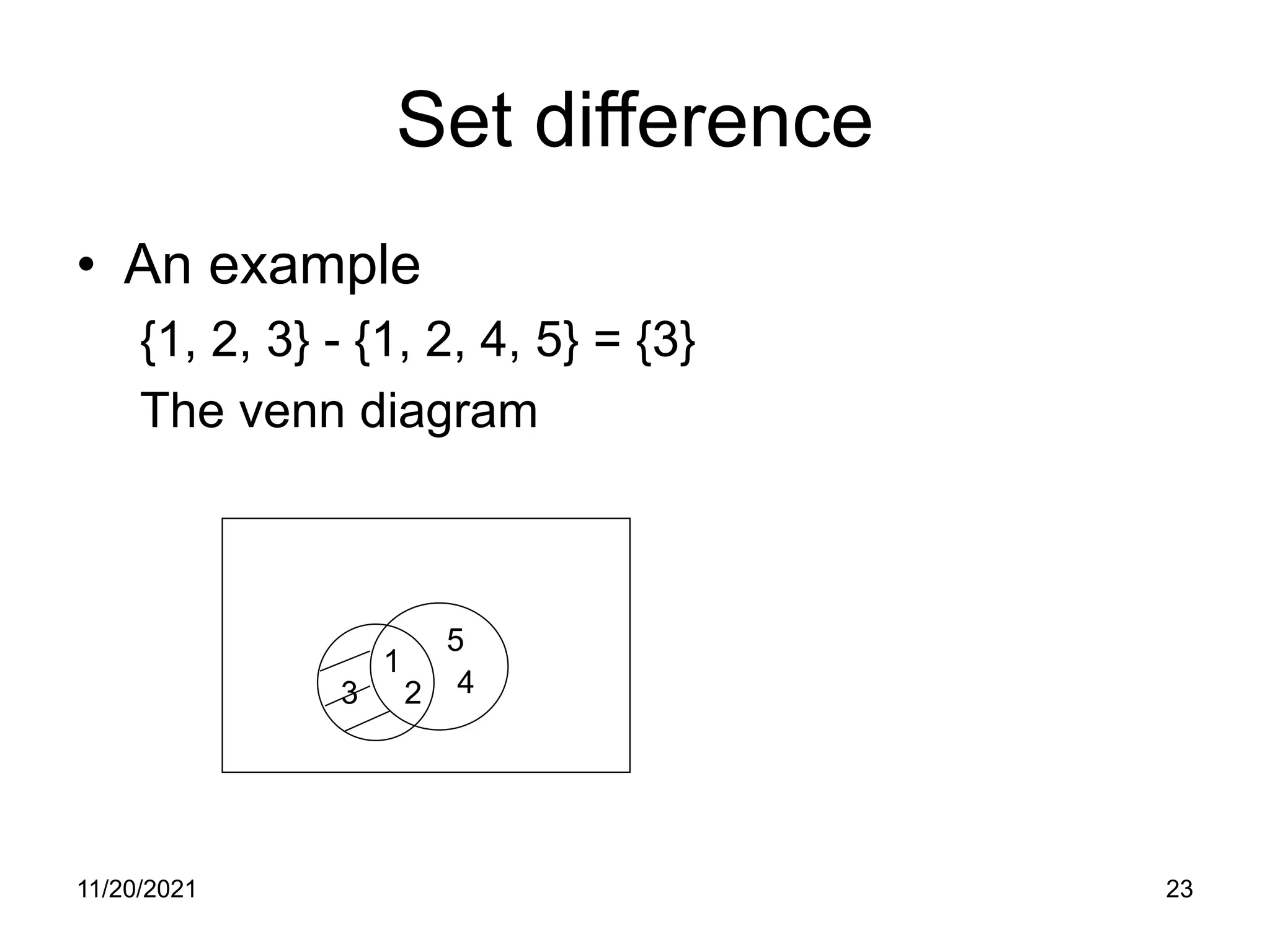
Set difference
• An example
{1, 2, 3} - {1, 2, 4, 5} = {3}
The venn diagram
1
2
3 4
5
11/20/2021 24
Set complement
• The venn diagram
11/20/2021 25
Some questions
• Let A ⊆ B.
– What is A – B?
– What is B – A?
– If A, B ⊆ C, what can you say about A ∪ B and
C?
– If C ⊆ A, B, what can you say about C and A
∩ B?
11/20/2021 26
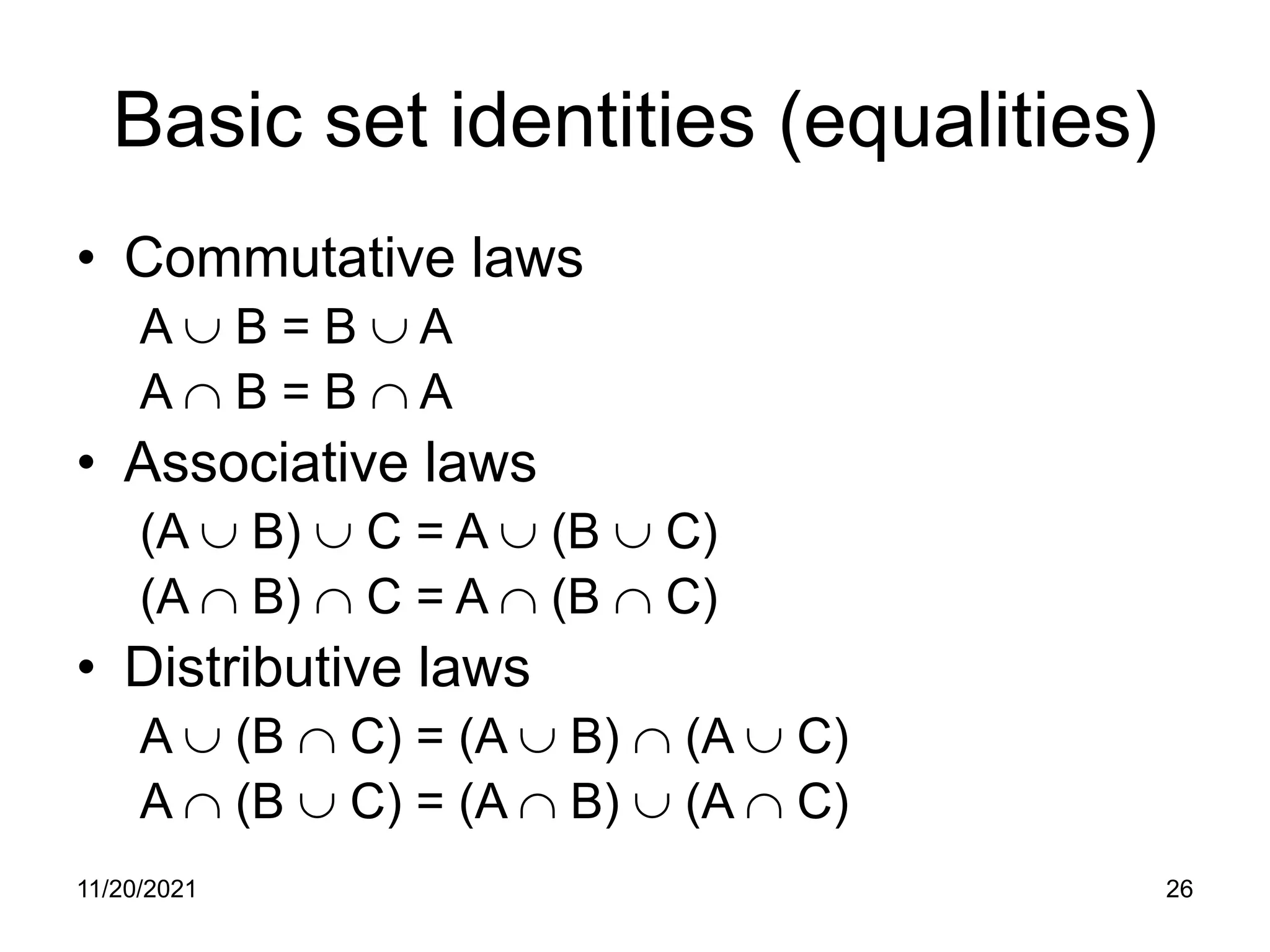
Basic set identities (equalities)
• Commutative laws
A ∪ B = B ∪ A
A ∩ B = B ∩ A
• Associative laws
(A ∪ B) ∪ C = A ∪ (B ∪ C)
(A ∩ B) ∩ C = A ∩ (B ∩ C)
• Distributive laws
A ∪ (B ∩ C) = (A ∪ B) ∩ (A ∪ C)
A ∩ (B ∪ C) = (A ∩ B) ∪ (A ∩ C)
11/20/2021 27
Basic set identities (cont …)
• Identity laws
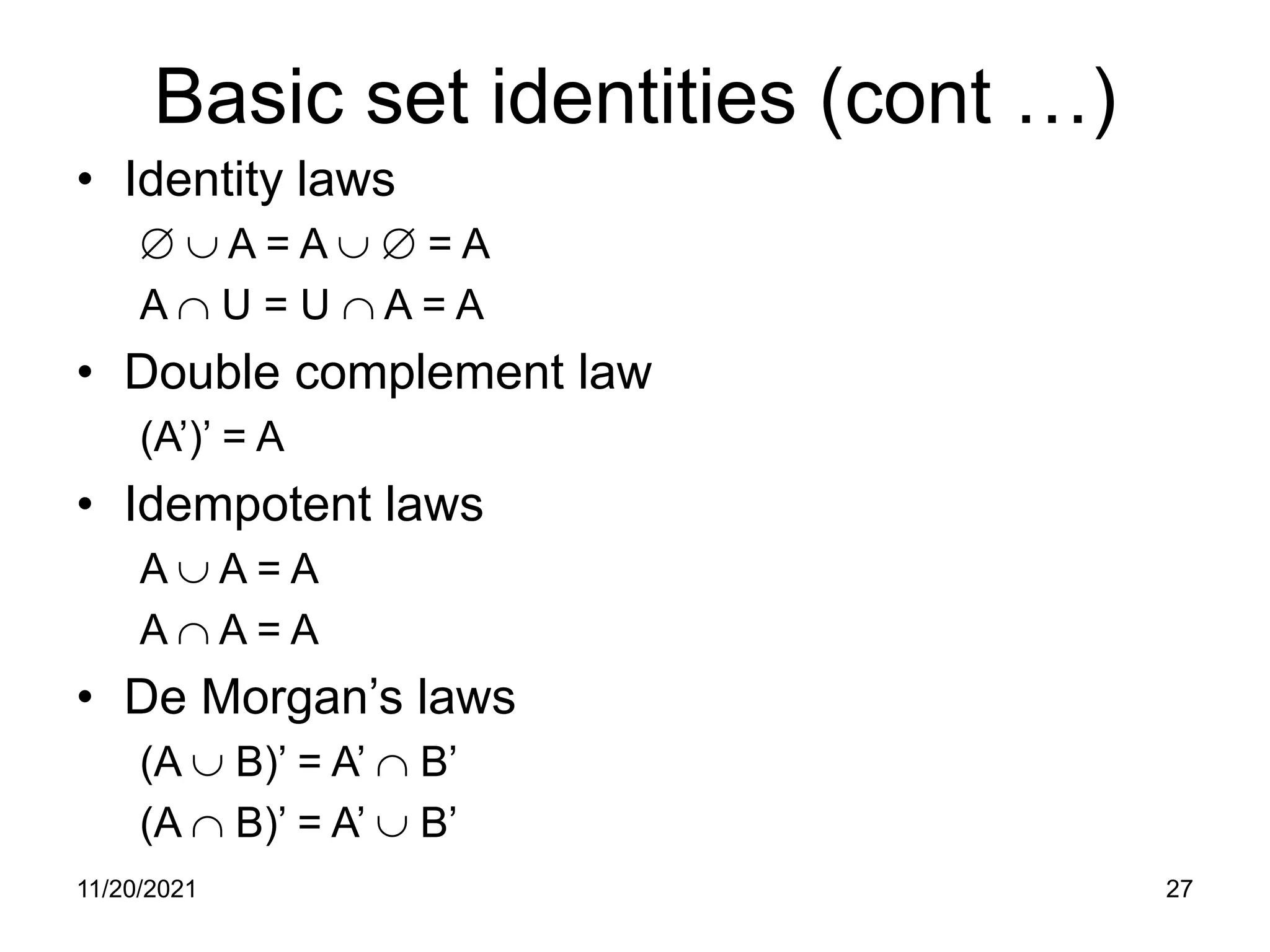
∅ ∪ A = A ∪ ∅ = A
A ∩ U = U ∩ A = A
• Double complement law
(A’)’ = A
• Idempotent laws
A ∪ A = A
A ∩ A = A
• De Morgan’s laws
(A ∪ B)’ = A’ ∩ B’
(A ∩ B)’ = A’ ∪ B’
Basic set identities (cont …)
• Absorption laws
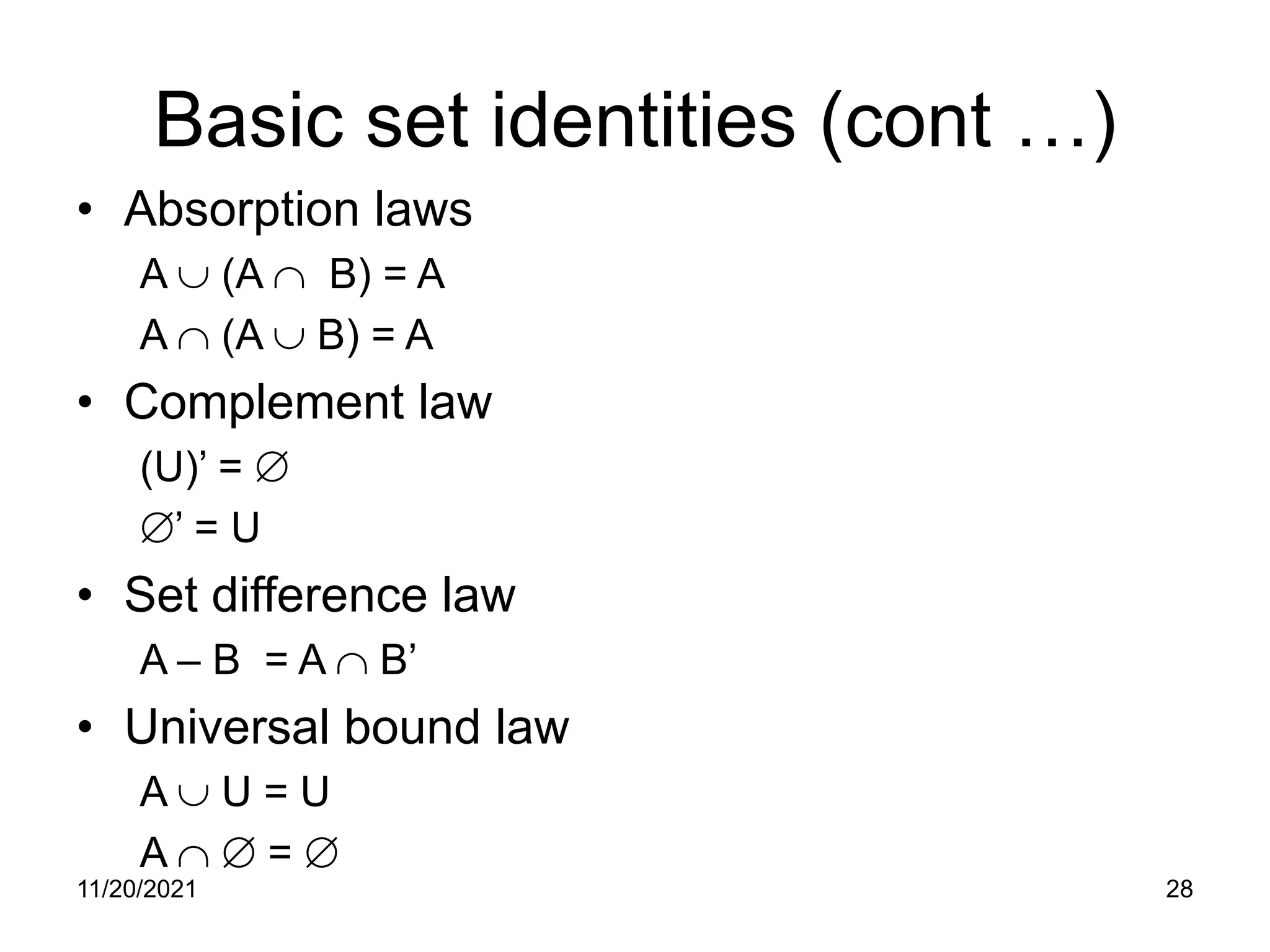
A ∪ (A ∩ B) = A
A ∩ (A ∪ B) = A
• Complement law
(U)’ = ∅
∅’ = U
• Set difference law
A – B = A ∩ B’
• Universal bound law
A ∪ U = U
A ∩ ∅ = ∅
11/20/2021 28
Quiz #1
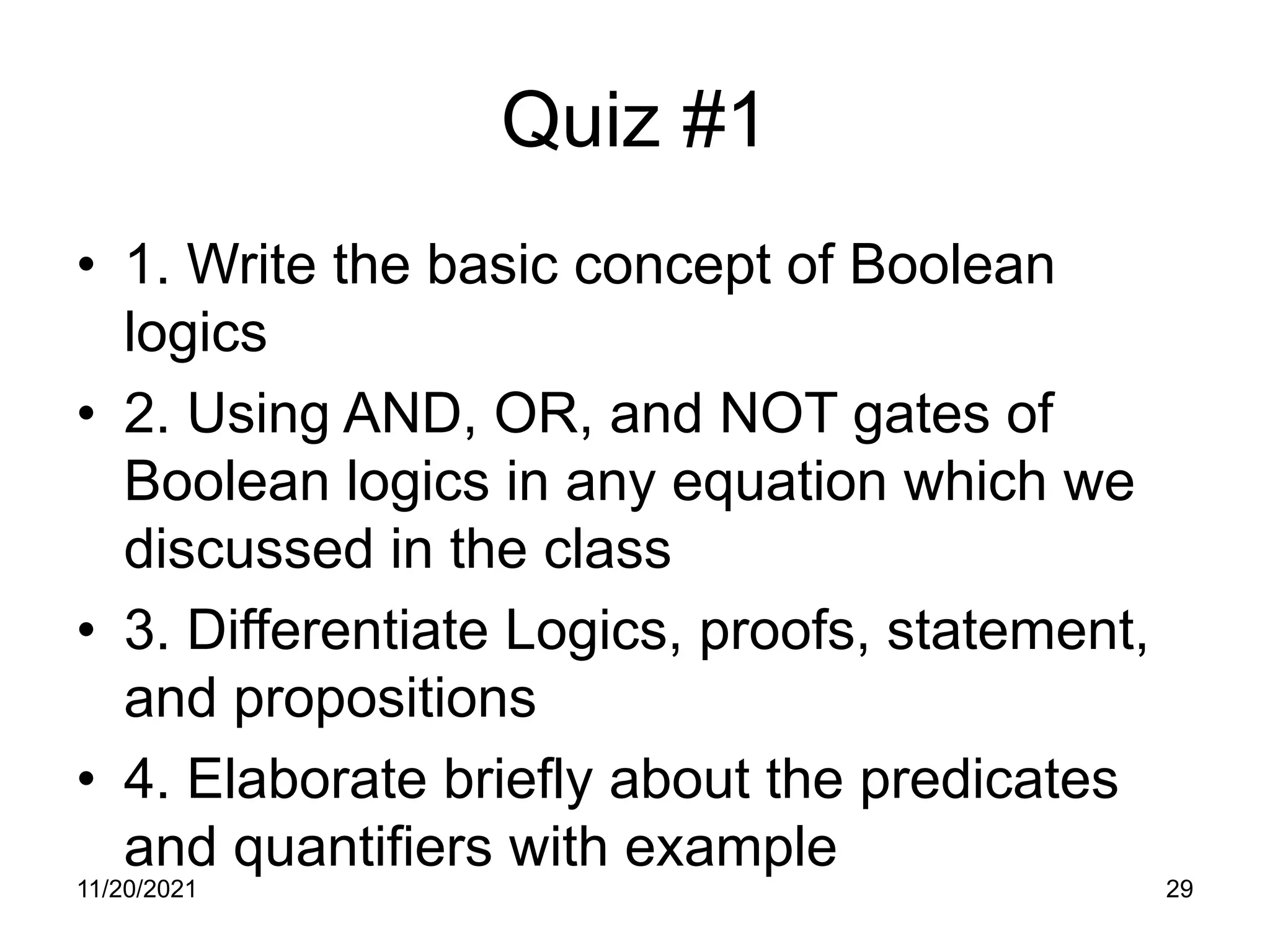
• 1. Write the basic concept of Boolean
logics
• 2. Using AND, OR, and NOT gates of
Boolean logics in any equation which we
discussed in the class
• 3. Differentiate Logics, proofs, statement,
and propositions
• 4. Elaborate briefly about the predicates
and quantifiers with example
11/20/2021 29
11/20/2021 30
Proof methods
• There are many ways to prove set identities
• The methods include
– Applying existing identities
– Using mutual inclusion
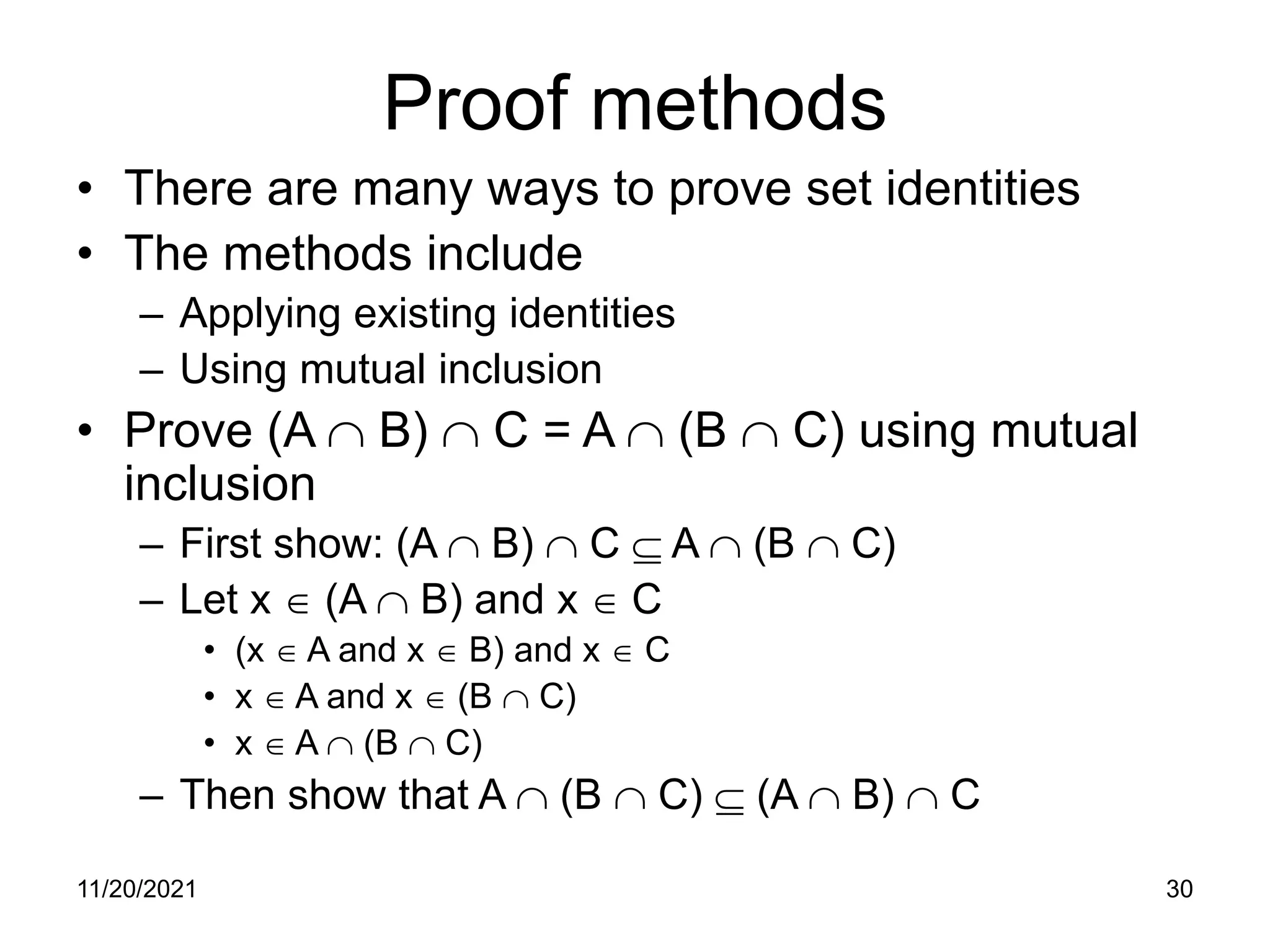
• Prove (A ∩ B) ∩ C = A ∩ (B ∩ C) using mutual
inclusion
– First show: (A ∩ B) ∩ C ⊆ A ∩ (B ∩ C)
– Let x ∈ (A ∩ B) and x ∈ C
• (x ∈ A and x ∈ B) and x ∈ C
• x ∈ A and x ∈ (B ∩ C)
• x ∈ A ∩ (B ∩ C)
– Then show that A ∩ (B ∩ C) ⊆ (A ∩ B) ∩ C
11/20/2021 31
More proof examples
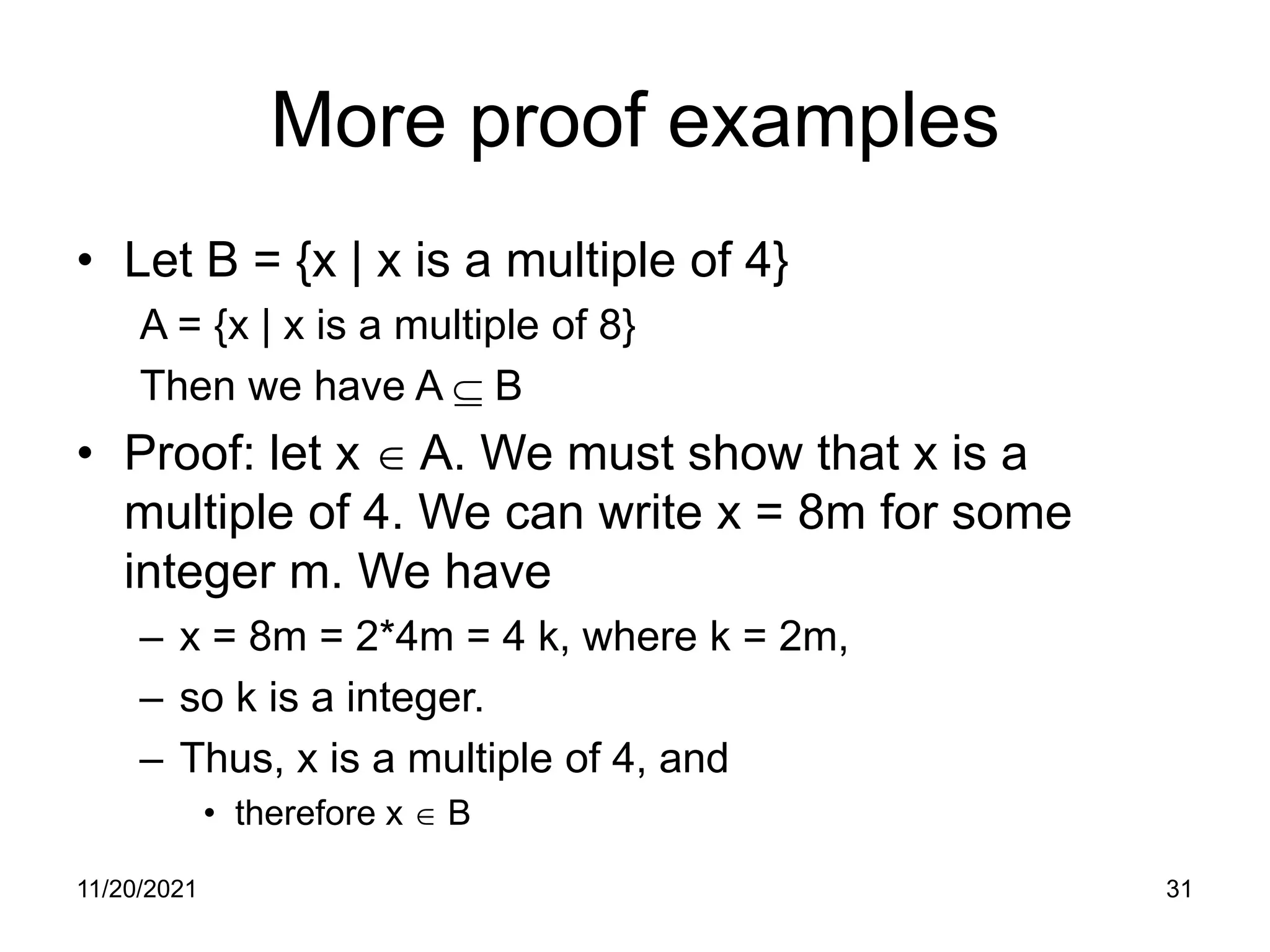
• Let B = {x | x is a multiple of 4}
A = {x | x is a multiple of 8}
Then we have A ⊆ B
• Proof: let x ∈ A. We must show that x is a
multiple of 4. We can write x = 8m for some
integer m. We have
– x = 8m = 2*4m = 4 k, where k = 2m,
– so k is a integer.
– Thus, x is a multiple of 4, and
• therefore x ∈ B
11/20/2021 32
More proof examples
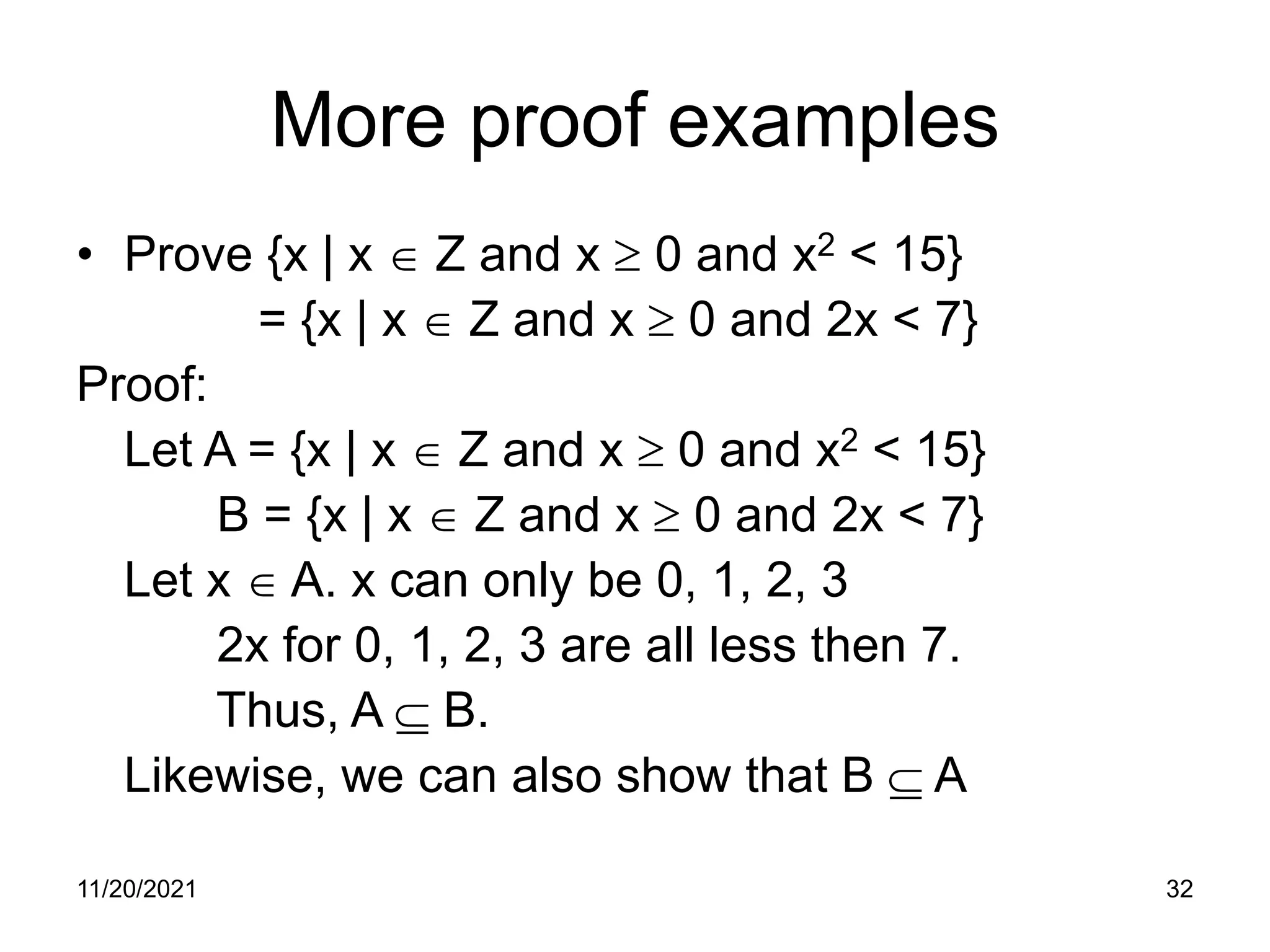
• Prove {x | x ∈ Z and x ≥ 0 and x2 < 15}
= {x | x ∈ Z and x ≥ 0 and 2x < 7}
Proof:
Let A = {x | x ∈ Z and x ≥ 0 and x2 < 15}
B = {x | x ∈ Z and x ≥ 0 and 2x < 7}
Let x ∈ A. x can only be 0, 1, 2, 3
2x for 0, 1, 2, 3 are all less then 7.
Thus, A ⊆ B.
Likewise, we can also show that B ⊆ A
11/20/2021 33
Algebraic proof examples
• Prove:
[A ∪ (B ∩ C)] ∩ ([A’ ∪ (B ∩ C)] ∩ (B ∩ C)’) = ∅
Proof:
[A ∪ (B ∩ C)] ∩ ([A’ ∪ (B ∩ C)] ∩ (B ∩ C)’)
= ([A ∪ (B ∩ C)] ∩ [A’ ∪ (B ∩ C)]) ∩ (B∩C)’ (associative)
= ([(B ∩ C)∪ A] ∩ [(B ∩ C) ∪ A’]) ∩ (B∩C)’ (commutative)
= [(B ∩ C)∪ (A ∩ A’)] ∩ (B ∩ C)’ (distributive)
= [(B ∩ C)∪ ∅] ∩ (B ∩ C)’ (complement)
= (B ∩ C) ∩ (B ∩ C)’ (Identity)
= ∅ (identity)
Algebraic proof examples
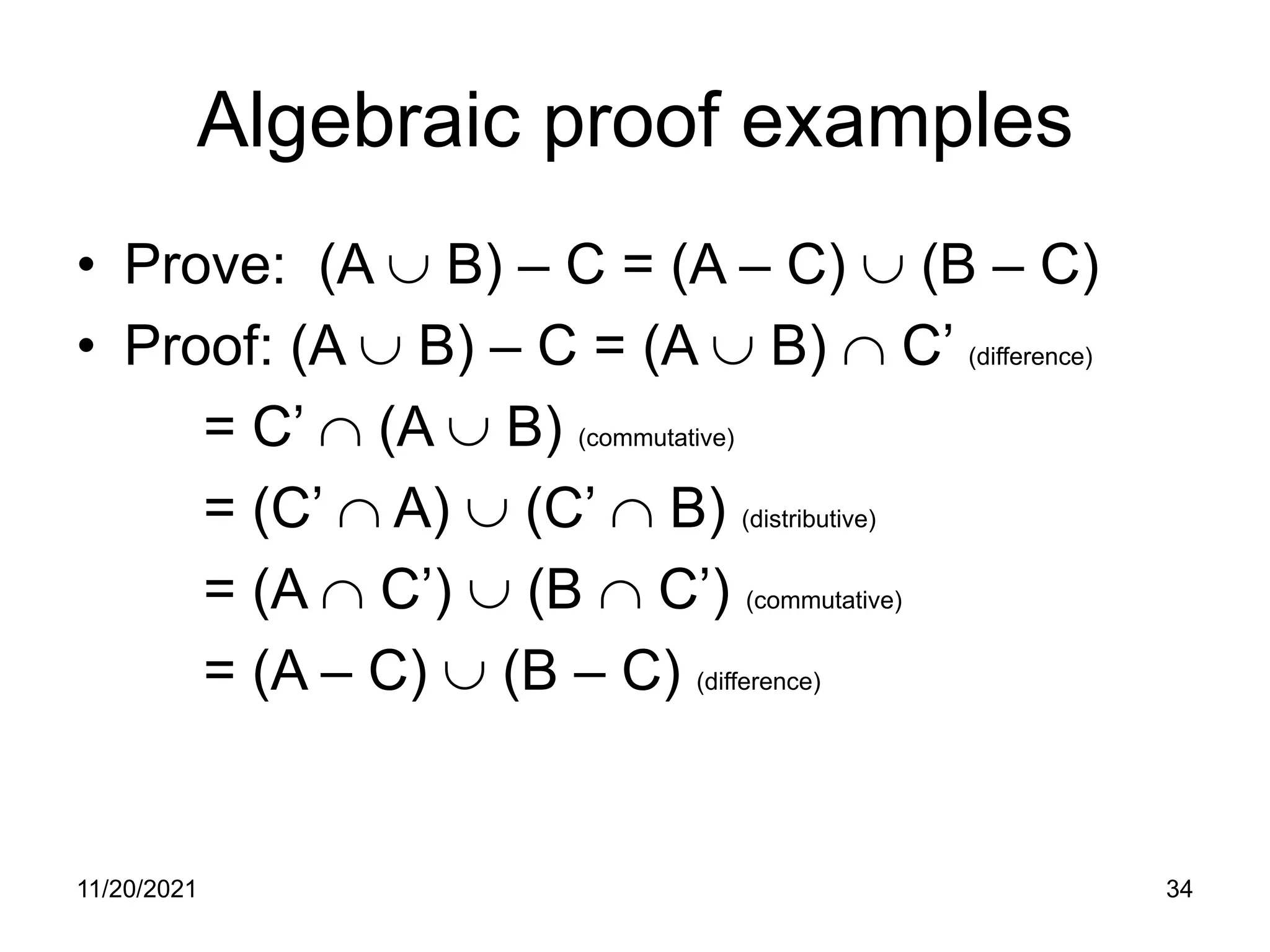
• Prove: (A ∪ B) – C = (A – C) ∪ (B – C)
• Proof: (A ∪ B) – C = (A ∪ B) ∩ C’ (difference)
= C’ ∩ (A ∪ B) (commutative)
= (C’ ∩ A) ∪ (C’ ∩ B) (distributive)
= (A ∩ C’) ∪ (B ∩ C’) (commutative)
= (A – C) ∪ (B – C) (difference)
11/20/2021 34
Disproving an alleged Set
property
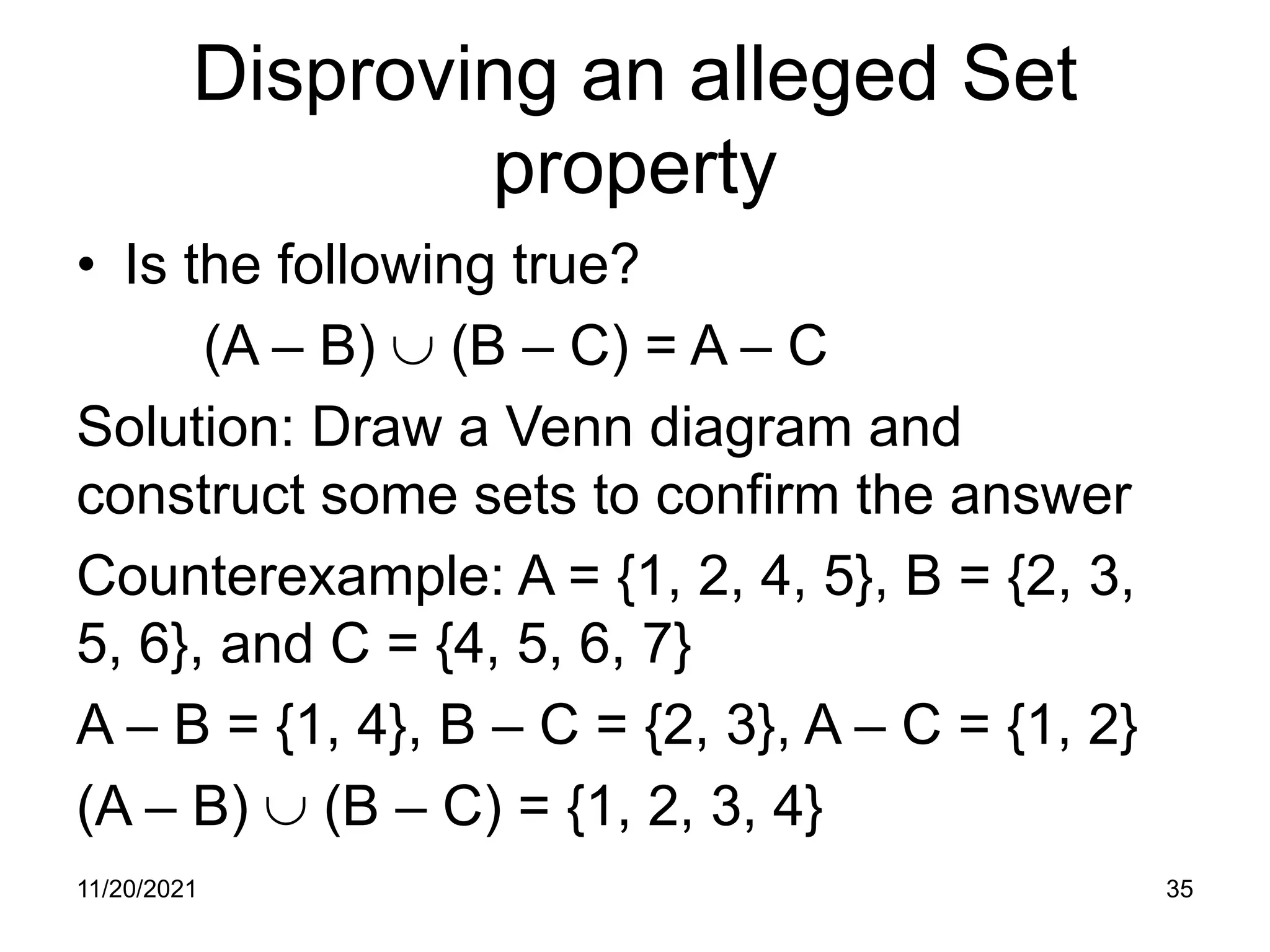
• Is the following true?
(A – B) ∪ (B – C) = A – C
Solution: Draw a Venn diagram and
construct some sets to confirm the answer
Counterexample: A = {1, 2, 4, 5}, B = {2, 3,
5, 6}, and C = {4, 5, 6, 7}
A – B = {1, 4}, B – C = {2, 3}, A – C = {1, 2}
(A – B) ∪ (B – C) = {1, 2, 3, 4}
11/20/2021 35
11/20/2021 36
Pigeonhole principle
• If more than k pigeons fly into k
pigeonholes, then at least one hole will
have more than one pigeon.
• Pigeonhole principle: if more than k
items are placed into k bins, then at least
one bin contains more than one item.
• Simple, and obvious!!
• To apply it, may not be easy sometimes.
Need to be clever in identifying pigeons
and pigeonholes.
11/20/2021 37
Example
• How many people must be in a room to
guarantee that two people have last
names that begin with the same initial?
27 since we have 26 letters
• How many times must a single die be
rolled in order to guarantee getting the
same value twice?
7
11/20/2021 38
Another example
• Prove that if four numbers are chosen from the
set {1, 2, 3, 4, 5, 6}, at least one pair must add
up to 7.
Proof: There are 3 pairs of numbers from the set
that add up to 7, i.e.,
(1, 6), (2, 5), (3, 4)
Apply pigeonhole principle: bins are the pairs,
and the numbers are the items.
11/20/2021 39
Infinite sets
• In a finite set, we can always designate one element as
the first member, s1, another element as the second
member, s2 and so on. If there are k elements in the set
we can list them as
– s1, s2, …, sk
• A set that is not finite is called a infinite set.
• If a set is infinite, we may still be able to select a first
element s1, a second element s2 and so on:
– s1, s2, …
– Such an infinite set is said to be denumerable.
• Both finite and denumerable sets are countable.
• Countable does not mean we can give a total number, but
means that we can say, “here is the first one” and “here is
the second one” and so on.
11/20/2021 40
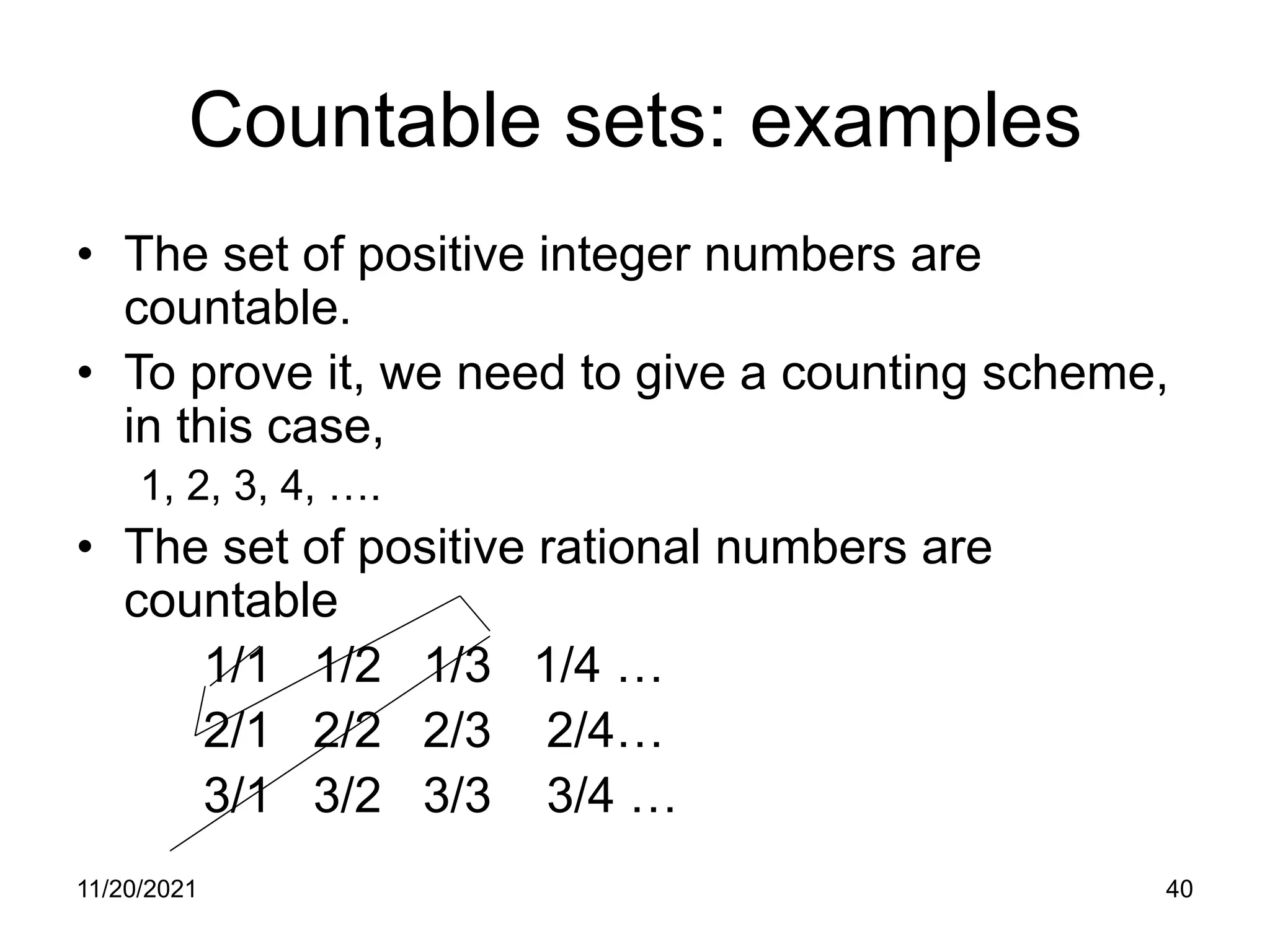
Countable sets: examples
• The set of positive integer numbers are
countable.
• To prove it, we need to give a counting scheme,
in this case,
1, 2, 3, 4, ….
• The set of positive rational numbers are
countable
1/1 1/2 1/3 1/4 …
2/1 2/2 2/3 2/4…
3/1 3/2 3/3 3/4 …
11/20/2021 41
Uncountable sets
• There are also some sets that are
uncountable.
– The set is so large, and there is no way to
count out the elements.
• One example: The set of real numbers
between 0 and 1 is uncountable.
• A computer can only manage finite sets.
11/20/2021 42
Summary
• Sets are extremely important for Computer
Science.
• A set is simply an unordered list of objects.
• Set operations: union, intersection,
difference.
• To prove set equalities
– Applying existing identities
– Using mutual inclusion
• Pigeonhole principle

Discrete Structure Lecture #7 & 8.pdf

  • 1.
    Sindh Madressatul Islam University,Karachi Department of Computer Science Discrete Structure 3rd Semester Section E 11/20/2021 1
  • 2.
    11/20/2021 2 Discrete Mathematics/ Discrete Structure Basic Set Theory
  • 3.
    11/20/2021 3 Sets • Aset is a collection of distinct objects. • For example (let A denote a set): A = {apple, pear, grape} A = {1, 2, 3, 4, 5} A = {1, b, c, d, e, f} A = {(1, 2), (3, 4), (9, 10)} A = {<1, 2, 3>, <3, 4, 5>, <6, 7, 8>} A = a collection of anything that is meaningful.
  • 4.
    11/20/2021 4 Members andEquality of Sets • The objects that make up a set are called members or elements of the set. • Two sets are equal iff they have the same members. – That is, a set is completely determined by its members. – Order and repetition do not matter in a set.
  • 5.
    11/20/2021 5 Set notations •The notation of {...} describes a set. Each member or element is separated by a comma. – E.g., S = {apple, pear, grape} – S is a set – The members of S are: apple, pear, grape • Order and repetition do not matter in a set. • The following expressions are equivalent: – {1, 3, 9} – {9, 1, 3} – {1, 1, 3, 3, 9}
  • 6.
    Sindh Madressatul Islam University,Karachi Department of Computer Science Discrete Structure 3rd Semester Section E 11/20/2021 6
  • 7.
    11/20/2021 7 Discrete Mathematics/ Discrete Structure Basic Set Theory
  • 8.
    11/20/2021 8 The membershipsymbol ∈ and the empty set ∅ • The fact that x is a member of a set S can be expressed as – x ∈ S – Reads: • x is in S, or • x is a member of S, or • X belongs to S • An example, S = {1, 2, 3}, 1 ∈ S, 2 ∈ S, 3 ∈ S • The negation of ∈ is written as ∉ (is not in). • The empty set is a set without any element – Denoted by {} or ∅ – For any object x, x ∉ ∅
  • 9.
    11/20/2021 9 Defining aSet by membership properties • Notation – S = {x ∈ T | P(x)} (or S = {x | x ∈ T and P(x)}) – The members of S are members of an already known set T that satisfy property P. • An example: – Let Z be the set of integers – Let Z+ be the set of positive integers. – Z+ = {x ∈ Z | x > 0}
  • 10.
    11/20/2021 10 Sets ofnumbers • Z = The set of all integers Z = {…, -2, -1, 0, 1, 2, …} • Z+ = The set of positive integers Z+ = {1, 2, 3…} = {x | x ∈ Z and x > 0} = {x ∈ Z | x > 0} • Z- = The set of negative integers Z- = {…, -3, -2, -1} = {-1, -2, -3…} = {x ∈ Z | x < 0} • R = The set of all real numbers • Q = the set of all rational numbers Q = {x ∈ R | x = p/q and p, q ∈ Z and q ≠ 0} • We can use “;” to replace “and”
  • 11.
    11/20/2021 11 Subsets • Ais a subset (⊆) of B, or B is a superset of A iff every member of A is a member of B. – A ⊆ B iff forall x if x ∈ A, then x ∈ B • An example: – {-2, 0, 6} ⊆ {-3, -2, -1, 0, 1, 3, 6} • Negation: A is not a subset of B or B is not a superset of A iff there is a member of A that is not a member of B – A ⊆ B iff there exist x, x ∈ A, x ∉ B
  • 12.
    11/20/2021 12 Obvious subsets –S ⊆ S – ∅ ⊆ S • By contradiction: • if ∅ ⊆ S then there exist x, x ∈ ∅ and x ∉ S.
  • 13.
    11/20/2021 13 Proper subsets •A is a proper subset (⊂) of B, or B is a proper superset of A iff A is a subset of B and A is not equal to B. – A ⊂ B iff A ⊆ B and A ≠ B • Examples: – {1, 2, 3} ⊂ {1, 2, 3, 4, 5} – Z+ ⊂ Z ⊂ Q ⊂ R – If S ≠ ∅ then ∅ ⊂ S
  • 14.
    11/20/2021 14 Power sets •The set of all subsets of a set is called the power set of the set • The power set of S is denoted by P(S). • Example: – P(∅) ={∅} – P({1, 2}) = {∅, {1}, {2}, {1, 2}} – P(S) = {∅, …, S} – What is P({1, 2, 3})? • How many elements does the power set of S have? Assume S has n elements.
  • 15.
    11/20/2021 15 ∈ and⊆ are different • Examples: 1 ∈ {1} is true 1 ⊆ {1} is false {1} ⊆ {1} is true • Which of the following statement is true? S ⊆ P(S) S ∈ P(S)
  • 16.
    11/20/2021 16 Mutual inclusionand set equality • Sets A and B have the same members iff they mutually include – A ⊆ B and B ⊆ A • That is, A = B iff A ⊆ B and B ⊆ A • Mutual inclusion is very useful for proving the equality of sets • To prove an equality, we prove two subset relationships.
  • 17.
    11/20/2021 17 An example:equality of sets • Recall that Z = the set of (all) integers • Let A = {x ∈ Z | x = 2m for m ∈ Z } • Let B = {x ∈ Z | x = 2n-2 for n ∈ Z } • To show A ⊆ B, note that 2m = 2(m+1) – 2 = 2n-2 • To show that B ⊆ A, note that 2n-2=2(n-1) = 2m • That is, A = B. (A, B both denote the set of all even integers.
  • 18.
    11/20/2021 18 Universal sets •Depending on the context of discussion – Define a set of U such that all sets of interest are subsets of U. – The set U is known as a universal set • Examples: – When dealing with integers, U may be Z. – When dealing with plane geometry, U may be the set of points in the plane
  • 19.
    11/20/2021 19 Venn diagram •Venn diagram is used to visualize relationships of some sets. • Each subset (of U, the rectangle) is represented by a circle inside the rectangle.
  • 20.
    11/20/2021 20 Set operations •Let A, B be subsets of some universal set U. • The following set operations create new sets from A and B. • Union: A ∪ B = {x ∈ U | x ∈ A or x ∈ B} • Intersection: A ∩ B = {x ∈ U | x ∈ A and x ∈ B} • Difference: A − B = A B= {x ∈ U | x ∈ A and x ∉ B} • Complement A′ = U − A = {x ∈ U | x ∉ A}
  • 21.
    11/20/2021 21 Set union •An example {1, 2, 3} ∪ {1, 2, 4, 5} = {1, 2, 3, 4, 5} The venn diagram 1 2 3 4 5
  • 22.
    11/20/2021 22 Set intersection •An example {1, 2, 3} ∩ {1, 2, 4, 5} = {1, 2} The venn diagram 1 2 3 4 5
  • 23.
    11/20/2021 23 Set difference •An example {1, 2, 3} - {1, 2, 4, 5} = {3} The venn diagram 1 2 3 4 5
  • 24.
  • 25.
    11/20/2021 25 Some questions •Let A ⊆ B. – What is A – B? – What is B – A? – If A, B ⊆ C, what can you say about A ∪ B and C? – If C ⊆ A, B, what can you say about C and A ∩ B?
  • 26.
    11/20/2021 26 Basic setidentities (equalities) • Commutative laws A ∪ B = B ∪ A A ∩ B = B ∩ A • Associative laws (A ∪ B) ∪ C = A ∪ (B ∪ C) (A ∩ B) ∩ C = A ∩ (B ∩ C) • Distributive laws A ∪ (B ∩ C) = (A ∪ B) ∩ (A ∪ C) A ∩ (B ∪ C) = (A ∩ B) ∪ (A ∩ C)
  • 27.
    11/20/2021 27 Basic setidentities (cont …) • Identity laws ∅ ∪ A = A ∪ ∅ = A A ∩ U = U ∩ A = A • Double complement law (A’)’ = A • Idempotent laws A ∪ A = A A ∩ A = A • De Morgan’s laws (A ∪ B)’ = A’ ∩ B’ (A ∩ B)’ = A’ ∪ B’
  • 28.
    Basic set identities(cont …) • Absorption laws A ∪ (A ∩ B) = A A ∩ (A ∪ B) = A • Complement law (U)’ = ∅ ∅’ = U • Set difference law A – B = A ∩ B’ • Universal bound law A ∪ U = U A ∩ ∅ = ∅ 11/20/2021 28
  • 29.
    Quiz #1 • 1.Write the basic concept of Boolean logics • 2. Using AND, OR, and NOT gates of Boolean logics in any equation which we discussed in the class • 3. Differentiate Logics, proofs, statement, and propositions • 4. Elaborate briefly about the predicates and quantifiers with example 11/20/2021 29
  • 30.
    11/20/2021 30 Proof methods •There are many ways to prove set identities • The methods include – Applying existing identities – Using mutual inclusion • Prove (A ∩ B) ∩ C = A ∩ (B ∩ C) using mutual inclusion – First show: (A ∩ B) ∩ C ⊆ A ∩ (B ∩ C) – Let x ∈ (A ∩ B) and x ∈ C • (x ∈ A and x ∈ B) and x ∈ C • x ∈ A and x ∈ (B ∩ C) • x ∈ A ∩ (B ∩ C) – Then show that A ∩ (B ∩ C) ⊆ (A ∩ B) ∩ C
  • 31.
    11/20/2021 31 More proofexamples • Let B = {x | x is a multiple of 4} A = {x | x is a multiple of 8} Then we have A ⊆ B • Proof: let x ∈ A. We must show that x is a multiple of 4. We can write x = 8m for some integer m. We have – x = 8m = 2*4m = 4 k, where k = 2m, – so k is a integer. – Thus, x is a multiple of 4, and • therefore x ∈ B
  • 32.
    11/20/2021 32 More proofexamples • Prove {x | x ∈ Z and x ≥ 0 and x2 < 15} = {x | x ∈ Z and x ≥ 0 and 2x < 7} Proof: Let A = {x | x ∈ Z and x ≥ 0 and x2 < 15} B = {x | x ∈ Z and x ≥ 0 and 2x < 7} Let x ∈ A. x can only be 0, 1, 2, 3 2x for 0, 1, 2, 3 are all less then 7. Thus, A ⊆ B. Likewise, we can also show that B ⊆ A
  • 33.
    11/20/2021 33 Algebraic proofexamples • Prove: [A ∪ (B ∩ C)] ∩ ([A’ ∪ (B ∩ C)] ∩ (B ∩ C)’) = ∅ Proof: [A ∪ (B ∩ C)] ∩ ([A’ ∪ (B ∩ C)] ∩ (B ∩ C)’) = ([A ∪ (B ∩ C)] ∩ [A’ ∪ (B ∩ C)]) ∩ (B∩C)’ (associative) = ([(B ∩ C)∪ A] ∩ [(B ∩ C) ∪ A’]) ∩ (B∩C)’ (commutative) = [(B ∩ C)∪ (A ∩ A’)] ∩ (B ∩ C)’ (distributive) = [(B ∩ C)∪ ∅] ∩ (B ∩ C)’ (complement) = (B ∩ C) ∩ (B ∩ C)’ (Identity) = ∅ (identity)
  • 34.
    Algebraic proof examples •Prove: (A ∪ B) – C = (A – C) ∪ (B – C) • Proof: (A ∪ B) – C = (A ∪ B) ∩ C’ (difference) = C’ ∩ (A ∪ B) (commutative) = (C’ ∩ A) ∪ (C’ ∩ B) (distributive) = (A ∩ C’) ∪ (B ∩ C’) (commutative) = (A – C) ∪ (B – C) (difference) 11/20/2021 34
  • 35.
    Disproving an allegedSet property • Is the following true? (A – B) ∪ (B – C) = A – C Solution: Draw a Venn diagram and construct some sets to confirm the answer Counterexample: A = {1, 2, 4, 5}, B = {2, 3, 5, 6}, and C = {4, 5, 6, 7} A – B = {1, 4}, B – C = {2, 3}, A – C = {1, 2} (A – B) ∪ (B – C) = {1, 2, 3, 4} 11/20/2021 35
  • 36.
    11/20/2021 36 Pigeonhole principle •If more than k pigeons fly into k pigeonholes, then at least one hole will have more than one pigeon. • Pigeonhole principle: if more than k items are placed into k bins, then at least one bin contains more than one item. • Simple, and obvious!! • To apply it, may not be easy sometimes. Need to be clever in identifying pigeons and pigeonholes.
  • 37.
    11/20/2021 37 Example • Howmany people must be in a room to guarantee that two people have last names that begin with the same initial? 27 since we have 26 letters • How many times must a single die be rolled in order to guarantee getting the same value twice? 7
  • 38.
    11/20/2021 38 Another example •Prove that if four numbers are chosen from the set {1, 2, 3, 4, 5, 6}, at least one pair must add up to 7. Proof: There are 3 pairs of numbers from the set that add up to 7, i.e., (1, 6), (2, 5), (3, 4) Apply pigeonhole principle: bins are the pairs, and the numbers are the items.
  • 39.
    11/20/2021 39 Infinite sets •In a finite set, we can always designate one element as the first member, s1, another element as the second member, s2 and so on. If there are k elements in the set we can list them as – s1, s2, …, sk • A set that is not finite is called a infinite set. • If a set is infinite, we may still be able to select a first element s1, a second element s2 and so on: – s1, s2, … – Such an infinite set is said to be denumerable. • Both finite and denumerable sets are countable. • Countable does not mean we can give a total number, but means that we can say, “here is the first one” and “here is the second one” and so on.
  • 40.
    11/20/2021 40 Countable sets:examples • The set of positive integer numbers are countable. • To prove it, we need to give a counting scheme, in this case, 1, 2, 3, 4, …. • The set of positive rational numbers are countable 1/1 1/2 1/3 1/4 … 2/1 2/2 2/3 2/4… 3/1 3/2 3/3 3/4 …
  • 41.
    11/20/2021 41 Uncountable sets •There are also some sets that are uncountable. – The set is so large, and there is no way to count out the elements. • One example: The set of real numbers between 0 and 1 is uncountable. • A computer can only manage finite sets.
  • 42.
    11/20/2021 42 Summary • Setsare extremely important for Computer Science. • A set is simply an unordered list of objects. • Set operations: union, intersection, difference. • To prove set equalities – Applying existing identities – Using mutual inclusion • Pigeonhole principle