Week 1 –
Introductory Lecture & Course Introduction
Methods of Assessment
RaymondChew/UiTM/Jasin/Melaka 2
Assessment
• 4 Quizzes
• 1 Programming
Assignment
• 2 Tests
• Final Examination
100%
12%
8%
30%
50%
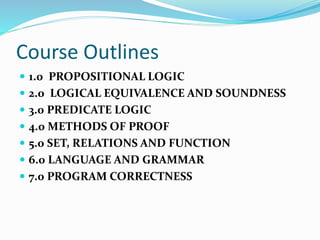
Course Outlines
 1.0 PROPOSITIONAL LOGIC
 2.0 LOGICAL EQUIVALENCE AND SOUNDNESS
 3.0 PREDICATE LOGIC
 4.0 METHODS OF PROOF
 5.0 SET, RELATIONS AND FUNCTION
 6.0 LANGUAGE AND GRAMMAR
 7.0 PROGRAM CORRECTNESS
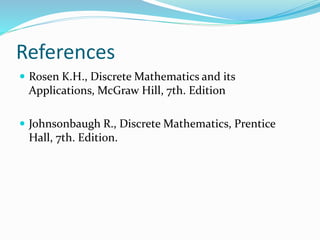
References
 Rosen K.H., Discrete Mathematics and its
Applications, McGraw Hill, 7th. Edition
 Johnsonbaugh R., Discrete Mathematics, Prentice
Hall, 7th. Edition.
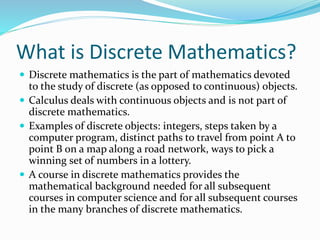
What is Discrete Mathematics?
 Discrete mathematics is the part of mathematics devoted
to the study of discrete (as opposed to continuous) objects.
 Calculus deals with continuous objects and is not part of
discrete mathematics.
 Examples of discrete objects: integers, steps taken by a
computer program, distinct paths to travel from point A to
point B on a map along a road network, ways to pick a
winning set of numbers in a lottery.
 A course in discrete mathematics provides the
mathematical background needed for all subsequent
courses in computer science and for all subsequent courses
in the many branches of discrete mathematics.
Kinds of Problems Solved Using
Discrete Mathematics
 How many ways can a password be chosen following
specific rules?
 How many valid Internet addresses are there?
 What is the probability of winning a particular lottery?
 Is there a link between two computers in a network?
 How can I identify spam email messages?
 How can I encrypt a message so that no unintended
recipient can read it?
 How can we build a circuit that adds two integers?
Kinds of Problems Solved Using
Discrete Mathematics
 What is the shortest path between two cities using a
transportation system?
 Find the shortest tour that visits each of a group of cities
only once and then ends in the starting city.
 How can we represent English sentences so that a computer
can reason with them?
 How can we prove that there are infinitely many prime
numbers?
 How can a list of integers be sorted so that the integers are
in increasing order?
 How many steps are required to do such a sorting?
 How can it be proved that a sorting algorithm always
correctly sorts a list?
Goals of a Course in Discrete
Mathematics
 Mathematical Reasoning: Ability to read,
understand, and construct mathematical arguments
and proofs.
 Combinatorial Analysis: Techniques for counting
objects of different kinds.
 Discrete Structures: Abstract mathematical
structures that represent objects and the relationships
between them. Examples are sets, permutations,
relations, graphs, trees, and finite state machines.
Goals of a Course in Discrete
Mathematics
 Algorithmic Thinking: One way to solve many problems is to
specify an algorithm. An algorithm is a sequence of steps that
can be followed to solve any instance of a particular problem.
Algorithmic thinking involves specifying algorithms, analyzing
the memory and time required by an execution of the algorithm,
and verifying that the algorithm will produce the correct answer.
 Applications and Modeling: It is important to appreciate and
understand the wide range of applications of the topics in
discrete mathematics and develop the ability to develop new
models in various domains. Concepts from discrete mathematics
have not only been used to address problems in computing, but
have been applied to solve problems in many areas such as
chemistry, biology, linguistics, geography, business, etc.
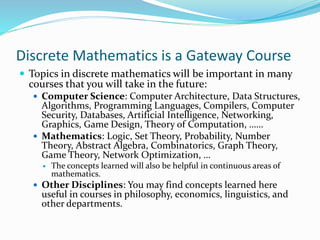
Discrete Mathematics is a Gateway Course
 Topics in discrete mathematics will be important in many
courses that you will take in the future:
 Computer Science: Computer Architecture, Data Structures,
Algorithms, Programming Languages, Compilers, Computer
Security, Databases, Artificial Intelligence, Networking,
Graphics, Game Design, Theory of Computation, ……
 Mathematics: Logic, Set Theory, Probability, Number
Theory, Abstract Algebra, Combinatorics, Graph Theory,
Game Theory, Network Optimization, …
 The concepts learned will also be helpful in continuous areas of
mathematics.
 Other Disciplines: You may find concepts learned here
useful in courses in philosophy, economics, linguistics, and
other departments.

Lesson 1 - Chapter0_Introductory Lecture.pptx

  • 1.
    Week 1 – IntroductoryLecture & Course Introduction
  • 2.
    Methods of Assessment RaymondChew/UiTM/Jasin/Melaka2 Assessment • 4 Quizzes • 1 Programming Assignment • 2 Tests • Final Examination 100% 12% 8% 30% 50%
  • 3.
    Course Outlines  1.0PROPOSITIONAL LOGIC  2.0 LOGICAL EQUIVALENCE AND SOUNDNESS  3.0 PREDICATE LOGIC  4.0 METHODS OF PROOF  5.0 SET, RELATIONS AND FUNCTION  6.0 LANGUAGE AND GRAMMAR  7.0 PROGRAM CORRECTNESS
  • 4.
    References  Rosen K.H.,Discrete Mathematics and its Applications, McGraw Hill, 7th. Edition  Johnsonbaugh R., Discrete Mathematics, Prentice Hall, 7th. Edition.
  • 5.
    What is DiscreteMathematics?  Discrete mathematics is the part of mathematics devoted to the study of discrete (as opposed to continuous) objects.  Calculus deals with continuous objects and is not part of discrete mathematics.  Examples of discrete objects: integers, steps taken by a computer program, distinct paths to travel from point A to point B on a map along a road network, ways to pick a winning set of numbers in a lottery.  A course in discrete mathematics provides the mathematical background needed for all subsequent courses in computer science and for all subsequent courses in the many branches of discrete mathematics.
  • 6.
    Kinds of ProblemsSolved Using Discrete Mathematics  How many ways can a password be chosen following specific rules?  How many valid Internet addresses are there?  What is the probability of winning a particular lottery?  Is there a link between two computers in a network?  How can I identify spam email messages?  How can I encrypt a message so that no unintended recipient can read it?  How can we build a circuit that adds two integers?
  • 7.
    Kinds of ProblemsSolved Using Discrete Mathematics  What is the shortest path between two cities using a transportation system?  Find the shortest tour that visits each of a group of cities only once and then ends in the starting city.  How can we represent English sentences so that a computer can reason with them?  How can we prove that there are infinitely many prime numbers?  How can a list of integers be sorted so that the integers are in increasing order?  How many steps are required to do such a sorting?  How can it be proved that a sorting algorithm always correctly sorts a list?
  • 8.
    Goals of aCourse in Discrete Mathematics  Mathematical Reasoning: Ability to read, understand, and construct mathematical arguments and proofs.  Combinatorial Analysis: Techniques for counting objects of different kinds.  Discrete Structures: Abstract mathematical structures that represent objects and the relationships between them. Examples are sets, permutations, relations, graphs, trees, and finite state machines.
  • 9.
    Goals of aCourse in Discrete Mathematics  Algorithmic Thinking: One way to solve many problems is to specify an algorithm. An algorithm is a sequence of steps that can be followed to solve any instance of a particular problem. Algorithmic thinking involves specifying algorithms, analyzing the memory and time required by an execution of the algorithm, and verifying that the algorithm will produce the correct answer.  Applications and Modeling: It is important to appreciate and understand the wide range of applications of the topics in discrete mathematics and develop the ability to develop new models in various domains. Concepts from discrete mathematics have not only been used to address problems in computing, but have been applied to solve problems in many areas such as chemistry, biology, linguistics, geography, business, etc.
  • 10.
    Discrete Mathematics isa Gateway Course  Topics in discrete mathematics will be important in many courses that you will take in the future:  Computer Science: Computer Architecture, Data Structures, Algorithms, Programming Languages, Compilers, Computer Security, Databases, Artificial Intelligence, Networking, Graphics, Game Design, Theory of Computation, ……  Mathematics: Logic, Set Theory, Probability, Number Theory, Abstract Algebra, Combinatorics, Graph Theory, Game Theory, Network Optimization, …  The concepts learned will also be helpful in continuous areas of mathematics.  Other Disciplines: You may find concepts learned here useful in courses in philosophy, economics, linguistics, and other departments.