This document provides an overview of smart grid technology. It begins by describing the conventional power grid and its drawbacks, such as aging equipment, obsolete systems, and lack of storage. It then introduces the smart grid as an infrastructure that supports advanced electricity generation, delivery, consumption, metering, monitoring, management, and communication technologies. Key differences between the conventional and smart grids are discussed. The document outlines various components that can be made smart, such as generation, transmission, distribution, and consumption. It proposes using optimization techniques and algorithms like genetic algorithms and particle swarm optimization to design an energy efficient and cost effective smart grid model.
Overview of Smart Grid, its evolution, and comparison with traditional grids highlighting inefficiencies.
Comparison highlighting the adaptability, reliability, and efficiency of smart grids over conventional systems.
Advantages including improved management, sustainability, and support for renewable energy sources.
Explains the role of energy storage solutions in the smart grid, emphasizing effectiveness under varying energy production.
System model design for smart grids detailing load classifications and consumer patterns to optimize energy use.
Various optimization methods, algorithms like GA and PSO for smart grid efficiency and reliability enhancement.Introduction to billing mechanisms and concluding remarks on the advancements and future of Smart Grid technologies.
Final content slide, serving as a placeholder or for acknowledgments.
Contents
Introduction
Conventionalpower grid
Smart grid
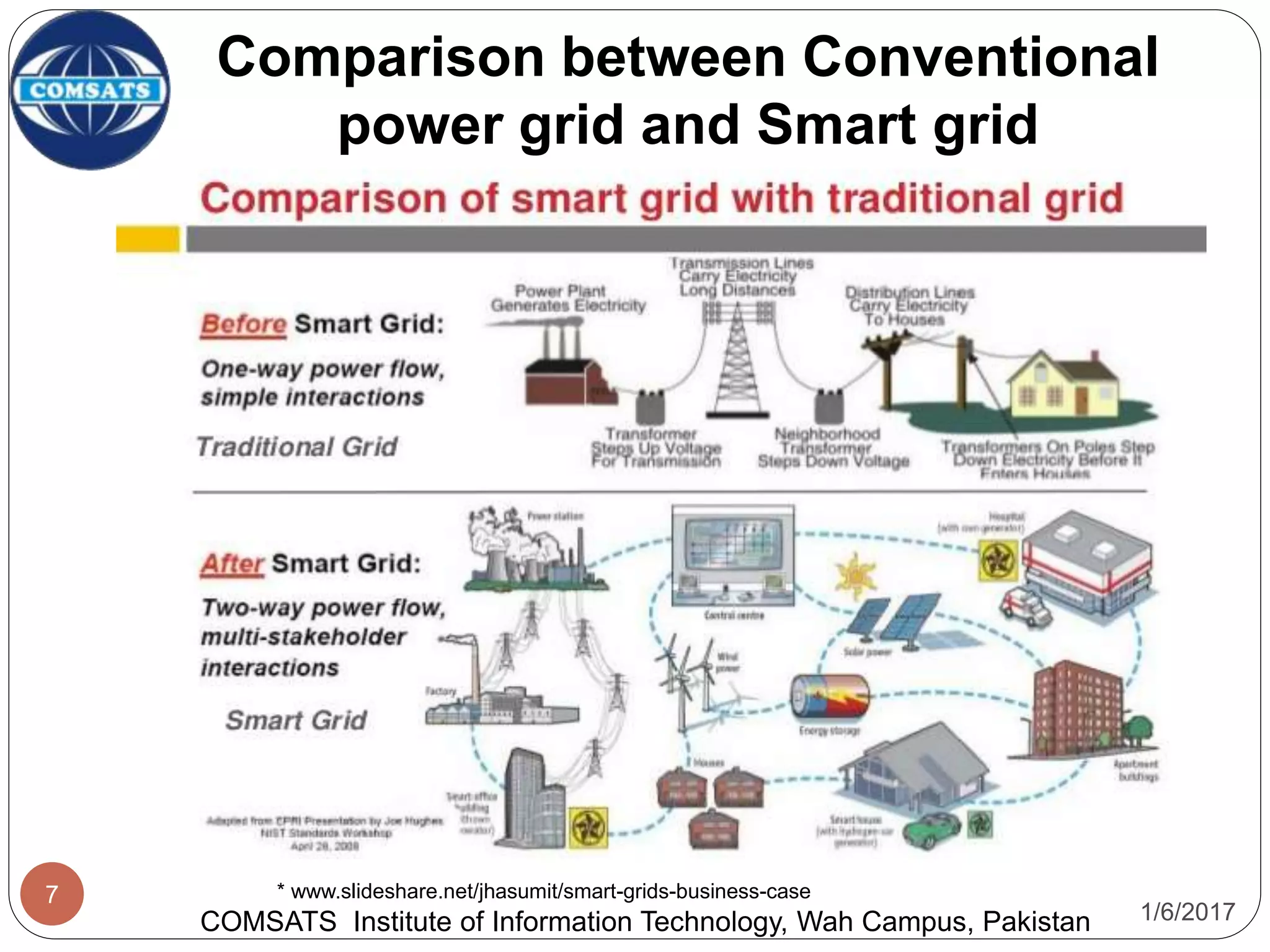
Comparison between Conventional and Smart grid
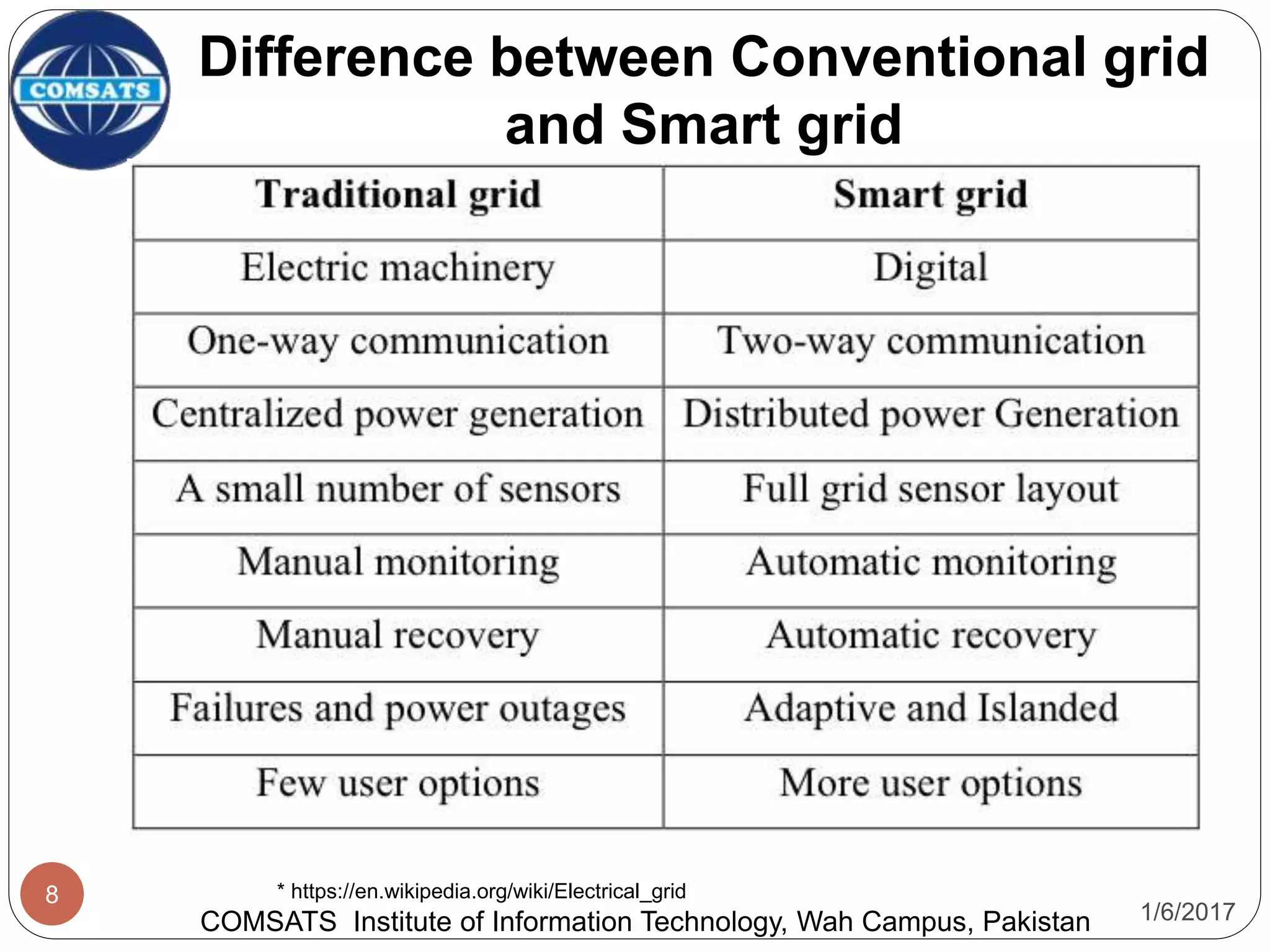
Difference between Conventional and Smart grid
Benefits of Smart grid
Distribution generation
Energy Storage banks
System Model
Proposed Solution
Billing Mechanism
Conclusion
1/6/20172
COMSATS Institute of Information Technology, Wah Campus, Pakistan
3.
1/6/2017
3
Traditional power grid
Interconnected and complex network
Deliver electricity from utility companies to consumers.
Comprises of following four major parts as in Fig. 1*
Generation
Produce electrical power
Non-renewable resources (fossil fuel, coal, gases, e.t.c.)
Renewable resources (wind, solar, water, e.t.c )
Transmission
Bulk of high-voltage transmission line.
Transformers (Step-up, step-down)
Towers.
Distribution
To distribute electrical power.
Relays
Interrupters
Consumption
Residential load.
Commercial load.
Industrial load.
Introduction (1/4)
COMSATS Institute of Information Technology, Wah Campus, Pakistan
Fig. 1: Conventional power grid
* https://cleantechnica.com/2015/12/16/how-the-grid-works-why-renewables-can-dominate/
4.
1/6/2017
4
Introduction (2/4)
COMSATS Instituteof Information Technology, Wah Campus, Pakistan
* https://en.wikipedia.org/wiki/Electrical_grid
Drawbacks
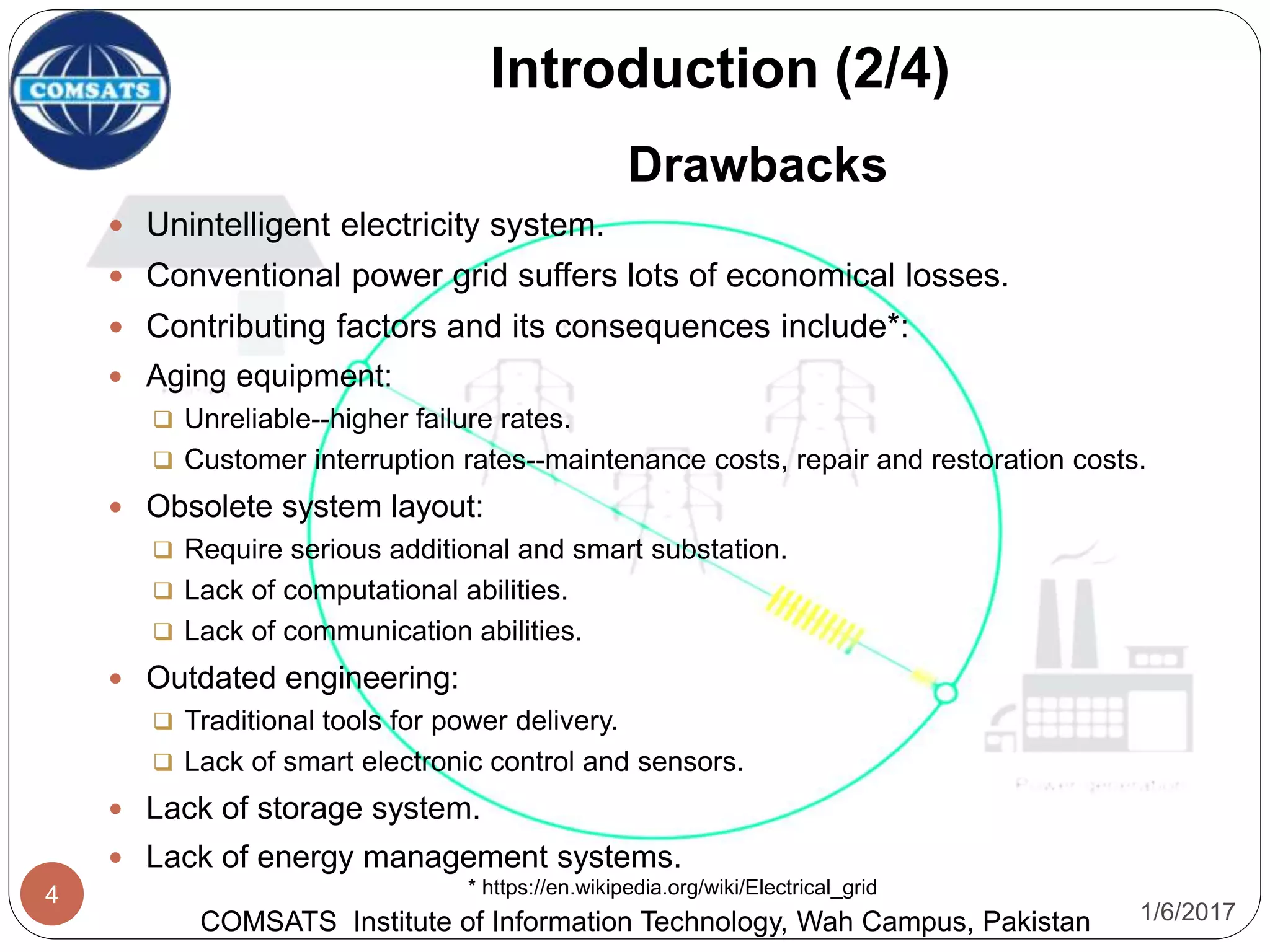
Unintelligent electricity system.
Conventional power grid suffers lots of economical losses.
Contributing factors and its consequences include*:
Aging equipment:
Unreliable--higher failure rates.
Customer interruption rates--maintenance costs, repair and restoration costs.
Obsolete system layout:
Require serious additional and smart substation.
Lack of computational abilities.
Lack of communication abilities.
Outdated engineering:
Traditional tools for power delivery.
Lack of smart electronic control and sensors.
Lack of storage system.
Lack of energy management systems.
5.
1/6/2017
5
Parts that canbe made smart
To increase efficiency, reliability
and robustness of the entire electrical
power system.
In this regard, there is a need to modify
all sections of electrical power grid.
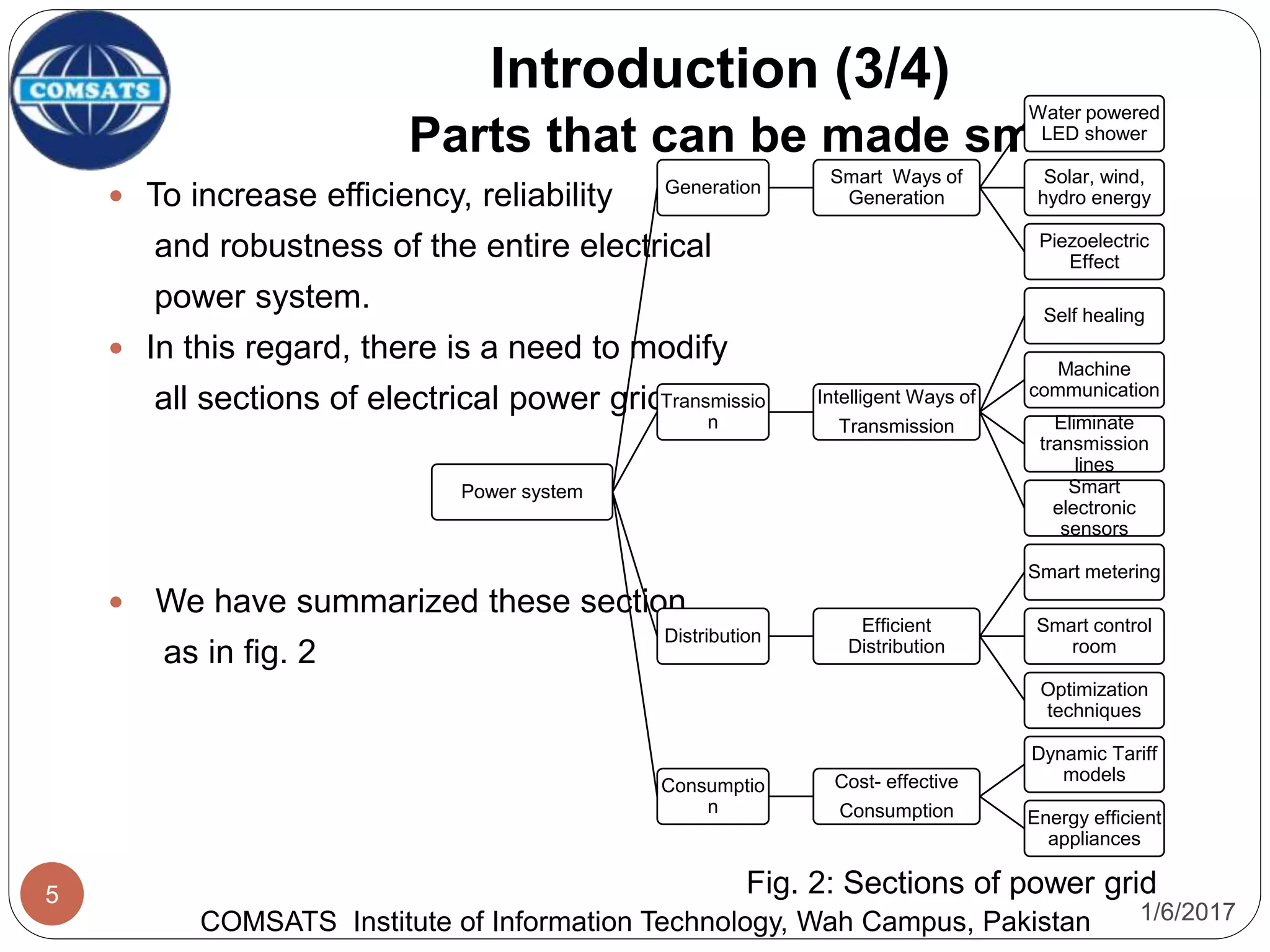
We have summarized these section
as in fig. 2
Introduction (3/4)
COMSATS Institute of Information Technology, Wah Campus, Pakistan
Power system
Generation
Smart Ways of
Generation
Water powered
LED shower
Solar, wind,
hydro energy
Piezoelectric
Effect
Transmissio
n
Intelligent Ways of
Transmission
Self healing
Machine
communication
Eliminate
transmission
lines
Smart
electronic
sensors
Distribution
Efficient
Distribution
Smart metering
Smart control
room
Optimization
techniques
Consumptio
n
Cost- effective
Consumption
Dynamic Tariff
models
Energy efficient
appliances
Fig. 2: Sections of power grid
6.
1/6/2017
6
Smart grid(Evolutionary powergrid)
Infrastructure that supports*
Advanced electricity generation, delivery, and consumption;
Advanced information metering, monitoring, and management; and
Advanced communication technologies.
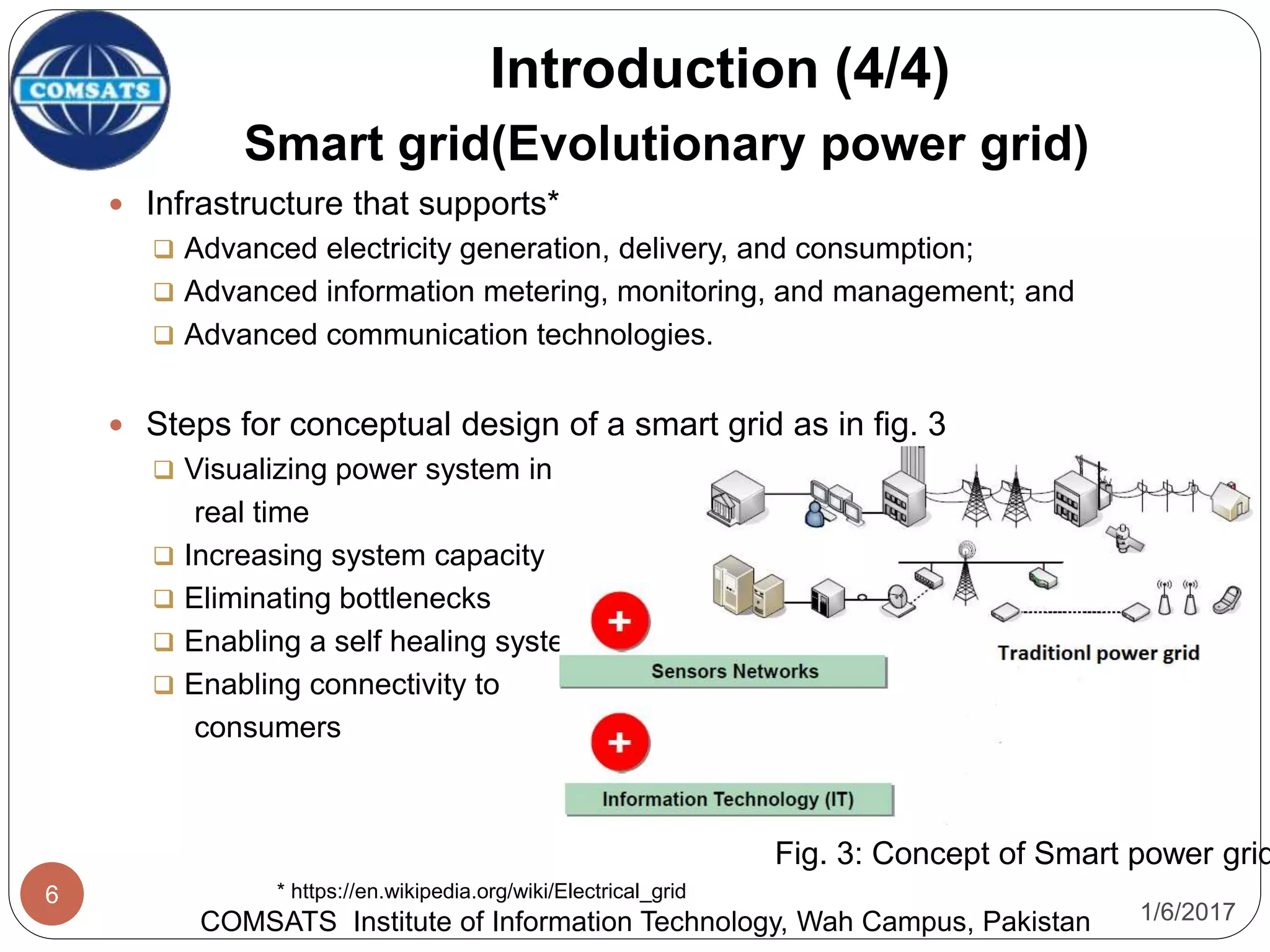
Steps for conceptual design of a smart grid as in fig. 3
Visualizing power system in
real time
Increasing system capacity
Eliminating bottlenecks
Enabling a self healing system
Enabling connectivity to
consumers
Introduction (4/4)
COMSATS Institute of Information Technology, Wah Campus, Pakistan
Fig. 3: Concept of Smart power grid
* https://en.wikipedia.org/wiki/Electrical_grid
1/6/2017
8
Difference between Conventionalgrid
and Smart grid
COMSATS Institute of Information Technology, Wah Campus, Pakistan
* https://en.wikipedia.org/wiki/Electrical_grid
9.
1/6/2017
9
Benefits of Smartgrid
COMSATS Institute of Information Technology, Wah Campus, Pakistan
* https://en.wikipedia.org/wiki/Electrical_grid
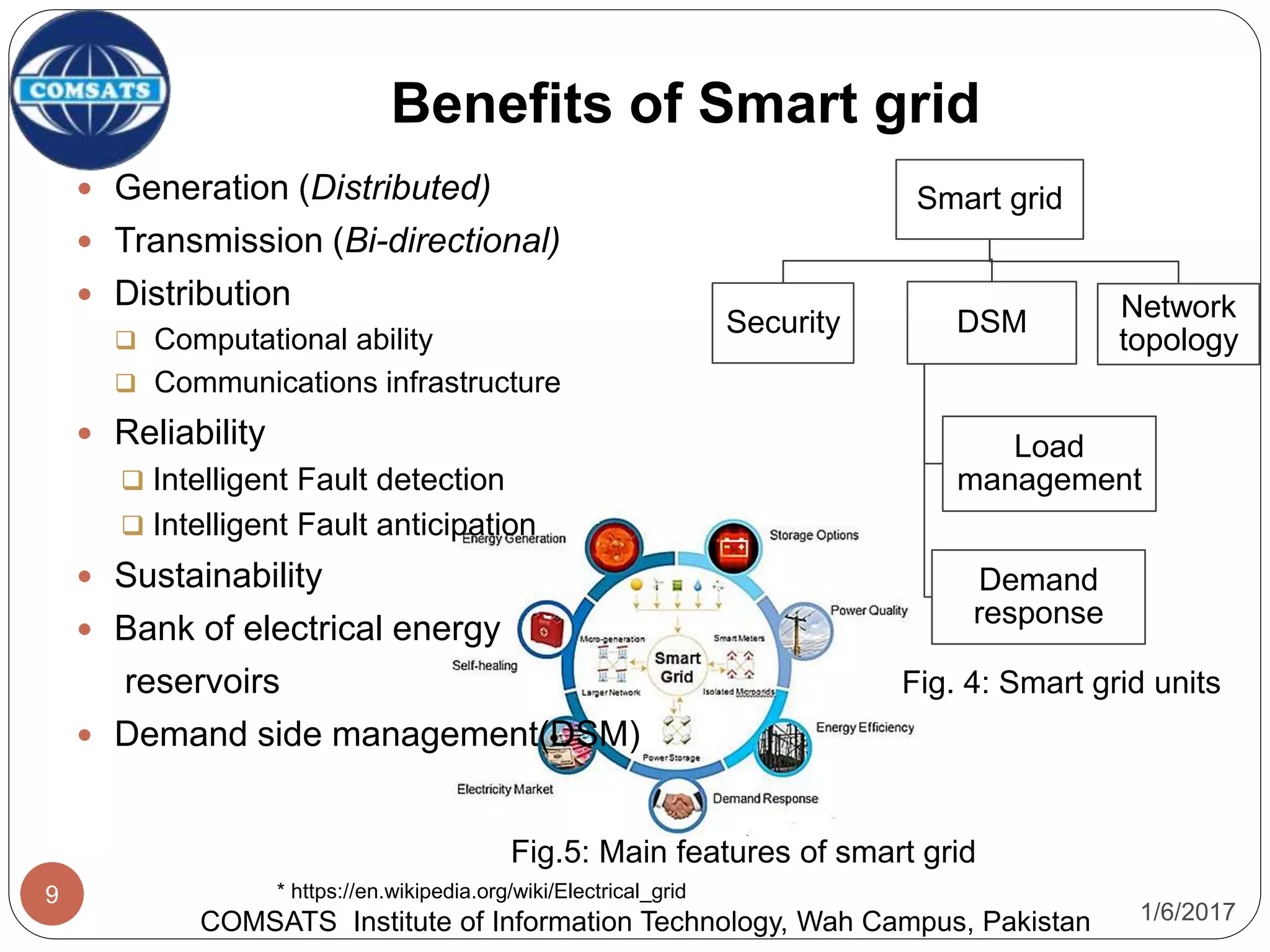
Generation (Distributed)
Transmission (Bi-directional)
Distribution
Computational ability
Communications infrastructure
Reliability
Intelligent Fault detection
Intelligent Fault anticipation
Sustainability
Bank of electrical energy
reservoirs
Demand side management(DSM)
Smart grid
Security DSM
Load
management
Demand
response
Network
topology
Fig. 4: Smart grid units
Fig.5: Main features of smart grid
10.
1/6/2017
10
Distribution generation
COMSATS Instituteof Information Technology, Wah Campus, Pakistan
* http://carbon.coop/blog/zapaman/community-smart-grid-prosumer-perspective.
Smart grid will enable renewable resources i.e.
Solar energy
Wind energy
Hydro energy plants
Bio-gas energy plants e.t.c.
Promotes consumers to
actively participate in
energy management system.
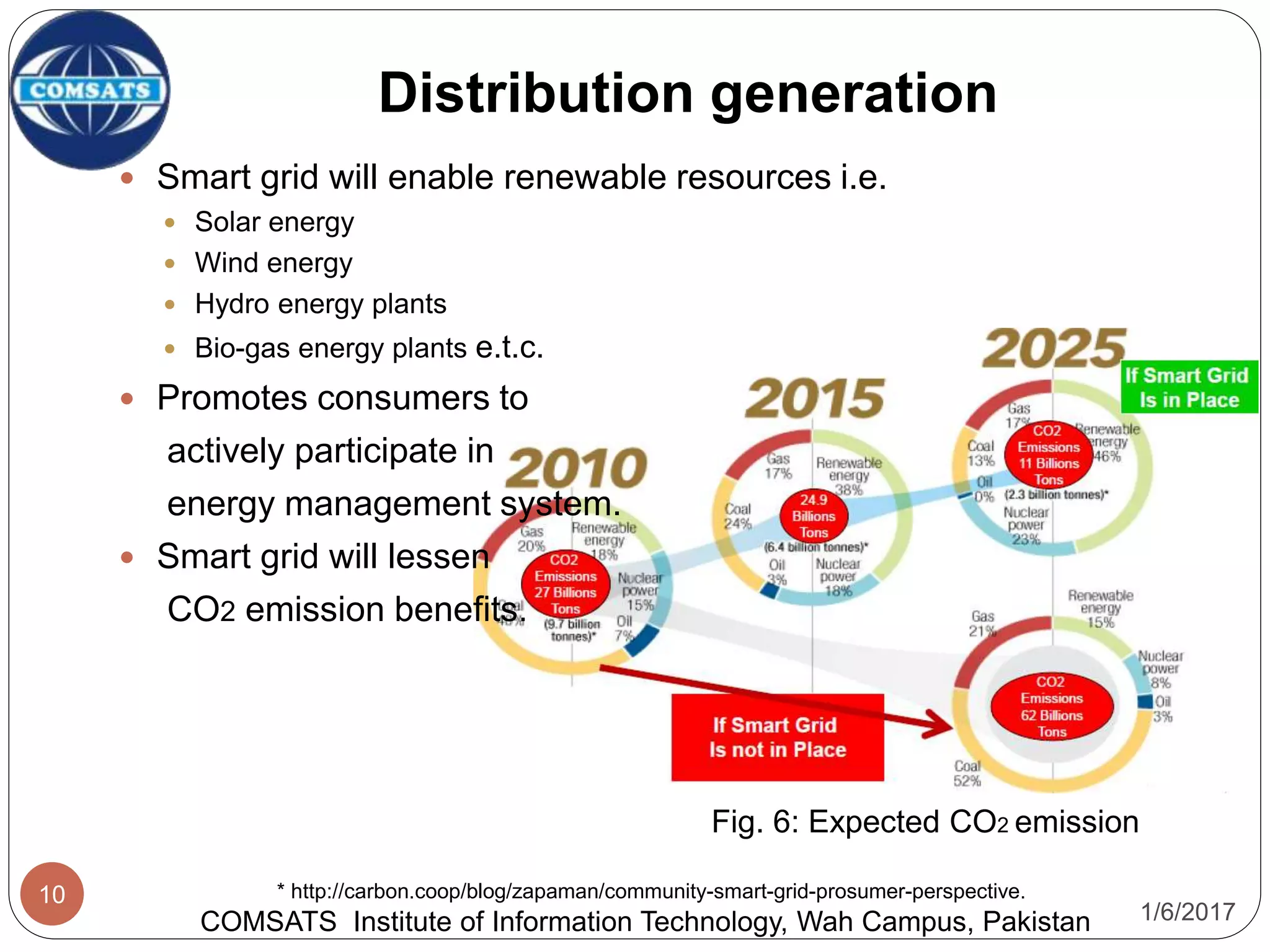
Smart grid will lessen
CO2 emission benefits.
Fig. 6: Expected CO2 emission
11.
1/6/2017
11
Distribution Energy storagebanks
COMSATS Institute of Information Technology, Wah Campus, Pakistan
* https://en.wikipedia.org/wiki/List_of_energy_storage_projects
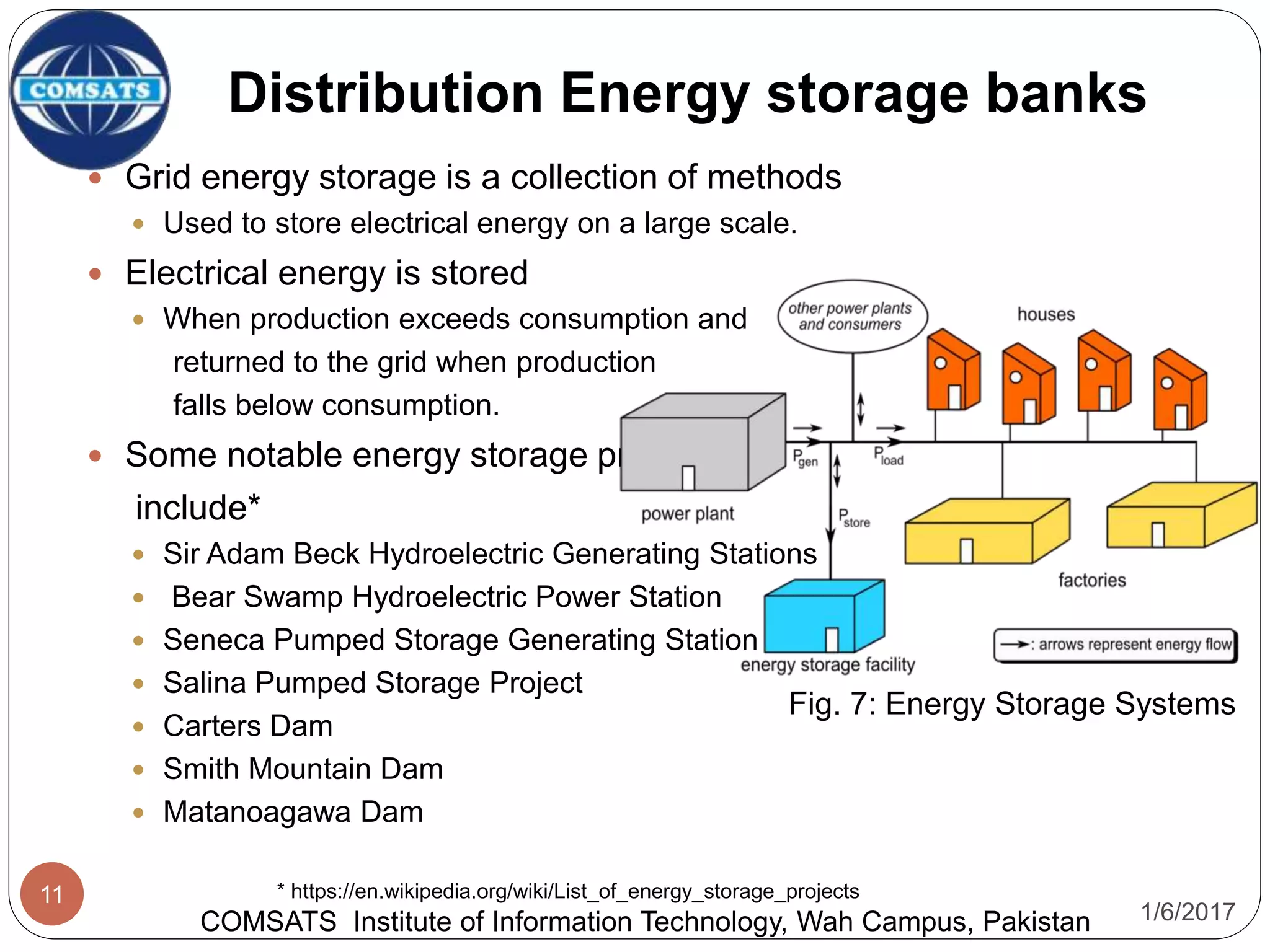
Grid energy storage is a collection of methods
Used to store electrical energy on a large scale.
Electrical energy is stored
When production exceeds consumption and
returned to the grid when production
falls below consumption.
Some notable energy storage projects
include*
Sir Adam Beck Hydroelectric Generating Stations
Bear Swamp Hydroelectric Power Station
Seneca Pumped Storage Generating Station
Salina Pumped Storage Project
Carters Dam
Smith Mountain Dam
Matanoagawa Dam
Fig. 7: Energy Storage Systems
12.
1/6/2017
12
System Model (1/2)
COMSATSInstitute of Information Technology, Wah Campus, Pakistan
* https://en.wikipedia.org/wiki/Appliance_classes.
One of the vital task while proposing smart grid infrastructure is
system model designing.
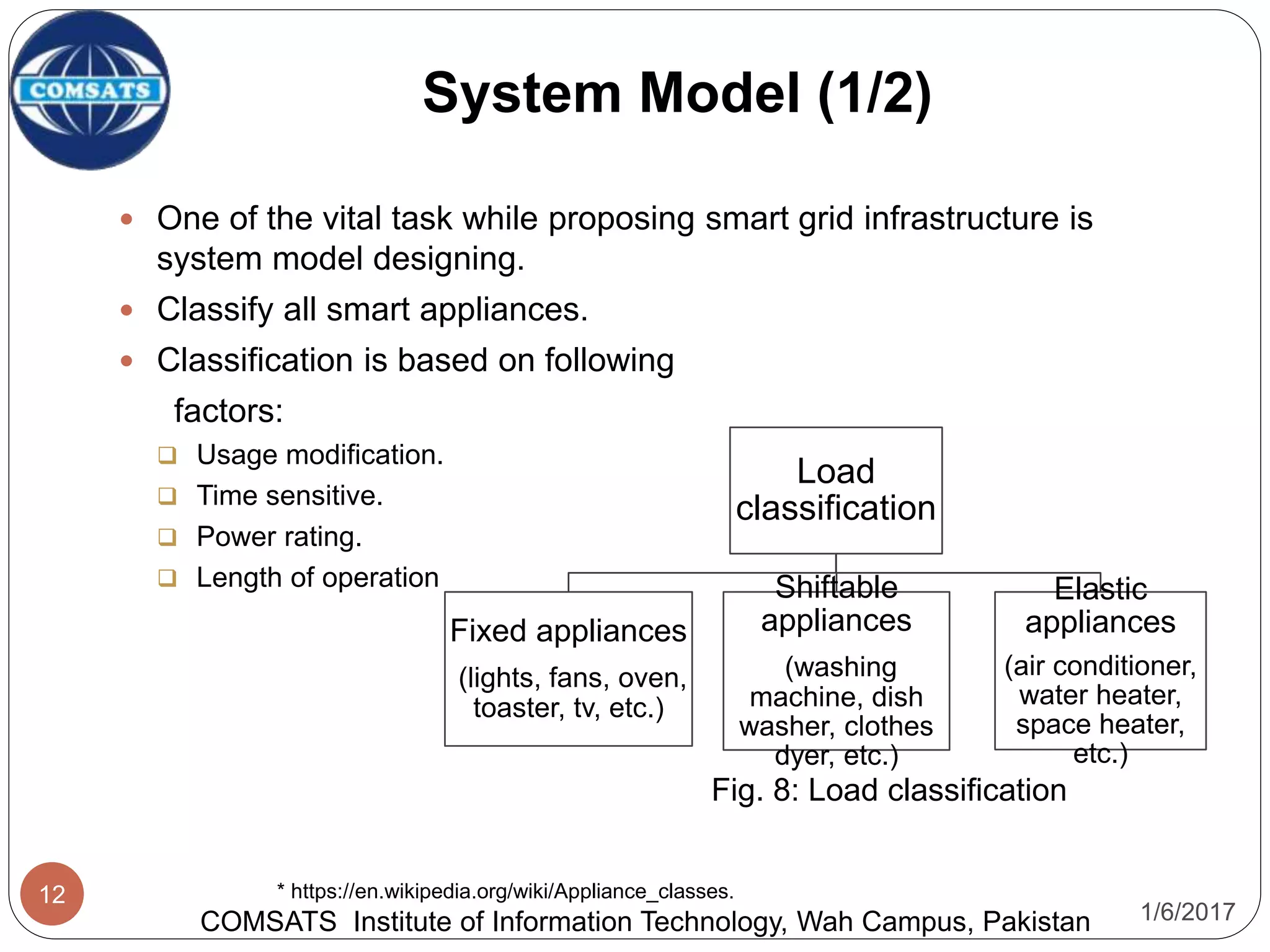
Classify all smart appliances.
Classification is based on following
factors:
Usage modification.
Time sensitive.
Power rating.
Length of operation
Fig. 8: Load classification
Load
classification
Fixed appliances
(lights, fans, oven,
toaster, tv, etc.)
Shiftable
appliances
(washing
machine, dish
washer, clothes
dyer, etc.)
Elastic
appliances
(air conditioner,
water heater,
space heater,
etc.)
13.
1/6/2017
13
System Model (2/2)
COMSATSInstitute of Information Technology, Wah Campus, Pakistan
* http://www.experian.com/small-business/consumer-classification-mailing-lists.jsp.
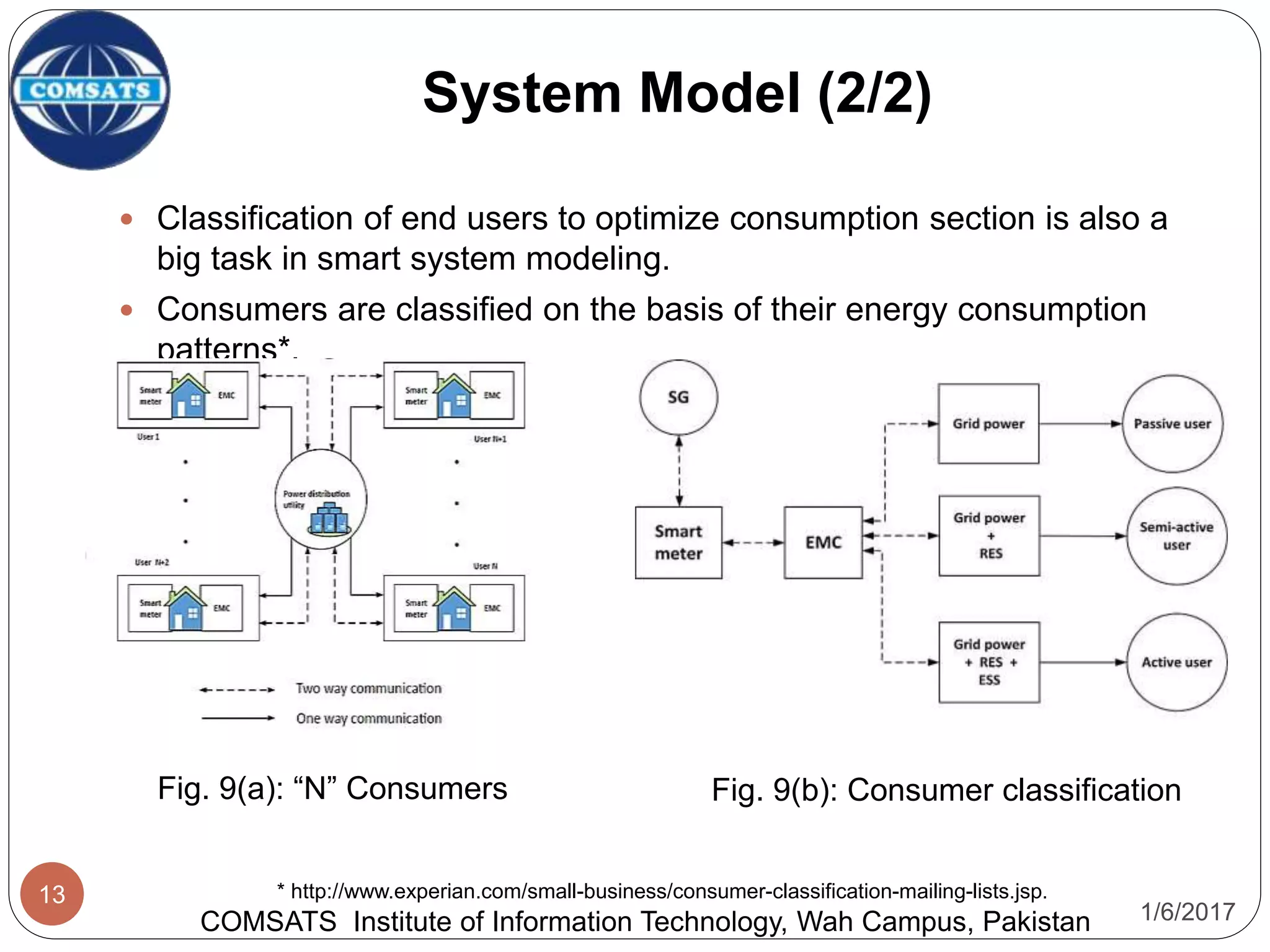
Classification of end users to optimize consumption section is also a
big task in smart system modeling.
Consumers are classified on the basis of their energy consumption
patterns*.
Fig. 9(b): Consumer classificationFig. 9(a): “N” Consumers
14.
1/6/2017
14
Proposed solution (1/5)
COMSATSInstitute of Information Technology, Wah Campus, Pakistan
* https://neos-guide.org/optimization-tree
Deficiencies in conventional power system
treated as mathematical problem.
To design energy efficient and cost
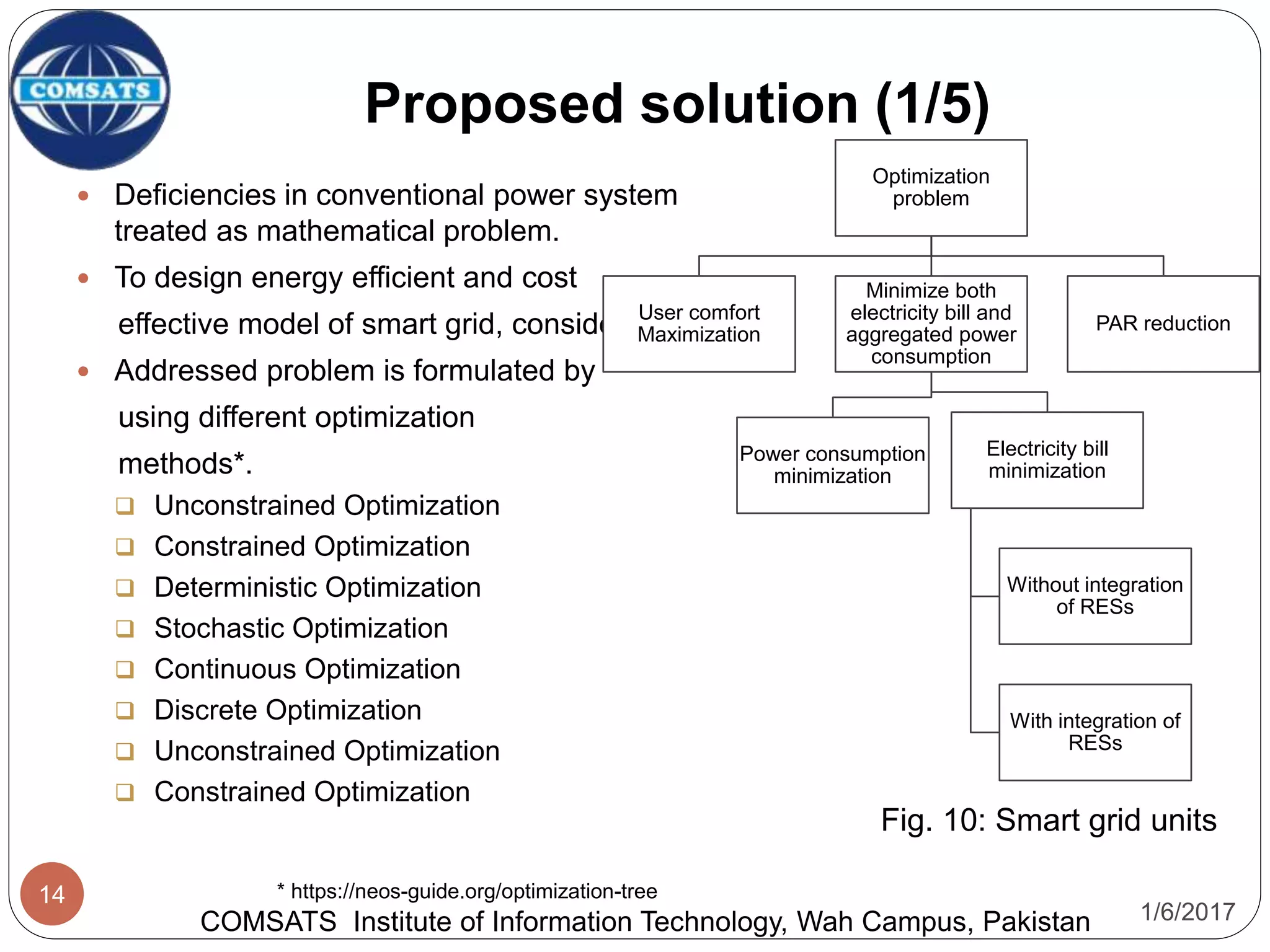
effective model of smart grid, consider fig. 6.
Addressed problem is formulated by
using different optimization
methods*.
Unconstrained Optimization
Constrained Optimization
Deterministic Optimization
Stochastic Optimization
Continuous Optimization
Discrete Optimization
Unconstrained Optimization
Constrained Optimization
Fig. 10: Smart grid units
Optimization
problem
User comfort
Maximization
Minimize both
electricity bill and
aggregated power
consumption
Power consumption
minimization
Electricity bill
minimization
Without integration
of RESs
With integration of
RESs
PAR reduction
15.
1/6/2017
15
Proposed solution (2/5)
COMSATSInstitute of Information Technology, Wah Campus, Pakistan
* https://neos-guide.org/optimization-tree. **http://students.ceid.upatras.gr/~papagel/project/kef5_5.htm.
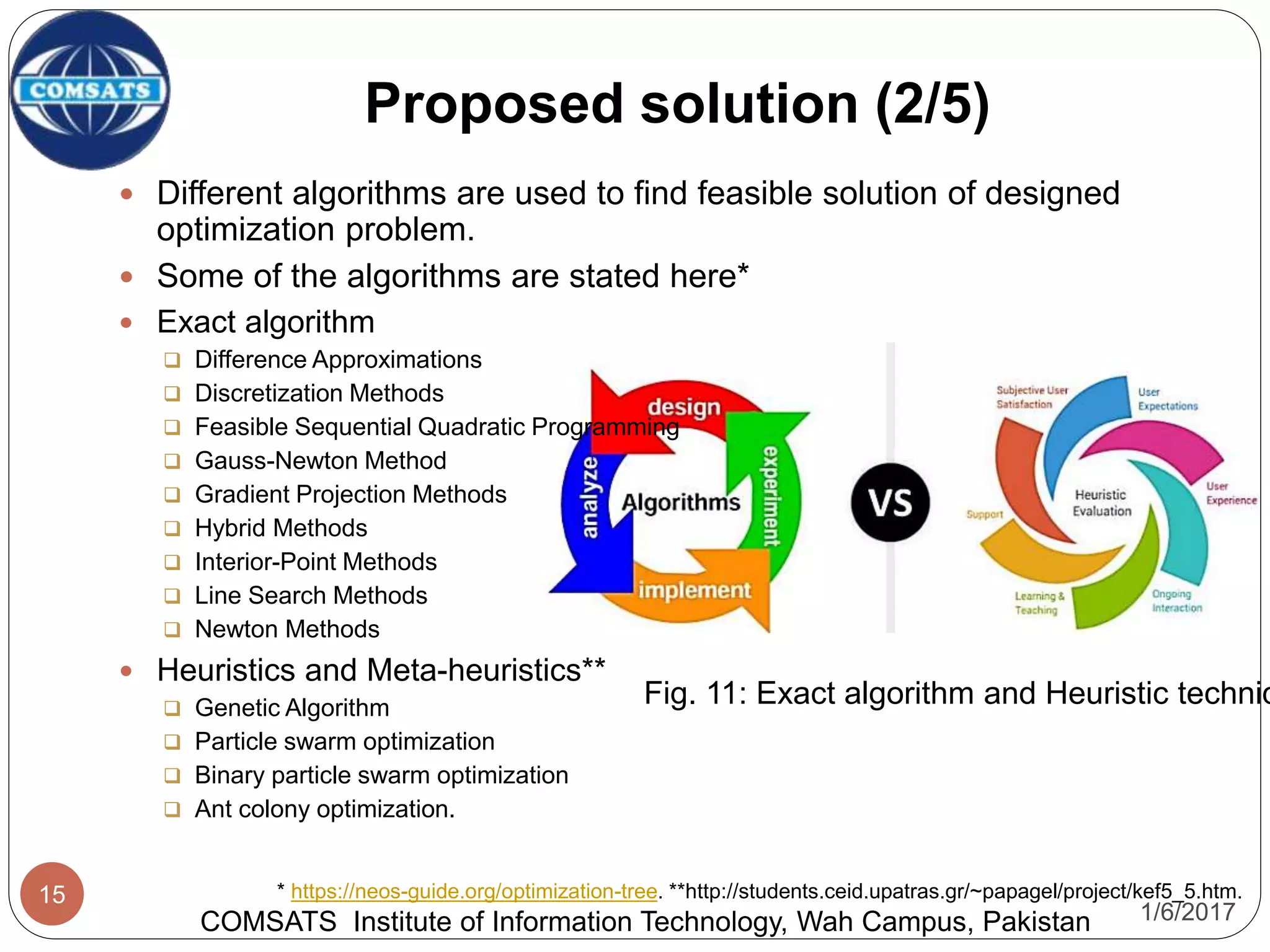
Different algorithms are used to find feasible solution of designed
optimization problem.
Some of the algorithms are stated here*
Exact algorithm
Difference Approximations
Discretization Methods
Feasible Sequential Quadratic Programming
Gauss-Newton Method
Gradient Projection Methods
Hybrid Methods
Interior-Point Methods
Line Search Methods
Newton Methods
Heuristics and Meta-heuristics**
Genetic Algorithm
Particle swarm optimization
Binary particle swarm optimization
Ant colony optimization.
Fig. 11: Exact algorithm and Heuristic techniq
16.
1/6/2017
16
Proposed solution (2/5)
COMSATSInstitute of Information Technology, Wah Campus, Pakistan
* https://www.cs.wmich.edu/~elise/courses/cs6800/Genetic-Algorithms.ppt.
Genetic algorithm (GA)
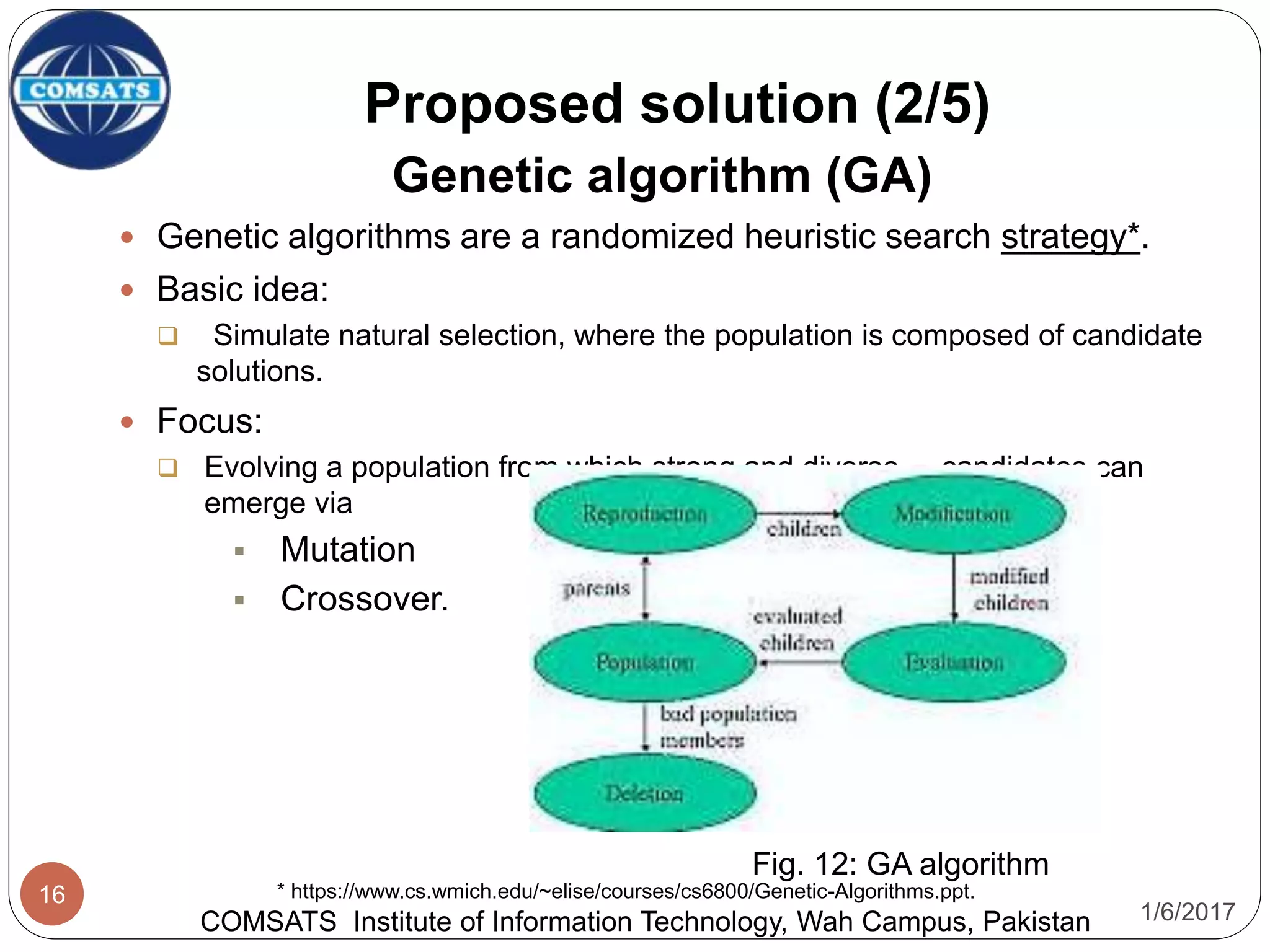
Genetic algorithms are a randomized heuristic search strategy*.
Basic idea:
Simulate natural selection, where the population is composed of candidate
solutions.
Focus:
Evolving a population from which strong and diverse candidates can
emerge via
Mutation
Crossover.
Fig. 12: GA algorithm
17.
1/6/2017
17
Proposed solution (2/5)
COMSATSInstitute of Information Technology, Wah Campus, Pakistan
* https://www.macs.hw.ac.uk/~dwcorne/Teaching/bic_pso.ppt
Particle Swarm Optimization (PSO)
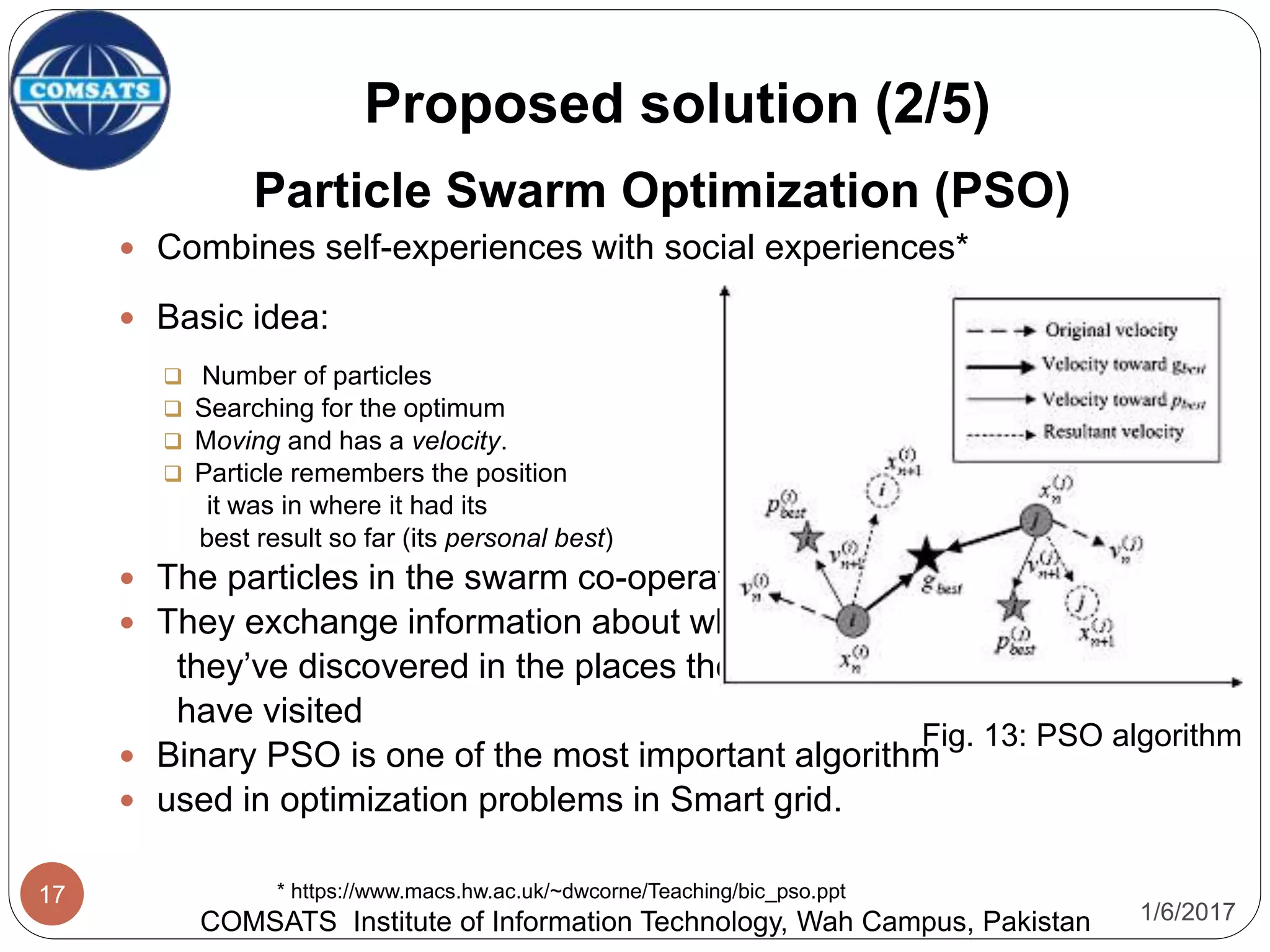
Combines self-experiences with social experiences*
Basic idea:
Number of particles
Searching for the optimum
Moving and has a velocity.
Particle remembers the position
it was in where it had its
best result so far (its personal best)
The particles in the swarm co-operate.
They exchange information about what
they’ve discovered in the places they
have visited
Binary PSO is one of the most important algorithm
used in optimization problems in Smart grid.
Fig. 13: PSO algorithm
18.
1/6/2017
18
Proposed solution (2/5)
COMSATSInstitute of Information Technology, Wah Campus, Pakistan
* https://en.wikipedia.org/wiki/Ant_colony_optimization_algorithms
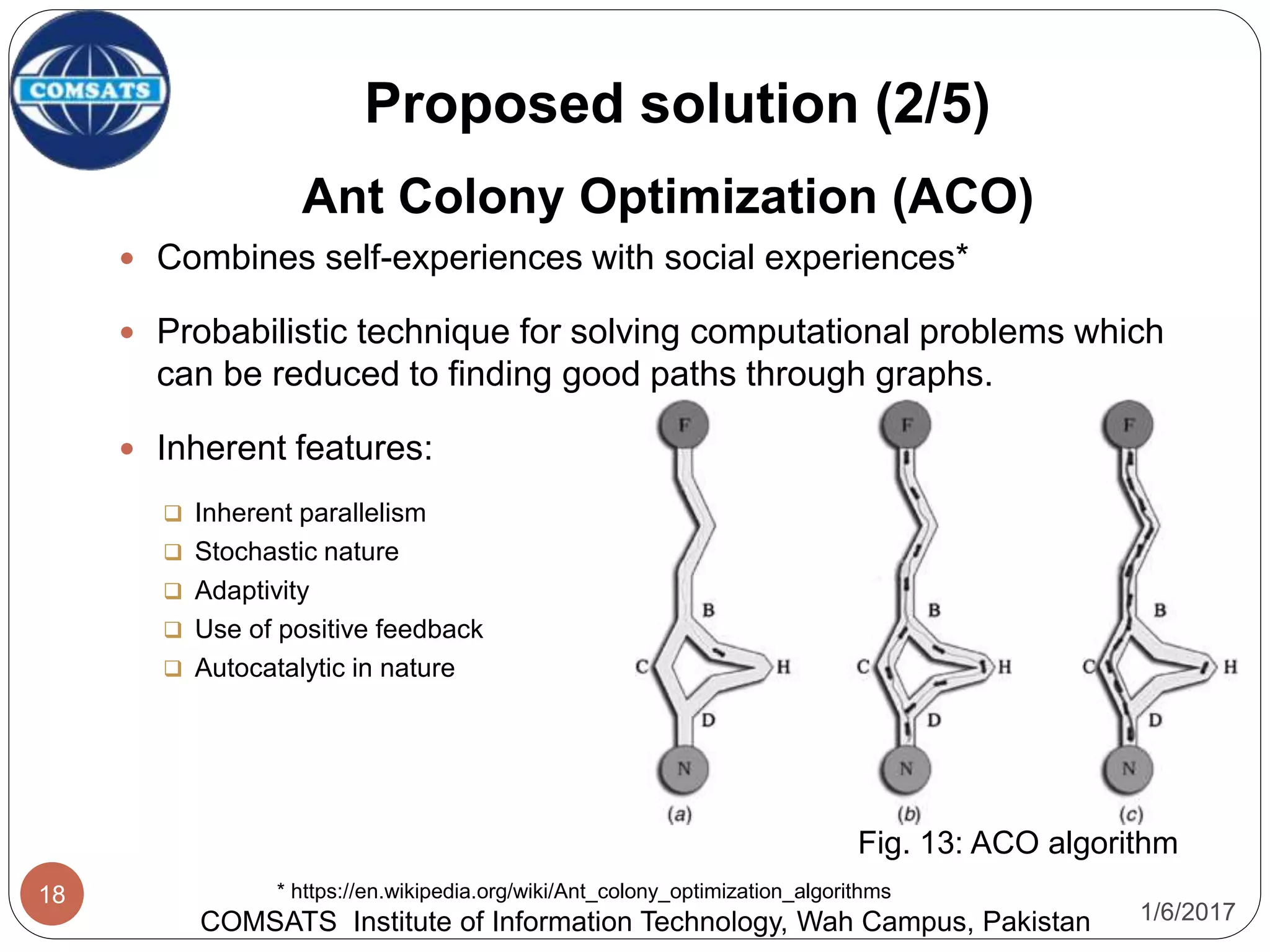
Ant Colony Optimization (ACO)
Combines self-experiences with social experiences*
Probabilistic technique for solving computational problems which
can be reduced to finding good paths through graphs.
Inherent features:
Inherent parallelism
Stochastic nature
Adaptivity
Use of positive feedback
Autocatalytic in nature
Fig. 13: ACO algorithm
19.
1/6/2017
19
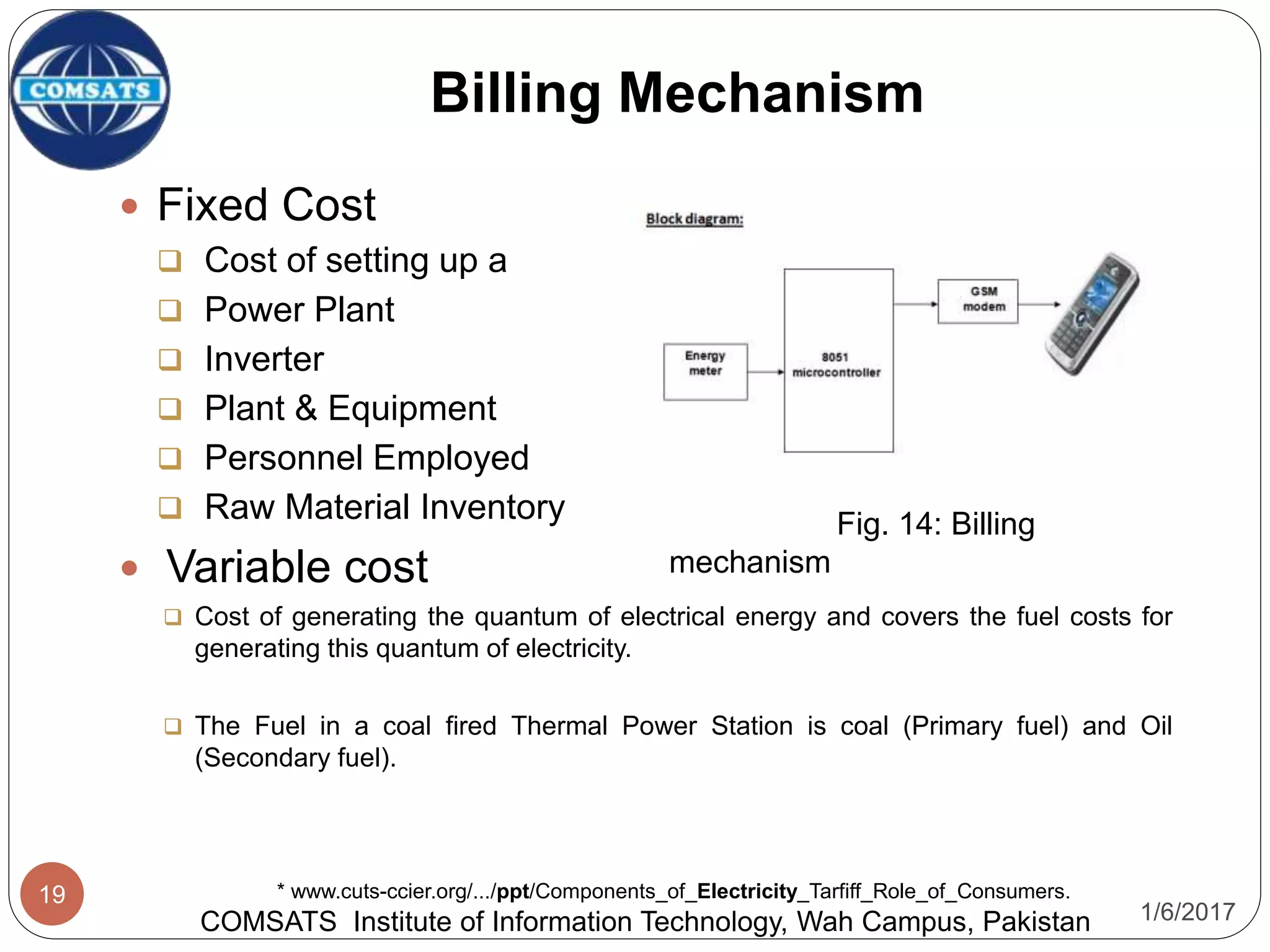
Billing Mechanism
COMSATS Instituteof Information Technology, Wah Campus, Pakistan
* www.cuts-ccier.org/.../ppt/Components_of_Electricity_Tarfiff_Role_of_Consumers.
Fixed Cost
Cost of setting up a
Power Plant
Inverter
Plant & Equipment
Personnel Employed
Raw Material Inventory
Variable cost
Cost of generating the quantum of electrical energy and covers the fuel costs for
generating this quantum of electricity.
The Fuel in a coal fired Thermal Power Station is coal (Primary fuel) and Oil
(Secondary fuel).
Fig. 14: Billing
mechanism
20.
Smart Gridprovides intelligent, advanced power
control for the next century
Many new technologies involve for supporting
sensing, controlling, human interfaces.
Charging electricity cost is fundamental
infrastructure can be implemented similar to stock
market in smart grid.
1/6/201720
Conclusion
COMSATS Institute of Information Technology, Wah Campus, Pakistan